Markets
News
Analysis
User
24/7
Economic Calendar
Education
Data
- Names
- Latest
- Prev


Signal Accounts for Members
All Signal Accounts
All Contests


China, Mainland M1 Money Supply YoY (Nov)--
F: --
P: --
China, Mainland M0 Money Supply YoY (Nov)--
F: --
P: --
China, Mainland M2 Money Supply YoY (Nov)--
F: --
P: --
U.S. 30-Year Bond Auction Avg. YieldA:--
F: --
P: --
Argentina CPI MoM (Nov)A:--
F: --
P: --
Argentina National CPI YoY (Nov)A:--
F: --
P: --
Argentina 12-Month CPI (Nov)A:--
F: --
P: --
U.S. Weekly Treasuries Held by Foreign Central BanksA:--
F: --
P: --
Japan Industrial Output Final MoM (Oct)A:--
F: --
P: --
Japan Industrial Output Final YoY (Oct)A:--
F: --
P: --
U.K. Services Index MoM (SA) (Oct)A:--
F: --
P: --
U.K. Services Index YoY (Oct)A:--
F: --
P: --
Germany HICP Final YoY (Nov)A:--
F: --
P: --
Germany HICP Final MoM (Nov)A:--
F: --
P: --
U.K. Trade Balance Non-EU (SA) (Oct)A:--
F: --
P: --
U.K. Trade Balance (Oct)A:--
F: --
P: --
U.K. Services Index MoMA:--
F: --
P: --
U.K. Construction Output MoM (SA) (Oct)A:--
F: --
P: --
U.K. Industrial Output YoY (Oct)A:--
F: --
P: --
U.K. Trade Balance (SA) (Oct)A:--
F: --
P: --
U.K. Trade Balance EU (SA) (Oct)A:--
F: --
P: --
U.K. Manufacturing Output YoY (Oct)A:--
F: --
P: --
U.K. GDP MoM (Oct)A:--
F: --
P: --
U.K. GDP YoY (SA) (Oct)A:--
F: --
P: --
U.K. Industrial Output MoM (Oct)A:--
F: --
P: --
U.K. Manufacturing Output MoM (Oct)A:--
F: --
P: --
U.K. Monthly GDP 3M/3M Change (Oct)A:--
F: --
P: --
Germany CPI Final MoM (Nov)A:--
F: --
P: --
Germany CPI Final YoY (Nov)A:--
F: --
P: --
U.K. Construction Output YoY (Oct)A:--
F: --
P: --
France HICP Final MoM (Nov)--
F: --
P: --
China, Mainland Outstanding Loans Growth YoY (Nov)--
F: --
P: --
U.K. Inflation Rate Expectations--
F: --
P: --
India CPI YoY (Nov)--
F: --
P: --
India Deposit Gowth YoY--
F: --
P: --
Brazil Services Growth YoY (Oct)--
F: --
P: --
Mexico Industrial Output YoY (Oct)--
F: --
P: --
Germany Current Account (Not SA) (Oct)--
F: --
P: --
Russia Trade Balance (Oct)--
F: --
P: --
Philadelphia Fed President Henry Paulson delivers a speech
Canada Building Permits MoM (SA) (Oct)--
F: --
P: --
Canada Wholesale Sales YoY (Oct)--
F: --
P: --
Canada Wholesale Inventory MoM (Oct)--
F: --
P: --
Canada Wholesale Inventory YoY (Oct)--
F: --
P: --
Canada Wholesale Sales MoM (SA) (Oct)--
F: --
P: --
U.S. Weekly Total Rig Count--
F: --
P: --
U.S. Weekly Total Oil Rig Count--
F: --
P: --
Japan Tankan Large Non-Manufacturing Diffusion Index (Q4)--
F: --
P: --
Japan Tankan Small Manufacturing Outlook Index (Q4)--
F: --
P: --
Japan Tankan Large Non-Manufacturing Outlook Index (Q4)--
F: --
P: --
Japan Tankan Large Manufacturing Outlook Index (Q4)--
F: --
P: --
Japan Tankan Small Manufacturing Diffusion Index (Q4)--
F: --
P: --
Japan Tankan Large Manufacturing Diffusion Index (Q4)--
F: --
P: --
Japan Tankan Large-Enterprise Capital Expenditure YoY (Q4)--
F: --
P: --
China, Mainland Industrial Output YoY (YTD) (Nov)--
F: --
P: --
China, Mainland Urban Area Unemployment Rate (Nov)--
F: --
P: --
Saudi Arabia CPI YoY (Nov)--
F: --
P: --
Euro Zone Industrial Output YoY (Oct)--
F: --
P: --
Euro Zone Industrial Output MoM (Oct)--
F: --
P: --
Canada Existing Home Sales MoM (Nov)--
F: --
P: --
Euro Zone Total Reserve Assets (Nov)--
F: --
P: --


No matching data
Latest Views
Latest Views
Trending Topics
Top Columnists
Latest Update
White Label
Data API
Web Plug-ins
Affiliate Program
View All

No data
Thailand's rice prices rose to their highest in more than six months on flood-driven supply worries and expectations of stronger demand after China pledged to buy rice, while rates in India and Vietnam remained unchanged.
Key points:
Thailand's rice prices rose to their highest in more than six months on flood-driven supply worries and expectations of stronger demand after China pledged to buy rice, while rates in India and Vietnam remained unchanged.
Thailand's 5% broken rice (RI-THBKN5-P1) was quoted at $400 per tonne, up from $375 last week. Prices were at their highest level since May 29.
Traders expect demand to rise as China moves to finalize a rice deal later this month, following its pledge to buy 500,000 tonnes of rice from Thailand.
"The deal with China and the prospect of more purchase from the Philippines makes the market livelier," a Bangkok-based rice trader said.
There has also been a decrease in supply because of recent flooding in many parts of the country, the trader added.
Indian rice export prices held steady this week, as the rupee's slide toward a record low helped traders offset rising paddy prices in the local market.
India's 5% broken parboiled variety was quoted this week at $347-$354 per metric ton, unchanged from last week. Indian 5% broken white rice was priced at $340 to $345 per metric ton this week.
Paddy prices are staying high because the government is buying at the increased minimum support price, which is also pushing traders to offer higher rates, said a Kolkata-based exporter.
The Indian rupee slid near a record low against the dollar on Thursday, lifting traders' rupee returns from overseas sales.
Vietnam's 5% broken rice (RI-VNBKN5-P1) was offered at $365-$370 per metric ton on Thursday, unchanged from a week ago, according to traders.
"Sales are slow amid weak demand," a trader based in Ho Chi Minh City said.
Vietnam's rice exports in November fell 49.1% from a year earlier to 358,000 tons, according to government data.
Meanwhile, Bangladesh approved the purchase of 50,000 tonnes of rice through an international open tender. The government continues to struggle to keep rice prices in check despite good stocks and yields.
As Chinese electric vehicle leader BYD's domestic sales suffer from competition in the low-priced cars that had driven its growth, the automaker is pinning its hopes of moving upmarket on other brands.
BYD's global new-vehicle sales slid 12% on the year in October to 441,706 units. This followed a drop in September that was BYD's first in 19 months.
BYD is struggling in the Chinese market, even as its sales abroad are growing. In October 2024, it sold about 470,000 passenger cars in China, but in October of this year, domestic sales topped out around 360,000 units, even including commercial vehicles.
To try to return to growth, BYD is playing up two brands: Denza and Fangchengbao.
The offroad-oriented Fangchengbao began delivering vehicles to customers in November 2023 and plans to expand its lineup to include a sedan in 2026. BYD positions it as an unconventional brand, appealing to a niche not covered by the company's mass-market autos like the Ocean and Dynasty series.
The Bao series of plug-in hybrid offroad vehicles tout high performance even on rough terrain. The Tai series, designed for both offroad and urban driving, debuted this year.
The Fangchengbao Bao 5 is more powerful than the newer Tai 7, but also more expensive. (Photo by Shizuka Tanabe)The Tai 7 is a plug-in hybrid, like the Bao 5, and comparable in size. The model has less power and acceleration than the Bao 5, and its exterior design is simple and geared toward city driving. But its price starts at 179,800 yuan ($25,500), 60,000 yuan cheaper than the Bao 5.
The Tai 7 sold about 20,000 units in October, helping lift Fangchengbao's sales that month to 31,052 vehicles, a roughly 400% year-on-year increase. The Tai 7 became Fangchengbao's biggest hit to date.
"We currently have a six- to eight-week waiting period for delivery, so we're going to increase production capacity to meet demand," Xiong Tianbo, Fangchengbao's general manager, told Chinese media.
Denza faces sluggish sales of its flagship D9 minivan. D9 took a hit earlier this year when Great Wall Motor, under its Wey new energy vehicle brand, released a model called Gaoshan.
A version of the Gaoshan that is the same size as the D9 sells for 309,800 yuan, around the same price. Gaoshan also offers smaller and larger versions, expanding customer options and cutting into the D9's appeal.
Denza was overtaken by Fangchengbao in sales volume in June, as the latter became the second largest of the four brands in the BYD group. Fangchengbao sold over 140,000 units from January to October, while Denza sold over 120,000.
Xiong said Fangchengbao is expected to surpass 200,000 units this year.
To turn things around, Denza debuted an SUV called the N8L in late October. Positioning the N8L as a high-end family car, BYD hopes to differentiate it from Fangchengbao and other brands.
Luxury brand Yangwang -- the group's fourth group -- focuses on high-tech new energy vehicles in the 1 million yuan-range. Models include the U7 sedan, which can accelerate from zero to 100 kph in 2.9 seconds, and the U8 SUV, which can float and move through water.
BYD's net profit margin is shrinking, from 5.8% in July-September 2024 to 4% in the same quarter this year, eroded by price competition in the mass-market vehicle segment. To boost profitability, the price range above 150,000 yuan is becoming increasingly important.
As expected, the Swiss National Bank (SNB) kept interest rates on hold at 0.00% during their December meeting, despite inflation hitting the bottom of its target range.
SNB policymakers emphasized their commitment to avoiding negative interest rates and signaled that monetary policy could remain at its current state for an extended period.
Key Takeaways
The central bank also reiterated its willingness to intervene in foreign exchange markets "as necessary," though officials at the press conference emphasized that interest rates remain their primary monetary policy tool, marking a notable evolution from the pre-pandemic period when FX interventions were used more extensively.
Still, the central bank significantly revised down its quarterly inflation outlook, now expecting just 0.1% in Q1 2026, 0.2% in Q2, and 0.3% in Q3, down from 0.5%, 0.5%, and 0.6% respectively in the September projections.
At the subsequent press conference, Governor Martin Schlegel, joined by Vice Chairman Antoine Martin and Governing Board Member Petra Tschudin, reiterated their strong aversion to negative interest rates. The central bank has been explicit in recent months about the "undesirable effects" of negative rates, which include distortions to financial markets, pressure on bank profitability, and unintended consequences for savers.
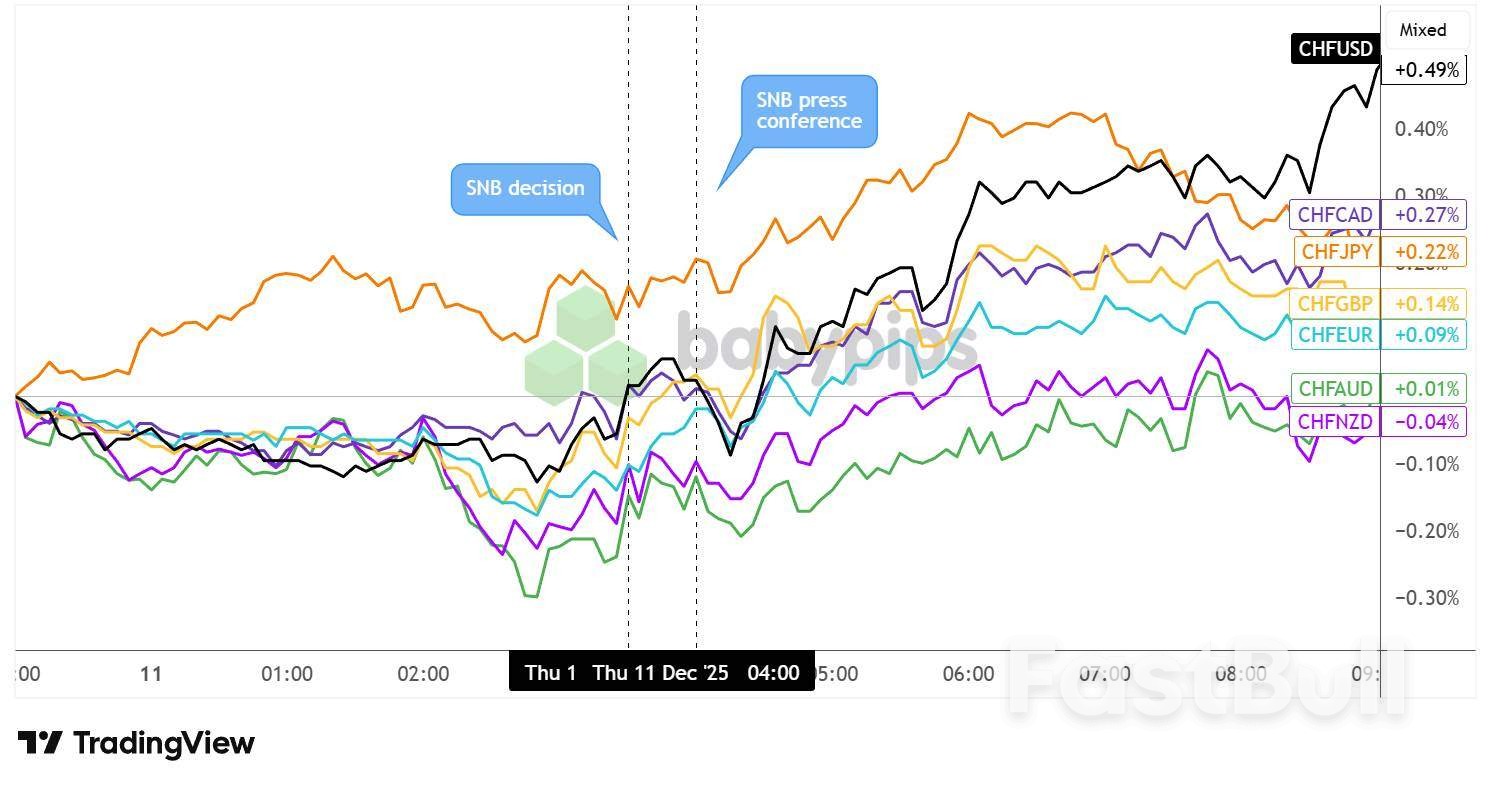
Swiss Franc vs. Major Currencies: 5-min

The Swiss franc, which had started to pull higher leading up to the actual SNB announcement, had an initial bullish reaction to the official decision since policymakers refrained from cutting rates to negative territory.
CHF briefly pulled back during the press conference, as traders likely weighed the implications of avoiding further easing amid a weaker inflation outlook, while also assessing the central bank's willingness to intervene in the currency market "as necessary."
Still, the Swiss currency managed to regain footing and sustain its rally as the London session went on, likely buoyed by dampened interest rate cut expectations until early 2026. CHF chalked up its strongest gains versus USD (+0.49%) followed by CAD (+0.27%) and JPY (+0.22%) while barely landing in positive territory versus AUD (+0.01%) and NZD (-0.04%) around the U.S. session open.
Key points:
Britons are set to spend 24.6 billion pounds ($32.9 billion) on presents and celebrations over the Christmas period this year, a 3.5% increase on 2024, despite a slow start to festive trading, according to a survey from PwC published on Friday.
With Britain's headline inflation rate running at 3.6% in October, PwC's forecast would indicate flat sales on a volume basis.
PwC said average spending per UK adult is forecast to rise to 461 pounds, with the top priorities being food and drink, Christmas dinner, and health and beauty products.
Of those consumers who said they are planning to spend less, the cost of living was cited as the main reason.
Survey data published on Tuesday showed British consumers kept a tight rein on their spending in November as they awaited finance minister Rachel Reeves' budget, while retailers said Black Friday sales disappointed.
Barclays said spending on its credit and debit cards fell by 1.1% in annual terms in November, the biggest drop since February 2021 when the COVID-19 pandemic still raged.
A separate survey from the British Retail Consortium (BRC) trade body showed spending at big retailers rose by 1.4% in annual terms last month, the slowest growth since May.
Analysts have also highlighted that a very mild autumn and early winter has been unhelpful for fashion retailers, particularly for sales of high-ticket items such as coats and boots.
"Post Budget, we should see clarity on personal finances easing some of the caution we have seen this Autumn, which has contributed to a slow start to the critical Golden Quarter for some retailers," Jacqueline Windsor, head of retail at PwC UK, said.
Last month, PwC forecast the steepest year-over-year drop in U.S. holiday spending since the pandemic, primarily fuelled by Gen Z shoppers pulling back amid economic uncertainty.
($1 = 0.7485 pounds)
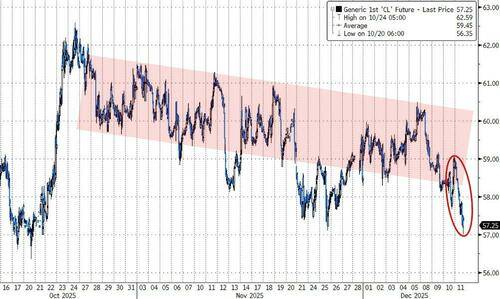
Oil prices are lower this morning despite a less-hawkish-than-feared Fed cut and a double-whammy of relative optimism from OPEC and the IEA...

OilPrice.com's Tsvetana Paraskova reports that the oil market still faces record oversupply next year, according to the monthly report by the International Energy Agency (IEA), but the glut estimate is now trimmed by about 230,000 barrels per day compared to the November forecast.
The market is headed to as much as 3.84 million barrels per day (bpd) of supply exceeding demand in 2026, the IEA said on Thursday in its closely-watched report for December.

While this still is a considerable glut, it's lower than the 4.09 million bpd implied oversupply expected in the November report.
In today's report, the IEA said that the projected global oil surplus in the fourth quarter of 2025 has narrowed since last month's report, "as the relentless surge in global oil supply came to an abrupt halt."
Total global oil supply dipped by 610,000 bpd in November compared to October and by a whopping 1.5 million bpd from September's all-time high, the IEA noted.
OPEC+ accounted for 80% of the decline over October and November, reflecting significant unplanned outages in Kuwait and Kazakhstan, while oil output from sanctions-hit Russia and Venezuela plunged.
Russia's total oil exports are estimated to have plummeted by about 400,000 bpd in November to 6.9 million bpd, as buyers assessed the implications and risks associated with more stringent sanctions.
Buyers, especially in Russia's second-biggest crude oil customer, India, are steering clear of any Rosneft and Lukoil-related cargoes, for fear of running afoul of the U.S. Administration while India and the United States are still locked in difficult trade negotiations.
The IEA noted in its report the apparent disconnect between the current global oil surplus and inventories near decade lows at key pricing hubs.
Despite record volumes of oil piling up on water, benchmark crude oil prices eased only marginally in November, because "in stark contrast to the broader picture, crude and refined product stocks in key pricing hubs have seen only marginal builds," the agency said.
As Charles Kennedy reports at OilPrice.com, global oil demand will rise by about 1.4 million barrels per day (bpd) next year, supported by solid economic growth, OPEC said in its monthly report ton Thursday, keeping its demand forecasts unchanged from last month.
Unlike other forecasters, investment banks, and analysts, OPEC continues to expect robust demand growth in 2026 that will be higher than the estimated increase for 2025 of about 1.3 million bpd, forecasts in the cartel's Monthly Oil Market Report (MOMR) showed on Thursday.

Figures about the balance of supply and demand in OPEC's report also suggest that the cartel expects a balanced market next year.
Demand for crude from the OPEC+ producers is expected at 43.0 million bpd in 2026, up by 60,000 bpd compared to the projection for 2025, OPEC said.
At the same time, crude oil production by the countries in the OPEC+ pact averaged 43.06 million bpd in November, a rise by 43,000 bpd from October, compared to the available secondary sources in OPEC's report.
After December, OPEC+ producers will be pausing their targeted monthly production increases during the first quarter of 2026.
OPEC expects rival non-OPEC+ oil supply to grow by about 600,000 bpd next year, versus growth of some 1 million bpd expected for 2025.
The rise in non-OPEC+ output is expected to be driven by offshore start-ups across Latin America and the Gulf of Mexico, increased NGLs production in the U.S., Argentina's tight oil production, and the scaling of oil sands projects in Canada. Latin America is projected to lead non-OPEC+ growth, accounting for about two-thirds of the total, followed by Canada and the U.S.
This projection, while not new for OPEC, reiterates the cartel's view that U.S. oil production growth will slow down next year.
Signals have started to emerge in the shale patch and from industry executives that WTI crude prices below the $60 per barrel mark will put the brakes on America's shale growth.
Key Points:

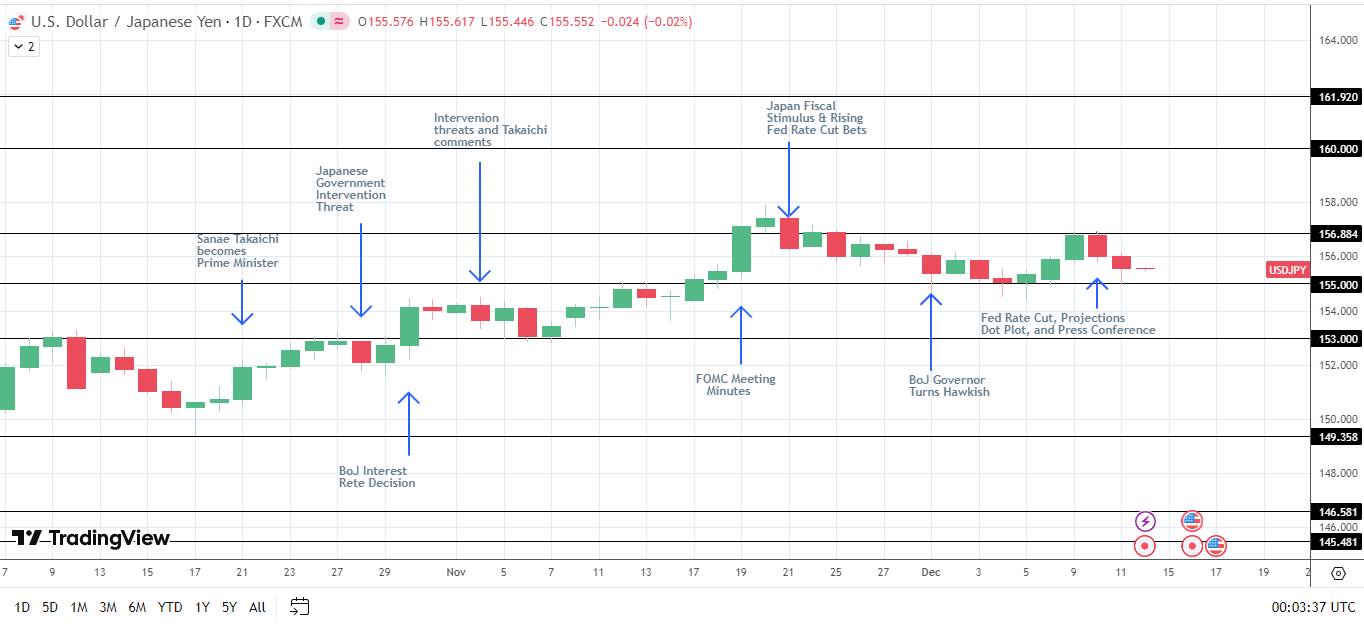
It's been a choppy week for USD/JPY, with the pair testing resistance at 157 before the Fed's interest rate decision, projections, and dot plot. Since then, the pair has tested support at 155, with softer US jobs data weighing on US dollar demand.
These swings came ahead of the Bank of Japan's highly anticipated interest rate decision on December 19. Expectations of a 25-basis-point rate hike to 0.75% have contributed to the pullback in USD/JPY as market focus shifts from the Fed to the BoJ.
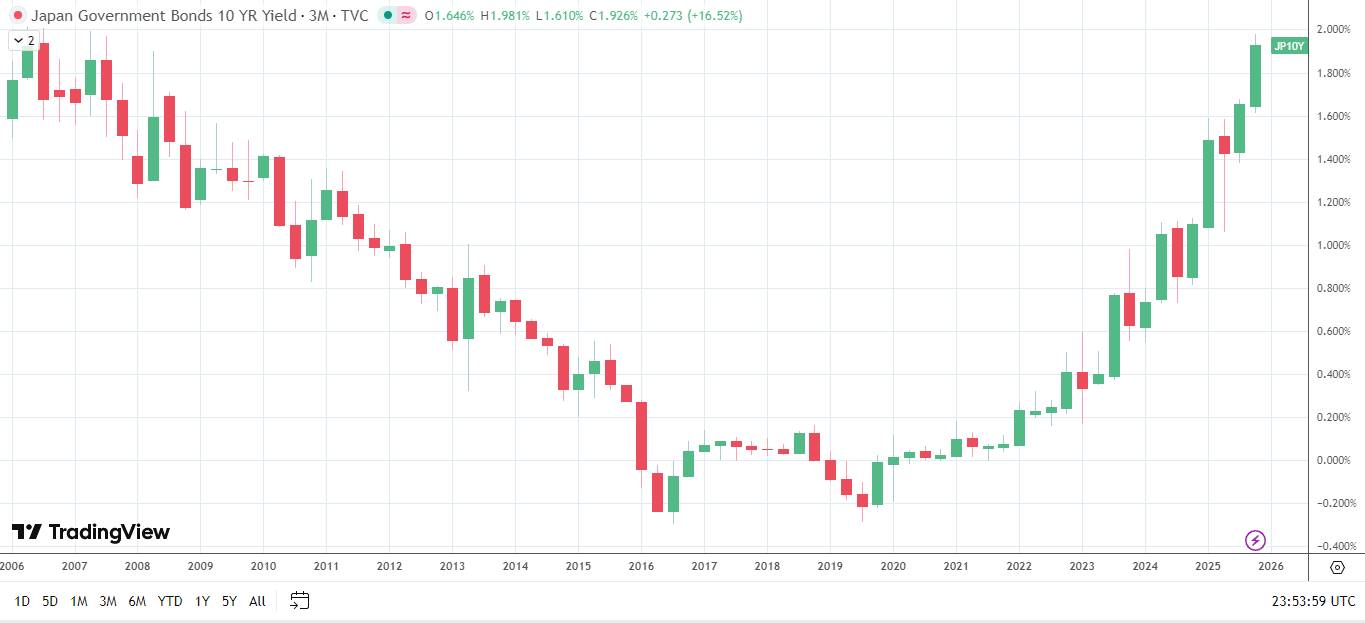
Crucially, market bets on a December BoJ rate hike and Prime Minister Sanae Takaichi's fiscal policy sent 10-year Japanese Government Bond (JGB) yields to their highest level since 2007 before easing back.
10-Year JGB – Quarterly Chart – 121225Given the BoJ's upcoming monetary policy decision, rising JGB yields, and the Fed's rate-cutting cycle, the short- to medium-term outlook for USD/JPY remains bearish.
Below, I'll discuss the macro backdrop, the near-term price catalysts, and technical levels traders should closely watch.
On Friday, December 12, Japanese industrial production will face scrutiny, given that BoJ Governor Kazuo Ueda saw diminishing US tariff risks to the economy. According to the preliminary report, production increased 1.4% month-on-month in October, after rising 2.6% in September.
A third consecutive month of rising industrial production would reinforce Governor Ueda's view that US tariff risks have softened. Crucially, improving demand would also boost jobs and wage growth. Higher wages would likely fuel consumer spending and demand-driven inflation, supporting a more hawkish BoJ rate path and a stronger yen.
Yen strength would likely keep USD/JPY on a downward trajectory in the run-up to next week's BoJ monetary policy decision, with 155 at risk.
USDJPY – Daily Chart – 121225 – Q3 Close UpWith the markets betting on a December BoJ rate hike, USD/JPY volatility could intensify on US economic data and Fed rhetoric. On the one hand, markets are speculating on how far the BoJ needs to go to reach normalization. On the other hand, incoming US data will fill the US government shutdown-induced data void, which may materially alter the Fed's rate path.
Later on Friday, traders should closely monitor FOMC members' speeches as the dust settles from Wednesday's monetary policy decision. FOMC members Beth Hammack and Austan Goolsbee are due to speak. Notably, Cleveland Fed President Hammack will become a voting member in 2026, while Chicago Fed President Goolsbee will be an alternative after being a voting member in 2025.
Cleveland Fed President Hammack's views on inflation, the labor market, and the timeline for a rate cut will influence US dollar demand. The FOMC's Dot Plot signaled a single rate cut in 2026. Growing calls for a Q1 2026 rate cut would signal a more dovish Fed rate path. A more dovish Fed policy stance would support a bearish short- to medium-term USD/JPY outlook.
For context, the CME FedWatch Tool gives a 24.4% chance of a January 2026 Fed rate cut, while the probability of a March 2026 cut rose from 42.2% to 49.6% on Thursday, December 11. Traders should closely monitor sentiment toward a Q1 2026 Fed rate cut, which are likely to influence USD/JPY trends.
With markets focused on rate differentials, technical indicators, and fundamentals will give crucial insights into potential USD/JPY price trends.
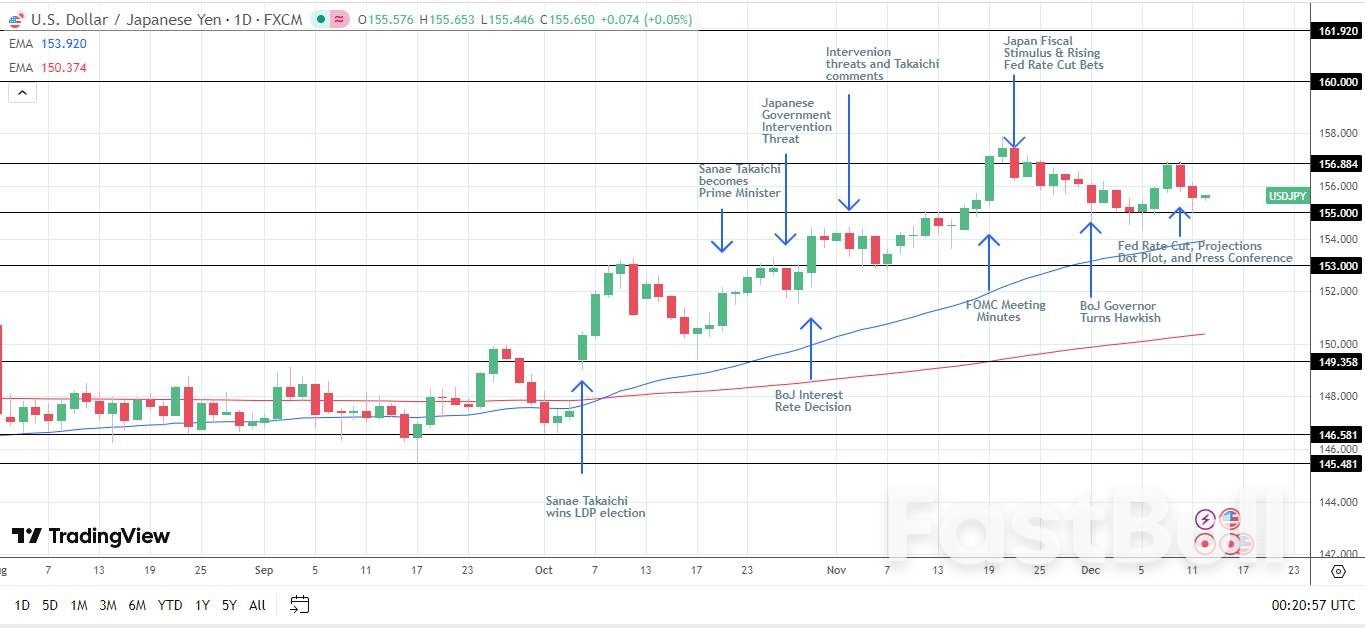
Looking at the daily chart, USD/JPY remained above the 50-day and 200-day Exponential Moving Averages (EMAs), signaling a bullish bias. While technicals remain bullish, fundamentals are increasingly outweighing the technical structure.
A drop below the 155 support level would open the door to testing the 50-day EMA. If breached, 153 would be the next key support. A sustained break below the 50-day EMA would signal a bearish near-term trend reversal. A near-term bearish trend reversal would expose the 200-day EMA and 150.
USDJPY – Daily Chart – 121225 – EMAsIn my view, speculation about multiple BoJ rate hikes and a shifting Fed rate path support a bearish short- to medium-term outlook. The BoJ's view on the neutral rate will be crucial for yen demand. USD/JPY would see a sharper drop toward 130 if the BoJ signals a 1.5% neutral rate. The neutral rate is where monetary policy is neither restrictive nor accommodative.
However, upside risks could challenge the bearish outlook. These risks include:
These scenarios would send USD/JPY higher. However, yen intervention threats are likely to cap the upside. USD/JPY topped at a November 20 high of 157.893, based on past communication.
Read the full USD/JPY forecast, including chart setups and trade ideas.
In summary, expectations of a BoJ rate hike and an evenly balanced chance of a March 2026 Fed rate cut signal a bearish USD/JPY outlook. Economic indicators and central bank commentary will be crucial in the final weeks of 2025.
Two key questions, beyond the economic calendar, would be:
The likelihood of a dovish incoming Fed Chair and a 1.5% BoJ neutral rate would narrow rate differentials further. Crucially, multiple Fed rate cuts and BoJ rate hikes would support a USD/JPY fall toward 130 over the 6-12 month time horizon.
SoftBank Group Corp. is studying potential acquisitions including data center operator Switch Inc., as billionaire founder Masayoshi Son ramps up the search for deals that can help it ride the AI-fueled boom in digital infrastructure, people with knowledge of the matter said.
The Japanese company has held discussions with Switch leadership and has been conducting due diligence on the closely held company, the people said, asking not to be identified because the information is private. SoftBank also has been in advanced talks on a potential purchase of one of Switch's main private equity backers, New York-listed investment firm DigitalBridge Group Inc., Bloomberg News reported last week.
Son has been looking for ways to play a bigger role in an artificial intelligence race that has elevated SoftBank's longtime business partner Nvidia Corp. to the status of the world's most valuable company. An acquisition of Switch, which specializes in designing and operating energy-efficient data centers, would help the Japanese billionaire control a key bottleneck to AI development.
The owners of Switch have been seeking a valuation of around $50 billion including debt for the data center operator in any deal, some of the people said. They have also simultaneously preparing for a potential initial public offering of Switch as soon as early next year, according to the people. Switch's backers have been considering seeking a valuation of about $60 billion including debt in a stock-market listing of the company, they said.
The SoftBank team often analyzes numerous potential deals in a particular space before deciding which transaction to pursue, and it sometimes decides to do multiple deals in a particular area it wants to rapidly expand in. Acquiring Switch would allow SoftBank to own a large portfolio of data centers outright at a time when demand for their computing power is growing rapidly.
A consortium including DigitalBridge and Australian infrastructure manager IFM Investors Pty bought Switch in a 2022 deal valued at $11 billion including debt.
Shares of DigitalBridge have gained about 35% this year, giving it a market value of $2.8 billion. With about $108 billion of assets under management, it's one of the biggest investment firms focused on digital infrastructure. A deal for DigitalBrige would bring SoftBank expertise in raising large amounts of capital, as well as deep relationships with investors keen to deploy their money in the data center industry.
SoftBank hasn't reached an agreement on terms of a deal, and there's no certainty the discussions will lead to a transaction, the people said. It would likely need to line up significant financing for any acquisition of Switch, which would rank as one of SoftBank's largest deals if it goes ahead.
Representatives for SoftBank, Switch and DigitalBridge declined to comment.
Despite being early to invest in AI technologies, Son has missed much of a global rally that's positioned Nvidia, Taiwan Semiconductor Manufacturing Co. and OpenAI at the forefront of a global boom in machine learning.
This year, however, SoftBank has announced a plethora of moves in the AI arena, including the $500 billion Stargate project alongside OpenAI, Oracle Corp. and Abu Dhabi's MGX to build data centers in the US. But while Son pledged to deploy $100 billion "immediately," the Stargate rollout has been slower than planned.
In recent months, SoftBank bought US chip designer Ampere Computing LLC for $6.5 billion and has committed roughly $30 billion to ChatGPT developer OpenAI. The Tokyo-based company has also proposed a $5.4 billion acquisition of ABB Ltd.'s robotics unit and bought a stake in chipmaker Intel Corp. To finance some of that cost, SoftBank has unloaded its entire Nvidia stake and expanded a margin loan using its Arm Holdings Plc shares. The company's SoftBank Corp. telecom unit is also ramping up spending on its data centers in Japan.
White Label
Data API
Web Plug-ins
Poster Maker
Affiliate Program
The risk of loss in trading financial instruments such as stocks, FX, commodities, futures, bonds, ETFs and crypto can be substantial. You may sustain a total loss of the funds that you deposit with your broker. Therefore, you should carefully consider whether such trading is suitable for you in light of your circumstances and financial resources.
No decision to invest should be made without thoroughly conducting due diligence by yourself or consulting with your financial advisors. Our web content might not suit you since we don't know your financial conditions and investment needs. Our financial information might have latency or contain inaccuracy, so you should be fully responsible for any of your trading and investment decisions. The company will not be responsible for your capital loss.
Without getting permission from the website, you are not allowed to copy the website's graphics, texts, or trademarks. Intellectual property rights in the content or data incorporated into this website belong to its providers and exchange merchants.
Not Logged In
Log in to access more features

FastBull Membership
Not yet
Purchase
Log In
Sign Up