Markets
News
Analysis
User
24/7
Economic Calendar
Education
Data
- Names
- Latest
- Prev


Signal Accounts for Members
All Signal Accounts
All Contests


Turkey Trade BalanceA:--
F: --
P: --
Germany Construction PMI (SA) (Nov)A:--
F: --
P: --
Euro Zone IHS Markit Construction PMI (Nov)A:--
F: --
P: --
Italy IHS Markit Construction PMI (Nov)A:--
F: --
P: --
U.K. Markit/CIPS Construction PMI (Nov)A:--
F: --
P: --
France 10-Year OAT Auction Avg. YieldA:--
F: --
P: --
Euro Zone Retail Sales MoM (Oct)A:--
F: --
P: --
Euro Zone Retail Sales YoY (Oct)A:--
F: --
P: --
Brazil GDP YoY (Q3)A:--
F: --
P: --
U.S. Challenger Job Cuts (Nov)A:--
F: --
P: --
U.S. Challenger Job Cuts MoM (Nov)A:--
F: --
P: --
U.S. Challenger Job Cuts YoY (Nov)A:--
F: --
P: --
U.S. Initial Jobless Claims 4-Week Avg. (SA)A:--
F: --
P: --
U.S. Weekly Initial Jobless Claims (SA)A:--
F: --
P: --
U.S. Weekly Continued Jobless Claims (SA)A:--
F: --
P: --
Canada Ivey PMI (SA) (Nov)A:--
F: --
P: --
Canada Ivey PMI (Not SA) (Nov)A:--
F: --
P: --
U.S. Non-Defense Capital Durable Goods Orders Revised MoM (Excl. Aircraft) (SA) (Sept)A:--
F: --
U.S. Factory Orders MoM (Excl. Transport) (Sept)A:--
F: --
P: --
U.S. Factory Orders MoM (Sept)A:--
F: --
P: --
U.S. Factory Orders MoM (Excl. Defense) (Sept)A:--
F: --
P: --
U.S. EIA Weekly Natural Gas Stocks ChangeA:--
F: --
P: --
Saudi Arabia Crude Oil ProductionA:--
F: --
P: --
U.S. Weekly Treasuries Held by Foreign Central BanksA:--
F: --
P: --
Japan Foreign Exchange Reserves (Nov)A:--
F: --
P: --
India Repo RateA:--
F: --
P: --
India Benchmark Interest RateA:--
F: --
P: --
India Reverse Repo RateA:--
F: --
P: --
India Cash Reserve RatioA:--
F: --
P: --
Japan Leading Indicators Prelim (Oct)A:--
F: --
P: --
U.K. Halifax House Price Index YoY (SA) (Nov)--
F: --
P: --
U.K. Halifax House Price Index MoM (SA) (Nov)--
F: --
P: --
France Current Account (Not SA) (Oct)--
F: --
P: --
France Trade Balance (SA) (Oct)--
F: --
P: --
France Industrial Output MoM (SA) (Oct)--
F: --
P: --
Italy Retail Sales MoM (SA) (Oct)--
F: --
P: --
Euro Zone Employment YoY (SA) (Q3)--
F: --
P: --
Euro Zone GDP Final YoY (Q3)--
F: --
P: --
Euro Zone GDP Final QoQ (Q3)--
F: --
P: --
Euro Zone Employment Final QoQ (SA) (Q3)--
F: --
P: --
Euro Zone Employment Final (SA) (Q3)--
F: --
Brazil PPI MoM (Oct)--
F: --
P: --
Mexico Consumer Confidence Index (Nov)--
F: --
P: --
Canada Unemployment Rate (SA) (Nov)--
F: --
P: --
Canada Labor Force Participation Rate (SA) (Nov)--
F: --
P: --
Canada Employment (SA) (Nov)--
F: --
P: --
Canada Part-Time Employment (SA) (Nov)--
F: --
P: --
Canada Full-time Employment (SA) (Nov)--
F: --
P: --
U.S. Dallas Fed PCE Price Index YoY (Sept)--
F: --
P: --
U.S. PCE Price Index YoY (SA) (Sept)--
F: --
P: --
U.S. PCE Price Index MoM (Sept)--
F: --
P: --
U.S. Personal Outlays MoM (SA) (Sept)--
F: --
P: --
U.S. Core PCE Price Index MoM (Sept)--
F: --
P: --
U.S. UMich 5-Year-Ahead Inflation Expectations Prelim YoY (Dec)--
F: --
P: --
U.S. Core PCE Price Index YoY (Sept)--
F: --
P: --
U.S. 5-10 Year-Ahead Inflation Expectations (Dec)--
F: --
P: --
U.S. UMich Current Economic Conditions Index Prelim (Dec)--
F: --
P: --
U.S. UMich Consumer Sentiment Index Prelim (Dec)--
F: --
P: --
U.S. UMich 1-Year-Ahead Inflation Expectations Prelim (Dec)--
F: --
P: --
U.S. UMich Consumer Expectations Index Prelim (Dec)--
F: --
P: --


No matching data
Latest Views
Latest Views
Trending Topics
Top Columnists
Latest Update
White Label
Data API
Web Plug-ins
Affiliate Program
View All

No data
Tesla'sUK car registrations dropped in November, industry data showed on Thursday, following steep declines in other European markets in the month amid intense competition particularly from Chinese rivals.
Key points:
Tesla'sUK car registrations dropped in November, industry data showed on Thursday, following steep declines in other European markets in the month amid intense competition particularly from Chinese rivals.
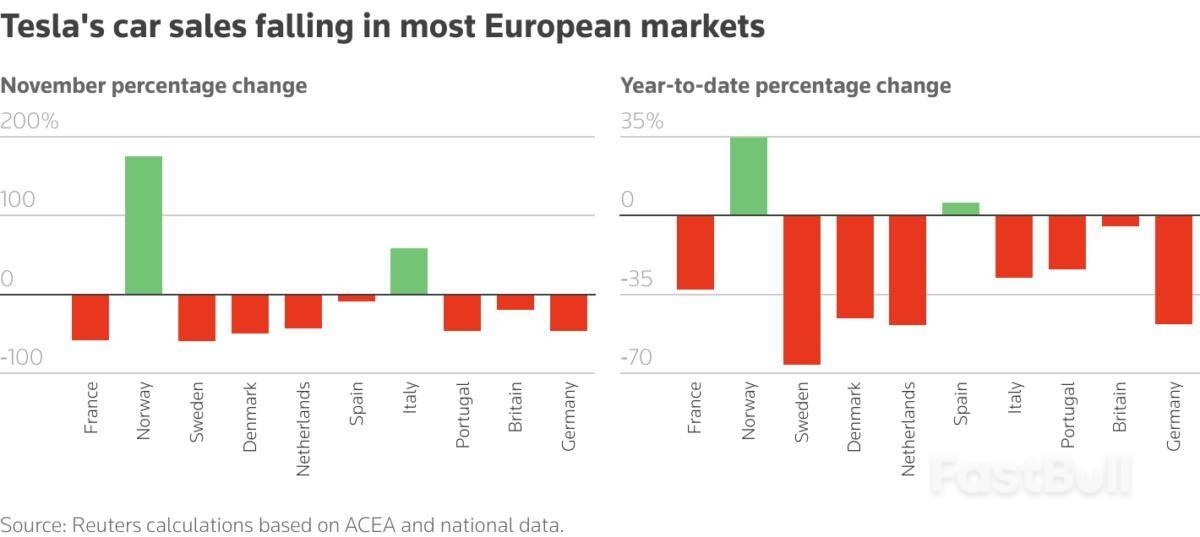
November registrations, a proxy for sales, of Tesla cars in the UK fell 19% to 3,784 from 4,680 cars a year ago, preliminary data from research group New AutoMotive data showed.
Data from the Society of Motor Manufacturers and Traders (SMMT) showed a 17.2% year-on-year decline to 3,772 Tesla sales in the UK, lagging other legacy automakers and Chinese rivals.
The numbers are slightly different as SMMT and New AutoMotive use different sources of data and methods of calculation.
The U.S. EV maker, which recently started rolling out new versions of its best-selling Model Y SUV, has been struggling with an aging lineup and growing competition in a crowded European market, especially from new entrants from China.
There are now more than 150 electric models available to British motorists, according to EV buying advice site Electrifying.com.
Amid the assortment of EV brands, registrations by Tesla's Chinese peer BYD, which also sells hybrids and plug-in hybrids, more than tripled in November.
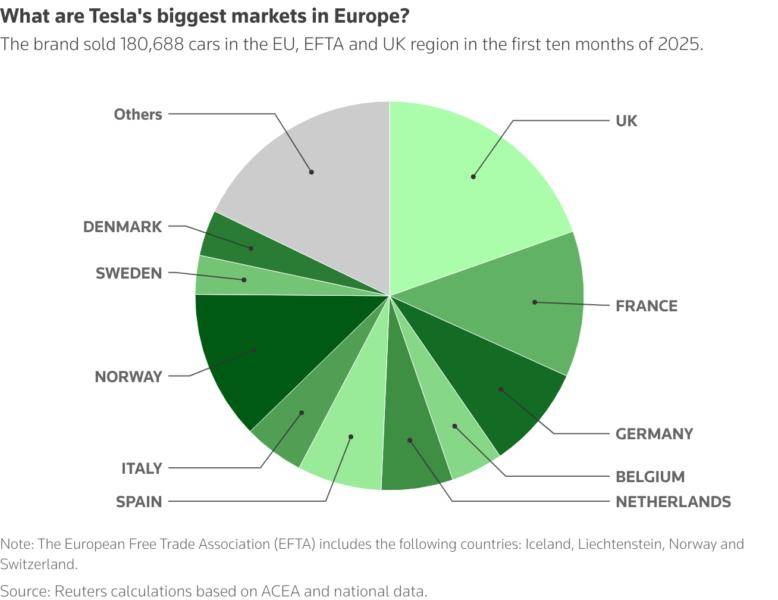
Customer sentiment for Tesla has also fallen in recent months, after CEOElon Muskpublicly praised right-wing political figures and after his short stint as head of the U.S. Department of Government Efficiency.
The brand's November drop in registrations is in line with a 20% fall in Germany and a slump of almost 60% in France and other European markets, which were only partly offset by record-breaking sales in Norway.
Overall, total new car registrations in Britain fell 6.3% to 146,780 vehicles for November, according to New AutoMotive, while SMMT logged a slight 1.6% decline to 151,154 vehicles.
Those of battery-electric cars fell 1.1% to 38,742 vehicles, while plug-in hybrid registrations jumped 3.8% to 16,526, New Automotive data showed.
"On the surface, some consumers may feel that BEVs have increased in cost, but this is not necessarily the case," said Jamie Hamilton, automotive partner and head of electric vehicles at Deloitte.
"The new EV mileage charge will increase running costs of electric vehicles, but changes to the Expensive Car Supplement threshold may mean some drivers are actually better off over the course of their lease period," Hamilton added.
China's major state-owned banks bought dollars in the onshore spot market this week and held on to them in an unusually strong effort to rein in yuan strength, according to people with knowledge of the matter.
The dollar buying came as the yuanleapt to a 14-month high on Wednesday and extended a trend of state banks leaning against yuan gains in order to smooth its rise.
But unlike their usual trading strategy, the lenders did not appear to recycle the dollars into the swap market, market sources said, noting the move was likely aimed at tightening dollar liquidity and so raising the cost of long yuan bets.
Back-end dollar/yuan swap points have since dropped, reflecting a deeper negative carry of owning yuan with the one-year tenor (CNY1Y=) down from a one-month high hit last week.
The state bank actions were meant to moderate the pace of yuan rallies rather than reverse an upward trend, said one of the sources. All requested anonymity because they are not allowed to discuss the matter publicly.
Slower yuan gains also make it harder to hold long positions because profits don't make up for the difference in interest income between dollars and the much lower-yielding yuan.
State banks sometimes trade on behalf of the central bank, but they could trade on their own behalf or execute orders for their clients.
China's central bank, the People's Bank of China did not immediately respond to a request for comment.
The Chinese currency has gained about 3.3% on the dollar year-to-date and on Thursday looked set for the biggest annual rise since the pandemic year of 2020.
The appreciation of the tightly managed currency has been helped by authorities' signalling their tacit approval, with the middle of the yuan's daily trading band repeatedly set firmer than market expectations.
But it has been smoothed by the state banks, prompting speculation the aim is a gradual rise that would avoid sudden yuan purchases by exporters and project the sort of stability that can encourage global use of the currency.
Dollar buying came on Thursday in tandem with a surprisingly soft midpoint fixingwhich has knocked the yuan from its 14-month high to trade about 0.1% weaker at 7.0694 per dollar.
BlackRock, under CEO Larry Fink's leadership, announced on October 2023 that the rising $12 trillion U.S. national debt will drive increased crypto adoption, highlighting Bitcoin's potential as a financial safe haven.
This announcement underscores crypto's viability amid fiscal uncertainties, with BlackRock's significant Bitcoin ETF allocations reflecting institutions' strategic shifts toward digital assets due to escalating national debt risks.
BlackRock has announced a massive allocation of $100 billion towards Bitcoin ETFs. This decision comes in the wake of mounting concerns about the rapid increase in the U.S. national debt, as highlighted by BlackRock's CEO, Larry Fink.
CEO Larry Fink, known for steering BlackRock's investment strategies, expressed concerns in his 2025 Chairman's Letter. He emphasized that escalating U.S. deficits could shift financial power towards digital assets like Bitcoin, encouraging greater crypto adoption.
The investment in Bitcoin ETFs by BlackRock is anticipated to bolster institutional demand for cryptocurrency assets. This move aligns with broader market trends where crypto is seen as a safer alternative in light of increasing national debt.
Institutional flows into Bitcoin are expected to strengthen digital finance infrastructure. The pivot illustrates a significant shift in how institutions approach financial stability amid a looming economic uncertainty driven by national debt. As Larry Fink, CEO of BlackRock, aptly put it, "BlackRock has allocated approximately $100 billion toward Bitcoin ETFs, demonstrating substantial institutional financial commitment to crypto as a hedge against mounting U.S. debt."
The rising U.S. debt levels are prompting institutional investors to reassess their asset allocations. Bitcoin, often dubbed as digital gold, stands to gain traction from these dynamics, serving as a hedge against fiscal instability.
Over time, growing institutional interest, supported by regulatory clarity and market conditions, may solidify Bitcoin's position as a viable asset class. BlackRock's strategic actions, highlighting the economic value of diverse asset holdings, could inspire similar corporate investments.

Thousands of Indianairline IndiGo passengers suffered flight cancellations and delays for the third day on Thursday, as the airline grapples with new government regulations that affect its staff's working hours.
At least 175 IndiGo flights were canceled as of early Thursday, the Reuters news agency reported, with 150 more flights canceled on Wednesday. Passengers were left stranded at major Indian airports including New Delhi, Hyderabad, Pune and Bengaluru.
The airline accounts for 60% of domestic flights in India.
The Indian government announced last year new regulations for flying and staff that came into effect in early November.
They include:
It is unclear why the new regulations only started to affect IndiGo this week. Other Indian airlines, including Air India and Spicejet, have not had to cancel flights.
The airline, which has long prided itself on its punctuality, acknowledged the delays in a statement shared by multiple Indian news websites.
"A multitude of unforeseen operational challenges, including minor technology glitches, schedule changes linked to the winter season, adverse weather conditions, increased congestion in the aviation system, and the implementation of updated crew rostering rules (Flight Duty Time Limitations), had a negative compounding impact on our operations in a way that was not feasible to be anticipated," IndiGo said.
It said it has introduced "calibrated adjustments" to address the delays, suggesting the issue might last another 48 hours.
India's aviation watchdog, the Director General of Civil Aviation (DGCA), has scheduled a meeting with IndiGo officials on Thursday to further inspect the matter.
The two-decade old airline operates over 2,000 flights daily, utilizing a fleet of over 400 planes.
IndiGo staff often proudly announce "IndiGo Standard Time" when boarding has been completed ahead of schedule, a play on "Indian Standard Time."
The two-decade old airline operates over 2,000 flights daily, utilizing a fleet of over 400 planesImage: Pius Koller/imageBROKER/picture allianceBritish construction activity contracted last month at the fastest pace since May 2020, with steep falls in civil engineering, residential, and commercial building, partly due to uncertainty ahead of the government's budget, a survey showed on Thursday.
S&P Global's monthly purchasing managers' index for the construction industry fell to 39.4 in November from 44.1 in October, extending its longest downturn since the global financial crisis and remaining well below the 50 mark that divides growth from contraction.
Residential construction activity was at its weakest since May 2020, when lockdowns during the COVID pandemic halted building work.
Activity in the commercial sector in November dropped at the sharpest pace in five-and-a-half years, with its subindex at 43.8. Civil engineering and new orders were also their weakest since May 2020.
"November data revealed a sharp retrenchment across the UK construction sector as weak client confidence and a shortfall of new project starts again weighed on activity," said Tim Moore, economics director at S&P Global Market Intelligence.
"Total industry activity decreased to the greatest extent for five-and-a-half years, led by steep falls in infrastructure and residential building work. Commercial construction also faced severe headwinds during November as business uncertainty in the run-up to the budget pushed clients to defer investment decisions.
Other recent business surveys have also shown similar concerns about investment, hiring and demand in the lead-up to finance minister Rachel Reeves' annual budget on November 26, which included 26 billion pounds ($35 billion) in tax rises.
S&P Global said the pace of job-shedding accelerated last month, with the employment index at its lowest since August 2020, with firms citing elevated wage costs and less work.
The survey's gauge of optimism struck a nearly three-year low, and cost pressure rose slightly.
The all-sector PMI, which combines the services, manufacturing and construction sectors, stood at 50.1 in November compared to October's 51.4.
($1 = 0.7525 pounds)

Plans to spend £28bn to upgrade Great Britain's electricity grid have been signed off, in a move that should improve the energy networks, speed the transition to new forms of energy…and increase household bills.
Energy regulator Ofgem has just announced that energy companies have been given approval to "strengthen the stability, security and resilience of our energy networks". by upgrading the energy grid.
The majority of the spending – £17.8bn - announced today is to maintain Britain's gas networks.
There's also £10.3bn to improve the nation's high-voltage electricity network – the biggest expansion of the grid since the 1960s.
In total, it's around £4bn more than was provisionally signed off in the summer.
Ofgem says the investment is the most cost-effective way to harness clean power, support economic growth and protect the country from a repeat of the 2022 gas price shock.
Customers will see the impact on their bills, which will rise to cover the cost of the investment. The regulator says £108 will be added to bills per year by 2031; £48 for gas and £60 for electricity.
But it claims, the investing will actually save customers £80 each compared to a word where the grid is not expanded.
So overall, the net increase in bills to cover all costs by 2031 works out at £30.
Jonathan Brearley, Ofgem CEO, insists the regulator isn't allowing "investment at any price", adding:
Every pound must deliver value for consumers.
Ofgem will hold network companies accountable for delivering on time and on budget, and we make no apologies for the efficiency challenge we're setting as the industry scales up investment.
We've built strong consumer protections into these contracts, meaning funds will only be released when needed and clawed back if not used. Households and businesses must get value for money, and we will ensure they do."
White Label
Data API
Web Plug-ins
Poster Maker
Affiliate Program
The risk of loss in trading financial instruments such as stocks, FX, commodities, futures, bonds, ETFs and crypto can be substantial. You may sustain a total loss of the funds that you deposit with your broker. Therefore, you should carefully consider whether such trading is suitable for you in light of your circumstances and financial resources.
No decision to invest should be made without thoroughly conducting due diligence by yourself or consulting with your financial advisors. Our web content might not suit you since we don't know your financial conditions and investment needs. Our financial information might have latency or contain inaccuracy, so you should be fully responsible for any of your trading and investment decisions. The company will not be responsible for your capital loss.
Without getting permission from the website, you are not allowed to copy the website's graphics, texts, or trademarks. Intellectual property rights in the content or data incorporated into this website belong to its providers and exchange merchants.
Not Logged In
Log in to access more features

FastBull Membership
Not yet
Purchase
Log In
Sign Up