• Trade
  • Markets
  • Copy
  • Contests
  • News
  • 24/7
  • Calendar
  • Q&A
  • Chats
Trending
Screeners
SYMBOL
LAST
BID
ASK
HIGH
LOW
NET CHG.
%CHG.
SPREAD
SPX
S&P 500 Index
6870.39
6870.39
6870.39
6895.79
6858.28
+13.27
+ 0.19%
--
DJI
Dow Jones Industrial Average
47954.98
47954.98
47954.98
48133.54
47871.51
+104.05
+ 0.22%
--
IXIC
NASDAQ Composite Index
23578.12
23578.12
23578.12
23680.03
23506.00
+72.99
+ 0.31%
--
USDX
US Dollar Index
98.930
99.010
98.930
98.960
98.730
-0.020
-0.02%
--
EURUSD
Euro / US Dollar
1.16500
1.16508
1.16500
1.16717
1.16341
+0.00074
+ 0.06%
--
GBPUSD
Pound Sterling / US Dollar
1.33161
1.33170
1.33161
1.33462
1.33136
-0.00151
-0.11%
--
XAUUSD
Gold / US Dollar
4211.89
4212.23
4211.89
4218.85
4190.61
+13.98
+ 0.33%
--
WTI
Light Sweet Crude Oil
59.273
59.303
59.273
60.084
59.160
-0.536
-0.90%
--

Community Accounts

Signal Accounts
--
Profit Accounts
--
Loss Accounts
--
View More

Become a signal provider

Sell trading signals to earn additional income

View More

Guide to Copy Trading

Get started with ease and confidence

View More

Signal Accounts for Members

All Signal Accounts

Best Return
  • Best Return
  • Best P/L
  • Best MDD
Past 1W
  • Past 1W
  • Past 1M
  • Past 1Y

All Contests

  • All
  • Trump Updates
  • Recommend
  • Stocks
  • Cryptocurrencies
  • Central Banks
  • Featured News
Top News Only
Share

SEBI: Modalities For Migration To Ai Only Schemes And Relaxations To Large Value Funds For Accredited Investors

Share

All 6 Bank Of Israel Monetary Policy Committee Members Voted To Lower Benchmark Interest Rate 25 Bps To 4.25% On Nov 24

Share

India Government: Cancellations Are On Account Of Developer Delays And Not Due To Transmission Side Delays

Share

Fitch: We See Moderation Of Export Performance In China In 2026

Share

India Government: Revokes Grid Access Permissions For Renewable Energy Projects

Share

Fitch: Calibrating Fiscal And Monetary Policies In China To Boost Domestic Demand And Reverse Deflationary Pressures Will Be A Key Challenge

Share

Stats Office - Tanzania Inflation At 3.4% Year-On-Year In November

Share

Fitch: External Risks From US Tariffs For Greater China Region Have Subsided

Share

Temasek CEO Dilhan Pillay: We Are Taking A Conservative Stance On Allocating Capital

Share

Brazil Economists See Brazilian Real At 5.40 Per Dollar By Year-End 2025 Versus 5.40 In Previous Estimate - Central Bank Poll

Share

Brazil Economists See Year-End 2026 Interest Rate Selic At 12.25% Versus 12.00% In Previous Estimate - Central Bank Poll

Share

Brazil Economists See Year-End 2025 Interest Rate Selic At 15.00% Versus 15.00% In Previous Estimate - Central Bank Poll

Share

EU Commission Says Meta Has Committed To Give EU Users Choice On Personalised Ads

Share

Sources Revealed That The Bank Of England Has Invited Employees To Voluntarily Apply For Layoffs

Share

The Bank Of England Plans To Cut Staff Due To Budget Pressures

Share

Traders Believe There Is Less Than A 10% Chance That The European Central Bank Will Cut Interest Rates By 25 Basis Points In 2026

Share

Egypt, European Bank For Reconstruction And Development Sign $100 Million Financing Agreement

Share

Israel Budget Deficit 4.5% Of GDP In November Over Past 12 Months Versus 4.9% Deficit In October

Share

JPMorgan - Council Chaired By Jamie Dimon Includes Jeff Bezos

Share

UK Government: UK Health Security Agency Identified New Recombinant Mpox Virus In England In Individual Who Had Recently Travelled To Asia

TIME
ACT
FCST
PREV
France Industrial Output MoM (SA) (Oct)

A:--

F: --

P: --
France Trade Balance (SA) (Oct)

A:--

F: --

P: --
Euro Zone Employment YoY (SA) (Q3)

A:--

F: --

P: --
Canada Part-Time Employment (SA) (Nov)

A:--

F: --

P: --

Canada Unemployment Rate (SA) (Nov)

A:--

F: --

P: --

Canada Full-time Employment (SA) (Nov)

A:--

F: --

P: --

Canada Labor Force Participation Rate (SA) (Nov)

A:--

F: --

P: --

Canada Employment (SA) (Nov)

A:--

F: --

P: --

U.S. PCE Price Index MoM (Sept)

A:--

F: --

P: --

U.S. Personal Income MoM (Sept)

A:--

F: --

P: --

U.S. Core PCE Price Index MoM (Sept)

A:--

F: --

P: --

U.S. PCE Price Index YoY (SA) (Sept)

A:--

F: --

P: --

U.S. Core PCE Price Index YoY (Sept)

A:--

F: --

P: --

U.S. Personal Outlays MoM (SA) (Sept)

A:--

F: --

P: --
U.S. 5-10 Year-Ahead Inflation Expectations (Dec)

A:--

F: --

P: --

U.S. Real Personal Consumption Expenditures MoM (Sept)

A:--

F: --

P: --
U.S. Weekly Total Rig Count

A:--

F: --

P: --

U.S. Weekly Total Oil Rig Count

A:--

F: --

P: --

U.S. Consumer Credit (SA) (Oct)

A:--

F: --

P: --
China, Mainland Foreign Exchange Reserves (Nov)

A:--

F: --

P: --

Japan Trade Balance (Oct)

A:--

F: --

P: --

Japan Nominal GDP Revised QoQ (Q3)

A:--

F: --

P: --

China, Mainland Imports YoY (CNH) (Nov)

A:--

F: --

P: --

China, Mainland Exports (Nov)

A:--

F: --

P: --

China, Mainland Imports (CNH) (Nov)

A:--

F: --

P: --

China, Mainland Trade Balance (CNH) (Nov)

A:--

F: --

P: --

China, Mainland Exports YoY (USD) (Nov)

A:--

F: --

P: --

China, Mainland Imports YoY (USD) (Nov)

A:--

F: --

P: --

Germany Industrial Output MoM (SA) (Oct)

A:--

F: --

P: --
Euro Zone Sentix Investor Confidence Index (Dec)

A:--

F: --

P: --

Canada National Economic Confidence Index

--

F: --

P: --

U.K. BRC Like-For-Like Retail Sales YoY (Nov)

--

F: --

P: --

U.K. BRC Overall Retail Sales YoY (Nov)

--

F: --

P: --

Australia Overnight (Borrowing) Key Rate

--

F: --

P: --

RBA Rate Statement
RBA Press Conference
Germany Exports MoM (SA) (Oct)

--

F: --

P: --

U.S. NFIB Small Business Optimism Index (SA) (Nov)

--

F: --

P: --

Mexico 12-Month Inflation (CPI) (Nov)

--

F: --

P: --

Mexico Core CPI YoY (Nov)

--

F: --

P: --

Mexico PPI YoY (Nov)

--

F: --

P: --

U.S. Weekly Redbook Index YoY

--

F: --

P: --

U.S. JOLTS Job Openings (SA) (Oct)

--

F: --

P: --

China, Mainland M1 Money Supply YoY (Nov)

--

F: --

P: --

China, Mainland M0 Money Supply YoY (Nov)

--

F: --

P: --

China, Mainland M2 Money Supply YoY (Nov)

--

F: --

P: --

U.S. EIA Short-Term Crude Production Forecast For The Year (Dec)

--

F: --

P: --

U.S. EIA Natural Gas Production Forecast For The Next Year (Dec)

--

F: --

P: --

U.S. EIA Short-Term Crude Production Forecast For The Next Year (Dec)

--

F: --

P: --

EIA Monthly Short-Term Energy Outlook
U.S. API Weekly Gasoline Stocks

--

F: --

P: --

U.S. API Weekly Cushing Crude Oil Stocks

--

F: --

P: --

U.S. API Weekly Crude Oil Stocks

--

F: --

P: --

U.S. API Weekly Refined Oil Stocks

--

F: --

P: --

South Korea Unemployment Rate (SA) (Nov)

--

F: --

P: --

Japan Reuters Tankan Non-Manufacturers Index (Dec)

--

F: --

P: --

Japan Reuters Tankan Manufacturers Index (Dec)

--

F: --

P: --

Japan Domestic Enterprise Commodity Price Index MoM (Nov)

--

F: --

P: --

Japan Domestic Enterprise Commodity Price Index YoY (Nov)

--

F: --

P: --

China, Mainland PPI YoY (Nov)

--

F: --

P: --

China, Mainland CPI MoM (Nov)

--

F: --

P: --

Q&A with Experts
    • All
    • Chatrooms
    • Groups
    • Friends
    Connecting
    .
    .
    .
    Type here...
    Add Symbol or Code

      No matching data

      All
      Trump Updates
      Recommend
      Stocks
      Cryptocurrencies
      Central Banks
      Featured News
      • All
      • Russia-Ukraine Conflict
      • Middle East Flashpoint
      • All
      • Russia-Ukraine Conflict
      • Middle East Flashpoint
      Search
      Products

      Charts Free Forever

      Chats Q&A with Experts
      Screeners Economic Calendar Data Tools
      Membership Features
      Data Warehouse Market Trends Institutional Data Policy Rates Macro

      Market Trends

      Market Sentiment Order Book Forex Correlations

      Top Indicators

      Charts Free Forever
      Markets

      News

      News Analysis 24/7 Columns Education
      From Institutions From Analysts
      Topics Columnists

      Latest Views

      Latest Views

      Trending Topics

      Top Columnists

      Latest Update

      Signals

      Copy Rankings Latest Signals Become a signal provider AI Rating
      Contests
      Brokers

      Overview Brokers Assessment Rankings Regulators News Claims
      Broker listing Forex Brokers Comparison Tool Live Spread Comparison Scam
      Q&A Complaint Scam Alert Videos Tips to Detect Scam
      More

      Business
      Events
      Careers About Us Advertising Help Center

      White Label

      Data API

      Web Plug-ins

      Affiliate Program

      Awards Institution Evaluation IB Seminar Salon Event Exhibition
      Vietnam Thailand Singapore Dubai
      Fans Party Investment Sharing Session
      FastBull Summit BrokersView Expo
      Recent Searches
        Top Searches
          Markets
          News
          Analysis
          User
          24/7
          Economic Calendar
          Education
          Data
          • Names
          • Latest
          • Prev

          View All

          No data

          Scan to Download

          Faster Charts, Chat Faster!

          Download App
          English
          • English
          • Español
          • العربية
          • Bahasa Indonesia
          • Bahasa Melayu
          • Tiếng Việt
          • ภาษาไทย
          • Français
          • Italiano
          • Türkçe
          • Русский язык
          • 简中
          • 繁中
          Open Account
          Search
          Products
          Charts Free Forever
          Markets
          News
          Signals

          Copy Rankings Latest Signals Become a signal provider AI Rating
          Contests
          Brokers

          Overview Brokers Assessment Rankings Regulators News Claims
          Broker listing Forex Brokers Comparison Tool Live Spread Comparison Scam
          Q&A Complaint Scam Alert Videos Tips to Detect Scam
          More

          Business
          Events
          Careers About Us Advertising Help Center

          White Label

          Data API

          Web Plug-ins

          Affiliate Program

          Awards Institution Evaluation IB Seminar Salon Event Exhibition
          Vietnam Thailand Singapore Dubai
          Fans Party Investment Sharing Session
          FastBull Summit BrokersView Expo

          Tech Slide Continues, Yen Still Lacks BoJ Signal

          Michelle

          Forex

          Stocks

          Economic

          Summary:

          Global markets remain under pressure today as risk sentiment deteriorates further across regions. Europe opened firmly lower, tracking the broad declines seen earlier in...

          Global markets remain under pressure today as risk sentiment deteriorates further across regions. Europe opened firmly lower, tracking the broad declines seen earlier in Asia, while U.S. futures point to another weak session. Today's tone is one of cautious de-risking, with markets showing little appetite to buy dips ahead of several major event risks.

          Technology stocks continue to drive the weakness. Selling pressure on Nvidia stayed intense ahead of the company's third-quarter results due after Wednesday's close. Nvidia has been the symbolic leader of the AI-driven market rally, and the reaction to its earnings could determine whether sentiment stabilizes or slips into a deeper correction. With concerns over market breadth, excessive valuations, and shaky AI fundamentals resurfacing, traders are positioning defensively.

          Attention is on Thursday's U.S. non-farm payrolls release — the first since the government reopened. Today's initial jobless claims, at 232k, and continuing claims, at 1.957m, produced almost no market reaction. That muted response raises doubts about how strongly markets will react to the delayed NFP, though the potential for a volatility shock should not be dismissed.

          In Japan, the highly anticipated meeting between Prime Minister Sanae Takaichi and BoJ Governor Kazuo Ueda offered far less clarity than markets had hoped. Traders were looking for sharper messaging on policy direction given rising political pressure on the central bank. Instead, the meeting produced broad, non-committal remarks that did little to shift expectations.

          Ueda reiterated that Japan's wage-price dynamics are improving thanks to both government policy and the BoJ's supportive stance. He described the central bank as "gradually adjusting" monetary support to ensure a stable path toward the 2% inflation goal. Takaichi, he said, appeared to accept his assessments. Yet nothing in his comments hinted at a change in stance or timeline.

          Asked about the timing of the next rate hike, Ueda repeated that decisions will be made "appropriately" based on incoming data — a stance that leaves the market no clearer about whether a December move is even on the table. Given the political backdrop, traders remain convinced that January or later is more likely.

          In FX, Dollar holds the top spot for the week so far, followed by Loonie and Sterling. At the other end of the spectrum, Aussie is the weakest performer, with Yen and Swiss Franc next in line. Kiwi and Euro sit squarely in the middle.

          In Europe, at the time of writing, FTSE is down -1.39%. DAX is down -1.42%. CAC is down -1.40%. UK 10-year yield is up 0.006 at 4.543. Germany 10-year yield is down -0.015 at 2.701. Earlier in Asia, Nikkei fell -3.22%. Hong Kong HSI fell -1.72%. China Shanghai SSE fell -0.81%. Singapore Strait Times fell -0.86%. Japan 10-year JGB yield rose 0.015 to 1.749.

          RBA minutes show no clear bias toward next move

          RBA minutes from the November 3–4 meeting underscored a Board that sees the economy as "broadly in balance" and saw no justification to adjust the cash rate at this stage. While the central projection remains aligned with the RBA's employment and inflation objectives, policymakers stressed that the next move in rates is not predetermined. Members agreed it was "not yet possible to be confident" about whether holding steady or easing further would become the more likely scenario.

          The minutes outlined several conditions that could support keeping policy unchanged. One is a stronger-than-expected recovery in "demand" that lifts employment. Another is if incoming data suggest the economy's "supply capacity" is weaker than previously assessed — potentially due to persistently high inflation or softer-than-expected productivity growth. A third is a reassessment of whether monetary policy is still "slightly restrictive". Any of these outcomes, the RBA said, would "limit the scope for further easing".

          But the Board also detailed circumstances that could justify another rate cut. A material weakening in the labor market remains the clearest trigger. A second downside risk is if GDP growth disappoints — for example, if households turn "more cautious about spending" than currently assumed. In these cases, excess capacity would likely reappear, cooling inflation and warranting additional support.

          Overall, the minutes confirm a central bank in wait-and-see mode. The RBA is not ruling out further easing, but neither is it leaning strongly toward it. The next several months of data — particularly on productivity, inflation persistence, and household spending — will be crucial in determining whether the Board holds steady or reopens the easing path in 2026.

          USD/JPY Mid-Day Outlook

          Daily Pivots: (S1) 154.43; (P) 154.86; (R1) 155.70;

          Intraday bias in USD/JPY remains on the upside for the moment. Current rise is part of the rally from 139.87. Next target is 100% projection of 146.58 to 153.26 from 149.37 at 156.05. Break there will pave the way to 158.85 key structural resistance. However, considering bearish divergence condition in 4H MACD, firm break of 153.60 support will indicate short term topping, and bring deeper pullback to 55 D EMA (now at 151.45).
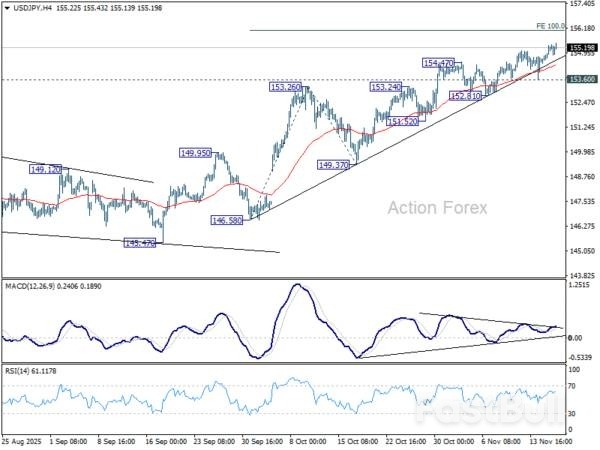
          In the bigger picture, current development suggests that corrective pattern from 161.94 (2024 high) has completed with three waves at 139.87. Larger up trend from 102.58 (2021 low) could be ready to resume through 161.94 high. On the downside, break of 149.37 support will dampen this bullish view and extend the corrective pattern with another falling leg.

          Source: ACTIONFOREX

          To stay updated on all economic events of today, please check out our Economic calendar
          Risk Warnings and Disclaimers
          You understand and acknowledge that there is a high degree of risk involved in trading. Following any strategies or investment methods may lead to potential losses. The content on the site is provided by our contributors and analysts for information purposes only. You are solely responsible for determining whether any trading assets, securities, strategy, or any other product is suitable for investing based on your own investment objectives and financial situation.
          Add to Favorites
          Share

          Stocks ‘Running Out of Time’ For a Year-End Rally Without Tech

          Adam

          Stocks

          Another brutal day on Wall Street has called into question whether US stocks can deliver during what is normally one of the strongest times of year.
          The main problem is with the high-flying technology stocks that have powered a 34% run in the S&P 500 since an April low. Their advance has stalled, leaving the market reliant on sectors more exposed to signs the economy is slowing and consumers are losing their mojo.
          The S&P 500 slid 0.9% Monday, pushing its drop in November to 2.5%. The index has gone 14 trading days without a record — itself hardly a cause for worry, but still the longest stretch since the 88 sessions between February and June, according to data compiled by Bloomberg. The Magnificent Seven tech stocks are off nearly 5% this month, with only Alphabet Inc. in the green. That group has accounted for virtually all of the market’s gain this year.
          The artificial intelligence trade has started to wobble as investors worry the amount of borrowing needed to fund its buildout will become a burden. Just Monday, Amazon.com Inc. tapped the credit market for $15 billion in a bond sale. The economy is showing signs of slowing, particularly in the labor market, and low-end consumers appear increasingly under pressure. With technical indicators also flashing warnings — both the S&P 500 and Nasdaq 100 closed below their average price for the past 50 days, for example — Wall Street strategists are questioning whether a year-end rally is in the cards.
          “We’re running out of time,” said Adam Turnquist, chief technical strategist at LPL Financial, adding that year-end rallies typically start at the beginning of November, not after a drawdown halfway through the month. He sees “more pain ahead,” as key indexes slide below key chart levels.
          The rest of the week is shaping up as critical for any run back toward all-time highs. Consumer giants like Walmart Inc., Home Depot Inc. and Target Corp. will deliver results and commentary on the looming holiday shopping period. Nvidia Corp. is the last of the big seven to give its business update. And government economic data, absent for the past seven weeks, will begin trickling out.
          For some analysts, though, the S&P 500 might’ve already notched its last high for the year.
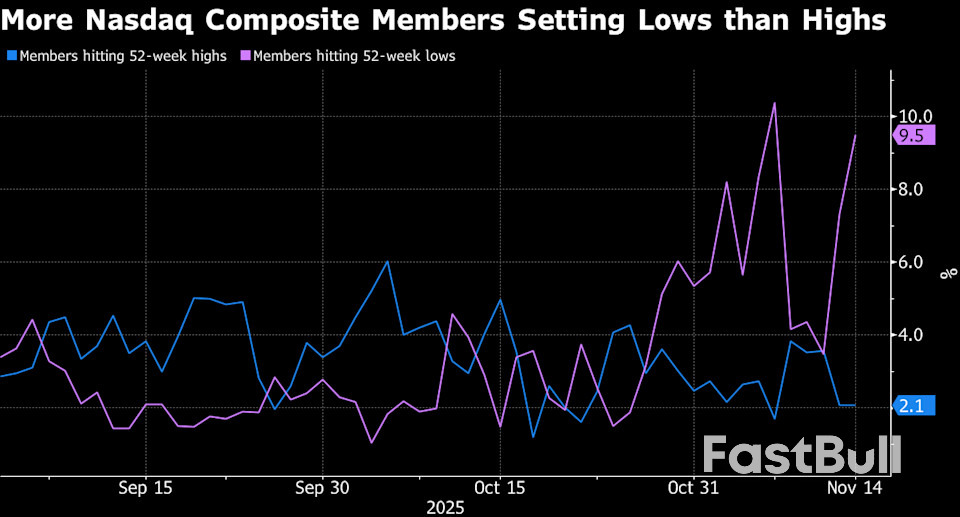
          John Roque, head of technical analysis at 22V Research, said some “ugly” technical signals are cause for concern. Among them: The number of Nasdaq Composite components hitting 52-week lows outnumbers those hitting highs.
          “There is no way a market can rally with new lows outnumbering new highs,” he said by phone.
          Moreover, he sees Facebook-owner Meta Platforms Inc. as the “bellwether for this correction” because it started falling before its peers and may need to “make a low” before the current retreat in the market ends. The company’s spending plans for AI have alarmed investors worried any profits from the investments are in the distant future. Meta fell again on Monday, declining 1.2% and is now down 24% from its August peak.
          Stocks ‘Running Out of Time’ For a Year-End Rally Without Tech_1
          Turnquist said he’s seen investor rotation not only out of large-cap tech names, but also unprofitable tech, Bitcoin, meme stocks and heavily shorted names as “we have this defensive tone that is developing in the market.”
          The rotation from those risky pockets into more defensive corners of the market began last week. The top-performing sector in the S&P 500 was health care, which Turnquist said has been the biggest beneficiary of the trade out of high-momentum sectors.
          “The US momentum factor is sitting on multi-month support here and flirting with a breakdown,” said Emily Roland and Matt Miskin, co-chief investment strategists at Manulife John Hancock Investments. They warned that market action over the last week looked like “the ‘sell America’ trade was back from April.”
          To be sure, 2025 can still go down as a banner year for stocks even without a normal rally through the holidays.
          The current rotation — which continued Monday with health care and utilities outperforming — “should unwind some of the frothiness built into the growth sectors,” said Sam Stovall, chief investment strategist at CFRA. The past two weeks have been turbulent as indexes have slumped, but right now, “hardly far enough to be labeled a pullback,” he said.
          Similarly, Ned Davis Research described the recent selloff as “contained enough” to keep prospects of a rally alive, but warned that “the longer the consolidation goes without reestablishing the uptrend, however, the higher the risk it evolves into a topping process.”

          source: Bloomberg

          Risk Warnings and Disclaimers
          You understand and acknowledge that there is a high degree of risk involved in trading. Following any strategies or investment methods may lead to potential losses. The content on the site is provided by our contributors and analysts for information purposes only. You are solely responsible for determining whether any trading assets, securities, strategy, or any other product is suitable for investing based on your own investment objectives and financial situation.
          Add to Favorites
          Share

          As data flow revives, Fed still faces a deep policy divide

          Adam

          Economic

          A divided U.S. Federal Reserve begins receiving updated economic reports from the now-reopened federal government this week as policymakers hope for clarity in their debate over whether to cut interest rates when they meet in just over three weeks.
          It remains unclear how much of the shutdown-delayed data on employment, inflation, retail spending, economic growth, and other aspects of the economy will be in hand by then. As of Monday, the Bureau of Labor Statistics said it would publish the delayed employment report for September on Thursday, but the White House has said some of the October reports may be skipped altogether, while data gathering for November may also be hampered by a shutdown that stretched to mid-month.
          But the lines of debate have been sharply drawn, and minutes of the Fed's October meeting to be released on Wednesday could provide more detail on the split that has emerged over whether the risk of higher inflation remains pronounced enough to delay rate cuts for now, or whether slowing job growth and looser monetary policy should take priority.
          "I am not worried about inflation accelerating or inflation expectations rising significantly," Fed Governor Christopher Waller said on Monday. "My focus is on the labor market, and after months of weakening, it is unlikely that the September jobs report later this week or any other data in the next few weeks would change my view that another cut is in order" when the Fed meets on December 9-10.
          Fed Vice Chair Philip Jefferson meanwhile said the central bank should go "slowly" given the benchmark interest rate, in the 3.75%-to-4.00% range, is likely nearing the level where it will no longer discourage economic activity and put downward pressure on inflation.
          Clear camps have formed within the central bank, with several Fed governors - all appointees of President Donald Trump - arguing for another cut, and several regional reserve bank presidents taking a hard line on inflation. Still, the intensity of those divisions may mask a narrower set of concerns about timing and the desire for more data to show a clearer direction for the economy.
          The Fed's approval of a quarter-percentage-point rate cut at the October 28-29 meeting included dissents in favor of both looser and tighter monetary policy, a rarity in recent decades. Afterward, Fed Chair Jerome Powell offered unusual, explicit guidance about the outcome of the December meeting.
          "There were strongly differing views about how to proceed in December. A further reduction in the policy rate at the December meeting is not a foregone conclusion - far from it," Powell said using language that pointed to a compromise with the policymakers most concerned about inflation.
          'GROWING CHORUS' FAVORS NO CUT IN DECEMBER
          Those remarks and other recent data have shifted market bets away from a December cut that previously had been given high odds. Policymaker projections in September showed officials themselves anticipated the benchmark interest rate would end the year in the 3.50%-to-3.75% range, a quarter-point below where it is now.
          Yet that outlook already showed the sharp division emerging, and some officials since then have intensified their concerns about higher inflation.
          "We've got this persistent high inflation that is sticking around. When all is said and done it will be the better part of a decade," said Cleveland Fed President Beth Hammack, among three regional presidents who will take on voting roles next year and who have been among the more strident recently on the need to not rush further cuts because of inflation risks. "Getting (inflation) back to 2% is critical to our credibility," she told MarketWatch in an interview last week.
          The array of opinions and the potential gaps in official data pose a challenge for Powell in molding a consensus. Even if some dissents may be unavoidable, possible points of compromise include approving a rate cut at the December meeting but indicating that a pause is likely to follow, or pausing in December but pointing to likely further cuts depending on incoming data.
          Officials will issue new quarterly projections at the December meeting that could help reinforce either approach.
          The pace of the federal government's data catch-up could also matter. While U.S. central bankers feel they have enough ways to monitor the economy to make a decision, a full suite of catch-up reports could boost their confidence in whatever decision is made.
          Even that may fall short of what's needed to produce consensus in a body also facing a leadership transition, with Powell's term as chair ending in May and two of the sitting governors on a short list of possible Trump nominees to replace him.
          Some of the forces shaping the job market and inflation, meanwhile, have not been in place long enough for Fed officials to fully understand them. They have little certainty over whether slow job growth is part of the normal business cycle, a product of stricter immigration policy, an outgrowth of weakening demand due to tariffs and inflation, or the first signs artificial intelligence is changing staffing needs.
          What policymakers do see clearly right now is that inflation has not changed much in a year and remains about a percentage point above their 2% target.
          "A growing chorus of hawks, centrists and even previously dovish FOMC participants appear assured that the data is not likely to justify a rate cut," SGH Macro Advisors Chief U.S. Economist Tim Duy wrote. "We think they want convincing evidence that inflation will return to target," likely pushing any further cuts into next year.

          Source: Reuters

          To stay updated on all economic events of today, please check out our Economic calendar
          Risk Warnings and Disclaimers
          You understand and acknowledge that there is a high degree of risk involved in trading. Following any strategies or investment methods may lead to potential losses. The content on the site is provided by our contributors and analysts for information purposes only. You are solely responsible for determining whether any trading assets, securities, strategy, or any other product is suitable for investing based on your own investment objectives and financial situation.
          Add to Favorites
          Share

          Trump’s Focus on Race Backfires as Voters Punish Economic Failings

          Warren Takunda

          Stocks

          Donald Trump’s 2024 campaign strategy leaned heavily on two sources of grievance among the Maga base. The first was the rising cost of living, propelled by the sharp burst of inflation that peaked at 9% a year in July 2022. Though inflation had receded to 2.7% by election day, frustration over prices convinced many voters that Trump would be a superior steward of the economy. The other theme was race.
          The strategy won the presidency. Then, Trump made a mistake: focusing relentlessly on hostility towards immigrants and the diverse citizens of urban America, the president pretty much ignored – nay, worsened – his supporters’ economic woes. In elections earlier this month, US economic grievances came back to bite him. Pummeled by voters, Trump is now trying to recover his economic narrative. But it may be too late.
          Ever since Trump launched his first successful run at the presidency in 2016, he has branded himself as a champion of a beleaguered white US working class that feels out of place in an increasingly diverse nation. In 2016, he branded Mexican immigrants as rapist thugs. In 2020, he suggested white suburban women needed his protection from violent urban minorities. In 2024, he kicked off the last week of his campaign at Madison Square Garden in New York City, promising to launch the “largest deportation program in American history to get these criminals out” and to get critical race theory “the hell out of our schools”.
          The focus on race probably fits Trump’s worldview better. When he was born, about 10% of Americans were non-white, compared to about 40% today. In his heart, he probably agrees that the beloved white America of his youth is under siege. He shares the fearful gaze with which some of his base look upon the multi-ethnic pot that urban America has become.
          Politically, Trump’s emphasis on race is not misplaced. There is abundant evidence that white Americans’ ethnic hostility has played a key role shaping American politics and its institutions. Work years ago by the economists Alberto Alesina, Edward Glaeser and Bruce Sacerdote concluded that racial barriers – fear, contempt, mistrust – are a big reason the United States did not develop the rich safety net that the more ethnically homogeneous democracies of western Europe built to protect their people from economic calamities. Indeed, when he started building the American safety net, FDR tailored New Deal programs to exclude Black Americans in order to get white southern Democrats onboard. On the day he signed the Civil Rights Act into law, President Lyndon Johnson, a southern Democrat, adroitly observed to his aide Bill Moyers: “I think we may have lost the south for your lifetime – and mine.”
          In any event, ethnic resentment has become the central focus of Trump’s domestic policy. The Department of Homeland Security’s violent deportation tactics and the deployment of the national guard to big cities (not coincidentally run by Democrats) are proposed as strategies to combat rampant immigrant crime. The high-profile attacks against universities for their diversity, equity and inclusion (DEI) programs are justified as a defense of white Americans from unjust policies depriving them of their due. Federal government agencies have been ordered to do away with all efforts to promote DEI. Cities, the most ethnically and culturally diverse ecosystems in America, are portrayed as dystopian cauldrons of unrest.
          Trump seems not only to have forgotten his promises on the economy, he also appears to enjoy stoking Americans’ economic anxieties. His array of tariffs against friend and foe has slowed the economy, stalling employment growth while it raises the prices of key necessities. His decision to end subsidies for health insurance plans under Obamacare will drastically raise premiums for millions of Americans. And there is probably no better strategy than ending Snap food assistance payments – as he did during the government shutdown–to deepen the economic misery of the poor.
          Many of his voters are increasingly unhappy. Last week the University of Michigan reported a sharp decline in its index of consumer sentiment to near its historical lows. Other than people with very large equity portfolios enjoying the ride in tech stocks, everybody is feeling more miserable. So it is perhaps not surprising that voters’ economic grievances are now coming back to bite him. Trump’s approval rating is tanking, driven down most precipitously by disapproval of his handling of inflation, the economy and employment.
          The special elections earlier this month in which Democrats swept the races for mayor of New York City and governors of Virginia and New Jersey, comfortably pushing through a redistricting plan in California that may cost Republicans five seats in the House – provided a sharp reminder of what is at stake. Discontent is seeping beyond Blue America and on to Trump’s turf. On 4 November it translated into Democratic wins in races for state legislatures, county executives and other offices in redder constituencies from Mississippi to Georgia to Virginia and Pennsylvania.
          On Truth Social Trump was adamant that “TRUMP WASN’T ON THE BALLOT, AND SHUTDOWN, WERE THE TWO REASONS THAT REPUBLICANS LOST ELECTIONS TONIGHT.” But he does seem aware of the political fallout from his economic policies: on Friday, he tried to engineer lower food prices by ending tariffs he had imposed, he has suggested a much-ridiculed 50-year mortgage to address housing affordability and floated a $2,000 tax rebate funded by the tariffs Americans have already paid.
          While Trump may have changed tack, in an echo of what happened to Joe Biden, voters living the reality of a moribund economy may find it harder to forget Trump claiming “we have no inflation” especially as Democrats replay that message again and again in their fight to recover the House in midterm elections next year.
          Racial hostility is, for sure, a central driver of American politics. Its importance will probably grow as a shrinking white share of the population leads a scared Maga coalition to circle the wagons ever more tightly. But it seems evident today that stoking Americans’ racial grievances will not be enough for Trump to cling to power. He had to deliver on the economy too. And he hasn’t.

          Source: Theguardian

          Risk Warnings and Disclaimers
          You understand and acknowledge that there is a high degree of risk involved in trading. Following any strategies or investment methods may lead to potential losses. The content on the site is provided by our contributors and analysts for information purposes only. You are solely responsible for determining whether any trading assets, securities, strategy, or any other product is suitable for investing based on your own investment objectives and financial situation.
          Add to Favorites
          Share

          As Data Flow Revives, Fed Still Faces A Deep Policy Divide

          Glendon

          Forex

          Economic

          A divided U.S. Federal Reserve begins receiving updated economic reports from the now-reopened federal government this week as policymakers hope for clarity in their debate over whether to cut interest rates when they meet in just over three weeks.

          It remains unclear how much of the shutdown-delayed data on employment, inflation, retail spending, economic growth, and other aspects of the economy will be in hand by then. As of Monday, the Bureau of Labor Statistics said it would publish the delayed employment report for September on Thursday, but the White House has said some of the October reports may be skipped altogether, while data gathering for November may also be hampered by a shutdown that stretched to mid-month.

          But the lines of debate have been sharply drawn, and minutes of the Fed's October meeting to be released on Wednesday could provide more detail on the split that has emerged over whether the risk of higher inflation remains pronounced enough to delay rate cuts for now, or whether slowing job growth and looser monetary policy should take priority.

          "I am not worried about inflation accelerating or inflation expectations rising significantly," Fed Governor Christopher Waller said on Monday. "My focus is on the labor market, and after months of weakening, it is unlikely that the September jobs report later this week or any other data in the next few weeks would change my view that another cut is in order" when the Fed meets on December 9-10.

          Fed Vice Chair Philip Jefferson meanwhile said the central bank should go "slowly" given the benchmark interest rate, in the 3.75%-to-4.00% range, is likely nearing the level where it will no longer discourage economic activity and put downward pressure on inflation.

          Clear camps have formed within the central bank, with several Fed governors - all appointees of President Donald Trump - arguing for another cut, and several regional reserve bank presidents taking a hard line on inflation. Still, the intensity of those divisions may mask a narrower set of concerns about timing and the desire for more data to show a clearer direction for the economy.

          The Fed's approval of a quarter-percentage-point rate cut at the October 28-29 meeting included dissents in favor of both looser and tighter monetary policy, a rarity in recent decades. Afterward, Fed Chair Jerome Powell offered unusual, explicit guidance about the outcome of the December meeting.

          "There were strongly differing views about how to proceed in December. A further reduction in the policy rate at the December meeting is not a foregone conclusion - far from it," Powell said using language that pointed to a compromise with the policymakers most concerned about inflation.

          'GROWING CHORUS' FAVORS NO CUT IN DECEMBER

          Those remarks and other recent data have shifted market bets away from a December cut that previously had been given high odds. Policymaker projections in September showed officials themselves anticipated the benchmark interest rate would end the year in the 3.50%-to-3.75% range, a quarter-point below where it is now.

          Yet that outlook already showed the sharp division emerging, and some officials since then have intensified their concerns about higher inflation.

          "We've got this persistent high inflation that is sticking around. When all is said and done it will be the better part of a decade," said Cleveland Fed President Beth Hammack, among three regional presidents who will take on voting roles next year and who have been among the more strident recently on the need to not rush further cuts because of inflation risks. "Getting (inflation) back to 2% is critical to our credibility," she told MarketWatch in an interview last week.

          The array of opinions and the potential gaps in official data pose a challenge for Powell in molding a consensus. Even if some dissents may be unavoidable, possible points of compromise include approving a rate cut at the December meeting but indicating that a pause is likely to follow, or pausing in December but pointing to likely further cuts depending on incoming data.

          Officials will issue new quarterly projections at the December meeting that could help reinforce either approach.

          The pace of the federal government's data catch-up could also matter. While U.S. central bankers feel they have enough ways to monitor the economy to make a decision, a full suite of catch-up reports could boost their confidence in whatever decision is made.

          Even that may fall short of what's needed to produce consensus in a body also facing a leadership transition, with Powell's term as chair ending in May and two of the sitting governors on a short list of possible Trump nominees to replace him.

          Some of the forces shaping the job market and inflation, meanwhile, have not been in place long enough for Fed officials to fully understand them. They have little certainty over whether slow job growth is part of the normal business cycle, a product of stricter immigration policy, an outgrowth of weakening demand due to tariffs and inflation, or the first signs artificial intelligence is changing staffing needs.

          What policymakers do see clearly right now is that inflation has not changed much in a year and remains about a percentage point above their 2% target.

          "A growing chorus of hawks, centrists and even previously dovish FOMC participants appear assured that the data is not likely to justify a rate cut," SGH Macro Advisors Chief U.S. Economist Tim Duy wrote. "We think they want convincing evidence that inflation will return to target," likely pushing any further cuts into next year.

          Source: Kitco

          To stay updated on all economic events of today, please check out our Economic calendar
          Risk Warnings and Disclaimers
          You understand and acknowledge that there is a high degree of risk involved in trading. Following any strategies or investment methods may lead to potential losses. The content on the site is provided by our contributors and analysts for information purposes only. You are solely responsible for determining whether any trading assets, securities, strategy, or any other product is suitable for investing based on your own investment objectives and financial situation.
          Add to Favorites
          Share

          Silver faces fifth annual supply deficit as industrial demand slumps but investment surges - Silver Institute

          Adam

          Commodity

          A slowing economy is taking its toll on silver’s industrial consumption, with demand expected to fall by 4%; however, demand won’t fall enough to reset the current imbalance in the marketplace.
          Last week, the Silver Institute reiterated its outlook that silver will see its fifth annual supply deficit of 95 million ounces. Although the deficit is significantly less than last year’s, analysts noted that it is still enough to support prices at record highs.
          Although silver has twice been unable to hold gains above $54 an ounce, the selling pressure has been limited. Spot silver last traded at $50.75 an ounce, and prices are up nearly 76% so far this year.
          While industrial demand has been weak, the survey shows that investment demand has more than made up for the drop. Philip Newman, Managing Director at Metals Focus, the British research firm behind the annual Silver Survey, said that inflows into exchange-traded funds (ETFs) have increased by 187 million ounces so far this year.
          “This reflects investor concerns over stagflation, the Federal Reserve’s independence, government debt sustainability, the US dollar’s role as a safe haven, and geopolitical risks. Silver’s exceptional price performance and its favorable supply-demand backdrop have further reinforced investor confidence,” Newman said in his note.
          Looking beyond investment demand, industrial consumption is expected to fall to 665 million ounces this year, down 2% from last year.
          “This reflects the impact of global economic uncertainty stemming from tariff policies and geopolitical tensions, as well as a more rapid pace of thrifting due to soaring silver prices. In photovoltaics (PV), global installations are set for a new record high. However, due to a sharp drop in the amount of silver used in each module, PV silver demand is forecast to ease by around 5% y/y,” the report said.
          Metals Focus wrote in the updated report that they expect silver jewelry and silverware demand to decline by 4% and 11%, respectively, this year.
          Finally, silver bar and coin demand is expected to fall by 4% to a seven-year low of 182 million ounces.
          “This is a result of weakness in the US market, which is offsetting gains in the other key markets of India, Germany, and Australia. Despite a recent uptick in US demand, for much of 2025, the US has had to contend with sizable retail investor liquidations. In contrast, Indian investors have bought into rising local prices, expecting further upside in 2025,” the report said.
          The silver market has seen significant supply chain disruptions this year, as physical metal has been trapped in the wrong location and in the wrong form. At the start of the year, significant amounts of silver flowed into the US as bullion banks and other market players built a stockpile to avoid potential tariffs.
          Although the US government has said that precious metals, including silver, are exempt from tariffs, the metal has remained in New York due to concerns it could still face import taxes, as it has also been declared a critical metal.
          New York vaults are overflowing with silver, and refiners are at capacity when it comes to recycling the metal. Buyback premiums for scrap silver are significantly lower in North America because of the glut.
          Meanwhile, in London, growing demand from India and rising investment demand in ETFs have created significant tightness in the local marketplace, driving lease rates to record highs. Although some metal has flowed back into London chasing higher premiums, analysts note that silver will continue to face supply chain challenges as supply struggles to keep up with demand.
          In an interview with Kitco News, Matthew Piggott, Director of Gold and Silver at Metals Focus, said there are expectations for silver to experience annual supply deficits for the foreseeable future.
          He added that global consumption would have to fall significantly to rebalance the market.

          Source: kitco

          Risk Warnings and Disclaimers
          You understand and acknowledge that there is a high degree of risk involved in trading. Following any strategies or investment methods may lead to potential losses. The content on the site is provided by our contributors and analysts for information purposes only. You are solely responsible for determining whether any trading assets, securities, strategy, or any other product is suitable for investing based on your own investment objectives and financial situation.
          Add to Favorites
          Share

          Thaksin Faces Revived Royal Insult Case And $542 Million Tax Bill

          Justin

          Political

          Economic

          Thailand's former Prime Minister Thaksin Shinawatra faces renewed legal troubles after prosecutors moved to appeal his acquittal in a royal defamation case and the country's top court separately ordered him to pay hundreds of millions of dollars in back taxes.

          The Supreme Court reinstated a tax penalty over Thaksin's 2006 sale of his telecom company Shin Corp. to Singapore's Temasek Holdings Pte, overturning earlier rulings that had voided the Revenue Department's claim, Lavaron Sangsnit, Finance Ministry's permanent secretary, confirmed Tuesday.

          The Office of the Attorney-General, meanwhile, has decided to challenge a lower court's August ruling that cleared Thaksin of lese majeste charges stemming from a 2015 interview with a South Korean newspaper, the Bangkok Post reported.

          The twin legal setbacks mark the latest twist in the long-running saga of Thaksin, the billionaire ex-premier who has played a key role shaping Thailand's politics since the early 2000s. The cases highlight his waning yet enduring influence on the nation's power structure.

          His lawyers didn't immediately respond to a request for comment. The Supreme Court hasn't published Thaksin's tax case on its website.

          Shin Corp.'s $1.9 billion sale — executed without any tax payment — triggered widespread street protests that ultimately led to Thaksin's ouster in a military coup. This week's 17.6 billion baht ($542 million) tax bill essentially revives a long-standing dispute over unpaid personal income tax and allows enforcement proceedings to resume.

          Shin Corp. merged with Gulf Energy Development earlier this year.

          Thaksin is currently serving a one-year prison sentence that began on Sept. 9, after the top court ruled that his six-month stay in a police hospital in 2023 didn't count as time served.

          Source: Bloomberg Europe

          To stay updated on all economic events of today, please check out our Economic calendar
          Risk Warnings and Disclaimers
          You understand and acknowledge that there is a high degree of risk involved in trading. Following any strategies or investment methods may lead to potential losses. The content on the site is provided by our contributors and analysts for information purposes only. You are solely responsible for determining whether any trading assets, securities, strategy, or any other product is suitable for investing based on your own investment objectives and financial situation.
          Add to Favorites
          Share
          FastBull
          Copyright © 2025 FastBull Ltd

          728 RM B 7/F GEE LOK IND BLDG NO 34 HUNG TO RD KWUN TONG KLN HONG KONG

          TelegramInstagramTwitterfacebooklinkedin
          App Store Google Play Google Play
          Products
          Charts

          Chats

          Q&A with Experts
          Screeners
          Economic Calendar
          Data
          Tools
          Membership
          Features
          Function
          Markets
          Copy Trading
          Latest Signals
          Contests
          News
          Analysis
          24/7
          Columns
          Education
          Company
          Careers
          About Us
          Contact Us
          Advertising
          Help Center
          Feedback
          User Agreement
          Privacy Policy
          Business

          White Label

          Data API

          Web Plug-ins

          Poster Maker

          Affiliate Program

          Risk Disclosure

          The risk of loss in trading financial instruments such as stocks, FX, commodities, futures, bonds, ETFs and crypto can be substantial. You may sustain a total loss of the funds that you deposit with your broker. Therefore, you should carefully consider whether such trading is suitable for you in light of your circumstances and financial resources.

          No decision to invest should be made without thoroughly conducting due diligence by yourself or consulting with your financial advisors. Our web content might not suit you since we don't know your financial conditions and investment needs. Our financial information might have latency or contain inaccuracy, so you should be fully responsible for any of your trading and investment decisions. The company will not be responsible for your capital loss.

          Without getting permission from the website, you are not allowed to copy the website's graphics, texts, or trademarks. Intellectual property rights in the content or data incorporated into this website belong to its providers and exchange merchants.

          Not Logged In

          Log in to access more features

          FastBull Membership

          Not yet

          Purchase

          Become a signal provider
          Help Center
          Customer Service
          Dark Mode
          Price Up/Down Colors

          Log In

          Sign Up

          Position
          Layout
          Fullscreen
          Default to Chart
          The chart page opens by default when you visit fastbull.com