

Markets
News
Analysis
User
24/7
Economic Calendar
Education
Data
- Names
- Latest
- Prev



Signal Accounts for Members
All Signal Accounts
All Contests
 U.K. Trade Balance (Oct)
A:--
F: --
P: --
U.K. Services Index MoMA:--
F: --
P: --
U.K. Construction Output MoM (SA) (Oct)A:--
F: --
P: --
U.K. Industrial Output YoY (Oct)A:--
F: --
P: --
U.K. Trade Balance (SA) (Oct)A:--
F: --
P: --
U.K. Trade Balance EU (SA) (Oct)A:--
F: --
P: --
U.K. Manufacturing Output YoY (Oct)A:--
F: --
P: --
U.K. GDP MoM (Oct)A:--
F: --
P: --
U.K. GDP YoY (SA) (Oct)A:--
F: --
P: --
U.K. Industrial Output MoM (Oct)A:--
F: --
P: --
U.K. Construction Output YoY (Oct)A:--
F: --
P: --
 France HICP Final MoM (Nov)
A:--
F: --
P: --
 China, Mainland Outstanding Loans Growth YoY (Nov)
A:--
F: --
P: --
China, Mainland M2 Money Supply YoY (Nov)A:--
F: --
P: --
China, Mainland M0 Money Supply YoY (Nov)A:--
F: --
P: --
China, Mainland M1 Money Supply YoY (Nov)A:--
F: --
P: --
 India CPI YoY (Nov)
A:--
F: --
P: --
India Deposit Gowth YoYA:--
F: --
P: --
 Brazil Services Growth YoY (Oct)
A:--
F: --
P: --
 Mexico Industrial Output YoY (Oct)
A:--
F: --
P: --
 Russia Trade Balance (Oct)
A:--
F: --
P: --
 Philadelphia Fed President Henry Paulson delivers a speech
 Canada Building Permits MoM (SA) (Oct)
A:--
F: --
P: --
Canada Wholesale Sales YoY (Oct)A:--
F: --
P: --
Canada Wholesale Inventory MoM (Oct)A:--
F: --
P: --
Canada Wholesale Inventory YoY (Oct)A:--
F: --
P: --
Canada Wholesale Sales MoM (SA) (Oct)A:--
F: --
P: --
 Germany Current Account (Not SA) (Oct)
A:--
F: --
P: --
U.S. Weekly Total Rig CountA:--
F: --
P: --
U.S. Weekly Total Oil Rig CountA:--
F: --
P: --
 Japan Tankan Large Non-Manufacturing Diffusion Index (Q4)
--
F: --
P: --
Japan Tankan Small Manufacturing Outlook Index (Q4)--
F: --
P: --
Japan Tankan Large Non-Manufacturing Outlook Index (Q4)--
F: --
P: --
Japan Tankan Large Manufacturing Outlook Index (Q4)--
F: --
P: --
Japan Tankan Small Manufacturing Diffusion Index (Q4)--
F: --
P: --
Japan Tankan Large Manufacturing Diffusion Index (Q4)--
F: --
P: --
Japan Tankan Large-Enterprise Capital Expenditure YoY (Q4)--
F: --
P: --
U.K. Rightmove House Price Index YoY (Dec)--
F: --
P: --
China, Mainland Industrial Output YoY (YTD) (Nov)--
F: --
P: --
China, Mainland Urban Area Unemployment Rate (Nov)--
F: --
P: --
 Saudi Arabia CPI YoY (Nov)
--
F: --
P: --
 Euro Zone Industrial Output YoY (Oct)
--
F: --
P: --
Euro Zone Industrial Output MoM (Oct)--
F: --
P: --
Canada Existing Home Sales MoM (Nov)--
F: --
P: --
Euro Zone Total Reserve Assets (Nov)--
F: --
P: --
U.K. Inflation Rate Expectations--
F: --
P: --
Canada National Economic Confidence Index--
F: --
P: --
Canada New Housing Starts (Nov)--
F: --
P: --
U.S. NY Fed Manufacturing Employment Index (Dec)--
F: --
P: --
U.S. NY Fed Manufacturing Index (Dec)--
F: --
P: --
Canada Core CPI YoY (Nov)--
F: --
P: --
Canada Manufacturing Unfilled Orders MoM (Oct)--
F: --
P: --
Canada Manufacturing New Orders MoM (Oct)--
F: --
P: --
Canada Core CPI MoM (Nov)--
F: --
P: --
Canada Manufacturing Inventory MoM (Oct)--
F: --
P: --
Canada CPI YoY (Nov)--
F: --
P: --
Canada CPI MoM (Nov)--
F: --
P: --
Canada CPI YoY (SA) (Nov)--
F: --
P: --
Canada Core CPI MoM (SA) (Nov)--
F: --
P: --
Canada CPI MoM (SA) (Nov)--
F: --
P: --


No matching data

Latest Views
Latest Views
Trending Topics
Top Columnists
Latest Update
White Label
Data API
Web Plug-ins
Affiliate Program
View All
No data
Economists are watching retail sales as an important signal on whether consumer fears about President Donald Trump’s tariffs are making them hesitant to spend money.
Much of the world was caught off guard when amid an avalanche of multiple US-Gulf deals worth hundreds of billions of dollars each being signed Wednesday, President Trump not only announced that he is lifting all sanctions on Syria, but even met in-person with US-designated terrorist and Syrian President Ahmed al-Sharaa (Jolani) in the Saudi capital.
Apparently even the State Department and US Treasury departments were caught off guard. Trump's move to lift sanctions on Syria "took many by surprise," including his own officials at State and Treasury, according to Reuters.
"In Washington, senior officials at the State Department and Treasury Department scrambled to understand how to cancel the sanctions, many of which have been in place for decades … The White House had issued no memorandum or directive to State or Treasury sanctions officials to prepare for the unwinding and didn’t alert them that the president’s announcement was imminent," several senior US officials anonymously told publication.
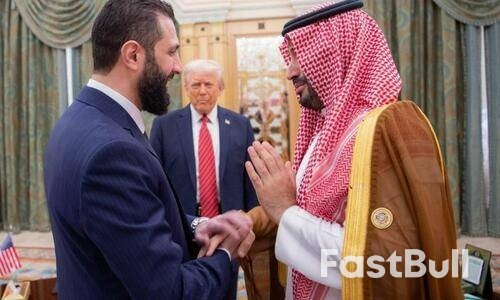 Via Office of the Syrian Presidency
"Officials were confused about exactly how the administration would unwind the layers of sanctions, which ones were being eased and when the White House wanted to begin the process," they added while emphasizing that top officials were "caught off guard."
"Everyone is trying to figure out how to implement it," Reuters cited the officials as saying. Legally and procedurally, the removal of the sanctions will be a process which could take weeks or even months.
Meanwhile there are reports saying the Syrian Pound (SYP) jumped 30% quickly upon Trump's announcement. The local currency has experienced runaway inflation, and people have to lug huge bricks of cash around to purchase simple items like eggs or medicines.
Syrians have further endured rolling blackouts and lack of resources, or even fuel, for years amid the US-sanctions regimen which was geared toward regime change. But now...
The streets of Syria were a carnival of car horns, fireworks and flags after President Donald Trump made the surprise announcement that the United States would lift sanctions that have throttled the country’s economy for more than 45 years.
Trump stunned even close observers on Tuesday by saying he wants to normalize relations after Syria’s longtime president, Bashar al Assad, was toppled in December. Trump met Wednesday with Assad’s successor, interim President Ahmad al-Sharaa, a former leader of an al-Qaeda offshoot group, in Saudi Arabia after urging him late Tuesday to “show us something special.”
Trump said he wanted to give Syrians a 'fresh start' - and indeed this could be the start of an economic turnaround after years of brutal proxy war.
With Assad having been overthrown, the Saudis and Qataris are also stepping in to cover national debt and prop up public sector salaries.
Ultimately, Washington and the Gulf monarchies got their desired regime change in Syria. It was never about "democracy" or the Syrian people at all. The brutality of the sanctions, which compounded the common mysery, proves that - as some US officials are now openly admitting.
But this sick policy of the Washington blob is nothing really new...
Israeli military strikes killed at least 85 people in the Gaza Strip on Thursday, Palestinian medics said, as the United States and Arab mediators pushed for a ceasefire deal and U.S. President Donald Trump visited the Middle East.
Most of the victims, including women and children, were killed in Khan Younis in southern Gaza in airstrikes that hit homes and tents, they said.
The dead included journalist Hassan Samour, who worked for the Hamas-run Aqsa radio station and was killed along with 11 family members when their home was hit, the medics said.
The Israeli military said its air force had struck 130 targets used by militant groups in Gaza over the past two days.
Israel has intensified its offensive in Gaza as it tries to eradicate Hamas in retaliation for the deadly attacks the Palestinian militant group carried out on Israel in 2023.
In Jabalia in the northern Gaza Strip, the health ministry said an Israeli strike on Al-Tawba medical clinic killed at least 15 people and wounded several others. It took Thursday's death toll to 85, medics said.
Hamas said in a statement that Israel was making a "desperate attempt to negotiate under cover of fire" as indirect ceasefire talks take place, also involving Trump envoys and Qatar and Egyptian mediators in Doha.
Palestinians on Thursday commemorated the "Nakba", or catastrophe, when hundreds of thousands fled or were forced to flee their towns and villages during the 1948 war that gave birth to Israel.
"What we are experiencing now is even worse than the Nakba of 1948," said Ahmed Hamad, a Palestinian in Gaza City who has been displaced several times.
"The truth is, we live in a constant state of violence and displacement. Wherever we go, we face attacks. Death surrounds us everywhere."
Palestinian health officials say the Israeli attacks have escalated since Trump started a visit on Tuesday to the Gulf states of Saudi Arabia, Qatar and the United Arab Emirates, which many Palestinians had hoped he would use to push for a truce.
Attacks on Gaza on Wednesday killed at least 80 people, local health officials said.
Little has come of the indirect ceasefire talks.
Hamas says it is ready to free all the remaining hostages it is holding in Gaza in return for an end to the war, while Israeli Prime Minister Benjamin Netanyahu prefers interim truces, saying the war can only end once Hamas is eradicated.
Israel invaded Gaza in retaliation for the Hamas-led attack on southern Israeli communities on October 7, 2023, in which about 1,200 people were killed and 251 were taken as hostages to Gaza, according to Israeli tallies.
Israel's campaign has killed more than 52,900 Palestinians, according to local health officials. It has left Gaza on the brink of famine, aid groups and international agencies say.
A U.S.-backed humanitarian organisation will start work in Gaza by the end of May under an aid distribution plan, but has asked Israel to let the United Nations and others resume deliveries to Palestinians now until it is set up.
No humanitarian assistance has been delivered to Gaza since March 2, and a global hunger monitor has warned that half a million people face starvation in Gaza.
Hamas said it had expected that aid would flow back into Gaza after it freed American-Israeli soldier Edan Alexander on Monday from captivity in Gaza, according to what it said was an understanding reached with U.S. officials.
"Failing to achieve these steps, and specially allowing humanitarian aid for our people, will cast negative shadows over efforts to conclude prisoner swap negotiation," said Hamas.
During his first 15 years at Qatar Investment Authority, Mohammed Al Sowaidi helped establish its US presence and scout opportunities. Now, as head of the $524 billion state-backed entity, he’s pledging to invest an amount nearly equal to the fund’s current size, as part of a major commitment by the Gulf nation.
QIA plans to invest an additional $500 billion in the US over the next decade, Al Sowaidi said in an interview in Doha. The sweeping new outlays will target areas traditionally favored by the fund — such as artificial intelligence, data centers and health care — while also aligning with President Donald Trump’s agenda to reindustrialize the US, he said.
The $500 billion accounts for nearly half of the total $1.2 trillion economic pledge by Qatar during Trump’s visit this week.
“We’re not shifting away from other markets — we’re increasing our exposure to the US,” Al Sowaidi said. The current US policy environment offers a “more promising direction” for long-term capital, he said.
To be sure, the QIA is not alone in pursuing an aggressive, US-focused investment strategy among Middle East funds. Saudi Arabia’s Public Investment Fund, state-owned entities in the United Arab Emirates, and the Kuwait Investment Authority are also looking to deploy billions across similar sectors — raising the likelihood of competition for the same deals and the risk of overpaying for assets.
Al Sowaidi took over as the chief executive officer last year during a pivotal moment for the fund, with an expansion of the country’s gas projects expected to funnel billions of dollars into its coffers. At the same time, Doha is no longer hamstrung by outlays for large projects like the 2022 FIFA World Cup, which is estimated to have cost $300 billion.
With fresh inflows expected, Al Sowaidi plans to steer the fund toward providing capital to large companies, taking stakes in listed businesses and prioritizing bigger deals.
That marks a departure from the QIA’s recent focus on smaller venture capital deals. Still, Al Sowaidi said the move isn’t “an actual strategic shift or pivot,” but rather a “further evolution” of the fund’s approach to keep pace with rapid global change.
The QIA is already the world’s eighth-largest sovereign wealth fund and owns a string of high-profile assets including London’s Harrods department store and the Shard skyscraper. But after years of relatively quiet dealmaking, Al Sowaidi’s plans show the fund is ready to be back in the spotlight.
Al Sowaidi joined the QIA in 2010, when it was led by Sheikh Hamad bin Jassim bin Jaber Al Thani, a former prime minister who’s widely regarded as among the most high-profile investors in the Middle East. Sheikh Hamad was ultimately replaced at the QIA by Ahmed Al-Sayed, who helped orchestrate large deals including Glencore Plc’s $29 billion takeover of Xstrata Plc.
Al Sowaidi, for his part, spent most of his early years at the fund in the Americas, where he helped establish a US office and eventually worked his way up to become chief investment officer for the region.
He holds bachelor’s degrees in finance and statistics from the University of Missouri, and has held roles including as the head of private equity funds and president of the QIA Advisory office in New York. The QIA was then known for its work in snapping up high-profile stakes in the likes of Barclays Plc and Credit Suisse.
Qatar is already one of the world’s richest nations and among the top exporters of liquefied natural gas. But the government’s plans to significantly expand that output is set to add more than $30 billion a year to state revenues.
Some of this cash will be funneled into the QIA. The research consultancy Global SWF recently projected the QIA’s total assets will surge to $905 billion by 2030, meaning it would be vaulted into the ranks of other high-profile investors across the region like Saudi Arabia’s PIF and the Abu Dhabi Investment Authority.
The QIA is already positioning itself to prepare for significant outlays.
Al Sowaidi said the fund typically takes minority stakes in successful businesses, with deal size varying widely by asset class. “In public equity, we can go big,” he said.
“In private equity, we’re capable of multibillion-dollar transactions, but we can also stay nimble — especially in sectors like technology or health care.”
Such a move would be welcome news for the private equity industry. For years, high interest rates have put a damper on global dealmaking. When private equity firms aren’t able to sell their portfolio companies at a healthy pace, they can’t return capital to their investors. Then that money can’t be recycled into new funds.
The QIA’s efforts in that space would help get fundraising moving for the industry again — and make up for the pullback that’s expected from the $925 billion PIF, which has started to increasingly focus on domestic investments.
Already, financial firms are eager for the chance to work more closely with the QIA. Eduardo Saverin’s B Capital, for instance, unveiled plans to set up offices in Qatar earlier this year. Days later, BlackRock Inc.’s Global Infrastructure Partners, said it would set up in Doha too.
Those outside Doha will get more insight into Al Sowaidi’s thinking next week, when he speaks at the annual Qatar Economic Forum, where top finance executives from around the world and key names from Trump’s orbit — including his son Eric and Tesla Inc.’s Elon Musk — are scheduled to speak.
Doha had until recently largely stayed away from the race for regional financial dominance, even as a flurry of Wall Street firms announced plans to set up their regional headquarters in Riyadh and hedge funds flocked to Abu Dhabi.
But Al Sowaidi’s plans show the gas-rich nation is intensifying efforts to catch up.
728 RM B 7/F GEE LOK IND BLDG NO 34 HUNG TO RD KWUN TONG KLN HONG KONG


White Label
Data API
Web Plug-ins
Poster Maker
Affiliate Program
The risk of loss in trading financial instruments such as stocks, FX, commodities, futures, bonds, ETFs and crypto can be substantial. You may sustain a total loss of the funds that you deposit with your broker. Therefore, you should carefully consider whether such trading is suitable for you in light of your circumstances and financial resources.
No decision to invest should be made without thoroughly conducting due diligence by yourself or consulting with your financial advisors. Our web content might not suit you since we don't know your financial conditions and investment needs. Our financial information might have latency or contain inaccuracy, so you should be fully responsible for any of your trading and investment decisions. The company will not be responsible for your capital loss.
Without getting permission from the website, you are not allowed to copy the website's graphics, texts, or trademarks. Intellectual property rights in the content or data incorporated into this website belong to its providers and exchange merchants.
Not Logged In
Log in to access more features

FastBull Membership
Not yet
Purchase


Log In
Sign Up


