Markets
News
Analysis
User
24/7
Economic Calendar
Education
Data
- Names
- Latest
- Prev


Signal Accounts for Members
All Signal Accounts
All Contests


Italy Retail Sales MoM (SA) (Oct)A:--
F: --
P: --
Euro Zone Employment YoY (SA) (Q3)A:--
F: --
P: --
Euro Zone GDP Final YoY (Q3)A:--
F: --
P: --
Euro Zone GDP Final QoQ (Q3)A:--
F: --
P: --
Euro Zone Employment Final QoQ (SA) (Q3)A:--
F: --
P: --
Euro Zone Employment Final (SA) (Q3)A:--
F: --
Brazil PPI MoM (Oct)A:--
F: --
P: --
Mexico Consumer Confidence Index (Nov)A:--
F: --
P: --
Canada Unemployment Rate (SA) (Nov)A:--
F: --
P: --
Canada Labor Force Participation Rate (SA) (Nov)A:--
F: --
P: --
Canada Employment (SA) (Nov)A:--
F: --
P: --
Canada Part-Time Employment (SA) (Nov)A:--
F: --
P: --
Canada Full-time Employment (SA) (Nov)A:--
F: --
P: --
U.S. Personal Income MoM (Sept)A:--
F: --
P: --
U.S. PCE Price Index YoY (SA) (Sept)A:--
F: --
P: --
U.S. PCE Price Index MoM (Sept)A:--
F: --
P: --
U.S. Personal Outlays MoM (SA) (Sept)A:--
F: --
P: --
U.S. Core PCE Price Index MoM (Sept)A:--
F: --
P: --
U.S. Core PCE Price Index YoY (Sept)A:--
F: --
P: --
U.S. UMich 5-Year-Ahead Inflation Expectations Prelim YoY (Dec)A:--
F: --
P: --
U.S. Real Personal Consumption Expenditures MoM (Sept)A:--
F: --
P: --
U.S. 5-10 Year-Ahead Inflation Expectations (Dec)A:--
F: --
P: --
U.S. UMich Current Economic Conditions Index Prelim (Dec)A:--
F: --
P: --
U.S. UMich Consumer Sentiment Index Prelim (Dec)A:--
F: --
P: --
U.S. UMich 1-Year-Ahead Inflation Expectations Prelim (Dec)A:--
F: --
P: --
U.S. UMich Consumer Expectations Index Prelim (Dec)A:--
F: --
P: --
U.S. Weekly Total Rig CountA:--
F: --
P: --
U.S. Weekly Total Oil Rig CountA:--
F: --
P: --
U.S. Unit Labor Cost Prelim (SA) (Q3)--
F: --
P: --
U.S. Consumer Credit (SA) (Oct)A:--
F: --
P: --
China, Mainland Foreign Exchange Reserves (Nov)--
F: --
P: --
China, Mainland Exports YoY (USD) (Nov)--
F: --
P: --
China, Mainland Imports YoY (CNH) (Nov)--
F: --
P: --
China, Mainland Imports YoY (USD) (Nov)--
F: --
P: --
China, Mainland Imports (CNH) (Nov)--
F: --
P: --
China, Mainland Trade Balance (CNH) (Nov)--
F: --
P: --
China, Mainland Exports (Nov)--
F: --
P: --
Japan Wages MoM (Oct)--
F: --
P: --
Japan Trade Balance (Oct)--
F: --
P: --
Japan Nominal GDP Revised QoQ (Q3)--
F: --
P: --
Japan Trade Balance (Customs Data) (SA) (Oct)--
F: --
P: --
Japan GDP Annualized QoQ Revised (Q3)--
F: --
China, Mainland Exports YoY (CNH) (Nov)--
F: --
P: --
China, Mainland Trade Balance (USD) (Nov)--
F: --
P: --
Germany Industrial Output MoM (SA) (Oct)--
F: --
P: --
Euro Zone Sentix Investor Confidence Index (Dec)--
F: --
P: --
Canada Leading Index MoM (Nov)--
F: --
P: --
Canada National Economic Confidence Index--
F: --
P: --
U.S. Dallas Fed PCE Price Index YoY (Sept)--
F: --
P: --
U.S. 3-Year Note Auction Yield--
F: --
P: --
U.K. BRC Overall Retail Sales YoY (Nov)--
F: --
P: --
U.K. BRC Like-For-Like Retail Sales YoY (Nov)--
F: --
P: --
Australia Overnight (Borrowing) Key Rate--
F: --
P: --
RBA Rate Statement
RBA Press Conference
Germany Exports MoM (SA) (Oct)--
F: --
P: --
U.S. NFIB Small Business Optimism Index (SA) (Nov)--
F: --
P: --
Mexico Core CPI YoY (Nov)--
F: --
P: --
Mexico 12-Month Inflation (CPI) (Nov)--
F: --
P: --
Mexico PPI YoY (Nov)--
F: --
P: --


No matching data
Latest Views
Latest Views
Trending Topics
Top Columnists
Latest Update
White Label
Data API
Web Plug-ins
Affiliate Program
View All

No data
In the Liberal Democratic Party (LDP) presidential election held on 4 October 2025, Sanae Takaichi defied widespread expectations by defeating Shinjiro Koizumi, who had been considered the frontrunner. Former prime minister Taro Aso is being lauded as instrumental in supporting Takaichi’s upset victory.
Amid the dissolution of various party factions triggered by the former Abe faction’s political funding scandal, Aso was the only one to retain his faction. He leveraged his organisational power to win over the camps behind Toshimitsu Motegi and Takayuki Kobayashi, who had lagged behind in the first round of voting, consolidating support for Takaichi in the runoff.
Some have criticised the outcome as a product of outdated factional politics. As the Asahi Shimbun editorial observed, the final stage of the LDP presidential race revealed the persistence of traditional factional politics, with many candidates seeking endorsements from senior figures such as former prime ministers Taro Aso and Fumio Kishida. But such assessments may not fully capture the dynamics behind the result.
The LDP election illustrates the diminished role of factions within Japanese politics. Many former factions lacked cohesion and had lost the ability to rally behind candidates. Paradoxically, it was precisely because factions had declined that Aso, who maintained his organisation, was able to exert influence. Traditional newspaper and television media have continued to calculate votes based on factional ties, leading to the incorrect prediction of a Koizumi landslide.
The votes of party members also significantly influenced the outcome. This LDP presidential election included votes from general party members and supporters, from which Takaichi secured the most support. Behind this shift was a sense of crisis following the LDP’s crushing defeat in the July House of Councillors election and the rise of the new right-wing party Sanseito. The loss reflected public discontent over rising inflation and corruption scandals, as well as frustration with the party’s lack of reform momentum. Many party members rallied behind Takaichi as the leader that they believed could reclaim the LDP’s lost conservative base.
But Takaichi’s victory brought about an unexpected turn of events. The Komeito, the ruling coalition partner dissatisfied with the Aso–Takaichi regime, decided to dissolve the coalition on 10 October. The LDP’s rightward shift, aimed at winning conservative support, collapsed the 26 year-long LDP–Komeito partnership.
Whether this will trigger a new political realignment remains unclear. Unless the opposition can field a unified candidate under a hung parliament, Takaichi will be designated as prime minister in the Diet, becoming Japan’s first female prime minister. But with the LDP having lost its majority in both houses and being unable to form a coalition with the opposition parties, the Takaichi administration is likely to struggle to pass budgets and legislation without policy coordination with the opposition, resulting in a weak political foundation.
The new administration’s immediate challenge lies in economic policy. The Ishiba administration struggled to contain inflation and failed to raise wages above the inflation rate, which was a key reason for its defeat in the July election. Takaichi is pursuing proactive fiscal policies including measures to curb inflation and expand local government grants. She is known as a hawkish politician, but her fiscal policy departs from the traditional conservative emphasis on austerity. In this respect, Takaichi is closely aligned with Abenomics.
In contrast, Takaichi is not expected to bring a major policy shift in diplomacy or national security from the Ishiba administration. Japan’s diplomatic stance — aimed at balancing an assertive China seeking to expand its presence in the East and South China Seas — has remained consistent since the second Abe administration. The Takaichi government is likely to continue prioritising the Japan–US alliance while strengthening ties with allies and like-minded partners such as those in the Quadrilateral Security Dialogue.
Some opposition parties and segments of the media are concerned that Takaichi’s right-wing posture may worsen relations with China and South Korea. With the moderating influence of the Komeito gone, it is expected that Takaichi, swayed by right-wing forces within the LDP, may take a hardline stance on historical and territorial issues. This risks an unexpected deterioration in relations with China and South Korea.
Takaichi needs to present effective economic policies, such as measures to curb rising inflation, to gain public support and stabilise her administration. But ultimately, she must win a general election and secure a stable majority to sustain her government. Policy coordination with the opposition alone will not be enough to bring about real change. Yet without the electoral cooperation of Komeito, backed by the Soka Gakkai, many LDP lawmakers are unlikely to retain their seats.
As Japan moves toward a full-fledged multiparty system, the Takaichi administration faces the challenge of navigating increasingly difficult and complex domestic and political circumstances.
US homebuilder sentiment jumped to a six-month high in October amid hopes that declining mortgage rates would stimulate demand for housing and help reduce an inventory overhang that has hampered new housing construction.
Economic uncertainty and a lackluster labor market are, however, likely to offset some of the anticipated boost to demand from lower borrowing costs. The Federal Reserve's Beige Book report on Wednesday described economic activity as little changed in recent weeks and said demand for labor was generally muted.
"Mortgage rates have fallen only slightly over the last three months and households remain anxious about the job market outlook, suggesting demand will remain weak ahead," said Samuel Tombs, chief US economist at Pantheon Macroeconomics.
"A meaningful recovery in housing demand, construction and transactions is unlikely before mid-2026."
The National Association of Home Builders/Wells Fargo Housing Market index increased five points to 37 this month, the highest reading since April, the NAHB said on Thursday.
But it remained below the 50 breakeven point for the 18th straight month. Economists polled by Reuters had forecast the index edging up to 33.
Higher mortgage rates have dampened housing demand, resulting in a glut of unsold new homes on the market. Mortgage rates have eased as the U.S. central bank resumed cutting interest rates. But the decline has not led to a surge in home buying as economic worries keep prospective buyers out.
"The housing market has some areas with firm demand, including ... ongoing solid conditions for the luxury market," said NAHB chairman Buddy Hughes. "However, most home buyers are still on the sidelines."
The survey is the latest to highlight what some economists are calling a K-shaped economy, where high-income households are driving much of activity. The Fed's Beige Book noted strong "spending by higher-income individuals on luxury travel and accommodation."
Higher goods prices from tariffs on imports as well as a stagnant labor market are hampering spending by lower-income and some middle-income households.
The NAHB survey's measure of current sales conditions increased four points to 38 this month, while its gauge of future sales jumped nine points to 54. A measure of prospective buyer traffic posted a four-point gain to 25.
Builders continued to reduce house prices to lure buyers. Thirty-eight percent reported cutting prices. The average price reduction rose to 6%, the largest cut in a year, after averaging 5% for several months.
New housing inventory decreased in August after hovering for several months at levels last seen in late 2007.
The government shutdown amid a standoff over funding has suspended the collection and publication of economic data.
It has also impacted the processing of flood insurance coverage, with realtors warning of severe disruptions to home sales in many states, including Maryland, Virginia, North Carolina and Florida.
The NAHB estimated new single-family building permits rebounded in September after plunging in August to the lowest level in more than two years.
"Based on modeling of historical data, the October increase for the HMI suggests an approximate 3% increase for the September single-family permit data on a seasonally adjusted annual rate basis," said NAHB chief economist Robert Dietz.
Key points:
Labor unions filed a lawsuit against the U.S. government on Thursday, alleging that the Trump administration violated the First Amendment rights of people who are legally in the United States by searching their social media for specific viewpoints, including criticism of Israel.The complaint is the latest legal challenge to the broad immigration crackdown initiated since President Donald Trump was inaugurated in January, which has seen unprecedented deportations of migrants, including some who had valid visas.
The Department of State on Tuesday said it had revoked the visas of at least six people over social media comments made about the assassination of conservative activist Charlie Kirk.Three major trade unions — United Auto Workers, Communications Workers of America and American Federation of Teachers — sued the State Department, the Department of Homeland Security, the U.S. Citizenship and Immigration Service, Immigration and Customs Enforcement and the heads of these agencies at a federal court in New York.
Responding to a request for comment, State Department Principal Deputy Spokesperson Tommy Pigott said: "The United States is under no obligation to allow foreign aliens to come to our country, commit acts of anti-American, pro-terrorist, and antisemitic hate, or incite violence. We will continue to revoke the visas of those who put the safety of our citizens at risk.”Trump officials have argued that foreigners do not have the same constitutional rights as U.S. citizens and that a visa is a privilege not a right.
The complaint by the labor unions cites high-profile cases and the comments of officials themselves to argue that a government program uses artificial intelligence and other automated tools to monitor visa holders' posts and singles out individuals with negative views toward the U.S. government and the Trump administration in particular, U.S. culture and what the government deems "hateful ideology."
The federal government has broadly defined support for terrorism to include criticism of U.S. support for Israel, of Israel's actions and support of Palestinians and used this as a reason to cancel visas, they said. The complaint cited cases including green card holder Mahmoud Khalil, who was released in June following months in detention after the administration sought to deport him for taking part in pro-Palestinian protests.
The unions argue this has chilled the speech of thousands of their members by threatening immigration action if the government disapproves of their views.Many union members have stopped expressing their views because "the government has promised and proven that saying the wrong thing can trigger life-altering immigration consequences, particularly for visa holders and Lawful Permanent Residents," the complaint says.
Peyush Bansal founded eyewear-maker Lenskart Solutions Ltd. more than 15 years ago with partners he met on LinkedIn and grew it into a multi-billion dollar business. Now the 41-year-old entrepreneur and Indian television star is in line for a windfall.Lenskart is planning to list as early as next month in Mumbai, targeting a stock debut that would value the company at $9 billion, based on the IPO size according to people familiar with the matter, and calculations from the prospectus.That would give the entrepreneur a stake close to $800 million after selling a small portion of his shares in the IPO according to the Bloomberg Billionaires Index. His stock could cross $1 billion if Lenskart shares pop about 25% on debut.
Bansal’s path to a public offering shows how investor confidence is returning for some founder-led ventures after a period where the country’s leading startups struggled to survive and funding dried up. Lenskart has carved out a niche with robotic production in India using machines imported from Germany to produce its glasses, along with a website that makes it easy for customers to order and test their purchases remotely.Starting with a huge domestic market, Lenskart is already expanding across Southeast Asia where Bansal notes demand patterns in Indonesia and Vietnam mirror India’s trajectory a decade ago.“India is the myopia capital of the world, and a lot of our people need glasses,” Bansal said in an interview in Mumbai. “If we can solve that, everything else, including scale, profit and rising market capitalization, will follow.”
Bansal’s pitch is that he stands apart from earlier Indian consumer-tech listings and already makes money. The Gurugram-based company, which designs, manufactures and sells eyewear online and through retail outlets, reported its first-ever full-year profit in the year to March 31.He’s also got the tailwind of an established retail fanbase behind him. Outside of Lenskart, Bansal is a judge on the Indian franchise of the American show Shark Tank and has amassed more than 900,000 followers on Instagram.
In business, he says he has benefited from timing and persistence. Bansal jokes that he and co-founder Amit Chaudhary spend one day every week brainstorming new ideas, with mixed results.“Our hit rate is about 50%,” he said. “A coin toss might have worked just as well.”This year, he’s contended with a stock debut buffeted by trade wars and geopolitical headwinds in addition to more wary investors.
While India’s startup scene is one of the world’s largest, valuations have nosedived for several companies that struggled to grow and as investors ask tougher questions. The family office of tech billionaire Narayana Murthy recently pointed to steep discounts driven by funds that need to exit their investments. Oyo Hotels, which like Lenskart is also backed by SoftBank Group Corp. was once among India’s most valued startups, worth $10 billion in 2019 before its valuation nosedived and later recovered.Bansal’s approach has drawn backing from investors who prefer patience over flash. SoftBank, which owns about 15% of the company, has described its stake in Lenskart as an example of patient capital that can wait decades for compounding growth. Earlier this year, investor Fidelity Management & Research valued Lenskart at $6.1 billion.
The IPO will test whether the rebound in investor appetite for Indian consumer-technology stocks has staying power. Urban Co.’s blockbuster debut last month, which saw shares of the rent-a-service marketplace surge 62% on opening day, rekindled optimism after a string of disappointing post-market performances from other startups had cooled enthusiasm for the sector.Still, Lenskart remains dependent on China for more than one-third of its purchases, including frames, molds and raw materials, a reliance Bansal acknowledges but describes as manageable. Such dependence leaves the firm exposed to China’s supply-chain swings, where tariffs or export curbs could hit deliveries and erode margins.
Now Bansal is overseeing production of a new manufacturing facility in Hyderabad, which is expected to be the world’s largest, covering 50 acres with a production capacity of hundreds of thousands of glasses daily.A graduate in engineering from McGill University in Montreal, Bansal began his career at Microsoft Corp. in Redmond, Washington, before returning to India to pursue entrepreneurship. His first venture, a student-housing platform, gave way to a broader mission after he recognized a much larger gap in vision care. From a small office in Faridabad, on the outskirts of Delhi, he and three partners he met on LinkedIn began building Lenskart.
The company now controls nearly every link in its value chain, from lens design and manufacturing to last-mile delivery. It employs hundreds of ophthalmologists in Kolkata who provide remote eye consultations and is developing AI-based testing tools to reach smaller cities where eye care access remains limited.Lenskart plans to use proceeds from the share sale to open new stores across India, invest in technology and artificial intelligence capabilities, make acquisitions, and fund general corporate purposes, according to filings.
As of March, it operated 2,723 stores - across India and in markets such as the Middle East and Southeast Asia. Nearly 40% of its revenue now comes from outside India, underscoring its growing international footprint.Its next big bet is smart eyewear. A 70-member team is working on integrating features such as UPI, AI tools, cameras, and headphones.
“It’s tempting to go all in,” Bansal said. “But timing matters.”
Key points:
The Australian and New Zealand dollars were on the defensive on Friday as concerns over U.S. credit losses bruised risk sentiment, while also leading investors to wager on more aggressive Federal Reserve rate cuts.A resulting dive in Treasury yields weighed on the greenback, but the Antipodeans failed to benefit as they are highly correlated to risk. Instead, the Aussie lost ground to the safe-haven Japanese yen, while sliding to a six-month low on the Swiss franc.The Aussie dipped 0.1% on the greenback to $0.6480, though it was holding above the recent two-month low of $0.6438. Momentum is to the downside while it stays under $0.6535.
The kiwi dollar was pinned at $0.5725, after a bounce to $0.5755 overnight ran into selling. A break of the recent six-month trough at $0.5684 would risk a retreat to at least $0.5600.The Aussie was still smarting from a surprise jump in unemployment at home that led markets to ramp up bets for more rate cuts from the Reserve Bank of Australia.Futures now imply around an 85% chance the RBA will cut the 3.60% cash rate by a quarter point at its meeting on November 4, against 50% early in the week. A further move to 3.10% is also fully priced in.
Analysts at JPMorgan cautioned that spikes in the unemployment data tend to get unwound in following months, so the RBA was unlikely to react to just one figure."We retain our view for the RBA to hold at the November meeting, but highlight the decision is finely balanced as it debates the conflicting signals from inflation and labour data," they wrote in a note.
"There's clearly a lot riding on the upcoming 3Q CPI release."
The consumer price data are due on October 29 and a high reading for core inflation would lean heavily against a near-term easing.New Zealand releases its CPI report next week and analysts assume inflation will pop up to 3.0%, from 2.7%, the top of the Reserve Bank of New Zealand's target band of 1% to 3%.Yet the central bank fully expected such a move when it slashed interest rates by 50 basis points to 2.5% earlier this month, confident that inflation would soon retreat.
"A reacceleration in imported inflation is driving the move higher, while domestic price pressures continue to cool, on balance," said Mary Jo Vergara, an economist at Kiwibank."There is significant spare capacity still sloshing in the economy, keeping downward pressure on medium-term inflation," she added. "In 2026, inflation is set to slow below the mid-point of the target band."
The recent dip in the broader crypto market was led by the gloomy momentum recorded in Bitcoin price.
Besides, the altcoins also followed suit, erasing around 1% from the global crypto market cap to $3.78 trillion, indicating a cautious stance of traders.
Notably, the dip in the recent BTC USD value could be attributed to a flurry of factors, including geopolitical tensions and waning institutional interest.
For context, Donald Trump has fueled the market concern with his threat to impose hefty tariffs on China.
In retaliation, China also said that the country would stand firm against the decision, which has spooked the investors.
As a result, the crypto market bleeds heavily, falling from the brief $4.15 trillion market cap of last week.
Simultaneously, Bitcoin price also slipped last week, falling to as low as $104k amid a broader market selloff.
Now, some analysts have further fueled concerns, saying that the BTC USD bull cycle is coming to an end.
So, let’s take a quick tour of the recent performance of the BTC price and the potential reasons behind the selloff.
Besides, we would also explore what lies ahead for the flagship crypto in the coming days.
BTC price today was down more than 0.5% and traded at $111,479, and its one-day volume fell 10% to $73 billion.
Notably, the crypto has touched a 24-hour high and low of $112,294 and $109,721, respectively.
The massive selloff has resulted in a weekly crash of over 10% in Bitcoin price. Besides, its monthly loss was recorded at 4%.
As said earlier, this dip could be attributed to the geopolitical tensions and waning institutional interest.
According to CoinGlass data, the BTC USD Futures Open Interest fell 0.4% over the last 24 hours to $653.94k BTC.
However, on the CME Exchange, the Open Interest (OI) was up around 2.35%, while Binance saw the largest decline of 2.42%.
So, here we take a look at the potential reason behind the dip in Bitcoin price before exploring what may lie ahead for the asset.
A flurry of factors may have weighed on the sentiment, triggering a widespread selloff in the market.
However, it appears that the soaring geopolitical tensions might have caused the most damage in the market, acting as a negative catalyst for the decline.
The trade war tensions have so far weighed on the investors’ sentiment, causing volatility across the financial market, let alone the crypto sector.
Having said that, the recent tensions between the US and China might have fueled the concerns. This has also forced the retail traders as well as institutions to stay on the sidelines.
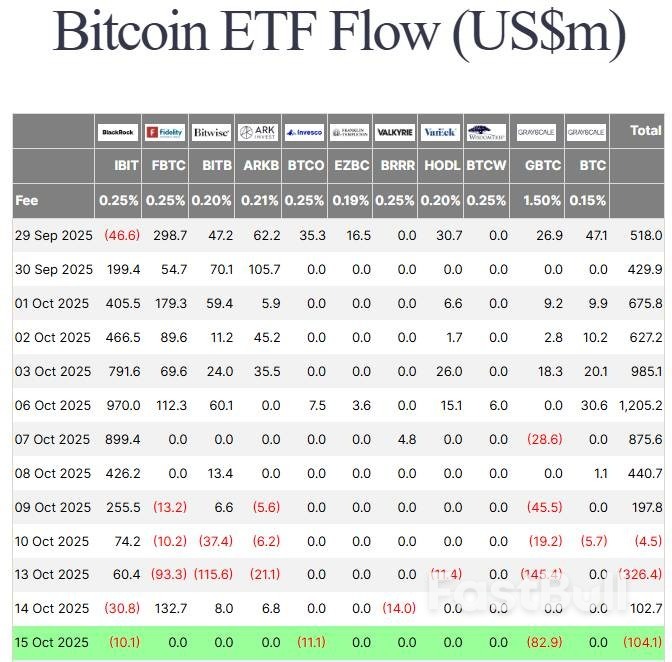
For context, Farside Investors’ data showed that the US Spot Bitcoin ETF has once again recorded an outflow of $104.1 million on Wednesday, October 15.
The investment instrument recorded an inflow of $102.7 million the previous day, on October 14, which has allayed some concerns of traders.
However, the continuing outflow since October 10 has weighed on the sentiment, indicating that the institutions are shifting focus from Bitcoin.
US Spot Bitcoin ETF Fund Flow | Source: Farside InvestorsAmid the gloomy momentum, analyst Captain Faibik has further fueled concern with his latest Bitcoin price prediction.
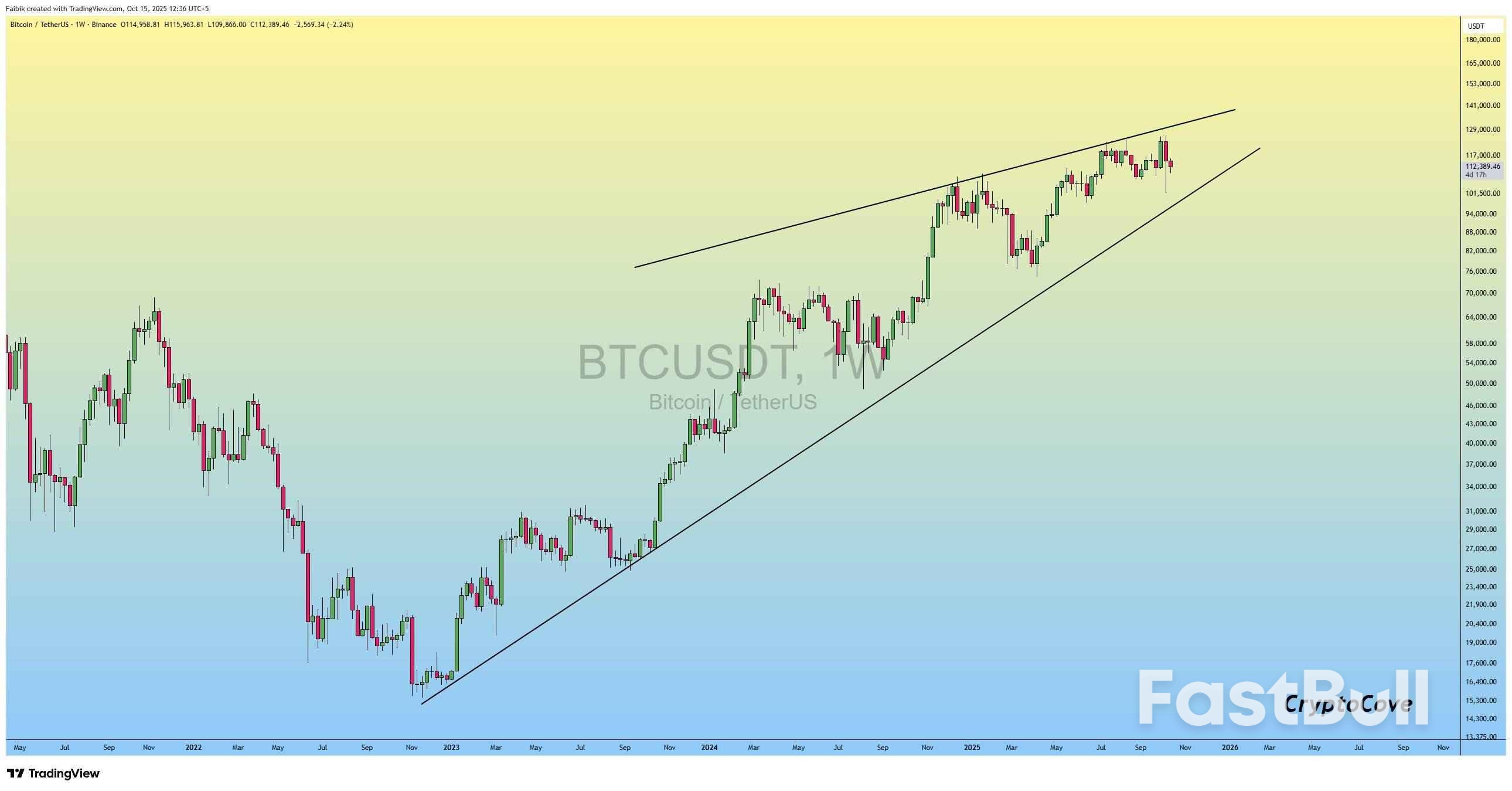
In a recent X post, the expert said, “I’m not bullish on Bitcoin anymore. That’s it.”
Besides, he said that “Bitcoin bull run is nearing its end.” This comment has sparked discussions among traders, with his prediction of a massive correction ahead further fueling market concerns.
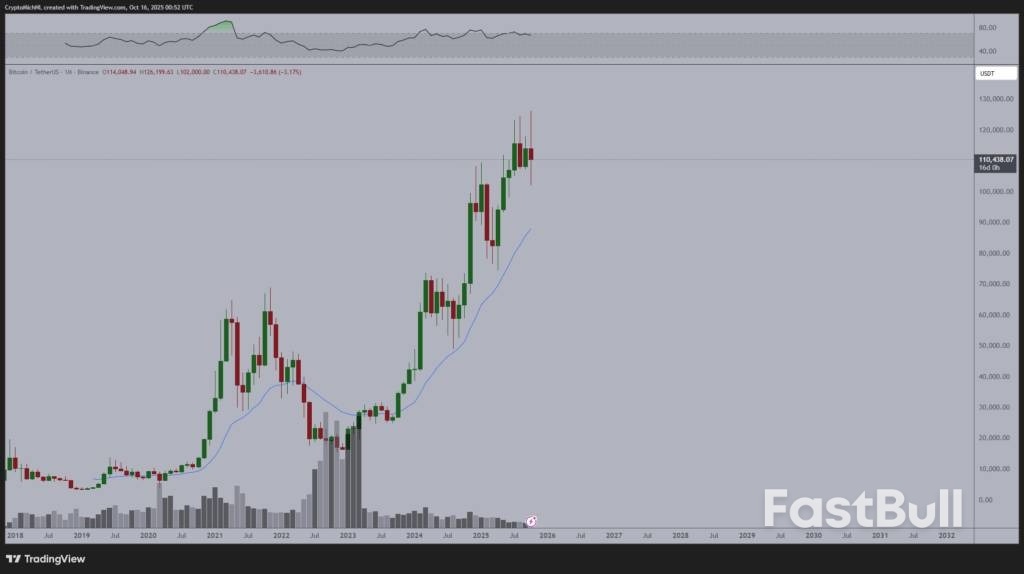
Bitcoin Price Analysis | Source: Captain Faibik, XHowever, expert Michael van de Poppe has shared a different outlook, evaluating the monthly chart of BTC USD. Poppe noted that the monthly chart looks “pretty much fine.”
BTC USD Price Action | Source: Michael van de Poppe, XBesides, he has advised traders to buy the dip, predicting that an all-time high is incoming.
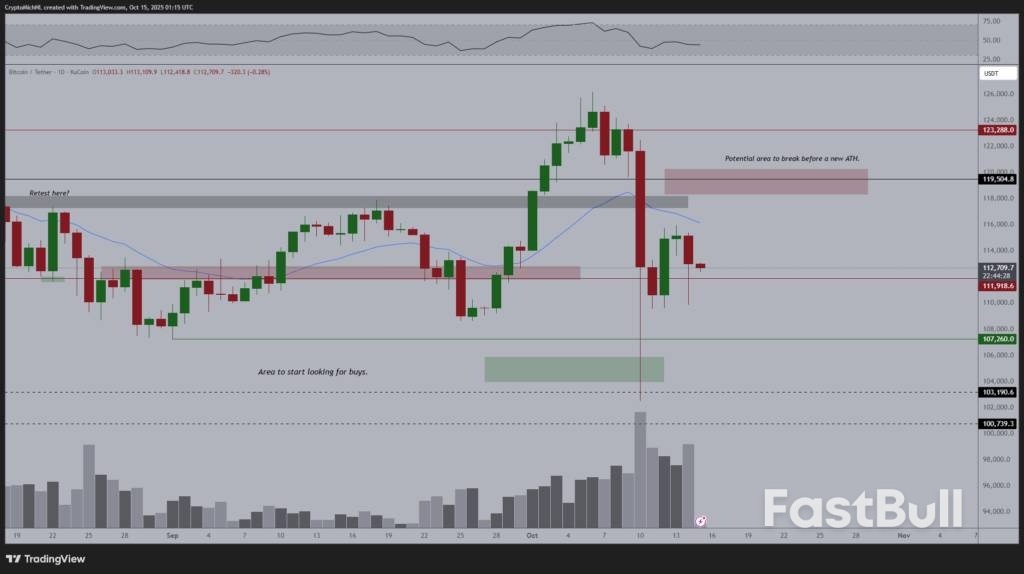
According to Poppe, BTC USD finds major support at $107k, and as long as the support holds, the future trajectory looks bullish.
In addition, his chart reveals that Bitcoin price faces major resistance at $119,504. Once this support is broken, BTC could target a new all-time high.
Bitcoin Price Prediction | Source: Michael van de Poppe, XHowever, investors should tread cautiously amid the ongoing volatile scenario in the market.
With the geopolitical tensions weighing on traders’ sentiment, the market may face a major pullback in the coming days.
The post Bitcoin Price Slips: Bull Run Coming To An End? appeared first on The Coin Republic.
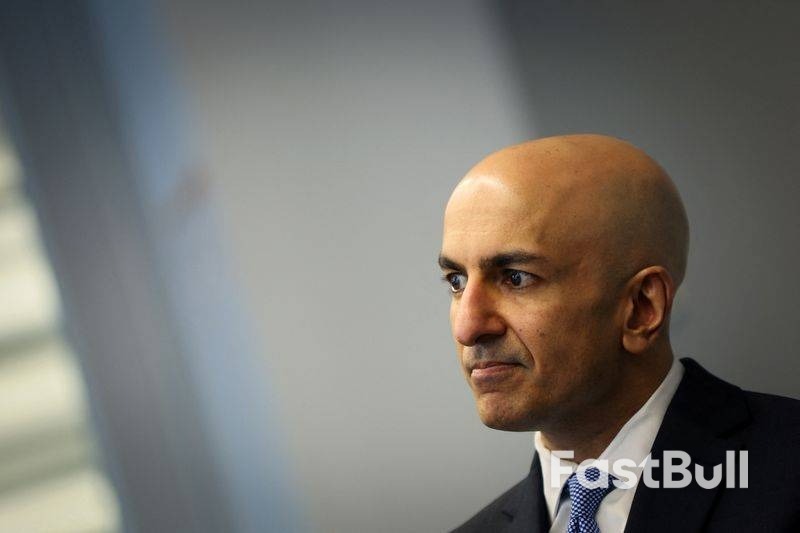
Minneapolis Federal Reserve President Neel Kashkari said Thursday he does not think that there is a big chance the labor market will weaken sharply or inflation will surge, though of the two, "there’s more risk of a labor market negative surprise than a big uptick in inflation."
"On the other hand, if I were to guess which mistake we’re more likely making, I think we’re more likely betting that the economy is really slowing more than it really is," Kashkari told a town hall in Rapid City, South Dakota.
Kashkari supported the Fed’s quarter-point interest-rate cut in September and feels two more such cuts will be warranted by the end of the year, he said last month. Like many of his colleagues, he sees the rate cuts as a form of insurance against dire outcomes that may not actually materialize.
Last year, for instance, the Fed cut rates to shore up what many policymakers feared was a rapidly softening labor market, and the economy proved to be unexpectedly resilient, he said.
As for inflation, Kashkari said Thursday that he thinks it is unlikely the inflation rate will rise to 4% or 5%, "because we can do the math of what tariff rates translate into what inflation. So I think the risk of inflation is more of one of persistence - that it’s not so much of a one time event, but that it stays at 3% for an extended period of time."
The Fed targets 2% inflation; in August it was 2.7% by the Fed’s targeted measure. Some of Kashkari’s policymaking colleagues say the Fed should be cautious about cutting rates when the inflation rate is too-high and rising

Though the ongoing federal government shutdown is delaying the publication of economic data, Fed policymakers have enough unofficial data through private sources and their own community and business outreach efforts to have a pretty good idea of economic conditions, Kashkari said.
"We can make our way through while the shutdown is happening," Kashkari said. "But the longer it goes on, the less confidence I have that we are reading the economy appropriately, because there’s no substitute for the gold standard government data that we rely on."
White Label
Data API
Web Plug-ins
Poster Maker
Affiliate Program
The risk of loss in trading financial instruments such as stocks, FX, commodities, futures, bonds, ETFs and crypto can be substantial. You may sustain a total loss of the funds that you deposit with your broker. Therefore, you should carefully consider whether such trading is suitable for you in light of your circumstances and financial resources.
No decision to invest should be made without thoroughly conducting due diligence by yourself or consulting with your financial advisors. Our web content might not suit you since we don't know your financial conditions and investment needs. Our financial information might have latency or contain inaccuracy, so you should be fully responsible for any of your trading and investment decisions. The company will not be responsible for your capital loss.
Without getting permission from the website, you are not allowed to copy the website's graphics, texts, or trademarks. Intellectual property rights in the content or data incorporated into this website belong to its providers and exchange merchants.
Not Logged In
Log in to access more features

FastBull Membership
Not yet
Purchase
Log In
Sign Up