• Trade
  • Markets
  • Copy
  • Contests
  • News
  • 24/7
  • Calendar
  • Q&A
  • Chats
Trending
Screeners
SYMBOL
LAST
BID
ASK
HIGH
LOW
NET CHG.
%CHG.
SPREAD
SPX
S&P 500 Index
6827.42
6827.42
6827.42
6899.86
6801.80
-73.58
-1.07%
--
DJI
Dow Jones Industrial Average
48458.04
48458.04
48458.04
48886.86
48334.10
-245.98
-0.51%
--
IXIC
NASDAQ Composite Index
23195.16
23195.16
23195.16
23554.89
23094.51
-398.69
-1.69%
--
USDX
US Dollar Index
97.950
98.030
97.950
98.500
97.950
-0.370
-0.38%
--
EURUSD
Euro / US Dollar
1.17394
1.17409
1.17394
1.17496
1.17192
+0.00011
+ 0.01%
--
GBPUSD
Pound Sterling / US Dollar
1.33707
1.33732
1.33707
1.33997
1.33419
-0.00148
-0.11%
--
XAUUSD
Gold / US Dollar
4299.39
4299.39
4299.39
4353.41
4257.10
+20.10
+ 0.47%
--
WTI
Light Sweet Crude Oil
57.233
57.485
57.233
58.011
56.969
-0.408
-0.71%
--

Community Accounts

Signal Accounts
--
Profit Accounts
--
Loss Accounts
--
View More

Become a signal provider

Sell trading signals to earn additional income

View More

Guide to Copy Trading

Get started with ease and confidence

View More

Signal Accounts for Members

All Signal Accounts

Best Return
  • Best Return
  • Best P/L
  • Best MDD
Past 1W
  • Past 1W
  • Past 1M
  • Past 1Y

All Contests

  • All
  • Trump Updates
  • Recommend
  • Stocks
  • Cryptocurrencies
  • Central Banks
  • Featured News
Top News Only
Share

Iranian Media Says 18 Crew Members Of Foreign Tanker Seized In Gulf Of Oman Over Carrying 'Smuggled Fuel' Detained

Share

Regional Governor: Two Killed In Ukrainian Drone Strike On Russia's Saratov

Share

Chinese Foreign Ministry - China Foreign Minister Met With United Arab Emirates Counterpart On Dec 12

Share

China's Central Financial And Economic Affairs Commission Deputy Director: Will Expand Export And Increase Import In 2026

Share

Thai Leader Anutin: Landmine Blast That Killed Thai Soldiers 'Not A Roadside Accident'

Share

Thai Leader Anutin: Thailand To Continue Military Action Until 'We Feel No More Harm'

Share

Cambodian Prime Minister Hun Manet Says He Had Phone Calls With Trump And Malaysian Leader Anwar About Ceasefire

Share

Cambodia's Hun Manet Says USA, Malaysia Should Verify 'Which Side Fired First' In Latest Conflict

Share

Cambodia's Hun Manet: Cambodia Maintains Its Stance In Seeking Peaceful Resolution Of Disputes

Share

Nasdaq Companies: Allergan, Ferrovia, Insmed, Monolithic Power Systems, Seagate Technology, And Western Digital Will Be Added To The NASDAQ 100 Index. Biogen, CdW, GlobalFoundries, Lululemon, ON Semiconductor, And Tradedesk Will Be Removed From The NASDAQ 100 Index

Share

Witkoff Headed To Berlin This Weekend To Meet With Zelenskiy, European Leaders -Wsj Reporter On X

Share

Russia Attacks Two Ukrainian Ports, Damaging Three Turkish-Owned Vessels

Share

[Historic Flooding Occurs In At Least Four Rivers In Washington State Due To Days Of Torrential Rains] Multiple Areas In Washington State Have Been Hit By Severe Flooding Due To Days Of Torrential Rains, With At Least Four Rivers Experiencing Historic Flooding. Reporters Learned On The 12th That The Floods Caused By The Torrential Rains In Washington State Have Destroyed Homes And Closed Several Highways. Experts Warn That Even More Severe Flooding May Occur In The Future. A State Of Emergency Has Been Declared In Washington State

Share

Trump Says Proposed Free Economic Zone In Donbas Would Work

Share

Trump: I Think My Voice Should Be Heard

Share

Trump Says Will Be Choosing New Fed Chair In Near Future

Share

Trump Says Proposed Free Economic Zone In Donbas Complex But Would Work

Share

Trump Says Land Strikes In Venezuela Will Start Happening

Share

US President Trump: Thailand And Cambodia Are In A Good Situation

Share

State Media: North Korean Leader Kim Hails Troops Returning From Russia Mission

TIME
ACT
FCST
PREV
U.K. Trade Balance Non-EU (SA) (Oct)

A:--

F: --

P: --

U.K. Trade Balance (Oct)

A:--

F: --

P: --

U.K. Services Index MoM

A:--

F: --

P: --

U.K. Construction Output MoM (SA) (Oct)

A:--

F: --

P: --

U.K. Industrial Output YoY (Oct)

A:--

F: --

P: --

U.K. Trade Balance (SA) (Oct)

A:--

F: --

P: --

U.K. Trade Balance EU (SA) (Oct)

A:--

F: --

P: --

U.K. Manufacturing Output YoY (Oct)

A:--

F: --

P: --

U.K. GDP MoM (Oct)

A:--

F: --

P: --

U.K. GDP YoY (SA) (Oct)

A:--

F: --

P: --

U.K. Industrial Output MoM (Oct)

A:--

F: --

P: --

U.K. Construction Output YoY (Oct)

A:--

F: --

P: --

France HICP Final MoM (Nov)

A:--

F: --

P: --

China, Mainland Outstanding Loans Growth YoY (Nov)

A:--

F: --

P: --

China, Mainland M2 Money Supply YoY (Nov)

A:--

F: --

P: --

China, Mainland M0 Money Supply YoY (Nov)

A:--

F: --

P: --

China, Mainland M1 Money Supply YoY (Nov)

A:--

F: --

P: --

India CPI YoY (Nov)

A:--

F: --

P: --

India Deposit Gowth YoY

A:--

F: --

P: --

Brazil Services Growth YoY (Oct)

A:--

F: --

P: --

Mexico Industrial Output YoY (Oct)

A:--

F: --

P: --

Russia Trade Balance (Oct)

A:--

F: --

P: --

Philadelphia Fed President Henry Paulson delivers a speech
Canada Building Permits MoM (SA) (Oct)

A:--

F: --

P: --

Canada Wholesale Sales YoY (Oct)

A:--

F: --

P: --

Canada Wholesale Inventory MoM (Oct)

A:--

F: --

P: --

Canada Wholesale Inventory YoY (Oct)

A:--

F: --

P: --

Canada Wholesale Sales MoM (SA) (Oct)

A:--

F: --

P: --

Germany Current Account (Not SA) (Oct)

A:--

F: --

P: --

U.S. Weekly Total Rig Count

A:--

F: --

P: --

U.S. Weekly Total Oil Rig Count

A:--

F: --

P: --

Japan Tankan Large Non-Manufacturing Diffusion Index (Q4)

--

F: --

P: --

Japan Tankan Small Manufacturing Outlook Index (Q4)

--

F: --

P: --

Japan Tankan Large Non-Manufacturing Outlook Index (Q4)

--

F: --

P: --

Japan Tankan Large Manufacturing Outlook Index (Q4)

--

F: --

P: --

Japan Tankan Small Manufacturing Diffusion Index (Q4)

--

F: --

P: --

Japan Tankan Large Manufacturing Diffusion Index (Q4)

--

F: --

P: --

Japan Tankan Large-Enterprise Capital Expenditure YoY (Q4)

--

F: --

P: --

U.K. Rightmove House Price Index YoY (Dec)

--

F: --

P: --

China, Mainland Industrial Output YoY (YTD) (Nov)

--

F: --

P: --

China, Mainland Urban Area Unemployment Rate (Nov)

--

F: --

P: --

Saudi Arabia CPI YoY (Nov)

--

F: --

P: --

Euro Zone Industrial Output YoY (Oct)

--

F: --

P: --

Euro Zone Industrial Output MoM (Oct)

--

F: --

P: --

Canada Existing Home Sales MoM (Nov)

--

F: --

P: --

Euro Zone Total Reserve Assets (Nov)

--

F: --

P: --

U.K. Inflation Rate Expectations

--

F: --

P: --

Canada National Economic Confidence Index

--

F: --

P: --

Canada New Housing Starts (Nov)

--

F: --

P: --

U.S. NY Fed Manufacturing Employment Index (Dec)

--

F: --

P: --

U.S. NY Fed Manufacturing Index (Dec)

--

F: --

P: --

Canada Core CPI YoY (Nov)

--

F: --

P: --

Canada Manufacturing Unfilled Orders MoM (Oct)

--

F: --

P: --

Canada Manufacturing New Orders MoM (Oct)

--

F: --

P: --

Canada Core CPI MoM (Nov)

--

F: --

P: --

Canada Manufacturing Inventory MoM (Oct)

--

F: --

P: --

Canada CPI YoY (Nov)

--

F: --

P: --

Canada CPI MoM (Nov)

--

F: --

P: --

Canada CPI YoY (SA) (Nov)

--

F: --

P: --

Canada Core CPI MoM (SA) (Nov)

--

F: --

P: --

Q&A with Experts
    • All
    • Chatrooms
    • Groups
    • Friends
    Connecting
    .
    .
    .
    Type here...
    Add Symbol or Code

      No matching data

      All
      Trump Updates
      Recommend
      Stocks
      Cryptocurrencies
      Central Banks
      Featured News
      • All
      • Russia-Ukraine Conflict
      • Middle East Flashpoint
      • All
      • Russia-Ukraine Conflict
      • Middle East Flashpoint
      Search
      Products

      Charts Free Forever

      Chats Q&A with Experts
      Screeners Economic Calendar Data Tools
      Membership Features
      Data Warehouse Market Trends Institutional Data Policy Rates Macro

      Market Trends

      Market Sentiment Order Book Forex Correlations

      Top Indicators

      Charts Free Forever
      Markets

      News

      News Analysis 24/7 Columns Education
      From Institutions From Analysts
      Topics Columnists

      Latest Views

      Latest Views

      Trending Topics

      Top Columnists

      Latest Update

      Signals

      Copy Rankings Latest Signals Become a signal provider AI Rating
      Contests
      Brokers

      Overview Brokers Assessment Rankings Regulators News Claims
      Broker listing Forex Brokers Comparison Tool Live Spread Comparison Scam
      Q&A Complaint Scam Alert Videos Tips to Detect Scam
      More

      Business
      Events
      Careers About Us Advertising Help Center

      White Label

      Data API

      Web Plug-ins

      Affiliate Program

      Awards Institution Evaluation IB Seminar Salon Event Exhibition
      Vietnam Thailand Singapore Dubai
      Fans Party Investment Sharing Session
      FastBull Summit BrokersView Expo
      Recent Searches
        Top Searches
          Markets
          News
          Analysis
          User
          24/7
          Economic Calendar
          Education
          Data
          • Names
          • Latest
          • Prev

          View All

          No data

          Scan to Download

          Faster Charts, Chat Faster!

          Download App
          English
          • English
          • Español
          • العربية
          • Bahasa Indonesia
          • Bahasa Melayu
          • Tiếng Việt
          • ภาษาไทย
          • Français
          • Italiano
          • Türkçe
          • Русский язык
          • 简中
          • 繁中
          Open Account
          Search
          Products
          Charts Free Forever
          Markets
          News
          Signals

          Copy Rankings Latest Signals Become a signal provider AI Rating
          Contests
          Brokers

          Overview Brokers Assessment Rankings Regulators News Claims
          Broker listing Forex Brokers Comparison Tool Live Spread Comparison Scam
          Q&A Complaint Scam Alert Videos Tips to Detect Scam
          More

          Business
          Events
          Careers About Us Advertising Help Center

          White Label

          Data API

          Web Plug-ins

          Affiliate Program

          Awards Institution Evaluation IB Seminar Salon Event Exhibition
          Vietnam Thailand Singapore Dubai
          Fans Party Investment Sharing Session
          FastBull Summit BrokersView Expo

          Taiwan Now a National Security Issue

          Thomas

          China-U.S. Relations

          Summary:

          Taiwan Now a National Security Issue

          The Cold War substantially changed the position of the United States on Taiwan. After a short interlude of indifference and neglect, especially after the Korean War (1950-53), the U.S. started seeing Taiwan as essential to its strategic interests and security.
          After that, notwithstanding all the tongue-in-cheek statements by the U.S. about taking a nonchalant or even positive stance on the "peaceful" reunification of Taiwan and the Chinese mainland, the actual U.S. policy has always been to forestall Taiwan's return to China by whatever means possible unless the cost of doing so becomes unbearable.

          Beijing's ultimate goal of national reunification

          For Beijing, the Taiwan question has always pertained to national reunification and the ultimate end of the civil war, preferably by peaceful means, and to prevent Taiwan from declaring "independence". And till national reunification is realized, the prerequisite and overriding principle for cross-Straits peace, for Beijing, is the recognition of the 1992 Consensus by Taiwan.
          However, the rise of China has prompted the U.S. to label China as a strategic rival and an existential threat, and incorporate the island into its grand strategy to contain, isolate and weaken China on both the military and nonmilitary fronts.
          For Beijing, on the other hand, the Taiwan question is not just about national reunification. A non-1992 Consensus recognizing Taiwan is also a strategic threat to national security and stability. This threat from Taiwan has over the years fundamentally altered Beijing's strategy toward both the U.S. and Taiwan.

          U.S. policy on Taiwan remains duplicitous

          In his book The Long Peace, John L. Gaddis, a prominent scholar of the Cold War, documents the U.S.' position on Taiwan in the 1940s. In his words: "There was never any question, whether in the Pentagon, the State Department, or the Far East Command, as to the strategic importance of Taiwan once it became apparent that Chiang Kai-shek could not retain control of the mainland. The prospect of a Taiwan dominated by 'Kremlin-directed Communists,' the Joint Chiefs (of Staff) concluded late in 1948, would be 'very seriously detrimental to our national security,' since it would give the Communists the capability of dominating sea lanes of communication between Japan and Malaya, and of threatening the Philippines, the Ryukyus, and ultimately Japan itself.
          "A State Department draft report to the National Security Council early in 1949 argued that 'the basic aim of the U.S. should be to deny Formosa and the Pescadores to the Communists.' MacArthur was particularly adamant on this point. He told Max W.Bishop, Chief of the State Department's Division of Northeast Asian Affairs, that'if Formosa went to the Chinese Communists our whole defensive position in the Far East (would be) definitely lost; that it could only result eventually in putting our defensive line back to the west coast of the continental United States.'"
          McArthur even characterized Taiwan as "an unsinkable aircraft carrier and submarine tender" that should never be allowed to fall under the control of the enemies of the U.S.
          Over time, the strategic value of Taiwan for the U.S. has not diminished; instead, it has vastly increased as a result of the dramatic rise of China, particularly its growing military power. China is also seen as a revanchist power challenging the global hegemony of the U.S..

          For U.S., reunification is harmful to its interest

          In the words of two U.S. strategists, Richard Haass and David Sacks: "One thing, however, has not changed…: an imposed Chinese takeover of Taiwan remains antithetical to U.S. interests. If the United States fails to respond to such a Chinese use of force, regional U.S. allies, such as Japan and South Korea, will conclude that the United States cannot be relied upon and that it is pulling back from the region. These Asian allies would then either accommodate China, leading to the dissolution of U.S. alliances and the crumbling of the balance of power, or they would seek nuclear weapons in a bid to become strategically self-reliant. Either scenario would greatly increase the chance of war in a region that is central to the world's economy and home to most of its people."
          Moreover, "China's military would no longer be bottled up within the first island chain: its navy would instead have the ability to project Chinese power throughout the western Pacific." These views on Taiwan are still dominant in the political and intellectual circles of the U.S..
          Given the crucial importance of Taiwan to U.S. security and strategic interests, as well as to its credibility among its allies and partners, it stretches the belief that the U.S. will accept with equanimity the reunification of the mainland and Taiwan even if the reunification comes about peacefully, a majority of the Taiwan residents support reunification with the mainland, and China is no longer demonized as an "authoritarian" country.

          U.S. goes to great lengths to prevent reunification

          In order to permanently prevent Taiwan's reunification with the mainland and tether the island to the U.S. bandwagon, Washington has in the last couple of decades ratcheted up support for the pro-independence and secessionist forces in Taiwan, pressured those backing rapprochement with the mainland not to do so, treated Taiwan as "an independent political entity", strengthened Taiwan's defense capabilities by selling it arms and training its armed forces, increased high-level official contacts with Taiwan, included Taiwan in its "Indo-Pacific" strategy, helped boost Taiwan's role in the "first island chain", changed its stance on Taiwan from "strategic ambiguity" to "strategic clarity", assured Taiwan residents it would militarily protect them against an "invasion" by the mainland, created opportunities for Taiwan to take part in international affairs, threatened countries still recognizing Taiwan as an "independent entity" to not cut diplomatic ties with the island, widened the U.S.-Japan alliance to cover the cross-Straits conflict, drawn the European Union, the QUAD and AUKUS into its Taiwan game, and boosted economic ties with Taiwan.
          From Beijing's point of view, all these are provocative moves by the U.S. aimed at widening the political and psychological chasm between the people on the two sides of the Taiwan Straits, increasing the island's dependence on the U.S. and its allies, and make the reunification of the mainland and Taiwan more difficult.
          The U.S.' provocative actions are also a dubious attempt to turn the island into a threat to China's security, particularly to bottle up the Chinese navy inside the "first island chain" forever, thus making it extremely difficult, if not impossible, for China to protect its overseas interests. Also, these measures will put the U.S. in an advantageous strategic position when a war with China eventually breaks out, inadvertently or otherwise. And in case a war breaks out, the island will become a forward base for the U.S. to attack the mainland.
          From Beijing's strategic point of view, the Taiwan question has rapidly transformed into a matter of national security which calls for immediate and serious attention. An "independent" Taiwan allied with the U.S. will be the biggest existential security threat.

          Strategic patience not a permanent choice

          Insofar as Taiwan remains a question of national reunification and does not declare de jure "independence", the Chinese mainland can afford strategic patience, and pursue peaceful reunification.
          But once Taiwan mutates into a national security threat and becomes increasingly alarming due to U.S. machinations, Beijing's strategic calculus will drastically change. And national reunification via forging closer economic ties with the island and winning the hearts and minds of the island's residents in the long run will become a secondary strategic goal. The primary imperative will be to permanently remove Taiwan as a national security threat through whatever means necessary.
          Beijing's sense of threat emerging from the increasingly bellicose and irresponsible Taiwan policy of the U.S. is amply reflected in the words of President Xi Jinping and other top Chinese officials. China's top diplomat Yang Jiechi and U.S. National Security Advisor Jake Sullivan held their third meeting in Luxembourg on June 13, where Yang warned Sullivan that there would be "cataclysmic effects" if the U.S. did not handle the Taiwan question properly. "This risk will increase if the U.S. continues its approach of 'using Taiwan to contain China' and Taiwan's adoption of 'relying on the U.S. for independence,'" Yang said.
          The warning by Yang came just a day after State Councilor and Defense Minister Wei Fenghe told the Shangri-La Dialogue in Singapore that Beijing will counter any attempts to make "Taiwan independent".
          Most importantly, in a phone call on July 28, President Xi asserted that China will not give any elbow room to the "Taiwan independence forces" and warned U.S. President Joe Biden that "those who play with fire will be perished by it. It is hoped that the U.S. will be clear-eyed about this".The warning was issued as tensions mounted over U.S. House Speaker Nancy Pelosi's visit to Taiwan, which she did on Tuesday.
          China believes the U.S. has adopted a "salami-slicing" approach to abandon the one-China principle and push Taiwan toward de facto, if not de jure, "independence"-and determined to maintain the status quo of a divided China.

          U.S. has turned Straits into a tinderbox

          As both Beijing and Washington see Taiwan as essential to their security and the U.S. is increasingly using Taiwan as a "forward base" against Beijing, the Taiwan Straits has turned into a tinderbox where a Sino-U.S. military conflict could flare up with disastrous consequences for the world. A U.S.-China war over Taiwan will see the island completely devastated. To avoid this catastrophe, Taiwan residents must force the pro-independence Taiwan authorities to stop allowing Washington to meddle in cross-Straits affairs and use the island against Beijing, and seek rapprochement with the mainland.
          Furthermore, the Hong Kong Special Administrative Region will be seriously affected by the fallout from the U.S.-China clash over Taiwan, especially because the U.S. might use all means possible to "destroy" the SAR and weaken China.
          But despite Hong Kong not having any means to change the course of events concerning Taiwan, both the SAR government and residents have to closely monitor the Taiwan situation and take steps to minimize the adverse impact of the cross-Straits crisis on Hong Kong. It goes without saying that concerted planning and action by the central and Hong Kong governments are indispensable to it.

          Source: China Daily

          Risk Warnings and Disclaimers
          You understand and acknowledge that there is a high degree of risk involved in trading. Following any strategies or investment methods may lead to potential losses. The content on the site is provided by our contributors and analysts for information purposes only. You are solely responsible for determining whether any trading assets, securities, strategy, or any other product is suitable for investing based on your own investment objectives and financial situation.
          Comments
          Add to Favorites
          Share

          Uncertainty Pervades the Southeast Asian Economy

          Owen Li
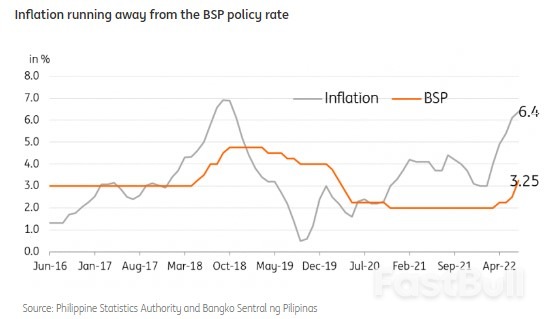
          Accelerating inflation to keep BSP hawkish
          Uncertainty Pervades the Southeast Asian Economy_1

          July inflation at 6.4%, faster than expected

          Price pressures stayed elevated in July, pushing headline inflation to 6.4%YoY. Expensive food (6.9%), transport (18.1%) and utilities (5.7%) continue to be the main drivers of the surge in inflation and we can expect inflation to head higher in the coming months. These three subsectors combined account for 68.2% of the overall CPI basket. All subsectors posted faster inflation in July except for health services where inflation slipped to 2.4% (2.6% in June).
          Recent wage hikes and transport fare adjustments continue to feed through to the rest of the CPI basket. Bread manufacturers and retail outlets have announced price increases in the past month, indicating that inflation has hit more than just energy and imported food items. The emergence of these 2nd round effects suggests that price pressures are more pervasive. Uncertainty Pervades the Southeast Asian Economy_2

          Above target inflation to keep BSP hawkish

          Inflation remains well above the Bangko Sentral ng Pilipinas' (BSP) upper bound target of 4%, which should keep BSP hawkish in the coming months. BSP Governor, Medalla signalled that rate hikes are in the pipeline and we continue to pencil in a 50bp rate increase at the 18 August policy meeting. Medalla remains optimistic that inflation is close to its peak but BSP will likely retain their hawkish slant until inflation heads closer to 4%.
          We expect BSP to hike rates for the rest of the year with the policy rate reaching 4.5% by year-end. The PHP should gain some support from policy tightening, but the PHP remains vulnerable to depreciation while inflation runs high and also as the Philippines now runs a current account deficit.
          Uncertainty Pervades the Southeast Asian Economy_3

          Recovery continues against backdrop of slowing global growth

          Uncertainty Pervades the Southeast Asian Economy_4

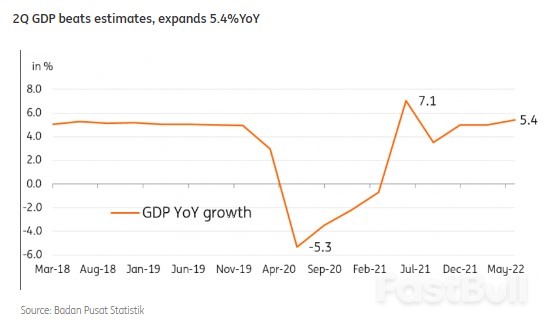
          2Q GDP at 5.4%

          Indonesia's economy grew 5.4%YoY in the second quarter, outpacing market expectations for a 5.1% gain. Year-to-date GDP growth is now 5.2%. ING had expected growth to hit 5.4% on the back of solid household consumption supported by a resurgent export sector. Household spending has been robust, in part, because of relatively manageable inflation.
          Retail sales continue to expand although spending is concentrated on food items and fuel and consumers are postponing purchases of durable equipment, communications and other items. Meanwhile, exports have benefited from the ongoing conflict in Ukraine as coal prices have surged, resulting in substantial trade surpluses for the first half of the year.

          Uncertainty Pervades the Southeast Asian Economy_5Solid recovery but headwinds loom

          Bank Indonesia (BI) Governor Warjiyo, flagged the threat of slowing global growth at the 21 July policy meeting. BI retained its growth projection for the year but admitted that full-year GDP will likely settle at the lower end of the 4.5-5.3% range. Slower global growth could weigh on export growth prospects, especially if a slower growth outlook translates to sliding coal prices. On the domestic front, the sustained acceleration in headline inflation could eventually sap some momentum from household spending and drag on overall GDP.
          BI remains cool to rate hikes, at least for now, citing well-behaved core inflation, which should cushion the fallout from a potential slowdown in global growth. However, the eventual BI rate hike (in late 3Q or early 4Q) coupled with accelerating inflation could eventually slow Indonesia's economy with full-year GDP likely at 4.6% for the year.

          Source: ING

          Risk Warnings and Disclaimers
          You understand and acknowledge that there is a high degree of risk involved in trading. Following any strategies or investment methods may lead to potential losses. The content on the site is provided by our contributors and analysts for information purposes only. You are solely responsible for determining whether any trading assets, securities, strategy, or any other product is suitable for investing based on your own investment objectives and financial situation.
          Comments
          Add to Favorites
          Share

          Asia Morning Bites

          Damon

          Global markets

          U.S. equities ran out of steam yesterday ahead of today's non-farm payrolls release. The S&P500 trod water for most of the day, while the tech-heavy NASDAQ made a little more ground and finished up 52 points or 0.41%. Relative strength indicators are hinting at U.S. stocks getting a little overbought now, and with the S&P500 closing in on the 50% retracement of the down move this year, moving higher may now get a little harder. Asian stocks didn't do too badly yesterday in spite of all the live fire military exercises taking place around Taiwan, and there was more green than red on the charts. Asian FX similarly made decent gains for the most part. The main detractor from this trend was the INR, which pushed sharply higher ahead of today's RBI meeting. Markets will be hoping things settle down around Taiwan now Pelosi has left the island. The USD had a weak day yesterday in spite of the mixed equity environment and a motley assortment of macro data that can't really be blamed for the jump up to 1.0250, the biggest gain in 13 days. Perhaps this was a collective sigh of relief following the end of the Pelosi Taiwan visit? The AUD gains were more moderate, and it still sits a little below 70 cents, while Cable ended up roughly unchanged at 1.2157 despite some mid-session gyrations and the Bank of England's 50bp rate hike and warning that inflation could reach 13%. The JPY had a better day, making solid gains that have taken it down to 132.80 currently. U.S. 2Y Treasury yields edged 2.2bp lower to 3.043%, certainly not enough to justify the USD weakness on the day. The yield on the 10Y U.S. Treasury bond was down even less to 2.688%. Crude oil prices continued to lose ground. The front-month Brent contract dropped to $94.12/bbl, while the equivalent WTI contract was also lower at $87.90/bbl. Gold continued its recent run of gains yesterday, perhaps helped by the slightly softer tone to U.S. rates and weaker USD, and has risen to $1992/t oz.

          G-7 Macro

          This whole week has been leading up to today's non-farm payrolls release, and the consensus is anticipating a reasonable 250,000 gain in employment and an unemployment rate that will remain at only 3.6%. Until now, markets have been responding to stronger economic data as good news. But at some point, they will maybe question whether the Fed's tightening is having the desired effect if the economy remains strong. At that stage, they could start to fret that rates may rise higher, or stay higher for longer. We probably aren't at that point yet. But it is worth keeping an open mind about how the market will respond to these figures later today. German industrial production and French wage growth should paint a fairly stagflationary picture for the Eurozone.

          China

          Mainland China's military drill around Taiwan has resulted in deferred flights and shipments in and out of Taiwan. The drill has had a negative impact on Taiwan's international trade. USDTWD has passed 30 as the TWD weakens. We expect the TWD to continue to be weak until next Monday (8 Aug), which is the last day of this drill. Further weakness in August is likely as the tension between the US and Mainland China over Taiwan has stepped into a new phase. This is likely to be negative for Taiwan's economy.
          India: The RBI meets today and is expected to take rates 35bp higher to 5.25%. We think there is a chance they move by only 25bp as the gap between Indian rates and inflation is not that big now, and there are signs it could narrow further in the months ahead.

          Philippines

          The Philippines reports July inflation today. The market consensus is at 6.1%YoY as transport and food prices stay elevated. Inflation is well above the central bank's target and we expect Bangko Sentral ng Pilipinas (BSP) to continue to tighten policy for the rest of the year. BSP Governor Medalla signalled more rate hikes are in the pipeline and we are pencilling in a 50bp rate hike at the 18 August policy meeting. A more hawkish tone from BSP has helped steady the PHP of late, but the currency remains vulnerable to depreciation as the Philippines now runs a current account deficit.

          Indonesia

          2Q GDP is scheduled for release today and market participants expect GDP growth of 5.2%YoY. Indonesia's economy continues to recover, driven by solid household consumption and boosted by a resurgent export sector. Inflation has stayed relatively manageable despite global developments, benefiting spending on food items and some recreational activities. Manageable inflation also gives Bank Indonesia space to go easy on policy-tightening, a development that has helped support bank lending.

          Korea

          The current account recorded a surplus of USD5.6bn in June, down from USD8.8bn in June last year. Rising commodity import prices were the main reason for the smaller surplus on the goods account. Meanwhile, the services account posted a deficit of USD0.5bn due to an increase in outbound travel. The primary income surplus widened to USD2.8bn on the back of increases in dividend payments from overseas.

          Source: ING

          Risk Warnings and Disclaimers
          You understand and acknowledge that there is a high degree of risk involved in trading. Following any strategies or investment methods may lead to potential losses. The content on the site is provided by our contributors and analysts for information purposes only. You are solely responsible for determining whether any trading assets, securities, strategy, or any other product is suitable for investing based on your own investment objectives and financial situation.
          Comments
          Add to Favorites
          Share

          Australia's Central Bank Warns Economy to Slow Sharply as Inflation Soars

          Owen Li
          Australia's central bank on Friday warned inflation was heading to three-decade highs requiring further hikes in interest rates that would slow growth sharply, making it tough to keep the economy on an "even keel".
          In its quarterly Statement on Monetary Policy, the Reserve Bank of Australia (RBA) jacked up its forecasts for inflation, downgraded the outlook for growth and foreshadowed an eventual rise in unemployment.
          Yet even with further increases in rates, inflation was not expected to return to the top of its 2-3% target range until the end of 2024, pointing to a long period of pain ahead.
          "It is seeking to do this in a way that keeps the economy on an even keel," said RBA Governor Philip Lowe in the introduction to the 66-page statement.
          "The path to achieve this balance is a narrow one and subject to considerable uncertainty."
          The central bank has already raised its cash rate four months in a row, taking it from an emergency low of 0.1 to a seven-year high of 1.85% and is flagging more to come.
          "The Board expects to take further steps in the process of normalising monetary conditions over the months ahead, but it is not on a pre-set path," said Lowe.
          Markets see rates reaching 3.0% by Christmas and peaking around 3.30% in April next year.
          The hawkish outlook reflects the fact policy makers have been badly wrong footed by inflation which has surged on the back of rising costs for energy, food and construction.
          The RBA has had to lift its forecast peak for headline inflation to 7.75%, when as recently as May it had tipped 5.9%.
          Core inflation is seen topping out at 6% by the end of this year and then declining only gradually to 3% by late 2024.
          Lowe said these high levels risked getting built into wage- and price-setting behaviour, though so far longer-term inflation expectations had remained anchored to the 2-3% range.
          Forecasts for economic growth this year were slashed by a full percentage point to 3.25%, while 2023 and 2024 were trimmed by around a quarter point to 1.75%.
          "A higher cost of living, rising interest rates and declining house prices are expected to weigh on growth and spending," said Lowe. After a bumper 2022, house prices are now on the retreat with Sydney seeing the fastest falls in 40 years.
          The bank has also been surprised by the strength of the labour market, which saw unemployment hit a 48-year low of 3.5% in June. The RBA now see the jobless rate falling to 3.25% by the end of this year, before rising slowly to 4% by late 2024.
          Annual wage growth is expected to pick up to 3.0% this year and 3.6% next, though that would still lag inflation. Wages could grow 3.9% in 2024 which would be the fastest in many years.
          All these forecasts are based on the assumption that interest rates rise ti around 3% by the end of this year, and decline a little in 2024.

          Source: Reuters

          Risk Warnings and Disclaimers
          You understand and acknowledge that there is a high degree of risk involved in trading. Following any strategies or investment methods may lead to potential losses. The content on the site is provided by our contributors and analysts for information purposes only. You are solely responsible for determining whether any trading assets, securities, strategy, or any other product is suitable for investing based on your own investment objectives and financial situation.
          Comments
          Add to Favorites
          Share

          August 5th Financial News

          FastBull Featured

          Daily News

          【Quick Facts】

          1. Wang Yi: China's current and future comprehensive measures are necessary and timely defensive countermeasures.
          2. Multiple governments reiterate adherence to the one-China principle, and no face-to-face meeting has been arranged between South Korean President Yoon Suk Yeol and Nancy Pelosi.
          3. OPEC increases oil production to its limit, but the capacity cannot return to the pre-pandemic levels.
          4. Citi analyst: Tesla stock is inflated and its autonomous driving technology has been questioned.

          【News Details】

          Wang Yi: China's current and future comprehensive measures are necessary and timely defensive countermeasures
          During the Foreign Ministers' Meeting on East Asia Cooperation in Phnom Penh on August 4, 2022, Chinese State Councilor and Foreign Minister Wang Yi further elaborated on China's position on the provocative behavior of the U.S. side in violating China's sovereignty.
          Wang Yi said that the U.S. side trampled international law, broke bilateral commitments, undermined peace in the Taiwan Strait, supported separatism, and advocated camp confrontation, which is a blatant provocation to the Chinese people and peoples in peace-loving regions, and a political gamble that is bound to bring about bad effects.
          Pelosi's performance is another bankruptcy of U.S. politics, U.S. diplomacy, and U.S. credibility, proving that the U.S. is the biggest destroyer of peace in the Taiwan Strait and the biggest troublemaker of regional stability. It also proved that the U.S. Indo-Pacific strategy is extremely confrontational and harmful, and the U.S. is hypocritical with double standards on international rules. If China does not resist this manic, irresponsible, and extremely irrational behavior of the U.S. side, the principle of respecting the sovereignty and territorial integrity in international relations will become a dead letter. Separatists and extremist forces will intensify, and the hard-won peace and stability in the region will be seriously damaged.
          Multiple governments reiterate adherence to the one-China principle, and no face-to-face meeting has been arranged between South Korean President Yoon Suk Yeol and Nancy Pelosi
          In response to U.S. House Speaker Nancy Pelosi's visit to Taiwan, several governments recently reiterated that they will continue to adhere to the one-China position.
          On August 2, the Russian Foreign Ministry issued a statement reiterating Russia's adherence to the one-China principle and its opposition to any form of "Taiwan independence."
          The Russian Foreign Ministry said it regards Pelosi's visit to Taiwan as a blatant provocation and "in line with the aggressive approach of the United States to curb China in all its aspects." The Russian side believes that the relations across the Taiwan Strait are purely an internal affair of China and that China has the right to take the necessary measures to preserve its sovereignty and territorial integrity on the Taiwan issue.
          Russia also urged the U.S. not to take actions that would undermine regional stability and international security. It said the U.S. should recognize "the new geopolitical reality that there is no place for American hegemony."
          Stéphane Dujarric, spokesman for the UN Secretary-General, responded to Pelosi's visit to Taiwan on August 2, saying that on this issue, the United Nations follows Resolution 2758 adopted by the UN General Assembly in 1971.
          OPEC increases oil production to its limit, but the capacity cannot return to the pre-pandemic levels
          The OPEC+ Ministerial Meeting announced on August 3 that each member country should increase its production by 100,000 barrels per day in September. After this adjustment, the production of the OPEC+ is scheduled to return to the pre-pandemic baseline level. However, with international oil prices still floating at $90-$100/bbl, the actual production capacity of OPEC+ will be difficult to return to the pre-pandemic levels even with the willingness to increase production.
          "Due to the very limited additional capacity, this capacity must be utilized very carefully to cope with severe supply disruptions." OPEC+ pointed out that the chronic under-investment is the cause of the decline in additional capacity across the value chain of the oil industry.
          Climate change and the rapid development of new energy industries have made oil-producing countries worried about the long-term prospects for oil demand, so they are cautious in long-cycle investment and development projects like oil fields, making it difficult to expand capacity further.
          As a "ceiling" has already been set, the number of rigs has slumped since the pandemic and has not returned to its original level, which has also limited the current ability of many member countries to increase oil production.
          Citi analyst: Tesla stock is inflated and its autonomous driving technology has been questioned
          Citi analyst Itay Michaeli said Tesla stock is inflated and could plunge more than 50% in the future. The analyst reiterated a sell rating on Tesla stock in a report with a price target of $424. Currently, Tesla stock is trading at about $923 per share. This bold analysis is largely based on skepticism about Tesla's autonomous driving technology. In addition, the analyst believes that Tesla's stock has a forward P/E ratio of 76 times, which does not take into account the intensifying economic slowdown.

          【Today's Focus】

          11:00 New Zealand Total Reserve Assets (Jul)
          12:30 India Benchmark Interest Rate
          -- India Central Bank Deposit Reserve Ratio
          14:00 Germany Industrial Output MoM (SA) (Jun)
          14:00 U.K. Halifax House Price Index MoM (SA) (Jul)
          14:45 France Industrial Output MoM (SA) (Jun)
          -- France Trade Balance (SA) (Jun)
          -- 20:30 Canada Employment (SA) (Jul)
          20:30 U.S. Unemployment Rate (SA) (Jul)
          -- U.S. Non-Farm Payrolls (SA) (Jul)
          -- U.S. U6 Unemployment Rate (SA) (Jul)
          -- U.S. Employment Participation Rate (SA) (Jul)
          -- U.S. Average Weekly Working Hours (SA) (Jul)
          22:58 Indonesia GDP YoY (Q2)
          Risk Warnings and Disclaimers
          You understand and acknowledge that there is a high degree of risk involved in trading. Following any strategies or investment methods may lead to potential losses. The content on the site is provided by our contributors and analysts for information purposes only. You are solely responsible for determining whether any trading assets, securities, strategy, or any other product is suitable for investing based on your own investment objectives and financial situation.
          Comments
          Add to Favorites
          Share

          Japan's Households Increase Spending for First Time In 4 Months

          Owen Li
          Japan's households increased spending for the first time in four months in June, as demand for travel services rose in a positive sign for broader recovery prospects.
          Spending jumped 3.5% in June from a year earlier, government data showed on Friday, posting its first year-on-year rise since January as households opened their purse strings for overnight stays, package tours and outdoor goods.
          The data, which was stronger than the median estimate for a 1.5% rise in a Reuters poll, showed people spent less on fish and vegetables, while also spending more on transportation.
          While the rise was larger than expected, it was unlikely to dispel worries that Japan's recovery will lag those seen in other major economies such as the United States, especially after COVID-19 infections saw a record surge in recent weeks.
          There will be cases where people give up travelling given the pandemic's rapid spread, even without new restrictions in place against it, said Atsushi Takeda, chief economist at Itochu Economic Research Institute.
          "The momentum driving the recovery in travel will slow for the moment," Takeda added.
          Spending on overnight stays in June topped levels seen before the pandemic three years earlier by 4.5%, data showed.
          Separate data on Friday showed Japan's real wages extended declines for a third straight month in June, as consumer prices rose faster than nominal wages, which saw their strongest growth in four years, in a worrying sign for households' purchasing power.
          "Wage growth remains subdued once we allow for the increases in working hours, and will not be enough to prompt the Bank of Japan to tighten monetary policy," said Darren Tay, Japan economist at Capital Economics.
          A private sector survey earlier this week showed growth in services sector activity stalling in July as rising inflation and uncertainty about the global economy hurt demand.
          Some analysts have started to warn that Japan's economic recovery may slow in the current quarter following an expected expansion in April-June due to a modest rebound in consumer demand after the government lifted COVID-19 curbs.
          Friday's data showed spending also rose from the previous month, gaining 1.5% on a seasonally-adjusted basis.
          That gain, which was stronger than a forecast 0.2% rise, marked a rebound from a sharp 1.9% decline in the previous month.

          Source: Reuters

          Risk Warnings and Disclaimers
          You understand and acknowledge that there is a high degree of risk involved in trading. Following any strategies or investment methods may lead to potential losses. The content on the site is provided by our contributors and analysts for information purposes only. You are solely responsible for determining whether any trading assets, securities, strategy, or any other product is suitable for investing based on your own investment objectives and financial situation.
          Comments
          Add to Favorites
          Share

          Why the Bond Market Chaos Could be A 'Moral Hazard' for Investors

          Owen Li
          In their campaign to bring rampant inflation under control, the world's major central banks could end up fuelling further chaos in bond markets that play crucial roles for the economies they are trying to protect.
          Policymakers, in a rush to rein in consumer prices, are quickly lifting interest rates and ending programmes that made them the dominant buyers of government debt in places such as the US, Europe and Australia.
          Investors have yet to pick up the slack, helping to create a liquidity drought that has led to historic swings in yields in recent months.
          "Worst we have ever seen" is how Andrew Brenner, head of international fixed income at NatAlliance Securities, characterises conditions in the bond market. "Central banks ruined liquidity from what it used to be."
          From Sydney to Frankfurt to New York, market weaknesses long hidden by ultra-easy monetary policies are being exposed, stoking concern about potentially painful disruptions that could ricochet into other markets and the economy as a whole.
          Once-boring German bunds are jumping around by the most on record while Australian bond futures are near their most volatile in 11 years. Japanese bankers are struggling with days when not a single benchmark bond trades.
          But it is in the $23 trillion US Treasuries market where the dislocations are causing the most trouble, stoking angst from investors and regulators alike about what can be done to shore up this crucial global financial linchpin.
          With US Treasuries serving as the risk-free benchmark for more than $50tn of fixed-income assets, extreme volatility in their yields could make it tougher for private companies to raise capital easily and at the lowest possible cost.
          The market gyrations also threaten to introduce chaos into what traditionally has been the preferred asset class for pension funds, retirees and other investors looking for the safest possible investment returns.
          And all of this, in turn, could pose risks for the broader economy that eventually may force central banks to change their plans.
          The European Central Bank is already working on a programme to limit premiums on lower-rated government debt in the euro area.
          In the US, the lack of Federal Reserve purchase of Treasuries has affected trading — and some dealers are even saying dislocations in money markets may put pressure on the regulator to scale back its plans to shrink its portfolio that had swollen to about $9tn due to quantitative-easing bond buying.
          "We are now seeing outsize intraday yield moves in the US, as well as in European markets," says Lawrence Gillum, a fixed-income strategist at LPL Financial.
          "If we start to see more cracks in markets, the Fed will be in a really tough situation — because they will be trying to fight inflation on one hand and on the other trying to support the smooth functioning of the Treasury market."
          One issue that has increasingly come into focus is the legacy of measures to strengthen the banking system after the 2008 global financial crisis.
          Tighter capital rules and restrictions on the use of leverage have made banks less willing to expand their government-bond trading capacity, leaving one of the market's most crucial sources of liquidity hamstrung.
          That was not as much of an issue when central banks were sopping up the trillions of dollars of securities that governments were issuing to fund the battle against economic fallout from the Covid-19 pandemic.
          But a dearth of market-making by banks is problematic now as the Fed and many of its counterparts scale down their debt holdings.
          "The size of the market has grown quite substantially," says Rob Nicholl, who heads the Australian Office of Financial Management, which oversees the country's debt issuance.
          Without market-making capacity keeping up, "when you get periods of volatility, you are almost mathematically going to get periods where liquidity disappears more quickly".
          While concerns about bond-market liquidity have been percolating for years, the fears are indisputably coming to fruition in 2022.
          The dynamic is on display as intraday yield swings of more than 10 basis points become commonplace across most major markets. On Monday, 10-year Treasury yields dropped by about 8 basis points by the end of the day, after rising 4 bps in the morning.
          A Bloomberg measure of Treasury liquidity is near its worst level since trading seized up in the spring of 2020 at the onset of Covid-19. Barclays strategists highlight other metrics, including higher transaction costs.
          In Europe, German bonds have been rocked by the highest volatility on record by some measures, as investors confront both an end to the ECB's quantitative easing and a deeply uncertain rate-increase cycle — all as trading volumes recede during the summer months.
          That means the yield on a security could be drastically different between when an investor makes a trade and a few moments later.
          "Doesn't matter if it is outright levels, spreads or curves, all moves could be obsolete within minutes and see proper U-turns anytime," says Jens-Christian Haeussermann, a government bond trader at Germany's Commerzbank. "Liquidity drained dramatically."
          The wildness of trading in US bonds has unsettled some international investors — an important group of buyers for American debt.
          "What is taking place recently are moves irrelevant to any news or events — and that suggests players could be scrambling to cover positions," says Eiichiro Miura, general manager of the fixed-income department at Nissay Asset Management, a unit of Japan's biggest life insurer.
          Mr. Miura's home market is not immune from liquidity challenges, although problems in Japan are centred on how much the Bank of Japan has bought, rather than the end of purchases.
          One legacy of years of massive bond buying by the BoJ — it now holds about half of the government bond market — is that there is simply not much supply available for investors.
          Japan's bond buyers are finding it harder to complete transactions since any period outside the 2008 global credit crunch.
          There have been bouts of low volume in both the cash market for government securities and in futures. Sellers failed to deliver 3.53tn yen ($26 billion) of government bonds in June, the second-largest amount ever in BoJ data going back to 2001.
          Similar problems are visible in Europe, and are poised to worsen. A regulatory measure that comes into force in September will compel hundreds of asset managers to post more collateral — at a time when there is fewer high-quality investments available to serve that role.
          Germany's free float — or the amount of its debt available to the general market — is at record lows, according to Bloomberg Intelligence.
          With risk-free securities more difficult to trade, this is undermining the environment for the tens of trillions of dollars worth of assets that are benchmarked against them — which are called spread products.
          Without incentives to big banks to add market-making liquidity, the risk is that costs will be borne by borrowers and investors across asset markets.
          "While sovereign bond markets are still functioning very well, price makers' appetite to hold any risk positions is much lower than normal," says James Wilson, a senior portfolio manager in Melbourne, Australia, at Jamieson Coote Bonds.
          That has been the case "especially for spread products — leaving markets jumpy and prone to the very wide daily ranges we have seen lately".
          Despite the volatility, not everyone sees evidence of structural problems in global bond markets.
          Fed chairman Jerome Powell told politicians in June that the Treasuries market was functioning "reasonably well".
          However, former US treasury secretary Timothy Geithner is among those urging structural reforms to address liquidity issues as the Fed's footprint in the market shrinks.
          For Kevin McPartland, head of market-structure research at Greenwich Associates, it is not clear if the bond market is "just broken" or if this type of action is simply what is to be expected during an especially volatile period.
          Regardless, the situation invokes the old notion of "moral hazard" — or the risk that aggressive policies of central bankers can distort market prices and eventually burn investors when they are reversed.
          "It is hard to take the punch bowl away," Mr. McPartland says, referring to the withdrawal of loose monetary policy.
          "Everyone has gotten so used to the Fed backstop. It is hard to say if the market needs it or has just grown accustomed to it. I really wonder about the moral hazard idea."

          Source: Bloomberg

          Risk Warnings and Disclaimers
          You understand and acknowledge that there is a high degree of risk involved in trading. Following any strategies or investment methods may lead to potential losses. The content on the site is provided by our contributors and analysts for information purposes only. You are solely responsible for determining whether any trading assets, securities, strategy, or any other product is suitable for investing based on your own investment objectives and financial situation.
          Comments
          Add to Favorites
          Share
          FastBull
          Copyright © 2025 FastBull Ltd

          728 RM B 7/F GEE LOK IND BLDG NO 34 HUNG TO RD KWUN TONG KLN HONG KONG

          TelegramInstagramTwitterfacebooklinkedin
          App Store Google Play Google Play
          Products
          Charts

          Chats

          Q&A with Experts
          Screeners
          Economic Calendar
          Data
          Tools
          Membership
          Features
          Function
          Markets
          Copy Trading
          Latest Signals
          Contests
          News
          Analysis
          24/7
          Columns
          Education
          Company
          Careers
          About Us
          Contact Us
          Advertising
          Help Center
          Feedback
          User Agreement
          Privacy Policy
          Business

          White Label

          Data API

          Web Plug-ins

          Poster Maker

          Affiliate Program

          Risk Disclosure

          The risk of loss in trading financial instruments such as stocks, FX, commodities, futures, bonds, ETFs and crypto can be substantial. You may sustain a total loss of the funds that you deposit with your broker. Therefore, you should carefully consider whether such trading is suitable for you in light of your circumstances and financial resources.

          No decision to invest should be made without thoroughly conducting due diligence by yourself or consulting with your financial advisors. Our web content might not suit you since we don't know your financial conditions and investment needs. Our financial information might have latency or contain inaccuracy, so you should be fully responsible for any of your trading and investment decisions. The company will not be responsible for your capital loss.

          Without getting permission from the website, you are not allowed to copy the website's graphics, texts, or trademarks. Intellectual property rights in the content or data incorporated into this website belong to its providers and exchange merchants.

          Not Logged In

          Log in to access more features

          FastBull Membership

          Not yet

          Purchase

          Become a signal provider
          Help Center
          Customer Service
          Dark Mode
          Price Up/Down Colors

          Log In

          Sign Up

          Position
          Layout
          Fullscreen
          Default to Chart
          The chart page opens by default when you visit fastbull.com