Markets
News
Analysis
User
24/7
Economic Calendar
Education
Data
- Names
- Latest
- Prev


Signal Accounts for Members
All Signal Accounts
All Contests


U.K. Trade Balance Non-EU (SA) (Oct)A:--
F: --
P: --
U.K. Trade Balance (Oct)A:--
F: --
P: --
U.K. Services Index MoMA:--
F: --
P: --
U.K. Construction Output MoM (SA) (Oct)A:--
F: --
P: --
U.K. Industrial Output YoY (Oct)A:--
F: --
P: --
U.K. Trade Balance (SA) (Oct)A:--
F: --
P: --
U.K. Trade Balance EU (SA) (Oct)A:--
F: --
P: --
U.K. Manufacturing Output YoY (Oct)A:--
F: --
P: --
U.K. GDP MoM (Oct)A:--
F: --
P: --
U.K. GDP YoY (SA) (Oct)A:--
F: --
P: --
U.K. Industrial Output MoM (Oct)A:--
F: --
P: --
U.K. Construction Output YoY (Oct)A:--
F: --
P: --
France HICP Final MoM (Nov)A:--
F: --
P: --
China, Mainland Outstanding Loans Growth YoY (Nov)A:--
F: --
P: --
China, Mainland M2 Money Supply YoY (Nov)A:--
F: --
P: --
China, Mainland M0 Money Supply YoY (Nov)A:--
F: --
P: --
China, Mainland M1 Money Supply YoY (Nov)A:--
F: --
P: --
India CPI YoY (Nov)A:--
F: --
P: --
India Deposit Gowth YoYA:--
F: --
P: --
Brazil Services Growth YoY (Oct)A:--
F: --
P: --
Mexico Industrial Output YoY (Oct)A:--
F: --
P: --
Russia Trade Balance (Oct)A:--
F: --
P: --
Philadelphia Fed President Henry Paulson delivers a speech
Canada Building Permits MoM (SA) (Oct)A:--
F: --
P: --
Canada Wholesale Sales YoY (Oct)A:--
F: --
P: --
Canada Wholesale Inventory MoM (Oct)A:--
F: --
P: --
Canada Wholesale Inventory YoY (Oct)A:--
F: --
P: --
Canada Wholesale Sales MoM (SA) (Oct)A:--
F: --
P: --
Germany Current Account (Not SA) (Oct)A:--
F: --
P: --
U.S. Weekly Total Rig CountA:--
F: --
P: --
U.S. Weekly Total Oil Rig CountA:--
F: --
P: --
Japan Tankan Large Non-Manufacturing Diffusion Index (Q4)--
F: --
P: --
Japan Tankan Small Manufacturing Outlook Index (Q4)--
F: --
P: --
Japan Tankan Large Non-Manufacturing Outlook Index (Q4)--
F: --
P: --
Japan Tankan Large Manufacturing Outlook Index (Q4)--
F: --
P: --
Japan Tankan Small Manufacturing Diffusion Index (Q4)--
F: --
P: --
Japan Tankan Large Manufacturing Diffusion Index (Q4)--
F: --
P: --
Japan Tankan Large-Enterprise Capital Expenditure YoY (Q4)--
F: --
P: --
U.K. Rightmove House Price Index YoY (Dec)--
F: --
P: --
China, Mainland Industrial Output YoY (YTD) (Nov)--
F: --
P: --
China, Mainland Urban Area Unemployment Rate (Nov)--
F: --
P: --
Saudi Arabia CPI YoY (Nov)--
F: --
P: --
Euro Zone Industrial Output YoY (Oct)--
F: --
P: --
Euro Zone Industrial Output MoM (Oct)--
F: --
P: --
Canada Existing Home Sales MoM (Nov)--
F: --
P: --
Euro Zone Total Reserve Assets (Nov)--
F: --
P: --
U.K. Inflation Rate Expectations--
F: --
P: --
Canada National Economic Confidence Index--
F: --
P: --
Canada New Housing Starts (Nov)--
F: --
P: --
U.S. NY Fed Manufacturing Employment Index (Dec)--
F: --
P: --
U.S. NY Fed Manufacturing Index (Dec)--
F: --
P: --
Canada Core CPI YoY (Nov)--
F: --
P: --
Canada Manufacturing Unfilled Orders MoM (Oct)--
F: --
P: --
Canada Manufacturing New Orders MoM (Oct)--
F: --
P: --
Canada Core CPI MoM (Nov)--
F: --
P: --
Canada Manufacturing Inventory MoM (Oct)--
F: --
P: --
Canada CPI YoY (Nov)--
F: --
P: --
Canada CPI MoM (Nov)--
F: --
P: --
Canada CPI YoY (SA) (Nov)--
F: --
P: --
Canada Core CPI MoM (SA) (Nov)--
F: --
P: --


No matching data
Latest Views
Latest Views
Trending Topics
Top Columnists
Latest Update
White Label
Data API
Web Plug-ins
Affiliate Program
View All

No data
U.S. stocks paused their rally as Trump’s tariff threats reignited trade-war fears. Despite strong services data, markets slipped, while investors eye the Fed’s decision and corporate earnings for direction.
The ISM Services increased 0.8 points to 51.6 in April, beating expectations of a small decline. Eleven of eighteen industries reported growth in April, up from ten in March, though still below the 14 reporting expansion in January and February.
Business activity declined, falling 2.2 points to 53.7. New orders increased to 52.3, ending a streak of monthly declines and reversing a particularly weak reading (50.4) last month. The imports index registered a large decline (-8.3), falling to 44.3 and sending the sub-index into contractionary territory.
The employment index increased to 49.0 but remains in contractionary territory, suggesting services payrolls continued to decline in April. However, the employment index has signaled contraction several times since early 2024, while the labor market continued to expand.
The prices paid sub-component jumped up to 65.1 from 60.9 April, suggesting price pressures are heating up in the service sector.
The service sector expanded in April, but the details are less encouraging. While the overall index improved, business activity declined and it looks as though the service sector is feeling the effects of tariffs coming into place in April, cutting activity and imports at the same time.
Most respondents in this survey reported challenges to their operations and pricing from tariffs. The combination of areas which registered gains (new export orders, inventories, and prices) is indicative of businesses trying to get ahead of retaliatory tariffs or other policy changes and could foreshadow a deeper decline in the coming months. More importantly, the sharp increase in prices, coupled with the decline in activity, suggests the service sector could also be moving towards stagflation, something we have already seen in manufacturing.


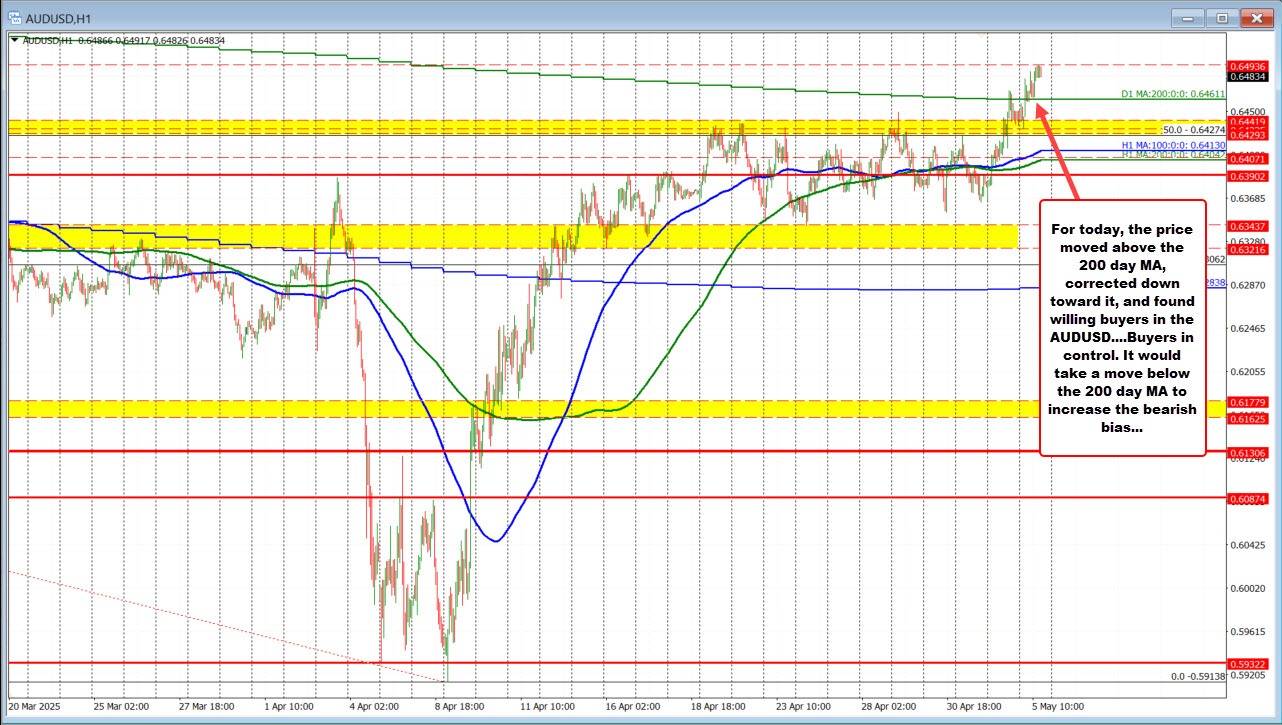
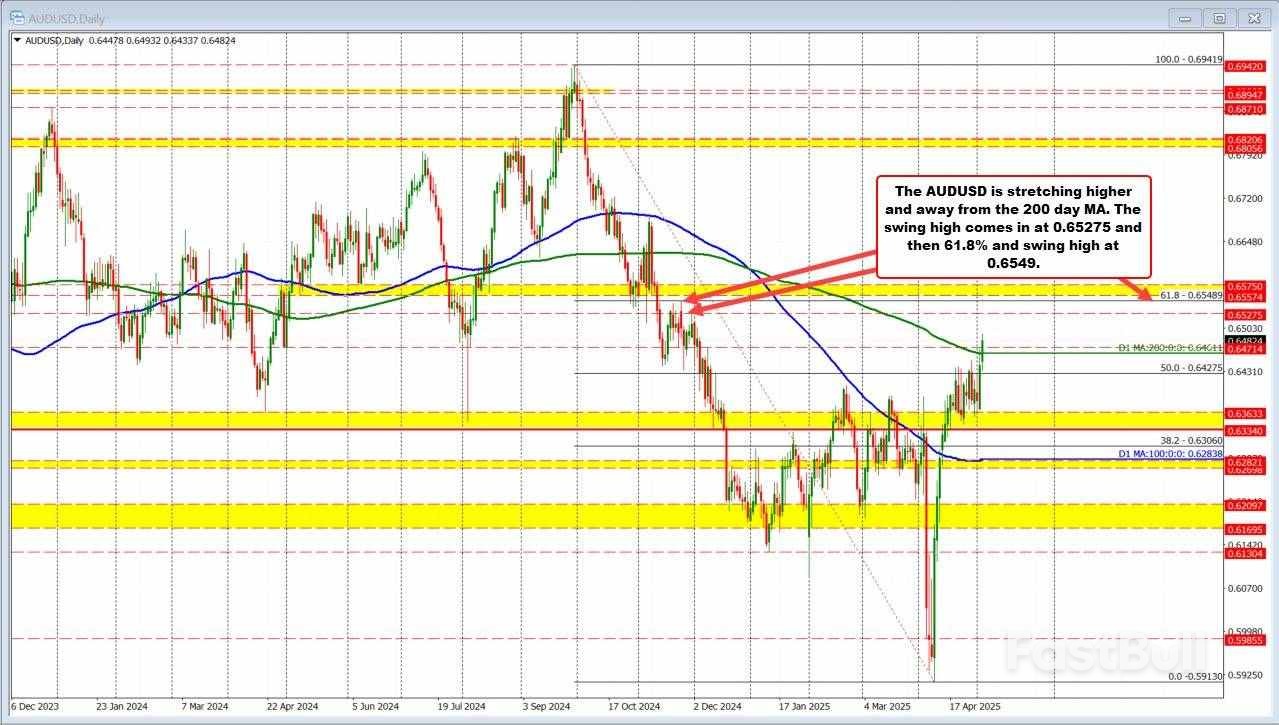
The AUDUSD is surging higher today and has convincingly broken above its 200-day moving average at 0.6461—a key technical milestone. On Friday, the pair briefly traded above this level for the first time since November 8, 2024, but bullish momentum faded, and the price settled back into a familiar swing area between 0.6427 and 0.6441. The Friday close landed near the upper end of that zone at 0.6441.
In early Asian trading today, the low dipped to 0.64337, within that same swing zone, before buyers stepped back in. The price reclaimed the 200-day MA, briefly pulled back to retest it, then based and pushed to a fresh session high at 0.6493.
With the pair now holding above the 200-day MA for a sustained period, 0.6461 becomes a key bias-defining support level. As long as the price remains above, the upside bias stays intact. Sellers gain no technical traction unless price breaks back below that level.
On the daily chart, the next upside target lies at the November 29 swing high of 0.65277, followed by the 61.8% retracement and high from November 25 at 0.6549 (see the chart below).

Israel may seize the Gaza Strip and control aid in an expanded offensive against Palestinian militant group Hamas that was approved by Prime Minister Benjamin Netanyahu's security cabinet on Monday, officials said.
An Israeli defence official said it would not be launched before U.S. President Donald Trump concludes his visit next week to the Middle East.
The decision, after weeks of faltering efforts to agree a ceasefire with Hamas, underlines the threat that a war heaping international pressure on Israel amid dwindling public support at home could continue with no end in sight.
A government spokesman told journalists online that reserve soldiers were being called up to expand operations in Gaza, not to occupy it.
A report by Israel's public broadcaster Kan, citing officials with knowledge of the details, said the new plan was gradual and would take months, with forces focusing first on one area of the battered enclave.
Israeli troops have already taken over an area amounting to around a third of the Gaza Strip, displacing the population and building watchtowers and surveillance posts on cleared ground the military has described as security zones, but the new plan would go further.
One Israeli government official said the newly approved offensive would seize the entire territory of the Gaza Strip, move its civilian population southward and keep humanitarian aid from falling into Hamas hands.
The defence official said aid distribution, which has been handled by international aid groups and U.N. organizations, would be transferred to private companies and handed out in the southern area of Rafah once the offensive begins.
The Israeli military, which throughout the war has shown little appetite for occupying Gaza, declined to comment on the remarks by government officials and politicians.
Israel resumed its offensive in March after the collapse of a U.S.-backed ceasefire that had halted fighting for two months. It has since imposed a blockade of aid into the enclave, drawing warnings from the United Nations and international organizations that the 2.3 million population faces imminent famine.
The Israeli defence official said that Israel would hold on to security zones seized along the Gaza perimeter because they were vital for protecting Israeli communities around the enclave.
But he said there was a "window of opportunity" for a ceasefire and hostage release deal during a visit by Trump to the region next week.
"If there is no hostage deal, Operation "Gideon Chariots" will begin with great intensity and will not stop until all its goals are achieved," he said.
Hamas official Mahmoud Mardawi rejected what he called "pressure and blackmail".
"No deal except a comprehensive one, which includes a complete ceasefire, full withdrawal from Gaza, reconstruction of the Gaza Strip, and the release of all prisoners from both sides," he said.
'OCCUPATION'
Israel has yet to present a clear vision for post-war Gaza after a campaign that has displaced most of Gaza's population and left it depending on aid supplies that have been dwindling rapidly since the blockade.
Ministers have said that aid distribution cannot be left to international organizations which it accuses of allowing Hamas to seize supplies intended for the civilian population.
Instead, officials have looked at plans for private contractors to handle distribution, through what the United Nations has described as Israeli hubs.
On Monday, Jan Egeland, Secretary-General of the Norwegian Refugee Council, said on X that Israel was demanding that the U.N. and non-governmental organisations shut down their aid distribution system in Gaza.
However, the decision to expand the operation was immediately hailed by Israeli government hardliners who have long pressed for a full takeover of the Gaza Strip by Israel and a permanent displacement of the population, along the line of the "Riviera" plans outlined by Trump in February.
"We are finally going to conquer Gaza. We are no longer afraid of the word 'occupation'," Finance Minister Bezalel Smotrich told a pro-settler conference in an online discussion.
However, with Israel facing threats from the Iranian-backed Houthis in Yemen, who on Sunday fired a missile that hit close to Ben Gurion Airport, an unstable Syria next door and a volatile situation in the occupied West Bank, the capacity for prolonged military operations faces constraints.
Israel's Chief of Staff Lieutenant General Eyal Zamir said on Sunday that the military has already begun issuing tens of thousands of call-up orders for its reserve forces, looking to expand the Gaza campaign.
Zamir, who took office in March, has pushed back against calls by government hardliners who want to choke off aid entirely and has told ministers aid must be let in soon, according to Kan.
The war was triggered by the Hamas October 7, 2023 attack on Israel that killed 1,200 people, mostly civilians, according to Israeli tallies, and saw 251 taken hostage into Gaza in the deadliest day for Israel in its history.
Israel's ground and air campaign in Gaza has since killed more than 52,000 Palestinians, most of them civilians according to local health authorities, and left much of Gaza in ruins.
Up to 24 of the 59 hostages still held in Gaza are believed to be alive. Families fear that the fighting will endanger their loved ones while critics say Israel risks being drawn into a long guerrilla war with limited gains and no clear strategy.
Successive surveys have shown dwindling public support for the war among Israelis, many of whom prefer to see a ceasefire deal reached and more hostages released.
The Institute of Supply Management (ISM) Non-Manufacturing Purchasing Managers’ Index (PMI) reported an unexpected rise in the non-manufacturing sector, indicating an expansion in the economy. The actual index value was reported at 51.6, surpassing forecasted and previous values.
The actual PMI figure of 51.6 outperformed the forecasted figure of 50.2. This indicates a more robust expansion in the non-manufacturing sector than analysts had predicted. The index, a composite measure of business activity, new orders, employment, and supplier deliveries, reflects the overall health of the non-manufacturing sector. A reading above 50 suggests expansion, while a figure below 50 indicates contraction.
In comparison to the previous month, the current ISM Non-Manufacturing PMI also shows an improvement. The previous month’s index was reported at 50.8, meaning that the non-manufacturing sector has seen a stronger expansion this month. This improvement is a positive sign for the U.S. economy, as the non-manufacturing sector represents a significant portion of the country’s GDP.
The data for the ISM Non-Manufacturing PMI is compiled from monthly responses to questions asked of more than 370 purchasing and supply executives in over 62 different industries. These industries span nine divisions from the Standard Industrial Classification (SIC) categories, providing a comprehensive view of the non-manufacturing sector’s performance.
The unexpected rise in the ISM Non-Manufacturing PMI is a positive sign for the USD. Higher than expected readings are generally taken as bullish for the USD, as they suggest a stronger economy. Conversely, lower than expected readings are seen as bearish for the USD, indicating a weaker economy. This month’s higher than expected PMI figure suggests that the non-manufacturing sector, and by extension the U.S. economy, is in a stronger position than previously thought.
White Label
Data API
Web Plug-ins
Poster Maker
Affiliate Program
The risk of loss in trading financial instruments such as stocks, FX, commodities, futures, bonds, ETFs and crypto can be substantial. You may sustain a total loss of the funds that you deposit with your broker. Therefore, you should carefully consider whether such trading is suitable for you in light of your circumstances and financial resources.
No decision to invest should be made without thoroughly conducting due diligence by yourself or consulting with your financial advisors. Our web content might not suit you since we don't know your financial conditions and investment needs. Our financial information might have latency or contain inaccuracy, so you should be fully responsible for any of your trading and investment decisions. The company will not be responsible for your capital loss.
Without getting permission from the website, you are not allowed to copy the website's graphics, texts, or trademarks. Intellectual property rights in the content or data incorporated into this website belong to its providers and exchange merchants.
Not Logged In
Log in to access more features

FastBull Membership
Not yet
Purchase
Log In
Sign Up