• Trade
  • Markets
  • Copy
  • Contests
  • News
  • 24/7
  • Calendar
  • Q&A
  • Chats
Trending
Screeners
SYMBOL
LAST
BID
ASK
HIGH
LOW
NET CHG.
%CHG.
SPREAD
SPX
S&P 500 Index
6827.42
6827.42
6827.42
6899.86
6801.80
-73.58
-1.07%
--
DJI
Dow Jones Industrial Average
48458.04
48458.04
48458.04
48886.86
48334.10
-245.98
-0.51%
--
IXIC
NASDAQ Composite Index
23195.16
23195.16
23195.16
23554.89
23094.51
-398.69
-1.69%
--
USDX
US Dollar Index
97.980
98.060
97.980
98.020
97.980
+0.030
+ 0.03%
--
EURUSD
Euro / US Dollar
1.17394
1.17402
1.17394
1.17395
1.17285
0.00000
0.00%
--
GBPUSD
Pound Sterling / US Dollar
1.33682
1.33695
1.33682
1.33732
1.33580
-0.00025
-0.02%
--
XAUUSD
Gold / US Dollar
4303.36
4303.80
4303.36
4307.76
4294.68
+3.97
+ 0.09%
--
WTI
Light Sweet Crude Oil
57.381
57.418
57.381
57.381
57.194
+0.148
+ 0.26%
--

Community Accounts

Signal Accounts
--
Profit Accounts
--
Loss Accounts
--
View More

Become a signal provider

Sell trading signals to earn additional income

View More

Guide to Copy Trading

Get started with ease and confidence

View More

Signal Accounts for Members

All Signal Accounts

Best Return
  • Best Return
  • Best P/L
  • Best MDD
Past 1W
  • Past 1W
  • Past 1M
  • Past 1Y

All Contests

  • All
  • Trump Updates
  • Recommend
  • Stocks
  • Cryptocurrencies
  • Central Banks
  • Featured News
Top News Only
Share

Australia's S&P/ASX 200 Index Down 0.6% At 8647.60 Points In Early Trade

Share

Nomura CEO: Aim To Develop Japanese Direct Lending Market

Share

Nomura CEO: Aim To Bring Private Debt Know-How From Overseas

Share

HSBC - Scheme Consideration Refers To Proposal For Privatisation Of Hang Seng Bank

Share

[Report: SpaceX Launches Bake-Off Process To Select Underwriters For Potential IPO] According To Sources Familiar With The Matter, SpaceX Executives Have Initiated A Process To Select Wall Street Investment Banks To Advise The Company On Its Initial Public Offering (IPO). Several Investment Banks Are Scheduled To Submit Their First Round Of Proposals This Week, A Process Known As "bake-off," Which Represents The Most Concrete Step The Rocket Maker Has Taken Towards A Potentially "blockbuster IPO," According To The Sources

Share

RBNZ: ASB Has Co-Operated With The Reserve Bank And Has Admitted Liability For All Seven Causes Of Action

Share

RBNZ: Court Proceedings For Breaches Of Core Requirements Under Anti-Money Laundering And Countering Financing Of Terrorism Act From At Least December 2019

Share

Jose Antonio Kast Leads Chile Presidential Election's Runoff Vote With 4.46% Of Ballots Counted: Official Count

Share

Mayor: Russian Air Defence Units Destroy Drone Heading For Moscow

Share

Australia's ASIC - ASIC And Reserve Bank Of Australia Will Step Up Their Review To Uplift Their Joint Supervisory Model

Share

US Envoy Witkoff Says A Lot Of Progress Was Made At Berlin Talks On Russia/Ukraine War

Share

Syria's President Sharaa Sends Condolences To Trump Over Killing Of USA Soldiers In Syria - Syrian Presidency

Share

ECOWAS Commission President: ECOWAS Rejects Guinea-Bissau Junta Transition Plan, Demands Return To Constitutional Order

Share

On Sunday (December 14), The Bangladesh DSE Broad Index Closed Down 0.62% At 4932.97 Points

Share

US President Trump: A New Federal Reserve Chairman Will Be Chosen Soon

Share

US President Trump: Inflation Is “completely Offset” And You Don’t Want To See Deflation

Share

Trump: Will Be A Lot Of Damage Done To The People That Attacked Troops In Syria

Share

Trump: Terrible Attack In Bondi Beach

Share

Interior Ministry - Syria Arrests Five Suspects In Shooting Of USA And Syrian Troops In Palmyra

Share

France Says Conditions For EU Vote On MERCOSUR Deal Not Yet Met, Despite Recent Progress — Prime Minister's Office

TIME
ACT
FCST
PREV
U.K. Trade Balance (Oct)

A:--

F: --

P: --

U.K. Services Index MoM

A:--

F: --

P: --

U.K. Construction Output MoM (SA) (Oct)

A:--

F: --

P: --

U.K. Industrial Output YoY (Oct)

A:--

F: --

P: --

U.K. Trade Balance (SA) (Oct)

A:--

F: --

P: --

U.K. Trade Balance EU (SA) (Oct)

A:--

F: --

P: --

U.K. Manufacturing Output YoY (Oct)

A:--

F: --

P: --

U.K. GDP MoM (Oct)

A:--

F: --

P: --

U.K. GDP YoY (SA) (Oct)

A:--

F: --

P: --

U.K. Industrial Output MoM (Oct)

A:--

F: --

P: --

U.K. Construction Output YoY (Oct)

A:--

F: --

P: --

France HICP Final MoM (Nov)

A:--

F: --

P: --

China, Mainland Outstanding Loans Growth YoY (Nov)

A:--

F: --

P: --

China, Mainland M2 Money Supply YoY (Nov)

A:--

F: --

P: --

China, Mainland M0 Money Supply YoY (Nov)

A:--

F: --

P: --

China, Mainland M1 Money Supply YoY (Nov)

A:--

F: --

P: --

India CPI YoY (Nov)

A:--

F: --

P: --

India Deposit Gowth YoY

A:--

F: --

P: --

Brazil Services Growth YoY (Oct)

A:--

F: --

P: --

Mexico Industrial Output YoY (Oct)

A:--

F: --

P: --

Russia Trade Balance (Oct)

A:--

F: --

P: --

Philadelphia Fed President Henry Paulson delivers a speech
Canada Building Permits MoM (SA) (Oct)

A:--

F: --

P: --

Canada Wholesale Sales YoY (Oct)

A:--

F: --

P: --

Canada Wholesale Inventory MoM (Oct)

A:--

F: --

P: --

Canada Wholesale Inventory YoY (Oct)

A:--

F: --

P: --

Canada Wholesale Sales MoM (SA) (Oct)

A:--

F: --

P: --

Germany Current Account (Not SA) (Oct)

A:--

F: --

P: --

U.S. Weekly Total Rig Count

A:--

F: --

P: --

U.S. Weekly Total Oil Rig Count

A:--

F: --

P: --

Japan Tankan Large Non-Manufacturing Diffusion Index (Q4)

--

F: --

P: --

Japan Tankan Small Manufacturing Outlook Index (Q4)

--

F: --

P: --

Japan Tankan Large Non-Manufacturing Outlook Index (Q4)

--

F: --

P: --

Japan Tankan Large Manufacturing Outlook Index (Q4)

--

F: --

P: --

Japan Tankan Small Manufacturing Diffusion Index (Q4)

--

F: --

P: --

Japan Tankan Large Manufacturing Diffusion Index (Q4)

--

F: --

P: --

Japan Tankan Large-Enterprise Capital Expenditure YoY (Q4)

--

F: --

P: --

U.K. Rightmove House Price Index YoY (Dec)

--

F: --

P: --

China, Mainland Industrial Output YoY (YTD) (Nov)

--

F: --

P: --

China, Mainland Urban Area Unemployment Rate (Nov)

--

F: --

P: --

Saudi Arabia CPI YoY (Nov)

--

F: --

P: --

Euro Zone Industrial Output YoY (Oct)

--

F: --

P: --

Euro Zone Industrial Output MoM (Oct)

--

F: --

P: --

Canada Existing Home Sales MoM (Nov)

--

F: --

P: --

Euro Zone Total Reserve Assets (Nov)

--

F: --

P: --

U.K. Inflation Rate Expectations

--

F: --

P: --

Canada National Economic Confidence Index

--

F: --

P: --

Canada New Housing Starts (Nov)

--

F: --

P: --

U.S. NY Fed Manufacturing Employment Index (Dec)

--

F: --

P: --

U.S. NY Fed Manufacturing Index (Dec)

--

F: --

P: --

Canada Core CPI YoY (Nov)

--

F: --

P: --

Canada Manufacturing Unfilled Orders MoM (Oct)

--

F: --

P: --

Canada Manufacturing New Orders MoM (Oct)

--

F: --

P: --

Canada Core CPI MoM (Nov)

--

F: --

P: --

Canada Manufacturing Inventory MoM (Oct)

--

F: --

P: --

Canada CPI YoY (Nov)

--

F: --

P: --

Canada CPI MoM (Nov)

--

F: --

P: --

Canada CPI YoY (SA) (Nov)

--

F: --

P: --

Canada Core CPI MoM (SA) (Nov)

--

F: --

P: --

Canada CPI MoM (SA) (Nov)

--

F: --

P: --

Q&A with Experts
    • All
    • Chatrooms
    • Groups
    • Friends
    Connecting
    .
    .
    .
    Type here...
    Add Symbol or Code

      No matching data

      All
      Trump Updates
      Recommend
      Stocks
      Cryptocurrencies
      Central Banks
      Featured News
      • All
      • Russia-Ukraine Conflict
      • Middle East Flashpoint
      • All
      • Russia-Ukraine Conflict
      • Middle East Flashpoint
      Search
      Products

      Charts Free Forever

      Chats Q&A with Experts
      Screeners Economic Calendar Data Tools
      Membership Features
      Data Warehouse Market Trends Institutional Data Policy Rates Macro

      Market Trends

      Market Sentiment Order Book Forex Correlations

      Top Indicators

      Charts Free Forever
      Markets

      News

      News Analysis 24/7 Columns Education
      From Institutions From Analysts
      Topics Columnists

      Latest Views

      Latest Views

      Trending Topics

      Top Columnists

      Latest Update

      Signals

      Copy Rankings Latest Signals Become a signal provider AI Rating
      Contests
      Brokers

      Overview Brokers Assessment Rankings Regulators News Claims
      Broker listing Forex Brokers Comparison Tool Live Spread Comparison Scam
      Q&A Complaint Scam Alert Videos Tips to Detect Scam
      More

      Business
      Events
      Careers About Us Advertising Help Center

      White Label

      Data API

      Web Plug-ins

      Affiliate Program

      Awards Institution Evaluation IB Seminar Salon Event Exhibition
      Vietnam Thailand Singapore Dubai
      Fans Party Investment Sharing Session
      FastBull Summit BrokersView Expo
      Recent Searches
        Top Searches
          Markets
          News
          Analysis
          User
          24/7
          Economic Calendar
          Education
          Data
          • Names
          • Latest
          • Prev

          View All

          No data

          Scan to Download

          Faster Charts, Chat Faster!

          Download App
          English
          • English
          • Español
          • العربية
          • Bahasa Indonesia
          • Bahasa Melayu
          • Tiếng Việt
          • ภาษาไทย
          • Français
          • Italiano
          • Türkçe
          • Русский язык
          • 简中
          • 繁中
          Open Account
          Search
          Products
          Charts Free Forever
          Markets
          News
          Signals

          Copy Rankings Latest Signals Become a signal provider AI Rating
          Contests
          Brokers

          Overview Brokers Assessment Rankings Regulators News Claims
          Broker listing Forex Brokers Comparison Tool Live Spread Comparison Scam
          Q&A Complaint Scam Alert Videos Tips to Detect Scam
          More

          Business
          Events
          Careers About Us Advertising Help Center

          White Label

          Data API

          Web Plug-ins

          Affiliate Program

          Awards Institution Evaluation IB Seminar Salon Event Exhibition
          Vietnam Thailand Singapore Dubai
          Fans Party Investment Sharing Session
          FastBull Summit BrokersView Expo

          South Korea Faces Credit and Fiscal Risks Despite Growth Momentum in 2026

          Gerik

          Economic

          Summary:

          South Korea's economy is expected to grow in 2026, supported by AI investment and eased U.S. tariffs, but credit rating and fiscal risks are emerging due to large-scale foreign investments and expansive fiscal policy....

          Positive Outlook Masked by Emerging Vulnerabilities

          According to a December 13 report by South Korea’s Newsis and supported by Fitch Ratings’ "Asia-Pacific Sovereign Outlook through 2026," the nation’s economic recovery remains on track thanks to increased capital flows into artificial intelligence infrastructure and progress in trade negotiations with the United States. However, behind this promising trajectory lie several structural and external vulnerabilities that could weigh heavily on South Korea’s fiscal health and sovereign credit rating.
          The decision to increase investment in artificial intelligence infrastructure aligns with South Korea’s long-term industrial strategy and supports its transition into a more tech-driven economy. Alongside this, the recent conclusion of tariff negotiations with the United States is expected to reinforce trade dynamics. Fitch Ratings anticipates a notable boost in South Korea’s exports, particularly in the automotive sector, following the U.S. commitment to lower tariffs on Korean cars from 25% to 15%, a level now comparable to those imposed on Japanese and European products. This change creates a level playing field for Korean manufacturers and will likely improve export competitiveness.

          Foreign Reserve Depletion: A Structural Credit Concern

          However, the positive sentiment is tempered by concerns over South Korea’s massive pledge to invest $350 billion in the United States. Fitch warns that fulfilling this commitment may lead to a significant decline in foreign exchange reserves. As of November 2025, South Korea’s reserves stood at $430.7 billion, which is only about one-third of Japan’s reserves, currently at $1.347 trillion. This disproportion underscores South Korea’s relatively limited buffer against external shocks. If reserve levels fall too sharply during the course of these outbound investments, the country’s credit rating may be reevaluated, especially if market perception shifts toward increasing vulnerability to capital flight or currency volatility.
          In this case, there is a potential causal relationship: the act of deploying reserves for international investment while beneficial for long-term strategic positioning can lead directly to reduced liquidity and perceived creditworthiness. Unlike mere correlation, this reflects a direct trade-off between growth ambition and reserve sustainability.

          Fiscal Expansion and the Risk of Worsening Public Debt

          Fitch also flags fiscal policy as a notable area of risk. South Korea, alongside economies like Indonesia, Thailand, and the Philippines, is currently pursuing expansionary public spending agendas. While these policies are aimed at post-pandemic recovery and strategic investment, they carry the consequence of weakening fiscal consolidation. The resulting rise in public debt could limit future policy flexibility and expose the economy to interest rate risk or international investor skepticism.
          The Ministry of Economy and Finance’s recent report “Government and Public Sector Debt for Fiscal Year 2024” reveals that South Korea’s government debt is projected to reach 1,270.8 trillion won, approximately 49.7% of GDP. Although this figure is still manageable by global standards, its rapid increase is raising concerns. If interest rates rise or growth falters, debt servicing could constrain future budgets, especially in the absence of structural reforms or enhanced tax revenue.

          Geopolitical Uncertainty and Broader APAC Risks

          Beyond domestic considerations, South Korea’s macroeconomic stability in 2026 will also be shaped by regional and global developments. The Fitch report highlights several key external risks facing the broader Asia-Pacific region, including ongoing U.S. trade and tariff unpredictability, fiscal imbalances driven by excessive government spending, and geopolitical instability in areas such as the South China Sea. Additionally, the persistent tension between the U.S. and China could pressure South Korea to navigate increasingly polarized trade and diplomatic relations, potentially affecting export channels and strategic alliances.
          In this context, the risks are largely correlational fiscal strain in other APAC economies or geopolitical instability may not directly cause downturns in Korea but could increase external pressure or investor caution that indirectly affects Korean assets and capital flows.
          While South Korea enters 2026 with strong economic fundamentals, aided by AI investments and improved trade terms with the United States, the country’s financial resilience faces tests on multiple fronts. The anticipated depletion of foreign reserves due to overseas investments and the expansionary fiscal stance present tangible risks to credit stability and public debt sustainability. Unless mitigated by structural safeguards and careful policy management, these factors may constrain Korea’s ability to weather future shocks despite short-term optimism. Balancing growth ambitions with fiscal discipline and reserve integrity will be critical for maintaining investor confidence and macroeconomic stability in the years ahead.
          To stay updated on all economic events of today, please check out our Economic calendar
          Risk Warnings and Disclaimers
          You understand and acknowledge that there is a high degree of risk involved in trading. Following any strategies or investment methods may lead to potential losses. The content on the site is provided by our contributors and analysts for information purposes only. You are solely responsible for determining whether any trading assets, securities, strategy, or any other product is suitable for investing based on your own investment objectives and financial situation.
          Add to Favorites
          Share

          Cryptocurrency Firms Edge Closer to the U.S. Banking System

          Gerik

          Economic

          Cryptocurrency

          Regulatory Breakthrough for Crypto Firms

          On December 12, the Office of the Comptroller of the Currency (OCC) announced a landmark move that may reshape the relationship between digital assets and the traditional financial sector in the United States. Several leading cryptocurrency firms, including Circle Internet Group and Ripple, received preliminary approval to either establish or convert into national trust banks. This decision marks a significant regulatory milestone, allowing these entities to participate more directly in the U.S. financial system, albeit under strict supervision.
          Among the beneficiaries of this conditional approval are Paxos, BitGo, and Fidelity Digital Assets. These firms are now authorized to transition their state-issued trust charters to federal trust bank charters. Such conversions would allow them to operate on a national scale, surpassing jurisdictional limitations previously imposed by state-level regulation.
          However, it is important to recognize that these approvals are not final. The OCC retains full authority to grant final approval, amend conditions, or suspend these decisions should the firms fail to meet the stringent requirements. This introduces a layer of regulatory prudence, ensuring that market participants do not overinterpret the current progress as full endorsement.

          Functionality of the National Trust Bank Charter

          The national trust bank charter affords these crypto firms key operational benefits. They are permitted to offer custodial services and facilitate faster settlement of transactions, a core need in the rapidly evolving crypto market. However, this charter stops short of authorizing them to accept deposits or issue credit. Moreover, customer accounts at these institutions will not be insured by the Federal Deposit Insurance Corporation (FDIC), in contrast to traditional commercial banks. This distinction underscores a cautious regulatory stance opening doors to innovation while minimizing systemic exposure.
          To be granted a full license, crypto companies must comply with capital adequacy and liquidity standards mandated by the OCC. Furthermore, their operations must remain within the functional boundaries of a trust bank. These firms are also expected to align with federal legislation, particularly the anticipated GENIUS Act, which will regulate stablecoins pegged to the U.S. dollar. This legal alignment is essential to ensure consistency across the digital asset landscape as Congress reviews broader cryptocurrency regulations in the near future.

          Potential Benefits and Concerns in the Banking Ecosystem

          Jonathan Gould, the acting head of the OCC appointed during the Trump administration, emphasized that the inclusion of new entities in the federal banking ecosystem could enhance competition and provide broader benefits to consumers and the economy. By integrating innovation-driven companies, the banking system may become more agile and responsive to evolving financial technologies.
          However, skepticism remains within traditional banking circles. Critics argue that cryptocurrency firms may be subject to less rigorous oversight, thereby introducing unquantified risks into the system. This perceived regulatory leniency could foster imbalances if not managed with robust safeguards, particularly given the complex and volatile nature of digital assets.

          Anchorage Digital: A Lone Precedent

          As of now, Anchorage Digital remains the only cryptocurrency firm that holds a national trust bank charter and is operational under this status. The OCC currently supervises around 60 national trust banks, alongside commercial banks and other federally regulated financial institutions. The expansion of this list to include more crypto-native firms suggests a shifting dynamic, one that blends traditional financial governance with emerging technologies.
          The conditional approvals appear to stem from the OCC’s strategic intent to modernize financial services by cautiously incorporating digital asset firms. While there is a causal link between regulatory interest and crypto integration, the correlation between crypto adoption and systemic financial health remains ambiguous. Regulatory bodies are navigating a fine line between fostering innovation and protecting financial stability, with each approval acting as both a litmus test and a precedent.
          The OCC’s decision to extend conditional trust bank charters to key players in the cryptocurrency sector represents a deliberate step toward deeper financial integration. While final approvals are still pending and significant limitations remain, this development reflects a changing regulatory landscape. As legal frameworks evolve and compliance hurdles are tested, the U.S. banking system is cautiously welcoming the digital economy, with both optimism and vigilance.
          To stay updated on all economic events of today, please check out our Economic calendar
          Risk Warnings and Disclaimers
          You understand and acknowledge that there is a high degree of risk involved in trading. Following any strategies or investment methods may lead to potential losses. The content on the site is provided by our contributors and analysts for information purposes only. You are solely responsible for determining whether any trading assets, securities, strategy, or any other product is suitable for investing based on your own investment objectives and financial situation.
          Add to Favorites
          Share

          Trump Administration Sued Over $300M White House Ballroom Project Amid Legal and Heritage Backlash

          Gerik

          Political

          Ballroom Construction Triggers Legal Showdown

          On December 12, the National Trust for Historic Preservation officially filed a federal lawsuit against the Trump administration over its high-profile plan to demolish the East Wing of the White House and replace it with a sprawling 8,361-square-meter ballroom. The organization claims that the administration bypassed mandatory environmental, legal, and congressional review processes before initiating construction, thereby violating multiple federal statutes.
          The central legal claim rests on the assertion that no U.S. president is entitled to unilaterally dismantle historically protected structures on federal property without transparent legal oversight. The plaintiffs argue that such an act not only circumvents public consultation but also undermines national heritage law, citing both the Administrative Procedure Act and the National Environmental Policy Act.

          White House Defends Authority and Intent

          The Trump administration immediately rejected the lawsuit’s premises. Spokesman Davis Ingle stated that the president retains full legal authority to renovate the White House, including modernizations aligned with past presidential initiatives. He described the ballroom as a legitimate and privately funded modernization project aimed at creating a more prestigious venue for official state functions.
          According to administration sources, the project commenced in October and is entirely financed by private donors. The original estimated cost of $200 million has since ballooned to around $300 million. Officials argue that the upgrade will enhance the White House’s capacity for hosting international summits and ceremonial events, aligning with modern diplomatic standards.

          Allegations of Procedural Breach and Overreach

          The lawsuit contends that the administration failed to submit the project for review to key oversight bodies including the National Capital Planning Commission, the U.S. Commission of Fine Arts, and Congress. These omissions are being portrayed by the plaintiffs as not just technical oversights but deliberate efforts to bypass institutional accountability.
          This challenge reflects a causal accusation: that the administration’s disregard for regulatory procedure facilitated the controversial demolition of a historically significant wing without legal approval. The plaintiffs have requested an immediate halt to the project until all environmental and legal evaluations are properly completed.

          Historic Preservation vs. Executive Discretion

          At the core of the dispute is a broader constitutional question: to what extent can the executive branch alter a structure that functions simultaneously as a residence, a workplace, and a national historic landmark? Critics argue that President Trump has overstepped constitutional bounds, leveraging presidential discretion for architectural ambitions that should require legislative checks.
          The administration, however, frames the preservationist lawsuit as politically motivated. It views the challenge not as a defense of heritage, but as a tactic to derail one of Trump’s high-profile legacy initiatives. The polarized nature of the responses reflects a correlative dynamic: preservation debates are increasingly entangled in broader political fault lines.

          International and Domestic Ramifications

          The ballroom project has sparked not just legal controversy but also diplomatic and symbolic debates. As the White House serves as a globally recognized emblem of U.S. continuity and tradition, any alterations to its structure carry international implications. Furthermore, critics warn that the East Wing’s demolition undermines efforts to preserve the architectural integrity of one of the nation’s most visited and studied government buildings.
          As construction advances and litigation proceeds, the future of the Trump administration’s White House ballroom project hangs in legal uncertainty. The outcome will likely set precedent for the scope of executive authority over historically protected federal properties. Whether framed as a symbol of modernization or an act of overreach, the courtroom battle over this architectural undertaking underscores the enduring tension between political ambition and historical preservation.
          Risk Warnings and Disclaimers
          You understand and acknowledge that there is a high degree of risk involved in trading. Following any strategies or investment methods may lead to potential losses. The content on the site is provided by our contributors and analysts for information purposes only. You are solely responsible for determining whether any trading assets, securities, strategy, or any other product is suitable for investing based on your own investment objectives and financial situation.
          Add to Favorites
          Share

          After Freezing Russian Assets, EU Prepares War-Financing Plan for Ukraine Amid Legal and Political Tensions

          Gerik

          Political

          Strategic Shift: From Asset Freeze to War Financing

          The European Union, having recently enacted an indefinite freeze on approximately €210 billion (about $246 billion) in Russian central bank assets, is now entering its next phase: mobilizing these funds to finance Ukraine’s needs for the 2026–2027 period. This development was confirmed by European Council President Antonio Costa, who described the decision as a critical step following the asset freeze.
          Unlike previous arrangements that required unanimous renewal every six months, the indefinite freeze was approved using qualified majority voting avoiding the vetoes of pro-Russia voices such as Hungary and Slovakia. This procedural adjustment reflects a causal decision to eliminate the internal obstacles that previously stalled EU consensus and to ensure long-term financial planning for Ukraine.

          Internal Dissent and Political Fractures

          Hungarian Prime Minister Viktor Orbán denounced the EU’s action as a breach of legal boundaries and warned of “irreparable damage” to the union's legal framework. Orbán’s reaction underscores the growing internal polarization within the EU regarding its role in the Ukraine conflict. The qualified majority vote mechanism allowed Brussels to bypass Budapest’s dissent, but at the cost of deepening rifts within the bloc.
          This tension is causally linked to institutional concerns over sovereignty and democratic procedures. Hungary's objection is not only political but also legal, as it challenges the legitimacy of freezing sovereign assets without unanimous consent potentially eroding the foundation of consensus-based EU decision-making.

          Legal Challenges from Russia and the Question of Sovereignty

          The Russian Central Bank condemned the EU’s move as a violation of international law and the principle of sovereign immunity. In its official statement, Moscow warned that the use direct or indirect of its foreign exchange reserves for war-related purposes is illegal and reserved the right to retaliate. On the same day, it filed a lawsuit against Euroclear in a Moscow court, marking the beginning of a broader legal counteroffensive.
          The correlation between legal risks and financial instruments is increasingly evident: the EU’s plan to convert frozen reserves into a war-financing mechanism introduces substantial legal ambiguity, especially concerning the future of sovereign immunity in global finance.

          Belgium’s Balancing Act and Euroclear's Central Role

          Belgium, where Euroclear is headquartered, now finds itself at the center of geopolitical and legal pressure. Deputy Prime Minister Vincent van Peteghem affirmed that the frozen Russian assets “must eventually be used for Ukraine,” while stressing that no premature or reckless compromise would be made. However, Belgium’s cooperation is essential both legally and logistically for any asset utilization plan to proceed.
          Here, the causal relationship between national jurisdiction and EU-level action becomes critical. Without Belgium’s legal authorization, Euroclear cannot repurpose the assets even with EU political support underscoring how national sovereignty still constrains supranational financial measures.

          Funding Ukraine Without National Budget Sacrifices

          The EU has reached a financial impasse: it has pledged to support Ukraine “for as long as necessary,” but most member states are reluctant to fund Kyiv using their own national budgets. As such, the plan to transform frozen Russian assets into war loans for Ukraine appears to be the only viable option without politically contentious budget reallocations.
          The European Commission is seeking Belgium’s legal approval to begin using the estimated €185–210 billion held in Euroclear accounts. These funds would be distributed as war-reparation loans, with repayment expected from Ukraine after the conflict ends assuming Moscow ultimately pays reparations to cover the damage caused.
          The use of such funds, although framed as a war loan, is causally intertwined with the assumption that future Russian reparations will underwrite Ukraine’s obligations. This construct introduces a speculative financial mechanism into international law, making it both innovative and controversial.

          US Involvement and the Diplomatic Undercurrent

          The EU’s announcement also comes at a sensitive moment, as former U.S. President Donald Trump is reportedly working on a peace deal that includes the unfreezing of Russian assets and a potential resumption of Russia–EU energy cooperation. These plans, reported by The Wall Street Journal, would directly clash with the EU’s new approach and risk undermining Brussels’ control over post-war reconstruction and justice mechanisms.
          This highlights a correlative friction between U.S. diplomatic strategies and EU legal instruments. While Washington may seek a broad compromise, Brussels is building a more rigid legal and financial framework to exert sustained pressure on Moscow and maintain long-term support for Kyiv.
          The European Union’s shift from freezing Russian assets to preparing war loans for Ukraine represents a bold and unprecedented maneuver in international finance and geopolitical strategy. By bypassing veto powers and anchoring its actions in long-term political and legal commitments, the EU seeks to reinforce its role as Ukraine’s steadfast backer. However, this path also invites legal backlash from Moscow, internal dissent from member states, and complications from U.S. peace initiatives. Whether the strategy will endure or fragment under pressure will depend on how successfully the EU navigates the intersecting domains of finance, law, and diplomacy in the months ahead.
          Risk Warnings and Disclaimers
          You understand and acknowledge that there is a high degree of risk involved in trading. Following any strategies or investment methods may lead to potential losses. The content on the site is provided by our contributors and analysts for information purposes only. You are solely responsible for determining whether any trading assets, securities, strategy, or any other product is suitable for investing based on your own investment objectives and financial situation.
          Add to Favorites
          Share

          Gold Pares Gains as Fedspeak Raises Doubts on Further Rate Cuts

          Manuel

          Commodity

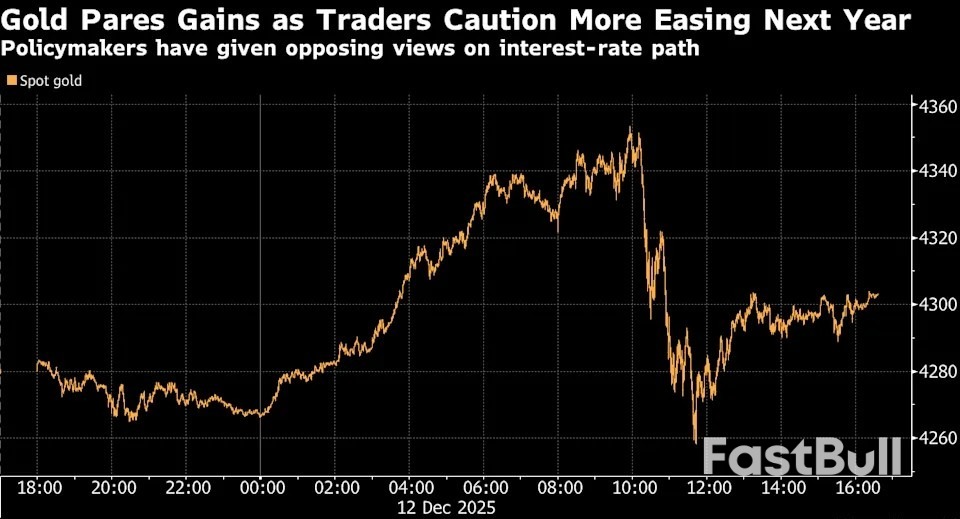
          Gold pared gains as traders grew cautious on bets of further monetary easing next year after US Federal Reserve officials offered strongly opposing views Friday.
          Declines in US equities, driven by a selloff in technology shares, also meant some investors may have to exit their positions in metals to cover losses elsewhere.
          Federal Reserve Bank of Cleveland President Beth Hammack said she would prefer interest rates be slightly more restrictive to keep pressure on inflation, which remains too high. Kansas City Fed President Jeff Schmid made the same argument, adding that’s why he dissented against the central bank’s decision this week to lower rates.
          After the policymakers’ remarks, yields on Treasury 30-year bonds rose, sending bullion lower by as much as 0.5% before paring some of the losses. The precious metal typically performs well in a lower-rate environment and investors now are looking for more certainty on the outlook.Gold Pares Gains as Fedspeak Raises Doubts on Further Rate Cuts_1
          The selloff appears broad-based across commodities markets and risk assets and is likely related to the aftermath of Wednesday’s Fed meeting, said Dan Ghali, senior commodity strategist at TD Securities.
          Gold traders initially cheered the Fed’s announcement that it will begin buying $40 billion of Treasury bills per month starting Dec. 12 as it’s looking to rebuild reserves in the financial system, a move signaling more easing ahead. The Fed stopped shrinking its holdings earlier this month, a process known as quantitative tightening, amid signs reserves in the banking system were no longer abundant.
          Markets are still debating whether the central bank’s reserve management purchases program is an effective form of quantitative easing, Ghali said.
          The Wall Street Journal reported Friday US President Donald Trump said he was leaning toward choosing either former Fed governor Kevin Warsh or National Economic Council Director Kevin Hassett to lead the Federal Reserve next year. Hassett has emerged as the front runner and is widely considered a supporter of Trump’s preference for lower rates.
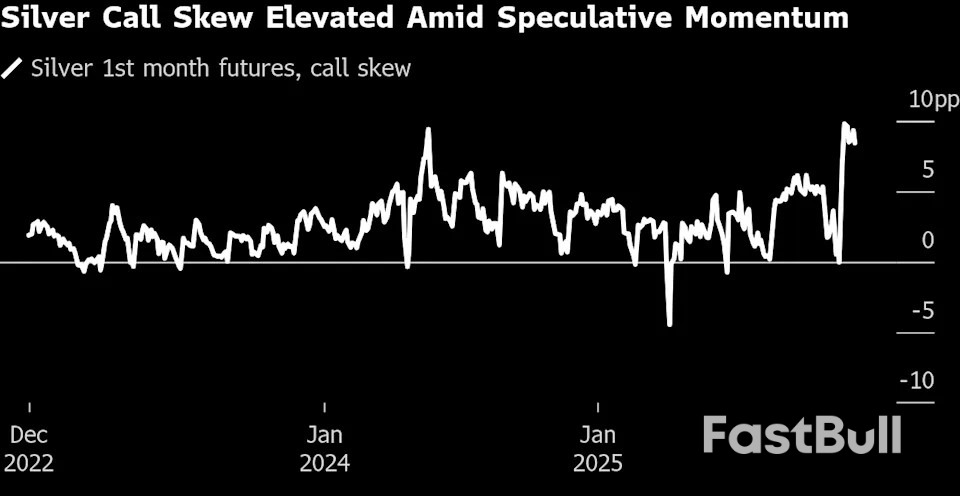
          Silver retreated from an all-time high above $64. The white metal has been on a tear recently, helped by exchange-traded fund inflows and physical market tightness.
          On iShares Silver Trust (SLV), the largest silver ETF, total call open interest hit the highest since 2021 this week. Meanwhile its total put open interest is at a record. The cost of buying calls relative to the cost of buying equivalent puts, which protect against downside in prices, has also jumped to a years-long high in recent weeks.Gold Pares Gains as Fedspeak Raises Doubts on Further Rate Cuts_2
          Spot gold gained 0.6% to $4,304.26 an ounce as of 4:40 p.m. in New York. Silver tumbled 2.4%. Platinum rose while palladium fell. The Bloomberg Dollar Spot Index was up 0.1%.

          Source: Bloomberg

          Risk Warnings and Disclaimers
          You understand and acknowledge that there is a high degree of risk involved in trading. Following any strategies or investment methods may lead to potential losses. The content on the site is provided by our contributors and analysts for information purposes only. You are solely responsible for determining whether any trading assets, securities, strategy, or any other product is suitable for investing based on your own investment objectives and financial situation.
          Add to Favorites
          Share

          Crypto Just Entered YouTube’s $100B Creator Payouts, Offering a Novel Path to Finally Exit Banks

          Manuel

          Cryptocurrency

          Stocks

          YouTube has added PayPal’s PYUSD stablecoin as a payout option for U.S. creators. The choice routes through PayPal’s payout infrastructure rather than requiring YouTube to custody or transfer crypto directly.
          According to Fortune, PayPal crypto chief May Zabaneh confirmed the arrangement. Google and YouTube also confirmed PYUSD was added as a payout option for eligible creators.
          The change lands inside one of the largest recurring creator pay streams in media. YouTube has paid out more than $100 billion to creators over the past four years.
          That implies roughly $25 billion per year flowing through the platform’s monetization stack. The immediate impact is not that creators must “go on-chain.” It is that a stablecoin is now presented as a selectable payout rail inside a familiar payouts workflow for some creators. It starts in the U.S. and is opt-in.

          Stablecoins move into mainstream creator payouts

          Primary product documentation already supports the plumbing for that workflow, even if the PYUSD toggle itself is only confirmed by Fortune. Google’s help pages state that AdSense and AdSense for YouTube can pay via PayPal Hyperwallet.
          They also state that Hyperwallet is available as a payment method for publishers based in the U.S. In some Google help flows, additional countries are listed.
          According to Google’s documentation, the AdSense for YouTube payment process describes earnings being issued and then made available in Hyperwallet as part of the payout flow.
          That matters because it keeps crypto handling concentrated inside a payments provider’s custodial, compliance-scoped environment. It still offers a route to external settlement for creators who want it.
          PayPal’s help center explains that customers can transfer supported crypto, including PYUSD, to external addresses. Network support details are handled within PayPal’s crypto transfer experience.
          Outbound transfers are part of the standard crypto feature set. That creates a practical bridge from a platform payout to an on-chain address without requiring the platform to integrate wallets.

          How PYUSD turns platform payouts into on-chain, user-controlled transfers

          In practice, a “payout in PYUSD” can be understood as three steps: YouTube earnings issuance, availability through Hyperwallet, and a creator-selected cash-out method. Google documents the first two steps through its AdSense for YouTube and Hyperwallet payout guides.
          Fortune reports the third step now includes PYUSD for U.S. creators. If a creator chooses PYUSD and later wants to move funds beyond PayPal’s custody, PayPal documents the transfer-to-address path in its crypto help pages.
          That places the final on-chain exit decision with the user rather than the platform. The scale of that distribution channel helps explain why stablecoin issuers and payment firms keep targeting payroll-like flows.
          Creator payouts behave like long-tail contractor payments: frequent, fragmented, and often international in effect even when the payer is U.S.-based. A stablecoin option inside a mainstream payout menu does not need majority adoption to become operationally meaningful.
          It converts small percentages of a large base into recurring transaction volume and repeated user behavior around holding, transferring, or spending a token balance. PYUSD’s current footprint also makes the distribution angle more relevant than a one-off announcement.
          PYUSD sits at around $3.91 billion in market cap and a similar circulating supply, consistent with its dollar peg design. The token’s supply depth suggests a new on-ramp from creator payouts is better framed as incremental flow and velocity rather than a near-term supply shock.

          PYUSD distribution shifts from headline supply to incremental payment flow

          PayPal has also been extending PYUSD’s network reach, expanding to Arbitrum in 2025.
          That adds another settlement environment intended to support commercial and cross-border uses alongside earlier support on other networks. Because YouTube has not published a breakdown for how much of its creator payouts are U.S.-based, any sizing exercise has to be explicit about assumptions.
          YouTube also has not published how many creators use PayPal-linked rails. Using Reuters’ $100 billion over four years figure as a baseline, the range of potential annual PYUSD payout volume depends on opt-in behavior more than on YouTube’s aggregate payout totals.Crypto Just Entered YouTube’s $100B Creator Payouts, Offering a Novel Path to Finally Exit Banks_1
          Even under the aggressive case, the implied flow is better read as a habits-and-plumbing story than a direct market-cap catalyst for a stablecoin already measured in the billions. Where supply can change is in “stickiness,” meaning how long recipients hold balances before converting or spending.
          If payouts arrive in PYUSD and creators treat that balance as a temporary staging point before cashing out, the incremental steady-state balance can remain modest even when monthly flow rises.
          If PayPal expands the places where PYUSD can be used within its network, or if creators choose to keep balances in-token, the same payout volume can support higher outstanding balances.
          This kind of integration is also landing as U.S. policymakers move toward clearer payment stablecoin frameworks that enterprise finance teams can map onto existing controls.
          Citi’s September 2025 “Stablecoins 2030” research notes stablecoin issuance rising from about $200 billion at the start of 2025 to roughly $280 billion.
          It also includes revised 2030 issuance forecasts of $1.9 trillion in its base case and $4.0 trillion in a higher-adoption case. According to Citi, the scale of potential usage is tied to settlement behavior and transaction turnover as much as raw issuance.
          Stablecoins move from pilot phase to regulated financial infrastructure
          A competing lens is that stablecoins function economically as deposit-like liabilities that raise classic oversight and run-risk debates. That point is discussed in the Financial Times.
          In Washington, the direction of travel is toward codifying guardrails rather than leaving stablecoins in a patchwork of state money-transmitter rules and enforcement actions. Congress.gov’s summary for the GENIUS Act outlines a framework concept for who can issue payment stablecoins and the expectations around redemption and oversight.
          The bill is structured around issuer permissions and standards. The U.S. Treasury has already opened an advance notice of proposed rulemaking on implementation.
          The ANPRM signals that operational details are moving into rulemaking, including the compliance and reporting expectations that large payment networks and platforms tend to require before turning a new money rail on at scale.
          The Richmond Fed has also summarized issuer disclosure concepts that can matter for enterprise adoption, including monthly attestations and executive certifications. Final requirements depend on completed rules.
          Against that backdrop, the YouTube-to-PYUSD option is a case study in how stablecoins can enter mainstream distribution without a platform retooling itself into a crypto business.
          The platform keeps its payouts relationship with an established provider, and the provider offers a stablecoin balance as one of several payout destinations.
          Creators decide whether to stop at a custodial balance, convert to fiat, or transfer to an external address. According to Fortune, that choice is now available to U.S. creators as a PYUSD payout option inside YouTube’s payout settings via PayPal’s rails.

          Source: Cryptoslate

          Risk Warnings and Disclaimers
          You understand and acknowledge that there is a high degree of risk involved in trading. Following any strategies or investment methods may lead to potential losses. The content on the site is provided by our contributors and analysts for information purposes only. You are solely responsible for determining whether any trading assets, securities, strategy, or any other product is suitable for investing based on your own investment objectives and financial situation.
          Add to Favorites
          Share

          The Stocks to Watch When Supreme Court Rules on Trump’s Tariffs

          Manuel

          Political

          China–U.S. Trade War

          An upcoming US Supreme Court ruling on the legality of the sweeping tariffs that President Donald Trump rolled out in April — briefly sending markets worldwide into a tailspin — could be the next test for stocks that have been flying high.
          The S&P 500 Index has since rallied 39% from the lows hit that month. It closed at a record high Thursday, in part because tariffs have settled lower than Trump’s highest threats, while support has come from an artificial-intelligence investment boom and a US economy that has kept expanding fast enough to throw off record corporate profits.
          If the nation’s top court says Trump exceeded his authority with the blanket tariffs on countries around the globe, there will still be significant uncertainty. The White House could use other laws to reimpose some new levies, for example. Bond traders could push up yields over worries about the deficit, and that concern could spread into the equity market.
          However, companies eager for a relief will likely to have to wait until at least January. With the Supreme Court beginning a four-week holiday recess, the window has all but closed for a ruling this year on challenges to Trump’s sweeping import taxes.
          But when a decision does come, market participants say the initial reaction, at least, would likely be positive for stocks should the court strike down the tariffs. A ruling upholding the tariffs would likely have the opposite effect.
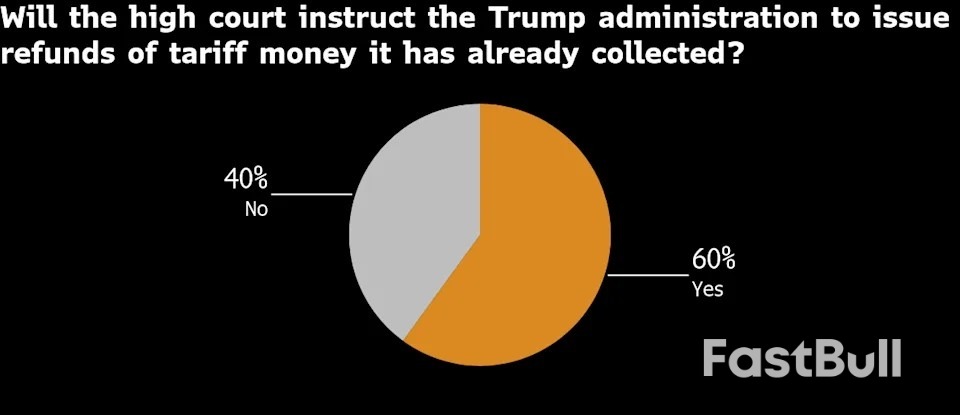
          There are a few reasons why. Striking down the tariffs would eliminate a tax that many businesses haven’t completely passed along to customers, resulting in a drag on the bottom line. Refunds on what they’ve already paid could provide a windfall. And consumer spending may get a boost, too, given that Democrats in Congress estimate tariffs have cost the average American family some $1,200 over the past 10 months.
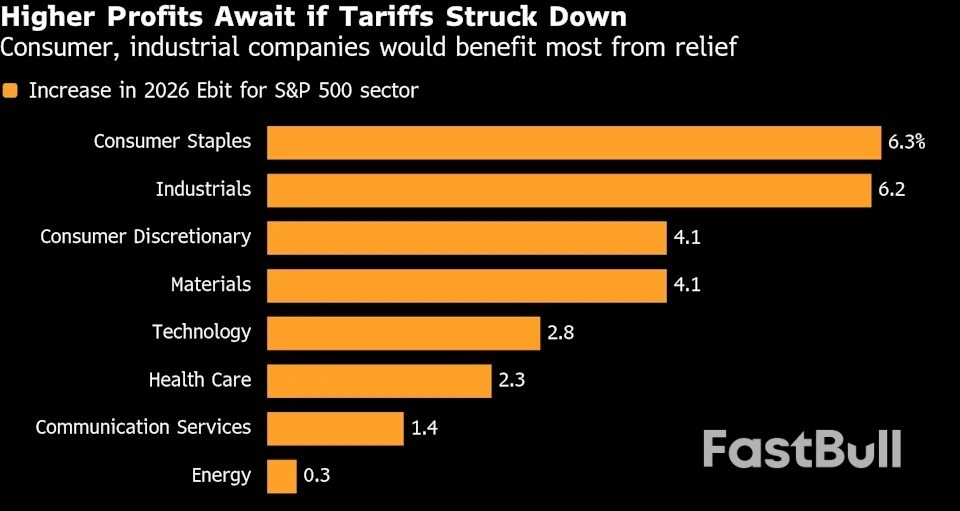
          Overall, a ruling against the tariffs would boost the earnings of companies in the S&P 500 Index, before interest and taxes, by 2.4% in 2026 compared to current-year levels, Wells Fargo & Co. Chief Equity Strategist Ohsung Kwon estimated in October.
          “That’s good for the market generally, because they look at tariffs as a tax,” said James St. Aubin, chief investment officer at Ocean Park Asset Management. “This will be a catalyst for a little bit of a rally.”The Stocks to Watch When Supreme Court Rules on Trump’s Tariffs_1
          Some companies, and their stocks, stand to benefit more than others. The tariffs have been particularly painful for those that are heavily dependent on imported goods, such as apparel companies and toymakers. Financial firms, for their part, stand to benefit from a more confident or flush consumer.
          “On the flip side,” said Haris Khurshid, chief investment officer at Karobaar Capital, “materials, commodities and domestic producers that benefited from protectionism might lag a bit.”
          Here’s a look at some of the sectors and companies with the most at stake when the decision does come:

          Consumer

          Clothing and toy companies — both heavily dependent on imports from China and other Asian countries targeted with some of the highest tariffs — are seen as clear winners, according to BI. Nike Inc. and Mattel Inc. are potential standouts.
          Others include Deckers Outdoor Corp., Under Armour Inc., Crocs Inc., and American Eagle Outfitters Inc., all of which have struggled with tariff-related uncertainty. Home furnishing stocks have been volatile too, including Wayfair Inc., Williams-Sonoma Inc. and RH.
          Texas Capital’s Eric Wold singled out some potential winners among the leisure-related companies he follows: boat-maker Brunswick Corp., toymaker Funko Inc. and Topgolf Callaway Brands Corp.

          Industrials

          Industrial manufacturing giants Caterpillar Inc. and Deere & Co. are among the firms set to benefit the most from tariff refunds, according to Wells Fargo’s Kwon. Stanley Black & Decker Inc., Fortive Corp. and Lennox International Inc. also make the list.The Stocks to Watch When Supreme Court Rules on Trump’s Tariffs_2
          Shares of automakers General Motors Co. and Ford Motor Co. advanced during the Supreme Court hearing last month, when the justices’ skepticism about the administration’s arguments increased market speculation that the tariffs would be struck down. While the case doesn’t affect the industry-specific tariff on automakers, they stand to gain from a stronger consumer.
          Hedgeye also sees positive implications for transport stocks, expecting a boost if the tariffs are struck down and importers move to snap up inventory before any new ones are imposed. That could benefit United Parcel Service Inc., FedEx Corp. and trucking companies.
          Financials
          Major banks such as JPMorgan Chase & Co. and Goldman Sachs Group Inc. faced volatility earlier this year, alongside private equity giants like Blackstone Inc., amid concerns that Trump’s trade war will slow economic activity. Financial-technology companies such as Affirm Holdings Inc. and Block Inc. are prone to big swings, as are stocks linked to cryptocurrencies.
          Lower tariffs may ease pressure on US consumers and support the broader economy. If inflation expectations move lower, it’ll also support the case for more rate cuts by the Federal Reserve, Clear Street analyst Owen Lau said.
          Lower interest rates encourage “loan growth, refinancing, stronger equities markets and even higher consumer spending,” Lau said, “which will fundamentally benefit financial stocks in general.”

          Source: Bloomberg

          Risk Warnings and Disclaimers
          You understand and acknowledge that there is a high degree of risk involved in trading. Following any strategies or investment methods may lead to potential losses. The content on the site is provided by our contributors and analysts for information purposes only. You are solely responsible for determining whether any trading assets, securities, strategy, or any other product is suitable for investing based on your own investment objectives and financial situation.
          Add to Favorites
          Share
          FastBull
          Copyright © 2025 FastBull Ltd

          728 RM B 7/F GEE LOK IND BLDG NO 34 HUNG TO RD KWUN TONG KLN HONG KONG

          TelegramInstagramTwitterfacebooklinkedin
          App Store Google Play Google Play
          Products
          Charts

          Chats

          Q&A with Experts
          Screeners
          Economic Calendar
          Data
          Tools
          Membership
          Features
          Function
          Markets
          Copy Trading
          Latest Signals
          Contests
          News
          Analysis
          24/7
          Columns
          Education
          Company
          Careers
          About Us
          Contact Us
          Advertising
          Help Center
          Feedback
          User Agreement
          Privacy Policy
          Business

          White Label

          Data API

          Web Plug-ins

          Poster Maker

          Affiliate Program

          Risk Disclosure

          The risk of loss in trading financial instruments such as stocks, FX, commodities, futures, bonds, ETFs and crypto can be substantial. You may sustain a total loss of the funds that you deposit with your broker. Therefore, you should carefully consider whether such trading is suitable for you in light of your circumstances and financial resources.

          No decision to invest should be made without thoroughly conducting due diligence by yourself or consulting with your financial advisors. Our web content might not suit you since we don't know your financial conditions and investment needs. Our financial information might have latency or contain inaccuracy, so you should be fully responsible for any of your trading and investment decisions. The company will not be responsible for your capital loss.

          Without getting permission from the website, you are not allowed to copy the website's graphics, texts, or trademarks. Intellectual property rights in the content or data incorporated into this website belong to its providers and exchange merchants.

          Not Logged In

          Log in to access more features

          FastBull Membership

          Not yet

          Purchase

          Become a signal provider
          Help Center
          Customer Service
          Dark Mode
          Price Up/Down Colors

          Log In

          Sign Up

          Position
          Layout
          Fullscreen
          Default to Chart
          The chart page opens by default when you visit fastbull.com