• Trade
  • Markets
  • Copy
  • Contests
  • News
  • 24/7
  • Calendar
  • Q&A
  • Chats
Trending
Screeners
SYMBOL
LAST
BID
ASK
HIGH
LOW
NET CHG.
%CHG.
SPREAD
SPX
S&P 500 Index
6844.51
6844.51
6844.51
6861.30
6844.22
+17.10
+ 0.25%
--
DJI
Dow Jones Industrial Average
48583.44
48583.44
48583.44
48679.14
48557.21
+125.40
+ 0.26%
--
IXIC
NASDAQ Composite Index
23242.16
23242.16
23242.16
23345.56
23242.16
+47.00
+ 0.20%
--
USDX
US Dollar Index
97.830
97.910
97.830
98.070
97.810
-0.120
-0.12%
--
EURUSD
Euro / US Dollar
1.17556
1.17563
1.17556
1.17596
1.17262
+0.00162
+ 0.14%
--
GBPUSD
Pound Sterling / US Dollar
1.33959
1.33966
1.33959
1.33970
1.33546
+0.00252
+ 0.19%
--
XAUUSD
Gold / US Dollar
4331.02
4331.43
4331.02
4350.16
4294.68
+31.63
+ 0.74%
--
WTI
Light Sweet Crude Oil
56.857
56.887
56.857
57.601
56.789
-0.376
-0.66%
--

Community Accounts

Signal Accounts
--
Profit Accounts
--
Loss Accounts
--
View More

Become a signal provider

Sell trading signals to earn additional income

View More

Guide to Copy Trading

Get started with ease and confidence

View More

Signal Accounts for Members

All Signal Accounts

Best Return
  • Best Return
  • Best P/L
  • Best MDD
Past 1W
  • Past 1W
  • Past 1M
  • Past 1Y

All Contests

  • All
  • Trump Updates
  • Recommend
  • Stocks
  • Cryptocurrencies
  • Central Banks
  • Featured News
Top News Only
Share

The Nasdaq Golden Dragon China Index Fell 0.9% In Early Trading

Share

The S&P 500 Opened 32.78 Points Higher, Or 0.48%, At 6860.19; The Dow Jones Industrial Average Opened 136.31 Points Higher, Or 0.28%, At 48594.36; And The Nasdaq Composite Opened 134.87 Points Higher, Or 0.58%, At 23330.04

Share

Miran: Goods Inflation Could Be Settling In At A Higher Level Than Was Normal Before The Pandemic, But That Will Be More Than Offset By Housing Disinflation

Share

Miran, Who Dissented In Favor Of A Larger Cut At Last Fed Meeting, Repeats Keeping Policy Too Tight Will Lead To Job Losses

Share

Miran: Does Not Think Higher Goods Inflation Is Mostly From Tariffs, But Acknowledges Does Not Have A Full Explanation For It

Share

Toronto Stock Index .GSPTSE Rises 67.16 Points, Or 0.21 Percent, To 31594.55 At Open

Share

Miran: Excluding Housing And Non-Market Based Items, Core Pce Inflation May Be Below 2.3%, “Within Noise” Of The Fed's 2% Target

Share

Polish State Assets Minister Balczun Says Jsw Needs Over USD 830 Million Financing To Keep Liquidity For A Year

Share

Miran: Prices Are “Once Again Stable” And Monetary Policy Should Reflect That

Share

Fed's Miran: Current Excess Inflation Is Not Reflective Of Underlying Supply And Demand In The Economy

Share

Portugal Treasury Puts 2026 Net Financing Needs At 13 Billion Euros, Up From 10.8 Billion In 2025

Share

Portugal Treasury Expects 2026 Net Financing Needs At 29.4 Billion Euros, Up From 25.8 Billion In 2025

Share

Bank Of America Says With Indonesia's Smelter Now Ramping Up, It Expects Aluminium Supply Growth To Accelerate To 2.6% Year On Year In 2026

Share

Bank Of America Expects A Deficit In Aluminium Next Year And Sees Prices Pushing Above $3000/T

Share

Fed Data - USA Effective Federal Funds Rate At 3.64 Percent On 12 December On $102 Billion In Trades Versus 3.64 Percent On $99 Billion On 11 December

Share

Brazil's Petrobras Says No Impact Seen On Oil, Petroleum Products Output As Workers Start Planned Strike

Share

Statement: US Travel Group Warns New Proposed Trump Administration Requirements For Foreign Tourists To Provide Social Media Histories Could Mean Millions Of People Opting Not To Visit

Share

Blackrock: Kerry White Will Become Head Of Citi Investment Management At Citi Wealth

Share

Blackrock: Rob Jasminski, Head Of Citi Investment Management, Has Joined With Team

Share

Blackrock: Effective Dec 15, Citi Investment Management Employees Will Join Blackrock

TIME
ACT
FCST
PREV
Japan Tankan Small Manufacturing Outlook Index (Q4)

A:--

F: --

P: --

Japan Tankan Large Non-Manufacturing Outlook Index (Q4)

A:--

F: --

P: --

Japan Tankan Large Manufacturing Outlook Index (Q4)

A:--

F: --

P: --

Japan Tankan Small Manufacturing Diffusion Index (Q4)

A:--

F: --

P: --

Japan Tankan Large Manufacturing Diffusion Index (Q4)

A:--

F: --

P: --

Japan Tankan Large-Enterprise Capital Expenditure YoY (Q4)

A:--

F: --

P: --

U.K. Rightmove House Price Index YoY (Dec)

A:--

F: --

P: --

China, Mainland Industrial Output YoY (YTD) (Nov)

A:--

F: --

P: --

China, Mainland Urban Area Unemployment Rate (Nov)

A:--

F: --

P: --

Saudi Arabia CPI YoY (Nov)

A:--

F: --

P: --

Euro Zone Industrial Output YoY (Oct)

A:--

F: --

P: --

Euro Zone Industrial Output MoM (Oct)

A:--

F: --

P: --

Canada Existing Home Sales MoM (Nov)

A:--

F: --

P: --

Canada National Economic Confidence Index

A:--

F: --

P: --

Canada New Housing Starts (Nov)

A:--

F: --

P: --
U.S. NY Fed Manufacturing Employment Index (Dec)

A:--

F: --

P: --

U.S. NY Fed Manufacturing Index (Dec)

A:--

F: --

P: --

Canada Core CPI YoY (Nov)

A:--

F: --

P: --

Canada Manufacturing Unfilled Orders MoM (Oct)

A:--

F: --

P: --

U.S. NY Fed Manufacturing Prices Received Index (Dec)

A:--

F: --

P: --

U.S. NY Fed Manufacturing New Orders Index (Dec)

A:--

F: --

P: --

Canada Manufacturing New Orders MoM (Oct)

A:--

F: --

P: --

Canada Core CPI MoM (Nov)

A:--

F: --

P: --

Canada Trimmed CPI YoY (SA) (Nov)

A:--

F: --

P: --

Canada Manufacturing Inventory MoM (Oct)

A:--

F: --

P: --

Canada CPI YoY (Nov)

A:--

F: --

P: --

Canada CPI MoM (Nov)

A:--

F: --

P: --

Canada CPI YoY (SA) (Nov)

A:--

F: --

P: --

Canada Core CPI MoM (SA) (Nov)

A:--

F: --

P: --

Canada CPI MoM (SA) (Nov)

A:--

F: --

P: --

Federal Reserve Board Governor Milan delivered a speech
U.S. NAHB Housing Market Index (Dec)

--

F: --

P: --

Australia Composite PMI Prelim (Dec)

--

F: --

P: --

Australia Services PMI Prelim (Dec)

--

F: --

P: --

Australia Manufacturing PMI Prelim (Dec)

--

F: --

P: --

Japan Manufacturing PMI Prelim (SA) (Dec)

--

F: --

P: --

U.K. 3-Month ILO Employment Change (Oct)

--

F: --

P: --

U.K. Unemployment Claimant Count (Nov)

--

F: --

P: --

U.K. Unemployment Rate (Nov)

--

F: --

P: --

U.K. 3-Month ILO Unemployment Rate (Oct)

--

F: --

P: --

U.K. Average Weekly Earnings (3-Month Average, Including Bonuses) YoY (Oct)

--

F: --

P: --

U.K. Average Weekly Earnings (3-Month Average, Excluding Bonuses) YoY (Oct)

--

F: --

P: --

France Services PMI Prelim (Dec)

--

F: --

P: --

France Composite PMI Prelim (SA) (Dec)

--

F: --

P: --

France Manufacturing PMI Prelim (Dec)

--

F: --

P: --

Germany Services PMI Prelim (SA) (Dec)

--

F: --

P: --

Germany Manufacturing PMI Prelim (SA) (Dec)

--

F: --

P: --

Germany Composite PMI Prelim (SA) (Dec)

--

F: --

P: --

Euro Zone Composite PMI Prelim (SA) (Dec)

--

F: --

P: --

Euro Zone Services PMI Prelim (SA) (Dec)

--

F: --

P: --

Euro Zone Manufacturing PMI Prelim (SA) (Dec)

--

F: --

P: --

U.K. Services PMI Prelim (Dec)

--

F: --

P: --

U.K. Manufacturing PMI Prelim (Dec)

--

F: --

P: --

U.K. Composite PMI Prelim (Dec)

--

F: --

P: --

Euro Zone ZEW Economic Sentiment Index (Dec)

--

F: --

P: --

Germany ZEW Current Conditions Index (Dec)

--

F: --

P: --

Germany ZEW Economic Sentiment Index (Dec)

--

F: --

P: --

Euro Zone Trade Balance (Not SA) (Oct)

--

F: --

P: --

Euro Zone ZEW Current Conditions Index (Dec)

--

F: --

P: --

Euro Zone Trade Balance (SA) (Oct)

--

F: --

P: --

U.S. Retail Sales MoM (Excl. Automobile) (SA) (Oct)

--

F: --

P: --

Q&A with Experts
    • All
    • Chatrooms
    • Groups
    • Friends
    Connecting
    .
    .
    .
    Type here...
    Add Symbol or Code

      No matching data

      All
      Trump Updates
      Recommend
      Stocks
      Cryptocurrencies
      Central Banks
      Featured News
      • All
      • Russia-Ukraine Conflict
      • Middle East Flashpoint
      • All
      • Russia-Ukraine Conflict
      • Middle East Flashpoint
      Search
      Products

      Charts Free Forever

      Chats Q&A with Experts
      Screeners Economic Calendar Data Tools
      Membership Features
      Data Warehouse Market Trends Institutional Data Policy Rates Macro

      Market Trends

      Market Sentiment Order Book Forex Correlations

      Top Indicators

      Charts Free Forever
      Markets

      News

      News Analysis 24/7 Columns Education
      From Institutions From Analysts
      Topics Columnists

      Latest Views

      Latest Views

      Trending Topics

      Top Columnists

      Latest Update

      Signals

      Copy Rankings Latest Signals Become a signal provider AI Rating
      Contests
      Brokers

      Overview Brokers Assessment Rankings Regulators News Claims
      Broker listing Forex Brokers Comparison Tool Live Spread Comparison Scam
      Q&A Complaint Scam Alert Videos Tips to Detect Scam
      More

      Business
      Events
      Careers About Us Advertising Help Center

      White Label

      Data API

      Web Plug-ins

      Affiliate Program

      Awards Institution Evaluation IB Seminar Salon Event Exhibition
      Vietnam Thailand Singapore Dubai
      Fans Party Investment Sharing Session
      FastBull Summit BrokersView Expo
      Recent Searches
        Top Searches
          Markets
          News
          Analysis
          User
          24/7
          Economic Calendar
          Education
          Data
          • Names
          • Latest
          • Prev

          View All

          No data

          Scan to Download

          Faster Charts, Chat Faster!

          Download App
          English
          • English
          • Español
          • العربية
          • Bahasa Indonesia
          • Bahasa Melayu
          • Tiếng Việt
          • ภาษาไทย
          • Français
          • Italiano
          • Türkçe
          • Русский язык
          • 简中
          • 繁中
          Open Account
          Search
          Products
          Charts Free Forever
          Markets
          News
          Signals

          Copy Rankings Latest Signals Become a signal provider AI Rating
          Contests
          Brokers

          Overview Brokers Assessment Rankings Regulators News Claims
          Broker listing Forex Brokers Comparison Tool Live Spread Comparison Scam
          Q&A Complaint Scam Alert Videos Tips to Detect Scam
          More

          Business
          Events
          Careers About Us Advertising Help Center

          White Label

          Data API

          Web Plug-ins

          Affiliate Program

          Awards Institution Evaluation IB Seminar Salon Event Exhibition
          Vietnam Thailand Singapore Dubai
          Fans Party Investment Sharing Session
          FastBull Summit BrokersView Expo

          South Korea Bets on U.S. Shipbuilding Revival to Strengthen Trump Alliance and Secure Trade Deals

          Gerik

          Economic

          Summary:

          During President Lee Jae Myung’s first U.S. state visit, South Korea pledged $150 billion to revive America’s struggling shipbuilding industry as part of a broader $350 billion investment strategy...

          Strategic Diplomacy Through Shipbuilding Investment

          In a carefully choreographed display of economic diplomacy, South Korean President Lee Jae Myung is using his first official summit with U.S. President Donald Trump to spotlight a $150 billion investment into U.S. shipbuilding. This initiative, a central part of South Korea’s broader $350 billion investment package in the U.S., is branded under the slogan “Make America Shipbuilding Great Again” a calculated echo of Trump’s own rhetoric.
          On Tuesday, Lee is set to visit Hanwha Group’s Philly Shipyard, acquired in 2024, to emphasize tangible industrial commitment. Hanwha plans to boost annual output at the Philadelphia site from fewer than two vessels to as many as 20, leveraging its advanced shipbuilding expertise from Korea, where its facilities produce a vessel per week.

          Economic Leverage Amid Trade and Security Tensions

          The shipbuilding pledge is a diplomatic “carrot” in broader negotiations over tariffs and defense spending. While both sides have been locked in contentious trade talks, Seoul views industrial cooperation especially in shipbuilding as a viable path to trade concessions from Washington.
          Trump, in turn, appears receptive. “We’re going to be buying ships from South Korea,” he told reporters, while also emphasizing domestic production: “We’re also going to have them make ships here with our people.” The aim is to counter China’s dominance in global shipbuilding and modernize a U.S. industry whose global market share has collapsed to just 0.04% by 2024, down from world-leading status during WWII.

          Legal and Structural Barriers to Revival

          Despite the political fanfare, the road to reviving U.S. shipbuilding is fraught with structural and regulatory barriers. Key among them are longstanding laws like the Jones Act (requiring goods shipped between U.S. ports to be carried on U.S.-built ships) and the Byrnes-Tollefson Amendment (restricting U.S. Navy shipbuilding to domestic yards). While Trump could issue national security waivers, congressional reform is still required for full bilateral integration in naval production.
          South Korean officials are aware of these barriers and have hinted at “detours and institutional improvements” to enable more flexibility in joint construction efforts. Proposals from some U.S. lawmakers could open legal loopholes to allow allied participation in modular shipbuilding and modernization.

          Implementation Hurdles: Labor, Materials, and Time

          Beyond legalities, physical and human capital challenges remain. U.S. shipyards, suffering from decades of underinvestment, lack modern facilities and skilled labor. According to Hanwha executives, training local technicians could take 4–5 years. The company plans to offset this by introducing automation (such as robotic welding), importing parts of its advanced Korean production line, and possibly leasing additional idle docks near Philly.
          However, logistical bottlenecks including access to steel plates and other key materials may stall rapid scale-up, especially amid current global supply chain vulnerabilities.

          Geopolitical Significance and Economic Symbolism

          Lee’s investment pledge is not merely economic but deeply symbolic. It projects South Korea’s rising geopolitical confidence and technological superiority in shipbuilding while strategically courting the Trump administration’s industrial policy agenda. Eleven non-binding agreements were signed during the trip, spanning shipbuilding, nuclear energy, and critical minerals solidifying bilateral momentum beyond security alliances.
          South Korea’s bold move to revive America’s shipbuilding sector represents a shrewd blend of strategic diplomacy, economic partnership, and industrial outreach. While significant regulatory, logistical, and labor obstacles remain, Seoul is betting that its technological edge and early action will cement deeper ties with Washington and position it as an indispensable ally both militarily and economically in a shifting Indo-Pacific order.

          Source: Reuters

          To stay updated on all economic events of today, please check out our Economic calendar
          Risk Warnings and Disclaimers
          You understand and acknowledge that there is a high degree of risk involved in trading. Following any strategies or investment methods may lead to potential losses. The content on the site is provided by our contributors and analysts for information purposes only. You are solely responsible for determining whether any trading assets, securities, strategy, or any other product is suitable for investing based on your own investment objectives and financial situation.
          Add to Favorites
          Share

          Fed's Williams Reaffirms Low R-Star Outlook, Tempers Market Speculation on Long-Term Rate Hikes

          Gerik

          Economic

          Williams Stresses Persistence of Low R-Star Dynamics

          Speaking at a monetary policy conference in Mexico City on Monday, Federal Reserve Bank of New York President John Williams offered a cautionary yet stabilizing perspective on long-term interest rates. Drawing attention to R-Star, the neutral real interest rate that neither stimulates nor restrains economic growth, Williams underscored that its subdued level is likely to persist.
          “The era of low R-Star appears far from over,” Williams noted, adding that global factors such as demographic shifts and slow productivity growth remain unchanged since the pre-pandemic era. He cited growth-adjusted R-Star estimates hovering around 0.5% for the U.S., Eurozone, U.K., and Canada nearly identical to the values observed prior to the COVID-19 shock.

          Relevance to Long-Term Monetary Policy Debate

          Williams’ commentary comes at a time when market participants are increasingly pricing in a possible structural revaluation of long-run interest rates, especially as inflationary pressures, fiscal stimulus, and geopolitical tensions have all contributed to recent rate volatility. Yet, his remarks signal a return to the pre-pandemic interest rate regime, where policy rates remained near or below neutral due to secular stagnation pressures.
          Crucially, while Fed officials have raised their long-run dot plot projections slightly in recent quarters, Williams' speech warns against overconfidence in such projections. He stressed the complexity and uncertainty in estimating unobservable variables like R-Star, noting, “Policymakers are well advised to avoid placing too great confidence in precise estimates.”

          Implications for Markets and Mortgage Rates

          Williams did not comment on current or upcoming monetary policy actions, including whether the Fed might cut rates at its September meeting. However, his defense of the low-R-Star thesis could be read as a dovish signal in the long term, even as short-term inflation and political pressure exemplified by President Trump’s attempt to oust Fed Governor Lisa Cook complicate the outlook.
          Despite growing speculation about rate cuts, particularly from political actors, Williams’ remarks imply that mortgage rates and borrowing costs may not fall rapidly in the short term. Instead, investors should consider the structural backdrop that suggests a long glide path back to low rates once inflation stabilizes and macroeconomic noise subsides.
          John Williams' reaffirmation of the low-R-Star thesis provides a stabilizing anchor to a financial environment roiled by short-term political interference, inflation volatility, and rate path uncertainty. While markets continue to speculate about imminent cuts, Williams reminds policymakers and investors alike that the fundamentals driving low real rates remain intact, reinforcing expectations that structurally low borrowing costs will eventually resurface.

          Source: Reuters

          To stay updated on all economic events of today, please check out our Economic calendar
          Risk Warnings and Disclaimers
          You understand and acknowledge that there is a high degree of risk involved in trading. Following any strategies or investment methods may lead to potential losses. The content on the site is provided by our contributors and analysts for information purposes only. You are solely responsible for determining whether any trading assets, securities, strategy, or any other product is suitable for investing based on your own investment objectives and financial situation.
          Add to Favorites
          Share

          Asian Markets Stumble After Wall Street Retreat; Investors Weigh Fed Uncertainty and Trump’s Fed Shake-up

          Gerik

          Economic

          Asian Equities Follow U.S. Lower Amid Renewed Volatility

          Asian stock markets opened the week with declines across major indices, reflecting a global risk-off mood sparked by Wall Street’s pullback and mounting uncertainty around U.S. monetary policy. Japan’s Nikkei 225 dropped 1.1% to 42,342.28, erasing part of last week’s rally fueled by rate cut optimism. Australia’s S&P/ASX 200 slid 0.3% to 8,949.40, while South Korea’s Kospi lost 0.8%, despite improved consumer sentiment data.
          Mainland Chinese and Hong Kong equities also fell, though to a lesser extent. The Hang Seng dipped 0.2% to 25,766.68, and the Shanghai Composite edged 0.1% lower to 3,878.24. Market participants in the region grew increasingly wary of the fragility of global growth prospects, given persistent inflation pressures, high rates, and U.S. political turmoil.

          Wall Street Weakens as Healthcare Lags and Political Risks Rise

          U.S. equity markets declined Monday, with the S&P 500 down 0.4% to 6,439.32 and the Dow Jones Industrial Average losing 349.27 points (-0.8%) to close at 45,282.47. The Nasdaq slipped 0.2% to 21,449.29. The retreat followed a strong week driven by Fed rate cut hopes, but caution returned as President Trump unexpectedly announced the dismissal of Fed Governor Lisa Cook amid mortgage fraud allegations.
          The announcement raised fears of growing political interference in the Fed and its policy direction. While rate cut odds remain high with CME Group data showing an 84% chance of a 25 basis-point cut in September the path forward is clouded by institutional uncertainty and concerns over the Fed’s independence.
          Health care stocks led the decline, with Pfizer down 2.9% and Eli Lilly off 2.3%. Technology, however, provided some support. Alphabet gained 1.2%, and Nvidia climbed 1% as investors continued to favor AI-linked momentum plays.

          Bond Yields Rebound Slightly, Oil Edges Lower

          Treasury yields rebounded after Friday’s sharp drop. The 10-year U.S. Treasury yield rose to 4.28% from 4.25%, and the 2-year yield climbed to 3.73% from 3.70%, reflecting still-elevated inflation expectations and market skepticism toward the Fed’s ability to aggressively loosen policy.
          In commodities, U.S. crude slipped $0.32 to $64.48 per barrel, while Brent fell $0.28 to $68.52. The soft energy market reflects tepid demand outlooks from Asia and increasing production from non-OPEC suppliers, compounding macroeconomic concerns.

          Currency Movements Signal Softer Dollar

          In forex markets, the U.S. dollar edged down against major peers, trading at 147.31 yen versus 147.71 yen. The euro strengthened to $1.1644 from $1.1623. Traders interpreted the Fed turmoil and potential leadership shifts as mildly dovish for the dollar, while European currency strength was supported by more stable economic readings.
          Asian markets’ synchronized decline reflects a fragile investment environment as optimism over Fed easing collides with rising political risk and mixed macroeconomic indicators. The global equity narrative remains fluid, with Trump’s reshuffling of the Fed board, upcoming inflation data, and central bank decisions likely to shape investor sentiment in the weeks ahead. Until then, caution appears to be the dominant trade.

          Source: AP

          To stay updated on all economic events of today, please check out our Economic calendar
          Risk Warnings and Disclaimers
          You understand and acknowledge that there is a high degree of risk involved in trading. Following any strategies or investment methods may lead to potential losses. The content on the site is provided by our contributors and analysts for information purposes only. You are solely responsible for determining whether any trading assets, securities, strategy, or any other product is suitable for investing based on your own investment objectives and financial situation.
          Add to Favorites
          Share

          Gold Rebounds as Trump’s Fed Move Sparks Fears Over Central Bank Independence

          Gerik

          Economic

          Commodity

          Gold Reclaims Momentum on Political Turbulence

          Gold regained upward momentum in early Asian trading on Tuesday, reversing earlier losses after President Donald Trump publicly announced his intent to remove Federal Reserve Governor Lisa Cook. The surprise move, posted late Monday on Trump’s Truth Social account, spooked markets by raising the specter of increased political interference in U.S. monetary policy a dynamic often favorable to gold, which thrives on uncertainty and loss of institutional trust.
          Spot gold jumped as much as 0.6%, trading at $3,377.24 per ounce in Singapore, while the Bloomberg Dollar Spot Index dropped 0.2%. The decline in the U.S. dollar, alongside falling short-term Treasury yields, created additional tailwinds for the precious metal, which is priced in dollars and offers no yield.

          Political Pressure and Institutional Risk Fuel Bullion Demand

          Trump’s intensifying efforts to reshape the Fed already under pressure to cut rates amid slowing growth and rising trade tensions have rattled confidence in central bank autonomy. His push to replace Cook, who is facing unproven mortgage fraud allegations, would allow him to secure a four-seat majority on the seven-member board. This move follows his recent appointment of Stephen Miran, a known critic of Fed independence.
          Analysts warn that such developments suggest future appointments may align more closely with Trump’s push for looser monetary policy a shift that undermines the Fed’s inflation-fighting credibility and increases institutional risk. As Charu Chanana of Saxo Capital Markets noted, gold is now benefiting from two simultaneous forces: increased expectations for rate cuts and investor hedging against long-term systemic threats.

          Market Positioning and Outlook

          Gold has already rallied more than 25% year-to-date, much of it during the first quarter when geopolitical and trade tensions peaked. However, prices have recently stalled below the April high of $3,500/oz, as traders waited for a new catalyst. Trump’s latest move could provide one.
          Still, the upside potential for gold remains sensitive to macro data. Attention now turns to Friday’s U.S. Personal Consumption Expenditures (PCE) report the Fed’s preferred inflation gauge. Core PCE, which strips out food and energy, is expected to rise at its fastest pace in five years. A strong number could limit the central bank’s flexibility to ease policy, potentially capping further gains in gold.

          Broader Metals Market Reaction

          Beyond gold, silver tracked higher, while platinum and palladium traded flat. In industrial metals, copper rose 0.6% to $9,853/ton on the LME, boosted by positive sentiment in the broader commodities complex. In contrast, iron ore fell 0.4% to $102.85/ton, and steel futures on the Dalian and Shanghai exchanges softened amid fading demand signals in China.
          Gold's latest bounce underscores its dual role as both an inflation hedge and a political risk barometer. With Trump pressing harder to steer Fed policy toward rate cuts, and institutions like UBS and Citi forecasting more upside for gold later this year, bullion may be entering another leg higher especially if data or political disruption limits the Fed’s room to maneuver.

          Source: Bloomberg

          To stay updated on all economic events of today, please check out our Economic calendar
          Risk Warnings and Disclaimers
          You understand and acknowledge that there is a high degree of risk involved in trading. Following any strategies or investment methods may lead to potential losses. The content on the site is provided by our contributors and analysts for information purposes only. You are solely responsible for determining whether any trading assets, securities, strategy, or any other product is suitable for investing based on your own investment objectives and financial situation.
          Add to Favorites
          Share

          IC Markets Asia Fundamental Forecast | 26 August 2025

          IC Markets

          Commodity

          Forex

          Economic

          What happened in the U.S session?

          Fed rate cut prospects, the U.S. housing rebound, and evolving inflation/trade policy data were the central macro themes in the U.S. session, with broad effects across equities, rates, FX, and some digital and commodity markets. During the latest U.S. session, financial headlines were dominated by strong anticipation of a Federal Reserve rate cut in September after comments from Chair Jerome Powell, as well as notable movements in the housing market and continued inflation and labor market concerns. The most impacted financial instruments were U.S. equities (especially the Dow and S&P 500), U.S. Treasury yields, the U.S. dollar, and digital assets like Ethereum.

          What does it mean for the Asia sessions?

          Asian traders on August 26 should monitor U.S. policy pivots, China stimulus, regional inflation, and retail prints, and sustained moves in tech, consumer, and commodity assets. Cross-asset volatility linked to macro/earnings surprises remains a key risk factor for trading strategies. Federal Reserve Chair Powell’s dovish Jackson Hole comments have increased the likelihood of a U.S. rate cut in September, fueling cross-asset rallies and sector rotation in global equities—this will impact Asian open and FX flows. U.S. inflation and GDP reports are impending, which will influence global rates, trade sentiment, and risk assets. Volatility could spike on any surprises.

          The Dollar Index (DXY)

          The U.S. Dollar is steadying after last week’s heavy declines, as traders await more U.S. economic data and clarity on both Fed policy and U.S. political risks. Most USD pairs remain in tight ranges for now, but with a dovish lean in the broader outlook. The dollar index, while still down year-to-date by over 9.5% and underperforming the euro, has stabilized, reflecting traders waiting for further U.S. economic news before adjusting positions. The dollar maintained modest gains against major currencies on Monday, rebounding from last week’s sharp pullback. Against the euro, the dollar recovered slightly, with EUR/USD trading just below four-week highs hit on Friday.

          Central Bank Notes:

          ● The Board of Governors of the Federal Reserve System voted unanimously to maintain the Federal Funds Rate in a target range of 4.25% to 4.50% at its meeting on July 29–30, 2025, keeping policy unchanged for the fifth consecutive meeting.
          ● The Committee reiterated its objective of achieving maximum employment and inflation at the rate of 2% over the longer run. While uncertainty around the economic outlook has diminished since earlier in the year, the Committee notes that challenges remain and continued vigilance is warranted.
          ● Policymakers remain highly attentive to risks on both sides of their dual mandate. The unemployment rate remains low, near 4.2%–4.5%, and labor market conditions are described as solid. However, inflation is still somewhat elevated, with the PCE price index at 2.6% and core inflation forecast at 3.1% for year-end 2025, up from earlier projections; tariff-related pressures are cited as a contributing factor.
          ● The Committee acknowledged that recent economic activity has expanded at a solid pace, with second-quarter annualized growth estimates near 2.4%. However, GDP growth for 2025 has been revised downward to 1.4% (from 1.7% projected in March), reflecting expectations of a slowdown in the coming quarters.
          ● In the revised Summary of Economic Projections, the unemployment rate is expected to average 4.5% in 2025, and headline PCE inflation is forecast at 3.0% for the year, with core PCE at 3.1%. Policymakers continue to anticipate that inflation will moderate gradually, with ongoing risks from tariffs and global conditions.
          ● The Committee reaffirmed its data-dependent and risk-aware approach to future policy decisions. Officials stated they are prepared to adjust the stance of monetary policy as appropriate if risks emerge that could impede progress toward the Fed’s goals.
          ● As previously outlined, the Committee continues the measured run-off of its securities holdings. The pace of balance sheet reduction, which slowed since April (monthly redemption cap on Treasury securities reduced from $25B to $5B, while holding agency MBS cap steady at $35B), was left unchanged this month to support orderly market functioning and financial conditions.
          ● The next meeting is scheduled for 16 to 17 September 2025.

          Next 24 Hours Bias

          Weak Bullish

          Gold (XAU)

          Gold prices are trading near record highs on Tuesday, August 26, 2025, driven by strong expectations for a September U.S. Federal Reserve rate cut and intensified geopolitical risks in the Middle East. Spot gold holds steady above key support levels, with futures contracts seeing gains supported by safe-haven demand and central bank buying. Federal Reserve Chair Jerome Powell’s dovish Jackson Hole remarks last Friday have led market participants to price in a nearly 70% chance of a 25-basis-point rate cut in September, weakening the U.S. dollar and boosting gold.Next 24 Hours Bias

          Medium Bullish

          The Australian Dollar (AUD)

          The Australian Dollar’s stability this session is supported by cautious RBA signals and a firm domestic labor market, but further directional momentum will depend on fresh central bank guidance and upcoming inflation data. The Australian Dollar is holding firm near 0.6485 against the U.S. Dollar today Tuesday, August 26, 2025 as markets await the release of the Reserve Bank of Australia (RBA) Meeting Minutes and monitor upcoming inflation data; overall, sentiment remains cautious, with the AUD likely to remain rangebound unless there is a significant shift from either the Fed or RBA. RBA Minutes today and CPI data tomorrow are pivotal for market direction a dovish RBA could mean further rate cuts and potential AUD weakness, while a stronger inflation number may support the currency.Australia’s economy is showing some resilience, but risks remain from China’s slowdown and global uncertainty impacting the AUD.Central Bank Notes:

          ● The RBA held its cash rate steady at 3.85% at the August meeting on 11–12 August 2025, maintaining its stance after keeping rates unchanged in July. The decision was widely expected, reflecting confidence that inflation is settling sustainably within the target.
          ● Inflation continues to moderate, though headline outcomes for the September quarter are not yet available. Timely indicators suggest price pressures in housing-related services and insurance remain elevated, even as tradables inflation stays subdued.
          ● The RBA’s preferred measure, trimmed mean inflation, is estimated to track close to 2.8 — 2.9%, signaling continued progress toward the midpoint of the 2–3% target range. Headline CPI is likely near 2.3%, subject to volatility in energy and food prices.
          ● Global conditions remain a source of uncertainty. The market reaction to ongoing U.S.–EU trade frictions has tempered slightly, but volatility persists across equity and commodity markets. These developments continue to feed into Australia’s trade outlook and business sentiment.
          ● Domestic demand showed further signs of recovery. Household consumption strengthened modestly over the winter months, helped by improving real incomes and a stabilizing housing market. However, business investment intentions remain mixed, with service industries stronger than manufacturing and construction.
          ● Labour market conditions remain relatively tight, but indicators point to reduced momentum compared with the first half of 2025. Job vacancies have eased, and while employment growth continues, underutilization edged slightly higher for the first time this year.
          ● Wage growth has moderated further, consistent with easing labour demand, though unit labour costs remain above average due to weak productivity performance. The RBA continues to flag productivity as a medium-term risk to cost dynamics.
          ● Forward-looking indicators suggest consumption growth may be softer than previously assumed, with households cautious despite modest income gains. Elevated rents and high borrowing costs continue to weigh on discretionary spending.
          ● The Board reasserted the risk that household spending may underperform forecasts, potentially dampening business conditions and leading to weaker labour demand if confidence fails to strengthen.
          ● The overall stance of monetary policy remains mildly restrictive, consistent with inflation outcomes near target and ongoing progress toward balance in the economy. The Board judged it prudent to leave rates unchanged, while emphasizing that adjustments remain contingent on incoming data.
          ● The Reserve Bank reaffirmed its commitment to price stability and full employment, noting its readiness to adjust settings if conditions diverge materially from baseline projections..
          ● The next meeting is on 8 to 9 September 2025.
          Next 24 Hours Bias

          Weak BearishThe Kiwi Dollar (NZD)

          The New Zealand Dollar is broadly stable today, supported by solid retail sales data and ongoing global rate cut expectations, but the medium-term outlook remains data-dependent and vulnerable to changes in local economic indicators and U.S. monetary policy. New Zealand’s Q2 retail sales rose 0.5% quarter-on-quarter (above expectations of 0.2%), signaling that lower interest rates are spurring consumer spending.Central Bank Notes:

          ● The Monetary Policy Committee (MPC) agreed to cut the Official Cash Rate (OCR) by 25 basis points to 3.00% on 20 August 2025, marking a three-year low and continuing the easing cycle after July’s pause. The vote was split 4-2, with two members advocating a 50-basis-point cut, highlighting diverging views within the Committee.
          ● Policymakers indicated that significant uncertainty and a stalling economic recovery prompted this move, leaving the door open for further rate cuts later in the year, with a possible trough around 2.5% by December.
          ● Annual consumer price index inflation rose to 2.7% in the June quarter and is expected to reach 3% for the September quarter—at the upper end of the MPC’s 1 to 3% target band—but medium-term expectations remain anchored near the 2% midpoint..
          ● Despite the near-term uptick, headline inflation is projected to return toward 2% by mid-2026, as tradables inflation pressures ease and significant spare capacity continues to dampen domestic price momentum.
          ● Domestic financial conditions are broadly aligning with MPC expectations, as lower wholesale rates have translated into reduced borrowing costs for households. However, declining consumption and investment demand, higher unemployment, and subdued wage growth reflect ongoing economic slack.
          ● GDP growth stalled in the second quarter of 2025, contrasting with earlier projections. High-frequency indicators point to continued weakness driven by rising prices for essentials, weakening household savings, and constrained business lending.
          ● The MPC cautioned that ongoing global tariff uncertainties and policy shifts, especially recent changes in US trade regulations, could amplify market volatility and present both upside and downside risks to New Zealand’s recovery.
          ● Subject to medium-term inflation pressures continuing to ease as projected, the MPC signaled scope for further OCR cuts, possibly down to 2.5% by year-end, consistent with the latest Monetary Policy Statement outlook.

          ● The next meeting is on 22 October 2025.

          Next 24 Hours Bias

          Medium Bearish

          The Japanese Yen (JPY)

          The Japanese yen is oscillating within important FX technical ranges, reflecting cautious sentiment amid policy divergence, with short bursts of strength linked to safe-haven flows and prevailing global macro risks. Bank of Japan Stance: The BOJ is maintaining ultra-accommodative policy (rate steady at 0.5%), but signals openness to a hike later this year if inflation and wage growth progress. The central bank raised its inflation projections, citing persistent food price increases and continued evaluation of U.S.-Japan trade developments.GBP/JPY dropped after Powell’s remarks, showing ongoing confusion at key resistance levels (notably 200 and support at 198.40), reflecting broader caution in risk assets.Central Bank Notes:

          ● The Policy Board of the Bank of Japan decided on 31 July, by a unanimous vote, to set the following guidelines for money market operations for the inter-meeting period:
          ● The Bank will encourage the uncollateralized overnight call rate to remain at around 0.5%.
          ● The BOJ will maintain its gradual reduction of monthly outright purchases of Japanese Government Bonds (JGBs). The scheduled amount of long-term government bond purchases will, in principle, continue to decrease by about ¥400 billion each quarter from January to March 2026, and by about ¥200 billion each quarter from April to June 2026 onward, targeting a purchase level near ¥2 trillion in January to March 2027.
          ● Japan’s economy is experiencing a moderate recovery overall, though some sectors remain sluggish. Overseas economies are generally growing moderately, but recent trade policies in major economies have introduced pockets of weakness. Exports and industrial production in Japan are essentially flat, with any uptick largely driven by front-loaded demand ahead of U.S. tariff increases.
          ● On the price front, the year-on-year rate of change in consumer prices (excluding fresh food) remains in the mid-3% range. This reflects continued wage pass-through, previous import cost surges, and further increases in food prices, particularly rice. Expectations for future inflation have begun to rise moderately.
          ● The effects of the earlier import price and food cost increases are expected to fade during the outlook period. There may be a temporary stagnation in core inflation as overall growth momentum softens.
          ● Looking forward, the economy is likely to see a slower growth pace in the near term as overseas economies feel the pinch of ongoing global trade policies, putting downward pressure on Japanese corporate profits. Accommodative financial conditions are expected to buffer these headwinds somewhat. In the medium term, as global growth recovers, Japan’s growth rate is also expected to improve.
          ● With renewed economic expansion, intensifying labor shortages, and a steady rise in medium- to long-term expected inflation rates, core inflation is projected to gradually pick up. By the latter half of the BOJ’s projection period, inflation is forecast to move in line with the 2% price stability target.
          ● There are multiple risks to the outlook, with especially elevated uncertainty regarding the future path of global trade policies and overseas price trends. The BOJ will continue to closely monitor their impact on financial and foreign exchange markets, as well as on Japan’s economy and inflation.
          ● The next meeting is scheduled for 17 to 18 September 2025.

          Next 24 Hours BiasWeak Bearish

          Oil

          Oil is higher today on short-term supply risks and Fed policy optimism, but market structure remains bearish, with large inventory builds and soft demand forecasts potentially capping further rallies. Market sentiment was also bolstered by signals of possible U.S. Federal Reserve rate cuts by September, potentially supporting demand, although broader headwinds remain, with traders wary that weaker economic growth could ultimately limit consumption. The International Energy Agency (IEA) says global oil supply is growing much faster than demand, with OPEC+ and non-OPEC+ producers rapidly ramping up output as they reverse earlier production cuts.Next 24 Hours Bias

          Weak Bullish

          Source: IC Markets

          To stay updated on all economic events of today, please check out our Economic calendar
          Risk Warnings and Disclaimers
          You understand and acknowledge that there is a high degree of risk involved in trading. Following any strategies or investment methods may lead to potential losses. The content on the site is provided by our contributors and analysts for information purposes only. You are solely responsible for determining whether any trading assets, securities, strategy, or any other product is suitable for investing based on your own investment objectives and financial situation.
          Add to Favorites
          Share

          Indian Stock Market Grows Cautious Ahead Of Tariff Roll Out

          Winkelmann

          Stocks

          Economic

          Political

          Indian equities are set for a weak start this morning, taking cues from the weakness in global markets. The jitters come after President Donald Trump moved to fire Federal Reserve Governor Lisa Cook and rattled markets with threats of new tariffs and tighter export curbs on advanced tech. For traders back home, these moves dash any hopes of a relaxation in the steep 50% tariffs kicking in tomorrow — a day when local markets will be shut for a public holiday. Adding some buzz to the session, investors will be watching the market debuts of four recent IPOs: Gem Aromatics, Shreeji Shipping, Vikram Solar, and Patel Retail.

          Value buyers smell opportunity in tech

          Software exporters may likely outperform the market, as investors with an eye for bargains circle the beaten-down sector. JPMorgan just upgraded Tata Consultancy Services to outperform for the first time this year, while Investec turned bullish on Infosys. The sector’s valuations remain well below the five-year average, leaving room for mean reversion. A likely interest-rate cut in the US is seen boosting software services firms, given their deep links to US financial clients.

          India confident of weathering tariff storm

          Jefferies’ team struck a more optimistic note after talks with top government officials. Tax cuts, easier monetary policy on the back of cooling inflation, a strong monsoon, and structural reforms should fuel broad-based growth in the months ahead, according to Mahesh Nandurkar. Still, the big question is if these measures will feed into corporate earnings upgrades. Valuations remain a sticking point for global fund managers and only a rebound in profit numbers can convince the fence-sitters to jump in.

          Long-bond bull changes mind

          Still, caution is most visible in the debt market. Bandhan AMC’s fixed-income chief Suyash Choudhary, who had stuffed his funds with the 7.3% 2053 paper earlier last year, has now slashed those chunky bets. The note made up about half of Bandhan’s dynamic bond and G-Sec funds as of July, down from nearly the entire portfolio. The rethink comes as traders brace for the RBI to pause on rate cuts and fret over higher government borrowing to offset revenues hit by the planned cuts in consumption taxes. The selloff has been harshest in long-dated paper, with the 30-year note leading losses.

          With no resolution yet in sight to India’s trade war with the US, the South Asian nation’s shares are set to lag their emerging-market peers for the fourth straight month. The proposed tax cuts may offer some relief, but they won’t fully counter the drag from tariffs, slowing economy, and earnings downgrades. And fiscal concerns sparked by those very tax cuts are also spilling into bonds, keeping debt investors wary.

          Source: Bloomberg Europe

          To stay updated on all economic events of today, please check out our Economic calendar
          Risk Warnings and Disclaimers
          You understand and acknowledge that there is a high degree of risk involved in trading. Following any strategies or investment methods may lead to potential losses. The content on the site is provided by our contributors and analysts for information purposes only. You are solely responsible for determining whether any trading assets, securities, strategy, or any other product is suitable for investing based on your own investment objectives and financial situation.
          Add to Favorites
          Share

          USDCHF In Focus As The Pair Oscillates Above 0.80 Mark

          MarketPulse by OANDA Group

          Forex

          Economic

          The US Dollar has been at the center of significant volatility over the past few weeks, navigating a softer NFP release at the beginning of the month, a notably stronger PPI report, and a Federal Reserve Chair Powell who was interpreted as dovish despite his measured tone.This led to a drop in the Greenback last Friday, followed by a minor rebound in today’s session.

          On the other hand, the Swiss Franc hasn’t pursued its strengthening trend against its major counterparts as the Swiss National Bank got caught in a massive disinflationary trend, forcing their dovish tone.As a reminder, Switzerland has achieved one of the worst tariff deals with the US, with the Swiss products marked up 39% as they arrive in the US, hurting their export-oriented economy.

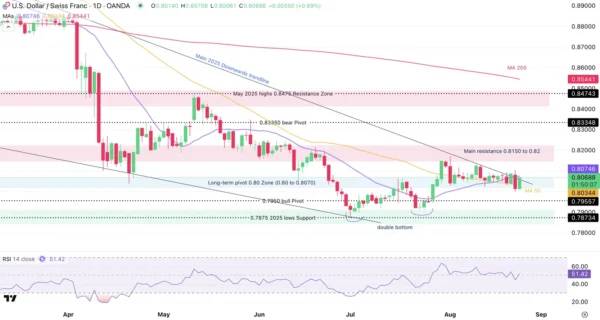
          USD/CHF was one of the FX pairs that saw the most consistent decline throughout the start of 2025, dropping by as much as 14.77% from peak to trough.

          The 2025 and 14-year lows sit at 0.7875.

          However, since its lows were formed with a double bottom, the pair is now trading back above the key 0.80 psychological level.Current price action is now reflecting indecision from a confluence of technical patterns.We will examine how these patterns are influencing the current price action and identify potential breakout levels for upcoming trading.

          USDCHF Multi-timeframe technical analysis

          USDCHF Daily Chart

          USDCHF In Focus As The Pair Oscillates Above 0.80 Mark_1

          USDCHF Daily Chart, August 25, 2025 – Source: TradingView

          Bulls have rebounded sharply from the Friday down-move in the pair, but looking at the past 9 days of price action hasn’t led to much.Prices are holding within the Daily pivot zone between 0.80 and 0.81 as the 50-Day MA flattens right in the middle, acting as a consolidation magnet.Also, the 2025 downwards trendline should be acting as immediate resistance but it seems that the mix between current zig-zags in the US Dollars supplemented by a dovish SNB don’t help to gain direction.

          This is why the current Pivot limits should serve as good technical breakout points:Either a break above or below, followed by a consolidation or a retest of the higher/lower bound should see continuation.

          If buyers and sellers fail to step in, the price action promises to be rangebound even further.

          Let’s try to look closer to see if there’s any element in shorter timeframes allowing to tilt the scales.

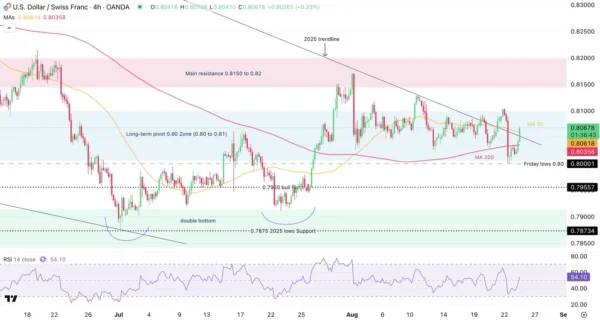
          USDCHF 4H Chart

          USDCHF In Focus As The Pair Oscillates Above 0.80 Mark_2

          USDCHF 4H Chart, August 25, 2025 – Source: TradingView

          The action from today’s session may give the intermediate hand to the Bulls as bears have failed to push the action below the 0.80 psychological handle despite a strong selloff in the US Dollar amid a dovish interpretation of Powell’s speech (you can access it right here).

          However, bulls will have to break both the current 0.8070 highs as intermediate resistance (getting tested as we speak) and closing strongly above 0.81 if they want to regain early 2025 levels.

          Levels of interest for USDCHF trading:

          Support Levels:

          ● 0.80 Immediate Pivot
          ● 0.7950 bull Pivot
          ● 0.7875 to 0.79 Main Support

          Resistance Levels:

          ● 0.8070 high volume zone within Pivot (getting tested)
          ● 0.81 Pivot highs
          ● Main resistance 0.8150 to 0.82 (0.8170 July 31st Highs)

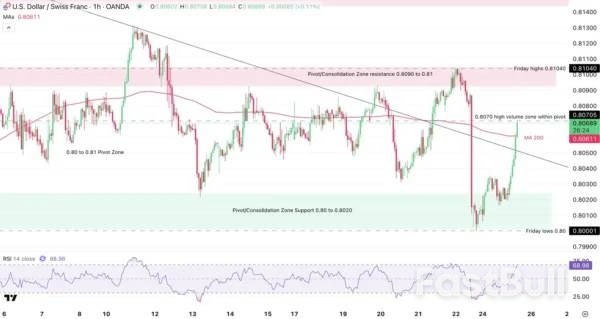
          USDCHF 1H Chart

          USDCHF In Focus As The Pair Oscillates Above 0.80 Mark_3

          USDCHF 1H Chart, August 25, 2025 – Source: TradingView

          Looking at the 1H timeframe allows us to spot further details within the ongoing consolidation pivot.The lows of the consolidation pivot that preceded today’s rebound are located between 0.80 to 0.8020 and the highs are between 0.8090 to 0.81.

          Buyers have the immediate advantage but will have to face current short-timeframe overbought conditions within a range, tough times amid unchanging fundamentals.Track any breakout to support analysis for upcoming trading. Failure to break concisely above or below the boundaries of the Pivot would reinforce the current range.

          Source: OANDA

          To stay updated on all economic events of today, please check out our Economic calendar
          Risk Warnings and Disclaimers
          You understand and acknowledge that there is a high degree of risk involved in trading. Following any strategies or investment methods may lead to potential losses. The content on the site is provided by our contributors and analysts for information purposes only. You are solely responsible for determining whether any trading assets, securities, strategy, or any other product is suitable for investing based on your own investment objectives and financial situation.
          Add to Favorites
          Share
          FastBull
          Copyright © 2025 FastBull Ltd

          728 RM B 7/F GEE LOK IND BLDG NO 34 HUNG TO RD KWUN TONG KLN HONG KONG

          TelegramInstagramTwitterfacebooklinkedin
          App Store Google Play Google Play
          Products
          Charts

          Chats

          Q&A with Experts
          Screeners
          Economic Calendar
          Data
          Tools
          Membership
          Features
          Function
          Markets
          Copy Trading
          Latest Signals
          Contests
          News
          Analysis
          24/7
          Columns
          Education
          Company
          Careers
          About Us
          Contact Us
          Advertising
          Help Center
          Feedback
          User Agreement
          Privacy Policy
          Business

          White Label

          Data API

          Web Plug-ins

          Poster Maker

          Affiliate Program

          Risk Disclosure

          The risk of loss in trading financial instruments such as stocks, FX, commodities, futures, bonds, ETFs and crypto can be substantial. You may sustain a total loss of the funds that you deposit with your broker. Therefore, you should carefully consider whether such trading is suitable for you in light of your circumstances and financial resources.

          No decision to invest should be made without thoroughly conducting due diligence by yourself or consulting with your financial advisors. Our web content might not suit you since we don't know your financial conditions and investment needs. Our financial information might have latency or contain inaccuracy, so you should be fully responsible for any of your trading and investment decisions. The company will not be responsible for your capital loss.

          Without getting permission from the website, you are not allowed to copy the website's graphics, texts, or trademarks. Intellectual property rights in the content or data incorporated into this website belong to its providers and exchange merchants.

          Not Logged In

          Log in to access more features

          FastBull Membership

          Not yet

          Purchase

          Become a signal provider
          Help Center
          Customer Service
          Dark Mode
          Price Up/Down Colors

          Log In

          Sign Up

          Position
          Layout
          Fullscreen
          Default to Chart
          The chart page opens by default when you visit fastbull.com