• Trade
  • Markets
  • Copy
  • Contests
  • News
  • 24/7
  • Calendar
  • Q&A
  • Chats
Trending
Screeners
SYMBOL
LAST
BID
ASK
HIGH
LOW
NET CHG.
%CHG.
SPREAD
SPX
S&P 500 Index
6846.50
6846.50
6846.50
6878.28
6827.18
-23.90
-0.35%
--
DJI
Dow Jones Industrial Average
47739.31
47739.31
47739.31
47971.51
47611.93
-215.67
-0.45%
--
IXIC
NASDAQ Composite Index
23545.89
23545.89
23545.89
23698.93
23455.05
-32.22
-0.14%
--
USDX
US Dollar Index
99.000
99.080
99.000
99.000
99.000
+0.050
+ 0.05%
--
EURUSD
Euro / US Dollar
1.16372
1.16380
1.16372
1.16388
1.16322
+0.00008
+ 0.01%
--
GBPUSD
Pound Sterling / US Dollar
1.33217
1.33228
1.33217
1.33220
1.33140
+0.00012
+ 0.01%
--
XAUUSD
Gold / US Dollar
4191.63
4192.07
4191.63
4193.27
4189.64
+1.93
+ 0.05%
--
WTI
Light Sweet Crude Oil
58.661
58.703
58.661
58.676
58.543
+0.106
+ 0.18%
--

Community Accounts

Signal Accounts
--
Profit Accounts
--
Loss Accounts
--
View More

Become a signal provider

Sell trading signals to earn additional income

View More

Guide to Copy Trading

Get started with ease and confidence

View More

Signal Accounts for Members

All Signal Accounts

Best Return
  • Best Return
  • Best P/L
  • Best MDD
Past 1W
  • Past 1W
  • Past 1M
  • Past 1Y

All Contests

  • All
  • Trump Updates
  • Recommend
  • Stocks
  • Cryptocurrencies
  • Central Banks
  • Featured News
Top News Only
Share

KCNA: North Korea's Supreme Leader Kim Jong UN Sends Condolences To Russian Embassy For Ambassador's Death

Share

Japan Prime Minister Takaichi: 30 Injuries Reported So Far From Monday Earthquake

Share

USA Senate Committee Votes To Advance Nomination Of Jared Isaacman To Head Nasa

Share

Singapore Post - New Rate For Standard Regular Mail & Standard Large Mail Will Be S$0.62 And S$0.90 Respectively

Share

Australia's S&P/ASX 200 Index Down 0.27% At 8601.10 Points In Early Trade

Share

Trump: The USA Needs Mexico To Release 200000 Acre-Feet Of Water Before December 31St, And The Rest Must Come Soon After

Share

Trump: I Have Authorized Documentation To Impose A 5% Tariff On Mexico If This Water Isn't Released

Share

Brazil's Sao Paulo State Governor Tarcisio De Freitas Says Flavio Bolsonaro Will Have His Support - Cnn Brasil

Share

Ukraine's Security Must Be Guaranteed, In The Long Term, As A First Line Of Defence For Our Union, Says European Commission President

Share

Ukraine's Sovereignty Must Be Respected, Says European Commission President

Share

The Goal Is A Strong Ukraine, On The Battlefield And At The Negotiating Table, Says European Commission President

Share

As Peace Talks Are Ongoing, The EU Remains Ironclad In Its Support For Ukraine, Says European Commission President

Share

Pepsico: Asking USA-Based Pepna Employees As Well As Pbus Division Offices And Pfus Region Offices To Work Remotely This Week

Share

A U.S. Judge Ruled That President Trump’s Ban On Several Wind Power Projects Was Illegal

Share

Senior USA Administration Official: We Continue To Monitor Drc-Rwanda Situation Closely, Continue To Work With All Sides To Ensure Commitments Are Honored

Share

Israeli Military Says It Has Struck Infrastructure Belonging To Hezbollah In Several Areas In Southern Lebanon

Share

SPDR Gold Holdings Down 0.11%, Or 1.14 Tonnes

Share

On Monday (December 8), In Late New York Trading, S&P 500 Futures Fell 0.21%, Dow Jones Futures Fell 0.43%, NASDAQ 100 Futures Fell 0.08%, And Russell 2000 Futures Fell 0.04%

Share

Morgan Stanley: Data Center ABS Spreads Are Expected To Widen In 2026

Share

(US Stocks) The Philadelphia Gold And Silver Index Closed Down 2.34% At 311.01 Points. (Global Session) The NYSE Arca Gold Miners Index Closed Down 2.17%, Hitting A Daily Low Of 2235.45 Points; US Stocks Remained Slightly Down Before The Opening Bell—holding Steady Around 2280 Points—before Briefly Rising Slightly

TIME
ACT
FCST
PREV
France Trade Balance (SA) (Oct)

A:--

F: --

P: --
Euro Zone Employment YoY (SA) (Q3)

A:--

F: --

P: --
Canada Part-Time Employment (SA) (Nov)

A:--

F: --

P: --

Canada Unemployment Rate (SA) (Nov)

A:--

F: --

P: --

Canada Full-time Employment (SA) (Nov)

A:--

F: --

P: --

Canada Labor Force Participation Rate (SA) (Nov)

A:--

F: --

P: --

Canada Employment (SA) (Nov)

A:--

F: --

P: --

U.S. PCE Price Index MoM (Sept)

A:--

F: --

P: --

U.S. Personal Income MoM (Sept)

A:--

F: --

P: --

U.S. Core PCE Price Index MoM (Sept)

A:--

F: --

P: --

U.S. PCE Price Index YoY (SA) (Sept)

A:--

F: --

P: --

U.S. Core PCE Price Index YoY (Sept)

A:--

F: --

P: --

U.S. Personal Outlays MoM (SA) (Sept)

A:--

F: --

P: --
U.S. 5-10 Year-Ahead Inflation Expectations (Dec)

A:--

F: --

P: --

U.S. Real Personal Consumption Expenditures MoM (Sept)

A:--

F: --

P: --
U.S. Weekly Total Rig Count

A:--

F: --

P: --

U.S. Weekly Total Oil Rig Count

A:--

F: --

P: --

U.S. Consumer Credit (SA) (Oct)

A:--

F: --

P: --
China, Mainland Foreign Exchange Reserves (Nov)

A:--

F: --

P: --

Japan Trade Balance (Oct)

A:--

F: --

P: --

Japan Nominal GDP Revised QoQ (Q3)

A:--

F: --

P: --

China, Mainland Imports YoY (CNH) (Nov)

A:--

F: --

P: --

China, Mainland Exports (Nov)

A:--

F: --

P: --

China, Mainland Imports (CNH) (Nov)

A:--

F: --

P: --

China, Mainland Trade Balance (CNH) (Nov)

A:--

F: --

P: --

China, Mainland Exports YoY (USD) (Nov)

A:--

F: --

P: --

China, Mainland Imports YoY (USD) (Nov)

A:--

F: --

P: --

Germany Industrial Output MoM (SA) (Oct)

A:--

F: --

P: --
Euro Zone Sentix Investor Confidence Index (Dec)

A:--

F: --

P: --

Canada National Economic Confidence Index

A:--

F: --

P: --

U.K. BRC Like-For-Like Retail Sales YoY (Nov)

--

F: --

P: --

U.K. BRC Overall Retail Sales YoY (Nov)

--

F: --

P: --

Australia Overnight (Borrowing) Key Rate

--

F: --

P: --

RBA Rate Statement
RBA Press Conference
Germany Exports MoM (SA) (Oct)

--

F: --

P: --

U.S. NFIB Small Business Optimism Index (SA) (Nov)

--

F: --

P: --

Mexico 12-Month Inflation (CPI) (Nov)

--

F: --

P: --

Mexico Core CPI YoY (Nov)

--

F: --

P: --

Mexico PPI YoY (Nov)

--

F: --

P: --

U.S. Weekly Redbook Index YoY

--

F: --

P: --

U.S. JOLTS Job Openings (SA) (Oct)

--

F: --

P: --

China, Mainland M1 Money Supply YoY (Nov)

--

F: --

P: --

China, Mainland M0 Money Supply YoY (Nov)

--

F: --

P: --

China, Mainland M2 Money Supply YoY (Nov)

--

F: --

P: --

U.S. EIA Short-Term Crude Production Forecast For The Year (Dec)

--

F: --

P: --

U.S. EIA Natural Gas Production Forecast For The Next Year (Dec)

--

F: --

P: --

U.S. EIA Short-Term Crude Production Forecast For The Next Year (Dec)

--

F: --

P: --

EIA Monthly Short-Term Energy Outlook
U.S. API Weekly Gasoline Stocks

--

F: --

P: --

U.S. API Weekly Cushing Crude Oil Stocks

--

F: --

P: --

U.S. API Weekly Crude Oil Stocks

--

F: --

P: --

U.S. API Weekly Refined Oil Stocks

--

F: --

P: --

South Korea Unemployment Rate (SA) (Nov)

--

F: --

P: --

Japan Reuters Tankan Non-Manufacturers Index (Dec)

--

F: --

P: --

Japan Reuters Tankan Manufacturers Index (Dec)

--

F: --

P: --

Japan Domestic Enterprise Commodity Price Index MoM (Nov)

--

F: --

P: --

Japan Domestic Enterprise Commodity Price Index YoY (Nov)

--

F: --

P: --

China, Mainland PPI YoY (Nov)

--

F: --

P: --

China, Mainland CPI MoM (Nov)

--

F: --

P: --

Italy Industrial Output YoY (SA) (Oct)

--

F: --

P: --

Q&A with Experts
    • All
    • Chatrooms
    • Groups
    • Friends
    Connecting
    .
    .
    .
    Type here...
    Add Symbol or Code

      No matching data

      All
      Trump Updates
      Recommend
      Stocks
      Cryptocurrencies
      Central Banks
      Featured News
      • All
      • Russia-Ukraine Conflict
      • Middle East Flashpoint
      • All
      • Russia-Ukraine Conflict
      • Middle East Flashpoint
      Search
      Products

      Charts Free Forever

      Chats Q&A with Experts
      Screeners Economic Calendar Data Tools
      Membership Features
      Data Warehouse Market Trends Institutional Data Policy Rates Macro

      Market Trends

      Market Sentiment Order Book Forex Correlations

      Top Indicators

      Charts Free Forever
      Markets

      News

      News Analysis 24/7 Columns Education
      From Institutions From Analysts
      Topics Columnists

      Latest Views

      Latest Views

      Trending Topics

      Top Columnists

      Latest Update

      Signals

      Copy Rankings Latest Signals Become a signal provider AI Rating
      Contests
      Brokers

      Overview Brokers Assessment Rankings Regulators News Claims
      Broker listing Forex Brokers Comparison Tool Live Spread Comparison Scam
      Q&A Complaint Scam Alert Videos Tips to Detect Scam
      More

      Business
      Events
      Careers About Us Advertising Help Center

      White Label

      Data API

      Web Plug-ins

      Affiliate Program

      Awards Institution Evaluation IB Seminar Salon Event Exhibition
      Vietnam Thailand Singapore Dubai
      Fans Party Investment Sharing Session
      FastBull Summit BrokersView Expo
      Recent Searches
        Top Searches
          Markets
          News
          Analysis
          User
          24/7
          Economic Calendar
          Education
          Data
          • Names
          • Latest
          • Prev

          View All

          No data

          Scan to Download

          Faster Charts, Chat Faster!

          Download App
          English
          • English
          • Español
          • العربية
          • Bahasa Indonesia
          • Bahasa Melayu
          • Tiếng Việt
          • ภาษาไทย
          • Français
          • Italiano
          • Türkçe
          • Русский язык
          • 简中
          • 繁中
          Open Account
          Search
          Products
          Charts Free Forever
          Markets
          News
          Signals

          Copy Rankings Latest Signals Become a signal provider AI Rating
          Contests
          Brokers

          Overview Brokers Assessment Rankings Regulators News Claims
          Broker listing Forex Brokers Comparison Tool Live Spread Comparison Scam
          Q&A Complaint Scam Alert Videos Tips to Detect Scam
          More

          Business
          Events
          Careers About Us Advertising Help Center

          White Label

          Data API

          Web Plug-ins

          Affiliate Program

          Awards Institution Evaluation IB Seminar Salon Event Exhibition
          Vietnam Thailand Singapore Dubai
          Fans Party Investment Sharing Session
          FastBull Summit BrokersView Expo

          Raising Disposable Incomes: Vietnam Officially Approves Higher Personal Income Tax Deductions from 2026

          Gerik

          Economic

          Summary:

          From the 2026 tax year, Vietnam will increase personal income tax deductions to VND 15.5 million/month for taxpayers and VND 6.2 million/month per dependent...

          Parliamentary Approval Signals Tax Policy Reform

          On November 17, 2025, Vietnam’s National Assembly Standing Committee formally passed a resolution to adjust personal income tax deductions starting with the 2026 tax year. The new deduction levels are set at VND 15.5 million per month for taxpayers and VND 6.2 million per month for each dependent, marking a significant rise of over 40% compared to the previous thresholds. The revision is embedded within the forthcoming amendment of the Personal Income Tax Law and is expected to be enforced from January 1, 2026.
          The primary rationale behind the adjustment lies in bridging the gap between stagnant tax thresholds and rising living costs. Since the previous revision under Resolution 954/2020, cumulative inflation as measured by the consumer price index has grown approximately 21.24%. This inflationary pressure, along with continued income and GDP per capita growth between 2020 and 2025, prompted the Ministry of Finance to propose an updated policy that reflects the actual cost of living and disposable income needs.
          Two policy proposals were evaluated. The first suggested adjusting deductions based on CPI growth, offering a more conservative increase to VND 13.3 million and VND 5.3 million for taxpayers and dependents, respectively. This option would have reduced state budget revenues by an estimated VND 12 trillion annually. The second, more expansive approach which was ultimately adopted proposed adjustments aligned with average income and GDP growth. This resulted in the finalized deduction levels and a projected annual revenue reduction of approximately VND 21 trillion.
          While both approaches involved revenue trade-offs, the government favored the second, arguing that it better captured income trends and enhanced the economic welfare of middle-class households.

          Budgetary Considerations and Timing

          A key aspect of the policy’s feasibility lies in its fiscal timing. Because the new deductions will only apply to the 2026 tax year with tax filings occurring in the first quarter of 2027 the changes will not impact the 2025 fiscal budget. Deputy State Auditor General Trần Minh Khương emphasized this point, adding that when revising the tax law, further reforms could consider regional income disparities, much like existing minimum wage differentiations by region.
          Despite some calls to introduce the deduction earlier specifically from the 2025 tax year the alignment with the revised tax law and legal consistency ultimately made 2026 the preferred implementation point. This sequencing simplifies legal interpretation, ensures transparency, and facilitates broader compliance.

          Broader Economic Implications and Consumption Stimulus

          This tax reform extends beyond fiscal recalibration. By increasing post-tax income, the policy is also expected to boost domestic consumption. The link between tax reductions and household spending is typically a causative relationship: lower taxes increase disposable income, which tends to drive higher retail and service sector activity. This effect is particularly relevant amid ongoing economic recovery and efforts to stimulate private sector growth.
          Additionally, the higher deductions are anticipated to reduce the tax burden on salaried workers, civil servants, and middle-income households, which constitute a growing segment of Vietnam’s workforce. This supports broader goals of inclusive economic development and labor market stabilization.

          Legislative Intent and Public Signaling

          Leaders from the National Assembly including Deputy Chairpersons Nguyễn Khắc Định and Vũ Hồng Thanh emphasized the symbolic weight of this resolution. In light of recent economic and natural disruptions, the decision sends a politically positive message: that the government is prioritizing citizen welfare and responding to the cost-of-living realities faced by millions.
          Concluding the session, Vice Chairman Nguyễn Đức Hải confirmed that the new deduction levels will be officially written into the amended Personal Income Tax Law, with effect from 2026. The revised policy is thus positioned as a structural upgrade to Vietnam’s tax code, offering clarity, consistency, and broader fiscal equity.

          Structural Role in Tax Code Modernization

          Beyond immediate financial relief, this adjustment represents a foundational element in the modernization of Vietnam’s tax system. It acknowledges that static deductions, when unresponsive to inflation or income growth, distort the equity of the tax code over time. By re-benchmarking deductions in line with economic performance, the revised framework ensures the tax burden remains proportionate and fair.
          In the longer term, this policy move provides a framework for periodic review of tax thresholds based on macroeconomic indicators. As income inequality, regional disparities, and social spending priorities evolve, a dynamic tax policy that adapts to these changes will be essential to sustainable development.
          This reform sets the stage for a more responsive, transparent, and inclusive tax environment one that not only raises fiscal efficiency but also enhances social stability through income protection and purchasing power preservation.
          To stay updated on all economic events of today, please check out our Economic calendar
          Risk Warnings and Disclaimers
          You understand and acknowledge that there is a high degree of risk involved in trading. Following any strategies or investment methods may lead to potential losses. The content on the site is provided by our contributors and analysts for information purposes only. You are solely responsible for determining whether any trading assets, securities, strategy, or any other product is suitable for investing based on your own investment objectives and financial situation.
          Add to Favorites
          Share

          Vietnam’s Coordinated Fiscal and Monetary Strategy Poised to Unlock Decade of High Growth

          Gerik

          Economic

          Strategic Outlook: Coordinated Economic Policy for a High-Growth Era

          Vietnam is entering a pivotal phase of development, targeting a transformational period between 2026 and 2030. The government has set ambitious benchmarks, including a GDP growth rate of at least 8% in 2025 and sustained double-digit growth in the years to follow. This forward-looking agenda is anchored in a synchronized approach involving expansive fiscal investment and supportive monetary easing. The overarching vision is to transition Vietnam into a high-income economy by 2045, with a strong emphasis on macroeconomic stability and structural reform.
          The current international environment has created favorable conditions for Vietnam to implement monetary stimulus. The US Federal Reserve’s recent decision to cut interest rates by 25 basis points to the 3.75–4% range, along with the planned halt of its quantitative tightening program in December, has eased external pressures. This policy reversal has diminished volatility in Vietnam’s foreign exchange markets and curbed persistent net foreign outflows, which had plagued the equity market since April 2023.
          Domestically, the Vietnamese central bank is capitalizing on this window by supporting credit growth. As of the first nine months of 2025, credit expanded by 13.4% compared to the end of 2024, and by 19.6% year-on-year. These figures indicate alignment with the annual credit growth target of 16%, largely fueled by public infrastructure investments, the real estate rebound, and revitalized private investment and consumption.

          Fiscal Expansion: Infrastructure as the Engine of Growth

          Fiscal policy is being recalibrated to support long-term infrastructure development. Mirae Asset reports that public investment from 2026 to 2030 will reach VND 8.5 quadrillion, a 166% increase over the 2021–2025 period. This capital injection is designed to support mega infrastructure projects such as Long Thanh International Airport, the North-South expressway, and several urban ring roads.
          Such a dramatic escalation in fiscal spending is made feasible by Vietnam’s favorable debt profile. The public debt-to-GDP ratio is projected to increase from 34% in 2024 to 42% by 2030, providing fiscal flexibility without jeopardizing financial stability.
          The reconfiguration of the national budget structure further reinforces this trajectory. From 2026 to 2030, current expenditure will be adjusted to 50.7% of the total budget, while development investment spending is targeted at 40.7%, up from 31.2% in 2024. This shift prioritizes productive expenditure over routine spending.

          Domestic Demand Rebound and Tax Reforms

          Domestic consumption is showing tangible signs of recovery, with retail sales rising 9.3% in the first ten months of 2025. This uptick is expected to gain momentum as the government introduces tax relief measures in 2026, notably increasing personal income tax deductions by over 40%. This initiative is aimed at bolstering the purchasing power of the middle class, thereby reinforcing the internal demand base of the economy.
          Structural legal reforms are also accelerating, with the implementation of key laws such as the Housing Law 2023, Real Estate Business Law 2023, and Land Law 2024. Effective from August 2024, these legislative changes are intended to resolve long-standing bottlenecks in land use, project development, and housing transactions.
          Moreover, Resolution 198/2025/QH15 sets a concrete goal: the private sector is expected to contribute 55–58% of GDP by 2030, compared to the current 50%. This signals a substantial policy shift to empower domestic enterprises and enhance their role in economic growth.

          Capital Market Reform and Financial Deepening

          Vietnam’s capital market remains bank-centric, with limited corporate bond and equity market development. To address this, authorities aim to increase stock market capitalization to 120% of GDP and corporate bond market size to 25% by 2030, from 68% and 9%, respectively.
          Strategic measures being deployed include the adoption of international financial reporting standards (IFRS), enhanced corporate governance in line with OECD guidelines, and regulatory streamlining for IPOs, reducing post-offering listing time from 90 days to 30. These changes aim to attract both domestic and foreign capital, fostering a deeper and more resilient financial market.
          According to Mirae Asset, current market conditions remain healthy, with attractive valuations and macroeconomic support. They project earnings-per-share growth in 2026 as a key driver for a market rebound. A fair market valuation of 17x price-to-earnings could push the VN-Index toward the 1,800–2,200 point range.

          Sectoral Outlook: Identifying Growth Catalysts

          In the context of monetary support, public investment, and digitization, several sectors are poised for strong performance:
          Banking will benefit from increased credit demand and improved asset quality, particularly as the property market stabilizes.
          Securities and Brokerage Services are undergoing regulatory and technological transformation, underpinned by enhanced liquidity and market upgrades.
          Construction, Real Estate, and Building Materials will see direct benefits from public infrastructure expansion, with VND 8.5 quadrillion earmarked for development over the next five years.
          Retail is poised for growth driven by rising disposable incomes and targeted tax reforms, positioning it as a vital engine for domestic demand recovery.

          Foundation for a Structural Growth Cycle

          Vietnam is entering a decisive phase marked by structural investments, regulatory modernization, and coordinated economic policy. The synergy between fiscal expansion and monetary flexibility provides the scaffolding for sustainable, inclusive growth. The transition from a credit-reliant system toward a balanced capital market, alongside productivity-enhancing infrastructure and legal frameworks, suggests that the economy is being primed for a long-term growth trajectory.
          If current reforms are effectively implemented and fiscal discipline is maintained, Vietnam could achieve not only its 2030 targets but also lay the foundation for its high-income economy aspiration by 2045.
          To stay updated on all economic events of today, please check out our Economic calendar
          Risk Warnings and Disclaimers
          You understand and acknowledge that there is a high degree of risk involved in trading. Following any strategies or investment methods may lead to potential losses. The content on the site is provided by our contributors and analysts for information purposes only. You are solely responsible for determining whether any trading assets, securities, strategy, or any other product is suitable for investing based on your own investment objectives and financial situation.
          Add to Favorites
          Share

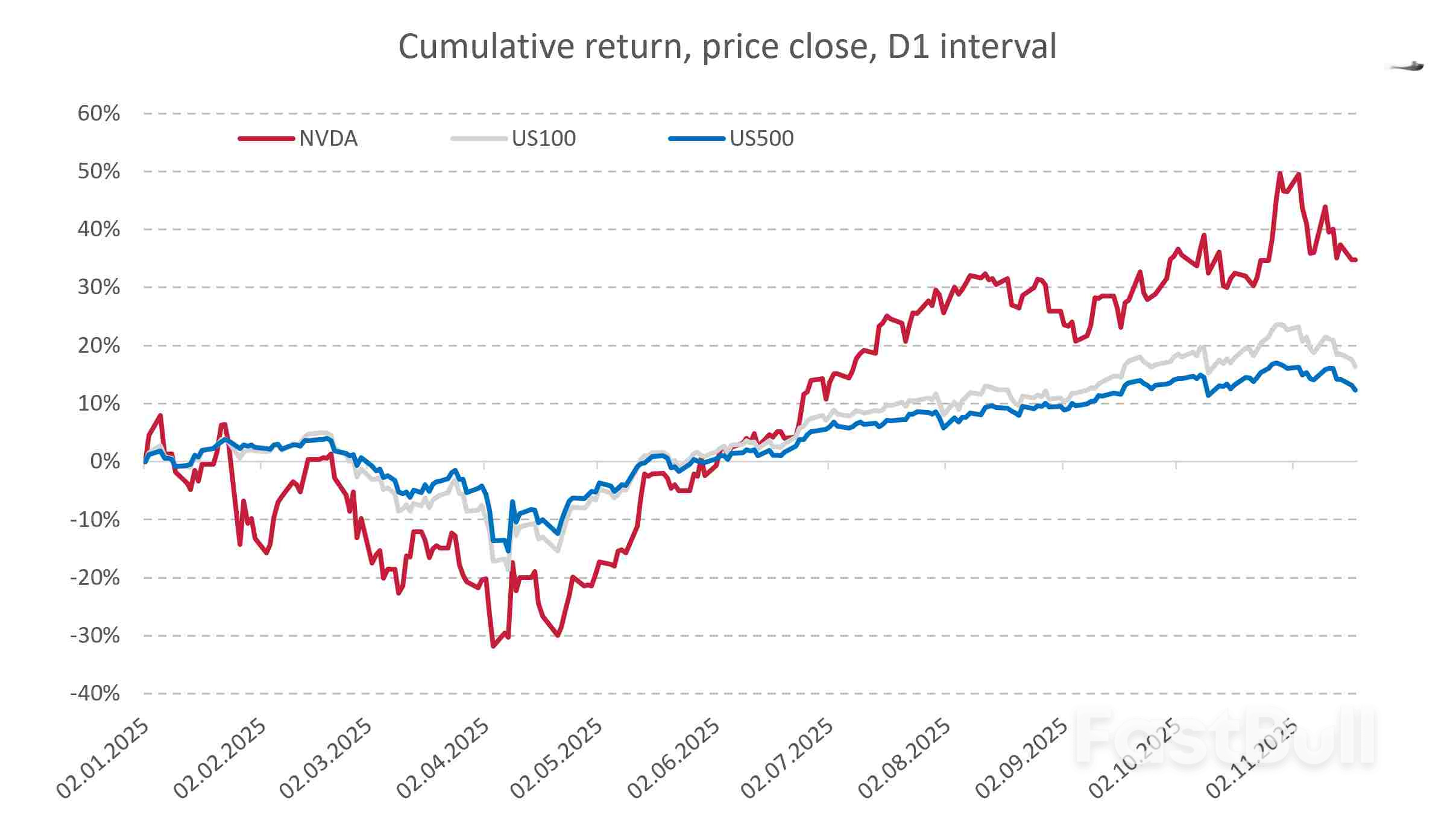
          AI Battle: Huawei vs Nvidia

          Adam

          Economic

          Huawei has announced groundbreaking AI software that could double the efficiency of its Ascend chips. This is a significant step in the context of export restrictions to China and geopolitical tensions, as it allows the Chinese manufacturer to maximize the use of its available hardware resources. The "software-first" strategy enables Huawei to scale existing chips through clustering and software optimization, enhancing the company's competitiveness in AI, including cloud and inference applications.
          Until now, Nvidia has been the virtually undisputed leader in the Chinese AI chip market, offering the highest computational power and a well-established developer ecosystem. However, the increasing efficiency and scalability of Ascend chips, combined with state support for the Chinese producer, are beginning to shift the dynamics of competition. Huawei is gaining adoption among major cloud companies in China and steadily increasing production of its chips, which in the longer term could limit Nvidia’s previously dominant position in the region.
          It is worth noting that although Nvidia still dominates globally, the Chinese market is becoming increasingly difficult to maintain without local partners or appropriate strategic adaptations. The efficiency and scalability of Ascend chips, combined with growing demand from local customers, could in practice take away part of Nvidia’s market share in China, particularly in inference and cloud AI segments. For Nvidia, this means closely monitoring local developments, adjusting pricing and technology strategies, and facing the potential risk of losing its competitive edge in a key Asian region.
          Currently, the AI technology boom appears to be at a crossroads. Markets are cautious about technology company valuations, while the rapid pace of innovation and rising competition in China are adding further volatility. In this context, Huawei may set new standards and accelerate local AI adoption, which on one hand intensifies competition, and on the other highlights that Nvidia can no longer treat the Chinese market as a fully secure space for its growth.
          In practice, the question of whether Nvidia is losing the Chinese market is no longer theoretical. The growing influence of Huawei and other local players demonstrates that even global leaders must account for regional shifts in power, as the AI market in China becomes an arena of increasingly fierce competition.
          AI Battle: Huawei vs Nvidia_1

          Source: xtb

          To stay updated on all economic events of today, please check out our Economic calendar
          Risk Warnings and Disclaimers
          You understand and acknowledge that there is a high degree of risk involved in trading. Following any strategies or investment methods may lead to potential losses. The content on the site is provided by our contributors and analysts for information purposes only. You are solely responsible for determining whether any trading assets, securities, strategy, or any other product is suitable for investing based on your own investment objectives and financial situation.
          Add to Favorites
          Share

          US Home Builder Sentiment Subdued In November Amid Labor Market Worries

          Devin

          Economic

          U.S. homebuilder sentiment remained subdued in November as concerns about the labor market and household finances weighed on demand, contributing to a surge in the share of builders slashing prices to reduce new housing inventory.

          The National Association of Home Builders/Wells Fargo Housing Market index edged up one point to 38 this month. It remained below the 50 breakeven point for the 19th straight month. Economists polled by Reuters had forecast the index unchanged at 37.

          The small uptick could reflect a decrease in mortgage rates when the Federal Reserve resumed its interest rate cuts. But mortgage rates have halted their decline, data from mortgage finance agency Freddie Mac showed, as U.S. central bank officials signaled a reluctance to lower rates again next month.

          Labor market stagnation is sidelining potential homebuyers, and new housing inventory was elevated in August, limiting the scope for builders to break ground on new projects.

          "We continue to see demand-side weakness as a softening labor market and stretched consumer finances are contributing to a difficult sales environment," said NAHB chief economist Robert Dietz.

          Lack of affordable housing has become a political hot-button issue. President Donald Trump this month floated a 50-year mortgage to make housing affordable, an idea that was panned by some of his supporters and housing market experts who argued it would result in homeowners paying more in interest and taking longer to build equity.

          The National Association of Realtors this month estimated the median age of first-time buyers was 40 years. In the 1980s the typical home buyer was in their late 20s, the NAR said.

          The survey's measure of current sales conditions increased two points to 41 this month, while its gauge of future sales fell three points to 51. A measure of prospective buyer traffic gained one point to 26.

          The share of builders reporting cutting prices increased to 41%, the highest since May 2020. The average price reduction was unchanged at 6%, while the share using incentives was 65%, holding steady since September.

          "More builders are using incentives to get deals closed, including lowering prices, but many potential buyers still remain on the fence," said NAHB chairman Buddy Hughes.

          Source: TradingView

          To stay updated on all economic events of today, please check out our Economic calendar
          Risk Warnings and Disclaimers
          You understand and acknowledge that there is a high degree of risk involved in trading. Following any strategies or investment methods may lead to potential losses. The content on the site is provided by our contributors and analysts for information purposes only. You are solely responsible for determining whether any trading assets, securities, strategy, or any other product is suitable for investing based on your own investment objectives and financial situation.
          Add to Favorites
          Share

          Larry Summers Says He's Stepping Back From Public Commitments After Epstein Emails

          Justin

          Political

          Former U.S. Treasury Secretary Larry Summers said on Monday he will step back from all public commitments, days after PresidentDonald Trumpordered the Justice Department to investigate his and other prominent Democrats' ties to convicted sex offender Jeffrey Epstein.

          Summers, a former president of Harvard University, where he is a professor, told the university's student newspaper that the move was to allow him "to rebuild trust and repair relationships with the people closest to me."

          The announcement came after the House Oversight Committee released thousands of files related to Epstein last week, including documents that showed personal correspondence between Summers and Epstein.

          "I am deeply ashamed of my actions and recognize the pain they have caused. I take full responsibility for my misguided decision to continue communicating with Mr. Epstein," Summers told The Crimson.

          "While continuing to fulfill my teaching obligations, I will be stepping back from public commitments as one part of my broader effort," Summers added.

          Summers, a Democrat, served as former President Bill Clinton's Treasury Secretary and former President Barack Obama's National Economic Council director. He currently serves on the board of OpenAI and as a director of the Harvard Kennedy School's Mossavar-Rahmani Center for Business and Government.

          OpenAI and Harvard did not immediately respond to requests for comments. Summers also did not immediately respond.

          The Epstein scandal has been a political thorn in Trump's side for months, partly because he amplified conspiracy theories about Epstein to his own supporters.

          Many Trump voters believe Bondi and other Trump officials have covered up Epstein's ties to powerful figures and obscured details surrounding his death by suicide in a Manhattan jail in 2019.

          The U.S. House of Representatives will vote on Tuesday on forcing the release of investigative Epstein files after Trump, who had initially opposed the vote, called on fellow Republicans to support it.

          Source: TradingView

          Risk Warnings and Disclaimers
          You understand and acknowledge that there is a high degree of risk involved in trading. Following any strategies or investment methods may lead to potential losses. The content on the site is provided by our contributors and analysts for information purposes only. You are solely responsible for determining whether any trading assets, securities, strategy, or any other product is suitable for investing based on your own investment objectives and financial situation.
          Add to Favorites
          Share

          AI’s Reckoning to Define Investing in 2026 — and It Starts Now

          Adam

          Economic

          The past four trading sessions have delivered a stark message that investors can no longer ignore.
          Heavy selling across global indices, the Nikkei’s 3% slide, and the broad retreat across US benchmarks show a decisive shift in the psychology that has shaped markets for two years. The AI-driven rally that powered an extraordinary run in equities has reached a point where momentum is no longer a substitute for proof.
          This moment has arrived faster than many expected, and it carries far-reaching implications for how investors position themselves for 2026. AI has remained the central engine of market performance, but the foundation beneath it is entering a defining test.
          The catalyst is Nvidia’s (NASDAQ:NVDA) earnings report on Wednesday, which has become more than another corporate update. It is now a gauge of whether the most powerful force in the market still commands the conviction that pushed valuations to historic extremes.
          I see investors reassessing their assumptions with a level of precision that has been missing during the past two years of relentless enthusiasm.
          The world has moved through a phase in which the scale of AI investment mattered more than the financial outcome. That period is ending. Markets now demand visibility, consistency and accountability. The companies offering that clarity will secure capital next year, while those relying on distant projections will find conditions far more challenging.
          The latest earnings cycle laid the groundwork for this shift. Results from major technology firms showed a widening gap between businesses that can convert AI infrastructure into measurable gains and those still relying on promise-driven stories.
          Alphabet (NASDAQ:GOOGL) and Amazon (NASDAQ:AMZN) demonstrated how disciplined investment linked to identifiable monetisation can outperform even in an environment crowded with competing narratives. In contrast, Meta and Microsoft met immediate resistance when spending rose ahead of revenue potential. Tesla’s (NASDAQ:TSLA) soft margins intensified the sense that the industry is confronting rising costs and slower demand at the same time.
          This divergence matters because it is shaping how investors appraise every part of the AI ecosystem. Market participants are watching strategy execution in real time. They are scrutinising operating efficiency with a sharper lens.
          They want to see how companies justify their investment intensity when funding becomes more selective. Margin strength, not headline revenue growth, is becoming the measure that determines whether a business has a future at the core of the AI economy.
          Nvidia’s upcoming numbers carry outsized weight because they anchor global expectations. Forecasts for another powerful jump in revenue and earnings have pushed the valuation into territory that tolerates no hesitation. Any sign of slowing customer absorption, weaker Blackwell momentum, softer hyperscaler orders, or pressure created by export restrictions will immediately influence market direction.
          Investors want assurance that profitability is expanding at a pace that matches the scale of spending. Without that alignment, the assumptions attached to the entire AI complex will come under review.
          This reassessment is unfolding alongside an important geopolitical backdrop. President Donald Trump’s tech and industrial priorities are driving companies to rethink their global exposure, supply-chain design and capital-allocation plans. Washington’s export controls are reshaping the competitive environment for advanced computing in China.
          At the same time, sovereign AI ambitions are accelerating in regions seeking strategic autonomy. These forces are reshaping demand patterns, risk considerations, and long-term planning across the industry. Nvidia’s guidance will influence how investors interpret these currents through next year.
          The pullback across global equities during the past several days is a reminder that markets remain vulnerable to concentration. Gains built on a narrow group of leaders can reverse quickly when confidence wavers. The S&P 500 closing below a key level on Monday reinforced the idea that investors are rediscovering the importance of diversification, valuation discipline, and cash-flow durability.
          But this moment is not a setback for AI. It is an essential recalibration of expectations that have reached levels impossible to maintain without consistent evidence. The technology remains transformative. Adoption continues across every sector. Productivity gains are accelerating, not fading.
          What is changing is the threshold investors apply when assessing which companies will dominate the next stage of this transition.
          As I look ahead to 2026, I expect a market defined by sharper selection. Capital will concentrate in businesses that can demonstrate earnings power tied directly to AI deployment. Investors who focus on durability instead of size, and on monetisation instead of scale, will be best placed for the opportunities emerging from this global adjustment.
          The reckoning has arrived. It is not a pause in progress. It is the point at which performance, discipline, and strategic clarity determine the winners of the next phase of the AI era.

          Source: investing

          To stay updated on all economic events of today, please check out our Economic calendar
          Risk Warnings and Disclaimers
          You understand and acknowledge that there is a high degree of risk involved in trading. Following any strategies or investment methods may lead to potential losses. The content on the site is provided by our contributors and analysts for information purposes only. You are solely responsible for determining whether any trading assets, securities, strategy, or any other product is suitable for investing based on your own investment objectives and financial situation.
          Add to Favorites
          Share

          BOE’s Pill Says Headline UK Inflation Overstates Price Pressures

          James Whitman

          Central Bank

          Economic

          Bank of England Chief Economist Huw Pill said that UK price pressures are not as strong as headline inflation estimates suggest, though signaled policymakers should not cut interest rates again just yet.

          Pill said on Tuesday that a raft of one-off impacts on inflation will likely be temporary but also reiterated concerns that a series of economics shocks to households and firms may have changed price and wage-setting behavior.

          "I think underlying inflationary dynamics in the UK are probably not as strong as current spot headline inflation suggests, but that doesn't mean I think that I embrace that story completely," he said in a fireside chat hosted by Natixis Corporate and Investment Banking. He said that the current momentum in domestic prices and wages is "not fully compatible with the inflation target," adding that "there's still work to do."

          Pill's comments came ahead of inflation figures on Wednesday that could be crucial in determining whether the BOE resumes cutting interest rates in December. Economists expect the data to show inflation cooling to 3.5% in October, the lowest in five months, after hitting almost double the BOE's 2% target over the summer.

          Recent data showing price pressures weaker than thought and the economy softening have fueled expectations of a rate reduction in December. Markets put the chances of a move next month at around 80%.

          However, it is expected to be a tight decision with the government's budget looming on Nov. 26. Pill was part of the 5-4 majority that voted to keep rates at 4% earlier this month, slowing the pace of the BOE's easing cycle. He said on Tuesday his views had not changed much since then.

          While Pill highlighted that temporary factors such as tax changes and good bills are pushing up inflation, he also remained worried over structural shifts in the economy that could mean price pressures persist.

          "That accumulation of structural shocks to the economy could certainly plausibly have had an impact on the structure of price setting and wage setting," he said. "Now that's a view probably I'm more associated with... I think there is some evidence for that view."

          Pill played down divisions on the MPC and said Governor Andrew Bailey sits "in between" the two broad camps on the panel, with signs of slack opening in the labor market pitted against concerns about above-target inflation. Policymakers are in a series of "finely balanced" decisions, he said.

          He also pushed back against claims he is the most hawkish member of the MPC and said he prefers a gradualist approach to policy over an activist stance that advocates more aggressive moves in rates.

          Source: Bloomberg

          To stay updated on all economic events of today, please check out our Economic calendar
          Risk Warnings and Disclaimers
          You understand and acknowledge that there is a high degree of risk involved in trading. Following any strategies or investment methods may lead to potential losses. The content on the site is provided by our contributors and analysts for information purposes only. You are solely responsible for determining whether any trading assets, securities, strategy, or any other product is suitable for investing based on your own investment objectives and financial situation.
          Add to Favorites
          Share
          FastBull
          Copyright © 2025 FastBull Ltd

          728 RM B 7/F GEE LOK IND BLDG NO 34 HUNG TO RD KWUN TONG KLN HONG KONG

          TelegramInstagramTwitterfacebooklinkedin
          App Store Google Play Google Play
          Products
          Charts

          Chats

          Q&A with Experts
          Screeners
          Economic Calendar
          Data
          Tools
          Membership
          Features
          Function
          Markets
          Copy Trading
          Latest Signals
          Contests
          News
          Analysis
          24/7
          Columns
          Education
          Company
          Careers
          About Us
          Contact Us
          Advertising
          Help Center
          Feedback
          User Agreement
          Privacy Policy
          Business

          White Label

          Data API

          Web Plug-ins

          Poster Maker

          Affiliate Program

          Risk Disclosure

          The risk of loss in trading financial instruments such as stocks, FX, commodities, futures, bonds, ETFs and crypto can be substantial. You may sustain a total loss of the funds that you deposit with your broker. Therefore, you should carefully consider whether such trading is suitable for you in light of your circumstances and financial resources.

          No decision to invest should be made without thoroughly conducting due diligence by yourself or consulting with your financial advisors. Our web content might not suit you since we don't know your financial conditions and investment needs. Our financial information might have latency or contain inaccuracy, so you should be fully responsible for any of your trading and investment decisions. The company will not be responsible for your capital loss.

          Without getting permission from the website, you are not allowed to copy the website's graphics, texts, or trademarks. Intellectual property rights in the content or data incorporated into this website belong to its providers and exchange merchants.

          Not Logged In

          Log in to access more features

          FastBull Membership

          Not yet

          Purchase

          Become a signal provider
          Help Center
          Customer Service
          Dark Mode
          Price Up/Down Colors

          Log In

          Sign Up

          Position
          Layout
          Fullscreen
          Default to Chart
          The chart page opens by default when you visit fastbull.com