• Trade
  • Markets
  • Copy
  • Contests
  • News
  • 24/7
  • Calendar
  • Q&A
  • Chats
Trending
Screeners
SYMBOL
LAST
BID
ASK
HIGH
LOW
NET CHG.
%CHG.
SPREAD
SPX
S&P 500 Index
6811.68
6811.68
6811.68
6861.30
6801.50
-15.73
-0.23%
--
DJI
Dow Jones Industrial Average
48339.52
48339.52
48339.52
48679.14
48285.67
-118.52
-0.24%
--
IXIC
NASDAQ Composite Index
23079.52
23079.52
23079.52
23345.56
23012.00
-115.64
-0.50%
--
USDX
US Dollar Index
97.970
98.050
97.970
98.070
97.740
+0.020
+ 0.02%
--
EURUSD
Euro / US Dollar
1.17429
1.17436
1.17429
1.17686
1.17262
+0.00035
+ 0.03%
--
GBPUSD
Pound Sterling / US Dollar
1.33655
1.33664
1.33655
1.34014
1.33546
-0.00052
-0.04%
--
XAUUSD
Gold / US Dollar
4303.32
4303.75
4303.32
4350.16
4285.08
+3.93
+ 0.09%
--
WTI
Light Sweet Crude Oil
56.365
56.395
56.365
57.601
56.233
-0.868
-1.52%
--

Community Accounts

Signal Accounts
--
Profit Accounts
--
Loss Accounts
--
View More

Become a signal provider

Sell trading signals to earn additional income

View More

Guide to Copy Trading

Get started with ease and confidence

View More

Signal Accounts for Members

All Signal Accounts

Best Return
  • Best Return
  • Best P/L
  • Best MDD
Past 1W
  • Past 1W
  • Past 1M
  • Past 1Y

All Contests

  • All
  • Trump Updates
  • Recommend
  • Stocks
  • Cryptocurrencies
  • Central Banks
  • Featured News
Top News Only
Share

USA State Department: Rubio Signs Status Of Forces Agreement With Paraguayan Foreign Minister

Share

New York Fed Accepts $2.601 Billion Of $2.601 Billion Submitted To Reverse Repo Facility On Dec 15

Share

Turkey: Shoots Down A Drone In The Black Sea Using F-16 Fighter Jets

Share

Goldman Sachs Says They Believe That The Copper Price Is Vulnerable To An Ai-Linked Price Correction

Share

Goldman Sachs Upgrades 2026 Copper Price Forecast To $11400 From $10,650

Share

Attempts By Ukrainian Troops To Advance From The South-West To Outskirts Of Kupiansk Are Being Thwarted

Share

Russian Troops Control All Of Kupiansk - IFX Cites Russian Military

Share

On Monday (December 15), The South Korean Won Ultimately Rose 0.60% Against The US Dollar, Closing At 1468.91 Won. The Won Was On An Upward Trend Throughout The Day, Rising Significantly At 17:00 Beijing Time And Reaching A Daily High Of 1463.04 Won At 17:36

Share

Health Ministry: Israeli Forces Kill Palestinian Teen In West Bank

Share

New York Federal Reserve President Williams: Over Time, The Size Of Reserves Could Grow From $2.9 Trillion

Share

New York Fed President Williams: AI Valuations Are High, But There Is A Real Driving Factor

Share

New York Federal Reserve President Williams: The Job Market Is In Very Good Shape

Share

New York Fed President Williams: 'Very Supportive' Of USA Central Bank's Decision To Cut Interest Rates Last Week

Share

New York Fed President Williams: 'Too Early To Say' What Central Bank Should Do At January Meeting

Share

New York Fed President Williams: Strong Markets Part Of Reason Why Economy Will Grow Robustly In 2026

Share

New York Fed President Williams: What Constitutes Ample Reserves Will Change Over Time

Share

New York Fed President Williams: Market Valuations 'Elevated,' But There Are Reasons For Pricing

Share

New York Fed President Williams: Ample Reserves System Working Very Well

Share

New York Fed President Williams: Some Signs That Parts Of Underlying Economy Not As Strong As GDP Data Suggests

Share

New York Fed President Williams: Expects Coming Job Data Will Show Gradual Cooling

TIME
ACT
FCST
PREV
Japan Tankan Small Manufacturing Outlook Index (Q4)

A:--

F: --

P: --

Japan Tankan Large Non-Manufacturing Outlook Index (Q4)

A:--

F: --

P: --

Japan Tankan Large Manufacturing Outlook Index (Q4)

A:--

F: --

P: --

Japan Tankan Small Manufacturing Diffusion Index (Q4)

A:--

F: --

P: --

Japan Tankan Large-Enterprise Capital Expenditure YoY (Q4)

A:--

F: --

P: --

U.K. Rightmove House Price Index YoY (Dec)

A:--

F: --

P: --

China, Mainland Industrial Output YoY (YTD) (Nov)

A:--

F: --

P: --

China, Mainland Urban Area Unemployment Rate (Nov)

A:--

F: --

P: --

Saudi Arabia CPI YoY (Nov)

A:--

F: --

P: --

Euro Zone Industrial Output YoY (Oct)

A:--

F: --

P: --

Euro Zone Industrial Output MoM (Oct)

A:--

F: --

P: --

Canada Existing Home Sales MoM (Nov)

A:--

F: --

P: --

Canada National Economic Confidence Index

A:--

F: --

P: --

Canada New Housing Starts (Nov)

A:--

F: --

P: --
U.S. NY Fed Manufacturing Employment Index (Dec)

A:--

F: --

P: --

U.S. NY Fed Manufacturing Index (Dec)

A:--

F: --

P: --

Canada Core CPI YoY (Nov)

A:--

F: --

P: --

Canada Manufacturing Unfilled Orders MoM (Oct)

A:--

F: --

P: --

U.S. NY Fed Manufacturing Prices Received Index (Dec)

A:--

F: --

P: --

U.S. NY Fed Manufacturing New Orders Index (Dec)

A:--

F: --

P: --

Canada Manufacturing New Orders MoM (Oct)

A:--

F: --

P: --

Canada Core CPI MoM (Nov)

A:--

F: --

P: --

Canada Trimmed CPI YoY (SA) (Nov)

A:--

F: --

P: --

Canada Manufacturing Inventory MoM (Oct)

A:--

F: --

P: --

Canada CPI YoY (Nov)

A:--

F: --

P: --

Canada CPI MoM (Nov)

A:--

F: --

P: --

Canada CPI YoY (SA) (Nov)

A:--

F: --

P: --

Canada Core CPI MoM (SA) (Nov)

A:--

F: --

P: --

Canada CPI MoM (SA) (Nov)

A:--

F: --

P: --

Federal Reserve Board Governor Milan delivered a speech
U.S. NAHB Housing Market Index (Dec)

A:--

F: --

P: --

Australia Composite PMI Prelim (Dec)

--

F: --

P: --

Australia Services PMI Prelim (Dec)

--

F: --

P: --

Australia Manufacturing PMI Prelim (Dec)

--

F: --

P: --

Japan Manufacturing PMI Prelim (SA) (Dec)

--

F: --

P: --

U.K. 3-Month ILO Employment Change (Oct)

--

F: --

P: --

U.K. Unemployment Claimant Count (Nov)

--

F: --

P: --

U.K. Unemployment Rate (Nov)

--

F: --

P: --

U.K. 3-Month ILO Unemployment Rate (Oct)

--

F: --

P: --

U.K. Average Weekly Earnings (3-Month Average, Including Bonuses) YoY (Oct)

--

F: --

P: --

U.K. Average Weekly Earnings (3-Month Average, Excluding Bonuses) YoY (Oct)

--

F: --

P: --

France Services PMI Prelim (Dec)

--

F: --

P: --

France Composite PMI Prelim (SA) (Dec)

--

F: --

P: --

France Manufacturing PMI Prelim (Dec)

--

F: --

P: --

Germany Services PMI Prelim (SA) (Dec)

--

F: --

P: --

Germany Manufacturing PMI Prelim (SA) (Dec)

--

F: --

P: --

Germany Composite PMI Prelim (SA) (Dec)

--

F: --

P: --

Euro Zone Composite PMI Prelim (SA) (Dec)

--

F: --

P: --

Euro Zone Services PMI Prelim (SA) (Dec)

--

F: --

P: --

Euro Zone Manufacturing PMI Prelim (SA) (Dec)

--

F: --

P: --

U.K. Services PMI Prelim (Dec)

--

F: --

P: --

U.K. Manufacturing PMI Prelim (Dec)

--

F: --

P: --

U.K. Composite PMI Prelim (Dec)

--

F: --

P: --

Euro Zone ZEW Economic Sentiment Index (Dec)

--

F: --

P: --

Germany ZEW Current Conditions Index (Dec)

--

F: --

P: --

Germany ZEW Economic Sentiment Index (Dec)

--

F: --

P: --

Euro Zone Trade Balance (Not SA) (Oct)

--

F: --

P: --

Euro Zone ZEW Current Conditions Index (Dec)

--

F: --

P: --

Euro Zone Trade Balance (SA) (Oct)

--

F: --

P: --

Euro Zone Total Reserve Assets (Nov)

--

F: --

P: --

U.K. Inflation Rate Expectations

--

F: --

P: --

Q&A with Experts
    • All
    • Chatrooms
    • Groups
    • Friends
    Connecting
    .
    .
    .
    Type here...
    Add Symbol or Code

      No matching data

      All
      Trump Updates
      Recommend
      Stocks
      Cryptocurrencies
      Central Banks
      Featured News
      • All
      • Russia-Ukraine Conflict
      • Middle East Flashpoint
      • All
      • Russia-Ukraine Conflict
      • Middle East Flashpoint
      Search
      Products

      Charts Free Forever

      Chats Q&A with Experts
      Screeners Economic Calendar Data Tools
      Membership Features
      Data Warehouse Market Trends Institutional Data Policy Rates Macro

      Market Trends

      Market Sentiment Order Book Forex Correlations

      Top Indicators

      Charts Free Forever
      Markets

      News

      News Analysis 24/7 Columns Education
      From Institutions From Analysts
      Topics Columnists

      Latest Views

      Latest Views

      Trending Topics

      Top Columnists

      Latest Update

      Signals

      Copy Rankings Latest Signals Become a signal provider AI Rating
      Contests
      Brokers

      Overview Brokers Assessment Rankings Regulators News Claims
      Broker listing Forex Brokers Comparison Tool Live Spread Comparison Scam
      Q&A Complaint Scam Alert Videos Tips to Detect Scam
      More

      Business
      Events
      Careers About Us Advertising Help Center

      White Label

      Data API

      Web Plug-ins

      Affiliate Program

      Awards Institution Evaluation IB Seminar Salon Event Exhibition
      Vietnam Thailand Singapore Dubai
      Fans Party Investment Sharing Session
      FastBull Summit BrokersView Expo
      Recent Searches
        Top Searches
          Markets
          News
          Analysis
          User
          24/7
          Economic Calendar
          Education
          Data
          • Names
          • Latest
          • Prev

          View All

          No data

          Scan to Download

          Faster Charts, Chat Faster!

          Download App
          English
          • English
          • Español
          • العربية
          • Bahasa Indonesia
          • Bahasa Melayu
          • Tiếng Việt
          • ภาษาไทย
          • Français
          • Italiano
          • Türkçe
          • Русский язык
          • 简中
          • 繁中
          Open Account
          Search
          Products
          Charts Free Forever
          Markets
          News
          Signals

          Copy Rankings Latest Signals Become a signal provider AI Rating
          Contests
          Brokers

          Overview Brokers Assessment Rankings Regulators News Claims
          Broker listing Forex Brokers Comparison Tool Live Spread Comparison Scam
          Q&A Complaint Scam Alert Videos Tips to Detect Scam
          More

          Business
          Events
          Careers About Us Advertising Help Center

          White Label

          Data API

          Web Plug-ins

          Affiliate Program

          Awards Institution Evaluation IB Seminar Salon Event Exhibition
          Vietnam Thailand Singapore Dubai
          Fans Party Investment Sharing Session
          FastBull Summit BrokersView Expo

          Putin Spox Boasts 'We Have Developed Immunity' To Sanctions

          Samantha Luan

          Economic

          Political

          Summary:

          The big geopolitical headline this week was President Trump on Monday and Tuesday making clear that if Russia can't reach a ceasefire agreement with Ukraine within 10 days, secondary sanctions will follow, which takes the new deadline to Friday, Aug. 8.

          The big geopolitical headline this week was President Trump on Monday and Tuesday making clear that if Russia can't reach a ceasefire agreement with Ukraine within 10 days, secondary sanctions will follow, which takes the new deadline to Friday, Aug. 8.The Kremlin has again responded in follow-up, boasting that Russia has developed immunity to sanctions, with Kremlin spokesman Dmitry Peskov describing an economy which has been functioning successfully for a long time under huge, unprecedented sanctions.

          "We have been living under a huge number of sanctions for quite a long time. Our economy operates under a huge number of restrictions. Therefore, of course, we have already developed a certain immunity to this," Peskov told reporters.Indeed this is consistent with recent observations of Western travelers, including Tucker Carlson, who say that grocery and clothing stores are stocked full, and life is going along as usual in all major cities.Still, not all is rosy - especially in southern border areas impacted by regular Ukrainian drone strikes. Russian forces are busy trying to create sizeable buffer zones within Ukraine.

          Also, unexplained internet outages are happening with increased frequency across multiple parts of Russia. One fresh report points to a mobile internet shut down which happened in 62 regions simultaneously on Monday.This has prompted calls for Russians to 'be prepared' - with state sources citing security measures resulting in occasional service disruptions:

          A senior Russian lawmaker is urging citizens to adjust to the growing likelihood of widespread internet disruptions by relying more on cash and preparing for reduced access to digital services.Vladimir Gutenev, head of the State Duma’s Industry and Trade Committee, told the pro-Kremlin news outlet Life that Russians should be ready for “regular and necessary” internet shutdowns and recommended withdrawing cash in advance to avoid being caught off guard.

          “Restricting or shutting down the internet is a necessary measure,” Gutenev said. “There are critical infrastructure facilities whose failure could have serious consequences.”Essentially, all of this points to the Kremlin's planning not to comply with Trump's ultimatum. Likely, the White House knows that it can't force Russia to the negotiating table, especially when Ukraine's Zelensky is refusing to agree to territorial concessions.

          But the Trump administration likely wants to be seen as "doing something" and so the usual sanctions playbook can create that appearance, and perhaps satisfy the hawks as well as some European allies. But it is tantamount to kicking the can down the road, and once again risking direct confrontation with Russia militarily - all the while the policy is unlikely to achieve the intended results.

          Source: Zero Hedge

          To stay updated on all economic events of today, please check out our Economic calendar
          Risk Warnings and Disclaimers
          You understand and acknowledge that there is a high degree of risk involved in trading. Following any strategies or investment methods may lead to potential losses. The content on the site is provided by our contributors and analysts for information purposes only. You are solely responsible for determining whether any trading assets, securities, strategy, or any other product is suitable for investing based on your own investment objectives and financial situation.
          Add to Favorites
          Share

          Oil Prices Ease As Market Weighs Trump Tariff Threats And US Stock Build

          Michelle

          Economic

          Commodity

          Oil prices fell on Thursday as investors weighed the supply risks from U.S. President Donald Trump's push for a swift resolution to the war in Ukraine through more tariffs, while a surprise build in U.S. crude stocks on Wednesday also weighed on prices.

          Brent crude futures for September , set to expire on Thursday, declined by 61 cents, or 0.83%, to $72.63 a barrel by 1326 GMT. U.S. West Texas Intermediate crude for September fell 68 cents, or 0.97%, to $69.32.

          Both benchmarks lost ground on Thursday after recording 1% gains on Wednesday.

          "The market front-runs the implications of President Trump's announcements before remembering that these policy intentions can turn on a dime if he can strike a deal," said Harry Tchiliguirian at Onyx Capital Group.

          "We're seeing a re-evaluation until there is more clarity," he added.

          Trump said he would start imposing measures on Russia, including 100% secondary tariffs on its trading partners, if it did not make progress on ending the war in Ukraine within 10-12 days, moving up an earlier 50-day deadline.

          The U.S. has also warned China, the largest buyer of Russian oil, that it could face huge tariffs if it kept buying.

          On Wednesday, the U.S. Treasury Department announced fresh sanctions on more than 115 Iran-linked individuals, entities and vessels, stepping up the Trump administration's "maximum pressure" campaign after bombing Iranian nuclear sites in June.

          Meanwhile, U.S. crude oil inventories rose by 7.7 million barrels to 426.7 million barrels in the week ending July 25, driven by lower exports, the Energy Information Administration said on Wednesday. Analysts had expected a draw of 1.3 million barrels.

          Gasoline stocks fell by 2.7 million barrels to 228.4 million barrels, far exceeding forecasts for a draw of 600,000 barrels.​

          "U.S. inventory data showed a surprise build in crude stocks, but a bigger than expected gasoline draw supported the view of strong driving season demand, resulting in neutral impact on the oil market," said Fujitomi Securities analyst Toshitaka Tazawa.

          Source: Reuters

          To stay updated on all economic events of today, please check out our Economic calendar
          Risk Warnings and Disclaimers
          You understand and acknowledge that there is a high degree of risk involved in trading. Following any strategies or investment methods may lead to potential losses. The content on the site is provided by our contributors and analysts for information purposes only. You are solely responsible for determining whether any trading assets, securities, strategy, or any other product is suitable for investing based on your own investment objectives and financial situation.
          Add to Favorites
          Share

          Treasury Secretary Bessent says ‘we have the makings of a deal’ with China

          Adam

          Economic

          Treasury Secretary Scott Bessent on Thursday expressed confidence that the U.S. and China are on the way to trade pact as a key tariff deadline nears.
          “I believe that we have the makings of a deal,” Bessent said during an interview on CNBC’s “Squawk Box.” “There’s still a few technical details to be worked out on the Chinese side between us. I’m confident that it will be done, but it’s not 100% done.”
          Bessent did not provide any details on what a final deal with China would look like.
          However, he stressed that he hasn’t discussed the issue yet with President Donald Trump, noting that the two sides negotiated in Stockholm for two days in talks he characterized as “tough.” Trump has said he would need to sign off personally on any deal with China.
          “The Chinese are tough negotiators. We’re tough, too,” he said.
          The two sides currently are in truce over tariffs after launching aggressive duties on each other previously. They have until Aug. 12 to come to an agreement. The U.S. had implemented 145% duties in Chinese imports, while China had countered with a 125% rate.
          Since then, the U.S. lowered its rate to 30% while China cut to 10%.
          The U.S. has expressed concern about China purchasing Iranian oil and supplying Russia with technology that could be used on the battlefield.

          Source:cnbc

          To stay updated on all economic events of today, please check out our Economic calendar
          Risk Warnings and Disclaimers
          You understand and acknowledge that there is a high degree of risk involved in trading. Following any strategies or investment methods may lead to potential losses. The content on the site is provided by our contributors and analysts for information purposes only. You are solely responsible for determining whether any trading assets, securities, strategy, or any other product is suitable for investing based on your own investment objectives and financial situation.
          Add to Favorites
          Share

          These AI-Linked Dividend Stocks Offer Yields as High as 13%

          Adam

          Stocks

          By now, you’ve no doubt heard the argument that AI is a bubble, and there’s no way Big Tech will make a significant profit from it, given the massive amounts of cash they’ve already piled in.
          That take is just plain wrong—the truth is, the tech giants are already booking profits from AI. And we closed-end fund (CEF) investors can grab our share at a discount—and at dividend rates running all the way up to 13%, too.
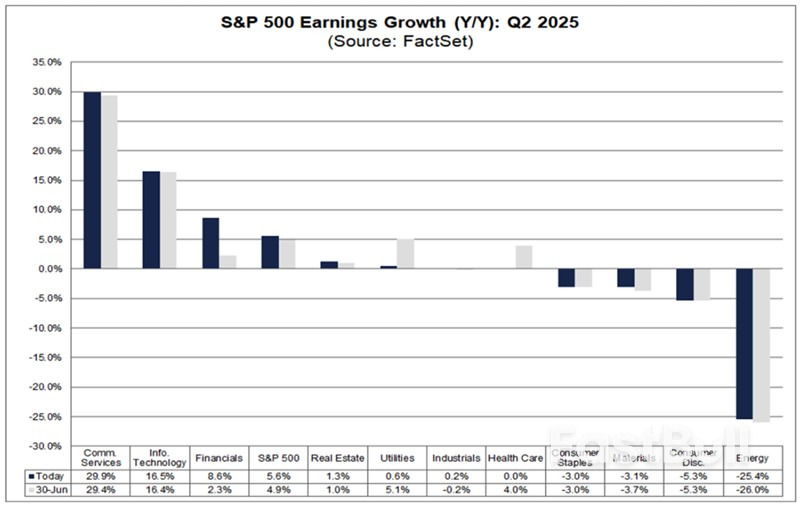
          This next chart tells us straight-up why the “AI-is-unprofitable” theory is off the mark.
          These AI-Linked Dividend Stocks Offer Yields as High as 13%_1
          Look at the far left of this chart and you see that communication-services stocks led in profit growth in the second quarter of 2025.
          Alphabet and Meta Platforms are both titans of that sector, and both have invested billions in AI. They’ve largely done it by buying chips and other hardware, as well as software, from IT firms like NVIDIA
          That pop in communication-services earnings proves that these companies are profiting from AI. Similarly, the second-highest earnings gains in the chart above, in IT, confirms that AI actually does make money for Big Tech.

          Tech-Focused CEFs Go on a Tear

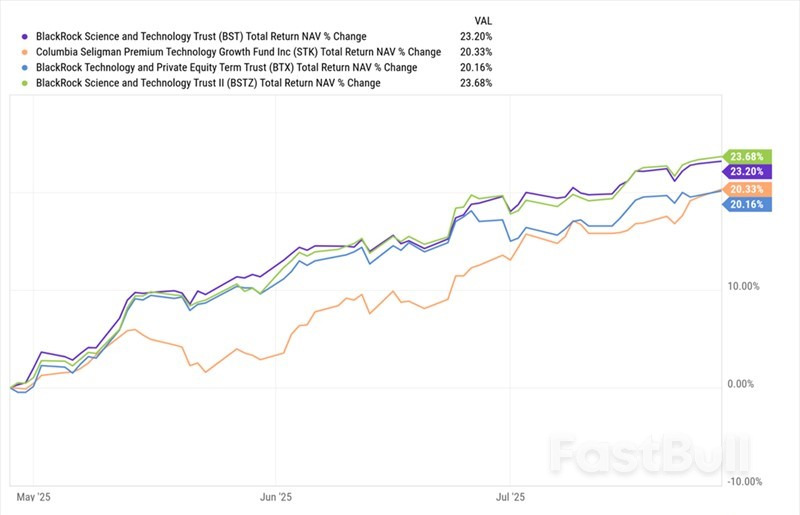
          When it comes to high-yielding, tech-focused CEFs, there are basically four tickers that income investors look to. Let’s check in on those now.
          As you can see in the chart below, all four of these funds’ net asset values have been roaring higher, with the 12.3%-yielding BlackRock Science and Technology Term Trust, in green, leading by a small amount over the last three months. It’s followed closely by its sister fund, the 7.7%-yielding BlackRock Science and Technology Trust, in purple.
          The BlackRock Technology and Private Equity Term Trust, with its huge 13% yield (in blue), and the Columbia Seligman Premium Technology Growth Fund, (in orange and paying 6%) bring up the rear.
          These AI-Linked Dividend Stocks Offer Yields as High as 13%_2

          Tech CEFs Rise Across the Board

          he Best Tech CEFs Are Still Great Bargains
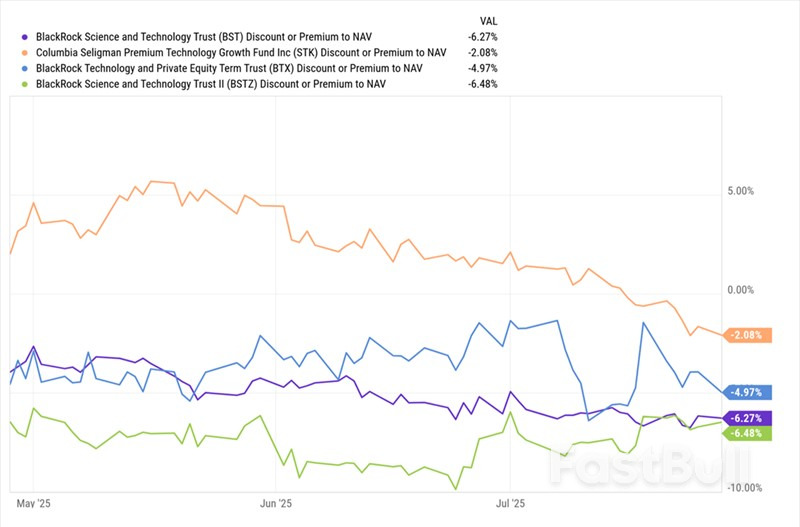
          The interesting thing, however, is the fact that these funds still trade at discounts to net asset value (NAV). The best values are the three BlackRock funds (again in green, blue and purple):
          These AI-Linked Dividend Stocks Offer Yields as High as 13%_3

          Tech CEFs Get Cheaper, Led By BlackRock Funds

          We’ve seen BSTZ’s discount remain basically where it was three months ago, despite its strong NAV return in that time, while BST’s discount has widened slightly, despite its strong performance.
          The third BlackRock tech CEF, the BlackRock Technology and Private Equity Term Trust (BTX), has seen its discount narrow slightly (April was a great time to buy BTX). The Columbia Seligman Premium Technology Growth Fund (STK) is the priciest of our quartet, but context matters here, as its premium to NAV, which it has held for much of the last decade, suddenly disappeared.
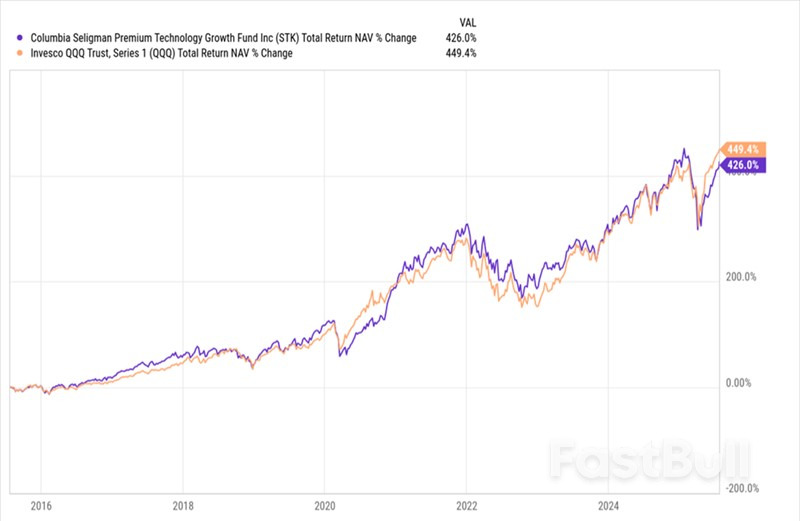
          Let’s stick with STK for a bit. Despite that fund’s smaller discount, is it still worth our time? I’d say yes, given the next chart. But there is a caveat that we’ll get into shortly.
          These AI-Linked Dividend Stocks Offer Yields as High as 13%_4

          STK Tracks the NASDAQ Higher, Pays a Bigger Dividend

          Before we get to that, we see that STK, whose NAV (in purple above) has closely matched the NASDAQ 100 (whose benchmark index fund is shown in orange) over the last decade. That makes STK a good way to get tech exposure, plus the index’s diversification.
          I mention that diversification because STK is tech-heavy, with core names like Microsoft, NVIDIA and Apple. But like the NASDAQ, it also branches out a bit, with holdings in companies like Visa and Bloom Energy, which focuses on products that help customers generate power on-site.
          On the dividend side, STK’s 6% yield far outruns the NASDAQ’s 0.5%, and the CEF has also never cut its payouts. However, STK is contending with funds yielding a lot more—up to 13% in the case of the highest-paying BlackRock fund, BTX.
          That’s the real reason for STK’s growing discount: Even though it was swept up in the tech rally, its lower payouts aren’t enough for many income investors, now that there’s more competition, plus dividends that nearly double STK’s 6% yield, among tech CEFs.
          This is why the bigger discounts offered by the BlackRock funds are the better deals here, and why STK’s discount isn’t yet big enough to warrant our attention.

          Source: investing

          Risk Warnings and Disclaimers
          You understand and acknowledge that there is a high degree of risk involved in trading. Following any strategies or investment methods may lead to potential losses. The content on the site is provided by our contributors and analysts for information purposes only. You are solely responsible for determining whether any trading assets, securities, strategy, or any other product is suitable for investing based on your own investment objectives and financial situation.
          Add to Favorites
          Share

          Gold Demand Soars to 1,249 Tonnes in Q2 2025 Amid Geopolitical Uncertainty

          Glendon

          Commodity

          The World Gold Council’s Q2 2025 Gold Demand Trends report reveals that total quarterly gold demand reached 1,249 tonne globally, a 3% increase year-on-year amid a high price environment. Strong gold investment flows largely fuelled quarterly growth, as an increasingly unpredictable geopolitical environment and price momentum sustained demand.

          Gold ETF investment remained a key driver of total demand, with inflows of 170 tonne over the quarter, compared with small outflows in Q2 2024. Asian-listed funds were major contributors at 70t, keeping pace with US flows. Combined with record inflows in Q1, global gold ETF demand reached 397tonne , the highest first half total since 2020.

          Total bar and coin investment also increased 11% year-on-year, adding 307 tonne. Chinese investors led the way with a notable 44% year-on-year increase to 115t, while Indian investors continued to add to their holdings, totalling 46 tonne in Q2. Divergent trends emerged in Western markets as European net investment more than doubled to 28t while US bar and coin demand halved to 9t in the second quarter.

          Central banks continued to buy, albeit at a slower pace, adding 166t in Q2 2025. Despite this deceleration, central bank buying remains at significantly elevated levels due to ongoing economic and geopolitical uncertainty. WGC's annual central bank survey shows that 95% of reserve managers believe that global central bank gold reserves will increase over the next 12 months.

          Jewellery demand continued to decline with the volume of consumption down 14% and nearing low levels last seen in 2020 during the COVID pandemic. Jewellery demand in China was down 20% and Indian demand fell 17% year-on-year. However, in value terms the global jewellery market increased to a total of US$36bn.

          Total gold supply increased 3% to 1,249 tonne, with mine production up marginally to a new second quarter record. Recycling increased 4% year-on-year but stayed relatively subdued considering the high price environment.

          Louise Street, Senior Markets Analyst at the World Gold Council, commented: “Global markets have navigated a volatile start to the year marked by trade tensions, unpredictable US policy shifts and frequent geopolitical flashpoints. The robust investment activity we have seen in the first half of 2025 underscores gold's role as a hedge against economic and geopolitical risks. Ongoing market volatility, coupled with gold's impressive price performance in recent months, has also generated significant momentum, drawing capital from investors around the globe."

          “Gold recorded a remarkable 26% appreciation in the first half of the year in dollar terms, outperforming many major asset classes. With such an impressive start to the year, it is possible that gold could trade within a relatively narrow range in the latter half of 2025. On the other hand, the macroeconomic environment remains highly unpredictable, which may underpin further gains for gold. Any material deterioration in global economic or geopolitical conditions could further amplify gold’s safe-haven appeal, potentially pushing prices are still higher.”

          Source: Kitco

          Risk Warnings and Disclaimers
          You understand and acknowledge that there is a high degree of risk involved in trading. Following any strategies or investment methods may lead to potential losses. The content on the site is provided by our contributors and analysts for information purposes only. You are solely responsible for determining whether any trading assets, securities, strategy, or any other product is suitable for investing based on your own investment objectives and financial situation.
          Add to Favorites
          Share

          Split Decision at the Fed Rekindles Debate Over Timing of Rate Cuts

          Adam

          Economic

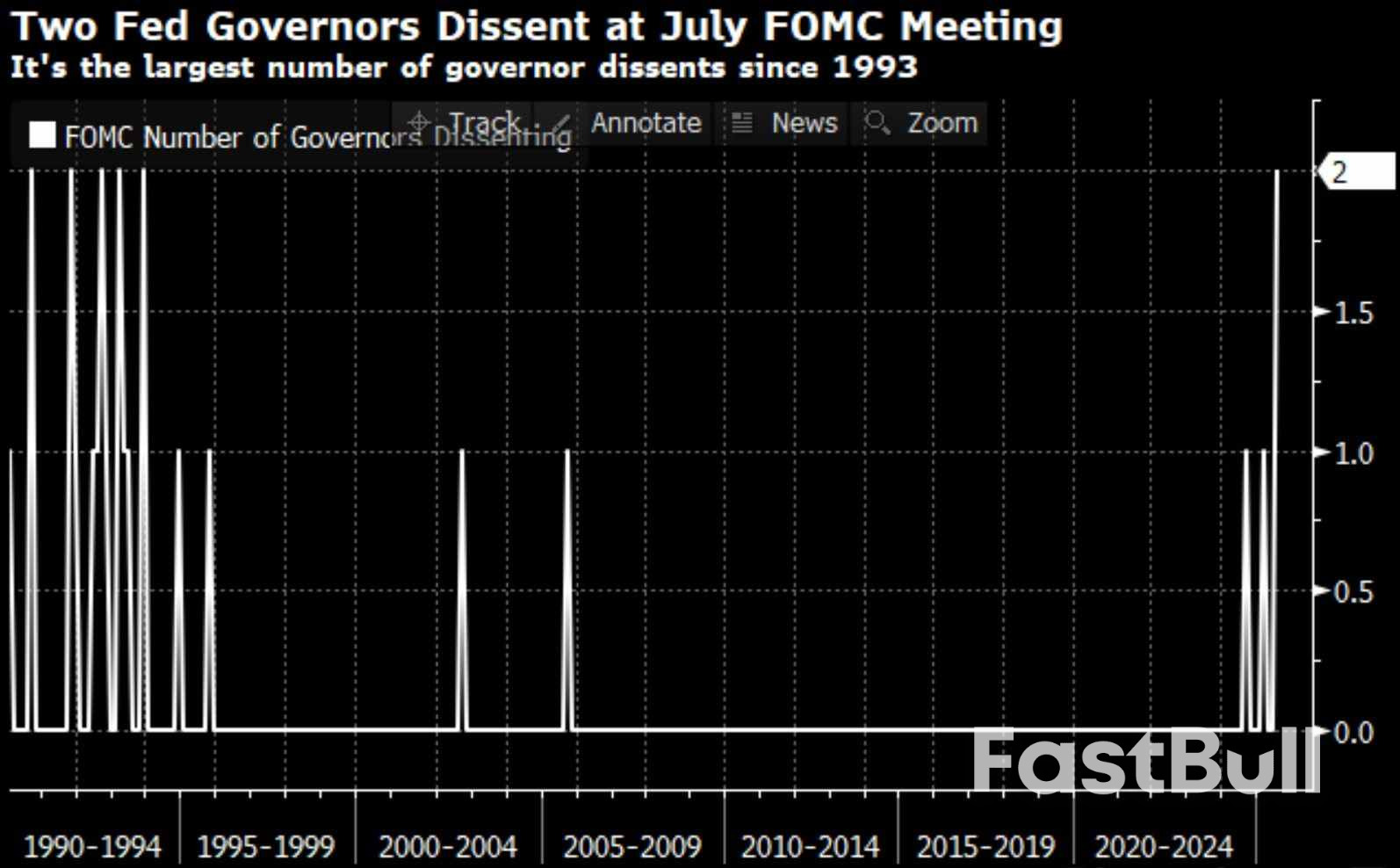
          December 2024 marked the second-to-last time there was a dissent by an FOMC voting member. The dissent, at the time, was a sole vote by Jefferey Schmid against cutting rates. The last dissent was yesterday. While the Fed voted to maintain the Fed Funds rate at 4.25-4.50%, Michelle Bowman and Christopher Wallace cast dissenting votes in favor of reducing rates.
          Such was the first time two members dissented since 1993, as shown below. The two dissenting votes at yesterday’s meeting inform us that the tide is turning, and the rationales for not cutting rates are fading.
          The Fed made two changes to its statement from six weeks ago as follows:
          Replaced “economic activity has continued to expand at a solid pace” with “growth of economic activity moderated in the first half of the year“
          Removed “diminished” from “uncertainty about economic outlook has diminished but remains elevated“
          In our opinion, the changes to the statement and the dissent votes point to slightly more dovish messaging by the Fed. Based on the market reaction, the markets do not agree with our take. In a section below, we share some quotes and commentary from Powell’s press conference.
          Split Decision at the Fed Rekindles Debate Over Timing of Rate Cuts_1

          When Powell Speaks, Investors Listen

          The following bullet points are from Jerome Powell’s post-FOMC press conference:
          The economy is not acting like policy is restrictive; thus, according to Powell, current monetary policy seems appropriate. That said, he recognizes “downside risks to the labor market are certainly apparent.”
          Labor market growth is slow, but it’s tempered as the workforce shrinks due to immigration policies. Thus, Powell believes the labor market is “balanced.”
          In regards to a potential September rate cut: “We have made no decisions about the September meeting.”
          The dissent votes resulted in good discussions about monetary policy at the meeting.
          Powell thinks it’s too early to evaluate how tariffs will impact inflation. He believes the process will be slower than they initially thought. He still thinks it’s reasonable to assume these will be “one-time price effects.” “We will make sure this doesn’t turn into serious inflation.“
          Services inflation is offsetting goods inflation due to tariffs.
          Interestingly, he said they “could look through inflation by not hiking.” “A pretty reasonable base case is that this will be a one-time price increase.”
          The Fed Funds futures market trimmed the odds of a September rate cut from 68% to 47%. In other words, the market thinks the statement and press conference were slightly hawkish.

          Source: investing

          To stay updated on all economic events of today, please check out our Economic calendar
          Risk Warnings and Disclaimers
          You understand and acknowledge that there is a high degree of risk involved in trading. Following any strategies or investment methods may lead to potential losses. The content on the site is provided by our contributors and analysts for information purposes only. You are solely responsible for determining whether any trading assets, securities, strategy, or any other product is suitable for investing based on your own investment objectives and financial situation.
          Add to Favorites
          Share

          EU–U.S. Trade Deal: Reduced Risks, But Still A Headwind For Europe

          PIMCO

          Economic

          Forex

          Political

          While not all details have been ironed out, we have a good idea of what the U.S.–EU trade agreement will look like following the recent announcements. The main contours of the deal are as follows:

          ● The U.S. will charge a 15% tariff rate on the vast majority of EU goods. Key exceptions are steel and aluminium (where the tariff rate will remain at 50%) and aircraft, plus some other goods where the tariff will be zero. Autos, semiconductors, and pharmaceuticals also appear to be subject to the 15% tariff, which is positive given fears of more unfavorable treatment of these sectors.
          ● The EU commits to 1) make $750 billion of energy purchases from the U.S. during President Trump’s tenure, 2) make $600 billion of investments into the U.S. (an unclear commitment that will rely on uncertain private sector investment decisions), and 3) purchase a yet unspecified amount of U.S. military equipment.
          ● The EU will refrain from retaliating against the trade measures introduced by the U.S.

          The agreed 15% tariff is largely in line with our assumptions and removes the outlier risks of a more adverse outcome. Even so, according to our modelling, the trade restrictions will likely weaken eurozone growth by around 1 percentage point over the next few quarters, bringing growth to a near halt during the second half of this year.

          Around half of that impact is due to the direct effect of tariffs on net trade, while the other half is linked to how trade policy uncertainty tends to curtail corporate investments. But the drag caused by the latter effect is difficult to estimate as we have only 2018–2019 (i.e., trade policy actions by the first Trump administration) as a relatively recent template. What’s more, global trade uncertainty actually has decreased of late, according to a widely tracked measure constructed by Federal Reserve researcher Matteo Iacoviello.

          Notably, the eurozone economy has not shown meaningful signs of slowdown so far this year, with GDP growth averaging more than 1% in annualized terms through the first half of the year and with the composite purchasing managers’ index (PMI) ticking up in July despite rising trade tensions. Still, it’s early days for economic effects to be felt, and much of the recent resilience is likely linked to U.S. import front-loading in advance of Trump’s August tariff deadline. We continue to expect a deceleration in euro area growth throughout the remainder of the year.

          The expected slowdown, and our assessment that near-term inflation risks are tilting to the downside due to a weaker economy, slowing wage growth, and a stronger currency – are factors underpinning our expectation that the European Central Bank (ECB) has potentially more policy easing to do. We believe the ECB could lower the policy rate one more time to a terminal rate of 1.75% – a level not far from current money market pricing – but upcoming data will be key to determining the policy path ahead.

          At the ECB’s 24 July monetary policy meeting, President Christine Lagarde stressed that ECB policy is currently in a “good place.” This is not surprising given growth running close to trend, inflation being close to target, and the policy rate being at a level the ECB considers to be neutral. Arguably, the central bank also wants to minimize the risk of having to reverse course shortly after reaching the terminal rate.

          Investment implications

          With ECB rate expectations largely priced into markets, we believe European bonds still offer an attractive hedge for investors bracing for Europe’s economic headwinds. We favor short- to medium-term maturities, given anchored front-end rates and elevated longer-term rates (the latter largely due to Germany’s fiscal push plus the ECB’s balance sheet unwind).On the currency front, the euro’s recent rally against the U.S. dollar looks set to continue, but that story is more about dollar weakness than euro strength.We also see significant opportunities in well-structured and defensive spread sectors throughout the eurozone, which – through appropriate name and sector selection – offer the potential for compelling risk-adjusted returns with lower volatility relative to equities.

          Source: PIMCO

          To stay updated on all economic events of today, please check out our Economic calendar
          Risk Warnings and Disclaimers
          You understand and acknowledge that there is a high degree of risk involved in trading. Following any strategies or investment methods may lead to potential losses. The content on the site is provided by our contributors and analysts for information purposes only. You are solely responsible for determining whether any trading assets, securities, strategy, or any other product is suitable for investing based on your own investment objectives and financial situation.
          Add to Favorites
          Share
          FastBull
          Copyright © 2025 FastBull Ltd

          728 RM B 7/F GEE LOK IND BLDG NO 34 HUNG TO RD KWUN TONG KLN HONG KONG

          TelegramInstagramTwitterfacebooklinkedin
          App Store Google Play Google Play
          Products
          Charts

          Chats

          Q&A with Experts
          Screeners
          Economic Calendar
          Data
          Tools
          Membership
          Features
          Function
          Markets
          Copy Trading
          Latest Signals
          Contests
          News
          Analysis
          24/7
          Columns
          Education
          Company
          Careers
          About Us
          Contact Us
          Advertising
          Help Center
          Feedback
          User Agreement
          Privacy Policy
          Business

          White Label

          Data API

          Web Plug-ins

          Poster Maker

          Affiliate Program

          Risk Disclosure

          The risk of loss in trading financial instruments such as stocks, FX, commodities, futures, bonds, ETFs and crypto can be substantial. You may sustain a total loss of the funds that you deposit with your broker. Therefore, you should carefully consider whether such trading is suitable for you in light of your circumstances and financial resources.

          No decision to invest should be made without thoroughly conducting due diligence by yourself or consulting with your financial advisors. Our web content might not suit you since we don't know your financial conditions and investment needs. Our financial information might have latency or contain inaccuracy, so you should be fully responsible for any of your trading and investment decisions. The company will not be responsible for your capital loss.

          Without getting permission from the website, you are not allowed to copy the website's graphics, texts, or trademarks. Intellectual property rights in the content or data incorporated into this website belong to its providers and exchange merchants.

          Not Logged In

          Log in to access more features

          FastBull Membership

          Not yet

          Purchase

          Become a signal provider
          Help Center
          Customer Service
          Dark Mode
          Price Up/Down Colors

          Log In

          Sign Up

          Position
          Layout
          Fullscreen
          Default to Chart
          The chart page opens by default when you visit fastbull.com