Markets
News
Analysis
User
24/7
Economic Calendar
Education
Data
- Names
- Latest
- Prev


Signal Accounts for Members
All Signal Accounts
All Contests


U.K. Trade Balance (Oct)A:--
F: --
P: --
U.K. Services Index MoMA:--
F: --
P: --
U.K. Construction Output MoM (SA) (Oct)A:--
F: --
P: --
U.K. Industrial Output YoY (Oct)A:--
F: --
P: --
U.K. Trade Balance (SA) (Oct)A:--
F: --
P: --
U.K. Trade Balance EU (SA) (Oct)A:--
F: --
P: --
U.K. Manufacturing Output YoY (Oct)A:--
F: --
P: --
U.K. GDP MoM (Oct)A:--
F: --
P: --
U.K. GDP YoY (SA) (Oct)A:--
F: --
P: --
U.K. Industrial Output MoM (Oct)A:--
F: --
P: --
U.K. Construction Output YoY (Oct)A:--
F: --
P: --
France HICP Final MoM (Nov)A:--
F: --
P: --
China, Mainland Outstanding Loans Growth YoY (Nov)A:--
F: --
P: --
China, Mainland M2 Money Supply YoY (Nov)A:--
F: --
P: --
China, Mainland M0 Money Supply YoY (Nov)A:--
F: --
P: --
China, Mainland M1 Money Supply YoY (Nov)A:--
F: --
P: --
India CPI YoY (Nov)A:--
F: --
P: --
India Deposit Gowth YoYA:--
F: --
P: --
Brazil Services Growth YoY (Oct)A:--
F: --
P: --
Mexico Industrial Output YoY (Oct)A:--
F: --
P: --
Russia Trade Balance (Oct)A:--
F: --
P: --
Philadelphia Fed President Henry Paulson delivers a speech
Canada Building Permits MoM (SA) (Oct)A:--
F: --
P: --
Canada Wholesale Sales YoY (Oct)A:--
F: --
P: --
Canada Wholesale Inventory MoM (Oct)A:--
F: --
P: --
Canada Wholesale Inventory YoY (Oct)A:--
F: --
P: --
Canada Wholesale Sales MoM (SA) (Oct)A:--
F: --
P: --
Germany Current Account (Not SA) (Oct)A:--
F: --
P: --
U.S. Weekly Total Rig CountA:--
F: --
P: --
U.S. Weekly Total Oil Rig CountA:--
F: --
P: --
Japan Tankan Large Non-Manufacturing Diffusion Index (Q4)--
F: --
P: --
Japan Tankan Small Manufacturing Outlook Index (Q4)--
F: --
P: --
Japan Tankan Large Non-Manufacturing Outlook Index (Q4)--
F: --
P: --
Japan Tankan Large Manufacturing Outlook Index (Q4)--
F: --
P: --
Japan Tankan Small Manufacturing Diffusion Index (Q4)--
F: --
P: --
Japan Tankan Large Manufacturing Diffusion Index (Q4)--
F: --
P: --
Japan Tankan Large-Enterprise Capital Expenditure YoY (Q4)--
F: --
P: --
U.K. Rightmove House Price Index YoY (Dec)--
F: --
P: --
China, Mainland Industrial Output YoY (YTD) (Nov)--
F: --
P: --
China, Mainland Urban Area Unemployment Rate (Nov)--
F: --
P: --
Saudi Arabia CPI YoY (Nov)--
F: --
P: --
Euro Zone Industrial Output YoY (Oct)--
F: --
P: --
Euro Zone Industrial Output MoM (Oct)--
F: --
P: --
Canada Existing Home Sales MoM (Nov)--
F: --
P: --
Euro Zone Total Reserve Assets (Nov)--
F: --
P: --
U.K. Inflation Rate Expectations--
F: --
P: --
Canada National Economic Confidence Index--
F: --
P: --
Canada New Housing Starts (Nov)--
F: --
P: --
U.S. NY Fed Manufacturing Employment Index (Dec)--
F: --
P: --
U.S. NY Fed Manufacturing Index (Dec)--
F: --
P: --
Canada Core CPI YoY (Nov)--
F: --
P: --
Canada Manufacturing Unfilled Orders MoM (Oct)--
F: --
P: --
Canada Manufacturing New Orders MoM (Oct)--
F: --
P: --
Canada Core CPI MoM (Nov)--
F: --
P: --
Canada Manufacturing Inventory MoM (Oct)--
F: --
P: --
Canada CPI YoY (Nov)--
F: --
P: --
Canada CPI MoM (Nov)--
F: --
P: --
Canada CPI YoY (SA) (Nov)--
F: --
P: --
Canada Core CPI MoM (SA) (Nov)--
F: --
P: --
Canada CPI MoM (SA) (Nov)--
F: --
P: --


No matching data
Latest Views
Latest Views
Trending Topics
Top Columnists
Latest Update
White Label
Data API
Web Plug-ins
Affiliate Program
View All

No data
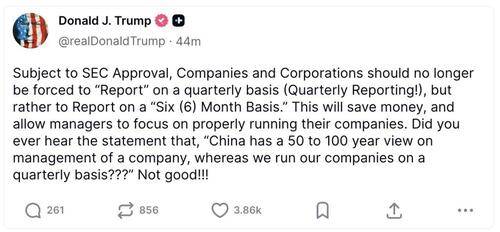
President Donald Trump suggested Monday on Truth Social that companies should stop filing quarterly earnings reports and instead move to a semiannual schedule. Trump’s call to replace quarterly earnings reports with semiannual filings revives a debate that also surfaced during his first term.
In his post, Trump said the idea is “subject to SEC approval” and would “save money, and allow managers to focus on properly running their companies.” He added: “Did you ever hear the statement that, ‘China has a 50 to 100 year view on management of a company, whereas we run our companies on a quarterly basis??? Not good!!!’”
The concept has long divided business leaders and regulators. In 2018, Warren Buffett and JPMorgan Chase CEO Jamie Dimon argued against quarterly guidance, writing: “In our experience, quarterly earnings guidance often leads to an unhealthy focus on short-term profits at the expense of long-term strategy, growth and sustainability.”
But others warn that reducing reporting could weaken transparency. “Trying to get companies less hyper focused on the short-term quarterly hamster wheel would be good, but it's far from clear that reducing investor disclosure to semi-annual reporting would do that,” Dennis Kelleher, CEO of advocacy group Better Markets, told Axios. “The real solution would be getting Boards of Directors to incentivize and then support corporate executives to focus more on the long term and less on the short term.”
TD Cowen, in a note Monday, said Trump’s comments could carry weight: given his push to roll back regulations, the post moves the idea “from improbable to probable though not guaranteed,” according to Axios.
“In speaking with some of the world’s top business leaders I asked what it is that would make business (jobs) even better in the U.S. ‘Stop quarterly reporting & go to a six month system,’ said one. That would allow greater flexibility & save money. I have asked the SEC to study!” Trump said in a post on X during his first term in 2018.

Currently, U.S. companies must file quarterly reports, though forecasts remain voluntary. Proponents say frequent reports give investors timely, reliable insights, with GAAP standards ensuring consistency. Critics, however, argue that short-term pressure hampers long-range planning.
Despite Trump’s comparison to China, firms there are required to file quarterly, semiannual, and annual reports. Hong Kong-listed companies report every six months, similar to rules in the U.K. and EU, where quarterly updates are optional. Norway’s sovereign wealth fund recently proposed semiannual reporting as well, citing the need for companies to prioritize long-term growth.
In 2025, the mainstream Keynesian narrative that the United States would inevitably experience a recession and stagflation has proven to be utterly incorrect.
The American economy is performing much better than its comparable nations, is showing broad-based strength, and even has indications of accelerating growth, giving investors and consumers plenty of reason to feel more optimistic, despite the consensus estimates from earlier in the year.
The consensus was wrong.
The United States economy is outperforming the economies of the UK, Germany, France, Italy, Japan, and the entire euro area, showing estimates of economic growth that exceed those of the best-performing developed nations, along with significantly lower unemployment rates and solid real wage growth.
Due to exaggerated expectations of the impact of factors like new tariffs, global uncertainty, and the potential for persistently high inflation, most mainstream analysts and market commentators projected a stagnant or recessionary environment for the US in 2025, while hailing the euro area as the place to invest. We have seen the opposite.
US bond yields are falling, while euro area sovereign yields are rising despite ECB rate cuts. Additionally, GDP growth estimates for the euro area are weak, and US economic growth is stronger than the European Union’s “engines of growth,” whereas Japan and the UK remain stagnant. Inflation is under control, real wage growth is strong, and the private sector is improving.
The mainstream consensus predictions were biased and incorrect. Rather, the US economy has reported strong real GDP growth: following a short contraction in Q1, growth in the second quarter bounced back to 3–3.3% annually, and the Atlanta Fed’s GDPNow model currently projects Q3 growth at a stable 3% pace. In addition to consumer spending and imports, business investment also contributed to this GDP strength, and, more importantly, it came with government spending under control.
The most recent CPI and PPI data dispel concerns that the tariff regime is causing inflation. CPI and core measures in August came in close to or below expectations, indicating that headline monthly inflation and producer price increases are still under control. Prices for durable and nondurable goods are still stable, and, despite negative forecasts, tariffs have not generated a significant increase in the cost of living for Americans; instead, energy and important imports have either decreased or stabilised.
Despite recent revisions, the private-sector labor market maintained momentum from January through August. The significant negative revisions occurred during the January-December 2024 period, indicating that the Biden administration’s job creation was only half of what was reported and required a two million downward adjustment to the job figures from 2023 to 2024. What the Bureau of Labour Statistics has shown clearly is that the United States was in a private sector recession in 2024, which justified the negative sentiment from citizens.
Private payrolls have reported consistent net gains, particularly in the important service and construction segments, despite slight revisions to previous months. Even more encouraging is the fact that real wage growth is accelerating rather than merely keeping up with inflation. Real average hourly earnings increased by 1.2%, and real weekly earnings increased by 1.4% between July 2024 and July 2025. Increased purchasing power is boosting middle-class disposable income and driving retail demand because wage gains are outpacing price growth.
Retail sales also remain resilient in the face of market volatility and trade uncertainty. Bloomberg predicts that headline retail sales will increase by 0.2% in August, while the core control group will increase by 0.3%. This increase is significantly better than what April estimates showed, particularly since consumer sentiment is still cautious but generally stable. Throughout the third quarter, household consumption is increasing due to strong private labor markets and healthy wage growth.
The growing agreement that inflation risks are under control represents the most significant development for financial markets, paving the way for the Federal Reserve to finally recognise reality and cut interest rates in the coming months. Markets are beginning to anticipate that the Fed will soon lower interest rates, which could further boost borrowing, investment, and the economy’s momentum for the rest of 2025.
Despite the pessimistic predictions of recession and stagflation, they have proven to be undeniably wrong. The US economy is in a period of true private sector expansion, thanks to strong job and wage growth, favourable taxation, and deregulation, whereas tariffs are having no real impact on inflation. Now the Fed needs to be truly data dependent. Putting aside the pessimism of the previous year, the data currently indicates an improving outlook and a recovery from the private sector recession and fiscal mess inherited in 2024.
The Fed models were wrong about inflation and used labor market figures that were hugely inflated. The Fed should have read its own Beige Book, which alerted of a marked slowdown in job creation in March and April, instead of succumbing to the biased consensus narrative.


The Bank of England should stop selling gilts from its quantitative-easing portfolio because the sales are distorting monetary policy, a former BOE rate-setter warned.
Sushil Wadhwani, who was a member of the nine-strong Monetary Policy Committee between 1999 and 2002, said active gilt sales are causing a “transmission problem.” While the bank has been cutting short-term interest rates, long-term borrowing costs have been rising in a sign that policy “is not transmitting along the yield curve in the way we normally expect.”
The comments by Wadhwani, who sold his Wadhwani Asset Management firm to US fund PGIM in 2018 and is now a research associate at the London School of Economics, echo concerns raised in June by Catherine Mann, a current MPC member. Mann said there is a disconnect between the five cuts in interest rates since August 2024, to 4% from 5.25%, and the rise in longer-term borrowing costs. The 30-year UK government bond yield recently hit a 27 year high.
Under quantitative tightening, the BOE has reduced its portfolio since 2022 from a peak of £895 billion ($1.2 trillion) to £558 billion, unwinding gilts at an annual pace of £100 billion through a combination of letting maturing bonds run off and actively selling debt. The securities were acquired to shore up the economy through the financial crisis, Brexit and Covid.
The MPC will announce its plan for QT alongside its interest-rate decision on Thursday. The bank is expected to hold rates at 4% but to reduce QT to about £70 billion, the median response to a Bloomberg survey of 22 economists. BNP Paribas SA, Morgan Stanley and NatWest Markets expect the active sales to end altogether, reducing the run-off rate to £49 billion. Oxford Economics and Royal Bank of Canada expect just the sale of long-dated bonds to cease.
Wadhwani said the bank should end active sales because they are affecting the cost of long-term government debt, which is having “a significant impact on confidence in the UK economy.”
“I have foreign investors bring it up all the time,” he said. He added that the budget on Nov. 26 is likely to involve a fiscal tightening, through tax rises or spending cuts, that will weigh on growth. “It is not uncommon to deliver monetary easing alongside fiscal tightening,” he said.
Ending active sales would potentially cost Chancellor of the Exchequer Rachel Reeves £4.5 billion by increasing interest losses on the BOE’s gilt portfolio. Wadhwani said the bank should ignore the fiscal consequences of its decision as its role is to manage interest rates. “They should stick to their knitting and focus on the primary objective,” he said.
The bank is losing money on the gilt portfolio in two ways. Interest-rate losses come about because the BOE pays its benchmark rate, currently 4%, on the reserves created to buy the gilts but earns only 2%-2.5% on the securities. Separate valuation losses arise when gilts are sold, though these only affect fiscal rules relating to debt, not Reeves’ binding rule that requires taxes and and day-to-day spending to be in balance by 2029-30.
White Label
Data API
Web Plug-ins
Poster Maker
Affiliate Program
The risk of loss in trading financial instruments such as stocks, FX, commodities, futures, bonds, ETFs and crypto can be substantial. You may sustain a total loss of the funds that you deposit with your broker. Therefore, you should carefully consider whether such trading is suitable for you in light of your circumstances and financial resources.
No decision to invest should be made without thoroughly conducting due diligence by yourself or consulting with your financial advisors. Our web content might not suit you since we don't know your financial conditions and investment needs. Our financial information might have latency or contain inaccuracy, so you should be fully responsible for any of your trading and investment decisions. The company will not be responsible for your capital loss.
Without getting permission from the website, you are not allowed to copy the website's graphics, texts, or trademarks. Intellectual property rights in the content or data incorporated into this website belong to its providers and exchange merchants.
Not Logged In
Log in to access more features

FastBull Membership
Not yet
Purchase
Log In
Sign Up