

Markets
News
Analysis
User
24/7
Economic Calendar
Education
Data
- Names
- Latest
- Prev



Signal Accounts for Members
All Signal Accounts
All Contests
 Italy Retail Sales MoM (SA) (Oct)
A:--
F: --
P: --
 Euro Zone Employment YoY (SA) (Q3)
A:--
F: --
P: --
Euro Zone GDP Final YoY (Q3)A:--
F: --
P: --
Euro Zone GDP Final QoQ (Q3)A:--
F: --
P: --
Euro Zone Employment Final QoQ (SA) (Q3)A:--
F: --
P: --
Euro Zone Employment Final (SA) (Q3)A:--
F: --
 Brazil PPI MoM (Oct)
A:--
F: --
P: --
 Mexico Consumer Confidence Index (Nov)
A:--
F: --
P: --
 Canada Unemployment Rate (SA) (Nov)
A:--
F: --
P: --
Canada Labor Force Participation Rate (SA) (Nov)A:--
F: --
P: --
Canada Employment (SA) (Nov)A:--
F: --
P: --
Canada Part-Time Employment (SA) (Nov)A:--
F: --
P: --
Canada Full-time Employment (SA) (Nov)A:--
F: --
P: --
 U.S. Personal Income MoM (Sept)
A:--
F: --
P: --
U.S. PCE Price Index YoY (SA) (Sept)A:--
F: --
P: --
U.S. PCE Price Index MoM (Sept)A:--
F: --
P: --
U.S. Personal Outlays MoM (SA) (Sept)A:--
F: --
P: --
U.S. Core PCE Price Index MoM (Sept)A:--
F: --
P: --
U.S. Core PCE Price Index YoY (Sept)A:--
F: --
P: --
U.S. UMich 5-Year-Ahead Inflation Expectations Prelim YoY (Dec)A:--
F: --
P: --
U.S. Real Personal Consumption Expenditures MoM (Sept)A:--
F: --
P: --
U.S. 5-10 Year-Ahead Inflation Expectations (Dec)A:--
F: --
P: --
U.S. UMich Current Economic Conditions Index Prelim (Dec)A:--
F: --
P: --
U.S. UMich Consumer Sentiment Index Prelim (Dec)A:--
F: --
P: --
U.S. UMich 1-Year-Ahead Inflation Expectations Prelim (Dec)A:--
F: --
P: --
U.S. UMich Consumer Expectations Index Prelim (Dec)A:--
F: --
P: --
U.S. Weekly Total Rig CountA:--
F: --
P: --
U.S. Weekly Total Oil Rig CountA:--
F: --
P: --
U.S. Unit Labor Cost Prelim (SA) (Q3)--
F: --
P: --
U.S. Consumer Credit (SA) (Oct)A:--
F: --
P: --
 China, Mainland Foreign Exchange Reserves (Nov)
--
F: --
P: --
China, Mainland Exports YoY (USD) (Nov)--
F: --
P: --
China, Mainland Imports YoY (CNH) (Nov)--
F: --
P: --
China, Mainland Imports YoY (USD) (Nov)--
F: --
P: --
China, Mainland Imports (CNH) (Nov)--
F: --
P: --
China, Mainland Trade Balance (CNH) (Nov)--
F: --
P: --
China, Mainland Exports (Nov)--
F: --
P: --
 Japan Wages MoM (Oct)
--
F: --
P: --
Japan Trade Balance (Oct)--
F: --
P: --
Japan Nominal GDP Revised QoQ (Q3)--
F: --
P: --
Japan Trade Balance (Customs Data) (SA) (Oct)--
F: --
P: --
Japan GDP Annualized QoQ Revised (Q3)--
F: --
China, Mainland Exports YoY (CNH) (Nov)--
F: --
P: --
China, Mainland Trade Balance (USD) (Nov)--
F: --
P: --
 Germany Industrial Output MoM (SA) (Oct)
--
F: --
P: --
Euro Zone Sentix Investor Confidence Index (Dec)--
F: --
P: --
Canada Leading Index MoM (Nov)--
F: --
P: --
Canada National Economic Confidence Index--
F: --
P: --
U.S. Dallas Fed PCE Price Index YoY (Sept)--
F: --
P: --
U.S. 3-Year Note Auction Yield--
F: --
P: --
 U.K. BRC Overall Retail Sales YoY (Nov)
--
F: --
P: --
U.K. BRC Like-For-Like Retail Sales YoY (Nov)--
F: --
P: --
 Australia Overnight (Borrowing) Key Rate
--
F: --
P: --
RBA Rate Statement RBA Press Conference Germany Exports MoM (SA) (Oct)--
F: --
P: --
U.S. NFIB Small Business Optimism Index (SA) (Nov)--
F: --
P: --
Mexico Core CPI YoY (Nov)--
F: --
P: --
Mexico 12-Month Inflation (CPI) (Nov)--
F: --
P: --
Mexico PPI YoY (Nov)--
F: --
P: --


No matching data

Latest Views
Latest Views
Trending Topics
Top Columnists
Latest Update
White Label
Data API
Web Plug-ins
Affiliate Program
View All
No data
Oil prices inched up on Monday supported by geopolitical tension in Europe and the Middle East, although the prospect of more oil supply and concern about the impact of trade tariffs on global fuel demand weighed.
Key points:
Oil prices inched up on Monday supported by geopolitical tension in Europe and the Middle East, although the prospect of more oil supply and concern about the impact of trade tariffs on global fuel demand weighed.
Brent crude futures (LCoc1) rose 28 cents, or 0.42%, to $66.96 a barrel by 0118 GMT while U.S. West Texas Intermediate crudewas at $62.88 a barrel, up 20 cents, or 0.32%.
"Reports over the weekend that Russia was threatening over the Polish border has provided traders with a timely reminder of the ongoing risks to European energy security from the north east," said Michael McCarthy, CEO of investment platform Moomoo Australia and New Zealand.
Polish and allied aircraft were deployed early on Saturday to ensure the safety of Polish airspace after Russia launched airstrikes targeting western Ukraine near the border with Poland, armed forces of the NATO-member country said.
The deployment came after three Russian military jets violated NATO Estonia's airspace for 12 minutes on Friday, while on Sunday, Germany's air force reported that a Russian military plane entered neutral airspace over the Baltic Sea.
The United Nations Security Council is due to meet on Monday over Estonia's accusation that Russian fighter jets violated its airspace, diplomats said.
In recent weeks, Ukraine stepped up drone attacks on Russia's energy infrastructure, hitting terminals and refineries, while U.S. President Donald Trump has urged the European Union to halt Russian oil and gas purchases.
In the Middle East news, four Western nations recognised Palestinian state, prompting a furious response from Israel and adding to jitters in the key oil-producing region.
Brent and WTI settled down more than 1% on Friday to mark a slight decline last week as worries about large supplies and declining demand outweighed expectations that the year's first interest-rate cut by the U.S. Federal Reserve would trigger more consumption.
"There are underpinning assumptions about the market outlook that encompass increased supply from the USA, OPEC+ and now Russia in response to a significant decline in oil revenues," McCarthy said.
Iraq has increased oil exports following the gradual unwinding of voluntary production cuts under an OPEC+ agreement, the country's state oil marketer SOMO said on Sunday.
Iraq's oil exports averaged 3.38 million barrels per day in August, according to the oil ministry. SOMO expects September's average exports to range from 3.4 million to 3.45 million bpd.
The cryptocurrency market is buzzing with significant news today as Bitcoin (BTC) has experienced a notable Bitcoin price drop, falling below the critical $115,000 mark. According to real-time market monitoring by Bitcoin World, BTC is currently trading at $114,985.48 on the Binance USDT market. This movement has naturally sparked discussions among investors and enthusiasts alike, prompting questions about the underlying causes and potential future implications for the world’s leading digital asset.
The sudden dip in Bitcoin’s value is a key event that demands attention. While specific catalysts can often be complex and multi-faceted, several factors typically contribute to such market movements. A fall below a psychological or technical support level like $115,000 can often accelerate selling pressure as automated trading systems and wary investors react. This particular Bitcoin price drop reflects a shift in immediate market sentiment, moving from optimism to caution.
Understanding the immediate triggers is crucial for investors. Market analysts often point to a combination of global economic indicators, shifts in investor confidence, or even large-scale sell-offs by significant holders, often referred to as ‘whales.’ These elements collectively shape the volatile landscape of cryptocurrency trading, making rapid price changes a common, albeit often unsettling, occurrence.
Bitcoin’s journey has always been marked by volatility. Its price action is influenced by a diverse range of internal and external factors. For instance, macroeconomic news, such as inflation reports or interest rate decisions from central banks, can have a ripple effect on risk assets like cryptocurrencies. Regulatory developments around the globe also play a pivotal role; news of stricter regulations or outright bans in certain regions can significantly impact investor sentiment and trigger a Bitcoin price drop.
Moreover, the crypto market is still relatively young and less liquid compared to traditional financial markets. This characteristic means that even moderately sized trades can sometimes have a disproportionate effect on price, especially during periods of low trading volume. Technical indicators, such as a breach of key support levels, can also signal further downward momentum, encouraging more sellers to enter the market.
Navigating the Current Bitcoin Price Drop: A Guide for Investors
When faced with a significant market movement like this Bitcoin price drop, investors often wonder how to proceed. It’s a natural reaction to feel concern, but panic selling is rarely the optimal strategy. Instead, adopting a measured and informed approach can help mitigate risks and potentially identify opportunities.
Here are some actionable insights for navigating such market conditions:
While the immediate Bitcoin price drop below $115,000 is a significant headline, it’s essential to view it within the broader context of Bitcoin’s journey. The cryptocurrency market is dynamic, characterized by cycles of expansion and contraction. Many analysts believe that such corrections are a healthy part of a maturing market, flushing out excessive speculation and paving the way for more sustainable growth.
The resilience of the Bitcoin network, its growing adoption, and its fundamental value proposition as a decentralized digital asset remain strong. While short-term fluctuations can be unsettling, the long-term narrative for Bitcoin often focuses on its scarcity, security, and potential as a hedge against traditional financial systems. Investors should therefore focus on these foundational aspects rather than getting overly fixated on daily price swings.
In conclusion, the recent Bitcoin price drop below $115,000 is a noteworthy event in the volatile world of cryptocurrency. While it highlights the inherent risks of digital asset investing, it also underscores the importance of informed decision-making, strategic planning, and a long-term perspective. Staying educated and avoiding impulsive reactions are paramount for navigating these market shifts successfully. The crypto journey is often a rollercoaster, and understanding its dynamics is key to a smoother ride.
Frequently Asked Questions (FAQs)
Q1: What is the current trading price of Bitcoin after this fall?A1: As reported, Bitcoin (BTC) is currently trading around $114,985.48 on platforms like Binance USDT, having fallen below the $115,000 mark.
Q2: What are the primary reasons for a sudden Bitcoin price drop?A2: A sudden Bitcoin price drop can be attributed to various factors including macroeconomic concerns, regulatory news, significant whale sell-offs, technical breaches of support levels, and overall shifts in market sentiment.
Q3: Is it a good time to buy Bitcoin when its price falls?A3: This depends on individual investment strategy and risk tolerance. Some investors view a price drop as a ‘buy the dip’ opportunity, while others prefer to wait for market stabilization. Dollar-Cost Averaging (DCA) is a popular strategy during such times.
Q4: How can investors protect their investments during cryptocurrency volatility?A4: Key strategies include thorough research, setting clear investment goals, practicing dollar-cost averaging, diversifying portfolios, and never investing more than you can afford to lose. Avoiding emotional decisions is also crucial.
Q5: What is the long-term outlook for Bitcoin after such market corrections?A5: Historically, Bitcoin has demonstrated resilience, recovering from numerous corrections to achieve new highs. Many long-term investors and analysts maintain a positive outlook, focusing on Bitcoin’s fundamental value proposition and increasing global adoption, despite short-term volatility.
Major central banks’ unconvincing mix of policy cuts and pauses last week shows they are struggling to regain the global rates narrative. Amid the uncertainty, relative value opportunities are emerging.As expected, the U.S. Federal Reserve last week lowered interest rates by 25 basis points, giving the markets what was priced in, but disappointing in providing forward guidance.Overall, the sense is that the Fed lacked solid conviction behind its decision, reflecting a wide dispersion in the views of the Federal Open Market Committee members on the economy and how best to manage a weakening labor market and above-target inflation.
Clearly the Fed is playing catch-up to other major central banks that have moved earlier and more aggressively in their monetary policy easing. But as we move through this more uncertain period for policy, we see attractive relative value opportunities emerging in the global rates market, a development our portfolios are well positioned for going into the final quarter of the year and 2026.
One of the most attractive opportunities we see is the relative value dislocation between U.S. and European rates markets, driven by the disparity between the current policy levels of the Fed, BoE and European Central Bank.The ECB held its key interest rate at 2% on September 11—half the level the policy rate was at last year—in contrast to the Fed’s current 4 – 4.25% range, and the BoE’s 4%.
While the ECB has held rates unchanged since June, we expect another cut to come before the end of this year, which would create opportunities across several eurozone countries and curves.More broadly, we are also seeing interesting dynamics in the rates markets of the U.K., Canada and Japan.
Even though the Fed is playing catch-up, it has clearly indicated it is in an easing cycle, which we anticipate will deliver three additional cuts between now and early 2026, with a neutral rate settling around the 3.25 – 3.75% range.
However, big questions remain about the path to the neutral rate level.
Indeed, disparity is wider in views on this among the FOMC members, evidenced by the updated 2025 “dot plot” chart, on which each member records their view of the appropriate interest rate for the end of the year.Seven of the 19 members expect no more rate cuts this year, and another two expect just one. The median expectation conceals a split committee, which included one member who thinks the fed funds rate should fall by 1.25 percentage points this year. This view was clearly from the committee’s newest member, Stephen Miran. He was the only dissenter – calling for a larger cut – while previous dissenters, governors Christopher Waller and Michelle Bowman, joined the majority this time for a smaller cut.
Regarding the neutral rate, we think the Miran dissent and dot-plot projection could act as a precursor of what the next Fed Chair delivers in 2026.
With the Fed and the BoC easing last week, the BoE and BoJ instead held interest rates unchanged, mirroring the ECB’s decision earlier this month.The ECB has a constructive view on eurozone growth, jobs and inflation, but remains watchful of inflation and cautioned that higher tariffs and increased global competition would impact growth for the rest of the year.
In contrast, stubbornly elevated inflation and lackluster growth are more acute challenges for the U.K., forcing the BoE to hold its key rate at 4%. By the end of the year, we expect another cut to come.Importantly, the central bank is also to dial back its annual quantitative tightening program—selling down its government bond holdings—from £100 billion to £70 billion to curb rising gilt yields. However, cash sales are set to increase to £21 billion from £13 billion due to the fall in passive quantitative tightening.
For the BoJ, which is in gradual tightening mode, it held rates at 0.5% in a contested vote and announced it would start selling its cache of exchange-traded funds (current market value of about $4.2 billion equivalent) and real estate investment trusts to support its efforts in monetary policy normalization.The two dissents on the BoJ’s policy committee were the largest since Governor Ueda took office, indicating growing pressure on the bank to raise rates this year.Despite some uncertainty about the path of rates due to the potential impact of tariffs, we are expecting the BoJ to raise rates by the end of the year.
After being in the background for much of the past year as markets wrestled with the economic consequences of fiscal and trade policy issues, monetary policy has come back to the forefront as the rate-cutting cycle under the Fed gets underway again.Fiscal concerns are not going away and will likely come back into sharp focus, potentially causing some further turbulence at the long end of the rates market. But in the near term, central bank policy seems to be the main force holding sway over markets.
Despite some uncertainty around the pace and extent of easing in the U.S. and across other major economies as central banks deal with labor market and inflation challenges, we expect monetary loosening to continue, creating attractive relative value opportunities across global rates markets in the remainder of this year and into 2026.
Hong Kong International Airport is weighing grounding all passenger flights for 36 hours, the longest in recent history, as the Asian financial hub braces for one of its strongest super typhoons in years, according to people familiar with the matter.Airport and aviation officials plan to halt all flights from as early as 6 p.m. local time on Tuesday through 6 a.m. on Thursday as Super Typhoon Ragasa bears down, the people said, asking not to be identified discussing confidential information.
A formal announcement is expected Monday, according to the people. The Hong Kong Observatory plans to hoist its first precautionary signal for the storm around noon.The Airport Authority Hong Kong and the Civil Aviation Department didn’t immediately respond to requests for comment.Hong Kong was last battered by a super typhoon in September 2023, when Saola, classed as one of Hong Kong’s strongest-ever storms, halted flight operations for all airlines for 20 hours. In July, storm Wipha forced most airport services to pause for 13 hours.
The city’s airport shutdown underscores the risks Ragasa poses to Hong Kong’s densely-packed 7.5 million residents and its economy. The storm has already intensified into a super typhoon, packing sustained winds of 143 miles (230 kilometers) per hour near its core, equivalent to a Category 4 hurricane, according to the Hong Kong Observatory.On average, the airport handles 1,100 flights and 190,000 passengers a day, serving 58 million travelers in the 12 months through August. Cathay Pacific Airways Ltd., whose share of flights in and out of Hong Kong International Airport is 45%, faces an outsized impact.
Cathay Pacific said in a message on its website that it is waiving ticket change fees so travelers can rearrange trips more easily. Other local airlines have also waived penalties for travel between Sept. 23 to 25.By shutting the airport, officials are also aiming to avoid a repeat of Typhoon Koinu in October 2023, when more than 10,000 travelers were stranded overnight after that storm caught authorities off guard. Airlines are currently planning to reschedule long-haul flights to mitigate disruptions, while short-haul services leaving Tuesday may not return immediately, the people familiar said.
Aircraft not in use will be flown out of Hong Kong to avoid damage from debris. A limited number of cargo flights could resume late Wednesday, though no decision has been finalized, the people added.Ragasa — a Filipino word for rapid or fast motion — was located in the Luzon Strait roughly 1,100 kilometers southeast of Hong Kong as of Monday morning. Government work and classes in metropolitan Manila and in nearly 30 provinces across the Philippines were suspended on Monday due to forecasts of heavy rain.
Its current trajectory puts it on course to swipe Hong Kong, and make landfall some time Wednesday over Guangdong province, the observatory says.
A large overhang that threatened the Japanese equity market is being removed with the central bank laying out a century-long plan to offload its massive holdings of exchange-traded funds.
While benchmark stock gauges fell Friday in a knee-jerk reaction when the Bank of Japan said it would be selling its ¥75 trillion ($507 billion) stockpile, traders quickly pared much of the decline as focus turned to the very gradual nature of the program. The BOJ intends to reduce its holdings by about ¥620 billion by market value per year.
The announcement also came at the end of a week that saw the blue-chip Nikkei-225 and broader Topix index set fresh record highs. The market’s resilience to shocks over the past two years underscores the confidence, with shares recovering first from the BOJ ending negative interest rates in 2024 and more recently rallying in the face of tariffs from the US. Futures contracts point to gains in Tokyo on Monday.
“Investors had been nervous about when the BOJ would start selling ETFs — a lot of them have been asking me about it,” said Seiichi Suzuki, chief equity analyst at Tokai Tokyo Intelligence Laboratory Co. The timeframe for the sell-down of ETFs is positive and suggests limited market impact, he said.
Global investors have contributed to the advance in Japanese stocks as they seek to diversify their portfolios, with equities in Tokyo trading at lower price-to-earnings and price-to-book valuations than those in the US.
Corporate governance reforms have also helped by encouraging buybacks, M&A activity and the emergence of activist investors as a powerful force for championing focus on shareholder returns.
The BOJ’s ETF sales could begin early next year, a person familiar with the matter has said.
Before then, the market still faces potential turbulence from uncertainty over the ruling Liberal Democratic Party selecting a new leader, and the continued risk of economic fallout from tariffs.
Given that the BOJ indirectly owns about 7% of Japanese stocks via ETFs, any miscalculation in its sales that exceeded market demand could still be damaging.
Yet the current amount indicated by the central bank should be easily absorbed, said Kohei Onishi, senior investment strategist at Mitsubishi UFJ Morgan Stanley Securities Co. He noted that Japanese companies, under pressure from regulators and shareholders to stop cash hoarding, are buying back a large amount of their own shares annually.
Investors will be closely watching the impact of ETF sales on stocks with heavy weighting on the Nikkei average, such as casual clothing chain operator Fast Retailing Co. and billionaire Masayoshi Son’s SoftBank Group Corp. Fast Retailing shares slid 4.5% on Friday while SoftBank’s stock rose 0.7%.
Japanese equities may see some short-term stress but the BOJ’s plan won’t scupper the market’s bull trend, according to Anna Wu, cross-asset strategist at VanEck Associates Corp. in Sydney.
“If we ask ourselves, will the new prime minister be pro-growth? Will fiscal expansion continue? And are foreign investors going to continue investing in Japan equities as part of US diversification trade? The answers are likely to be yes for all three,” she said.
U.S. stock index futures fell slightly on Sunday evening, cooling after optimism over interest rate cuts by the Federal Reserve pushed Wall Street to record highs last week, with technology shares rising the most.
Focus this week is on a host of key economic indicators, while several Fed officials, including Chair Jerome Powell, are also set to speak in the coming days.
S&P 500 Futures fell 0.1% to 6,715.25 points, while Nasdaq 100 Futures fell 0.1% to 24,849.50 points by 19:37 ET (23:37 GMT). Dow Jones Futures fell 0.1% to 46,587.0 points.
Wall St hits record high on rate cut cheer, tech strength
Wall Street indexes finished at record highs last week after the Fed cut interest rates by 25 basis points and signaled that more easing was likely in the coming months.
The central bank said that it was attempting to avoid further weakness in the labor market, and warned that sticky inflation would still factor into its decisions.
Markets largely welcomed the prospect of lower rates, especially amid some signs of cooling economic growth in the country.
The S&P 500 rose 0.5% to a record close of 6,664.36 points on Friday. The NASDAQ Composite rose 0.7% to finish at a peak of 22,631.48 points, while the Dow Jones Industrial Average rose 0.4% to 46,315.27 points.
Tech shares were the biggest driver of Wall Street, with Apple Inc (NASDAQ:AAPL) among the best performers as early sales indicators for its iPhone 17 line pointed to strong year-on-year growth.
Chipmaking and cloud stocks also benefited from optimism over sustained artificial intelligence demand, while positive earnings from delivery firm FedEx Corporation (NYSE:FDX), which usually act as a bellwether for the U.S. economy, also spurred gains.
Fed speakers, PMI data, and inflation on tap this week
A host of Fed officials are set to speak in the coming days, most notably Chair Jerome Powell on Tuesday.
Markets will be watching for any more cues from the Fed on interest rates, with the central bank having signaled a largely data-driven approach to future easing.
To that end, a host of key U.S. economic readings are also due this week. Purchasing managers index data for September is expected to provide more cues on U.S. business activity.
A final reading on second-quarter gross domestic product growth is also due this week.
PCE price index data– the Fed’s preferred inflation gauge– is due on Friday and is expected to provide more definitive cues on the central bank’s plans to cut interest rates.
Core PCE inflation is expected to remain largely above the Fed’s 2% annual target, while focus will be on any signs of higher inflation from increased trade tariffs.
European equity markets are witnessing heightened performance dispersion across countries, sectors and individual stocks as the region seeks to get to grips with an uncertain and fast-evolving global landscape.In an environment of intrinsic uncertainty driven by geopolitical instability, deglobalisation and an unfolding AI revolution, we think active, research-driven investors are well-positioned to identify opportunities that others may overlook — even more so if they are willing to take a contrarian approach and look beyond short-term volatility and macro headlines to uncover companies with long-term earnings potential that the market is currently missing.
In our view, Europe’s structural transition presents a particularly compelling opportunity for a contrarian investment philosophy. For us, the key elements of building a resilient, core European equity portfolio to navigate today’s new economic era include:
We advocate a focus on companies where the market is pricing in negative earnings revisions indefinitely, despite their solid fundamentals and the potential for long-term growth. That means uncovering durable business models that have the financial resilience to weather cyclical downturns and benefit from secular trends.
In practice, we think investors should start by homing in on the opportunity set. In our process, for instance, we screen for signs of mispricing to identify companies that have experienced significant share price declines and negative earnings revisions, but where the pace of negative earnings revisions is slowing, which can signal a potential turning point. We look at around 200 to 300 names and assess:
We revisit the investment thesis regularly, using a detailed checklist-based process to ensure each company continues to execute as expected and remains on an upward trajectory.
In our view, understanding and aligning with the longer-term factors that drive performance is key to the potential success of our investment approach. The rapid changes currently occurring in Europe make this even more essential. For instance, our research has identified a number of companies in the food and building materials sectors that we believe stand to benefit from long-term structural drivers such as shifting consumer demand patterns, regulatory changes that enhance growth potential and company-specific advantages like leadership in R&D.
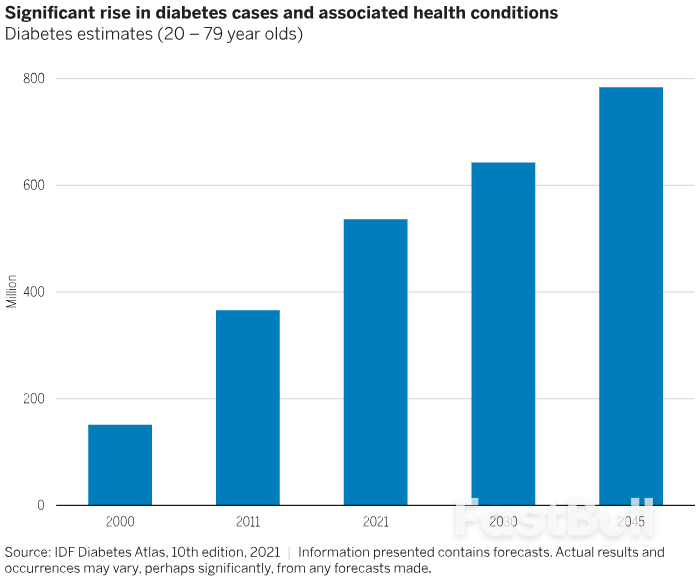
The food sector is undergoing a major transformation, and we see significant opportunities in underappreciated food ingredient companies where the likely ongoing dramatic rise in diabetes cases (Figure 1) should continue to drive innovation and demand.
We’ve invested, for example, in a global leader in low-calorie sweeteners and added fibre — products that support healthier lifestyles and help reduce the risk of diabetes. Over the past five years, this company’s innovations have enabled the removal of 9 million tons of sugar from global diets, which is equivalent to 36 trillion calories. We expect sustained demand for healthier ingredients to drive its ongoing, long-term growth.
Figure 1
In the building materials sector, stricter building regulations and the pressing need for improved energy efficiency and climate-resilient infrastructure are driving significant investment. Between 2021 and 2027, for example, the EU has allocated over €100 billion to various programmes aimed at improving buildings’ energy efficiency.
Through our research, we’ve identified a leading manufacturer of plastic piping systems used in residential, commercial and infrastructure projects. The company also provides ventilation and water infrastructure solutions. We believe it is well-positioned to benefit from a recovery in housebuilding activity and the growing adoption of piping systems for indirect heating — an approach aimed at lowering energy consumption, and one that requires enhanced ventilation.
These examples illustrate the breadth of opportunities we’re seeing in attractively valued European equities with strong structural tailwinds and solid fundamentals. Above all, a long-term mindset is essential. Identifying quality companies that are temporarily out of favour requires the patience to hold them through periods of market dislocation until fundamentals and sentiment align. For investors willing to look through today’s volatility, we believe the rewards of a contrarian, bottom-up approach will be well worth the wait.
728 RM B 7/F GEE LOK IND BLDG NO 34 HUNG TO RD KWUN TONG KLN HONG KONG


White Label
Data API
Web Plug-ins
Poster Maker
Affiliate Program
The risk of loss in trading financial instruments such as stocks, FX, commodities, futures, bonds, ETFs and crypto can be substantial. You may sustain a total loss of the funds that you deposit with your broker. Therefore, you should carefully consider whether such trading is suitable for you in light of your circumstances and financial resources.
No decision to invest should be made without thoroughly conducting due diligence by yourself or consulting with your financial advisors. Our web content might not suit you since we don't know your financial conditions and investment needs. Our financial information might have latency or contain inaccuracy, so you should be fully responsible for any of your trading and investment decisions. The company will not be responsible for your capital loss.
Without getting permission from the website, you are not allowed to copy the website's graphics, texts, or trademarks. Intellectual property rights in the content or data incorporated into this website belong to its providers and exchange merchants.
Not Logged In
Log in to access more features

FastBull Membership
Not yet
Purchase


Log In
Sign Up


