• Trade
  • Markets
  • Copy
  • Contests
  • News
  • 24/7
  • Calendar
  • Q&A
  • Chats
Trending
Screeners
SYMBOL
LAST
BID
ASK
HIGH
LOW
NET CHG.
%CHG.
SPREAD
SPX
S&P 500 Index
6836.35
6836.35
6836.35
6878.28
6827.18
-34.05
-0.50%
--
DJI
Dow Jones Industrial Average
47684.90
47684.90
47684.90
47971.51
47611.93
-270.08
-0.56%
--
IXIC
NASDAQ Composite Index
23509.36
23509.36
23509.36
23698.93
23455.05
-68.75
-0.29%
--
USDX
US Dollar Index
99.030
99.110
99.030
99.160
98.730
+0.080
+ 0.08%
--
EURUSD
Euro / US Dollar
1.16384
1.16391
1.16384
1.16717
1.16162
-0.00042
-0.04%
--
GBPUSD
Pound Sterling / US Dollar
1.33253
1.33263
1.33253
1.33462
1.33053
-0.00059
-0.04%
--
XAUUSD
Gold / US Dollar
4191.66
4192.10
4191.66
4218.85
4175.92
-6.25
-0.15%
--
WTI
Light Sweet Crude Oil
58.636
58.666
58.636
60.084
58.495
-1.173
-1.96%
--

Community Accounts

Signal Accounts
--
Profit Accounts
--
Loss Accounts
--
View More

Become a signal provider

Sell trading signals to earn additional income

View More

Guide to Copy Trading

Get started with ease and confidence

View More

Signal Accounts for Members

All Signal Accounts

Best Return
  • Best Return
  • Best P/L
  • Best MDD
Past 1W
  • Past 1W
  • Past 1M
  • Past 1Y

All Contests

  • All
  • Trump Updates
  • Recommend
  • Stocks
  • Cryptocurrencies
  • Central Banks
  • Featured News
Top News Only
Share

IMF: Review Pakistan Authorities To Draw The Equivalent Of About US$1 Billion

Share

President Trump Is Committed To The Continued Cessation Of Violence And Expects The Governments Of Cambodia And Thailand To Fully Honor Their Commitments To End This Conflict - Senior White House Official

Share

[Water Overflows From Spent Fuel Pool At Japanese Nuclear Facility] According To Japan's Nuclear Waste Management Company, Following A Strong Earthquake Off The Coast Of Aomori Prefecture Late On December 8th, Workers At The Nuclear Waste Treatment Plant In Rokkasho Village, Aomori Prefecture, Discovered "at Least 100 Liters Of Water" On The Ground Around The Spent Fuel Pool During An Inspection. Analysis Suggests This Water "may Have Overflowed Due To The Earthquake's Shaking." However, It Is Reported That The Overflowed Water "remains Inside The Building And Has Not Affected The External Environment."

Share

Trump Says Netflix, Paramount Are Not His Friends As Warner Bros Fight Heats Up

Share

On Monday (December 8), The ICE Dollar Index Rose 0.11% To 99.102 In Late New York Trading, Trading Between 98.794 And 99.227, Following A Significant Rally After The US Stock Market Opened. The Bloomberg Dollar Index Rose 0.12% To 1213.90, Trading Between 1210.34 And 1214.88

Share

Trump: Has Not Spoken To Kushner About Paramount Bid

Share

US President Trump: I Don’t Know Much About Paramount’s Hostile Takeover Bid For Warner Bros. Discovery

Share

Trump: I Want To Do What's Right

Share

Trump On Bids For Warner Bros: I'd Have To See Netflix, Paramount Percentages Of Market

Share

Trump On Vaccines: We Are Looking At A Lot Of Things

Share

Trump: EU Fine On X A “Nasty One”

Share

Trump: I Don't Want To Pay Insurance Companies, They Are Owned By Democrats

Share

Trump: On Healthcare, I Want The Money To Be Paid To The People

Share

US Treasury Secretary Bessenter: We Are Still Working Towards A Trade Agreement With India

Share

US Natural Gas Futures Drop 7% On Less Cold Forecasts, Near-Record Output

Share

[Trump: The US Will Not Experience Deflation] US President Trump Believes That US Inflation Will Decline Slightly Further, But There Will Be No Deflation

Share

Trump: We Will End Up Putting Severe Tariffs On Fertilizer From Canada If We Have To

Share

Bessent: We Are Still Working On India Trade Deal

Share

Brent Crude Futures Settle At $62.49/Bbl, Down $1.26, 1.98 Percent

Share

Trump: Farming Equipment Has Gotten Too Expensive

TIME
ACT
FCST
PREV
France Trade Balance (SA) (Oct)

A:--

F: --

P: --
Euro Zone Employment YoY (SA) (Q3)

A:--

F: --

P: --
Canada Part-Time Employment (SA) (Nov)

A:--

F: --

P: --

Canada Unemployment Rate (SA) (Nov)

A:--

F: --

P: --

Canada Full-time Employment (SA) (Nov)

A:--

F: --

P: --

Canada Labor Force Participation Rate (SA) (Nov)

A:--

F: --

P: --

Canada Employment (SA) (Nov)

A:--

F: --

P: --

U.S. PCE Price Index MoM (Sept)

A:--

F: --

P: --

U.S. Personal Income MoM (Sept)

A:--

F: --

P: --

U.S. Core PCE Price Index MoM (Sept)

A:--

F: --

P: --

U.S. PCE Price Index YoY (SA) (Sept)

A:--

F: --

P: --

U.S. Core PCE Price Index YoY (Sept)

A:--

F: --

P: --

U.S. Personal Outlays MoM (SA) (Sept)

A:--

F: --

P: --
U.S. 5-10 Year-Ahead Inflation Expectations (Dec)

A:--

F: --

P: --

U.S. Real Personal Consumption Expenditures MoM (Sept)

A:--

F: --

P: --
U.S. Weekly Total Rig Count

A:--

F: --

P: --

U.S. Weekly Total Oil Rig Count

A:--

F: --

P: --

U.S. Consumer Credit (SA) (Oct)

A:--

F: --

P: --
China, Mainland Foreign Exchange Reserves (Nov)

A:--

F: --

P: --

Japan Trade Balance (Oct)

A:--

F: --

P: --

Japan Nominal GDP Revised QoQ (Q3)

A:--

F: --

P: --

China, Mainland Imports YoY (CNH) (Nov)

A:--

F: --

P: --

China, Mainland Exports (Nov)

A:--

F: --

P: --

China, Mainland Imports (CNH) (Nov)

A:--

F: --

P: --

China, Mainland Trade Balance (CNH) (Nov)

A:--

F: --

P: --

China, Mainland Exports YoY (USD) (Nov)

A:--

F: --

P: --

China, Mainland Imports YoY (USD) (Nov)

A:--

F: --

P: --

Germany Industrial Output MoM (SA) (Oct)

A:--

F: --

P: --
Euro Zone Sentix Investor Confidence Index (Dec)

A:--

F: --

P: --

Canada National Economic Confidence Index

A:--

F: --

P: --

U.K. BRC Like-For-Like Retail Sales YoY (Nov)

--

F: --

P: --

U.K. BRC Overall Retail Sales YoY (Nov)

--

F: --

P: --

Australia Overnight (Borrowing) Key Rate

--

F: --

P: --

RBA Rate Statement
RBA Press Conference
Germany Exports MoM (SA) (Oct)

--

F: --

P: --

U.S. NFIB Small Business Optimism Index (SA) (Nov)

--

F: --

P: --

Mexico 12-Month Inflation (CPI) (Nov)

--

F: --

P: --

Mexico Core CPI YoY (Nov)

--

F: --

P: --

Mexico PPI YoY (Nov)

--

F: --

P: --

U.S. Weekly Redbook Index YoY

--

F: --

P: --

U.S. JOLTS Job Openings (SA) (Oct)

--

F: --

P: --

China, Mainland M1 Money Supply YoY (Nov)

--

F: --

P: --

China, Mainland M0 Money Supply YoY (Nov)

--

F: --

P: --

China, Mainland M2 Money Supply YoY (Nov)

--

F: --

P: --

U.S. EIA Short-Term Crude Production Forecast For The Year (Dec)

--

F: --

P: --

U.S. EIA Natural Gas Production Forecast For The Next Year (Dec)

--

F: --

P: --

U.S. EIA Short-Term Crude Production Forecast For The Next Year (Dec)

--

F: --

P: --

EIA Monthly Short-Term Energy Outlook
U.S. API Weekly Gasoline Stocks

--

F: --

P: --

U.S. API Weekly Cushing Crude Oil Stocks

--

F: --

P: --

U.S. API Weekly Crude Oil Stocks

--

F: --

P: --

U.S. API Weekly Refined Oil Stocks

--

F: --

P: --

South Korea Unemployment Rate (SA) (Nov)

--

F: --

P: --

Japan Reuters Tankan Non-Manufacturers Index (Dec)

--

F: --

P: --

Japan Reuters Tankan Manufacturers Index (Dec)

--

F: --

P: --

Japan Domestic Enterprise Commodity Price Index MoM (Nov)

--

F: --

P: --

Japan Domestic Enterprise Commodity Price Index YoY (Nov)

--

F: --

P: --

China, Mainland PPI YoY (Nov)

--

F: --

P: --

China, Mainland CPI MoM (Nov)

--

F: --

P: --

Italy Industrial Output YoY (SA) (Oct)

--

F: --

P: --

Q&A with Experts
    • All
    • Chatrooms
    • Groups
    • Friends
    Connecting
    .
    .
    .
    Type here...
    Add Symbol or Code

      No matching data

      All
      Trump Updates
      Recommend
      Stocks
      Cryptocurrencies
      Central Banks
      Featured News
      • All
      • Russia-Ukraine Conflict
      • Middle East Flashpoint
      • All
      • Russia-Ukraine Conflict
      • Middle East Flashpoint
      Search
      Products

      Charts Free Forever

      Chats Q&A with Experts
      Screeners Economic Calendar Data Tools
      Membership Features
      Data Warehouse Market Trends Institutional Data Policy Rates Macro

      Market Trends

      Market Sentiment Order Book Forex Correlations

      Top Indicators

      Charts Free Forever
      Markets

      News

      News Analysis 24/7 Columns Education
      From Institutions From Analysts
      Topics Columnists

      Latest Views

      Latest Views

      Trending Topics

      Top Columnists

      Latest Update

      Signals

      Copy Rankings Latest Signals Become a signal provider AI Rating
      Contests
      Brokers

      Overview Brokers Assessment Rankings Regulators News Claims
      Broker listing Forex Brokers Comparison Tool Live Spread Comparison Scam
      Q&A Complaint Scam Alert Videos Tips to Detect Scam
      More

      Business
      Events
      Careers About Us Advertising Help Center

      White Label

      Data API

      Web Plug-ins

      Affiliate Program

      Awards Institution Evaluation IB Seminar Salon Event Exhibition
      Vietnam Thailand Singapore Dubai
      Fans Party Investment Sharing Session
      FastBull Summit BrokersView Expo
      Recent Searches
        Top Searches
          Markets
          News
          Analysis
          User
          24/7
          Economic Calendar
          Education
          Data
          • Names
          • Latest
          • Prev

          View All

          No data

          Scan to Download

          Faster Charts, Chat Faster!

          Download App
          English
          • English
          • Español
          • العربية
          • Bahasa Indonesia
          • Bahasa Melayu
          • Tiếng Việt
          • ภาษาไทย
          • Français
          • Italiano
          • Türkçe
          • Русский язык
          • 简中
          • 繁中
          Open Account
          Search
          Products
          Charts Free Forever
          Markets
          News
          Signals

          Copy Rankings Latest Signals Become a signal provider AI Rating
          Contests
          Brokers

          Overview Brokers Assessment Rankings Regulators News Claims
          Broker listing Forex Brokers Comparison Tool Live Spread Comparison Scam
          Q&A Complaint Scam Alert Videos Tips to Detect Scam
          More

          Business
          Events
          Careers About Us Advertising Help Center

          White Label

          Data API

          Web Plug-ins

          Affiliate Program

          Awards Institution Evaluation IB Seminar Salon Event Exhibition
          Vietnam Thailand Singapore Dubai
          Fans Party Investment Sharing Session
          FastBull Summit BrokersView Expo

          Oil Hedging Volumes hit new Records as US Producers Rush to Lock in Soaring Prices

          Manuel

          Commodity

          Middle East Situation

          Summary:

          U.S. crude futures jumped 7% on June 13 to around $73 a barrel, after Israel struck Iran, the largest single day rise since July 2022.
          Israel's surprise attack on Iran last week had oil prices spiking which sent U.S. producers scrambling to lock in the price gain, driving record hedging volumes that will help shield them from future price swings.
          West Texas Intermediate crude futures rose further this week, closing on Friday at around $75 a barrel. This prompted U.S. producers to secure additional price gains through 2026, having already driven hedging activity on the Aegis Hedging platform to a record high last Friday.
          Aegis Hedging, which handles hedging for roughly 25-30% of U.S. output, according to internal estimates, saw a record volume and greatest number of trades done on its trading platform on June 13. The U.S. produces some 13.56 million barrels per day of oil, according to the latest government figures.
          U.S. crude futures jumped 7% on June 13 to around $73 a barrel, after Israel struck Iran, the largest single day rise since July 2022.
          Prices had been hovering under where many producers would opt to hedge, hitting a four-year low of $57 a barrel in May as OPEC+ started hiking output while U.S. President Donald Trump waged a trade war. The jump on June 13 gave traders an opportunity to lock in prices for their barrels not seen in several weeks.
          When prices react to risk-related events - such as Israel's attack on Iran - as opposed to supply-and-demand fundamentals, the front of the oil futures curve rises more than later contracts, influencing whether producers opt for short- or long-term hedging strategies, according to Aegis Hedging.
          "In this case it was probably a six-month effect," said Matt Marshall, president of Aegis Hedging.
          Oil producers need a price of $65 a barrel on average to profitably drill, according to the first quarter 2025 Dallas Federal Reserve Survey. U.S. crude futures closed below $65 every day from April 4 to June 9, according to LSEG.
          "We stay disciplined and pay close attention to market volatility. We watch for accretive pricing to our existing hedges and layer in hedges to reduce risk to our asset revenue as well as meet our reserve-based lending covenants," said Rhett Bennett, chief executive at Black Mountain Energy, a producer with operations in the Permian Basin.
          A reserve-based lending covenant refers to a type of loan producers can obtain, based on the value of the company's oil and gas reserves.
          "Producers recognized that this could be a fleeting issue and so they saw a price that was above their budget for the first time in a few months, and instead of doing a structure that would give them a floor which is below market, they opted to be aggressive and lock in," said Aegis' Marshall.
          Aegis' customers often have hedging policies in which a certain amount of production must be hedged by a certain time in the year.
          "Producers had two months of hedges that they needed to catch up on," Aegis' Marshall said.
          Traders on June 13 exchanged the most $80 West Texas Intermediate crude oil call options since January on the Chicago Mercantile Exchange, expecting more upside to prices.
          A total of 33,411 contracts of August-2025 $80 call options for WTI crude oil were traded that day on a total trading volume of 681,000 contracts, marking the highest volume for these options this year, according to CME Group data.

          Source: Reuters

          Risk Warnings and Disclaimers
          You understand and acknowledge that there is a high degree of risk involved in trading. Following any strategies or investment methods may lead to potential losses. The content on the site is provided by our contributors and analysts for information purposes only. You are solely responsible for determining whether any trading assets, securities, strategy, or any other product is suitable for investing based on your own investment objectives and financial situation.
          Add to Favorites
          Share

          Household Wealth Fell for The First Time In 2 Years. Here's Why It Will Bounce Back

          Manuel

          Economic

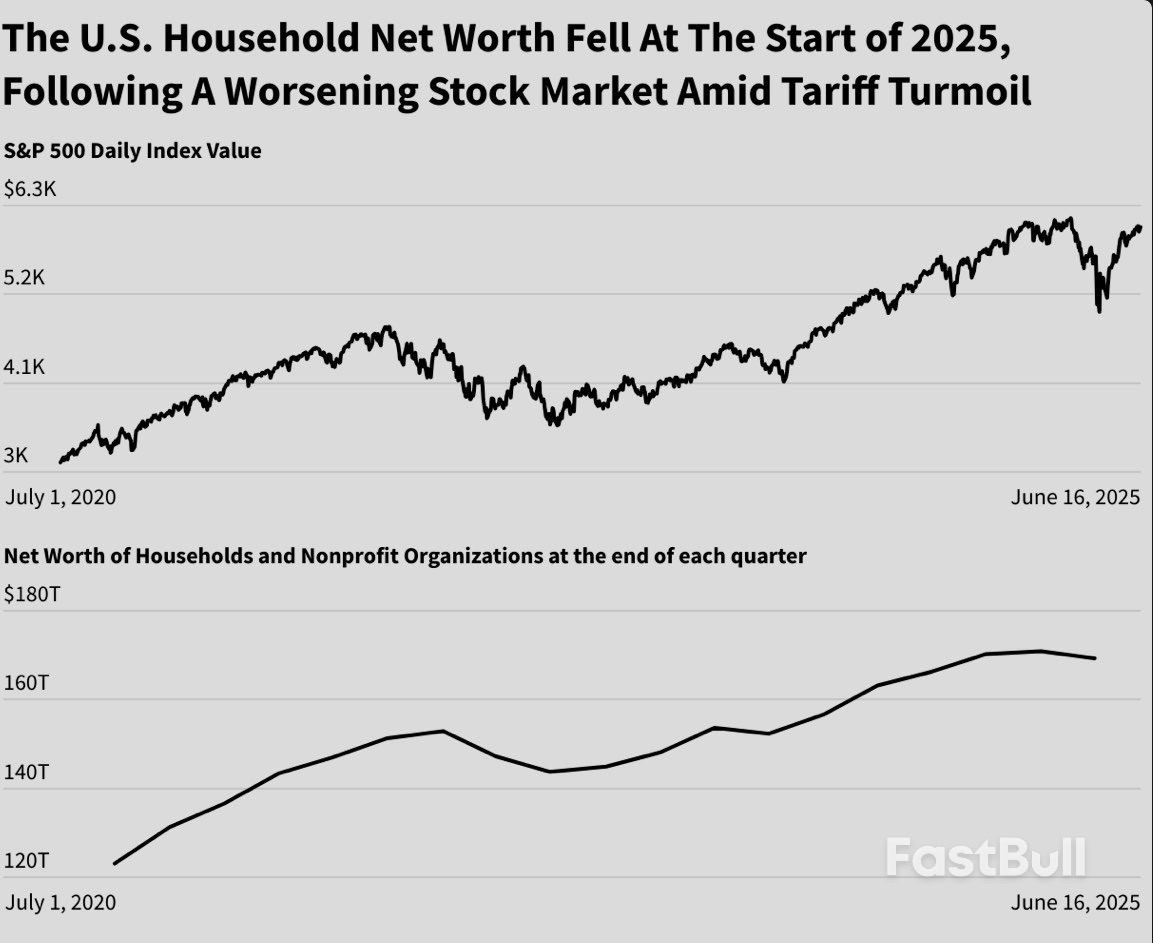
          After stocks fell sharply earlier this year as new tariffs were rolled out, the average American households' net worth fell for the first time in almost two years. Many, but not all of them, are expected to bounce back as the worst of the tariffs have been paused or rolled back.
          The Federal Reserve said last week that household net worthdecreased to $169.3 trillion in the first quarter of 2025. That's a $1.6 trillion drop, and the first decline since the second quarter of 2023. Household net worth was at a record high in 2024's fourth quarter.Household Wealth Fell for The First Time In 2 Years. Here's Why It Will Bounce Back_1
          The majority of this decline is likely attributed to the drop in stock values after President Donald Trump's tariff announcements worried investors and consumers. The S&P 500, a key indicator of how well American companies and their stocks are doing, fell by almost 20% from February to April.
          However, after Trump pulled back or temporarily paused the most extreme tariffs, the S&P bounced back and now stands only 1.5% below its peak in February.
          The market's recovery should help the roughly 60% of households that hold stocks recover a portion of their net worth in the second quarter, said Priscilla Thiagamoorthy, senior economist at BMO Bank.
          However, Thiagamoorthy said lower- and middle-income households are less likely to see a significant gain in their net worth as the stock market improves.
          "Lower- and middle-income families have far less invested in the stock market compared to the ultra wealthy," Thiagamoorthy said. "Higher stock values push up net worth, but these households aren’t experiencing that wealth effect in the same way."
          Additionally, Thiagamoorthy said lower- and middle-income households still feel pinched by food inflation, which remains relatively high, since they typically spend a larger share of their income on groceries.

          Source: Investopedia

          To stay updated on all economic events of today, please check out our Economic calendar
          Risk Warnings and Disclaimers
          You understand and acknowledge that there is a high degree of risk involved in trading. Following any strategies or investment methods may lead to potential losses. The content on the site is provided by our contributors and analysts for information purposes only. You are solely responsible for determining whether any trading assets, securities, strategy, or any other product is suitable for investing based on your own investment objectives and financial situation.
          Add to Favorites
          Share

          5 Stocks to Anchor Your Portfolio Amid Escalating US-Israel-Iran Tensions

          Adam

          Stocks

          Middle East Situation

          As tensions between the U.S., Iran, and Israel escalate, investors are bracing for potential market ripple effects. Historical data shows Middle East conflicts often trigger short-term S&P 500 pullbacks of roughly ~6%, though markets typically recover within weeks unless oil supplies are severely disrupted.
          5 Stocks to Anchor Your Portfolio Amid Escalating US-Israel-Iran Tensions_1
          While armed conflict inflicts devastating human and economic costs, certain industries historically capitalize on geopolitical instability. Based on market trends and insights from recent Israel-Iran tensions, here are five stocks that could see gains in the event of a US-Iran-Israel war, along with the factors driving their potential.
          Lockheed Martin
          Sector: Defense & Aerospace (Fighter Jets, Missile Defense Systems)
          Catalyst: Surge in military demand for missiles, drones, and fighter jets.
          Why It Benefits:
          Israel relies heavily on US-made defense systems like Lockheed’s (NYSE:LMT) THAAD missile interceptors to counter Iranian ballistic missiles as well as F-35 jets.
          Pentagon spending could spike further amid broader regional instability.
          It is worth noting that the InvestingPro Fair Value price target sits at $520.75, implying a potential +11.1% upside, with the high end of Wall Street estimates at around $528.
          Chevron
          Sector: Energy
          Catalyst: Oil supply disruptions in the Strait of Hormuz.
          Why It Benefits:
          Iran has threatened to block the Strait, through which 20% of global oil passes. A US-Iran-Israel war threatening Middle East oil routes could push Brent crude above $90-$100/barrel.
          Chevron’s (NYSE:CVX) diversified global operations (including Israel’s Leviathan gas field) would profit from higher oil and gas prices.
          With a Fair Value of $187.57, CVX stock presents a sizable upside potential of +26.6% from its current price of $148.19.
          Palantir
          Sector: Cybersecurity/Data Analytics
          Catalyst: Demand for AI-driven defense and surveillance tools.
          Why It Benefits:
          Israeli and US agencies use Palantir’s (NASDAQ:PLTR) AI platforms for intelligence, targeting, and disaster response.
          Recent $178M Pentagon contract highlights its role in modern warfare.
          Palantir’s InvestingPro Financial Health score stands at a “GREAT” level—one of the highest possible tiers. This score reflects the company’s robust profit margins, strong cash position, and accelerating revenue growth.
          RTX
          Sector: Defense & Aerospace (Missiles, Radar, Air Defense Systems)
          Catalyst: Surge in demand for advanced missile defense systems and radar technology amid heightened aerial threats.
          Why It Benefits:
          Raytheon’s portfolio includes the Iron Dome system, co-developed with Israel, which has proven critical in defending against drones and ballistic missiles fired from Iran.
          Rtx Corp’s (NYSE:RTX) Tomahawk cruise missiles and AN/TPY-2 radar systems are critical for precision strikes and detecting threats like Iranian proxies’ rocket attacks.
          RTX earns a “GOOD” InvestingPro Financial Health label, with a 2.54 score. The stock last closed at $145.87, sitting near its 52-week high—a testament to strong recent momentum.
          Barrick Mining
          Sector: Precious Metals
          Catalyst: Flight to safe-haven assets.
          Why It Benefits:
          Gold prices historically rise during geopolitical crises (e.g., +15% after the Russia-Ukraine war).
          Barrick Mining (NYSE:B), one of the world’s largest gold miners, offers direct exposure to price surges.
          Barrick Mining stands out with a robust InvestingPro Financial Health score of 3.28 and a “GREAT” rating—well above the sector average. Its Fair Value price target of $27.15 implies +28.5% upside potential.
          Conclusion
          These five stocks highlight the diverse ways in which geopolitical events can shape investment opportunities, though investors should remain mindful of the broader risks and volatility that accompany such scenarios. As tensions in the Middle East unfold, keeping a close eye on these names could provide a strategic edge in navigating uncertain markets.
          Whether you’re a novice investor or a seasoned trader, leveraging InvestingPro can unlock a world of investment opportunities while minimizing risks amid the challenging market backdrop.

          Source: investing

          Risk Warnings and Disclaimers
          You understand and acknowledge that there is a high degree of risk involved in trading. Following any strategies or investment methods may lead to potential losses. The content on the site is provided by our contributors and analysts for information purposes only. You are solely responsible for determining whether any trading assets, securities, strategy, or any other product is suitable for investing based on your own investment objectives and financial situation.
          Add to Favorites
          Share

          Waller Says Fed Could Cut Interest Rates as Soon as July

          Manuel

          Central Bank

          Economic

          Federal Reserve Governor Christopher Waller said the central bank can lower interest rates as soon as next month, reiterating his view that the inflation hit from tariffs is likely to be short-lived.
          “We could do this as early as July,” Waller said Friday in an interview on CNBC. The Federal Open Market Committee next meets July 29-30 in Washington.
          Waller said economic data show GDP growth and inflation are running close to the central bank’s targets. He also said he believes the Fed’s benchmark rate is 1.25 to 1.5 percentage points above the estimated neutral level, at which it would neither slow nor stimulate the economy.
          “I think we’ve got room to bring it down, and then we can kind of see what happens with inflation,” he said, adding the central bank could pause cuts if needed due to a shock from events, such as the crisis in the Middle East. “We’ve been on pause for six months to wait and see, and so far the data has been fine.”
          Waller’s comments follow the decision by Fed policymakers on Wednesday to keep interest rates on hold for the fourth straight policy meeting. Fed Chair Jerome Powell said officials are bracing for the price hit from President Trump’s tariffs and want to see some of that play out before they lower rates.
          Officials also continued to signal their expectation for two rate cuts before the end of 2025, according to their median projection. But seven policymakers signaled they expect no cuts this year, pointing to an apparent split in the committee.

          No Cheap Financing

          Trump has repeatedly called on the Fed to lower interest rates, focusing his recent comments on how that could reduce debt servicing costs for the government. Treasury figures show the government shelled out some $776 billion in interest expenses on the federal debt over the past eight months.
          The tally, which now well outstrips the amount spent on defense, reflects both the much higher size of outstanding debt and the impact of higher interest rates from the Fed’s battle with inflation.
          “I would like to get this guy to lower interest rates, because if he doesn’t, we have to pay,” Trump said during a June 12 White House event, referring to Powell.
          Asked whether the Fed should be cutting rates to lower borrowing costs for the federal government, Waller said that was not part of the central bank’s mandate.
          “Our mandate from Congress tells us to worry about unemployment and price stability,” Waller said. “It does not tell us to provide cheap financing to the US government.”

          No Rush

          Richmond Fed President Tom Barkin, in an interview with Reuters published Friday, said he saw no rush to cut interest rates given the risk that tariffs might raise inflation while the US job market and consumer spending continue to hold up.
          Barkin said the jobless rate remains low and companies don’t appear to be on the verge of major layoffs.

          Source: Bloomberg

          To stay updated on all economic events of today, please check out our Economic calendar
          Risk Warnings and Disclaimers
          You understand and acknowledge that there is a high degree of risk involved in trading. Following any strategies or investment methods may lead to potential losses. The content on the site is provided by our contributors and analysts for information purposes only. You are solely responsible for determining whether any trading assets, securities, strategy, or any other product is suitable for investing based on your own investment objectives and financial situation.
          Add to Favorites
          Share

          Goldman and Citi See Europe’s Economy Powering Stock Rally

          Adam

          Stocks

          The perils of trade and geopolitics will only slow the rally in European stocks rather than derail it, according to Wall Street strategists.
          The Stoxx Europe 600 Index is expected to end the year around 557 points, according to the average of 19 strategists polled by Bloomberg. That implies a further 3% advance from Wednesday’s close, handing investors annual returns of about 10%.
          Europe’s loosening monetary policy and increased government spending are forecast to give the region’s stocks the impetus they need to overcome risks from tariffs and rising international tensions.
          “Equity markets have been remarkably resilient, despite many risks,” said Citigroup Inc. strategist Beata Manthey. She noted that global equity market valuations reflected relatively average levels of geo-economic risk in the lead up to the Israel-Iran conflict. “This could be worrisome from a short-term perspective, but over the longer term we see many structural tailwinds to support European equities.”
          European stocks have posted moderate moves since mid-May, following a V-shaped recovery that erased all the losses triggered by the US tariff announcements of early April. Recent weeks have proved more volatile, as Middle East tensions intensified and pushed oil prices higher. The Stoxx Europe 600 is down 1.5% this month, with energy shares and utilities the only sectors in the green.
          “Many investors we are speaking with are awaiting the end of the truce on US tariffs on July 9 to gain better visibility,” said Societe Generale SA strategist Roland Kaloyan. “Looking ahead, we anticipate that the European equity market will remain within a trading range.”
          Most strategists have had to chase the rally in Europe as the outlook brightened, updating the cautious price targets they drew up in January. Challenges to so-called US exceptionalism in stocks, Europe’s improving economic prospects, as well as a wide interest-rate differential have fueled bets on the region.
          This is also evident in other asset classes. The euro is gaining prominence in the global currency options market as traders avoid the dollar due to unpredictable US policy and global trade war risks. Trading volumes show 15% to 30% of contracts tied to the dollar versus major currencies being switched to the euro which is increasingly being used as a haven and for bets on big moves.
          Meanwhile, Bank of America Corp. strategists led by Sebastian Raedler raised their target for the European equity benchmark on Friday, after the survey was published. They now see the Stoxx Europe 600 reaching 530 points by year-end. The strategists remain relatively negative, but now anticipate a more modest decline, citing better prospects for global PMIs from the partial US-China trade truce.
          The positive sentiment is also evident among investors. BofA’s own fund manager survey conducted this month before Middle East tensions escalated showed that a net 34% of European investors expect stocks in the region to rise in the coming months. While that’s broadly unchanged from May, the net proportion expecting gains in the next 12 months has rebounded to the February high of 75%.
          On a relative basis, asset allocators are increasingly bullish on Europe. A net 34% of portfolio managers in the BofA survey said they are overweight European equities against their funds’ benchmark levels — close to a four-year high. A net 36% said they are underweight US equities, nearly the most in two years.
          While investors haven’t lost sight of the risks posed by trade tariffs, they are growing more optimistic about the economy, which will feed into corporate profits, the survey showed.
          “Our view is that the diversification theme has further to go,” said Goldman Sachs Group Inc. partner and chief global equity strategist Peter Oppenheimer, adding the weakening dollar favors European assets. “In total returns, European stocks offer quite a compelling story for investors, especially given their starting point of having very concentrated portfolios, particularly in US equities.”
          European stocks have outperformed US peers this year, but the gap is narrowing. Renewed appetite for American tech megacaps, potential tax cuts and optimism about trade negotiations helped the S&P 500 erase its losses for 2025 last month.
          Still, for Deutsche Bank AG strategists led by Maximilian Uleer, who’ve been consistently bullish on the outlook for the Stoxx 600, tariffs will be a bigger burden for US companies than their European peers. Earnings momentum and valuations are more favorable in Europe, while political uncertainty remains more of a problem, they said. The outlook for fiscal policy and interest rates also favors Europe, while a potential ceasefire between Ukraine and Russia would be an additional boost.
          “Once we have more clarity on US tariffs, the One Big Beautiful Bill, the German budget and fiscal package, as well as NATO spending, markets could start moving higher again in late summer,” the Deutsche Bank team said. “In the medium-term, European equities could start outperforming US equities again.”

          Bloomberg : source

          Risk Warnings and Disclaimers
          You understand and acknowledge that there is a high degree of risk involved in trading. Following any strategies or investment methods may lead to potential losses. The content on the site is provided by our contributors and analysts for information purposes only. You are solely responsible for determining whether any trading assets, securities, strategy, or any other product is suitable for investing based on your own investment objectives and financial situation.
          Add to Favorites
          Share

          Is The Dollar's Death Greatly Exaggerated?

          Thomas

          Economic

          Forex

          The narrative surrounding the “dollar’s death” as the world’s reserve currency has been on the rise recently. However, this happens whenever the dollar declines relative to other currencies. We previously wrote about the false claims of the “dollar’s death” in 2023 (see here, here, and here). The recent decline in the dollar relative to other currencies is well within historical norms. Notably, previous declines were much larger without the “fear-mongering” from the “experts of doom.”
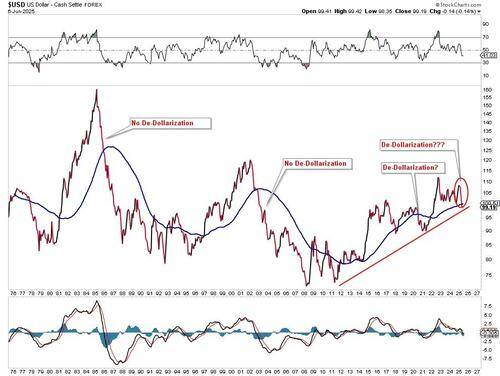
          The “dollar’s death” frequently appears in financial discussions. Of course, that is often when geopolitical tensions, economic disruption, or market fluctuations are on the rise. Yes, there are valid concerns about the U.S. dollar’s long-term dominance. However, the notion that the dollar’s death is imminent, leading to a catastrophic economic collapse, is vastly overstated. The dollar remains the cornerstone of global finance due to structural, economic, and geopolitical factors unlikely to shift abruptly. Below, I outline five reasons why the dollar’s death narrative is exaggerated.

          Five Reasons the Dollar’s Death Narrative Is Overstated

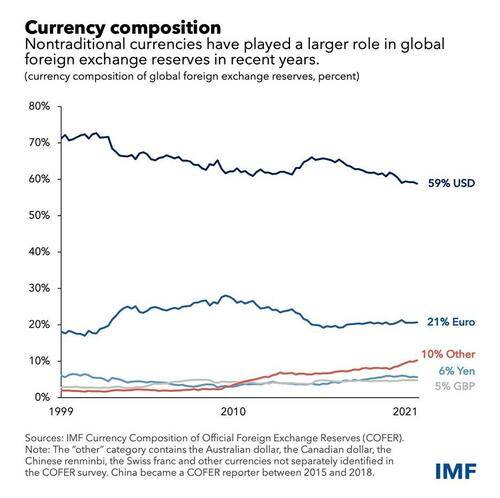
          1. Lack of a Viable Alternative Currency – The dollar’s reserve status persists because no credible rival exists. The euro, holding 20% of global reserves compared to the dollar’s ~58% (IMF, Q2 2024), is constrained by the eurozone’s fragmented bond markets and political volatility. Despite increasing use (2–3% of reserves), China’s renminbi is limited by capital controls and restricted convertibility, rendering it unfit for global reserve status. Other currencies, such as the Japanese yen (6%) or smaller ones like the Canadian or Australian dollar, lack the economic scale or liquidity to challenge the dollar. Without a currency matching the dollar’s deep, liquid markets and global trust, the dollar’s death remains improbable in the near term.

          2. Strength of the U.S. Economy – The U.S. economy, accounting for 26% of global GDP, anchors the dollar’s dominance. Its large, dynamic economy, supported by the rule of law and robust capital markets, positions the dollar as a haven, particularly during global instability. While critics highlight rising U.S. debt ($35 trillion, ~120% of GDP), the dollar’s reserve status enables borrowing at lower rates, sustaining deficits without immediate crisis. Compared to other economies—Japan’s slow growth, China’s restricted markets, or Europe’s fragmentation—the U.S. offers stability, making the dollar’s death unlikely in the foreseeable future.

          3. Network Effects and Global Financial Inertia – Network effects perpetuate the dollar’s dominance: its widespread use enhances its value. It constitutes ~88% of global foreign exchange transactions (SWIFT data) and ~60% of international debt and trade invoicing. Transitioning to another currency would demand extensive coordination among central banks, governments, and markets, incurring significant costs and risks. Historical currency transitions, such as from the pound to the dollar, spanned decades and required major geopolitical shifts, which are absent today. This inertia renders the dollar’s death a distant prospect.

          4. Limited Scope of De-Dollarization Efforts – Although countries like China, Russia, and BRICS nations advocate for trade in local currencies (e.g., China’s renminbi in 56% of its bilateral trade), these efforts have limited global impact. The dollar’s share of reserves has dipped gradually (from 67% to 58% over two decades). However, this reflects diversification, not the dollar’s death, often into allied currencies like the Canadian or Australian dollar. China holds ~$2 trillion in dollar-denominated assets, underscoring its reliance. Geopolitical moves, such as Russia’s shift to gold or renminbi, are constrained by the small scale of non-dollar systems (e.g., China’s CIPS vs. SWIFT). These fragmented efforts fall short of triggering the dollar’s death.

          5. Resilience Amid Policy Challenges – Critics argue that U.S. policies—like tariffs, sanctions, or Federal Reserve actions—undermine confidence in the dollar. For instance, Trump’s tariffs in 2025 caused a ~9% dollar decline, fueling dollar death fears. However, economists note such fluctuations are cyclical, not structural, with the dollar still robust compared to its 2011–2022 peak (up ~40% against a currency basket). Sanctions, such as those on Russia in 2022, have not significantly reduced global dollar holdings, as most reserve currencies are held by U.S. allies who joined sanctions. The Federal Reserve’s swap lines and liquidity support further reinforce the dollar’s role in crises.

          As shown, the dollar dominates the composition of global currency transactions.
          However, there is a reason that the recent dollar decline could be nearing its end.

          Why The Dollar Could Rally Strongly

          This isn’t the first time the “dollar’s death” has made the news. In 2022, “de-dollarization” narratives filled the bearish narratives, with everyone saying the dollar’s death was imminent. Yet, that “frenzy of doom” marked the bottom of the dollar before a robust rally. We could be setting up for another similar rally for two reasons.

          First, from the technical perspective, the dollar selloff has become rather extreme. Using weekly data, the dollar is now oversold on a momentum basis as it was in early 2021 and late 2018. These previous oversold conditions set the dollar up for a strong counter-trend rally.
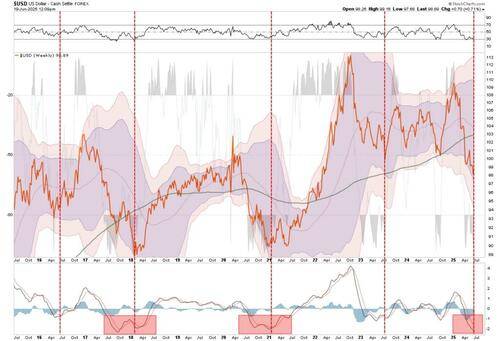
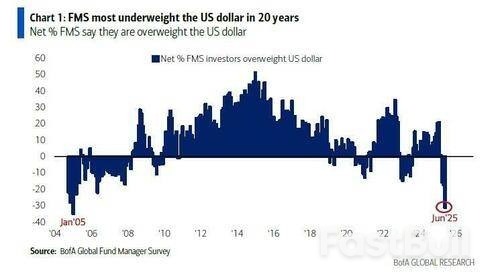
          Furthermore, everyone from the “shoe-shine boy to the street corner vendor” is shorting the dollar. According to BofA’s fund manager survey, the short position against the US Dollar is at the highest level in 20 years. As such, any reversal in the dollar could be substantial if those “shorts” are forced to reverse their positions.
          The question is, what must change for a dollar price reversal currently? That brings us to the second reason the dollar could rally: the ECB’s rate cuts.

          As the reserve currency, foreign sovereign nations hold reserves in U.S. dollars to facilitate trade. If the dollar is too weak or strong relative to another currency, it can negatively impact that nation’s economy. Therefore, when the dollar drifts too far from another currency, that country can intervene to stabilize its currency. That intervention is achieved by increasing or decreasing U.S. dollar reserves. It can do this by buying or selling U.S. Treasuries, gold, or other dollar-denominated assets. In the majority of cases, it is either U.S. treasuries or gold.

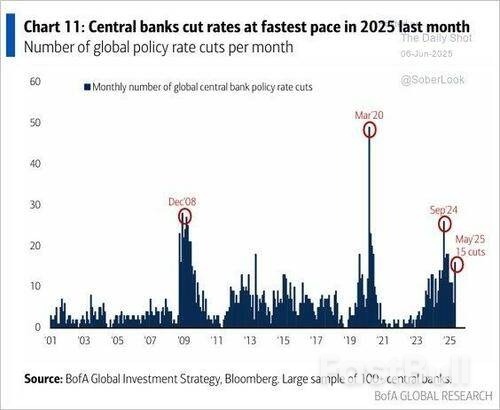
          The ECB has been aggressively cutting rates, eight times in this recent cycle, while the U.S. Federal Reserve remains on hold. The result is a divergence that is developing between U.S. Treasury bond yields and, for example, the German Bund.
          There are three primary reasons this is crucial for investors to understand.

          1. Higher Yields Attract Capital Inflows – Historically, rising U.S. Treasury yields draw foreign investment due to higher returns compared to other major economies’ bonds. For instance, 10-year Treasury yields surged from 3.65% in September 2024 to 4.8% by early 2025. However, European bond yields (e.g., German 10-year Bunds) remain lower due to ECB easing. This yield differential incentivizes foreign investors, including central banks and institutional investors, to buy Treasuries. That buying increases dollar demand and supports appreciation.

          2. Treasuries as a Preferred Store of Foreign Reserves – As noted above, U.S. Treasuries are the backbone of global foreign exchange reserves. Higher yields offer reserve managers better returns without sacrificing safety, unlike riskier assets like equities or emerging market bonds. For example, foreign demand for Treasuries has remained stable despite ECB rate cuts. This sustained demand supports the dollar, as central banks must buy dollars to purchase Treasuries, reinforcing its status as a reserve currency.

          3. Dollar Appreciation Driven by Yield Differentials – The divergence in monetary policy—ECB’s dovish stance versus the Fed’s pause after 100 basis points of cuts in late 2024—has widened the interest rate gap, favoring the dollar. Higher U.S. yields, particularly on 10-year Treasuries (4.4–4.8% in early 2025), contrast with lower European yields, which could drive capital flows to the U.S. The demand for yield aligns with historical patterns where higher U.S. rates bolster the DXY, as seen during the 2016 post-election period when fiscal optimism pushed yields and the dollar higher. Despite tariff-related volatility, the dollar’s recent appreciation suggests that yield differentials are a key support.

          The critical point is that this would be an attractive set-up for sovereign governments, wealth funds, and foreign investors. As foreign inflows are initially used to capture higher bond yields, investors also receive a double benefit of currency gains and higher bond prices (lower yields).

          However, the dollar’s death narrative persists due to recent decoupling trends. Yields rose as the dollar weakened in early 2025, driven by fiscal concerns and tariff uncertainty. These recent concerns will pass, but the dollar’s role as a reserve currency for world trade will not.

          Addressing the Dollar’s Death Narrative and Economic Implications

          The dollar’s death narrative often arises from concerns about U.S. debt, inflation, tariffs, or the geopolitical use as a weapon of the dollar (e.g., sanctions). These risks exist, but overstate their near-term impact. Losing reserve status could elevate U.S. borrowing costs, drive inflation through pricier imports, and diminish geopolitical influence. Still, the U.S. economy’s scale, military strength, and institutional stability make the dollar’s death improbable without a seismic global event (e.g., the loss of a major war as witnessed in the Weimar Republic). Despite a gradual decline, the dollar would likely remain a leading currency alongside others and would not vanish entirely.

          This narrative is often amplified on platforms and media outlets that depend on “bearish narratives” to get clicks and views. While some posts exaggerate the “dollar’s death” to promote alternatives like gold or cryptocurrencies, these narratives are often misleading. Economists like Barry Eichengreen and Morgan Stanley’s James Lord contend that the dollar’s death is “greatly exaggerated,” citing its entrenched role and the absence of viable alternatives, as discussed above. Sure, the U.S. economy could face challenges from a weaker dollar, but a devastating collapse is unlikely due to its adaptability and global financial integration.

          Most notably, as discussed in “Narratives Change, Markets Don’t,” it is essential to look past narratives to avoid the emotional biases that impact our investing outcomes. To wit:

          “The need for a narrative is deeply rooted in our psychology. As pattern-seeking creatures, we crave coherence and predictability. Chaos triggers anxiety. It feels dangerous, uncontrollable, and unsettling. In investing, this anxiety is magnified by the direct impact on our wealth and financial security. We regain a semblance of control by latching onto the narrative, no matter how tenuous. The narrative tells us why things are happening and what might happen next, which soothes our natural fear of uncertainty.”

          Humans are hardwired to prioritize negative information over optimistic information. From an evolutionary perspective, this bias was essential. Our ancestors learned to recognize threats (like predators) to survive.

          This instinct, known as “negativity bias,” influences how we process information, including financial news and market narratives. Such is why “bearish” leaning podcasts and articles generate the most clicks and views.

          • Fear Is a Stronger Motivator Than Greed – While the hope of making money drives investors, the fear of losing money is more powerful.

          • Bearish Narratives Seem More “Rational” – Pessimism often feels safer and more cautious. During volatile markets, a bearish forecast can sound more analytical and responsible.

          • Media Amplifies Negative Headlines – News outlets know that fear sells. Sensational headlines like “MARKETS IN TURMOIL” or “CRASH COMING?” generate clicks and engagement.

          • Herd Behavior and Echo Chambers – Investors flock to bearish opinions for validation when markets are shaky. If others are cautious or fearful, this reinforces the idea that a downturn is imminent. This is the case even if the underlying fundamentals remain sound. Social media and financial news create echo chambers that amplify these fears.

          Most importantly to investors, the market absorbs all negative media narratives over the long term. The recent barrage of narratives surrounding debts, deficits, tariffs, and the “dollar’s death” feeds your negative bias. However, zooming out, investors who have stayed away from investing in the financial markets to “avoid the loss” of potential adverse outcomes have paid a dear price in reduced financial wealth.

          In other words, there is always a “reason” not to invest. However, the current narrative will change, but the market won’t.

          Source: Zero Hedge

          To stay updated on all economic events of today, please check out our Economic calendar
          Risk Warnings and Disclaimers
          You understand and acknowledge that there is a high degree of risk involved in trading. Following any strategies or investment methods may lead to potential losses. The content on the site is provided by our contributors and analysts for information purposes only. You are solely responsible for determining whether any trading assets, securities, strategy, or any other product is suitable for investing based on your own investment objectives and financial situation.
          Add to Favorites
          Share

          Fed Governor Waller Hints at July Rate Cut Despite Internal Divisions

          Gerik

          Economic

          Waller Pushes for Early Easing Amid Mild Inflation Concerns

          In a CNBC interview, Fed Governor Christopher Waller expressed confidence that monetary policy could begin loosening “as soon as July,” stating that current inflation dynamics do not justify further restraint. He downplayed the inflationary impact of President Donald Trump's proposed tariffs, asserting they are unlikely to meaningfully drive prices higher in the short term. Waller’s proactive stance centers on maintaining labor market resilience and avoiding economic slowdown.
          This comes shortly after the Fed's June FOMC meeting, where officials unanimously voted to hold the federal funds rate steady at 4.25%–4.5%, marking the fourth consecutive pause since the last rate cut in December 2024.

          Internal Fed Views Remain Divided

          Despite Waller’s personal call for a July cut, not all Fed officials agree. Mary Daly, President of the San Francisco Fed, expressed a more cautious view, suggesting autumn as a more suitable time to begin easing, citing the need for further data. Daly, who is not a voting member in 2025, emphasized that unless the labor market shows clear signs of deterioration, the Fed should wait.
          The Fed’s updated dot plot reveals deep division among its 19 members:
          7 members anticipate no rate cuts in 2025,
          2 project only one cut, and
          10 expect two or more cuts this year.
          This fragmentation underscores the uncertainty around the economic outlook, especially given conflicting signals from inflation and employment metrics.

          Tariff Impact Still an Open Question

          A central point of concern remains the long-term impact of Trump’s tariffs, particularly their effects on inflation and supply chains. While Waller sees minimal inflationary risk, others—like Fed Chair Jerome Powell—remain cautious. Powell reiterated a “wait and see” stance, noting that the labor market is still relatively solid, which justifies patience.
          Despite Waller’s comments, futures markets remain skeptical of a July cut. According to CME Group’s FedWatch Tool, traders assign nearly a 0% probability to a July rate cut, instead betting on September as the more likely timeline.
          U.S. equity futures edged higher following Waller’s dovish remarks, reflecting investor optimism about future monetary easing, but broader market pricing remains aligned with Powell’s slower, data-dependent approach.
          While Governor Waller’s remarks inject a sense of urgency into the rate cut debate, the Federal Reserve is clearly grappling with internal disagreement and external uncertainty. With economic data offering mixed signals and inflation still hovering above the 2% target, the likelihood of a July rate cut remains low barring a rapid deterioration in job market conditions. September appears to be the more probable turning point, assuming inflation remains subdued and growth continues to moderate.

          Source: CNBC

          To stay updated on all economic events of today, please check out our Economic calendar
          Risk Warnings and Disclaimers
          You understand and acknowledge that there is a high degree of risk involved in trading. Following any strategies or investment methods may lead to potential losses. The content on the site is provided by our contributors and analysts for information purposes only. You are solely responsible for determining whether any trading assets, securities, strategy, or any other product is suitable for investing based on your own investment objectives and financial situation.
          Add to Favorites
          Share
          FastBull
          Copyright © 2025 FastBull Ltd

          728 RM B 7/F GEE LOK IND BLDG NO 34 HUNG TO RD KWUN TONG KLN HONG KONG

          TelegramInstagramTwitterfacebooklinkedin
          App Store Google Play Google Play
          Products
          Charts

          Chats

          Q&A with Experts
          Screeners
          Economic Calendar
          Data
          Tools
          Membership
          Features
          Function
          Markets
          Copy Trading
          Latest Signals
          Contests
          News
          Analysis
          24/7
          Columns
          Education
          Company
          Careers
          About Us
          Contact Us
          Advertising
          Help Center
          Feedback
          User Agreement
          Privacy Policy
          Business

          White Label

          Data API

          Web Plug-ins

          Poster Maker

          Affiliate Program

          Risk Disclosure

          The risk of loss in trading financial instruments such as stocks, FX, commodities, futures, bonds, ETFs and crypto can be substantial. You may sustain a total loss of the funds that you deposit with your broker. Therefore, you should carefully consider whether such trading is suitable for you in light of your circumstances and financial resources.

          No decision to invest should be made without thoroughly conducting due diligence by yourself or consulting with your financial advisors. Our web content might not suit you since we don't know your financial conditions and investment needs. Our financial information might have latency or contain inaccuracy, so you should be fully responsible for any of your trading and investment decisions. The company will not be responsible for your capital loss.

          Without getting permission from the website, you are not allowed to copy the website's graphics, texts, or trademarks. Intellectual property rights in the content or data incorporated into this website belong to its providers and exchange merchants.

          Not Logged In

          Log in to access more features

          FastBull Membership

          Not yet

          Purchase

          Become a signal provider
          Help Center
          Customer Service
          Dark Mode
          Price Up/Down Colors

          Log In

          Sign Up

          Position
          Layout
          Fullscreen
          Default to Chart
          The chart page opens by default when you visit fastbull.com
