• Trade
  • Markets
  • Copy
  • Contests
  • News
  • 24/7
  • Calendar
  • Q&A
  • Chats
Trending
Screeners
SYMBOL
LAST
BID
ASK
HIGH
LOW
NET CHG.
%CHG.
SPREAD
SPX
S&P 500 Index
6857.13
6857.13
6857.13
6865.94
6827.13
+7.41
+ 0.11%
--
DJI
Dow Jones Industrial Average
47850.93
47850.93
47850.93
48049.72
47692.96
-31.96
-0.07%
--
IXIC
NASDAQ Composite Index
23505.13
23505.13
23505.13
23528.53
23372.33
+51.04
+ 0.22%
--
USDX
US Dollar Index
98.850
98.930
98.850
98.980
98.740
-0.130
-0.13%
--
EURUSD
Euro / US Dollar
1.16588
1.16596
1.16588
1.16715
1.16408
+0.00143
+ 0.12%
--
GBPUSD
Pound Sterling / US Dollar
1.33523
1.33532
1.33523
1.33622
1.33165
+0.00252
+ 0.19%
--
XAUUSD
Gold / US Dollar
4224.23
4224.57
4224.23
4230.62
4194.54
+17.06
+ 0.41%
--
WTI
Light Sweet Crude Oil
59.334
59.364
59.334
59.480
59.187
-0.049
-0.08%
--

Community Accounts

Signal Accounts
--
Profit Accounts
--
Loss Accounts
--
View More

Become a signal provider

Sell trading signals to earn additional income

View More

Guide to Copy Trading

Get started with ease and confidence

View More

Signal Accounts for Members

All Signal Accounts

Best Return
  • Best Return
  • Best P/L
  • Best MDD
Past 1W
  • Past 1W
  • Past 1M
  • Past 1Y

All Contests

  • All
  • Trump Updates
  • Recommend
  • Stocks
  • Cryptocurrencies
  • Central Banks
  • Featured News
Top News Only
Share

Amd Chief Says Company Ready To Pay 15% Tax On Ai Chip Shipments To China

Share

Kremlin Aide Ushakov Says USA Kushner Is Working Very Actively On Ukrainian Settlement

Share

Norway To Acquire 2 More Submarines, Long-Range Missiles, Daily Vg Reports

Share

Ucb Sa Shares Open Up 7.3% After 2025 Guidance Upgrade, Top Of Bel 20 Index

Share

Shares In Italy's Mediobanca Down 1.3% After Barclays Cuts To Underweight From Equal-Weight

Share

Stats Office - Austrian November Wholesale Prices +0.9% Year-On-Year

Share

Britain's FTSE 100 Up 0.15%

Share

Europe's STOXX 600 Up 0.1%

Share

Taiwan November PPI -2.8% Year-On-Year

Share

Stats Office - Austrian September Trade -230.8 Million EUR

Share

Swiss National Bank Forex Reserves Revised To Chf 724906 Million At End Of October - SNB

Share

Swiss National Bank Forex Reserves At Chf 727386 Million At End Of November - SNB

Share

Shanghai Warehouse Rubber Stocks Up 8.54% From Week Earlier

Share

Turkey's Main Banking Index Up 2%

Share

French October Trade Balance -3.92 Billion Euros Versus Revised -6.35 Billion Euros In September

Share

Kremlin Aide Says Russia Is Ready To Work Further With Current USA Team

Share

Kremlin Aide Says Russia And USA Are Moving Forward In Ukraine Talks

Share

Shanghai Rubber Warehouse Stocks Up 7336 Tons

Share

Shanghai Tin Warehouse Stocks Up 506 Tons

Share

Reserve Bank Of India Chief Malhotra: Goal Is To Have Inflation Be Around 4%

TIME
ACT
FCST
PREV
France 10-Year OAT Auction Avg. Yield

A:--

F: --

P: --

Euro Zone Retail Sales MoM (Oct)

A:--

F: --

P: --

Euro Zone Retail Sales YoY (Oct)

A:--

F: --

P: --

Brazil GDP YoY (Q3)

A:--

F: --

P: --

U.S. Challenger Job Cuts (Nov)

A:--

F: --

P: --

U.S. Challenger Job Cuts MoM (Nov)

A:--

F: --

P: --

U.S. Challenger Job Cuts YoY (Nov)

A:--

F: --

P: --

U.S. Initial Jobless Claims 4-Week Avg. (SA)

A:--

F: --

P: --

U.S. Weekly Initial Jobless Claims (SA)

A:--

F: --

P: --

U.S. Weekly Continued Jobless Claims (SA)

A:--

F: --

P: --

Canada Ivey PMI (SA) (Nov)

A:--

F: --

P: --

Canada Ivey PMI (Not SA) (Nov)

A:--

F: --

P: --

U.S. Non-Defense Capital Durable Goods Orders Revised MoM (Excl. Aircraft) (SA) (Sept)

A:--

F: --

P: --
U.S. Factory Orders MoM (Excl. Transport) (Sept)

A:--

F: --

P: --

U.S. Factory Orders MoM (Sept)

A:--

F: --

P: --

U.S. Factory Orders MoM (Excl. Defense) (Sept)

A:--

F: --

P: --

U.S. EIA Weekly Natural Gas Stocks Change

A:--

F: --

P: --

Saudi Arabia Crude Oil Production

A:--

F: --

P: --

U.S. Weekly Treasuries Held by Foreign Central Banks

A:--

F: --

P: --

Japan Foreign Exchange Reserves (Nov)

A:--

F: --

P: --

India Repo Rate

A:--

F: --

P: --

India Benchmark Interest Rate

A:--

F: --

P: --

India Reverse Repo Rate

A:--

F: --

P: --

India Cash Reserve Ratio

A:--

F: --

P: --

Japan Leading Indicators Prelim (Oct)

A:--

F: --

P: --

U.K. Halifax House Price Index YoY (SA) (Nov)

A:--

F: --

P: --

U.K. Halifax House Price Index MoM (SA) (Nov)

A:--

F: --

P: --

France Current Account (Not SA) (Oct)

A:--

F: --

P: --

France Trade Balance (SA) (Oct)

A:--

F: --

P: --

France Industrial Output MoM (SA) (Oct)

A:--

F: --

P: --

Italy Retail Sales MoM (SA) (Oct)

--

F: --

P: --

Euro Zone Employment YoY (SA) (Q3)

--

F: --

P: --

Euro Zone GDP Final YoY (Q3)

--

F: --

P: --

Euro Zone GDP Final QoQ (Q3)

--

F: --

P: --

Euro Zone Employment Final QoQ (SA) (Q3)

--

F: --

P: --

Euro Zone Employment Final (SA) (Q3)

--

F: --

P: --
Brazil PPI MoM (Oct)

--

F: --

P: --

Mexico Consumer Confidence Index (Nov)

--

F: --

P: --

Canada Unemployment Rate (SA) (Nov)

--

F: --

P: --

Canada Labor Force Participation Rate (SA) (Nov)

--

F: --

P: --

Canada Employment (SA) (Nov)

--

F: --

P: --

Canada Part-Time Employment (SA) (Nov)

--

F: --

P: --

Canada Full-time Employment (SA) (Nov)

--

F: --

P: --

U.S. Personal Income MoM (Sept)

--

F: --

P: --

U.S. Dallas Fed PCE Price Index YoY (Sept)

--

F: --

P: --

U.S. PCE Price Index YoY (SA) (Sept)

--

F: --

P: --

U.S. PCE Price Index MoM (Sept)

--

F: --

P: --

U.S. Personal Outlays MoM (SA) (Sept)

--

F: --

P: --

U.S. Core PCE Price Index MoM (Sept)

--

F: --

P: --

U.S. UMich 5-Year-Ahead Inflation Expectations Prelim YoY (Dec)

--

F: --

P: --

U.S. Core PCE Price Index YoY (Sept)

--

F: --

P: --

U.S. Real Personal Consumption Expenditures MoM (Sept)

--

F: --

P: --

U.S. 5-10 Year-Ahead Inflation Expectations (Dec)

--

F: --

P: --

U.S. UMich Current Economic Conditions Index Prelim (Dec)

--

F: --

P: --

U.S. UMich Consumer Sentiment Index Prelim (Dec)

--

F: --

P: --

U.S. UMich 1-Year-Ahead Inflation Expectations Prelim (Dec)

--

F: --

P: --

U.S. UMich Consumer Expectations Index Prelim (Dec)

--

F: --

P: --

U.S. Weekly Total Rig Count

--

F: --

P: --

U.S. Weekly Total Oil Rig Count

--

F: --

P: --

U.S. Consumer Credit (SA) (Oct)

--

F: --

P: --

Q&A with Experts
    • All
    • Chatrooms
    • Groups
    • Friends
    Connecting
    .
    .
    .
    Type here...
    Add Symbol or Code

      No matching data

      All
      Trump Updates
      Recommend
      Stocks
      Cryptocurrencies
      Central Banks
      Featured News
      • All
      • Russia-Ukraine Conflict
      • Middle East Flashpoint
      • All
      • Russia-Ukraine Conflict
      • Middle East Flashpoint
      Search
      Products

      Charts Free Forever

      Chats Q&A with Experts
      Screeners Economic Calendar Data Tools
      Membership Features
      Data Warehouse Market Trends Institutional Data Policy Rates Macro

      Market Trends

      Market Sentiment Order Book Forex Correlations

      Top Indicators

      Charts Free Forever
      Markets

      News

      News Analysis 24/7 Columns Education
      From Institutions From Analysts
      Topics Columnists

      Latest Views

      Latest Views

      Trending Topics

      Top Columnists

      Latest Update

      Signals

      Copy Rankings Latest Signals Become a signal provider AI Rating
      Contests
      Brokers

      Overview Brokers Assessment Rankings Regulators News Claims
      Broker listing Forex Brokers Comparison Tool Live Spread Comparison Scam
      Q&A Complaint Scam Alert Videos Tips to Detect Scam
      More

      Business
      Events
      Careers About Us Advertising Help Center

      White Label

      Data API

      Web Plug-ins

      Affiliate Program

      Awards Institution Evaluation IB Seminar Salon Event Exhibition
      Vietnam Thailand Singapore Dubai
      Fans Party Investment Sharing Session
      FastBull Summit BrokersView Expo
      Recent Searches
        Top Searches
          Markets
          News
          Analysis
          User
          24/7
          Economic Calendar
          Education
          Data
          • Names
          • Latest
          • Prev

          View All

          No data

          Scan to Download

          Faster Charts, Chat Faster!

          Download App
          English
          • English
          • Español
          • العربية
          • Bahasa Indonesia
          • Bahasa Melayu
          • Tiếng Việt
          • ภาษาไทย
          • Français
          • Italiano
          • Türkçe
          • Русский язык
          • 简中
          • 繁中
          Open Account
          Search
          Products
          Charts Free Forever
          Markets
          News
          Signals

          Copy Rankings Latest Signals Become a signal provider AI Rating
          Contests
          Brokers

          Overview Brokers Assessment Rankings Regulators News Claims
          Broker listing Forex Brokers Comparison Tool Live Spread Comparison Scam
          Q&A Complaint Scam Alert Videos Tips to Detect Scam
          More

          Business
          Events
          Careers About Us Advertising Help Center

          White Label

          Data API

          Web Plug-ins

          Affiliate Program

          Awards Institution Evaluation IB Seminar Salon Event Exhibition
          Vietnam Thailand Singapore Dubai
          Fans Party Investment Sharing Session
          FastBull Summit BrokersView Expo

          Oil Drops in Choppy Trade on Russia Uncertainty, OPEC+ Increase

          Manuel

          Commodity

          Energy

          Summary:

          The latest fluctuation came after oil prices hit the lowest in a week as OPEC+ endorsed an additional 547,000 barrels-a-day of output for next month.

          Oil prices fell in choppy trading as traders took stock of OPEC+’s latest bumper supply increase while US President Donald Trump stepped up threats to penalize India for buying Russian crude, raising fears of tightening global supplies.
          West Texas Intermediate crude traded close to $66 a barrel after Trump’s renewed warnings of tariffs on India over purchases of Russian oil. The latest fluctuation came after oil prices hit the lowest in a week as OPEC+ endorsed an additional 547,000 barrels-a-day of output for next month.
          “We still have this looming deadline for Russia to come to the table for a ceasefire with Ukraine,” said Frank Monkam, head of macro trading at Buffalo Bayou Commodities. Trump’s reiteration of possible tariffs on India for buying Russian oil “reminded the market that this whole thing is still in limbo.”
          US Special Envoy Steve Witkoff is expected to visit Russia on Wednesday, Tass reported, citing people familiar with the plans. Some investors — already wary of Trump’s habit of threatening economic penalties just to reverse course days later — see the development as a clue that an agreement between Washington and Moscow may be reached before any significant penalties come to pass.
          Still, the impact of any potential measures is uncertain. “The oil market is still assigning a low probability to anything meaningful from the White House as it relates to Russian oil exports,” said Pavel Molchanov, an analyst at Raymond James. “The only way to zero out Russian oil exports would be to implement a full-fledged naval blockade of the Russian coastline, which no one is seriously considering.”
          Earlier in the session, Indian Prime Minister Narendra Modi struck a defiant tone in the face of Trump’s threats, signaling his country would continue to buy Russian oil. That walked back earlier gains on signs of dropping refinery run rates in the Asian country as a result of Trump’s threats against Moscow, which had stoked fears of tightness in refined-product markets.
          Crude is coming off three months of gains. Prices had slumped Friday as soft US jobs data raised concern the world’s largest economy was slowing following the Trump administration’s wave of trade tariffs. While global crude stockpiles grew early in the year, much of the increase has been in China, far away from the market’s vital pricing points.
          The September output hike announced by OPEC+ over the weekend stands to complete the reversal of a cutback made in 2023 by an eight-member sub-group in the alliance that includes Saudi Arabia and Russia. The progressive restoration of supplies over recent months has been widely seen as a concerted push by the cartel to reclaim market share. It’s uncertain whether additional curtailed output will be restored in the coming months, or the group will now stand pat.
          The latest increase may reinforce speculation that global crude supplies will run ahead of demand into the end of the year, lifting commercial stockpiles, compressing key market timespreads, and setting the scene for a selloff.

          Source: Bloomberg

          Risk Warnings and Disclaimers
          You understand and acknowledge that there is a high degree of risk involved in trading. Following any strategies or investment methods may lead to potential losses. The content on the site is provided by our contributors and analysts for information purposes only. You are solely responsible for determining whether any trading assets, securities, strategy, or any other product is suitable for investing based on your own investment objectives and financial situation.
          Add to Favorites
          Share

          Did the Fed just royally screw up?

          Adam

          Economic

          It took only a few days for the Federal Reserve’s latest decision on interest rates to age like milk.
          The central bank on Wednesday said it was holding borrowing costs steady yet again, extending a wait-and-see pattern that began in January. That same day, Fed Chair Jerome Powell told reporters that a “solid” labor market means central bankers still have the luxury of waiting to see how President Donald Trump’s tariffs affect prices before resuming rate cuts that could help boost jobs but could also reignite inflation.
          Just two days later, it turned out that the job market is on shakier ground than Powell had suggested. It may take a bit more time to know if that’s really the case.
          But the Fed may walk away with egg on its face.
          On Friday, the Labor Department reported that employers added just 73,000 jobs in July, well below the threshold of monthly job growth necessary to keep up with population growth. Meanwhile, the unemployment rate ticked up to 4.2% from 4.1%.
          And the monthly report was even worse than it seems: The Labor Department also massively revised downward the job gains for the prior two months.
          It’s now clear that job growth has been anemic, based on the newly revised data: The average pace of monthly job growth from May through July was the weakest than any other three-month period since 2009, outside of the pandemic recession in 2020.
          The Fed declined CNN’s request for comment.
          “Powell is going to regret holding rates steady this week,” Jamie Cox, managing partner at Harris Financial Group, said in commentary issued Friday.
          But not everyone at the Fed shared Powell’s view on the labor market. The Fed’s latest decision generated pushback from within like it hasn’t seen in decades.
          Fed Governor Christopher Waller and Fed Vice Chair for Supervision Michelle Bowman cast dissenting votes, marking the first time that more than one Fed governor has done so since 1993.
          In statements issued Friday, both officials pointed to signs of weakness in labor market as a major reason why they dissented, while downplaying the potential effects of Trump’s tariffs on prices. The Fed is tasked by Congress to address both high inflation and a weakening labor market.
          “The labor market has become less dynamic and shows increasing signs of fragility,” Bowman wrote, adding that just few industries have propelled job growth this year, which remained the case in July, according to the latest data.
          Still, it may be too soon to conclude that the Fed has royally screwed up.
          “It was a disappointing report to be sure, but when I look at the data, we try not to make too much out of any one individual report,” Cleveland Fed President Beth Hammack told Bloomberg on Friday after the July jobs report was released. “I feel confident with the decision we made earlier this week.”
          Last year, after the unemployment rate climbed quickly in a short period of time and there were similar calls that the central bank was too late to lower rates, the Fed stepped in with a bold, half-point rate cut to stave off any further weakening.
          By the end of last year, it turned out that the labor market wasn’t falling off a cliff: In December, employers added a massive 323,000 jobs as the unemployment rate edged down from the prior month to 4.1%.

          Source: cnn

          To stay updated on all economic events of today, please check out our Economic calendar
          Risk Warnings and Disclaimers
          You understand and acknowledge that there is a high degree of risk involved in trading. Following any strategies or investment methods may lead to potential losses. The content on the site is provided by our contributors and analysts for information purposes only. You are solely responsible for determining whether any trading assets, securities, strategy, or any other product is suitable for investing based on your own investment objectives and financial situation.
          Add to Favorites
          Share

          Morgan Stanley’s Wilson Says Buy Stocks Dip on Earnings Strength

          Adam

          Economic

          Investors should buy into the selloff in US stocks because of the robust earnings outlook for the coming year, according to Morgan Stanley strategist Michael Wilson.
          While the S&P 500 faces pressure from the weakening labor market and tariff-related inflation that may delay Federal Reserve interest-rate cuts, investors should view any pullback as a buying opportunity, Wilson wrote in a note Monday.
          “The rolling recovery has begun as evidenced by our earnings revisions breadth analysis,” Wilson wrote. “While the Fed remains on hold for now, the combination of a fading inflation impulse later this year plus softness in the labor market should foster a robust cutting cycle.”
          The record breaking rally in US equities came to a halt last week, with the S&P 500 swinging from posting six consecutive all-time highs to a four session losing streak. Stocks sank Friday after data showed slowing job growth and rising unemployment, and as President Donald Trump unveiled a slew of tariffs on US trading partners.
          On a brighter note, the second-quarter earnings season is proving much better than expected. S&P 500 firms are on track to post a 9.1% jump in profits, far above analysts’ projection of 2.8%, according to data compiled by Bloomberg Intelligence. The share of companies beating estimates is also the highest in four years.
          Goldman Sachs Group Inc. strategist David Kostin said company executives had so far sounded confident in their ability to mitigate the impact of tariffs on profits. While pressure on revenue growth from levies should increase in the second half, there should be support for stocks from mega-cap tech earnings and fiscal policy heading into 2026, he said.
          At Morgan Stanley, Wilson said AI adoption, dollar weakness and tax cuts will act as tailwinds for equities. The strategist was among the most bearish voices on US stocks until mid-2024.

          Source: Bloomberg

          To stay updated on all economic events of today, please check out our Economic calendar
          Risk Warnings and Disclaimers
          You understand and acknowledge that there is a high degree of risk involved in trading. Following any strategies or investment methods may lead to potential losses. The content on the site is provided by our contributors and analysts for information purposes only. You are solely responsible for determining whether any trading assets, securities, strategy, or any other product is suitable for investing based on your own investment objectives and financial situation.
          Add to Favorites
          Share

          Market navigator: week of 4 August 2025

          Adam

          Economic

          What happened last week

          Fed maintains policy stance: The Federal Reserve (Fed) held interest rates unchanged at its July meeting, citing economic uncertainties, moderating growth, and elevated inflation. Q2 gross domestic product (GDP) expanded 3.0% annualised after a 0.5% contraction in Q1, while core personal consumption expenditures (PCE) accelerated to 0.3% month-on-month in June. Governor Kugler's surprise resignation creates an opportunity for Trump to appoint a potential successor to Powell.
          US labour market deteriorates: Non-farm payrolls increased by 73,000, substantially below the 105,000 consensus estimate, while the unemployment rate climbed to 4.2%. Significant downward revisions reduced June's payroll count from 147,000 to 14,000. The disappointing employment data elevated September rate cut probabilities to 95% from 40%.
          China's manufacturing sector remains in contraction: Both official and private purchasing managers' indices (PMI) indicated factory activity contraction in July, driven by declining export orders and subdued domestic demand. The official PMI fell to 49.3, marking the fourth consecutive month below the 50 threshold and the lowest reading since November.
          Trade policy updates implemented: The White House revised tariff schedules affecting 90+ territories, with rates ranging from 10% to 41%. Notable adjustments include South Korea (15% from 25%), India (25% from 26%), and Taiwan (20% from 32%), effective 7 August. Canadian goods face increased 35% tariffs due to inadequate progress addressing illicit drug flows.

          Markets in focus

          US equity retreats from record highs
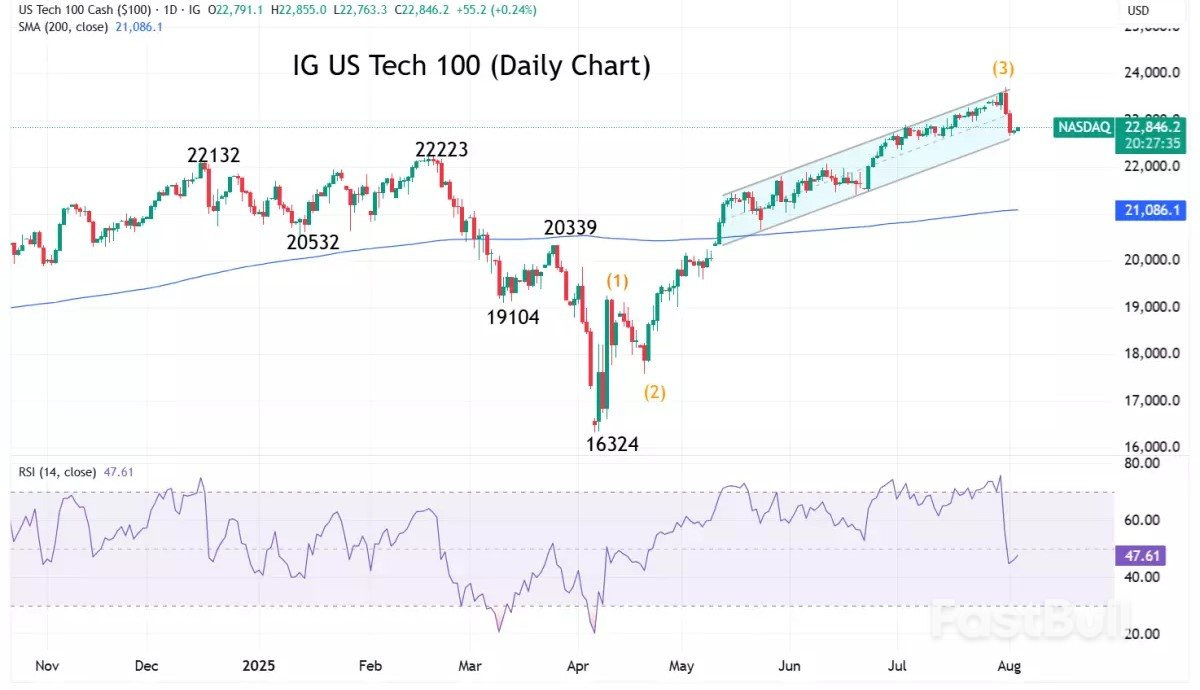
          Persistent inflationary pressures and deteriorating labour market conditions have intensified uncertainty surrounding Fed monetary policy trajectory. The volatility index (VIX) surged above 20 from the previous week's local trough near 14. The S&P 500 declined 2.4% while the Nasdaq 100 retreated 2.2% during the period.
          Individual equity performance diverged significantly based on earnings outcomes. Four Magnificent Seven constituents reported quarterly results. Meta share prices achieved record highs following 22% year-on-year (YoY) revenue growth that exceeded expectations, supported by enhanced artificial intelligence monetisation through advertising platforms. Microsoft advanced 2% as Azure cloud services delivered 39% growth, surpassing analyst estimates. Conversely, Amazon declined 8% as AWS growth lagged key competitors Google Cloud and Azure. Apple exceeded earnings expectations driven by accelerating growth in emerging markets, particularly China, though tariff-related concerns contributed to a 2% Friday decline.
          The US Tech 100 exhibits corrective wave characteristics as Thursday and Friday's decline decisively drove the index to the bottom of the ascending trend channel established in mid-May. Failure to maintain support above 22,600 may trigger testing of material level at February's peak of 22,223. However, a reversal from current levels could facilitate a challenge of new highs above 23,800.
          Figure 1: US Tech 100 index (daily) price chart
          Market navigator: week of 4 August 2025_1
          Hang Seng Index surrenders previous gains
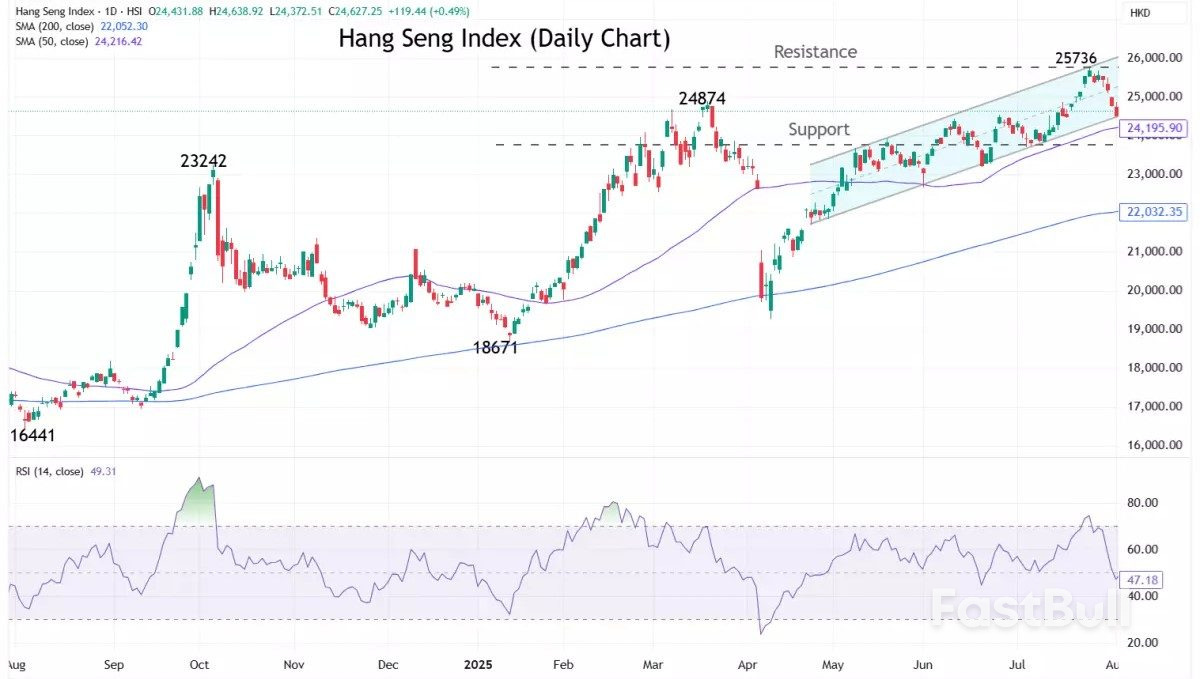
          The Hang Seng Index surrendered the previous week's gains through four consecutive sessions of negative returns, driven by disappointing China PMI data. The absence of substantial economic stimulus measures from the recent Politburo meeting and uncertainties surrounding the 12 August trade truce expiration further pressured equity performance.
          Currency weakness intensified negative sentiment among Hong Kong investors. The Hong Kong Monetary Authority (HKMA) conducted two interventions totalling HK$7.5 billion as the Hong Kong dollar breached its weak-side limit of HK$7.85 per US dollar under the Linked Exchange Rate System. These interventions raised concerns regarding potential Hong Kong interbank offered rate (HIBOR) increases, which could dampen margin lending appetite.
          Despite the 3.5% weekly correction, the uptrend channel established from 24 April continues to govern price action. The HSI currently tests support at the channel's lower boundary, likely finding stabilisation near the 50-day moving average (SMA) at 24,195. A breach below this level could precipitate a retreat towards 23,800, while a recovery above 25,000 may drive prices towards the recent peak at 25,736.
          Figure 2: Hang Seng Index (daily) price chart
          Market navigator: week of 4 August 2025_2
          Japanese yen under renewed pressure
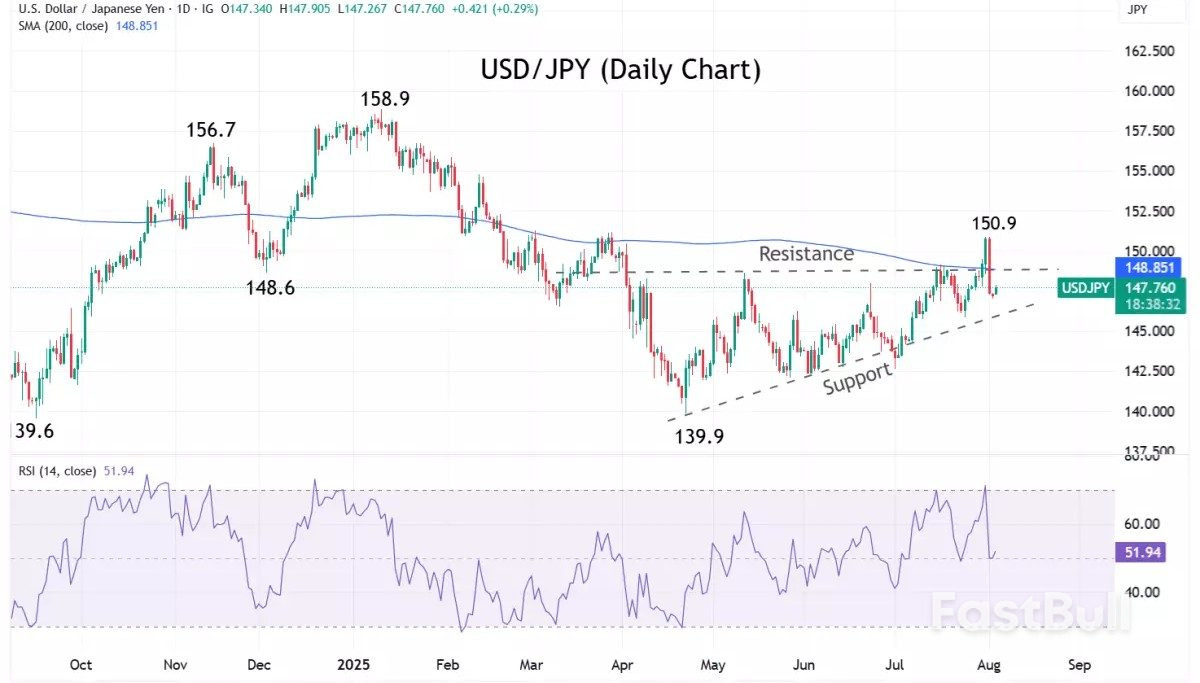
          Firm US tariff policies and hawkish Fed positioning have strengthened US dollar performance, recording the first monthly gain in 2025. Although recent US-Japan agreements provided greater clarity for the export-dependent economy, the Bank of Japan (BOJ) maintained policy rates unchanged at its July meeting. The central bank emphasised limited urgency for rate increases despite upward revisions to inflation forecasts.
          USD/JPY reached four-month highs, touching 150.9 before retreating following Friday's disappointing non-farm payrolls data. The temporary breach above the 200-day SMA indicates increased probability that the prevailing bearish trend may be concluding. Critical price action in coming sessions will determine direction, with sustained movement above the SMA at 148.85 confirming trend reversal, while retreat towards 146 would suggest continued bearish momentum.
          Figure 3: USD/JPY (daily) price chart
          Market navigator: week of 4 August 2025_3

          The week ahead

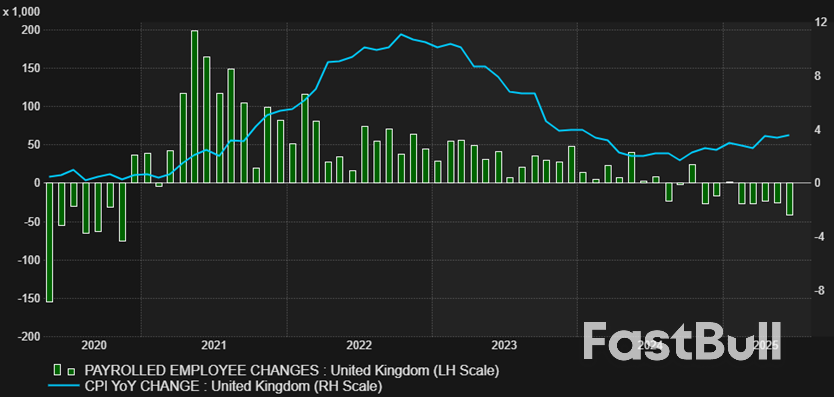
          Critical policy decisions and trade dynamics will significantly influence global economic sentiment this week. The Bank of England's (BOE) interest rate decision on Thursday takes centre stage, with markets anticipating a 25 basis point reduction to 4.0% amid sharp labour market deceleration.
          Comprehensive trade data from China and Australia will provide crucial insights into global commerce flows, with China's figures revealing manufacturing hub resilience amid ongoing trade tensions and shifting demand patterns. China's inflation data on Saturday will be particularly significant, especially the Producer Price Index (PPI), which has remained contractionary for 33 consecutive months, reflecting persistent deflationary pressures weighing on industrial sector profitability and investment decisions. Consumer Price Index (CPI) will be scrutinised for domestic demand recovery sustainability, while services PMI readings from China and the US will complete sectoral health assessments across major economies.
          Corporate earnings will command significant investor attention, with technology remaining in focus through Palantir and Advanced Micro Devices results, offering insights into artificial intelligence demand trends and semiconductor market dynamics. Pharmaceutical leaders Eli Lilly and Novo Nordisk will be scrutinised for updates on blockbuster diabetes and weight-loss drug portfolios in the rapidly expanding GLP-1 market. Japanese results feature automotive leader Toyota Motor and financial services giant Mitsubishi UFJ Financial Group.
          Figure 4: UK employment count vs. inflation rate
          Market navigator: week of 4 August 2025_4

          Source: ig

          To stay updated on all economic events of today, please check out our Economic calendar
          Risk Warnings and Disclaimers
          You understand and acknowledge that there is a high degree of risk involved in trading. Following any strategies or investment methods may lead to potential losses. The content on the site is provided by our contributors and analysts for information purposes only. You are solely responsible for determining whether any trading assets, securities, strategy, or any other product is suitable for investing based on your own investment objectives and financial situation.
          Add to Favorites
          Share

          US Dollar Poised to Resume Downtrend Amid Weak Data, Rising Rate-Cut Bets

          Adam

          Forex

          Immediately after the release of the jobs data, President Donald Trump dismissed Erika McEntarfer, the head of the Bureau of Labor Statistics (BLS) responsible for employment statistics.
          "Today’s employment data was rigged to make Republicans and me look bad, " Trump said, citing "manipulation of the data" as justification.
          This outburst called into question not only institutional independence but also the accuracy of the data. The political questioning of official data in a country like the US risks undermining the US dollar’s global safe-haven credentials.
          On the other hand, Moody’s Analytics Chief Economist Mark Zandi states that the US is on the brink of recession. According to Zandi, consumer spending is stagnating, while the construction and manufacturing sectors are contracting. While the labor market is weakening, the employment of new graduates is also declining. At the root of all this, Zandi says, are Washington’s choices, especially its trade and immigration policies.

          Trump Escalates Political Pressure on US Institutions

          In the immediate aftermath of the jobs report, Trump abruptly dismissed Erika McEntarfer, head of the Bureau of Labor Statistics, accusing her of manipulating the data. “Today’s employment data was rigged to make Republicans and me look bad,” Trump claimed, alleging political bias behind the weak numbers.
          The move raised alarms over the independence of US institutions and cast doubt on the credibility of official statistics. For global investors, political interference of this nature risks eroding trust in US data and weakening the US dollar’s position as a safe-haven currency.
          Separately, Moody’s Analytics Chief Economist Mark Zandi has warned that the US may be edging toward a recession. Consumer spending has plateaued, while both the construction and manufacturing sectors are showing signs of contraction. Zandi also pointed to a slowdown in hiring among new graduates—a sign that labor market softness is beginning to affect younger cohorts. At the core of the downturn, he argues, are policy missteps in Washington, particularly around trade and immigration.
          The unexpected resignation of Fed Governor Adriana Kugler has added to mounting concerns over the politicization of key US institutions. Kugler, who will step down on August 8, leaves a vacant seat that Trump could soon fill. Market chatter points to Kevin Hassett—a longtime Trump ally and former White House economic adviser—as a possible replacement.
          The prospect of Hassett joining the Fed is being viewed as a troubling signal for the US dollar. Investors fear that a shift in the Fed’s composition toward politically aligned figures could undermine the central bank’s independence and cloud its policy outlook. Coming on the heels of Trump’s public attack on the Bureau of Labor Statistics, Kugler’s exit is seen as another step in reshaping institutions once considered immune to political pressure.

          Pressure Increases on Fed

          Following the weak jobs report, markets have sharply raised their bets on rate cuts. A 25 basis point cut at the Federal Reserve’s September meeting is now priced in with a 90% probability. Traders are also anticipating a total of 60 basis points in cuts by year-end—nearly double the 33 basis points expected just weeks ago.
          Meanwhile, trade tensions are flaring once again. Trump last week signed a new decree introducing a reciprocity-based tariff framework. As part of the move, tariffs on Canadian imports were increased from 25% to 35%. There is speculation that similar hikes could be extended to other key partners, including the European Union and Mexico, adding another layer of uncertainty for global markets.
          Trump has also floated the idea of redirecting tariff revenues into direct payments to select voter groups—a move critics say is more about politics than policy. The plan reportedly includes issuing checks signed by Trump himself, echoing the pandemic-era stimulus checks of 2020. While the proposal has no formal structure yet, it is widely seen as a campaign-driven gesture rather than a measure grounded in economic strategy.
          Adding to the uncertainty, the US Court of Appeals has reopened the case challenging the legality of Trump-era tariffs. A ruling against the tariffs could force the Treasury to refund years’ worth of collected duties—an outcome that would introduce significant fiscal strain at a time when budget pressures are already mounting.

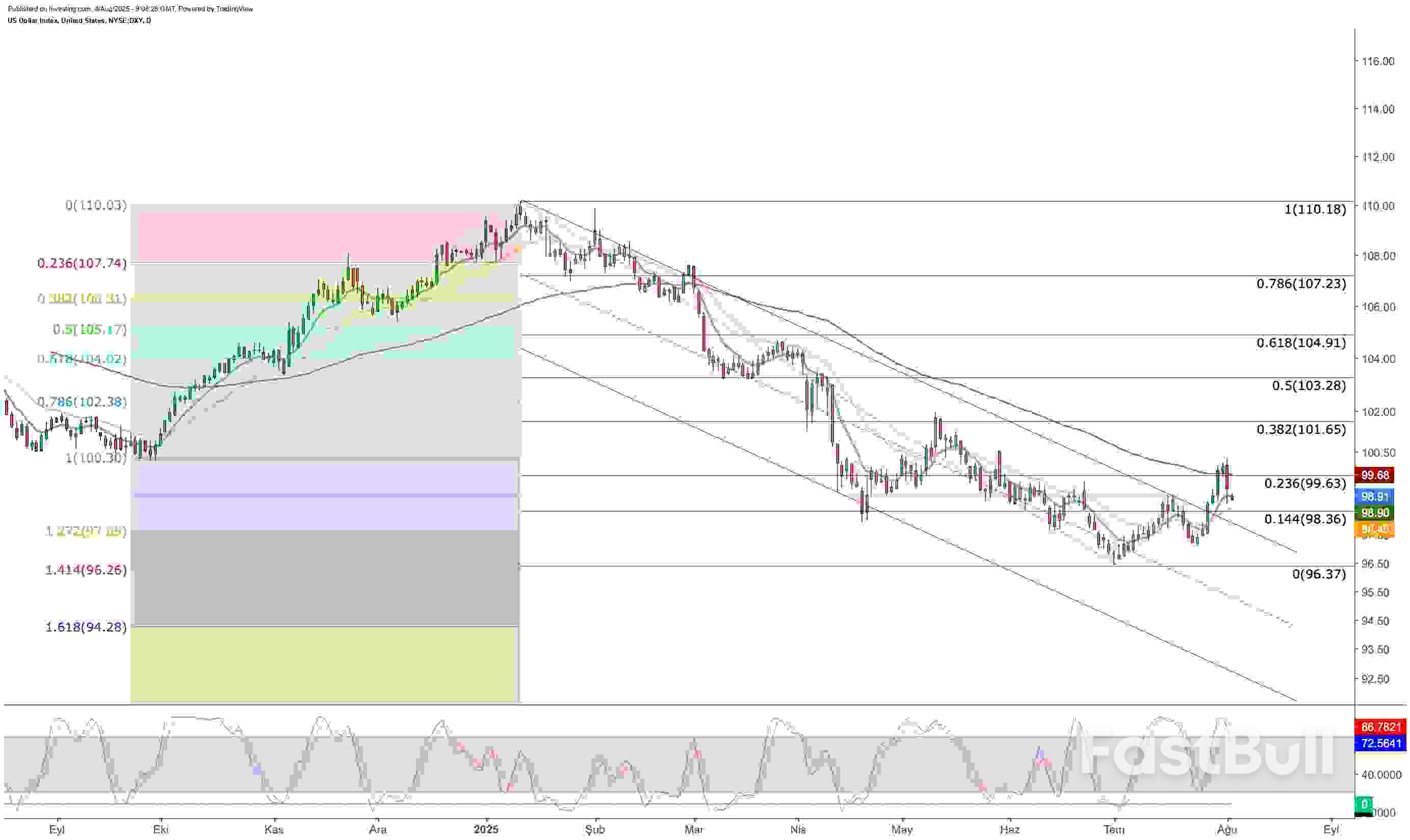
          US Dollar Technical Outlook

          US Dollar Poised to Resume Downtrend Amid Weak Data, Rising Rate-Cut Bets_1
          The US dollar index (DXY) climbed earlier last week but reversed sharply on Friday following the weak jobs report and renewed political turbulence. After briefly testing the 100 mark, the index fell swiftly and ended the week at 98.61.
          At the start of the new week, DXY is attempting a modest recovery toward 99, though the broader trend remains fragile. The 98.60–100 range continues to act as a key resistance zone, while 98.30 serves as the immediate support. A decisive break below that could open the way toward the 96 level, extending the downward momentum.
          Recent data has confirmed a clear cooling in the US economy. Yet, market reactions have been shaped not just by macro signals but also by intensifying political noise. Trump’s interventions—rhetorical and institutional—are increasingly influencing the US dollar’s direction. In the near term, the DXY appears exposed not only to Fed rate policy but also to the unpredictable dynamics emerging from the White House.
          Throughout the month, markets will closely track not just employment and inflation data but also every move and statement from Trump. The upcoming Fed appointment and key macro releases ahead of the September policy meeting are expected to be the primary drivers of the US dollar index. Together, these factors will likely shape the next leg of the DXY’s trajectory.

          Source: investing

          Risk Warnings and Disclaimers
          You understand and acknowledge that there is a high degree of risk involved in trading. Following any strategies or investment methods may lead to potential losses. The content on the site is provided by our contributors and analysts for information purposes only. You are solely responsible for determining whether any trading assets, securities, strategy, or any other product is suitable for investing based on your own investment objectives and financial situation.
          Add to Favorites
          Share

          Trump’s penalty threat puts India in a bind over Russian oil

          Adam

          Economic

          India is navigating a tricky balancing act after U.S. President Donald Trump threatened a “penalty” over its continued imports of Russian oil — a trade that New Delhi appears reluctant to end anytime soon.
          Despite Trump telling reporters Friday that he “heard” India would halt purchases, officials in New Delhi have remained noncommittal. Foreign ministry spokesperson Randhir Jaiswal said that the country decides its energy import sources “based on the price at which oil is available in the international market and depending on the global situation at that time.”
          “The Indians must be having some confusion” following Trump’s threat — a reversal from the more tolerant approach taken under the Biden administration, Bob McNally, president of consulting firm Rapidan Energy Group, told CNBC’s “Squawk Box Asia.”
          “Now we’re flipping around and saying, ‘What are you doing taking all this Russian oil?’” McNally said.
          In March 2022 — a month after Russia launched its full-scale invasion of Ukraine — Daleep Singh, a former U.S. deputy national security adviser for international economics in the Biden administration, reportedly said that “friends don’t set red lines” and “there is no prohibition at present on energy imports from Russia.”
          “What we would not like to see is a rapid acceleration of India’s imports from Russia as it relates to energy or any other exports that are currently being prohibited by us or by other aspects of the international sanctions regime,” Singh said.
          On July 30, Trump announced that India would face a 25% tariff beginning Aug. 1, along with an unspecified “penalty” for buying Russian oil and military equipment.
          But analysts suggest that India, which is the third-largest energy consumer in the world, isn’t blinking for now. Reuters reported that there are no immediate changes planned to India’s long-term contracts with Russian suppliers, citing two anonymous Indian government sources that did not wish to be identified due to the sensitivity of the matter.
          Russia has become the leading oil supplier to India since the war in Ukraine began, increasing from just under 100,000 barrels per day before the invasion, or a 2.5% share of total imports, to more than 1.8 million barrels per day in 2023, or 39%. According to the International Energy Agency, 70% of Russian crude was exported to India in 2024.
          India’s energy minister Hardeep Singh Puri defended New Delhi’s actions in a July 10 interview with CNBC, saying that it helped stabilize global prices and was even encouraged by the U.S.
          “If people or countries had stopped buying at that stage, the price of oil would have gone up to 130 dollars a barrel. That was a situation in which we were advised, including by our friends in the United States, to please buy Russian oil, but within the price cap.”
          Russian oil exports had been capped at $60 per barrel in December 2022 by the Group of Seven nations, representing the world’s top economies, while the European Union had lowered the price cap to just above $47 per barrel in July.
          Still, pressure is mounting. Vishnu Varathan, Managing Director at Mizuho Securities, said that the U.S. threats present a “clear and present danger” to India. He said that New Delhi is likely to remain non-committal on oil purchases as it assesses the trade-offs of this “Russia option” as a bargaining chip.
          India will need to scour the global market for comparable oil bargains with Russian oil, Varathan, who is also the head of macro research for Asia ex-Japan, added.
          New Delhi could explore alternatives, including Iran — if an exemption from the U.S. can be negotiated — as well as a few other producers “either within or outside of the OPEC+ that have been pressured by the U.S,” Varathan said.
          The OPEC+ bloc had agreed on Sunday to raise output by 547,000 barrels per day in September, as concerns mount over potential supply disruptions linked to Russia.
          India is going to face a tough choice, Rapidan’s McNally said.
          “Trump is serious. He’s frustrated with Putin... India is going to have a tough choice to make, but it’s hard to see them continuing to import that a million and a half barrels [of] Russian crude if Donald Trump decides to really put the whole relationship on the line over it.”

          Source: cnbc

          To stay updated on all economic events of today, please check out our Economic calendar
          Risk Warnings and Disclaimers
          You understand and acknowledge that there is a high degree of risk involved in trading. Following any strategies or investment methods may lead to potential losses. The content on the site is provided by our contributors and analysts for information purposes only. You are solely responsible for determining whether any trading assets, securities, strategy, or any other product is suitable for investing based on your own investment objectives and financial situation.
          Add to Favorites
          Share

          Israel To Decide Next Steps In Gaza After Ceasefire Talks Collapse

          James Whitman

          Political

          Palestinian-Israeli conflict

          Benjamin Netanyahu will convene his security cabinet this week to decide on Israel's next steps in Gaza following the collapse of indirect ceasefire talks with Hamas, with one senior Israeli source suggesting more force could be an option.

          Last Saturday, during a visit to the country, U.S. Middle East envoy Steve Witkoff had said he was working with the Israeli government on a plan that would effectively end the war in Gaza.

          But Israeli officials have also floated ideas including expanding the military offensive in Gaza and annexing parts of the shattered enclave.

          The failed ceasefire talks in Doha had aimed to clinch agreements on a U.S.-backed proposal for a 60-day truce, during which aid would be flown into Gaza and half of the hostages Hamas is holding would be freed in exchange for Palestinian prisoners jailed in Israel.

          After Netanyahu met Witkoff last Thursday, a senior Israeli official said that "an understanding was emerging between Washington and Israel," of a need to shift from a truce to a comprehensive deal that would "release all the hostages, disarm Hamas, and demilitarize the Gaza Strip," - Israel's key conditions for ending the war.

          A source familiar with the matter told Reuters on Sunday that the envoy's visit was seen in Israel as "very significant."

          But later on Sunday, the Israeli official signalled that pursuit of a deal would be pointless, threatening more force:

          "An understanding is emerging that Hamas is not interested in a deal and therefore the prime minister is pushing to release the hostages while pressing for military defeat."

          "STRATEGIC CLARITY"

          What a "military defeat" might mean, however, is up for debate within the Israeli leadership. Some Israeli officials have suggested that Israel might declare it was annexing parts of Gaza as a means to pressure the militant group.

          Others, like Finance Minister Bezalel Smotrich and National Security Minister Itamar Ben-Gvir want to see Israel impose military rule in Gaza before annexing it and re-establishing the Jewish settlements Israel evicted 20 years ago.

          The Israeli military, which has pushed back at such ideas throughout the war, was expected on Tuesday to present alternatives that include extending into areas of Gaza where it has not yet operated, according to two defence officials.

          While some in the political leadership are pushing for expanding the offensive, the military is concerned that doing so will endanger the 20 hostages who are still alive, the officials said.

          Israeli Army Radio reported on Monday that military chief Eyal Zamir has become increasingly frustrated with what he describes as a lack of strategic clarity by the political leadership, concerned about being dragged into a war of attrition with Hamas militants.

          A spokesperson for the Israel Defense Forces (IDF) declined to comment on the report but said that the military has plans in store.

          "We have different ways to fight the terror organization, and that's what the army does," Lieutenant Colonel Nadav Shoshani said.

          On Tuesday, Qatar and Egypt endorsed a declaration by France and Saudi Arabia outlining steps toward a two-state solution to the Israeli-Palestinian conflict, which included a call on Hamas to hand over its arms to the Western-backed Palestinian Authority.

          Hamas has repeatedly said it won't lay down arms. But it has told mediators it was willing to quit governance in Gaza for a non-partisan ruling body, according to three Hamas officials.

          It insists that the post-war Gaza arrangement must be agreed upon among the Palestinians themselves and not dictated by foreign powers.

          Israel's Foreign Minister Gideon Saar suggested on Monday that the gaps were still too wide to bridge.

          "We would like to have all our hostages back. We would like to see the end of this war. We always prefer to get there by diplomatic means, if possible. But of course, the big question is, what will be the conditions for the end of the war?" he told journalists in Jerusalem.

          Source: Reuters

          Risk Warnings and Disclaimers
          You understand and acknowledge that there is a high degree of risk involved in trading. Following any strategies or investment methods may lead to potential losses. The content on the site is provided by our contributors and analysts for information purposes only. You are solely responsible for determining whether any trading assets, securities, strategy, or any other product is suitable for investing based on your own investment objectives and financial situation.
          Add to Favorites
          Share
          FastBull
          Copyright © 2025 FastBull Ltd

          728 RM B 7/F GEE LOK IND BLDG NO 34 HUNG TO RD KWUN TONG KLN HONG KONG

          TelegramInstagramTwitterfacebooklinkedin
          App Store Google Play Google Play
          Products
          Charts

          Chats

          Q&A with Experts
          Screeners
          Economic Calendar
          Data
          Tools
          Membership
          Features
          Function
          Markets
          Copy Trading
          Latest Signals
          Contests
          News
          Analysis
          24/7
          Columns
          Education
          Company
          Careers
          About Us
          Contact Us
          Advertising
          Help Center
          Feedback
          User Agreement
          Privacy Policy
          Business

          White Label

          Data API

          Web Plug-ins

          Poster Maker

          Affiliate Program

          Risk Disclosure

          The risk of loss in trading financial instruments such as stocks, FX, commodities, futures, bonds, ETFs and crypto can be substantial. You may sustain a total loss of the funds that you deposit with your broker. Therefore, you should carefully consider whether such trading is suitable for you in light of your circumstances and financial resources.

          No decision to invest should be made without thoroughly conducting due diligence by yourself or consulting with your financial advisors. Our web content might not suit you since we don't know your financial conditions and investment needs. Our financial information might have latency or contain inaccuracy, so you should be fully responsible for any of your trading and investment decisions. The company will not be responsible for your capital loss.

          Without getting permission from the website, you are not allowed to copy the website's graphics, texts, or trademarks. Intellectual property rights in the content or data incorporated into this website belong to its providers and exchange merchants.

          Not Logged In

          Log in to access more features

          FastBull Membership

          Not yet

          Purchase

          Become a signal provider
          Help Center
          Customer Service
          Dark Mode
          Price Up/Down Colors

          Log In

          Sign Up

          Position
          Layout
          Fullscreen
          Default to Chart
          The chart page opens by default when you visit fastbull.com