• Trade
  • Markets
  • Copy
  • Contests
  • News
  • 24/7
  • Calendar
  • Q&A
  • Chats
Trending
Screeners
SYMBOL
LAST
BID
ASK
HIGH
LOW
NET CHG.
%CHG.
SPREAD
SPX
S&P 500 Index
6870.39
6870.39
6870.39
6895.79
6858.28
+13.27
+ 0.19%
--
DJI
Dow Jones Industrial Average
47954.98
47954.98
47954.98
48133.54
47871.51
+104.05
+ 0.22%
--
IXIC
NASDAQ Composite Index
23578.12
23578.12
23578.12
23680.03
23506.00
+72.99
+ 0.31%
--
USDX
US Dollar Index
98.880
98.960
98.880
98.960
98.730
-0.070
-0.07%
--
EURUSD
Euro / US Dollar
1.16536
1.16543
1.16536
1.16717
1.16341
+0.00110
+ 0.09%
--
GBPUSD
Pound Sterling / US Dollar
1.33204
1.33214
1.33204
1.33462
1.33136
-0.00108
-0.08%
--
XAUUSD
Gold / US Dollar
4207.95
4208.36
4207.95
4218.85
4190.61
+10.04
+ 0.24%
--
WTI
Light Sweet Crude Oil
59.431
59.461
59.431
60.084
59.291
-0.378
-0.63%
--

Community Accounts

Signal Accounts
--
Profit Accounts
--
Loss Accounts
--
View More

Become a signal provider

Sell trading signals to earn additional income

View More

Guide to Copy Trading

Get started with ease and confidence

View More

Signal Accounts for Members

All Signal Accounts

Best Return
  • Best Return
  • Best P/L
  • Best MDD
Past 1W
  • Past 1W
  • Past 1M
  • Past 1Y

All Contests

  • All
  • Trump Updates
  • Recommend
  • Stocks
  • Cryptocurrencies
  • Central Banks
  • Featured News
Top News Only
Share

Russian Defence Ministry: Russian Forces Take Control Of Novodanylivka In Ukraine's Zaporizhzhia Region

Share

Russian Defence Ministry: Russian Forces Take Control Of Chervone In Ukraine's Donetsk Region

Share

French Finance Ministry: Government Started Process To Block Temporarily Shein Platform

Share

Finance Minister: Indonesia To Impose Coal Export Tax Of Up To 5% Next Year

Share

[Trump Considering Fired Homeland Security Secretary Noem? White House Denies] According To Reports From US Media Outlets Such As The Daily Beast And The UK's Independent, The White House Has Denied Reports That US President Trump Is Considering Firing Homeland Security Secretary Noem. White House Spokesperson Abigail Jackson Posted On Social Media On The 7th Local Time, Calling The Claims "fake News" And Stating That "Secretary Noem Has Done An Excellent Job Implementing The President's Agenda And 'making America Safe Again'."

Share

HKEX: Standard Chartered Bought Back 571604 Total Shares On Other Exchanges For Gbp9.5 Million On Dec 5

Share

Morgan Stanley Reiterates Bullish Outlook On US Stocks Due To Fed Rate Cut Expectations. Morgan Stanley Strategists Believe That The US Stock Market Faces A "bullish Outlook" Given Improved Earnings Expectations And Anticipated Fed Rate Cuts. They Expect Strong Corporate Earnings By 2026, And Anticipate The Fed Will Cut Rates Based On Lagging Or Mildly Weak Labor Markets. They Expect The US Consumer Discretionary Sector And Small-cap Stocks To Continue To Outperform

Share

China's National Development And Reform Commission Announced That Starting From 24:00 On December 8, The Retail Price Limit For Gasoline And Diesel In China Will Be Reduced By 55 Yuan Per Ton, Which Translates To A Reduction Of 0.04 Yuan Per Liter For 92-octane Gasoline, 0.05 Yuan Per Liter For 95-octane Gasoline, And 0.05 Yuan Per Liter For 0# Diesel

Share

Tkms CEO: US Security Strategy Highlights Need For Europe To Take Care Of Its Own Defences

Share

USA S&P 500 E-Mini Futures Up 0.1%, NASDAQ 100 Futures Up 0.18%, Dow Futures Down 0.02%

Share

London Metal Exchange (LME): Copper Inventories Increased By 2,000 Tons, Aluminum Inventories Decreased By 2,500 Tons, Nickel Inventories Increased By 228 Tons, Zinc Inventories Increased By 2,375 Tons, Lead Inventories Decreased By 3,725 Tons, And Tin Inventories Decreased By 10 Tons

Share

Swiss Sight Deposits Of Domestic Banks At 440.519 Billion Sfr In Week Ending December 5 Versus 437.298 Billion Sfr A Week Earlier

Share

Czech November Jobless Rate 4.6% Versus Mkt Fcast 4.7%

Share

Czech Jobless Rate Unchanged At 4.6% In November

Share

Singapore Central Bank Data: November Foreign Exchange Reserves At $400.0 Billion

Share

Fitch On EMEA Homebuilders Says Weak Demand Is Likely To Constrain Completions And New Starts, Despite Easing Inflation And Gradual Rate Cuts

Share

French Otc Day-Ahead Baseload Power Price At 22.50 EUR/Mwh, Down 35.3% From The Price Paid Friday For Monday Delivery - Lseg Data

Share

Cambodia Information Minister: 4 Cambodian Civilians Killed, 9 Injured Amid Conflict With Thailand

Share

Tkms CEO: With Meko Frigates We Are Offering To German Government An Alternative To Delayed F126 Frigates

Share

Tkms CEO: Expect Decision On Canadian Submarine Order In 2026

TIME
ACT
FCST
PREV
France Industrial Output MoM (SA) (Oct)

A:--

F: --

P: --
France Trade Balance (SA) (Oct)

A:--

F: --

P: --
Euro Zone Employment YoY (SA) (Q3)

A:--

F: --

P: --
Canada Part-Time Employment (SA) (Nov)

A:--

F: --

P: --

Canada Unemployment Rate (SA) (Nov)

A:--

F: --

P: --

Canada Full-time Employment (SA) (Nov)

A:--

F: --

P: --

Canada Labor Force Participation Rate (SA) (Nov)

A:--

F: --

P: --

Canada Employment (SA) (Nov)

A:--

F: --

P: --

U.S. PCE Price Index MoM (Sept)

A:--

F: --

P: --

U.S. Personal Income MoM (Sept)

A:--

F: --

P: --

U.S. Core PCE Price Index MoM (Sept)

A:--

F: --

P: --

U.S. PCE Price Index YoY (SA) (Sept)

A:--

F: --

P: --

U.S. Core PCE Price Index YoY (Sept)

A:--

F: --

P: --

U.S. Personal Outlays MoM (SA) (Sept)

A:--

F: --

P: --
U.S. 5-10 Year-Ahead Inflation Expectations (Dec)

A:--

F: --

P: --

U.S. Real Personal Consumption Expenditures MoM (Sept)

A:--

F: --

P: --
U.S. Weekly Total Rig Count

A:--

F: --

P: --

U.S. Weekly Total Oil Rig Count

A:--

F: --

P: --

U.S. Consumer Credit (SA) (Oct)

A:--

F: --

P: --
China, Mainland Foreign Exchange Reserves (Nov)

A:--

F: --

P: --

Japan Trade Balance (Oct)

A:--

F: --

P: --

Japan Nominal GDP Revised QoQ (Q3)

A:--

F: --

P: --

China, Mainland Imports YoY (CNH) (Nov)

A:--

F: --

P: --

China, Mainland Exports (Nov)

A:--

F: --

P: --

China, Mainland Imports (CNH) (Nov)

A:--

F: --

P: --

China, Mainland Trade Balance (CNH) (Nov)

A:--

F: --

P: --

China, Mainland Exports YoY (USD) (Nov)

A:--

F: --

P: --

China, Mainland Imports YoY (USD) (Nov)

A:--

F: --

P: --

Germany Industrial Output MoM (SA) (Oct)

A:--

F: --

P: --
Euro Zone Sentix Investor Confidence Index (Dec)

A:--

F: --

P: --

Canada National Economic Confidence Index

--

F: --

P: --

U.K. BRC Like-For-Like Retail Sales YoY (Nov)

--

F: --

P: --

U.K. BRC Overall Retail Sales YoY (Nov)

--

F: --

P: --

Australia Overnight (Borrowing) Key Rate

--

F: --

P: --

RBA Rate Statement
RBA Press Conference
Germany Exports MoM (SA) (Oct)

--

F: --

P: --

U.S. NFIB Small Business Optimism Index (SA) (Nov)

--

F: --

P: --

Mexico 12-Month Inflation (CPI) (Nov)

--

F: --

P: --

Mexico Core CPI YoY (Nov)

--

F: --

P: --

Mexico PPI YoY (Nov)

--

F: --

P: --

U.S. Weekly Redbook Index YoY

--

F: --

P: --

U.S. JOLTS Job Openings (SA) (Oct)

--

F: --

P: --

China, Mainland M1 Money Supply YoY (Nov)

--

F: --

P: --

China, Mainland M0 Money Supply YoY (Nov)

--

F: --

P: --

China, Mainland M2 Money Supply YoY (Nov)

--

F: --

P: --

U.S. EIA Short-Term Crude Production Forecast For The Year (Dec)

--

F: --

P: --

U.S. EIA Natural Gas Production Forecast For The Next Year (Dec)

--

F: --

P: --

U.S. EIA Short-Term Crude Production Forecast For The Next Year (Dec)

--

F: --

P: --

EIA Monthly Short-Term Energy Outlook
U.S. API Weekly Gasoline Stocks

--

F: --

P: --

U.S. API Weekly Cushing Crude Oil Stocks

--

F: --

P: --

U.S. API Weekly Crude Oil Stocks

--

F: --

P: --

U.S. API Weekly Refined Oil Stocks

--

F: --

P: --

South Korea Unemployment Rate (SA) (Nov)

--

F: --

P: --

Japan Reuters Tankan Non-Manufacturers Index (Dec)

--

F: --

P: --

Japan Reuters Tankan Manufacturers Index (Dec)

--

F: --

P: --

Japan Domestic Enterprise Commodity Price Index MoM (Nov)

--

F: --

P: --

Japan Domestic Enterprise Commodity Price Index YoY (Nov)

--

F: --

P: --

China, Mainland PPI YoY (Nov)

--

F: --

P: --

Q&A with Experts
    • All
    • Chatrooms
    • Groups
    • Friends
    Connecting
    .
    .
    .
    Type here...
    Add Symbol or Code

      No matching data

      All
      Trump Updates
      Recommend
      Stocks
      Cryptocurrencies
      Central Banks
      Featured News
      • All
      • Russia-Ukraine Conflict
      • Middle East Flashpoint
      • All
      • Russia-Ukraine Conflict
      • Middle East Flashpoint
      Search
      Products

      Charts Free Forever

      Chats Q&A with Experts
      Screeners Economic Calendar Data Tools
      Membership Features
      Data Warehouse Market Trends Institutional Data Policy Rates Macro

      Market Trends

      Market Sentiment Order Book Forex Correlations

      Top Indicators

      Charts Free Forever
      Markets

      News

      News Analysis 24/7 Columns Education
      From Institutions From Analysts
      Topics Columnists

      Latest Views

      Latest Views

      Trending Topics

      Top Columnists

      Latest Update

      Signals

      Copy Rankings Latest Signals Become a signal provider AI Rating
      Contests
      Brokers

      Overview Brokers Assessment Rankings Regulators News Claims
      Broker listing Forex Brokers Comparison Tool Live Spread Comparison Scam
      Q&A Complaint Scam Alert Videos Tips to Detect Scam
      More

      Business
      Events
      Careers About Us Advertising Help Center

      White Label

      Data API

      Web Plug-ins

      Affiliate Program

      Awards Institution Evaluation IB Seminar Salon Event Exhibition
      Vietnam Thailand Singapore Dubai
      Fans Party Investment Sharing Session
      FastBull Summit BrokersView Expo
      Recent Searches
        Top Searches
          Markets
          News
          Analysis
          User
          24/7
          Economic Calendar
          Education
          Data
          • Names
          • Latest
          • Prev

          View All

          No data

          Scan to Download

          Faster Charts, Chat Faster!

          Download App
          English
          • English
          • Español
          • العربية
          • Bahasa Indonesia
          • Bahasa Melayu
          • Tiếng Việt
          • ภาษาไทย
          • Français
          • Italiano
          • Türkçe
          • Русский язык
          • 简中
          • 繁中
          Open Account
          Search
          Products
          Charts Free Forever
          Markets
          News
          Signals

          Copy Rankings Latest Signals Become a signal provider AI Rating
          Contests
          Brokers

          Overview Brokers Assessment Rankings Regulators News Claims
          Broker listing Forex Brokers Comparison Tool Live Spread Comparison Scam
          Q&A Complaint Scam Alert Videos Tips to Detect Scam
          More

          Business
          Events
          Careers About Us Advertising Help Center

          White Label

          Data API

          Web Plug-ins

          Affiliate Program

          Awards Institution Evaluation IB Seminar Salon Event Exhibition
          Vietnam Thailand Singapore Dubai
          Fans Party Investment Sharing Session
          FastBull Summit BrokersView Expo

          New Board Member Hints At Possible Raising Of BOJ Price Outlook

          Damon

          Central Bank

          Summary:

          One of the Bank of Japan’s newest board members alluded to a possible upward revision to the central bank’s inflation view this

          One of the Bank of Japan’s newest board members alluded to a possible upward revision to the central bank’s inflation view this month, an outcome that would keep open the possibility of another rate increase this year.

          “Inflation for rice and food-related items has been stronger than expected,” Junko Koeda said Monday in her first media interview since joining the board in March. “I’m closely watching potential secondary effects on underlying inflation from rice, which is a staple food.”

          Koeda spoke before President Donald Trump announced a new tariff level of 25% on Japan. The board member stressed there are high economic uncertainties stemming from the US levies as she underscored the need to assess incoming data before considering any policy moves.

          “Given ongoing high uncertainties, it’s inappropriate to talk about a specific timing for the next rate hike,” Koeda said. “We need to decide by closely looking at the economy, inflation and financial markets without missing a sign of change.”

          Governor Kazuo Ueda’s board delivers its next policy decision on July 31 and will update its quarterly economic outlook. With a stand-pat decision widely expected, the main focus is on whether the BOJ will raise its inflation forecasts, a key factor in mulling the likely timing of rate hikes once there’s more clarity over US tariffs.

          Trump has now set Aug. 1 as the new day when higher “reciprocal tariffs” kick in, thereby giving countries another three weeks or so to reach trade deals.

          Japan’s key inflation gauge showed an acceleration to 3.7% from a year earlier in May, the highest level among Group of Seven nations. Price growth has remained at or above the BOJ’s 2% target for more than three years with the cost of rice among the drivers recently. The nation’s staple food surged 102% in May, the fastest pace in half a century.

          The central bank currently expects the cost of living to rise 2.2% in the year ending March 2026, lower than 2.4%, the median estimate of private economists.

          “There are both upside and downside risks for inflation,” Koeda said, echoing Ueda’s remarks last month. The comments suggest a potential change in the BOJ’s risk balance assessment, after the central bank’s April outlook report mentioned only downside risks for prices in that section.

          Koeda assumed her five-year term on March 26 in a career shift from her position as an economics professor at Tokyo’s Waseda University. She became known among BOJ watchers after the BOJ’s think tank published a paper of hers in 2018, highlighting positive aspects of scrapping the negative interest rate policy. The paper was perceived as a hint at coming changes and contributed to her reputation for leaning toward hawkishness.

          Koeda is also known for her research on the BOJ’s balance sheet and Japan’s debt market. While the central bank has trimmed its bond buying over the last year, it decided last month to slow down its withdrawal from the market after super-long bond yields hit a record high in May in a sign of instability.

          Despite the central bank’s move, the market continues to be hit by volatility, with 30-year bond yields rising Tuesday on concerns over fiscal policy after an upper house election on July 20.

          “Long-term interest rates should be determined by financial markets in principle,” Koeda said. The BOJ should step into the market only “in exceptional cases when yields surge in an abnormal manner.”

          At 49, Koeda is the youngest of the nine-member board and her presence marks the first time the board has had two female members, a sign of progress in raising the representation of women at the bank. She said the BOJ is well positioned to achieve its goal of having women fill 20% of management positions by June next year.

          “Productivity overall can be boosted by making the work environment friendlier to the needs of each employee,” Koeda said.

          Source: Bloomberg Europe

          Risk Warnings and Disclaimers
          You understand and acknowledge that there is a high degree of risk involved in trading. Following any strategies or investment methods may lead to potential losses. The content on the site is provided by our contributors and analysts for information purposes only. You are solely responsible for determining whether any trading assets, securities, strategy, or any other product is suitable for investing based on your own investment objectives and financial situation.
          Add to Favorites
          Share

          Trump unveils 25% tariffs on South Korea and Japan, nearly identical to his 'Liberation Day' rates

          Adam

          Economic

          President Trump began unveiling his "UNITED STATES TARIFF Letters" Monday with the threat of 25% duties on South Korea and Japan, two top trading partners.
          The new rates — which aren’t scheduled to take effect until Aug. 1 — track closely with what the president first announced on "Liberation Day" this spring before he offered a 90-day pause that had been scheduled to expire on July 8.
          Back in April, Trump announced plans for a 25% rate on South Korea and a 24% rate on Japan.
          Trump posted other letters Monday afternoon to a dozen other trading partners, from Malaysia (a 25% rate) to South Africa (30%) to Serbia (35%).
          On Tuesday, Japan and South Korea stocks gained, with the Nikkei 225 (^N225) closing up 0.2% and South Korea's Kospi (^KS11) rising 1.8%.
          By and large, the rates in Monday's letter closely tracked what Trump had promised back in April but with a few exceptions. Cambodia saw its rate drop from 49% to 36%. Laos went from a 48% rate to 40% while Myanmar saw a 4 percentage point drop to 40%.
          All the letters also suggested more negotiations could be in the offing with Trump noting that if these targeted countries change their trade policies "we will, perhaps, consider an adjustment to this letter."
          Stocks sank Monday on the news falling even as the letters were paired with a delayed deadline that means none of these countries will see rate changes this week at least.
          White House press secretary Karoline Leavitt confirmed Monday afternoon that Trump's overall "reciprocal" tariff deadlines would be delayed by executive order to move the deadline for these nations and over 100 more from July 8 until Aug. 1.
          Leavitt added that many other countries are set to receive letters in the coming days, saying: "Keep your eyes on Truth Social."

          A focus on South Korea and Japan

          Negotiations with both South Korea and Japan are sure to continue for the next three weeks as the two nations look to avoid the tariffs coming into place, but Monday's move from the president underlined his desire to move aggressively after country-by-country negotiations have proven slower than he had hoped.
          Monday’s announcement does represent somewhat of a win for Japan, which had seen Trump threaten 35% tariffs just a few days ago in comments where he called the nation "so spoiled."
          South Korea, meanwhile, had initially been seen as a country that was near the front of the line for a deal and was even reportedly in Washington this past weekend for talks, but saw progress slow in part because of the nation’s recent elections.
          If Trump does follow through with these tariffs, Paul Ashworth of Capital Economics noted Monday afternoon that a higher baseline for these two countries at least may “have a relatively modest impact on the average effective tariff rates" because both economies are heavily focused on goods that are subject to different sector-specific tariffs.
          Ashworth calculates that Trump following through would hit about half of the exports from the two nations, with key industries like autos, electronics, and pharmaceuticals subject to other Trump tariff actions and expected to sidestep these new tariffs at least.
          The letters, addressed to the leaders of the nations, often offered identical language in many cases, with Trump touting both "the strength and commitment of our Trading Relationship" to South Korea and Japan while also lambasting "these longterm, and very persistent Trade Deficits" that he blamed on both countries.
          “If, for any reason you decide to raise your Tariffs, then, whatever the number you choose to raise them by will be added onto the 25% we charge,” Trump noted in his letters, adding that goods transshipped from another country would also face a higher rate.
          Transshipment has been a key issue for Trump — and was also included in an agreement last week with Vietnam — in response to Chinese shippers often looking to the practice to avoid tariffs.

          Other countries still outstanding

          The total number of letters could top 100 in the coming days.
          Perhaps the highest stakes shoe to drop in the coming days could be an update on where things stand with the European Union, a bloc that represents the top trading partner of the US.
          The EU had previously signaled it would be willing to accept a 10% universal tariff but Trump has often promised much higher duties as a range of issues from how specific sectors like autos are treated to the continent's digital service taxes has making negotiations slow.
          A spokesperson for the European Commission said Monday it is still hoping for a deal this week but Trump has promised a 50% tariff rate if no agreement is reached.
          Another closely watched negotiation is with India, which reportedly said it has made its final offer and said a deal is in Trump’s hands.
          Monday’s announcement also comes after Trump continued to bring other issues into the trade talks, including with an overnight announcement that he planned to use a 10% tariff to dissuade nations from lining up against him through an intergovernmental organization comprising 10 countries known as BRICS.
          As for the market reaction, Terry Haines of Pangaea Policy suggested that the initial market reaction could even out, especially if deals are announced later this week in addition to Monday's unilateral tariff threats.
          "Quickly following this shallow dip is very likely to be multiple trade deals upside by midweek," he wrote adding, "Watch particularly for a phase 1 US-India deal."

          Source : finance.yahoo

          To stay updated on all economic events of today, please check out our Economic calendar
          Risk Warnings and Disclaimers
          You understand and acknowledge that there is a high degree of risk involved in trading. Following any strategies or investment methods may lead to potential losses. The content on the site is provided by our contributors and analysts for information purposes only. You are solely responsible for determining whether any trading assets, securities, strategy, or any other product is suitable for investing based on your own investment objectives and financial situation.
          Add to Favorites
          Share

          Trump's Tariffs Could Overshadow The Red Carpet As Macron Meets King Charles

          Michelle

          Political

          Economic

          French President Emmanuel Macron is set to begin a three-day state visit of pomp, pageantry and political showmanship in the U.K. on Tuesday — but it's U.S. President Donald Trump's unpredictable global tariffs threats stateside that are likely to overshadow the red carpet.

          Macron and his wife Brigitte will be hosted by King Charles III and Queen Camilla at a state banquet on Tuesday. The French president will later meet business leaders and Prime Minister Keir Starmer for talks, which are expected to focus on "joint priorities" including migration, trade, defense and security, the U.K. government said.

          Looming large is the thorny issue of Washington and how to handle Trump and his unwieldy and unpredictable tariffs regime that could affect severely impact European and global economic growth.

          On Monday, Trump shared screenshots on social media of signed "letters" that were purportedly sent to 14 countries, including Japan, South Korea and South Africa, telling them that they faced a steep hike in trade tariffs from Aug. 1. The original July 9 deadline for higher tariffs has been extended.

          White House Spokesperson Karoline Leavitt said that further letters will be sent out in the coming days. That has put the European Union (EU), which did not receive a "letter" on Monday, on notice.

          Hopes are rising that a U.S.-EU trade deal could be inked this week although how beneficial — or disadvantageous — it will be to Brussels remains a big unknown as Macron, who leads the bloc's second-largest economy, travels to the U.K.

          "The EU is reportedly rushing to conclude a deal with the U.S., possibly by the end of this week already," Holger Schmieding, chief economist at Berenberg Bank, noted Tuesday, emphasizing that "major stumbling blocks remain."

          "The EU seems to have grudgingly accepted that the current 10% U.S. base tariff in addition to some sectoral tariffs cannot be negotiated away. The EU still hopes to get some limited exemptions from these tariffs, for example for aircraft and aircraft parts, so that the overall rise in the average U.S. tariff on imports from the EU this year will be below 10 percentage points. The U.S. is so far threatening to impose higher tariffs than that," he said.

          Pomp and pageantry

          Britain is certainly pulling out the stops for Macron's state visit, which will have all the pomp and pageantry that the country excels at.

          On Tuesday, the Macrons are due to travel to the U.K., where they will be met by the Prince and Princess of Wales, William and Kate. There, they will take part in a carriage procession with King Charles III and Queen Camilla heading to Windsor Castle, before attending a glamorous state banquet on site on Tuesday evening.

          The king is expected to deliver a speech at the start of the state visit in which he says that the U.K. and France "face a multitude of complex threats, emanating from multiple directions. As friends and as allies, we face them together. These challenges know no borders: no fortress can protect us against them this time," according to Sky News.

          The Macrons are known to have a warm relationship with the British royals. Tellingly, the king last won plaudits from Paris when he addressed the French Senate in both English and French, which he speaks fluently, during a state visit in 2023.

          Macron is also due to address lawmakers in London around 4 p.m. London time on Tuesday, will meet business leaders in London on Wednesday and will hold talks at a France-British summit with Starmer on Thursday.

          This is the first state visit by an EU leader on British soil since the U.K. acrimoniously left the bloc in 2020 following the 2016 Brexit referendum. The British government said the visit "will provide a historic opportunity to showcase the breadth of the U.K.-France relationship."

          Starmer, who seems to have ingratiated himself with Trump despite their different political persuasions, might be able to give Macron some tips on how to win over their transatlantic ally, as the EU continues trade negotiations with Washington.

          Trump stated matter-of-factly that the U.K. was the first country to strike a trade deal with Washington, and was likely to be protected from future tariffs, "because I like them." Macron has meanwhile had a trickier ride with the U.S. leader, who has humiliated him more than once. In June, at the last G-7 meeting, Trump lambasted Macron as "publicity seeking."

          Source: CNBC

          To stay updated on all economic events of today, please check out our Economic calendar
          Risk Warnings and Disclaimers
          You understand and acknowledge that there is a high degree of risk involved in trading. Following any strategies or investment methods may lead to potential losses. The content on the site is provided by our contributors and analysts for information purposes only. You are solely responsible for determining whether any trading assets, securities, strategy, or any other product is suitable for investing based on your own investment objectives and financial situation.
          Add to Favorites
          Share

          It’s TACO Tuesday, as markets ignore Trump’s tariff threats

          Adam

          Economic

          This week was all about Wednesday’s reciprocal tariff deadline in the US. Except, Donald Trump has now kicked the can down the road to August 1st. This means that countries who have yet to secure a deal, or a letter, will have three weeks for more negotiations. The President may have hit Japan, South Korea and other trade allies with tough tariff rates on Monday, but even these aren’t set in stone, and the market reaction on Tuesday reflects this.

          Japan fights fire with fire on trade talks, as stocks remain calm

          Japanese stocks are higher, the Nikkei is higher by 0.25%, and the loss in the last 5 days is a mere 0.75%. This suggests that we are not repeating the sharp sell off and spike in volatility that we saw in April. After falling sharply on Monday, US equity futures are also pointing to a higher open later today, and the Vix is stable and below the average rate for the last 12 months.
          As negotiations continue, officials in Japan have stood firm against Trump’s tariffs and set out their red lines earlier today. They said that they will not sacrifice Japanese agriculture in trade talks with the US, and an agreement with the US will not be reached until there is a better agreement regarding the car sector. This is worth noting. Japan is fighting fire with fire and is not backing down to get a quick trade deal with the US on better terms. This suggests that Japan thinks that Trump will back down and lower their tariff rates in the coming weeks. The market is aligned with this view, hence the mild reaction to yesterday’s tariff news.

          EU/US trade agreement could push EUR/USD to $1.20

          The dollar is erasing Monday’s gains, and the yen is down a mere 0.1% on Tuesday, the South Korean won is in recovery mode and is higher by 0.8% vs. the USD this morning. The euro is also higher on Tuesday, and EUR/USD is a mere 140 points away from $1.20. Reports suggest that a trade agreement is in the wings between the EU and the US. The US has offered the EU a 10% baseline tariff rate, except for aircraft and sprits. This is a rate that the EU could cope with and may not have major economic ramifications.
          This deal has not been officially announced, and the EU could still come under pressure from tariffs if the US announce more sector specific tariffs, including on pharma. However, for now, the news is positive, and unless something changes that, today could be a good day for the single currency, with $1.20 a possibility. Hopes for a trade deal means that weakness in Germany’s imports and exports for May have been sidelined, as traders favour the euro over safe havens.

          Bond yields surge as Trump’s trade deals weigh on bonds

          The bond market is also reflecting a potential EU/ US trade agreement. European bond yields are rising sharply on Tuesday. The 10-year German Bund yield is higher by 5bps and yields are rising at a faster pace in Germany than in the UK and the US. Japanese long end bond yields are also rising sharply. Whereas German yields are rising because of a rumored positive trade deal between the EU and the US, Japanese yields are rising because there are concerns that a bad trade deal with the US will push up Japan’s government borrowing needs.

          Is this the peak for the Swissie?

          The FX market is in risk on mode today, the Swiss franc is one of the weakest currencies in the G10 FX space on Tuesday, after reaching multiyear highs vs. the USD and the EUR. This is a sign that risk sentiment is back on, and it will be worth watching to see if the Swissie loses ground from here, as the existential threat from tariffs recedes.
          Ahead today, the focus will be on trade headlines and the potential for an announcement of an EU/US trade deal. Will Trump be as lenient to the EU as reports suggests? If yes, then this is a big win for the currency bloc.

          source :xtb

          To stay updated on all economic events of today, please check out our Economic calendar
          Risk Warnings and Disclaimers
          You understand and acknowledge that there is a high degree of risk involved in trading. Following any strategies or investment methods may lead to potential losses. The content on the site is provided by our contributors and analysts for information purposes only. You are solely responsible for determining whether any trading assets, securities, strategy, or any other product is suitable for investing based on your own investment objectives and financial situation.
          Add to Favorites
          Share

          Auto Winners and Losers of Proposed EU-US Export Mechanism

          Warren Takunda

          Economic

          China–U.S. Trade War

          Brussels is considering pursuing a potential arrangement that would allow European automakers that produce and export cars from the United States to import vehicles from the EU at reduced tariff rates, according to two sources familiar with the matter.
          The discussion is part of the European Commission's efforts to broker a trade deal with U.S. President Donald Trump and would replace the hefty 25% tariff on car and car part imports the U.S. administration implemented in April.
          This would be a clear positive for those carmakers with major U.S. production facilities, who would be able to use their U.S. production to lower their exposure to tariffs.
          This is what a trade deal means for the EU and how individual European automakers would be affected:

          WHAT'S AT STAKE FOR EU?

          According to data from European auto association ACEA, nearly 758,000 cars worth 38.9 billion euros ($45.55 billion) were exported to the U.S. from Europe in 2024, more than four times as many as in the other direction.
          One EU diplomat said cars were a "red line" for the bloc, making a concession on cars a caveat of any deal. However, Brussels and Washington have conflicting goals as Trump wants to revive U.S. auto production while Brussels wants open markets for its sector, which is struggling with high energy costs and competition from China.

          WHO STANDS TO WIN?

          Germany's BMW and Mercedes-Benz would benefit most from a mechanism counting U.S. exports against imports from the EU, as both companies operate large factories in the United States.
          BMW, for example, exported around 225,000 vehicles produced at its Spartanburg, South Carolina, plant in 2024, while it sold around 400,000 autos in the U.S. market. It imported around 175,000 autos from other markets, less than what it exported.
          Mercedes-Benz exports around two thirds of the vehicles it makes at its plant in Tuscaloosa, Alabama, or around 170,000 based on 2024 production.
          It sold around 324,528 vehicles in the United States last year and imported around 235,000 from other countries.

          WHO WOULD BE THE LOSERS?

          Volkswagen, Europe's biggest carmaker, would not benefit, as it mostly sells cars produced at its Chattanooga, Tennessee, plant locally rather than exporting them.
          An industry source said for that reason, there has also been a push to get Washington to agree to investment credits, which would support foreign automakers' plans to expand to boost local production.
          Volkswagen, for example, is currently deciding whether to localise production of its Audi brand - which imports all of its cars into the U.S. market - either via a new factory or expanding existing sites.
          Porsche would also see no benefit: it has no local production and imports all of its cars from Europe.

          LITTLE IMPACT FOR STELLANTIS

          Stellantis, the world's No. 4 automaker, owner of brands including Jeep, Ram and Chrysler, would not be seriously affected by such an arrangement.
          Stellantis operates a number of U.S. plants, mostly serving the local market, while import and export flows of its cars between the U.S. and the European Union have historically been very low - typically small volumes of U.S.-made trucks versus European-made models from the Alfa Romeo, Maserati and Fiat brands.
          The group is far more vulnerable to any U.S. tariffs on Mexico and Canada, as it manufactures around 40% of its North American vehicles in those two countries, particularly in Mexico.

          CLEAR LOSS FOR VOLVO CARS

          Volvo Cars is one of the most exposed European automakers to U.S. tariffs, as most of the cars it sells there are imported from Europe. The U.S. accounted for 16% of group sales last year.
          The company has said it will expand production at its Charleston, South Carolina factory, adding a new model alongside the electric EX90 that is currently made there.
          Volvo has said the new vehicle would most likely be a plug-in hybrid mid-sized SUV, a popular option with U.S. consumers.
          Last year Polestar, which like Volvo Cars is part of China's Geely group, started producing the Polestar 3 SUV at the Charleston plant to avoid hefty U.S. tariffs on Chinese-made cars.

          Source: Reuters

          To stay updated on all economic events of today, please check out our Economic calendar
          Risk Warnings and Disclaimers
          You understand and acknowledge that there is a high degree of risk involved in trading. Following any strategies or investment methods may lead to potential losses. The content on the site is provided by our contributors and analysts for information purposes only. You are solely responsible for determining whether any trading assets, securities, strategy, or any other product is suitable for investing based on your own investment objectives and financial situation.
          Add to Favorites
          Share

          RBA Governor Bullock Hints at August Cut After Surprise Hold; AUD/USD Jumps

          Adam

          Economic

          Central Bank

          RBA Governor Michele Bullock Toes Cautious Policy Line

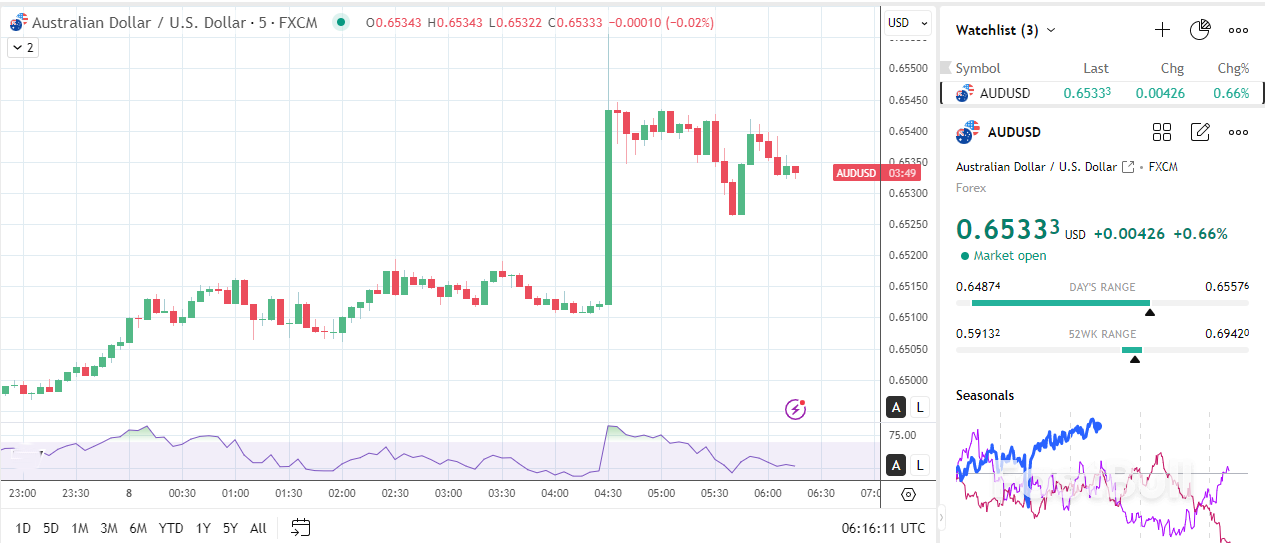
          RBA Governor Michele Bullock held a test press conference after the Bank unexpectedly held interest rates at 3.85%. Falling bets on multiple rate cuts in H2 2025 drove the AUD/USD pair higher, exposing the pair to heightened volatility during the press conference. However, the pair dipped during the press conference as RBA Governor Bullock hinted at a possible August rate cut.
          Key Takeaways from the media Q&A:
          If the quarterly CPI shows inflation falling toward the middle of the band over time, the RBA can cut interest rates in the next meeting.
          We have the opportunity to cut rates cautiously and gradually as the RBA didn’t hike rates to levels seen elsewhere.
          The RBA could cut rates more aggressively if needed.
          On tariffs, there will be an impact on us, partly driving deflationary forecasts, but the impact on Australia will likely be less severe than on the US. Trade terms with China remain crucial.
          The Reserve Bank can’t go out and warn markets against rate cut bets before the interest rate decision.
          Differences among board members relate to the timing of rate cuts, not the direction.
          Households should be banking on us to ensure inflation doesn’t get out of hand again.
          We’ve still got a low unemployment rate relative to history.
          Provided we are still on top of inflation and we are getting confirmation, then an easing cycle is coming.
          House building costs and durable goods in the monthly CPI numbers were higher than the RBA thought, contributing to the rate cut delay.
          If there is an external shock, the RBA has room to react.
          We are not keeping interest rates high just in case. We are reacting to the data.
          If China bolsters its economy with fiscal stimulus, that could cushion the impact of tariffs on Australia’s economy.

          RBA Surprises Markets, Fueling Aussie Dollar Demand

          Earlier on Tuesday, the RBA caught markets by surprise, leaving the cash rate at 3.85%. Economists expected a 25-basis point rate cut. The RBA Rate Statement set the stage for a testy press conference for RBA Governor Michele Bullock.

          Expert Views on the RBA Rate Path

          Shane Oliver, Head of Investment Strategy and Chief Economist at AMP, remarked on the RBA’s interest rate decision, stating:
          “RBA surprised on hold waiting for a more info inflation is on track for 2.5%. With the RBA seeing inflation risks more balanced, remaining “cautious” & noting heightened uncertainty & the cash rate > neutral we still it falling to 2.85% but more slowly with next cut in Aug.”
          AUD/USD Reacts to Governor Michele Bullock’s Q&A Session
          The AUD/USD pair soared in reaction to the RBA’s interest rate decision, climbing from $0.65120 to a pre-press conference high of 0.65567.
          The AUD/USD gave up some gains during the RBA press conference, falling from $0.65427 to a low of $0.65263 before steadying. The market reaction reflected hopes of an August rate cut but a potentially less dovish RBA policy stance, narrowing the US-Australia interest rate differential in favor of the Aussie dollar.
          On Tuesday, July 8, the AUD/USD was up 0.66% to $0.65333.
          RBA Governor Bullock Hints at August Cut After Surprise Hold; AUD/USD Jumps_1

          AUDUSD – 5 Minute Chart – 080725

          Source: fxempire

          To stay updated on all economic events of today, please check out our Economic calendar
          Risk Warnings and Disclaimers
          You understand and acknowledge that there is a high degree of risk involved in trading. Following any strategies or investment methods may lead to potential losses. The content on the site is provided by our contributors and analysts for information purposes only. You are solely responsible for determining whether any trading assets, securities, strategy, or any other product is suitable for investing based on your own investment objectives and financial situation.
          Add to Favorites
          Share

          ’It’s Dangerous to Underestimate Corporate America’: BofA Ups S&P 500 Target

          Glendon

          Economic

          Stocks

          Bank of America raised its S&P 500 year-end target to 6,300 from 5,600, citing the resilience of U.S. corporations despite persistent macroeconomic uncertainty.

          In a note Tuesday, the bank’s analysts wrote, “It’s dangerous to underestimate Corporate America,” and admitted, “Mea culpa for ignoring our own advice (above) on Liberation Day.”

          The firm also introduced a 12-month target of 6,600, saying a lower equity risk premium (ERP) assumption now offsets the headwinds from elevated sovereign yields.

          “The resiliency of large public companies in the face of macro uncertainty leads us to lower our equity risk premium (ERP) assumption,” BofA said.

          While acknowledging that “policy uncertainty is near all-time highs and sovereign yields are at multi-decade highs,” BofA believes the outlook is brighter for equities than bonds.

          “Price return is only half the story – dividends are likely to contribute more from here,” the analysts wrote. “Aging demographics and sticky inflation create a compelling supply/demand case for inflation-proof income and easily favors stocks over bonds.”

          In the near term, BofA noted that momentum could slow, saying the S&P 500’s run “into Q3” lacks an obvious catalyst. “Negative guidance and revisions in April/May have improved to average levels but economic surprises have broken down,” it said.

          However, looking further ahead, BofA is more constructive: “Deregulation and a pick-up in business investment could buoy markets ahead of mid-term elections.”

          Even with modest long-term price returns projected from today’s elevated multiples, BofA remains bullish. “Corporate transparency has remained intact,” the analysts concluded, adding that since COVID, “corporates either adapted or dropped out of the index.”

          Source: Yahoo Finance

          To stay updated on all economic events of today, please check out our Economic calendar
          Risk Warnings and Disclaimers
          You understand and acknowledge that there is a high degree of risk involved in trading. Following any strategies or investment methods may lead to potential losses. The content on the site is provided by our contributors and analysts for information purposes only. You are solely responsible for determining whether any trading assets, securities, strategy, or any other product is suitable for investing based on your own investment objectives and financial situation.
          Add to Favorites
          Share
          FastBull
          Copyright © 2025 FastBull Ltd

          728 RM B 7/F GEE LOK IND BLDG NO 34 HUNG TO RD KWUN TONG KLN HONG KONG

          TelegramInstagramTwitterfacebooklinkedin
          App Store Google Play Google Play
          Products
          Charts

          Chats

          Q&A with Experts
          Screeners
          Economic Calendar
          Data
          Tools
          Membership
          Features
          Function
          Markets
          Copy Trading
          Latest Signals
          Contests
          News
          Analysis
          24/7
          Columns
          Education
          Company
          Careers
          About Us
          Contact Us
          Advertising
          Help Center
          Feedback
          User Agreement
          Privacy Policy
          Business

          White Label

          Data API

          Web Plug-ins

          Poster Maker

          Affiliate Program

          Risk Disclosure

          The risk of loss in trading financial instruments such as stocks, FX, commodities, futures, bonds, ETFs and crypto can be substantial. You may sustain a total loss of the funds that you deposit with your broker. Therefore, you should carefully consider whether such trading is suitable for you in light of your circumstances and financial resources.

          No decision to invest should be made without thoroughly conducting due diligence by yourself or consulting with your financial advisors. Our web content might not suit you since we don't know your financial conditions and investment needs. Our financial information might have latency or contain inaccuracy, so you should be fully responsible for any of your trading and investment decisions. The company will not be responsible for your capital loss.

          Without getting permission from the website, you are not allowed to copy the website's graphics, texts, or trademarks. Intellectual property rights in the content or data incorporated into this website belong to its providers and exchange merchants.

          Not Logged In

          Log in to access more features

          FastBull Membership

          Not yet

          Purchase

          Become a signal provider
          Help Center
          Customer Service
          Dark Mode
          Price Up/Down Colors

          Log In

          Sign Up

          Position
          Layout
          Fullscreen
          Default to Chart
          The chart page opens by default when you visit fastbull.com