Markets
News
Analysis
User
24/7
Economic Calendar
Education
Data
- Names
- Latest
- Prev



Signal Accounts for Members
All Signal Accounts
All Contests


The Main Shanghai Gold Futures Contract Fell By 2.00% During The Day, Currently Trading At 1098.00 Yuan/gram
Bessent: Cap On Credit Card Interest At 10% For One Year Would Help Allow Americans To Recover From Past Inflation
The Survey Results Show That OPEC Oil Production Declined In January, With Venezuela Experiencing Significant Fluctuations
U.S. Treasury Secretary Bessant Stated That The U.S. Will Not "go To Any Lengths" To Loosen Financial Regulations
A Senior Iranian Source Said The Outcome Of The Negotiations Depends On Whether The United States Changes Its Current Approach. Consultations Are Currently Underway Regarding The Final Arrangements For Friday's Talks And Whether Direct Negotiations Can Take Place
U.S. Treasury Secretary Bessenter: The Federal Reserve’s Involvement In Other Areas Would Damage Its Independence
[Italian Banking Sector Continues To Hit Record Closing Highs] Germany's DAX 30 Index Preliminarily Closed Down 0.54% At 24,647.18 Points. France's Stock Index Preliminarily Closed Up 1.22%, Italy's Stock Index Preliminarily Closed Up 0.69% With Its Banking Index Up 0.36%, And The UK Stock Index Preliminarily Closed Up 1.22%
The STOXX Europe 600 Index Closed Up 0.27% At 619.57 Points, A Record Closing High. The Eurozone STOXX 50 Index Closed Down 0.17% At 5984.95 Points. The FTSE Eurotop 300 Index Closed Up 0.21% At 2468.84 Points
U.S. Treasury Secretary Bessant: The Fed’s Dual Mandate (maintaining Price Stability And Achieving Full Employment) Is A “very Good Balance.”
Bessent: Independence Of Federal Reserve Is Based On Its Trust Among The American People, It Has Lost That -House Financial Services Committee Hearing

Euro Zone Services PMI Final (Jan)A:--
F: --
P: --
U.K. Composite PMI Final (Jan)A:--
F: --
P: --
U.K. Total Reserve Assets (Jan)A:--
F: --
P: --
U.K. Services PMI Final (Jan)A:--
F: --
P: --
U.K. Official Reserves Changes (Jan)A:--
F: --
P: --
Euro Zone Core CPI Prelim YoY (Jan)A:--
F: --
P: --
Euro Zone Core HICP Prelim YoY (Jan)A:--
F: --
P: --
Euro Zone HICP Prelim YoY (Jan)A:--
F: --
P: --
Euro Zone PPI MoM (Dec)A:--
F: --
Euro Zone Core HICP Prelim MoM (Jan)A:--
F: --
P: --
Italy HICP Prelim YoY (Jan)A:--
F: --
P: --
Euro Zone Core CPI Prelim MoM (Jan)A:--
F: --
P: --
Euro Zone PPI YoY (Dec)A:--
F: --
U.S. MBA Mortgage Application Activity Index WoWA:--
F: --
P: --
Brazil IHS Markit Composite PMI (Jan)A:--
F: --
P: --
Brazil IHS Markit Services PMI (Jan)A:--
F: --
P: --
U.S. ADP Employment (Jan)A:--
F: --
The U.S. Treasury Department released its quarterly refinancing statement.
U.S. IHS Markit Composite PMI Final (Jan)A:--
F: --
P: --
U.S. IHS Markit Services PMI Final (Jan)A:--
F: --
P: --
U.S. ISM Non-Manufacturing Price Index (Jan)A:--
F: --
P: --
U.S. ISM Non-Manufacturing Employment Index (Jan)A:--
F: --
P: --
U.S. ISM Non-Manufacturing New Orders Index (Jan)A:--
F: --
P: --
U.S. ISM Non-Manufacturing Inventories Index (Jan)A:--
F: --
P: --
U.S. ISM Non-Manufacturing PMI (Jan)A:--
F: --
P: --
U.S. EIA Weekly Crude Oil Imports ChangesA:--
F: --
P: --
U.S. EIA Weekly Heating Oil Stock ChangesA:--
F: --
P: --
U.S. EIA Weekly Crude Demand Projected by ProductionA:--
F: --
P: --
U.S. EIA Weekly Gasoline Stocks ChangeA:--
F: --
P: --
U.S. EIA Weekly Crude Stocks ChangeA:--
F: --
P: --
U.S. EIA Weekly Cushing, Oklahoma Crude Oil Stocks ChangeA:--
F: --
P: --
Australia Trade Balance (SA) (Dec)--
F: --
P: --
Australia Exports MoM (SA) (Dec)--
F: --
P: --
Japan 30-Year JGB Auction Yield--
F: --
P: --
Indonesia Annual GDP Growth--
F: --
P: --
Indonesia GDP YoY (Q4)--
F: --
P: --
France Industrial Output MoM (SA) (Dec)--
F: --
P: --
Italy IHS Markit Construction PMI (Jan)--
F: --
P: --
Euro Zone IHS Markit Construction PMI (Jan)--
F: --
P: --
Germany Construction PMI (SA) (Jan)--
F: --
P: --
Italy Retail Sales MoM (SA) (Dec)--
F: --
P: --
U.K. Markit/CIPS Construction PMI (Jan)--
F: --
P: --
France 10-Year OAT Auction Avg. Yield--
F: --
P: --
Euro Zone Retail Sales YoY (Dec)--
F: --
P: --
Euro Zone Retail Sales MoM (Dec)--
F: --
P: --
U.K. BOE MPC Vote Cut (Feb)--
F: --
P: --
U.K. BOE MPC Vote Hike (Feb)--
F: --
P: --
U.K. BOE MPC Vote Unchanged (Feb)--
F: --
P: --
U.K. Benchmark Interest Rate--
F: --
P: --
MPC Rate Statement
U.S. Challenger Job Cuts (Jan)--
F: --
P: --
U.S. Challenger Job Cuts MoM (Jan)--
F: --
P: --
U.S. Challenger Job Cuts YoY (Jan)--
F: --
P: --
Bank of England Governor Bailey held a press conference on monetary policy.
Euro Zone ECB Marginal Lending Rate--
F: --
P: --
Euro Zone ECB Deposit Rate--
F: --
P: --


No matching data
View All

No data
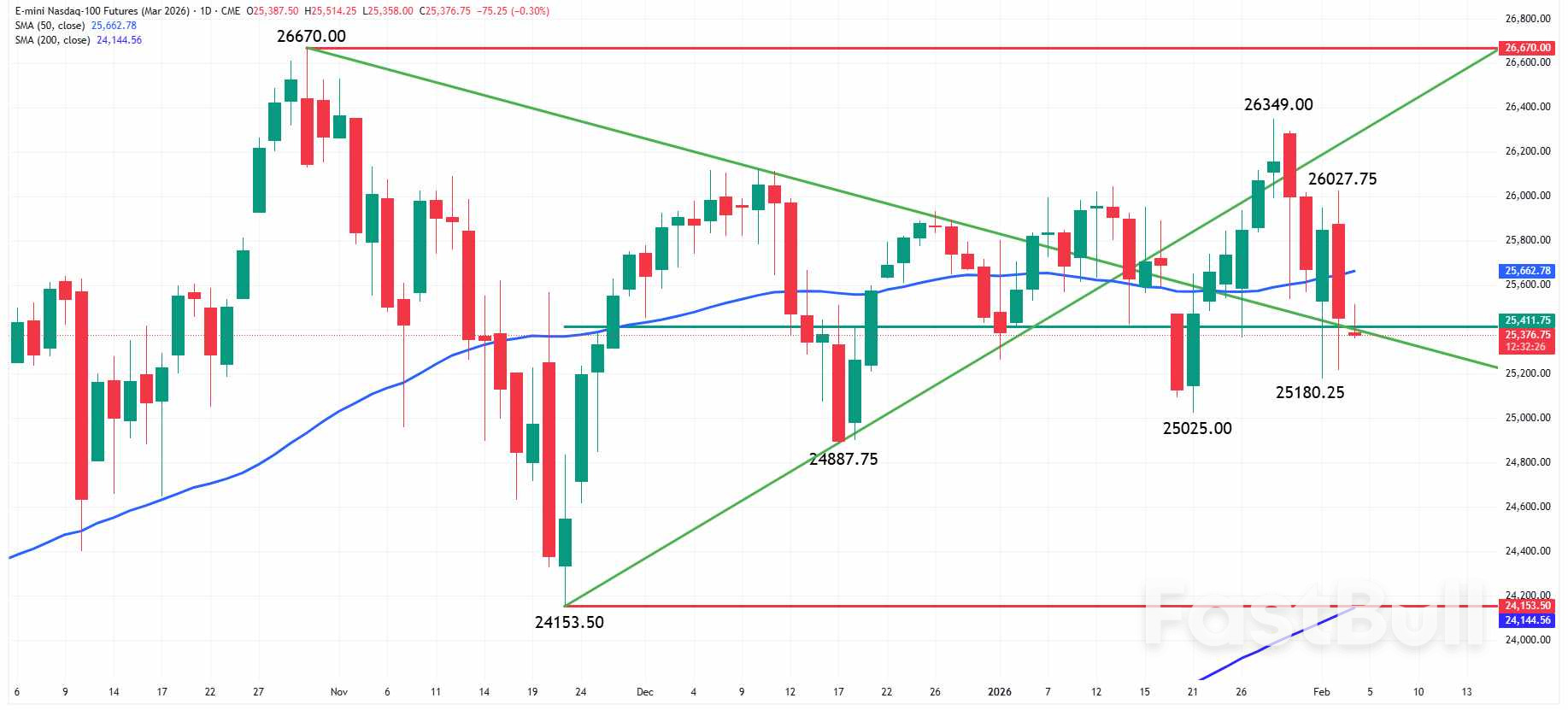
The Nasdaq turned bearish after breaking its 50-day moving average as AI fears triggered a sharp tech selloff, prompting rotation into old-economy stocks and raising correction risks ahead of major earnings.
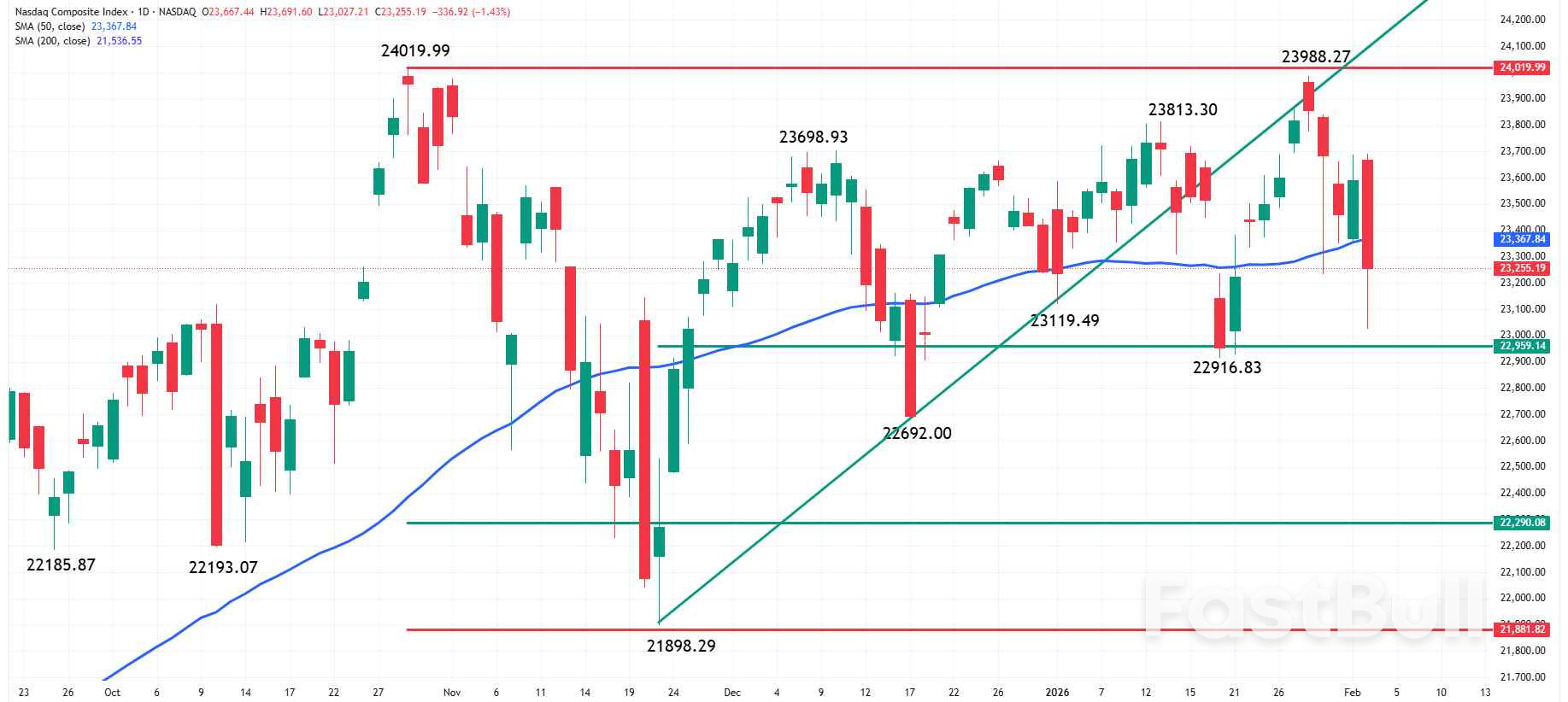
Daily Nasdaq Composite Index (IXIC)
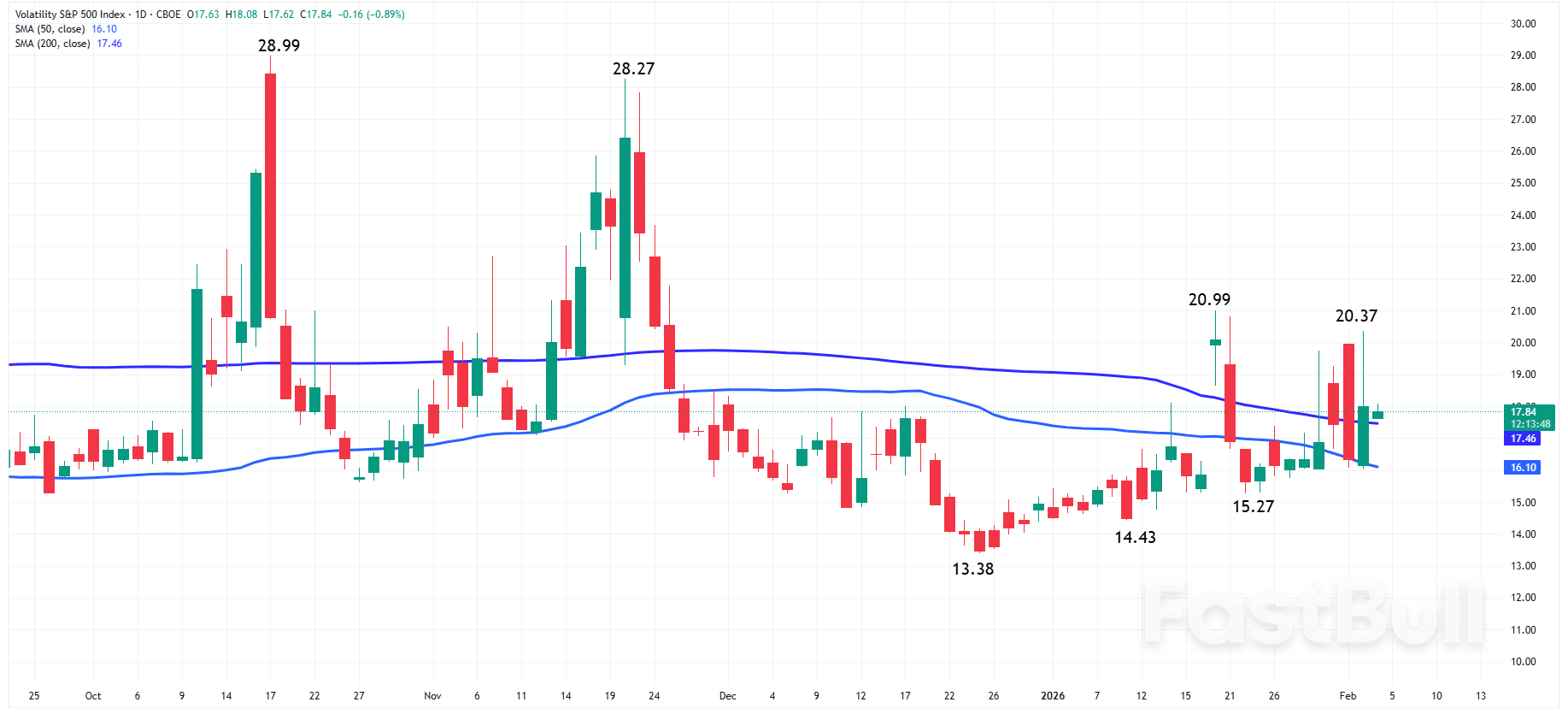
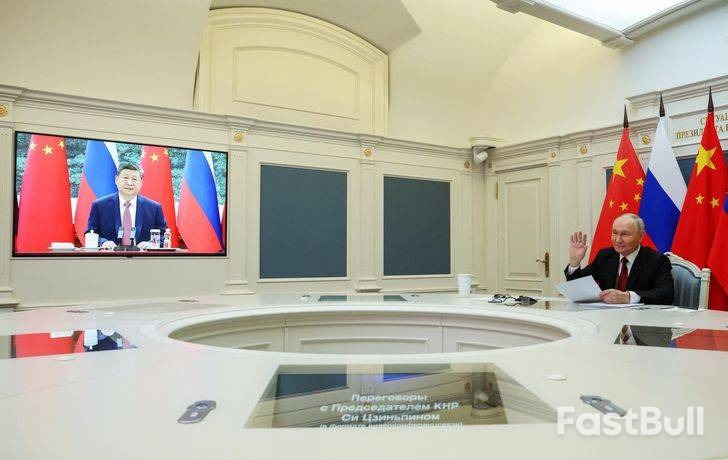
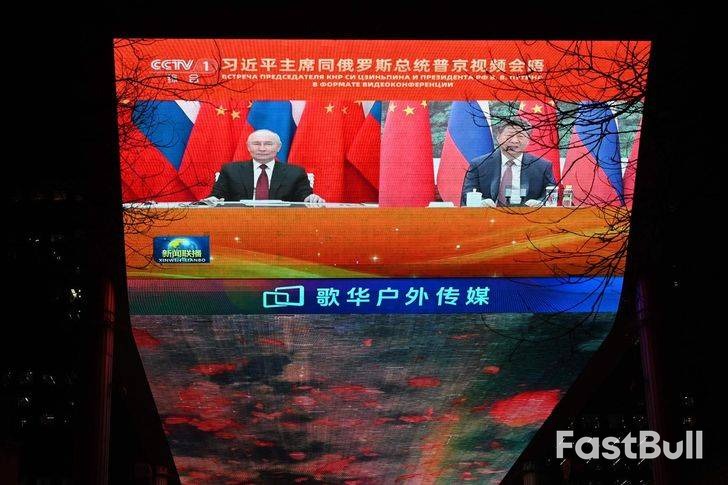
Daily Volatility S&P 500 Index (VIX)Chinese President Xi Jinping and his Russian counterpart Vladimir Putin reaffirmed their strategic partnership on Wednesday, hailing their deepening alliance as a key stabilizing force in an increasingly turbulent world.
In a video call, both leaders underscored their commitment to a united front against the West, building on ties that have grown closer since Russia's 2022 offensive in Ukraine. The discussion followed recent meetings between top officials from both nations, who agreed that their relationship could "break new ground" this year through expanded economic cooperation.

Xi told Putin that the international situation has become more turbulent since the start of the year. According to Chinese state broadcaster CCTV, Xi called for "deeper strategic coordination" to ensure that China-Russia relations "continue to develop steadily along the right track."
Addressing Xi as his "dear friend," Putin echoed the sentiment, stating that "the foreign policy alliance between Moscow and Beijing remains an important stabilizing factor." He described their comprehensive partnership as "exemplary," though neither leader specified the exact areas where they would increase coordination.
Putin praised the strong trade ties between the two countries, which have become crucial for Moscow as it redirects exports toward Asia. This economic pivot is a direct response to the massive sanctions imposed by Western nations following the Kremlin's military actions in Ukraine.
China has consistently avoided denouncing Russia's military campaign and has not called for a withdrawal of troops, a position that many of Ukraine's allies view as tacit support for Moscow.
The video conference occurred as Russian, Ukrainian, and U.S. negotiators were meeting in Abu Dhabi for another round of talks aimed at ending the conflict. However, Putin made no reference to Ukraine during his call with Xi.

This high-level communication follows several in-person meetings. The two leaders last met in September when Putin attended a military parade in Beijing. Xi had also visited Moscow in May of last year for Russia's World War II victory celebrations. More recently, on Sunday, China's Foreign Minister Wang Yi met with Russia's security chief Sergei Shoigu in Beijing, where Wang stressed the need to jointly uphold multilateralism and "advocate for an equal and orderly multipolar world."
The call with Putin is part of a broader diplomatic effort by Xi to consolidate international support, particularly as China navigates its relationship with an increasingly unpredictable United States.
During the discussion, Xi reiterated his commitment to the international system centered around the United Nations, where China holds a permanent, veto-wielding seat on the Security Council. This emphasis on the UN has been a consistent theme in his recent talks with leaders from France, Canada, Britain, and Brazil.
This focus comes after U.S. President Donald Trump announced plans in January for a "Board of Peace," raising concerns that Washington may seek to create an alternative to the United Nations.
Even while engaging with the UN, Beijing has pushed back against what it considers internal interference. It has also worked to position itself as a stable global partner, hosting Western leaders and U.S. allies who have been unsettled by Trump's policies, such as his tariff threats and his bid to acquire Greenland. In recent weeks, leaders from France, Canada, Finland, and Uruguay have all made visits to Beijing.
India and the United States are negotiating a trade agreement that would see the U.S. lower tariffs on Indian goods from 50% to 18%. In return, India would stop purchasing Russian oil and reduce its own trade barriers. While the broad strokes of the deal have been shared, specific details remain under wraps, particularly regarding the contentious issue of agricultural market access.
India is unlikely to reduce tariffs on major U.S. agricultural imports like corn, soybeans, and soymeal. The primary reason is the country's ban on genetically modified (GM) food crops, a standard for the vast majority of U.S. corn and soybean production. This fundamental difference severely limits the potential for American market penetration.
Furthermore, India’s import needs for these commodities are small compared to a country like China. India currently holds large domestic stockpiles of both corn and soymeal, which is used as animal feed. While it is the world's biggest importer of soyoil—sourcing mainly from Brazil, Argentina, and the U.S.—its purchases of raw soybeans are negligible.
Other key areas face similar resistance:
• Ethanol: India has sufficient domestic ethanol production from corn, rice, and sugarcane, making it improbable that it will agree to import U.S. ethanol or the corn needed to produce it.
• Dairy: The U.S. has pushed for greater access to India’s heavily protected dairy market. However, New Delhi is expected to keep this sector off-limits to protect the livelihoods of millions of small farmers. Indian officials point to the vast difference in scale, with the average Indian farmer owning just two to three animals compared to herds of hundreds in the United States.
While core agricultural sectors are protected, India may be willing to lower trade barriers on a range of other products. These are typically items that do not directly threaten the income of a large number of Indian farmers.
Potential areas for concessions include:
• Almonds, walnuts, and pistachios
• Apples, pears, and berries
• Fruits and vegetables
• Wine and spirits
Since India is already dependent on imports for many of these premium goods, reducing tariffs would be an easier political move for Prime Minister Narendra Modi's government. A deal in these areas would also allow President Donald Trump's administration to claim a victory for American farmers by securing new market access.
Agriculture is a deeply sensitive issue in India. Although the sector makes up just 15% of the country's nearly $4 trillion economy, it provides a livelihood for almost half of its 1.4 billion people.
Nearly 80% of farmers in India are smallholders who own two hectares of land or less, which limits their income potential. This massive population forms a powerful voting bloc that successive governments have been careful not to alienate.
Farmer advocacy groups are already mobilizing against the potential deal. The Samyukt Kisan Morcha, a coalition of farmers' organizations, and prominent leaders like Rakesh Tikait have begun to criticize the Modi government's trade negotiations with Washington, signaling the political challenges that lie ahead.
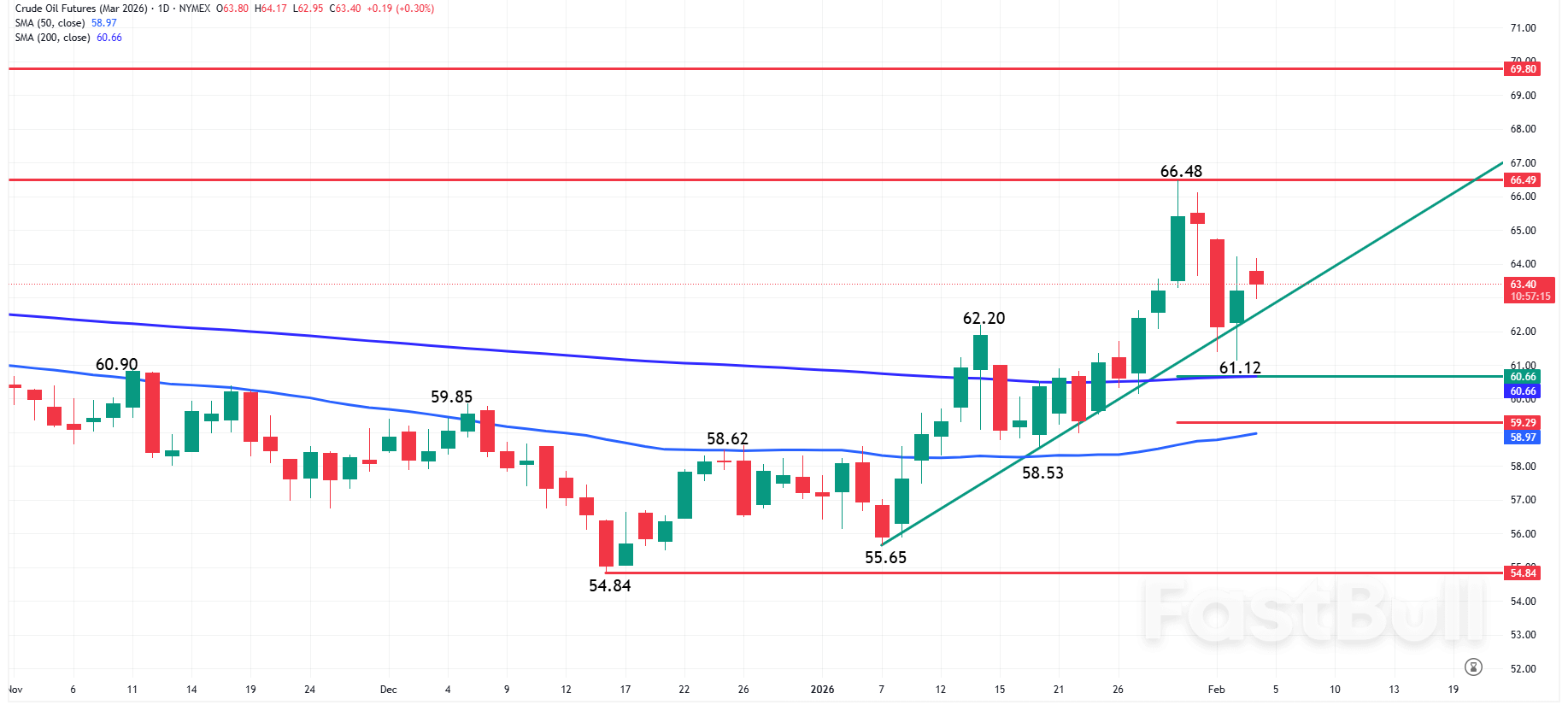
Daily March WTI Crude Oil FuturesThe United Nations is sounding the alarm over its finances, warning of a potential cash crisis by July as funding from the United States dwindles and unpaid dues from member states accumulate.
U.N. Secretary-General António Guterres stated that outstanding contributions from members reached a record $1.568 billion by the end of 2025. With collections covering only 76.7% of assessed contributions, the organization's financial stability is at risk.
Guterres cautioned that unless collections improve dramatically, the U.N. will be unable to fully implement its 2026 budget and could face a severe liquidity crisis by the middle of the year. The situation is compounded by new budgeting rules that require the U.N. to return certain "unspent funds" to members.

The financial squeeze follows significant policy shifts from the Trump administration, which has been cutting support over claims the U.N. fails to advance U.S. interests. Historically, the United States has been the organization's largest financial backer.
In 2024, for instance, U.S. taxpayers provided approximately 25% of the U.N.'s core budget and peacekeeping operations, along with 40% of its humanitarian assistance funding. The withdrawal of this support exposes the U.N.'s deep financial dependence on American contributions.
This dynamic intensified in January 2026 when the United States formally withdrew from the World Health Organization and began exiting dozens of other international bodies, citing a misalignment with American priorities.
The funding shortfall is already having tangible effects on U.N. operations worldwide. Agencies including the World Food Programme and various refugee organizations are reportedly preparing for layoffs and program reductions. Overall contributions have fallen to their lowest point in a decade, forcing a widespread tightening of spending.
In his final yearly address before stepping down at the end of 2026, Secretary-General Guterres made a direct appeal to member states. "Either all member states honour their obligations to pay in full and on time—or member states must fundamentally overhaul our financial rules to prevent an imminent financial collapse," he wrote.
Guterres also highlighted a world troubled by "self-defeating geopolitical divides" and "brazen violations of international law," while denouncing "wholesale cuts in development and humanitarian aid."
The crisis raises a fundamental question that drives the U.S. position: why American taxpayers should continue funding a global institution that is increasingly viewed as ideologically opposed to their country's values and national interests.
The risk of loss in trading financial instruments such as stocks, FX, commodities, futures, bonds, ETFs and crypto can be substantial. You may sustain a total loss of the funds that you deposit with your broker. Therefore, you should carefully consider whether such trading is suitable for you in light of your circumstances and financial resources.
No decision to invest should be made without thoroughly conducting due diligence by yourself or consulting with your financial advisors. Our web content might not suit you since we don't know your financial conditions and investment needs. Our financial information might have latency or contain inaccuracy, so you should be fully responsible for any of your trading and investment decisions. The company will not be responsible for your capital loss.
Without getting permission from the website, you are not allowed to copy the website's graphics, texts, or trademarks. Intellectual property rights in the content or data incorporated into this website belong to its providers and exchange merchants.
Not Logged In
Log in to access more features
Log In
Sign Up