• Trade
  • Markets
  • Copy
  • Contests
  • News
  • 24/7
  • Calendar
  • Q&A
  • Chats
Trending
Screeners
SYMBOL
LAST
BID
ASK
HIGH
LOW
NET CHG.
%CHG.
SPREAD
SPX
S&P 500 Index
6846.50
6846.50
6846.50
6878.28
6827.18
-23.90
-0.35%
--
DJI
Dow Jones Industrial Average
47739.31
47739.31
47739.31
47971.51
47611.93
-215.67
-0.45%
--
IXIC
NASDAQ Composite Index
23545.89
23545.89
23545.89
23698.93
23455.05
-32.22
-0.14%
--
USDX
US Dollar Index
99.000
99.080
99.000
99.000
99.000
+0.050
+ 0.05%
--
EURUSD
Euro / US Dollar
1.16338
1.16394
1.16338
1.16365
1.16322
-0.00026
-0.02%
--
GBPUSD
Pound Sterling / US Dollar
1.33177
1.33282
1.33177
1.33213
1.33140
-0.00028
-0.02%
--
XAUUSD
Gold / US Dollar
4189.70
4190.14
4189.70
4218.85
4175.92
-8.21
-0.20%
--
WTI
Light Sweet Crude Oil
58.555
58.807
58.555
60.084
58.495
-1.254
-2.10%
--

Community Accounts

Signal Accounts
--
Profit Accounts
--
Loss Accounts
--
View More

Become a signal provider

Sell trading signals to earn additional income

View More

Guide to Copy Trading

Get started with ease and confidence

View More

Signal Accounts for Members

All Signal Accounts

Best Return
  • Best Return
  • Best P/L
  • Best MDD
Past 1W
  • Past 1W
  • Past 1M
  • Past 1Y

All Contests

  • All
  • Trump Updates
  • Recommend
  • Stocks
  • Cryptocurrencies
  • Central Banks
  • Featured News
Top News Only
Share

Senior USA Administration Official: We Continue To Monitor Drc-Rwanda Situation Closely, Continue To Work With All Sides To Ensure Commitments Are Honored

Share

Israeli Military Says It Has Struck Infrastructure Belonging To Hezbollah In Several Areas In Southern Lebanon

Share

SPDR Gold Holdings Down 0.11%, Or 1.14 Tonnes

Share

On Monday (December 8), In Late New York Trading, S&P 500 Futures Fell 0.21%, Dow Jones Futures Fell 0.43%, NASDAQ 100 Futures Fell 0.08%, And Russell 2000 Futures Fell 0.04%

Share

Morgan Stanley: Data Center ABS Spreads Are Expected To Widen In 2026

Share

(US Stocks) The Philadelphia Gold And Silver Index Closed Down 2.34% At 311.01 Points. (Global Session) The NYSE Arca Gold Miners Index Closed Down 2.17%, Hitting A Daily Low Of 2235.45 Points; US Stocks Remained Slightly Down Before The Opening Bell—holding Steady Around 2280 Points—before Briefly Rising Slightly

Share

IMF: IMF Executive Board Approves Extension Of The Extended Credit Facility Arrangement With Nepal

Share

Trump: Same Approach Will Apply To Amd, Intel, And Other Great American Companies

Share

Trump: Department Of Commerce Is Finalizing Details

Share

Trump: $25% Will Be Paid To United States Of America

Share

Trump: President Xi Responded Positively

Share

[Consumer Discretionary ETFs Fell Over 1.4%, Leading The Decline Among US Sector ETFs; Semiconductor ETFs Rose Over 1.1%] On Monday (December 8), The Consumer Discretionary ETF Fell 1.45%, The Energy ETF Fell 1.09%, The Internet ETF Fell 0.18%, The Regional Banks ETF Rose 0.34%, The Technology ETF Rose 0.70%, The Global Technology ETF Rose 0.93%, And The Semiconductor ETF Rose 1.13%

Share

Trump: I Have Informed President Xi, Of China, That United States Will Allow Nvidia To Ship Its H200 Products To Approved Customers In China

Share

Argentina's Merval Index Closed Up 0.02% At 3.047 Million Points. It Rose To A New Daily High Of 3.165 Million Points In Early Trading In Buenos Aires Before Gradually Giving Back Its Gains

Share

US Stock Market Closing Report | On Monday (December 8), The Magnificent 7 Index Fell 0.20% To 208.33 Points. The "mega-cap" Tech Stock Index Fell 0.33% To 405.00 Points

Share

Pentagon - USA State Dept Approves Potential Sale Of Hellfire Missiles To Belgium For An Estimated $79 Million

Share

Toronto Stock Index .GSPTSE Unofficially Closes Down 141.44 Points, Or 0.45 Percent, At 31169.97

Share

The Nasdaq Golden Dragon China Index Closed Up Less Than 0.1%. Nxtt Rose 21%, Microalgo Rose 7%, Daqo New Energy Rose 4.3%, And 21Vianet, Baidu, And Miniso All Rose More Than 3%

Share

The S&P 500 Initially Closed Down More Than 0.4%, With The Telecom Sector Down 1.9%, And Materials, Consumer Discretionary, Utilities, Healthcare, And Energy Sectors Down By As Much As 1.6%, While The Technology Sector Rose 0.7%. The NASDAQ 100 Initially Closed Down 0.3%, With Marvell Technology Down 7%, Fortinet Down 4%, And Netflix And Tesla Down 3.4%

Share

IMF: Review Pakistan Authorities To Draw The Equivalent Of About US$1 Billion

TIME
ACT
FCST
PREV
France Trade Balance (SA) (Oct)

A:--

F: --

P: --
Euro Zone Employment YoY (SA) (Q3)

A:--

F: --

P: --
Canada Part-Time Employment (SA) (Nov)

A:--

F: --

P: --

Canada Unemployment Rate (SA) (Nov)

A:--

F: --

P: --

Canada Full-time Employment (SA) (Nov)

A:--

F: --

P: --

Canada Labor Force Participation Rate (SA) (Nov)

A:--

F: --

P: --

Canada Employment (SA) (Nov)

A:--

F: --

P: --

U.S. PCE Price Index MoM (Sept)

A:--

F: --

P: --

U.S. Personal Income MoM (Sept)

A:--

F: --

P: --

U.S. Core PCE Price Index MoM (Sept)

A:--

F: --

P: --

U.S. PCE Price Index YoY (SA) (Sept)

A:--

F: --

P: --

U.S. Core PCE Price Index YoY (Sept)

A:--

F: --

P: --

U.S. Personal Outlays MoM (SA) (Sept)

A:--

F: --

P: --
U.S. 5-10 Year-Ahead Inflation Expectations (Dec)

A:--

F: --

P: --

U.S. Real Personal Consumption Expenditures MoM (Sept)

A:--

F: --

P: --
U.S. Weekly Total Rig Count

A:--

F: --

P: --

U.S. Weekly Total Oil Rig Count

A:--

F: --

P: --

U.S. Consumer Credit (SA) (Oct)

A:--

F: --

P: --
China, Mainland Foreign Exchange Reserves (Nov)

A:--

F: --

P: --

Japan Trade Balance (Oct)

A:--

F: --

P: --

Japan Nominal GDP Revised QoQ (Q3)

A:--

F: --

P: --

China, Mainland Imports YoY (CNH) (Nov)

A:--

F: --

P: --

China, Mainland Exports (Nov)

A:--

F: --

P: --

China, Mainland Imports (CNH) (Nov)

A:--

F: --

P: --

China, Mainland Trade Balance (CNH) (Nov)

A:--

F: --

P: --

China, Mainland Exports YoY (USD) (Nov)

A:--

F: --

P: --

China, Mainland Imports YoY (USD) (Nov)

A:--

F: --

P: --

Germany Industrial Output MoM (SA) (Oct)

A:--

F: --

P: --
Euro Zone Sentix Investor Confidence Index (Dec)

A:--

F: --

P: --

Canada National Economic Confidence Index

A:--

F: --

P: --

U.K. BRC Like-For-Like Retail Sales YoY (Nov)

--

F: --

P: --

U.K. BRC Overall Retail Sales YoY (Nov)

--

F: --

P: --

Australia Overnight (Borrowing) Key Rate

--

F: --

P: --

RBA Rate Statement
RBA Press Conference
Germany Exports MoM (SA) (Oct)

--

F: --

P: --

U.S. NFIB Small Business Optimism Index (SA) (Nov)

--

F: --

P: --

Mexico 12-Month Inflation (CPI) (Nov)

--

F: --

P: --

Mexico Core CPI YoY (Nov)

--

F: --

P: --

Mexico PPI YoY (Nov)

--

F: --

P: --

U.S. Weekly Redbook Index YoY

--

F: --

P: --

U.S. JOLTS Job Openings (SA) (Oct)

--

F: --

P: --

China, Mainland M1 Money Supply YoY (Nov)

--

F: --

P: --

China, Mainland M0 Money Supply YoY (Nov)

--

F: --

P: --

China, Mainland M2 Money Supply YoY (Nov)

--

F: --

P: --

U.S. EIA Short-Term Crude Production Forecast For The Year (Dec)

--

F: --

P: --

U.S. EIA Natural Gas Production Forecast For The Next Year (Dec)

--

F: --

P: --

U.S. EIA Short-Term Crude Production Forecast For The Next Year (Dec)

--

F: --

P: --

EIA Monthly Short-Term Energy Outlook
U.S. API Weekly Gasoline Stocks

--

F: --

P: --

U.S. API Weekly Cushing Crude Oil Stocks

--

F: --

P: --

U.S. API Weekly Crude Oil Stocks

--

F: --

P: --

U.S. API Weekly Refined Oil Stocks

--

F: --

P: --

South Korea Unemployment Rate (SA) (Nov)

--

F: --

P: --

Japan Reuters Tankan Non-Manufacturers Index (Dec)

--

F: --

P: --

Japan Reuters Tankan Manufacturers Index (Dec)

--

F: --

P: --

Japan Domestic Enterprise Commodity Price Index MoM (Nov)

--

F: --

P: --

Japan Domestic Enterprise Commodity Price Index YoY (Nov)

--

F: --

P: --

China, Mainland PPI YoY (Nov)

--

F: --

P: --

China, Mainland CPI MoM (Nov)

--

F: --

P: --

Italy Industrial Output YoY (SA) (Oct)

--

F: --

P: --

Q&A with Experts
    • All
    • Chatrooms
    • Groups
    • Friends
    Connecting
    .
    .
    .
    Type here...
    Add Symbol or Code

      No matching data

      All
      Trump Updates
      Recommend
      Stocks
      Cryptocurrencies
      Central Banks
      Featured News
      • All
      • Russia-Ukraine Conflict
      • Middle East Flashpoint
      • All
      • Russia-Ukraine Conflict
      • Middle East Flashpoint
      Search
      Products

      Charts Free Forever

      Chats Q&A with Experts
      Screeners Economic Calendar Data Tools
      Membership Features
      Data Warehouse Market Trends Institutional Data Policy Rates Macro

      Market Trends

      Market Sentiment Order Book Forex Correlations

      Top Indicators

      Charts Free Forever
      Markets

      News

      News Analysis 24/7 Columns Education
      From Institutions From Analysts
      Topics Columnists

      Latest Views

      Latest Views

      Trending Topics

      Top Columnists

      Latest Update

      Signals

      Copy Rankings Latest Signals Become a signal provider AI Rating
      Contests
      Brokers

      Overview Brokers Assessment Rankings Regulators News Claims
      Broker listing Forex Brokers Comparison Tool Live Spread Comparison Scam
      Q&A Complaint Scam Alert Videos Tips to Detect Scam
      More

      Business
      Events
      Careers About Us Advertising Help Center

      White Label

      Data API

      Web Plug-ins

      Affiliate Program

      Awards Institution Evaluation IB Seminar Salon Event Exhibition
      Vietnam Thailand Singapore Dubai
      Fans Party Investment Sharing Session
      FastBull Summit BrokersView Expo
      Recent Searches
        Top Searches
          Markets
          News
          Analysis
          User
          24/7
          Economic Calendar
          Education
          Data
          • Names
          • Latest
          • Prev

          View All

          No data

          Scan to Download

          Faster Charts, Chat Faster!

          Download App
          English
          • English
          • Español
          • العربية
          • Bahasa Indonesia
          • Bahasa Melayu
          • Tiếng Việt
          • ภาษาไทย
          • Français
          • Italiano
          • Türkçe
          • Русский язык
          • 简中
          • 繁中
          Open Account
          Search
          Products
          Charts Free Forever
          Markets
          News
          Signals

          Copy Rankings Latest Signals Become a signal provider AI Rating
          Contests
          Brokers

          Overview Brokers Assessment Rankings Regulators News Claims
          Broker listing Forex Brokers Comparison Tool Live Spread Comparison Scam
          Q&A Complaint Scam Alert Videos Tips to Detect Scam
          More

          Business
          Events
          Careers About Us Advertising Help Center

          White Label

          Data API

          Web Plug-ins

          Affiliate Program

          Awards Institution Evaluation IB Seminar Salon Event Exhibition
          Vietnam Thailand Singapore Dubai
          Fans Party Investment Sharing Session
          FastBull Summit BrokersView Expo

          Mid-Cap Marvels: 3 Stocks That Crushed Sales Estimates in May

          Adam

          Economic

          Stocks

          Summary:

          Three mid-cap stocks—TransMedics, Everus, and Excelerate Energy—posted major sales beats in May, driven by strong revenue growth and sector demand, leading to sharp stock gains and optimistic future outlooks.

          In May, three stocks that released earnings stood out due to their massive sales beats. These names are mid-cap companies with market capitalizations between $2 billion and $10 billion.
          Companies of this size are typically less covered by Wall Street analysts, creating larger opportunities for earnings surprises. Indeed, these companies surprised, leading to huge moves in shares.

          TMDX’s Sales Rout Forecasts, Boosts Full Year Guidance

          One stock that markets have had a love-hate relationship with over the last 52 weeks or so is TransMedics Group (NASDAQ:TMDX). The healthcare company has beaten sales estimates and seen shares rise afterward in three out of its last four releases. However, the one time that the company missed estimates over this period resulted in dire consequences for the stock.
          After the company’s Q3 2024 release came out at the end of October 2024, shares dropped 30% in one day.
          Luckily for shareholders, TransMedics delivered in its latest release. The company’s Q1 2025 sales came in at over $143 million, around 16% higher than the $123 million analysts expected. This resulted in revenue growth of over 48%, massively faster than the approximately 27% analyst forecasts implied.
          This revenue beat enabled the company to post adjusted earnings per share (EPS) of $0.70, more than twice the expected amount. TransMedics also increased the midpoint of its full-year revenue guidance by $34 million, adding fuel to its fire.
          The company’s current full-year revenue forecast of $575 million implies growth of 30% compared to 2024. Shares rose nearly 20% in the day following the release. As of the June 10 close, the stock remains down around 20% from its all-time high closing price reached in August 2024.

          ECG: +20% Sales Beat, Backlog Up 41% on Data Center Demand

          Next up is Everus (NYSE:ECG). This mid-cap construction services stock also handily beat expectations on sales, posting revenue of nearly $827 million in Q1. This was around $150 million higher than forecasted, resulting in a sales beat of over 22%. Sales growth was 32%, approximately four times faster than the Wall Street-anticipated growth of 8%. Aided by this topline number, the company’s non-adjusted EPS rose by 31% to $0.72. Analysts thought the figure would decline by 22% to $0.43.
          Shares rose 17% on the day after the results. Although analyst coverage on this stock is relatively light, those that do cover it see a solid amount of upside in shares. Stifel Nicolaus and DA Davidson both raised their targets after the results. The average of their targets is just under $70, implying upside in shares of 16% from their June 10 closing price.
          Stifel noted the 41% increase in the company’s order backlog as a reason for boosting its target to $70. The company’s backlog of $3.1 billion is slightly more than all the revenue generated over the last 12 months. This should help give the company a revenue floor going forward, providing it with a solid opportunity to continue growing sales strongly.
          The company’s Electrical and Mechanical (E&M) backlog grew particularly fast at 46%. This was largely due to demand from data center buildouts, showing that the company is participating in this growing part of the economy.

          Excelerate’s LNG Business Booms in Q1

          Last up is Excelerate Energy (NYSE:EE). Excelerate works in the liquefied natural gas (LNG) industry. It has one of the largest fleets of floating storage and regasification units (FSRUs) in the world. FSRUs are massive vessels that can not only transport LNG but can also convert it back into gas and deliver it to land-based receiving terminals.
          The company’s Q1 sales were $315 million, beating estimates of $208 million by over 51%. Revenues grew by over 57%, compared to expectations of just 4% growth. Shares rose 10% afterward.
          Jefferies recently initiated the stock with a $39 price target, implying upside of nearly 27% from its June 10 closing price. This reflects the rising global demand for LNG and the expectation that the company’s vessels will receive more valuable contracts once their current agreements expire.
          However, others fear that LNG supply will significantly outstrip demand by 2030. This would put downward pressure on prices, potentially hurting Excelerate’s investment thesis.
          Overall, these three stocks had some of the most impressive sales beats in the market in May. Everus stands out in particular due to its rapid backlog growth, which creates an opportunity for sustained sales growth going forward.

          Source: investing

          To stay updated on all economic events of today, please check out our Economic calendar
          Risk Warnings and Disclaimers
          You understand and acknowledge that there is a high degree of risk involved in trading. Following any strategies or investment methods may lead to potential losses. The content on the site is provided by our contributors and analysts for information purposes only. You are solely responsible for determining whether any trading assets, securities, strategy, or any other product is suitable for investing based on your own investment objectives and financial situation.
          Add to Favorites
          Share

          Trump’s $11 Trillion Gap: White House Optimism Clashes with Economic Reality

          Gerik

          Economic

          Contrasting Forecasts Highlight Vast Ideological Divide

          The Congressional Budget Office, the Tax Foundation, and the Penn-Wharton Budget Model all estimate that Trump’s legislative package—primarily composed of tax cuts and tariff-driven revenue plans—will deepen deficits by roughly $3 trillion over ten years. These institutions rely on conservative economic assumptions, standard scoring models, and historic precedents.
          In stark contrast, the White House projects a fiscal surplus of $6.7–$8 trillion, justifying it through overly optimistic growth expectations (3% annually), aggressive revenue forecasts from tariffs ($2.8 trillion), and cost-free assumptions for tax cuts. This divergence isn’t just technical—it reflects an ideological conflict over the role of government forecasting and economic orthodoxy.

          Optimism Anchored in 3% Growth and Tariff Windfalls

          The administration’s fiscal argument hinges largely on two controversial pillars. First, it assumes annual GDP growth of 3% for a full decade—a pace well above consensus estimates of 1.6% to 2%. Economists argue that the bill’s structure (mostly an extension of existing tax cuts) lacks sufficient stimulus to generate such sustained acceleration.
          Second, the White House counts on nearly $3 trillion in tariff revenues while ignoring the CBO’s warning that such trade measures would shrink the economy and raise inflation. This selective use of data—accepting favorable revenue projections while ignoring downside macroeconomic risks—highlights internal contradictions in the administration’s narrative.

          Internal Contradictions Undermine Policy Credibility

          Critics argue the White House is “double counting” benefits. Temporary tax cuts are treated as permanent revenue gains, while tariffs are assumed to yield stable long-term revenue despite ongoing volatility and legal challenges. Moreover, potential inflationary effects from tariffs and their drag on consumer spending are largely dismissed.
          In congressional hearings, Treasury Secretary Scott Bessent distanced himself from the most extreme claims, stating that “it remains to be seen” whether the bill will add to the debt—an implicit acknowledgment of its fiscal ambiguity. When asked to name an independent expert who supports the administration’s view, he cited Arthur Laffer, a long-time supply-side advocate, drawing laughter from lawmakers.

          Fiscal Confidence Erodes as Assumptions Collide

          The administration’s persistent dismissal of mainstream economic opinion adds political risk to fiscal uncertainty. While Trump's budget chief Russ Vought frames the plan as a “coherent fiscal agenda,” even Republican lawmakers have balked at relying on assumptions not shared by the CBO or their own budget offices.
          As negotiations continue, the legal fragility of certain tariffs—especially those linked to Trump’s controversial “Liberation Day” declarations—adds more volatility. An appeals court has temporarily upheld them, but any judicial reversal could further derail revenue assumptions.

          A Politicized Gamble on Growth

          The White House’s vision is ultimately a bet: that a combination of tax cuts, tariffs, and deregulation will trigger a productivity boom strong enough to offset revenue losses. However, economists argue that even under rosy conditions, such outcomes are historically rare and policy-sensitive.
          Unless growth surprises to the upside or a global realignment dramatically benefits U.S. exports and industrial productivity, the promised surplus may never materialize. Instead, the U.S. risks entering a new era of debt-driven fiscal policy based more on political narrative than economic fundamentals.

          Source: Reuters

          To stay updated on all economic events of today, please check out our Economic calendar
          Risk Warnings and Disclaimers
          You understand and acknowledge that there is a high degree of risk involved in trading. Following any strategies or investment methods may lead to potential losses. The content on the site is provided by our contributors and analysts for information purposes only. You are solely responsible for determining whether any trading assets, securities, strategy, or any other product is suitable for investing based on your own investment objectives and financial situation.
          Add to Favorites
          Share

          US Yields Continue Slide After Worsening Labor Data

          Daniel Carter

          Bond

          Economic

          Investors are also awaiting a $22 billion auction later Thursday of 30-year bonds, seen as another test of investor demand for U.S. sovereign debt in light of concerns over the mounting federal deficit. Wednesday's auction of 10-year Treasuries pointed to healthy demand.
          According to the Labor Department, total insured unemployment, or all people receiving benefits, overshot expectations to rise to 1.956 million workers, the highest level in nearly four years.
          Meanwhile the annual reading of the Producer Price Index ticked one tenth higher to 2.6%, in line with expectations, even though a closely watched "core" reading, which the excludes volatile food and fuel categories, was cooler than the prior month's print.
          Lou Brien, market strategist at DRW Trading, said he investors likely were reacting to labor market weakness and believed consumer price increases from President Donald Trump's trade wars were in the pipeline even if they had yet to materialize.
          "There are many details in the labor market that have shown weakness for a long time," he said. "I think the move higher in the continuing claims and the weekly claims is starting to confirm some of that weakness."
          "We're still anticipating there's gonna be some kind of a jump in prices. We keep thinking that month after month and nothing happens but I don't think that thought has left the market."
          Chinese authorities on Thursday affirmed a trade deal reached this week with Washington, though specifics remain unclear.
          The yield on the benchmark U.S. 10-year Treasury note (US10YT=TWEB) was last down 4.3 basis points to 4.371%. The yield on the 30-year bond (US30YT=TWEB) fell 4.3 basis points to 4.866%.
          A closely watched part of the U.S. Treasury yield curve measuring the gap between yields on two- and 10-year Treasury notes (US2US10=TWEB), seen as an indicator of economic expectations, was at a positive 46.6 basis points.
          The two-year (US2YT=TWEB) U.S. Treasury yield, which typically moves in step with interest rate expectations, fell 4.4 basis points to 3.901%.
          The breakeven rate on five-year U.S. Treasury Inflation-Protected Securities (US5YTIP=TWEB) was last at 2.295% after closing at 2.313% on June 11.
          The 10-year TIPS breakeven rate (US10YTIP=TWEB) was last at 2.272%, indicating the market sees inflation averaging about 2.3% a year for the next decade.

          Source: Reuters

          To stay updated on all economic events of today, please check out our Economic calendar
          Risk Warnings and Disclaimers
          You understand and acknowledge that there is a high degree of risk involved in trading. Following any strategies or investment methods may lead to potential losses. The content on the site is provided by our contributors and analysts for information purposes only. You are solely responsible for determining whether any trading assets, securities, strategy, or any other product is suitable for investing based on your own investment objectives and financial situation.
          Add to Favorites
          Share

          JP Morgan maintains 2025 forecast for oil prices in low-to-mid $60s

          Adam

          Economic

          Commodity

          JP Morgan downplayed geopolitical concerns on Thursday and maintained its base case forecast for oil prices to stay in the low-to-mid $60s through 2025 and $60 in 2026, but said certain worst-case scenarios could send prices surging to double those levels.
          U.S. President Donald Trump said on Wednesday the United States was moving personnel out of the Middle East because it "could be a dangerous place". He also said the U.S. would not allow Iran to have a nuclear weapon. Iran has said its nuclear activity is peaceful.
          Increased tension with Iran has raised the prospect of disruption to oil supplies, with both sides set to meet on Sunday.
          The geopolitical risk premium is already at least partially reflected in current oil prices, which are just under $70, trading about $4 higher than their estimated fair value of $66 for June, JP Morgan said in a Thursday note.
          However, the analysts drew attention to certain worst-case scenarios, where the impact on supply could potentially extend beyond a 2.1 million barrels per day reduction in Iranian oil exports. Attention is focused on the risk that a broader Middle East conflict could close the Strait of Hormuz, or provoke retaliatory responses from major oil producing countries in the region.
          "Under this severe outcome, we estimate oil prices could surge to the $120-130/bbl range," they said.
          Brent crude futures were trading near $68.76 per barrel on Thursday, while U.S. West Texas Intermediate crude futures were at $67.14 per barrel. [O/R]
          If nuclear negotiations fail and conflict arises with the United States, Iran will strike American bases in the region, Iranian Defence Minister Aziz Nasirzadeh said on Wednesday, days ahead of a planned sixth round of Iran-U.S. nuclear talks.
          The U.N. nuclear watchdog's board of governors declared Iran in breach of its non-proliferation obligations on Thursday and Tehran announced counter-measures, as tensions rose in the Middle East.

          source : Reuters

          To stay updated on all economic events of today, please check out our Economic calendar
          Risk Warnings and Disclaimers
          You understand and acknowledge that there is a high degree of risk involved in trading. Following any strategies or investment methods may lead to potential losses. The content on the site is provided by our contributors and analysts for information purposes only. You are solely responsible for determining whether any trading assets, securities, strategy, or any other product is suitable for investing based on your own investment objectives and financial situation.
          Add to Favorites
          Share

          Fed Seen On Track To Resume Rate Cuts After Inflation, Job Market Data

          Damon

          Economic

          The Federal Reserve's path to interest rate cuts starting in September appeared to widen on Thursday, after a pair of government reports pointed to cooler inflation and signs of potential weakening in the labor market.

          U.S. producer prices advanced 2.6% in May from a year earlier, after rising 2.5% in April, the Labor Department reported. Taken together with tamer-than-expected increases in the Consumer Price Index in May, economists estimated that inflation by the Fed's preferred gauge of underlying price pressures, the core Personal Consumption Expenditures Price Index, likely rose in line with the Fed's 2% goal last month.Economists still expect the Trump administration's tariffs to push up prices and lift inflation later this year, but "the near-term trend remains favorable, enabling the (Fed) to signal next week that it still intends to begin easing policy again later this year," economists at Pantheon Macroeconomics wrote.

          They estimate that core PCE rose by just 0.12% in May from April, based on the latest PPI and CPI data. Economists at other Wall Street firms issued similar estimates.

          The Fed is nearly universally expected to leave its policy rate in the 4.25%-4.50% range at its June 17-18 meeting. Futures that settle to the Fed's policy rate show traders now expect a quarter-percentage-point reduction by September, with another such move likely in October. Before Thursday's data, traders had expected the Fed to wait until December to deliver a second rate cut. The U.S. central bank cut rates three times in 2024.A separate Labor Department report on Thursday showed initial weekly claims for jobless benefits held steady at a seasonally adjusted 248,000 for the week ended June 7, while continuing claims jumped to 1.951 million, their highest level since November 2021 and a sign that it is getting harder for unemployed workers to find a new job.

          "Americans, especially recent graduates, are worried about how hard it is to find a job," said Heather Long, chief economist at Navy Federal Credit Union. "If layoffs worsen this summer, it will heighten fears of a recession and consumer spending pullback."

          Source: Kitco

          To stay updated on all economic events of today, please check out our Economic calendar
          Risk Warnings and Disclaimers
          You understand and acknowledge that there is a high degree of risk involved in trading. Following any strategies or investment methods may lead to potential losses. The content on the site is provided by our contributors and analysts for information purposes only. You are solely responsible for determining whether any trading assets, securities, strategy, or any other product is suitable for investing based on your own investment objectives and financial situation.
          Add to Favorites
          Share

          WTI Oil Dips 2.2%, Geopolitical Risk Keeps Bulls in Play

          Adam

          Commodity

          Oil prices surged yesterday ending the day with a 5.4% gain on heightened geopolitical risk from the Middle East. A decision by the US to lighten embassy staff in Iraq and move personnel in the Middle East ahead of Nuclear talks with Iran raised eyebrows.
          US President Trump's comments over the last 6 hours did not help matters with the President stating: “the U.S. was moving personnel because the Middle East "could be a dangerous place". He also said the U.S. would not allow Iran to have a nuclear weapon.
          Iran has said its nuclear activity is peaceful and has threatened retaliation if attacked.
          Today however, has seen Oil prices slide in European trade, down as much as 2.2% at the time of writing, trading at 66.75 a barrel.

          Straight of Hormuz Raises Supply Concerns

          A potential escalation with Iran could have massive implications for Oil markets. The biggest concern being a supply disruption as around 20% of the world's Oil passes through the Straight of Hormuz.
          The narrow chokepoint could become a key area of focus in the event of regional tensions with Britain's maritime agency warning that rising tensions in the area could lead to more military activity, which might affect shipping in key waterways.
          It advised vessels to use caution while travelling through the Gulf, the Gulf of Oman and the Straits of Hormuz, which all border Iran.

          US PPI Data Could Affect Oil Prices

          With Market participants still concerned about growth and the potential for inflation to rise due to tariffs, US PPI data could have a knock on effect on markets sentiment and thus Oil prices.
          If PPI data comes in higher than expected markets may see this as a sign that a rise in CPI may be on its way. This in turn could affect global demand as consumers prioritize critical spending.
          This of course is a possibility but Geopolitical risk is likely to remain front and center.

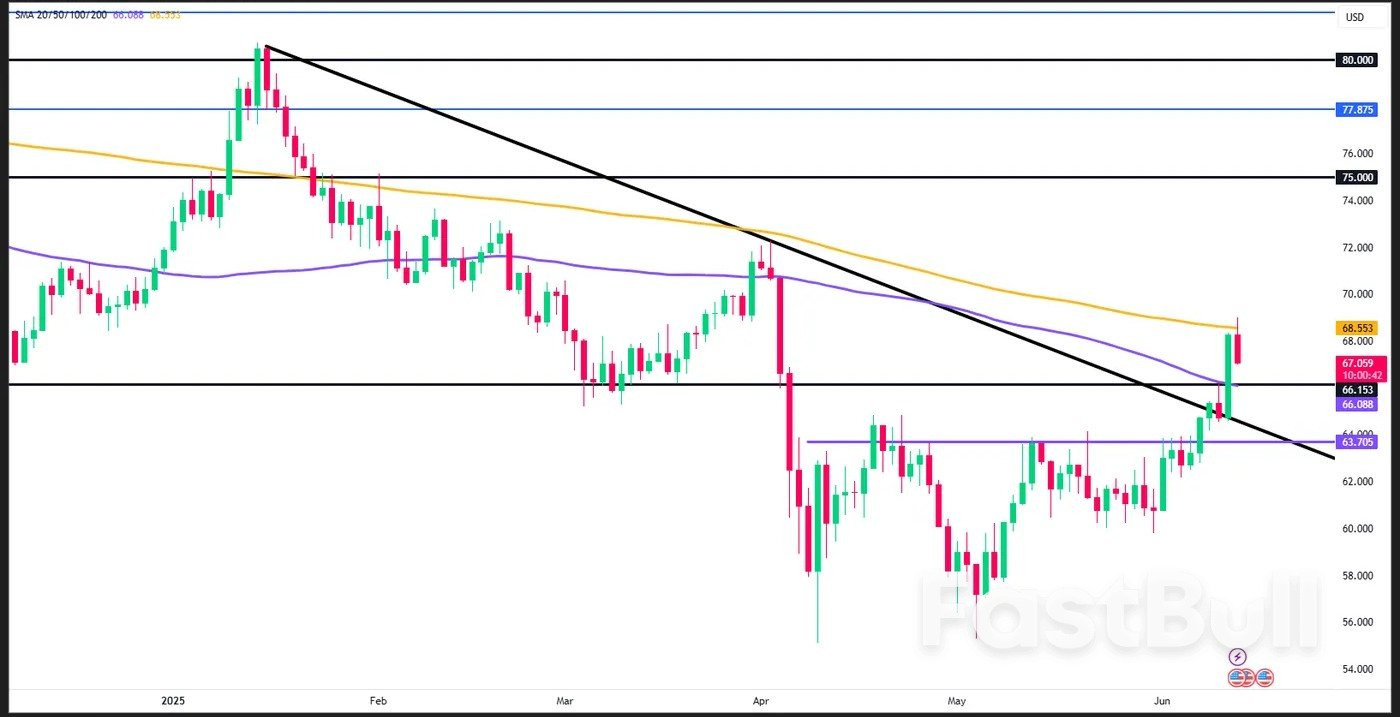
          Technical Analysis - WTI Oil

          From a technical analysis standpoint, Oil broke a significant descending trendline which had been in play since January 2025.
          However the move only occurred on the back of US-Iran tensions. Prior to that, Tuesday's daily candle close echoed a false breakout and highlighted the current concern from bulls.
          The concern for bulls still remains focused on tariffs and trade deals and how that may impact growth for the rest of the year. This will keep sellers interested and thus could hamper any rally higher.
          The rise in US-Iran tensions however could be the catalyst needed for price to head higher but then again sustainability of the move may become a hot topic of discussion. The pullback in price this morning has provided a brief glimpse that sustainable higher prices for Oil may prove to be elusive right now.
          Oil rejected after testing the 200-day MA resting at 68.55 and now looks set to test support at the 100-day MA around the 66.00 a barrel mark.
          Will this handle hold and lead to the next bullish leg or will a deeper retracement to the trendline take place? That may be the focus for day traders as the US session unfolds.
          WTI Oil Daily Chart, June 12, 2025
          WTI Oil Dips 2.2%, Geopolitical Risk Keeps Bulls in Play_1

          Source: marketpulse

          Risk Warnings and Disclaimers
          You understand and acknowledge that there is a high degree of risk involved in trading. Following any strategies or investment methods may lead to potential losses. The content on the site is provided by our contributors and analysts for information purposes only. You are solely responsible for determining whether any trading assets, securities, strategy, or any other product is suitable for investing based on your own investment objectives and financial situation.
          Add to Favorites
          Share

          Trump-Xi Trade Deal Ushers in Tentative Truce, but Tariff Ambiguities Remain

          Gerik

          Economic

          China–U.S. Trade War

          Deal Marks Political Symbolism More Than Immediate Economic Clarity

          On June 12, Beijing formally acknowledged a new trade agreement following President Trump’s declaration of a breakthrough with Chinese President Xi Jinping. While both sides emphasized commitment to consensus, the announcement is more a gesture of political cooperation than a clear economic roadmap.
          The deal, which revives talks that previously stalled due to tensions over Chinese restrictions on mineral exports, was made possible by direct leader-to-leader diplomacy. According to China's Foreign Ministry, the agreement represents both nations’ willingness to fulfill their promises, signaling that this truce—unlike earlier breakdowns—might hold if politically sustained.

          Tariff Figures Reveal Underlying Fragility in Terms

          President Trump stated the U.S. would maintain a cumulative 55% tariff on Chinese goods, combining three layers: a 10% "reciprocal" baseline rate applied broadly, an additional 20% penalty linked to China’s alleged inaction on U.S. fentanyl concerns, and 25% from legacy trade measures dating to his first term. China, in turn, reportedly committed to upfront rare earth supplies and re-admittance of Chinese students to U.S. universities.
          While such language may appeal to domestic political narratives—especially as U.S. elections loom—the actual policy implications are ambiguous. There was no published agreement text, no clear tariff phase-down schedule, and no clarification on how enforcement mechanisms would work or whether China’s mineral curbs would be relaxed reciprocally.

          Implications for Markets and Global Trade Relations

          This agreement, if implemented consistently, could bring temporary relief to global markets that have been destabilized by aggressive tit-for-tat tariffs and restrictions on semiconductors and aviation parts. Sectors such as electric vehicles, rare earth mining, and advanced manufacturing may see modest boosts if the resource supply chain normalizes.
          However, risks persist. The high 55% tariff regime signals that the U.S. is far from returning to pre-trade-war openness with China. It remains to be seen whether businesses can rely on this fragile peace when many supply chains have already diversified out of China toward Southeast Asia and India.

          Strategic Signaling Overshadows Economic Precision

          Beijing’s diplomatic language—"China always keeps its word"—hints at a soft pushback against Western skepticism but avoids specifics. Meanwhile, Trump’s statement about Chinese students returning to U.S. campuses and China fulfilling rare earth supply obligations seems aimed more at building a campaign narrative than crafting enduring economic policy.
          The new U.S.-China trade deal, while politically significant, lacks the structural clarity needed for deep investor confidence. The layered tariff scheme may stifle long-term trade normalization, and without clear benchmarks or enforcement terms, the pact risks becoming another short-lived truce. The outcome will hinge not just on policy details, but on how geopolitical pressures, especially from the tech and defense sectors, influence execution in the months ahead.

          Source: Reuters

          To stay updated on all economic events of today, please check out our Economic calendar
          Risk Warnings and Disclaimers
          You understand and acknowledge that there is a high degree of risk involved in trading. Following any strategies or investment methods may lead to potential losses. The content on the site is provided by our contributors and analysts for information purposes only. You are solely responsible for determining whether any trading assets, securities, strategy, or any other product is suitable for investing based on your own investment objectives and financial situation.
          Add to Favorites
          Share
          FastBull
          Copyright © 2025 FastBull Ltd

          728 RM B 7/F GEE LOK IND BLDG NO 34 HUNG TO RD KWUN TONG KLN HONG KONG

          TelegramInstagramTwitterfacebooklinkedin
          App Store Google Play Google Play
          Products
          Charts

          Chats

          Q&A with Experts
          Screeners
          Economic Calendar
          Data
          Tools
          Membership
          Features
          Function
          Markets
          Copy Trading
          Latest Signals
          Contests
          News
          Analysis
          24/7
          Columns
          Education
          Company
          Careers
          About Us
          Contact Us
          Advertising
          Help Center
          Feedback
          User Agreement
          Privacy Policy
          Business

          White Label

          Data API

          Web Plug-ins

          Poster Maker

          Affiliate Program

          Risk Disclosure

          The risk of loss in trading financial instruments such as stocks, FX, commodities, futures, bonds, ETFs and crypto can be substantial. You may sustain a total loss of the funds that you deposit with your broker. Therefore, you should carefully consider whether such trading is suitable for you in light of your circumstances and financial resources.

          No decision to invest should be made without thoroughly conducting due diligence by yourself or consulting with your financial advisors. Our web content might not suit you since we don't know your financial conditions and investment needs. Our financial information might have latency or contain inaccuracy, so you should be fully responsible for any of your trading and investment decisions. The company will not be responsible for your capital loss.

          Without getting permission from the website, you are not allowed to copy the website's graphics, texts, or trademarks. Intellectual property rights in the content or data incorporated into this website belong to its providers and exchange merchants.

          Not Logged In

          Log in to access more features

          FastBull Membership

          Not yet

          Purchase

          Become a signal provider
          Help Center
          Customer Service
          Dark Mode
          Price Up/Down Colors

          Log In

          Sign Up

          Position
          Layout
          Fullscreen
          Default to Chart
          The chart page opens by default when you visit fastbull.com