Markets
News
Analysis
User
24/7
Economic Calendar
Education
Data
- Names
- Latest
- Prev




Signal Accounts for Members
All Signal Accounts
All Contests


U.S. NY Fed Manufacturing New Orders Index (Jan)A:--
F: --
P: --
U.S. NY Fed Manufacturing Employment Index (Jan)A:--
F: --
P: --
U.S. Export Price Index YoY (Nov)A:--
F: --
P: --
U.S. NY Fed Manufacturing Index (Jan)A:--
F: --
U.S. Initial Jobless Claims 4-Week Avg. (SA)A:--
F: --
U.S. Export Price Index MoM (Nov)A:--
F: --
P: --
Canada Manufacturing Unfilled Orders MoM (Nov)A:--
F: --
P: --
Canada Manufacturing New Orders MoM (Nov)A:--
F: --
P: --
U.S. Philadelphia Fed Manufacturing Employment Index (Jan)A:--
F: --
P: --
Canada Wholesale Sales YoY (Nov)A:--
F: --
P: --
Canada Wholesale Inventory MoM (Nov)A:--
F: --
P: --
U.S. Philadelphia Fed Business Activity Index (SA) (Jan)A:--
F: --
P: --
U.S. EIA Weekly Natural Gas Stocks ChangeA:--
F: --
P: --
Richmond Federal Reserve President Barkin delivered a speech.
U.S. Weekly Treasuries Held by Foreign Central BanksA:--
F: --
P: --
Germany CPI Final MoM (Dec)A:--
F: --
P: --
Germany CPI Final YoY (Dec)A:--
F: --
P: --
Germany HICP Final MoM (Dec)A:--
F: --
P: --
Germany HICP Final YoY (Dec)A:--
F: --
P: --
Brazil PPI MoM (Nov)A:--
F: --
P: --
Canada New Housing Starts (Dec)A:--
F: --
U.S. Capacity Utilization MoM (SA) (Dec)A:--
F: --
U.S. Industrial Output YoY (Dec)A:--
F: --
P: --
U.S. Manufacturing Capacity Utilization (Dec)A:--
F: --
P: --
U.S. Manufacturing Output MoM (SA) (Dec)A:--
F: --
U.S. Industrial Output MoM (SA) (Dec)A:--
F: --
U.S. NAHB Housing Market Index (Jan)A:--
F: --
P: --
Russia CPI YoY (Dec)A:--
F: --
P: --
U.S. Weekly Total Rig CountA:--
F: --
P: --
U.S. Weekly Total Oil Rig CountA:--
F: --
P: --
Japan Core Machinery Orders YoY (Nov)--
F: --
P: --
Japan Core Machinery Orders MoM (Nov)--
F: --
P: --
U.K. Rightmove House Price Index YoY (Jan)--
F: --
P: --
China, Mainland GDP YoY (YTD) (Q4)--
F: --
P: --
China, Mainland Industrial Output YoY (YTD) (Dec)--
F: --
P: --
Japan Industrial Output Final MoM (Nov)--
F: --
P: --
Japan Industrial Output Final YoY (Nov)--
F: --
P: --
Euro Zone Core HICP Final MoM (Dec)--
F: --
P: --
Euro Zone HICP Final MoM (Dec)--
F: --
P: --
Euro Zone HICP Final YoY (Dec)--
F: --
P: --
Euro Zone HICP MoM (Excl. Food & Energy) (Dec)--
F: --
P: --
Euro Zone Core CPI Final YoY (Dec)--
F: --
P: --
Euro Zone Core HICP Final YoY (Dec)--
F: --
P: --
Euro Zone CPI YoY (Excl. Tobacco) (Dec)--
F: --
P: --
Euro Zone Core CPI Final MoM (Dec)--
F: --
P: --
Canada National Economic Confidence Index--
F: --
P: --
Canada CPI MoM (SA) (Dec)--
F: --
P: --
Canada Core CPI MoM (SA) (Dec)--
F: --
P: --
Canada CPI YoY (SA) (Dec)--
F: --
P: --
Canada Trimmed CPI YoY (SA) (Dec)--
F: --
P: --
Canada CPI YoY (Dec)--
F: --
P: --
Canada CPI MoM (Dec)--
F: --
P: --
Canada Core CPI YoY (Dec)--
F: --
P: --
Canada Core CPI MoM (Dec)--
F: --
P: --
South Korea PPI MoM (Dec)--
F: --
P: --
China, Mainland 1-Year Loan Prime Rate (LPR)--
F: --
P: --
China, Mainland 5-Year Loan Prime Rate--
F: --
P: --
Germany PPI YoY (Dec)--
F: --
P: --
Germany PPI MoM (Dec)--
F: --
P: --
U.K. 3-Month ILO Unemployment Rate (Nov)--
F: --
P: --


No matching data
Latest Views
Latest Views
Trending Topics
Top Columnists
Latest Update
White Label
Data API
Web Plug-ins
Affiliate Program
View All

No data
Italian PM Meloni labels Trump's Greenland tariffs a "mistake," pressing for NATO to address rising US-Europe tensions.
Italian Prime Minister Giorgia Meloni has labeled U.S. President Donald Trump's threat to impose tariffs over his Greenland plan a "mistake," confirming she has personally communicated her concerns to him.
Speaking to journalists during a visit to Seoul on Sunday, Meloni stated, "I believe that imposing new sanctions today would be a mistake." She added, "I spoke to Donald Trump a few hours ago and told him what I think."
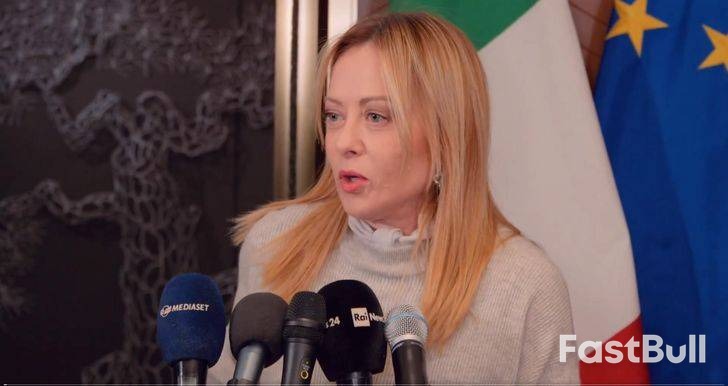
Despite her direct opposition to the tariffs, the far-right prime minister, who is considered a Trump ally in Europe, attempted to de-escalate the conflict. She suggested to reporters that "there has been a problem of understanding and communication" between the United States and Europe regarding the autonomous Danish territory.
Meloni noted that from the American perspective, the signals coming from Europe were unclear. "It seems to me that the risk is that the initiatives of some European countries were interpreted as anti-American, which was clearly not the intention," she explained, without specifying which initiatives she was referring to.
Meloni argued that NATO is the appropriate venue for resolving the growing crisis. She reported speaking with the NATO secretary general, who confirmed the alliance is beginning to work on the matter.
"NATO is the place where we must try to organise together deterrents against interference that may be hostile in a territory that is clearly strategic," she said. "I believe that the fact that NATO has begun to work on this is a good initiative."
The dispute centers on Trump's moves related to Greenland, which he claims is essential for U.S. national security. In response to European objections, Trump has threatened to impose tariffs of up to 25% on all goods imported into the U.S. from several key nations:
• Denmark
• Norway
• Sweden
• France
• Germany
• The United Kingdom
• The Netherlands
• Finland
The Netherlands' foreign minister has labeled U.S. President Donald Trump's threat to impose new tariffs on European allies as "blackmail." The move is designed to pressure several nations into facilitating the sale of Greenland to the United States.

"It's blackmail what he's doing," Foreign Minister David van Weel said during an interview on Dutch television. "And it's not necessary. It doesn't help the alliance (NATO) and it also doesn't help Greenland."
In a post on Truth Social, President Trump announced that additional 10% import tariffs would take effect on February 1. The tariffs target goods from eight European countries that have committed personnel to a NATO exercise on Greenland:
• Denmark
• Norway
• Sweden
• France
• Germany
• The Netherlands
• Finland
• Great Britain
Van Weel argued that connecting trade policy to the Greenland issue was inappropriate. He explained that the NATO mission was intended to demonstrate Europe's commitment to defending the island, not as a bargaining chip for its sale.
President Trump has insisted on achieving full U.S. ownership of Greenland, which is an autonomous territory of Denmark. He cites the island's strategic location and mineral deposits as vital to American security.
However, leaders in both Denmark and Greenland have firmly stated that the island is not for sale and does not wish to become part of the United States.
In response to the escalating trade tensions, ambassadors from the 27 European Union member states are set to convene for an emergency meeting on Sunday. The primary agenda will be to formulate a unified response to Trump's tariff threat.
South Korea's government has announced it will not stand by as the United States imposes a 25% tariff on imported artificial intelligence chips, vowing to negotiate directly with Washington to protect its semiconductor industry.
A presidential spokesperson confirmed on Sunday that Seoul will push for favorable terms to shield its globally significant chipmakers, Samsung Electronics and SK Hynix. While Donald Trump’s new tariff proclamation may not immediately affect these memory chip giants, the South Korean government is taking proactive steps to mitigate any future impact.
Officials reminded reporters of a joint fact sheet published last year, in which the U.S. agreed that South Korea would not receive worse tariff treatment than other chip-producing nations. This agreement is now facing a critical test.
The first wave of tariffs primarily targets high-end AI chips, not the memory chips that form the core of South Korea's semiconductor exports.
Trade Minister Yeo Han-koo stated on Saturday that the initial measures focus on advanced processors made by companies like Nvidia and AMD. "The impact is expected to be limited," he noted, as the memory chips typically exported by South Korea are not included in this phase.
However, Yeo cautioned against complacency. "It is not yet time to be reassured," he said, emphasizing the uncertainty surrounding the future scope of the tariffs. He affirmed that the government would continue collaborating with local companies to secure the best possible outcome.
The new U.S. tariff policy, signed by Trump on Wednesday, is officially justified on national security grounds. It applies a 25% duty on specific AI chips, including Nvidia's H200 and AMD's MI325X.
The White House described the scope as "narrow," listing several exemptions. The tariffs will not apply to chips imported for:
• U.S. data centers
• Public sector applications
• Consumer electronics
• Startups
• Civil industrial uses not involving data centers
Despite these exemptions, the policy signals a clear long-term strategy: pressuring foreign companies to increase domestic production in the United States. The official fact sheet explicitly leaves the door open for wider tariffs on more chip types and related products.
U.S. Commerce Secretary Howard Lutnick delivered a stark warning, suggesting that South Korean and Taiwanese chipmakers that do not invest in American manufacturing could face tariffs as high as 100%. "If you want to sell in America, you should build in America," Lutnick declared at a groundbreaking event for Micron's new plant in New York.
The new rules follow a nine-month investigation conducted under Section 232 of the Trade Expansion Act of 1962, which targeted advanced chips meeting specific performance thresholds.
France is preparing to request that the European Union deploy its most powerful economic defense mechanism after U.S. President Donald Trump announced new tariffs tied to his demand to purchase Greenland.
President Emmanuel Macron, who has already branded the tariff threat "unacceptable," will formally ask the EU to activate its anti-coercion instrument (ACI), according to a person familiar with the decision.
The move comes in response to a U.S. plan to impose a 10% tariff on goods from eight European countries, including France, starting February 1. In a social media post, President Trump threatened to raise the levy to 25% in June unless a "Deal is reached for the Complete and Total purchase of Greenland."
In response to the announcement, EU national ambassadors are set to meet on Sunday to determine the bloc's next steps.
The ACI is the European Union's most formidable retaliatory trade tool. While it has never been used, the instrument was designed primarily as a deterrent to counter coercive economic actions from other countries. It specifically targets situations where trade is used to pressure the policy choices of the EU or its member states.
If triggered, the EU could enact a range of countermeasures, including:
• Imposing retaliatory tariffs on U.S. goods.
• Introducing new taxes on tech companies.
• Placing targeted curbs on U.S. investment in the EU.
• Restricting access to certain segments of the EU market.
• Barring firms from bidding for public contracts in Europe.
According to the person familiar with President Macron's thinking, Trump's tariff plan directly challenges the validity of the trade deal reached between the EU and the U.S. last year.
That agreement has been partially implemented but still requires final approval from parliament. With the new tensions over Greenland, that approval process is now likely to be halted.
U.S. President Donald Trump hosted Slovak Prime Minister Robert Fico at his Mar-a-Lago club in Florida on Saturday, signaling a push to deepen bilateral ties around a major nuclear energy project and shared geopolitical views.
The meeting highlights Slovakia's strategy of strengthening its relationship with Washington, even as its policies often diverge from the European Union's mainstream positions. The discussions covered international issues, with a strong focus on the war in Ukraine and future energy security.
A central topic of the meeting was a planned €15 billion ($17.4 billion) nuclear project in Slovakia. The talks followed the signing of an intergovernmental agreement on nuclear energy cooperation on Friday, which sets the stage for formal negotiations with Westinghouse Electric Co.
Slovakia intends to build a state-owned 1,200 MW reactor. Prime Minister Fico indicated that the contract could be awarded to Westinghouse as soon as next year, with the project slated for completion around 2040.
"Both countries fully recognize that serious energy challenges cannot be solved through wind turbines or photovoltaics," Fico stated in a video message. "The cornerstone for the future is the rapid development of nuclear energy."
Fico, 61, confirmed that he and Trump discussed the war in Ukraine, where he reiterated Slovakia's call for a peaceful resolution. "Diplomacy and mutual listening must take precedence over military solutions," Fico said.
This stance reflects a broader alignment between the two leaders. The four-time prime minister, who survived a 2024 assassination attempt, frequently employs Trump-like rhetoric that prioritizes national interests over established alliances. His nationalist views, despite his left-wing domestic platform, earned him an invitation to the conservative CPAC conference in the U.S. last year.
Like Hungarian Prime Minister Viktor Orban, Fico is a vocal critic of several core EU policies, including:
• Military aid to Ukraine
• Ambitious climate targets
• The bloc's migration policy
Fico's "Slovakia First" Foreign Policy
Fico has actively sought to strengthen economic ties with Moscow and Beijing. Since Russia's 2022 invasion of Ukraine, he has met with Russian President Vladimir Putin multiple times. In 2023, his government halted Slovakia's military assistance to Kyiv, arguing it was "unnecessarily prolonging the war."
While describing the invasion as a violation of international law, Fico has also claimed that Moscow was provoked by the West. He has expressed support for an early peace deal, even if it requires Ukraine to make territorial concessions.
The meeting also touched on economic matters rooted in past trade disputes. Fico has previously lobbied Trump to lower U.S. tariffs on European cars, which have severely impacted Slovakia's auto-dependent economy. According to a UniCredit Bank analysis, Slovak car exports to the U.S.—once the second-largest market—have been cut in half since the tariffs were introduced.
On energy, Trump has consistently pushed European nations to reduce their reliance on Russian supplies. However, he previously approved a temporary exemption for Hungary and Slovakia, two landlocked countries bordering Ukraine that are heavily dependent on Russian energy.
China's exports of rare earth materials edged lower in December, as markets monitored rising geopolitical friction between Beijing and Japan that could foreshadow tighter shipment controls on the critical minerals.
According to customs data released on Sunday, China's total outbound shipments of rare earths reached 6,745 tonnes in December. This marks a decrease from the 6,958 tonnes exported in November.
These materials are indispensable components in a wide range of modern technologies, including electric vehicles, advanced weapons systems, and high-tech manufacturing. A significant portion of these exports consists of rare-earth magnets, a product that provides Beijing with powerful leverage in global trade disputes.
In recent years, the rare earths supply chain has become a major geopolitical flashpoint, with the United States and other nations actively working to reduce their dependence on China's dominance in mining and processing.
While a trade truce between Beijing and Washington in October eased some of those tensions, the focus has now shifted to Japan. China's Ministry of Commerce recently announced new controls on shipments to Japan that have potential military applications. This move followed remarks made last year by Japan's prime minister concerning Taiwan.
Adding to the pressure, Beijing is also reportedly considering stricter scrutiny of licenses for shipping these minerals to Japan, according to a report from the China Daily.
The export data released on Sunday represents a total figure for all destinations and does not offer a breakdown by individual country or specific product type. More detailed data, which could provide greater insight into trade flows with specific partners, is expected to be released on Tuesday.
The European Union has called an emergency meeting of its ambassadors in Brussels this Sunday following President Donald Trump's announcement of tariffs on eight EU nations. The move is designed to pressure Denmark into a deal for the United States to acquire Greenland.
A representative for Cyprus, the current holder of the EU Council presidency, confirmed the urgent meeting to NBC News. Trump's declaration on Saturday triggered immediate and sharp criticism from lawmakers on both sides of the Atlantic, who largely rejected both the tariff threats and the goal of taking control of Danish territory.
European leaders swiftly pushed back against the tariff announcement, framing it as a damaging move against key allies.
Roberta Metsola, President of the European Parliament, questioned the strategy of targeting NATO partners. Writing on X, the Maltese official stated that actions against allies would not improve security in the Arctic. Instead, she warned, they could embolden shared adversaries seeking to undermine common values. Metsola reiterated that both Greenland and Denmark have made their positions clear: the territory is not for sale, and its sovereignty will be respected, regardless of tariff intimidation.
Kaja Kallas, an Estonian vice president of the European Commission and the EU's chief diplomat, argued that China and Russia would be the only beneficiaries of Trump's decision. She noted that these countries celebrate when divisions appear among allied nations. Kallas suggested that NATO is the appropriate venue for any security discussions concerning Greenland and cautioned that the proposed tariffs would harm economies and reduce prosperity in both Europe and America. She also urged that such disagreements should not distract from the crucial mission of supporting Ukraine against Russian aggression.
The tariff threat has also put a major EU-US trade agreement at risk. Several European officials have signaled a desire to block the final ratification of a trade deal negotiated last summer. While parts of the agreement are already in effect, it requires approval from the European Parliament to become fully binding.
Bernd Lange, the long-serving chair of the parliament's international trade committee, called the new tariffs unacceptable. The German official posted on X that the approach violates how partners should treat one another. Accusing Trump of weaponizing trade for political leverage, Lange insisted that the EU cannot conduct business as usual under these conditions and demanded that all progress on the trade deal be halted until the US withdraws its threats.
The reaction in Washington was similarly critical, with American legislators from both parties voicing their opposition to Trump's plan.
Senators Jeanne Shaheen (D-NH) and Thom Tillis (R-NC), who co-chair the Senate NATO Observer Group, issued a joint statement from Copenhagen. They were there with a bipartisan congressional delegation meeting Danish officials to strengthen ties amid Trump's ongoing comments about Greenland.
The senators warned that with many Americans already concerned about the cost of living, these tariffs would only increase expenses for households and businesses. They urged the administration to abandon the threats and seek a diplomatic solution instead. Their statement underscored that the targeted nations are among America's most steadfast allies:
• United Kingdom
• France
• Germany
• Netherlands
• Finland
• Sweden
• Denmark
• Norway
They reminded the administration that these NATO partners have fought alongside American troops, suffered shared casualties, and contributed to US security and economic prosperity.
Senate Minority Leader Chuck Schumer (D-NY) announced Saturday that Democrats would introduce legislation to block the tariffs before they could further damage the American economy and its European partnerships. Schumer criticized Trump's existing tariffs for raising prices and argued that the new actions would compound those errors by targeting close allies over an "unrealistic" attempt to acquire Greenland.
While the Senate has previously passed similar bipartisan measures to limit Trump's tariff authority with a simple 51-vote majority, any new legislation would still face uncertain prospects in the House.
White Label
Data API
Web Plug-ins
Poster Maker
Affiliate Program
The risk of loss in trading financial instruments such as stocks, FX, commodities, futures, bonds, ETFs and crypto can be substantial. You may sustain a total loss of the funds that you deposit with your broker. Therefore, you should carefully consider whether such trading is suitable for you in light of your circumstances and financial resources.
No decision to invest should be made without thoroughly conducting due diligence by yourself or consulting with your financial advisors. Our web content might not suit you since we don't know your financial conditions and investment needs. Our financial information might have latency or contain inaccuracy, so you should be fully responsible for any of your trading and investment decisions. The company will not be responsible for your capital loss.
Without getting permission from the website, you are not allowed to copy the website's graphics, texts, or trademarks. Intellectual property rights in the content or data incorporated into this website belong to its providers and exchange merchants.
Not Logged In
Log in to access more features

FastBull Membership
Not yet
Purchase
Log In
Sign Up