• Trade
  • Markets
  • Copy
  • Contests
  • News
  • 24/7
  • Calendar
  • Q&A
  • Chats
Trending
Screeners
SYMBOL
LAST
BID
ASK
HIGH
LOW
NET CHG.
%CHG.
SPREAD
SPX
S&P 500 Index
6827.42
6827.42
6827.42
6899.86
6801.80
-73.58
-1.07%
--
DJI
Dow Jones Industrial Average
48458.04
48458.04
48458.04
48886.86
48334.10
-245.98
-0.51%
--
IXIC
NASDAQ Composite Index
23195.16
23195.16
23195.16
23554.89
23094.51
-398.69
-1.69%
--
USDX
US Dollar Index
97.950
98.030
97.950
98.500
97.950
-0.370
-0.38%
--
EURUSD
Euro / US Dollar
1.17394
1.17409
1.17394
1.17496
1.17192
+0.00011
+ 0.01%
--
GBPUSD
Pound Sterling / US Dollar
1.33707
1.33732
1.33707
1.33997
1.33419
-0.00148
-0.11%
--
XAUUSD
Gold / US Dollar
4299.39
4299.39
4299.39
4353.41
4257.10
+20.10
+ 0.47%
--
WTI
Light Sweet Crude Oil
57.233
57.485
57.233
58.011
56.969
-0.408
-0.71%
--

Community Accounts

Signal Accounts
--
Profit Accounts
--
Loss Accounts
--
View More

Become a signal provider

Sell trading signals to earn additional income

View More

Guide to Copy Trading

Get started with ease and confidence

View More

Signal Accounts for Members

All Signal Accounts

Best Return
  • Best Return
  • Best P/L
  • Best MDD
Past 1W
  • Past 1W
  • Past 1M
  • Past 1Y

All Contests

  • All
  • Trump Updates
  • Recommend
  • Stocks
  • Cryptocurrencies
  • Central Banks
  • Featured News
Top News Only
Share

Ukraine's Navy Says Russian Drone Attack Hit Civilian Turkish Vessel Carrying Sunflower Oil To Egypt On Saturday

Share

Israeli Military Says It Put Planned Strike On South Lebanon Site On Hold After Lebanese Army Requested Access

Share

Norwegian Nobel Committee: Calls On The Belarusian Authorities To Release All Political Prisoners

Share

Norwegian Nobel Committee: His Freedom Is A Deeply Welcome And Long-Awaited Moment

Share

Ukraine Says It Received 114 Prisoners From Belarus

Share

USA Embassy In Lithuania: Maria Kalesnikava Is Not Going To Vilnius

Share

USA Embassy In Lithuania: Other Prisoners Are Being Sent From Belarus To Ukraine

Share

Ukraine President Zelenskiy: Five Ukrainians Released By Belarus In US-Brokered Deal

Share

USA Vilnius Embassy: USA Stands Ready For "Additional Engagement With Belarus That Advances USA Interests"

Share

USA Vilnius Embassy: Belarus, USA, Other Citizens Among The Prisoners Released Into Lithuania

Share

USA Vilnius Embassy: USA Will Continue Diplomatic Efforts To Free The Remaining Political Prisoners In Belarus

Share

USA Vilnius Embassy: Belarus Releases 123 Prisoners Following Meeting Of President Trump's Envoy Coale And Belarus President Lukashenko

Share

USA Vilnius Embassy: Masatoshi Nakanishi, Aliaksandr Syrytsa Are Among The Prisoners Released By Belarus

Share

USA Vilnius Embassy: Maria Kalesnikava And Viktor Babaryka Are Among The Prisoners Released By Belarus

Share

USA Vilnius Embassy: Nobel Peace Prize Laureate Ales Bialiatski Is Among The Prisoners Released By Belarus

Share

Belarusian Presidential Administration Telegram Channel: Lukashenko Has Pardoned 123 Prisoners As Part Of Deal With US

Share

Two Local Syrian Officials: Joint US-Syrian Military Patrol In Central Syria Came Under Fire From Unknown Assailants

Share

Israeli Military Says It Targeted 'Key Hamas Terrorist' In Gaza City

Share

Rwanda's Actions In Eastern Drc Are A Clear Violation Of Washington Accords Signed By President Trump - Secretary Of State Rubio

Share

Israeli Military Issues Evacuation Warning In Southern Lebanon Village Ahead Of Strike - Spokesperson On X

TIME
ACT
FCST
PREV
U.K. Trade Balance Non-EU (SA) (Oct)

A:--

F: --

P: --

U.K. Trade Balance (Oct)

A:--

F: --

P: --

U.K. Services Index MoM

A:--

F: --

P: --

U.K. Construction Output MoM (SA) (Oct)

A:--

F: --

P: --

U.K. Industrial Output YoY (Oct)

A:--

F: --

P: --

U.K. Trade Balance (SA) (Oct)

A:--

F: --

P: --

U.K. Trade Balance EU (SA) (Oct)

A:--

F: --

P: --

U.K. Manufacturing Output YoY (Oct)

A:--

F: --

P: --

U.K. GDP MoM (Oct)

A:--

F: --

P: --

U.K. GDP YoY (SA) (Oct)

A:--

F: --

P: --

U.K. Industrial Output MoM (Oct)

A:--

F: --

P: --

U.K. Construction Output YoY (Oct)

A:--

F: --

P: --

France HICP Final MoM (Nov)

A:--

F: --

P: --

China, Mainland Outstanding Loans Growth YoY (Nov)

A:--

F: --

P: --

China, Mainland M2 Money Supply YoY (Nov)

A:--

F: --

P: --

China, Mainland M0 Money Supply YoY (Nov)

A:--

F: --

P: --

China, Mainland M1 Money Supply YoY (Nov)

A:--

F: --

P: --

India CPI YoY (Nov)

A:--

F: --

P: --

India Deposit Gowth YoY

A:--

F: --

P: --

Brazil Services Growth YoY (Oct)

A:--

F: --

P: --

Mexico Industrial Output YoY (Oct)

A:--

F: --

P: --

Russia Trade Balance (Oct)

A:--

F: --

P: --

Philadelphia Fed President Henry Paulson delivers a speech
Canada Building Permits MoM (SA) (Oct)

A:--

F: --

P: --

Canada Wholesale Sales YoY (Oct)

A:--

F: --

P: --

Canada Wholesale Inventory MoM (Oct)

A:--

F: --

P: --

Canada Wholesale Inventory YoY (Oct)

A:--

F: --

P: --

Canada Wholesale Sales MoM (SA) (Oct)

A:--

F: --

P: --

Germany Current Account (Not SA) (Oct)

A:--

F: --

P: --

U.S. Weekly Total Rig Count

A:--

F: --

P: --

U.S. Weekly Total Oil Rig Count

A:--

F: --

P: --

Japan Tankan Large Non-Manufacturing Diffusion Index (Q4)

--

F: --

P: --

Japan Tankan Small Manufacturing Outlook Index (Q4)

--

F: --

P: --

Japan Tankan Large Non-Manufacturing Outlook Index (Q4)

--

F: --

P: --

Japan Tankan Large Manufacturing Outlook Index (Q4)

--

F: --

P: --

Japan Tankan Small Manufacturing Diffusion Index (Q4)

--

F: --

P: --

Japan Tankan Large Manufacturing Diffusion Index (Q4)

--

F: --

P: --

Japan Tankan Large-Enterprise Capital Expenditure YoY (Q4)

--

F: --

P: --

U.K. Rightmove House Price Index YoY (Dec)

--

F: --

P: --

China, Mainland Industrial Output YoY (YTD) (Nov)

--

F: --

P: --

China, Mainland Urban Area Unemployment Rate (Nov)

--

F: --

P: --

Saudi Arabia CPI YoY (Nov)

--

F: --

P: --

Euro Zone Industrial Output YoY (Oct)

--

F: --

P: --

Euro Zone Industrial Output MoM (Oct)

--

F: --

P: --

Canada Existing Home Sales MoM (Nov)

--

F: --

P: --

Euro Zone Total Reserve Assets (Nov)

--

F: --

P: --

U.K. Inflation Rate Expectations

--

F: --

P: --

Canada National Economic Confidence Index

--

F: --

P: --

Canada New Housing Starts (Nov)

--

F: --

P: --

U.S. NY Fed Manufacturing Employment Index (Dec)

--

F: --

P: --

U.S. NY Fed Manufacturing Index (Dec)

--

F: --

P: --

Canada Core CPI YoY (Nov)

--

F: --

P: --

Canada Manufacturing Unfilled Orders MoM (Oct)

--

F: --

P: --

Canada Manufacturing New Orders MoM (Oct)

--

F: --

P: --

Canada Core CPI MoM (Nov)

--

F: --

P: --

Canada Manufacturing Inventory MoM (Oct)

--

F: --

P: --

Canada CPI YoY (Nov)

--

F: --

P: --

Canada CPI MoM (Nov)

--

F: --

P: --

Canada CPI YoY (SA) (Nov)

--

F: --

P: --

Canada Core CPI MoM (SA) (Nov)

--

F: --

P: --

Q&A with Experts
    • All
    • Chatrooms
    • Groups
    • Friends
    Connecting
    .
    .
    .
    Type here...
    Add Symbol or Code

      No matching data

      All
      Trump Updates
      Recommend
      Stocks
      Cryptocurrencies
      Central Banks
      Featured News
      • All
      • Russia-Ukraine Conflict
      • Middle East Flashpoint
      • All
      • Russia-Ukraine Conflict
      • Middle East Flashpoint
      Search
      Products

      Charts Free Forever

      Chats Q&A with Experts
      Screeners Economic Calendar Data Tools
      Membership Features
      Data Warehouse Market Trends Institutional Data Policy Rates Macro

      Market Trends

      Market Sentiment Order Book Forex Correlations

      Top Indicators

      Charts Free Forever
      Markets

      News

      News Analysis 24/7 Columns Education
      From Institutions From Analysts
      Topics Columnists

      Latest Views

      Latest Views

      Trending Topics

      Top Columnists

      Latest Update

      Signals

      Copy Rankings Latest Signals Become a signal provider AI Rating
      Contests
      Brokers

      Overview Brokers Assessment Rankings Regulators News Claims
      Broker listing Forex Brokers Comparison Tool Live Spread Comparison Scam
      Q&A Complaint Scam Alert Videos Tips to Detect Scam
      More

      Business
      Events
      Careers About Us Advertising Help Center

      White Label

      Data API

      Web Plug-ins

      Affiliate Program

      Awards Institution Evaluation IB Seminar Salon Event Exhibition
      Vietnam Thailand Singapore Dubai
      Fans Party Investment Sharing Session
      FastBull Summit BrokersView Expo
      Recent Searches
        Top Searches
          Markets
          News
          Analysis
          User
          24/7
          Economic Calendar
          Education
          Data
          • Names
          • Latest
          • Prev

          View All

          No data

          Scan to Download

          Faster Charts, Chat Faster!

          Download App
          English
          • English
          • Español
          • العربية
          • Bahasa Indonesia
          • Bahasa Melayu
          • Tiếng Việt
          • ภาษาไทย
          • Français
          • Italiano
          • Türkçe
          • Русский язык
          • 简中
          • 繁中
          Open Account
          Search
          Products
          Charts Free Forever
          Markets
          News
          Signals

          Copy Rankings Latest Signals Become a signal provider AI Rating
          Contests
          Brokers

          Overview Brokers Assessment Rankings Regulators News Claims
          Broker listing Forex Brokers Comparison Tool Live Spread Comparison Scam
          Q&A Complaint Scam Alert Videos Tips to Detect Scam
          More

          Business
          Events
          Careers About Us Advertising Help Center

          White Label

          Data API

          Web Plug-ins

          Affiliate Program

          Awards Institution Evaluation IB Seminar Salon Event Exhibition
          Vietnam Thailand Singapore Dubai
          Fans Party Investment Sharing Session
          FastBull Summit BrokersView Expo

          May 13th Financial News

          FastBull Featured

          Daily News

          Summary:

          Trump's "big priority bill" unveiled: proposes $4 trillion in cuts over a decade, omits millionaire tax proposal; Zelensky approves U.S.-Ukraine minerals agreement; Iraq to cut crude oil exports in May and June......

          [Quick Facts]

          1. Trump's "big priority bill" unveiled: proposes $4 trillion in cuts over a decade, omits millionaire tax proposal.
          2. Zelensky approves U.S.-Ukraine minerals agreement.
          3. Trump floats idea of joining Zelensky-Putin talks this week.
          4. Ishiba: "Full Measures" to counter U.S. tariffs.
          5. Germany's new Finance Minister leaves EU deficit limit in doubt amid defense surge.
          6. Iraq to cut crude oil exports in May and June.
          7. Kugler: trade tensions ease, but tariffs still pose major impact.
          8. Lombardelli: inflation pressures weaken, but needed cautious.

          [News Details]

          Trump's "big priority bill" unveiled: proposes $4 trillion in cuts over a decade, omits millionaire tax proposal
          The Committee on Ways and Means released the tax bill ahead of a scheduled subcommittee debate on Tuesday, signaling that the Republican-controlled House is pushing for a full floor vote on the legislation this month. The bill proposes over $4 trillion in tax cuts over the next decade, alongside savings of at least $1.5 trillion. Dubbed by Trump as "THE ONE, BIG, BEAUTIFUL BILL," the legislation is a cornerstone of his policy agenda.
          The bill extends many tax cuts from Trump's first term set to expire this year. While incorporating key campaign promises, it notably excludes Trump’s proposal for tiered taxation on millionaires. The draft text exempts taxes on tips and overtime income through 2028. However, contentious issues like raising the cap on state and local tax (SALT) deductions remain unresolved. There’s also a tripling of the state and local tax deduction, called SALT, from $10,000 up to $30,000 for couples, which certain high-tax state GOP lawmakers from New York and California already rejected as too meager.
          Zelensky approves U.S.-Ukraine minerals agreement
          On May 12th local time, Ukrainian President Zelensky signed a law ratifying the U.S.-Ukraine Reconstruction Investment Fund Establishment Agreement, initially referred to as the "U.S.-Ukraine Minerals Agreement." Signed jointly by both nations on April 30th, the agreement received overwhelming parliamentary support (338 votes) on May 8th. While seen as a thaw in bilateral relations, its practical impact remains uncertain. Mining consultancies note that developing strategic minerals in Ukraine—a mature mining jurisdiction—could take 10–20 years, with limited data on economic viability. Damaged infrastructure, including power supply and traffic, and security risks from the Russia-Ukraine conflict further deter investor confidence.
          Trump floats idea of joining Zelensky-Putin talks this week
          U.S. President Donald Trump stated he is considering attending a potential meeting between Ukrainian and Russian leaders in Turkey on Thursday. "I was thinking about flying over," Trump said at the White House on Monday. "I've got so many meetings, but I was thinking about actually flying over there. There's a possibility of it, I guess, if I think things can happen, but we've got to get it done." Both Putin and Zelensky have been cautious about direct talks, but Trump’s remarks suggest momentum. Zelensky and European leaders have called for a 30-day ceasefire during negotiations.
          Ishiba: "Full Measures" to counter U.S. tariffs
          Japanese Prime Minister Shigeru Ishiba emphasized on May 12th that Japan will adopt "comprehensive measures" against U.S. tariffs, particularly targeting the automotive sector, and will take additional steps if necessary. In a parliamentary budget committee session, Ishiba rejected any deal excluding automobiles and refused to sacrifice agriculture or expand U.S. rice imports as bargaining chips. He reiterated that ongoing U.S.-Japan tariff talks must safeguard national interests. Two rounds of negotiations have failed to sway the U.S. from denying Japan "special treatment" on cars and steel.
          Germany's New Finance Minister Leaves EU Deficit Limit in Doubt Amid Defense Surge
          At a Eurozone finance ministers' meeting in Brussels on May 12th, Germany's newly appointed Finance Minister, Klingbeil, sparked scrutiny by stating that whether Germany will violate the EU's 3% GDP deficit ceiling to fund defense and infrastructure spending " will also be clarified in the next few weeks." Klingbeil noted that massive investments could push Germany's 2025 budget beyond EU limits, with a draft expected by June. The remarks highlight tensions between EU fiscal rules and Germany's security priorities.
          Iraq to cut crude oil exports in May and June
          An informed Iraqi official told Reuters that Iraq will export 3.2 million barrels per day (bpd) of crude oil in May and June, a significant reduction compared to previous months. The official added that the lowered export plan is part of Iraq's commitment to compensatory cuts under its OPEC+ agreement. This export level would fall below the March figure of approximately 3.42 million bpd reported by Iraq's oil ministry.
          Iraq has not yet released April export data, but according to data intelligence firm Kpler, the country averaged 3.3 million bpd in April. OPEC+ (including OPEC, Russia, and allies) has agreed to a series of production cuts since 2022. Its compensation plan, updated last month, aims to ensure that members who fell short of earlier cuts implement additional reductions. If fully enforced, the latest cuts could largely offset the planned 411,000 bpd output increase in May and June, providing additional support to oil markets.
          Kugler: trade tensions ease, but tariffs still pose major impact
          Federal Reserve Governor Kugler stated in a speech Monday that the Trump administration's tariff policies could drive up inflation and weigh on economic growth, even as U.S.-China trade tensions ease.
          Kugler explained that current U.S. average tariff rates remain far higher than levels seen in decades. If tariffs stay significantly elevated compared to earlier this year, the economic effects could be similar, including higher inflation and slower growth.
          With inflation and employment potentially moving in opposite directions, the Fed will closely monitor developments as it considers the future policy path. Kugler believes the current monetary policy stance is well-positioned to handle any shifts in the macroeconomic environment.
          Lombardelli: inflation pressures weaken, but needed cautious
          Bank of England Deputy Governor Clare Lombardelli said in a Monday speech that while there are signs UK inflation pressures in Britain will continue to weaken but she was still cautious and would wait for evidence of the slowdown.
          The progress in cooling domestic inflation pressures is a more significant factor than U.S. trade tariffs. However, earnings are still rising too fast to be consistent with bringing it back to its two per cent target, making continued gradual rate cuts prudent.

          [Today's Focus]

          UTC+8 14:00 UK March ILO Unemployment Rate
          UTC+8 15:00 ECB Governing Council Member Escrivá Speaks
          UTC+8 16:00 ECB Governing Council Member Makhlouf Speaks
          UTC+8 17:00 Eurozone May ZEW Economic Sentiment Index
          UTC+8 20:30 US April CPI
          UTC+8 23:00 Bank of England Governor Bailey Speaks
          Risk Warnings and Disclaimers
          You understand and acknowledge that there is a high degree of risk involved in trading. Following any strategies or investment methods may lead to potential losses. The content on the site is provided by our contributors and analysts for information purposes only. You are solely responsible for determining whether any trading assets, securities, strategy, or any other product is suitable for investing based on your own investment objectives and financial situation.
          Add to Favorites
          Share

          Policy Divergence Widens: Fed Holds Steady as European Central Banks Move to Cut Rates

          Gerik

          Economic

          Fed Stands Firm Amid Inflation Risk from Tariff Shocks

          The Federal Reserve has signaled it will not rush into rate cuts despite rising global uncertainty, particularly around new trade tariffs. In its May 6–7 policy meeting, the Fed opted to hold interest rates steady, with Chair Jerome Powell warning that premature easing could risk exacerbating inflation and labor market pressures. He emphasized that inflation remains elevated and that potential upward price pressures from tariff-related import costs cannot be ignored.
          Powell stated, “There’s no real cost to waiting at this point,” reinforcing the Fed’s cautious stance. Supporting his view, New York Fed President John Williams also highlighted the need to monitor incoming economic data, especially around the economic fallout from evolving trade policies, before committing to any policy shifts.
          Market expectations have quickly adjusted. Whereas in April there was over a 60% chance priced in for a Fed rate cut by June, that probability has now dropped to just 17%, reflecting a broader reassessment of monetary easing prospects in the US.

          European Central Banks Pivot as Growth Outlook Weakens

          In contrast, several European central banks are already moving ahead with rate cuts. On May 8, the Bank of England (BoE) lowered its benchmark interest rate by 25 basis points to 4.25%, citing tariff-induced uncertainty and the risk of further drag on global growth. Governor Andrew Bailey noted that the past few weeks have revealed how fragile the global economic environment has become, justifying a gradual and cautious approach to further easing.
          Earlier, on April 17, the European Central Bank (ECB) executed its seventh consecutive rate cut, bringing the deposit rate to 2.25%—its lowest level since 2023. ECB officials have already signaled another potential cut in June, arguing that inflation is now within target and that trade friction is eroding economic momentum across the eurozone.
          Sweden’s Riksbank, although holding rates steady at 2.25% in its May 7 meeting, has also left the door open for future rate reductions. It views current trade tensions as a disinflationary risk for Europe, even as they are contributing to short-term inflationary pressures in the US.

          Tariffs Create Asymmetric Economic Effects

          The divergence in monetary policy reflects broader asymmetries in how tariffs are impacting the global economy. In the US, higher import tariffs are directly pushing up input costs, especially as the US dollar weakens. This dynamic is expected to intensify price pressures in consumer goods and supply chains.
          Conversely, in Europe and other regions, trade tariffs are dampening export activity and leading to currency appreciation against the dollar, which in turn reduces imported inflation. Cheaper energy costs and weaker trade flows are further moderating price pressures, giving central banks more flexibility to stimulate growth.
          Riksbank noted that while short-term inflation expectations are rising in the US, they are trending downward in the eurozone—a split that underpins the diverging policy paths.

          Monetary Tools Face Limitations in a Supply-Side Shock

          Central bankers are increasingly recognizing that the current economic turbulence differs from typical demand-driven recessions. According to Jean Boivin, Head of the BlackRock Investment Institute, the disruption resembles the pandemic-era shock, where supply chains were rapidly upended. In such scenarios, traditional monetary policy has limited ability to address bottlenecks or restore market equilibrium.
          This places central banks in a difficult position: their decisions take 12 to 18 months to fully affect the economy, yet trade policy shifts and geopolitical developments occur far more quickly. As a result, central banks are being forced to focus on preserving market confidence while avoiding policy overreactions that could destabilize inflation expectations.

          Transatlantic Monetary Policies Reflect Contrasting Realities

          The current divergence in policy between the Fed and its European counterparts is a function of differing inflation trajectories and structural economic exposures. While the Fed must manage the immediate inflationary effects of tariffs and dollar weakness, European central banks are grappling with declining growth and easing inflationary risks.
          This divergence may widen in the coming months if tariff uncertainty persists and global supply chains remain fragmented. The ability of central banks to respond effectively will depend not only on inflation metrics, but on their capacity to coordinate fiscal responses and maintain investor confidence amid a volatile geopolitical and trade landscape.

          Source: Bloomberg

          To stay updated on all economic events of today, please check out our Economic calendar
          Risk Warnings and Disclaimers
          You understand and acknowledge that there is a high degree of risk involved in trading. Following any strategies or investment methods may lead to potential losses. The content on the site is provided by our contributors and analysts for information purposes only. You are solely responsible for determining whether any trading assets, securities, strategy, or any other product is suitable for investing based on your own investment objectives and financial situation.
          Add to Favorites
          Share

          Russia Sets Sights on Energy Sovereignty and Asian Gas Dominance by 2050

          Gerik

          Commodity

          Strategic Shift Toward Energy Independence and Innovation

          In a series of statements published in Energy Policy on May 12, Russian Deputy Prime Minister Alexander Novak outlined an ambitious roadmap aimed at transforming the country’s energy sector. By 2027, Russia intends to nearly eliminate its reliance on foreign oil-related imports. This initiative, supported through state-enterprise coordination, will allow Russia to assert greater control over its domestic energy infrastructure and reduce vulnerability to external sanctions and supply shocks.
          Novak emphasized that this self-sufficiency will not be limited to crude oil and equipment but will also encompass technological competencies—particularly in high-value segments like gas turbines, solar and wind power generation, and energy storage systems. Russia is also seeking to become an exporter of advanced energy technology in the long run, positioning itself in a competitive niche beyond traditional resource markets.

          Natural Gas Expansion in Asia and Domestic Localization

          By 2036, Russia plans to increase its pipeline gas exports to 197 billion cubic meters annually, a move designed to secure stable production levels and consistent budget revenues. Longer term, by 2050, Russia aims to become the largest natural gas supplier to Asia. This shift reflects both geopolitical and commercial recalibrations in response to Europe’s gradual disengagement from Russian energy supplies.
          As part of this strategy, Russia also plans to localize production of key energy infrastructure, including high-capacity gas turbines and renewable energy components. The initiative is not only technical but also strategic: it seeks to deepen domestic capabilities and build resilience against foreign technology embargoes.

          Global Demand Outlook: Asia and Emerging Markets Take Center Stage

          Novak argued that global demand for oil and gas has not yet peaked and may continue rising until well after 2050. Citing data from OPEC, he noted that India will be a primary driver of oil consumption growth, with demand projected to rise from 5.3 million barrels per day in 2023 to 13.3 million barrels per day by 2050. Other key growth markets include China, the broader Asia-Pacific, the Middle East, and Africa.
          This forecast reinforces Russia’s pivot to Asia, where long-term contracts and strategic infrastructure projects—like the Power of Siberia gas pipeline—are seen as essential for anchoring export revenues and securing market share.

          Europe’s Diminishing Role and the Coal Transition

          In contrast to the bullish outlook for Asia, Europe is expected to see a substantial decline in oil consumption. According to Novak, European demand will fall from 13.4 million barrels per day to just 9.2 million by 2050. This downward trend underscores the continent’s continued push toward decarbonization, energy diversification, and reduced reliance on fossil fuels.
          Regarding coal, Novak predicted a slow global decline, with peak consumption likely delayed until the 2030s or beyond. He suggested that metallurgical coal—used in steelmaking—will remain more resilient than thermal coal, which faces growing pressure from environmental regulations and green finance movements.
          Russia’s energy strategy represents a multifaceted response to the evolving global landscape. While seeking to decouple from Western technological dependencies, the country is simultaneously shifting its market orientation toward Asia and investing in downstream capabilities. By aiming for full localization, expanding natural gas dominance, and forecasting long-term hydrocarbon demand in emerging economies, Russia is recalibrating its role in the global energy ecosystem—not as a passive exporter, but as an integrated energy power with technological ambitions.

          Source: IZ

          Risk Warnings and Disclaimers
          You understand and acknowledge that there is a high degree of risk involved in trading. Following any strategies or investment methods may lead to potential losses. The content on the site is provided by our contributors and analysts for information purposes only. You are solely responsible for determining whether any trading assets, securities, strategy, or any other product is suitable for investing based on your own investment objectives and financial situation.
          Add to Favorites
          Share

          Asian IPO Market Stalls as Trade War and Tariff Concerns Cloud Outlook

          Gerik

          Economic

          IPO Momentum in Asia Falters Amid Growing Trade Uncertainty

          The Asian initial public offering (IPO) market, once buoyed by a strong pipeline in early 2025, is now entering a state of pause as companies reassess listing strategies in response to intensifying global trade tensions. According to financial experts, firms across the region are holding back IPO launches due to declining investor appetite, largely triggered by the escalating tariff war initiated by the United States under President Donald Trump.
          Manishi Raychaudhuri, Managing Director at Emmer Capital Partners in Hong Kong, observed that while Q1 2025 saw pockets of IPO optimism, markets underestimated the Trump administration’s determination to pursue wide-ranging reciprocal tariff policies. This miscalculation has led to a sharp pivot in sentiment.

          Trade Disputes Undermine Market Confidence and IPO Demand

          The catalyst for the current unease came in early April when the US introduced aggressive new tariff measures, followed by a limited trade deal with the UK. Although this suggested willingness to negotiate, skepticism remains high. Investors continue to worry about prolonged volatility and the growing possibility of a US economic slowdown. Raychaudhuri noted that “companies are unlikely to enter a market where investor commitment is weak,” highlighting a mutual hesitation from both issuers and backers.

          Q1 Activity Strong in Select Regions, But Risks Intensify

          According to EY, Asia-Pacific led the world in IPO volume in Q1 2025, outperforming even the US. Hong Kong and South Korea drove much of this momentum, while activity in Japan, India, and ASEAN countries saw notable declines. Despite this early strength, current projections suggest a sharp deceleration due to macroeconomic risk.
          Chan Yew Kiang, Head of IPO Services at EY ASEAN, emphasized that most companies planning IPOs are now adopting a "wait-and-see" approach, given the unpredictable trajectory of the trade war and the wide-reaching implications of tariff changes for Asian economies.

          Tariff Exposure Creates Regional Disparities

          The effects of trade friction are not uniformly felt across Asia. Abhineet Kaul from Access Partnership pointed out that countries with lower US tariff exposure may fare better. For example, Singapore, with a base US import tariff of 10%, is positioned more favorably than peers like Thailand and Malaysia, which are subject to retaliatory rates of 24% or higher. This variation has direct implications for market stability and IPO prospects within the region.
          Despite broader caution, Hong Kong remains one of the few IPO markets showing signs of durability. Louis Lau, Head of Capital Markets at KPMG Hong Kong, described the outlook as “cautiously optimistic.” As of March 31, 120 companies had filed for IPOs in Hong Kong—a 38% increase year-on-year—highlighting sustained supply interest.
          Several structural advantages underpin this resilience. The Hong Kong Stock Exchange has eased IPO requirements for select sectors, particularly tech, and established dedicated listing channels. Pamela Chung from Vistra added that favorable policy shifts in mainland China supporting tech and private firms are further boosting interest in Hong Kong listings.
          Hong Kong’s role as a dual-listing hub for mainland Chinese firms and its currency peg to the US dollar offer additional stability. These factors collectively echo the IPO surge experienced during Trump’s first term, suggesting that the city may again serve as a strategic listing venue even in turbulent times.
          Asia’s IPO landscape is entering a cautious phase, shaped by trade policy shifts, investor wariness, and divergent regional exposures to tariffs. While markets like Japan, ASEAN, and India face growing constraints, relatively shielded economies such as Singapore and structurally favored markets like Hong Kong may maintain IPO momentum. The coming months will test the region’s ability to adapt to geopolitical shocks and capitalize on regulatory flexibility to keep capital markets active.

          Source: Nikkei Asia

          To stay updated on all economic events of today, please check out our Economic calendar
          Risk Warnings and Disclaimers
          You understand and acknowledge that there is a high degree of risk involved in trading. Following any strategies or investment methods may lead to potential losses. The content on the site is provided by our contributors and analysts for information purposes only. You are solely responsible for determining whether any trading assets, securities, strategy, or any other product is suitable for investing based on your own investment objectives and financial situation.
          Add to Favorites
          Share

          Goldman Sachs Pushes Fed Rate Cut Forecast To December 2025

          Fiona Harper

          Central Bank

          Economic

          Cryptocurrency

          Key Points:
          ● Goldman Sachs adjusts Fed rate cut timing to December 2025.
          ● Implications for financial markets and cryptocurrencies like BTC and ETH.
          ● Market participants anticipate changes in asset pricing and investor sentiment.
          Goldman Sachs has adjusted the timing for the anticipated Federal Reserve rate cut to December 2025, diverging from an earlier prediction for July. This adjustment follows strong employment data and potential macroeconomic shifts.
          The forecast shift by Goldman Sachs suggests significant implications for both financial markets and the cryptocurrency sector. Market participants anticipate changes in asset pricing and investor sentiment, with particular attention on BTC and ETH sensitivity to US rate policies.

          Goldman Sachs Extends Fed Rate Cut Expectation to Q4 2025

          Goldman Sachs, a major US financial player, has revised its Federal Reserve rate cut projection, now anticipating the next cut in December instead of July. This change comes amid a landscape of easier financial conditions and macroeconomic recalculations. The expected rate cut delay aligns with improved employment statistics and an updated growth outlook. Goldman Sachs analysts have increased the US 2025 fourth-quarter GDP growth estimate by 0.5 percentage points. They also predict a 3.6% peak in core personal consumption expenditure inflation, fostering better economic prospects.
          Market sentiment has shifted with these adjustments. Notable individual insights come from Raoul Pal, CEO of Real Vision, paraphrasing that the expected pause and potential cut may catalyze risk asset rotations, prominently including cryptocurrencies. Community sentiment across social platforms reflects cautious optimism, pending definitive Fed actions.
          “The pause, and more so, the eventual first cut, will trigger a huge rotation into risk assets. Crypto will move fast and hard once the Fed signals—it’s about the liquidity, stupid.” - Raoul Pal, CEO, Real Vision.

          Crypto Response: BTC and ETH Under Rate Pressure

          Did you know? In past instances where the Fed delayed cuts, similar to 2019, BTC and ETH experienced notable short-term volatility, underscoring the close relationship between macroeconomic policy shifts and crypto market dynamics.
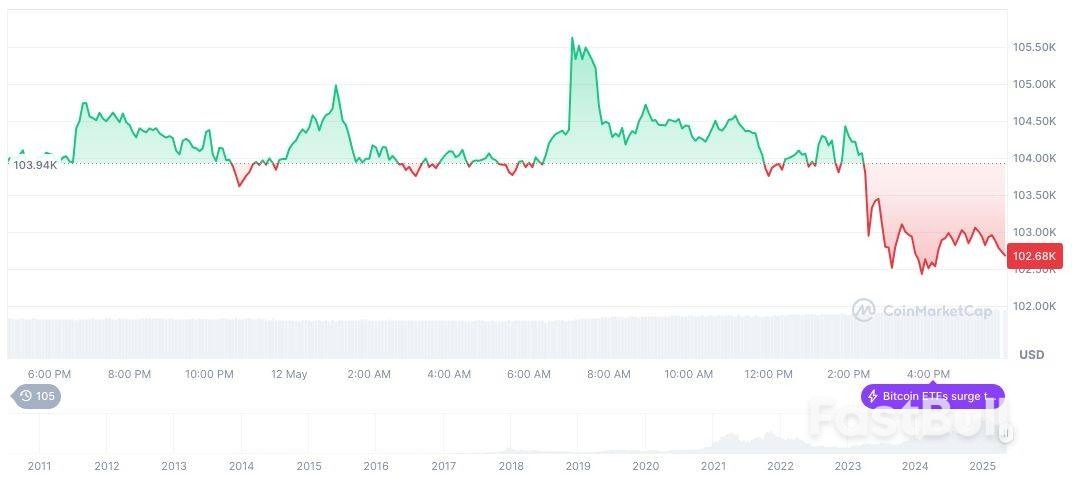
          Bitcoin's current data: trading at $102,929.11 with a market cap of $2.04 trillion, according to CoinMarketCap. Despite a 1.07% decline over 24 hours, Bitcoin saw growth of 8.56% in seven days, and a broader upward trend with a 30-day increase of 20.62%. Trading volume reached $64.05 billion, clearly impacting market engagement and investor strategies.

          Bitcoin(BTC), daily chart, screenshot on CoinMarketCap at 23:49 UTC on May 12, 2025.

          Insights from the Coincu research team emphasize the potential ripple effects on technological sectors and crypto product innovations. Delayed monetary easing creates interim pressure but historically catalyzes post-adjustment asset influxes. Such contexts illustrate opportunities for strategic positioning in risk-on environments.

          Source: CryptoSlate

          To stay updated on all economic events of today, please check out our Economic calendar
          Risk Warnings and Disclaimers
          You understand and acknowledge that there is a high degree of risk involved in trading. Following any strategies or investment methods may lead to potential losses. The content on the site is provided by our contributors and analysts for information purposes only. You are solely responsible for determining whether any trading assets, securities, strategy, or any other product is suitable for investing based on your own investment objectives and financial situation.
          Add to Favorites
          Share

          Explainer: What Has Trump Said About Cutting Drug Prices?

          Michelle Reid

          May 12 (Reuters) - U.S. President Donald Trump signed a broad executive order on Monday directing drugmakers to lower the prices of their prescription drugs to align with what other countries pay.

          White House officials said the government will give drugmakers price targets in the next month, and will take further action within six months if the companies do not make "significant progress" toward the goal of lower prices.

          WHAT IS TRUMP'S STANCE ON PRESCRIPTION DRUG PRICES?

          Trump has sharply criticised the pharmaceutical industry for years over the price of medicines in the United States. He has also chided other wealthy nations for "freeloading" on U.S. pharmaceutical innovation.

          During his first term, in 2017, he accused the industry of "getting away with murder" in the prices they charge the government for prescription drugs.

          Trump's proposed international reference pricing program was blocked by a court in 2020.

          During his 2024 presidential campaign, Trump said Americans were being overcharged for medicines compared to other nations and pledged to take action.

          On Monday, he said he wants to "equalize" prices with other countries by implementing tariffs.

          ARE U.S. DRUG PRICES MORE EXPENSIVE?

          Yes. The U.S. pays the most for prescription medicines in the world, often nearly three times that of other developed nations.

          Top-selling blood thinner Eliquis from Bristol Myers Squibb (BMY.N), opens new tab and Pfizer (PFE.N), opens new tab carries a U.S. list price of $606 for a month's supply. The previous administration of Democratic President Joe Biden negotiated that down to $295 for Medicare, which goes into effect in 2026, but the drug costs $114 in Sweden and just $20 in Japan.

          WHAT IS TRUMP GOING TO DO ABOUT IT?

          Since taking office in January, Trump has reiterated that he wants to end this inequity. On Sunday, he announced on Truth Social that he would sign an executive order to pursue "most favoured nation" pricing.

          Also known as international reference pricing, it seeks to narrow the gap between the U.S. and foreign drug prices. Reuters reported in April such a policy was under consideration.

          The executive order on Monday differed from what drugmakers had been expecting. Lobbyist sources had told Reuters ahead of the order's signing on Monday that they expected the "most favored nation" pricing to apply to drugs for Medicare patients. But the order appeared to apply to all medicines.

          Separately, Trump has also pushed for drugmakers to boost U.S. manufacturing. His administration is conducting an investigation into imports of pharmaceuticals in a bid to levy tariffs on grounds that reliance on foreign production of medicine threatens national security.

          HOW DOES THIS DIFFER FROM PREVIOUS PRICE REDUCTION EFFORTS?

          Biden's Inflation Reduction Act allows the government to negotiate the price of its most expensive drugs within Medicare.

          The prices for the first 10 prescription drugs it negotiated were still on average more than double, and in some cases five times, what drugmakers had agreed to in four other high-income countries, Reuters previously reported.

          WHAT IS THE PHARMA INDUSTRY'S RESPONSE?

          The industry is strongly opposed to the prospect of dramatically lower drug prices in the United States, the world's largest pharmaceuticals market.

          Two industry sources told Reuters last month that any such policy was more concerning to the industry than other potential government moves such as tariffs on imported medicines.

          The main U.S. lobby group for drugmakers, the Pharmaceutical Research and Manufacturers of America, known as PhRMA, said, "to lower costs for Americans, we need to address the real reasons U.S. prices are higher: foreign countries not paying their fair share and middlemen driving up prices for U.S. patients."

          "Most favored nation is a deeply flawed proposal that would devastate our nation's small- and mid-size biotech companies," said John Crowley, CEO of BIO, the main U.S. trade group for biotechnology companies, in a statement.

          WHAT ARE THE CHALLENGES IN CARRYING OUT THE ORDER?

          Experts warn that referencing prices from other countries is complex, as many drugs sold in the U.S. are not available abroad, and some nations do not publish what they pay for drugs or take years to negotiate prices.

          The U.S. does not buy drugs directly for a national health system, as countries such as England and Germany do, instead relying on the private sector to manage drug price negotiations for both government and private health plans.

          Analysts said implementing the broad order would be difficult.

          The executive order is also likely to face legal challenges, particularly for exceeding limits set by U.S. law, including on imports of drugs from abroad, legal experts said.

          Reporting by Maggie Fick in London; Editing by Josephine, Mason, Caroline Humer and Bill Berkrot

          Source: Reuters

          Risk Warnings and Disclaimers
          You understand and acknowledge that there is a high degree of risk involved in trading. Following any strategies or investment methods may lead to potential losses. The content on the site is provided by our contributors and analysts for information purposes only. You are solely responsible for determining whether any trading assets, securities, strategy, or any other product is suitable for investing based on your own investment objectives and financial situation.
          Add to Favorites
          Share

          Toy Stocks Rally After Chinese Tariffs Slashed To 30%

          Edward Lawson

          China–U.S. Trade War

          Toys made by Mattel, Hasbro and others are seen at a Macy's store in New York.

          Shares of major toy makers rallied on Monday after the U.S. agreed to temporarily reduce tariffs on China.

          The agreement will pause most tariffs and other trade barriers for 90 days, including reducing the 145% levy President Donald Trump had in place on Chinese imports to 30%.

          Shares of Mattel jumped more than 10% Monday, Hasbro traded up 6.5%, Jakks rose more than 15% and Funko soared a whopping 46.4%.

          The rally pushed shares of Hasbro above their trading level from early April, before Trump first announced his so-called "reciprocal tariffs" on dozens of trade partners. The rest of the toy stocks are still trading below their April 1 closing prices.

          The stocks had been hammered by Wall Street as investors anticipated manufacturing hiccups and price hikes resulting from the tariff scheme. The toy industry is heavily reliant on supply chains in China, leaving toy makers at the mercy of trade policy. Bank of America estimates that both Mattel and Hasbro source around 40% of their U.S. product from China.

          Last month, Hasbro estimated that it would see as much as a $300 million hit to its bottom line if Trump's 145% China duty held.

          Mattel, too, warned last week that it was taking mitigating actions to fully offset costs associated with Trump's trade war with China, including raising prices in the U.S.

          Both companies had previously issued forecasts that assumed 25% tariffs on Chinese imports. Mattel retracted its guidance earlier this month, citing macroeconomic volatility and uncertainty surrounding U.S. tariffs. Hasbro, meanwhile, maintained the full-year guidance it issued last quarter, but warned investors about the uncertainty of the current tariff environment.

          Representatives from Hasbro, Mattel, Jakks and Funko did not immediately return CNBC's request for comment.

          Source: CNBC

          Risk Warnings and Disclaimers
          You understand and acknowledge that there is a high degree of risk involved in trading. Following any strategies or investment methods may lead to potential losses. The content on the site is provided by our contributors and analysts for information purposes only. You are solely responsible for determining whether any trading assets, securities, strategy, or any other product is suitable for investing based on your own investment objectives and financial situation.
          Add to Favorites
          Share
          FastBull
          Copyright © 2025 FastBull Ltd

          728 RM B 7/F GEE LOK IND BLDG NO 34 HUNG TO RD KWUN TONG KLN HONG KONG

          TelegramInstagramTwitterfacebooklinkedin
          App Store Google Play Google Play
          Products
          Charts

          Chats

          Q&A with Experts
          Screeners
          Economic Calendar
          Data
          Tools
          Membership
          Features
          Function
          Markets
          Copy Trading
          Latest Signals
          Contests
          News
          Analysis
          24/7
          Columns
          Education
          Company
          Careers
          About Us
          Contact Us
          Advertising
          Help Center
          Feedback
          User Agreement
          Privacy Policy
          Business

          White Label

          Data API

          Web Plug-ins

          Poster Maker

          Affiliate Program

          Risk Disclosure

          The risk of loss in trading financial instruments such as stocks, FX, commodities, futures, bonds, ETFs and crypto can be substantial. You may sustain a total loss of the funds that you deposit with your broker. Therefore, you should carefully consider whether such trading is suitable for you in light of your circumstances and financial resources.

          No decision to invest should be made without thoroughly conducting due diligence by yourself or consulting with your financial advisors. Our web content might not suit you since we don't know your financial conditions and investment needs. Our financial information might have latency or contain inaccuracy, so you should be fully responsible for any of your trading and investment decisions. The company will not be responsible for your capital loss.

          Without getting permission from the website, you are not allowed to copy the website's graphics, texts, or trademarks. Intellectual property rights in the content or data incorporated into this website belong to its providers and exchange merchants.

          Not Logged In

          Log in to access more features

          FastBull Membership

          Not yet

          Purchase

          Become a signal provider
          Help Center
          Customer Service
          Dark Mode
          Price Up/Down Colors

          Log In

          Sign Up

          Position
          Layout
          Fullscreen
          Default to Chart
          The chart page opens by default when you visit fastbull.com