• Trade
  • Markets
  • Copy
  • Contests
  • News
  • 24/7
  • Calendar
  • Q&A
  • Chats
Trending
Screeners
SYMBOL
LAST
BID
ASK
HIGH
LOW
NET CHG.
%CHG.
SPREAD
SPX
S&P 500 Index
6827.42
6827.42
6827.42
6899.86
6801.80
-73.58
-1.07%
--
DJI
Dow Jones Industrial Average
48458.04
48458.04
48458.04
48886.86
48334.10
-245.98
-0.51%
--
IXIC
NASDAQ Composite Index
23195.16
23195.16
23195.16
23554.89
23094.51
-398.69
-1.69%
--
USDX
US Dollar Index
97.920
98.000
97.920
98.070
97.810
-0.030
-0.03%
--
EURUSD
Euro / US Dollar
1.17447
1.17454
1.17447
1.17596
1.17262
+0.00053
+ 0.05%
--
GBPUSD
Pound Sterling / US Dollar
1.33840
1.33847
1.33840
1.33961
1.33546
+0.00133
+ 0.10%
--
XAUUSD
Gold / US Dollar
4331.54
4331.97
4331.54
4350.16
4294.68
+32.15
+ 0.75%
--
WTI
Light Sweet Crude Oil
56.872
56.902
56.872
57.601
56.789
-0.361
-0.63%
--

Community Accounts

Signal Accounts
--
Profit Accounts
--
Loss Accounts
--
View More

Become a signal provider

Sell trading signals to earn additional income

View More

Guide to Copy Trading

Get started with ease and confidence

View More

Signal Accounts for Members

All Signal Accounts

Best Return
  • Best Return
  • Best P/L
  • Best MDD
Past 1W
  • Past 1W
  • Past 1M
  • Past 1Y

All Contests

  • All
  • Trump Updates
  • Recommend
  • Stocks
  • Cryptocurrencies
  • Central Banks
  • Featured News
Top News Only
Share

Portugal Treasury Expects 2026 Net Financing Needs At 29.4 Billion Euros, Up From 25.8 Billion In 2025

Share

Bank Of America Says With Indonesia's Smelter Now Ramping Up, It Expects Aluminium Supply Growth To Accelerate To 2.6% Year On Year In 2026

Share

Bank Of America Expects A Deficit In Aluminium Next Year And Sees Prices Pushing Above $3000/T

Share

Fed Data - USA Effective Federal Funds Rate At 3.64 Percent On 12 December On $102 Billion In Trades Versus 3.64 Percent On $99 Billion On 11 December

Share

Brazil's Petrobras Says No Impact Seen On Oil, Petroleum Products Output As Workers Start Planned Strike

Share

Statement: US Travel Group Warns New Proposed Trump Administration Requirements For Foreign Tourists To Provide Social Media Histories Could Mean Millions Of People Opting Not To Visit

Share

Blackrock: Kerry White Will Become Head Of Citi Investment Management At Citi Wealth

Share

Blackrock: Rob Jasminski, Head Of Citi Investment Management, Has Joined With Team

Share

Blackrock: Effective Dec 15, Citi Investment Management Employees Will Join Blackrock

Share

Blackrock: Formally Launch Citi Portfolio Solutions Powered By Blackrock

Share

According To Data From The Federal Reserve Bank Of New York, The Secured Overnight Funding Rate (Sofr) Was 3.67% On The Previous Trading Day (December 15), Compared To 3.66% The Day Before

Share

Peru Energy And Mines Ministry: Copper Production Up 4.8% Year-On-Year In October To 248192 Metric Tons

Share

Security Source: Ukrainian Drones Hits Russian Oil Infrastructure In Caspian Sea For Third Time

Share

Spot Palladium Extends Gains, Last Up 5% To $1562.7/Oz

Share

Mexico's Economy Ministry Announces Start Of Anti-Dumping Investigation And Anti-Subsidy Investigations Into USA Pork Imports

Share

Canada Nov CPI Common +2.8%, CPI Median +2.8%, CPI Trim +2.8% On Year

Share

NY Fed's Empire State Prices Paid Index +37.6 In December Versus+49.0 In November

Share

Canada Nov Consumer Prices +0.1% On Month, +2.2% On Year

Share

Canada Nov CPI Core -0.1% On Month, +2.9% On Year

Share

Canada Nov Core CPI, Seasonally Adjusted +0.2% On Month, Oct +0.3% (Unrevised)

TIME
ACT
FCST
PREV
Japan Tankan Small Manufacturing Outlook Index (Q4)

A:--

F: --

P: --

Japan Tankan Large Non-Manufacturing Outlook Index (Q4)

A:--

F: --

P: --

Japan Tankan Large Manufacturing Outlook Index (Q4)

A:--

F: --

P: --

Japan Tankan Small Manufacturing Diffusion Index (Q4)

A:--

F: --

P: --

Japan Tankan Large Manufacturing Diffusion Index (Q4)

A:--

F: --

P: --

Japan Tankan Large-Enterprise Capital Expenditure YoY (Q4)

A:--

F: --

P: --

U.K. Rightmove House Price Index YoY (Dec)

A:--

F: --

P: --

China, Mainland Industrial Output YoY (YTD) (Nov)

A:--

F: --

P: --

China, Mainland Urban Area Unemployment Rate (Nov)

A:--

F: --

P: --

Saudi Arabia CPI YoY (Nov)

A:--

F: --

P: --

Euro Zone Industrial Output YoY (Oct)

A:--

F: --

P: --

Euro Zone Industrial Output MoM (Oct)

A:--

F: --

P: --

Canada Existing Home Sales MoM (Nov)

A:--

F: --

P: --

Canada National Economic Confidence Index

A:--

F: --

P: --

Canada New Housing Starts (Nov)

A:--

F: --

P: --
U.S. NY Fed Manufacturing Employment Index (Dec)

A:--

F: --

P: --

U.S. NY Fed Manufacturing Index (Dec)

A:--

F: --

P: --

Canada Core CPI YoY (Nov)

A:--

F: --

P: --

Canada Manufacturing Unfilled Orders MoM (Oct)

A:--

F: --

P: --

U.S. NY Fed Manufacturing Prices Received Index (Dec)

A:--

F: --

P: --

U.S. NY Fed Manufacturing New Orders Index (Dec)

A:--

F: --

P: --

Canada Manufacturing New Orders MoM (Oct)

A:--

F: --

P: --

Canada Core CPI MoM (Nov)

A:--

F: --

P: --

Canada Trimmed CPI YoY (SA) (Nov)

A:--

F: --

P: --

Canada Manufacturing Inventory MoM (Oct)

A:--

F: --

P: --

Canada CPI YoY (Nov)

A:--

F: --

P: --

Canada CPI MoM (Nov)

A:--

F: --

P: --

Canada CPI YoY (SA) (Nov)

A:--

F: --

P: --

Canada Core CPI MoM (SA) (Nov)

A:--

F: --

P: --

Canada CPI MoM (SA) (Nov)

A:--

F: --

P: --

Federal Reserve Board Governor Milan delivered a speech
U.S. NAHB Housing Market Index (Dec)

--

F: --

P: --

Australia Composite PMI Prelim (Dec)

--

F: --

P: --

Australia Services PMI Prelim (Dec)

--

F: --

P: --

Australia Manufacturing PMI Prelim (Dec)

--

F: --

P: --

Japan Manufacturing PMI Prelim (SA) (Dec)

--

F: --

P: --

U.K. 3-Month ILO Employment Change (Oct)

--

F: --

P: --

U.K. Unemployment Claimant Count (Nov)

--

F: --

P: --

U.K. Unemployment Rate (Nov)

--

F: --

P: --

U.K. 3-Month ILO Unemployment Rate (Oct)

--

F: --

P: --

U.K. Average Weekly Earnings (3-Month Average, Including Bonuses) YoY (Oct)

--

F: --

P: --

U.K. Average Weekly Earnings (3-Month Average, Excluding Bonuses) YoY (Oct)

--

F: --

P: --

France Services PMI Prelim (Dec)

--

F: --

P: --

France Composite PMI Prelim (SA) (Dec)

--

F: --

P: --

France Manufacturing PMI Prelim (Dec)

--

F: --

P: --

Germany Services PMI Prelim (SA) (Dec)

--

F: --

P: --

Germany Manufacturing PMI Prelim (SA) (Dec)

--

F: --

P: --

Germany Composite PMI Prelim (SA) (Dec)

--

F: --

P: --

Euro Zone Composite PMI Prelim (SA) (Dec)

--

F: --

P: --

Euro Zone Services PMI Prelim (SA) (Dec)

--

F: --

P: --

Euro Zone Manufacturing PMI Prelim (SA) (Dec)

--

F: --

P: --

U.K. Services PMI Prelim (Dec)

--

F: --

P: --

U.K. Manufacturing PMI Prelim (Dec)

--

F: --

P: --

U.K. Composite PMI Prelim (Dec)

--

F: --

P: --

Euro Zone ZEW Economic Sentiment Index (Dec)

--

F: --

P: --

Germany ZEW Current Conditions Index (Dec)

--

F: --

P: --

Germany ZEW Economic Sentiment Index (Dec)

--

F: --

P: --

Euro Zone Trade Balance (Not SA) (Oct)

--

F: --

P: --

Euro Zone ZEW Current Conditions Index (Dec)

--

F: --

P: --

Euro Zone Trade Balance (SA) (Oct)

--

F: --

P: --

U.S. Retail Sales MoM (Excl. Automobile) (SA) (Oct)

--

F: --

P: --

Q&A with Experts
    • All
    • Chatrooms
    • Groups
    • Friends
    Connecting
    .
    .
    .
    Type here...
    Add Symbol or Code

      No matching data

      All
      Trump Updates
      Recommend
      Stocks
      Cryptocurrencies
      Central Banks
      Featured News
      • All
      • Russia-Ukraine Conflict
      • Middle East Flashpoint
      • All
      • Russia-Ukraine Conflict
      • Middle East Flashpoint
      Search
      Products

      Charts Free Forever

      Chats Q&A with Experts
      Screeners Economic Calendar Data Tools
      Membership Features
      Data Warehouse Market Trends Institutional Data Policy Rates Macro

      Market Trends

      Market Sentiment Order Book Forex Correlations

      Top Indicators

      Charts Free Forever
      Markets

      News

      News Analysis 24/7 Columns Education
      From Institutions From Analysts
      Topics Columnists

      Latest Views

      Latest Views

      Trending Topics

      Top Columnists

      Latest Update

      Signals

      Copy Rankings Latest Signals Become a signal provider AI Rating
      Contests
      Brokers

      Overview Brokers Assessment Rankings Regulators News Claims
      Broker listing Forex Brokers Comparison Tool Live Spread Comparison Scam
      Q&A Complaint Scam Alert Videos Tips to Detect Scam
      More

      Business
      Events
      Careers About Us Advertising Help Center

      White Label

      Data API

      Web Plug-ins

      Affiliate Program

      Awards Institution Evaluation IB Seminar Salon Event Exhibition
      Vietnam Thailand Singapore Dubai
      Fans Party Investment Sharing Session
      FastBull Summit BrokersView Expo
      Recent Searches
        Top Searches
          Markets
          News
          Analysis
          User
          24/7
          Economic Calendar
          Education
          Data
          • Names
          • Latest
          • Prev

          View All

          No data

          Scan to Download

          Faster Charts, Chat Faster!

          Download App
          English
          • English
          • Español
          • العربية
          • Bahasa Indonesia
          • Bahasa Melayu
          • Tiếng Việt
          • ภาษาไทย
          • Français
          • Italiano
          • Türkçe
          • Русский язык
          • 简中
          • 繁中
          Open Account
          Search
          Products
          Charts Free Forever
          Markets
          News
          Signals

          Copy Rankings Latest Signals Become a signal provider AI Rating
          Contests
          Brokers

          Overview Brokers Assessment Rankings Regulators News Claims
          Broker listing Forex Brokers Comparison Tool Live Spread Comparison Scam
          Q&A Complaint Scam Alert Videos Tips to Detect Scam
          More

          Business
          Events
          Careers About Us Advertising Help Center

          White Label

          Data API

          Web Plug-ins

          Affiliate Program

          Awards Institution Evaluation IB Seminar Salon Event Exhibition
          Vietnam Thailand Singapore Dubai
          Fans Party Investment Sharing Session
          FastBull Summit BrokersView Expo

          Massive USDT Transfer: $402 Million Moves To OKX, What Does It Mean?

          Samantha Luan

          Cryptocurrency

          Economic

          Summary:

          In the dynamic world of cryptocurrency, where billions of dollars move across the globe every second, certain transactions stand out, grabbing the attention of traders, analysts, and enthusiasts alike.

          Massive USDT Transfer: $402 Million Moves to OKX, What Does It Mean?

          One such event recently sent ripples through the digital asset community: a monumental USDT transfer. Whale Alert, a renowned blockchain tracker, reported that an astounding 401,961,138 USDT, valued at approximately $402 million, was moved from an unknown wallet to the popular cryptocurrency exchange OKX. This single, massive USDT transfer raises numerous questions about market sentiment, potential strategies, and the ever-evolving landscape of digital finance.

          What Exactly Happened with This Enormous USDT Transfer?

          On a specific date, blockchain tracking service Whale Alert, known for monitoring large cryptocurrency movements, detected and reported a colossal USDT transfer. The details are as follows:

          ● Amount: 401,961,138 USDT
          ● Approximate Value: $402,000,000
          ● Origin: An unknown wallet (address not publicly associated with a known entity or individual)
          ● Destination: OKX, one of the world’s leading cryptocurrency exchanges

          This kind of large-scale USDT transfer is not entirely uncommon in the crypto space, but its sheer size always warrants close examination. Stablecoins like USDT are crucial for liquidity and trading within the crypto ecosystem, often serving as a bridge between fiat currencies and volatile cryptocurrencies. A movement of this magnitude can signal various intentions, from institutional maneuvers to strategic trading plays, impacting market sentiment and potentially future price action.

          Understanding ‘Unknown Wallets’ and Their Significance in a Large USDT Transfer

          When a transaction originates from an ‘unknown wallet,’ it often adds an element of mystery and speculation. But what exactly does ‘unknown’ signify in the context of a significant USDT transfer?

          ● Privacy and Anonymity: Blockchain transactions are pseudonymous. While the wallet addresses are public, the identity of the owner behind those addresses is not inherently revealed. This privacy is a core tenet of cryptocurrency.
          ● Institutional Holdings: Many large ‘unknown’ wallets could belong to institutions, investment funds, or even large individual investors (often termed ‘whales’) who prefer to keep their holdings and activities private.
          ● Over-the-Counter (OTC) Desks: OTC desks facilitate large block trades for institutional clients, often moving funds between their own wallets and exchanges to fulfill orders without significantly impacting public order books. A large USDT transfer might be part of an OTC deal.
          ● Custodial Services: Some ‘unknown’ wallets might be associated with custodial services that hold funds on behalf of multiple clients, making it difficult to pinpoint the exact end-user or purpose of the transfer.

          The very nature of an ‘unknown wallet’ means we can only speculate on the exact motives behind such a large USDT transfer. However, the destination provides a clearer hint.

          Why OKX? Potential Implications of a Massive USDT Transfer to an Exchange

          The choice of destination, OKX, is a critical piece of the puzzle. OKX is a global cryptocurrency exchange offering a wide range of services, including spot trading, derivatives, and various financial products. A large USDT transfer to an exchange typically suggests one of several possibilities:

          1.Preparing for Large Purchases: The most common assumption is that the funds are being moved to the exchange to purchase other cryptocurrencies. A $402 million USDT deposit could be used to acquire significant amounts of Bitcoin, Ethereum, or other altcoins, potentially signaling bullish sentiment from the whale.

          2.Liquidity Provision: Large entities, including market makers, often deposit stablecoins onto exchanges to provide liquidity, facilitate trading, and earn fees from market operations. This helps ensure smooth price discovery and execution for other traders.

          3.Yield Farming or Staking: OKX, like many exchanges, offers various financial products such as yield farming, staking, and lending. The whale might be moving the USDT to participate in these programs to earn passive income.

          4.Rebalancing Portfolios: Large investors frequently rebalance their portfolios. This USDT transfer could be part of a broader strategy to adjust asset allocations, moving from an external wallet to the exchange for easier trading access.

          5.OTC Deal Fulfillment: While an OTC deal itself happens off-exchange, the final settlement or part of the funds might need to be moved to an exchange wallet to complete the transaction or distribute funds to various participants.

          Each of these scenarios carries different implications for the broader market. The movement of such a substantial amount of stablecoin can precede significant market activity.

          Decoding the Whale’s Intentions: What Could This Mean for the Market After a Huge USDT Transfer?

          While definitive answers are elusive, market observers often try to ‘decode’ the intentions behind such large movements. A significant USDT transfer like this can be interpreted in several ways:

          ● Bullish Signal: If the whale intends to buy a large amount of Bitcoin or other cryptocurrencies, this influx of stablecoin liquidity could be seen as a bullish indicator, suggesting an expectation of rising prices.

          ● Bearish Signal (Less Likely for USDT Inflow): While less common for stablecoin inflows, if the USDT is intended for withdrawal after converting other assets to stablecoins, it could indicate a move to de-risk or take profits. However, direct USDT inflow to an exchange is typically associated with buying power.

          ● Market Stability: The presence of large amounts of stablecoin on exchanges can also contribute to market stability by providing deep liquidity, which can absorb large buy or sell orders without causing extreme price volatility.

          ● Institutional Interest: The size of this USDT transfer strongly suggests institutional involvement. Growing institutional participation is often viewed positively, as it brings more capital and maturity to the market.

          It is crucial to remember that one large transaction does not necessarily dictate the entire market’s direction. However, it provides a valuable data point for analysis.

          Navigating the Waters: How to Interpret Such Events and Their Impact on a USDT Transfer

          For everyday crypto participants, understanding these large transactions is key to navigating the market. Here are some actionable insights:

          ● Monitor Whale Alerts: Services like Whale Alert provide transparency into significant on-chain movements. Keeping an eye on these reports can offer early indications of potential market shifts.

          ● Context is Key: Don’t react solely to one transaction. Always consider it within the broader market context – overall market sentiment, news events, technical analysis, and macroeconomic factors.

          ● Stablecoin Inflows vs. Outflows: Generally, large stablecoin inflows to exchanges suggest an intent to buy, while large stablecoin outflows might indicate funds being moved off-exchange for cold storage or OTC deals.

          ● Diversify Your Information Sources: Rely on multiple reputable sources for your crypto news and analysis to get a well-rounded view.

          ● Practice Risk Management: Regardless of whale movements, always trade responsibly and never invest more than you can afford to lose. Large transactions can cause short-term volatility.

          This particular USDT transfer serves as a reminder of the powerful forces at play in the crypto market.

          The Broader Impact on USDT and Stablecoins

          Beyond the immediate implications for OKX and potential market movements, this massive USDT transfer also reinforces the critical role of stablecoins like Tether (USDT) in the cryptocurrency ecosystem. USDT remains the largest stablecoin by market capitalization, serving as a vital trading pair and a safe haven during periods of volatility. The ability to seamlessly move hundreds of millions of dollars in USDT across the blockchain highlights its utility and liquidity. Such large transfers underscore the trust and reliance placed on stablecoins for facilitating significant value transfers efficiently and cost-effectively, underpinning the vast majority of crypto trading volume globally.

          Conclusion: The Enduring Mystery of the Massive USDT Transfer

          The recent USDT transfer of over $400 million from an unknown wallet to OKX is a compelling example of the powerful, yet often opaque, movements that characterize the cryptocurrency market. While the exact motives of the ‘whale’ remain a mystery, the transaction underscores the growing institutional interest, the critical role of stablecoins, and the deep liquidity available on major exchanges. Such events serve as important data points for market analysis, offering glimpses into potential shifts in sentiment or strategic plays by major players. As the crypto market continues to mature, monitoring these large transactions will remain a vital practice for anyone looking to understand its intricate dynamics and potential future directions. The world of crypto is always buzzing with activity, and a USDT transfer of this magnitude certainly adds to the intrigue.

          Source: CryptoSlate

          To stay updated on all economic events of today, please check out our Economic calendar
          Risk Warnings and Disclaimers
          You understand and acknowledge that there is a high degree of risk involved in trading. Following any strategies or investment methods may lead to potential losses. The content on the site is provided by our contributors and analysts for information purposes only. You are solely responsible for determining whether any trading assets, securities, strategy, or any other product is suitable for investing based on your own investment objectives and financial situation.
          Add to Favorites
          Share

          US and China to Talk in Stockholm as Trade Truce Expiration Nears

          Warren Takunda

          Economic

          When top US and Chinese officials meet in Stockholm on Monday, it’s likely that they will agree to leave tariffs at the current levels, if they don’t secure a more favourable framework. Analysts say the two sides are working to secure a more lasting trade deal ahead of a meeting between their presidents later this year.
          Treasury Secretary Scott Bessent and Chinese Vice Premier He Lifeng are holding talks on Monday for the third time this year. This round of discussions is taking place in the Swedish capital, nearly four months after President Donald Trump upset global trade with his sweeping tariff proposal, including an import tax that shot up to 145% on Chinese goods.
          “We have the confines of a deal with China,” Trump said on Friday.
          Bessent told MSNBC on Wednesday that the two countries had reached a “status quo” after talks in Geneva and London, with the US taxing imported goods from China at 30% and China responding with a 10% tariff, on top of tariffs prior to the start of Trump's second term in office.
          “Now we can move on to discussing other matters in terms of bringing the economic relationship into balance,” Bessent said. He was referring to the US running a $295.5 billion (€253.1bn) trade deficit last year. Washington is seeking an agreement that would enable it to export more to China and shift the Chinese economy more toward domestic consumer spending.
          The Chinese embassy in Washington said Beijing hopes “there will be more consensus and cooperation and less misperception” coming out of the talks.
          With an eye on a possible leaders' summit, Stockholm could provide some answers as to the timeline and viability of that particular goal ahead of a possible meeting between Trump and Chinese leader Xi Jinping.
          “The meeting will be important in starting to set the stage for a fall meeting between Trump and Xi,” said Wendy Cutler, a former US trade negotiator and now vice president at the Asia Society Policy Institute. “Beijing will likely insist on detailed preparations before they agree to a leaders’ meeting.”
          In Stockholm, the two sides are likely to focus on commercial announcements to be made at a leaders’ summit as well as agreements to address “major irritants”, such as China's industrial overcapacity and its lack of control over chemicals used to make fentanyl, also to be announced when Xi and Trump should meet, Cutler said.
          Sean Stein, president of the US-China Business Council, said Stockholm could be the first real opportunity for the two governments to address structural reform issues including market access in China for US companies.
          What businesses will be seeking coming out of Stockholm would largely be “the atmosphere” — how the two sides characterise the discussions. They will also look for clues about a possible leaders’ summit, as any real deal will hinge on the two presidents meeting each other, he said.

          Fentanyl-related tariffs are likely a focus for China

          In Stockholm, Beijing will likely demand the removal of the 20% fentanyl-related tariff that Trump imposed earlier this year, said Sun Yun, director of the China program at the Washington-based Stimson Center.
          This round of the US-China trade dispute began with fentanyl, when Trump in February imposed a 10% tariff on Chinese goods, citing that China failed to curb the outflow of the chemicals used to make the drug. The following month, Trump added another 10% tax for the same reason. Beijing retaliated with extra duties on some US goods, including coal, liquefied natural gas, and farm products such as beef, chicken, pork and soy.
          In Geneva, both sides climbed down from three-digit tariffs rolled out following Trump's “Liberation Day” tariffs in April, but the US kept the 20% “fentanyl” tariffs, in addition to the 10% baseline rate — to which China responded by keeping the same 10% rate on US products. These across-the-board duties were unchanged when the two sides met in London a month later to negotiate over non-tariff measures such as export controls on critical products.
          The Chinese government has long protested that American politicians blame China for the fentanyl crisis in the US but argued the root problem lies with the US itself. Washington says Beijing is not doing enough to regulate precursor chemicals that flow out of China into the hands of drug dealers.
          In July, China placed two fentanyl ingredients under enhanced control, a move seen as in response to US pressure and signalling goodwill.
          Gabriel Wildau, managing director at the consultancy Teneo, said he doesn't expect any tariff to go away in Stockholm but that tariff relief could be part of a final trade deal.
          “It’s possible that Trump would cancel the 20% tariff that he has explicitly linked with fentanyl, but I would expect the final tariff level on China to be at least as high as the 15-20% rate contained in the recent deals with Japan, Indonesia, Vietnam,” Wildau said.

          US wants China to dump less, buy less oil from Russia and Iran

          China's industrial overcapacity is as much a headache for the United States as it is for the European Union. Even Beijing has acknowledged the problem but suggested it might be difficult to address.
          America’s trade imbalance with China has decreased from a peak of $418bn (€358bn) in 2018, according to the Census Bureau. But China has found new markets for its goods; the world’s dominant manufacturer ran a global trade surplus approaching $1 trillion last year — somewhat larger than the size of the US overall trade deficit in 2024. And China’s emergence as a manufacturer of electric vehicles and other emerging technologies has suddenly made it more of a financial and geopolitical threat for those same industries based in the US, Europe, Japan and South Korea.
          “Some enterprises, especially manufacturing enterprises, feel more deeply that China’s manufacturing capabilities are too strong, and Chinese people are too hardworking. Factories run 24 hours a day,” Chinese Premier Li Qiang said on Thursday when hosting European Commission President Ursula von der Leyen in Beijing. “Some people think this will cause some new problems in the balance of supply and demand in world production.” Li added: “We see this problem too.”
          Bessent also said the Stockholm talks could address Chinese purchases of Russian and Iranian oil. However, Wildau of Teneo said China could demand some US security concessions in exchange, such as a reduced US military presence in East Asia and scaled-back diplomatic support for Taiwan and the Philippines. This would likely face political pushback in Washington.
          The Stockholm talks will be “geared towards building a trade agreement based around Chinese purchase commitments and pledges of investment in the US in exchange for partial relief from U.S. tariffs and export controls,” Wildau said.
          He doubts there will be a grand deal. Instead, he predicts “a more limited agreement based around fentanyl”.
          “That,” he said, “is probably the preferred outcome for China hawks in the Trump administration, who worry that an overeager Trump might offer too much to Xi.”

          Source: Euronews

          To stay updated on all economic events of today, please check out our Economic calendar
          Risk Warnings and Disclaimers
          You understand and acknowledge that there is a high degree of risk involved in trading. Following any strategies or investment methods may lead to potential losses. The content on the site is provided by our contributors and analysts for information purposes only. You are solely responsible for determining whether any trading assets, securities, strategy, or any other product is suitable for investing based on your own investment objectives and financial situation.
          Add to Favorites
          Share

          A breakthrough and a burden? What the U.S.-EU trade deal means for the auto sector

          Adam

          Economic

          U.S. President Donald Trump has hailed the framework trade agreement with the European Union as the biggest trade deal ever made and one that promises to be “great for cars.”
          An agreement brokered on Sunday between the U.S. and the EU means the Trump administration will impose a blanket tariff of 15% on most EU goods.
          It represents a significant reduction from Trump’s threat to impose charges of 30% from Aug. 1 and almost halves the existing tariff rate on Europe’s auto sector from 27.5%.
          Industry groups, while welcoming the trade deal, have expressed deep concern about the costs associated with the new tariff reality.
          Sitting alongside the U.S. president in Scotland on Sunday, European Commission President Ursula von der Leyen described the agreement as a “good deal” following tough negotiations.
          The German Association of the Automotive Industry (VDA) said Monday it is “fundamentally positive” that the U.S. and EU have managed to secure a deal that averts a transatlantic trade dispute.
          “The decisive factor now will be how the agreement is structured in concrete terms and how reliable it is,” VDA President Hildegard Müller said in a statement.
          “However, it is also clear that the US tariff of 15 per cent on automotive products will cost German automotive companies billions annually and place a burden on them in the midst of their transformation,” Müller said.
          Alongside a call to ensure automotive supply chains receive the necessary support, the VDA also pushed for the EU to make the framework conditions internationally competitive for investors and companies “in order to become more attractive and relevant as an investment location again.”

          ‘A significant burden’

          The European Automobile Manufacturers Association, an industry lobby group, said Monday that the U.S.-EU trade agreement represents an important step toward easing “intense uncertainty,” welcoming the development in principle.
          “Nevertheless, the US will retain higher tariffs on automobiles and automotive parts, and this will continue to have a negative impact not just for industry in the EU but also in the US,” ACEA Director-General Sigrid de Vries said in a statement.
          ACEA said it would closely examine the details of the agreement that still need to be clarified.
          ico Luman, senior sector economist for transport and logistics at Dutch bank ING, said Monday that the new tariff rate of 15% on cars exported from the EU to the U.S. is clearly much better than 27.5% — but it still reflects “a significant burden” for automakers.
          “Margins are under pressure in a multi-challenge market and the bill can’t be fully passed on to customers without volume losses,” Luman told CNBC by email.
          Second-quarter earnings season showed that carmakers were already struggling with the tariff impact, Luman said, noting there’s more to come over the coming months.
          “The weakened dollar also makes US car imports more expensive and complicate things. That’s why global car makers are all looking for ways to adjust manufacturing footprints within current facilities,” he added.

          Winners and losers?

          The Stoxx Europe autos index led gains during early morning deals, up as much as 1.6%, before reversing course to dip into negative territory.
          French car parts supplier Valeo traded 4.3% higher at 12:33 p.m. London time (7:33 a.m. ET), with luxury Italian carmaker Ferrari up around 0.9%. Germany’s BMW, Volkswagen and Mercedes-Benz Group , however, were all down more than 1.3%.
          Rella Suskin, equity analyst at Morningstar, said the U.S.-EU trade deal is likely to benefit EU automakers that have a greater reliance on imports from Europe.
          “We estimate that Porsche , Mercedes, BMW, and Volkswagen, in that order, are the most significant beneficiaries of this trade deal, with a greater share of imports from Europe into the US versus Mexico and/ or Canada,” Suskin said.
          “Stellantis imports a single-digit share of its volumes from the EU for sale in the US, and thus should not see meaningful upside,” she added.
          Milan-listed shares of Jeep maker Stellantis were last seen 0.6% lower on Monday.

          Source: cnbc

          To stay updated on all economic events of today, please check out our Economic calendar
          Risk Warnings and Disclaimers
          You understand and acknowledge that there is a high degree of risk involved in trading. Following any strategies or investment methods may lead to potential losses. The content on the site is provided by our contributors and analysts for information purposes only. You are solely responsible for determining whether any trading assets, securities, strategy, or any other product is suitable for investing based on your own investment objectives and financial situation.
          Add to Favorites
          Share

          Thailand And Cambodia Agree to Ceasefire After Five Days of Fighting

          Glendon

          Political

          Cambodia and Thailand agreed to an "immediate and unconditional ceasefire" from midnight (1700 GMT) on Monday, in a bid to halt their deadliest conflict in more than a decade after five days of fierce fighting that has displaced more than 300,000 people.

          After days of efforts by Malaysia, chair of the ASEAN regional bloc, the United States and China to bring both sides to the table, the two countries' leaders agreed to end hostilities, resume direct communications and create a mechanism to implement the truce. At least 36 people have been killed in the fighting, mostly civilians.

          Following more than two hours of talks at his official residence in Putrajaya, Malaysian Prime Minister Anwar Ibrahim, flanked by Thai and Cambodian leaders, said he was ready to deploy a team to observe and ensure implementation.

          "This is a vital first step towards de-escalation and the restoration of peace and security," he told a press conference.

          "All parties shared a commitment to peace."

          BORDER DISPUTE HAS FESTERED FOR DECADES

          The Southeast Asian neighbours have wrangled for decades over border territory and have been on a conflict footing since the killing of a Cambodian soldier in a skirmish late in May, which led to a troop buildup on both sides. A full-blown diplomatic crisis brought Thailand's fragile coalition government to the brink of collapse.

          They accuse each other of starting the fighting last week, both quickly deploying heavy artillery at multiple points along their 800-km (500-mile) land border. Thailand flew air raids with an F-16 fighter jet.

          U.S. President Donald Trump called both leaders at the weekend, warning he would not conclude trade deals with them unless they ended the fighting. Both sides are facing a steep import tariff of 36% on their goods in the U.S., their top export market.

          Cambodian Prime Minister Hun Manet thanked his acting Thai counterpart Phumtham Wechayachai for what he said was a positive role and said he deeply appreciated Trump's "decisive mediation" and China's constructive participation.

          "We agreed that the fighting will stop immediately," he said, expressing confidence that both sides could rebuild trust and confidence.

          "The solutions proposed by Prime Minister Anwar will set the conditions for moving forward with bilateral discussions, returning to normalcy, and forming the foundation for future de-escalation."

          Responding to the ceasefire, White House spokeswoman Karoline Leavitt said Trump "made this happen".

          "Give him the Nobel Peace Prize!" Leavitt posted on X.

          Tensions boiled over last week after Thailand recalled its ambassador to Phnom Penh and expelled Cambodia's envoy, in response to a second Thai soldier losing a limb to a landmine that Bangkok alleged Cambodian troops had recently laid.

          Cambodia has strongly denied the charge, as well as Thai accusations that it has fired at civilian targets including schools and hospitals.

          Hun Manet last week accused Thailand of "unprovoked and premeditated military aggression".

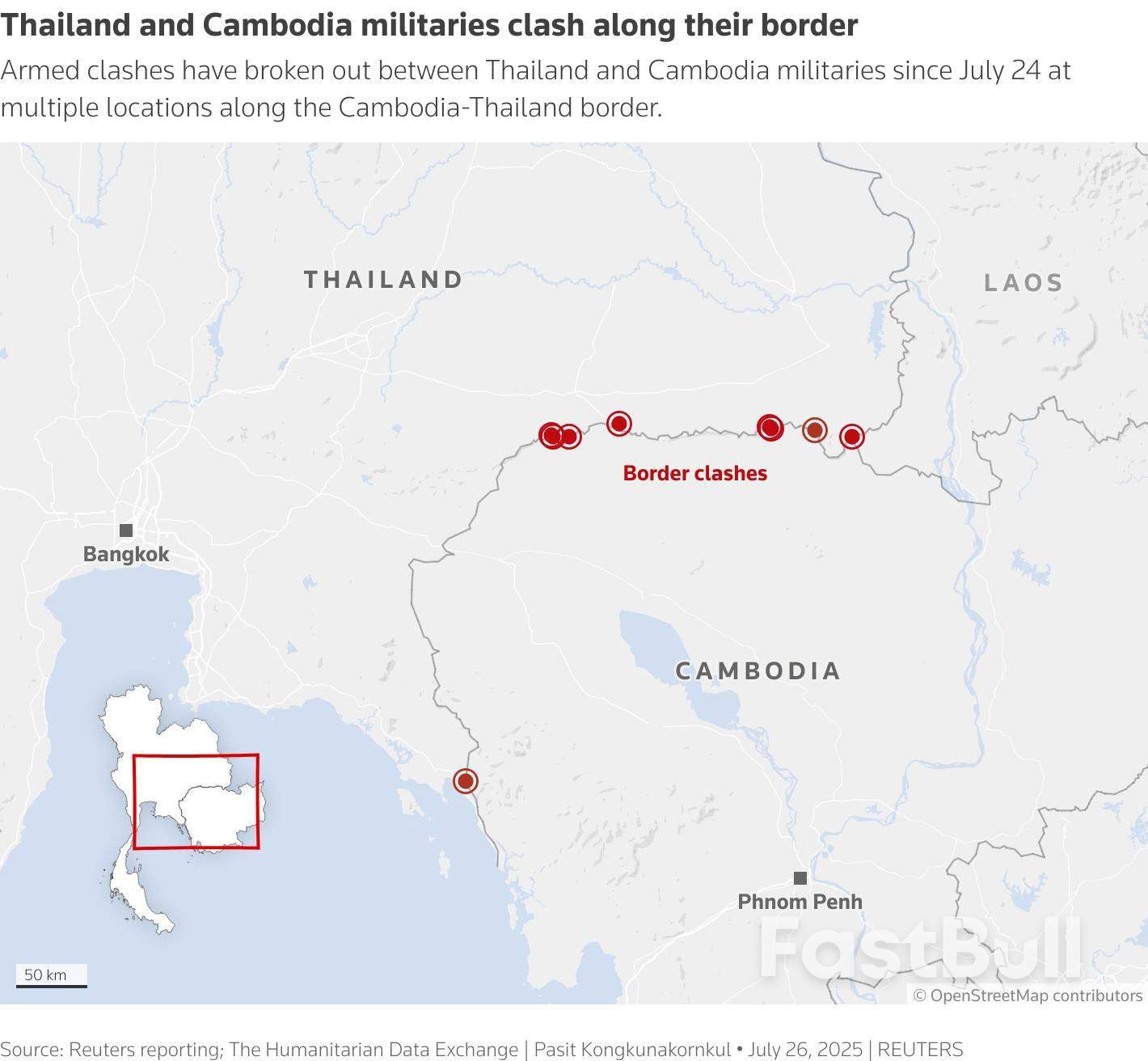
          Thailand And Cambodia Agree to Ceasefire After Five Days of Fighting_1

          This map shows the locations where military clashes have occurred along the disputed border between Thailand and Cambodia.

          IN GOOD FAITH

          Thai leader Phumtham, who had expressed doubts about Cambodia's sincerity, said Bangkok had agreed to a ceasefire that would be "carried out successfully in good faith by both sides".

          "Today's outcome reflects Thailand's desire for peaceful resolution by continuing to protect our sovereignty and the life of our people," he said, thanking Trump and Malaysia.

          The fighting has scarred border communities on both sides.

          In Thailand's Sisaket province, a house lay reduced to splintered wood and twisted beams after being struck by artillery fire from Cambodia. The roof had caved in, windows hung by the frame and power lines drooped over the structure.

          Amid the din of occasional artillery fire, homes and shops remained shut and a four-lane road was deserted except for a few cars and military vehicles.

          Dozens of displaced residents lined up quietly for their evening meal at an evacuation centre about 40 km away from the frontlines.

          A few children played with dogs, others swept the dusty floor.

          Fifty-four-year-old Nong Ngarmsri just wanted to go back to her village.

          "I want to go to my children who stayed back," she said. "I want them to cease firing so that I can go home."

          Source: Reuters

          Risk Warnings and Disclaimers
          You understand and acknowledge that there is a high degree of risk involved in trading. Following any strategies or investment methods may lead to potential losses. The content on the site is provided by our contributors and analysts for information purposes only. You are solely responsible for determining whether any trading assets, securities, strategy, or any other product is suitable for investing based on your own investment objectives and financial situation.
          Add to Favorites
          Share

          Copper Rises to Start Pivotal Week Ahead of US Tariffs Deadline

          Adam

          Commodity

          Copper rose along with equities after the European Union’s deal with the US averted a damaging rift between the two major economies, while traders watch for final details on imminent US tariffs on the industrial metal.
          Benchmark prices edged higher on the London Metal Exchange, following a tariff agreement that will see the EU face 15% levies on most exports. The deal comes ahead of a US-China meeting in Stockholm that’s expected to extend a trade truce for 90 more days.
          But for copper, the most anticipated development will be the launch of a touted 50% tariff on the metal, with details still unclear ahead of their planned start date on Friday.
          President Donald Trump’s administration hasn’t so far confirmed important aspects of the duties, including which products will be covered, whether supplies from all nations will be hit equally, or how metal already on its way to US shores will be treated.
          Global traders have shipped massive amounts of copper to America to get ahead of tariffs, and Trump’s announcement of an Aug. 1 deadline earlier this month triggered a last-minute scramble. Prices in the US are now much higher than those on the LME, but they don’t fully reflect a 50% universal tariff rate on all exchange-traded copper. The premium now stands at about 30%.
          Further important developments lie ahead this week. The Federal Reserve is expect to keep rates unchanged at the conclusion of its policy meeting on Wednesday, but its commentary will be scrutinized for clues on what comes next. There’s also a deluge of US data, from the latest on economic growth to jobs.
          Copper rose 0.6% to $9,824.50 a ton on the LME as of 11:51 a.m. in London. Aluminum was steady while zinc and nickel both edged 0.6% lower. The Bloomberg Dollar Spot Index rose 0.4%.

          Source: Bloomberg

          Risk Warnings and Disclaimers
          You understand and acknowledge that there is a high degree of risk involved in trading. Following any strategies or investment methods may lead to potential losses. The content on the site is provided by our contributors and analysts for information purposes only. You are solely responsible for determining whether any trading assets, securities, strategy, or any other product is suitable for investing based on your own investment objectives and financial situation.
          Add to Favorites
          Share

          US-EU Trade Deal Wards Off Further Escalation but Will Raise Costs for Companies and Consumers

          Warren Takunda

          Economic

          China–U.S. Trade War

          President Donald Trump and European Commission President Ursula von der Leyen have announced a sweeping trade deal that imposes 15% tariffs on most European goods, warding off Trump’s threat of a 30% rate if no deal had been reached by Aug. 1.
          The tariffs, or import taxes, paid when Americans buy European products could raise prices for U.S. consumers and dent profits for European companies and their partners who bring goods into the country.
          Here are some things to know about the trade deal between the United States and the European Union:

          Many details remain to be decided

          Trump and von der Leyen’s announcement, made during Trump’s visit to one of his golf courses in Scotland, leaves many details to be filled in.
          The headline figure is a 15% tariff rate on “the vast majority” of European goods brought into the U.S., including cars, computer chips and pharmaceuticals. It’s lower than the 20% Trump initially proposed, and lower than his threats of 50% and then 30%.
          Von der Leyen said the two sides agreed on zero tariffs on both sides for a range of “strategic” goods: Aircraft and aircraft parts, certain chemicals, semiconductor equipment, certain agricultural products, and some natural resources and critical raw materials. Specifics were lacking.
          She said the two sides “would keep working” to add more products to the list.
          Additionally, the EU side would purchase what Trump said was $750 billion (638 billion euros) worth of natural gas, oil and nuclear fuel to replace Russian energy supplies, and Europeans would invest an additional $600 billion (511 billion euros) in the U.S.

          50% U.S. tariff on steel stays and others might, too

          Trump said the 50% U.S. tariff on imported steel would remain; von der Leyen said the two sides agreed to further negotiations to fight a global steel glut, reduce tariffs and establish import quotas — that is, set amounts that can be imported, often at a lower rate.
          Trump said pharmaceuticals were not included in the deal. Von der Leyen said the pharmaceuticals issue was “on a separate sheet of paper” from Sunday’s deal.
          Where the $600 billion for additional investment would come from was not specified. And von der Leyen said that when it came to farm products, the EU side made clear that “there were tariffs that could not be lowered,” without specifying which products.

          The 15% rate is higher than in the past

          The 15% rate removes Trump’s threat of a 30% tariff. It’s still much higher than the average tariff before Trump came into office of around 1%, and higher than Trump’s minimum 10% baseline tariff.
          Higher tariffs, or import taxes, on European goods mean sellers in the U.S. would have to either increase prices for consumers — risking loss of market share — or swallow the added cost in terms of lower profits. The higher tariffs are expected to hurt export earnings for European firms and slow the economy.
          The 10% baseline applied while the deal was negotiated was already sufficiently high to make the European Union’s executive commission cut its growth forecast for this year from 1.3% to 0.9%.
          Von der Leyen said the 15% rate was “the best we could do” and credited the deal with maintaining access to the U.S. market and providing “stability and predictability for companies on both sides.”

          The reaction is tentative

          German Chancellor Friedrich Merz welcomed the deal which avoided “an unnecessary escalation in transatlantic trade relations” and said that “we were able to preserve our core interests,” while adding that “I would have very much wished for further relief in transatlantic trade.”
          The Federation of German Industries was blunter. “Even a 15% tariff rate will have immense negative effects on export-oriented German industry,” said Wolfgang Niedermark, a member of the federation’s leadership.
          While the rate is lower than threatened, “the big caveat to today’s deal is that there is nothing on paper, yet,” said Carsten Brzeski, global chief of macro at ING bank.
          “With this disclaimer in mind and at face value, today’s agreement would clearly bring an end to the uncertainty of recent months. An escalation of the US-EU trade tensions would have been a severe risk for the global economy,” Brzeski said.
          “This risk seems to have been avoided.”

          Car companies expect higher prices

          Asked if European carmakers could still sell cars at 15%, von der Leyen said the rate was much lower than the current 27.5%. That has been the rate under Trump’s 25% tariff on cars from all countries, plus the preexisting U.S. car tariff of 2.5%.
          The impact is likely to be substantial on some companies, given that automaker Volkswagen said it suffered a 1.3 billion euro ($1.5 billion) hit to profit in the first half of the year from the higher tariffs.
          Mercedes-Benz dealers in the U.S. have said they are holding the line on 2025 model year prices “until further notice.” The German automaker has a partial tariff shield because it makes 35% of the Mercedes-Benz vehicles sold in the U.S. in Tuscaloosa, Alabama, but the company said it expects prices to undergo “significant increases” in coming years.

          Trump had cited the trade gap with Europe

          Before Trump returned to office, the U.S. and the EU maintained generally low tariff levels in what is the largest bilateral trading relationship in the world, with some 1.7 trillion euros ($2 trillion) in annual trade. Together the U.S. and the EU have 44% of the global economy. The U.S. rate averaged 1.47% for European goods, while the EU’s averaged 1.35% for American products, according to the Bruegel think tank in Brussels.
          Trump has complained about the EU’s 198 billion-euro trade surplus in goods, which shows Americans buy more from European businesses than the other way around, and has said the European market is not open enough for U.S.-made cars.
          However, American companies fill some of the trade gap by outselling the EU when it comes to services such as cloud computing, travel bookings, and legal and financial services. And some 30% of European imports are from American-owned companies, according to the European Central Bank.

          Source: AP

          To stay updated on all economic events of today, please check out our Economic calendar
          Risk Warnings and Disclaimers
          You understand and acknowledge that there is a high degree of risk involved in trading. Following any strategies or investment methods may lead to potential losses. The content on the site is provided by our contributors and analysts for information purposes only. You are solely responsible for determining whether any trading assets, securities, strategy, or any other product is suitable for investing based on your own investment objectives and financial situation.
          Add to Favorites
          Share

          Oil Rises As Trump’s Russia Comments, Tariff Deal Boost Prices

          Glendon

          Commodity

          Oil rose after President Donald Trump said he would reduce the deadline for Russia to agree to a truce in Ukraine, compounding earlier gains from a US-European Union trade deal.

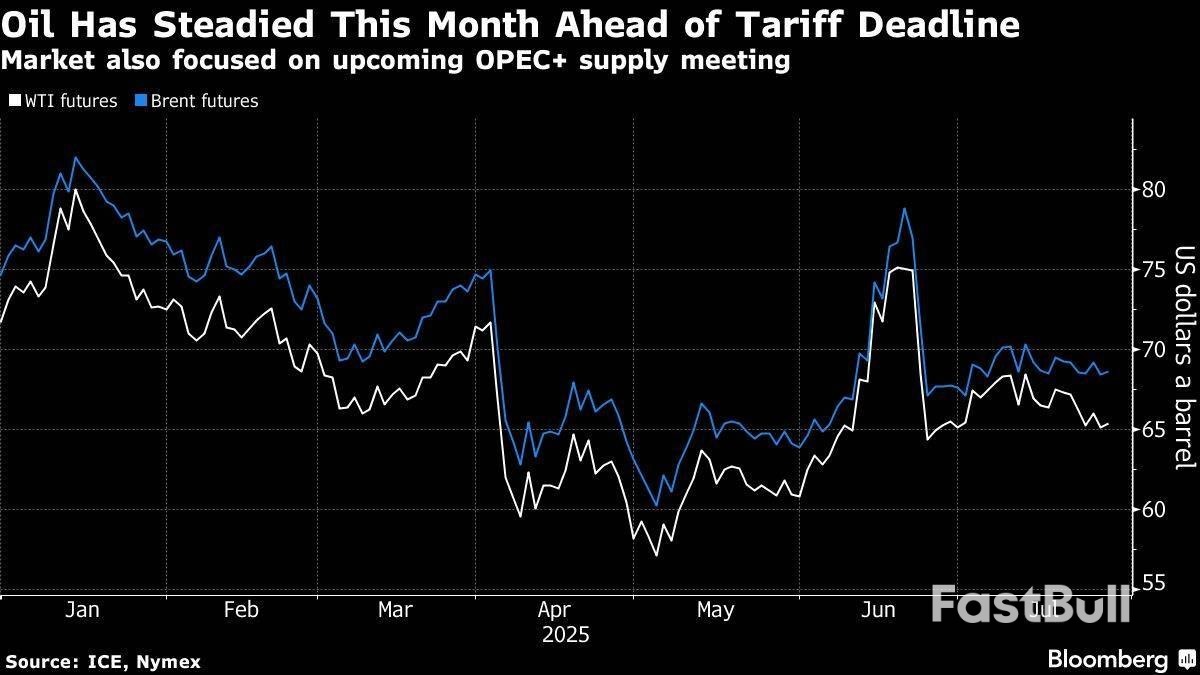
          Brent was near $70 a barrel after closing 1.1% lower on Friday. Trump said the EU had agreed to buy $750 billion in American energy products, although he and European Commission President Ursula von der Leyen appeared to differ on some key details of the agreement.

          Later on Monday, Trump also said he would reduce a 50-day deadline he gave to Vladimir Putin to achieve a ceasefire in the war in Ukraine. He said he was disappointed the Russian president hadn’t already agreed to a truce. Trump previously threatened Moscow with 100% “secondary tariffs” unless the conflict halts within 50 days.

          Trump’s trade policies and threats of retaliation from targeted countries for months have raised concerns about the outlook for energy demand should global economic growth slow, while a decision by OPEC+ to rapidly increase output has put the market on track for oversupply later this year.

          An OPEC+ committee will convene later on Monday to assess the oil market ahead of a meeting on Sunday to decide on production policy for September. Traders and analysts expect the group to hike its quota again.

          US and Chinese officials are scheduled to meet on Monday for trade talks, and the South China Morning Post reported that the two countries are expected to extend their tariff truce, according to people it didn’t identify.

          Source: Yahoo Finance

          Risk Warnings and Disclaimers
          You understand and acknowledge that there is a high degree of risk involved in trading. Following any strategies or investment methods may lead to potential losses. The content on the site is provided by our contributors and analysts for information purposes only. You are solely responsible for determining whether any trading assets, securities, strategy, or any other product is suitable for investing based on your own investment objectives and financial situation.
          Add to Favorites
          Share
          FastBull
          Copyright © 2025 FastBull Ltd

          728 RM B 7/F GEE LOK IND BLDG NO 34 HUNG TO RD KWUN TONG KLN HONG KONG

          TelegramInstagramTwitterfacebooklinkedin
          App Store Google Play Google Play
          Products
          Charts

          Chats

          Q&A with Experts
          Screeners
          Economic Calendar
          Data
          Tools
          Membership
          Features
          Function
          Markets
          Copy Trading
          Latest Signals
          Contests
          News
          Analysis
          24/7
          Columns
          Education
          Company
          Careers
          About Us
          Contact Us
          Advertising
          Help Center
          Feedback
          User Agreement
          Privacy Policy
          Business

          White Label

          Data API

          Web Plug-ins

          Poster Maker

          Affiliate Program

          Risk Disclosure

          The risk of loss in trading financial instruments such as stocks, FX, commodities, futures, bonds, ETFs and crypto can be substantial. You may sustain a total loss of the funds that you deposit with your broker. Therefore, you should carefully consider whether such trading is suitable for you in light of your circumstances and financial resources.

          No decision to invest should be made without thoroughly conducting due diligence by yourself or consulting with your financial advisors. Our web content might not suit you since we don't know your financial conditions and investment needs. Our financial information might have latency or contain inaccuracy, so you should be fully responsible for any of your trading and investment decisions. The company will not be responsible for your capital loss.

          Without getting permission from the website, you are not allowed to copy the website's graphics, texts, or trademarks. Intellectual property rights in the content or data incorporated into this website belong to its providers and exchange merchants.

          Not Logged In

          Log in to access more features

          FastBull Membership

          Not yet

          Purchase

          Become a signal provider
          Help Center
          Customer Service
          Dark Mode
          Price Up/Down Colors

          Log In

          Sign Up

          Position
          Layout
          Fullscreen
          Default to Chart
          The chart page opens by default when you visit fastbull.com