• Trade
  • Markets
  • Copy
  • Contests
  • News
  • 24/7
  • Calendar
  • Q&A
  • Chats
Trending
Screeners
SYMBOL
LAST
BID
ASK
HIGH
LOW
NET CHG.
%CHG.
SPREAD
SPX
S&P 500 Index
6843.04
6843.04
6843.04
6878.28
6841.15
-27.36
-0.40%
--
DJI
Dow Jones Industrial Average
47759.82
47759.82
47759.82
47971.51
47709.38
-195.16
-0.41%
--
IXIC
NASDAQ Composite Index
23514.49
23514.49
23514.49
23698.93
23505.52
-63.63
-0.27%
--
USDX
US Dollar Index
99.110
99.190
99.110
99.160
98.730
+0.160
+ 0.16%
--
EURUSD
Euro / US Dollar
1.16240
1.16247
1.16240
1.16717
1.16162
-0.00186
-0.16%
--
GBPUSD
Pound Sterling / US Dollar
1.33184
1.33191
1.33184
1.33462
1.33053
-0.00128
-0.10%
--
XAUUSD
Gold / US Dollar
4191.33
4191.74
4191.33
4218.85
4175.92
-6.58
-0.16%
--
WTI
Light Sweet Crude Oil
58.964
58.994
58.964
60.084
58.837
-0.845
-1.41%
--

Community Accounts

Signal Accounts
--
Profit Accounts
--
Loss Accounts
--
View More

Become a signal provider

Sell trading signals to earn additional income

View More

Guide to Copy Trading

Get started with ease and confidence

View More

Signal Accounts for Members

All Signal Accounts

Best Return
  • Best Return
  • Best P/L
  • Best MDD
Past 1W
  • Past 1W
  • Past 1M
  • Past 1Y

All Contests

  • All
  • Trump Updates
  • Recommend
  • Stocks
  • Cryptocurrencies
  • Central Banks
  • Featured News
Top News Only
Share

In The Past 24 Hours, The Marketvector Digital Asset 100 Small Cap Index Rose 1.96%, Currently At 4135.44 Points. The Sydney Market Initially Exhibited An N-shaped Pattern, Hitting A Daily Low Of 3988.39 Points At 06:08 Beijing Time, Before Steadily Rising To A Daily High Of 4206.06 Points At 17:07, Subsequently Stabilizing At This High Level

Share

[Sovereign Bond Yields In France, Italy, Spain, And Greece Rose By More Than 7 Basis Points, Raising Concerns That The ECB's Interest Rate Outlook May Push Up Financing Costs] In Late European Trading On Monday (December 8), The Yield On French 10-year Bonds Rose 5.8 Basis Points To 3.581%. The Yield On Italian 10-year Bonds Rose 7.4 Basis Points To 3.559%. The Yield On Spanish 10-year Bonds Rose 7.0 Basis Points To 3.332%. The Yield On Greek 10-year Bonds Rose 7.1 Basis Points To 3.466%

Share

Oil Falls 1% Amid Ongoing Ukraine Talks, Ahead Of Expected US Interest Rate Cut

Share

Azeri Btc Crude Oil Exports From Ceyhan Port Set At 16.2 Million Barrels In January Versus 17.0 Million In December, Schedule Shows

Share

USA - Greenland Joint Committee Statement: The United States And Greenland Look Forward To Building On Momentum In The Year Ahead And Strengthening Ties That Support A Secure And Prosperous Arctic Region

Share

MSCI Nordic Countries Index Fell 0.4% To 356.64 Points. Among The Ten Sectors, The Nordic Healthcare Sector Saw The Largest Decline. Novo Nordisk, A Heavyweight Stock, Closed Down 3.4%, Leading The Losses Among Nordic Stocks

Share

France's CAC 40 Down 0.2%, Spain's IBEX Up 0.1%

Share

Europe's STOXX Index Up 0.1%, Euro Zone Blue Chips Index Flat

Share

Germany's DAX 30 Index Closed Up 0.08% At 24,044.88 Points. France's Stock Index Closed Down 0.19%, Italy's Stock Index Closed Down 0.13% With Its Banking Index Up 0.33%, And The UK's Stock Index Closed Down 0.32%

Share

The STOXX Europe 600 Index Closed Down 0.12% At 578.06 Points. The Eurozone STOXX 50 Index Closed Down 0.04% At 5721.56 Points. The FTSE Eurotop 300 Index Closed Down 0.05% At 2304.93 Points

Share

Israeli Prime Minister Netanyahu: Hamas Has Violated The Ceasefire Agreement, And We Will Never Allow Its Members To Re-arm Themselves And Threaten US

Share

Israeli Prime Minister Netanyahu: We Are Working To Return The Body Of Another Detainee From The Gaza Strip

Share

Iraq's West Qurna 2 Oil Field Will Increase Oil Production Beyond Normal Levels To Compensate For The Production Stoppage Caused By The Trump Administration's Sanctions Against Russia

Share

Israeli Prime Minister Netanyahu: We Are Close To Completing The First Phase Of Trump’s Plan And Will Now Focus On Disarming Gaza And Seizing Hamas Weapons

Share

Moody's Affirmed Burberry's Long-term Rating Of Baa3 And Revised Its Outlook (from Negative) To Stable

Share

The Trump Administration Supports Iraq's Plan To Transfer Russian Oil Company Lukoil Pjsc's Assets In The West Qurna 2 Oil Field To An American Company

Share

JMA: Tsunami Of 70 Centimetres Observed In Japan's Kuji Port In Iwate Prefecture

Share

The U.S. Bureau Of Labor Statistics Plans To Release A Press Release On January 15, 2026, For November 2025, Along With Data For October

Share

Tiger Global Has Established A New Fund, Aiming To Raise $2 Billion To $3 Billion

Share

The U.S. Bureau Of Labor Statistics Announced That It Will Not Release A Press Release Regarding The U.S. Import And Export Price Index (MXP) For October 2025

TIME
ACT
FCST
PREV
France Trade Balance (SA) (Oct)

A:--

F: --

P: --
Euro Zone Employment YoY (SA) (Q3)

A:--

F: --

P: --
Canada Part-Time Employment (SA) (Nov)

A:--

F: --

P: --

Canada Unemployment Rate (SA) (Nov)

A:--

F: --

P: --

Canada Full-time Employment (SA) (Nov)

A:--

F: --

P: --

Canada Labor Force Participation Rate (SA) (Nov)

A:--

F: --

P: --

Canada Employment (SA) (Nov)

A:--

F: --

P: --

U.S. PCE Price Index MoM (Sept)

A:--

F: --

P: --

U.S. Personal Income MoM (Sept)

A:--

F: --

P: --

U.S. Core PCE Price Index MoM (Sept)

A:--

F: --

P: --

U.S. PCE Price Index YoY (SA) (Sept)

A:--

F: --

P: --

U.S. Core PCE Price Index YoY (Sept)

A:--

F: --

P: --

U.S. Personal Outlays MoM (SA) (Sept)

A:--

F: --

P: --
U.S. 5-10 Year-Ahead Inflation Expectations (Dec)

A:--

F: --

P: --

U.S. Real Personal Consumption Expenditures MoM (Sept)

A:--

F: --

P: --
U.S. Weekly Total Rig Count

A:--

F: --

P: --

U.S. Weekly Total Oil Rig Count

A:--

F: --

P: --

U.S. Consumer Credit (SA) (Oct)

A:--

F: --

P: --
China, Mainland Foreign Exchange Reserves (Nov)

A:--

F: --

P: --

Japan Trade Balance (Oct)

A:--

F: --

P: --

Japan Nominal GDP Revised QoQ (Q3)

A:--

F: --

P: --

China, Mainland Imports YoY (CNH) (Nov)

A:--

F: --

P: --

China, Mainland Exports (Nov)

A:--

F: --

P: --

China, Mainland Imports (CNH) (Nov)

A:--

F: --

P: --

China, Mainland Trade Balance (CNH) (Nov)

A:--

F: --

P: --

China, Mainland Exports YoY (USD) (Nov)

A:--

F: --

P: --

China, Mainland Imports YoY (USD) (Nov)

A:--

F: --

P: --

Germany Industrial Output MoM (SA) (Oct)

A:--

F: --

P: --
Euro Zone Sentix Investor Confidence Index (Dec)

A:--

F: --

P: --

Canada National Economic Confidence Index

A:--

F: --

P: --

U.K. BRC Like-For-Like Retail Sales YoY (Nov)

--

F: --

P: --

U.K. BRC Overall Retail Sales YoY (Nov)

--

F: --

P: --

Australia Overnight (Borrowing) Key Rate

--

F: --

P: --

RBA Rate Statement
RBA Press Conference
Germany Exports MoM (SA) (Oct)

--

F: --

P: --

U.S. NFIB Small Business Optimism Index (SA) (Nov)

--

F: --

P: --

Mexico 12-Month Inflation (CPI) (Nov)

--

F: --

P: --

Mexico Core CPI YoY (Nov)

--

F: --

P: --

Mexico PPI YoY (Nov)

--

F: --

P: --

U.S. Weekly Redbook Index YoY

--

F: --

P: --

U.S. JOLTS Job Openings (SA) (Oct)

--

F: --

P: --

China, Mainland M1 Money Supply YoY (Nov)

--

F: --

P: --

China, Mainland M0 Money Supply YoY (Nov)

--

F: --

P: --

China, Mainland M2 Money Supply YoY (Nov)

--

F: --

P: --

U.S. EIA Short-Term Crude Production Forecast For The Year (Dec)

--

F: --

P: --

U.S. EIA Natural Gas Production Forecast For The Next Year (Dec)

--

F: --

P: --

U.S. EIA Short-Term Crude Production Forecast For The Next Year (Dec)

--

F: --

P: --

EIA Monthly Short-Term Energy Outlook
U.S. API Weekly Gasoline Stocks

--

F: --

P: --

U.S. API Weekly Cushing Crude Oil Stocks

--

F: --

P: --

U.S. API Weekly Crude Oil Stocks

--

F: --

P: --

U.S. API Weekly Refined Oil Stocks

--

F: --

P: --

South Korea Unemployment Rate (SA) (Nov)

--

F: --

P: --

Japan Reuters Tankan Non-Manufacturers Index (Dec)

--

F: --

P: --

Japan Reuters Tankan Manufacturers Index (Dec)

--

F: --

P: --

Japan Domestic Enterprise Commodity Price Index MoM (Nov)

--

F: --

P: --

Japan Domestic Enterprise Commodity Price Index YoY (Nov)

--

F: --

P: --

China, Mainland PPI YoY (Nov)

--

F: --

P: --

China, Mainland CPI MoM (Nov)

--

F: --

P: --

Q&A with Experts
    • All
    • Chatrooms
    • Groups
    • Friends
    Connecting
    .
    .
    .
    Type here...
    Add Symbol or Code

      No matching data

      All
      Trump Updates
      Recommend
      Stocks
      Cryptocurrencies
      Central Banks
      Featured News
      • All
      • Russia-Ukraine Conflict
      • Middle East Flashpoint
      • All
      • Russia-Ukraine Conflict
      • Middle East Flashpoint
      Search
      Products

      Charts Free Forever

      Chats Q&A with Experts
      Screeners Economic Calendar Data Tools
      Membership Features
      Data Warehouse Market Trends Institutional Data Policy Rates Macro

      Market Trends

      Market Sentiment Order Book Forex Correlations

      Top Indicators

      Charts Free Forever
      Markets

      News

      News Analysis 24/7 Columns Education
      From Institutions From Analysts
      Topics Columnists

      Latest Views

      Latest Views

      Trending Topics

      Top Columnists

      Latest Update

      Signals

      Copy Rankings Latest Signals Become a signal provider AI Rating
      Contests
      Brokers

      Overview Brokers Assessment Rankings Regulators News Claims
      Broker listing Forex Brokers Comparison Tool Live Spread Comparison Scam
      Q&A Complaint Scam Alert Videos Tips to Detect Scam
      More

      Business
      Events
      Careers About Us Advertising Help Center

      White Label

      Data API

      Web Plug-ins

      Affiliate Program

      Awards Institution Evaluation IB Seminar Salon Event Exhibition
      Vietnam Thailand Singapore Dubai
      Fans Party Investment Sharing Session
      FastBull Summit BrokersView Expo
      Recent Searches
        Top Searches
          Markets
          News
          Analysis
          User
          24/7
          Economic Calendar
          Education
          Data
          • Names
          • Latest
          • Prev

          View All

          No data

          Scan to Download

          Faster Charts, Chat Faster!

          Download App
          English
          • English
          • Español
          • العربية
          • Bahasa Indonesia
          • Bahasa Melayu
          • Tiếng Việt
          • ภาษาไทย
          • Français
          • Italiano
          • Türkçe
          • Русский язык
          • 简中
          • 繁中
          Open Account
          Search
          Products
          Charts Free Forever
          Markets
          News
          Signals

          Copy Rankings Latest Signals Become a signal provider AI Rating
          Contests
          Brokers

          Overview Brokers Assessment Rankings Regulators News Claims
          Broker listing Forex Brokers Comparison Tool Live Spread Comparison Scam
          Q&A Complaint Scam Alert Videos Tips to Detect Scam
          More

          Business
          Events
          Careers About Us Advertising Help Center

          White Label

          Data API

          Web Plug-ins

          Affiliate Program

          Awards Institution Evaluation IB Seminar Salon Event Exhibition
          Vietnam Thailand Singapore Dubai
          Fans Party Investment Sharing Session
          FastBull Summit BrokersView Expo

          Japan’s Pro-Stimulus Advisers to Outline Economic Vision Ahead of Critical BOJ Policy Meeting

          Gerik

          Economic

          Summary:

          Key economic advisers to Prime Minister Sanae Takaichi will speak at a business forum on December 17, just one day before the Bank of Japan’s policy meeting...

          Strategic Timing Ahead of BOJ’s December Deliberations

          In a move poised to influence both markets and monetary policymakers, a group of influential economic advisers aligned with Prime Minister Sanae Takaichi’s reflationary agenda will headline a panel discussion hosted by Keidanren, Japan’s top business lobby, on December 17. This event comes just 24 hours before the Bank of Japan (BOJ) begins its two-day monetary policy meeting, scheduled for December 18–19. The proximity of the forum to the BOJ meeting has sparked speculation that it may serve as a signal-setting venue for the administration’s preferred economic direction.
          The panel will feature prominent voices such as Etsuro Honda and Masazumi Wakatabe, both of whom have historically championed accommodative monetary policy and fiscal expansion. Their participation is notable not just for their ideological alignment with Takaichi, but for their potential to shape the BOJ's policy tone through public discourse.

          Reflationary Policy Advocates Reassert Influence

          Prime Minister Takaichi, who assumed office last month, has made reflating the Japanese economy a cornerstone of her economic platform. Her administration finalized a ¥20 trillion ($135 billion) stimulus package on Friday, financed in large part through new debt issuance. The December 17 panel, taking place from 2 to 4 p.m. in Tokyo, offers a platform for key economic thinkers to reinforce the administration’s policy priorities ahead of what could be a pivotal BOJ decision.
          Etsuro Honda has already warned against further rate hikes by the central bank, citing risks to economic recovery. Similarly, former BOJ Deputy Governor Masazumi Wakatabe told Reuters that it would be difficult for the central bank to justify another rate increase before the end of the year. Other panelists include economists Toshihiro Nagahama and Takuji Aida, both of whom have served on government panels advocating for large-scale stimulus.

          Causal Interplay Between Fiscal Policy, Monetary Strategy, and Currency Pressures

          The timing of the event also reflects the delicate balance between fiscal expansion and monetary normalization. Since Takaichi took office, concerns over aggressive government spending combined with the BOJ’s slow pace of interest rate normalization have weighed on the Japanese yen, which has fallen to a 10-month low against the U.S. dollar. The depreciation has raised fresh fears over imported inflation, prompting warnings from financial authorities about the potential impact on consumer prices.
          This presents a complex causal landscape: Takaichi’s stimulus-led strategy supports short-term growth but intensifies downward pressure on the yen, which in turn may compel the BOJ to consider rate hikes to stabilize the currency and manage inflation. Yet with core inflation still hovering around the BOJ’s target and growth remaining fragile, rate increases carry significant risks to domestic demand and debt sustainability.

          Monetary Policy at a Crossroads: What’s at Stake for the BOJ

          The December BOJ meeting will likely be a critical inflection point. If the board signals readiness to raise rates in early 2026, it would mark a departure from over a decade of ultra-loose monetary policy. However, the political environment, shaped by a newly elected administration with a pro-stimulus mandate, complicates that pathway.
          The BOJ must now weigh external pressure to address yen weakness and inflation concerns against internal pressure to maintain accommodative conditions for fiscal stimulus to take effect. The public remarks of Honda, Wakatabe, and other reflationist advisers on December 17 may provide insight into how the administration expects the central bank to position itself.
          With Japan navigating a fragile recovery, high debt levels, and volatile currency markets, the coordination between fiscal and monetary policy is more consequential than ever. The Keidanren panel offers a strategic opportunity for Prime Minister Takaichi’s economic advisers to assert their vision at a critical moment, potentially swaying the BOJ’s decision-making framework. Investors, policymakers, and international observers will be watching closely to discern whether Japan will double down on stimulus or begin recalibrating its approach to inflation and currency management.

          Source: Reuters

          To stay updated on all economic events of today, please check out our Economic calendar
          Risk Warnings and Disclaimers
          You understand and acknowledge that there is a high degree of risk involved in trading. Following any strategies or investment methods may lead to potential losses. The content on the site is provided by our contributors and analysts for information purposes only. You are solely responsible for determining whether any trading assets, securities, strategy, or any other product is suitable for investing based on your own investment objectives and financial situation.
          Add to Favorites
          Share

          Asian Markets Plunge Following Wall Street Reversal as AI Bubble Fears and Rate Uncertainty Weigh on Sentiment

          Gerik

          Economic

          Stocks

          Broad-Based Sell-Off Mirrors Wall Street Volatility

          Asian equities plunged on November 21 as markets mirrored the previous day’s dramatic downturn in U.S. stocks. Major indices across the region gave up earlier gains, with Japan’s Nikkei 225 falling 2.4% to 48,645.95, South Korea’s KOSPI plunging 3.9%, and China’s Hang Seng and Shanghai Composite indices down 2.3% and 1.8%, respectively. Australia’s S&P/ASX 200 dropped 1.5%, while Taiwan’s Taiex slid 3.2%. The widespread retreat follows one of the most volatile trading sessions on Wall Street this year, where initial optimism around AI leader Nvidia gave way to deep concerns about asset overvaluation.
          The cause of this synchronized regional decline is rooted in investor anxiety over the artificial intelligence sector’s sharp rally, which many now fear is unsustainable. The U.S. session on Thursday was defined by a sudden shift in sentiment: Nvidia and other AI-driven stocks surged early before collapsing later in the day. The Nasdaq Composite ended 2.2% lower, the S&P 500 dropped 1.6%, and the Dow Jones Industrial Average lost 0.8%.

          AI Bubble Concerns Deepen Despite Strong Nvidia Earnings

          Nvidia, a bellwether for the AI hype cycle, initially buoyed investor confidence with robust earnings and a revenue forecast that exceeded expectations. CEO Jensen Huang rejected concerns of an AI bubble, attempting to reassure markets. However, despite these fundamentals, traders appeared unconvinced. Nvidia’s stock reversed from a 5% morning gain to close 3.2% lower, illustrating that technical momentum and valuation fatigue may now be overpowering earnings performance.
          The broader correlation between Nvidia’s reversal and losses in other tech-heavy markets, such as South Korea and Taiwan, signals that AI-driven sentiment is still the dominant force shaping regional risk appetite. SK Hynix and Samsung Electronics two key semiconductor players fell 8.6% and 5.8%, respectively, as investor nervousness spread across global chip and data infrastructure stocks.

          Fed Policy Expectations Recalibrated on Strong Labor Data

          Adding to the global market strain was stronger-than-expected U.S. employment data. The economy added 119,000 jobs in September, more than double the forecast of 50,000. While this suggests economic strength, the causal implication is that the Federal Reserve may delay or cancel its next interest rate cut, as inflationary pressures may persist.
          With the Fed potentially holding rates higher for longer, growth-sensitive assets like tech and AI stocks become less attractive due to their reliance on low borrowing costs to justify high valuations. This monetary policy reassessment has compounded volatility and shifted market psychology away from risk-on positioning.

          Japan Faces Dual Pressures: Tariffs and Stimulus Expectations

          Japan’s economy faces its own set of pressures. Despite a 3.7% rise in exports globally in October, shipments to the U.S. declined due to new 15% tariffs under President Donald Trump’s trade framework. This export hit, combined with elevated inflation (3.0% in October), has dampened investor sentiment. Meanwhile, investors are awaiting details of a stimulus package from Prime Minister Sanae Takaichi, with anticipation of fiscal expansion weakening the yen and placing pressure on government bonds.
          Political tensions with China over Taiwan have further unsettled regional investors, adding a layer of geopolitical risk that weighed on Chinese and Japanese equities. The deterioration in diplomatic relations could potentially disrupt trade channels and deepen volatility in the weeks ahead.

          Oil Prices and Currency Markets Reflect Risk-Off Sentiment

          In commodities, oil prices slipped as investor sentiment cooled. U.S. benchmark crude fell by 77 cents to $58.23 per barrel, while Brent crude dropped 68 cents to $62.70. These declines reflect expectations of softer demand amid tightening financial conditions. Currency movements were relatively muted: the U.S. dollar edged down slightly to 157.39 yen, while the euro firmed marginally to $1.1539.
          Friday’s sell-off across Asian equities highlights the fragile nature of current market sentiment. While Nvidia’s earnings momentarily reignited AI enthusiasm, the broader market quickly pivoted to focus on stretched valuations, Federal Reserve policy uncertainty, and geopolitical instability. With little clarity on the Fed’s next move and concerns of an AI bubble persisting, investors appear poised for continued turbulence. The risk-off tone could deepen unless forthcoming data or policy guidance provides more definitive support for global risk assets.

          Source: AP

          To stay updated on all economic events of today, please check out our Economic calendar
          Risk Warnings and Disclaimers
          You understand and acknowledge that there is a high degree of risk involved in trading. Following any strategies or investment methods may lead to potential losses. The content on the site is provided by our contributors and analysts for information purposes only. You are solely responsible for determining whether any trading assets, securities, strategy, or any other product is suitable for investing based on your own investment objectives and financial situation.
          Add to Favorites
          Share

          From Rally to Retreat: AI Enthusiasm Fades Amid Bubble Fears and Fed Policy Repricing

          Gerik

          Economic

          Stocks

          Market Sentiment Reverses as AI Surge Gives Way to Skepticism

          What began as a high-energy rally on Wall Street quickly turned into one of the most volatile trading sessions in recent months. On November 20, 2025, the Nasdaq Composite closed down 2.16% after climbing as much as 2.6% in the morning. Similarly, the S&P 500 fell 1.56% and the Dow Jones Industrial Average dropped 0.84%, despite intraday gains earlier in the session. The reversal came swiftly and was largely driven by renewed concerns surrounding the sustainability of the artificial intelligence sector’s meteoric rise.
          Nvidia was at the center of this turmoil. Initially surging 5% on investor optimism following statements from CEO Jensen Huang dismissing the existence of an AI bubble, the stock reversed course and ended the day down 3.2%. The pattern was mirrored by fellow AI-linked names like Oracle and AMD, suggesting that broader market sentiment could not be calmed by a single executive’s reassurance.

          Nvidia’s Outlook Strong, But Market Eyes Broader Systemic Risks

          The company’s CFO, Colette Kress, reaffirmed Nvidia’s bullish revenue outlook, projecting a “half a trillion” forecast, while minimizing the role of Chinese demand in the latest quarter. Despite this, the stock market's reaction indicates that investor optimism in the AI space may have reached unsustainable levels. The initial spike in Nvidia’s share price reveals a correlational relationship between investor sentiment and high-profile corporate forecasts, but the rapid selloff afterward suggests underlying skepticism about whether the AI boom is built on stable foundations.
          Analysts caution that while Nvidia’s fundamentals remain robust, the broader AI ecosystem particularly data center builders and firms heavily leveraging debt may be more vulnerable. According to Gil Luria from D.A. Davidson, the concern is not with the chipmakers but rather with downstream companies overextending themselves financially to support AI infrastructure demands.

          Labor Market Data Fuels Fed Rate Speculation

          Thursday’s turmoil was exacerbated by stronger-than-expected labor market data. The U.S. economy added 119,000 jobs in September, far surpassing the 50,000 estimate. While this would normally be interpreted as a positive signal, in the current macroeconomic context, it has the opposite effect. A robust labor market reduces the likelihood of the Federal Reserve cutting interest rates in the near term a key hope that had helped fuel risk asset rallies throughout the year.
          As a result, traders revised their expectations, with CME FedWatch data indicating a higher probability that rates will remain unchanged in December. The causal relationship here is straightforward: stronger employment metrics decrease the urgency for the Fed to pivot toward monetary easing, thereby placing downward pressure on equities especially those with high growth valuations like AI stocks.

          Bubble Talk Gains Momentum, But No Immediate Popping Sound

          The sudden shift in market tone was further amplified by high-profile voices like Bridgewater founder Ray Dalio, who publicly stated that "the picture is pretty clear" regarding the presence of a financial bubble. While he advised investors to remain invested for now, his remarks underscored a growing unease that has begun to spread through institutional circles.
          Dalio’s statement did not point to an imminent collapse, but it reinforced the narrative that market valuations particularly in sectors like AI may be detached from sustainable fundamentals. This concern, when layered over a delayed monetary policy pivot and stretched corporate borrowing, paints a picture of fragility beneath the recent tech-driven rally.

          Global Market Divergence Reflects Differing Investor Priorities

          While the U.S. indices closed deep in the red, Europe’s Stoxx 600 climbed 0.4%, supported by gains in AI-related firms such as ASML and BESI. This divergence may be partially explained by differing exposure to U.S. interest rate policy and sector concentration, but it also highlights that AI enthusiasm remains alive in certain global pockets. However, that enthusiasm is increasingly tempered by selectivity and fundamental analysis.
          Bitcoin also joined the downturn, hitting its lowest level since April, showing that risk aversion extended beyond equities and into crypto markets suggesting a broader de-risking across speculative assets.
          Thursday’s trading session demonstrated how quickly market narratives can unravel, especially when speculative momentum meets macroeconomic reality. Nvidia’s strong forecast offered temporary confidence, but investor anxiety about inflated valuations, monetary tightening, and overleveraged AI infrastructure projects quickly overrode the optimism. As the year winds down, the question is no longer whether AI is the future, but whether markets have already priced in too much of that future too quickly. Investors now face the delicate task of distinguishing between sustainable innovation and speculative froth while keeping one eye on the Fed and the other on earnings reports.

          Source: CNBC

          To stay updated on all economic events of today, please check out our Economic calendar
          Risk Warnings and Disclaimers
          You understand and acknowledge that there is a high degree of risk involved in trading. Following any strategies or investment methods may lead to potential losses. The content on the site is provided by our contributors and analysts for information purposes only. You are solely responsible for determining whether any trading assets, securities, strategy, or any other product is suitable for investing based on your own investment objectives and financial situation.
          Add to Favorites
          Share

          Japan’s Export Growth Shifts Toward Asia as U.S. Tariffs Drag Down American Trade

          Gerik

          Economic

          Mixed Trade Performance Highlights Diverging Regional Trends

          Japan’s export sector showed signs of resilience in October, posting a 3.7% year-on-year increase in global shipments, while imports edged up 0.6%, according to the Finance Ministry’s latest data. However, the country’s trade relationship with the United States continued to deteriorate, with exports to its largest non-Asian partner declining 3.1% a trend now in its seventh consecutive month. This export contraction is largely attributable to the tariff framework introduced by President Donald Trump, which imposed a 15% levy on most Japanese imports starting in July 2025.
          Although the new tariff rate is lower than the initially proposed 25%, it still represents a significant escalation from the previous average of 2.5%. The causal relationship between these heightened tariffs and Japan’s declining exports to the U.S. is reflected in reduced shipments of key products such as computer parts, industrial machinery, buses, and trucks. As these goods become more expensive for U.S. buyers, Japanese exporters face reduced demand and eroded competitiveness.

          Import Dynamics Reflect Broader Shifts in Bilateral Trade

          Interestingly, Japan’s imports from the U.S. surged 20.9% in October, suggesting a shift in bilateral trade balance. This growth was led by food products, especially cereals, as well as petroleum. The increase may stem from seasonal demand and the relative cost-effectiveness of U.S. agricultural exports despite the broader trade tensions. The juxtaposition of declining Japanese exports to the U.S. with rising American imports indicates a widening asymmetry that is unfavorable to Japan’s trade surplus goals.
          Beyond bilateral trade, soybean imports from all global sources surged 37.3%, possibly due to domestic agricultural supply issues or feedstock demand. Meanwhile, imports of iron and steel dropped 17.1%, likely reflecting a cooling in construction or manufacturing investment cycles.

          Asia Emerges as a Growth Engine Amid U.S. Weakness

          Japan’s trade data reveals a regional rebalancing in its export strategy. Exports to China rose 2.1%, while shipments to Hong Kong and Taiwan posted significant gains of 19.2% and 17.7%, respectively. These trends suggest that Japan is actively shifting its export focus toward more receptive Asian markets, both to offset U.S. trade friction and to capitalize on regional demand.
          This correlational pivot toward Asia may become increasingly intentional. Analysts warn that given ongoing strain with the U.S. and new political frictions with China triggered by Prime Minister Sanae Takaichi’s pro-Taiwan comments Japan’s long-term export strategy will need to balance regional diplomacy with market diversification.

          Trade Deficit Narrows, But Vulnerabilities Remain

          The improved export performance and modest import rise helped Japan narrow its trade deficit to 231.77 billion yen (approximately $1.5 billion), a significant reduction from the 499.95 billion yen ($3.2 billion) recorded a year earlier. This narrowing is statistically positive, but it does not erase the structural concern that the deficit could widen again if U.S. demand continues to soften and political tensions with China escalate.
          While October’s figures show that Japan is partially adapting to its new trade environment, the sustainability of its recovery remains uncertain. The government may need to strengthen ties with Southeast Asia and India to create buffers against future economic or political shocks in its two largest export markets the U.S. and China.
          Japan’s October trade data underscores a complex economic reorientation shaped by tariff policies, geopolitical tensions, and shifting regional dynamics. With U.S.-bound exports in steady decline due to policy-induced friction and a rising appetite for Japanese goods in parts of Asia, Japan is recalibrating its external trade dependence. Whether this pivot will be enough to stabilize long-term growth depends on its ability to navigate a volatile global landscape while maintaining diversified export relationships and domestic resilience.

          Source: AP

          To stay updated on all economic events of today, please check out our Economic calendar
          Risk Warnings and Disclaimers
          You understand and acknowledge that there is a high degree of risk involved in trading. Following any strategies or investment methods may lead to potential losses. The content on the site is provided by our contributors and analysts for information purposes only. You are solely responsible for determining whether any trading assets, securities, strategy, or any other product is suitable for investing based on your own investment objectives and financial situation.
          Add to Favorites
          Share

          XRP News Today: ETF Launches Lag As XRP Faces Heavy Selling

          Samantha Luan

          Forex

          Cryptocurrency

          Key Points:

          · XRP drops to key support as BTC weakness, ETF outflows, and fading Fed rate-cut bets intensify bearish market pressure.
          · Bitwise XRP ETF launches with solid demand but lags Canary's higher debut volume, weighing on near-term sentiment.
          · Crypto markets slump as liquidations surge, with leverage-driven selling pushing BTC and XRP into a 45-day decline.

          XRP tumbled to its key psychological support level on Thursday, November 20, as selling pressure intensified across the broader crypto market.

          XRP-spot ETFs failed to stem the selling wave, as Bitcoin (BTC) slumped to its lowest level since April 2025. XRP's continued correlation with Bitcoin exposed the token to BTC-spot ETF flows, which have weighed on sentiment in November.

          Prominent crypto commentator Quinten, with more than 200,000 followers, commented on the percentage of short-term holders being underwater, stating:

          "2020 COVID crash, 92% in a loss at $3,750. 2020 FTX collapse, 94% in a loss at $16,000. Today, 99% in a loss at $89,000. This is the highest short term holder capitulation ever recorded."

          XRP-Spot ETFs Fail to Impress

          Bitwise XRP ETF launched on Thursday, November 20, signaling robust institutional demand on its first day of trading. However, trading volumes came up short of the Canary XRP ETF's (XRPC) $59 million on day one, weighing on sentiment.

          Bloomberg Intelligence analyst James Seyffart commented on Bitwise XRP ETF's first day of trading, stating:

          "With a bit over ~2 hours left in trading, Bitwise's $XRP is almost at $22 million in trading today. Quite impressive for the second product to market a full week after Canary Funds' $XRPC, which is the #1 launch by volume this year."

          Analysts had previously speculated that Bitwise and Franklin Templeton would draw significantly more demand, given their rankings on the ETF issuer Assets Under Management league table.

          According to VettaFi, Franklin Templeton ranks #19 on the ETF issuer Assets Under Management (AUM) league table, with $44.7 billion in AUM. Bitwise Asset Management ranks #56, with $5.6 billion in AUM. The first-to-market XRP-spot ETF issuer, Canary Capital, ranks #231, with $84.82 million in AUM.

          However, market conditions are likely to have impacted trading volumes. For context, the US BTC-spot ETF market is facing net outflows of $3 billion in November.

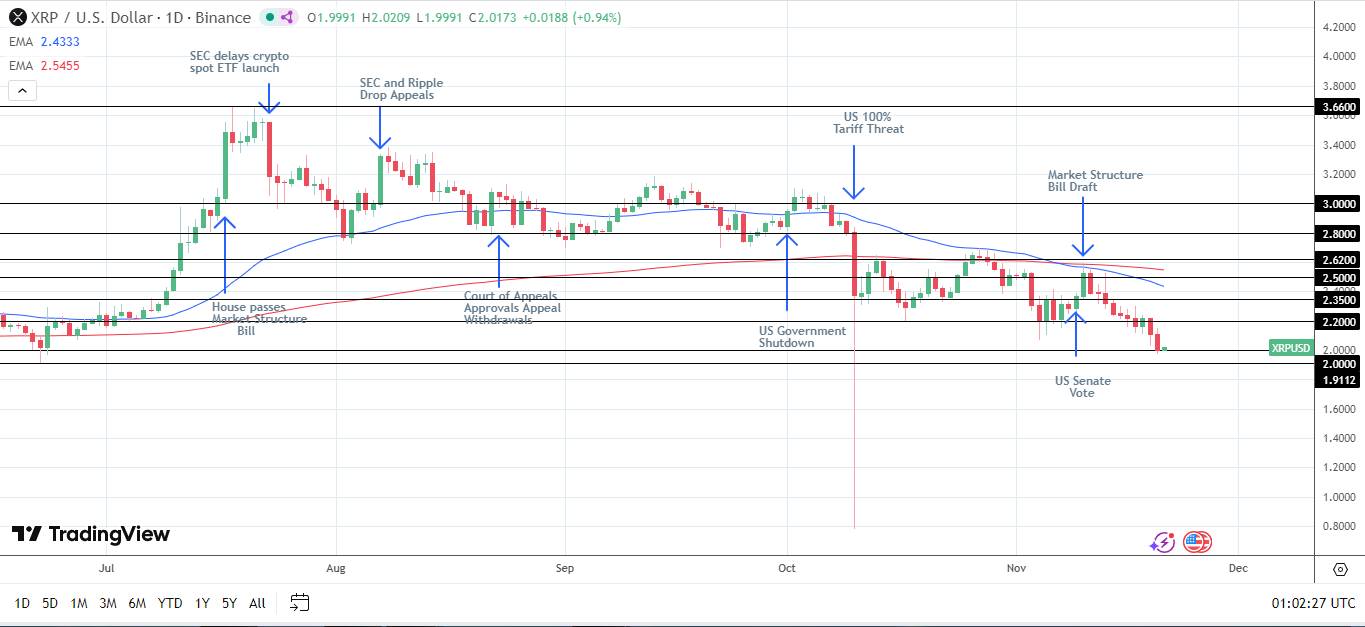
          There were no new market events to trigger Thursday's sell-off. However, sentiment remains weak due to two key October events. The US government shutdown and President Trump's threat of raising tariffs on Chinese shipments by 100% have sent XRP down 30% from October 1 to November 20. The only good news for XRP holders was the swift recovery from the October 10 flash crash to $0.7773.

          XRPUSD – Daily Chart – 211125 – Shutdown and Tariff Threats

          Macro Pressures Deepen Losses

          The Kobeissi Letter commented on the extended crypto sell-off, stating:

          "The crypto collapse: On October 6th, just 45 days ago, Bitcoin hit a record high of $126,272, worth $2.5 trillion. Then, something "mechanical" seems to have shifted on October 10th, after President Trump threatened 100% tariffs on China. Not only did this lead to the record -$19.2 billion liquidation, but Bitcoin never truly recovered."

          The Kobeissi Letter noted:

          "Even when the October 30th trade deal was reached between the US and China, liquidation pressures only worsened. Then, since November 10th, Bitcoin has moved in a literal straight-line lower with average daily liquidations nearing $1 billion. Throughout the course of this 45-day bear market, crypto has seen little to no bearish fundamental developments."

          The Kobeissi Letter attributed the 45-day bear market to excessive levels of leverage and sporadic liquidations, while highlighting that conditions will steady given market efficiency.

          While the October 10 flash crash has spooked investors, fading bets on a December Fed rate cut have added to the selling momentum. FOMC members have raised concerns about elevated inflation, while downplaying a cooling labor market, suggesting a delay to further policy easing.

          According to the CME FedWatch Tool, the chances of a December rate cut fell from 50.1% on November 13 to 39.1% on November 20. For context, the probability of a December cut stood at 98.8% on October 20. XRP has fallen 16.4% since October 20, reflecting the Fed's influence on sentiment.

          Crucially, the absence of key US economic reports has left XRP and the broader crypto market in a tailspin. Updated inflation and jobs data could change the narrative if inflation softens and the labor market continues to cool rather than collapse.

          Technical Outlook: Key XRP Price Levels

          XRP slid 5.17% on Thursday, November 20, following the previous day's 4.94% loss, closing at $1.9985. The token underperformed the broader crypto market, which dropped 4.84%.

          Thursday's extended sell-off left the token trading well below the 50-day and 200-day Exponential Moving Averages (EMAs), affirming bearish momentum.

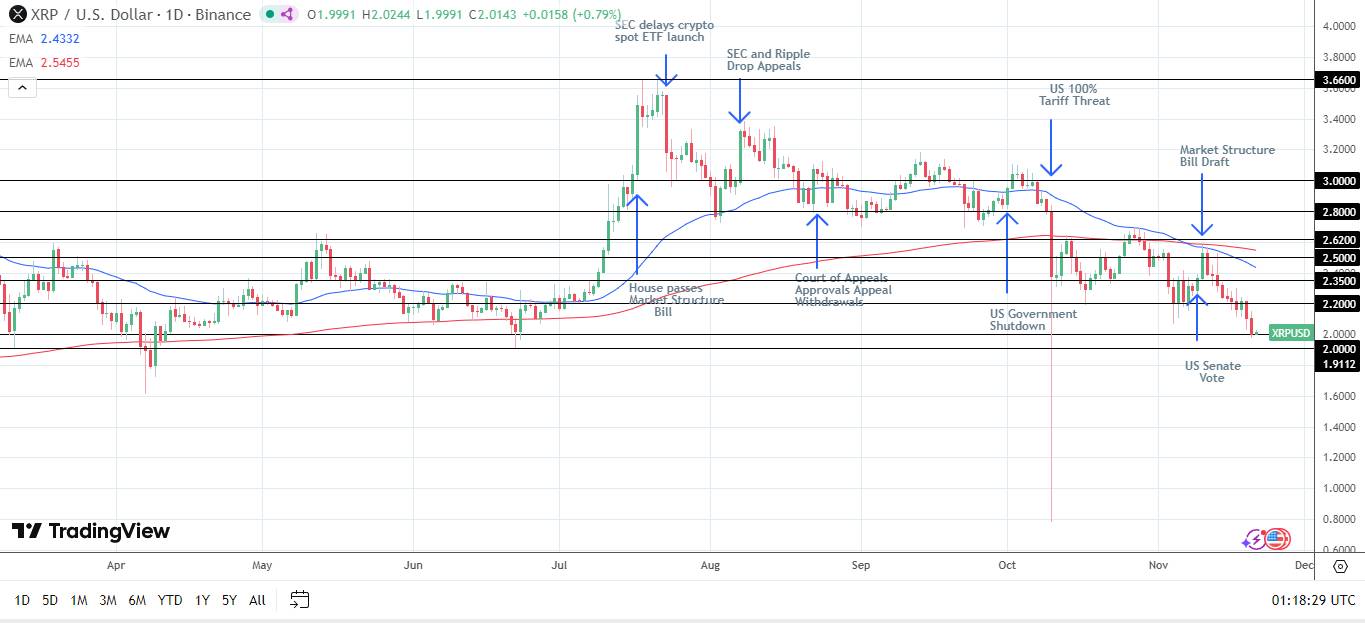
          Looking ahead, several events could trigger a shift in sentiment, potentially sending XRP toward $2.5.

          Key technical levels to watch include:

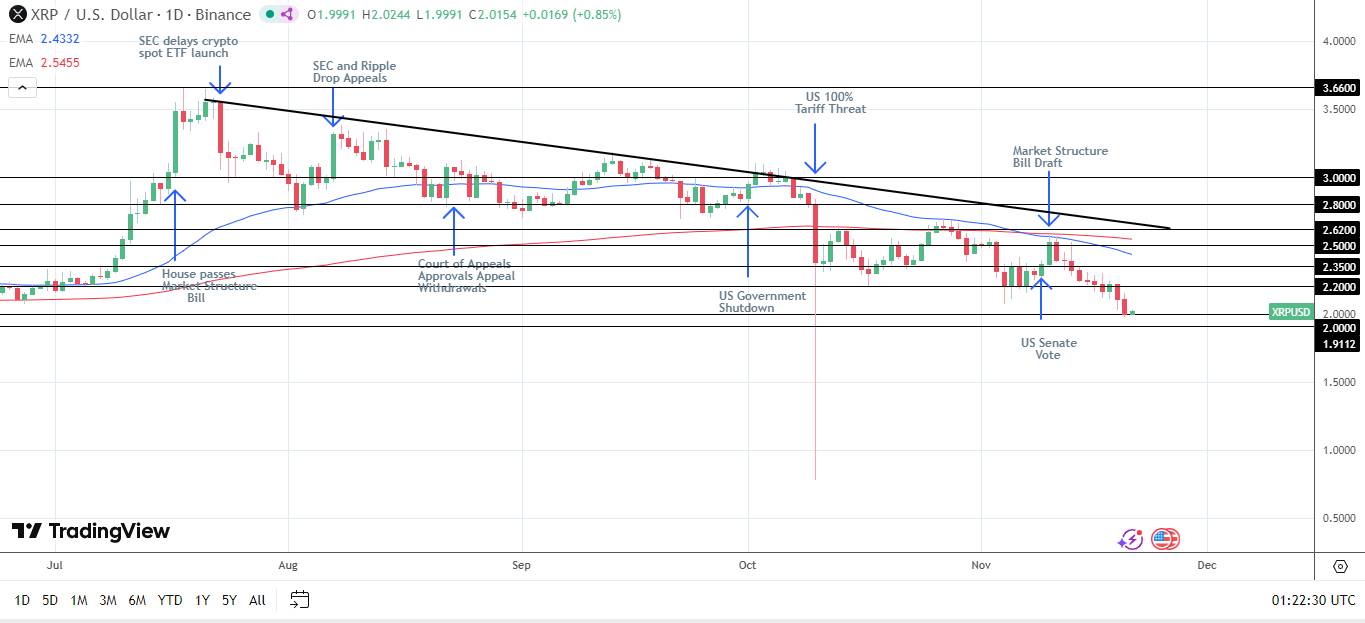
          · Support levels: $2.0, $1.9112, and $1.6147.
          · 50-day EMA resistance: $2.4332.
          · 200-day EMA resistance: $2.5455.
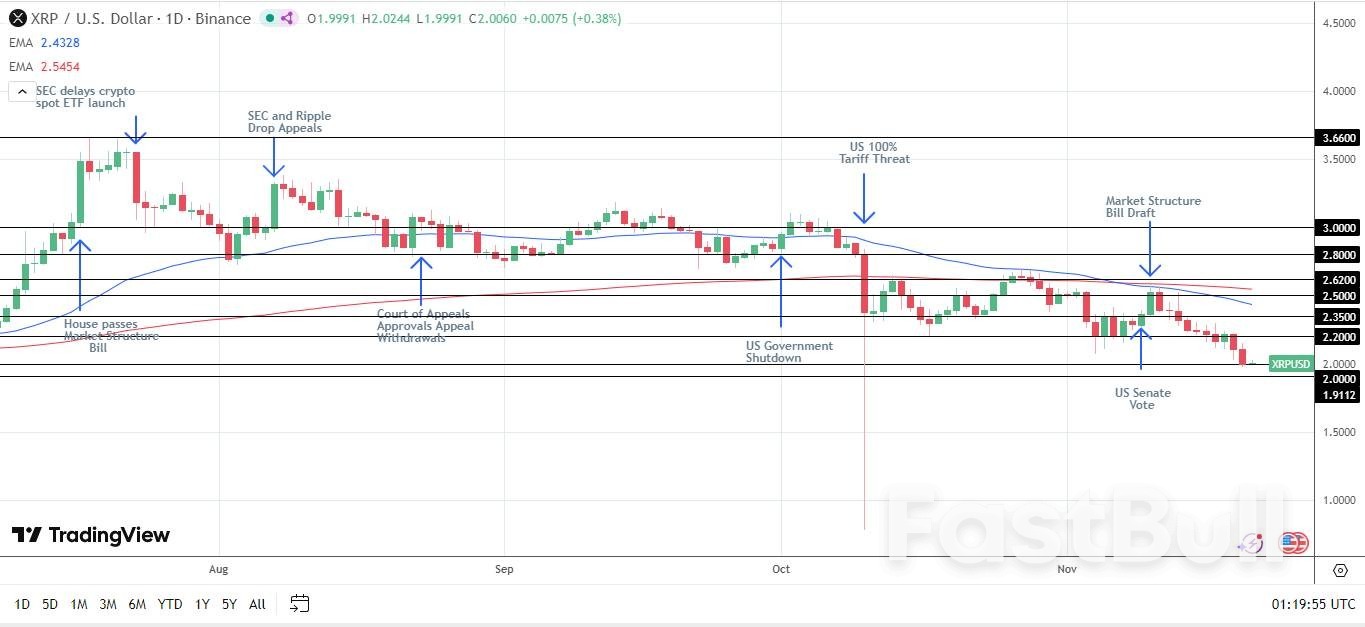
          · Resistance levels: $2.2, $2.35, $2.5, $2.62, $2.8, $3.0, and $3.66.

          Catalysts to Watch in the Sessions Ahead

          Near-term price catalysts include:

          · US Services PMI data.
          · Fed speakers and policy signals.
          · Canary XRP ETF and Bitwise XRP ETF flows.
          · Blue-chip companies' positions on XRP as a treasury reserve asset.
          · Regulatory milestones: Ripple's application for a US-chartered bank license, the progress of the Market Structure Bill on Capitol Hill.

          Bearish Scenario: Risks Below $2.0

          · Strong US PMI data cools bets on a Fed rate cut.
          · Hawkish Fed speakers.
          · XRP-spot ETFs report net outflows.
          · The US Senate opposes crypto-friendly legislation, including the Market Structure Bill.
          · Blue-chip companies dismiss XRP as a treasury reserve asset.
          · OCC delays or rejects Ripple's US-chartered bank license.

          These bearish scenarios could push XRP toward $2.0. If breached, $1.9112 would be the next key support level. A break below $1.9112 could expose the April low of $1.6147. Notably, XRP has been printing lower highs and lower lows, signaling further losses.

          XRPUSD – Daily Chart – 211125 – Bearish

          Bullish Scenario: Path to $2.5 Remains Challenging

          · Weak Services PMI data.
          · Dovish Fed speeches.
          · XRP-spot ETFs report strong inflows.
          · Blue-chip companies target XRP as a treasury reserve asset.
          · Ripple secures a US-chartered bank license, and the US Senate passes the Market Structure Bill.

          A breakout above the $2.2 resistance level could open the door to testing $2.35. A sustained move through $2.35 would pave the way toward the 50-day EMA, with $2.5 the next key resistance level. Buyer demand at $2.0 will be crucial over the coming sessions.

          XRPUSD – Daily Chart – 211125 – Bullish

          Outlook: $2.0 Remains the Pivotal Level

          The absence of key US data and Fed policy uncertainty continue to weigh on market sentiment.

          However, robust demand for XRP-spot ETFs could support a price recovery, potentially driving the token towards $2.2. The launch of the Franklin XRP ETF on Monday, November 24, could prove pivotal, given Franklin Templeton's prominence in the ETF space.

          The next 72 hours could determine whether XRP extends its losses or begins a recovery toward $2.5. XRP-spot ETF flows will be crucial if the token is to begin decoupling from BTC.

          Source: FX Empire

          Risk Warnings and Disclaimers
          You understand and acknowledge that there is a high degree of risk involved in trading. Following any strategies or investment methods may lead to potential losses. The content on the site is provided by our contributors and analysts for information purposes only. You are solely responsible for determining whether any trading assets, securities, strategy, or any other product is suitable for investing based on your own investment objectives and financial situation.
          Add to Favorites
          Share

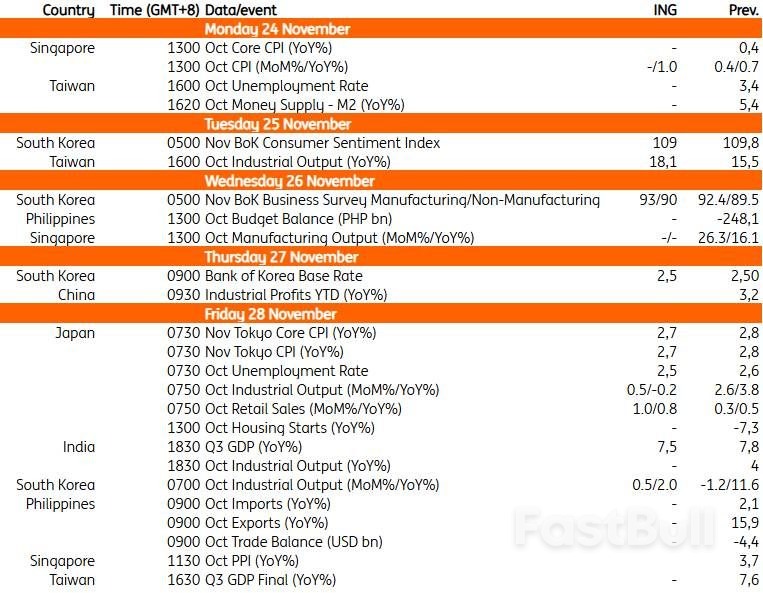
          Bank Of Korea Rate Decision And Key Data From China, Taiwan, Japan, India

          ING

          Forex

          Economic

          South Korea: BOK to stand pat, while industrial production continues growing

          The Bank of Korea will likely keep the policy rate at 2.50% on Thursday for another month, with a minor dissent vote expected. The Bank of Korea is likely to prioritise concerns about financial instability over inflation. Given no clear signs that housing prices have settled and the FX market remains volatile, the BoK has reason to keep rates unchanged. Also Thursday, the BoK releases its outlook report. Amid easing trade tensions and a stronger-than-anticipated semiconductor cycle, we believe the BoK will revise up its 2025 GDP forecast to 1.1% from 0.8% and its 2026 forecast to 1.9% from 1.6%. A GDP outlook below 2% is likely to support the BoK's continued easing policy stance. The recent hike in KTB yields reflected Governor Rhee's hawkish remarks - signalling a possible change of policy direction - during an earlier media interview. We think his remarks at press conference should be more balanced and highlight that policy decisions are data-dependent.

          Industrial production is forecasted to increase for a second consecutive month, driven by strong chip output. The longer-than-expected Chuseok holiday, combined with the 2nd cash payout program, should boost service activity.

          China: Industrial profit data expected to continue improving

          China's industrial profits data, out Thursday, will round out the month's data releases. The data has been showing signs of improvement in the past few months, with profits so far up 3.2% YoY, year-to-date, through September, thanks to two straight months of YoY profit growth above 20% in August and September. This was boosted by a supportive base effect. Support from this effect should gradually wane in the 4Q data, but be enough to keep profit growth solidly positive in October. The industries that have been seeing strong export demand such as rail, ships, and aerospace, computers, communication, other electronic equipment manufacturing, and electrical machinery & equipment manufacturing have generally been outperformers so far this year. This trend should continue.

          Japan: Tokyo CPI inflation supported by solid wage gains

          Tokyo's consumer price index inflation is expected to rise 2.7% YoY in November, supported by solid wage gains. The weaker JPY probably added upward pressure. Industrial production will likely remain positive following Japan's trade agreement with the US. Despite a contraction in the third quarter, recent data suggest an economic recovery, supporting the Bank of Japan's continued policy normalisation. Market expectations for a December rate hike have fallen sharply over the week. We believe that recent BoJ comments indicate at least three board members support a more hawkish stance. However, it remains unclear if others will agree. We continue to forecast a rate hike in December, though the likelihood of a delay to January is rising.

          Taiwan: Industrial production expected to accelerate slightly

          We expect Taiwan's industrial production data, out Tuesday, to continue its streak of strong growth, accelerating slightly to 18.1% YoY. Strength has been quite heavily concentrated in the Information & Electronic Industries and remains vulnerable to a downturn if demand in this sector slows. While market debate on this possibility has increased recently, we do not yet see it affecting the October data.

          India: Q3 GDP growth expected to slow modestly

          We expect India's GDP growth in the third quarter to slow down modestly to 7.5% YoY. Export growth began to slow in 3Q due to the impact of 50% tariffs on US exports. But private consumption growth remained relatively strong, driven by GST rate cuts and the consequent boost in consumer goods purchases.

          Key events in Asia next week

          Source: ING

          To stay updated on all economic events of today, please check out our Economic calendar
          Risk Warnings and Disclaimers
          You understand and acknowledge that there is a high degree of risk involved in trading. Following any strategies or investment methods may lead to potential losses. The content on the site is provided by our contributors and analysts for information purposes only. You are solely responsible for determining whether any trading assets, securities, strategy, or any other product is suitable for investing based on your own investment objectives and financial situation.
          Add to Favorites
          Share

          EU Eyes Strategic Investments in Australian Resources Amid Renewed Trade Momentum

          Gerik

          Economic

          A Strategic Pivot Toward Resource Security

          In a renewed push for resource security and economic alignment, the European Union is actively considering direct investments in Australian resources projects. Speaking from Melbourne, EU Trade Commissioner Maros Sefcovic revealed that discussions with Australian Resources Minister Madeleine King had centered on several mechanisms including equity stakes, long-term off-take agreements, and joint ventures aimed at deepening the EU’s participation in Australia’s resource sector.
          These conversations come as both sides attempt to revive a long-stalled free trade agreement, one which could reshape access to critical minerals essential for Europe’s green and digital transitions. Sefcovic noted that the EU had already shortlisted several projects of interest, with a formal announcement expected imminently. This move reflects a strategic shift in the EU’s trade posture: from purely transactional trade negotiations toward more embedded, co-investment-led partnerships.

          Lessons from Past Dependencies and the Case for Diversification

          Sefcovic pointed to recent European overdependence on Russian oil and gas as a cautionary tale. The subsequent scramble for alternatives after the Ukraine invasion, combined with current constraints in global semiconductor and raw material supplies, has made clear the costs of reactive diversification. Rather than repeat this cycle, the EU is proactively seeking upstream control and supply stability in sectors like lithium, cobalt, and rare earths resources abundant in Australia.
          The shift also mirrors strategies adopted by Japan, which has long used government-supported equity and processing investments to secure long-term access to essential inputs. By following a similar model, the EU aims to reduce exposure to geopolitical shocks and price volatility, especially in light of current global competition for these resources.

          Rekindling Trade Talks with Mutual Strategic Interests

          While a prior attempt to finalize an EU-Australia free trade deal collapsed in 2023 primarily due to disputes over agricultural market access the latest signals from both parties suggest renewed momentum. Australia has long sought more flexibility to export farm goods into Europe, whereas the EU is focusing on securing reliable access to Australian critical minerals and lowering barriers to its manufactured exports.
          Sefcovic confirmed that another round of negotiations is scheduled for early next year, and the recent tone from both delegations is markedly more constructive. The strategic alignment on resource security is providing a new shared foundation for compromise.

          A New Trade Framework Anchored in Resource Diplomacy

          The EU’s willingness to move beyond tariff reduction into resource co-investment represents a broader evolution in trade policy, where economic security now intersects with environmental and geopolitical goals. Australia’s rich mineral base and stable regulatory environment make it a natural partner, especially as the EU seeks to de-risk supply chains for its ambitious climate and technology goals.
          By transitioning from a buyer-supplier dynamic to one of strategic partnership, both the EU and Australia stand to benefit Europe through supply assurance, and Australia through capital inflows and diversified export markets. If successful, this model could reshape how future trade agreements are built in a resource-constrained and geopolitically complex world.
          The EU’s direct engagement in Australian resource projects signals a maturing approach to trade and economic security. As both sides look to conclude a comprehensive agreement in 2026, these investments may serve not only as a foundation for shared prosperity but also as a geopolitical hedge in a world increasingly defined by competition for critical resources.

          Source: Reuters

          To stay updated on all economic events of today, please check out our Economic calendar
          Risk Warnings and Disclaimers
          You understand and acknowledge that there is a high degree of risk involved in trading. Following any strategies or investment methods may lead to potential losses. The content on the site is provided by our contributors and analysts for information purposes only. You are solely responsible for determining whether any trading assets, securities, strategy, or any other product is suitable for investing based on your own investment objectives and financial situation.
          Add to Favorites
          Share
          FastBull
          Copyright © 2025 FastBull Ltd

          728 RM B 7/F GEE LOK IND BLDG NO 34 HUNG TO RD KWUN TONG KLN HONG KONG

          TelegramInstagramTwitterfacebooklinkedin
          App Store Google Play Google Play
          Products
          Charts

          Chats

          Q&A with Experts
          Screeners
          Economic Calendar
          Data
          Tools
          Membership
          Features
          Function
          Markets
          Copy Trading
          Latest Signals
          Contests
          News
          Analysis
          24/7
          Columns
          Education
          Company
          Careers
          About Us
          Contact Us
          Advertising
          Help Center
          Feedback
          User Agreement
          Privacy Policy
          Business

          White Label

          Data API

          Web Plug-ins

          Poster Maker

          Affiliate Program

          Risk Disclosure

          The risk of loss in trading financial instruments such as stocks, FX, commodities, futures, bonds, ETFs and crypto can be substantial. You may sustain a total loss of the funds that you deposit with your broker. Therefore, you should carefully consider whether such trading is suitable for you in light of your circumstances and financial resources.

          No decision to invest should be made without thoroughly conducting due diligence by yourself or consulting with your financial advisors. Our web content might not suit you since we don't know your financial conditions and investment needs. Our financial information might have latency or contain inaccuracy, so you should be fully responsible for any of your trading and investment decisions. The company will not be responsible for your capital loss.

          Without getting permission from the website, you are not allowed to copy the website's graphics, texts, or trademarks. Intellectual property rights in the content or data incorporated into this website belong to its providers and exchange merchants.

          Not Logged In

          Log in to access more features

          FastBull Membership

          Not yet

          Purchase

          Become a signal provider
          Help Center
          Customer Service
          Dark Mode
          Price Up/Down Colors

          Log In

          Sign Up

          Position
          Layout
          Fullscreen
          Default to Chart
          The chart page opens by default when you visit fastbull.com