





Markets
News
Analysis
User
24/7
Economic Calendar
Education
Data
- Names
- Latest
- Prev


Signal Accounts for Members
All Signal Accounts
All Contests


U.S. Dallas Fed New Orders Index (Jan)A:--
F: --
P: --
U.S. 2-Year Note Auction Avg. YieldA:--
F: --
P: --
U.K. BRC Shop Price Index YoY (Jan)A:--
F: --
P: --
China, Mainland Industrial Profit YoY (YTD) (Dec)A:--
F: --
P: --
Germany 2-Year Schatz Auction Avg. YieldA:--
F: --
P: --
Mexico Trade Balance (Dec)A:--
F: --
P: --
U.S. Weekly Redbook Index YoYA:--
F: --
P: --
U.S. S&P/CS 20-City Home Price Index YoY (Not SA) (Nov)A:--
F: --
P: --
U.S. S&P/CS 20-City Home Price Index MoM (SA) (Nov)A:--
F: --
U.S. FHFA House Price Index MoM (Nov)A:--
F: --
P: --
U.S. FHFA House Price Index (Nov)A:--
F: --
P: --
U.S. FHFA House Price Index YoY (Nov)A:--
F: --
U.S. S&P/CS 10-City Home Price Index YoY (Nov)A:--
F: --
P: --
U.S. S&P/CS 10-City Home Price Index MoM (Not SA) (Nov)A:--
F: --
P: --
U.S. S&P/CS 20-City Home Price Index (Not SA) (Nov)A:--
F: --
P: --
U.S. S&P/CS 20-City Home Price Index MoM (Not SA) (Nov)A:--
F: --
P: --
U.S. Richmond Fed Manufacturing Composite Index (Jan)A:--
F: --
P: --
U.S. Conference Board Present Situation Index (Jan)A:--
F: --
P: --
U.S. Conference Board Consumer Expectations Index (Jan)A:--
F: --
P: --
U.S. Richmond Fed Manufacturing Shipments Index (Jan)A:--
F: --
P: --
U.S. Richmond Fed Services Revenue Index (Jan)A:--
F: --
P: --
U.S. Conference Board Consumer Confidence Index (Jan)A:--
F: --
U.S. 5-Year Note Auction Avg. YieldA:--
F: --
P: --
U.S. API Weekly Refined Oil StocksA:--
F: --
P: --
U.S. API Weekly Crude Oil StocksA:--
F: --
P: --
U.S. API Weekly Gasoline StocksA:--
F: --
P: --
U.S. API Weekly Cushing Crude Oil StocksA:--
F: --
P: --
Australia RBA Trimmed Mean CPI YoY (Q4)A:--
F: --
P: --
Australia CPI YoY (Q4)A:--
F: --
P: --
Australia CPI QoQ (Q4)A:--
F: --
P: --
Germany GfK Consumer Confidence Index (SA) (Feb)--
F: --
P: --
Germany 10-Year Bund Auction Avg. Yield--
F: --
P: --
India Industrial Production Index YoY (Dec)--
F: --
P: --
India Manufacturing Output MoM (Dec)--
F: --
P: --
U.S. MBA Mortgage Application Activity Index WoW--
F: --
P: --
Canada Overnight Target Rate--
F: --
P: --
BOC Monetary Policy Report
U.S. EIA Weekly Crude Stocks Change--
F: --
P: --
U.S. EIA Weekly Cushing, Oklahoma Crude Oil Stocks Change--
F: --
P: --
U.S. EIA Weekly Crude Demand Projected by Production--
F: --
P: --
U.S. EIA Weekly Crude Oil Imports Changes--
F: --
P: --
U.S. EIA Weekly Heating Oil Stock Changes--
F: --
P: --
U.S. EIA Weekly Gasoline Stocks Change--
F: --
P: --
BOC Press Conference
Russia PPI MoM (Dec)--
F: --
P: --
Russia PPI YoY (Dec)--
F: --
P: --
U.S. Target Federal Funds Rate Lower Limit (Overnight Reverse Repo Rate)--
F: --
P: --
U.S. Interest Rate On Reserve Balances--
F: --
P: --
U.S. Federal Funds Rate Target--
F: --
P: --
U.S. Target Federal Funds Rate Upper Limit (Excess Reserves Ratio)--
F: --
P: --
FOMC Statement
FOMC Press Conference
Brazil Selic Interest Rate--
F: --
P: --
Australia Import Price Index YoY (Q4)--
F: --
P: --
Japan Household Consumer Confidence Index (Jan)--
F: --
P: --
Turkey Economic Sentiment Indicator (Jan)--
F: --
P: --
Euro Zone M3 Money Supply (SA) (Dec)--
F: --
P: --
Euro Zone Private Sector Credit YoY (Dec)--
F: --
P: --
Euro Zone M3 Money Supply YoY (Dec)--
F: --
P: --
Euro Zone 3-Month M3 Money Supply YoY (Dec)--
F: --
P: --
South Africa PPI YoY (Dec)--
F: --
P: --


No matching data
Latest Views
Latest Views
Trending Topics
Top Columnists
Latest Update
White Label
Data API
Web Plug-ins
Affiliate Program
View All

No data
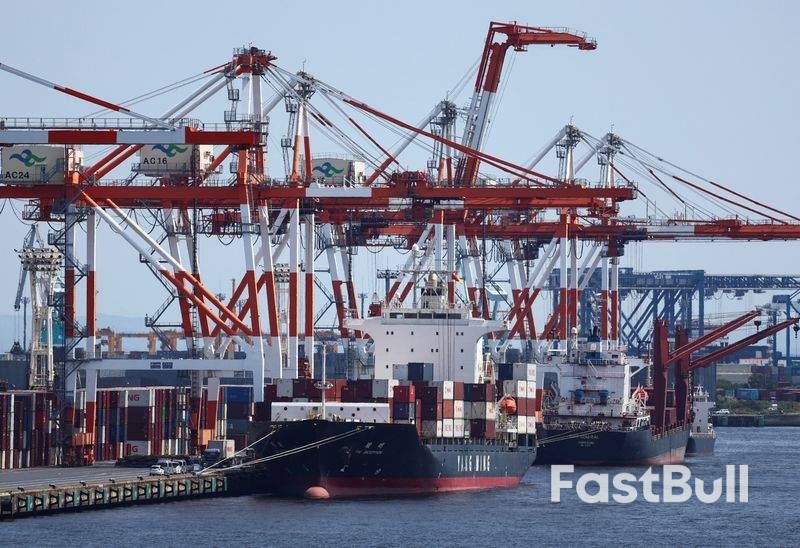
Japan's exports rose for a third straight month in November, government data showed on Wednesday, as shipments to the U.S. rebounded for the first time in eight months, bolstering the case for the central bank to continue raising interest rates.
Total exports by value rose 6.1% year-on-year last month, more than a median market forecast for a 4.8% increase and following a 3.6% gain in October.
Exports to the United States rose 8.8% in November from a year earlier, while those to China were down 2.4%, the data showed.
Imports grew 1.3% last month year-on-year, compared with market forecasts for a 2.5% increase.
As a result, Japan ran a trade surplus of 322.3 billion yen ($2.08 billion) in November, compared with the forecast of 71.2 billion yen.
Japan's economy shrank in the third quarter as exports slumped under the weight of U.S. tariffs, but analysts expect growth to rebound in the current quarter.
The initial shock from higher tariffs proved milder than feared, as Japanese exporters absorbed the tariff costs to stay competitive, aided by a weaker yen.
Some relief came after the U.S. and Japan formalised a trade agreement in September that implemented a baseline 15% tariff on nearly all U.S. imports from Japan, down from an initial 27.5% on autos and 25% on most other goods.
Adding to positive sentiment, a closely watched Bank of Japan survey showed on Monday that big Japanese manufacturers' business sentiment hit a four-year high in the three months to December.
With concerns over tariffs easing, the BOJ is widely expected to raise its short-term policy rate to 0.75% from 0.5% later this week, although the pace of future rate hikes remains unclear.
One of my all-time favorite investment books is titled Triumph of the Optimists. Though pessimism tends to sound smarter, optimists enjoy better investment performance. Markets have a long history of overcoming risk factors.
This year, we've seen wild swings between risk-on and risk-off, greed and fear. A debate swirls over whether we're in an AI bubble. I'm reminded of a couple of years back when the question was whether we were heading for a "hard" or "soft landing," only for a recession to never materialize. Through all the ups and downs, investors who stayed the course have prospered in 2025 (and in most prior years).
As the year winds down, here are five investment surprises from a memorable 2025.
If you had told me on the evening of April 3 that the broad US stock market would end the year delivering double-digit gains, I would have dismissed you as a Pollyanna. Early April seems like a long time ago now, but, as a reminder, the Morningstar US Market Index was flirting with bear-market territory. Between its peak on Feb. 18 and the selloff following April 2's "Liberation Day," the market fell more than 19%. Then President Donald Trump announced a pause on tariffs, and April 9 brought its biggest one-day gain in 17 years.
We've seen a lot more stock market volatility in 2025 than we did in 2024 or 2023. The tug-of-war between artificial-intelligence-fueled bullishness and various causes for concern has led to both drops and pops. The biggest swings came during springtime's tariff turmoil, but October and November were also quite bumpy.
Ultimately, the bulls have pulled the rope harder. Stocks have climbed the proverbial "wall of worry," and the Morningstar US Market Index is up more than 17% through mid-December.
I see 2025 as a case study in why trading in and out of investments is so difficult. Timing short-term fluctuations can lead investors to miss out on gains. Remember the "Pandemic Panic" of 2020? The Morningstar US Market Index fell 12% in a single March day, only for stocks to recover and post a gain of more than 20% that year. To invoke another old investment saw, it's about time in the market, not timing the market.
This one doesn't sound like much of a surprise, considering that 2016 was the last time the Morningstar US Small Cap Index meaningfully outperformed the broad stock market. It's surprising because small-cap stocks rallied powerfully after the November 2024 US election, considered one of the "Trump Trades." The expectation was that animal spirits would lift small caps.
The fact that the small-cap segment of the US stock market has returned to its underperforming ways in 2025 is especially surprising because we've had interest rate cuts and a resilient economy—conditions considered favorable to the asset class. With their simpler business models and domestic revenue sources, smaller companies are seen to be more leveraged to macro forces than their larger counterparts.
What's plaguing small caps in 2025? For one thing, the springtime volatility hit the asset class hard, leaving small caps with a deeper hole from which to climb. Second, sector dynamics have held small caps back. The segment is lighter on technology and less exposed to AI than the overall market. Third, it's entirely possible that the rise of private markets has diminished the asset class. High-growth-potential companies are staying private, and high-quality public small caps are going private.
US-based investors can be forgiven for thinking global exposure is unnecessary. For years—and I mean years—US equities were the only game in town. The US share of the Morningstar Global Markets Index climbed from 40% in 2009 to 63% today. That's far out of proportion to the US share of the global economy—roughly one fourth. A single US company—Nvidia NVDA—exceeds the market value of once-great markets like the UK.
For the few US investors who maintained global exposure, the outperformance of international stocks in 2025 has been vindicating. Foreign equities have posted gaudy returns this year, especially when translated into US dollars, which have lost value relative to most global currencies. Both the Morningstar Developed Markets ex-US Index and the Morningstar Emerging Markets Index have outperformed their US counterpart by more than 10 percentage points so far in 2025.
European markets have come to life thanks to the defense industry, as well as the financial-services sector, which has been lifted by higher economic growth and interest rates. Within emerging markets, Korea, China, and Latin America are standout performers. All entered the year undervalued.
Many expect the rally to continue, for a few reasons. First, global equity market leadership is cyclical. In the 1970s, 1980s, and 2000s, international exposure was a boon to US investors. My colleagues on Morningstar's investment management team continue to see valuations and currency dynamics as tailwinds for markets outside the US, too. The US stock market looks top-heavy and highly concentrated by company, sector, and theme relative to overseas markets.
There are so many reasons to stay out of bonds. Debt, deficits, and inflation are all bearish factors. After the November 2024 US elections, bond yields rose on the expectations of a free-spending administration.
Yet, here we sit in mid-December with the Morningstar US Core Bond Index up nearly 7% for the year. Even more impressive than the return is how well bonds held up during the equity market selloff in spring 2025. As the stock market flirted with bear-market territory, bonds performed exactly how you would hope—providing crucial portfolio ballast. From an income standpoint, the Morningstar US Core Bond Index throws off a yield of 4.25%, comfortably above the inflation rate.
My colleagues on Morningstar's investment management team continue to view a US core bond allocation as offering an attractive risk/reward profile. The "sweet spot," in their view, lies in intermediate-term maturities. As ever, income investors are cautioned against reaching too far for yield into lower-quality debt.
You think of gold as a "risk-off" asset. It tends to thrive on fear. The "gold bug" moniker conjures images of tin-foil hats and bunkers prepped for doomsday.
It's surprising that in a year in which risk assets—especially fast-growing tech companies—have thrived, gold is also up. Yet, up it is. Gold prices surpassed $4,000 per ounce in October. The effect on the share prices of gold-mining companies has been dramatic.
What accounts for the gold rally? Global central banks diversifying away from the US dollar have undoubtedly had an effect. In China and elsewhere, gold is a popular reserve asset and a hedge against an increasingly unpredictable US.
The gold rally is also surprising because of the struggles of bitcoin, which has been dubbed "millennial gold." The largest cryptocurrency rode a postelection wave and hit a price of $125,000 in October 2025. Then, it went into free fall, dropping below $80,000 in November. Technical factors, including margin calls and exchange-traded fund flows, could be contributing. With speculative assets, it's always hard to know.
The year saw strong returns for both risk-on and risk-off assets. Stocks and bonds both rallied. AI optimism lifted markets, while gold, a gauge of fear, posted record-highs. The dollar sank even as US interest rates remained elevated relative to other markets.
Given 2025, what can investors expect in 2026? My prediction: more surprises.

A California regulator has put on hold an order to suspend Tesla (TSLA.O), sales in the state, the latest development in a case in which it accused the electric vehicle maker of falsely marketing and overstating self-driving capabilities.
The decision grants a reprieve to Tesla in a case that could force it to halt sales in its biggest U.S. market.
The Department of Motor Vehicles (DMV) ordered the suspension of Tesla's manufacturing and sales licenses for 30 days, adopting a judge's proposals, but immediately put them on hold, DMV director Steve Gordon told reporters on Tuesday.
The DMV had accused Tesla of misleading consumers by using brand names Autopilot and Full Self-Driving (FSD) for their vehicles' advanced driver assistance features. The regulator had told Judge Juliet Cox of the state Office of Administrative Hearings that the names falsely implied the cars operate autonomously.
But Gordon said on Tuesday the DMV wants to give Tesla "one more chance to be able to remedy the situation," adding that he hoped Tesla will "find a way to get these misleading statements corrected."
The DMV said it stayed the suspension of Tesla's ability to sell vehicles for 90 days and stayed its manufacturing license indefinitely.
Tesla did not immediately respond to a Reuters request for comment.
A lawyer for Tesla previously said the company had "clearly and consistently" explained that its vehicles purchased with Autopilot and FSD software require driver supervision and are not autonomous. "Tesla has never misled consumers. Never. And not even close," the lawyer said in a hearing.
DMV's Gordon said Tesla can pursue an appeal with the agency or potentially in court.
The order is a potential setback for Tesla and its marketing of autonomous vehicles, but the stay is a relief.
The Elon Musk-led company, like its EV rivals, is battling a plunge in demand following the expiry of key tax credits that have been a major driver of sales.
Musk has pivoted the company's focus to robotaxis, underpinned by a version of its self-driving software, as well as humanoid robots, and much of Tesla's valuation hangs on those bets.
While Autopilot helps Tesla vehicles to accelerate, brake and stay in their lanes on highways, Full Self-Driving allows vehicles to change lanes, obey traffic signals and drive on city streets.
Tesla has added the term "Supervised" for FSD in passenger vehicles. It uses an "Unsupervised" version of the software for moving cars from the assembly lines to delivery lots at some of its factories. Tesla also uses the software to run a robotaxi service in Austin with human safety monitors in front passenger seats and remote support.
Reporting by Abhirup Roy in San Francisco and Chris Kirkham in Los Angeles; Additional reporting by Juby Babu in Mexico City and Mike Scarcella in Washington D.C.; Editing by David Gregorio and Christopher Cushing
U.S. President Donald Trump on Tuesday stateside ordered a "complete and total" blockade of sanctioned oil tankers moving in and out of Venezuela as tensions ramp up between the Washington and the South American country.
In a post on Truth Social, Trump said "Venezuela is completely surrounded by the largest Armada ever assembled in the History of South America."He added, "It will only get bigger, and the shock to them will be like nothing they have ever seen before — Until such time as they return to the United States of America all of the Oil, Land, and other Assets that they previously stole from us."
"For the theft of our Assets, and many other reasons, including Terrorism, Drug Smuggling, and Human Trafficking, the Venezuelan Regime has been designated a FOREIGN TERRORIST ORGANIZATION. Therefore, today, I am ordering A TOTAL AND COMPLETE BLOCKADE OF ALL SANCTIONED OIL TANKERS going into, and out of, Venezuela," Trump said.
The Trump administration is weighing an executive order that would pressure defense contractors to spend less on stock buybacks and dividends while boosting investment in infrastructure and weapons production, a person familiar with the matter said.
The executive order, which President Donald Trump could sign as early as this week, would mark the latest effort by the White House to bring the defense contractors to heel. In a speech last month, Defense Secretary Pete Hegseth demanded the companies speed weapons development or "fade away."
The proposed order would mandate that the companies tie executive compensation more closely to overall performance levels in delivering specific systems, said the person, who asked not to be identified discussing a plan that hasn't been released.
Even so, it appears to be a White House effort. Pentagon officials only saw the draft order in the last two weeks, the person said. Depending on how it's worded, the order could trigger a Pentagon review on how best to extract those demands from industry.
The White House didn't immediately respond to a request for comment. Punchbowl first reported the order plans.
Trump's ability to enforce such an order is unclear, and it would represent an extraordinary intrusion by the US government into corporate affairs. But the administration hasn't been shy about making similar demands in recent months, telling contractors to get in line with its priorities and even buying stakes in some companies.
Backed by Trump, Hegseth has said he intends to fix the painfully slow procurement process in which weapons are often over-budget, years late and sometimes obsolete by the time they debut. That challenge drew the ire of White House Chief of Staff Susie Wiles, who told Vanity Fair in an interview published Tuesday that Hegseth was the right person to take on the job.
"People talk about the deep state being at the State Department," Wiles said. "It's not. It's the military-industrial complex."
In his November speech, Hegseth demanded the biggest US defense companies invest their own capital in speed and volume of delivery. Officials from defense companies such as Lockheed Martin Corp. and Northrop Grumman Corp., were in the audience when Hegseth delivered the remarks.
In October, Lockheed raised its quarterly dividend 15% and approved buying back up to an additional $2 billion, the Wall Street Journal reported at the time. Northrop pays a dividend of $2.31 per share.
But the companies have also made major investments. Earlier this month, Lockheed opened a new lab focused on hypersonic weapons in Alabama as part of a $700 million planned investment from the strategic and missile defense unit in recent years to expand and upgrade facilities. Northrop has invested more than $1 billion in advanced manufacturing facilities since 2018.
Undersecretary Michael Duffey, in a separate memo to the Pentagon senior leadership earlier this month, directed each military service to publish new contracting guidelines in the next 180 days that would ensure "clear incentives for timely delivery" and "increased production capacity".

President Donald Trump has signed a proclamation further restricting and limiting the entry of foreign nationals to the United States, the White House said on Tuesday.
The U.S. has imposed full restrictions and entry limitations on nationals from five countries - Burkina Faso, Mali, Niger, South Sudan, and Syria - in addition to the initial list of 12 countries, the White House said.
Full restrictions have also been imposed on individuals holding Palestinian Authority-issued travel documents, it said.
White Label
Data API
Web Plug-ins
Poster Maker
Affiliate Program
The risk of loss in trading financial instruments such as stocks, FX, commodities, futures, bonds, ETFs and crypto can be substantial. You may sustain a total loss of the funds that you deposit with your broker. Therefore, you should carefully consider whether such trading is suitable for you in light of your circumstances and financial resources.
No decision to invest should be made without thoroughly conducting due diligence by yourself or consulting with your financial advisors. Our web content might not suit you since we don't know your financial conditions and investment needs. Our financial information might have latency or contain inaccuracy, so you should be fully responsible for any of your trading and investment decisions. The company will not be responsible for your capital loss.
Without getting permission from the website, you are not allowed to copy the website's graphics, texts, or trademarks. Intellectual property rights in the content or data incorporated into this website belong to its providers and exchange merchants.
Not Logged In
Log in to access more features
Log In
Sign Up