• Trade
  • Markets
  • Copy
  • Contests
  • News
  • 24/7
  • Calendar
  • Q&A
  • Chats
Trending
Screeners
SYMBOL
LAST
BID
ASK
HIGH
LOW
NET CHG.
%CHG.
SPREAD
SPX
S&P 500 Index
6838.99
6838.99
6838.99
6878.28
6827.18
-31.41
-0.46%
--
DJI
Dow Jones Industrial Average
47703.97
47703.97
47703.97
47971.51
47611.93
-251.01
-0.52%
--
IXIC
NASDAQ Composite Index
23513.74
23513.74
23513.74
23698.93
23455.05
-64.38
-0.27%
--
USDX
US Dollar Index
99.010
99.090
99.010
99.160
98.730
+0.060
+ 0.06%
--
EURUSD
Euro / US Dollar
1.16401
1.16408
1.16401
1.16717
1.16162
-0.00025
-0.02%
--
GBPUSD
Pound Sterling / US Dollar
1.33272
1.33281
1.33272
1.33462
1.33053
-0.00040
-0.03%
--
XAUUSD
Gold / US Dollar
4192.12
4192.56
4192.12
4218.85
4175.92
-5.79
-0.14%
--
WTI
Light Sweet Crude Oil
58.609
58.639
58.609
60.084
58.495
-1.200
-2.01%
--

Community Accounts

Signal Accounts
--
Profit Accounts
--
Loss Accounts
--
View More

Become a signal provider

Sell trading signals to earn additional income

View More

Guide to Copy Trading

Get started with ease and confidence

View More

Signal Accounts for Members

All Signal Accounts

Best Return
  • Best Return
  • Best P/L
  • Best MDD
Past 1W
  • Past 1W
  • Past 1M
  • Past 1Y

All Contests

  • All
  • Trump Updates
  • Recommend
  • Stocks
  • Cryptocurrencies
  • Central Banks
  • Featured News
Top News Only
Share

President Trump Is Committed To The Continued Cessation Of Violence And Expects The Governments Of Cambodia And Thailand To Fully Honor Their Commitments To End This Conflict - Senior White House Official

Share

[Water Overflows From Spent Fuel Pool At Japanese Nuclear Facility] According To Japan's Nuclear Waste Management Company, Following A Strong Earthquake Off The Coast Of Aomori Prefecture Late On December 8th, Workers At The Nuclear Waste Treatment Plant In Rokkasho Village, Aomori Prefecture, Discovered "at Least 100 Liters Of Water" On The Ground Around The Spent Fuel Pool During An Inspection. Analysis Suggests This Water "may Have Overflowed Due To The Earthquake's Shaking." However, It Is Reported That The Overflowed Water "remains Inside The Building And Has Not Affected The External Environment."

Share

Trump Says Netflix, Paramount Are Not His Friends As Warner Bros Fight Heats Up

Share

On Monday (December 8), The ICE Dollar Index Rose 0.11% To 99.102 In Late New York Trading, Trading Between 98.794 And 99.227, Following A Significant Rally After The US Stock Market Opened. The Bloomberg Dollar Index Rose 0.12% To 1213.90, Trading Between 1210.34 And 1214.88

Share

Trump: Has Not Spoken To Kushner About Paramount Bid

Share

US President Trump: I Don’t Know Much About Paramount’s Hostile Takeover Bid For Warner Bros. Discovery

Share

Trump: I Want To Do What's Right

Share

Trump On Bids For Warner Bros: I'd Have To See Netflix, Paramount Percentages Of Market

Share

Trump On Vaccines: We Are Looking At A Lot Of Things

Share

Trump: EU Fine On X A “Nasty One”

Share

Trump: I Don't Want To Pay Insurance Companies, They Are Owned By Democrats

Share

Trump: On Healthcare, I Want The Money To Be Paid To The People

Share

US Treasury Secretary Bessenter: We Are Still Working Towards A Trade Agreement With India

Share

US Natural Gas Futures Drop 7% On Less Cold Forecasts, Near-Record Output

Share

[Trump: The US Will Not Experience Deflation] US President Trump Believes That US Inflation Will Decline Slightly Further, But There Will Be No Deflation

Share

Trump: We Will End Up Putting Severe Tariffs On Fertilizer From Canada If We Have To

Share

Bessent: We Are Still Working On India Trade Deal

Share

Brent Crude Futures Settle At $62.49/Bbl, Down $1.26, 1.98 Percent

Share

Trump: Farming Equipment Has Gotten Too Expensive

Share

Trump: We Will Take Off A Lot Of Environment Rules That Affect Tractor Companies

TIME
ACT
FCST
PREV
France Trade Balance (SA) (Oct)

A:--

F: --

P: --
Euro Zone Employment YoY (SA) (Q3)

A:--

F: --

P: --
Canada Part-Time Employment (SA) (Nov)

A:--

F: --

P: --

Canada Unemployment Rate (SA) (Nov)

A:--

F: --

P: --

Canada Full-time Employment (SA) (Nov)

A:--

F: --

P: --

Canada Labor Force Participation Rate (SA) (Nov)

A:--

F: --

P: --

Canada Employment (SA) (Nov)

A:--

F: --

P: --

U.S. PCE Price Index MoM (Sept)

A:--

F: --

P: --

U.S. Personal Income MoM (Sept)

A:--

F: --

P: --

U.S. Core PCE Price Index MoM (Sept)

A:--

F: --

P: --

U.S. PCE Price Index YoY (SA) (Sept)

A:--

F: --

P: --

U.S. Core PCE Price Index YoY (Sept)

A:--

F: --

P: --

U.S. Personal Outlays MoM (SA) (Sept)

A:--

F: --

P: --
U.S. 5-10 Year-Ahead Inflation Expectations (Dec)

A:--

F: --

P: --

U.S. Real Personal Consumption Expenditures MoM (Sept)

A:--

F: --

P: --
U.S. Weekly Total Rig Count

A:--

F: --

P: --

U.S. Weekly Total Oil Rig Count

A:--

F: --

P: --

U.S. Consumer Credit (SA) (Oct)

A:--

F: --

P: --
China, Mainland Foreign Exchange Reserves (Nov)

A:--

F: --

P: --

Japan Trade Balance (Oct)

A:--

F: --

P: --

Japan Nominal GDP Revised QoQ (Q3)

A:--

F: --

P: --

China, Mainland Imports YoY (CNH) (Nov)

A:--

F: --

P: --

China, Mainland Exports (Nov)

A:--

F: --

P: --

China, Mainland Imports (CNH) (Nov)

A:--

F: --

P: --

China, Mainland Trade Balance (CNH) (Nov)

A:--

F: --

P: --

China, Mainland Exports YoY (USD) (Nov)

A:--

F: --

P: --

China, Mainland Imports YoY (USD) (Nov)

A:--

F: --

P: --

Germany Industrial Output MoM (SA) (Oct)

A:--

F: --

P: --
Euro Zone Sentix Investor Confidence Index (Dec)

A:--

F: --

P: --

Canada National Economic Confidence Index

A:--

F: --

P: --

U.K. BRC Like-For-Like Retail Sales YoY (Nov)

--

F: --

P: --

U.K. BRC Overall Retail Sales YoY (Nov)

--

F: --

P: --

Australia Overnight (Borrowing) Key Rate

--

F: --

P: --

RBA Rate Statement
RBA Press Conference
Germany Exports MoM (SA) (Oct)

--

F: --

P: --

U.S. NFIB Small Business Optimism Index (SA) (Nov)

--

F: --

P: --

Mexico 12-Month Inflation (CPI) (Nov)

--

F: --

P: --

Mexico Core CPI YoY (Nov)

--

F: --

P: --

Mexico PPI YoY (Nov)

--

F: --

P: --

U.S. Weekly Redbook Index YoY

--

F: --

P: --

U.S. JOLTS Job Openings (SA) (Oct)

--

F: --

P: --

China, Mainland M1 Money Supply YoY (Nov)

--

F: --

P: --

China, Mainland M0 Money Supply YoY (Nov)

--

F: --

P: --

China, Mainland M2 Money Supply YoY (Nov)

--

F: --

P: --

U.S. EIA Short-Term Crude Production Forecast For The Year (Dec)

--

F: --

P: --

U.S. EIA Natural Gas Production Forecast For The Next Year (Dec)

--

F: --

P: --

U.S. EIA Short-Term Crude Production Forecast For The Next Year (Dec)

--

F: --

P: --

EIA Monthly Short-Term Energy Outlook
U.S. API Weekly Gasoline Stocks

--

F: --

P: --

U.S. API Weekly Cushing Crude Oil Stocks

--

F: --

P: --

U.S. API Weekly Crude Oil Stocks

--

F: --

P: --

U.S. API Weekly Refined Oil Stocks

--

F: --

P: --

South Korea Unemployment Rate (SA) (Nov)

--

F: --

P: --

Japan Reuters Tankan Non-Manufacturers Index (Dec)

--

F: --

P: --

Japan Reuters Tankan Manufacturers Index (Dec)

--

F: --

P: --

Japan Domestic Enterprise Commodity Price Index MoM (Nov)

--

F: --

P: --

Japan Domestic Enterprise Commodity Price Index YoY (Nov)

--

F: --

P: --

China, Mainland PPI YoY (Nov)

--

F: --

P: --

China, Mainland CPI MoM (Nov)

--

F: --

P: --

Italy Industrial Output YoY (SA) (Oct)

--

F: --

P: --

Q&A with Experts
    • All
    • Chatrooms
    • Groups
    • Friends
    Connecting
    .
    .
    .
    Type here...
    Add Symbol or Code

      No matching data

      All
      Trump Updates
      Recommend
      Stocks
      Cryptocurrencies
      Central Banks
      Featured News
      • All
      • Russia-Ukraine Conflict
      • Middle East Flashpoint
      • All
      • Russia-Ukraine Conflict
      • Middle East Flashpoint
      Search
      Products

      Charts Free Forever

      Chats Q&A with Experts
      Screeners Economic Calendar Data Tools
      Membership Features
      Data Warehouse Market Trends Institutional Data Policy Rates Macro

      Market Trends

      Market Sentiment Order Book Forex Correlations

      Top Indicators

      Charts Free Forever
      Markets

      News

      News Analysis 24/7 Columns Education
      From Institutions From Analysts
      Topics Columnists

      Latest Views

      Latest Views

      Trending Topics

      Top Columnists

      Latest Update

      Signals

      Copy Rankings Latest Signals Become a signal provider AI Rating
      Contests
      Brokers

      Overview Brokers Assessment Rankings Regulators News Claims
      Broker listing Forex Brokers Comparison Tool Live Spread Comparison Scam
      Q&A Complaint Scam Alert Videos Tips to Detect Scam
      More

      Business
      Events
      Careers About Us Advertising Help Center

      White Label

      Data API

      Web Plug-ins

      Affiliate Program

      Awards Institution Evaluation IB Seminar Salon Event Exhibition
      Vietnam Thailand Singapore Dubai
      Fans Party Investment Sharing Session
      FastBull Summit BrokersView Expo
      Recent Searches
        Top Searches
          Markets
          News
          Analysis
          User
          24/7
          Economic Calendar
          Education
          Data
          • Names
          • Latest
          • Prev

          View All

          No data

          Scan to Download

          Faster Charts, Chat Faster!

          Download App
          English
          • English
          • Español
          • العربية
          • Bahasa Indonesia
          • Bahasa Melayu
          • Tiếng Việt
          • ภาษาไทย
          • Français
          • Italiano
          • Türkçe
          • Русский язык
          • 简中
          • 繁中
          Open Account
          Search
          Products
          Charts Free Forever
          Markets
          News
          Signals

          Copy Rankings Latest Signals Become a signal provider AI Rating
          Contests
          Brokers

          Overview Brokers Assessment Rankings Regulators News Claims
          Broker listing Forex Brokers Comparison Tool Live Spread Comparison Scam
          Q&A Complaint Scam Alert Videos Tips to Detect Scam
          More

          Business
          Events
          Careers About Us Advertising Help Center

          White Label

          Data API

          Web Plug-ins

          Affiliate Program

          Awards Institution Evaluation IB Seminar Salon Event Exhibition
          Vietnam Thailand Singapore Dubai
          Fans Party Investment Sharing Session
          FastBull Summit BrokersView Expo

          Japan’s Bond Yields Surge to Multi-Decade Highs Amid Election-Driven Fiscal Jitters

          Gerik

          Economic

          Bond

          Summary:

          Japanese government bond yields soared to levels not seen in decades as markets braced for possible fiscal loosening ahead of the Upper House election....

          Rising Yields Reflect Election Uncertainty and Fiscal Risk

          On Tuesday, Japan’s 10-year government bond yield jumped to 1.599%, marking its highest point since 2008. Meanwhile, the 30-year yield reached an unprecedented 3.21%, and 20-year bonds hit levels last seen in 1999. The sharp rise in yields comes amid speculation that the upcoming Upper House election could usher in policies favoring tax cuts and increased spending, deepening the government’s fiscal imbalance.
          According to Ken Matsumoto of Crédit Agricole CIB, expectations of post-election fiscal expansion are driving long-term yields higher. The policy debate surrounding the election has become increasingly centered on potential consumption tax cuts, adding volatility to the bond market.

          A Divided Political Landscape Triggers Investor Anxiety

          While Prime Minister Shigeru Ishiba maintains his opposition to tax cuts financed by more debt, opposition parties are rallying around more populist measures pushing for consumption tax reductions and greater spending commitments. The uncertainty over Japan’s future fiscal path has triggered what analysts call a "bond vigilante" response.
          Amir Anvarzadeh from Asymmetric Advisors warned that talk of tax cuts is perceived as "suicidal" for a country with one of the highest public debt ratios in the world. "Investors are demanding more yield to offset the rising risk," he said. This growing skepticism has led to increased short-selling of Japanese government bonds (JGBs), further fueling the yield surge.

          Underlying Macro Pressures Add to the Tension

          Beyond the political noise, structural issues are also pushing yields higher. Tokyo’s inflation slowed slightly to 3.1% year-on-year in June, down from 3.6% in May, but still remains elevated. Carlos Casanova of Union Bancaire Privée noted that this could force the Bank of Japan (BOJ) to revise its inflation outlook upward, potentially expediting the timing of its next rate hike.
          Simultaneously, supply-demand dynamics in the bond market are shifting. Japanese life insurers, traditionally major bond buyers, are showing reduced appetite, adding to concerns over who will absorb the increased bond issuance. Masahiko Loo from State Street warned of growing supply-demand imbalances that could persist if fiscal pressures intensify.

          BOJ’s Gradual Tightening Offers Limited Relief

          The BOJ has so far adopted a cautious approach. It kept its policy rate unchanged at 0.5% in June and reaffirmed plans to taper its government bond purchases slowly, targeting a ¥400 billion reduction per quarter until March 2026. While the central bank aims to balance economic support with long-term sustainability, its limited policy maneuverability raises doubts about its ability to rein in market volatility should political risks materialize.
          With bond yields surging and political rhetoric intensifying ahead of Sunday’s election, Japan faces a precarious balancing act. Markets are demanding fiscal restraint, but politicians are floating populist tax cuts that may worsen long-term debt sustainability. Unless clearer policy direction emerges post-election, Japan could find itself trapped between market distrust and political pressure both of which risk destabilizing its fragile economic recovery.

          Source: CNBC

          To stay updated on all economic events of today, please check out our Economic calendar
          Risk Warnings and Disclaimers
          You understand and acknowledge that there is a high degree of risk involved in trading. Following any strategies or investment methods may lead to potential losses. The content on the site is provided by our contributors and analysts for information purposes only. You are solely responsible for determining whether any trading assets, securities, strategy, or any other product is suitable for investing based on your own investment objectives and financial situation.
          Add to Favorites
          Share

          European Businesses Paralyzed by Trump's Tariff Rollercoaster

          Gerik

          Economic

          Strategic Paralysis Amid Escalating Trade Tensions

          President Donald Trump’s latest tariff threat a 30% levy on EU imports starting August 1 has left European businesses in limbo. While EU leaders chose to pursue further negotiations instead of immediate retaliation, this lack of clarity has frozen strategic decisions among firms. Companies are unable to plan investments, hiring, or supply chain adjustments with confidence.
          EU Trade Commissioner Maros Sefcovic described the proposed tariffs as an “almost insurmountable obstacle” to transatlantic trade, emphasizing that the current instability is unsustainable. This uncertainty is magnified by the fact that the EU is America’s largest export partner, accounting for $600 billion out of the $3.2 trillion in annual U.S. imports.

          Tax Avoidance Tactics Grow Riskier and More Complex

          Faced with looming costs, European companies are scrambling to explore ways to sidestep tariffs. Common strategies under discussion include shifting production outside the EU, sending partially assembled goods to the U.S. for final assembly, or absorbing some tariff costs to protect American market share. Yet each tactic comes with risks.
          Executives are especially wary of relocating production, fearing that new host countries could become future targets of U.S. tariffs. “This is far from the end of the story,” warned Eleonora Catella, deputy director of BusinessEurope, an EU business lobby.
          Within the same boardroom, executives are discussing conflicting tax strategies, which underscores how fragmented and uncertain the environment has become.

          Massive Job Losses and Export Declines on the Horizon

          The European Trade Union Confederation (ETUC) estimates that even a 20% tariff could threaten at least 700,000 EU jobs and that figure doesn’t account for Trump's 30% threat. Key sectors such as automobiles, steel, and machinery are expected to be hit hardest.
          In France, think tanks predict a 2% drop in exports to the U.S., particularly if Washington continues to issue erratic policy announcements. Though the French government is trying to expand trade ties with Asia and Australia, experts warn that new markets cannot fully compensate for the potential losses from the U.S.
          Meanwhile, Germany’s Ministry of Economics reported that exports to the U.S. dropped over 13% year-over-year in May. The second half of 2025 could see even sharper declines if the trade war escalates.

          Political Risk Surpasses Market Risk

          What worries executives most is not just the cost it’s the unpredictability. A tariff deal agreed upon today could be reversed tomorrow by a social media post from the U.S. President. That level of policy volatility is unprecedented in modern trade relations.
          Nadia Lovell, a senior equity strategist at UBS, noted that prominent European brands are deliberately keeping quiet out of fear of being publicly targeted by Trump. Their American partners are equally hesitant to complain, even as they shoulder rising costs likely to be passed on to U.S. consumers.
          David Deissner of the German Family Business Foundation, representing 600 companies, likened the situation to “constantly shifting between the gas and the brakes” a climate of permanent strategic confusion.
          The tariff rollercoaster has left European businesses unable to operate normally. Even the hope of a last-minute trade deal offers little comfort, as firms know it could be undone at any moment. While governments are negotiating, companies are bleeding from lost orders, delayed investments, and rising political risk. If nothing changes soon, the long-term damage to transatlantic business trust may be irreversible.

          Source: The New York Times

          To stay updated on all economic events of today, please check out our Economic calendar
          Risk Warnings and Disclaimers
          You understand and acknowledge that there is a high degree of risk involved in trading. Following any strategies or investment methods may lead to potential losses. The content on the site is provided by our contributors and analysts for information purposes only. You are solely responsible for determining whether any trading assets, securities, strategy, or any other product is suitable for investing based on your own investment objectives and financial situation.
          Add to Favorites
          Share

          U.S. Inflation Heats Up in June as Tariff Effects Begin to Emerge

          Gerik

          Economic

          June CPI Likely to Show First Wave of Tariff Impact

          The June Consumer Price Index (CPI), set for release Tuesday, is anticipated to show a 0.3% month-on-month increase up from May’s modest 0.1% driven by a rebound in gasoline prices and rising costs of tariff-sensitive goods such as furniture and recreation products. If confirmed, this would mark the largest monthly CPI gain since January 2025.
          Year-on-year, inflation is expected to rise to 2.7% in June, up from 2.4% in May, confirming that inflationary pressures are starting to resurface after a relatively subdued four-month stretch. While food prices are projected to see only mild increases due to easing supply constraints, energy costs and durable goods are beginning to reflect the higher input costs from new U.S. tariffs.

          Inventory Buffers Running Low, Prices Set to Climb

          Retailers such as Walmart have already warned of imminent price increases, with economists noting that many firms had relied on pre-tariff inventories to cushion consumers from rising costs. As those buffers dry up and new import duties take effect on August 1 affecting goods from major trade partners including the EU, Japan, Mexico, Canada, and Brazil consumers may see more visible price hikes by July and August.
          Sarah House of Wells Fargo explained that businesses are increasingly unable to absorb these import costs, meaning "tariff pass-through" will accelerate this summer. Business sentiment and pricing surveys have already pointed toward rising input costs, particularly in sectors linked to electronics, automotive goods, and apparel.

          Core Inflation Warms, But Services Prices Still Tame

          Core CPI which excludes volatile food and energy items is expected to rise 0.3% month-on-month, a notable pickup from the 0.1% increase seen in May. This would also be the strongest core inflation print since January and reflects increasing price pressure in tariff-exposed goods.
          Annual core CPI is projected to reach 3.0%, up from 2.8% in previous months. However, this firmer core figure is not yet seen as indicative of runaway inflation. Prices in services such as travel and accommodation remain subdued due to weak demand, helping to prevent a broader inflationary surge.
          Veronica Clark from Citigroup noted that so far, there is little evidence of tariff-related goods inflation spilling over into service sectors, which would otherwise alarm Federal Reserve policymakers.

          Monetary Policy Implications: Fed on Alert, But Not in Panic Mode

          The Federal Reserve, which targets a 2% inflation rate using the Personal Consumption Expenditures (PCE) index rather than CPI, is closely watching these developments. The central bank is widely expected to keep its key interest rate steady at 4.25%-4.50% at the upcoming July 29–30 meeting.
          While minutes from the June policy meeting revealed that only a few officials advocated for a near-term rate cut, a sustained increase in core inflation would complicate the Fed's room to maneuver. Nonetheless, as Citigroup’s Clark suggested, modest services inflation could give the Fed enough confidence to proceed with a rate cut in September, especially if rising goods prices do not translate into broad-based inflation.
          Goldman Sachs forecasts that monthly core inflation could remain in the 0.3%–0.4% range over the next few months, largely reflecting tariff-related cost adjustments. However, they expect little immediate impact on core services inflation, reducing the urgency for aggressive monetary tightening.
          The June CPI report is shaping up to be a turning point in U.S. inflation dynamics. As tariff effects begin to take hold, inflation is likely to accelerate modestly in the months ahead, with consumers facing rising prices in sectors like energy, electronics, autos, and furniture. However, restrained services inflation and cautious monetary signals suggest the Fed still views the current inflation pulse as manageable.
          With markets awaiting the CPI figures and Q2 corporate earnings in tandem, investors will look for clues on pricing power, margin pressures, and how businesses plan to navigate the evolving trade and inflation landscape.

          Source: Reuters

          To stay updated on all economic events of today, please check out our Economic calendar
          Risk Warnings and Disclaimers
          You understand and acknowledge that there is a high degree of risk involved in trading. Following any strategies or investment methods may lead to potential losses. The content on the site is provided by our contributors and analysts for information purposes only. You are solely responsible for determining whether any trading assets, securities, strategy, or any other product is suitable for investing based on your own investment objectives and financial situation.
          Add to Favorites
          Share

          Top 3 Crypto Stocks To Watch As Investors Eye Q3 Altcoin Season

          Samantha Luan

          Cryptocurrency

          Economic

          Key Insights:

          ·Crypto stocks of Circle, Coinbase, and Robinhood are positioned for a positive rally in Q3 2025.
          ·CRCL, COIN, and HOOD are all up in Pre-market trading in readiness for a bullish week ahead.
          ·Investors eye a potential Q3 2025 altcoin season, fuelled by historical patterns with crypto stock ties.

          Over the years, crypto stock and associated currencies have solidified their position as a significant asset class. The market continues to attract interest from both individual and institutional investors.

          The current bull run in the market is further fueling investor interest in stocks associated with crypto-based firms. Cryptocurrency stocks allow investors to benefit from both the traditional stock and crypto prices.

          As market participants turn their attention to Q3, here are three top crypto stocks to look out for:

          Circle Internet Group

          Despite a mild correction, Circle CRCL remains a top performer among other crypto stocks. According to data from TradingView, the CRCL stock was priced at $187.33, up 0.92% in pre-market trading.

          Circle began trading on the New York Stock Exchange (NYSE) on June 5, 2025, following its Initial Public Offering (IPO). The stock opened at $69, surged to $103.75 intraday, and closed at $83.23.

          Circle stock jumped 800% in just 18 days to trade at $279. Circle CRCL has rallied approximately 550% since the initial public offering. This rapid increase indicated strong demand and effective positioning.

          As of July 14, 2025, the stock had a market capitalization of $42.64 Billion at the time of filing this story. Circle is the issuer of USDC, the second-largest stablecoin by market cap, $63 Billion (press time).

          Beyond stablecoin settlements, Circle has a partner network of over 500. Additionally, the US Senate passed the GENIUS Act with a 68–30 vote on June 17.

          This legislation creates the first federal framework for dollar‑pegged stablecoins, further boosting CRCL’s outlook.

          Using a 10-year discounted cash flow model, Bernstein analysts forecasted a $230 target for Circle stock.

          Coinbase Global Inc

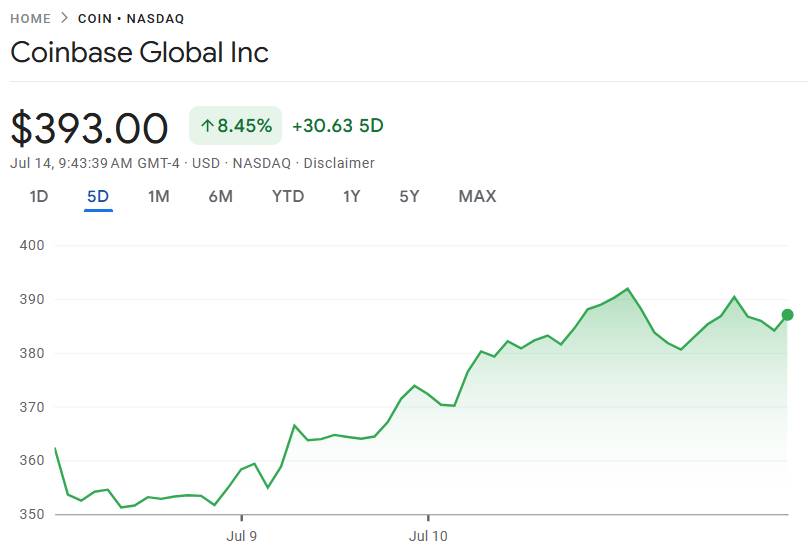
          Coinbase is another promising stock to watch in the third quarter of 2025. COIN has rallied in pre-market trading on July 14, 2025, according to Google Finance data.

          The stock is currently traded at $387.06, reflecting a 55% increase year-to-date. As of writing, COIN was trading at $393 atop 5-day rally of 8.45%.

          Coinbase Price Chart | Source: Google Finance

          The Coinbase stock debuted at $381 on the Nasdaq Global Select Market on April 14, 2021. Price dropped below $50 in 2022, but it bounced back in 2023, 2024, and 2025.

          The rally is supported by the growing popularity of Bitcoin Exchange-Traded Funds (ETFs) and the fourth Bitcoin halving.

          Analysts are optimistic about the future outlook of COIN. Popular market analyst Ali Martinez recently predicted a $2,000 target for COIN, citing a rare bullish pattern on the COIN chart.

          Moreover, COIN recently rose as high as $388.96, despite Ark Invest selling 16,627 units of its Coinbase stock.

          Separately, the Czech National Bank has recently announced the acquisition of $18 Million worth of Coinbase shares during the second quarter of 2025.

          Robinhood Markets Inc

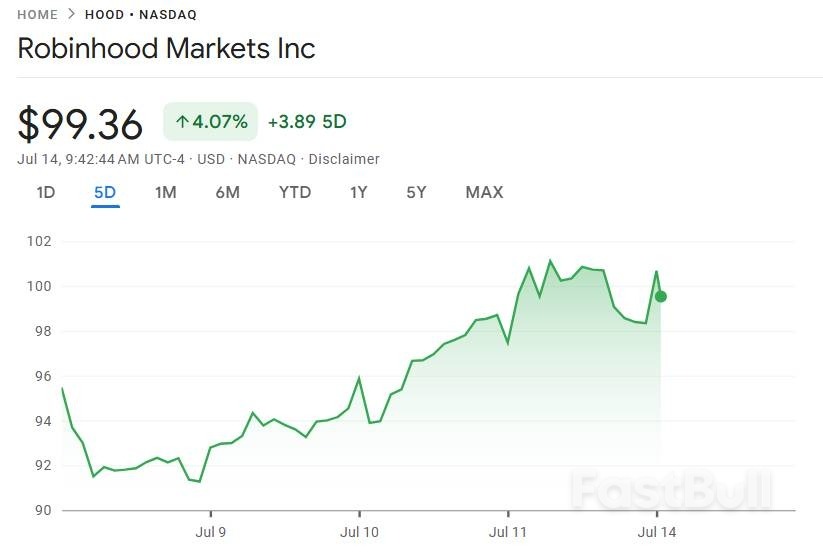
          Robinhood Markets, Inc. is the third crypto-related stock to consider in Q3 2025. HOOD opened at $98.34 on July 14, 2025, with a market capitalization of $86.78 Billion.

          As of writing, it was up 4.05% in the last 5 days to $99.36.

          Robinhood Price Chart | Source: Google Finance

          Robinhood Markets has a fifty-two-week low of $13.98 and a fifty-two-week high of $101.50. HOOD surged over 163% year-to-date and 310.7% within the past year.

          Analysts noted a strong rising trend, with some predicting a 117% rise in the next three months.

          In a research note on Tuesday, July 1, KeyCorp boosted its price objective on HOOD shares from $60 to $110. The bank-based financial services company gave the HOOD stock an “overweight” rating.

          In its last quarterly earnings released on April 30, Robinhood reported $0.37 earnings per share (EPS) for the quarter. This figure comes short of analysts’ consensus estimates of $0.41.

          However, the firm reported revenue of $927.00 Million for the quarter, higher than the consensus estimate of $917.12 Million.

          Beyond Crypto Stocks: Is an Altcoin Season in View in Q3?

          Historically, the altcoin season follows Bitcoin’s strong rallies and subsequent consolidation.According to CoinMarketCap data, Bitcoin has hit a new all-time high of $123,000, driven by positive market sentiments.

          This rally creates an opportunity for prices to consolidate, giving room for altcoins to shine.Ethereum often leads altcoin rallies, as its performance against Bitcoin signals broader altcoin market strength.

          In the past 24 hours, ETH has surged over 2.7% to $3,046. Blockchains like Solana and Avalanche have also benefited from the recent BTC rally.

          Additionally, altcoins like Aave and Toncoin are seeing renewed interest due to their scalability and DeFi innovations.

          Source: CryptoSlate

          To stay updated on all economic events of today, please check out our Economic calendar
          Risk Warnings and Disclaimers
          You understand and acknowledge that there is a high degree of risk involved in trading. Following any strategies or investment methods may lead to potential losses. The content on the site is provided by our contributors and analysts for information purposes only. You are solely responsible for determining whether any trading assets, securities, strategy, or any other product is suitable for investing based on your own investment objectives and financial situation.
          Add to Favorites
          Share

          China's Q2 GDP Beats Forecasts at 5.2%, but Headwinds Intensify Amid Tariff Threats and Property Slump

          Gerik

          Economic

          Economic Resilience, But Momentum Slips

          China’s second-quarter GDP growth of 5.2% year-on-year came in above the consensus estimate of 5.1%, though it marked a deceleration from 5.4% in Q1. On a quarterly basis, the economy grew 1.1%, beating the 0.9% forecast. The data point to modest resilience in the face of renewed external pressure from U.S. President Donald Trump’s escalating tariff threats and lingering domestic structural challenges.
          June’s industrial production growth, at 6.8%, far exceeded expectations, highlighting the strength of China’s manufacturing engine. However, this was offset by softening consumer activity, with retail sales up only 4.8% below the 5.4% forecast and significantly lower than May’s 6.4%. This divergence illustrates a widening imbalance between supply-side stability and weak domestic demand.
          Fixed-asset investment in the first half of the year grew just 2.8%, compared to the forecast of 3.6%, reflecting investor caution amid economic uncertainty. Meanwhile, property investment plunged 11.2%, extending its drag on the broader economy.

          Tariffs, Trade, and Waning Consumer Confidence

          President Trump’s announcement of a 30% tariff on EU and Mexican imports, alongside the threat of 100% secondary tariffs on countries purchasing Russian exports, has reignited concerns about global trade fragmentation. For China, the looming August 1 tariff deadline risks disrupting already fragile export-driven sectors.
          While June exports did climb to a record high suggesting a short-term boost from exporters front-loading shipments analysts warn this may be temporary. Dan Wang of Eurasia Group notes that small and medium-sized exporters are already facing bankruptcy risks, while consumers and businesses alike have grown more risk-averse.
          The yuan’s muted response to the data reflects Beijing’s ongoing strategy to maintain currency stability in the face of external shocks. However, policymakers are walking a tightrope: with fiscal and monetary levers already in use, their room to maneuver is narrowing.

          Policy Support May Need to Deepen

          Despite the upbeat GDP headline, China’s recovery lacks depth. The industrial sector particularly capital-intensive and automated remains a bright spot but contributes little to job creation or wage growth. Meanwhile, the disappointing performance of consumption and investment raises alarms about structural fragility.
          Beijing has responded with targeted measures: infrastructure spending, consumer subsidies, monetary easing, and housing-related support. Yet deflationary pressures continue to weigh, as shown by the steep fall in producer prices. Without more aggressive fiscal stimulus and demand-side reforms, analysts doubt whether the 2025 growth target of "around 5%" can be met.
          According to Reuters’ polling, China’s full-year GDP growth is now expected to slow to 4.6%, down from 5.0% in 2024, and could ease further to 4.2% in 2026 as trade tensions and domestic constraints persist.

          A Strong Quarter Masks Growing Risks

          China’s better-than-expected Q2 GDP figure may offer temporary relief to policymakers, but the underlying economic signals suggest growing stress beneath the surface. With retail consumption softening, property investment plunging, and external trade threats mounting, Q3 may prove significantly more challenging.
          Unless Beijing can effectively counteract these headwinds with deeper structural reforms and targeted fiscal policies, the path to sustained recovery and meeting its growth target remains precarious.

          Source: Reuters

          To stay updated on all economic events of today, please check out our Economic calendar
          Risk Warnings and Disclaimers
          You understand and acknowledge that there is a high degree of risk involved in trading. Following any strategies or investment methods may lead to potential losses. The content on the site is provided by our contributors and analysts for information purposes only. You are solely responsible for determining whether any trading assets, securities, strategy, or any other product is suitable for investing based on your own investment objectives and financial situation.
          Add to Favorites
          Share

          China’s Property Slump Deepens: June New Home Prices Fall at Sharpest Monthly Rate Since October

          Gerik

          Economic

          Home Prices Slide Further as Policy Support Falls Short

          China's real estate market continues to struggle despite a flurry of stimulus efforts, with new home prices in June dropping 0.3% from the previous month. This is the fastest decline since October 2024 and follows a 0.2% monthly drop in May, according to Reuters calculations based on data from the National Bureau of Statistics.
          On a year-over-year basis, the fall in prices moderated slightly to 3.2% in June, compared to a 3.5% annual decline in May. However, the persistent downward trend underscores the structural fragility of a sector that once accounted for roughly 25% of China's GDP.
          The prolonged correction, which began with the 2021 debt crisis engulfing developers like Evergrande and Country Garden, continues to weigh on consumer confidence, housing investment, and related supply chains. Even as the broader economy faces deflationary pressures and softening external demand, the real estate sector remains a core drag on the government's goal of achieving "around 5%" GDP growth in 2025.

          Policy Measures Yet to Revive Demand

          Beijing has rolled out several policy tools to stabilize the housing market, including:
          Allowing indebted developers to liquidate inventories and land to local governments
          Promoting urban village redevelopment to absorb excess supply
          Lowering mortgage rates and easing down-payment requirements
          Relaxing homebuying restrictions and tapping housing provident funds in many cities
          Despite these actions, consumer sentiment remains weak, especially among middle-class buyers who are skeptical about the long-term value of real estate as an investment. Developers remain constrained by liquidity issues, and local governments already fiscally stressed are cautious about aggressively purchasing assets.
          The State Council, in a meeting on June 13, pledged to improve policy targeting through a nationwide survey of land under development and unfinished housing projects. However, tangible outcomes from this initiative may take months to materialize.

          Broader Economic and Political Context Adds Pressure

          The housing downturn is not occurring in isolation. It is compounded by broader macroeconomic headwinds including weak domestic consumption, faltering private investment, and geopolitical uncertainty, especially amid rising trade tensions with the United States.
          This confluence of factors raises doubts about whether China can rely on housing-led stimulus to revive growth an approach that worked in the past but now appears structurally unsustainable. Analysts warn that without deeper reforms to stimulate income growth, boost labor mobility, and diversify investment channels, the housing market’s malaise may persist well into 2026.

          A Shifting Policy Dilemma

          China's June data paints a sobering picture for policymakers attempting to engineer a soft landing for the property sector. The 0.3% monthly price decline, while modest in absolute terms, reflects an entrenched confidence problem and diminishing returns from traditional stimulus tools.
          Unless Beijing can pivot toward more targeted, demand-side reforms such as household subsidies, rental housing schemes, or broader financial market liberalization the property sector may continue to underperform and act as a structural drag on China’s economic ambitions.

          Source: Reuters

          To stay updated on all economic events of today, please check out our Economic calendar
          Risk Warnings and Disclaimers
          You understand and acknowledge that there is a high degree of risk involved in trading. Following any strategies or investment methods may lead to potential losses. The content on the site is provided by our contributors and analysts for information purposes only. You are solely responsible for determining whether any trading assets, securities, strategy, or any other product is suitable for investing based on your own investment objectives and financial situation.
          Add to Favorites
          Share

          Markets Steady Amid Tariff Tensions as Asia Rises and Dollar Firms Ahead of US Earnings

          Gerik

          Economic

          Stocks

          Asia Climbs, but Caution Persists Amid Global Trade Volatility

          Asian equity markets started Tuesday on a cautiously positive note, with the MSCI Asia-Pacific Index outside Japan up 0.4% and Japan’s Nikkei edging 0.2% higher. This regional strength comes amid a backdrop of looming trade disruptions, a high-stakes U.S. earnings season, and elevated inflation uncertainty.
          The primary market concern stems from President Donald Trump’s recent announcement of 30% tariffs on European Union and Mexican imports, with implementation set for August 1. While the tone softened slightly this week as Trump signaled openness to further negotiations, the threat remains. Japan is scrambling to schedule high-level meetings with the U.S. ahead of the deadline, with Prime Minister Shigeru Ishiba expected to meet U.S. Treasury Secretary Scott Bessent this Friday in Tokyo.
          However, investors appear cautiously optimistic. Market strategist Rodrigo Catril from National Australia Bank noted that the muted reaction likely reflects a sense of “complacency or uncertainty over how far the tariff plans will actually go.”

          Yields Spike in Japan Ahead of Elections and Trade Talks

          Japan’s government bond market saw significant movement as political pressure mounts ahead of Sunday’s upper house election. The 10-year Japanese government bond yield soared to 1.595%, the highest since 2008, while the 30-year yield hit an unprecedented 3.195%. These moves reflect not only the trade risks but also fiscal uncertainty should the ruling coalition lose control to opposition parties advocating for aggressive spending.
          The U.S. dollar held firm against key currencies, trading at 147.71 yen and flat at $1.1672 against the euro. This strength comes ahead of pivotal inflation data and the kickoff of the second-quarter U.S. earnings season. Analysts expect S&P 500 profits to rise just 5.8% year-over-year a notable downgrade from the 10.2% forecast in April, prior to the escalation of Trump’s trade offensive.
          Energy markets remain under pressure. U.S. crude oil dropped another 0.3% to $66.80 per barrel as traders assessed the impact of Trump’s 50-day ultimatum to Russia and the potential ripple effects of energy sanctions. While the U.S. refrained from announcing immediate measures against Russian oil, the implied threat of secondary sanctions on its buyers especially China, India, and Turkey continues to weigh on sentiment.
          Precious metals were relatively stable, with gold inching up 0.1% to $3,348.35/oz and silver maintaining momentum at $38.15/oz, near its highest since 2011.

          Equity Futures Mixed as Earnings Season Takes the Stage

          Global futures offered mixed signals. Euro Stoxx 50, German DAX, and FTSE futures all ticked up by 0.1–0.2%, reflecting guarded optimism in European markets despite Brussels warning of potential countermeasures against U.S. tariffs. In contrast, S&P 500 e-mini futures slipped 0.1% in early trading, with investors eagerly awaiting results from major U.S. banks that could shape sentiment for the rest of the quarter.
          Investors are entering a pivotal stretch with macroeconomic, political, and earnings-related events converging. While markets in Asia and Europe showed resilience, the true test lies ahead especially with inflation data and corporate forward guidance poised to either confirm stability or highlight emerging cracks. Tariff headlines may dominate, but earnings commentary on margins and demand could determine whether current market calm holds or breaks in the coming weeks.

          Source: Reuters

          To stay updated on all economic events of today, please check out our Economic calendar
          Risk Warnings and Disclaimers
          You understand and acknowledge that there is a high degree of risk involved in trading. Following any strategies or investment methods may lead to potential losses. The content on the site is provided by our contributors and analysts for information purposes only. You are solely responsible for determining whether any trading assets, securities, strategy, or any other product is suitable for investing based on your own investment objectives and financial situation.
          Add to Favorites
          Share
          FastBull
          Copyright © 2025 FastBull Ltd

          728 RM B 7/F GEE LOK IND BLDG NO 34 HUNG TO RD KWUN TONG KLN HONG KONG

          TelegramInstagramTwitterfacebooklinkedin
          App Store Google Play Google Play
          Products
          Charts

          Chats

          Q&A with Experts
          Screeners
          Economic Calendar
          Data
          Tools
          Membership
          Features
          Function
          Markets
          Copy Trading
          Latest Signals
          Contests
          News
          Analysis
          24/7
          Columns
          Education
          Company
          Careers
          About Us
          Contact Us
          Advertising
          Help Center
          Feedback
          User Agreement
          Privacy Policy
          Business

          White Label

          Data API

          Web Plug-ins

          Poster Maker

          Affiliate Program

          Risk Disclosure

          The risk of loss in trading financial instruments such as stocks, FX, commodities, futures, bonds, ETFs and crypto can be substantial. You may sustain a total loss of the funds that you deposit with your broker. Therefore, you should carefully consider whether such trading is suitable for you in light of your circumstances and financial resources.

          No decision to invest should be made without thoroughly conducting due diligence by yourself or consulting with your financial advisors. Our web content might not suit you since we don't know your financial conditions and investment needs. Our financial information might have latency or contain inaccuracy, so you should be fully responsible for any of your trading and investment decisions. The company will not be responsible for your capital loss.

          Without getting permission from the website, you are not allowed to copy the website's graphics, texts, or trademarks. Intellectual property rights in the content or data incorporated into this website belong to its providers and exchange merchants.

          Not Logged In

          Log in to access more features

          FastBull Membership

          Not yet

          Purchase

          Become a signal provider
          Help Center
          Customer Service
          Dark Mode
          Price Up/Down Colors

          Log In

          Sign Up

          Position
          Layout
          Fullscreen
          Default to Chart
          The chart page opens by default when you visit fastbull.com