• Trade
  • Markets
  • Copy
  • Contests
  • News
  • 24/7
  • Calendar
  • Q&A
  • Chats
Trending
Screeners
SYMBOL
LAST
BID
ASK
HIGH
LOW
NET CHG.
%CHG.
SPREAD
SPX
S&P 500 Index
6857.13
6857.13
6857.13
6865.94
6827.13
+7.41
+ 0.11%
--
DJI
Dow Jones Industrial Average
47850.93
47850.93
47850.93
48049.72
47692.96
-31.96
-0.07%
--
IXIC
NASDAQ Composite Index
23505.13
23505.13
23505.13
23528.53
23372.33
+51.04
+ 0.22%
--
USDX
US Dollar Index
98.920
99.000
98.920
98.980
98.740
-0.060
-0.06%
--
EURUSD
Euro / US Dollar
1.16511
1.16518
1.16511
1.16715
1.16408
+0.00066
+ 0.06%
--
GBPUSD
Pound Sterling / US Dollar
1.33386
1.33397
1.33386
1.33622
1.33165
+0.00115
+ 0.09%
--
XAUUSD
Gold / US Dollar
4226.44
4226.87
4226.44
4230.62
4194.54
+19.27
+ 0.46%
--
WTI
Light Sweet Crude Oil
59.278
59.308
59.278
59.543
59.187
-0.105
-0.18%
--

Community Accounts

Signal Accounts
--
Profit Accounts
--
Loss Accounts
--
View More

Become a signal provider

Sell trading signals to earn additional income

View More

Guide to Copy Trading

Get started with ease and confidence

View More

Signal Accounts for Members

All Signal Accounts

Best Return
  • Best Return
  • Best P/L
  • Best MDD
Past 1W
  • Past 1W
  • Past 1M
  • Past 1Y

All Contests

  • All
  • Trump Updates
  • Recommend
  • Stocks
  • Cryptocurrencies
  • Central Banks
  • Featured News
Top News Only
Share

Shell : BofA Global Research Cuts To Neutral From Buy, Cuts Price Objective To 3100P From 3200P

Share

Russia Plans To Supply 5-5.5 Million Tons Of Fertilizers To India In 2025

Share

Euro Zone Q3 Employment Revised To 0.6% Year-On-Year

Share

Rheinmetall Ag : BofA Global Research Cuts Price Objective To EUR 2215 From EUR 2540

Share

China's Commerce Minister: Will Eliminate Restrictive Measures

Share

Russia - India Statement Says Defence Partnership Is Responding To India's Aspirations For Self-Reliance

Share

Russia - India Statement Says Defence Ties Being Reoriented Towards Joint R&D And Production Of Advanced Defence Platforms

Share

Russia And India Express Interest In Deepening Cooperation In Exploration, Processing And Refining Technologies For Critical Minerals And Rare Earth Elements

Share

Eurostat - Euro Zone Q3 Employment +0.6% Year-On-Year (Reuters Poll +0.5%)

Share

Eurostat - Euro Zone Q3 Employment +0.2% Quarter-On-Quarter (Reuters Poll +0.1%)

Share

Indian Rupee At 89.98 Per USA Dollar As Of 3:30 P.M. Ist, Nearly Unchanged Form 89.9750 Previous Close

Share

Russian President Putin: Modi Statement Says Russia-India Ties Are 'Resilient To External Pressure'

Share

Stats Office - Mauritius Inflation Rate At 4.0% Year-On-Year In November

Share

Kremlin - Russia, India Sign Comprehensive Joint Statement

Share

Swiss Government: Exemption Is Appropriate Given That Reinsurance Business Is Conducted Between Insurance Companies, Protection Of Clients Not Affected

Share

Morgan Stanley Expects Fed To Cut Rates By 25 Bps Each In January And April 2026 Taking Terminal Target Range To 3.0%-3.25%

Share

Azerbaijan's Socar Says Socar And Ucc Holding Sign Memorandum Of Understanding On Fuel Supply To Damascus International Airport

Share

Fca: Measures Include Review Of Credit Union Regulations & Launch Of Mutual Societies Development Unit By Fca

Share

Morgan Stanley Expects US Fed To Cut Interest Rates By 25 Bps In December 2025 Versus Prior Forecast Of No Rate Cut

Share

Russian Defence Ministry Says Russian Forces Capture Bezimenne In Ukraine's Donetsk Region

TIME
ACT
FCST
PREV
U.S. Challenger Job Cuts MoM (Nov)

A:--

F: --

P: --

U.S. Initial Jobless Claims 4-Week Avg. (SA)

A:--

F: --

P: --

U.S. Weekly Initial Jobless Claims (SA)

A:--

F: --

P: --

U.S. Weekly Continued Jobless Claims (SA)

A:--

F: --

P: --

Canada Ivey PMI (SA) (Nov)

A:--

F: --

P: --

Canada Ivey PMI (Not SA) (Nov)

A:--

F: --

P: --

U.S. Non-Defense Capital Durable Goods Orders Revised MoM (Excl. Aircraft) (SA) (Sept)

A:--

F: --

P: --
U.S. Factory Orders MoM (Excl. Transport) (Sept)

A:--

F: --

P: --

U.S. Factory Orders MoM (Sept)

A:--

F: --

P: --

U.S. Factory Orders MoM (Excl. Defense) (Sept)

A:--

F: --

P: --

U.S. EIA Weekly Natural Gas Stocks Change

A:--

F: --

P: --

Saudi Arabia Crude Oil Production

A:--

F: --

P: --

U.S. Weekly Treasuries Held by Foreign Central Banks

A:--

F: --

P: --

Japan Foreign Exchange Reserves (Nov)

A:--

F: --

P: --

India Repo Rate

A:--

F: --

P: --

India Benchmark Interest Rate

A:--

F: --

P: --

India Reverse Repo Rate

A:--

F: --

P: --

India Cash Reserve Ratio

A:--

F: --

P: --

Japan Leading Indicators Prelim (Oct)

A:--

F: --

P: --

U.K. Halifax House Price Index YoY (SA) (Nov)

A:--

F: --

P: --

U.K. Halifax House Price Index MoM (SA) (Nov)

A:--

F: --

P: --

France Current Account (Not SA) (Oct)

A:--

F: --

P: --

France Trade Balance (SA) (Oct)

A:--

F: --

P: --

France Industrial Output MoM (SA) (Oct)

A:--

F: --

P: --

Italy Retail Sales MoM (SA) (Oct)

A:--

F: --

P: --

Euro Zone Employment YoY (SA) (Q3)

A:--

F: --

P: --

Euro Zone GDP Final YoY (Q3)

A:--

F: --

P: --

Euro Zone GDP Final QoQ (Q3)

A:--

F: --

P: --

Euro Zone Employment Final QoQ (SA) (Q3)

A:--

F: --

P: --

Euro Zone Employment Final (SA) (Q3)

A:--

F: --

P: --
Brazil PPI MoM (Oct)

--

F: --

P: --

Mexico Consumer Confidence Index (Nov)

--

F: --

P: --

Canada Unemployment Rate (SA) (Nov)

--

F: --

P: --

Canada Labor Force Participation Rate (SA) (Nov)

--

F: --

P: --

Canada Employment (SA) (Nov)

--

F: --

P: --

Canada Part-Time Employment (SA) (Nov)

--

F: --

P: --

Canada Full-time Employment (SA) (Nov)

--

F: --

P: --

U.S. Personal Income MoM (Sept)

--

F: --

P: --

U.S. Dallas Fed PCE Price Index YoY (Sept)

--

F: --

P: --

U.S. PCE Price Index YoY (SA) (Sept)

--

F: --

P: --

U.S. PCE Price Index MoM (Sept)

--

F: --

P: --

U.S. Personal Outlays MoM (SA) (Sept)

--

F: --

P: --

U.S. Core PCE Price Index MoM (Sept)

--

F: --

P: --

U.S. UMich 5-Year-Ahead Inflation Expectations Prelim YoY (Dec)

--

F: --

P: --

U.S. Core PCE Price Index YoY (Sept)

--

F: --

P: --

U.S. Real Personal Consumption Expenditures MoM (Sept)

--

F: --

P: --

U.S. 5-10 Year-Ahead Inflation Expectations (Dec)

--

F: --

P: --

U.S. UMich Current Economic Conditions Index Prelim (Dec)

--

F: --

P: --

U.S. UMich Consumer Sentiment Index Prelim (Dec)

--

F: --

P: --

U.S. UMich 1-Year-Ahead Inflation Expectations Prelim (Dec)

--

F: --

P: --

U.S. UMich Consumer Expectations Index Prelim (Dec)

--

F: --

P: --

U.S. Weekly Total Rig Count

--

F: --

P: --

U.S. Weekly Total Oil Rig Count

--

F: --

P: --

U.S. Consumer Credit (SA) (Oct)

--

F: --

P: --

China, Mainland Foreign Exchange Reserves (Nov)

--

F: --

P: --

China, Mainland Exports YoY (USD) (Nov)

--

F: --

P: --

Q&A with Experts
    • All
    • Chatrooms
    • Groups
    • Friends
    Connecting
    .
    .
    .
    Type here...
    Add Symbol or Code

      No matching data

      All
      Trump Updates
      Recommend
      Stocks
      Cryptocurrencies
      Central Banks
      Featured News
      • All
      • Russia-Ukraine Conflict
      • Middle East Flashpoint
      • All
      • Russia-Ukraine Conflict
      • Middle East Flashpoint
      Search
      Products

      Charts Free Forever

      Chats Q&A with Experts
      Screeners Economic Calendar Data Tools
      Membership Features
      Data Warehouse Market Trends Institutional Data Policy Rates Macro

      Market Trends

      Market Sentiment Order Book Forex Correlations

      Top Indicators

      Charts Free Forever
      Markets

      News

      News Analysis 24/7 Columns Education
      From Institutions From Analysts
      Topics Columnists

      Latest Views

      Latest Views

      Trending Topics

      Top Columnists

      Latest Update

      Signals

      Copy Rankings Latest Signals Become a signal provider AI Rating
      Contests
      Brokers

      Overview Brokers Assessment Rankings Regulators News Claims
      Broker listing Forex Brokers Comparison Tool Live Spread Comparison Scam
      Q&A Complaint Scam Alert Videos Tips to Detect Scam
      More

      Business
      Events
      Careers About Us Advertising Help Center

      White Label

      Data API

      Web Plug-ins

      Affiliate Program

      Awards Institution Evaluation IB Seminar Salon Event Exhibition
      Vietnam Thailand Singapore Dubai
      Fans Party Investment Sharing Session
      FastBull Summit BrokersView Expo
      Recent Searches
        Top Searches
          Markets
          News
          Analysis
          User
          24/7
          Economic Calendar
          Education
          Data
          • Names
          • Latest
          • Prev

          View All

          No data

          Scan to Download

          Faster Charts, Chat Faster!

          Download App
          English
          • English
          • Español
          • العربية
          • Bahasa Indonesia
          • Bahasa Melayu
          • Tiếng Việt
          • ภาษาไทย
          • Français
          • Italiano
          • Türkçe
          • Русский язык
          • 简中
          • 繁中
          Open Account
          Search
          Products
          Charts Free Forever
          Markets
          News
          Signals

          Copy Rankings Latest Signals Become a signal provider AI Rating
          Contests
          Brokers

          Overview Brokers Assessment Rankings Regulators News Claims
          Broker listing Forex Brokers Comparison Tool Live Spread Comparison Scam
          Q&A Complaint Scam Alert Videos Tips to Detect Scam
          More

          Business
          Events
          Careers About Us Advertising Help Center

          White Label

          Data API

          Web Plug-ins

          Affiliate Program

          Awards Institution Evaluation IB Seminar Salon Event Exhibition
          Vietnam Thailand Singapore Dubai
          Fans Party Investment Sharing Session
          FastBull Summit BrokersView Expo

          Japan September Exports Rebound, Missing Estimates, After Four Months Of Declines

          Isaac Bennett
          Summary:

          Japanese exports in September snapped four months of declines, climbing 4.2% year on year, as shipments to Asia saw robust growth, partially offsetting the drop in exports to the U.S.

          Japanese exports in September snapped four months of declines, climbing 4.2% year on year, as shipments to Asia saw robust growth, partially offsetting the drop in exports to the U.S.

          Exports, however, missed expectations of a 4.6% rise, according to median estimates in a Reuters poll of economists.

          The world's fourth-largest economy saw imports increase 3.3% year on year, reversing course from the 5.2% decline in August and beating the 0.6% growth expected by the Reuters poll.

          Japan's exports had fallen into negative territory as the country grappled with U.S. tariffs with its shipments of automobiles to the world's largest economy taking a huge hit. Tokyo in July clinched a trade deal with Washington, bringing down tariffs on its exports to the U.S. to 15% from the 25% initially proposed by President Donald Trump.

          The data comes a day after the country got its first female prime minister in Sanae Takaichi, after months of political turmoil following electoral losses of the ruling Liberal Democratic Party under former Prime Minister Shigeru Ishiba.

          Takaichi's stance of a loose momentary policy and massive fiscal stimulus is likely to weaken the yen, making Japan's exports more competitive and benefiting exporters — heavyweights on the benchmark Nikkei 225 that hit a record high on Tuesday.

          Markets have priced in the so-called "Takaichi trade" since she took the helm of the LDP in September, which has seen the Nikkei rise to record highs and the yen weakening past the 150 mark.

          However, the country's economy has seemed to hold up better than expected, with second quarter GDP being revised upward in September compared to advance estimates.

          Source: CNBC

          Risk Warnings and Disclaimers
          You understand and acknowledge that there is a high degree of risk involved in trading. Following any strategies or investment methods may lead to potential losses. The content on the site is provided by our contributors and analysts for information purposes only. You are solely responsible for determining whether any trading assets, securities, strategy, or any other product is suitable for investing based on your own investment objectives and financial situation.
          Add to Favorites
          Share

          Trump Says He Spoke To Modi, India Will Ease Russian Oil Buys

          James Whitman

          Political

          President Donald Trump said he spoke to Indian Prime Minister Narendra Modi earlier Tuesday and reiterated claims that New Delhi would ease its purchases of Russian energy.

          “I just spoke to your prime minister today. We had a great conversation. We talked about trade,” Trump said as he hosted a Diwali celebration in the Oval Office of the White House. “We talked about a lot of things, but mostly the world of trade — he’s very interested in that.”

          Trump hit India with 50% tariffs on its exports to the US in part to pressure New Delhi to stop buying Russian oil, purchases which are seen as buoying the Kremlin’s economy and its war effort in Ukraine. In recent weeks, however, Trump has softened his rhetoric as the two nations carry out talks to clinch a trade deal and lower tariffs and suggested that Modi was on board with reducing those energy buys

          “He’s not going to buy much oil from Russia. He wants to see that war end as much as I do. He wants to see the war end with Russia, Ukraine, and as you know, they’re not going to be buying too much oil,” Trump said Tuesday.

          The US president last week also said that India had agreed to stop buying oil from Russia, saying he had received assurances from Modi in a phone call. India’s foreign ministry, however, had said they were not aware of that conversation. Any effort to scale back Russian energy buys would be a gradual process and Modi’s government has previously indicated that the country would continue to make those purchases if it is economically viable.

          India became a major importer of Russian crude after the start of the war in Ukraine in 2022, buying oil at a discount. Russian oil makes up about one-third of India’s overall imports in spite of the US push to curb flows.

          Trump and Modi have also been at odds over the US president’s claims that he used trade as leverage to broker a ceasefire between India and Pakistan in May. While Pakistan has embraced that assertion — and nominated Trump for a Nobel Peace Prize — Modi and Indian officials have bristled at the notion that the US pressured them into a ceasefire.

          Trump on Tuesday reiterated those claims, saying that he and Modi spoke “a little while ago about — let’s have no wars with Pakistan.”

          Source: Bloomberg

          Risk Warnings and Disclaimers
          You understand and acknowledge that there is a high degree of risk involved in trading. Following any strategies or investment methods may lead to potential losses. The content on the site is provided by our contributors and analysts for information purposes only. You are solely responsible for determining whether any trading assets, securities, strategy, or any other product is suitable for investing based on your own investment objectives and financial situation.
          Add to Favorites
          Share

          Trump Administration To Resume Farmer Aid Halted By Shutdown

          James Whitman

          Economic

          Agriculture Secretary Brooke Rollins said President Donald Trump’s administration will resume distributing $3 billion in aid from the Farm Service Agency that had been halted as a result of the three-week-long government shutdown.

          “President Trump will not let the radical left Democrat shutdown impact critical USDA services while harvest is underway across the country,” Rollins said in a social media post Tuesday. “Thursday, USDA will resume Farm Service Agency core operations, including critical services for farm loan processing.”

          Rollins also said that agriculture risk coverage and price loss coverage payments — financial guarantees for farmers to protect against fluctuations in crop prices — and other programs would resume operating.

          The move to resume some activities at USDA demonstrates the flexibility the White House has over which government functions continue running during a shutdown to achieve their political goals.

          Trump has sought to exact maximum pressure on Democrats during the impasse, halting funds for projects in states that voted for Kamala Harris in the 2024 election, while resuming farm aid and continuing to process economic data important for calculating the increase for elderly Americans’ Social Security benefits.

          The Agriculture secretary told Fox Business Tuesday that $3 billion would be distributed to farmers, adding that the administration would soon announce an additional aid plan to address “China compromising our soybean farmers’ access.”

          Trump allies have for weeks teased an aid program as a way to provide temporary assistance for farmers rattled by price fluctuations and a Chinese blockade of US soybeans until market conditions improve. Rollins signaled that a package won’t be announced as long as the government funding lapse, now in its 21st day, continues.

          Despite a temporary US-China trade truce, Beijing has turned to other exporters, including Brazil and Argentina for the crop. Trump has said the move is a negotiating tactic by China, the world’s largest importer of soybeans, to gain leverage in broader trade talks.

          Farming communities, which voted overwhelmingly for Trump in the 2024 election, have seen export markets for many crops dissipate and federal-safety net programs shrink during the president’s second term. The administration had said previously that it was working on providing assistance to farmers, with Trump floating the use of revenue from his tariffs on foreign imports to fund that plan.
          Source: Bloomberg

          To stay updated on all economic events of today, please check out our Economic calendar
          Risk Warnings and Disclaimers
          You understand and acknowledge that there is a high degree of risk involved in trading. Following any strategies or investment methods may lead to potential losses. The content on the site is provided by our contributors and analysts for information purposes only. You are solely responsible for determining whether any trading assets, securities, strategy, or any other product is suitable for investing based on your own investment objectives and financial situation.
          Add to Favorites
          Share

          Bitcoin now Pays Interest: How to Earn Money on Your BTC While Pumping the Price

          Manuel

          Cryptocurrency

          Bitcoin is now more than just something people trade or hold as a store of value; it’s starting to pay interest.
          But there’s a catch: the coins earning those rewards can’t move for months or years. A growing number of holders are locking their BTC into time-based contracts that promise yield but also freeze supply.
          However, on the plus side, this tightens the market’s breathing room and opens a pathway to future supply squeeze-enabled price pumps.
          Timelocked and staked Bitcoin are creating a duration structure in the UTXO set that affects free float, execution costs, and fee reflexes.
          The change is most visible in Babylon’s self-custodial model, which uses Bitcoin script timelocks to let holders stake without wrapping coins, and in the broader rise of locktime use on L1.
          Per Babylon, about 56,900 BTC are currently staked. According to Babylon’s staking script documentation, the design relies on CLTV and CSV primitives to enforce time, so the duration sits natively at the UTXO level rather than in a bridge or synthetic claim.

          The macro backdrop for supply tightness is already in place

          The long-term holder supply is near 14.4 million BTC, and the illiquid supply is near 14.3 million BTC. Those are behavioral cohorts, not hard locks. Yet, they frame how much additional duration from timelocks can influence the marginal coin available to meet new demand or to sell into drawdowns.
          An effective free-float proxy subtracts Babylon-staked coins and a discounted slice of other time-encumbered outputs from circulating supply to make that link concrete. The discount recognizes that some timelocks expire soon and some scripts permit partial spend paths.
          The result is a free-float that changes with live staking and locktime usage rather than with price alone.
          Governance and policy choices are shortening the operational window for stakers while raising the cost of protection. The unbonding delay for new stakes was cut from 1,008 to about 301 blocks, roughly 50 hours at target block time.
          The same change raised the preset fee on pre-signed slashing transactions to 150,000 sats, which, at a typical 355-vB transaction size, equates to about 422 sat per vB.
          That parameter aims to guarantee inclusion against censorship over a run of blocks and becomes a live stress dial when the fee tape heats up. In quiet conditions, preset slashing fees clear without delay, and staking UX is stable.
          When median fee levels sit in the 50 to 200 sat per vB range, the preset still clears, but child-pays-for-parent packages for non-slashing operations become more expensive.
          If median levels approach the slashing preset, slashing latency risk rises unless the governance minimum moves or policy changes improve the ability to relay and mine packages.
          According to Bitcoin Optech, version-3 transaction relay, also called TRUC, and package relay are advancing in the policy track and are designed to make ancestor and child packages safer and more predictable, which matters when many users need to free encumbered coins at once.

          Fee observations today do not fully reveal that structural pressure

          The market has printed median fees near 1 sat per vB, which points to slack blockspace. At the same time, mainnet.observer now breaks out height-based and time-based timelocks and displays fee-rate distributions, giving a way to track whether the share of encumbered UTXOs rises while typical fee buckets stay low.
          If the timelocked share grows, the marginal user who needs to move fast relies more on ancestor packages and CPFP mechanics, so peaks in fee pressure can become sharper even if baseline demand looks unchanged.
          This is a mechanical channel rather than a sentiment call, and it ties duration directly to the shape of fee spikes.
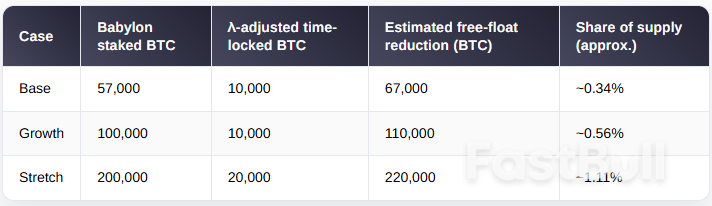
          The size of the duration effect can be sketched with simple ranges. Using a circulating supply near the 19.7 to 19.8 million BTC band, subtracting Babylon’s live staked count and a conservative slice of other time-encumbered outputs yields the following directional cases:Bitcoin now Pays Interest: How to Earn Money on Your BTC While Pumping the Price_1
          For each additional 50,000 BTC that moves into hard timelocks or into Babylon staking, free float falls by about 0.25 percent of supply.
          That is the part of the book that can be hit in a single session, so even modest changes in durational share can alter depth near the top of book.
          Illiquid and long-term holder cohorts are still useful for color, yet the free-float arithmetic above purposely counts only explicit script constraints and Babylon staking to avoid double-counting behavioral wallets that also happen to be locked by time.
          The settlement stack is adding new consumers of duration.
          Citrea positions a zk-rollup that settles on Bitcoin and sets its own finality window to favor predictable time horizons for collateral and settlement. Per the project’s blog, it is moving toward the mainnet.
          Stacks’ sBTC deposits are live, establishing a path for BTC-anchored collateral that interacts with L1 over time windows rather than instant redemptions. These designs lean on timelocks to manage peg safety and settlement guarantees, which means L1 duration demand can grow even if spot trading activity is flat.
          A steady risk-free rate near 4 percent on the U.S. 10-year, visible on standard rate dashboards and referenced in Citrea’s update, gives a financial context for why a native yield narrative can keep a bid under duration even when price volatility is low.
          Policy timing matters. Bitcoin Core v30 just launched with active debate on mempool defaults and relay rules.
          Bitcoin Core v30 shipped with package relay improvements and policy defaults, especially for OP_RETURN, which are now notably permissive unless an operator chooses to revert to stricter settings. This improves the system’s ability to move safety-critical packages during congestion, reducing the tail risk that slashing transactions face when the fee tape prints near the preset.
          If defaults had come in tighter, more of the load would have shifted to fee levels and governance parameters such as Babylon’s minimum slashing fee. Either way, the fee and staking policies are now coupled through the mempool.

          Two practical notes should anchor near-term monitoring

          First, Babylon’s unbonding change applies to new stakes, while older guides may still reference the prior 1,008-block delay, so data slices should be clear about cohort timing.
          Second, fee distribution snapshots from mainnet.observer, including the share of sub-1 sat per vB transactions, can be paired with Babylon’s live staked count to watch whether duration grows during quiet blocks.
          A sustained push in the staked total toward 100,000 BTC would warrant a refresh of the free-float scenarios, and a shift in fee buckets toward higher medians would put Babylon’s preset slashing fee back in view.
          The picture that emerges is a market where a measurable slice of coins now carries a maturity date set by script or by staking terms, and where peak fee behavior is shaped by how many of those coins need to move at once.
          The shape of that curve now rests on Babylon’s stake count, live fee regimes, and Bitcoin Core’s final policy decisions.

          Source: Cryptoslate

          Risk Warnings and Disclaimers
          You understand and acknowledge that there is a high degree of risk involved in trading. Following any strategies or investment methods may lead to potential losses. The content on the site is provided by our contributors and analysts for information purposes only. You are solely responsible for determining whether any trading assets, securities, strategy, or any other product is suitable for investing based on your own investment objectives and financial situation.
          Add to Favorites
          Share

          US Ranchers Oppose Trump's Plan to Import More Argentine Beef and Experts Doubt it Will Lower Prices

          Manuel

          Commodity

          Economic

          President Donald Trump ’s plan to cut record beef prices by importing more meat from Argentina is running into heated opposition from U.S. ranchers who are enjoying some rare profitable years and skepticism from experts who say the president’s move probably wouldn’t lead to cheaper prices at grocery stores.
          The National Cattlemen's Beef Association along with the Ranchers-Cattlemen Action Legal Fund United Stockgrowers of America and other farming groups — who are normally some of the president's biggest supporters — all criticized Trump's idea because of what it could do to American ranchers and feedlot operators. And agricultural economists say Argentine beef accounts for such a small slice of beef imports — only about 2% — that even doubling that wouldn't change prices much.
          South Dakota rancher Brett Kenzy said he wants American consumers to determine whether beef is too expensive, not the government. And so far there is little sign that consumers are substituting chicken or other proteins for beef on their shopping lists even though the average price of a pound of ground beef hit its highest point ever at $6.32 in the latest report before the government shutdown began.
          “I love ‘Make America Great Again’ rhetoric. I love ‘America First’ rhetoric,” he said. “But to me this feels a lot like the failed policies of the past — the free trade sourcing cheap global goods.”
          Several factors have sent beef prices soaring, starting with continued strong demand combined with the smallest U.S. herd size since 1961. In part, that small herd is due to years of drought and low cattle prices.
          Beef imports also are down overall because of the 50% tariffs that Trump imposed on Brazil, a big beef exporter, and limits on Mexico, where the country is fighting a flesh-eating pest.
          Kansas State University agricultural economist Glynn Tonsor said Argentina can't produce enough beef to offset those other losses of imports.
          Through July, the United States has imported 72.5 million pounds of Argentine beef while producing more than 15 billion pounds of beef. Much of what is imported is lean beef trimmings that meatpackers mix with fattier beef produced in the United States to produce the varieties of ground beef that domestic consumers want, so any change in imports would affect primarily hamburger. Steak prices that were averaging $12.22 per pound probably wouldn't change much.

          Idea creates uncertainty among US ranchers

          Even if increased imports from Argentina won't reduce prices, the idea creates uncertainty for ranchers, making them less likely to invest in raising more cattle.
          “We’re always going to have uncertainty in the world. But the more uncertain something is, the less likely most are to put money on the line,” Tonsor said.
          Argentine livestock producers like Augusto Wallace are excited about the prospect of selling more beef to America because he said “whenever an additional buyer comes, it's beneficial for everyone, right? For all the producers.”
          But economists caution that exporting too much beef could backfire for Argentina because that would drive up prices for consumers there.
          American ranchers say the idea of boosting imports from Argentina runs counter to the stated purpose of Trump's tariffs to encourage more domestic production and help American ranchers compete.
          “It’s a contradiction of what we believed his new course of action was. We thought he was on the right track," said the president of R-CALF, Bill Bullard, who hoped Trump's policies would discourage imports and encourage ranchers to expand their herds.
          Texas A&M livestock economist David Anderson said “ranchers are finally getting prices that are going to make up for some really bad years in the past with the drought, low prices and high costs. We finally get some good prices. And we start talking about government policy to bring down prices.”
          Bryant Kagay, part owner of Kagay Farms in Amity, Missouri, said he thinks the plan would hurt ranchers. Cattle prices that had been averaging around $3,000 for a 1,250-pound animal slipped more than $100 immediately after Trump mentioned the idea of intervening in beef prices last week, though they have recovered a bit since then.

          Ranchers hope Trump changes his mind

          Although Kagay voted for Trump in the last election, he worries the trade war is hurting farmers and ranchers by driving up costs and costing them major markets like China.
          “I continue to see things that I don’t really think are in the best interest of our country and the average citizen,” Kagay said. “I guess I hope he starts to see that and quits worrying about punishing opponents and winning whatever battle he’s involved in, and then tries to do what’s best for everybody.”
          Ranchers are hopeful Trump will reconsider this plan. Agriculture Secretary Brooke Rollins said Tuesday on CNBC that the administration remains committed to helping ranchers prosper while trying to reduce consumer prices. She promised more details soon about the Argentina plan and a larger effort to reinvigorate U.S. beef production by opening up more land and opening new processing plants while securing trade deals for new markets. The administration wants ranchers to raise more cattle and produce more beef.
          “The bigger supply — even aligned with a bigger demand — is going to allow those prices to come down, but also to have a vital industry for these ranchers to be able to survive, which is what we've got to do,” Rollins said.
          Sen. John Hoeven, a North Dakota Republican, said Tuesday that after talking to Trump and others in the administration, he expected to see more details about the policy.
          “It’s very important that we support our cattle ranchers,” Hoeven said.
          Rancher Cory Eich, who lives near Epiphany, South Dakota, said he doesn’t consider the Argentina idea a serious threat in the long term and doubts ranchers will make changes to their operation in light of the news.
          “Nobody’s happy about it, let’s put it that way,” Eich said. “Personal opinion, I thought it was kind of a ruse when he mentioned it. I mean, it’s coming from Trump, so take everything there with a grain of salt.”

          Source: AP

          To stay updated on all economic events of today, please check out our Economic calendar
          Risk Warnings and Disclaimers
          You understand and acknowledge that there is a high degree of risk involved in trading. Following any strategies or investment methods may lead to potential losses. The content on the site is provided by our contributors and analysts for information purposes only. You are solely responsible for determining whether any trading assets, securities, strategy, or any other product is suitable for investing based on your own investment objectives and financial situation.
          Add to Favorites
          Share

          US Bitcoin Payments are Getting Real: Retail Rails Could Push $2M a Day On-Chain

          Manuel

          Cryptocurrency

          Crypto retail checkouts now have two levers that can move quickly, merchant rails that reduce processing cost, and consumer apps that toggle on crypto buying and spending.
          Walmart’s OnePay sits at the intersection of both, as a recent Zero Hash partnership allows the app to support Bitcoin and Ethereum trading, hosted wallets, peer-to-peer transfers, and on-chain deposits and withdrawals if the operator enables those features.
          According to the Zero Hash documentation, custody would be with Zero Hash entities, and execution would be supported by an affiliated liquidity services unit. Pricing can include a spread in addition to any platform fee.
          The hinge is the decision to enable external transfers since a walled garden model concentrates balances in omnibus wallets. In contrast, an open model moves a portion of daily purchases onto public networks where activity is visible.
          OnePay’s distribution channel matters for scale.
          Synchrony is rolling out Walmart cards that live inside the OnePay app, which provides a native wallet to later add crypto funding and transfers if that switch is turned on.
          According to company materials, Walmart reports broad proximity to U.S. households, which reduces acquisition cost for a payments app tied to retail checkout. The conversion math is straightforward: user eligibility multiplied by enablement, purchase incidence, and average ticket.
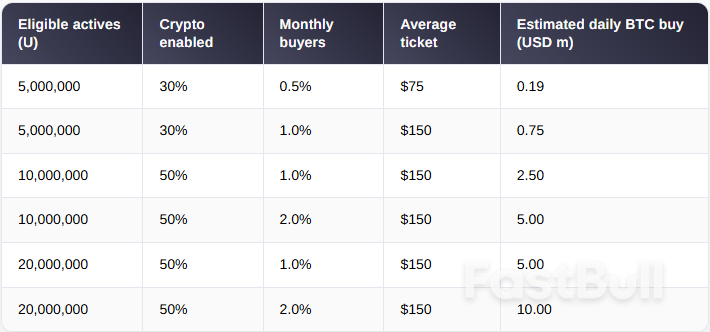
          If 10 million actives are eligible, half of them have crypto enabled, 1.0 percent buy monthly, and the average ticket is $150, the flow implies about $1.7 to $2.5 million per day of Bitcoin purchases, depending on asset share.
          U.S. spot Bitcoin exchange-traded funds regularly record daily net flows in the hundreds of millions, so app-driven buying of that size would be small against an intense ETF session yet persistent and sourced from retail behavior rather than model-based allocators.
          The checkout side of the story is already live elsewhere.
          According to Shopify and Coinbase, merchants can accept USDC on Base inside Shopify Payments with a protocol for delayed capture, refunds, and receipts that mirrors card operations, which reduces the operational gap between crypto and existing systems.
          Users can purchase up to $100,000 per week and send crypto to external wallets. In September, the company added peer-to-peer crypto features, a shift covered by the broader product push alongside fee incentives for PYUSD.
          Cash App supports Lightning sends and on-chain transfers within consumer limits. These product choices turn crypto off ramps into two-way rails that can touch the mempool and, in the case of stablecoins, deliver predictable denominations for merchants.
          Fee and latency forces are stable enough to frame scenarios. Ethereum’s average transaction fee is about 40 cents, while layer-2 fee ranges for simple sends and swaps sit roughly between 4 and 20 cents, per L2fees dashboards.
          Bitcoin’s Lightning network processes payments in subseconds for minimal fees in typical conditions, while on-chain confirmations remain probabilistic around ten minutes with congestion-dependent fees.
          This split sets the practical menu for merchants: Lightning for Bitcoin, layer 2 or stablecoin rails for Ethereum ecosystems, and stablecoins for fiat-like denominations.
          Steak ’n Shake functions as a live case study for culture and operations. According to company statements around the May 16 Lightning rollout, the chain recorded a quarter-over-quarter same-store sales increase of about 10.7 percent in Q2 and credited Bitcoiners.
          Management described a reduction of roughly 50 percent in processing costs versus cards, with a launch-day share of global Bitcoin transactions, as reported by company commentary.
          The chain’s communications around Ethereum acceptance are not formalized, which puts the optics of asset choice and the reaction it draws ahead of any technical difference at the register.
          The technical question for retailers is not whether Bitcoin or Ethereum can process a checkout payment; it is which configuration reduces refund friction, reconciles in back office systems, and preserves unit economics.
          A simple flow model frames how a OnePay launch could interact with ETF-driven price formation and on-chain activity. The table translates user funnel inputs into a daily Bitcoin purchase flow, not as a forecast, but to benchmark against ETF numbers that traders watch daily.US Bitcoin Payments are Getting Real: Retail Rails Could Push $2M a Day On-Chain_1
          Whether those purchases register on-chain depends on the product scope. Zero Hash materials show partner platforms can enable on-chain deposits and withdrawals. If OnePay launches without that feature, market makers still need to acquire crypto to fill customer orders, but balances remain off-chain within omnibus custody.
          If on-chain transfers are enabled, withdrawals to self-custody and exchanges would add address activity and mempool load for Bitcoin and route to layer 2 or bridge paths for Ethereum, which links retail buying to visible network metrics.
          Pricing disclosure will influence repeat behavior.
          According to Zero Hash, affiliated liquidity services can quote prices with a spread over reference rates, and platforms can charge their own fee.
          Retail cohorts respond to round-trip cost, so a lower all-in spread, combined with checkout rewards, tends to raise purchase incidence, while a higher spread depresses repeat tickets.
          KYC tiers and rolling limits will be set per trade ceilings, yet in practice, the meaningful constraints on network liquidity are the presence of external transfers, supported networks such as Lightning, and specific layer 2s, and any waiting periods tied to card or ACH funding.
          The merchant readiness story is now less about raw throughput and more about operations. According to Shopify, the framework covers refund flows, partial captures, and receipt state, which are the controls that card systems have built over decades.
          For Bitcoin, Lightning solves the confirmation time for the payment event, and merchants can sweep to cold storage or settlement accounts later. For Ethereum, layer 2 and stablecoins reduce the fee and latency profile to a consumer-acceptable range, and stablecoins avoid price conversion steps for fiat-denominated businesses.
          The retail optics will continue to influence which asset sits at the counter.
          Bitcoin brings community energy that converts into earned media and early adoption, reflected in the Steak ’n Shake quarter. Ethereum brings a builder base and optionality through layer-2 networks that can be cheaper or faster than its base layer.
          Stablecoins present a third path that frames the decision as internet dollars rather than asset tribal choice. The practical outcome for most large retailers is a mix, Lightning where Bitcoin spenders are active, stablecoins for ecommerce and kiosks, and selective support for Ethereum routed over layer 2 to meet fee and latency goals.
          The question in the headline concerns product toggles and back office design rather than technology availability. Today, checkout can use Lightning, USDC on Base inside Shopify Payments, or comparable rails.
          OnePay has a pathway to offer trading, custody, and transfers through Zero Hash if it turns those settings on, supported by its trust company approval. ETFs remain the benchmark to compare retail app flow against when judging price impact.
          The setting that decides whether retail demand reaches public networks is external transfers at launch.

          Source: Cryptoslate

          Risk Warnings and Disclaimers
          You understand and acknowledge that there is a high degree of risk involved in trading. Following any strategies or investment methods may lead to potential losses. The content on the site is provided by our contributors and analysts for information purposes only. You are solely responsible for determining whether any trading assets, securities, strategy, or any other product is suitable for investing based on your own investment objectives and financial situation.
          Add to Favorites
          Share

          Long-Simmering Challenges Have Put Air Traffic Controllers Front and Center During the Shutdown

          Manuel

          Stocks

          Political

          The first three weeks of this government shutdown have positioned air traffic controllers — a group that often rode out previous stoppages with minimal fanfare — as a key economic crimp point so far.
          Scattered flight delays have been seen across the country for weeks, with Transportation Secretary Sean Duffy previously calculating that shortages in control towers are responsible for about 53% of them.
          Just this past weekend, tracking site FlightAware clocked over 5,000 US delays on both Saturday and Sunday. The Federal Aviation Administration (FAA) said staffing shortages were a major culprit.
          It's a notable change for this shutdown go-around — previous stoppages saw much greater focus on TSA agents — and comes after years of enormous pressure on the nation's approximately 13,000 air traffic controllers.
          The FAA is currently short of its training goals by about 3,500 controllers.
          That has led to mandatory overtime in recent years, and now the shutdown has cut off paychecks and appears to have led at least some controllers to call in sick — further exacerbating the shortage.
          The situation for controllers is also just one example of an increasingly tense environment at airports that have seen disruptions from factors like weather as well as a shortage of pilots.
          "The system has been stretched more and more since 2019," noted Association of Flight Attendants-CWA, AFL-CIO International president Sara Nelson in a recent Yahoo Finance appearance, referring to the last government shutdown.
          "It is less safe than it was before this government shutdown started," she added of the flying environment this month, "and every single day that goes on, it becomes less and less safe."

          A situation that could escalate quickly

          Controllers got a partial paycheck earlier this month and are set to fully miss the pay they're due to receive next week.
          That factor, Secretary Duffy says, could make things worse in a hurry.
          "I'm concerned about the next week," he said in a Fox News appearance Monday.
          He notes that some controllers are already missing work, adding "I think you could see more" disruptions soon, with staffing shortfalls rippling quickly and hitting controllers already working over 50 hours a week.
          With an average salary north of $140,000, controllers have historically been seen as more able to weather the temporary paycheck stoppage that comes with a shutdown.
          Transportation Security Administration (TSA) agents — who typically earn much less — have been seen as a more volatile factor at airports during a shutdown.
          This time around, the roles are at least partially reversed.
          For one thing, Homeland Security Secretary Kristi Noem recently announced that at least some TSA agents will be paid. No similar pot of money has been in the offing for air traffic controllers.
          Various efforts are underway to try to change that.
          There are reports of the Trump administration searching for money that could be tapped for air traffic controllers and bills on Capitol Hill to pay either all "excepted" workers or just aviation workers.
          But all options appear to be long shots at the moment.
          By law, both TSA employees (who operate under the Department of Homeland Security) and air traffic controllers (employed by the FAA) are required to receive full back pay once the government reopens.

          A problem that could be felt for years

          Airlines for America, the trade association that represents airlines in Washington, noted in a recent message to lawmakers that the stoppage could be especially damaging as it "is coming at a critical moment" in the middle of efforts to both modernize the air traffic control system and get air traffic control facilities fully staffed.
          It's emblematic of a fear that, in addition to chaos at the airports in the weeks ahead, the shutdown could cause problems that may take years to unwind.
          Much of the focus is on the FAA Academy in Oklahoma City, which is charged with training every air traffic controller in the country.
          The expectation — voiced repeatedly by figures like Nick Daniels of the National Air Traffic Controllers Association — is that the academy could run out of money by the end of the month if the shutdown lasts much longer.
          Duffy has also expressed worry about the long-term effects of the shutdown and even raised the possibility of permanent layoffs for some workers charged with training newly minted air traffic controllers.
          The secretary has made clear that in nearly any scenario, the shutdown "has a longer-lasting impact on our ability to make up the ground in the shortages that we have with air traffic controllers."

          Source: Yahoo Finance

          Risk Warnings and Disclaimers
          You understand and acknowledge that there is a high degree of risk involved in trading. Following any strategies or investment methods may lead to potential losses. The content on the site is provided by our contributors and analysts for information purposes only. You are solely responsible for determining whether any trading assets, securities, strategy, or any other product is suitable for investing based on your own investment objectives and financial situation.
          Add to Favorites
          Share
          FastBull
          Copyright © 2025 FastBull Ltd

          728 RM B 7/F GEE LOK IND BLDG NO 34 HUNG TO RD KWUN TONG KLN HONG KONG

          TelegramInstagramTwitterfacebooklinkedin
          App Store Google Play Google Play
          Products
          Charts

          Chats

          Q&A with Experts
          Screeners
          Economic Calendar
          Data
          Tools
          Membership
          Features
          Function
          Markets
          Copy Trading
          Latest Signals
          Contests
          News
          Analysis
          24/7
          Columns
          Education
          Company
          Careers
          About Us
          Contact Us
          Advertising
          Help Center
          Feedback
          User Agreement
          Privacy Policy
          Business

          White Label

          Data API

          Web Plug-ins

          Poster Maker

          Affiliate Program

          Risk Disclosure

          The risk of loss in trading financial instruments such as stocks, FX, commodities, futures, bonds, ETFs and crypto can be substantial. You may sustain a total loss of the funds that you deposit with your broker. Therefore, you should carefully consider whether such trading is suitable for you in light of your circumstances and financial resources.

          No decision to invest should be made without thoroughly conducting due diligence by yourself or consulting with your financial advisors. Our web content might not suit you since we don't know your financial conditions and investment needs. Our financial information might have latency or contain inaccuracy, so you should be fully responsible for any of your trading and investment decisions. The company will not be responsible for your capital loss.

          Without getting permission from the website, you are not allowed to copy the website's graphics, texts, or trademarks. Intellectual property rights in the content or data incorporated into this website belong to its providers and exchange merchants.

          Not Logged In

          Log in to access more features

          FastBull Membership

          Not yet

          Purchase

          Become a signal provider
          Help Center
          Customer Service
          Dark Mode
          Price Up/Down Colors

          Log In

          Sign Up

          Position
          Layout
          Fullscreen
          Default to Chart
          The chart page opens by default when you visit fastbull.com
