• Trade
  • Markets
  • Copy
  • Contests
  • News
  • 24/7
  • Calendar
  • Q&A
  • Chats
Trending
Screeners
SYMBOL
LAST
BID
ASK
HIGH
LOW
NET CHG.
%CHG.
SPREAD
SPX
S&P 500 Index
6827.42
6827.42
6827.42
6899.86
6801.80
-73.58
-1.07%
--
DJI
Dow Jones Industrial Average
48458.04
48458.04
48458.04
48886.86
48334.10
-245.98
-0.51%
--
IXIC
NASDAQ Composite Index
23195.16
23195.16
23195.16
23554.89
23094.51
-398.69
-1.69%
--
USDX
US Dollar Index
97.900
97.980
97.900
98.070
97.890
-0.050
-0.05%
--
EURUSD
Euro / US Dollar
1.17410
1.17418
1.17410
1.17447
1.17262
+0.00016
+ 0.01%
--
GBPUSD
Pound Sterling / US Dollar
1.33803
1.33811
1.33803
1.33821
1.33546
+0.00096
+ 0.07%
--
XAUUSD
Gold / US Dollar
4349.66
4350.09
4349.66
4349.67
4294.68
+50.27
+ 1.17%
--
WTI
Light Sweet Crude Oil
57.445
57.475
57.445
57.601
57.194
+0.212
+ 0.37%
--

Community Accounts

Signal Accounts
--
Profit Accounts
--
Loss Accounts
--
View More

Become a signal provider

Sell trading signals to earn additional income

View More

Guide to Copy Trading

Get started with ease and confidence

View More

Signal Accounts for Members

All Signal Accounts

Best Return
  • Best Return
  • Best P/L
  • Best MDD
Past 1W
  • Past 1W
  • Past 1M
  • Past 1Y

All Contests

  • All
  • Trump Updates
  • Recommend
  • Stocks
  • Cryptocurrencies
  • Central Banks
  • Featured News
Top News Only
Share

Ivory Coast 2025/26 Cocoa Arrivals Reached 894000 T By December 14 Versus 895000 T Year Ago - Exporters' Estimate

Share

Ishares MSCI Chile ETF Up 3.9% Premarket After Jose Antonio Kast Wins Chile's Presidential Election On Sunday

Share

Spain's Debt-To-GDP Ratio Falls To 103.2% In Third Quarter 2025

Share

China's Central Bank: Authorises DBS Bank As Yuan Clearing Bank In Singapore

Share

Bank Of Korea - South Korea Central Bank, Nps Agree To Extend Currency Swap Agreement For Another Year

Share

Poland's CPI At 0.1% Month-On-Month In November Versus 0.1% Released Earlier

Share

London Metal Exchange (LME): Copper Inventories Decreased By 25 Tons, Aluminum Inventories Decreased By 50 Tons, Nickel Inventories Increased By 360 Tons, Zinc Inventories Increased By 2,550 Tons, Lead Inventories Increased By 17,725 Tons, And Tin Inventories Increased By 125 Tons

Share

Polish Inflation At 2.5% Year-On-Year In November

Share

Poland's January-October Import Up 5.4% To 309.3 Billion Euros

Share

Poland's January-October Trade Balance At -5.1 Billion Euros

Share

Poland's January-October Export Up 2.8% To 304.3 Billion Euros

Share

Ceasefire Negotiations Between Ukraine And US Representatives In Berlin To Continue Monday Morning - German Source Familiar With The Schedule

Share

Spain's IBEX Hits Fresh Record High, Up Over 1%

Share

Spot Silver Rises Nearly 3% To $63.82/Oz

Share

France's Foreign Minister Says He Suggesd To EU's Kallas That US Representatives Brief EU Foreign Ministers On Gaza Peace Plan During Their Meeting

Share

India Trade Secretary: Prime Facie Don't See A Case Of Rice Dumping To USA And There Is No Active Investigation On That

Share

India Trade Secretary: India's Rice Exported To USA Largely Limited To Basmati And At Price Higher Than General Price Of Rice

Share

India Trade Secretary: India Can Raise Shipments To Russia In Sectors Like Automobiles And Pharmaceuticals

Share

India Trade Secretary:India-Oman Trade Deal Completed And Will Be Signed Soon

Share

Burberry Shares Top FTSE Gainer, Up 3.5% In Positive European Luxury Sector

TIME
ACT
FCST
PREV
France HICP Final MoM (Nov)

A:--

F: --

P: --

China, Mainland Outstanding Loans Growth YoY (Nov)

A:--

F: --

P: --

China, Mainland M2 Money Supply YoY (Nov)

A:--

F: --

P: --

China, Mainland M0 Money Supply YoY (Nov)

A:--

F: --

P: --

China, Mainland M1 Money Supply YoY (Nov)

A:--

F: --

P: --

India CPI YoY (Nov)

A:--

F: --

P: --

India Deposit Gowth YoY

A:--

F: --

P: --

Brazil Services Growth YoY (Oct)

A:--

F: --

P: --

Mexico Industrial Output YoY (Oct)

A:--

F: --

P: --

Russia Trade Balance (Oct)

A:--

F: --

P: --

Philadelphia Fed President Henry Paulson delivers a speech
Canada Building Permits MoM (SA) (Oct)

A:--

F: --

P: --

Canada Wholesale Sales YoY (Oct)

A:--

F: --

P: --

Canada Wholesale Inventory MoM (Oct)

A:--

F: --

P: --

Canada Wholesale Inventory YoY (Oct)

A:--

F: --

P: --

Canada Wholesale Sales MoM (SA) (Oct)

A:--

F: --

P: --

Germany Current Account (Not SA) (Oct)

A:--

F: --

P: --

U.S. Weekly Total Rig Count

A:--

F: --

P: --

U.S. Weekly Total Oil Rig Count

A:--

F: --

P: --

Japan Tankan Small Manufacturing Outlook Index (Q4)

A:--

F: --

P: --

Japan Tankan Large Non-Manufacturing Diffusion Index (Q4)

A:--

F: --

P: --

Japan Tankan Large Non-Manufacturing Outlook Index (Q4)

A:--

F: --

P: --

Japan Tankan Large Manufacturing Outlook Index (Q4)

A:--

F: --

P: --

Japan Tankan Small Manufacturing Diffusion Index (Q4)

A:--

F: --

P: --

Japan Tankan Large Manufacturing Diffusion Index (Q4)

A:--

F: --

P: --

Japan Tankan Large-Enterprise Capital Expenditure YoY (Q4)

A:--

F: --

P: --

U.K. Rightmove House Price Index YoY (Dec)

A:--

F: --

P: --

China, Mainland Industrial Output YoY (YTD) (Nov)

A:--

F: --

P: --

China, Mainland Urban Area Unemployment Rate (Nov)

A:--

F: --

P: --

Saudi Arabia CPI YoY (Nov)

A:--

F: --

P: --

Euro Zone Industrial Output YoY (Oct)

--

F: --

P: --

Euro Zone Industrial Output MoM (Oct)

--

F: --

P: --

Canada Existing Home Sales MoM (Nov)

--

F: --

P: --

Euro Zone Total Reserve Assets (Nov)

--

F: --

P: --

U.K. Inflation Rate Expectations

--

F: --

P: --

Canada National Economic Confidence Index

--

F: --

P: --

Canada New Housing Starts (Nov)

--

F: --

P: --

U.S. NY Fed Manufacturing Employment Index (Dec)

--

F: --

P: --

U.S. NY Fed Manufacturing Index (Dec)

--

F: --

P: --

Canada Core CPI YoY (Nov)

--

F: --

P: --

Canada Manufacturing Unfilled Orders MoM (Oct)

--

F: --

P: --

U.S. NY Fed Manufacturing Prices Received Index (Dec)

--

F: --

P: --

U.S. NY Fed Manufacturing New Orders Index (Dec)

--

F: --

P: --

Canada Manufacturing New Orders MoM (Oct)

--

F: --

P: --

Canada Core CPI MoM (Nov)

--

F: --

P: --

Canada Trimmed CPI YoY (SA) (Nov)

--

F: --

P: --

Canada Manufacturing Inventory MoM (Oct)

--

F: --

P: --

Canada CPI YoY (Nov)

--

F: --

P: --

Canada CPI MoM (Nov)

--

F: --

P: --

Canada CPI YoY (SA) (Nov)

--

F: --

P: --

Canada Core CPI MoM (SA) (Nov)

--

F: --

P: --

Canada CPI MoM (SA) (Nov)

--

F: --

P: --

Federal Reserve Board Governor Milan delivered a speech
U.S. NAHB Housing Market Index (Dec)

--

F: --

P: --

Australia Composite PMI Prelim (Dec)

--

F: --

P: --

Australia Services PMI Prelim (Dec)

--

F: --

P: --

Australia Manufacturing PMI Prelim (Dec)

--

F: --

P: --

Japan Manufacturing PMI Prelim (SA) (Dec)

--

F: --

P: --

U.K. Unemployment Claimant Count (Nov)

--

F: --

P: --

U.K. Unemployment Rate (Nov)

--

F: --

P: --

U.K. 3-Month ILO Unemployment Rate (Oct)

--

F: --

P: --

Q&A with Experts
    • All
    • Chatrooms
    • Groups
    • Friends
    Connecting
    .
    .
    .
    Type here...
    Add Symbol or Code

      No matching data

      All
      Trump Updates
      Recommend
      Stocks
      Cryptocurrencies
      Central Banks
      Featured News
      • All
      • Russia-Ukraine Conflict
      • Middle East Flashpoint
      • All
      • Russia-Ukraine Conflict
      • Middle East Flashpoint
      Search
      Products

      Charts Free Forever

      Chats Q&A with Experts
      Screeners Economic Calendar Data Tools
      Membership Features
      Data Warehouse Market Trends Institutional Data Policy Rates Macro

      Market Trends

      Market Sentiment Order Book Forex Correlations

      Top Indicators

      Charts Free Forever
      Markets

      News

      News Analysis 24/7 Columns Education
      From Institutions From Analysts
      Topics Columnists

      Latest Views

      Latest Views

      Trending Topics

      Top Columnists

      Latest Update

      Signals

      Copy Rankings Latest Signals Become a signal provider AI Rating
      Contests
      Brokers

      Overview Brokers Assessment Rankings Regulators News Claims
      Broker listing Forex Brokers Comparison Tool Live Spread Comparison Scam
      Q&A Complaint Scam Alert Videos Tips to Detect Scam
      More

      Business
      Events
      Careers About Us Advertising Help Center

      White Label

      Data API

      Web Plug-ins

      Affiliate Program

      Awards Institution Evaluation IB Seminar Salon Event Exhibition
      Vietnam Thailand Singapore Dubai
      Fans Party Investment Sharing Session
      FastBull Summit BrokersView Expo
      Recent Searches
        Top Searches
          Markets
          News
          Analysis
          User
          24/7
          Economic Calendar
          Education
          Data
          • Names
          • Latest
          • Prev

          View All

          No data

          Scan to Download

          Faster Charts, Chat Faster!

          Download App
          English
          • English
          • Español
          • العربية
          • Bahasa Indonesia
          • Bahasa Melayu
          • Tiếng Việt
          • ภาษาไทย
          • Français
          • Italiano
          • Türkçe
          • Русский язык
          • 简中
          • 繁中
          Open Account
          Search
          Products
          Charts Free Forever
          Markets
          News
          Signals

          Copy Rankings Latest Signals Become a signal provider AI Rating
          Contests
          Brokers

          Overview Brokers Assessment Rankings Regulators News Claims
          Broker listing Forex Brokers Comparison Tool Live Spread Comparison Scam
          Q&A Complaint Scam Alert Videos Tips to Detect Scam
          More

          Business
          Events
          Careers About Us Advertising Help Center

          White Label

          Data API

          Web Plug-ins

          Affiliate Program

          Awards Institution Evaluation IB Seminar Salon Event Exhibition
          Vietnam Thailand Singapore Dubai
          Fans Party Investment Sharing Session
          FastBull Summit BrokersView Expo

          Japan Records First Real Wage Growth in Seven Months as Pay and Bonuses Rise

          Gerik

          Economic

          Summary:

          Average wages in Japan rose 4.1% year-on-year in July, lifting inflation-adjusted real wages by 0.5% for the first increase in seven months, driven by steady base pay hikes and higher bonuses....
          Wage Growth Breaks Prolonged Stagnation

          Data released by Japan’s Ministry of Health, Labour and Welfare (MHLW) on September 5 showed that average total wages per worker climbed 4.1% in July compared with the same period last year. After adjusting for inflation, real wages increased 0.5%, marking the first positive growth since late 2023.
          The survey, covering over 30,000 companies nationwide with at least five employees, revealed that average monthly wages, including base pay, overtime, and bonuses, reached 419,668 yen (about USD 2,834). This was the 43rd consecutive month of nominal wage growth.

          Drivers of the Increase: Base Pay and Bonuses

          Base salaries and fixed allowances rose 2.5%, while bonuses and special payments surged 7.9%. This dual effect allowed real wages to turn positive despite persistent inflationary pressure. Officials at MHLW stressed that the steady rise in base pay combined with higher seasonal bonuses supported household income, though they warned that elevated consumer prices remain a challenge.
          The causal relationship here is direct: wage hikes and bonus increases boosted take-home pay enough to outpace inflation, resulting in real wage growth. However, the sustainability of this trend depends on whether wage growth continues to exceed price gains over time.

          Government Response and Policy Considerations

          Prime Minister Shigeru Ishiba acknowledged the improvement but emphasized the need for broader measures to protect households from high living costs. He confirmed that the government will roll out an economic policy package this autumn, including potential cash subsidies and targeted relief for vulnerable households.
          Ishiba also noted that external pressures, particularly tariffs from US President Donald Trump’s administration, have weighed on Japanese industries. These trade-related shocks may indirectly affect wage stability by raising import costs and influencing domestic price levels.

          Inflation Challenge and Policy Outlook

          The Japanese government’s stated policy priority is ensuring that income growth consistently outpaces inflation, a goal that would strengthen consumer purchasing power and sustain economic momentum. Yet this remains fragile: while July’s data reflects a correlation between rising wages and improved real incomes, high and uncertain price levels still pose a risk of eroding gains in subsequent months.
          For now, the return of positive real wage growth marks a turning point after seven months of decline, but policymakers must ensure that wage hikes are both sustainable and inclusive to support long-term household resilience.
          To stay updated on all economic events of today, please check out our Economic calendar
          Risk Warnings and Disclaimers
          You understand and acknowledge that there is a high degree of risk involved in trading. Following any strategies or investment methods may lead to potential losses. The content on the site is provided by our contributors and analysts for information purposes only. You are solely responsible for determining whether any trading assets, securities, strategy, or any other product is suitable for investing based on your own investment objectives and financial situation.
          Add to Favorites
          Share

          American Bitcoin Delivers a Political and Financial Jolt to Crypto Markets

          Gerik

          Cryptocurrency

          Eric Trump’s Billionaire Turn Through Crypto

          The Nasdaq debut of American Bitcoin Corp. has catapulted Eric Trump, the second son of President Donald Trump, into the crypto spotlight. Holding 7.5% of the company, his stake was valued at $548 million after shares doubled on their first day of trading, closing at $8.04. That valuation surpasses the worth of Trump Organization’s golf resorts and underlines how digital assets are reshaping wealth creation in the US.
          The company’s rise was rapid, built on a series of strategic moves. A small investment bank, Dominari with Trump family ties founded American Data Centers, which absorbed mining rigs from Hut 8 Corp. in exchange for equity. The entity then merged with Gryphon Digital Mining, rebranded as American Bitcoin, and listed under ticker ABTC. As of September 3, the firm’s market cap stood at $7.2 billion with Q2 revenue of $30.3 million and net profit of $3.4 million.

          Trump Family Fortunes Intertwined with Digital Assets

          Public filings show Eric Trump and Donald Trump Jr., alongside close associates, control as much as 98% of American Bitcoin’s shares. This consolidation of ownership has magnified the Trump family’s fortune, now estimated above $6.4 billion.
          The correlation between political backing and financial gain is striking. President Trump, once critical of cryptocurrencies, has pivoted to become their most powerful political supporter. His administration legalized select digital assets, established a national crypto reserve, and appointed regulators favorable to the industry. These moves fostered an environment where American Bitcoin could flourish, demonstrating how policy shifts can directly accelerate corporate growth and investor confidence.

          From Speculation to Mainstream Finance

          The company’s Nasdaq listing marks a significant milestone for digital assets, moving them from speculative niches into mainstream capital markets. Institutional investors now have easier access, and American Bitcoin plans expansions across New York, Alberta, and Texas. The causal relationship is evident: regulatory approval and political endorsement allowed crypto firms to secure legitimacy, fueling investment and scale.
          Yet, controversy persists. Critics warn of conflicts of interest, as the president’s son directly profits from an industry enjoying White House backing. The overlap of family wealth and national policy risks eroding public trust, even as it accelerates capital flows into the sector.

          A Symbolic Shift in Global Crypto Politics

          American Bitcoin’s emergence is more than a business story it symbolizes the US embedding crypto into its financial system while other governments remain divided on regulation. By allowing a company so closely tied to the First Family to list publicly, Washington signals a bold embrace of digital assets.
          This duality opportunity and controversy captures the current state of crypto: a sector straddling innovation, political power, and regulatory uncertainty. Regardless of criticism, American Bitcoin has undeniably delivered a powerful boost to the global crypto narrative.
          Risk Warnings and Disclaimers
          You understand and acknowledge that there is a high degree of risk involved in trading. Following any strategies or investment methods may lead to potential losses. The content on the site is provided by our contributors and analysts for information purposes only. You are solely responsible for determining whether any trading assets, securities, strategy, or any other product is suitable for investing based on your own investment objectives and financial situation.
          Add to Favorites
          Share

          Will the Fed Deliver a Sharp Rate Cut to Support a Weakening Labor Market?

          Gerik

          Economic

          Labor Market Weakness Fuels Rate Cut Expectations

          The latest employment report showed the US economy added only 22,000 jobs in August, far below the expected 75,000 and well under July’s revised 79,000. Unemployment ticked up to 4.3%, marking its highest level since October 2021. Even more troubling, June data was revised to reveal a net loss of 13,000 jobs, the first monthly decline since December 2020.
          The slowdown has been evident since April, as Trump administration tariffs, tighter immigration policies, and public-sector layoffs weigh on labor supply and business confidence. While average hourly earnings rose 0.3% for the month and 3.7% year-over-year, falling work hours signaled that income growth may not be enough to sustain household demand.
          The causal link is clear: tariffs and immigration restrictions have directly constrained business hiring capacity, while government cutbacks have amplified labor market weakness. This deterioration has shifted investor focus away from inflation risks toward the fragility of job creation.

          Fed Under Pressure, Powell Cautious

          The Federal Reserve has held its benchmark rate at 4.25%–4.50% since late 2024, wary of inflationary risks from Trump’s tariff policy. Yet the weak August jobs report is widely interpreted as a turning point. At Jackson Hole in August, Fed Chair Jerome Powell flagged the labor market as a rising concern, noting that stable conditions would allow “cautious” rate adjustments.
          Economists at Bank of America now expect two quarter-point cuts one in September and another in December bringing the federal funds rate to 3.00%–3.25% by the end of 2026. Futures markets, however, assign only about a 10% chance of a more aggressive half-point cut this month, suggesting investors still anticipate incremental easing rather than a dramatic shift.

          Trump’s Political Pressure Intensifies

          President Trump has consistently criticized Powell for “keeping borrowing costs too high.” After the jobs data release, he renewed attacks on social media, accusing the Fed chief of acting “too late.” White House economic adviser Kevin Hassett went further, suggesting that a larger-than-normal cut could be justified to stabilize the labor market. Hassett is reportedly under consideration as Powell’s potential successor when his term ends in May.
          The correlation here is political rather than causal: while Trump cannot directly dictate Fed decisions, his public pressure influences expectations and highlights how monetary policy is intertwined with the administration’s broader economic agenda.

          Small Cut More Likely, But Bigger Moves Not Ruled Out

          For now, the consensus among analysts is a 0.25 percentage point cut in September, followed by gradual easing at subsequent meetings. Some strategists, such as Goldman Sachs’s Simon Dangoor, caution that rapid deterioration in labor conditions could push the Fed to accelerate cuts sooner than Powell’s stated “cautious” approach.
          If healthcare hiring the lone bright spot slows, or layoffs continue to accelerate, the Fed may be forced into more decisive action. Still, the base case remains steady quarter-point reductions, with financial markets expecting rates to be roughly a full percentage point lower by January.
          The August employment report underscores the Fed’s dilemma: inflation remains a concern due to tariffs, but job growth is faltering badly. A modest rate cut this month appears almost certain, but the scale of easing will depend on how quickly the labor market deteriorates in the coming months. For now, investors and workers alike are bracing for a slower, more fragile economic outlook unless policy action stabilizes confidence.
          To stay updated on all economic events of today, please check out our Economic calendar
          Risk Warnings and Disclaimers
          You understand and acknowledge that there is a high degree of risk involved in trading. Following any strategies or investment methods may lead to potential losses. The content on the site is provided by our contributors and analysts for information purposes only. You are solely responsible for determining whether any trading assets, securities, strategy, or any other product is suitable for investing based on your own investment objectives and financial situation.
          Add to Favorites
          Share

          Trump Signs Order Offering Targeted Tariff Exemptions to Trade Partners

          Gerik

          Economic

          A New Phase in Trump’s Tariff Strategy

          Since returning to the White House earlier this year, President Trump has centered economic policy around reshaping global trade. His tariff-first approach aims to cut the US trade deficit while pushing foreign governments into bilateral negotiations. The latest executive order, signed on September 5, aligns US tariff schedules with commitments already made in framework agreements with allies such as Japan and the European Union.
          The order reflects a causal relationship: tariff pressure compels trading partners to strike deals, and in exchange, the US offers selective relief. By rewarding cooperation with exemptions, Trump strengthens Washington’s leverage in trade talks while maintaining a tough baseline stance against noncompliant countries.

          Scope of Tariff Exemptions

          Effective September 8, 2025, the order sets import tariffs to zero on more than 45 categories of goods from “linked partners” that have signed reciprocal trade pacts under Section 232 of the National Security Act. These include raw materials and intermediate goods critical to US industries but scarce domestically.
          Key exemptions cover graphite, multiple forms of nickel (vital for stainless steel and EV battery production), various gold products (powder, leaf, bullion), and generic pharmaceutical compounds like lidocaine and diagnostic reagents. The order also grants exemptions for certain agricultural goods, aircraft parts, and non-patented medicines.
          At the same time, prior exemptions on items such as some plastics and polysilicon essential for solar panels were revoked, showing a selective and strategic recalibration.

          Implications for Trade Partners

          The policy immediately benefits allies with existing framework agreements, such as Japan and the EU, by lowering their export barriers to the US. For Switzerland, however, whose gold exports face a 39% tariff due to the absence of a trade deal, the stakes are significant. Gold’s inclusion in the exemption list signals both economic opportunity and diplomatic pressure: unless Bern reaches a deal, it risks losing competitive access to a major market.
          This dynamic highlights a causal interplay: exemptions reward aligned countries, while tariffs remain punitive tools for those outside Washington’s framework.

          Broader Economic and Political Context

          The order demonstrates how tariff policy is now embedded within national security and industrial policy. By prioritizing materials like nickel and rare-earth magnets (neodymium), the administration is reinforcing domestic supply chains for defense, renewable energy, and advanced manufacturing.
          At the same time, critics argue that frequent policy changes fuel business uncertainty. Companies dependent on steady imports of strategic materials face planning challenges if tariff exemptions can be revised or withdrawn with each new executive order.

          A Trade System Redrawn by Tariff Leverage

          Trump’s latest executive order underscores how tariff power has become a cornerstone of US trade negotiations. Exemptions are no longer broad but finely targeted, aimed at incentivizing trade partners while protecting key US industries.
          By linking tariff relief to reciprocal deals, the administration both rewards cooperation and penalizes resistance. This dual-track approach strengthens US bargaining power but also raises the risk of volatility for global supply chains, particularly in sectors like energy storage, aerospace, and pharmaceuticals. The long-term question is whether such policies will produce a sustainable balance between protectionism and partnership, or whether they will deepen global trade fragmentation.
          To stay updated on all economic events of today, please check out our Economic calendar
          Risk Warnings and Disclaimers
          You understand and acknowledge that there is a high degree of risk involved in trading. Following any strategies or investment methods may lead to potential losses. The content on the site is provided by our contributors and analysts for information purposes only. You are solely responsible for determining whether any trading assets, securities, strategy, or any other product is suitable for investing based on your own investment objectives and financial situation.
          Add to Favorites
          Share

          Dark Clouds Over the US Labor Market as Unemployment Climbs

          Gerik

          Economic

          Weakening Momentum After Years of Recovery

          After more than three years of strong recovery, the US labor market is showing clear signs of strain. August saw only 22,000 new jobs created, well under the 75,000–80,000 analysts had forecast, making it the weakest job growth in years. At the same time, the unemployment rate climbed to 4.3%, its highest since 2021.
          Even more concerning, revised data for June showed the economy actually lost 13,000 jobs the first negative month since late 2020. This ended the second-longest streak of continuous job growth in US history, underscoring a troubling shift in momentum.

          Policy Uncertainty and High Borrowing Costs Weigh on Hiring

          Economists attribute much of the slowdown to policy instability under President Donald Trump. Sweeping decisions on tariffs, immigration, and government spending have created uncertainty that discourages businesses from expanding payrolls.
          With interest rates still anchored at 4.25–4.50% since December 2024, borrowing costs remain high, further limiting hiring. The causal link is clear: tighter monetary policy combined with unpredictable trade and fiscal moves has directly stalled firms’ willingness to add staff.

          Healthcare as the Lone Growth Engine

          Healthcare and social assistance added 46,800 jobs in August, accounting for nearly all net job creation. Yet this sector only represents about 15% of the workforce, meaning 85% of workers see little benefit.
          This imbalance creates fragility: if healthcare hiring slows, overall job growth could collapse rapidly. The dependence on a single sector is a structural weakness that exposes the labor market to sudden shocks.

          Wages Slow, Layoffs Accelerate

          Average hourly earnings rose just 3.7% year-on-year, down from 3.9% in July. Slower wage growth combined with still-high living costs is squeezing household income.
          Meanwhile, layoffs surged. Reports from Challenger, Gray & Christmas showed nearly 86,000 job cuts in August, the highest since the pandemic and up 39% from July. For the first time in four years, the number of unemployed workers has exceeded the number of available jobs a signal of deteriorating labor market balance.

          Sectoral Weakness and Public Job Cuts

          Weakness spread across manufacturing, construction, wholesale trade, and professional services. Federal government payrolls also shrank, losing 15,000 jobs in August, bringing total public job losses this year to almost 97,000.
          Combined with rising long-term unemployment and political uncertainty, the broad-based downturn paints a picture of mounting risks for the world’s largest economy.

          Waiting for Fed Intervention

          The labor market, once a bright spot of the post-pandemic recovery, has now become a major source of concern. With hiring slowing, wages under pressure, and layoffs mounting, the risk of recession or stagnation in the coming months is rising.
          Markets and workers alike are looking to the Federal Reserve for clarity. A rate cut at the September meeting could offer relief and help stabilize confidence, but without decisive action, the US economy may struggle to escape its current labor market malaise.
          To stay updated on all economic events of today, please check out our Economic calendar
          Risk Warnings and Disclaimers
          You understand and acknowledge that there is a high degree of risk involved in trading. Following any strategies or investment methods may lead to potential losses. The content on the site is provided by our contributors and analysts for information purposes only. You are solely responsible for determining whether any trading assets, securities, strategy, or any other product is suitable for investing based on your own investment objectives and financial situation.
          Add to Favorites
          Share

          Bill Pulte Accused Fed Governor Lisa Cook of Fraud. His Relatives Filed Housing Claims Similar to Hers

          Manuel

          Political

          Central Bank

          Close relatives of the federal official who has accused a Federal Reserve governor of improperly claiming primary residence on two properties have declared the same status on two homes in two different states, public records show.
          Mark and Julie Pulte, the father and stepmother of Bill Pulte, President Donald Trump’s appointee as director of the Federal Housing Finance Agency, since 2020 have claimed so-called “homestead exemptions” for residences in wealthy neighborhoods in both Michigan and Florida, according to the records. The exemption is meant to give a discount to homeowners on taxes for properties they use as their primary residence.
          Local tax officials in both states told Reuters that claiming more than one home as a primary residence isn’t generally allowed in their jurisdictions and could be punishable by fines or back taxes. After Reuters contacted tax officials in Bloomfield Township, Michigan, to inquire about the dual claims, Darrin Kraatz, director of assessing, on Thursday said the township “as of today” would revoke the exemption on the Pultes’ residence there.
          According to public real estate records, and a resident at the Michigan house on Thursday evening, the home was rented out by the Pultes this year, a move that also violates rules for the exemption. “Revised tax bills will be issued to the Pultes, including all applicable penalty and interest,” Kraatz said by email. He didn’t respond to a follow-up question about the value of any payment now due and Reuters couldn’t determine a precise figure for previous tax payments they have made.
          Officials in Florida, citing the claim for exemption in that state as older, said any conflict with the second exemption would need to be addressed in Michigan.
          Reuters was unable to reach Mark or Julie Pulte for comment. Representatives at Mark Pulte’s business and a Pulte family foundation didn’t respond to phone calls or emails seeking comment for this story.
          Officials at the FHFA, the federal agency led by Bill Pulte, didn’t respond to a request for comment. The news agency was unable to reach him otherwise.
          The claim of more than one property as a primary residence has been the basis for Bill Pulte’s accusations against Lisa Cook, the Federal Reserve governor Trump fired as a result and who has since filed suit against the president to fight the dismissal. Pulte referred the matter to the attorney general, prompting a probe of Cook by the Justice Department.
          In addition to that formal action against Cook, Pulte in recent days has made multiple public statements against her, accusing her of defrauding mortgage lenders and the public. “Financial fraud is a big deal,” Pulte wrote last weekend on X, the social media site, to his three million followers. “Don’t do it!”
          He also criticized Cook after learning she rented out one of the homes that she had declared as a primary residence. “Lisa Cook’s declared ‘PRIMARY RESIDENCE’ is being RENTED out to tenants,” he wrote in another X post.
          Cook has repeatedly denied any wrongdoing. “How Governor Cook described her properties,” her attorney wrote in a statement on Thursday, is “not fraud.”
          In the garage of the Michigan house, on a quiet cul-de-sac with wood-shingled homes and manicured yards, a man told Reuters that he lives at the property as a tenant and doesn’t know the name of the homeowner. He declined to be identified by name or say through whom or how long he has been renting the property.

          “THEY GOT LUCKY”

          The Pulte family, which rose to prominence with a housing empire started in Michigan by Mark Pulte’s father, is active in conservative circles. Both Mark and his wife, electoral records show, have made multiple campaign contributions to Republican candidates and causes.
          In addition to founding his own housing company in Florida, where he has specialized in building luxury properties, Mark Pulte is a senior official at a Pulte family foundation. His high-profile real estate activities have included the 2021 sale of a property for $122.7 million, a record for Palm Beach at the time. Years earlier, the property had been among Trump’s Florida holdings.
          In his comments to Senate officials for his confirmation as director of the federal housing agency, Bill Pulte thanked his father and stepmother for their support. He said he grew up visiting construction sites of homes built by his father and grandfather. In past public statements he has said that Mark helped finance Pulte Capital Partners, the Florida-based private equity firm Bill founded.
          The homestead exemptions claimed by Mark and Julie Pulte, eight tax and real estate experts told Reuters, would typically be permissible only in a rare exception that can be made for a couple in which spouses are conducting entirely independent lives – living separately at the two addresses, separating their finances and filing their taxes individually. Reuters couldn’t determine whether the Pultes qualified for such an exemption or had used such grounds to justify their homestead claims.
          “It’s not something that either state generally lets you get away with,” said Lisa Bender, a longtime real estate agent in both Michigan and Florida. Bender said she personally knows the ins-and-outs of the homestead exemptions because she also owns properties in both states. “I wish I could claim both,” she said. “Somehow they got lucky.”
          No mortgage records exist for the Michigan and Florida properties, which suggests the Pultes likely paid for the homes in cash, real estate experts said. By paying lower taxes on both homes, they added, the couple is contributing less than they otherwise would to public coffers, including funding for area schools.
          On properties like those owned by the Pultes, the exemptions can add up to thousands of dollars in savings each year. On the Florida home, in Boca Raton, the exemption saved the Pultes an estimated $158,000 in taxes for 2025, according to officials with the tax assessor’s office in Palm Beach County, the property tax jurisdiction. The county granted an additional exemption on the property because the house – a waterfront home with marble floors, in-ground pool, and a boat dock – surpasses a certain value threshold, the records indicate.
          The Pultes bought the Boca Raton house in 2016 for $4.25 million and later transferred the title to a legal entity in which they are both listed as beneficiaries, the records show. Mark Pulte filed the exemption request.
          On the Michigan property, listed as a four-bedroom home with sauna and purchased for nearly $1 million in 2020, both spouses are named on a trust that owns the house. Julie Pulte claimed the exemption there.
          When contacted by Reuters about the dual exemptions, Nery Mejia, an exemptions manager for the Palm Beach County Property Appraiser's Office, said the office would look into it. In a follow-up by email, she said the paperwork in Florida is valid and predates the Michigan claim. “Based on this,” she wrote, “the matter should be handled by Michigan.”
          It isn’t clear how much the Pultes may have saved each year because of the Michigan claim, but on Friday property records already indicated the exemption there is now zero.

          Source: Reuters

          Risk Warnings and Disclaimers
          You understand and acknowledge that there is a high degree of risk involved in trading. Following any strategies or investment methods may lead to potential losses. The content on the site is provided by our contributors and analysts for information purposes only. You are solely responsible for determining whether any trading assets, securities, strategy, or any other product is suitable for investing based on your own investment objectives and financial situation.
          Add to Favorites
          Share

          Trump Threatens Trade Actions After EU Fines Google Over Ad Tech

          Manuel

          Political

          Stocks

          US President Donald Trump threatened a probe that could prompt fresh tariffs in response to the European Union fining Alphabet Inc.’s Google over findings the company abused its dominance by giving its own ad exchanges a competitive advantage.
          The president made his warning in a social media post Friday after the EU announced it was fining Google almost €3 billion ($3.5 billion) and ordering the search giant to stop favoring its own advertising technology services.
          “This is on top of the many other Fines and Taxes that have been issued against Google and other American Tech Companies, in particular,” Trump said. “Very unfair, and the American Taxpayer will not stand for it! As I have said before, my Administration will NOT allow these discriminatory actions to stand.”
          Trump has previously used so-called 301 probes to target imports from Brazil over its prosecution of former President Jair Bolsonaro. He’s long criticized Europe for its fines against US technology firms, and earlier this month warned he would impose “substantial” tariffs on countries that imposed digital taxes, rules, or regulations that hit American companies.
          The European Commission said Friday that Google had exploited its advantage over rivals and that it must bring the practices to an end.
          “When markets fail, public institutions must act to prevent dominant players from abusing their power,” EU antitrust commissioner Teresa Ribera said in a statement. “True freedom means a level playing field, where everyone competes on equal terms and citizens have a genuine right to choose.”
          The company immediately vowed to appeal. Lee-Anne Mulholland, vice president for regulatory affairs at Google, said the move “imposes an unjustified fine and requires changes that will hurt thousands of European businesses by making it harder for them to make money.”
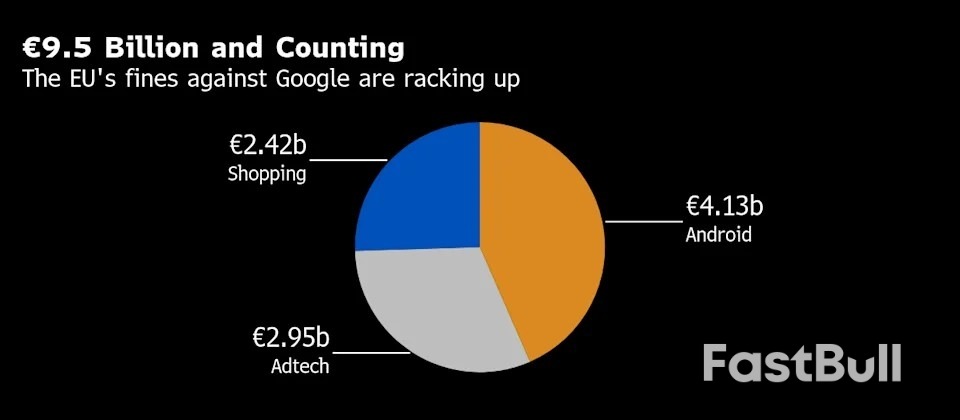
          The fine, which totaled €2.95 billion, ranks among Brussels’ toughest sanctions and is the second highest by the EU against Google for alleged abuses of dominance. It follows a €4.125 billion Android penalty and a €2.42 billion fine for crushing shopping search rivals. A €1.49 billion AdSense levy was annulled last year. The decisions push Google’s EU liabilities to just shy of €10 billion — far outpacing fines against Apple, Meta Platforms Inc. and Microsoft Corp.Trump Threatens Trade Actions After EU Fines Google Over Ad Tech_1
          The Mountain View, California-based company is No. 1 in the $757.5 billion global digital ad market, according to 2025 estimates by research firm EMarketer. In total, worldwide, Google is expected to pull in $205.04 billion in digital ad revenue in 2025. Most of that, $171.72 billion, comes from Google’s global search advertising business. The remaining $33.33 billion is from display ads. Google runs an ad-buying service for marketers and an ad-selling one for publishers, as well as a trading exchange where both sides complete transactions in lightning-fast auctions.
          Angela Mills Wade, executive director of the European Publishers Council, which brought the complaint to the European Commission said “a fine will not fix Europe’s broken adtech market.”
          “Without strong and decisive enforcement, Google will simply write this off as a cost of business while consolidating its dominance in the AI era,” she said. “Europe risks undermining its own rules and weakening the news media and publishing sector.”
          The EU punishment comes at a tense moment for EU–US trade relations, with Trump repeatedly deriding the bloc’s efforts to rein in Silicon Valley giants. Although Google faces antitrust scrutiny worldwide, it won some relief this week when a US judge ruled that its search business would not need to be broken up to address the harms alleged by the Department of Justice.
          Google’s adtech operations, however, also remain under threat in the US. The DOJ is expected to file proposed remedies later on Friday in another case, ahead of a Sept. 22 hearing on those proposals. Previously, the department had floated forcing Google to divest its Ad Manager platform to tackle the alleged anticompetitive risks.
          The EU’s Ribera pointed to the potential for a US ruling that would force Google to break up its ad tech platform.
          “At this stage, it appears that the only way for Google to end its conflict of interest effectively is with a structural remedy, such as selling some part of its Adtech business,” she said in her statement.
          The EU warned Google in 2023 that it had abused its dominance in advertising technology to harm online publishers. At the time, the Brussels-based commission said Google had favored its own ad exchange program over its rivals and bolstered the company’s central role in the ad tech supply chain.
          Ribera’s predecessor Margrethe Vestager said then that only a “mandatory divestment” of part of its business would solve the issues. The Dane had spent a decade in Brussels, where she hit Google with fines of more than €8 billion across three different cases, although one penalty was annulled and another cut by EU judges.

          Source: Bloomberg

          Risk Warnings and Disclaimers
          You understand and acknowledge that there is a high degree of risk involved in trading. Following any strategies or investment methods may lead to potential losses. The content on the site is provided by our contributors and analysts for information purposes only. You are solely responsible for determining whether any trading assets, securities, strategy, or any other product is suitable for investing based on your own investment objectives and financial situation.
          Add to Favorites
          Share
          FastBull
          Copyright © 2025 FastBull Ltd

          728 RM B 7/F GEE LOK IND BLDG NO 34 HUNG TO RD KWUN TONG KLN HONG KONG

          TelegramInstagramTwitterfacebooklinkedin
          App Store Google Play Google Play
          Products
          Charts

          Chats

          Q&A with Experts
          Screeners
          Economic Calendar
          Data
          Tools
          Membership
          Features
          Function
          Markets
          Copy Trading
          Latest Signals
          Contests
          News
          Analysis
          24/7
          Columns
          Education
          Company
          Careers
          About Us
          Contact Us
          Advertising
          Help Center
          Feedback
          User Agreement
          Privacy Policy
          Business

          White Label

          Data API

          Web Plug-ins

          Poster Maker

          Affiliate Program

          Risk Disclosure

          The risk of loss in trading financial instruments such as stocks, FX, commodities, futures, bonds, ETFs and crypto can be substantial. You may sustain a total loss of the funds that you deposit with your broker. Therefore, you should carefully consider whether such trading is suitable for you in light of your circumstances and financial resources.

          No decision to invest should be made without thoroughly conducting due diligence by yourself or consulting with your financial advisors. Our web content might not suit you since we don't know your financial conditions and investment needs. Our financial information might have latency or contain inaccuracy, so you should be fully responsible for any of your trading and investment decisions. The company will not be responsible for your capital loss.

          Without getting permission from the website, you are not allowed to copy the website's graphics, texts, or trademarks. Intellectual property rights in the content or data incorporated into this website belong to its providers and exchange merchants.

          Not Logged In

          Log in to access more features

          FastBull Membership

          Not yet

          Purchase

          Become a signal provider
          Help Center
          Customer Service
          Dark Mode
          Price Up/Down Colors

          Log In

          Sign Up

          Position
          Layout
          Fullscreen
          Default to Chart
          The chart page opens by default when you visit fastbull.com
