• Trade
  • Markets
  • Copy
  • Contests
  • News
  • 24/7
  • Calendar
  • Q&A
  • Chats
Trending
Screeners
SYMBOL
LAST
BID
ASK
HIGH
LOW
NET CHG.
%CHG.
SPREAD
SPX
S&P 500 Index
6827.42
6827.42
6827.42
6899.86
6801.80
-73.58
-1.07%
--
DJI
Dow Jones Industrial Average
48458.04
48458.04
48458.04
48886.86
48334.10
-245.98
-0.51%
--
IXIC
NASDAQ Composite Index
23195.16
23195.16
23195.16
23554.89
23094.51
-398.69
-1.69%
--
USDX
US Dollar Index
97.910
97.990
97.910
98.070
97.810
-0.040
-0.04%
--
EURUSD
Euro / US Dollar
1.17463
1.17470
1.17463
1.17596
1.17262
+0.00069
+ 0.06%
--
GBPUSD
Pound Sterling / US Dollar
1.33862
1.33872
1.33862
1.33961
1.33546
+0.00155
+ 0.12%
--
XAUUSD
Gold / US Dollar
4332.67
4333.08
4332.67
4350.16
4294.68
+33.28
+ 0.77%
--
WTI
Light Sweet Crude Oil
56.902
56.932
56.902
57.601
56.789
-0.331
-0.58%
--

Community Accounts

Signal Accounts
--
Profit Accounts
--
Loss Accounts
--
View More

Become a signal provider

Sell trading signals to earn additional income

View More

Guide to Copy Trading

Get started with ease and confidence

View More

Signal Accounts for Members

All Signal Accounts

Best Return
  • Best Return
  • Best P/L
  • Best MDD
Past 1W
  • Past 1W
  • Past 1M
  • Past 1Y

All Contests

  • All
  • Trump Updates
  • Recommend
  • Stocks
  • Cryptocurrencies
  • Central Banks
  • Featured News
Top News Only
Share

Bank Of America Expects A Deficit In Aluminium Next Year And Sees Prices Pushing Above $3000/T

Share

Fed Data - USA Effective Federal Funds Rate At 3.64 Percent On 12 December On $102 Billion In Trades Versus 3.64 Percent On $99 Billion On 11 December

Share

Brazil's Petrobras Says No Impact Seen On Oil, Petroleum Products Output As Workers Start Planned Strike

Share

Statement: US Travel Group Warns New Proposed Trump Administration Requirements For Foreign Tourists To Provide Social Media Histories Could Mean Millions Of People Opting Not To Visit

Share

Blackrock: Kerry White Will Become Head Of Citi Investment Management At Citi Wealth

Share

Blackrock: Rob Jasminski, Head Of Citi Investment Management, Has Joined With Team

Share

Blackrock: Effective Dec 15, Citi Investment Management Employees Will Join Blackrock

Share

Blackrock: Formally Launch Citi Portfolio Solutions Powered By Blackrock

Share

According To Data From The Federal Reserve Bank Of New York, The Secured Overnight Funding Rate (Sofr) Was 3.67% On The Previous Trading Day (December 15), Compared To 3.66% The Day Before

Share

Peru Energy And Mines Ministry: Copper Production Up 4.8% Year-On-Year In October To 248192 Metric Tons

Share

Security Source: Ukrainian Drones Hits Russian Oil Infrastructure In Caspian Sea For Third Time

Share

Spot Palladium Extends Gains, Last Up 5% To $1562.7/Oz

Share

Mexico's Economy Ministry Announces Start Of Anti-Dumping Investigation And Anti-Subsidy Investigations Into USA Pork Imports

Share

Canada Nov CPI Common +2.8%, CPI Median +2.8%, CPI Trim +2.8% On Year

Share

NY Fed's Empire State Prices Paid Index +37.6 In December Versus+49.0 In November

Share

Canada Nov Consumer Prices +0.1% On Month, +2.2% On Year

Share

Canada Nov CPI Core -0.1% On Month, +2.9% On Year

Share

Canada Nov Core CPI, Seasonally Adjusted +0.2% On Month, Oct +0.3% (Unrevised)

Share

UK Health Minister Streeting On Doctors' Strike: Vote To Go Ahead Reveals The Bma's Shocking Disregard For Patient Safety

Share

Venezuelan State Oil Company Pdvsa Says Was Subject To Cyber Attack But Operations Unaffected

TIME
ACT
FCST
PREV
Japan Tankan Small Manufacturing Outlook Index (Q4)

A:--

F: --

P: --

Japan Tankan Large Non-Manufacturing Outlook Index (Q4)

A:--

F: --

P: --

Japan Tankan Large Manufacturing Outlook Index (Q4)

A:--

F: --

P: --

Japan Tankan Small Manufacturing Diffusion Index (Q4)

A:--

F: --

P: --

Japan Tankan Large Manufacturing Diffusion Index (Q4)

A:--

F: --

P: --

Japan Tankan Large-Enterprise Capital Expenditure YoY (Q4)

A:--

F: --

P: --

U.K. Rightmove House Price Index YoY (Dec)

A:--

F: --

P: --

China, Mainland Industrial Output YoY (YTD) (Nov)

A:--

F: --

P: --

China, Mainland Urban Area Unemployment Rate (Nov)

A:--

F: --

P: --

Saudi Arabia CPI YoY (Nov)

A:--

F: --

P: --

Euro Zone Industrial Output YoY (Oct)

A:--

F: --

P: --

Euro Zone Industrial Output MoM (Oct)

A:--

F: --

P: --

Canada Existing Home Sales MoM (Nov)

A:--

F: --

P: --

Canada National Economic Confidence Index

A:--

F: --

P: --

Canada New Housing Starts (Nov)

A:--

F: --

P: --
U.S. NY Fed Manufacturing Employment Index (Dec)

A:--

F: --

P: --

U.S. NY Fed Manufacturing Index (Dec)

A:--

F: --

P: --

Canada Core CPI YoY (Nov)

A:--

F: --

P: --

Canada Manufacturing Unfilled Orders MoM (Oct)

A:--

F: --

P: --

U.S. NY Fed Manufacturing Prices Received Index (Dec)

A:--

F: --

P: --

U.S. NY Fed Manufacturing New Orders Index (Dec)

A:--

F: --

P: --

Canada Manufacturing New Orders MoM (Oct)

A:--

F: --

P: --

Canada Core CPI MoM (Nov)

A:--

F: --

P: --

Canada Trimmed CPI YoY (SA) (Nov)

A:--

F: --

P: --

Canada Manufacturing Inventory MoM (Oct)

A:--

F: --

P: --

Canada CPI YoY (Nov)

A:--

F: --

P: --

Canada CPI MoM (Nov)

A:--

F: --

P: --

Canada CPI YoY (SA) (Nov)

A:--

F: --

P: --

Canada Core CPI MoM (SA) (Nov)

A:--

F: --

P: --

Canada CPI MoM (SA) (Nov)

A:--

F: --

P: --

Federal Reserve Board Governor Milan delivered a speech
U.S. NAHB Housing Market Index (Dec)

--

F: --

P: --

Australia Composite PMI Prelim (Dec)

--

F: --

P: --

Australia Services PMI Prelim (Dec)

--

F: --

P: --

Australia Manufacturing PMI Prelim (Dec)

--

F: --

P: --

Japan Manufacturing PMI Prelim (SA) (Dec)

--

F: --

P: --

U.K. 3-Month ILO Employment Change (Oct)

--

F: --

P: --

U.K. Unemployment Claimant Count (Nov)

--

F: --

P: --

U.K. Unemployment Rate (Nov)

--

F: --

P: --

U.K. 3-Month ILO Unemployment Rate (Oct)

--

F: --

P: --

U.K. Average Weekly Earnings (3-Month Average, Including Bonuses) YoY (Oct)

--

F: --

P: --

U.K. Average Weekly Earnings (3-Month Average, Excluding Bonuses) YoY (Oct)

--

F: --

P: --

France Services PMI Prelim (Dec)

--

F: --

P: --

France Composite PMI Prelim (SA) (Dec)

--

F: --

P: --

France Manufacturing PMI Prelim (Dec)

--

F: --

P: --

Germany Services PMI Prelim (SA) (Dec)

--

F: --

P: --

Germany Manufacturing PMI Prelim (SA) (Dec)

--

F: --

P: --

Germany Composite PMI Prelim (SA) (Dec)

--

F: --

P: --

Euro Zone Composite PMI Prelim (SA) (Dec)

--

F: --

P: --

Euro Zone Services PMI Prelim (SA) (Dec)

--

F: --

P: --

Euro Zone Manufacturing PMI Prelim (SA) (Dec)

--

F: --

P: --

U.K. Services PMI Prelim (Dec)

--

F: --

P: --

U.K. Manufacturing PMI Prelim (Dec)

--

F: --

P: --

U.K. Composite PMI Prelim (Dec)

--

F: --

P: --

Euro Zone ZEW Economic Sentiment Index (Dec)

--

F: --

P: --

Germany ZEW Current Conditions Index (Dec)

--

F: --

P: --

Germany ZEW Economic Sentiment Index (Dec)

--

F: --

P: --

Euro Zone Trade Balance (Not SA) (Oct)

--

F: --

P: --

Euro Zone ZEW Current Conditions Index (Dec)

--

F: --

P: --

Euro Zone Trade Balance (SA) (Oct)

--

F: --

P: --

U.S. Retail Sales MoM (Excl. Automobile) (SA) (Oct)

--

F: --

P: --

Q&A with Experts
    • All
    • Chatrooms
    • Groups
    • Friends
    Connecting
    .
    .
    .
    Type here...
    Add Symbol or Code

      No matching data

      All
      Trump Updates
      Recommend
      Stocks
      Cryptocurrencies
      Central Banks
      Featured News
      • All
      • Russia-Ukraine Conflict
      • Middle East Flashpoint
      • All
      • Russia-Ukraine Conflict
      • Middle East Flashpoint
      Search
      Products

      Charts Free Forever

      Chats Q&A with Experts
      Screeners Economic Calendar Data Tools
      Membership Features
      Data Warehouse Market Trends Institutional Data Policy Rates Macro

      Market Trends

      Market Sentiment Order Book Forex Correlations

      Top Indicators

      Charts Free Forever
      Markets

      News

      News Analysis 24/7 Columns Education
      From Institutions From Analysts
      Topics Columnists

      Latest Views

      Latest Views

      Trending Topics

      Top Columnists

      Latest Update

      Signals

      Copy Rankings Latest Signals Become a signal provider AI Rating
      Contests
      Brokers

      Overview Brokers Assessment Rankings Regulators News Claims
      Broker listing Forex Brokers Comparison Tool Live Spread Comparison Scam
      Q&A Complaint Scam Alert Videos Tips to Detect Scam
      More

      Business
      Events
      Careers About Us Advertising Help Center

      White Label

      Data API

      Web Plug-ins

      Affiliate Program

      Awards Institution Evaluation IB Seminar Salon Event Exhibition
      Vietnam Thailand Singapore Dubai
      Fans Party Investment Sharing Session
      FastBull Summit BrokersView Expo
      Recent Searches
        Top Searches
          Markets
          News
          Analysis
          User
          24/7
          Economic Calendar
          Education
          Data
          • Names
          • Latest
          • Prev

          View All

          No data

          Scan to Download

          Faster Charts, Chat Faster!

          Download App
          English
          • English
          • Español
          • العربية
          • Bahasa Indonesia
          • Bahasa Melayu
          • Tiếng Việt
          • ภาษาไทย
          • Français
          • Italiano
          • Türkçe
          • Русский язык
          • 简中
          • 繁中
          Open Account
          Search
          Products
          Charts Free Forever
          Markets
          News
          Signals

          Copy Rankings Latest Signals Become a signal provider AI Rating
          Contests
          Brokers

          Overview Brokers Assessment Rankings Regulators News Claims
          Broker listing Forex Brokers Comparison Tool Live Spread Comparison Scam
          Q&A Complaint Scam Alert Videos Tips to Detect Scam
          More

          Business
          Events
          Careers About Us Advertising Help Center

          White Label

          Data API

          Web Plug-ins

          Affiliate Program

          Awards Institution Evaluation IB Seminar Salon Event Exhibition
          Vietnam Thailand Singapore Dubai
          Fans Party Investment Sharing Session
          FastBull Summit BrokersView Expo

          Japan Commits $68 Billion Investment in India Over the Next Decade, Launches Strategic Economic Security Initiative

          Gerik

          Economic

          Summary:

          At the Tokyo summit on August 29, Japan pledged to invest 10 trillion yen ($68 billion) in India over the next ten years, marking a new phase in the Japan–India Special Strategic Partnership with a focus on technology...

          Tokyo Summit Marks Deepening of Japan–India Strategic Cooperation

          During a high-profile summit in Tokyo, Japanese Prime Minister Shigeru Ishiba and Indian Prime Minister Narendra Modi unveiled a 10-year roadmap aimed at significantly expanding economic and technological ties between their two nations. The centerpiece of the announcement was Japan’s commitment to invest 10 trillion yen approximately $68 billion into India’s key sectors through private capital by 2035.
          This initiative, as outlined by Prime Minister Ishiba, targets strategic industries such as high technology, digital transformation, and rare earth minerals. His remarks underscored the causal relationship between India’s market potential and Japan’s pursuit of sustainable regional growth amid a volatile global landscape.

          A Milestone in Japan’s Confidence in India

          Prime Minister Ishiba also revealed that Japan had already met its previous goal of investing 5 trillion yen between 2022 and 2026 two years ahead of schedule demonstrating growing confidence in India’s economic trajectory. This early completion is both symbolic and strategic, reflecting Tokyo’s deepening alignment with New Delhi as a counterweight to regional disruptions.
          From India’s perspective, Modi emphasized that the partnership had entered a “new chapter,” anchored in pillars of investment, innovation, economic security, green technology, healthcare, and regional exchanges. The bilateral framework now includes eight key domains that extend beyond trade to institutional cooperation and people-to-people ties.

          Workforce Mobility and Supply Chain Integration

          One of the most notable aspects of the partnership is a large-scale workforce exchange plan. Over the next five years, the two countries will facilitate the movement of 500,000 individuals including 50,000 skilled Indian workers to contribute to Japan’s labor market and local communities. This exchange not only supports Japan’s demographic needs but also showcases a mutually reinforcing model of combining Japanese capital with Indian talent.
          To facilitate investment, Prime Minister Modi pledged further administrative and regulatory reforms to help Japanese firms expand their supply chains in India. He also encouraged investors to leverage what he termed the "synergy of Japanese technology and Indian human capital" a narrative that reaffirms India’s pitch as a strategic manufacturing and innovation hub.

          Japan–India Economic Security Initiative and Technological Frontiers

          The summit also marked the official launch of the Japan–India Economic Security Initiative, aimed at enhancing supply chain resilience in critical sectors such as semiconductors, telecommunications, pharmaceuticals, and emerging technologies. This is a causal response to growing geopolitical risks and reflects a shared goal of reducing dependency on external actors, particularly in sensitive industries.
          Both leaders emphasized high-tech cooperation as a top priority. Collaborative projects are expected to focus on artificial intelligence (AI) and next-generation mobility systems including smart ports, advanced aviation, and maritime technologies. These areas align closely with both nations’ industrial policy agendas and long-term development strategies.

          Space Collaboration: Chandrayaan-5 and Beyond

          In the aerospace domain, ISRO (India) and JAXA (Japan) have agreed to collaborate on the upcoming Chandrayaan-5 lunar mission, with a specific aim of exploring the Moon’s South Pole. The mission, scheduled for 2027–2028, highlights the maturation of space diplomacy between the two nations and could pave the way for more ambitious joint missions in deep space exploration and satellite technologies.
          The 2025 Tokyo summit between Japan and India marks a pivotal step in the evolution of a multi-dimensional strategic partnership. With a historic investment commitment, expanded industrial and technological cooperation, and an ambitious framework for workforce and space collaboration, both nations are positioning themselves as co-architects of a new, resilient Indo-Pacific economic order. As global supply chains fragment and geopolitical alignments shift, this bilateral alignment stands out as a model of pragmatic and forward-looking cooperation.
          To stay updated on all economic events of today, please check out our Economic calendar
          Risk Warnings and Disclaimers
          You understand and acknowledge that there is a high degree of risk involved in trading. Following any strategies or investment methods may lead to potential losses. The content on the site is provided by our contributors and analysts for information purposes only. You are solely responsible for determining whether any trading assets, securities, strategy, or any other product is suitable for investing based on your own investment objectives and financial situation.
          Add to Favorites
          Share

          Canada’s Q2 Economic Slowdown Deepens as U.S. Tariffs Weigh on Exports

          Gerik

          Economic

          External Trade Pressures Reverse Canada’s Growth Momentum

          Canada’s economy faced a pronounced deceleration in the second quarter of 2025, with fresh U.S. tariffs delivering a direct blow to its export sector. The impact of these protectionist measures has been particularly severe given Canada’s integration into the North American supply chain. While domestic demand provided some insulation against external shocks, the negative trade balance tipped overall growth into contraction territory.
          Analysts attribute the downturn primarily to declining export performance. Canada’s tight linkage to U.S. and global value chains renders it especially sensitive to rising trade barriers. The causal relationship between U.S. tariffs and Canada’s export slump is clearly visible in the Q2 figures, revealing how global protectionism can override internal economic momentum.

          Domestic Economy Remains Resilient, but Vulnerabilities Grow

          Despite the headline contraction, domestic components of GDP showed unexpected strength. According to Derek Holt of Scotiabank, final domestic demand which includes household consumption, business investment, and public sector spending grew by 3.4% quarter-over-quarter. This figure reflects a partial decoupling between domestic and external dynamics, underscoring the short-term resilience of Canada’s internal economy.
          However, economists like Jimmy Jean from Desjardins warn that this resilience may mask underlying fragilities. While not yet in a recession, Canada’s exposure to global trade tensions especially from its largest trading partner could trigger deeper declines if external demand continues to weaken. Jean emphasized that the export sector has become a clear structural weak point in Canada’s post-pandemic recovery trajectory.

          Monetary Policy Outlook Hinges on Dual Pressures

          This economic backdrop presents a complex challenge for the Bank of Canada (BoC). Although strong domestic activity might argue for policy patience, the drag from trade and weakening external demand could tilt the central bank toward a rate cut as early as September. The BoC’s decision will likely rest on upcoming labor market and inflation data. If domestic stability falters or inflation re-accelerates, policymakers may feel compelled to intervene more decisively.
          The interplay between export vulnerability and monetary flexibility suggests a bifurcated policy path ahead. A rate cut would aim to stabilize investment and consumer confidence, while a hold might be warranted if internal momentum proves sustainable. The choice will hinge on whether internal strength can continue compensating for external fragility.

          Broader Implications for Trade-Dependent Economies

          Canada’s experience is not isolated. Economies heavily reliant on U.S. trade including the European Union and Mexico have also reported export slowdowns under the weight of Washington’s widening tariff regime. However, Canada’s deep structural integration with U.S. supply chains particularly in the automotive, energy, and agricultural sectors makes it uniquely susceptible to fluctuations in cross-border trade policy.
          As the Trump administration escalates its tariff strategy across multiple regions and product categories, Canada’s economic outlook may become increasingly conditioned by geopolitical trade dynamics rather than domestic fundamentals alone.a
          Canada’s second-quarter economic contraction illustrates how quickly external shocks in this case, punitive U.S. tariffs can undermine a stable domestic backdrop. While internal consumption and investment remain supportive, the erosion of export strength threatens broader macroeconomic balance. The Bank of Canada now faces a policy crossroads: either move to shield the economy with a rate cut or gamble on continued domestic momentum to absorb the shock. The decision, and its timing, will be closely watched not just in Ottawa, but across a global economy grappling with renewed trade fragmentation.
          To stay updated on all economic events of today, please check out our Economic calendar
          Risk Warnings and Disclaimers
          You understand and acknowledge that there is a high degree of risk involved in trading. Following any strategies or investment methods may lead to potential losses. The content on the site is provided by our contributors and analysts for information purposes only. You are solely responsible for determining whether any trading assets, securities, strategy, or any other product is suitable for investing based on your own investment objectives and financial situation.
          Add to Favorites
          Share

          Fed’s Preferred Inflation Gauge Rises Again, September Rate Cut Hinges on Labor Data

          Gerik

          Economic

          PCE Inflation Accelerates, Testing Fed's 2% Target

          According to the latest report from the U.S. Department of Commerce, the Personal Consumption Expenditures (PCE) Price Index the Federal Reserve’s preferred inflation metric showed a 2.9% increase in core prices in July 2024 compared to the same month last year. This marks a 0.1 percentage point rise from June and is the strongest annual gain in five months. On a monthly basis, core PCE rose 0.3%, perfectly in line with market expectations.
          Headline PCE, which includes food and energy, climbed 2.6% year-over-year and 0.2% month-over-month. These results match Dow Jones forecasts and signal that while inflation is cooling from 2022 highs, it remains above the Fed’s 2% target, prompting debate over the timing and magnitude of future rate cuts.

          Services Drive Price Gains, Tariff Effects Remain Contained

          The July inflation uptick is largely attributed to a strong rise in services costs, which increased 3.6% annually and 0.3% monthly. In contrast, goods prices rose a modest 0.5% year-over-year and actually declined 0.1% on the month, suggesting only a weak correlation between goods inflation and recent tariff policy.
          Energy prices fell 2.7% compared to a year ago, helping to offset headline inflation, while food prices rose 1.9%. On a monthly basis, energy and food prices decreased by 1.1% and 0.1%, respectively. According to Capital Economics' Harry Chambers, these data points imply that Trump-era tariffs have had limited causal impact on goods inflation, which remains subdued despite new import duties.

          Consumer Spending and Income Support Inflation Resilience

          Consumer spending in July rose 0.5% month-over-month, aligned with forecasts, and personal incomes increased 0.4%, further reinforcing strong household demand despite elevated prices. This indicates a causal support mechanism for inflation persistence: with consumers still spending, price pressures particularly in services remain sticky.
          Although inflation has yet to return to target, Fed officials remain open to rate cuts. Governor Christopher Waller reiterated his support for a potential cut in September, citing the need to respond flexibly to evolving labor market conditions. He hinted at the possibility of a “stronger move” if employment weakens materially in the coming weeks.
          According to Morgan Stanley’s Ellen Zentner, the Fed appears “ready” to reduce interest rates but is awaiting confirmation on which risk inflation or labor deterioration poses the greater threat. With July’s inflation data meeting but not exceeding expectations, all attention now turns to the August jobs report, due in early September. This will likely serve as the decisive factor in the Fed’s policy choice.
          While core inflation remains elevated, the July PCE report does not on its own rule out a rate cut at the Fed’s September meeting. With tariffs contributing little to inflationary pressure and consumer demand remaining firm, the balance of risks may now shift toward supporting growth. The Fed’s decision will likely rest on the strength or fragility of the upcoming labor market report, making early September a pivotal moment for global monetary policy watchers.
          To stay updated on all economic events of today, please check out our Economic calendar
          Risk Warnings and Disclaimers
          You understand and acknowledge that there is a high degree of risk involved in trading. Following any strategies or investment methods may lead to potential losses. The content on the site is provided by our contributors and analysts for information purposes only. You are solely responsible for determining whether any trading assets, securities, strategy, or any other product is suitable for investing based on your own investment objectives and financial situation.
          Add to Favorites
          Share

          US Appeals Court Rules Wide Swath of Trump's Tariffs Illegal

          Manuel

          Economic

          China–U.S. Trade War

          A federal appeals court ruled on Friday that most of President Trump's global tariffs were illegal. The ruling explains the president exceeded his authority in using emergency powers to impose them.
          The judges allowed the tariffs to stay in place as the case continues to be adjudicated in a lower court. Friday's decision from the US Court of Appeals for the Federal Circuit reaffirms an earlier ruling by the Court of International Trade.
          Trump responded to the decision on Truth Social, saying "ALL TARIFFS ARE STILL IN EFFECT!" He also called the court "Highly Partisan" and said "with the help of the United States Supreme Court, we will use [tariffs] to benefit our nation."
          The case is expected to eventually make it to the US Supreme Court, but Friday's decision to send it back to a lower court could delay that outcome, Bloomberg reports.
          Meanwhile, Brazilian President Luiz Inacio Lula da Silva has authorized plans to retaliate against the 50% US tariffs imposed by President Trump, though the Brazilian leader emphasized he is looking to negotiate with the US administration.
          "This is a somewhat lengthy process, and I'm in no hurry to do anything about reciprocity against the US," Lula said.
          Separately, the $800 duty-free loophole ends Friday, with small imported packages to the US facing tariffs of 10% to 50%, depending on their origin.
          The European Commission proposed on Thursday to withdraw all tariffs on imported US industrial goods in a bid to speed up the removal of US duties on European cars.
          The proposal is the first step in enacting the framework agreement between Trump and Commission President Ursula von der Leyen, which was established last month. Trump requested the removal of tariffs before the US lowers its duties on the bloc's auto exports.
          Meanwhile, Mexico is set to join the US with tariffs and will raise duties on Chinese goods under its 2026 budget plan, Bloomberg reported on Wednesday. The proposal, due next month, targets cars, textiles, and plastics to shield local industries from cheap imports.
          US pressure on Mexico stems from Trump's claim that cheap Chinese goods slip into Mexico before heading north.
          Meanwhile, Trump's 50% tariffs on India have now kicked in, a move that experts say could upend a decades-long push by Washington to forge closer ties with New Delhi. Trump added an extra 25% tariff on Indian imports because of the country's purchase of Russian oil.
          The unfolding situations with both India and Mexico are the latest examples of how Trump's tariffs are pushing countries to choose sides between the US and China.
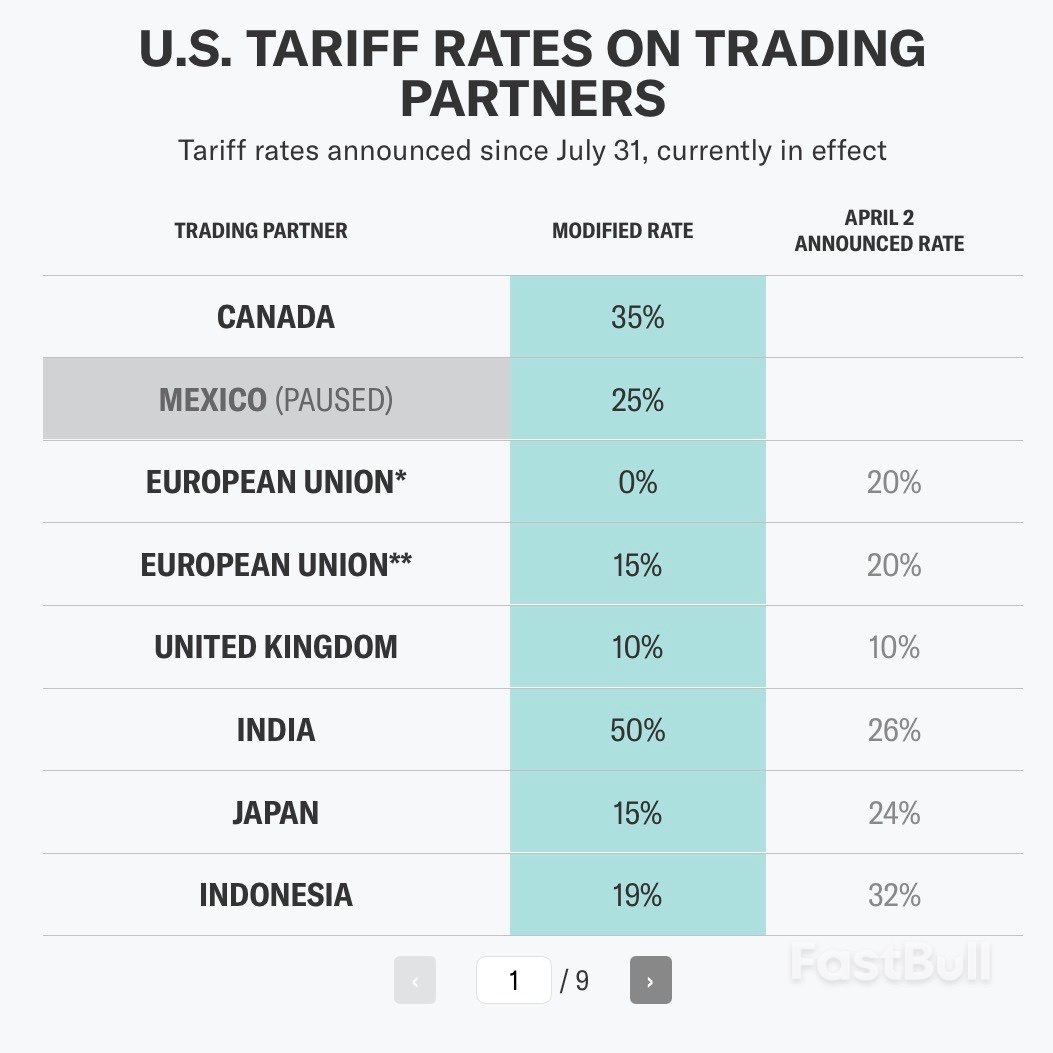
          Earlier in August, Trump unveiled "reciprocal" tariffs on dozens of US trade partners (which you can see in the graphic below).US Appeals Court Rules Wide Swath of Trump's Tariffs Illegal_1
          Those tariffs face legal limbo in an appeals court case that could be decided within days.
          Justice Department lawyers and lawyers for a group of small business importers who are challenging the tariffs imposed under this authority argued their positions before the US Court of Appeals for the Federal Circuit. If the court rules against the government, it's likely Trump would appeal to the Supreme Court.

          Source: Yahoo Finance

          To stay updated on all economic events of today, please check out our Economic calendar
          Risk Warnings and Disclaimers
          You understand and acknowledge that there is a high degree of risk involved in trading. Following any strategies or investment methods may lead to potential losses. The content on the site is provided by our contributors and analysts for information purposes only. You are solely responsible for determining whether any trading assets, securities, strategy, or any other product is suitable for investing based on your own investment objectives and financial situation.
          Add to Favorites
          Share

          Morgan Stanley Asks Fed to Lower Bank’s Capital Requirement

          Manuel

          Central Bank

          Political

          Morgan Stanley asked the Federal Reserve to reduce its capital requirements, the regulator said as it announced upcoming capital requirements for most Wall Street banks that are in line with lenders’ expectations.
          “The firm requested reconsideration to reduce this requirement,” the Federal Reserve said in a statement Friday. “The board is reviewing the request to reduce the firm’s stress capital buffer requirement,” and plans to make and publish a decision by Sept. 30.
          The central bank’s announcement formally wraps up its annual stress-tests exercise, a multistep process that assesses how the nation’s largest lenders are likely to perform under hypothetical economic conditions. It concludes with an updated total Common Equity Tier 1 capital-ratio requirement for each firm, which will take effect Oct 1.
          “Morgan Stanley remains actively engaged with the Federal Reserve to reach a final SCB requirement” before Oct. 1, the New York-based bank said in a statement.
          The Fed didn’t specify the reduction that Morgan Stanley was requesting. The company said last month that, based on its stress-test result, it expected its CET1 requirement to drop to 12.6% from the current 13.5%.
          A total of 22 banks, including Morgan Stanley, underwent and comfortably passed this year’s Fed stress test that determined they would be able to withstand more than $550 billion in losses. Friday’s capital requirements tied to that test is made up of several components, including a minimum CET1 capital-ratio requirement of 4.5% — the same for each company — and the stress capital buffer requirement. The biggest lenders, or so-called global systemically important banks, are also subject to a capital surcharge.
          The Fed’s announcement comes as the industry awaits the outcome of the Fed’s planned changes to its stress-test process. In April, the agency unveiled a proposal to average results over two years when setting capital requirements. Michelle Bowman, the Fed’s vice chair for supervision, has said that potential changes would help the agency address the “excessive volatility in the stress-test results and corresponding capital requirements.”
          “The individual capital requirements announced today represent a period of transition,” Bowman said in the statement, adding that finalizing the April plan would be an important next step to reducing year-over-year volatility in bank capital requirements.
          The Fed also unveiled plans to decrease what’s called the enhanced supplementary leverage ratio, which requires banks to hold a certain amount of capital relative to their assets. The regulator also will move to propose a fresh risk-based capital plan that Wall Street has advocated for.

          Source: Bloomberg

          Risk Warnings and Disclaimers
          You understand and acknowledge that there is a high degree of risk involved in trading. Following any strategies or investment methods may lead to potential losses. The content on the site is provided by our contributors and analysts for information purposes only. You are solely responsible for determining whether any trading assets, securities, strategy, or any other product is suitable for investing based on your own investment objectives and financial situation.
          Add to Favorites
          Share

          Oil Slides to Monthly Loss as Traders Weigh Glut, Geopolitics

          Manuel

          Commodity

          Political

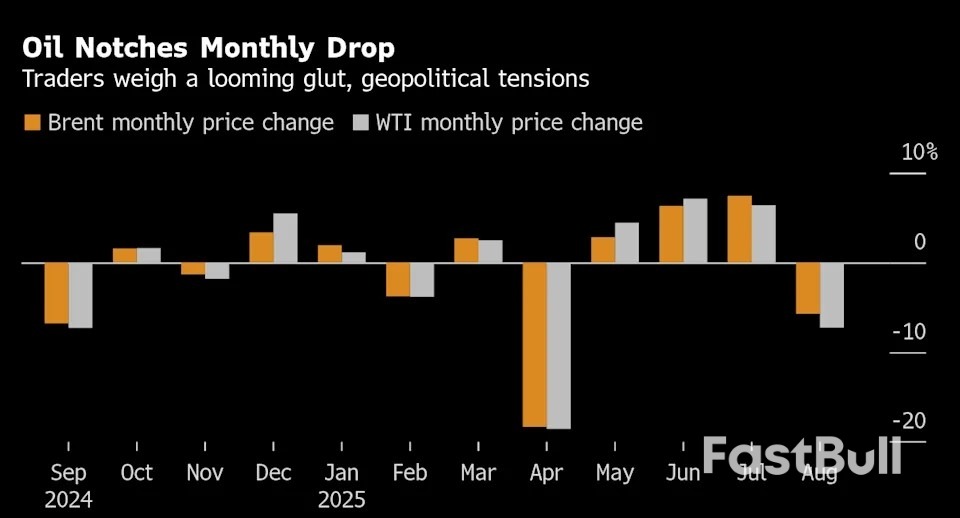
          Oil notched its first monthly loss since April, with trading dominated by concerns about a looming glut and geopolitical issues, including US-led efforts to end the war in Ukraine.
          West Texas Intermediate for October delivery slid 0.9% to settle near $64 a barrel, with the US benchmark down 7.6% this month. Brent closed above $68. Oil has lost ground in August on worries that global supplies will run ahead of demand in the coming quarters, boosting stockpiles.
          The commodity’s slump deepened on Friday after US consumer sentiment declined to a three-month low, reflecting concerns that tariffs will hurt the economy.Oil Slides to Monthly Loss as Traders Weigh Glut, Geopolitics_1
          nvestors are also focused on Ukraine and potential shifts in crude flows from Russia. US President Donald Trump was “not happy” about Moscow’s recent strikes on Ukraine, White House Press Secretary Karoline Leavitt said. Washington has imposed a 50% levy on most Indian imports to punish the South Asian nation for buying Russian crude.
          Moscow unleashed a wave of drone and missile strikes on Kyiv earlier this week, in defiance of US calls for an end to the fighting, killing 18 people, Ukrainian authorities said.
          A meeting between Ukrainian President Volodymyr Zelenskiy and Russia’s Vladimir Putin was unlikely, according to German Chancellor Friedrich Merz. Trump has threatened “very big consequences” if Moscow doesn’t come to the negotiating table.
          Oil is down 11% this year on concerns that Trump’s trade war will hurt energy consumption at the same time that OPEC+ is working to restore idled capacity.
          “More OPEC+ oil is coming to the market amid worries over US economic growth, which keeps the market well-supplied,” said Jens Naervig Pedersen, a strategist at Danske Bank AS.
          Trading volumes on Friday were muted ahead of the Labor Day holiday weekend in the US, contributing to exaggerated price swings.

          Source: Bloomberg

          Risk Warnings and Disclaimers
          You understand and acknowledge that there is a high degree of risk involved in trading. Following any strategies or investment methods may lead to potential losses. The content on the site is provided by our contributors and analysts for information purposes only. You are solely responsible for determining whether any trading assets, securities, strategy, or any other product is suitable for investing based on your own investment objectives and financial situation.
          Add to Favorites
          Share

          Dow, S&P 500, Nasdaq Slide as Nvidia Leads Tech Losses After PCE Inflation, Consumer Data

          Manuel

          Economic

          Stocks

          US stocks fell from record highs on Friday as Wall Street digested an update on consumer inflation that showed prices firming higher above the Fed's target in July.
          The Dow Jones Industrial Average (^DJI) fell around 0.3%, and the S&P 500 (^GSPC) lost about 0.8%. The tech-heavy Nasdaq Composite (^IXIC) led the retreat, down over 1.2%. Big Tech slumped, with Nvidia (NVDA) declining over 3% to end the week not long after releasing its highly anticipated earnings report.
          A key Fed-watched measure of inflation rose as expected in July, new government data showed Friday. The "core" Personal Consumption Expenditures index, closely studied by the central bank, rose 0.3% on a monthly basis and 2.9% on an annual basis, above the Fed's 2% inflation target. Both numbers matched economist expectations, though the annual pace marked the biggest rise since February.
          Meanwhile, US consumer sentiment declined to a three-month low as consumers in a University of Michigan survey suggested they expect inflation to surge over the next year.
          Friday's data comes after signs of a resilient economy helped lift the S&P 500 and Dow Jones Industrial Average to new all-time highs on Thursday.
          Bets that the Fed will ease rates at its September meeting were still riding high Friday, and traders were pricing in an 87% chance of a quarter-point cut following the PCE reading.
          The inflation data caps a whirlwind week for markets gripped by Nvidia earnings and President Trump's effort to oust Fed governor Lisa Cook, which took a new turn. On Friday, a judge is expected to rule on Cook's bid for a temporary restraining order.
          Despite the pullback in stocks on Friday, the major indexes were set for their longest streak of consecutive monthly gains in more than a year.
          The tech-heavy Nasdaq Composite was on track to see a 2% bump in August, marking its fifth straight monthly rise, the longest winning streak in nearly a year and a half. For their part, the S&P 500 and the Dow were set for their fourth consecutive month of gains, on track to add 1.6% and 2%, respectively — the longest since September 2024.
          And the Russell 2000 (^RUT), which includes small market capitalization companies, eyed a 6% jump for August, on course for its fourth monthly uptick, the longest streak in over four years.

          Source: Yahoo Finance

          To stay updated on all economic events of today, please check out our Economic calendar
          Risk Warnings and Disclaimers
          You understand and acknowledge that there is a high degree of risk involved in trading. Following any strategies or investment methods may lead to potential losses. The content on the site is provided by our contributors and analysts for information purposes only. You are solely responsible for determining whether any trading assets, securities, strategy, or any other product is suitable for investing based on your own investment objectives and financial situation.
          Add to Favorites
          Share
          FastBull
          Copyright © 2025 FastBull Ltd

          728 RM B 7/F GEE LOK IND BLDG NO 34 HUNG TO RD KWUN TONG KLN HONG KONG

          TelegramInstagramTwitterfacebooklinkedin
          App Store Google Play Google Play
          Products
          Charts

          Chats

          Q&A with Experts
          Screeners
          Economic Calendar
          Data
          Tools
          Membership
          Features
          Function
          Markets
          Copy Trading
          Latest Signals
          Contests
          News
          Analysis
          24/7
          Columns
          Education
          Company
          Careers
          About Us
          Contact Us
          Advertising
          Help Center
          Feedback
          User Agreement
          Privacy Policy
          Business

          White Label

          Data API

          Web Plug-ins

          Poster Maker

          Affiliate Program

          Risk Disclosure

          The risk of loss in trading financial instruments such as stocks, FX, commodities, futures, bonds, ETFs and crypto can be substantial. You may sustain a total loss of the funds that you deposit with your broker. Therefore, you should carefully consider whether such trading is suitable for you in light of your circumstances and financial resources.

          No decision to invest should be made without thoroughly conducting due diligence by yourself or consulting with your financial advisors. Our web content might not suit you since we don't know your financial conditions and investment needs. Our financial information might have latency or contain inaccuracy, so you should be fully responsible for any of your trading and investment decisions. The company will not be responsible for your capital loss.

          Without getting permission from the website, you are not allowed to copy the website's graphics, texts, or trademarks. Intellectual property rights in the content or data incorporated into this website belong to its providers and exchange merchants.

          Not Logged In

          Log in to access more features

          FastBull Membership

          Not yet

          Purchase

          Become a signal provider
          Help Center
          Customer Service
          Dark Mode
          Price Up/Down Colors

          Log In

          Sign Up

          Position
          Layout
          Fullscreen
          Default to Chart
          The chart page opens by default when you visit fastbull.com