Markets
News
Analysis
User
24/7
Economic Calendar
Education
Data
- Names
- Latest
- Prev


Signal Accounts for Members
All Signal Accounts
All Contests


France 10-Year OAT Auction Avg. YieldA:--
F: --
P: --
Euro Zone Retail Sales YoY (Oct)A:--
F: --
P: --
Brazil GDP YoY (Q3)A:--
F: --
P: --
U.S. Challenger Job Cuts (Nov)A:--
F: --
P: --
U.S. Challenger Job Cuts MoM (Nov)A:--
F: --
P: --
U.S. Challenger Job Cuts YoY (Nov)A:--
F: --
P: --
U.S. Initial Jobless Claims 4-Week Avg. (SA)A:--
F: --
P: --
U.S. Weekly Initial Jobless Claims (SA)A:--
F: --
P: --
U.S. Weekly Continued Jobless Claims (SA)A:--
F: --
P: --
Canada Ivey PMI (SA) (Nov)A:--
F: --
P: --
Canada Ivey PMI (Not SA) (Nov)A:--
F: --
P: --
U.S. Non-Defense Capital Durable Goods Orders Revised MoM (Excl. Aircraft) (SA) (Sept)A:--
F: --
U.S. Factory Orders MoM (Excl. Transport) (Sept)A:--
F: --
P: --
U.S. Factory Orders MoM (Sept)A:--
F: --
P: --
U.S. Factory Orders MoM (Excl. Defense) (Sept)A:--
F: --
P: --
U.S. EIA Weekly Natural Gas Stocks ChangeA:--
F: --
P: --
Saudi Arabia Crude Oil ProductionA:--
F: --
P: --
U.S. Weekly Treasuries Held by Foreign Central BanksA:--
F: --
P: --
Japan Foreign Exchange Reserves (Nov)A:--
F: --
P: --
India Repo RateA:--
F: --
P: --
India Benchmark Interest RateA:--
F: --
P: --
India Reverse Repo RateA:--
F: --
P: --
India Cash Reserve RatioA:--
F: --
P: --
Japan Leading Indicators Prelim (Oct)A:--
F: --
P: --
U.K. Halifax House Price Index YoY (SA) (Nov)A:--
F: --
P: --
U.K. Halifax House Price Index MoM (SA) (Nov)A:--
F: --
P: --
France Current Account (Not SA) (Oct)A:--
F: --
P: --
France Trade Balance (SA) (Oct)A:--
F: --
P: --
France Industrial Output MoM (SA) (Oct)A:--
F: --
P: --
Italy Retail Sales MoM (SA) (Oct)A:--
F: --
P: --
Euro Zone Employment YoY (SA) (Q3)--
F: --
P: --
Euro Zone GDP Final YoY (Q3)--
F: --
P: --
Euro Zone GDP Final QoQ (Q3)--
F: --
P: --
Euro Zone Employment Final QoQ (SA) (Q3)--
F: --
P: --
Euro Zone Employment Final (SA) (Q3)--
F: --
Brazil PPI MoM (Oct)--
F: --
P: --
Mexico Consumer Confidence Index (Nov)--
F: --
P: --
Canada Unemployment Rate (SA) (Nov)--
F: --
P: --
Canada Labor Force Participation Rate (SA) (Nov)--
F: --
P: --
Canada Employment (SA) (Nov)--
F: --
P: --
Canada Part-Time Employment (SA) (Nov)--
F: --
P: --
Canada Full-time Employment (SA) (Nov)--
F: --
P: --
U.S. Personal Income MoM (Sept)--
F: --
P: --
U.S. Dallas Fed PCE Price Index YoY (Sept)--
F: --
P: --
U.S. PCE Price Index YoY (SA) (Sept)--
F: --
P: --
U.S. PCE Price Index MoM (Sept)--
F: --
P: --
U.S. Personal Outlays MoM (SA) (Sept)--
F: --
P: --
U.S. Core PCE Price Index MoM (Sept)--
F: --
P: --
U.S. UMich 5-Year-Ahead Inflation Expectations Prelim YoY (Dec)--
F: --
P: --
U.S. Core PCE Price Index YoY (Sept)--
F: --
P: --
U.S. Real Personal Consumption Expenditures MoM (Sept)--
F: --
P: --
U.S. 5-10 Year-Ahead Inflation Expectations (Dec)--
F: --
P: --
U.S. UMich Current Economic Conditions Index Prelim (Dec)--
F: --
P: --
U.S. UMich Consumer Sentiment Index Prelim (Dec)--
F: --
P: --
U.S. UMich 1-Year-Ahead Inflation Expectations Prelim (Dec)--
F: --
P: --
U.S. UMich Consumer Expectations Index Prelim (Dec)--
F: --
P: --
U.S. Weekly Total Rig Count--
F: --
P: --
U.S. Weekly Total Oil Rig Count--
F: --
P: --
U.S. Consumer Credit (SA) (Oct)--
F: --
P: --
China, Mainland Foreign Exchange Reserves (Nov)--
F: --
P: --


No matching data
Latest Views
Latest Views
Trending Topics
Top Columnists
Latest Update
White Label
Data API
Web Plug-ins
Affiliate Program
View All

No data
During Donald Trump’s first presidency, Japan supported the liberal international order by playing a leading role in the conclusion of the Comprehensive and Progressive Agreement for Trans-Pacific Partnership, after the United States’ withdrawal from the process and introducing the concept of the Free and Open Indo-Pacific.
Japan and the rest of the world now face a wave of populism and illiberalism from the second Trump administration which threatens civil society, human rights protections and democratic norms globally. Amid this upheaval and responding to calls to play a greater role in international security, Japanese Prime Minister Shigeru Ishiba and his administration are reconsidering Japan’s part in protecting democratic values and institutions on the international stage.
In an interview with the Nikkei Shimbun in March 2025, Jack McConnell of the British House of Lords expressed his expectation that Japan would participate in the coalition of the willing led by the United Kingdom and France in support of Ukraine. Japan’s major media continue to send messages that Japan should work with European countries for Ukraine and beyond. Underlying this proactive interest in the security sphere is a concern that the ceasefire between Ukraine and Russia brokered by the Trump administration may give too much ground to Russia’s claims, undermining relations between Europe and the United States and increasing the likelihood of China attempting to take Taiwan by force.
To prevent disruption of peace and stability, it is vital that Japan expand its security partnerships while making sure that the United States—its one and only alliance partner—maintains its security commitments in Asia. In this, Japan has had some rare success.
At a meeting with Japanese Minister of Defense Gen Nakatani in March 2025, US Secretary of Defense Pete Hegseth reaffirmed the importance of the US–Japan security alliance and declared US intentions to strengthen the military command in Japan. Although the United States called on Japan to increase its financial contribution to the alliance, this commitment was a stark contrast to the Trump administration’s hints of loosening its commitments with European allies.
Initially cautious, the Ishiba administration has begun actively strengthening its security partnerships. In addition to additional agreements with Ukraine in support of energy sector recovery and the country’s economic health, the Japanese government has continued to show its commitment to rules-based international order on occasions such as the NATO Foreign Ministers’ meeting and the Japan–UK 2+2 economic meeting.
Japan’s moves have been more proactive in the Indo-Pacific, where the stakes are high. Tokyo and Manila have committed to conclude a general agreement on security of information as soon as possible and to begin negotiation of an acquisition and cross-service agreement, leading Ishiba to state that Japan and the Philippines have become ‘partners close to an alliance’. An agreement in principle has been reached on the provision of Japanese defence equipment and official defence consultations with Vietnam, and Japan has also agreed to expand and deepen joint drills with India. Several members of the governing Liberal Democratic Party have also travelled to Taipei and reconfirmed bilateral cooperation on maritime security.
Japan is following the same pattern in the economic realm. When Trump introduced the idea of ‘reciprocal tariffs’, the Japanese government initially refrained from taking any action to defend the liberal international economic order despite expectations that Japan go beyond protecting its own economy by supporting free trade. Yoji Muto, Japan’s Minister of Economy, Trade and Industry, initially flew to Washington to get a tariff exemption rather than objecting to their imposition as an infringement of international trade law completely, but this stance changed in April 2025.
When Ryosei Akazawa, the Minister in charge of Economic Revitalization who took over Japan–US tariff negotiations, visited Washington on 3 May, he argued that the United States should also reduce existing tariffs on items such as automobiles, auto parts, steel and aluminium in addition to abolishing the newly imposed ‘reciprocal’ tariffs. As the first country to negotiate on Trump’s tariffs, Japan set the tone for the international community in not readily conceding the arbitrary measures taken by the United States.
Further afield, current and former Japanese prime ministers and cabinet members have been visiting countries across Asia, the Middle East, Europe and Africa to discuss the future of the free trade system and demonstrate commitment to free trade with these countries. In an unprecedented development, more than 70 per cent of Japan’s cabinet members travelled abroad for such talks during the long holiday week beginning in late April.
An even stronger voice for a free and open international order has been heard from Japanese media outlets which are closely analysing Trump’s moves. Shogo Akagawa, Editor-in-Chief of the Nikkei Shimbun, is even calling for Japan to be ready to carry the banner of democracy, rule of law and free trade in face of a potential US withdrawal from the G7.
An advantage that the media, has compared to the government, is its ability to analyse critically the Trump administration’s moves against the liberal international order. While the Japanese government is concerned about Trump’s actions in both the security and economic realms, its posture remains diplomatic. The sharper criticisms of the media add an important layer to the government’s messaging, as Japan works to buttress free and open international order.
This perspective needs to be heard clearly internationally. The Japanese government should support a network of pro-democracy journalists to deliver pro-democracy and pro-free trade narratives that appeal to the feelings of international audiences, no matter what the US administration does.
The momentum towards authoritarianism is real. It is time to move to fight it.
Gold held a decline as progress in talks between the US and key trading partners hurt demand for haven assets.
Bullion traded near $3,390 an ounce — following a 1.3% loss in the previous session — after Bloomberg News reported the European Union could be ready to accept a 15% tariff on most of its goods going to the US. That followed a similar agreement with Japan that included a $550 billion investment pledge by the Asian country.
That drove Treasury yields higher for the first time in six days. Higher yields tend to pose a headwind for gold, which doesn’t pay interest.
The positive sentiment was tempered by US President Donald Trump’s continued threats to impose between 15% and 50% duties on other countries, like South Korea and India, that are still trying to clinch agreements before the duties come into effect on Aug. 1. Traders were also seeking clarity on the progress of negotiations with China.
Elsewhere, money markets are betting the Federal Reserve will keep interest rates on hold next week when officials gather for their July meeting. However, traders expect at least one quarter-point reduction by October, with a roughly 60% chance of a cut at the September meeting. Lower borrowing costs tend to benefit non-yielding gold.
Gold has climbed about 30% this year, as uncertainty around Trump’s aggressive attempts to reshape global trade and conflicts in Ukraine and the Middle East sparked a flight to havens. The precious metal has been trading within a tight range over the past few months after hitting an all-time high above $3,500 an ounce in April.
Spot gold was up 0.1% to $3,389.77 an ounce at 8:24 a.m. in Singapore. The Bloomberg Dollar Spot Index was steady, though the gauge is down more than 1% so far this week. Platinum rose while palladium fell.
Silver, meanwhile, steadied after reaching the highest since 2011 on Wednesday before retreating slightly. Unlike its yellow cousin, silver is in high demand as an industrial metal used in clean-energy technologies like solar panels. The cost of borrowing it has jumped above historical norms, while growing exchange-trade fund holdings have further eroded the amount of metal freely available to buy.
Japan's manufacturing activity slipped into contraction in July, weighed down by uncertainties over U.S. tariffs, a private-sector survey showed on Thursday.
At the same time, Japan's service sector continued to outshine the struggling manufacturing industry, with activity growing at the fastest pace in five months, helped by robust demand.
"Business activity across Japan's private sector continued to expand at the start of the third quarter, fuelled by stronger growth of the service sector," said Annabel Fiddes, Economics Associate Director at S&P Global Market Intelligence, which compiles the PMI.
The S&P Global Japan manufacturing purchasing managers' index (PMI) dropped to 48.8 in July from June's final reading of 50.1, which was the first time the index exceeded the 50.0 threshold separating expansion from contraction in 13 months.
The key sub-indexes of output and new orders dropped at the fastest pace in four and three months, respectively, as businesses assessed the impact from U.S. tariffs, the survey showed.
"Uncertainty over future trade policy weighed on expectations regarding the year-ahead," Fiddes said.
U.S. President Donald Trump on Tuesday announced a trade deal with Tokyo that he said would result in Japan investing $550 billion into the U.S. and a 15% tariff on imports from the Asian country.
Meanwhile, the S&P Global Japan services PMI increased to 53.5 in July from 51.7 in June, thanks to new business growth.
However, new export business saw its first contraction in seven months and employment growth rose at the slowest rate in nearly two years.
Combining both manufacturing and service activity, the S&P Global Japan composite PMI in July remained unchanged from June's 51.5, the data showed.
The Trump administration and the European Union are racing to clinch a trade deal by the White House's self-imposed Aug. 1 deadline, with economists warning that a sharp hike in tariffs could raise costs for consumers and businesses.
As the clock ticks down, a series of pacts with other U.S. trading partners in recent days have raised hopes of avoiding a potentially damaging trade war with Europe, with experts saying a deal with Japan announced on Tuesday could serve as a template for a deal with the EU.
The U.S. has also recently announced the outlines of trade deals with China, Indonesia, the Philippines and U.K., though with many details still remaining to be finalized.
For consumers and businesses on both sides of the Atlantic, much is riding on the outcome of the trade talks. Absent a deal, President Trump has threatened to hit imports from the EU's 27 member countries with a 30% tax. In preparing possible countermeasures, the European Commission has said it would impose tariffs on more than $100 billion worth of U.S. goods starting Aug. 7, AFP reported on Wednesday.
Negotiations are ongoing and a U.S.-EU trade war could yet be avoided. Citing EU diplomats, AFP also said officials with the trading block could be open to a 15% U.S. tariff rate, with potential carveouts for key sectors, according to the wire service.
The White House did not immediately respond to questions about the status of talks with the EU, including whether the Trump administration expects to reach a trade deal by the Aug. 1 deadline.
President Trump on Tuesday struck a trade deal with Tokyo that calls for a 15% tariff on Japanese imports. In return, the deal calls for Japan to invest $550 billion in the U.S. and further open its domestic market to U.S. exports, including cars and certain farm products.
The 15% tariff rate on Japanese goods is five percentage points higher than a baseline tariff the Trump administration imposed on all foreign imports on April 2. But it is lower than the 25% he threatened against Japan earlier this month and the 24% duties his administration proposed in early April.
"The Japan deal solidifies this pattern we've seen thus far, which is some market access relief, a commitment to purchase U.S. goods, and a slightly lower, but above the universal baseline, tariff level," Alex Jacquez, chief of policy and advocacy at Groundwork Collaborative, a public policy research firm, told CBS MoneyWatch.
"The Japan deal certainly provides a framework of what [Mr. Trump] looking for," Jacquez said. "It's about accepting a baseline tariff at or above 10%, and then making purchase commitments."

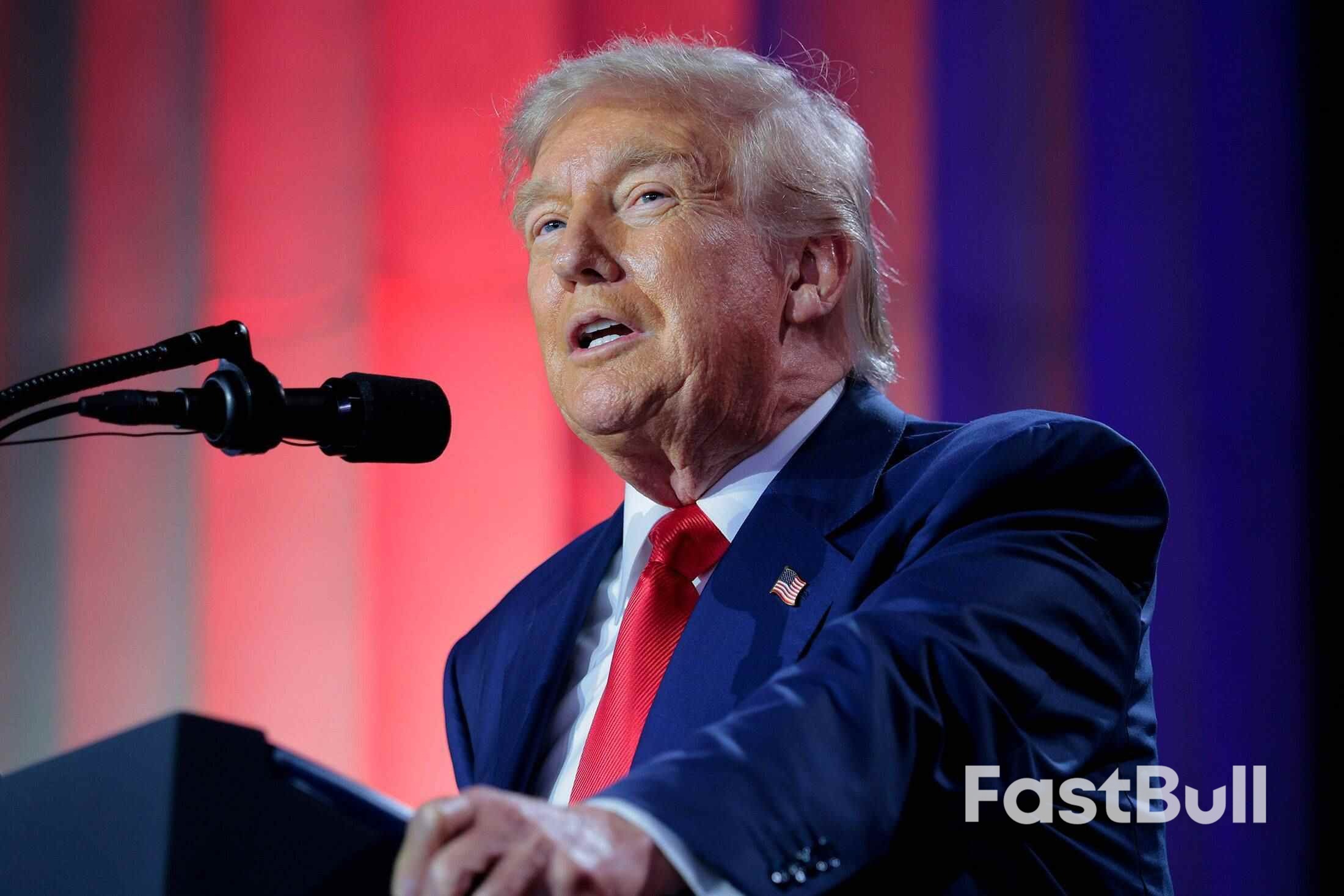
US President Donald Trump suggested that he would not go below 15% as he sets so-called reciprocal tariff rates ahead of an Aug. 1 deadline, an indication that the floor for the increased levies was rising.
“We’ll have a straight, simple tariff of anywhere between 15% and 50%,” Trump said Wednesday at an AI summit in Washington. “A couple of — we have 50 because we haven’t been getting along with those countries too well.”
Trump’s comment declaring that the tariffs would begin at 15% represented the latest twist in his effort to impose duties on nearly every US trading partner, and the latest indication that Trump was looking to more aggressively impose the levies on exports from countries outside the small group that so far has been able to broker trade frameworks with Washington.
Trump earlier this month said that more than 150 countries would receive a letter including a tariff rate of “probably 10 or 15%, we haven’t decided yet.” Commerce Secretary Howard Lutnick told CBS News on Sunday that small countries including “the Latin American countries, the Caribbean countries, many countries in Africa” would have a baseline tariff of 10%. And at the first announcement of the tariffs in April, Trump unveiled a universal tariff of 10% on nearly every country.
While Trump and his advisers initially expressed hopes of securing multiple deals, the president has been touting the tariff letters themselves as “deals” and suggesting that he is uninterested in back-and-forth negotiations. Still, he has left the door open for countries to make agreements that could lower those rates.
On Tuesday, Trump announced he was reducing a threatened 25% tariff on Japan to 15% in exchange for the country removing restrictions on some US products as well as offering to back a $550 billion investment fund. Other nations, including South Korea, India, and members of the European Union, are still pushing for an agreement before the heightened tariffs go into effect.
On Wednesday, Trump said he would “have a very, very simple tariff for some of the countries” because there were so many nations that “you can’t negotiate deals with everyone.” He said talks with the European Union were “serious.”
White Label
Data API
Web Plug-ins
Poster Maker
Affiliate Program
The risk of loss in trading financial instruments such as stocks, FX, commodities, futures, bonds, ETFs and crypto can be substantial. You may sustain a total loss of the funds that you deposit with your broker. Therefore, you should carefully consider whether such trading is suitable for you in light of your circumstances and financial resources.
No decision to invest should be made without thoroughly conducting due diligence by yourself or consulting with your financial advisors. Our web content might not suit you since we don't know your financial conditions and investment needs. Our financial information might have latency or contain inaccuracy, so you should be fully responsible for any of your trading and investment decisions. The company will not be responsible for your capital loss.
Without getting permission from the website, you are not allowed to copy the website's graphics, texts, or trademarks. Intellectual property rights in the content or data incorporated into this website belong to its providers and exchange merchants.
Not Logged In
Log in to access more features

FastBull Membership
Not yet
Purchase
Log In
Sign Up