• Trade
  • Markets
  • Copy
  • Contests
  • News
  • 24/7
  • Calendar
  • Q&A
  • Chats
Trending
Screeners
SYMBOL
LAST
BID
ASK
HIGH
LOW
NET CHG.
%CHG.
SPREAD
SPX
S&P 500 Index
6819.08
6819.08
6819.08
6861.30
6801.50
-8.33
-0.12%
--
DJI
Dow Jones Industrial Average
48386.58
48386.58
48386.58
48679.14
48285.67
-71.46
-0.15%
--
IXIC
NASDAQ Composite Index
23109.35
23109.35
23109.35
23345.56
23012.00
-85.81
-0.37%
--
USDX
US Dollar Index
97.960
98.040
97.960
98.070
97.740
+0.010
+ 0.01%
--
EURUSD
Euro / US Dollar
1.17440
1.17449
1.17440
1.17686
1.17262
+0.00046
+ 0.04%
--
GBPUSD
Pound Sterling / US Dollar
1.33702
1.33709
1.33702
1.34014
1.33546
-0.00005
0.00%
--
XAUUSD
Gold / US Dollar
4303.04
4303.45
4303.04
4350.16
4285.08
+3.65
+ 0.08%
--
WTI
Light Sweet Crude Oil
56.384
56.414
56.384
57.601
56.233
-0.849
-1.48%
--

Community Accounts

Signal Accounts
--
Profit Accounts
--
Loss Accounts
--
View More

Become a signal provider

Sell trading signals to earn additional income

View More

Guide to Copy Trading

Get started with ease and confidence

View More

Signal Accounts for Members

All Signal Accounts

Best Return
  • Best Return
  • Best P/L
  • Best MDD
Past 1W
  • Past 1W
  • Past 1M
  • Past 1Y

All Contests

  • All
  • Trump Updates
  • Recommend
  • Stocks
  • Cryptocurrencies
  • Central Banks
  • Featured News
Top News Only
Share

New York Fed Accepts $2.601 Billion Of $2.601 Billion Submitted To Reverse Repo Facility On Dec 15

Share

Turkey: Shoots Down A Drone In The Black Sea Using F-16 Fighter Jets

Share

Goldman Sachs Says They Believe That The Copper Price Is Vulnerable To An Ai-Linked Price Correction

Share

Goldman Sachs Upgrades 2026 Copper Price Forecast To $11400 From $10,650

Share

Attempts By Ukrainian Troops To Advance From The South-West To Outskirts Of Kupiansk Are Being Thwarted

Share

Russian Troops Control All Of Kupiansk - IFX Cites Russian Military

Share

On Monday (December 15), The South Korean Won Ultimately Rose 0.60% Against The US Dollar, Closing At 1468.91 Won. The Won Was On An Upward Trend Throughout The Day, Rising Significantly At 17:00 Beijing Time And Reaching A Daily High Of 1463.04 Won At 17:36

Share

Health Ministry: Israeli Forces Kill Palestinian Teen In West Bank

Share

New York Federal Reserve President Williams: Over Time, The Size Of Reserves Could Grow From $2.9 Trillion

Share

New York Fed President Williams: AI Valuations Are High, But There Is A Real Driving Factor

Share

New York Federal Reserve President Williams: The Job Market Is In Very Good Shape

Share

New York Fed President Williams: 'Very Supportive' Of USA Central Bank's Decision To Cut Interest Rates Last Week

Share

New York Fed President Williams: 'Too Early To Say' What Central Bank Should Do At January Meeting

Share

New York Fed President Williams: Strong Markets Part Of Reason Why Economy Will Grow Robustly In 2026

Share

New York Fed President Williams: What Constitutes Ample Reserves Will Change Over Time

Share

New York Fed President Williams: Market Valuations 'Elevated,' But There Are Reasons For Pricing

Share

New York Fed President Williams: Ample Reserves System Working Very Well

Share

New York Fed President Williams: Some Signs That Parts Of Underlying Economy Not As Strong As GDP Data Suggests

Share

New York Fed President Williams: Expects Coming Job Data Will Show Gradual Cooling

Share

Ukraine President Zelenskiy: Monitoring Of Ceasefire Should Be Part Of Security Guarantees

TIME
ACT
FCST
PREV
Japan Tankan Small Manufacturing Outlook Index (Q4)

A:--

F: --

P: --

Japan Tankan Large Non-Manufacturing Outlook Index (Q4)

A:--

F: --

P: --

Japan Tankan Large Manufacturing Outlook Index (Q4)

A:--

F: --

P: --

Japan Tankan Small Manufacturing Diffusion Index (Q4)

A:--

F: --

P: --

Japan Tankan Large-Enterprise Capital Expenditure YoY (Q4)

A:--

F: --

P: --

U.K. Rightmove House Price Index YoY (Dec)

A:--

F: --

P: --

China, Mainland Industrial Output YoY (YTD) (Nov)

A:--

F: --

P: --

China, Mainland Urban Area Unemployment Rate (Nov)

A:--

F: --

P: --

Saudi Arabia CPI YoY (Nov)

A:--

F: --

P: --

Euro Zone Industrial Output YoY (Oct)

A:--

F: --

P: --

Euro Zone Industrial Output MoM (Oct)

A:--

F: --

P: --

Canada Existing Home Sales MoM (Nov)

A:--

F: --

P: --

Canada National Economic Confidence Index

A:--

F: --

P: --

Canada New Housing Starts (Nov)

A:--

F: --

P: --
U.S. NY Fed Manufacturing Employment Index (Dec)

A:--

F: --

P: --

U.S. NY Fed Manufacturing Index (Dec)

A:--

F: --

P: --

Canada Core CPI YoY (Nov)

A:--

F: --

P: --

Canada Manufacturing Unfilled Orders MoM (Oct)

A:--

F: --

P: --

U.S. NY Fed Manufacturing Prices Received Index (Dec)

A:--

F: --

P: --

U.S. NY Fed Manufacturing New Orders Index (Dec)

A:--

F: --

P: --

Canada Manufacturing New Orders MoM (Oct)

A:--

F: --

P: --

Canada Core CPI MoM (Nov)

A:--

F: --

P: --

Canada Trimmed CPI YoY (SA) (Nov)

A:--

F: --

P: --

Canada Manufacturing Inventory MoM (Oct)

A:--

F: --

P: --

Canada CPI YoY (Nov)

A:--

F: --

P: --

Canada CPI MoM (Nov)

A:--

F: --

P: --

Canada CPI YoY (SA) (Nov)

A:--

F: --

P: --

Canada Core CPI MoM (SA) (Nov)

A:--

F: --

P: --

Canada CPI MoM (SA) (Nov)

A:--

F: --

P: --

Federal Reserve Board Governor Milan delivered a speech
U.S. NAHB Housing Market Index (Dec)

A:--

F: --

P: --

Australia Composite PMI Prelim (Dec)

--

F: --

P: --

Australia Services PMI Prelim (Dec)

--

F: --

P: --

Australia Manufacturing PMI Prelim (Dec)

--

F: --

P: --

Japan Manufacturing PMI Prelim (SA) (Dec)

--

F: --

P: --

U.K. 3-Month ILO Employment Change (Oct)

--

F: --

P: --

U.K. Unemployment Claimant Count (Nov)

--

F: --

P: --

U.K. Unemployment Rate (Nov)

--

F: --

P: --

U.K. 3-Month ILO Unemployment Rate (Oct)

--

F: --

P: --

U.K. Average Weekly Earnings (3-Month Average, Including Bonuses) YoY (Oct)

--

F: --

P: --

U.K. Average Weekly Earnings (3-Month Average, Excluding Bonuses) YoY (Oct)

--

F: --

P: --

France Services PMI Prelim (Dec)

--

F: --

P: --

France Composite PMI Prelim (SA) (Dec)

--

F: --

P: --

France Manufacturing PMI Prelim (Dec)

--

F: --

P: --

Germany Services PMI Prelim (SA) (Dec)

--

F: --

P: --

Germany Manufacturing PMI Prelim (SA) (Dec)

--

F: --

P: --

Germany Composite PMI Prelim (SA) (Dec)

--

F: --

P: --

Euro Zone Composite PMI Prelim (SA) (Dec)

--

F: --

P: --

Euro Zone Services PMI Prelim (SA) (Dec)

--

F: --

P: --

Euro Zone Manufacturing PMI Prelim (SA) (Dec)

--

F: --

P: --

U.K. Services PMI Prelim (Dec)

--

F: --

P: --

U.K. Manufacturing PMI Prelim (Dec)

--

F: --

P: --

U.K. Composite PMI Prelim (Dec)

--

F: --

P: --

Euro Zone ZEW Economic Sentiment Index (Dec)

--

F: --

P: --

Germany ZEW Current Conditions Index (Dec)

--

F: --

P: --

Germany ZEW Economic Sentiment Index (Dec)

--

F: --

P: --

Euro Zone Trade Balance (Not SA) (Oct)

--

F: --

P: --

Euro Zone ZEW Current Conditions Index (Dec)

--

F: --

P: --

Euro Zone Trade Balance (SA) (Oct)

--

F: --

P: --

Euro Zone Total Reserve Assets (Nov)

--

F: --

P: --

U.K. Inflation Rate Expectations

--

F: --

P: --

Q&A with Experts
    • All
    • Chatrooms
    • Groups
    • Friends
    Connecting
    .
    .
    .
    Type here...
    Add Symbol or Code

      No matching data

      All
      Trump Updates
      Recommend
      Stocks
      Cryptocurrencies
      Central Banks
      Featured News
      • All
      • Russia-Ukraine Conflict
      • Middle East Flashpoint
      • All
      • Russia-Ukraine Conflict
      • Middle East Flashpoint
      Search
      Products

      Charts Free Forever

      Chats Q&A with Experts
      Screeners Economic Calendar Data Tools
      Membership Features
      Data Warehouse Market Trends Institutional Data Policy Rates Macro

      Market Trends

      Market Sentiment Order Book Forex Correlations

      Top Indicators

      Charts Free Forever
      Markets

      News

      News Analysis 24/7 Columns Education
      From Institutions From Analysts
      Topics Columnists

      Latest Views

      Latest Views

      Trending Topics

      Top Columnists

      Latest Update

      Signals

      Copy Rankings Latest Signals Become a signal provider AI Rating
      Contests
      Brokers

      Overview Brokers Assessment Rankings Regulators News Claims
      Broker listing Forex Brokers Comparison Tool Live Spread Comparison Scam
      Q&A Complaint Scam Alert Videos Tips to Detect Scam
      More

      Business
      Events
      Careers About Us Advertising Help Center

      White Label

      Data API

      Web Plug-ins

      Affiliate Program

      Awards Institution Evaluation IB Seminar Salon Event Exhibition
      Vietnam Thailand Singapore Dubai
      Fans Party Investment Sharing Session
      FastBull Summit BrokersView Expo
      Recent Searches
        Top Searches
          Markets
          News
          Analysis
          User
          24/7
          Economic Calendar
          Education
          Data
          • Names
          • Latest
          • Prev

          View All

          No data

          Scan to Download

          Faster Charts, Chat Faster!

          Download App
          English
          • English
          • Español
          • العربية
          • Bahasa Indonesia
          • Bahasa Melayu
          • Tiếng Việt
          • ภาษาไทย
          • Français
          • Italiano
          • Türkçe
          • Русский язык
          • 简中
          • 繁中
          Open Account
          Search
          Products
          Charts Free Forever
          Markets
          News
          Signals

          Copy Rankings Latest Signals Become a signal provider AI Rating
          Contests
          Brokers

          Overview Brokers Assessment Rankings Regulators News Claims
          Broker listing Forex Brokers Comparison Tool Live Spread Comparison Scam
          Q&A Complaint Scam Alert Videos Tips to Detect Scam
          More

          Business
          Events
          Careers About Us Advertising Help Center

          White Label

          Data API

          Web Plug-ins

          Affiliate Program

          Awards Institution Evaluation IB Seminar Salon Event Exhibition
          Vietnam Thailand Singapore Dubai
          Fans Party Investment Sharing Session
          FastBull Summit BrokersView Expo

          Israel-Iran Conflict Unlikely To Impact US Associated Gas Production, Prices

          Daniel Carter

          Economic

          Political

          Commodity

          Summary:

          US associated gas production and benchmark Henry Hub prices will likely see no material impact from the Israel-Iran conflict, despite a continued risk premium reflected in the crude oil markets.

          Over the past two weeks, global crude prices surged as Israel launched a major air offensive on Iran over the latter's alleged nuclear weapons program.
          Amid mounting alarm over potential supply disruptions, especially for crude in the Persian Gulf and Iran, WTI crude prices climbed to over $75/b -- up about $10-$15/b from early June, data from S&P Global Commodity Insights showed.
          On June 23, US President Donald Trump announced a tenuous ceasefire agreement between Israel and Iran, sending crude prices tumbling to around $68.50/b. On June 24 and June 25, however, NYMEX crude prices appeared to stabilize around $65/b, according to data from CME Group and Commodity Insights.
          Although the rally was short-lived, it did raise questions about how US crude oil producers might respond to higher prices.
          In a social media post on June 23, Trump appeared to be addressing the US oil industry while calling on the US Department of Energy to "DRILL, BABY, DRILL." Trump's remarks came even as crude prices were in retreat.
          For the US gas market, drilling and production decisions made by domestic crude producers can and often do have profound implications for US gas supply and benchmark prices.
          As a co-product of crude oil production, US associated gas output comes primarily from the Permian Basin, as well as other major oil-focused shale plays like the Eagle Ford, the Bakken, the SCOOP-STACK and the Denver-Julesburg. According to the US Energy Information Administration, associated gas production accounted for nearly 37% of total US production in 2023.
          For the US gas market, higher crude prices could fuel an increase in associated gas production and potentially weigh on benchmark Henry Hub prices -- presuming that crude-weighted operators respond to the higher WTI price signal by increasing their oil output.
          Although the risk of a reescalation in the Israel-Iran conflict has kept crude prices in the mid-$60s/b -- up from the low-$60s in early June, that change is unlikely to motivate many US crude oil producers to increase output -- especially considering the continued production hikes approved by OPEC+ members in recent months.
          Unless WTI crude oil prices consistently hold up above $70/b, oil-directed activity should be flat to lower, according to Svetlana Tretyakova, an oil analyst with Rystad Energy.
          "Capital allocation is being guided by full-year and mid-term planning, not short-term price moves," Tretyakova said. "Unless WTI moves sustainably above $70 for at least a quarter, our base case holds: production flatlines before declining in 2026 and beyond."
          On June 25, as the tentative ceasefire between Israel and Iran continued to hold, NYMEX WTI crude prices were up about $1.50/b on the day to around $65.50/b, data from CME Group showed.
          "With global [oil] supply unimpeded, we would expect the risk premium to continue to unwind, and for crude to potentially push lower if the US loosened sanctions on Iran's crude industry," Matt Portillo, market analyst with TPH Energy Research, said in a June 23 market note.
          "Lower crude prices remain a priority for [Trump] with incremental Iranian barrels only piling onto our already bearish outlook," Portillo said.
          On first-quarter earnings calls, more than a month prior to the Middle East conflict, both US and Canadian oil producers had continued to signal restraint in their planned capital spending -- a course that seems unlikley to change. Some producers also announced cuts to their drilling and completion programs. So far, efficiency gains have helped keep output stable to modestly higher this year.
          From January to May, crude oil production in the Permian Basin grew from about 6.4 million b/d to an estimated 6.6 million b/d, according to data from Commodity Insights.
          In the latest earnings round, more than a handful of oil-weighted producers said they were planning spending and activity cuts in the Permian -- a key basin for associated gas production that accounted for over 60% of the US total in 2024.
          Among those planning reductions were Matador Resources, Occidental Petroleum, Diamondback Energy, EOG Resources and Coterra Energy, all of whom said they were planning some combination of lower spending, rig cuts and/or reduction to their well-completion programs.
          Crude oil producers have kept their promise. Since the start of the second quarter, the Permian Basin rig count has continued to decline from over 290 rigs to an average 275 over the past four weeks.

          Source: S&P Global Platts

          To stay updated on all economic events of today, please check out our Economic calendar
          Risk Warnings and Disclaimers
          You understand and acknowledge that there is a high degree of risk involved in trading. Following any strategies or investment methods may lead to potential losses. The content on the site is provided by our contributors and analysts for information purposes only. You are solely responsible for determining whether any trading assets, securities, strategy, or any other product is suitable for investing based on your own investment objectives and financial situation.
          Add to Favorites
          Share

          Dow, S&P 500, Nasdaq Futures Hold Steady as Trump Looks Forward to Powell's Replacement

          Manuel

          Political

          Stocks

          US stock futures held steady as President Trump talked up his search for a successor to Federal Reserve Chair Jerome Powell.
          Futures attached to the Dow Jones Industrial Average (YM=F), the benchmark S&P 500 (ES=F), and the tech-heavy Nasdaq 100 (NQ=F) flatlined.
          The Wall Street Journal reported late Wednesday that the president's frustration with Powell's "wait and see" approach to interest rates has led him to consider announcing his pick to succeed the Fed chair in September or October. Powell's term ends in May 2026 and such an announcement would be far earlier than the typical three or four month transition period.
          Trump said earlier on Wednesday he is actively considering replacements for Powell, adding "I know within three or four people who I’m going to pick."
          Powell wrapped up two days of testifying before the House and the Senate, where he stressed to lawmakers the central bank is "well-positioned" to wait and see how Trump's tariffs are impacting the economy before reducing rates.
          Stocks wobbled throughout the day with the S&P 500 finishing just below a record high. Investors' jubilation from the day before, sparked by an end to hostilities between Israel and Iran, moderated even as Trump declared the conflict "over." Nvidia (NVDA), meanwhile, leaped to a record high.
          The main event for Wall Street to end the week lands Friday with the release of the Fed's preferred inflation gauge, the Personal Consumption Expenditures (PCE) report. Investors will be watching closely for any signs that Trump's tariffs pushed prices higher.

          Source: Yahoo Finance

          Risk Warnings and Disclaimers
          You understand and acknowledge that there is a high degree of risk involved in trading. Following any strategies or investment methods may lead to potential losses. The content on the site is provided by our contributors and analysts for information purposes only. You are solely responsible for determining whether any trading assets, securities, strategy, or any other product is suitable for investing based on your own investment objectives and financial situation.
          Add to Favorites
          Share

          Trump Says US To Hold Nuclear Talks With Iran Next Week

          Daniel Carter

          Political

          Middle East Situation

          Trump said his decision to unleash huge bunker-busting bombs in Sunday's attack had devastated Iran's nuclear program and called the outcome "a victory for everybody".
          "It was very severe. It was obliteration," he said, shrugging off an initial assessment by the U.S. Defense Intelligence Agency that Iran's path to building a nuclear weapon may have been set back only by months.
          Meanwhile, anxious Iranians and Israelis sought to resume normal life after 12 days of the most intense confrontation ever between the two foes and a ceasefire that took effect Tuesday.
          Speaking in The Hague where he attended a NATO summit on Wednesday, Trump said he did not see Iran again engaging in nuclear weapons development. Tehran has for decades denied accusations by Western leaders that it is seeking nuclear arms.
          "We're going to talk to them next week, with Iran. We may sign an agreement. I don't know. To me, I don't think it's that necessary," Trump said.
          "I'll tell you, the last thing they want to do is enrich anything right now. They want to recover," he said, referring to Western accusations that Iran has been enriching uranium to near-weapons-grade purity.
          Later on Wednesday, U.S. Central Intelligence Agency Director John Ratcliffe said in a statement that the U.S. air strikes had “severely damaged” Iran's nuclear program, but he stopped short of declaring that the program had been destroyed.
          The agency confirmed a “body of credible evidence" that several key Iranian facilities were destroyed and would take years to rebuild, he said.
          Israel's nuclear agency assessed the strikes had "set back Iran's ability to develop nuclear weapons by many years". The White House also circulated the Israeli assessment, although Trump said he was not relying on Israeli intelligence.
          Trump said he was confident Tehran would pursue a diplomatic path towards reconciliation. The president gave no details on the discussions next week such as the venue and participants.
          If Iran tried to rebuild its nuclear programme, "we won't let that happen. Number one, militarily we won't," he said, adding that he thought "we'll end up having something of a relationship with Iran" to resolve the issue.
          The head of the U.N.'s nuclear watchdog, Rafael Grossi, dismissed what he called the "hourglass approach" of assessing damage to Iran's nuclear programme in terms of months needed to rebuild as besides the point for an issue that needed a long-term solution.
          "In any case, the technological knowledge is there and the industrial capacity is there. That, no one can deny. So we need to work together with them," he said. His priority was returning international inspectors to Iranian nuclear sites, which he said was the only way to find out precisely what state they were in.

          People gesture as they attend a gathering to support Iran's Armed Forces, after U.S. President Donald Trump announced a ceasefire between Israel and Iran, in Tehran, Iran, June 24, 2025.

          IRAN PRESIDENT HINTS AT DOMESTIC REFORMS

          Israel's bombing campaign, launched with a surprise attack on June 13, wiped out the top echelon of Iran's military leadership and killed leading nuclear scientists. Iran responded with missiles that pierced Israel's defences in large numbers for the first time.
          Iranian authorities said 627 people were killed and nearly 5,000 injured in Iran, where the extent of the damage could not be independently confirmed because of tight restrictions on media. Twenty-eight people were killed in Israel.
          Israel claimed to have achieved its goals of destroying Iran's nuclear sites and missiles; Iran claimed to have forced the end of the war by penetrating Israeli defences.
          Israel's demonstration that it could target Iran's senior leadership seemingly at will posed perhaps the biggest challenge yet for Iran's clerical rulers, at a critical juncture when they must find a successor for Supreme Leader Ali Khamenei, now 86 and in power for 36 years.
          Iranian President Masoud Pezeshkian, a relative moderate elected last year in a challenge to years of dominance by hardliners, said it could result in reform.
          "This war and the empathy that it fostered between the people and officials is an opportunity to change the outlook of management and the behaviour of officials so that they can create unity," he said in a statement carried by state media.
          Still, Iran's authorities moved swiftly to demonstrate their control. The judiciary announced the execution of three men on Wednesday convicted of collaborating with Israel's Mossad spy agency and smuggling equipment used in an assassination. Iran had arrested 700 people accused of ties with Israel during the conflict, the state-affiliated Nournews reported.
          During the war, both Israel Prime Minister Benjamin Netanyahu and Trump publicly suggested that it could end with the toppling of Iran's entire system of clerical rule, established in its 1979 revolution.
          But after the ceasefire, Trump said he did not want to see "regime change" in Iran, which he said would bring chaos at a time when he wanted the situation to settle down.

          RELIEF, APPREHENSION, EXHAUSTION

          In both Iran and Israel, residents expressed relief at the end of the fighting, but also apprehension.
          "We came back after the ceasefire was announced. People are relieved that the war has stopped, but there's a lot of uncertainty about what comes next," said Farah, 67, who returned to Tehran from nearby Lavasan, where she had fled to escape Israeli bombing.
          In Tel Aviv, Rony Hoter-Ishay Meyer, 38, said the war's end brought mixed emotions: relief that children could return to school and normal life resume, but exhaustion from the stress.
          "Those past two weeks were catastrophic in Israel, and we are very much exhausted and we need to get back to our normal energy."

          Source: Reuters

          Risk Warnings and Disclaimers
          You understand and acknowledge that there is a high degree of risk involved in trading. Following any strategies or investment methods may lead to potential losses. The content on the site is provided by our contributors and analysts for information purposes only. You are solely responsible for determining whether any trading assets, securities, strategy, or any other product is suitable for investing based on your own investment objectives and financial situation.
          Add to Favorites
          Share

          Bitcoin Tops $108,000 as Crypto Traders Shrug off Mid-East Tensions

          Manuel

          Cryptocurrency

          Bitcoin climbed above $108,000 on Wednesday, reaching its highest level in weeks, as traders ignored renewed unrest in the Middle East and a US stock market that stayed just below all-time highs.
          The world’s OG crypto hit the intraday peak without hesitation, even while altcoins like Ether and Solana dipped slightly in the afternoon.
          Meanwhile, lawmakers and regulators in Washington, D.C. made noise that could fuel even more momentum. Jerome Powell, the Federal Reserve Chair, appeared before the Senate Banking Committee earlier in the day and said that stablecoins have “come a long way” and now sit firmly inside the “traditional financial framework.”
          Powell’s acknowledgment that crypto isn’t just a side show anymore came on the same day that the head of the Federal Housing Finance Agency, Billy Pulte, directed Fannie Mae and Freddie Mac to begin reviewing how crypto assets, like Bitcoin, could be used to qualify for mortgages.
          Billy’s family founded Pulte Group, one of the country’s largest homebuilders, and his influence over the housing sector is substantial. That directive may be seen as a green light for digital assets in US real estate financing.

          Trump’s NYSE crypto ETF faces decision window

          Inside the New York Stock Exchange, officials are pushing forward a proposal tied to President Donald Trump’s Truth Social platform. The exchange submitted a rule change request that would allow the listing of a Bitcoin and Ethereum ETF linked directly to Trump’s company.
          If the Securities and Exchange Commission gives it the go-ahead, it could launch within 90 days and expand the administration’s push to bring crypto closer to Wall Street. Trump, now back in the White House, has been vocal about making crypto a larger piece of the American financial system, and this ETF would mark one of the most significant steps yet.
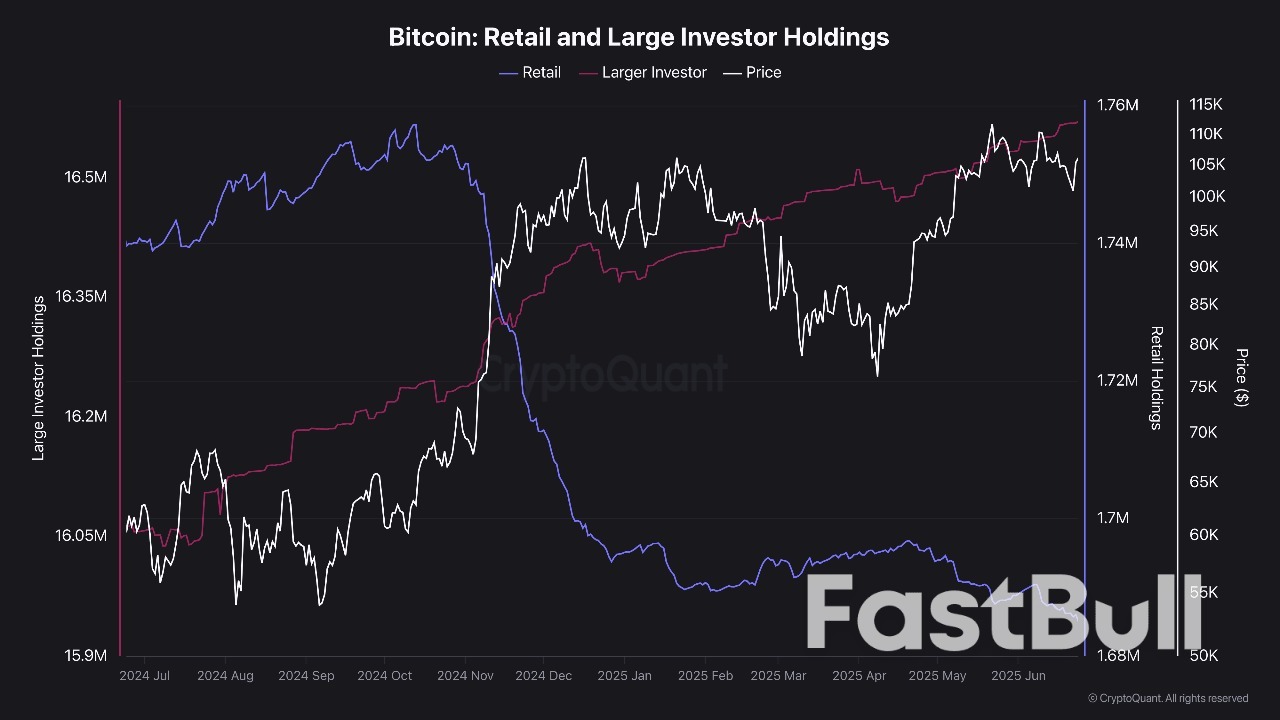
          On-chain analytics show a dramatic split in market behavior. Retail holders, wallets holding less than 1 BTC, have been selling consistently. These addresses dropped to 1.69 million BTC, a 54,500 BTC year-over-year decline, with daily outflows averaging 220 BTC.Bitcoin Tops $108,000 as Crypto Traders Shrug off Mid-East Tensions_1
          Over the past 12 months, these wallet movements had a –0.89 correlation to price, meaning the more they sold, the higher the price climbed. At the same time, large wallets, those holding at least 1,000 BTC now control 16.57 million BTC, after adding over 507,000 BTC in a year. These wallets are absorbing around 1,460 BTC per day and show a +0.86 correlation to price, which means their activity tracks upward movement.
          That imbalance is sharp. Institutions are taking in nearly seven times the amount retail holders are letting go. Combine that with the fact that only 450 BTC are mined daily after the halving, and the pressure on supply becomes obvious. But what’s different this time is that small traders haven’t jumped back in.
          There’s no retail FOMO yet, no frenzy like previous bull runs. Instead, individual holders are still exiting, hinting that the current rally might not even be close to peaking.

          Binance, stablecoins, and key support levels show what comes next

          Over on Binance, a big move happened on June 24. Net Taker Volume topped $100 million, something that hadn’t happened since June 9. It’s usually seen when overleveraged shorts get wiped or when retail traders pile in all at once. These bursts can fuel short-term buying, but they don’t guarantee lasting demand, and plus the activity also happened alongside $1.25 billion in stablecoin outflows from derivatives exchanges, the largest since mid-May.
          Another number traders are watching closely is the Realized Price, also called the cost basis, of short-term holders (STH). These wallets, which hold for fewer than six months, represent over 40% of Bitcoin’s total market cap. That makes their entry points critical.
          Right now, wallets in the 1 week to 1 month group are holding at $106,200, while those in the 1 to 3 month range sit at $95,000, and wallets from 3 to 6 months ago are at $93,300. When those values are weighted, the average cost basis lands at about $97,700.
          That’s where things get fragile. Bitcoin’s current price is hovering near $100,000, a level that matters both emotionally and technically. If the price dips below $97k, a chain reaction of panic selling could hit the market, especially from STHs who are already nervous. It’s a narrow range, and a dangerous one.

          Source: Cyrptopolitan

          Risk Warnings and Disclaimers
          You understand and acknowledge that there is a high degree of risk involved in trading. Following any strategies or investment methods may lead to potential losses. The content on the site is provided by our contributors and analysts for information purposes only. You are solely responsible for determining whether any trading assets, securities, strategy, or any other product is suitable for investing based on your own investment objectives and financial situation.
          Add to Favorites
          Share

          Trump Gets 'Golden Share' Power in US Steel Buyout. US Agencies Will get it Under Future Presidents

          Manuel

          Economic

          Political

          President Donald Trump will control the so-called “golden share” that's part of the national security agreement under which he allowed Japan-based Nippon Steel to buy out iconic American steelmaker U.S. Steel, according to disclosures with the U.S. Securities and Exchange Commission.
          The provision gives the president the power to appoint a board member and have a say in company decisions that affect domestic steel production and competition with overseas producers.
          Under the provision, Trump — or someone he designates — controls that decision-making power while he is president. However, control over those powers reverts to the Treasury Department and the Commerce Department when anyone else is president, according to the filings.
          The White House didn't immediately respond to questions Wednesday about why Trump will directly control the decision-making and why it goes to the Treasury and Commerce departments under future presidents.
          Nippon Steel's nearly $15 billion buyout of Pittsburgh-based U.S. Steel became final last week, making U.S. Steel a wholly owned subsidiary.
          Trump has sought to characterize the acquisition as a "partnership" between the two companies after he at first vowed to block the deal — as former President Joe Biden did on his way out of the White House — before changing his mind after he became president.
          The national security agreement became effective June 13 and is between Nippon Steel, as well as its American subsidiary, and the federal government, represented by the departments of Commerce and Treasury, according to the disclosures.
          The complete national security agreement hasn't been published publicly, although aspects of it have been outlined in statements and securities filings made by the companies, U.S. Steel said Wednesday.
          The pursuit by Nippon Steel dragged on for a year and-a-half, weighed down by national security concerns, opposition by the United Steelworkers and presidential politics in the premier battleground state of Pennsylvania, where U.S. Steel is headquartered.
          The combined company will become the world’s fourth-largest steelmaker in an industry dominated by Chinese companies, and bring what analysts say is Nippon Steel’s top-notch technology to U.S. Steel’s antiquated steelmaking processes, plus a commitment to invest $11 billion to upgrade U.S. Steel facilities.
          The potential that the deal could be permanently blocked forced Nippon Steel to sweeten the deal.
          That included upping its capital commitments in U.S. Steel facilities and adding the golden share provision, giving Trump the right to appoint an independent director and veto power on specific matters.
          Those matters include reductions in Nippon Steel’s capital commitments in the national security agreement; changing U.S. Steel’s name and headquarters; closing or idling U.S. Steel’s plants; transferring production or jobs outside of the U.S.; buying competing businesses in the U.S.; and certain decisions on trade, labor and sourcing outside the U.S.

          Source: AP

          To stay updated on all economic events of today, please check out our Economic calendar
          Risk Warnings and Disclaimers
          You understand and acknowledge that there is a high degree of risk involved in trading. Following any strategies or investment methods may lead to potential losses. The content on the site is provided by our contributors and analysts for information purposes only. You are solely responsible for determining whether any trading assets, securities, strategy, or any other product is suitable for investing based on your own investment objectives and financial situation.
          Add to Favorites
          Share

          Crypto Enters Home Loans as Housing Finance Agency Directs Fannie and Freddie to Treat Reserves as Assets

          Manuel

          Cryptocurrency

          Political

          US Federal Housing Finance Agency (FHFA) Director Willian J. Pulte ordered on June 25 that Fannie Mae and Freddie Mac treat cryptocurrency reserves as eligible assets when they measure risk on single-family mortgage loans, effective immediately.
          The two government-sponsored enterprises must draft plans that show how they will recognize borrower crypto holdings without first converting the coins to dollars.

          Strict collateral rules and board oversight

          Pulte’s signed directive instructs each enterprise to limit recognition to cryptocurrency that sits in wallets controlled by US-regulated centralized exchanges.
          The order also requires the enterprises to add risk mitigants that account for market volatility and to keep reserve ratios that reflect the share of collateral held in digital assets.
          Additionally, each enterprise must secure board approval before it submits the completed proposal to the FHFA conservator for review. The order is effective immediately.
          Fannie Mae and Freddie Mac purchase and securitize the majority of conforming US residential mortgages. Their risk models determine the amount of capital they must hold against potential credit losses.
          By allowing crypto reserves to enter those models, Pulte aims to widen the asset information available for underwriting and “facilitate sustainable homeownership to credit-worthy borrowers,” according to the text of the directive.

          Risk-adjusted frameworks

          The directive instructs each enterprise to develop an assessment that integrates crypto reserves into its existing loan risk framework. That assessment must describe how the enterprise will value cryptocurrency, apply haircuts, and adjust for daily price swings.
          The directive also requires an analysis of how crypto reserves interact with other borrower assets and liabilities. After board approval, each enterprise must send the proposal to FHFA for sign-off before implementation.
          By invoking the authority to issue binding instructions that alter underwriting or capital standards, Pulte accelerated a process that otherwise would have needed rulemaking or legislative action.
          The order does not change conforming loan limits or documentation requirements but expands the categories of qualifying reserves.

          Broader national crypto policy

          Pulte announced the action on his social media account the same day, writing that he acted “in keeping with President Donald Trump’s vision to make the US the crypto capital of the world.”
          He added: “Today is a historic day in the cryptocurrency industry.”
          The directive follows months of internal study, according to Pulte’s remarks. The order does not specify which coins qualify. Still, the reference to US-regulated exchanges limits the pool to tokens listed on venues that follow federal know-your-customer and anti-money laundering rules.
          Both enterprises must begin work on the proposals “as soon as reasonably practical,” the directive states. Pulte committed the agency to review each plan once the boards submit them but did not set a public deadline for submission.
          The order remains in force unless FHFA rescinds or modifies it.

          Source: Cryptoslate

          Risk Warnings and Disclaimers
          You understand and acknowledge that there is a high degree of risk involved in trading. Following any strategies or investment methods may lead to potential losses. The content on the site is provided by our contributors and analysts for information purposes only. You are solely responsible for determining whether any trading assets, securities, strategy, or any other product is suitable for investing based on your own investment objectives and financial situation.
          Add to Favorites
          Share

          The White House Makes its Closing Argument for Trump´s Big Beautiful Bill: ´Very big' Economic Benefits

          Manuel

          Economic

          Political

          The White House is making its closing argument for President Trump’s "One Big Beautiful Bill Act,” and it involves some eye-popping projections for the US economy that don’t line up with predictions of independent economists.
          How eye-popping? Try economic growth of 4.9% in the short term and up to $11.1 trillion in deficit reduction over the next decade if the Senate bill is passed and Trump’s agenda is enacted.
          "Those are very big numbers," acknowledged Council of Economic Advisers Chair Stephen Miran on a call with reporters as he laid out a 27-page report.
          The findings were immediately met with skepticism by economists who have come to very different conclusions.
          The report nevertheless concludes that Trump’s entire “suite” of policies — from the bill itself to unilateral deregulation efforts to tariffs — could lead in Miran's words to “very material increases in GDP growth, very material increases in investment activity, and very material increases in real wages and take-home pay.”
          The case is essentially that certain provisions in the bill — especially deductions for businesses around things like research and development — will lead to a spike in corporate investment that will then fuel 4.6% to 4.9% in additional GDP growth over the next four years.
          It's an aggressive projection to say the least. For context, a recent Tax Foundation estimate pegged that figure at 1.1%.
          But that outsized 4%+ growth will then fuel, the White House says, a reduction in federal deficits by roughly $8.5-$11.1 trillion over the standard 10-year budget window. That would lead to thousands of dollars in additional income for a typical family and stabilize America’s debt-to-GDP ratio, according to the report.
          The rosy predictions from the White House were immediately slammed by a range of economists.
          “Well I guess if you are going to make stuff up, go big or go home,” offered former Democratic Congresswoman Carolyn Bourdeaux.
          “No credible economist believes this bill is going to reduce the deficit,” she added, noting that “it adds $3+ trillion.” Bourdeaux currently runs the Concord Coalition, a group focused on the national debt.
          A range of independent projections — from the Congressional Budget Office to the Tax Foundation to the Penn-Wharton Budget Model — have looked at different versions of the bill and reached a similar conclusion of much lower economic growth and a price tag in the neighborhood of $3 trillion over the next decade.
          The back and forth comes after the House passed a first version of the bill last month that was then followed by amendments in the Senate. Majority Leader John Thune hopes to finalize those amendments and put the entire package up for a series of votes starting Friday.
          The deliberations are also being closely watched by Wall Street with the mega-bill also responsible for raising a debt ceiling that is ticking towards a government default as early as Aug. 15, the Bipartisan Policy Center projected in a new report also released Wednesday.

          A frantic final series of negotiations and cost projections

          The problem for Thune and other Republicans is that a series of fights over different pieces of the bill remain unresolved, with GOP leaders facing a daunting to-do list in the days ahead before another round of voting can begin.
          In addition to lawmaker objections over issues like state and local tax (SALT) deductions and Medicaid cuts, recent Senate changes already appear likely to increase the price tag further and have further inflamed the concerns of fiscal hawks.The White House Makes its Closing Argument for Trump´s Big Beautiful Bill: ´Very big'  Economic Benefits_1
          A look at the tax provisions of the bill in recent days from the Joint Committee on Taxation offered a new price tag that tops $4 trillion.
          Wednesday’s White House report offered a breakdown of how officials say the top figure of $11.1 trillion is achievable, suggesting that roughly $2.1-2.2 trillion in deficit declines come from the bill itself.
          Other cost savings will come from additional reductions in discretionary spending (about $1.8 trillion) and more tariff revenue (another $3.2 trillion).
          The tariff revenue figure is an increase from a recent Congressional Budget Office calculation of $2.8 trillion in revenues, but only if tariffs stay at current levels for the next decade.
          The final piece of the report focused on deregulatory and energy policies. The White House concluded those steps could reduce the deficit somewhere between an additional $1.3 and $3.7 trillion over the coming decade.
          The new numbers further reinforced a divide between between economists and the White House.
          After the House bill was released, there was an $11 trillion chasm between what economists said the bill’s effects would be and what the White House said Trump’s agenda will bring.
          The divide is now now even wider, with $15 trillion separating projections released in recent days from each side.
          The bill is "far from deficit neutral" added Heather Boushey, a former member of Joe Biden's Council of Economic Advisors on Wednesday afternoon. "There are a lot of shenanigans in how they are calculating their numbers."

          Source: Yahoo Finance

          To stay updated on all economic events of today, please check out our Economic calendar
          Risk Warnings and Disclaimers
          You understand and acknowledge that there is a high degree of risk involved in trading. Following any strategies or investment methods may lead to potential losses. The content on the site is provided by our contributors and analysts for information purposes only. You are solely responsible for determining whether any trading assets, securities, strategy, or any other product is suitable for investing based on your own investment objectives and financial situation.
          Add to Favorites
          Share
          FastBull
          Copyright © 2025 FastBull Ltd

          728 RM B 7/F GEE LOK IND BLDG NO 34 HUNG TO RD KWUN TONG KLN HONG KONG

          TelegramInstagramTwitterfacebooklinkedin
          App Store Google Play Google Play
          Products
          Charts

          Chats

          Q&A with Experts
          Screeners
          Economic Calendar
          Data
          Tools
          Membership
          Features
          Function
          Markets
          Copy Trading
          Latest Signals
          Contests
          News
          Analysis
          24/7
          Columns
          Education
          Company
          Careers
          About Us
          Contact Us
          Advertising
          Help Center
          Feedback
          User Agreement
          Privacy Policy
          Business

          White Label

          Data API

          Web Plug-ins

          Poster Maker

          Affiliate Program

          Risk Disclosure

          The risk of loss in trading financial instruments such as stocks, FX, commodities, futures, bonds, ETFs and crypto can be substantial. You may sustain a total loss of the funds that you deposit with your broker. Therefore, you should carefully consider whether such trading is suitable for you in light of your circumstances and financial resources.

          No decision to invest should be made without thoroughly conducting due diligence by yourself or consulting with your financial advisors. Our web content might not suit you since we don't know your financial conditions and investment needs. Our financial information might have latency or contain inaccuracy, so you should be fully responsible for any of your trading and investment decisions. The company will not be responsible for your capital loss.

          Without getting permission from the website, you are not allowed to copy the website's graphics, texts, or trademarks. Intellectual property rights in the content or data incorporated into this website belong to its providers and exchange merchants.

          Not Logged In

          Log in to access more features

          FastBull Membership

          Not yet

          Purchase

          Become a signal provider
          Help Center
          Customer Service
          Dark Mode
          Price Up/Down Colors

          Log In

          Sign Up

          Position
          Layout
          Fullscreen
          Default to Chart
          The chart page opens by default when you visit fastbull.com