• Trade
  • Markets
  • Copy
  • Contests
  • News
  • 24/7
  • Calendar
  • Q&A
  • Chats
Trending
Screeners
SYMBOL
LAST
BID
ASK
HIGH
LOW
NET CHG.
%CHG.
SPREAD
SPX
S&P 500 Index
6827.42
6827.42
6827.42
6899.86
6801.80
-73.58
-1.07%
--
DJI
Dow Jones Industrial Average
48458.04
48458.04
48458.04
48886.86
48334.10
-245.98
-0.51%
--
IXIC
NASDAQ Composite Index
23195.16
23195.16
23195.16
23554.89
23094.51
-398.69
-1.69%
--
USDX
US Dollar Index
97.950
98.030
97.950
98.500
97.950
-0.370
-0.38%
--
EURUSD
Euro / US Dollar
1.17394
1.17409
1.17394
1.17496
1.17192
+0.00011
+ 0.01%
--
GBPUSD
Pound Sterling / US Dollar
1.33707
1.33732
1.33707
1.33997
1.33419
-0.00148
-0.11%
--
XAUUSD
Gold / US Dollar
4299.39
4299.39
4299.39
4353.41
4257.10
+20.10
+ 0.47%
--
WTI
Light Sweet Crude Oil
57.233
57.485
57.233
58.011
56.969
-0.408
-0.71%
--

Community Accounts

Signal Accounts
--
Profit Accounts
--
Loss Accounts
--
View More

Become a signal provider

Sell trading signals to earn additional income

View More

Guide to Copy Trading

Get started with ease and confidence

View More

Signal Accounts for Members

All Signal Accounts

Best Return
  • Best Return
  • Best P/L
  • Best MDD
Past 1W
  • Past 1W
  • Past 1M
  • Past 1Y

All Contests

  • All
  • Trump Updates
  • Recommend
  • Stocks
  • Cryptocurrencies
  • Central Banks
  • Featured News
Top News Only
Share

USA Embassy In Lithuania: Maria Kalesnikava Is Not Going To Vilnius

Share

USA Embassy In Lithuania: Other Prisoners Are Being Sent From Belarus To Ukraine

Share

Ukraine President Zelenskiy: Five Ukrainians Released By Belarus In US-Brokered Deal

Share

USA Vilnius Embassy: USA Stands Ready For "Additional Engagement With Belarus That Advances USA Interests"

Share

USA Vilnius Embassy: Belarus, USA, Other Citizens Among The Prisoners Released Into Lithuania

Share

USA Vilnius Embassy: USA Will Continue Diplomatic Efforts To Free The Remaining Political Prisoners In Belarus

Share

USA Vilnius Embassy: Belarus Releases 123 Prisoners Following Meeting Of President Trump's Envoy Coale And Belarus President Lukashenko

Share

USA Vilnius Embassy: Masatoshi Nakanishi, Aliaksandr Syrytsa Are Among The Prisoners Released By Belarus

Share

USA Vilnius Embassy: Maria Kalesnikava And Viktor Babaryka Are Among The Prisoners Released By Belarus

Share

USA Vilnius Embassy: Nobel Peace Prize Laureate Ales Bialiatski Is Among The Prisoners Released By Belarus

Share

Belarusian Presidential Administration Telegram Channel: Lukashenko Has Pardoned 123 Prisoners As Part Of Deal With US

Share

Two Local Syrian Officials: Joint US-Syrian Military Patrol In Central Syria Came Under Fire From Unknown Assailants

Share

Israeli Military Says It Targeted 'Key Hamas Terrorist' In Gaza City

Share

Rwanda's Actions In Eastern Drc Are A Clear Violation Of Washington Accords Signed By President Trump - Secretary Of State Rubio

Share

Israeli Military Issues Evacuation Warning In Southern Lebanon Village Ahead Of Strike - Spokesperson On X

Share

Belarusian State Media Cites US Envoy Coale As Saying He Discussed Ukraine And Venezuela With Lukashenko

Share

Belarusian State Media Cites US Envoy Coale As Saying That US Removes Sanctions On Belarusian Potassium

Share

Thai Prime Minister: No Ceasefire Agreement With Cambodia

Share

US, Ukraine To Discuss Ceasefire In Berlin Ahead Of European Summit

Share

Incoming Czech Prime Minister Babis: Czech Republic Will Not Take On Guarantees For Ukraine Financing, European Commission Must Find Alternatives

TIME
ACT
FCST
PREV
U.K. Trade Balance Non-EU (SA) (Oct)

A:--

F: --

P: --

U.K. Trade Balance (Oct)

A:--

F: --

P: --

U.K. Services Index MoM

A:--

F: --

P: --

U.K. Construction Output MoM (SA) (Oct)

A:--

F: --

P: --

U.K. Industrial Output YoY (Oct)

A:--

F: --

P: --

U.K. Trade Balance (SA) (Oct)

A:--

F: --

P: --

U.K. Trade Balance EU (SA) (Oct)

A:--

F: --

P: --

U.K. Manufacturing Output YoY (Oct)

A:--

F: --

P: --

U.K. GDP MoM (Oct)

A:--

F: --

P: --

U.K. GDP YoY (SA) (Oct)

A:--

F: --

P: --

U.K. Industrial Output MoM (Oct)

A:--

F: --

P: --

U.K. Construction Output YoY (Oct)

A:--

F: --

P: --

France HICP Final MoM (Nov)

A:--

F: --

P: --

China, Mainland Outstanding Loans Growth YoY (Nov)

A:--

F: --

P: --

China, Mainland M2 Money Supply YoY (Nov)

A:--

F: --

P: --

China, Mainland M0 Money Supply YoY (Nov)

A:--

F: --

P: --

China, Mainland M1 Money Supply YoY (Nov)

A:--

F: --

P: --

India CPI YoY (Nov)

A:--

F: --

P: --

India Deposit Gowth YoY

A:--

F: --

P: --

Brazil Services Growth YoY (Oct)

A:--

F: --

P: --

Mexico Industrial Output YoY (Oct)

A:--

F: --

P: --

Russia Trade Balance (Oct)

A:--

F: --

P: --

Philadelphia Fed President Henry Paulson delivers a speech
Canada Building Permits MoM (SA) (Oct)

A:--

F: --

P: --

Canada Wholesale Sales YoY (Oct)

A:--

F: --

P: --

Canada Wholesale Inventory MoM (Oct)

A:--

F: --

P: --

Canada Wholesale Inventory YoY (Oct)

A:--

F: --

P: --

Canada Wholesale Sales MoM (SA) (Oct)

A:--

F: --

P: --

Germany Current Account (Not SA) (Oct)

A:--

F: --

P: --

U.S. Weekly Total Rig Count

A:--

F: --

P: --

U.S. Weekly Total Oil Rig Count

A:--

F: --

P: --

Japan Tankan Large Non-Manufacturing Diffusion Index (Q4)

--

F: --

P: --

Japan Tankan Small Manufacturing Outlook Index (Q4)

--

F: --

P: --

Japan Tankan Large Non-Manufacturing Outlook Index (Q4)

--

F: --

P: --

Japan Tankan Large Manufacturing Outlook Index (Q4)

--

F: --

P: --

Japan Tankan Small Manufacturing Diffusion Index (Q4)

--

F: --

P: --

Japan Tankan Large Manufacturing Diffusion Index (Q4)

--

F: --

P: --

Japan Tankan Large-Enterprise Capital Expenditure YoY (Q4)

--

F: --

P: --

U.K. Rightmove House Price Index YoY (Dec)

--

F: --

P: --

China, Mainland Industrial Output YoY (YTD) (Nov)

--

F: --

P: --

China, Mainland Urban Area Unemployment Rate (Nov)

--

F: --

P: --

Saudi Arabia CPI YoY (Nov)

--

F: --

P: --

Euro Zone Industrial Output YoY (Oct)

--

F: --

P: --

Euro Zone Industrial Output MoM (Oct)

--

F: --

P: --

Canada Existing Home Sales MoM (Nov)

--

F: --

P: --

Euro Zone Total Reserve Assets (Nov)

--

F: --

P: --

U.K. Inflation Rate Expectations

--

F: --

P: --

Canada National Economic Confidence Index

--

F: --

P: --

Canada New Housing Starts (Nov)

--

F: --

P: --

U.S. NY Fed Manufacturing Employment Index (Dec)

--

F: --

P: --

U.S. NY Fed Manufacturing Index (Dec)

--

F: --

P: --

Canada Core CPI YoY (Nov)

--

F: --

P: --

Canada Manufacturing Unfilled Orders MoM (Oct)

--

F: --

P: --

Canada Manufacturing New Orders MoM (Oct)

--

F: --

P: --

Canada Core CPI MoM (Nov)

--

F: --

P: --

Canada Manufacturing Inventory MoM (Oct)

--

F: --

P: --

Canada CPI YoY (Nov)

--

F: --

P: --

Canada CPI MoM (Nov)

--

F: --

P: --

Canada CPI YoY (SA) (Nov)

--

F: --

P: --

Canada Core CPI MoM (SA) (Nov)

--

F: --

P: --

Q&A with Experts
    • All
    • Chatrooms
    • Groups
    • Friends
    Connecting
    .
    .
    .
    Type here...
    Add Symbol or Code

      No matching data

      All
      Trump Updates
      Recommend
      Stocks
      Cryptocurrencies
      Central Banks
      Featured News
      • All
      • Russia-Ukraine Conflict
      • Middle East Flashpoint
      • All
      • Russia-Ukraine Conflict
      • Middle East Flashpoint
      Search
      Products

      Charts Free Forever

      Chats Q&A with Experts
      Screeners Economic Calendar Data Tools
      Membership Features
      Data Warehouse Market Trends Institutional Data Policy Rates Macro

      Market Trends

      Market Sentiment Order Book Forex Correlations

      Top Indicators

      Charts Free Forever
      Markets

      News

      News Analysis 24/7 Columns Education
      From Institutions From Analysts
      Topics Columnists

      Latest Views

      Latest Views

      Trending Topics

      Top Columnists

      Latest Update

      Signals

      Copy Rankings Latest Signals Become a signal provider AI Rating
      Contests
      Brokers

      Overview Brokers Assessment Rankings Regulators News Claims
      Broker listing Forex Brokers Comparison Tool Live Spread Comparison Scam
      Q&A Complaint Scam Alert Videos Tips to Detect Scam
      More

      Business
      Events
      Careers About Us Advertising Help Center

      White Label

      Data API

      Web Plug-ins

      Affiliate Program

      Awards Institution Evaluation IB Seminar Salon Event Exhibition
      Vietnam Thailand Singapore Dubai
      Fans Party Investment Sharing Session
      FastBull Summit BrokersView Expo
      Recent Searches
        Top Searches
          Markets
          News
          Analysis
          User
          24/7
          Economic Calendar
          Education
          Data
          • Names
          • Latest
          • Prev

          View All

          No data

          Scan to Download

          Faster Charts, Chat Faster!

          Download App
          English
          • English
          • Español
          • العربية
          • Bahasa Indonesia
          • Bahasa Melayu
          • Tiếng Việt
          • ภาษาไทย
          • Français
          • Italiano
          • Türkçe
          • Русский язык
          • 简中
          • 繁中
          Open Account
          Search
          Products
          Charts Free Forever
          Markets
          News
          Signals

          Copy Rankings Latest Signals Become a signal provider AI Rating
          Contests
          Brokers

          Overview Brokers Assessment Rankings Regulators News Claims
          Broker listing Forex Brokers Comparison Tool Live Spread Comparison Scam
          Q&A Complaint Scam Alert Videos Tips to Detect Scam
          More

          Business
          Events
          Careers About Us Advertising Help Center

          White Label

          Data API

          Web Plug-ins

          Affiliate Program

          Awards Institution Evaluation IB Seminar Salon Event Exhibition
          Vietnam Thailand Singapore Dubai
          Fans Party Investment Sharing Session
          FastBull Summit BrokersView Expo

          ISM Manufacturing PMI Drops To 48.7, Beating Analyst Estimates

          Adam

          Stocks

          Summary:

          ISM Manufacturing PMI fell to 48.7 in April, signaling contraction but beating forecasts. Tariffs remain a key concern, while the U.S. dollar rose and gold declined amid improving trade sentiment.

          On May 1, 2025, the Institute for Supply Management released ISM Manufacturing PMI report for April. The report indicated that ISM Manufacturing PMI decreased from 49 in March to 48.7 in April, compared to analyst forecast of 48. Numbers below 50 show contraction.
          New Orders Index increased from 45.2 in March to 47.2 in April, while Production Index declined from 48.3 to 44.0.
          The report indicated that tariffs remained the key factor for businesses. It’s not surprising to see that ISM Manufacturing PMI is in the contraction territory as businesses are cautious in the current environment.
          U.S. Dollar Index moved above the psychologically important 100.00 level as traders reacted to the better-than-expected ISM Manufacturing PMI report. From a big picture point of view, the American currency continues to rebound from yearly lows.
          Gold settled near the $3225 level after the release of the report. Gold remains under material pressure as demand for safe-haven assets declines.
          SP500 made an attempt to settle above the 5630 level as traders reacted to the report. Stock traders stay bullish amid reports indicating that the U.S. has reached progress in trade negotiations. Trade wars will remain the key catalyst for SP500 in the near term.

          Source: fxempire

          Risk Warnings and Disclaimers
          You understand and acknowledge that there is a high degree of risk involved in trading. Following any strategies or investment methods may lead to potential losses. The content on the site is provided by our contributors and analysts for information purposes only. You are solely responsible for determining whether any trading assets, securities, strategy, or any other product is suitable for investing based on your own investment objectives and financial situation.
          Add to Favorites
          Share

          Venezuela Pleads For China To Buy Oil As Trump Kicks Chevron Out

          Thomas

          Economic

          Commodity

          Rodríguez, who also runs Venezuela’s energy ministry, met with Chinese Vice President Han Zheng and China National Petroleum Corp. Chairman Dai Houliang in Beijing on Thursday and Friday of last week, according to Chinese state media. During the meetings, Rodríguez asked China to increase oil purchases and help provide the diluent and light crude needed to process and export Venezuela’s tar-like oil, according to people briefed on the matter.

          China, Venezuela’s biggest creditor, is seeking to renegotiate terms on its contracts, requesting an even steeper discount on oil purchases, some of the people said.

          Venezuela is in an increasingly vulnerable position as US President Donald Trump targets the oil that serves as major source of government revenue, part of his effort to ratchet up pressure on Nicolas Maduro’s regime.

          Trump, who considers Maduro an “extraordinary threat” to US national security, has imposed tariffs on countries that import oil from the South American nation, making negotiations with allies like China even more sensitive. He has also revoked licenses for foreign energy companies operating there, including Chevron, Repsol SA, Eni SpA, and Maurel & Prom.

          Press officials for Venezuela’s presidency and PDVSA didn’t respond to requests for comment on the visit. The Ministry of Foreign Affairs in Beijing did not respond to a request for comment on each side’s demands. China is currently on its annual May Day public holidays.

          To avoid exposure, at least four zombie vessels — ships that take on the identities of scrapped tankers to appear legitimate and avoid scrutiny from authorities in the US and elsewhere — have sailed off of the José and Amuay oil export terminals in Venezuela in recent weeks, according to ship-tracking data provided by Starboard Maritime Intelligence and analyzed by Bloomberg.

          Asia’s largest economy was already the No. 1 buyer of Venezuelan oil last month, with 10 tankers taking an average of 461,000 barrels per day to processors, according to US Customs and shipping data.

          About 5% to 10% of those exports already go toward paying down debt, according to people familiar with the matter. Public data supports estimates that Beijing lent upwards of $60 billion in oil-backed loans to Venezuela through state-run banks until 2015, reaching a level of diplomatic and financial investment unmatched elsewhere in Latin America and perhaps the world.

          China became a key lender to Venezuela in 2007, when it first provided funds for infrastructure and oil projects under late President Hugo Chávez.

          “We’re reaching a new level with the agreements we’re going to sign, some of which were already signed there,” Rodríguez said in televised broadcast alongside Maduro on Monday. “That’s a reserved agenda that we can’t mention, it’s confidential.”

          “I can tell you that we’re really extremely happy with this Chinese tour, to be able to reaffirm our friendship, carry your message and present a new concrete work agenda,” she added.

          Trump’s pick to take the lead on US sanctions strategy warned of “consequences” for any nation that imports Venezuelan oil, signaling potential repercussions for China.

          “President Trump is sending a clear message that access to our economy is a privilege, not a right,” John Hurley recently wrote in response to questions from a Senate committee. “Countries importing Venezuelan oil will face consequences.”

          The US State Department didn’t immediately respond to requests for comment on whether it’s evaluating imposing secondary tariffs on China for this reason.

          Venezuela’s economy is already feeling the consequences of US maximum pressure policy, with the currency crashing to record lows on expectations that a massive shortage of dollars will lead companies and individuals to rush to the black market to buy greenbacks. The fallout threatens to stoke inflation and undo the economic stabilization the Maduro government has found, in part, by allowing wide use of the dollar.

          The tariffs couldn’t have come at a worse time for the country. With surveys from the opposition-led Observatorio de Finanzas predicting the economy will contract this year for the first time since 2020 and the central bank’s liquid reserves drying up, oil revenue is essential to supply dollars to the official market.

          CNPC, once a key producer in Venezuela’s Orinoco belt, has seen at its Sinovensa joint venture dwindle to 103,000 barrels a day on April 1, according to PDVSA data seen by Bloomberg. Production is still below historic levels of 160,000 barrels a day in 2015.

          Source: Bloomberg Europe

          To stay updated on all economic events of today, please check out our Economic calendar
          Risk Warnings and Disclaimers
          You understand and acknowledge that there is a high degree of risk involved in trading. Following any strategies or investment methods may lead to potential losses. The content on the site is provided by our contributors and analysts for information purposes only. You are solely responsible for determining whether any trading assets, securities, strategy, or any other product is suitable for investing based on your own investment objectives and financial situation.
          Add to Favorites
          Share

          EU Turns to China for Rare Earths as U.S.-China Tensions Deepen

          Gerik

          China–U.S. Trade War

          EU Reconfigures Rare Earth Supply Chains Amid Geopolitical Tensions

          The global rare earth supply chain is undergoing a strategic realignment as the European Union (EU) accelerates efforts to diversify away from Russian resources and leans further into China as a critical supplier. Triggered by President Donald Trump’s unpredictable trade policies and escalating tariff threats, Brussels is recalibrating its industrial sourcing to reduce strategic vulnerabilities—marking one of the most significant shifts in EU trade behavior since the post–World War II era.
          Recent export restrictions by China on seven types of rare earth elements bound for the U.S. have created a vacuum that the EU is now actively filling. While the U.S. remains highly dependent on Chinese rare earths for its defense and tech industries, the EU sees an opportunity to deepen commercial ties with China—despite ongoing strategic mistrust—leveraging the situation to strengthen its raw material security.

          China’s Dominance and U.S.-EU Divergence

          China currently dominates approximately 98% of global rare earth processing, granting it extraordinary leverage in global supply chains. By restricting exports to the U.S., Beijing not only deepens the fragility of American access to critical minerals but also opens up room for expanded trade flows with other global actors, notably the EU.
          Historically aligned with Washington on trade and security, the EU is now demonstrating an increasing willingness to break with the U.S. under the Trump administration’s isolationist policies. Brussels appears to be hedging against growing unpredictability in U.S. foreign policy by seeking more autonomous supply arrangements, even if that means relying more heavily on Beijing.

          Strategic Numbers Reveal Shifting Supply Trends

          The EU’s import patterns from 2020 to 2024 reveal a clear strategic pivot:
          In 2020, the EU imported 10,700 tonnes of rare earths worth €72.3 million. Russia accounted for over half the value (50+%), with China at 43%.
          By 2021, total imports rose to 16,900 tonnes (€106.5 million). Russia’s share dropped to 27.2%, China held 35.5%, and alternative suppliers expanded.
          In 2022, imports surged to 18,400 tonnes (€145.7 million). China’s share increased to 40.2%, while Russia declined to 24.5%.
          In 2024, imports decreased slightly to 12,900 tonnes (€101.5 million), but China’s dominance grew to 46.5%. Russia recovered modestly to 28.7%, and other countries—including the U.S., Malaysia, and Australia—collectively held a 24.8% share.
          These figures underscore a pronounced shift: China is regaining ground as Europe’s top supplier, while Russia’s relevance continues to wane due to geopolitical fallout from the Ukraine conflict and energy sanctions.

          Geopolitical Pressures Create Asymmetric Dependence

          Although the EU remains cautious of Beijing’s strategic ambitions, it views the diversification of supply chains as essential to ensuring both economic resilience and industrial competitiveness. The European Commission has repeatedly warned against overdependence on any single source—citing not only Russia but implicitly also the United States.
          With strategic materials forming the backbone of the EU’s green and digital transitions, the bloc’s new industrial policy has placed rare earths, battery metals, and semiconductors at the core of economic security. As a result, reducing vulnerability to geopolitical shocks is now guiding material sourcing decisions more than traditional alliance frameworks.
          The EU’s deepening engagement with China in rare earth trade reflects a larger geopolitical recalibration driven by the twin forces of U.S. policy volatility and Russian isolation. While Brussels still walks a diplomatic tightrope between Western alignment and pragmatic trade, the rare earth sector illustrates a growing willingness to prioritize strategic autonomy—even if it means turning to China. This dynamic underscores a broader trend: in today’s fragmented world, material security is increasingly superseding political loyalty.

          Source: Bne Intellinews

          Risk Warnings and Disclaimers
          You understand and acknowledge that there is a high degree of risk involved in trading. Following any strategies or investment methods may lead to potential losses. The content on the site is provided by our contributors and analysts for information purposes only. You are solely responsible for determining whether any trading assets, securities, strategy, or any other product is suitable for investing based on your own investment objectives and financial situation.
          Add to Favorites
          Share

          Oil Prices Slide as U.S. Economic Contraction and OPEC+ Signals Weigh on Market Sentiment

          Gerik

          Commodity

          Oil Declines as Demand Outlook Deteriorates

          Oil markets extended losses into Thursday, reflecting a combination of bearish signals from both demand and supply sides. Brent crude futures dropped by 59 cents, or 1%, to $60.47 per barrel, while U.S. West Texas Intermediate (WTI) crude slid 65 cents, or 1.1%, to $57.56. This decline builds on the previous session’s sharp sell-off, driven by renewed macroeconomic headwinds and expectations of looser OPEC+ production restraint.
          UBS analyst Giovanni Staunovo emphasized that "the oil market remains concerned about weakening oil demand growth over the coming months," citing persistent trade tensions and speculation that the OPEC+ alliance may unwind supply cuts more aggressively.

          U.S. Contraction Amplifies Demand Fears

          One of the key contributors to the bearish tone in energy markets was the first-quarter contraction of the U.S. economy—the first such occurrence in three years. The decline, driven by a surge in imports as firms rushed to front-run President Trump’s escalating tariff regime, casts doubt on the strength of energy demand in the world's largest oil-consuming nation.
          This contraction not only signals potential weakening in domestic consumption but also reinforces concerns that U.S. policy volatility is disrupting global trade flows. According to a Reuters poll, the combination of tariffs and macroeconomic instability now raises the risk of a broader global recession in 2025, adding another layer of downside risk for oil prices.

          Saudi Arabia and OPEC+ Rethink Supply Discipline

          On the supply front, fresh signals from OPEC+ have added to market jitters. Reuters sources indicated that Saudi Arabia, the bloc’s de facto leader, is prepared to tolerate lower oil prices for an extended period and is less willing to unilaterally support the market through deeper production cuts. This strategic stance represents a shift from previous periods where Riyadh took the lead in stabilizing prices.
          Moreover, three insiders familiar with OPEC+ deliberations revealed that several member countries are likely to push for accelerated output increases at the alliance's upcoming meeting on May 5. If approved, June could mark the second straight month of rising supply, adding further pressure to a market already worried about fragile demand.

          Physical Demand Still Strong but Insufficient

          Despite the negative macro signals, U.S. crude inventories declined by 2.7 million barrels last week, beating expectations of a 429,000-barrel build. The drawdown was driven by robust export flows and increased refinery activity. However, this temporary support for prices is not expected to offset the weight of larger structural concerns about slowing demand growth.
          Analytics firm Kpler, for example, has cut its 2025 global oil demand growth forecast to 640,000 barrels per day (bpd), down from 800,000 bpd. The firm cited the prolonged U.S.-China trade war and weak demand from India—two key growth engines for global energy consumption.

          Bearish Bias Dominates Near-Term Sentiment

          With weakening growth signals from the U.S., potential oversupply from OPEC+, and heightened uncertainty due to erratic trade policy, oil markets appear poised for a period of volatility and downward pressure. Analysts note that unless demand shows a stronger-than-expected recovery or OPEC+ takes a more coordinated and disciplined approach, crude benchmarks may struggle to find sustained support in the near term.
          Ehsan Khoman of MUFG summarized the sentiment by stating, "The U.S. administration’s volatile tariff policy strategy... has made traders nervous about loosening fundamentals," highlighting the interconnected nature of trade, economic confidence, and energy pricing.
          The convergence of softer U.S. economic data, strategic shifts within OPEC+, and rising geopolitical uncertainty has created a highly unstable environment for oil prices. While strong refinery demand and short-term inventory drawdowns offer temporary support, the broader structural forces point to growing downside risks. Market participants now await the May 5 OPEC+ meeting and upcoming U.S. labor data to gauge whether the current downtrend will deepen or find reprieve.

          Source: Reuters

          Risk Warnings and Disclaimers
          You understand and acknowledge that there is a high degree of risk involved in trading. Following any strategies or investment methods may lead to potential losses. The content on the site is provided by our contributors and analysts for information purposes only. You are solely responsible for determining whether any trading assets, securities, strategy, or any other product is suitable for investing based on your own investment objectives and financial situation.
          Add to Favorites
          Share

          1,525 Enterprises, 1.4 Million Jobs: Can Vietnam’s Textile Industry Endure the Tariff Storm?

          Gerik

          Economic

          Textiles at the Center of Vietnam’s Export Ecosystem

          Vietnam’s textile and garment sector is no longer a peripheral player in the global trade map. With 1,525 enterprises and a labor force of 1.4 million—primarily female, low-skilled workers—it plays a central role in both economic output and social stability. The sector accounts for 27% of Vietnam’s domestic export value to the U.S., outpacing other sectors still dominated by foreign-invested enterprises (FDIs), such as electronics and machinery.
          However, the escalating unpredictability of U.S. trade policy under President Donald Trump has created mounting uncertainty for textile exporters. More than just a challenge of maintaining export orders, the issue is now one of preserving livelihoods, protecting macroeconomic stability, and sustaining confidence in the domestic economic engine.

          High Exposure, Low Resilience: Financial Fragility Uncovered

          According to FiinGroup’s newly released report, although domestic textile companies maintain strong export presence, their financials reveal systemic vulnerabilities. The average gross margin across the sector stands at 13.17%, but net profit margins are deeply negative at –3.06%, with some firms reporting losses of up to –30.96%. High operating, financing, and administrative costs continue to erode profitability.
          This fragile foundation is further threatened by deteriorating credit conditions. The textile sector is rated FG-7 on an 18-point credit risk scale, with a 2.64% probability of default—high enough for banks to re-evaluate loan limits, hike interest rates, or require more collateral. With the sector carrying over VND 60 trillion in debt, any credit disruption could trigger a cascading effect throughout the supply chain.

          Beyond Exports: A Social Safety Net at Risk

          More than just export revenue, the textile sector functions as a crucial pillar of Vietnam’s social safety net. Its 1.4 million jobs provide steady income for families across major industrial regions such as Ho Chi Minh City, Hanoi, Binh Duong, and the central provinces. A contraction in demand caused by tariffs would not only lead to factory closures and job losses, but also depress domestic consumption, increase non-performing loans, and strain the welfare system.
          As FiinGroup highlights, the textile industry is one of the few where domestic firms still hold a meaningful share—over 40% of U.S.-bound exports—unlike footwear, toys, or electronics, where FDI entities control more than 80% of export value. A weakening textile sector could exacerbate the imbalance between domestic and foreign ownership in national export performance.

          Strategic Response Needed: More Than Short-Term Credit

          FiinGroup warns that financial support alone will not solve the sector’s structural challenges. While low-interest credit packages and trade assistance programs are essential, the real challenge lies in building competitive strength. A critical issue is import dependency: in 2024, Chinese FDI firms in Vietnam imported $2.7 billion worth of materials from China, including 15% in yarn and textiles, reinforcing Vietnam’s vulnerability to supply chain disruptions.
          To build resilience, Vietnam must scale up domestic production capabilities—from fabric and yarn to logistics and branding. This includes leveraging free trade agreements like EVFTA, CPTPP, and UKVFTA to reduce reliance on the U.S. and expand into new markets.

          From Cost-Cutting to Value-Building: The Industry’s Strategic Fork

          Vietnam’s textile industry stands at a crossroads. It can either persist with the current model—competing on low labor costs and wafer-thin margins—or transition into a value-driven export ecosystem built on quality, innovation, and brand equity. The former risks long-term stagnation; the latter requires vision, coordinated investment, and structural policy support.
          The report concludes that Vietnam needs a long-term industrial strategy that empowers domestic firms to become true leaders in export-driven growth. That means more than weathering the tariff storm—it means reshaping the economic model that supports 1.4 million livelihoods and contributes significantly to the country’s export identity.
          To stay updated on all economic events of today, please check out our Economic calendar
          Risk Warnings and Disclaimers
          You understand and acknowledge that there is a high degree of risk involved in trading. Following any strategies or investment methods may lead to potential losses. The content on the site is provided by our contributors and analysts for information purposes only. You are solely responsible for determining whether any trading assets, securities, strategy, or any other product is suitable for investing based on your own investment objectives and financial situation.
          Add to Favorites
          Share

          ISM Manufacturing Index Contracted In April, Marking Two Consecutive Months Of Decline

          Damon

          Economic

          The ISM Manufacturing Index declined slightly in April, to 48.7 from 49.0 in March.Eleven of 18 industries reported growth for the month, up from nine in February. In another sign of slowing momentum, 41% of manufacturing GDP contracted in April, comparable to the 46% in March.

          Demand conditions continued to be weak. The new orders index improved marginally but remains in contractionary territory (47.2, 45.2 in March), and new export order growth declined sharply further into contraction (43.1 vs 49.6 in March). The backlog of orders also shrank at a faster pace than in March (43.7 vs 44.5) and imports slid into contractionary territory.

          Like new export orders, the production index tumbled further into contraction, falling to 44.0 from 48.3. This marks the second month in a row where the production index and the backlog of orders have both been in contractionary territory. Employment contracted at a slower pace than in March, ticking up to 46.5.

          Price gains held steady at a high level after having accelerated in April, coming in at 69.8, compared to 69.4 in March (and 62.4 in February). The prices index is again at its highest level since June 2022.

          Key Implications

          Respondents are indicating there is disruption to their operations from tariffs, both in the form of rising costs, delays in border crossings, and a lack of clarity on exactly what duties are owed. While last month it seemed that we were heading toward a significant inventory build to get ahead of tariffs, it seems that now tariffs are in place, the build in inventories has slowed, and is mirrored in lower production and lower demand.

          We are only one short month into the current tariff environment, and it remains uncertain how long these tariffs will be in place. Notably, the 145 percent tariffs on China were cited as disruptive, paralyzing, and inflationary. But for all that has changed, this month’s report was very similar to last month’s. The big difference is that we are seeing weak demand and price pressures now accompanied by evidence of production declines – in other words, the manufacturing sector is experiencing stagflation.
          Source: ACTIONFOREX

          To stay updated on all economic events of today, please check out our Economic calendar
          Risk Warnings and Disclaimers
          You understand and acknowledge that there is a high degree of risk involved in trading. Following any strategies or investment methods may lead to potential losses. The content on the site is provided by our contributors and analysts for information purposes only. You are solely responsible for determining whether any trading assets, securities, strategy, or any other product is suitable for investing based on your own investment objectives and financial situation.
          Add to Favorites
          Share

          US Mid-Session Bell: US earnings bolsters sentiment as Apple, Amazon report next

          Adam

          Economic

          China–U.S. Trade War

          U.S. stock index futures climbed on Thursday, driven by tech giants Microsoft and Meta. Microsoft jumped nearly 9% in premarket trading after predicting strong growth for its Azure cloud business, while Meta rose 6.3% thanks to higher-than-expected revenue fueled by strong ad performance.
          Strong results from Microsoft and Meta eased worries about the uncertain business and economic outlook caused by unpredictable U.S. tariff changes and the growing trade war with China.
          While many companies have cut or withdrawn their forecasts, S&P 500 earnings are still expected to rise 11.5% in the first quarter, up from the 7.8% forecast earlier in April, according to LSEG data.
          This has been welcomed by market participants after yesterday's US GDP data print which showed the US economy contracted in Q1 raising recessionary fears. US Treasury Secretary Scott Bessent said earlier today that the administration expects to see the GDP print revised when the final number is released.
          Earnings are expected to continue after the market closes, with big hitters Amazon and Apple reporting.
          On the FX front, the US Dollar has continued its recovery with the greenback climbing 1.1% to 144.62 to the yen. The Yen faced pressure on Thursday after the Bank of Japan (BOJ) cut growth forecasts due to U.S. tariffs and kept interest rates unchanged.
          Elsewhere, GBP is starting Thursday’s North American session unchanged against the US Dollar, performing better than all G10 currencies except the Euro. This came about after a positive PMI print in the European session.
          Gold has continued its slide today, finding support just above the $3200/oz handle. For a full breakdown on Gold read Gold (XAU/USD) Forecast: Gold faces headwinds as risk appetite improves
          Market sentiment continues to improve on hopes of a US-China trade deal. For now this narrative is the major driving force of market moves while positive earnings will only aid the current recovery in risk assets.

          Economic data releases

          For now the US calendar awaits PMI due in a short while which could have a short-term impact on market moves. However, judging by yesterday's GDP release and market reaction, it is clear that tariffs are overshadowing data releases.
          Tomorrow the week will come to a close with NFP jobs report data from the US.

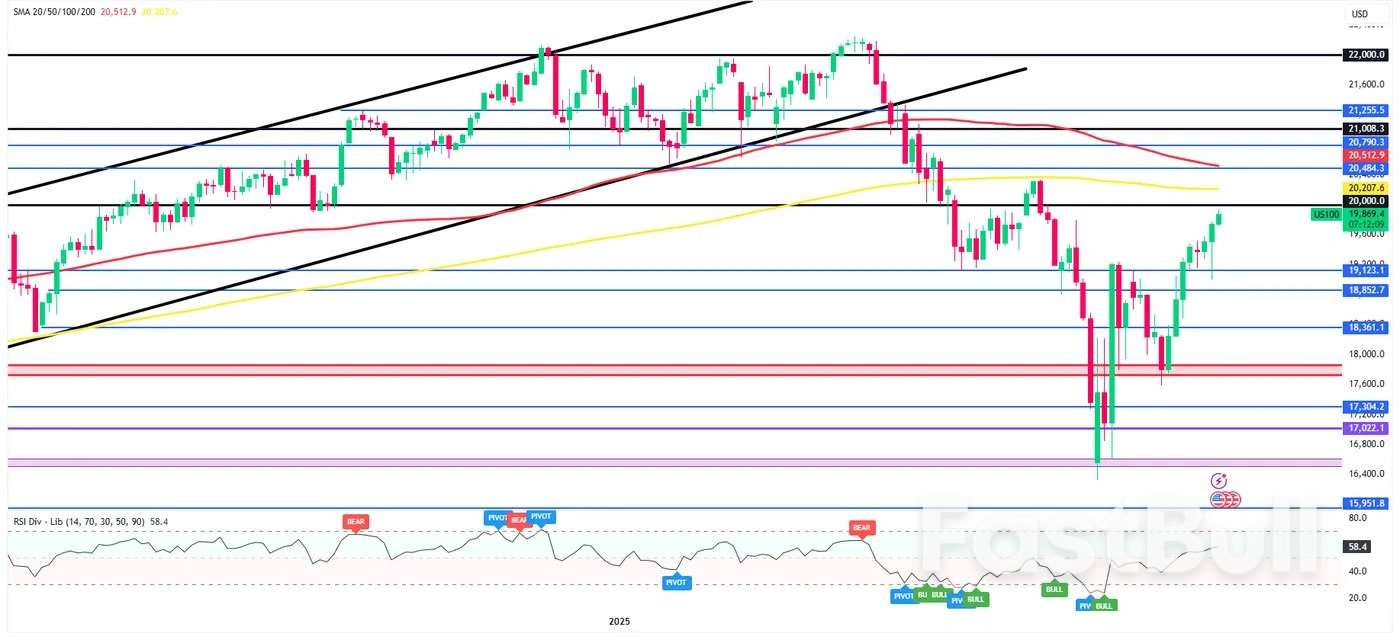
          Chart of the day - Nasdaq 100

          From a technical standpoint, the Nasdaq 100 is a whisker away from the key psychological 20000 handle. In pre-market trade, the index touched a high 19932 before falling somewhat since the US open.
          WIll Apple and Amazon be the catalyst for a break higher or will we see another pullback?
          US equities have also been largely driven by tariff developments. As it stands the improved sentiment and hopes of a US-China deal has set up the earnings reports from the 'Magnificent 7' perfectly to have a notable impact.
          However, if we are to see a poor earnings report and forward guidance from Apple and Amazon, i still believe a selloff may be short-lived given the improving risk appetite.
          Immediate resistance rests at 20000 but a host of hurdles lie just abit higher with the 20207 and 20484 handle both likely to prove tough hurdles to overcome.
          A pullback from here will have to navigate past the 19436 handle before the selloff gains traction in my opinion. Below that support rests at 19123 and 18852 respectively.

          Nasdaq 100 Daily Chart, May 1, 2025

          US Mid-Session Bell: US earnings bolsters sentiment as Apple, Amazon report next_1

          Source: marketpulse

          To stay updated on all economic events of today, please check out our Economic calendar
          Risk Warnings and Disclaimers
          You understand and acknowledge that there is a high degree of risk involved in trading. Following any strategies or investment methods may lead to potential losses. The content on the site is provided by our contributors and analysts for information purposes only. You are solely responsible for determining whether any trading assets, securities, strategy, or any other product is suitable for investing based on your own investment objectives and financial situation.
          Add to Favorites
          Share
          FastBull
          Copyright © 2025 FastBull Ltd

          728 RM B 7/F GEE LOK IND BLDG NO 34 HUNG TO RD KWUN TONG KLN HONG KONG

          TelegramInstagramTwitterfacebooklinkedin
          App Store Google Play Google Play
          Products
          Charts

          Chats

          Q&A with Experts
          Screeners
          Economic Calendar
          Data
          Tools
          Membership
          Features
          Function
          Markets
          Copy Trading
          Latest Signals
          Contests
          News
          Analysis
          24/7
          Columns
          Education
          Company
          Careers
          About Us
          Contact Us
          Advertising
          Help Center
          Feedback
          User Agreement
          Privacy Policy
          Business

          White Label

          Data API

          Web Plug-ins

          Poster Maker

          Affiliate Program

          Risk Disclosure

          The risk of loss in trading financial instruments such as stocks, FX, commodities, futures, bonds, ETFs and crypto can be substantial. You may sustain a total loss of the funds that you deposit with your broker. Therefore, you should carefully consider whether such trading is suitable for you in light of your circumstances and financial resources.

          No decision to invest should be made without thoroughly conducting due diligence by yourself or consulting with your financial advisors. Our web content might not suit you since we don't know your financial conditions and investment needs. Our financial information might have latency or contain inaccuracy, so you should be fully responsible for any of your trading and investment decisions. The company will not be responsible for your capital loss.

          Without getting permission from the website, you are not allowed to copy the website's graphics, texts, or trademarks. Intellectual property rights in the content or data incorporated into this website belong to its providers and exchange merchants.

          Not Logged In

          Log in to access more features

          FastBull Membership

          Not yet

          Purchase

          Become a signal provider
          Help Center
          Customer Service
          Dark Mode
          Price Up/Down Colors

          Log In

          Sign Up

          Position
          Layout
          Fullscreen
          Default to Chart
          The chart page opens by default when you visit fastbull.com
