Markets
News
Analysis
User
24/7
Economic Calendar
Education
Data
- Names
- Latest
- Prev


Signal Accounts for Members
All Signal Accounts
All Contests


U.K. Trade Balance (Oct)A:--
F: --
P: --
U.K. Services Index MoMA:--
F: --
P: --
U.K. Construction Output MoM (SA) (Oct)A:--
F: --
P: --
U.K. Industrial Output YoY (Oct)A:--
F: --
P: --
U.K. Trade Balance (SA) (Oct)A:--
F: --
P: --
U.K. Trade Balance EU (SA) (Oct)A:--
F: --
P: --
U.K. Manufacturing Output YoY (Oct)A:--
F: --
P: --
U.K. GDP MoM (Oct)A:--
F: --
P: --
U.K. GDP YoY (SA) (Oct)A:--
F: --
P: --
U.K. Industrial Output MoM (Oct)A:--
F: --
P: --
U.K. Construction Output YoY (Oct)A:--
F: --
P: --
France HICP Final MoM (Nov)A:--
F: --
P: --
China, Mainland Outstanding Loans Growth YoY (Nov)A:--
F: --
P: --
China, Mainland M2 Money Supply YoY (Nov)A:--
F: --
P: --
China, Mainland M0 Money Supply YoY (Nov)A:--
F: --
P: --
China, Mainland M1 Money Supply YoY (Nov)A:--
F: --
P: --
India CPI YoY (Nov)A:--
F: --
P: --
India Deposit Gowth YoYA:--
F: --
P: --
Brazil Services Growth YoY (Oct)A:--
F: --
P: --
Mexico Industrial Output YoY (Oct)A:--
F: --
P: --
Russia Trade Balance (Oct)A:--
F: --
P: --
Philadelphia Fed President Henry Paulson delivers a speech
Canada Building Permits MoM (SA) (Oct)A:--
F: --
P: --
Canada Wholesale Sales YoY (Oct)A:--
F: --
P: --
Canada Wholesale Inventory MoM (Oct)A:--
F: --
P: --
Canada Wholesale Inventory YoY (Oct)A:--
F: --
P: --
Canada Wholesale Sales MoM (SA) (Oct)A:--
F: --
P: --
Germany Current Account (Not SA) (Oct)A:--
F: --
P: --
U.S. Weekly Total Rig CountA:--
F: --
P: --
U.S. Weekly Total Oil Rig CountA:--
F: --
P: --
Japan Tankan Large Non-Manufacturing Diffusion Index (Q4)--
F: --
P: --
Japan Tankan Small Manufacturing Outlook Index (Q4)--
F: --
P: --
Japan Tankan Large Non-Manufacturing Outlook Index (Q4)--
F: --
P: --
Japan Tankan Large Manufacturing Outlook Index (Q4)--
F: --
P: --
Japan Tankan Small Manufacturing Diffusion Index (Q4)--
F: --
P: --
Japan Tankan Large Manufacturing Diffusion Index (Q4)--
F: --
P: --
Japan Tankan Large-Enterprise Capital Expenditure YoY (Q4)--
F: --
P: --
U.K. Rightmove House Price Index YoY (Dec)--
F: --
P: --
China, Mainland Industrial Output YoY (YTD) (Nov)--
F: --
P: --
China, Mainland Urban Area Unemployment Rate (Nov)--
F: --
P: --
Saudi Arabia CPI YoY (Nov)--
F: --
P: --
Euro Zone Industrial Output YoY (Oct)--
F: --
P: --
Euro Zone Industrial Output MoM (Oct)--
F: --
P: --
Canada Existing Home Sales MoM (Nov)--
F: --
P: --
Euro Zone Total Reserve Assets (Nov)--
F: --
P: --
U.K. Inflation Rate Expectations--
F: --
P: --
Canada National Economic Confidence Index--
F: --
P: --
Canada New Housing Starts (Nov)--
F: --
P: --
U.S. NY Fed Manufacturing Employment Index (Dec)--
F: --
P: --
U.S. NY Fed Manufacturing Index (Dec)--
F: --
P: --
Canada Core CPI YoY (Nov)--
F: --
P: --
Canada Manufacturing Unfilled Orders MoM (Oct)--
F: --
P: --
Canada Manufacturing New Orders MoM (Oct)--
F: --
P: --
Canada Core CPI MoM (Nov)--
F: --
P: --
Canada Manufacturing Inventory MoM (Oct)--
F: --
P: --
Canada CPI YoY (Nov)--
F: --
P: --
Canada CPI MoM (Nov)--
F: --
P: --
Canada CPI YoY (SA) (Nov)--
F: --
P: --
Canada Core CPI MoM (SA) (Nov)--
F: --
P: --
Canada CPI MoM (SA) (Nov)--
F: --
P: --


No matching data
Latest Views
Latest Views
Trending Topics
Top Columnists
Latest Update
White Label
Data API
Web Plug-ins
Affiliate Program
View All

No data
The world economy has proven more resilient than expected despite acute strains from multiple shocks, the head of the International Monetary Fund said on Wednesday, forecasting only a slight slowing of global growth this year and in 2026.f global growth this year and in 2026.
The world economy has proven more resilient than expected despite acute strains from multiple shocks, the head of the International Monetary Fund said on Wednesday, forecasting only a slight slowing of global growth this year and in 2026.
IMF managing director Kristalina Georgieva said the US economy had dodged a recession feared by many experts just six months ago. The US economy and many others had held up, given better policies, a more adaptable private sector, less severe import tariffs than feared — at least for now — and supportive financial conditions, according to a text of her remarks to an event at the Milken Institute in Washington.
"We see global growth slowing only slightly this year and next. All signs point to a world economy that has generally withstood acute strains from multiple shocks," Georgieva said in a preview of the IMF's upcoming World Economic Outlook.
In July, the IMF raised its global growth forecast by 0.2 percentage point to 3.0% for 2025 and by 0.1 percentage point to 3.1% for 2026.
It will release a fresh outlook next Tuesday during the annual meetings of the IMF and World Bank in Washington. The gathering takes place at a time when US President Donald Trump has upended global trade with steep tariffs and cracked down on immigration, and artificial intelligence is rapidly transforming technology and the outlook for labour.
The world economy is doing "better than feared, but worse than needed," Georgieva said, noting that the IMF was forecasting global growth of roughly 3% over the medium-term, well below the 3.7% forecast before the Covid-19 pandemic.
Georgieva cited deep undercurrents of marginalisation, discontent and hardship around the world, and said the global economy faced an array of risks.
Uncertainty is at exceptionally high levels and continuing to climb, while demand for gold — a traditional safe-haven asset for investors — is surging, Georgieva said, adding that holdings of monetary gold now exceeded 20% of the world's official reserves.
The US tariff shock has been less severe than initially announced in April, with the US trade-weighted tariff rate now around 17.5%, down from 23% in April, and countries largely skipping retaliatory tariffs.
But US tariff rates keep changing, and US inflation could rise if companies started to pass through more of the cost of tariffs, or if a flood of goods previously headed for the US triggered a second round of tariff hikes elsewhere.
Financial market valuations are also heading toward levels last seen during the internet-related bullishness 25 years ago, she said. An abrupt shift in sentiment — such as what happened during the dot.com crash of March 2000 — could drag down world growth, making life especially tough for developing countries.
"Buckle up," Georgieva said, adding, "Uncertainty is the new normal and it is here to stay."
The IMF chief urged countries to durably lift growth by boosting private-sector productivity, consolidating fiscal spending and addressing excessive imbalances, allowing them to rebuild their buffers to prepare for the next crisis.
Global public debt is expected to exceed 100% of GDP by 2029, Georgieva said.
Competition is key, along with free-market-friendly property rights, rule of law, strong financial sector oversights and accountable institutions.
In Asia, countries need to deepen trade and carry out reforms to strengthen the service sector, Georgieva said. A push to lower non-tariff barriers and boost regional integration could lift gross domestic product by 1.8% in the long run.
In Sub-Saharan Africa, business-friendly reforms could boost the real GDP per capita of the median African country by more than 10%. Europe should forge ahead with building a single market, which could help it catch up with the dynamism of the US private sector, she said.
The US should take "sustained action" to lower its federal debt, with the debt-to-GDP ratio on track to exceed its all-time high after World War Two, Georgieva said. It should also work to boost household saving, such as through favorable treatment of retirement savings.
China also has work to do, including boosting fiscal spending on social safety nets and property sector clean-up, while cutting spending on industrial policy initiatives, she said.


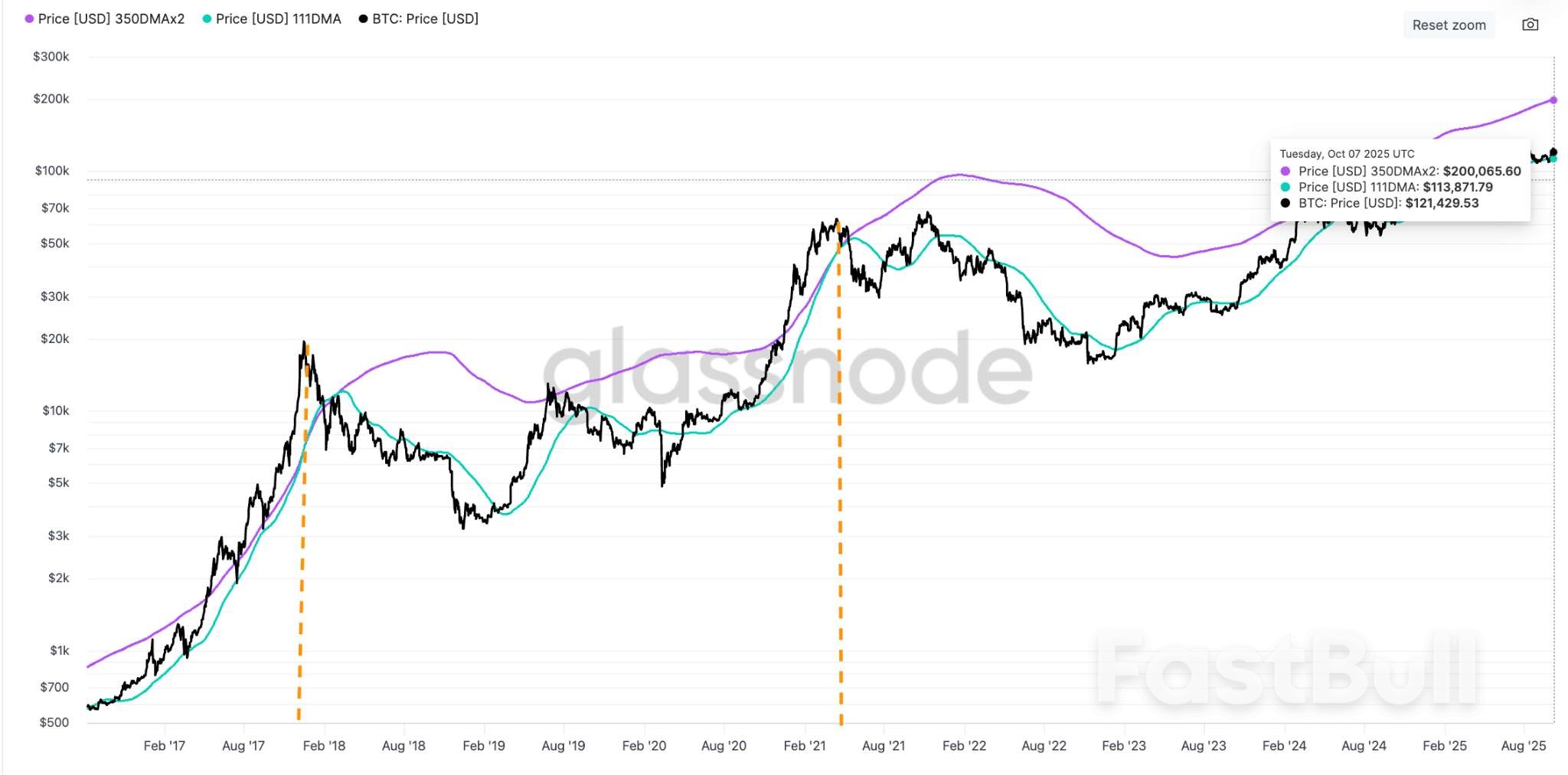
Bitcoin: Pi Cycle Top indicator. Source: Glassode
The Bank of England on Wednesday warned that the risk of a "sharp market correction" has increased, noting that valuations appear stretched, particularly for artificial intelligence-focused tech firms.
The central bank becomes the latest in a long list of banks and investors to weigh in on whether an AI bubble is forming as markets tick into the fourth quarter.
Heightened geopolitical tensions, fragmented trade and financial markets and pressures on sovereign debt markets play into the risk, the Bank of England said in a record of its latest meeting minutes.
"A crystallisation of such global risks could have a material impact on the UK as an open economy and global financial centre," it said.
Equity market valuations stood at near all-time highs, the Bank of England said, thanks in part to strong second-quarter earnings by U.S. tech firms.
"The market share of the top 5 members of the S&P 500, at close to 30%, was higher than at any point in the past 50 years," it said, noting that AI-focused tech company valuations appear particularly stretched.
"This, when combined with increasing concentration within market indices, leaves equity markets particularly exposed should expectations around the impact of AI become less optimistic," the meeting minutes said. With such high expectations of future earnings growth, any pullback on AI-related bets could lead to ripple effects, it added.
Investors are closely watching AI-related stocks as earning season gets underway, with some strategists confident that tech company valuations are being driven by sound fundamentals. Goldman Sachs also remained cautiously optimistic in its latest note, believing a bubble has not yet formed but heeded a warning to investors to "diversify."
Federal Reserve Chair Jerome Powell, however, warned of "fairly highly valued" assets on Tuesday, though he didn't explicitly refer to technology firms.
The Bank of England further warned that "downside factors included disappointing AI capability/adoption progress or increased competition, which could drive a re-evaluation of currently high expected future earnings."
"Material bottlenecks to AI progress – from power, data, or commodity supply chains – as well as conceptual breakthroughs which change the anticipated AI infrastructure requirements for the development and utilisation of powerful AI models could also harm valuations, including for companies whose revenue expectations are derived from high levels of anticipated AI infrastructure investment," it added.
Meanwhile, the private credit market has suffered recently, following news that auto maker First Brands and auto finance firm Tricolor have filed for bankruptcy. Meanwhile, political uncertainty in France and Japan persists and questions remain over U.S. President Donald Trump's interference with the Federal Reserve, adding to the Bank of England's more gloomy outlook.
Changes to the risk landscape "increases the risk that markets have not fully priced in possible adverse outcomes, and a sudden correction could occur should any of these risks crystallise," the Bank of England said.
As such, it could have a knock-on effect for households and businesses in a market that is already feeling the pinch through high costs of living and borrowing costs, it added.
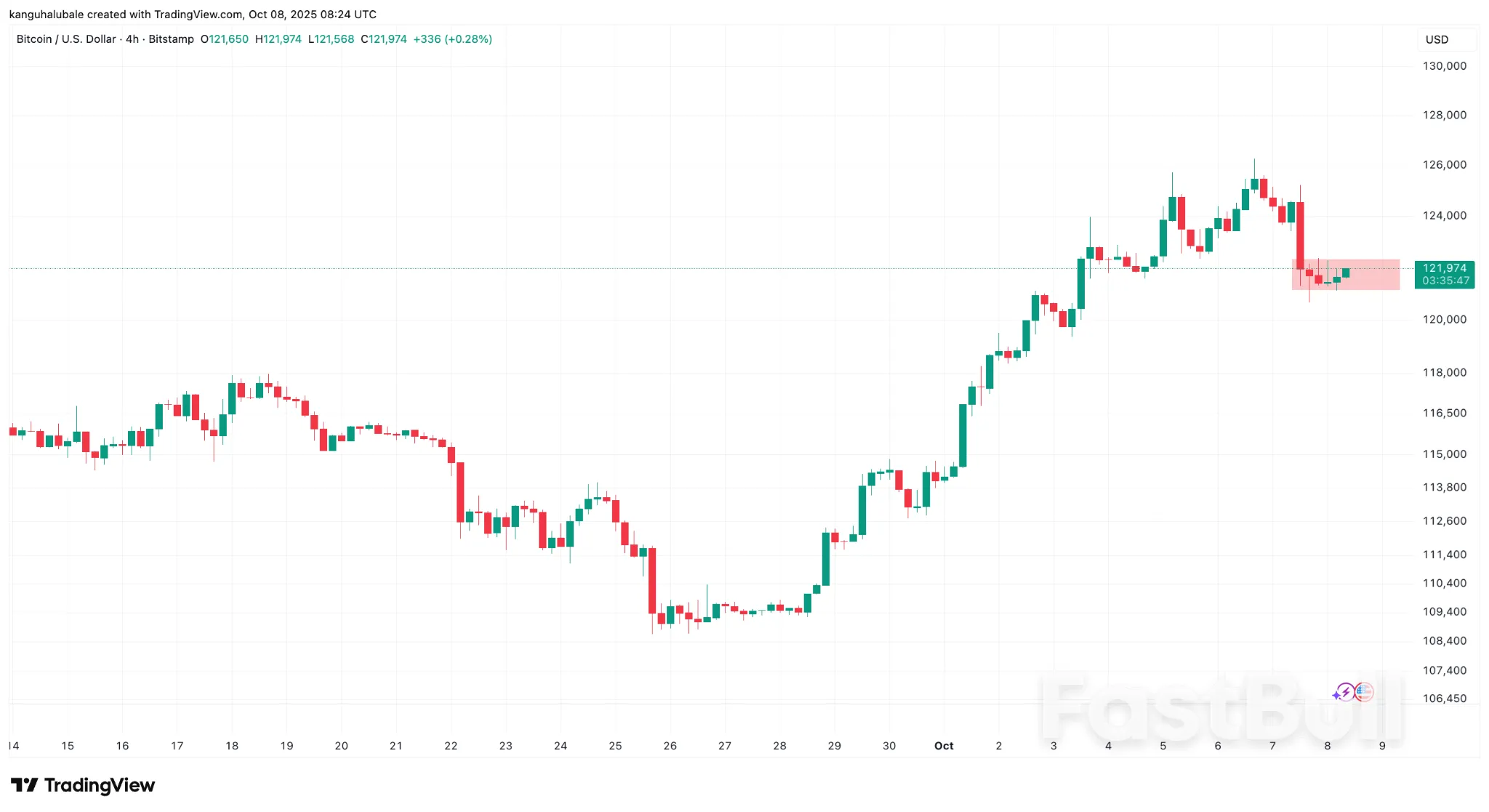
Bitcoin continued to hover near the $122,000 mark on Wednesday, struggling to regain momentum after a sharp correction.
Data from Cointelegraph Markets Pro and TradingView showed BTC/USD consolidating after a 4.2% drop from its all-time highs earlier in the week.
The pullback had been anticipated, following a series of record-breaking highs that lacked strong follow-through.
Rapidly rising open interest in Bitcoin derivatives had also fueled speculation of a potential retracement, as excessive leverage often precedes short-term pullbacks.
Analyst Skew described the price action as “very efficient” with “low volatility,” noting on X that larger traders exhibited “predatory” behavior on exchange order books during the correction.
Overnight, liquidity began to return to the market. Data from CoinGlass indicated improving bid- and ask-side activity, hinting at renewed stability after Tuesday’s volatility.
Skew suggested that the market could settle into a “consolidation range” in the near term, as traders reassess key price levels.
Analysts are now focused on identifying Bitcoin’s next potential support zone.
Trader ZYN highlighted that the $121,000 to $120,000 range offers limited technical support, suggesting prices could decline quickly if selling pressure increases.
“But just below, around $117K, nearly 190K BTC were last bought. That’s a heavy cluster of recent buyers,” ZYN said. “If we get a pullback into that range, it’s the kind of zone where demand usually shows up — strong buyers defending their entries, new capital stepping in. In short: weak cushion at $121K, but a very real floor forming at $117K.”
Material Indicators, a trading analytics firm, also identified $120,000 as a potential support zone but noted stronger technical support near $114,000, aligning with Bitcoin’s 50-day simple moving average (SMA).
Crypto analyst Michaël van de Poppe believes the next buying opportunity could appear near $118,000.
“Bitcoin made a new all-time high, which is often a reference for people to be taking profits,” he said. “Slight pullback and we’re approaching my personal area of interest for potential dip buying.”
Many traders see the current correction as a healthy pause in Bitcoin’s broader uptrend, with on-chain data still pointing to strong long-term demand and institutional inflows.
The post Bitcoin Struggles to Reclaim Momentum With Plunge Down to $112,000 ‘Likely’ in October appeared first on London Insider.
Prime Minister Keir Starmer said he wants the UK’s free trade agreement with India implemented “as soon as humanly possible,” as the two major economies deepen ties while US pursues a more protectionist trade agenda.Speaking to business delegates from the grand staircase of Mumbai’s Taj Mahal Palace hotel on Wednesday, Starmer said he has instructed his team to move quickly on the deal signed earlier this year.Starmer and his Indian counterpart Narendra Modi had finalized a free-trade agreement in July after three years of intense negotiations. The UK premier is in India this week — his first visit as prime minister — leading a delegation of more than 100 British business, academic, and cultural leaders to deepen commercial ties between the two countries.
“Our job is to make it easier for you to seize the opportunities,” Starmer told the business delegates. “On the plane home, I want each of you to tell me what you got out of this trip — a deal, a contact.”The British leader’s arrival was met with a warm welcome across Mumbai, the seaside megacity that is India’s business and financial capital. Hundreds of billboards and posters with Starmer’s face dotted the city, including some showing the British leader standing alongside Modi and praising the close ties between the two nations.
Still, the visit had some awkward undertones. Just hours before Starmer’s arrival, Modi announced warm birthday greetings to Russian President Vladimir Putin, calling him “my friend” and and praising “his personal commitment to deepening India-Russia ties.” Starmer has been a leader in urging nations to pressure Putin and bring him to the negotiating table to end his invasion of Ukraine.Starmer deflected a question while on the plane to India about the birthday greetings. “Just for the record, I haven’t sent birthday congratulations to Putin,” he told reporters.
Speaking in Mumbai, Starmer said the signing of the FTA is already boosting trade between the two nations. Starmer closed his address by taking a selfie with the gathered delegates with a disposable camera. The visit also comes a day after British Airways announced plans to start a third daily flight between London Heathrow and New Delhi.Yet, tensions over migration are expected to linger. On the flight to Mumbai, Starmer said he would resist demands from business to allow more highly skilled workers from India to come to the UK.“The visa situation hasn’t changed with the free trade agreement — we didn’t open up more visas,” Starmer said. “The issue is not about visas — it’s about business-to-business engagement and investment and jobs and prosperity coming into the United Kingdom.”
Germany will eke out meager expansion of 0.2% this year before growth strengthens to 1.3% in 2026 supported by tens of billions of euros in fiscal stimulus, according to revised government projections.
The latest twice-yearly forecasts published Wednesday by Economy Minister Katherina Reiche are slightly more optimistic than April’s projections by the previous government and bring the outlook into line with Germany’s leading research institutes.
Reiche acknowledged that “a significant portion” of growth in coming years will come from the jump in government spending and cautioned that the stimulus will only be effective “if investments are implemented quickly.”
“To ensure long-term growth, we must resolve the reform backlog,” she said in an emailed statement. Outstanding tasks include accelerating planning and approval procedures, reducing energy costs, and promoting private investment, added the minister.
Chancellor Friedrich Merz’s ruling coalition of his conservatives and the Social Democrats, which took office in early May, is trying to restore meaningful growth to Europe’s biggest economy after several years of stagnation.
It loosened rules that constrain government borrowing to facilitate a massive program of debt-financed spending on infrastructure and the military, and has enacted measures designed to spur investment and cut back restrictive red tape.
In publishing their forecasts last month, the research institutes warned that more fundamental reforms to strengthen the economy, boost competitiveness and lift long-term growth prospects aren’t yet being implemented.
“The German economy is still on shaky ground,” said Geraldine Dany-Knedlik, head of forecasting at the Berlin-based DIW institute.
“It will recover noticeably in the next two years,” she added. “However, given ongoing structural weaknesses, this momentum will not last.”
Bundesbank President Joachim Nagel on Tuesday added his voice to calls for more urgent efforts to tackle the economy’s deep-seated problems and increase its growth potential.
It’s “time to speed up on the path to reform,” Nagel, who was appointed by the previous Social Democrat-led government, said in Athens. “To reignite productivity and foster growth, the government must take decisive action.”
The Economy Ministry cautioned that risks to Germany’s expected recovery include “the volatile trade and security policies” of the US, together with “potential counter-reactions from commercial partners.”
“Further obstacles could arise from an escalation of geopolitical crises or a potentially stronger-than-expected slowdown among Germany’s key trading partners,” it added. It expects growth of 1.4% in 2027, according to the new forecasts.
In the volatile world of cryptocurrency trading, few assets command as much fervent attention as Ripple’s XRP. Long a battleground for bulls and bears alike, XRP has once again captured the spotlight—not for a regulatory win or partnership announcement, but for a stark pivot in technical sentiment from a prominent analyst. On October 8, 2025, @egcrypto, a seasoned voice in the crypto Twittersphere with a knack for Elliott Wave dissections, posted a pair of annotated TradingView charts under the cryptic banner “#XRP – Not Confident.” What unfolded was a visual narrative of eroding optimism, shifting from a “Before: Confident” setup to an “After” scenario laced with red flags.
The “Before” chart paints a picture of measured bullishness. XRP’s price action, framed against a backdrop of gray trendlines and green upward channels, suggests a classic ascending triangle pattern. Yellow annotations highlight potential breakout zones above the $0.60 resistance, with green triangles marking wave completions that align with a fifth-wave rally toward $0.75–$0.85. The analyst’s notes emphasize confluence: “Strong support at 0.55, volume spike incoming?” It’s the kind of setup that lures dip-buyers, evoking memories of XRP’s 2017 moonshot. Confidence here stems from macroeconomic tailwinds—easing Fed rhetoric and crypto’s post-halving glow—positioning XRP for a 20-30% upside leg.
Fast-forward to the “After” chart, and the tone darkens. Those green channels morph into precarious gray wedges, with red downward arrows signaling a breakdown below key supports. The ascending triangle? Now a descending one, complete with crimson alerts on failed retests of the 50-day EMA. Annotations scream caution: “Divergence confirmed, RSI overbought—trap?” The shift appears triggered by recent price rejection at $0.62, coupled with broader market jitters from Bitcoin’s sideways grind. @egcrypto’s pivot underscores a timeless trading axiom: patterns evolve, and overconfidence kills. XRP now hovers around $0.58, down 4% in the last 24 hours, testing the resolve of holders amid SEC overhang whispers.
This isn’t just chart porn for traders; it’s a microcosm of XRP’s perennial struggle. Despite Ripple’s legal victories, adoption lags behind Ethereum’s DeFi dominance and Solana’s speed. Yet, for contrarians, this “not confident” call could be the contrarian buy signal—after all, fear often precedes fortune in crypto. As @egcrypto urges subscribers to “stay ahead of the crowd,” the community buzzes with debates: Is this a healthy pullback or the prelude to a deeper correction?
For now, XRP traders should heed the tape. Scale in lightly on dips to $0.55, but keep stops tight. In a market where sentiment flips faster than a memecoin pump, today’s caution could tomorrow’s catalyst. Watch for volume resurgence or BTC’s cue—the next wave awaits.
White Label
Data API
Web Plug-ins
Poster Maker
Affiliate Program
The risk of loss in trading financial instruments such as stocks, FX, commodities, futures, bonds, ETFs and crypto can be substantial. You may sustain a total loss of the funds that you deposit with your broker. Therefore, you should carefully consider whether such trading is suitable for you in light of your circumstances and financial resources.
No decision to invest should be made without thoroughly conducting due diligence by yourself or consulting with your financial advisors. Our web content might not suit you since we don't know your financial conditions and investment needs. Our financial information might have latency or contain inaccuracy, so you should be fully responsible for any of your trading and investment decisions. The company will not be responsible for your capital loss.
Without getting permission from the website, you are not allowed to copy the website's graphics, texts, or trademarks. Intellectual property rights in the content or data incorporated into this website belong to its providers and exchange merchants.
Not Logged In
Log in to access more features

FastBull Membership
Not yet
Purchase
Log In
Sign Up