• Trade
  • Markets
  • Copy
  • Contests
  • News
  • 24/7
  • Calendar
  • Q&A
  • Chats
Trending
Screeners
SYMBOL
LAST
BID
ASK
HIGH
LOW
NET CHG.
%CHG.
SPREAD
SPX
S&P 500 Index
6827.42
6827.42
6827.42
6899.86
6801.80
-73.58
-1.07%
--
DJI
Dow Jones Industrial Average
48458.04
48458.04
48458.04
48886.86
48334.10
-245.98
-0.51%
--
IXIC
NASDAQ Composite Index
23195.16
23195.16
23195.16
23554.89
23094.51
-398.69
-1.69%
--
USDX
US Dollar Index
97.950
98.030
97.950
98.500
97.950
-0.370
-0.38%
--
EURUSD
Euro / US Dollar
1.17394
1.17409
1.17394
1.17496
1.17192
+0.00011
+ 0.01%
--
GBPUSD
Pound Sterling / US Dollar
1.33707
1.33732
1.33707
1.33997
1.33419
-0.00148
-0.11%
--
XAUUSD
Gold / US Dollar
4299.39
4299.39
4299.39
4353.41
4257.10
+20.10
+ 0.47%
--
WTI
Light Sweet Crude Oil
57.233
57.485
57.233
58.011
56.969
-0.408
-0.71%
--

Community Accounts

Signal Accounts
--
Profit Accounts
--
Loss Accounts
--
View More

Become a signal provider

Sell trading signals to earn additional income

View More

Guide to Copy Trading

Get started with ease and confidence

View More

Signal Accounts for Members

All Signal Accounts

Best Return
  • Best Return
  • Best P/L
  • Best MDD
Past 1W
  • Past 1W
  • Past 1M
  • Past 1Y

All Contests

  • All
  • Trump Updates
  • Recommend
  • Stocks
  • Cryptocurrencies
  • Central Banks
  • Featured News
Top News Only
Share

Kuwait's Oil Minister Says: We Expected Prices To Remain At Least As They Were, If Not Better, But We Were Surprised By Their Drop

Share

Kuwait Sees Fair Oil Price At $60-$68 A Barrel Under Current Conditions

Share

Syria Produces About 100000 Barrels/Day And Aims To Boost Output If Issues East Of The Euphrates Are Resolved

Share

Australia Intelligence Official: National Terrorism Threat Level Remains At Probable

Share

Australia Intelligence Official: We're Looking To See If There Are Anyone In The Community That Has Similar Intent

Share

Australia Intelligence Official: We Are Looking At The Identities Of The Attackers

Share

Australia Prime Minister: Tells Jews We Will Dedicate Every Resource Required To Making Sure You Are Safe And Protected

Share

Australia Prime Minister: Police And Security Agencies Are Working To Determine Anyone Associated With This Outrage

Share

Australia Police: Police Bomb Disposal Unit Currently Working On Several Suspected Improvised Explosive Devices

Share

Syria's Oil Ministry Forecasts Country's Gas Production To Increase To 15 Million Cubic Meters By End Of 2026

Share

His Office: Ukraine's President Zelenskiy Landed In Germany

Share

Australia Police: This Is Not A Time For Retribution. This Is A Time To Allow The Police To Do Their Duty

Share

Australia Police: We Know That We Have Two Definite Offenders, But We Want To Make Sure The Community Is Safe

Share

Australia Police: Our Counter-Terrorism Command Will Lead This Investigation With Investigators From The State Crime Command. No Stone Will Be Left Unturned

Share

Australia Police: This Is A Terrorist Incident

Share

Ukraine President Zelenskiy: Ukraine-Russia Ceasefire Along The Current Frontlines Would Be A Fair Option

Share

New South Wales Premier Chris Minns: This Is A Massive, Complex And Just Beginning Investigation

Share

New South Wales Premier Chris Minns: 12 Killed In Bondi Shooting

Share

Ukraine President Zelenskiy: Security Guarantees Should Be Legally Binding

Share

Ukraine President Zelenskiy: US, European Security Guarantees Instead Of NATO Membership Is Compromise From Ukraine's Side

TIME
ACT
FCST
PREV
U.K. Trade Balance (Oct)

A:--

F: --

P: --

U.K. Services Index MoM

A:--

F: --

P: --

U.K. Construction Output MoM (SA) (Oct)

A:--

F: --

P: --

U.K. Industrial Output YoY (Oct)

A:--

F: --

P: --

U.K. Trade Balance (SA) (Oct)

A:--

F: --

P: --

U.K. Trade Balance EU (SA) (Oct)

A:--

F: --

P: --

U.K. Manufacturing Output YoY (Oct)

A:--

F: --

P: --

U.K. GDP MoM (Oct)

A:--

F: --

P: --

U.K. GDP YoY (SA) (Oct)

A:--

F: --

P: --

U.K. Industrial Output MoM (Oct)

A:--

F: --

P: --

U.K. Construction Output YoY (Oct)

A:--

F: --

P: --

France HICP Final MoM (Nov)

A:--

F: --

P: --

China, Mainland Outstanding Loans Growth YoY (Nov)

A:--

F: --

P: --

China, Mainland M2 Money Supply YoY (Nov)

A:--

F: --

P: --

China, Mainland M0 Money Supply YoY (Nov)

A:--

F: --

P: --

China, Mainland M1 Money Supply YoY (Nov)

A:--

F: --

P: --

India CPI YoY (Nov)

A:--

F: --

P: --

India Deposit Gowth YoY

A:--

F: --

P: --

Brazil Services Growth YoY (Oct)

A:--

F: --

P: --

Mexico Industrial Output YoY (Oct)

A:--

F: --

P: --

Russia Trade Balance (Oct)

A:--

F: --

P: --

Philadelphia Fed President Henry Paulson delivers a speech
Canada Building Permits MoM (SA) (Oct)

A:--

F: --

P: --

Canada Wholesale Sales YoY (Oct)

A:--

F: --

P: --

Canada Wholesale Inventory MoM (Oct)

A:--

F: --

P: --

Canada Wholesale Inventory YoY (Oct)

A:--

F: --

P: --

Canada Wholesale Sales MoM (SA) (Oct)

A:--

F: --

P: --

Germany Current Account (Not SA) (Oct)

A:--

F: --

P: --

U.S. Weekly Total Rig Count

A:--

F: --

P: --

U.S. Weekly Total Oil Rig Count

A:--

F: --

P: --

Japan Tankan Large Non-Manufacturing Diffusion Index (Q4)

--

F: --

P: --

Japan Tankan Small Manufacturing Outlook Index (Q4)

--

F: --

P: --

Japan Tankan Large Non-Manufacturing Outlook Index (Q4)

--

F: --

P: --

Japan Tankan Large Manufacturing Outlook Index (Q4)

--

F: --

P: --

Japan Tankan Small Manufacturing Diffusion Index (Q4)

--

F: --

P: --

Japan Tankan Large Manufacturing Diffusion Index (Q4)

--

F: --

P: --

Japan Tankan Large-Enterprise Capital Expenditure YoY (Q4)

--

F: --

P: --

U.K. Rightmove House Price Index YoY (Dec)

--

F: --

P: --

China, Mainland Industrial Output YoY (YTD) (Nov)

--

F: --

P: --

China, Mainland Urban Area Unemployment Rate (Nov)

--

F: --

P: --

Saudi Arabia CPI YoY (Nov)

--

F: --

P: --

Euro Zone Industrial Output YoY (Oct)

--

F: --

P: --

Euro Zone Industrial Output MoM (Oct)

--

F: --

P: --

Canada Existing Home Sales MoM (Nov)

--

F: --

P: --

Euro Zone Total Reserve Assets (Nov)

--

F: --

P: --

U.K. Inflation Rate Expectations

--

F: --

P: --

Canada National Economic Confidence Index

--

F: --

P: --

Canada New Housing Starts (Nov)

--

F: --

P: --

U.S. NY Fed Manufacturing Employment Index (Dec)

--

F: --

P: --

U.S. NY Fed Manufacturing Index (Dec)

--

F: --

P: --

Canada Core CPI YoY (Nov)

--

F: --

P: --

Canada Manufacturing Unfilled Orders MoM (Oct)

--

F: --

P: --

Canada Manufacturing New Orders MoM (Oct)

--

F: --

P: --

Canada Core CPI MoM (Nov)

--

F: --

P: --

Canada Manufacturing Inventory MoM (Oct)

--

F: --

P: --

Canada CPI YoY (Nov)

--

F: --

P: --

Canada CPI MoM (Nov)

--

F: --

P: --

Canada CPI YoY (SA) (Nov)

--

F: --

P: --

Canada Core CPI MoM (SA) (Nov)

--

F: --

P: --

Canada CPI MoM (SA) (Nov)

--

F: --

P: --

Q&A with Experts
    • All
    • Chatrooms
    • Groups
    • Friends
    Connecting
    .
    .
    .
    Type here...
    Add Symbol or Code

      No matching data

      All
      Trump Updates
      Recommend
      Stocks
      Cryptocurrencies
      Central Banks
      Featured News
      • All
      • Russia-Ukraine Conflict
      • Middle East Flashpoint
      • All
      • Russia-Ukraine Conflict
      • Middle East Flashpoint
      Search
      Products

      Charts Free Forever

      Chats Q&A with Experts
      Screeners Economic Calendar Data Tools
      Membership Features
      Data Warehouse Market Trends Institutional Data Policy Rates Macro

      Market Trends

      Market Sentiment Order Book Forex Correlations

      Top Indicators

      Charts Free Forever
      Markets

      News

      News Analysis 24/7 Columns Education
      From Institutions From Analysts
      Topics Columnists

      Latest Views

      Latest Views

      Trending Topics

      Top Columnists

      Latest Update

      Signals

      Copy Rankings Latest Signals Become a signal provider AI Rating
      Contests
      Brokers

      Overview Brokers Assessment Rankings Regulators News Claims
      Broker listing Forex Brokers Comparison Tool Live Spread Comparison Scam
      Q&A Complaint Scam Alert Videos Tips to Detect Scam
      More

      Business
      Events
      Careers About Us Advertising Help Center

      White Label

      Data API

      Web Plug-ins

      Affiliate Program

      Awards Institution Evaluation IB Seminar Salon Event Exhibition
      Vietnam Thailand Singapore Dubai
      Fans Party Investment Sharing Session
      FastBull Summit BrokersView Expo
      Recent Searches
        Top Searches
          Markets
          News
          Analysis
          User
          24/7
          Economic Calendar
          Education
          Data
          • Names
          • Latest
          • Prev

          View All

          No data

          Scan to Download

          Faster Charts, Chat Faster!

          Download App
          English
          • English
          • Español
          • العربية
          • Bahasa Indonesia
          • Bahasa Melayu
          • Tiếng Việt
          • ภาษาไทย
          • Français
          • Italiano
          • Türkçe
          • Русский язык
          • 简中
          • 繁中
          Open Account
          Search
          Products
          Charts Free Forever
          Markets
          News
          Signals

          Copy Rankings Latest Signals Become a signal provider AI Rating
          Contests
          Brokers

          Overview Brokers Assessment Rankings Regulators News Claims
          Broker listing Forex Brokers Comparison Tool Live Spread Comparison Scam
          Q&A Complaint Scam Alert Videos Tips to Detect Scam
          More

          Business
          Events
          Careers About Us Advertising Help Center

          White Label

          Data API

          Web Plug-ins

          Affiliate Program

          Awards Institution Evaluation IB Seminar Salon Event Exhibition
          Vietnam Thailand Singapore Dubai
          Fans Party Investment Sharing Session
          FastBull Summit BrokersView Expo

          Huawei Unveils AI Chip Roadmap to Challenge Nvidia’s Lead

          Adam

          Economic

          Summary:

          Huawei revealed its AI chip roadmap with new Ascend processors, memory, and SuperPod clusters. Aiming to rival Nvidia under U.S. curbs, it pushes China toward self-reliance and stronger computing power.
          Huawei Technologies Co. unveiled new technology from memory chips to AI accelerators Thursday, outlining publicly for the first time its multiyear plan to challenge Nvidia Corp.’s dominance in a growing market.
          The highlight of the company’s presentation on Thursday were new SuperPod cluster designs that will allow Huawei to link as many as 15,488 of its Ascend neural processing units for artificial intelligence and operate them as a coherent system, rotating chairman Eric Xu said at the event. Those SuperPod products will be built with new generations of Ascend chips from next year.
          The next-generation Ascend 950 series will be accompanied by new high-bandwidth memory designed by Huawei itself, Xu said, without elaborating on who will fabricate the semiconductors. Huawei also plans to roll out an Ascend 960 in late 2027, to be succeeded by a 970 model in late 2028.
          “This is a significant milestone in China’s long march of the AI chipset industry,” said Charlie Dai, vice president at Forrester Research. “This achievement reflects breakthroughs in system design, interconnect technologies, and local fabrication capabilities. It signals a stronger push toward self-reliance and resilience in the face of export restrictions.”
          Shenzhen-based Huawei is China’s most advanced chip designer and strongest contender to build alternatives to Nvidia’s industry-leading AI hardware. Washington has for years blocked the export of Nvidia’s top products to China, and Beijing recently told its biggest tech companies not to use Nvidia’s RTX Pro 6000D, a graphics card for workstations that can be repurposed for AI applications. The move marked a clear attempt by Chinese leaders to wean the country off Nvidia hardware and boost domestic alternatives.
          Like its US competitor, Huawei is developing systems that combine several of its AI chips into more capable clusters. The newly announced Atlas 950 SuperPod will deliver 6.7 times more computing power than Nvidia’s upcoming NVL144 systems, Xu said. Huawei is also planning a super cluster with about 1 million graphic cards, based on the new SuperPod technology.
          Earlier this year, company founder Ren Zhengfei told state newspaper People’s Daily that Huawei still lags behind the US in terms of output from a single chip, but “can still get the results we want by compensating with cluster-based computing.”
          The aggressive approach helps China’s AI chip leader draw more performance from its semiconductors, which face a manufacturing constraint as the company cannot readily advance to more sophisticated fabrication due to trade restrictions on leading-edge machinery. While short of a big breakthrough in chip technology, Huawei’s solution marks the latest development by Chinese firms trying to develop homegrown alternatives and lessen the impact of US sanctions.
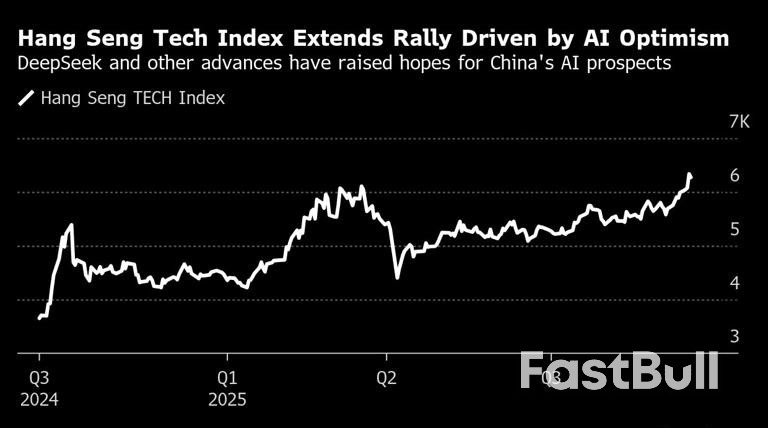
          Chinese tech stocks have surged in past weeks, driven by a perception that the nation’s industry leaders are making steady progress in developing homegrown AI and chips. Alibaba Group Holding Ltd. and Baidu Inc. are among the companies that have secured important clients for their in-house designs, while Cambricon Technologies Corp. — seen as a proxy for the country’s AI chip sector — has surged in market value this year.
          Huawei Unveils AI Chip Roadmap to Challenge Nvidia’s Lead_1

          Hang Seng Tech Index Extends Rally Driven by AI Optimism | DeepSeek and other advances have raised hopes for China's AI prospects

          Among other measures, Chinese authorities have also discouraged companies from using Nvidia’s H20 chip that’s designed for AI workloads. While the guidance stops short of an outright ban, it has nonetheless had a chilling effect. Nvidia, despite having gotten Washington’s official green light for some H20 exports, has not executed those shipments, the company said last week. That creates a bigger gap in the Chinese market for domestic chipmakers like Huawei and Cambricon to fill.

          Source : Bloomberg

          To stay updated on all economic events of today, please check out our Economic calendar
          Risk Warnings and Disclaimers
          You understand and acknowledge that there is a high degree of risk involved in trading. Following any strategies or investment methods may lead to potential losses. The content on the site is provided by our contributors and analysts for information purposes only. You are solely responsible for determining whether any trading assets, securities, strategy, or any other product is suitable for investing based on your own investment objectives and financial situation.
          Add to Favorites
          Share

          UBS AM’s Zhao Says Fed Rate Hikes Will Widen Treasury Spreads

          Kevin Du

          Central Bank

          The Federal Reserve will have to switch to raising interest rates next year because of a pick up in growth, which will cause a dramatic widening in Treasury yield spreads, according to Kevin Zhao of UBS Asset Management.

          “If you have growth going up, unemployment going down, and inflation staying high, I think the justification for rate hikes will become evident by the middle of next year,” said Zhao, who leads the Swiss firm’s actively managed sovereign, fixed income and currency funds.

          It’s a bold call coming just a day after the Fed lowered borrowing costs for the first time in 2025 and penciled in two more such moves this year. For comparison, traders in the swaps markets are currently pricing five more reductions by the end of 2026, and investors including Pimco anticipate more cuts lie ahead.

          Zhao says it is “reasonable” for the central bank to deliver two more rate cuts by year-end. In his view, while a new incoming Fed chair might initially resist a shift to tighter monetary policy, they could eventually be overruled if more policymakers push for higher rates.

          Once it becomes clear to the wider market that the Fed will need to hike, the spread between two-year and 10-year Treasury yields will widen to 100 basis points and steepen the overall curve, Zhao said.

          The spread between the two maturities has narrowed to about 50 basis points in recent weeks. Zhao is waiting for it to reach around 40 basis points before initiating a trade that would profit from a steeper yield curve.

          His Global Dynamic Bond Fund fund has returned more than 7% this year, beating 89% of its peers, according to data compiled by Bloomberg.

          Source: Bloomberg Europe

          Risk Warnings and Disclaimers
          You understand and acknowledge that there is a high degree of risk involved in trading. Following any strategies or investment methods may lead to potential losses. The content on the site is provided by our contributors and analysts for information purposes only. You are solely responsible for determining whether any trading assets, securities, strategy, or any other product is suitable for investing based on your own investment objectives and financial situation.
          Add to Favorites
          Share

          Gold: Why It Outshines Platinum and Palladium in Monetary Stability

          Adam

          Commodity

          Markets live and die on illusions of abundance. Central banks can conjure money with keystrokes, miners can flood the world with copper if demand and price are right, and shale rigs can be spun up almost overnight. But gold is the one market clock that refuses to speed up. It ticks at its own glacial pace: 1.7% annual growth, century after century, empire after empire. No policy, no discovery, no “quantitative easing of geology” can bend that hand forward.
          That is why gold, more than any other metal, has been humanity’s base layer of trust. It is not its scarcity that crowns it king—platinum and palladium are far rarer—but its hardness. Hardness is not about how difficult it is to scratch with a knife; it’s about how impossible it is to debase.
          Every ounce ever mined still exists. Every ring, every coin, every central bank bar can be melted, re-stamped, and re-hoarded. Gold does not vanish into industrial furnaces or chemical reactions. Unlike copper or oil, it is not consumed by the world—it merely changes form, never dying.
          Copper offers the perfect contrast. Each year, miners produce 21.9 million tonnes—fifteen times larger than the available stockpile. Copper is used, burned up, and buried in wires and circuits. Its price is forever hostage to factory cycles and construction booms. That is why copper can never be money. It is too entangled in the noise of the real economy.
          Platinum and palladium tempt with rarity, but they too fail the hardness test. Their annual supply growth is obscene—178% for platinum, 83% for palladium—because their stockpiles are so small relative to production, and industrial demand consumes them quickly. They are exotic industrial ingredients, not neutral monetary anchors. Scarcity alone cannot grant them trust.
          Gold, by contrast, is the monetary metronome. Its stockpile is enormous, its supply trickle is microscopic, and its industrial pull is negligible. That creates a structural resistance to debasement unmatched by any other commodity. The gold supply is immune to sudden floods, panicked accelerations, or politically driven production surges. That neutrality is why civilizations keep returning to it—Romans, Chinese dynasties, British empire, Bretton Woods, and now once again in an age where fiat currencies are stretched thinner than rice paper.
          We are approaching another reset. Global debt curves look more like terminal charts than sustainable slopes. Fiat money, when debased, relies on faith in institutions, and faith is the first casualty of political expediency. Central banks can tell stories, politicians can spin narratives, but gold requires no script. Its slow heartbeat is the only part of the financial system that cannot be doctored or Photoshopped.
          So the question is not whether gold will re-emerge as the hard anchor in the next monetary storm—it always does. The only real question is whether you are already on board before the clock tolls midnight.

          Source: investing

          Risk Warnings and Disclaimers
          You understand and acknowledge that there is a high degree of risk involved in trading. Following any strategies or investment methods may lead to potential losses. The content on the site is provided by our contributors and analysts for information purposes only. You are solely responsible for determining whether any trading assets, securities, strategy, or any other product is suitable for investing based on your own investment objectives and financial situation.
          Add to Favorites
          Share

          Chinese Fiscal Spending Slowdown Persists in Risk for Growth

          Adam

          Economic

          China’s government spending increased at a slower rate for the second straight month, underscoring how weaker fiscal support now presents a risk to an economy whose momentum is cooling across the board.
          While revenue stagnated, total expenditure under the country’s two major fiscal books climbed just 6% last month from a year earlier, the slowest since May, according to Bloomberg calculations based on data published Wednesday by the Ministry of Finance.
          The allocation on infrastructure-related spending in China’s main budget slumped at the fastest clip in a year with a contraction of 10%, as the use of funding raised from government bond sales has likely been slowing.
          “The August slowdown in government spending growth, continued accumulation in fiscal deposits and the sharp decline in infrastructure investment during July-August suggest policymakers are not in a rush to step up stimulus amid still-resilient exports,” Goldman Sachs Group Inc. economists including Lisheng Wang wrote in a note.
          The pullback in spending follows a front-loading of fiscal stimulus earlier in the year as the world’s second-biggest economy came under pressure from Donald Trump’s tariffs.
          In August, China’s net government bond issuance decelerated for the first time this year, constraining Beijing’s spending power.
          The waning fiscal support has contributed to the two weakest months for the economy this year in July and August. Investment — a key lever used by the government to stimulate growth — has weakened sharply.
          What Bloomberg Economics Says...
          “Fiscal policy isn’t providing the growth support China needs. July–August saw an alarming deceleration in investment, with government spending — a traditional lever to spur demand — shrinking year on year, exacerbating private-sector weakness.”
          — Chang Shu and David Qu. For full analysis, click here
          While analysts are increasingly calling on Beijing to ramp up support for the economy, ballooning debt risks mean the authorities may opt against the kind of aggressive fiscal expansion seen in the past couple of years.
          The government’s broad spending in January-August is already up 8.9% from a year earlier for a total of 24.2 trillion yuan. As a result, the broad budget deficit in the period widened to 6.7 trillion yuan.
          Still, the efficiency with which the government disburses the funds it borrowed for projects remains a question, creating uncertainty over the ultimate impact on the economy from the debt sales.
          A total of 8.4 trillion yuan was raised from sovereign bond net financing and sales of new local notes in the first eight months of the year. Accounting for the gap between actual spending and income in the period, that suggests 1.7 trillion yuan likely remained in so-called fiscal deposits at banks.
          Red tape and the complicated logistics of getting construction started are among reasons why putting money to work takes more time.
          A recent case in point is a state-owned road and bridge builder in the southwestern province of Sichuan. In its earnings report for the first half of 2025, the company said it saw a “notable” decline in the volume of active projects as many new ones struggled to break ground because of delays in land approval and relocation work.
          The Ministry of Finance’s revenue side of the ledger also provided further evidence that the government is struggling to lift income. Pressure is rising because China’s growth woes are curtailing tax revenue while land sales remain sluggish, with the years-long housing slump showing no signs of improvement.
          According to the latest numbers, combined revenue under the general public budget and the government-managed fund account rose less than 0.3% last month.
          In the first eight months of the year, tax revenue edged up just 0.02% from a year earlier to 12.1 trillion yuan, while local government income from selling land contracted 4.7% to 1.9 trillion yuan. Combined, they made up 80% of broad government revenue during the period.
          In August alone, revenue from land sales fell 5.8% from a year earlier, declining for the first time in three months. Income from property-related taxes was down 11.7%, its biggest slide in a year.
          “Given sluggish domestic demand and continued weakness in labor and property markets, we believe incremental and targeted easing is still necessary in coming quarters,” Goldman’s economists said.

          Source: Bloomberg

          To stay updated on all economic events of today, please check out our Economic calendar
          Risk Warnings and Disclaimers
          You understand and acknowledge that there is a high degree of risk involved in trading. Following any strategies or investment methods may lead to potential losses. The content on the site is provided by our contributors and analysts for information purposes only. You are solely responsible for determining whether any trading assets, securities, strategy, or any other product is suitable for investing based on your own investment objectives and financial situation.
          Add to Favorites
          Share

          Bessent Suggests Acceptance Of Yuan Exchange Rate Versus Dollar

          Devin

          Economic

          Forex

          US Treasury Secretary Scott Bessent suggested he’s fine with how China’s yuan has moved against the dollar this year, while pointing out its depreciation against the euro presents a challenge for European economies.

          “Well, they haven’t done it to the US,” Bessent said of descriptions of China having engaged in “opportunistic devaluation” this year. “The RMB is actually stronger this year versus the dollar,” he said, referring to the renminbi, China’s official name for its currency. “It’s at an all-time low versus the euro, which is a problem for the Europeans.”

          The yuan is up about 3% so far this year against the dollar — roughly half the appreciation of South Korea’s won or Japan’s yen, according to data compiled by Bloomberg. The euro has soared almost 14% against the dollar in that time. Because it’s risen by less against the dollar, the yuan has dropped versus other major currencies. It’s dropped about 10% versus the euro.

          “Chinese trade with Europe is up 6.9%, and it’s down 14% with the US,” Bessent said during an interview in Madrid following talks with his Chinese counterparts on trade and TikTok earlier this week. “We’re coming into balance. Our trade deficit with China this year will probably be 30% lower.”

          Earlier this year, the Treasury Department in its semiannual analysis of trading partners’ currency policies singled China out for “its lack of transparency,” something it’s done for years. But it stopped short of naming any economy for manipulating its exchange rate.

          Bessent also said he was confident that the Supreme Court would rule in the administration’s favor on President Donald Trump’s use of emergency authorities to impose tariffs on a wide range of countries.

          He said that the tariff revenue, which is helping to stabilize US debt, is “all extra” and that the administration can achieve its goal of bringing the deficit-to-GDP ratio down to something “with a three in front of it” by the time Trump leaves office.

          If the Supreme Court rules against the tariffs, Bessent said that the administration has other authorities it can use to replicate the same effect, and that countries that have struck trade deals with Washington based on seeking relief from higher tariff rates should “stick with it.”

          “Those of you who’ve gotten a good deal should stick with it,” he said. “You should assume that they’re here to stay and that you should honor your agreements.”

          Source: Bloomberg Europe

          To stay updated on all economic events of today, please check out our Economic calendar
          Risk Warnings and Disclaimers
          You understand and acknowledge that there is a high degree of risk involved in trading. Following any strategies or investment methods may lead to potential losses. The content on the site is provided by our contributors and analysts for information purposes only. You are solely responsible for determining whether any trading assets, securities, strategy, or any other product is suitable for investing based on your own investment objectives and financial situation.
          Add to Favorites
          Share

          Fed: the doves have gone to roost

          Adam

          Economic

          Central Bank

          However, many expected several members to oppose the decision. And potentially in both directions. Some in favor of larger reductions; others in favor of the status quo.
          In particular, the markets expected dissenting votes from Christopher Waller and Michelle Bowman, who had already voted against the status quo at the July meeting (they wanted a quarter-point cut). Even Stephen Miran remained relatively moderate, voting for a 50bp cut, while his boss wanted 100-to-150bp immediately.

          Disagreement over disagreement

          When you disagree with the position of the FOMC (the monetary policy committee), you have two strategies: vote against it or rally behind the majority decision to influence the discourse.
          Here, we see both approaches at work. Miran opposes the majority decision but effectively breaks with the consensus, while Bowman and Waller attempt to shift it.
          However, their influence is clearly visible in the statement, which is more dovish than anticipated. Compared to the previous meeting, there is a greater focus on employment: "The Committee is attentive to risks to both legs of its dual mandate and judges that downside risks to employment have increased," the statement reads. "Job growth has slowed and the unemployment rate has risen slightly."
          These votes also contradict the idea that Donald Trump could have a majority within the Fed. This is an idea that has been widely discussed since he attempted to remove Lisa Cook from her position. If he were to succeed (even though recent court rulings have not been in his favor), four out of seven governors would have been appointed by him. Hence the idea of a "majority."
          But this meeting clearly shows that Christopher Waller and Michelle Bowman are serious people; not Republican congressmen who push buttons on the president's orders. For several months, they have been calling for rate cuts, but with credible arguments to back them up: i.e. the risks in the job market. And subsequent events have proven them right, as data since the summer has shown a slowdown in the labor market.

          The fog of clouds

          In his speech, Jerome Powell was relatively cautious. He did not commit to a path of rate cuts, continuing to say that the Fed has a "meeting-by-meeting" approach.
          This caution reflects the considerable uncertainty surrounding the economic outlook. As we explained yesterday, the US economy could be considered to be in a slowdown phase that requires rate cuts. However, it could also be argued that growth is resilient and that the slowdown is already underway. In this case, there is no urgent need to cut rates, especially since US equities are already at very high valuation levels.
          There is also little certainty about inflation. Jerome Powell reiterated the position he expressed in Jackson Hole: tariffs should be a one-off shock to prices but should not reignite inflation. This is the Fed's central scenario, but Jerome Powell acknowledged that "it is also possible that the inflationary effects could be more persistent."
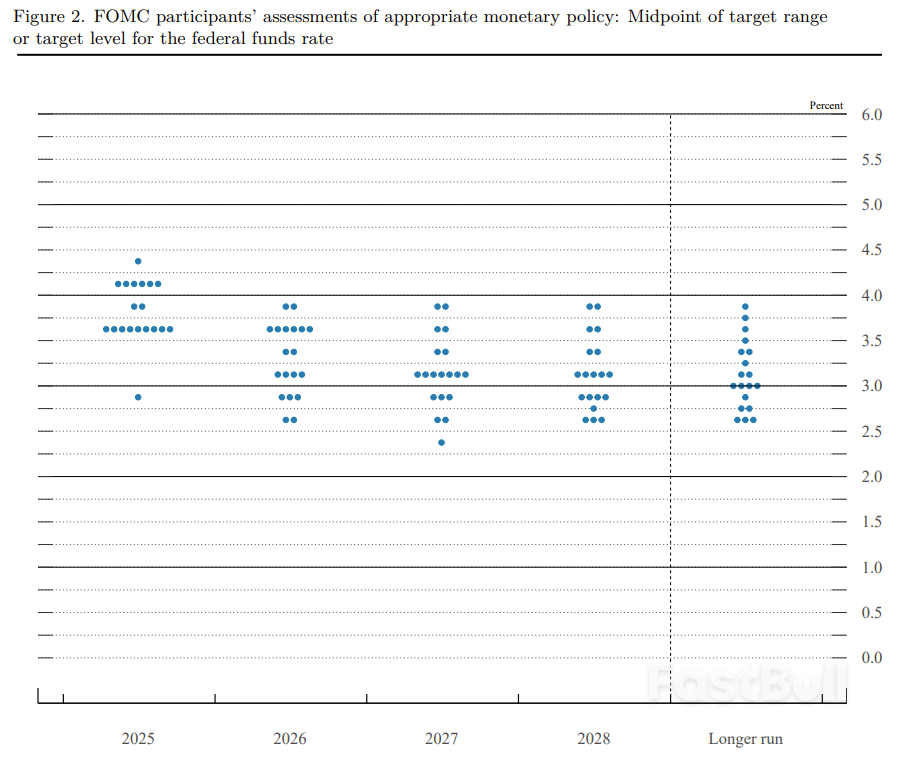
          This considerable uncertainty surrounding economic forecasts is reflected in the Fed members' projections for key interest rates, known as dot plots.
          Between now and the end of the year, a narrow majority believe that at least two rate cuts will be necessary. However, seven members do not foresee any further rate cuts, while one member believes that rates will be 125 basis points lower. These projections are anonymous, but there is little doubt as to the identity of this dove (a certain Stephen M., to give you a clue).
          Fed: the doves have gone to roost_1

          Summary of economic projections

          These forecasts are somewhat disappointing for the market, which was anticipating six rate cuts between now and the end of 2026 (before the meeting, i.e., including September), compared with only four for the median of the Fed members' projections.

          A third term?

          For the Fed, there is therefore no clear path forward. In recent months, inflation, which is already considered "somewhat high," has risen again, while the job market is showing signs of slowing down.
          "There is no risk-free path... It's not obvious what to do," Jerome Powell acknowledged at a press conference. "We have to keep an eye on inflation while not ignoring... full employment."
          The Fed must always consider these two mandates in its decisions, which is known in the jargon as the "balance of risks."
          And as if finding this balance wasn't difficult enough, Stephen Miran has put forward the idea that the Fed has a third mandate: to maintain interest rates at moderate levels. He bases this on the Federal Reserve Act, which defines three objectives: "maximum employment, price stability, and moderate long-term interest rates."
          This notion has now been taken up by the Trump administration in its quest for low interest rates, which is itself intended to reduce the cost of debt for the government.
          The question was put to Jerome Powell at a press conference. In his view, Fed officials have not considered this third mandate to require "independent action" for some time. Moderate interest rates are simply the result of price stability and maximum employment.

          Source: marketscreener

          To stay updated on all economic events of today, please check out our Economic calendar
          Risk Warnings and Disclaimers
          You understand and acknowledge that there is a high degree of risk involved in trading. Following any strategies or investment methods may lead to potential losses. The content on the site is provided by our contributors and analysts for information purposes only. You are solely responsible for determining whether any trading assets, securities, strategy, or any other product is suitable for investing based on your own investment objectives and financial situation.
          Add to Favorites
          Share

          Bank of England slows pace of QT, skews away from long-dated gilt sales

          Adam

          Economic

          Central Bank

          The Bank of England kept rates unchanged on Thursday and said it was slowing the pace of its quantitative tightening programme and skewing sales away from long-dated gilts to minimise the impact on turbulent bond markets.
          Policymakers voted 7-2 to slow the annual pace at which it unloads the gilts which it purchased from 2009 and 2021 to 70 billion pounds from 100 billion pounds, broadly in line with a Reuters poll median forecast for it to be cut to 67.5 billion.
          "The new target means the MPC can continue to reduce the size of the Bank's balance sheet in line with its monetary policy objectives while continuing to minimise the impact of gilt market conditions," Governor Andrew Bailey said.
          The slowdown is the first since the BoE started in 2022 to unwind its gilt holdings, which followed 875 billion pounds of purchases between 2009 and 2021 to boost the economy.
          Bank of England Chief Economist Huw Pill voted to maintain the pace at 100 billion pounds - viewing the impact on markets as small - while MPC member Catherine Mann called for a faster reduction of 62 billion pounds.
          The BoE said that over the next year, sales would be split 40:40:20 between short-, medium- and long-dated gilts on an initial purchase price basis.
          Long-dated gilt yields hit their highest since 1998 at the start of this month.
          Policymakers also voted 7-2 to keep interest rates at 4% after last month's quarter-point cut, in line with expectation in a Reuters poll, after Monetary Policy Committee members Swati Dhingra and Alan Taylor kept up their call for lower rates.
          The BoE maintained its forecast that inflation would peak at 4% this month and slowly fall back to its 2% target by the second quarter of 2027, and nudged up its growth forecast for the third quarter to 0.4% from 0.3%.
          "Although we expect inflation to return to our 2% target, we're not out of the woods yet so any future cuts will need to be made gradually and carefully," Bailey said.
          Before Thursday's decision, markets priced in only around a one-in-three chance of a further rate cut this year.

          Source: Reuters

          To stay updated on all economic events of today, please check out our Economic calendar
          Risk Warnings and Disclaimers
          You understand and acknowledge that there is a high degree of risk involved in trading. Following any strategies or investment methods may lead to potential losses. The content on the site is provided by our contributors and analysts for information purposes only. You are solely responsible for determining whether any trading assets, securities, strategy, or any other product is suitable for investing based on your own investment objectives and financial situation.
          Add to Favorites
          Share
          FastBull
          Copyright © 2025 FastBull Ltd

          728 RM B 7/F GEE LOK IND BLDG NO 34 HUNG TO RD KWUN TONG KLN HONG KONG

          TelegramInstagramTwitterfacebooklinkedin
          App Store Google Play Google Play
          Products
          Charts

          Chats

          Q&A with Experts
          Screeners
          Economic Calendar
          Data
          Tools
          Membership
          Features
          Function
          Markets
          Copy Trading
          Latest Signals
          Contests
          News
          Analysis
          24/7
          Columns
          Education
          Company
          Careers
          About Us
          Contact Us
          Advertising
          Help Center
          Feedback
          User Agreement
          Privacy Policy
          Business

          White Label

          Data API

          Web Plug-ins

          Poster Maker

          Affiliate Program

          Risk Disclosure

          The risk of loss in trading financial instruments such as stocks, FX, commodities, futures, bonds, ETFs and crypto can be substantial. You may sustain a total loss of the funds that you deposit with your broker. Therefore, you should carefully consider whether such trading is suitable for you in light of your circumstances and financial resources.

          No decision to invest should be made without thoroughly conducting due diligence by yourself or consulting with your financial advisors. Our web content might not suit you since we don't know your financial conditions and investment needs. Our financial information might have latency or contain inaccuracy, so you should be fully responsible for any of your trading and investment decisions. The company will not be responsible for your capital loss.

          Without getting permission from the website, you are not allowed to copy the website's graphics, texts, or trademarks. Intellectual property rights in the content or data incorporated into this website belong to its providers and exchange merchants.

          Not Logged In

          Log in to access more features

          FastBull Membership

          Not yet

          Purchase

          Become a signal provider
          Help Center
          Customer Service
          Dark Mode
          Price Up/Down Colors

          Log In

          Sign Up

          Position
          Layout
          Fullscreen
          Default to Chart
          The chart page opens by default when you visit fastbull.com