Markets
News
Analysis
User
24/7
Economic Calendar
Education
Data
- Names
- Latest
- Prev


Signal Accounts for Members
All Signal Accounts
All Contests


France Industrial Output MoM (SA) (Oct)A:--
F: --
France Trade Balance (SA) (Oct)A:--
F: --
Euro Zone Employment YoY (SA) (Q3)A:--
F: --
Canada Part-Time Employment (SA) (Nov)A:--
F: --
P: --
Canada Unemployment Rate (SA) (Nov)A:--
F: --
P: --
Canada Full-time Employment (SA) (Nov)A:--
F: --
P: --
Canada Labor Force Participation Rate (SA) (Nov)A:--
F: --
P: --
Canada Employment (SA) (Nov)A:--
F: --
P: --
U.S. PCE Price Index MoM (Sept)A:--
F: --
P: --
U.S. Personal Income MoM (Sept)A:--
F: --
P: --
U.S. Core PCE Price Index MoM (Sept)A:--
F: --
P: --
U.S. PCE Price Index YoY (SA) (Sept)A:--
F: --
P: --
U.S. Core PCE Price Index YoY (Sept)A:--
F: --
P: --
U.S. Personal Outlays MoM (SA) (Sept)A:--
F: --
U.S. 5-10 Year-Ahead Inflation Expectations (Dec)A:--
F: --
P: --
U.S. Real Personal Consumption Expenditures MoM (Sept)A:--
F: --
U.S. Weekly Total Rig CountA:--
F: --
P: --
U.S. Weekly Total Oil Rig CountA:--
F: --
P: --
U.S. Consumer Credit (SA) (Oct)A:--
F: --
China, Mainland Foreign Exchange Reserves (Nov)A:--
F: --
P: --
Japan Trade Balance (Oct)A:--
F: --
P: --
Japan Nominal GDP Revised QoQ (Q3)A:--
F: --
P: --
China, Mainland Imports YoY (CNH) (Nov)A:--
F: --
P: --
China, Mainland Exports (Nov)A:--
F: --
P: --
China, Mainland Imports (CNH) (Nov)A:--
F: --
P: --
China, Mainland Trade Balance (CNH) (Nov)A:--
F: --
P: --
China, Mainland Exports YoY (USD) (Nov)A:--
F: --
P: --
China, Mainland Imports YoY (USD) (Nov)A:--
F: --
P: --
Germany Industrial Output MoM (SA) (Oct)A:--
F: --
Euro Zone Sentix Investor Confidence Index (Dec)A:--
F: --
P: --
Canada National Economic Confidence Index--
F: --
P: --
U.K. BRC Like-For-Like Retail Sales YoY (Nov)--
F: --
P: --
U.K. BRC Overall Retail Sales YoY (Nov)--
F: --
P: --
Australia Overnight (Borrowing) Key Rate--
F: --
P: --
RBA Rate Statement
RBA Press Conference
Germany Exports MoM (SA) (Oct)--
F: --
P: --
U.S. NFIB Small Business Optimism Index (SA) (Nov)--
F: --
P: --
Mexico 12-Month Inflation (CPI) (Nov)--
F: --
P: --
Mexico Core CPI YoY (Nov)--
F: --
P: --
Mexico PPI YoY (Nov)--
F: --
P: --
U.S. Weekly Redbook Index YoY--
F: --
P: --
U.S. JOLTS Job Openings (SA) (Oct)--
F: --
P: --
China, Mainland M1 Money Supply YoY (Nov)--
F: --
P: --
China, Mainland M0 Money Supply YoY (Nov)--
F: --
P: --
China, Mainland M2 Money Supply YoY (Nov)--
F: --
P: --
U.S. EIA Short-Term Crude Production Forecast For The Year (Dec)--
F: --
P: --
U.S. EIA Natural Gas Production Forecast For The Next Year (Dec)--
F: --
P: --
U.S. EIA Short-Term Crude Production Forecast For The Next Year (Dec)--
F: --
P: --
EIA Monthly Short-Term Energy Outlook
U.S. API Weekly Gasoline Stocks--
F: --
P: --
U.S. API Weekly Cushing Crude Oil Stocks--
F: --
P: --
U.S. API Weekly Crude Oil Stocks--
F: --
P: --
U.S. API Weekly Refined Oil Stocks--
F: --
P: --
South Korea Unemployment Rate (SA) (Nov)--
F: --
P: --
Japan Reuters Tankan Non-Manufacturers Index (Dec)--
F: --
P: --
Japan Reuters Tankan Manufacturers Index (Dec)--
F: --
P: --
Japan Domestic Enterprise Commodity Price Index MoM (Nov)--
F: --
P: --
Japan Domestic Enterprise Commodity Price Index YoY (Nov)--
F: --
P: --
China, Mainland PPI YoY (Nov)--
F: --
P: --
China, Mainland CPI MoM (Nov)--
F: --
P: --


No matching data
Latest Views
Latest Views
Trending Topics
Top Columnists
Latest Update
White Label
Data API
Web Plug-ins
Affiliate Program
View All

No data
Learn how to buy DeepSeek stock and explore when it may go public. Discover ways to invest in DeepSeek AI stock and related companies before its IPO.
Interest in how to buy DeepSeek stock has surged as the Chinese AI company gains global attention for its rapid technological progress and market disruption. Although DeepSeek is not yet listed, investors are closely monitoring potential IPO developments and partnership signals. This guide explains when and how to buy DeepSeek AI stock once it becomes available, and explores practical ways to gain early exposure through related public companies and AI-focused funds.
DeepSeek has gained investor attention due to its advanced AI models and promising commercial use cases in predictive analytics, autonomous systems, and enterprise automation. The company reports growing pilot deployments across finance, supply chain, and healthcare sectors.
Its intellectual property—proprietary data pipelines, custom architectures, and licensing agreements—offers a competitive moat. In addition, DeepSeek is reportedly in talks with major cloud providers and data partners, raising prospects for wide adoption. Some investors researching how to buy DeepSeek AI stock view it as a potential future unicorn in the AI infrastructure space.
As of the latest public filings, DeepSeek remains a privately held company and does not trade on any public exchange. That means you cannot currently purchase DeepSeek shares in the open market like typical stocks. This is relevant for anyone exploring how to buy stock in DeepSeek.
However, some accredited investors may gain access via secondary markets or venture capital funds. Alternatively, caveat investors sometimes purchase options, pre-IPO shares, or invest in related AI or infrastructure firms to gain indirect exposure while waiting for a public offering.
When DeepSeek eventually files for an IPO, you’ll be able to obtain shares via standard broker platforms in the US. That will open the route for retail investors to engage in how to buy DeepSeek stock in US markets.
DeepSeek is not currently listed on any public exchange, so retail investors cannot yet buy it directly. The earliest opportunity would come when DeepSeek files an initial public offering (IPO) or lists its shares on a stock exchange. Watch for SEC filings or public announcements that include a ticker symbol and trading start date.
To prepare, consider opening a brokerage account capable of trading US equities. Many platforms require weeks for verification, so it’s wise to get that set up before DeepSeek’s share becomes available for purchase—this gives you first-mover advantage when executing how to buy DeepSeek stock in US.
When DeepSeek goes public, the process to buy is straightforward:
Until public trading is enabled, investors often research how to buy DeepSeek AI stock to follow the company’s progress, filings, and valuation metrics. That knowledge helps in making informed entry decisions once shares become available.
If direct ownership isn’t currently possible, here are indirect approaches to gain exposure to DeepSeek’s growth potential:
These methods help you position ahead of the public offering of how to buy stock in DeepSeek, while managing risk by diversifying across the AI sector.
Currently, DeepSeek remains a privately held company. Its primary shareholders include founders, early employees, and venture capital firms specializing in artificial intelligence and deep learning. Until an IPO occurs, public investors cannot directly own DeepSeek stock.
Like any emerging AI company, DeepSeek carries risks such as rapid market shifts, high R&D costs, and competitive pressure from major tech firms. For investors exploring how to buy DeepSeek AI stock, it’s important to remember that early-stage AI valuations can fluctuate sharply with market sentiment and regulatory developments.
News about DeepSeek’s breakthroughs or pricing strategies may temporarily shake markets due to the company’s influence in the AI sector. A “DeepSeek crash” usually refers to investor overreaction or profit-taking after major announcements. Understanding these dynamics helps investors decide how to buy DeepSeek stock in US markets with better timing and risk management.
DeepSeek’s rapid rise in the AI industry has captured global investor attention. While you currently can’t buy DeepSeek stock directly, staying alert for its IPO plans and monitoring related AI equities offers strong exposure opportunities. Understanding how to buy DeepSeek stock early can give investors a valuable edge once the company goes public.
The Swiss government, via Seco, slashed economic growth forecasts due to US tariff impositions, burdening Swiss industry and exporters, as per official updates.
The revised GDP outlook and expected unemployment rise highlight potential shifts in Swiss economic stability, affecting industry competitiveness, without direct crypto market impacts documented.
The Swiss government, through the State Secretariat for Economic Affairs, has revised its economic growth forecasts. The adjustment follows the United States' imposition of 39% tariffs, which exert a "heavy burden" on Swiss exporters.
Swiss GDP projections are now lowered, with a forecast of 1.3% in 2025 and 0.9% in 2026. Actions were taken by the State Secretariat for Economic Affairs, highlighting the economic implications of US trade policies.
Projected Swiss unemployment rates are set to rise to 2.9% in 2025 and 3.2% in 2026. Industries reliant on US markets face eroded competitiveness owing to the increased tariffs.
Economic pressures from tariffs may affect the crypto market indirectly. Past trade tensions have triggered shifts in revenues, impacting assets such as BTC and ETH. However, no official reports confirm a direct crypto impact from current conditions.
Previous trade actions, like the 2018 Trump tariff dispute with China, also caused volatility in global markets. Although these events mirrored current dynamics, specific ties to crypto market changes are undocumented as per government reports.
Experts suggest macroeconomic pressures historically prompt lower asset risk appetite. This scenario is in line with decreased risk appetite for large-cap cryptocurrencies, including BTC and ETH, given current US-Swiss tariff-induced macro pressures. "Swiss GDP growth forecasts for 2025 have been reduced to 1.3% and further to 0.9% for 2026," notes the Swiss State Secretariat for Economic Affairs.
Ethereum (ETH) fell below $4,000 due to substantial ETF outflows and whale activity. Notably, BlackRock's ETF saw $310.13M in outflows, increasing sell pressure, while BitMine added 104,336 ETH, signaling institutional confidence.
Ethereum dipped below the $4,000 mark on October 13, 2025, following notable institutional outflows primarily from BlackRock's ETF, amid wider crypto market volatility.
The event signifies Ethereum's vulnerability to ETF flows, affecting investor sentiment. Market response reflects broader technology sector dynamics.
Ethereum's recent descent was chiefly influenced by institutional behaviors, particularly BlackRock’s ETF outflow of $310 million in one day. Owning over 100,000 ETH, BitMine counteracted with significant accumulation. Influences trace back to heightened volatility within the market.
Negative net flows marked by Ethereum ETFs reached $428.5 million combined. BlackRock, as a key player, catalyzed sell pressure. Absent commentary from Ethereum's leadership, institutional moves dominated the discourse.
Bitcoin and major altcoins also mirrored Ethereum's decline. DeFi and NFT sectors revealed reduced activity, accentuating impacts on network demand. Analysts project technical rebounds yet stress prevailing market skepticism.
Analyzing historical precedents, ETH often recovers post correction. Major past sell-offs required stabilizing above technical support. Historical data indicates patterns of balance restoration following institutional actions.
Ethereum must navigate potential regulatory shifts affecting technological integration. Focus pivots on long-term trends in network utilization, indicating how the ecosystem might adjust amid financial and technological landscapes.
Over the past week, U.S.-China trade tensions escalated once more, heightening policy uncertainty and increasing market volatility.
On one side, China's Ministry of Commerce announced further restrictions on exports of rare earths, lithium batteries, and other critical materials, adding more companies to the “unreliable entities list” and expanding export controls to cover rare earth materials, key equipment, and lithium batteries. On the other side, the U.S. government threatened to impose an additional 100% tariff on Chinese goods and plans to restrict exports of critical software and aircraft components starting November 1.
Within just a few days, both sides acted swiftly and decisively, alternating between signaling willingness to negotiate and applying pressure. This made it difficult for traders to accurately price in the potential market impact of the U.S.-China standoff.
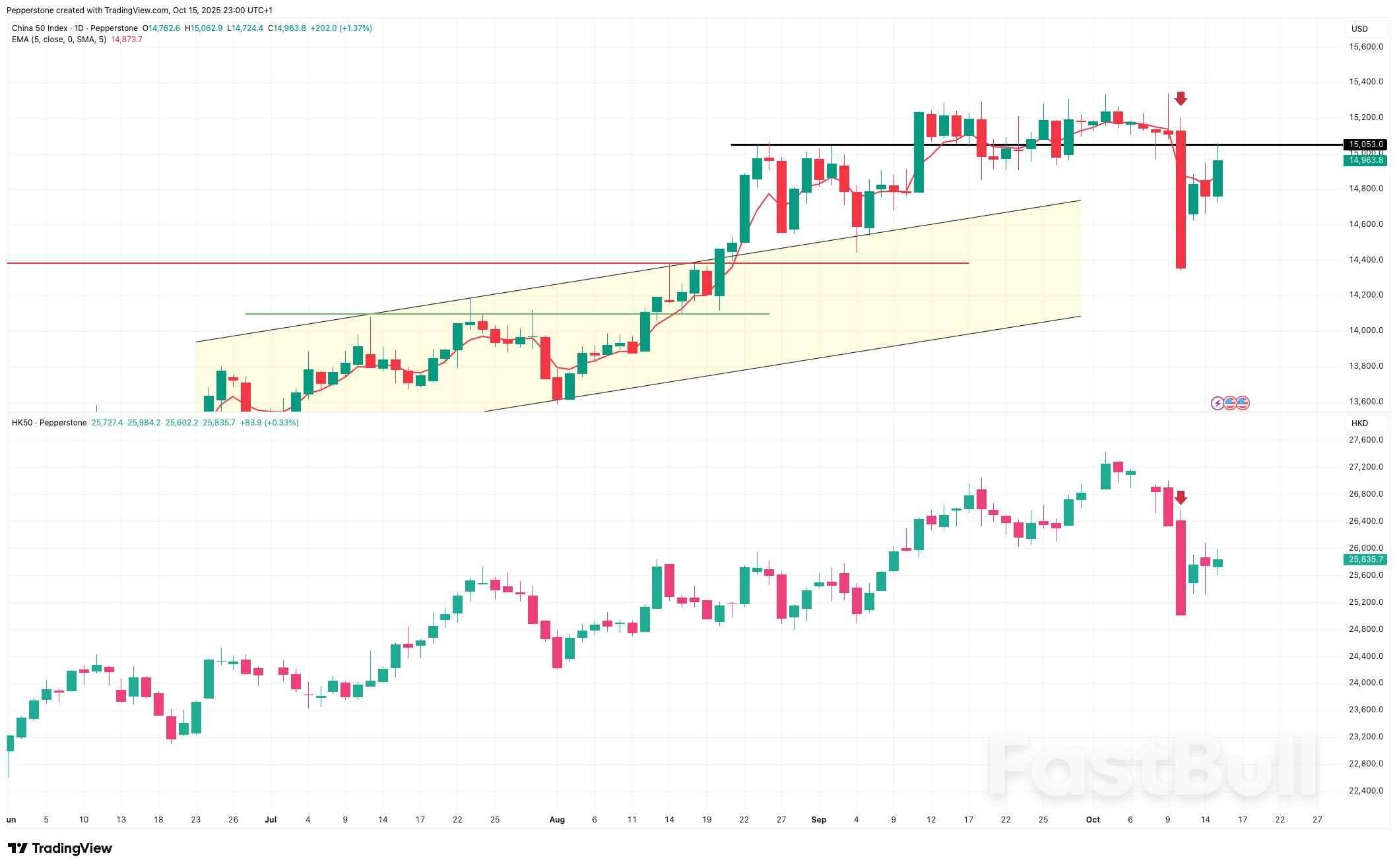
Global risk assets came under broad pressure, with the CN50 and Hang Seng Index (HK50) both falling nearly 5% on the day the tariffs were announced. Although investor sentiment in other Asia-Pacific markets, such as Japan and Australia, has since stabilized and partially recovered from the tariff-induced pullback, stocks in mainland China and Hong Kong remain mixed.

Chinese market participants are processing the news flow while closely monitoring several key questions: Will these tariffs and export restrictions actually be implemented? If so, what impact could they have on China's economy and capital markets? And which upcoming events or potential risks should investors pay attention to?
Compared with the tariffs announced by the U.S. in April, the latest round of U.S.-China frictions shows significant shifts.
First, the dispute has moved from traditional tariffs to export controls and technology restrictions, particularly in rare earths and high-tech sectors. China controls approximately 70%-80% of global rare earth mining and around 90% of refining and processing capacity. This round of restrictions targets not only raw material exports but also key equipment and processing technology.
While the U.S. can seek alternative supplies from countries like Brazil, India, and Australia, fully compensating for China's production gap would take significant time. A 2010 precedent—China's two-month rare earth export ban on Japan—took nearly five years for Japan to partially offset the supply shortfall, highlighting the strategic leverage inherent in rare earth controls.
Similarly, U.S. restrictions on exporting high-end chips to China make technological independence increasingly urgent. Accelerating domestic development of semiconductors and AI chips is not only a necessary step to mitigate supply risks but also strengthens China's bargaining position in tariff and trade negotiations.
Political factors have also added complexity to this round of talks. Ongoing U.S. government shutdown risks and the Supreme Court's pending ruling on IEEPA tariffs could reduce administrative efficiency and delay policy implementation, complicating negotiations further.
Even if the proposed 100% tariffs and export restrictions were fully implemented, the direct impact on China's macroeconomy may be less severe than some market expectations suggest.
From a trade perspective, while China's effective tariffs are already approaching 40%, diversification of export markets provides a buffer. In September 2025, China's exports to the U.S. fell 27% year-on-year, marking six consecutive months of decline, yet exports to ASEAN, the EU, and Japan rebounded significantly.
With trade increasingly shifting toward regional partners and emerging markets, China's external demand structure is gradually reshaping. Trade diversion, combined with potential policy offsets from Chinese authorities, should help mitigate the negative effects of U.S. tariffs.
At a deeper level, this round of friction is not just about tariff rates or export volumes; it is a contest over technological leadership, supply chain control, and global institutional influence.
Critical materials like rare earths hold strategic positions in global supply chains, giving China an irreplaceable advantage. Restricting exports may raise short-term downstream costs but simultaneously enhances China's leverage in negotiations.
In addition, U.S. software exports to China account for just 5.8% of total exports in 2024, limiting overall impact. Facing U.S. restrictions on high-end equipment and semiconductors, China's ongoing push for domestic substitutes and technological autonomy is gradually closing the gap while strengthening supply chain resilience.
Overall, short-term frictions may raise risk premiums, increase capital outflow pressures, and heighten expectations of RMB depreciation. Industries such as technology, semiconductors, electronics, and machinery—especially small and medium-sized enterprises—may bear the initial brunt, with some companies possibly accelerating shipments to avoid tariffs.
Nevertheless, China's relatively ample foreign exchange reserves, flexible exchange rate management, and solid fiscal tools should help stabilize market sentiment and ease short-term volatility.
Despite the continuous news flow, the likelihood of these tariffs being fully implemented remains low.
President Trump's well-known “TACO Strategy” involves escalating tariff threats and issuing vague statements to create a high-pressure negotiation environment, signaling to other economies that the U.S. is willing to endure short-term pain for long-term gains. China, meanwhile, seeks to condemn and retaliate while signaling to markets that it will not compromise. Their interactions have largely been a credibility game, where political signaling often outweighs immediate economic impact.
Domestic political uncertainty in the U.S. is the biggest obstacle to implementing these tariffs, with government shutdowns and compliance risks limiting practical execution. In contrast, China has more flexibility to respond with countermeasures, and this timing gap reduces the feasibility of fully implementing U.S. tariffs.
The APEC summit and planned U.S.-China presidential meetings remain on schedule, and the new tariffs proposed by the White House are not expected to take effect until November, leaving room and time for negotiations.
In the short term, discussions are likely to focus on quantifiable issues such as trade balance, tariff levels, export controls, and exchange rate fluctuations. The U.S. may push China to increase agricultural purchases and U.S. investments while pressing on issues like fentanyl; China could respond strategically by slowing the pace of foreign investment reforms.
Over a longer horizon, U.S.-China relations are likely to oscillate between temporary truce and ongoing negotiations. For the U.S., short-term pauses help ease domestic political and market pressures while retaining leverage for future action. For China, they stabilize external conditions, alleviate economic pressure, and provide breathing space for domestic reforms.
Breaking this cyclical deadlock ultimately depends on building verifiable mechanisms of trust. Setting concrete execution checkpoints to verify commitments, using temporary compromises to gain negotiation space, and gradually establishing reciprocal expectations could open new avenues for bilateral relations. This approach mirrors the framework of the 2019–2020 interim agreements and may again serve as a practical reference for current negotiations.
Overall, with temporary agreements becoming part of U.S.-China trade friction, such tensions are likely to represent a recurring feature of bilateral competition. Both sides use policy tools to signal positions and gain bargaining leverage, but the market impact ultimately hinges on the balance between “deterrence” and “executability.”
Market volatility is inevitable amid this strategic game. In the near term, key points to watch include the leaders' planned meeting in South Korea at the end of the month and the U.S. Supreme Court's IEEPA tariff ruling in early November. Both sides are sending negotiation signals; if tensions ease, risk sentiment could improve, and China-Hong Kong stocks, supported by technology and AI sectors, may show more stable gains.
In the face of short-term uncertainty, market participants may consider balancing defensive and opportunistic approaches.
Defensively, attention can be given to export-oriented companies, raw materials, and critical supply chain nodes to reduce short-term volatility risks. Maintaining adequate liquidity, managing exposure to firms heavily reliant on U.S. exports, and hedging systemic risks are also prudent. Close monitoring of foreign exchange and interest rate markets can help respond to potential RMB depreciation pressures.
On the opportunity side, investors may focus on growth prospects arising from technology upgrades, industrial substitution, and long-term structural reforms. High-quality targets in domestic substitution chains—such as semiconductor equipment, upstream materials, and core components for new energy—could benefit from both policy support and growing demand.
White Label
Data API
Web Plug-ins
Poster Maker
Affiliate Program
The risk of loss in trading financial instruments such as stocks, FX, commodities, futures, bonds, ETFs and crypto can be substantial. You may sustain a total loss of the funds that you deposit with your broker. Therefore, you should carefully consider whether such trading is suitable for you in light of your circumstances and financial resources.
No decision to invest should be made without thoroughly conducting due diligence by yourself or consulting with your financial advisors. Our web content might not suit you since we don't know your financial conditions and investment needs. Our financial information might have latency or contain inaccuracy, so you should be fully responsible for any of your trading and investment decisions. The company will not be responsible for your capital loss.
Without getting permission from the website, you are not allowed to copy the website's graphics, texts, or trademarks. Intellectual property rights in the content or data incorporated into this website belong to its providers and exchange merchants.
Not Logged In
Log in to access more features

FastBull Membership
Not yet
Purchase
Log In
Sign Up