Markets
News
Analysis
User
24/7
Economic Calendar
Education
Data
- Names
- Latest
- Prev
























At 2.09 am on Saturday, Ahmad Subhan, who lives near an air base in the Pakistan military garrison city of Rawalpindi, heard the first explosion that rattled the windows of his house - and took South Asia to the brink of war.
At 2.09 am on Saturday, Ahmad Subhan, who lives near an air base in the Pakistan military garrison city of Rawalpindi, heard the first explosion that rattled the windows of his house - and took South Asia to the brink of war.
As dawn broke, the heaviest fighting in decades between nuclear-armed India and Pakistan reached a crescendo, after nearly three weeks of escalating tensions.
Fighter jets and missiles crisscrossed the skies of one of the world's most populated regions. Pakistani officials said they would convene an emergency meeting of their top nuclear decision-making body.
The critical eight-hour window also saw Indian missile barrages on three major Pakistan air bases and other facilities, including Nur Khan, which is ringed by civilian homes like Subhan's, and just a 20-minute drive to the capital, Islamabad.
After the initial blast, Subhan and his wife grabbed their three children and ran out of their home. "We were just figuring out what had happened when there was another explosion," said the retired government employee, who remembered the precise time of the strike because he was just about to make a call.
This account of Saturday's events - which began with the looming specter of a full-blown war and ended with an evening cease-fire announcement by U.S. President Donald Trump - is based on interviews with 14 people, including U.S., Indian and Pakistani officials, as well as Reuters' review of public statements from the three capitals.
They described the rapid escalation of hostilities as well as behind-the-scenes diplomacy involving the U.S., India and Pakistan, and underscore the key role played by Washington in brokering peace.
The attack on Nur Khan air base saw at least two missile strikes as well as drone attacks, according to Subhan and two Pakistani security officials, who like some of the people interviewed by Reuters, spoke on condition of anonymity.
The barrage took out two roofs and hit the hangar of a refuelling plane, which was airborne at the time, according to one of the officials, who visited the base the next day.
A senior Indian military officer, however, told reporters on Sunday that an operation command center at Nur Khan had been hit.
"The attack on Nur Khan... close to our capital, that left us with no option but to retaliate," Pakistan Foreign Minister Ishaq Dar told Reuters.
Nur Khan is located just over a mile from the military-run body responsible for Pakistan's nuclear planning.
So, an attack on the facility may have been perceived as more dangerous than India intended - and the two sides shouldn't conclude that it is possible to have a conflict without it going nuclear, said Christopher Clary, an associate professor at the University at Albany in New York.
"If you are playing Russian roulette and pull the trigger, the lesson isn't that you should pull the trigger again," said Clary.
India's defense and foreign ministries, as well as Pakistan's military and its foreign ministry, did not immediately answer written questions submitted by Reuters.
A U.S. State Department spokesperson did not directly respond to questions from Reuters about the American role, but said that further military escalation posed a serious threat to regional stability.
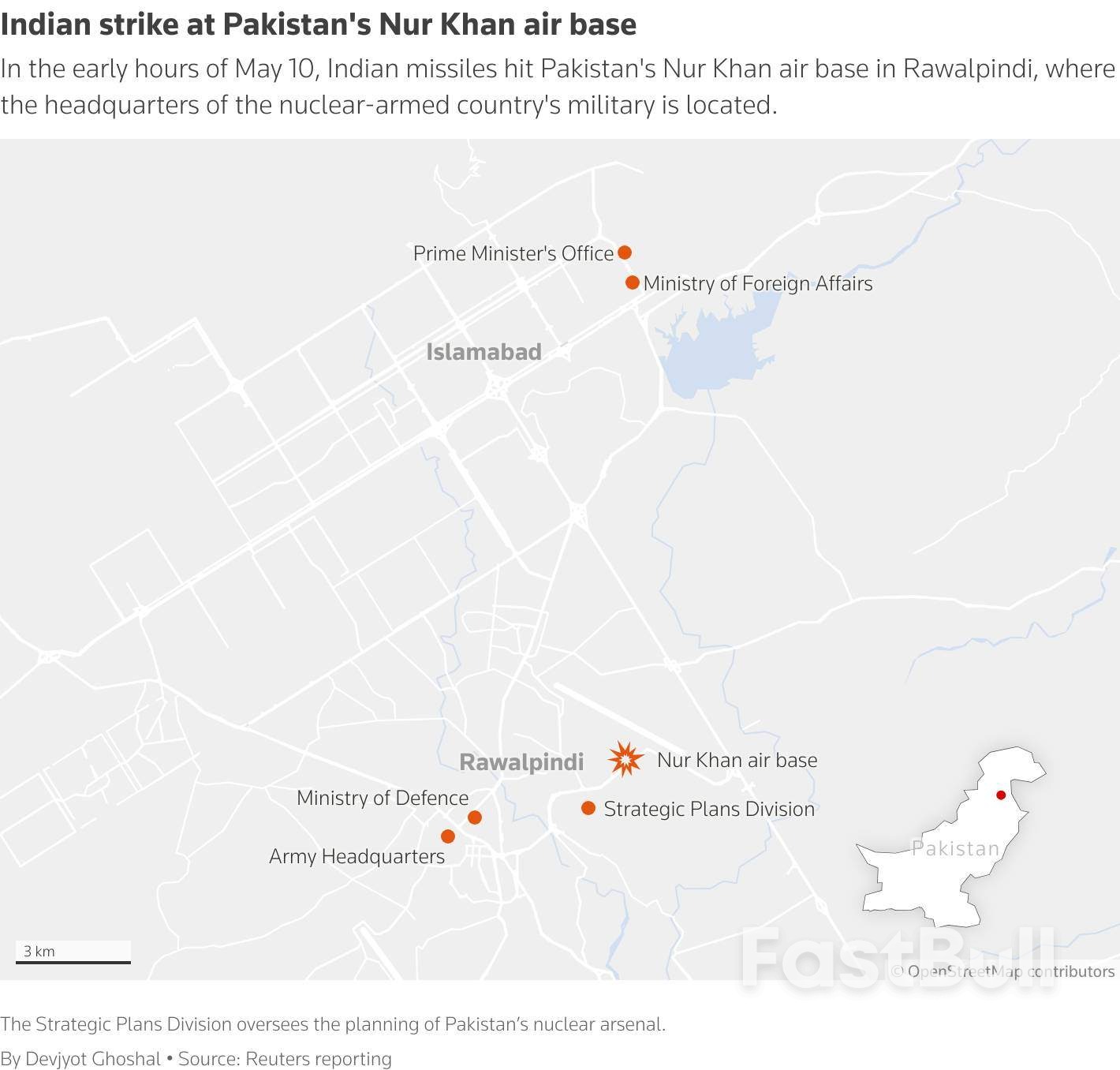
In the early hours of May 10, Indian missiles hit Pakistan's Nur Khan air base in Rawalpindi, where the headquarters of the nuclear-armed country's military is located.
India and Pakistan have fought three major wars and been at loggerheads since their independence. The spark for the latest chaos was an April 22 attack in Indian Kashmir that killed 26 people, most of them tourists. New Delhi blamed the incident on "terrorists" backed by Pakistan, a charge denied by Islamabad.
It was the latest of many disputes involving Kashmir, a Himalayan territory ravaged by an anti-India insurgency since the late 1980s. Both New Delhi and Islamabad claim the region in full but only control parts of it.
Hindu-majority India has accused its Muslim-majority neighbor of arming and backing militant groups operating in Kashmir, but Pakistan maintains it only provides diplomatic support to Kashmiri separatists.
After a go-ahead from Prime Minister Narendra Modi, the Indian military on May 7 carried out air strikes on what it called "terrorist infrastructure" in Pakistan, in response to the April attack in Kashmir.
In air battles that followed, Pakistan said it shot down five Indian aircraft, including prized Rafale planes New Delhi recently acquired from France. India has indicated that it suffered losses and inflicted some of its own.
Senior U.S. officials became seriously concerned by Friday, May 9 that the conflict was at risk of spiralling out of control, according to two sources familiar with the matter.
That evening, Modi took a call from Vice President J.D. Vance, who presented a potential off-ramp to the Indian prime minister that he described as a path the Pakistanis would also be amenable to, the people said.
Vance's intervention came despite him saying publicly on Thursday that the U.S. was "not going to get involved in the middle of war that's fundamentally none of our business."
The sources didn't provide specifics but said that Modi was non-committal. One of the people also said that Modi told Vance, who had been visiting India during the Kashmir attack, that any Pakistani escalation would be met by an even more forceful response.
Hours later, according to Indian officials, that escalation came: Pakistan launched attacks on at least 26 locations in India in the early hours of May 10.
Pakistan said their strikes occurred only after the pre-dawn Indian attack on its air bases, including Nur Khan.
A little over an hour after that Indian attack began, Pakistan military spokesman Lt. Gen. Ahmed Sharif Chaudhry confirmed Indian strikes on three air bases.
Some Indian strikes on Saturday, May 10 also utilized the supersonic BrahMos missile, according to a Pakistani official and an Indian source. Pakistan believes the BrahMos is nuclear-capable, though India says it carries a conventional warhead.
By 5 a.m. local time on Saturday, Pakistan's military announced it had launched operations against Indian air bases and other facilities.
About two hours later, Pakistani officials told journalists that Prime Minister Shehbaz Sharif had called a meeting of the National Command Authority, which oversees the nuclear arsenal.
Dar told Reuters on Tuesday that any international alarm was overblown: "There was no such concern. There should not be. We are a responsible nation."
But signalling an intention to convene NCA reflected how much the crisis had escalated and "may also have been an indirect call for external mediation," said Michael Kugelman, a Washington-based South Asia expert.
About an hour after the NCA announcement, the U.S. said Secretary of State Marco Rubio had spoken to Pakistan Army Chief Gen. Asim Munir - widely regarded as the most powerful man in that country - and was pushing both sides to de-escalate.
Rubio also soon got on the phone with Dar and Indian Foreign Minister S. Jaishankar.
"Rubio said that Indians were ready to stop," Dar told Reuters. "I said if they are ready to stop, ask them to stop, we will stop."
An Indian official with knowledge of Rubio's call with Jaishankar said that Rubio passed on a message that the Pakistanis were willing to stop firing if India would also cease.
Pakistan Defense Minister Khawaja Muhammad Asif, who only days earlier warned of conflict, dialled into a local TV news channel at around 10:30 am on Saturday.
Two-and-a-half hours after Pakistani officials shared news of the NCA meeting, Asif declared that no such event had been scheduled, putting a lid on the matter.
The international intervention anchored by Rubio paved the way to a cessation of hostilities formalized in a mid-afternoon phone call between the Directors General of Military Operations (DGMO) of India and Pakistan. The two spoke again on Monday.
Pakistan Lt. Gen. Chaudhry said in a briefing that New Delhi had initially requested a call between the DGMOs after the Indian military's May 7 strikes across the border.
Islamabad only responded to the request on Saturday, following its retaliation and requests from international interlocutors, according to Chaudhry, who did not name the countries.
Almost exactly 12 hours after Pakistan said it had launched retaliatory strikes against India for hitting three key air bases, Trump declared on social media there would be a cessation of hostilities.
"Congratulations to both Countries on using Common Sense and Great Intelligence," he said.

728 RM B 7/F GEE LOK IND BLDG NO 34 HUNG TO RD KWUN TONG KLN HONG KONG


The risk of loss in trading financial instruments such as stocks, FX, commodities, futures, bonds, ETFs and crypto can be substantial. You may sustain a total loss of the funds that you deposit with your broker. Therefore, you should carefully consider whether such trading is suitable for you in light of your circumstances and financial resources.
No decision to invest should be made without thoroughly conducting due diligence by yourself or consulting with your financial advisors. Our web content might not suit you since we don't know your financial conditions and investment needs. Our financial information might have latency or contain inaccuracy, so you should be fully responsible for any of your trading and investment decisions. The company will not be responsible for your capital loss.
Without getting permission from the website, you are not allowed to copy the website's graphics, texts, or trademarks. Intellectual property rights in the content or data incorporated into this website belong to its providers and exchange merchants.
Not Logged In
Log in to access more features


Log In
Sign Up