• Trade
  • Markets
  • Copy
  • Contests
  • News
  • 24/7
  • Calendar
  • Q&A
  • Chats
Trending
Screeners
SYMBOL
LAST
BID
ASK
HIGH
LOW
NET CHG.
%CHG.
SPREAD
SPX
S&P 500 Index
6827.42
6827.42
6827.42
6899.86
6801.80
-73.58
-1.07%
--
DJI
Dow Jones Industrial Average
48458.04
48458.04
48458.04
48886.86
48334.10
-245.98
-0.51%
--
IXIC
NASDAQ Composite Index
23195.16
23195.16
23195.16
23554.89
23094.51
-398.69
-1.69%
--
USDX
US Dollar Index
97.920
98.000
97.920
98.070
97.810
-0.030
-0.03%
--
EURUSD
Euro / US Dollar
1.17456
1.17463
1.17456
1.17596
1.17262
+0.00062
+ 0.05%
--
GBPUSD
Pound Sterling / US Dollar
1.33847
1.33856
1.33847
1.33961
1.33546
+0.00140
+ 0.10%
--
XAUUSD
Gold / US Dollar
4329.36
4329.70
4329.36
4350.16
4294.68
+29.97
+ 0.70%
--
WTI
Light Sweet Crude Oil
56.867
56.897
56.867
57.601
56.789
-0.366
-0.64%
--

Community Accounts

Signal Accounts
--
Profit Accounts
--
Loss Accounts
--
View More

Become a signal provider

Sell trading signals to earn additional income

View More

Guide to Copy Trading

Get started with ease and confidence

View More

Signal Accounts for Members

All Signal Accounts

Best Return
  • Best Return
  • Best P/L
  • Best MDD
Past 1W
  • Past 1W
  • Past 1M
  • Past 1Y

All Contests

  • All
  • Trump Updates
  • Recommend
  • Stocks
  • Cryptocurrencies
  • Central Banks
  • Featured News
Top News Only
Share

Portugal Treasury Expects 2026 Net Financing Needs At 29.4 Billion Euros, Up From 25.8 Billion In 2025

Share

Bank Of America Says With Indonesia's Smelter Now Ramping Up, It Expects Aluminium Supply Growth To Accelerate To 2.6% Year On Year In 2026

Share

Bank Of America Expects A Deficit In Aluminium Next Year And Sees Prices Pushing Above $3000/T

Share

Fed Data - USA Effective Federal Funds Rate At 3.64 Percent On 12 December On $102 Billion In Trades Versus 3.64 Percent On $99 Billion On 11 December

Share

Brazil's Petrobras Says No Impact Seen On Oil, Petroleum Products Output As Workers Start Planned Strike

Share

Statement: US Travel Group Warns New Proposed Trump Administration Requirements For Foreign Tourists To Provide Social Media Histories Could Mean Millions Of People Opting Not To Visit

Share

Blackrock: Kerry White Will Become Head Of Citi Investment Management At Citi Wealth

Share

Blackrock: Rob Jasminski, Head Of Citi Investment Management, Has Joined With Team

Share

Blackrock: Effective Dec 15, Citi Investment Management Employees Will Join Blackrock

Share

Blackrock: Formally Launch Citi Portfolio Solutions Powered By Blackrock

Share

According To Data From The Federal Reserve Bank Of New York, The Secured Overnight Funding Rate (Sofr) Was 3.67% On The Previous Trading Day (December 15), Compared To 3.66% The Day Before

Share

Peru Energy And Mines Ministry: Copper Production Up 4.8% Year-On-Year In October To 248192 Metric Tons

Share

Security Source: Ukrainian Drones Hits Russian Oil Infrastructure In Caspian Sea For Third Time

Share

Spot Palladium Extends Gains, Last Up 5% To $1562.7/Oz

Share

Mexico's Economy Ministry Announces Start Of Anti-Dumping Investigation And Anti-Subsidy Investigations Into USA Pork Imports

Share

Canada Nov CPI Common +2.8%, CPI Median +2.8%, CPI Trim +2.8% On Year

Share

NY Fed's Empire State Prices Paid Index +37.6 In December Versus+49.0 In November

Share

Canada Nov Consumer Prices +0.1% On Month, +2.2% On Year

Share

Canada Nov CPI Core -0.1% On Month, +2.9% On Year

Share

Canada Nov Core CPI, Seasonally Adjusted +0.2% On Month, Oct +0.3% (Unrevised)

TIME
ACT
FCST
PREV
Japan Tankan Small Manufacturing Outlook Index (Q4)

A:--

F: --

P: --

Japan Tankan Large Non-Manufacturing Outlook Index (Q4)

A:--

F: --

P: --

Japan Tankan Large Manufacturing Outlook Index (Q4)

A:--

F: --

P: --

Japan Tankan Small Manufacturing Diffusion Index (Q4)

A:--

F: --

P: --

Japan Tankan Large Manufacturing Diffusion Index (Q4)

A:--

F: --

P: --

Japan Tankan Large-Enterprise Capital Expenditure YoY (Q4)

A:--

F: --

P: --

U.K. Rightmove House Price Index YoY (Dec)

A:--

F: --

P: --

China, Mainland Industrial Output YoY (YTD) (Nov)

A:--

F: --

P: --

China, Mainland Urban Area Unemployment Rate (Nov)

A:--

F: --

P: --

Saudi Arabia CPI YoY (Nov)

A:--

F: --

P: --

Euro Zone Industrial Output YoY (Oct)

A:--

F: --

P: --

Euro Zone Industrial Output MoM (Oct)

A:--

F: --

P: --

Canada Existing Home Sales MoM (Nov)

A:--

F: --

P: --

Canada National Economic Confidence Index

A:--

F: --

P: --

Canada New Housing Starts (Nov)

A:--

F: --

P: --
U.S. NY Fed Manufacturing Employment Index (Dec)

A:--

F: --

P: --

U.S. NY Fed Manufacturing Index (Dec)

A:--

F: --

P: --

Canada Core CPI YoY (Nov)

A:--

F: --

P: --

Canada Manufacturing Unfilled Orders MoM (Oct)

A:--

F: --

P: --

U.S. NY Fed Manufacturing Prices Received Index (Dec)

A:--

F: --

P: --

U.S. NY Fed Manufacturing New Orders Index (Dec)

A:--

F: --

P: --

Canada Manufacturing New Orders MoM (Oct)

A:--

F: --

P: --

Canada Core CPI MoM (Nov)

A:--

F: --

P: --

Canada Trimmed CPI YoY (SA) (Nov)

A:--

F: --

P: --

Canada Manufacturing Inventory MoM (Oct)

A:--

F: --

P: --

Canada CPI YoY (Nov)

A:--

F: --

P: --

Canada CPI MoM (Nov)

A:--

F: --

P: --

Canada CPI YoY (SA) (Nov)

A:--

F: --

P: --

Canada Core CPI MoM (SA) (Nov)

A:--

F: --

P: --

Canada CPI MoM (SA) (Nov)

A:--

F: --

P: --

Federal Reserve Board Governor Milan delivered a speech
U.S. NAHB Housing Market Index (Dec)

--

F: --

P: --

Australia Composite PMI Prelim (Dec)

--

F: --

P: --

Australia Services PMI Prelim (Dec)

--

F: --

P: --

Australia Manufacturing PMI Prelim (Dec)

--

F: --

P: --

Japan Manufacturing PMI Prelim (SA) (Dec)

--

F: --

P: --

U.K. 3-Month ILO Employment Change (Oct)

--

F: --

P: --

U.K. Unemployment Claimant Count (Nov)

--

F: --

P: --

U.K. Unemployment Rate (Nov)

--

F: --

P: --

U.K. 3-Month ILO Unemployment Rate (Oct)

--

F: --

P: --

U.K. Average Weekly Earnings (3-Month Average, Including Bonuses) YoY (Oct)

--

F: --

P: --

U.K. Average Weekly Earnings (3-Month Average, Excluding Bonuses) YoY (Oct)

--

F: --

P: --

France Services PMI Prelim (Dec)

--

F: --

P: --

France Composite PMI Prelim (SA) (Dec)

--

F: --

P: --

France Manufacturing PMI Prelim (Dec)

--

F: --

P: --

Germany Services PMI Prelim (SA) (Dec)

--

F: --

P: --

Germany Manufacturing PMI Prelim (SA) (Dec)

--

F: --

P: --

Germany Composite PMI Prelim (SA) (Dec)

--

F: --

P: --

Euro Zone Composite PMI Prelim (SA) (Dec)

--

F: --

P: --

Euro Zone Services PMI Prelim (SA) (Dec)

--

F: --

P: --

Euro Zone Manufacturing PMI Prelim (SA) (Dec)

--

F: --

P: --

U.K. Services PMI Prelim (Dec)

--

F: --

P: --

U.K. Manufacturing PMI Prelim (Dec)

--

F: --

P: --

U.K. Composite PMI Prelim (Dec)

--

F: --

P: --

Euro Zone ZEW Economic Sentiment Index (Dec)

--

F: --

P: --

Germany ZEW Current Conditions Index (Dec)

--

F: --

P: --

Germany ZEW Economic Sentiment Index (Dec)

--

F: --

P: --

Euro Zone Trade Balance (Not SA) (Oct)

--

F: --

P: --

Euro Zone ZEW Current Conditions Index (Dec)

--

F: --

P: --

Euro Zone Trade Balance (SA) (Oct)

--

F: --

P: --

U.S. Retail Sales MoM (Excl. Automobile) (SA) (Oct)

--

F: --

P: --

Q&A with Experts
    • All
    • Chatrooms
    • Groups
    • Friends
    Connecting
    .
    .
    .
    Type here...
    Add Symbol or Code

      No matching data

      All
      Trump Updates
      Recommend
      Stocks
      Cryptocurrencies
      Central Banks
      Featured News
      • All
      • Russia-Ukraine Conflict
      • Middle East Flashpoint
      • All
      • Russia-Ukraine Conflict
      • Middle East Flashpoint
      Search
      Products

      Charts Free Forever

      Chats Q&A with Experts
      Screeners Economic Calendar Data Tools
      Membership Features
      Data Warehouse Market Trends Institutional Data Policy Rates Macro

      Market Trends

      Market Sentiment Order Book Forex Correlations

      Top Indicators

      Charts Free Forever
      Markets

      News

      News Analysis 24/7 Columns Education
      From Institutions From Analysts
      Topics Columnists

      Latest Views

      Latest Views

      Trending Topics

      Top Columnists

      Latest Update

      Signals

      Copy Rankings Latest Signals Become a signal provider AI Rating
      Contests
      Brokers

      Overview Brokers Assessment Rankings Regulators News Claims
      Broker listing Forex Brokers Comparison Tool Live Spread Comparison Scam
      Q&A Complaint Scam Alert Videos Tips to Detect Scam
      More

      Business
      Events
      Careers About Us Advertising Help Center

      White Label

      Data API

      Web Plug-ins

      Affiliate Program

      Awards Institution Evaluation IB Seminar Salon Event Exhibition
      Vietnam Thailand Singapore Dubai
      Fans Party Investment Sharing Session
      FastBull Summit BrokersView Expo
      Recent Searches
        Top Searches
          Markets
          News
          Analysis
          User
          24/7
          Economic Calendar
          Education
          Data
          • Names
          • Latest
          • Prev

          View All

          No data

          Scan to Download

          Faster Charts, Chat Faster!

          Download App
          English
          • English
          • Español
          • العربية
          • Bahasa Indonesia
          • Bahasa Melayu
          • Tiếng Việt
          • ภาษาไทย
          • Français
          • Italiano
          • Türkçe
          • Русский язык
          • 简中
          • 繁中
          Open Account
          Search
          Products
          Charts Free Forever
          Markets
          News
          Signals

          Copy Rankings Latest Signals Become a signal provider AI Rating
          Contests
          Brokers

          Overview Brokers Assessment Rankings Regulators News Claims
          Broker listing Forex Brokers Comparison Tool Live Spread Comparison Scam
          Q&A Complaint Scam Alert Videos Tips to Detect Scam
          More

          Business
          Events
          Careers About Us Advertising Help Center

          White Label

          Data API

          Web Plug-ins

          Affiliate Program

          Awards Institution Evaluation IB Seminar Salon Event Exhibition
          Vietnam Thailand Singapore Dubai
          Fans Party Investment Sharing Session
          FastBull Summit BrokersView Expo

          How Dividends Affect Stock Prices

          Glendon

          Economic

          Summary:

          Explore how dividends influence stock prices and investor behavior. Learn the relationship between dividend payments and stock value, including the impact on share price and market performance.

          Dividends have long been an important aspect of investing, especially for those seeking income-generating assets. These periodic payments made by companies to shareholders can be a sign of a company’s financial health and its commitment to rewarding its investors. However, the impact of dividends on stock prices is often debated among investors and financial analysts. In this article, we will explore how dividends affect stock prices, the underlying economic principles at play, and the ways in which investors can interpret these movements.

          What Are Dividends?

          A dividend is a distribution of a company’s profits to its shareholders, typically in the form of cash or additional shares. While not all companies pay dividends, those that do usually do so on a regular basis, such as quarterly, semi-annually, or annually. Companies that pay dividends often have a stable and predictable cash flow, making them attractive to income-focused investors.
          Dividends are an essential way for shareholders to receive returns on their investment. They can be particularly appealing to those seeking a steady stream of income, such as retirees. Dividends also serve as an indication of a company’s financial health and its ability to generate profits consistently.

          The Effect of Dividends on Stock Prices

          Dividends directly influence stock prices in several ways, both in the short term and long term. However, the impact on stock prices can be complex, and it depends on various factors, including the company’s dividend policy, the overall market environment, and investor sentiment.

          Ex-Dividend Date and Stock Price Drop

          One of the most significant impacts dividends have on stock prices occurs on the ex-dividend date. The ex-dividend date is the day on which the stock begins trading without the upcoming dividend payment. Investors who purchase the stock on or after this date are not entitled to receive the next dividend. As a result, the stock price typically drops by the amount of the dividend on this date.
          For example, if a company announces a dividend of $1 per share, its stock price will usually decrease by approximately $1 on the ex-dividend date. This price adjustment reflects the fact that new shareholders will not receive the dividend. It is important to note that the drop in stock price is generally temporary and often stabilizes shortly after the ex-dividend date. The decrease is also an accounting adjustment and does not necessarily indicate a loss in the company’s value.

          Long-Term Dividend Impact on Stock Prices

          Over the long term, dividends can have a more complex effect on stock prices. In general, companies that consistently pay and increase dividends tend to be more attractive to investors, particularly those seeking income. As a result, these companies often see stronger demand for their shares, which can drive up stock prices over time.
          The relationship between dividends and stock prices is rooted in the concept of value investing. Investors often view companies with a strong history of dividend payments as financially stable and less risky. This perception can lead to increased investor interest, ultimately driving up the stock price. Additionally, companies that increase their dividend payouts over time are seen as demonstrating confidence in their future earnings potential, which can further boost investor sentiment and stock prices.
          On the other hand, companies that cut or suspend their dividends may signal financial troubles or a lack of confidence in future earnings. Such actions often lead to a negative reaction from investors, which can result in a decline in stock prices. Dividend cuts are often seen as a sign of financial instability, which can erode investor trust and lead to sell-offs.

          Dividend Yield and Stock Price Movements

          The dividend yield is a key metric that investors use to assess the income potential of a stock. It is calculated by dividing the annual dividend payment by the stock’s current market price. For example, if a company pays a $2 annual dividend and its stock is trading at $40, the dividend yield would be 5%.
          Changes in dividend yields can influence stock prices. When a company increases its dividend, it may signal that it is performing well financially, leading to an increase in demand for its stock. Conversely, a decrease in the dividend yield may indicate that a company is facing challenges or that its stock is becoming less attractive to income-focused investors. As a result, stock prices may fall if the dividend yield decreases significantly.

          Investor Sentiment and Market Reactions

          Investor sentiment plays a crucial role in how dividends affect stock prices. While the ex-dividend date price drop is a predictable event, the broader impact of dividends on stock prices is influenced by how investors perceive the dividend policy. If investors view a dividend payment as a sign of strength and stability, they may bid up the stock price, especially if the company’s earnings are growing and the dividend is increasing.
          In contrast, if the dividend is perceived as unsustainable or the company is facing external challenges, investors may react negatively, causing the stock price to decline. A sudden change in dividend policy, such as a reduction or omission of a dividend, can trigger a wave of selling, as investors may interpret it as a red flag.

          The Role of Dividends in Total Return

          It is important to note that dividends contribute to the total return on an investment, which includes both price appreciation and dividend income. For long-term investors, dividends can play a significant role in overall performance, particularly when reinvested through dividend reinvestment plans (DRIPs). Over time, reinvesting dividends can result in compounding growth, which can significantly increase the total return on an investment, even if the stock price itself does not appreciate dramatically.

          Conclusion

          Dividends have a profound impact on stock prices, influencing both short-term fluctuations and long-term trends. While the ex-dividend date leads to a temporary drop in stock prices, the long-term effects of dividends are more nuanced. Companies with a strong history of dividend payments often see increased investor demand, which can drive up stock prices over time. Conversely, dividend cuts or suspensions can signal trouble, leading to declines in stock prices.
          For investors, understanding how dividends affect stock prices is crucial in making informed decisions about where to allocate capital. Whether seeking regular income or long-term capital appreciation, dividends are an important factor to consider in building a well-rounded investment strategy.
          To stay updated on all economic events of today, please check out our Economic calendar
          Risk Warnings and Disclaimers
          You understand and acknowledge that there is a high degree of risk involved in trading. Following any strategies or investment methods may lead to potential losses. The content on the site is provided by our contributors and analysts for information purposes only. You are solely responsible for determining whether any trading assets, securities, strategy, or any other product is suitable for investing based on your own investment objectives and financial situation.
          Add to Favorites
          Share

          Goldman Strategists See Battered Chinese Stocks Rising 20% in 2025

          Alex

          Stocks

          Strategists led by Kinger Lau remained 'overweight' on both onshore and offshore Chinese shares as the risk-reward ratio is still favourable, according to a note dated Sunday. “The sentiment and liquidity backdrop may begin to improve late in the first quarter of 2025 on better tariff and policy clarity,” they wrote.

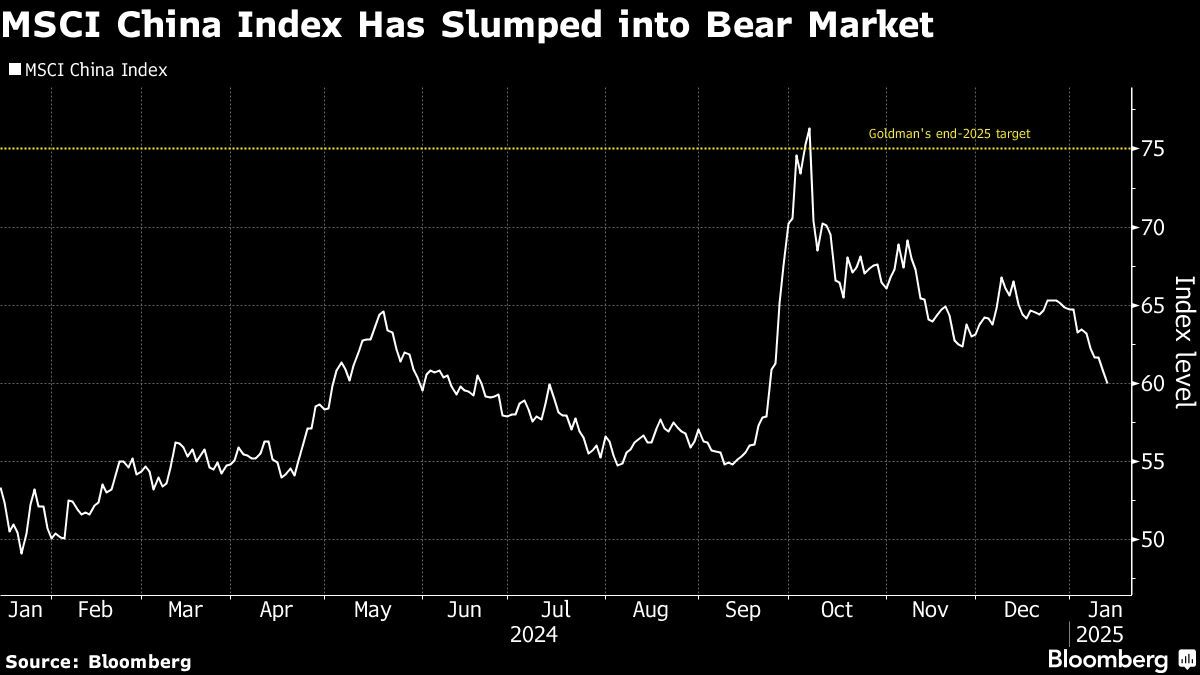
          The broker is sticking to its guns even though a similarly optimistic call in November looks increasingly at odds with recent market moves. The MSCI China Index tumbled into a bear market last week, and the CSI 300 gauge lost more than 5% in the first seven trading sessions of 2025, its worst such performance for any year since 2016.

          Goldman recommended investors buy government consumption proxies, emerging market exporters which will benefit from a weaker yuan, as well as select tech and infrastructure names. Meanwhile, shareholder returns “should continue to prevail on record-breaking cash distribution and falling domestic rates”, they wrote.

          Goldman Strategists See Battered Chinese Stocks Rising 20% in 2025_1

          In addition, the strategists also maintained an 'overweight' call on online retail, media and healthcare stocks, while upgrading consumer services shares to 'overweight'.

          HSBC Holdings plc is similarly optimistic, saying last week that it’s positive on Chinese stocks listed in Hong Kong given the “favorable policy rhetoric” in mainland China and a better economic growth outlook.

          Back in November, Goldman predicted that Chinese shares could gain about 20% over the next 12 months, as authorities stepped up measures to support the struggling economy. The MSCI China Index has lost about 10% since then as growth jitters, falling producer prices and the prospect of additional US tariffs unnerved investors.

          Source: Theedgemarkets

          Risk Warnings and Disclaimers
          You understand and acknowledge that there is a high degree of risk involved in trading. Following any strategies or investment methods may lead to potential losses. The content on the site is provided by our contributors and analysts for information purposes only. You are solely responsible for determining whether any trading assets, securities, strategy, or any other product is suitable for investing based on your own investment objectives and financial situation.
          Add to Favorites
          Share

          AUD/USD and NZD/USD under Fire, Deeper Losses Ahead?

          Justin

          Forex

          AUD/USD declined below the 0.6350 and 0.6250 support levels. NZD/USD is also moving lower and might extend losses below 0.5540.

          Important Takeaways for AUD/USD and NZD/USD Analysis Today

          The Aussie Dollar started a fresh decline from well above the 0.6300 level against the US Dollar.

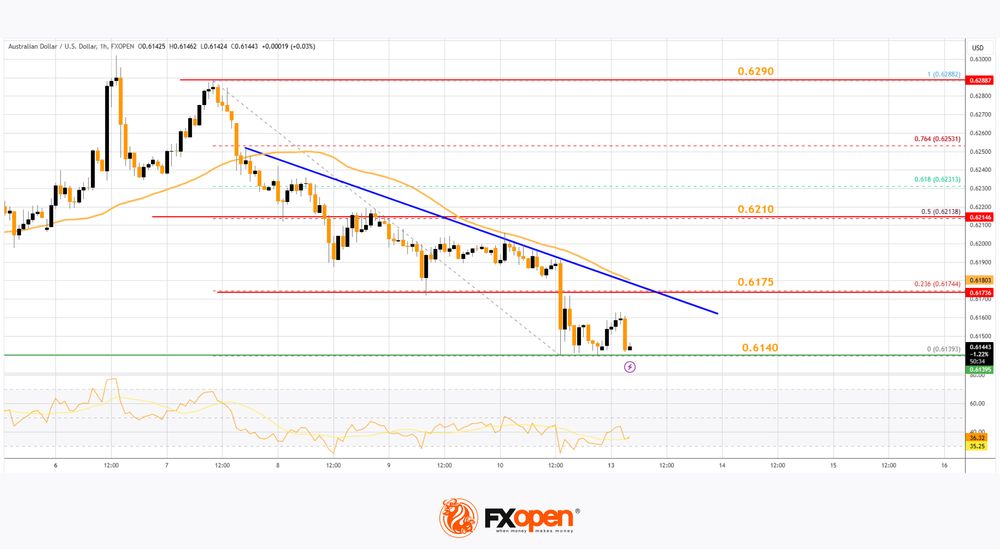
          There is a connecting bearish trend line forming with resistance at 0.6175 on the hourly chart of AUD/USD at FXOpen.

          NZD/USD declined steadily from the 0.5690 resistance zone.

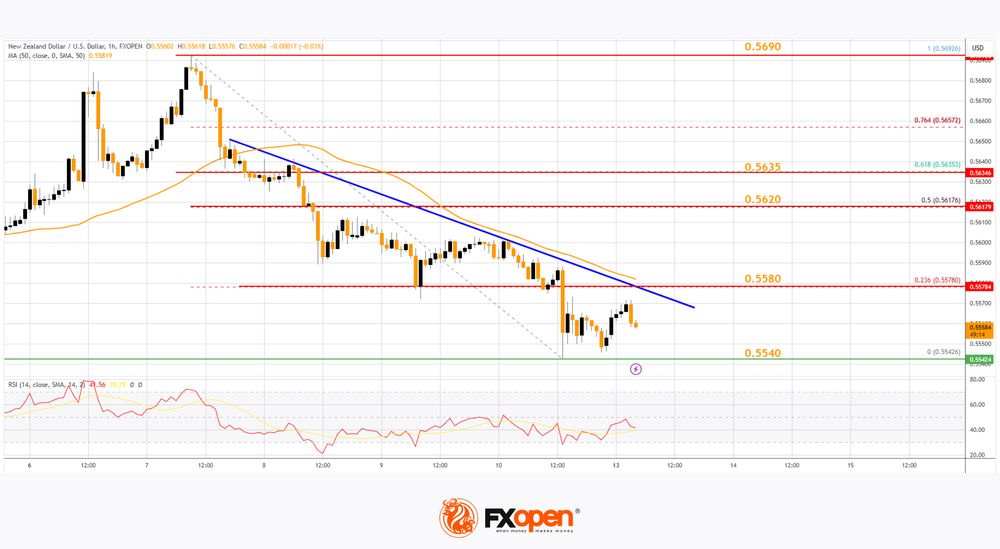
          There is a short-term bearish trend line forming with resistance at 0.5580 on the hourly chart of NZD/USD at FXOpen.

          AUD/USD Technical Analysis

          On the hourly chart of AUD/USD at FXOpen, the pair struggled to clear the 0.6300 zone. The Aussie Dollar started a fresh decline below the 0.6250 support against the US Dollar.

          The pair even settled below 0.6220 and the 50-hour simple moving average. There was a clear move below 0.6200. A low was formed at 0.6139 and the pair is now consolidating losses. On the upside, an immediate resistance is near the 0.6175 level.

          There is also a connecting bearish trend line forming with resistance at 0.6175. It is close to the 23.6% Fib retracement level of the downward move from the 0.6288 swing high to the 0.6139 low.

          The next major resistance is near the 0.6210 zone or the 50% Fib retracement level of the downward move from the 0.6288 swing high to the 0.6139 low, above which the price could rise toward 0.6290. Any more gains might send the pair toward the 0.6320 resistance.

          A close above the 0.6320 level could start another steady increase in the near term. The next major resistance on the AUD/USD chart could be 0.6400.

          On the downside, initial support is near the 0.6140 zone. The next support sits at 0.6120. If there is a downside break below 0.6120, the pair could extend its decline. The next support could be 0.6050. Any more losses might send the pair toward the 0.6000 support.

          NZD/USD Technical Analysis

          On the hourly chart of NZD/USD on FXOpen, the pair also followed a similar pattern and declined from the 0.5700 zone. The New Zealand Dollar gained bearish momentum and traded below 0.5635 against the US Dollar.

          The pair settled below the 0.5600 level and the 50-hour simple moving average. Finally, it tested the 0.5540 zone and is currently consolidating losses.

          Immediate resistance on the upside is near the 23.6% Fib retracement level of the downward move from the 0.5692 swing high to the 0.5542 low at 0.5580. There is also a short-term bearish trend line forming with resistance at 0.5580.

          The next resistance is the 0.5620 level or the 50% Fib retracement level of the downward move from the 0.5692 swing high to the 0.5542 low. If there is a move above 0.5620, the pair could rise toward 0.5635.

          Any more gains might open the doors for a move toward the 0.5690 resistance zone in the coming days. On the downside, immediate support on the NZD/USD chart is near the 0.5540 level.

          The next major support is near the 0.5500 zone. If there is a downside break below 0.5500, the pair could extend its decline toward the 0.5465 level. The next key support is near 0.5420.

          Trade over 50 forex markets 24 hours a day with FXOpen. Take advantage of low commissions, deep liquidity, and spreads from 0.0 pips. Open your FXOpen account now or learn more about trading forex with FXOpen.

          This article represents the opinion of the Companies operating under the FXOpen brand only. It is not to be construed as an offer, solicitation, or recommendation with respect to products and services provided by the Companies operating under the FXOpen brand, nor is it to be considered financial advice.

          Source: ACTIONFOREX

          Risk Warnings and Disclaimers
          You understand and acknowledge that there is a high degree of risk involved in trading. Following any strategies or investment methods may lead to potential losses. The content on the site is provided by our contributors and analysts for information purposes only. You are solely responsible for determining whether any trading assets, securities, strategy, or any other product is suitable for investing based on your own investment objectives and financial situation.
          Add to Favorites
          Share

          The Case for US Innovation and Growth

          Cohen

          Economic

          Stocks

          The greatest concentration of high-quality innovative growth companies are domiciled in the US. US technology companies, specifically, are 75%* of global tech market cap. This is not a coincidence: the US market offers a long list of traits that have enabled this dominance, including:
          less overbearing regulation
          strong rule of law and intellectual property protection.
          a strong history of entrepreneurship supported by the largest venture capital community.
          a rewarding compensation system that allows for talent to flow and innovative growth companies to form.
          a generally favorable tax environment.
          As a result, investing in US large cap growth stocks has proved particularly rewarding –even more so relative to value or international stocks over the past decade or so. Such a prolonged period of outperformance has prompted many to argue that a value or non-US equity rally is imminent. But in our view, these arguments lack substance because they don’t address the fundamental factors that have led to this dominance.
          We believe that growth companies in the United States offer many dominant, high-quality, innovative, asset-light business models capable of compounding strong sustainable growth. The US equity market, especially growth equities, provides access to some of the world’s most innovative companies in the semiconductor, AI, software, medical technology, biotech, internet services, ecommerce, robotics and industrial automation sectors, to name a few. Many of these companies operate on a global scale, driving improvements in operating leverage, returns, and free cash flow generation. This provides increased capital for companies to reinvest in further innovation that enhances their competitive advantage.

          Our Approach

          The Fundamental Growth and Core Equity team does not try to second-guess the short-term style preferences of the market – nor do we think investors are well served in trying to do so. In our view, investors should have a dedicated allocation to high-quality, premier US growth companies because this area of the US market offers potentially the greatest long-term opportunities for capital appreciation – something that is not as readily seen in other asset classes, styles, or geographies.
          Unfortunately, this part of the market also contains companies with unproven business models: high-leverage, fad stocks that can fall as fast as they rise, or have sky-high valuations that create massive downside risk. Without a doubt, it pays to be selective when investing in this segment. This is where our actively managed fundamental approach can make a difference.
          Figure 1 illustrates our differentiated approach. We compare US Premier Growth to a leading momentum-driven growth manager (red) and the US Large Cap Growth peer group in general (blue) during the strong growth cycle of the past five years. By not chasing growth-at-any-price and employing a rigorous selection process, US Premier Growth has handily outperformed over the cycle with much less risk and volatility.
          The Case for US Innovation and Growth_1
          As you can see in Figure 2, we are looking for companies with a strong competitive moat around their business that is driving them from the murky world of promising, but un-tested, emerging growth companies into established growers, capable of delivering double-digit earnings growth with a long runway before hitting maturity. At the same time, we avoid many of the mature, limited-growth companies found in the Russell 1000 Growth benchmark.
          The Case for US Innovation and Growth_2

          US Premier Growth Equity Strategy

          State Street’s US Premier Growth Equity Strategy is a growth strategy centered around quality growth at a reasonable price principles. It is not just a collection of high-growth momentum names that are the mainstay of many other portfolios in the category. Despite a strong run by the Russell 1000 Growth Index, we believe our discerning active approach is a better way to harvest the opportunities among large- and mid-cap growth equities in the US. Our strategy does not depend on style momentum, but instead is driven by the ability of portfolio company holdings in aggregate, to compound at a mid-teens growth rate throughout the economic and market cycle.

          Portfolio Construction: Adopting a Longer Horizon to Identify Opportunities Short-term Investors May Miss

          In constructing the portfolio, we apply a rigorous bottom-up approach to unearth quality double-digit growth companies that trade at reasonable valuations. We seek companies that can reliably compound their earnings at a minimum 10% rate over the next three-to-five years. Most sell-side analyst models only go out two or three years on average and conservatively assume a natural fade in growth and returns. This means that if we can identify companies that can sustain growth beyond this short horizon, they are likely to be undervalued by the market, as illustrated in Figure 3. Further, if we can hold these companies for the longer term, 3-5 years or longer, we can let the power of compound earnings growth drive alpha.
          The Case for US Innovation and Growth_3

          Identifying Opportunities: The Confidence Quotient (CQ)

          How do we find such undervalued companies? Alongside intense fundamental analysis and proprietary modeling, we score each name on our proprietary Confidence Quotient (CQ) research framework. This is unlike traditional measures of quality that emphasize a simple combination of historical returns, earnings volatility, and debt. Instead, we define quality on a forward-looking basis and focus on qualitative measures such as the competitive moat; our confidence in the management team; the appropriateness of the capital allocation strategy; the transparency of the business model; and the fundamental momentum of the business drivers. We leverage our long-tenured research team (with an average of 20+ years of experience) to quantify these “soft” metrics using our detailed CQ framework. The higher the CQ score, the higher our conviction in our projection of the duration of growth, creating substantial stock outperformance and alpha potential as this compound growth is realized over time.
          Figure 4 shows the premium that durable growth commands in the market. In this hypothetical example, the valuation premium rises exponentially as the number of years of compound growth increases. We expect the strong quality attributes found in our high CQ companies will lead to steady predictable earnings growth, while our valuation discipline provides downside protection.
          The Case for US Innovation and Growth_4

          We Don’t Chase Growth at Any Price

          Attempting to time market valuation swings and sentiment changes is a notoriously difficult job for investors. Our reasonable valuation discipline, which underpins the portfolio strategy, aims to keep up with, or beat, the benchmark in strong ‘up’ years while providing downside protection during market corrections. We believe the strategy is not only an excellent way to participate in exciting innovative long-term US growth opportunities but is a more secure portfolio than our growth and innovation peers in a market storm. This is especially true for funds holding more emerging, yet profitless, concept companies that can fall dramatically if market perception, interest rates, or other conditions change.
          Our concentrated portfolio has historically offered a three-to-five-year earnings per share (EPS) growth rate in line with or better than the Russell 1000 Growth Index, but the aggregate price -to-earnings (PE) multiple has been somewhat lower than that benchmark. The Premier Growth Equity strategy has in recent years had a similar standard deviation and beta than the benchmark, further reflecting relatively lower risk and volatility than peers. Additionally, while we are long-term holders, we use position sizing to manage our risk by scaling company weights up or down based on the forward-looking risk/reward.

          A Portfolio of Innovative Long-Term, Double-Digit Winners

          In summary, our objective is to consistently compound our portfolio over the long run by investing in quality companies, where innovation, brand and other intangibles leads to a strong competitive moat that helps drive durable mid-teens growth and consistently high returns on invested capital. We also aim not to overpay for this growth by focusing on stocks that trade at reasonable valuations. Our approach targets a portfolio of long-term winners that we expect can provide excess returns, while at the same time providing better downside protection than other US Growth funds. This approach is backed by our deep fundamental work, a strong emphasis on quality, and our valuation discipline.

          Source:State Street Global Advisors

          To stay updated on all economic events of today, please check out our Economic calendar
          Risk Warnings and Disclaimers
          You understand and acknowledge that there is a high degree of risk involved in trading. Following any strategies or investment methods may lead to potential losses. The content on the site is provided by our contributors and analysts for information purposes only. You are solely responsible for determining whether any trading assets, securities, strategy, or any other product is suitable for investing based on your own investment objectives and financial situation.
          Add to Favorites
          Share

          The Year in Review: What Happened in 2024?

          JPMorgan

          Economic

          2024 was a busy year. Global economic growth diverged amidst elevated uncertainty; nearly half of the world's population went to the polls, igniting debates around policy; inflation eased across major economies, with policymakers seemingly successful in engineering a "soft landing"; and risk assets performed well, though the dispersion of returns across asset classes widened.
          What was behind these market moves? To answer that, it is important to unpack some of the themes that defined last year:

          U.S. growth exceptionalism continued:

          Coming into 2024, consensus estimates projected U.S. growth to normalize. Instead, the U.S. economy surprised to the upside, driven by resilient consumer spending and AI-driven private investment. In fact, current estimates suggest that the U.S. economy expanded by 2.8% in 2024, more than double initial estimates and driving a wedge between the U.S. and other developed economies. In the emerging world, the Indian economy topped the league tables, while China managed to achieve its 5% growth target thanks to year-end stimulus.

          Rate cuts materialized, but bonds lagged:

          2024 was expected to be the “year of bonds,” as markets anticipated rate cuts from major developed markets. While cuts did materialize, they did so unevenly: stubborn inflation (with policy-related risks anticipated in 2025) and warmer growth pushed U.S. long rates higher while hawkishly shifting rate expectations for this year. However, while duration disappointed in 2024, credit markets fared better despite tight spreads, supported by low default rates and attractive base rates.

          Gold and the dollar soared:

          Safe-haven assets flourished in 2024. Gold climbed 27% amid record central bank purchases while the U.S. dollar appreciated around 7% thanks to macro conditions — like strong U.S. growth and high U.S. yields — and geopolitical concerns. As a result, the historical negative correlation between gold and the dollar was challenged.

          Risk assets had another banner year:

          Despite muted expectations in early 2024, U.S. equities defied projections, posting a second consecutive year of 20%+ return, a feat achieved only four times since the 1930s. Once again, these returns were driven by large cap names, fueled by strong earnings, optimism around AI and potential deregulation under the new administration. Outside the U.S., European equities struggled alongside a weakening economy, while Japanese and emerging markets fared better, including particularly good performance from Taiwan and India. Meanwhile, Bitcoin more than doubled in value, following regulatory approval of spot ETFs and optimism around potential policy changes.
          The Year in Review: What Happened in 2024?_1
          To stay updated on all economic events of today, please check out our Economic calendar
          Risk Warnings and Disclaimers
          You understand and acknowledge that there is a high degree of risk involved in trading. Following any strategies or investment methods may lead to potential losses. The content on the site is provided by our contributors and analysts for information purposes only. You are solely responsible for determining whether any trading assets, securities, strategy, or any other product is suitable for investing based on your own investment objectives and financial situation.
          Add to Favorites
          Share

          Pound to Australian Dollar Week Ahead Forecast: 1.96

          Warren Takunda

          Economic

          The Australian Dollar is advancing in value agains the British Pound and the trend looks set to extend.
          GBP/AUD hit a high at 2.0301 in mid-December, but this looks to be the interim top, and the retreat we are observing looks to be consistent with previous pullbacks:Pound to Australian Dollar Week Ahead Forecast: 1.96_1
          If the current decline in GBP/AUD is a mere pullback in the uptrend, as per the previous episodes illustrated in the above chart, then the retreat is close to completing.
          It could extend to 1.96 and then begin to slowly recover before resuming the multi-year rally that remains intact from a technical perspective.
          Should GBP/AUD extend below 1.96 we would be seeing an initial signal that a broader, more sustained change in trend is underway.
          The other key level to watch is the 200-day exponential moving average (EMA), located at 1.95. A general rule of thumb we use is that an asset is in a medium-term uptrend while above the 200 EMA, and a downtrend when below.
          The 200 EMA is still rising, so it should more or less converge on the 1.96 level with the spot exchange rate in the coming days, providing a key level of support.
          So, all signs point to further GBP/AUD weakness, but it is still too soon to say the bigger more relevant GBP/AUD uptrend is over.
          Theres is some interest in Australia this week with the release of monthly employment statistics for December. Here, the market looks for a seasonal slowdown to just 10K positions, down from 33K in November. The country's unemployment rate is anticipated to increase slightly to 4%.
          Of more relevance to the Aussie Dollar is China, where the domestic currency is under pressure and where market nervousness about Donald Trump's ascension to the White House is rife.
          "Perhaps the most significant battleground today is in China. Here, USD/CNY onshore is pressing the +2% trading band around the daily fixing. The People's Bank of China (PBoC) seems to be announcing new measures each day in an attempt to support the renminbi," says Chris Turner, Head of FX Research at ING.
          "On Friday, it was a large PBoC sale (planned for Wednesday) of CNH bills in order to drain liquidity. Today it is a relaxation of macro-capital measures that now allows Chinese corporates and financial institutions to raise more money overseas," says Turner.
          The Australian Dollar is a G10 proxy for China and the Chinese Yuan, meaning pressures here inevitably translate into Aussie Dollar weakness, which could limit GBP/AUD downside
          "Commodity and emerging currencies should take the brunt of the higher US rate story. Indeed, AUD/USD is not far from 0.60, where we could start to hear speculation over impending Reserve Bank of Australia FX intervention," aadds Turner.
          There is a definite shift in sentiment towards the GBP underway, which could mean this time, the pullback in GBP/AUD will be more concerted, and a trend-turn is potentially underway.
          Pound exchange rates sold off significantly last week as investors grew increasingly concerned about the UK's debt dynamics. The UK ten-year bond yield rose again on Monday and is at its highest level since the turn of the millennium, which speaks of acute pressures on the UK's finances.
          The bond yield represents the interest rate the UK government pays its creditors; as they rise so the UK government must scramble for more money.
          Economists think the UK will now need £10BN more just to service debts than was anticipated in October when Chancellor Rachel Reeves set out her budget. To stick to her fiscal rules, she must now find more money via taxation or cut spending.
          News publications indicate that, for now, Reeves thinks she can find some loose change by telling government departments to cut spending.
          However, departmental budgets have already been cut drastically, and there will be limited success in this strategy.
          Until she goes after the balooning benefits bill, success on the expenditure side of the books will not be forthcoming. We think markets would reward a clear commitment to reducing this bill.
          However, for Labour, this is a particularly unappetising approach to take, and we doubt it will be forthcoming.
          As such, GBP weakness looks to remain a feature of early 2025.

          Source: Poundsterlinglive

          To stay updated on all economic events of today, please check out our Economic calendar
          Risk Warnings and Disclaimers
          You understand and acknowledge that there is a high degree of risk involved in trading. Following any strategies or investment methods may lead to potential losses. The content on the site is provided by our contributors and analysts for information purposes only. You are solely responsible for determining whether any trading assets, securities, strategy, or any other product is suitable for investing based on your own investment objectives and financial situation.
          Add to Favorites
          Share

          Morning Bid: Forget the Soft Landing, Just Keep Flying

          Warren Takunda

          Economic

          Why bother engineering a soft landing, when you can just keep flying?
          That's the message from the U.S. payrolls report, which is likely to lift the Atlanta Fed GDP Now estimate from its already above-trend pace of 2.7%.
          With the labour market so resilient and inflation receding only slowly, markets may be wondering why the Federal Reserve is easing policy at all. A reading above +0.2% for core consumer prices on Wednesday could convince futures to start giving up on even one cut this year.
          The Treasury market is clearly fretting that cuts are done and the next move might be up, especially if President-elect Donald Trump goes through with universal tariffs, mass migrant deportations and tax cuts.
          China's reveal of a whopping $105 billion trade surplus with the United States in December only adds ammunition to those arguing for swingeing tariffs.
          Add in an ever-expanding budget deficit and it would be no surprise to see 10-year Treasury yields test the 5% barrier.
          That raises the bar for discounting corporate earnings, just as the profit season starts with the big banks on Wednesday. It also makes risk-free debt relatively more attractive compared with other investments including equities, cash, property and commodities.
          So it's been pretty much a sea of red in Asian stocks so far on Monday. Japan is on holiday but Nikkei futures are down around 1.2%. S&P 500 and Nasdaq futures are both down around 0.5%, and European stock futures have lost 0.1% to 0.3%. There's no trading of cash Treasuries but futures are down 5 ticks or so.
          The ascent of yields is stoking the dollar's bull run and causing stress across Asia, where central banks have to routinely intervene to prop up their currencies.
          China's central bank is increasingly rummaging through its policy tool kit to support the yuan, announcing on Monday an increase in the cap on what local companies can borrow abroad. If they can borrow the dollars they require, then there is less need to buy dollars for yuan in the spot market.
          Another currency under fire is sterling, which hit a fresh 14-month low at $1.2138 as markets fret about the Labour government's financial credibility. On a trip to China, finance minister Rachel Reeves had to reassure the media she would act to ensure the government's fiscal rules are met.
          Oh, and oil is up another 1.5% as investors ponder the full implications of the latest round of U.S. and UK sanctions on Russian producers.
          This move could really bite since it sanctions another 160 tankers of Russia's shadow fleet, taking the total to 270. Previous tankers so hit were severely curtailed in where they could travel and some ended up being scrapped.
          Key developments that could influence markets on Monday:
          - U.S. Federal budget balance

          Source: Reuters

          To stay updated on all economic events of today, please check out our Economic calendar
          Risk Warnings and Disclaimers
          You understand and acknowledge that there is a high degree of risk involved in trading. Following any strategies or investment methods may lead to potential losses. The content on the site is provided by our contributors and analysts for information purposes only. You are solely responsible for determining whether any trading assets, securities, strategy, or any other product is suitable for investing based on your own investment objectives and financial situation.
          Add to Favorites
          Share
          FastBull
          Copyright © 2025 FastBull Ltd

          728 RM B 7/F GEE LOK IND BLDG NO 34 HUNG TO RD KWUN TONG KLN HONG KONG

          TelegramInstagramTwitterfacebooklinkedin
          App Store Google Play Google Play
          Products
          Charts

          Chats

          Q&A with Experts
          Screeners
          Economic Calendar
          Data
          Tools
          Membership
          Features
          Function
          Markets
          Copy Trading
          Latest Signals
          Contests
          News
          Analysis
          24/7
          Columns
          Education
          Company
          Careers
          About Us
          Contact Us
          Advertising
          Help Center
          Feedback
          User Agreement
          Privacy Policy
          Business

          White Label

          Data API

          Web Plug-ins

          Poster Maker

          Affiliate Program

          Risk Disclosure

          The risk of loss in trading financial instruments such as stocks, FX, commodities, futures, bonds, ETFs and crypto can be substantial. You may sustain a total loss of the funds that you deposit with your broker. Therefore, you should carefully consider whether such trading is suitable for you in light of your circumstances and financial resources.

          No decision to invest should be made without thoroughly conducting due diligence by yourself or consulting with your financial advisors. Our web content might not suit you since we don't know your financial conditions and investment needs. Our financial information might have latency or contain inaccuracy, so you should be fully responsible for any of your trading and investment decisions. The company will not be responsible for your capital loss.

          Without getting permission from the website, you are not allowed to copy the website's graphics, texts, or trademarks. Intellectual property rights in the content or data incorporated into this website belong to its providers and exchange merchants.

          Not Logged In

          Log in to access more features

          FastBull Membership

          Not yet

          Purchase

          Become a signal provider
          Help Center
          Customer Service
          Dark Mode
          Price Up/Down Colors

          Log In

          Sign Up

          Position
          Layout
          Fullscreen
          Default to Chart
          The chart page opens by default when you visit fastbull.com