• Trade
  • Markets
  • Copy
  • Contests
  • News
  • 24/7
  • Calendar
  • Q&A
  • Chats
Trending
Screeners
SYMBOL
LAST
BID
ASK
HIGH
LOW
NET CHG.
%CHG.
SPREAD
SPX
S&P 500 Index
6857.13
6857.13
6857.13
6865.94
6827.13
+7.41
+ 0.11%
--
DJI
Dow Jones Industrial Average
47850.93
47850.93
47850.93
48049.72
47692.96
-31.96
-0.07%
--
IXIC
NASDAQ Composite Index
23505.13
23505.13
23505.13
23528.53
23372.33
+51.04
+ 0.22%
--
USDX
US Dollar Index
98.860
98.940
98.860
98.980
98.840
-0.120
-0.12%
--
EURUSD
Euro / US Dollar
1.16572
1.16580
1.16572
1.16589
1.16408
+0.00127
+ 0.11%
--
GBPUSD
Pound Sterling / US Dollar
1.33442
1.33453
1.33442
1.33450
1.33165
+0.00171
+ 0.13%
--
XAUUSD
Gold / US Dollar
4219.85
4220.28
4219.85
4221.12
4194.54
+12.68
+ 0.30%
--
WTI
Light Sweet Crude Oil
59.327
59.364
59.327
59.469
59.187
-0.056
-0.09%
--

Community Accounts

Signal Accounts
--
Profit Accounts
--
Loss Accounts
--
View More

Become a signal provider

Sell trading signals to earn additional income

View More

Guide to Copy Trading

Get started with ease and confidence

View More

Signal Accounts for Members

All Signal Accounts

Best Return
  • Best Return
  • Best P/L
  • Best MDD
Past 1W
  • Past 1W
  • Past 1M
  • Past 1Y

All Contests

  • All
  • Trump Updates
  • Recommend
  • Stocks
  • Cryptocurrencies
  • Central Banks
  • Featured News
Top News Only
Share

[Market Update] Spot Silver Broke Through $58/ounce, Up 1.56% On The Day

Share

Dollar/Yen Down 0.33% To 154.61

Share

Kremlin Says No Plans For Putin-Trump Call For Now

Share

Kremlin Says Moscow Is Waiting For USA Reaction After Putin-Witkoff Meeting

Share

Cctv - China, France: Say Both Sides Support All Efforts For A Ceasefire, Restore Peace According To Intl Law

Share

[Chinese Ambassador To The US Xie Feng Hopes Chinese And American Business Communities Will Focus On Three Lists] On December 4, Chinese Ambassador To The US Xie Feng Delivered A Speech At The China-US Economic And Trade Cooperation Forum Jointly Hosted By The China Council For The Promotion Of International Trade And The Meridian International Center. Xie Feng Said That In November 2026, China Will Host The APEC Leaders' Informal Meeting For The Third Time In Shenzhen, Guangdong Province. In December 2026, The United States Will Also Host The G20 Meeting. Regarding How Chinese And American Business Communities Can Seize These Opportunities, He Suggested Focusing On Three Lists: First, Continue To Expand The Dialogue List; Second, Continuously Lengthen The Cooperation List; And Third, Constantly Reduce The Problem List

Share

India's Nifty Financial Services Index Extends Gains, Last Up 0.75%

Share

Eni : Jp Morgan Cuts To Underweight From Overweight

Share

Cctv - China, France: Signed Protocol On Sanitary, Phytosanitary Requirements For Export Of French Alfalfa Grass

Share

India's NIFTY IT Index Last Up 1.3%

Share

India's Nifty 50 Index Rises 0.35%

Share

Israel Sets 2026 Defence Budget At $34 Billion

Share

Russia Says Azov Sea's Port Of Temryuk Damaged In Ukrainian Attack

Share

Israel's Defense Budget For 2026 Will Be 112 Billion Israeli Shekels - Defense Minister Office

Share

One India Rate Panel Member Ram Singh Was Of View That Stance Should Be Changed To 'Accommodative' From 'Neutral' - Monetary Policy Committee Statement

Share

Reserve Bank Of India Chief: Will Continue To Meet Productive Needs Of Economy In Proactive Manner

Share

Reserve Bank Of India Chief: System Level Financial Parameters Of Nbfcs Sound

Share

Reserve Bank Of India Chief: Dollar Rupee Swap To Be For 3 Years, To Be Conducted This Month

Share

India's Nifty Realty Index Extend Gains, Last Up 1.4%

Share

India's Nifty Psu Bank Index Rises 1%

TIME
ACT
FCST
PREV
Turkey Trade Balance

A:--

F: --

P: --

Germany Construction PMI (SA) (Nov)

A:--

F: --

P: --

Euro Zone IHS Markit Construction PMI (Nov)

A:--

F: --

P: --

Italy IHS Markit Construction PMI (Nov)

A:--

F: --

P: --

U.K. Markit/CIPS Construction PMI (Nov)

A:--

F: --

P: --

France 10-Year OAT Auction Avg. Yield

A:--

F: --

P: --

Euro Zone Retail Sales MoM (Oct)

A:--

F: --

P: --

Euro Zone Retail Sales YoY (Oct)

A:--

F: --

P: --

Brazil GDP YoY (Q3)

A:--

F: --

P: --

U.S. Challenger Job Cuts (Nov)

A:--

F: --

P: --

U.S. Challenger Job Cuts MoM (Nov)

A:--

F: --

P: --

U.S. Challenger Job Cuts YoY (Nov)

A:--

F: --

P: --

U.S. Initial Jobless Claims 4-Week Avg. (SA)

A:--

F: --

P: --

U.S. Weekly Initial Jobless Claims (SA)

A:--

F: --

P: --

U.S. Weekly Continued Jobless Claims (SA)

A:--

F: --

P: --

Canada Ivey PMI (SA) (Nov)

A:--

F: --

P: --

Canada Ivey PMI (Not SA) (Nov)

A:--

F: --

P: --

U.S. Non-Defense Capital Durable Goods Orders Revised MoM (Excl. Aircraft) (SA) (Sept)

A:--

F: --

P: --
U.S. Factory Orders MoM (Excl. Transport) (Sept)

A:--

F: --

P: --

U.S. Factory Orders MoM (Sept)

A:--

F: --

P: --

U.S. Factory Orders MoM (Excl. Defense) (Sept)

A:--

F: --

P: --

U.S. EIA Weekly Natural Gas Stocks Change

A:--

F: --

P: --

Saudi Arabia Crude Oil Production

A:--

F: --

P: --

U.S. Weekly Treasuries Held by Foreign Central Banks

A:--

F: --

P: --

Japan Foreign Exchange Reserves (Nov)

A:--

F: --

P: --

India Repo Rate

A:--

F: --

P: --

India Benchmark Interest Rate

A:--

F: --

P: --

India Reverse Repo Rate

A:--

F: --

P: --

India Cash Reserve Ratio

A:--

F: --

P: --

Japan Leading Indicators Prelim (Oct)

A:--

F: --

P: --

U.K. Halifax House Price Index YoY (SA) (Nov)

--

F: --

P: --

U.K. Halifax House Price Index MoM (SA) (Nov)

--

F: --

P: --

France Current Account (Not SA) (Oct)

--

F: --

P: --

France Trade Balance (SA) (Oct)

--

F: --

P: --

France Industrial Output MoM (SA) (Oct)

--

F: --

P: --

Italy Retail Sales MoM (SA) (Oct)

--

F: --

P: --

Euro Zone Employment YoY (SA) (Q3)

--

F: --

P: --

Euro Zone GDP Final YoY (Q3)

--

F: --

P: --

Euro Zone GDP Final QoQ (Q3)

--

F: --

P: --

Euro Zone Employment Final QoQ (SA) (Q3)

--

F: --

P: --

Euro Zone Employment Final (SA) (Q3)

--

F: --

P: --
Brazil PPI MoM (Oct)

--

F: --

P: --

Mexico Consumer Confidence Index (Nov)

--

F: --

P: --

Canada Unemployment Rate (SA) (Nov)

--

F: --

P: --

Canada Labor Force Participation Rate (SA) (Nov)

--

F: --

P: --

Canada Employment (SA) (Nov)

--

F: --

P: --

Canada Part-Time Employment (SA) (Nov)

--

F: --

P: --

Canada Full-time Employment (SA) (Nov)

--

F: --

P: --

U.S. Dallas Fed PCE Price Index YoY (Sept)

--

F: --

P: --

U.S. PCE Price Index YoY (SA) (Sept)

--

F: --

P: --

U.S. PCE Price Index MoM (Sept)

--

F: --

P: --

U.S. Personal Outlays MoM (SA) (Sept)

--

F: --

P: --

U.S. Core PCE Price Index MoM (Sept)

--

F: --

P: --

U.S. UMich 5-Year-Ahead Inflation Expectations Prelim YoY (Dec)

--

F: --

P: --

U.S. Core PCE Price Index YoY (Sept)

--

F: --

P: --

U.S. 5-10 Year-Ahead Inflation Expectations (Dec)

--

F: --

P: --

U.S. UMich Current Economic Conditions Index Prelim (Dec)

--

F: --

P: --

U.S. UMich Consumer Sentiment Index Prelim (Dec)

--

F: --

P: --

U.S. UMich 1-Year-Ahead Inflation Expectations Prelim (Dec)

--

F: --

P: --

U.S. UMich Consumer Expectations Index Prelim (Dec)

--

F: --

P: --

Q&A with Experts
    • All
    • Chatrooms
    • Groups
    • Friends
    Connecting
    .
    .
    .
    Type here...
    Add Symbol or Code

      No matching data

      All
      Trump Updates
      Recommend
      Stocks
      Cryptocurrencies
      Central Banks
      Featured News
      • All
      • Russia-Ukraine Conflict
      • Middle East Flashpoint
      • All
      • Russia-Ukraine Conflict
      • Middle East Flashpoint
      Search
      Products

      Charts Free Forever

      Chats Q&A with Experts
      Screeners Economic Calendar Data Tools
      Membership Features
      Data Warehouse Market Trends Institutional Data Policy Rates Macro

      Market Trends

      Market Sentiment Order Book Forex Correlations

      Top Indicators

      Charts Free Forever
      Markets

      News

      News Analysis 24/7 Columns Education
      From Institutions From Analysts
      Topics Columnists

      Latest Views

      Latest Views

      Trending Topics

      Top Columnists

      Latest Update

      Signals

      Copy Rankings Latest Signals Become a signal provider AI Rating
      Contests
      Brokers

      Overview Brokers Assessment Rankings Regulators News Claims
      Broker listing Forex Brokers Comparison Tool Live Spread Comparison Scam
      Q&A Complaint Scam Alert Videos Tips to Detect Scam
      More

      Business
      Events
      Careers About Us Advertising Help Center

      White Label

      Data API

      Web Plug-ins

      Affiliate Program

      Awards Institution Evaluation IB Seminar Salon Event Exhibition
      Vietnam Thailand Singapore Dubai
      Fans Party Investment Sharing Session
      FastBull Summit BrokersView Expo
      Recent Searches
        Top Searches
          Markets
          News
          Analysis
          User
          24/7
          Economic Calendar
          Education
          Data
          • Names
          • Latest
          • Prev

          View All

          No data

          Scan to Download

          Faster Charts, Chat Faster!

          Download App
          English
          • English
          • Español
          • العربية
          • Bahasa Indonesia
          • Bahasa Melayu
          • Tiếng Việt
          • ภาษาไทย
          • Français
          • Italiano
          • Türkçe
          • Русский язык
          • 简中
          • 繁中
          Open Account
          Search
          Products
          Charts Free Forever
          Markets
          News
          Signals

          Copy Rankings Latest Signals Become a signal provider AI Rating
          Contests
          Brokers

          Overview Brokers Assessment Rankings Regulators News Claims
          Broker listing Forex Brokers Comparison Tool Live Spread Comparison Scam
          Q&A Complaint Scam Alert Videos Tips to Detect Scam
          More

          Business
          Events
          Careers About Us Advertising Help Center

          White Label

          Data API

          Web Plug-ins

          Affiliate Program

          Awards Institution Evaluation IB Seminar Salon Event Exhibition
          Vietnam Thailand Singapore Dubai
          Fans Party Investment Sharing Session
          FastBull Summit BrokersView Expo

          Government Shutdown Enters Third Week With No End In Sight

          Kevin Du

          Economic

          Summary:

          The government shutdown stretched into its third week on Wednesday as Republican and Democratic senators continued to dig in their heels on dueling stopgap funding proposals.

          The government shutdown stretched into its third week on Wednesday as Republican and Democratic senators continued to dig in their heels on dueling stopgap funding proposals.

          The Senate is set Wednesday afternoon to vote for the ninth time on competing short-term funding resolutions that have failed in eight previous votes.

          Republicans insist on a "clean" continuing resolution that would provide funds to reopen the government until at least Nov. 21.

          Democrats want any funding bill to extend enhanced Affordable Care Act subsidies that are set to run out at the end of this year. That and other provisions in the Democratic bill would cost an estimated $1 trillion.

          Wednesday's vote comes days after the Trump administration said in a court filing that more than 4,000 federal employees received notifications that they were being laid off.

          Trump administration officials blame the so-called reductions-in-force on Senate Democrats' refusal to vote for the Republican funding proposal.

          "Democrats are dug in 15 days into a government shutdown. Democrats show no sign that they're ready for it to end," Senate Majority Leader John Thune, R-S.D., said Wednesday on the chamber's floor.

          "Not even the prospect of military families going without a paycheck was enough for Democrats to reopen the government," Thune said.

          "Nor are Democrats concerned about needy families uncertain about ... the future of nutrition assistance, or Americans in flood zones who are unable to update their insurance or close on a home in the midst of hurricane season," Thune said.

          Senate Minority Leader Chuck Schumer, D-N.Y., countered Thune's argument, saying that the government has been shut since Oct. 1 because Republicans "refuse to work with Democrats in a serious way to fix the health care crisis looming over the American people."

          "As we speak, families are receiving letters for their new health insurance rates, and more states, more states are opening their window shopping period for what health insurance will look like next year," Schumer said.

          "With open enrollment around the corner, Republicans cannot continue to kick this can down the road. It's happening now. The health care crisis is now," Schumer said.

          Thune and other Republicans have said they are willing to discuss the question of extending ACA enhanced tax credits after the short-term funding is approved.

          "We need five more Democrats to say enough is enough to put the American people ahead of the far left and to support this clean, nonpartisan continuing resolution sitting right there at the Senate desk, ready to be picked up and passed today," said Thune on Wednesday.

          Source: CNBC

          To stay updated on all economic events of today, please check out our Economic calendar
          Risk Warnings and Disclaimers
          You understand and acknowledge that there is a high degree of risk involved in trading. Following any strategies or investment methods may lead to potential losses. The content on the site is provided by our contributors and analysts for information purposes only. You are solely responsible for determining whether any trading assets, securities, strategy, or any other product is suitable for investing based on your own investment objectives and financial situation.
          Add to Favorites
          Share

          Why are stocks so up and down lately?

          Adam

          Stocks

          After months of steadily climbing higher, stocks are bouncing around as investors process renewed US-China trade tensions.
          Stocks were mixed on Tuesday in volatile trading: The Dow gained 203 points, or 0.44%, after falling as much as 615 points earlier. The S&P 500 fell 0.16%. The tech-heavy Nasdaq closed 0.72% lower after sinking as much as 2.1% in the session.
          Tensions between the world’s two largest economies have reignited with tit-for-tat punitive measures. The prospect of a trade war has injected uncertainty into global markets, sending tech and chip stocks lower and weighing on investors’ outlook.
          As traders try to assess whether the trade spat will escalate, stocks are fluctuating and pausing their months-long ascent.
          “Market participants had been hoping that the worst of the trade conflict between China and the US was in the past,” Lee Hardman, senior currency analyst at Japanese bank MUFG, said in a note on Monday.
          Trade war fears
          Tensions were initially reignited after China on October 9 unveiled new export controls on rare earths and US President Donald Trump threatened a new 100% tariff the next day.
          The back-and-forth has continued: Beijing on Tuesday announced sanctions on five American subsidiary companies of South Korean shipping giant Hanwha Ocean, and it’s also reviewing a US government trade investigation into China’s maritime sector.
          Trump said via Truth Social on Tuesday that China is committing an “Economically Hostile Act” by “purposefully not buying our Soybeans.” American soybean farmers have been faced with a lack of demand from China as part of the trade war.
          Investors are concerned a resurgent US-China trade war could stoke inflation and raise the risk of an economic slowdown, according to Sam Stovall, chief investment strategist at CFRA Research.
          “With the trade war being put back on the front burner, I think investors have a lot more to be worried about,” Stovall said.
          The turmoil comes ahead of an anticipated meeting between Trump and Chinese leader Xi Jinping at the APEC summit in South Korea at the end of October.
          Volatility returns to markets
          Wall Street’s fear gauge, the VIX, jumped 31% on Friday — its biggest one-day gain since April — before falling 12% on Monday.
          The VIX gained 9% on Tuesday after briefly rising as much as 20%. The fluctuations are emblematic of the rise in uncertainty and heightened geopolitical risks.
          “The VIX is like the pulse of the market,” Stovall said. “Right now, because of renewed concerns, that pulse has accelerated.”
          Tech stocks have helped power the rally this year, but they are sensitive to trade tensions. The AI boom relies on China’s market for sales while trade tensions could also disrupt chip manufacturing supply chains.
          Nvidia (NVDA), the largest company in the S&P 500 by market value, has been caught in the crosshairs of the US-China trade spat. Nvidia sank 4.4% on Tuesday.
          Tech and chip sectors could see near-term volatility amid ongoing trade talks, according to Ulrike Hoffmann-Burchardi, global head of equities at UBS.
          Meanwhile, safe havens like gold and silver are surging — another sign that investors are hedging against geopolitical instability.
          What else is going on with stocks?
          The S&P 500 has rallied 33% across six months. Stocks are historically expensive while concerns are mounting about an AI bubble.
          At the same time, Wall Street strategists say stocks have more room to run, with strong corporate earnings and Federal Reserve rate cuts supporting the rally.
          While stocks have dipped lower because of recent trade concerns, some investors are also buying the dip, helping buoy the market.
          “We remain cautiously optimistic that (the US and China) will ultimately pursue a negotiated resolution,” said Hoffmann-Burchardi.

          Source: cnn

          Risk Warnings and Disclaimers
          You understand and acknowledge that there is a high degree of risk involved in trading. Following any strategies or investment methods may lead to potential losses. The content on the site is provided by our contributors and analysts for information purposes only. You are solely responsible for determining whether any trading assets, securities, strategy, or any other product is suitable for investing based on your own investment objectives and financial situation.
          Add to Favorites
          Share

          Analysis-Investors on guard for risks that could derail the AI gravy train

          Adam

          Economic

          Optimism over the profit potential of artificial intelligence has helped drive the U.S. stock market to record highs, but investors are looking for weak spots that could emerge in the AI trade and have identified some risks to watch for.
          AI has been the dominant theme on Wall Street since the launch of ChatGPT in November 2022, which fueled enthusiasm about the technology's potential. Citigroup strategists estimate that nearly 50% of the S&P 500's overall roughly $57 trillion in market capitalization has “high” or “medium” exposure to AI.
          The benchmark index is up about 13% year-to-date, while the tech-heavy Nasdaq Composite has climbed 17%.
          "So much of what is holding up the markets is either directly or indirectly related to that trade," said Yung-Yu Ma, chief investment strategist at PNC Financial Services Group.
          Technology and AI-linked stocks have stumbled several times this year. The emergence of a Chinese low-cost AI model called Deepseek at the start of the year sent shockwaves through tech stocks as it raised questions about massive capital spending. Similar questions also arose in August, briefly hitting tech stocks once again. The AI trade recovered from those setbacks and has thrived.
          "There is a huge opportunity here, but it really just comes down to what's priced in and what's not," said Steve Lowe, chief investment strategist at Thrivent Financial. "There is a lot of growth priced in, and that is one of the concerns, because there are still a number of risks that could trip up people's expectations."
          While some of the market participants who point to risks remain bullish as the benchmark S&P 500 starts the fourth year of its bull run, investors have identified potential warning signs to watch for as tech and other major U.S. companies begin reporting quarterly results in the days ahead.
          MASSIVE CAPEX SPENDING IN FOCUS
          Given massive capital expenditures required to build out infrastructure tied to AI applications, investors said they will watch the rate of spending and return on investments, and the potential for outlays to erode profitability.
          Capex from major cloud computing and AI platform companies known as "hyperscalers" including Microsoft, Amazon, Alphabet, Meta Platforms and Oracle, is expected to roughly double from 2024 to 2027 to $500 billion annually, according to Barclays strategists.
          While these companies generate massive amounts of cash, it is important to watch whether they are "spending faster than their growth rates and eating into their free cash flow margins," said Michael Arone, chief investment strategist for State Street Investment Management.
          Investors are also wary of any surprise softening in the spending, given the importance of tech outlays to support the AI expansion.
          "The bigger risk is not investing too much; it is not investing enough right now," said Garrett Melson, portfolio strategist at Natixis Investment Managers Solutions.
          There could be ramifications from potential "circular" deals involving AI companies with overlapping interests, such as Nvidia's recent announcement it will invest up to $100 billion in OpenAI.
          While the interdependent relationships within the AI ecosystem "do not appear sinister ... there is significant systemic risk in such close financial and operational ties," Irene Tunkel, chief U.S. equity strategist at BCA Research, said in a note this week.
          Tech companies have large cash resources to support AI spending and deal making. But a switch toward more leverage might raise eyebrows.
          "When you see these big announcements, you want to see it funded through cash flow, not debt or equity raises," said Anastacio Teodoro, senior portfolio manager at Federated Hermes.
          EYEING RETURN ON INVESTMENTS
          Barclays strategists are optimistic about the AI theme over the next 12 to 18 months, but they are also wary of signs the energy infrastructure may not be sufficient to support data centers and the AI-related build-out.
          "The power issue is probably one of the most important gating factors you should be looking out for," Venu Krishna, head of U.S. equity strategy at Barclays, said on a recent call with journalists.
          Investors are also on guard for signals that demand is tailing off or that the massive investments are not paying off as anticipated.
          "One potential trigger is that suddenly the needs just look like they are going to be less than was originally anticipated," PNC's Ma said.
          Patrick Ryan, chief investment strategist at Madison Investments, said there have yet to be many tangible signs of significant revenue and productivity gains stemming from AI.
          "If you get to the point where it becomes questionable that all of this investment was really going to pay off ... that is going to be something that would be very at risk," Ryan said.
          "How that happens, I can't necessarily put my finger on it."

          Source: Reuters

          To stay updated on all economic events of today, please check out our Economic calendar
          Risk Warnings and Disclaimers
          You understand and acknowledge that there is a high degree of risk involved in trading. Following any strategies or investment methods may lead to potential losses. The content on the site is provided by our contributors and analysts for information purposes only. You are solely responsible for determining whether any trading assets, securities, strategy, or any other product is suitable for investing based on your own investment objectives and financial situation.
          Add to Favorites
          Share

          China's retaliation cements a bitcoin reset

          Adam

          Cryptocurrency

          Not even Fed Chair Jerome Powell could lift bitcoin out of the red.
          Following historic losses, triggered by escalating trade tensions between the US and China, cryptocurrency investors have tried to regain their footing. But it's been a rough slog.
          Riding on the winds of a booming stock market and the prevailing sense that more rate cuts will fuel an extended rally, bitcoin recently topped the charts and set itself up for a historically strong October. Even accounting for the sharp losses in recent days, the digital currency is up more than 20% for the year, outpacing the gains of the benchmark S&P 500. But geopolitical tensions highlighted how fragile such asset climbs can be.
          After months of an upward spiral with higher peaks, investors now confront a reset of speculative bets.
          The back-and-forth between Washington and Beijing forced a pause across an array of bullish markets, rattled investors, and reminded Wall Street that, far from being a settled matter, tariffs are still in play as a political weapon and a powerful destabilizer. But bitcoin and other cryptocurrencies were hit especially hard.
          Part of the plunge in prices has to do with the excitement surrounding crypto investing, which translates to more aggressive wagers using borrowed money. Some investors who wielded leverage on the chance of winning outsized gains were left dangerously exposed when panic selling took hold. A wave of forced liquidations exacerbated the fall.
          Bitcoin shed as much as 5% Tuesday, but pared back the losses as investors reacted to Powell implying that another rate cut is possible at the Fed's next meeting in two weeks. Still, the weight of unresolved disputes with China, which worsened just before the closing bell, kept investors from doing much even with a bullish catalyst.
          The market-moving influence of a worsening trade conflict makes it harder to declare the sell-off a turning point for crypto or a peak bitcoin moment. If the dispute over critical minerals restrictions leads to a massive escalation in tariffs come Nov. 1, investors — crypto and otherwise — are in for more pain. And bitcoin and its lesser altcoin peers don't have the corporate earnings to cushion a deteriorating macroeconomic picture.
          But if trade diplomacy succeeds, then stability could be just around the corner. And the next peak ahead of us.

          Source: finance.yahoo

          Risk Warnings and Disclaimers
          You understand and acknowledge that there is a high degree of risk involved in trading. Following any strategies or investment methods may lead to potential losses. The content on the site is provided by our contributors and analysts for information purposes only. You are solely responsible for determining whether any trading assets, securities, strategy, or any other product is suitable for investing based on your own investment objectives and financial situation.
          Add to Favorites
          Share

          Shutdown Is Costing US Economy $15 Billion A Day, Bessent Says

          Devin

          Economic

          The two-week-old federal government shutdown is costing the U.S. economy about $15 billion a day in lost output, Treasury Secretary Scott Bessent said on Wednesday, putting an estimate on its economic toll and urging Democrats to "be heroes" and side with Republicans to end it.

          Bessent told a news conference that the shutdown was starting to "cut into muscle" of the U.S. economy.

          "We believe that the shutdown may start costing the U.S. economy up to $15 billion a day," he said.

          The wave of investment into the U.S. economy, including into artificial intelligence, is sustainable and is only getting started, but the federal government shutdown is increasingly an impediment, Bessent said.

          "There is pent-up demand, but then President (Donald) Trump has unleashed this boom with his policies," Bessent said at a CNBC event held on the sidelines of the International Monetary Fund and World Bank annual meetings in Washington.

          "The only thing slowing us down here is this government shutdown," Bessent said.

          He said that incentives in the Republican tax law and Trump's tariffs would keep the investment boom going and fuel continued growth.

          "I think we can be in a period like the late 1800s when railroads came in, like the 1990s when we got the internet and office tech boom," Bessent said.

          US DEFICIT HAS SHRUNK, BESSENT SAYS

          Bessent also said that the U.S. deficit for the 2025 fiscal year ended September 30 was smaller than the $1.833 trillion deficit posted in the prior fiscal year. He did not provide a figure, but said that the deficit-to-GDP ratio could come down to the 3% range in coming years.

          The Treasury Department has not yet reported the annual deficit figure.

          The Congressional Budget Office estimated last week that the U.S. fiscal 2025 deficit fell only slightly to $1.817 trillion despite a $118 billion jump in customs revenue from Trump's tariffs.

          "The deficit-to-GDP, which is the important number, now has a five in front of it," Bessent said at the CNBC event.

          Asked if he wanted to see a three at the start of the deficit-to-GDP ratio, Bessent said, "Yes, it's still possible." He added that the ratio would come down if the U.S. could "grow more, spend less, and constrain spending."

          Source: Yahoo Finance

          To stay updated on all economic events of today, please check out our Economic calendar
          Risk Warnings and Disclaimers
          You understand and acknowledge that there is a high degree of risk involved in trading. Following any strategies or investment methods may lead to potential losses. The content on the site is provided by our contributors and analysts for information purposes only. You are solely responsible for determining whether any trading assets, securities, strategy, or any other product is suitable for investing based on your own investment objectives and financial situation.
          Add to Favorites
          Share

          Auto industry raises the alarm as China tightens export rules for rare earths

          Adam

          Economic

          Automotive industry groups have raised the alarm over the ramifications of China’s latest move to restrict critical rare earth exports, saying the measures could pave the way to a period of supply chain chaos.
          China’s Commerce Ministry last week announced expanded curbs on the export of rare earths and related technologies, seeking to prevent the “misuse” of minerals in the military and other sensitive sectors.
          Beijing has since defended the policy, saying it was “not afraid” of a U.S. trade war after President Donald Trump threatened to impose 100% tariffs on Chinese imports.
          Despite an agreement in July designed to fast-track shipments to the region, Europe’s auto industry has been experiencing significant disruption after China imposed rare earth export curbs in early April.
          The German Association of the Automotive Industry (VDA), the country’s main car industry lobby, said China’s new regulations were expected to have “far-reaching consequences for deliveries of the affected products to Germany and Europe,” as well as for their onward transport.
          China’s latest export restrictions will hit the battery and semiconductor industries “particularly hard, and thus also the automotive industry,” the VDA spokesperson told CNBC by email on Tuesday.
          The German car industry lobby called on policymakers in both Brussels and Berlin to tackle the issue “forcefully” with China to quickly find a viable solution.
          “The fact is that the Chinese export restrictions on rare earths and permanent magnets implemented in April this year have already significantly exacerbated the supply situation for rare earths and strategic materials. The new measures now go even further,” the VDA spokesperson said.
          Rare earth metals are vital components to the production of electric vehicles, as well as various high-tech applications, including electronics and renewable energy applications.
          Demand for rare earths and critical minerals is expected to grow exponentially in the coming years as the clean energy transition picks up pace.
          China is the undisputed leader of the critical minerals supply chain, accounting for roughly 60% of the world’s production of rare earth minerals and materials. U.S. officials have previously warned that this poses a strategic challenge amid the pivot to more sustainable energy sources.
          Depleted reserves
          Roberto Vavassori, chairman of the Italian auto part maker lobby ANFIA, reportedly said Tuesday that while manufacturers had been able to maintain production when China restricted supplies over the summer, reserves of rare earth metals were now at risk of being depleted.
          This buffer “is not there anymore,” Vavassori said at a conference in Milan, according to Reuters. ANFIA did not respond to a CNBC request for comment.
          Rico Luman, senior sector economist for transport and logistics at Dutch bank ING, said China’s new crackdown on exports is pressing from a supply chain perspective.
          “China dominates 90% of global refinery capacity and therefore it’s a real bottleneck,” Luman told CNBC by email.
          “Across the supply chain there are still inventories, such as at Tradium’s major storage facility near Frankfurt, so I don’t expect immediate large fallouts already,” Luman said.
          “But rare earths include a range of elements, some could run short in delivery. And going forward relaxation of supplies is highly dependent on upcoming talks between China,” he added.

          Source: cnbc

          To stay updated on all economic events of today, please check out our Economic calendar
          Risk Warnings and Disclaimers
          You understand and acknowledge that there is a high degree of risk involved in trading. Following any strategies or investment methods may lead to potential losses. The content on the site is provided by our contributors and analysts for information purposes only. You are solely responsible for determining whether any trading assets, securities, strategy, or any other product is suitable for investing based on your own investment objectives and financial situation.
          Add to Favorites
          Share

          The Bitcoin spot ETF is BlackRock's most profitable product

          Adam

          Cryptocurrency

          IBIT, from crypto bet to flagship product

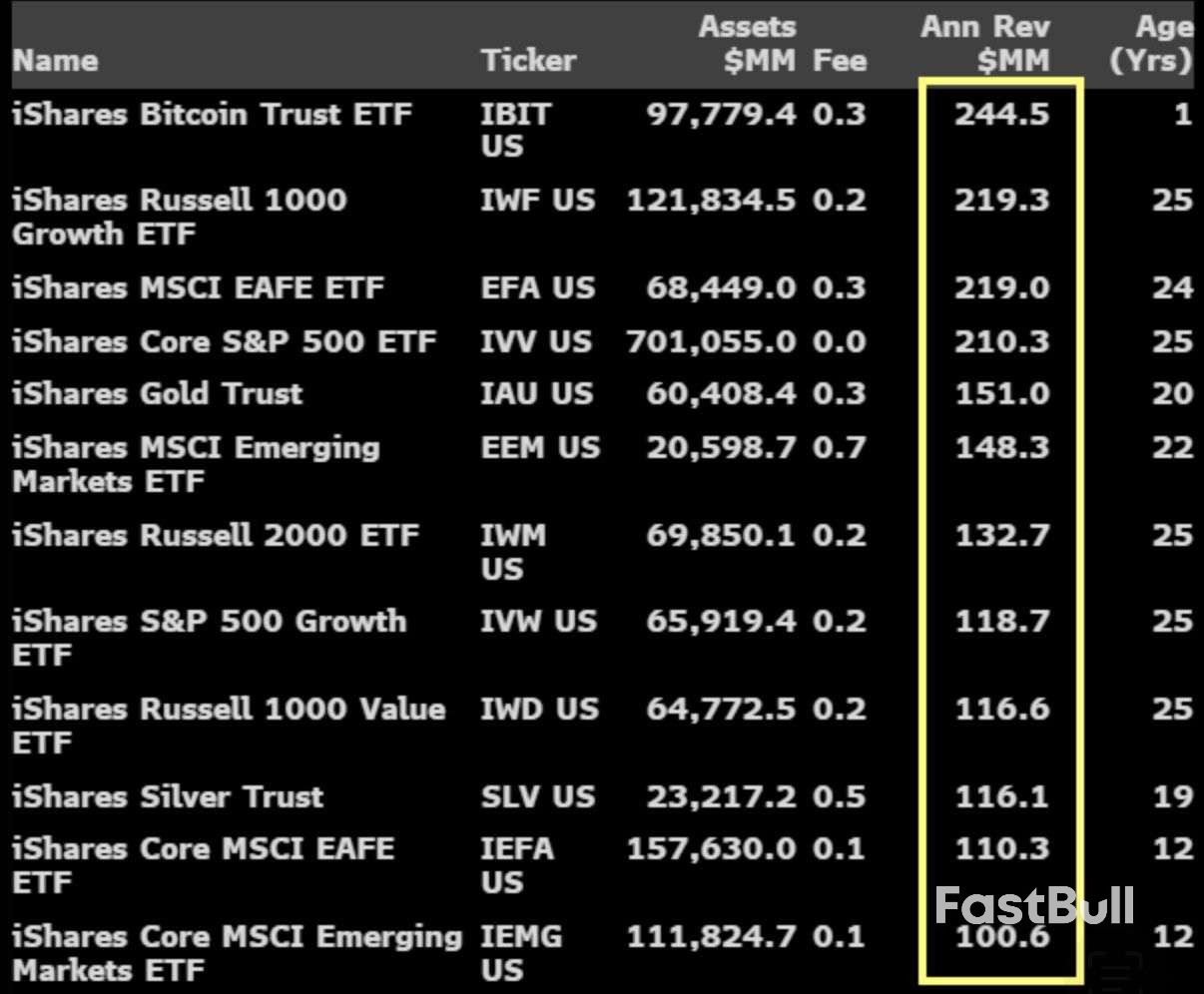
          Launched less than two years ago, IBIT is no longer a bold experiment: it is now a cornerstone of the iShares range. With $93.5bn in assets under management, equivalent to approximately 760,000 BTC, or nearly 60% of the US spot Bitcoin ETF market, and 0.25% in management fees, the fund generates approximately $244.5m per year. According to ETF analyst Eric Balchunas (Bloomberg Intelligence), IBIT already outperforms historic giants such as IWF (Russell 1000 Growth) and EFA (MSCI EAFE) by more than $25m in annual revenue. And it is just a hair's breadth away—a little over $5bn—from crossing the symbolic $100bn mark.
          The Bitcoin spot ETF is BlackRock's most profitable product_1

          Revenue by BlackRock fund

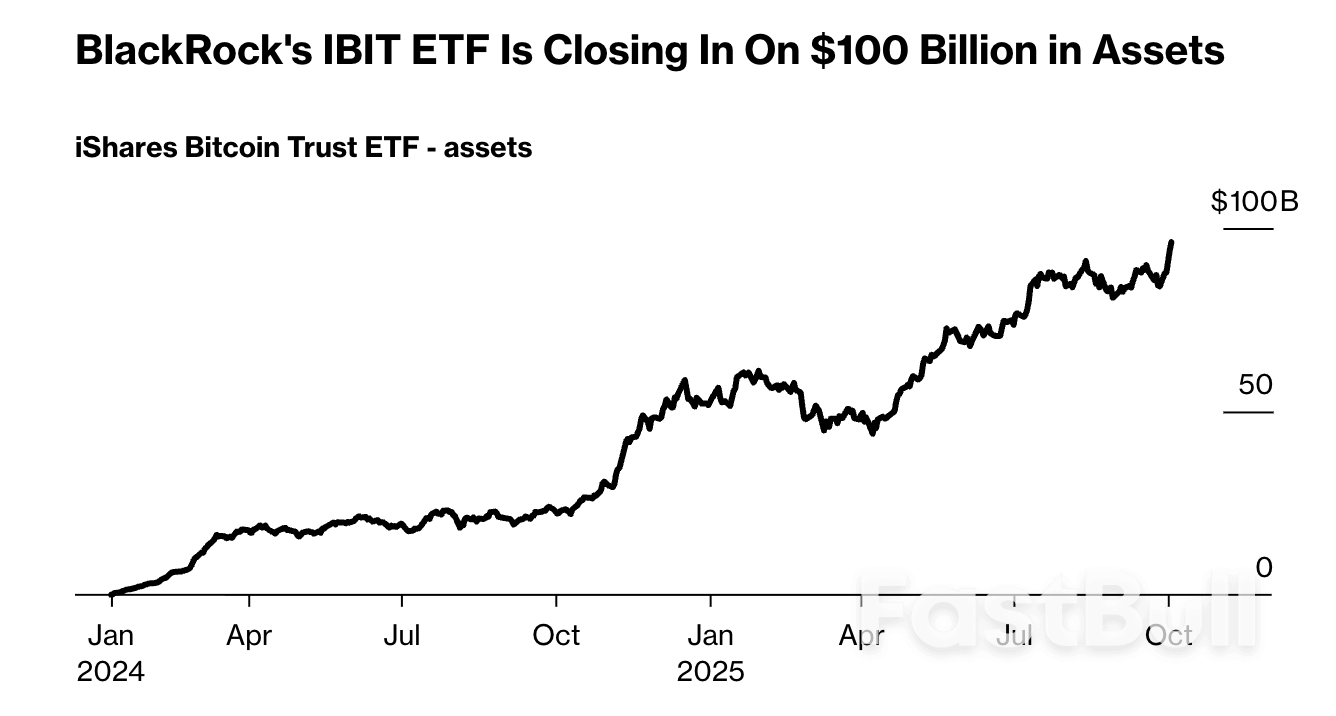
          To gauge the feat:Vanguard's S&P 500 ETF (VOO) took more than five years (2,011 days) to reach $100bn. IBIT is approaching that mark in... 435 days. A straight line, driven by both institutional appetite and mainstream adoption of regulated bitcoin exposure. Normalization also comes through reassuring names. For example,Harvard's endowment fund has taken $116 million in IBIT —another signal to investment committees that bitcoin is cautiously, slowly but surely entering the realm of assets that can be "purchased" by large institutional pockets.
          The Bitcoin spot ETF is BlackRock's most profitable product_2

          IBIT ETF assets under management

          BlackRock's crypto strategy, version 2.0

          Building on the success of IBIT, BlackRock is already rolling out the next step: setting up a trust in Delaware for a future "Bitcoin Premium Income ETF." The idea is to sell covered calls on bitcoin futures to generate regular income in exchange for a portion of the upside potential. According to Bloomberg, the roadmap remains focused on bitcoin and ether— no rush to altcoins, but an expanded range around the two flagship assets.
          Important: It should be noted that an ETF is not the same as self-held bitcoin. IBIT provides price exposure, not censorship resistance or key sovereignty. To benefit from the "hard" properties of the protocol (no third party can seize or freeze), you must hold your BTC yourself. The ETF is a package: convenient, regulated, but not a complete substitute.

          A useful reminder: Self-custody vs. delegation

          Self-custody means that you keep your bitcoins yourself, using a private key (a string of words called a seed phrase or "recovery phrase"). This phrase is the key that proves to the network that you are the owner: if you lose or disclose it, your funds are lost or stolen—there is no "customer service" to recover them. To secure this key, a hardware wallet (a small, specialized offline USB key) is often used and, to go further, multisig (for example, 2 out of 3 keys are required to move funds, which prevents a single loss from compromising everything). The advantage? Full sovereignty: no one can censor a transaction (prevent it from going through) or freeze your bitcoins (block them). The downside? You are the administrator: you must back up the seed (on paper/metal), have procedures in place in case of death (inheritance plan), perform regular checks... in short, there is no room for error.
          Delegating to platforms means entrusting custody to an exchange (buy/sell platform) or exposing the price of bitcoin via an ETF (exchange-traded fund such as IBIT), without directly holding the cryptos. It's convenient: mobile app, password, tax statements, sometimes insurance, and no need to learn about key security. But you accept the risk of an intermediary: failure, hacking, bankruptcy, or suspension of withdrawals. Another nuance: with an ETF, you own an off-chain (outside the blockchain) financial share that tracks the price of bitcoin, not on-chain bitcoins (on the blockchain) that you can send yourself; you don't benefit from any forks (technical splits in the network that sometimes create new tokens) or certain native crypto features.
          In short:
          Self-custody = total control, no intermediary, but technical and organizational responsibility (security, backups, transmission).
          Delegation = simplicity, compliance, and turnkey services, but dependence on a third party, fees, and no technical rights on the chain.
          The right choice is your balance between convenience, cost, and control. Many combine a long-term self-custody core (secure, multisig if necessary) and a delegated pocket (exchange/ETF) for liquidity and everyday convenience.

          Source: marketscreener

          Risk Warnings and Disclaimers
          You understand and acknowledge that there is a high degree of risk involved in trading. Following any strategies or investment methods may lead to potential losses. The content on the site is provided by our contributors and analysts for information purposes only. You are solely responsible for determining whether any trading assets, securities, strategy, or any other product is suitable for investing based on your own investment objectives and financial situation.
          Add to Favorites
          Share
          FastBull
          Copyright © 2025 FastBull Ltd

          728 RM B 7/F GEE LOK IND BLDG NO 34 HUNG TO RD KWUN TONG KLN HONG KONG

          TelegramInstagramTwitterfacebooklinkedin
          App Store Google Play Google Play
          Products
          Charts

          Chats

          Q&A with Experts
          Screeners
          Economic Calendar
          Data
          Tools
          Membership
          Features
          Function
          Markets
          Copy Trading
          Latest Signals
          Contests
          News
          Analysis
          24/7
          Columns
          Education
          Company
          Careers
          About Us
          Contact Us
          Advertising
          Help Center
          Feedback
          User Agreement
          Privacy Policy
          Business

          White Label

          Data API

          Web Plug-ins

          Poster Maker

          Affiliate Program

          Risk Disclosure

          The risk of loss in trading financial instruments such as stocks, FX, commodities, futures, bonds, ETFs and crypto can be substantial. You may sustain a total loss of the funds that you deposit with your broker. Therefore, you should carefully consider whether such trading is suitable for you in light of your circumstances and financial resources.

          No decision to invest should be made without thoroughly conducting due diligence by yourself or consulting with your financial advisors. Our web content might not suit you since we don't know your financial conditions and investment needs. Our financial information might have latency or contain inaccuracy, so you should be fully responsible for any of your trading and investment decisions. The company will not be responsible for your capital loss.

          Without getting permission from the website, you are not allowed to copy the website's graphics, texts, or trademarks. Intellectual property rights in the content or data incorporated into this website belong to its providers and exchange merchants.

          Not Logged In

          Log in to access more features

          FastBull Membership

          Not yet

          Purchase

          Become a signal provider
          Help Center
          Customer Service
          Dark Mode
          Price Up/Down Colors

          Log In

          Sign Up

          Position
          Layout
          Fullscreen
          Default to Chart
          The chart page opens by default when you visit fastbull.com