Markets
News
Analysis
User
24/7
Economic Calendar
Education
Data
- Names
- Latest
- Prev


Signal Accounts for Members
All Signal Accounts
All Contests


France 10-Year OAT Auction Avg. YieldA:--
F: --
P: --
Euro Zone Retail Sales MoM (Oct)A:--
F: --
P: --
Euro Zone Retail Sales YoY (Oct)A:--
F: --
P: --
Brazil GDP YoY (Q3)A:--
F: --
P: --
U.S. Challenger Job Cuts (Nov)A:--
F: --
P: --
U.S. Challenger Job Cuts MoM (Nov)A:--
F: --
P: --
U.S. Challenger Job Cuts YoY (Nov)A:--
F: --
P: --
U.S. Initial Jobless Claims 4-Week Avg. (SA)A:--
F: --
P: --
U.S. Weekly Initial Jobless Claims (SA)A:--
F: --
P: --
U.S. Weekly Continued Jobless Claims (SA)A:--
F: --
P: --
Canada Ivey PMI (SA) (Nov)A:--
F: --
P: --
Canada Ivey PMI (Not SA) (Nov)A:--
F: --
P: --
U.S. Non-Defense Capital Durable Goods Orders Revised MoM (Excl. Aircraft) (SA) (Sept)A:--
F: --
U.S. Factory Orders MoM (Excl. Transport) (Sept)A:--
F: --
P: --
U.S. Factory Orders MoM (Sept)A:--
F: --
P: --
U.S. Factory Orders MoM (Excl. Defense) (Sept)A:--
F: --
P: --
U.S. EIA Weekly Natural Gas Stocks ChangeA:--
F: --
P: --
Saudi Arabia Crude Oil ProductionA:--
F: --
P: --
U.S. Weekly Treasuries Held by Foreign Central BanksA:--
F: --
P: --
Japan Foreign Exchange Reserves (Nov)A:--
F: --
P: --
India Repo RateA:--
F: --
P: --
India Benchmark Interest RateA:--
F: --
P: --
India Reverse Repo RateA:--
F: --
P: --
India Cash Reserve RatioA:--
F: --
P: --
Japan Leading Indicators Prelim (Oct)A:--
F: --
P: --
U.K. Halifax House Price Index YoY (SA) (Nov)A:--
F: --
P: --
U.K. Halifax House Price Index MoM (SA) (Nov)A:--
F: --
P: --
France Current Account (Not SA) (Oct)A:--
F: --
P: --
France Trade Balance (SA) (Oct)A:--
F: --
P: --
France Industrial Output MoM (SA) (Oct)A:--
F: --
P: --
Italy Retail Sales MoM (SA) (Oct)--
F: --
P: --
Euro Zone Employment YoY (SA) (Q3)--
F: --
P: --
Euro Zone GDP Final YoY (Q3)--
F: --
P: --
Euro Zone GDP Final QoQ (Q3)--
F: --
P: --
Euro Zone Employment Final QoQ (SA) (Q3)--
F: --
P: --
Euro Zone Employment Final (SA) (Q3)--
F: --
Brazil PPI MoM (Oct)--
F: --
P: --
Mexico Consumer Confidence Index (Nov)--
F: --
P: --
Canada Unemployment Rate (SA) (Nov)--
F: --
P: --
Canada Labor Force Participation Rate (SA) (Nov)--
F: --
P: --
Canada Employment (SA) (Nov)--
F: --
P: --
Canada Part-Time Employment (SA) (Nov)--
F: --
P: --
Canada Full-time Employment (SA) (Nov)--
F: --
P: --
U.S. Personal Income MoM (Sept)--
F: --
P: --
U.S. Dallas Fed PCE Price Index YoY (Sept)--
F: --
P: --
U.S. PCE Price Index YoY (SA) (Sept)--
F: --
P: --
U.S. PCE Price Index MoM (Sept)--
F: --
P: --
U.S. Personal Outlays MoM (SA) (Sept)--
F: --
P: --
U.S. Core PCE Price Index MoM (Sept)--
F: --
P: --
U.S. UMich 5-Year-Ahead Inflation Expectations Prelim YoY (Dec)--
F: --
P: --
U.S. Core PCE Price Index YoY (Sept)--
F: --
P: --
U.S. Real Personal Consumption Expenditures MoM (Sept)--
F: --
P: --
U.S. 5-10 Year-Ahead Inflation Expectations (Dec)--
F: --
P: --
U.S. UMich Current Economic Conditions Index Prelim (Dec)--
F: --
P: --
U.S. UMich Consumer Sentiment Index Prelim (Dec)--
F: --
P: --
U.S. UMich 1-Year-Ahead Inflation Expectations Prelim (Dec)--
F: --
P: --
U.S. UMich Consumer Expectations Index Prelim (Dec)--
F: --
P: --
U.S. Weekly Total Rig Count--
F: --
P: --


No matching data
Latest Views
Latest Views
Trending Topics
Top Columnists
Latest Update
White Label
Data API
Web Plug-ins
Affiliate Program
View All

No data
Gold held a decline — but remained near an all-time high — as traders weighed positive US economic data and divergent views by Federal Reserve officials this week that clouded the path for interest-rate cuts.
Bullion edged up to near $3,745 an ounce — less than $50 shy of a record set on Tuesday. Prices fell on Wednesday after data showed new-home sales in the US unexpectedly surged in August to the fastest pace since early 2022, easing some concerns about a slowdown in the world’s biggest economy. The dollar rose to the highest in almost two weeks, making gold more expensive for most buyers.
Investors were also digesting comments from US officials, with Treasury Secretary Scott Bessent on Wednesday expressing disappointment that Fed Chair Jerome Powell hasn’t clearly established an agenda for cutting rates. Earlier this week, the head of the US central bank reiterated the need to take a cautious approach amid signs of a weakening labor market and the risk of higher inflation. Lower rates tend to benefit precious metals, which don’t pay interest.
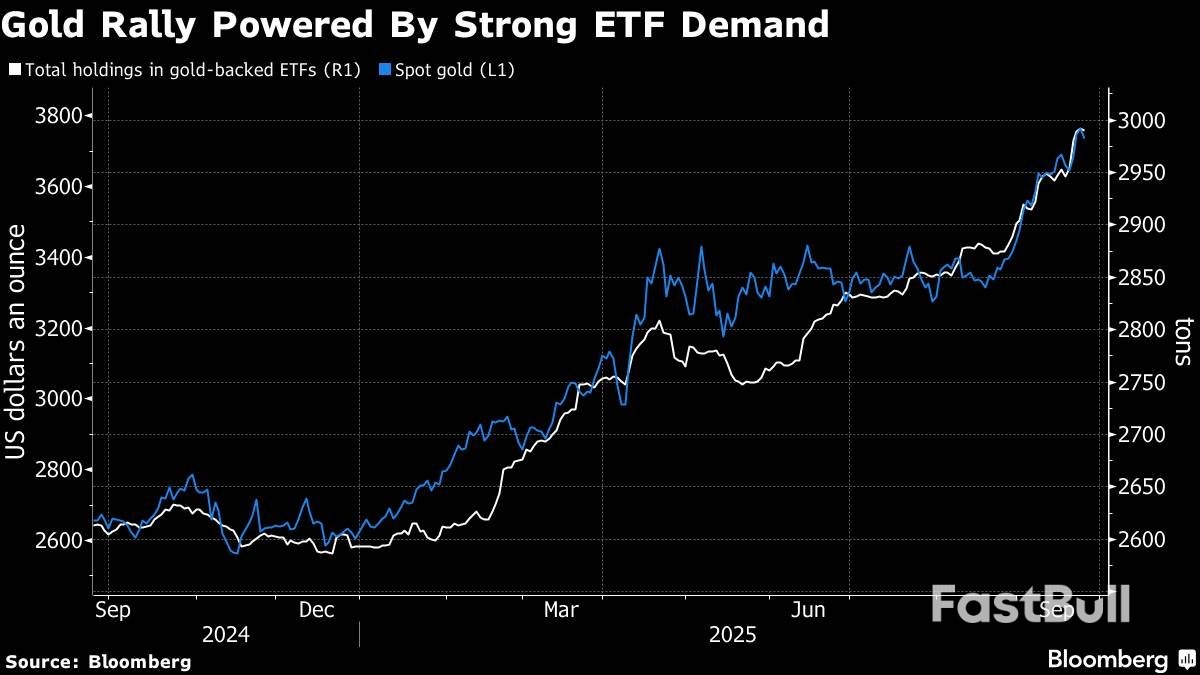
Gold and silver have been among this year’s best-performing major commodities on a broad confluence of supportive factors, including last week’s Fed rate cut, as well as robust central-bank demand. On Tuesday, prices climbed as much as 1.2% to a peak at $3,791.10 an ounce, after Bloomberg News reported China has plans to become a custodian of foreign sovereign bullion reserves.
Bullion has also seen strong demand from exchange-traded funds, with inflows hitting a three-year high on Friday. So far this year, bullion-backed holdings have risen every month apart from May, expanding by 400 tons, according to data compiled by Bloomberg.
Looking ahead, traders will focus on the US personal consumption expenditures price index that’s due on Friday. The Fed’s preferred measure of underlying inflation likely grew at a slower pace last month, which would boost the argument for rate cuts.
Spot gold edged up 0.2% to $3,743.09 an ounce at 7:50 a.m. in Singapore, after falling 0.7% on Wednesday. The Bloomberg Dollar Spot Index was down 0.1%, following a 0.6% gain in the previous session. Silver and platinum were little changed, while palladium rose.

China led several countries in announcing new climate plans on Wednesday and offered a veiled rebuke of the U.S. president's anti-climate rhetoric a day earlier at the U.N. General Assembly.Addressing a climate leaders’ summit hosted by U.N. Secretary-General Antonio Guterres, Chinese President Xi Jinping said in a live video message from Beijing that by 2035 his country would cut its greenhouse gas emissions by 7%-10% from its peak.In addition, Xi said China planned to increase its wind and solar power capacity by six times from its 2020 levels within the next 10 years – helping to boost its share of non-fossil fuels in domestic energy consumption to over 30%.
China's reduction target marked the first time the world's biggest emitter pledged a cut in emissions, rather than just limiting their growth, though the reduction was less than many observers had expected.Xi urged stronger climate action from the world's developed countries. He referred, though not by name, to the United States for moving away from the goals of the Paris Agreement on climate change."Green and low-carbon transformation is the trend of our times. Despite some countries going against the trend, the international community should stay on the right track, maintain unwavering confidence, unwavering action, and undiminished efforts," Xi said.
On Tuesday, U.S. President Donald Trump used his U.N. General Assembly speech to blast climate change as a "con job", to call scientists “stupid” and to criticize EU member states and China for embracing clean energy technologies.Trump ordered a second withdrawal by Washington from the 10-year-old Paris treaty, which aimed to prevent global temperatures from rising beyond 1.5 degrees Celsius through national climate plans. The U.S. is the world's biggest historical greenhouse gas emitter and second biggest current emitter behind China.
Ian Bremmer, a political scientist with the Belfer Center, said Trump's climate denial speech had effectively ceded the market for post-carbon energy to the Chinese."Trump wants fossil fuels and the United States is indeed a powerful petro-state,” Bremmer said. “But letting China become the world’s sole powerful electro-state is the opposite of making America great again … at least if you care about the future.”Observers had been hoping that China would seize on the U.S. retreat as a moment to announce a reduction target of at least 30% to stay in line with its past goal of net-zero emissions by 2060.
Li Shuo, director of the China Climate Hub at the Asia Society, said China's announcement was underwhelming in light of its rapid production of renewable energy and electric vehicles."Beijing's commitment represents a cautious move that extends a long-standing political tradition of prioritizing steady, predictable decision-making but also hides a more significant economic reality," he said.Li noted, however, that China's dominance in green technology and Washington's retreat could push China toward a more proactive role on the global stage.
Despite pressure for significant new climate commitments ahead of this year’s COP30 summit in Brazil, Wednesday’s announcements failed to impress.Environmental groups and observers said pledges by some of the world's biggest economies fell well short of where they should be in emissions reductions, given the rapidly worsening impacts of climate change.Brazilian President Luis Inacio Lula da Silva warned that countries’ commitments made ahead of the U.N. climate summit in November would show the world "whether or not we believe in what the science is showing us."
Brazil has committed to reducing emissions by 59%-67% by 2035 and to stepping up efforts to combat deforestation."Society is going to stop believing its leaders," Lula said. "And all of us will lose because denialism may actually win."Guterres, who hosted the summit on the sidelines of the U.N. General Assembly, assured that the world was making progress in the energy transition, even if it was slow.
"The Paris Agreement has made a difference," Guterres said in prepared remarks, noting that actions taken under the 2015 treaty had lowered the projected rise in the average global temperature to from 4 degrees C to 2.6 degrees C.That’s still far from the treaty’s stated goal of holding to 1.5 degrees C. Already the world has warmed more than 1.2 degrees C from the preindustrial average."Now, we need new plans for 2035 that go much further, much faster," Guterres said.
The European Union has not yet reached agreement on its new U.N.-mandated climate target, instead drafting plans to submit a temporary goal, which could change.EU President Ursula Van der Leyen told the summit the EU was on track to reach its 2030 target of slashing emissions 55% by 2030, and the bloc’s 2035 reduction goal would range between 66% and 72%.Australia, which plans to host a 2026 UN climate summit, announced a pledge that by 2035, it would slash greenhouse gas to between 62% and 70% below 2005 levels.
"We want to bring the world with us on climate change, not by asking any nation to forgo the jobs or security that its people deserve, but by working with every nation to seize and share those opportunities," Australia Prime Minister Anthony Albanese said.The South Pacific island nation of Palau, representing the 39-member Alliance of Small Island States, announced its own goal of slashing emissions to 44% of 2015 levels by 2035.Palau’s President Surangel Whipps reminded leaders of the advisory opinion issued by the International Court of Justice earlier this year affirming an "obligation grounded in international law" for countries to take stronger measures to curb their emissions.
"Those with the greatest responsibility and the greatest capacity to act must do far more," he said, in reference to the world’s industrialized nations.
The computing chips that power artificial intelligence consume a lot of electricity. On Wednesday, the world's biggest manufacturer of those chips showed off a new strategy to make them more energy efficient: Using AI-powered software to design them.At a conference in Silicon Valley, Taiwan Semiconductor Manufacturing Co, the contract manufacturer that fabricates chips for Nvidia, showed off a range of ways that it is hoping to boost the energy efficiency of AI computing chips by about 10 times.Nvidia's current flagship AI servers, for example, can consume as much as 1,200 watts during demanding tasks, which would be the equivalent of the power used by 1,000 U.S. homes if run continuously.
The gains TSMC is hoping to achieve come from a new generation of chip designs in which multiple "chiplets" - smaller pieces of full computing chips - using different technologies are packaged together to make one computing package.But to make use of those technologies, the firms that design chips are increasingly relying on AI-powered software from providers such as Cadence Design Systems and Synopsys, both of which rolled out new products on Wednesday that had been developed in close coordination with TSMC.For some of the complex tasks in designing chips, the tools from TSMC's software partners found better solutions than TSMC's own human engineers - and did so much faster.
"That helps to max out TSMC technology's capability, and we find this is very useful," Jim Chang, deputy director at TSMC for its 3DIC Methodology Group, said during a presentation describing the findings. "This thing runs five minutes while our designer needs to work for two days."The current way of manufacturing chips is hitting limits, such as the ability to move data on and off chips using electrical connections. New technologies, such as moving information between chips with optical connections, need to be made reliable enough to use in massive data centers, said Kaushik Veeraraghavan, an engineer in Meta Platforms' infrastructure group who gave a keynote address.
"Really, this is not an engineering problem," Veeraraghavan said. "It's a fundamental physical problem."
San Francisco Federal Reserve Bank President Mary Daly said on Wednesday she "fully supported" the decision by the Fed to cut its policy rate last week and expects further reductions ahead.
"Will they come right now, this year or going forward?" Daly said at the University of Utah’s David Eccles School of Business. "It's hard to say, but what's really important is that making those policy adjustments will likely be required to balance both of our goals -- keep pressure on inflation to bring it to price stability and offer support to the labor market to ensure that it stays near full employment."
Daly said she does not expect a recession and rejected the idea that the economy is heading toward the high-inflation, high-unemployment environment known as "stagflation."
Inflation excluding tariff-driven goods inflation, she said, is probably around 2.4% or 2.5% -- still too high compared to the Fed's 2% goal, but approaching it. And though the labor market has cooled and can no longer be called solid, she said, she wouldn't call it weak either.
"I'd say it's sustainable, but ... I do not want to see further softening," she said. "That's part of why the interest rate decision was very straightforward: You're taking out some insurance" to support the labor market, even as borrowing costs remain high enough to keep continued downward pressure on inflation.
"It's an economy that still needs monetary policy bridling, but not as much as we had," she said.
Fed policymaker projections released at the end of the September 16-17 meeting showed most U.S. central bankers expect at least one more quarter-point cut this year, and the largest number expect two more.
Echoing Fed Chair Jerome Powell, Daly said those projections are not promises and noted that the Fed's actual rate-setting decisions may require assessing tradeoffs between the Fed's two goals.
Daly had previously said she felt two quarter-point rate cuts this year was a reasonable forecast. On Wednesday she did not provide an update to that view.
The Bank of Japan may raise its benchmark interest rate as soon as next month, according to a former BOJ board member, backing intensifying market speculation over an impending move.
“The BOJ may act in October,” Makoto Sakurai, a former member of the nine-person board, said in an interview Wednesday. The decision will depend heavily on the degree of certainty authorities are seeking, “but economic data by then could be robust because of a delay in the appearance of the tariff impact.”
Market expectations for a rate hike when the bank next sets policy on Oct. 30 have been gaining momentum as inflation held steady and the economy showed resilience even as US trade policies jolted global commerce. With uncertainties remaining high, he also said he wouldn’t rule out the chance of officials waiting until December to be more confident about the tariff impact.
Money markets increased their bets on a hike by year-end after people familiar said earlier this month that BOJ officials were of the view that another rate hike in 2025 was possible. Those bets got a further boost after the BOJ’s hawkish policy hold last week.
The BOJ’s board surprised analysts with its Sept. 19 policy vote. For the first time in Governor Kazuo Ueda’s tenure, two members dissented in opposition to a rate hold. Sakurai said it’s possible the votes were meant to flag a looming shift.
The two dissenters Naoki Tamura and Hajime Takata essentially cited the strength of inflation for their votes. Sakurai said he was a little puzzled by that rationale, considering inflation has stayed at or above the BOJ’s target for more than three years.
The dissenters could have taken the same action with the same explanation back in June. That raises the possibility the vote was part of a coordinated message from the board, said Sakurai, who left the bank in 2021. “The BOJ can raise rates anytime it wants if they only look at inflation.”
A wildcard factor for the BOJ’s policy path could be the result of the ruling Liberal Democratic Party’s leadership election on Oct. 4, Sakurai said. Authorities might have to delay a hike if Sanae Takaichi, a top contender, prevails. She’s considered a monetary easing advocate, although she’s toned down her dovish rhetoric this year compared with remarks she made during last year’s leadership contest, he said.
At a debate with other four contenders Wednesday, Takaichi signaled a softening of her stance on policy by saying the means of monetary policy should be left to the BOJ while the government decides the direction of fiscal and monetary policy. A year ago she said a rate hike would be absurd.
Ultimately Sakurai sees the potential for the bank’s policy rate to rise by as much as 100 basis points from the current 0.5% over the next two and a half years before Ueda’s term ends in April 2028. That’s a little higher than the median market consensus of a 1.25% peak for the current cycle, according to a Bloomberg survey.
“The BOJ probably wants to surely bring it to around 1.5%,” Sakurai said. “It looks certain to hit 1.25%.”
Denmark's Aalborg airport, used for commercial and military flights, was closed due to drones in its airspace, police said early on Thursday, two days after Copenhagen airport was shut over drone sightings that raised European security concerns.A string of drone sightings and digital outages has repeatedly disrupted airports since 2017. These episodes bypass core flight‑safety systems and instead hit choke points such as check‑in and boarding systems, power infrastructure and airfield perimeters, causing ripple effects across networks.
British Airways cancelled all flights from Heathrow, Europe's busiest airport, and Gatwick on the first day of a holiday weekend after a data-centre power issue, affecting 75,000 passengers.A power surge on the morning of Saturday, May 27 hit BA's flight, baggage and communication systems. It was so strong it also rendered the back-up systems ineffective, with knock-on delays lasting into the following Monday as systems were restored.
Persistent drone reports crippled London's Gatwick Airport for three days during peak travel in the run up to Christmas. Roughly 140,000 passengers and about 1,000 flights were affected in the biggest disruption since an Icelandic volcanic ash cloud in 2010.The British army was drafted in to Gatwick to deploy "specialist equipment" as the anti-drone capability needed was not yet commercially available.The length of disruption at an airport the size of Gatwick was unprecedented. Dubai airport was shut a number of times in 2016 due to unauthorised drone activity, but the longest period was for under two hours.
The Federal Aviation Administration (FAA) ordered a nationwide ground stop lasting about 90 minutes that disrupted more than 11,000 U.S. flights, following a "Notice to Air Mission" (NOTAM) system failure.This FAA system is meant to alert pilots to a range of hazards, including snow, volcanic ash or birds near an airport. It also provides information on closed runways and temporary air restrictions.
UK air traffic control limited flows after a flight‑plan processing fault, forcing manual input. Around 1,500 flights were cancelled and disruptions spilled into the following day.
A faulty security software update by global cybersecurity firm CrowdStriketriggered widespread Windows crashes, which affected numerous industries and grounded more than 5,000 flights worldwide.Across the United States, Asia and Europe, carriers such as Delta Air Lines, Ryanair, United Airlinesand Air India said they had faced delays or disruptionU.S. cancellations topped 2,200 on day one, with nearly 7,000 delayed, and some airlines took days to fully recover operations.
Britain's Heathrow Airport, the world's fifth-busiest, was shut for 18 hours after a huge fire at a nearby electrical substation knocked out its power, stranding over 200,000 people and costing airlines millions of poundsThe airport had been due to handle 1,351 flights on the Friday, flying up to 291,000 passengers, but planes were diverted to other airports in Britain and across Europe.
Several Polish airports were temporarily closed when around 21 suspected Russian drones entered Polish airspace.Warsaw Chopin and Modlin airports, as well as Rzeszow and Lublin airports in the country's east, temporarily closed before resuming operations.
A cyberattack targeting check-in and boarding systems provider Collins Aerospace, owned by RTX, disrupted operations at several major European airports including London's Heathrow, Berlin Airport and in Brussels.Brussels Airport canceled 25 flights on Saturday, 50 on Sunday and half of Monday's flight departures due to persistent problems.
Two to three large drones repeatedly flew over Copenhagen's airspace, prompting a nearly four‑hour airport shutdown, diversions and delays, leaving tens of thousands of passengers stranded.Authorities in Norway also shut the airspace at Oslo airport for three hours after a drone was seen.Denmark said the incident at Copenhagen airport was the most serious attack yet on its critical infrastructure and linked it to a series of suspected Russian drone incursions and other disruptions across Europe.
Drones were first sighted near Denmark's Aalborg airport at about 9:44 p.m. (1944 GMT) on Wednesday, police said.The drones followed a similar pattern to the ones that had halted flights at Copenhagen airport two days earlier, police said.The closure of Aalborg airport also affected Denmark's armed forces because it is used as a military base, police added.
South Korean President Lee Jae Myung told U.S. Treasury Secretary Scott Bessent that trade talks with the United States should be "commercially rational" and meet the interests of both countries, the president's office said on Thursday.
Lee spoke to Bessent at the United Nations on the sidelines of the General Assembly on Wednesday, his chief secretary for policy, Kim Yong-beom, told a briefing in New York.
The meeting focused on the $350 billion package of investment from South Korea agreed in principle between Lee and U.S. President Donald Trump at a summit in July as part of a deal to lower tariffs against South Korean goods, Kim said.
"With regard to the investment package with the U.S., (Lee) expressed hope that the discussions would progress based on commercial rationality and in a direction that serves the interests of both countries," Kim said.
He said South Korea’s economy and its foreign exchange market — which differ significantly from Japan’s — should be key factors in the ongoing talks on a final agreement.
Japan formalized a trade deal with the U.S. earlier in September to lower tariffs on its exports. The agreement includes Japan investing $550 billion in U.S. projects.
South Korea's Lee has said that a similar arrangement involving large capital outflow to the United States could destabilize the currency market and drain South Korea's foreign reserves.
South Korea is seeking a foreign exchange swap with an unlimited credit line from the U.S. to support any final trade agreement, Kim said. South Korean officials have said Washington is reviewing the FX swap proposal.
White Label
Data API
Web Plug-ins
Poster Maker
Affiliate Program
The risk of loss in trading financial instruments such as stocks, FX, commodities, futures, bonds, ETFs and crypto can be substantial. You may sustain a total loss of the funds that you deposit with your broker. Therefore, you should carefully consider whether such trading is suitable for you in light of your circumstances and financial resources.
No decision to invest should be made without thoroughly conducting due diligence by yourself or consulting with your financial advisors. Our web content might not suit you since we don't know your financial conditions and investment needs. Our financial information might have latency or contain inaccuracy, so you should be fully responsible for any of your trading and investment decisions. The company will not be responsible for your capital loss.
Without getting permission from the website, you are not allowed to copy the website's graphics, texts, or trademarks. Intellectual property rights in the content or data incorporated into this website belong to its providers and exchange merchants.
Not Logged In
Log in to access more features

FastBull Membership
Not yet
Purchase
Log In
Sign Up