• Trade
  • Markets
  • Copy
  • Contests
  • News
  • 24/7
  • Calendar
  • Q&A
  • Chats
Trending
Screeners
SYMBOL
LAST
BID
ASK
HIGH
LOW
NET CHG.
%CHG.
SPREAD
SPX
S&P 500 Index
6827.42
6827.42
6827.42
6899.86
6801.80
-73.58
-1.07%
--
DJI
Dow Jones Industrial Average
48458.04
48458.04
48458.04
48886.86
48334.10
-245.98
-0.51%
--
IXIC
NASDAQ Composite Index
23195.16
23195.16
23195.16
23554.89
23094.51
-398.69
-1.69%
--
USDX
US Dollar Index
97.950
98.030
97.950
98.500
97.950
-0.370
-0.38%
--
EURUSD
Euro / US Dollar
1.17394
1.17409
1.17394
1.17496
1.17192
+0.00011
+ 0.01%
--
GBPUSD
Pound Sterling / US Dollar
1.33707
1.33732
1.33707
1.33997
1.33419
-0.00148
-0.11%
--
XAUUSD
Gold / US Dollar
4299.39
4299.39
4299.39
4353.41
4257.10
+20.10
+ 0.47%
--
WTI
Light Sweet Crude Oil
57.233
57.485
57.233
58.011
56.969
-0.408
-0.71%
--

Community Accounts

Signal Accounts
--
Profit Accounts
--
Loss Accounts
--
View More

Become a signal provider

Sell trading signals to earn additional income

View More

Guide to Copy Trading

Get started with ease and confidence

View More

Signal Accounts for Members

All Signal Accounts

Best Return
  • Best Return
  • Best P/L
  • Best MDD
Past 1W
  • Past 1W
  • Past 1M
  • Past 1Y

All Contests

  • All
  • Trump Updates
  • Recommend
  • Stocks
  • Cryptocurrencies
  • Central Banks
  • Featured News
Top News Only
Share

Iranian Media Says 18 Crew Members Of Foreign Tanker Seized In Gulf Of Oman Over Carrying 'Smuggled Fuel' Detained

Share

Regional Governor: Two Killed In Ukrainian Drone Strike On Russia's Saratov

Share

Chinese Foreign Ministry - China Foreign Minister Met With United Arab Emirates Counterpart On Dec 12

Share

China's Central Financial And Economic Affairs Commission Deputy Director: Will Expand Export And Increase Import In 2026

Share

Thai Leader Anutin: Landmine Blast That Killed Thai Soldiers 'Not A Roadside Accident'

Share

Thai Leader Anutin: Thailand To Continue Military Action Until 'We Feel No More Harm'

Share

Cambodian Prime Minister Hun Manet Says He Had Phone Calls With Trump And Malaysian Leader Anwar About Ceasefire

Share

Cambodia's Hun Manet Says USA, Malaysia Should Verify 'Which Side Fired First' In Latest Conflict

Share

Cambodia's Hun Manet: Cambodia Maintains Its Stance In Seeking Peaceful Resolution Of Disputes

Share

Nasdaq Companies: Allergan, Ferrovia, Insmed, Monolithic Power Systems, Seagate Technology, And Western Digital Will Be Added To The NASDAQ 100 Index. Biogen, CdW, GlobalFoundries, Lululemon, ON Semiconductor, And Tradedesk Will Be Removed From The NASDAQ 100 Index

Share

Witkoff Headed To Berlin This Weekend To Meet With Zelenskiy, European Leaders -Wsj Reporter On X

Share

Russia Attacks Two Ukrainian Ports, Damaging Three Turkish-Owned Vessels

Share

[Historic Flooding Occurs In At Least Four Rivers In Washington State Due To Days Of Torrential Rains] Multiple Areas In Washington State Have Been Hit By Severe Flooding Due To Days Of Torrential Rains, With At Least Four Rivers Experiencing Historic Flooding. Reporters Learned On The 12th That The Floods Caused By The Torrential Rains In Washington State Have Destroyed Homes And Closed Several Highways. Experts Warn That Even More Severe Flooding May Occur In The Future. A State Of Emergency Has Been Declared In Washington State

Share

Trump Says Proposed Free Economic Zone In Donbas Would Work

Share

Trump: I Think My Voice Should Be Heard

Share

Trump Says Will Be Choosing New Fed Chair In Near Future

Share

Trump Says Proposed Free Economic Zone In Donbas Complex But Would Work

Share

Trump Says Land Strikes In Venezuela Will Start Happening

Share

US President Trump: Thailand And Cambodia Are In A Good Situation

Share

State Media: North Korean Leader Kim Hails Troops Returning From Russia Mission

TIME
ACT
FCST
PREV
U.K. Trade Balance Non-EU (SA) (Oct)

A:--

F: --

P: --

U.K. Trade Balance (Oct)

A:--

F: --

P: --

U.K. Services Index MoM

A:--

F: --

P: --

U.K. Construction Output MoM (SA) (Oct)

A:--

F: --

P: --

U.K. Industrial Output YoY (Oct)

A:--

F: --

P: --

U.K. Trade Balance (SA) (Oct)

A:--

F: --

P: --

U.K. Trade Balance EU (SA) (Oct)

A:--

F: --

P: --

U.K. Manufacturing Output YoY (Oct)

A:--

F: --

P: --

U.K. GDP MoM (Oct)

A:--

F: --

P: --

U.K. GDP YoY (SA) (Oct)

A:--

F: --

P: --

U.K. Industrial Output MoM (Oct)

A:--

F: --

P: --

U.K. Construction Output YoY (Oct)

A:--

F: --

P: --

France HICP Final MoM (Nov)

A:--

F: --

P: --

China, Mainland Outstanding Loans Growth YoY (Nov)

A:--

F: --

P: --

China, Mainland M2 Money Supply YoY (Nov)

A:--

F: --

P: --

China, Mainland M0 Money Supply YoY (Nov)

A:--

F: --

P: --

China, Mainland M1 Money Supply YoY (Nov)

A:--

F: --

P: --

India CPI YoY (Nov)

A:--

F: --

P: --

India Deposit Gowth YoY

A:--

F: --

P: --

Brazil Services Growth YoY (Oct)

A:--

F: --

P: --

Mexico Industrial Output YoY (Oct)

A:--

F: --

P: --

Russia Trade Balance (Oct)

A:--

F: --

P: --

Philadelphia Fed President Henry Paulson delivers a speech
Canada Building Permits MoM (SA) (Oct)

A:--

F: --

P: --

Canada Wholesale Sales YoY (Oct)

A:--

F: --

P: --

Canada Wholesale Inventory MoM (Oct)

A:--

F: --

P: --

Canada Wholesale Inventory YoY (Oct)

A:--

F: --

P: --

Canada Wholesale Sales MoM (SA) (Oct)

A:--

F: --

P: --

Germany Current Account (Not SA) (Oct)

A:--

F: --

P: --

U.S. Weekly Total Rig Count

A:--

F: --

P: --

U.S. Weekly Total Oil Rig Count

A:--

F: --

P: --

Japan Tankan Large Non-Manufacturing Diffusion Index (Q4)

--

F: --

P: --

Japan Tankan Small Manufacturing Outlook Index (Q4)

--

F: --

P: --

Japan Tankan Large Non-Manufacturing Outlook Index (Q4)

--

F: --

P: --

Japan Tankan Large Manufacturing Outlook Index (Q4)

--

F: --

P: --

Japan Tankan Small Manufacturing Diffusion Index (Q4)

--

F: --

P: --

Japan Tankan Large Manufacturing Diffusion Index (Q4)

--

F: --

P: --

Japan Tankan Large-Enterprise Capital Expenditure YoY (Q4)

--

F: --

P: --

U.K. Rightmove House Price Index YoY (Dec)

--

F: --

P: --

China, Mainland Industrial Output YoY (YTD) (Nov)

--

F: --

P: --

China, Mainland Urban Area Unemployment Rate (Nov)

--

F: --

P: --

Saudi Arabia CPI YoY (Nov)

--

F: --

P: --

Euro Zone Industrial Output YoY (Oct)

--

F: --

P: --

Euro Zone Industrial Output MoM (Oct)

--

F: --

P: --

Canada Existing Home Sales MoM (Nov)

--

F: --

P: --

Euro Zone Total Reserve Assets (Nov)

--

F: --

P: --

U.K. Inflation Rate Expectations

--

F: --

P: --

Canada National Economic Confidence Index

--

F: --

P: --

Canada New Housing Starts (Nov)

--

F: --

P: --

U.S. NY Fed Manufacturing Employment Index (Dec)

--

F: --

P: --

U.S. NY Fed Manufacturing Index (Dec)

--

F: --

P: --

Canada Core CPI YoY (Nov)

--

F: --

P: --

Canada Manufacturing Unfilled Orders MoM (Oct)

--

F: --

P: --

Canada Manufacturing New Orders MoM (Oct)

--

F: --

P: --

Canada Core CPI MoM (Nov)

--

F: --

P: --

Canada Manufacturing Inventory MoM (Oct)

--

F: --

P: --

Canada CPI YoY (Nov)

--

F: --

P: --

Canada CPI MoM (Nov)

--

F: --

P: --

Canada CPI YoY (SA) (Nov)

--

F: --

P: --

Canada Core CPI MoM (SA) (Nov)

--

F: --

P: --

Q&A with Experts
    • All
    • Chatrooms
    • Groups
    • Friends
    Connecting
    .
    .
    .
    Type here...
    Add Symbol or Code

      No matching data

      All
      Trump Updates
      Recommend
      Stocks
      Cryptocurrencies
      Central Banks
      Featured News
      • All
      • Russia-Ukraine Conflict
      • Middle East Flashpoint
      • All
      • Russia-Ukraine Conflict
      • Middle East Flashpoint
      Search
      Products

      Charts Free Forever

      Chats Q&A with Experts
      Screeners Economic Calendar Data Tools
      Membership Features
      Data Warehouse Market Trends Institutional Data Policy Rates Macro

      Market Trends

      Market Sentiment Order Book Forex Correlations

      Top Indicators

      Charts Free Forever
      Markets

      News

      News Analysis 24/7 Columns Education
      From Institutions From Analysts
      Topics Columnists

      Latest Views

      Latest Views

      Trending Topics

      Top Columnists

      Latest Update

      Signals

      Copy Rankings Latest Signals Become a signal provider AI Rating
      Contests
      Brokers

      Overview Brokers Assessment Rankings Regulators News Claims
      Broker listing Forex Brokers Comparison Tool Live Spread Comparison Scam
      Q&A Complaint Scam Alert Videos Tips to Detect Scam
      More

      Business
      Events
      Careers About Us Advertising Help Center

      White Label

      Data API

      Web Plug-ins

      Affiliate Program

      Awards Institution Evaluation IB Seminar Salon Event Exhibition
      Vietnam Thailand Singapore Dubai
      Fans Party Investment Sharing Session
      FastBull Summit BrokersView Expo
      Recent Searches
        Top Searches
          Markets
          News
          Analysis
          User
          24/7
          Economic Calendar
          Education
          Data
          • Names
          • Latest
          • Prev

          View All

          No data

          Scan to Download

          Faster Charts, Chat Faster!

          Download App
          English
          • English
          • Español
          • العربية
          • Bahasa Indonesia
          • Bahasa Melayu
          • Tiếng Việt
          • ภาษาไทย
          • Français
          • Italiano
          • Türkçe
          • Русский язык
          • 简中
          • 繁中
          Open Account
          Search
          Products
          Charts Free Forever
          Markets
          News
          Signals

          Copy Rankings Latest Signals Become a signal provider AI Rating
          Contests
          Brokers

          Overview Brokers Assessment Rankings Regulators News Claims
          Broker listing Forex Brokers Comparison Tool Live Spread Comparison Scam
          Q&A Complaint Scam Alert Videos Tips to Detect Scam
          More

          Business
          Events
          Careers About Us Advertising Help Center

          White Label

          Data API

          Web Plug-ins

          Affiliate Program

          Awards Institution Evaluation IB Seminar Salon Event Exhibition
          Vietnam Thailand Singapore Dubai
          Fans Party Investment Sharing Session
          FastBull Summit BrokersView Expo

          Gold price sharply up on renewed safe-haven demand

          Adam

          Commodity

          Summary:

          Gold prices jumped over $60 amid safe-haven demand following a U.S. credit rating downgrade and trade tensions. Global stocks weakened, silver rose moderately, and risk aversion dominated early-week trading.
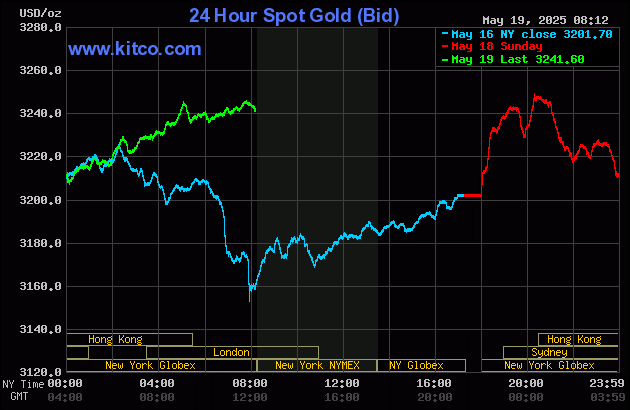
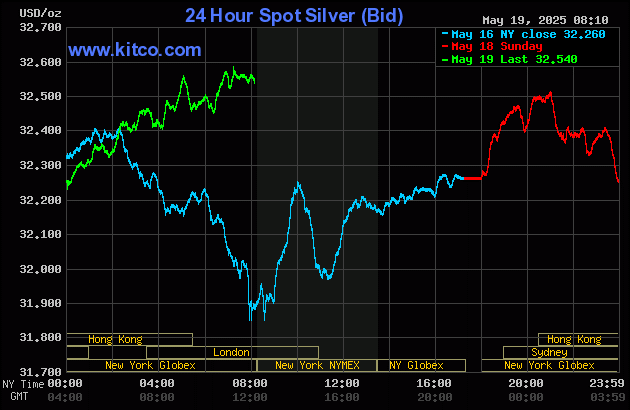
          Gold prices are solidly higher in early U.S. trading Monday, as the marketplace is jittery following a surprise ratings agency downgrade to U.S. government debt and lingering global trade worries. Silver prices are moderately up. June gold was last up $60.20 at $3,247.40. July silver prices were last up $0.421 at $32.775.
          Risk aversion is elevated to start the trading week. Moody’s ratings agency downgraded the United States’ long-term credit rating from “Aaa” to “Aa1” last Friday, citing sustained increases in federal debt and chronic fiscal deficits. The U.S. now joins Fitch and S&P Global in no longer holding a perfect rating among major credit agencies.
          Financial markets were also rattled a bit when U.S. Treasury Secretary Bessent said in an interview Sunday that trade tariffs would go back to April 2 announced levels if countries don’t negotiate with the U.S. “in good faith.” Fresh economic data out of China shows the trade war with the U.S. has dented the Chinese economy.
          Asian and European stock markets were mixed to weaker in overnight trading. U.S. stock indexes are pointed to solidly lower openings today in New York.
          Gold prices are sharply up on safe-have demand amid the sell off in global stock markets.
          The key outside markets today see the U.S. dollar index sharply lower. Nymex crude oil futures prices are lower and trading around $62.00 a barrel. The yield on the benchmark 10-year U.S. Treasury note is presently at 4.546%.
          U.S. economic data due for release Monday is light and includes leading economic indicators.
          Gold price sharply up on renewed safe-haven demand_1
          Technically, June gold futures bulls and bears are on a level overall near-term technical playing field but the bulls are fading. Bulls’ next upside price objective is to produce a close above solid resistance at $3,350.00. Bears' next near-term downside price objective is pushing futures prices below solid technical support at the May low of $3,123.30. First resistance is seen at $3,275.00 and then at $3,300.00. First support is seen at the overnight low of $3,209.10 and then at $3,200.00. Wyckoff's Market Rating: 5.0.
          Gold price sharply up on renewed safe-haven demand_2
          July silver futures bulls and bears are on a level overall near-term technical playing field. Silver bulls' next upside price objective is closing prices above solid technical resistance at $33.48. The next downside price objective for the bears is closing prices below solid support at $31.00. First resistance is seen at $33.00 and then at $33.48. Next support is seen at the overnight low of $32.425 and then at $32.00. Wyckoff's Market Rating: 5.0.

          Source: kitco

          Risk Warnings and Disclaimers
          You understand and acknowledge that there is a high degree of risk involved in trading. Following any strategies or investment methods may lead to potential losses. The content on the site is provided by our contributors and analysts for information purposes only. You are solely responsible for determining whether any trading assets, securities, strategy, or any other product is suitable for investing based on your own investment objectives and financial situation.
          Add to Favorites
          Share

          US 30-Year Treasury Yield Soars Past 5% After Shock Moody’s Downgrade

          Damon

          Economic

          Hey crypto enthusiasts! While your focus might be on Bitcoin charts and altcoin movements, a significant shift just happened in the traditional finance world that could send ripples into the digital asset space. The US 30-year Treasury yield just climbed to a level not seen since November 2023, hitting 5.02%. What does this seemingly distant financial metric have to do with your crypto portfolio? Potentially, a lot. This surge didn’t happen in a vacuum; it closely followed a major announcement from credit rating agency Moody’s.

          What is the US 30-Year Treasury Yield and Why Does 5.02% Matter?

          Let’s break it down. The US 30-year Treasury yield represents the return an investor receives for holding a U.S. government bond for 30 years. Think of it as the interest rate the U.S. government pays to borrow money over the long term. It’s a crucial benchmark for long-term interest rates across the entire economy, influencing everything from mortgage rates to corporate borrowing costs.

          When the yield goes up, it means investors are demanding a higher return to lend money to the government for such a long period. A jump to 5.02%, the highest point since November 2023, signals a significant shift in the bond market. This could be driven by several factors:

          • Inflation expectations: Investors may anticipate higher inflation in the future, demanding a higher yield to compensate for the loss of purchasing power.
          • Increased government borrowing: More supply of bonds (due to government spending) can push yields up if demand doesn’t keep pace.
          • Investor sentiment: A decrease in confidence or a shift towards other investments can reduce demand for Treasuries, raising yields.

          The Catalyst: Understanding the Moody’s US Downgrade

          Adding fuel to the fire, this yield surge occurred shortly after Moody’s announced on the evening of May 16 that it had downgraded the U.S. government’s credit rating. The rating moved from the top-tier Aaa to Aa1. This Moody’s US downgrade is a big deal because credit ratings are essentially grades given by agencies like Moody’s, S&P, and Fitch, assessing a borrower’s ability to repay debt. A downgrade suggests a slightly increased risk, even for a borrower as historically safe as the U.S. government.

          Moody’s cited several reasons for their decision, primarily focusing on:
          1. Fiscal Challenges: Concerns over the U.S.’s growing debt burden and the political challenges in addressing it.
          2. Political Polarization: The difficulty in reaching consensus on fiscal policy, potentially leading to increased volatility or delays in debt ceiling negotiations.

          While still a high rating (Aa1 is the second-highest tier), a downgrade from Aaa can rattle investor confidence and potentially increase the perceived risk of holding U.S. debt, contributing to the demand for higher yields.

          How Does This Treasury Yield Impact Broader Markets?

          The Treasury yield impact extends far beyond just government bonds. As a benchmark, the 30-year yield influences a wide range of long-term interest rates. Higher Treasury yields generally lead to:

          • Higher borrowing costs: For companies, consumers, and even homeowners (think mortgage rates). This can slow down economic activity.
          • Reduced appeal of riskier assets: When ‘safe’ investments like U.S. Treasuries offer higher returns, they become more attractive relative to riskier assets like stocks or, yes, cryptocurrencies. This can lead investors to shift capital out of risk assets.
          • Currency strength: Higher yields can attract foreign investment into U.S. dollar-denominated assets, potentially strengthening the dollar.

          Navigating Current Bond Market Trends

          The recent move to 5.02% is part of broader bond market trends that have seen yields fluctuate based on economic data, inflation reports, Federal Reserve policy expectations, and now, credit rating assessments. The bond market is often seen as a forward-looking indicator. The current trends suggest that investors are factoring in persistent inflation, potential future rate hikes (or fewer cuts than previously expected), and increased fiscal risk.

          These trends indicate a market environment where the cost of capital is rising. This can pose challenges for businesses relying on borrowing and can influence investment decisions across all asset classes.

          What Could Be the Crypto Market Reaction?

          Now, for the question many of you are asking: What does this mean for crypto? The crypto market reaction to traditional finance shifts isn’t always direct or immediate, but macro factors play a significant role, especially in times of uncertainty.

          When safe-haven assets like U.S. Treasuries offer increasingly attractive returns (like 5.02% on a 30-year bond), the relative appeal of volatile, risk-on assets like cryptocurrencies can diminish. Investors who prioritize capital preservation might opt for the higher yield on government bonds rather than the potential high returns (and high risks) of crypto.

          Potential impacts on the crypto market could include:
          • Reduced liquidity: As capital potentially flows towards higher-yielding traditional assets.
          • Increased selling pressure: Some investors might de-risk portfolios by selling speculative assets.
          • Heightened volatility: Uncertainty in traditional markets often spills over into crypto.

          However, it’s important to remember that the crypto market has its own unique drivers, including technological developments, regulatory news, and adoption rates. While macro headwinds can create pressure, they don’t solely dictate crypto’s trajectory.

          Challenges and Insights for Crypto Investors

          The current environment presents challenges but also offers opportunities for informed investors.

          Challenges:

          • Increased correlation with traditional markets: Crypto is less of an uncorrelated asset when macro risks dominate.
          • Potential for drawdowns: Risk assets can face significant pressure when borrowing costs rise and liquidity tightens.

          Insights:

          • Stay informed about macroeconomics: Understanding factors like Treasury yields and credit ratings is crucial.
          • Assess your risk tolerance: Re-evaluate your portfolio allocation in light of changing market conditions.
          • Look for long-term value: Focus on projects with strong fundamentals rather than purely speculative plays during uncertain times.
          • Dollar-Cost Averaging (DCA): This strategy can help mitigate volatility by investing a fixed amount regularly, regardless of market ups and downs.

          Conclusion: Navigating a Shifting Landscape

          The surge in the US 30-year Treasury yield to 5.02% and the preceding Moody’s US downgrade are significant developments in the traditional financial world. They highlight ongoing fiscal challenges and political risks facing the U.S. economy. These factors contribute to rising borrowing costs and can influence global investment flows.

          While the direct Treasury yield impact on daily crypto prices can be hard to isolate, these macro bond market trends create a backdrop of tighter financial conditions. The potential crypto market reaction is one of increased sensitivity to risk-off sentiment and potentially reduced liquidity compared to periods of ultra-low interest rates.

          For crypto investors, staying aware of these broader economic shifts is vital. It’s a reminder that the crypto market doesn’t exist in a vacuum and is increasingly influenced by global macroeconomic forces. As markets continue to digest these developments, vigilance and a well-thought-out strategy remain your best tools.

          Source: CryptoSlate

          To stay updated on all economic events of today, please check out our Economic calendar
          Risk Warnings and Disclaimers
          You understand and acknowledge that there is a high degree of risk involved in trading. Following any strategies or investment methods may lead to potential losses. The content on the site is provided by our contributors and analysts for information purposes only. You are solely responsible for determining whether any trading assets, securities, strategy, or any other product is suitable for investing based on your own investment objectives and financial situation.
          Add to Favorites
          Share

          Growth Forecasts Cut Amid Uncertainty Over Trump Trade War

          Michelle

          Economic

          Forex

          The European Commission has cut its growth forecasts for the eurozone this year and next as a result of uncertainty caused by Donald Trump’s tariff wars.

          The commission said the impact of tariffs demanded a “considerable downgrade” to the expected growth this year of the 20-member eurozone to 0.9% from the previous forecast, made in November, of 1.3%.

          The commission’s spring forecast also reduced the extent of the eurozone recovery in 2026 to 1.4% from the November forecast of 1.6%.

          Trump’s threat in April to impose a 20% tariff on imported goods from the EU, followed by its suspension for 90 days has given rise to a level of uncertainty “not seen since the darkest days of the Covid-19 pandemic”, said the economy commissioner, Valdis Dombrovskis.

          He said the European economy remained resilient and that the jobs market was robust, with the commission predicting a fall in unemployment to a record low 5.7% next year.

          Germany is expected to be the biggest drag on growth in 2025, although the commission said zero growth in 2025 and 1.1% in 2026 would mean the EU’s largest economy would avoid a third consecutive year of contraction.

          Germany’s economy has suffered from a lack of public investment and high energy costs after the Russian invasion of Ukraine. A sharp slowdown in exports to China has hit exports. Hopes of a recovery this year have been dashed by the prospect of German car and industrial goods losing sales after the increase in US tariffs.

          Dombrovskis said risks of a further deterioration in Europe were “tilted to the downside”, although Trump is under pressure to reduce the impact of higher tariffs after the rating agency Moody’s stripped the US of its much-coveted triple-A credit rating last week.

          The rating agencies S&P and Fitch had already downgraded the US, citing the hit to economic growth from higher tariffs and White House plans to cut taxes and increase defence spending expected in the autumn.

          Hauke Siemssen, an interest rate strategist at Commerzbank, said: “While Moody’s is catching up with other rating agencies, the downgrade serves as a reminder of the mounting fiscal challenges [in the US].”

          The impact of US tariffs is expected to be discussed at the G7 meeting of finance ministers and central bank governors in Banff, Canada, later this week, although there is not expected to be an agreement on the next steps.

          The Belgian central bank governor, Pierre Wunsch, told the Financial Times that the extra stress on the eurozone economy from tariffs could force the European Central Bank to cut interest rates to “slightly below” 2%.

          The 10-year US Treasury bond rose to 4.54% on Monday. The equivalent bond sold by the German government attracts a yield of 2.60% and 3.63% for 10-year Italian bonds.

          Underscoring the EU’s safe haven status, despite the downgrade to growth, the European Commission sold three-year bonds on Monday at an average yield, or interest rate, of 2.31%. A UK five-year bond on Monday was trading at a yield of 4.17%.

          S&P Global said its survey of UK consumers found them to be nervous about spending because of “limited cash availability”. Its regular consumer sentiment survey of 1,500 households, which tracks their financial wellbeing, job prospects, savings and debt, rose from 44.5 in April to 45.2 in May, when a figure below 50 indicates contraction.

          Source: GUARDIAN

          To stay updated on all economic events of today, please check out our Economic calendar
          Risk Warnings and Disclaimers
          You understand and acknowledge that there is a high degree of risk involved in trading. Following any strategies or investment methods may lead to potential losses. The content on the site is provided by our contributors and analysts for information purposes only. You are solely responsible for determining whether any trading assets, securities, strategy, or any other product is suitable for investing based on your own investment objectives and financial situation.
          Add to Favorites
          Share

          Fed's Williams Says No Significant Move Out Of US Assets Seen So Far, Monetary Policy in Good Place

          Glendon

          Economic

          Forex

          New York Federal Reserve president John Williams acknowledged on Monday that investors are taking a look at how they invest in US assets while noting he's seen no large-scale move away, and added that the US central bank can take its time before deciding its next interest rate move.

          Flagging signs of "rumors or concerns" about the state of US dollar assets amid big government policy changes and large levels of uncertainty, Williams told a Mortgage Bankers Association conference in New York that "we're not seeing major changes" in how foreign money flows into the Treasury bond market, although there have been some price effects related to those shifting preferences.

          Williams said even with rising yields related to this situation, government bond yields have been mostly range-bound. He also said when it comes to "core" fixed income markets like the Treasury market, the sector has been "functioning very well."

          The New York Fed chief also said "the economy is doing very well" at the moment amid lots of uncertainty and some signs in recent data that there could be trouble ahead. Fed interest rate policy is slightly restrictive of growth and is "well positioned" for what lies ahead, he said.

          "It's going to take some time to get a clear view" on how the economy is faring given all the government policy shifts and "we can take our time" to figure out where interest rate policy stands. He said clarity on the impact of things like the surge in import tariffs implemented by the Trump administration will not come quickly.
          Source: Theedgemarkets

          To stay updated on all economic events of today, please check out our Economic calendar
          Risk Warnings and Disclaimers
          You understand and acknowledge that there is a high degree of risk involved in trading. Following any strategies or investment methods may lead to potential losses. The content on the site is provided by our contributors and analysts for information purposes only. You are solely responsible for determining whether any trading assets, securities, strategy, or any other product is suitable for investing based on your own investment objectives and financial situation.
          Add to Favorites
          Share

          Trump’s Massive Import Taxes Haven’t Done Much Economic Damage — Yet

          Warren Takunda

          Stocks

          For months, American consumers and businesses have been hearing that President Trump’s massive import taxes – tariffs – would drive up prices and hurt the U.S. economy. But the latest economic reports don’t match the doom and gloom: Inflation actually eased last month, and hiring was solid in April.
          For now, the disconnect has businesses and consumers struggling to reconcile what they were told to expect, what the numbers say and what they are seeing on the ground. Trump and his supporters are quick to point out that the trade wars of his first term didn’t translate into higher overall inflation across the economy.
          So is it time to breathe easy?
          Not yet, economists say. Trump’s tariffs are still huge – the highest since the Great Depression of the 1930s. They’re unpredictable: The president frequently announces tariffs only to suspend them days later and to conjure up new ones. And they are still working their way through the system.
          “We had a good jobs report. We had a cool inflation report, and that’s great,” said Ernie Tedeschi, director of economics at Yale University’s Budget Lab. “But that should not give us comfort about what next month will be, particularly on inflation.’’
          Walmart, for example, warned its customers last week that prices will be going up for everything from clothing to car seats. Prices for some items like bananas have already increased.
          True, the truce with China last Monday dramatically reduced the risks to the U.S. economy, and U.S. and global stock markets rallied last week in relief. The United States dropped the import tax that Trump angrily imposed on China – America’s third-biggest source of imports – from an eye-watering 145% to 30%; Beijing cut its retaliatory tariffs from 125% to 10%. Economists at JPMorgan Chase, who had forecast last month that the China tariffs made a recession likely, don’t expect one now.

          Trump’s tariffs are the highest since the Great Depression

          But even with the lower levies on China, the Yale Budget Lab reported that the cost of Trump’s trade war will be high. Climbing prices will reduce the purchasing power of the average household by $2,800. Shoe prices will rise 15% and clothing 14%. The tariffs will shave 0.7 percentage points off U.S. economic growth this year and increase the unemployment rate — now a low 4.2% — by nearly 0.4 percentage points.
          Trump has plastered 10% taxes on imports from almost every country on earth. He’s also imposed 25% duties on cars, aluminum, steel, and many imports from Canada and Mexico.
          The Yale Budget Lab estimates that Trump policies will push the average U.S. tariff rate to 17.8%, highest since 1934 and up from around 2.5% when Trump took office. (Other economists put his tariff rate at 14% to 15%.) During Trump’s first term, the average tariff rose just 1 percentage point despite all the headlines generated by trade policies. Now, according to the budget lab, they are rising 15 percentage points.
          And the tariffs have only begun to bite. In April, the import tax revenues collected by U.S. Customs and Border Protection came to a tariff rate of just 4.5%, a fraction of what’s coming, Tedeschi said. That’s partly because of delays in rolling out the tariffs, including technical glitches that prevented customs agents from collecting them for a couple of weeks.
          The full impact has also been delayed because companies beat the clock by bringing in foreign goods before Trump’s tariffs took effect. Retailers and importers had also largely halted shipments of shoes, clothes, toys, and other items due to new tariffs, but many are resuming imports from China.
          Tedeschi, who was chief economist at President Joe Biden’s Council of Economic Advisers, also notes that it just takes time for tariffs to translate into higher prices. During Trump’s first term, his January 2018 levies on foreign washing machines didn’t yield more expensive appliances until April that year. Still, a Federal Reserve study this month found that duties Trump imposed in 2018 and 2019 meant higher prices as soon as two months later, suggesting consumers could start paying more in June.

          Consumers are less willing to accept higher prices

          Things have changed from the first time Trump was in the White House, when companies essentially passed along the entire cost of his tariffs. Now American consumers, still scarred by the burst of inflation that followed the COVID-19 pandemic, may be more reluctant to accept higher prices.
          “Consumers weren’t inflation exhausted in 2018 the way that they are now,’’ Tedeschi said. Surveys by Federal Reserve banks in Atlanta and Dallas have found that most companies would eat at least some of the tariff costs this time around. And one reason that the Labor Department’s producer price index fell in April was that retailers and wholesalers reported lower profit margins, a sign that they may have been absorbing some of the tariff cost.
          Trump, who has long insisted that foreign countries and not U.S. companies or consumers pay his tariffs, on Saturday lashed out at Walmart for saying it would raise prices. On social media, he demanded that the giant retailer “ EAT THE TARIFFS, and do not charge valued customers anything. I’ll be watching, and so will your customers!!!’’
          The economic damage doesn’t just come from the cost of tariffs, but from the erratic way the president imposes them. For instance, the 145% China tariffs were just suspended for 90 days. Likewise, Trump has paused high taxes he slapped last month on imports from countries with which the United States runs trade deficits. Could those levies come back?
          Consumers are clearly fearful that the duties will boost prices, as consumer confidence surveys have plummeted since Trump began ramping up his tariff threats in February. The Conference Board’s consumer confidence index has fallen for five straight months to its lowest level since the depths of the pandemic in May 2020.

          Costlier coffee and Christmas wreathes are coming

          Snowy Owl Coffee Roasters in Sandwich, Massachusetts, which imports beans from Brazil, Nicaragua, Burundi and other countries, is only now planning to raise its prices this week to cover the cost of the 10% tariffs. It plans to add 25 cents to 35 cents to the price for each cup.
          “Tariffs are increasing costs and they’re adding to a lot of uncertainty around the potential for a downturn,” said Shayna Ferullo, 44, co-owner of Snowy Owl. “We are looking closely at the year ahead with the goal of consolidating and operating really, really tightly.”
          Ferullo will also have to pay much more than she budgeted to renovate her shop in Brewster, Massachusetts -- one of her three retail locations -- because the contractor has raised his estimate, partly due to tariffs on building supplies. She has already elected to not fill one job after an employee left and is looking at ways automation could help reduce her labor costs, though she hasn’t laid off any of her 35 employees.
          Jared Hendricks, CEO of Village Lighting Co., last month halted shipments of supplies he gets from China – holiday storage bags, wreathes, holiday lights and garlands. Now that the U.S. and China have reached a truce, he’s trying to get the products to the United States in time for the holidays.
          He estimates that it will take 10 to 20 days from China to the West Coast ports via ship and another 20 days to 40 days for the goods to go through U.S. Customs, then travel via Union Pacific Railways to his company in Utah. Given all the expected delays, Hendricks said he’s worried that his holiday décor won’t arrive by Sept. 1 when it should start appearing in stores.
          Meanwhile, he’s figuring out how to foot a $1 million bill for the tariffs. He’s hoping he can cover the cost by raising prices 10% to 15%.
          In the meantime, he’s trying to secure a loan against his house to pay for the levies.
          “We are moving forward,’’ he said, “but at great cost, personal risk, and weariness.”

          Source: AP

          Risk Warnings and Disclaimers
          You understand and acknowledge that there is a high degree of risk involved in trading. Following any strategies or investment methods may lead to potential losses. The content on the site is provided by our contributors and analysts for information purposes only. You are solely responsible for determining whether any trading assets, securities, strategy, or any other product is suitable for investing based on your own investment objectives and financial situation.
          Add to Favorites
          Share

          The 'triple A' sovereign bond club has shrunk

          Adam

          Economic

          The group of governments whose bonds get the highest ranking just got smaller, after the United States lost its last triple-A credit rating from Moody's.
          The agency on Friday downgraded the U.S. rating by a notch to "Aa1" from "Aaa", citing rising debt and interest, and reflecting increased concern about rising debt in big economies.
          Here's a look at what's at stake.
          1/ What is a triple-A rating and why does it matter?
          It all comes down to money. The credit rating is a guide to how risky buying debt is for potential investors. Independent agencies examine the metrics of a would-be bond seller to assess their creditworthiness and determine how likely that issuer might be to default on their debt.
          The downgrade highlights growing concern about the U.S. fiscal trajectory and has led to some upward pressure on long-dated bond yields, but analysts do not expect a sharp selloff in U.S. assets. The impact on how banks use government bonds, for instance as collateral, should not be significantly impacted, they add.
          However, ratings downgrades can be symbolic, as they were during the global financial crisis and euro zone debt crisis.
          The U.S. downgrade is potentially more significant because concern has already risen about U.S. trade policy and the dollar's reserve currency status.
          The 'triple A' sovereign bond club has shrunk_1

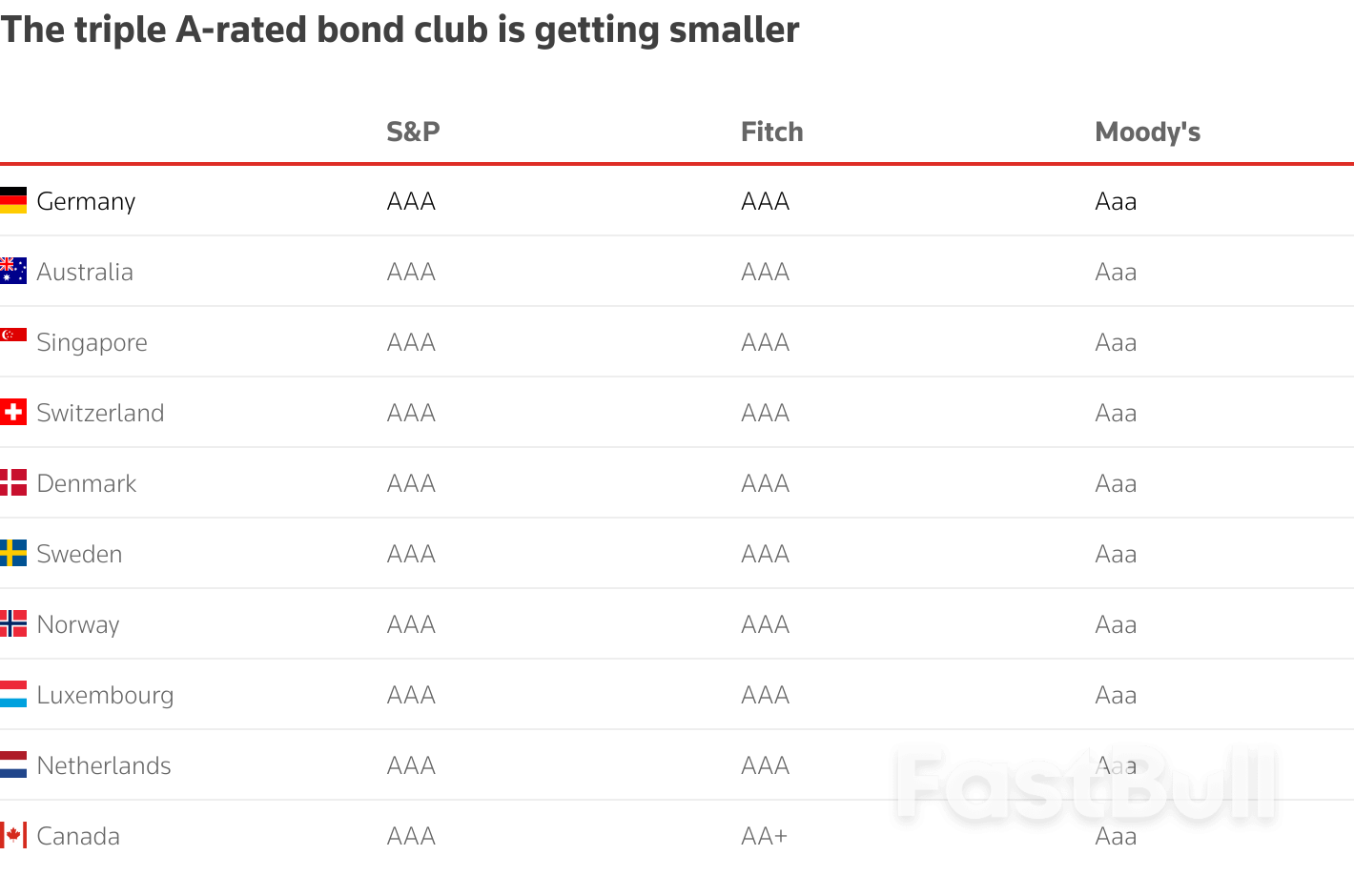
          The triple A-rated bond club is getting smaller

          2/ Which sovereigns now have a triple-A credit rating?
          The triple-A club has been shrinking for years.
          With the loss of the last remaining AAA-rating for the U.S., the group of countries that are the highest ranked by the three biggest agencies is 11, down from more than 15 before the 2007-8 financial crisis.
          Their economies account for a little over 10% of total world output.
          In Europe, Germany, Switzerland and the Netherlands are the largest economies with the highest rating.
          Elsewhere, Canada, Singapore and Australia are in the list.
          U.S. debt, meanwhile, ranks below that of the tiny European principality of Liechtenstein, which has a AAA credit score and GDP of just $7 billion, according to the World Bank.
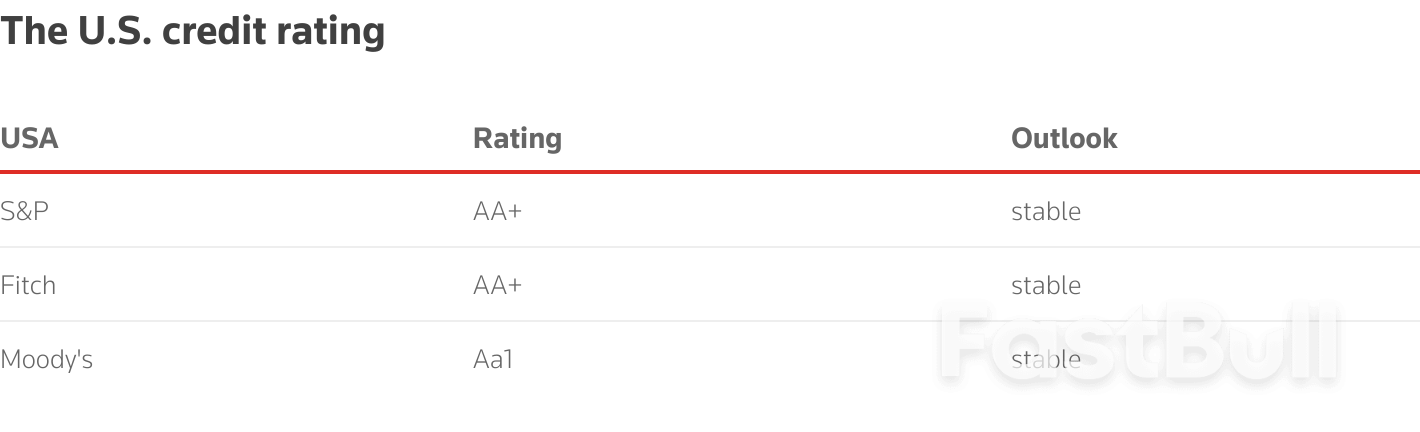
          3/ What is the U.S. rating now?
          The United States still carries the second-highest rating of AA.
          Moody's was the last of the big three agencies, after S&P Global and Fitch, to lower its U.S. rating, the only time it has done so since 1949.
          S&P was the first agency to cut, in 2011, for the first time since granting the U.S. its triple-A rating in 1941. Fitch followed in 2023.
          The 'triple A' sovereign bond club has shrunk_2

          The U.S. credit rating

          4/ Why are big economies being downgraded?
          Rising government debt and concern that not enough is being done to tackle long-term fiscal problems have led to the downgrades.
          The U.S. government, for instance, has spent more money than it has collected every year since 2001, leading to annual budget deficits and a debt load of some $36 trillion.
          It spent $881 billion on interest payments in the most recent fiscal year, more than triple the amount it spent in 2017. Borrowing costs exceed defence spending.
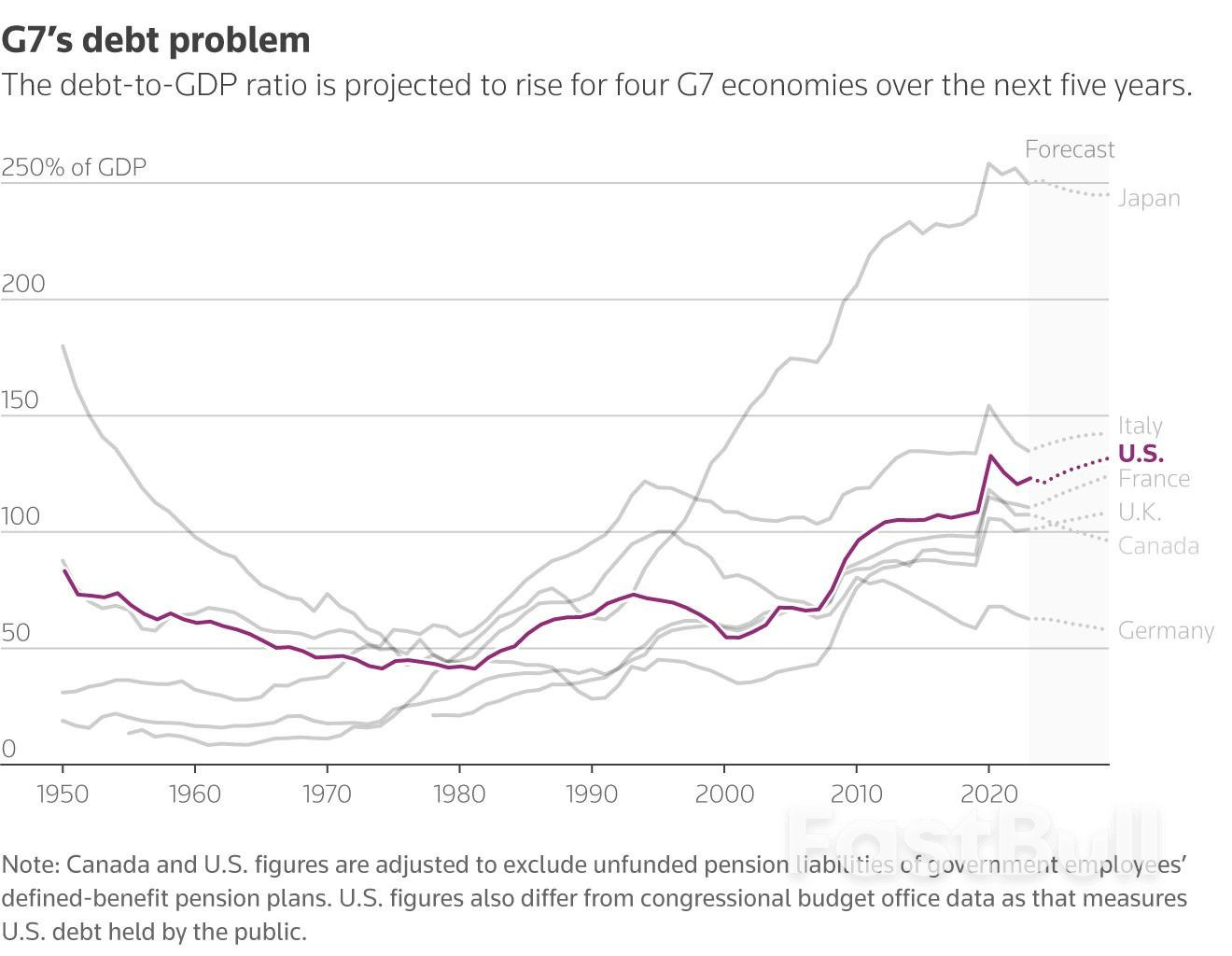
          Other big economies also face rising debt loads from ageing populations, climate change and defence needs. Britain has a debt-to-GDP ratio near 100% and Japan's is above 250%.
          The 'triple A' sovereign bond club has shrunk_3

          A story on the bond market and Donald Trump. Line chart showing the annual general government debt to GDP ratio of G7 member countries

          5/ What is a ratings agency?
          A ratings agency assesses the creditworthiness of an issuer - that could be a sovereign or a corporate - and assigns a credit rating to the bonds they issue.
          Typically, ratings use a letter system run that from AAA for effectively risk-free issuers, to D, for an issuer actively in default.
          Ratings are ranked under two tiers: investment grade and high-yield, or junk. The higher the credit rating, the lower the premium that investors demand to hold those bonds, therefore, the lower the interest rate an issuer pays on that debt.
          The agencies assess factors including debt, economic growth projections and the strength of independent institutions.
          Traditionally, three main ratings agencies - Moodys, Standard & Poor's and Fitch have dominated. Others, including Morningstar DBRS and Scope, have gained more prominence in the last decade.

          source :reuters

          To stay updated on all economic events of today, please check out our Economic calendar
          Risk Warnings and Disclaimers
          You understand and acknowledge that there is a high degree of risk involved in trading. Following any strategies or investment methods may lead to potential losses. The content on the site is provided by our contributors and analysts for information purposes only. You are solely responsible for determining whether any trading assets, securities, strategy, or any other product is suitable for investing based on your own investment objectives and financial situation.
          Add to Favorites
          Share

          $107K Fakeout or New All-Time Highs? 5 Things to Know in Bitcoin This Week

          Warren Takunda

          Cryptocurrency

          Bitcoin starts a new week with a long-awaited breakout from a narrow trading range around $103,000.
          BTC price action grabs liquidity before reversing to its starting position, liquidating many an emotional trader on the way. A fakeout or a taste of things to come?
          The May 18 daily and weekly close nonetheless became Bitcoin’s highest ever.
          US trade deals remain high on the list of macro volatility triggers for risk asset traders this week.
          Crypto’s correlation with stocks paints a mixed picture, adding to uncertainty over how macro developments will influence Bitcoin and altcoins going forward.
          Bitcoin exchange volume delta becomes a key ingredient in assessing the staying power of BTC price breakouts, per analysis from CryptoQuant.

          A liquidity grab for the ages

          Bitcoin price action delivered some “classic” moves around the May 18 weekly close.
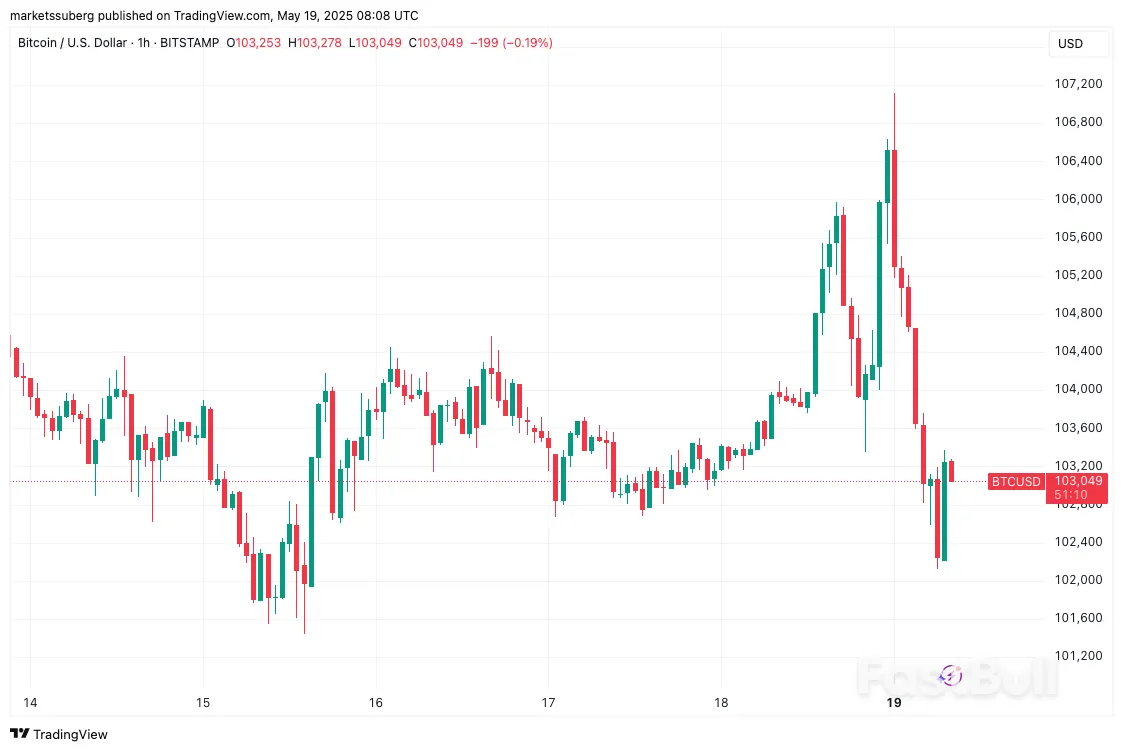
          A trip to new multimonth highs near $107,000 was followed by a 4% correction in a matter of hours, data from Cointelegraph Markets Pro and TradingView shows.$107K Fakeout or New All-Time Highs? 5 Things to Know in Bitcoin This Week_1

          BTC/USD 1-hour chart. Source: Cointelegraph/TradingView

          The spike took out a block of liquidity nestled close to all-time highs, with BTC/USD performing a liquidity “grab” designed to first squeeze out shorts and then trap late longs.
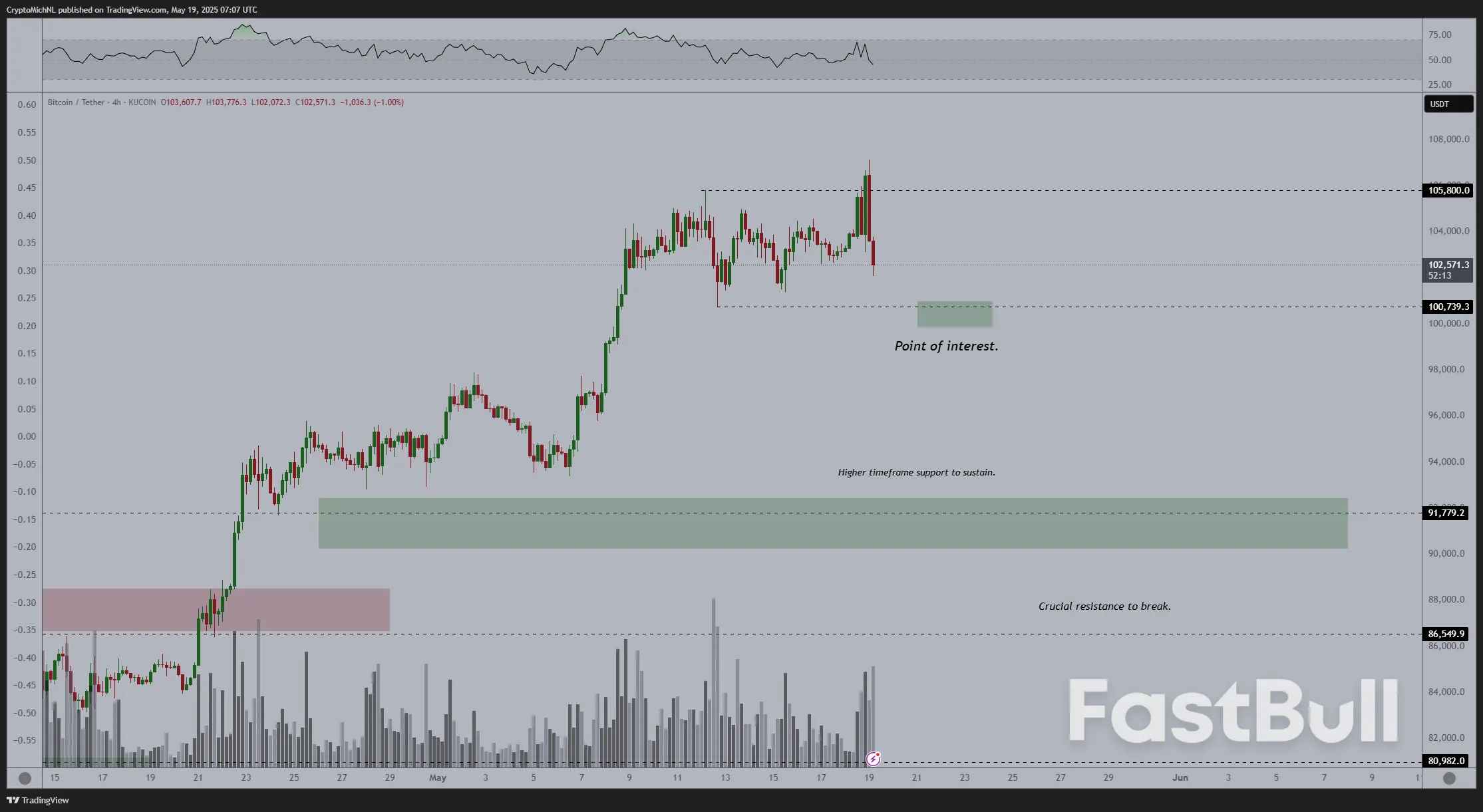
          “Classic liquidity trap above the recent high and reversal downwards,” crypto trader, analyst and entrepreneur Michaël van de Poppe responded on X.
          “I think we'll do the same at $100K before we'll start breaking out above the ATHs. Those are the zones to accumulate your Bitcoin.”

          $107K Fakeout or New All-Time Highs? 5 Things to Know in Bitcoin This Week_2BTC/USDT 4-hour chart with RSI data. Source: Michaël van de Poppe/X
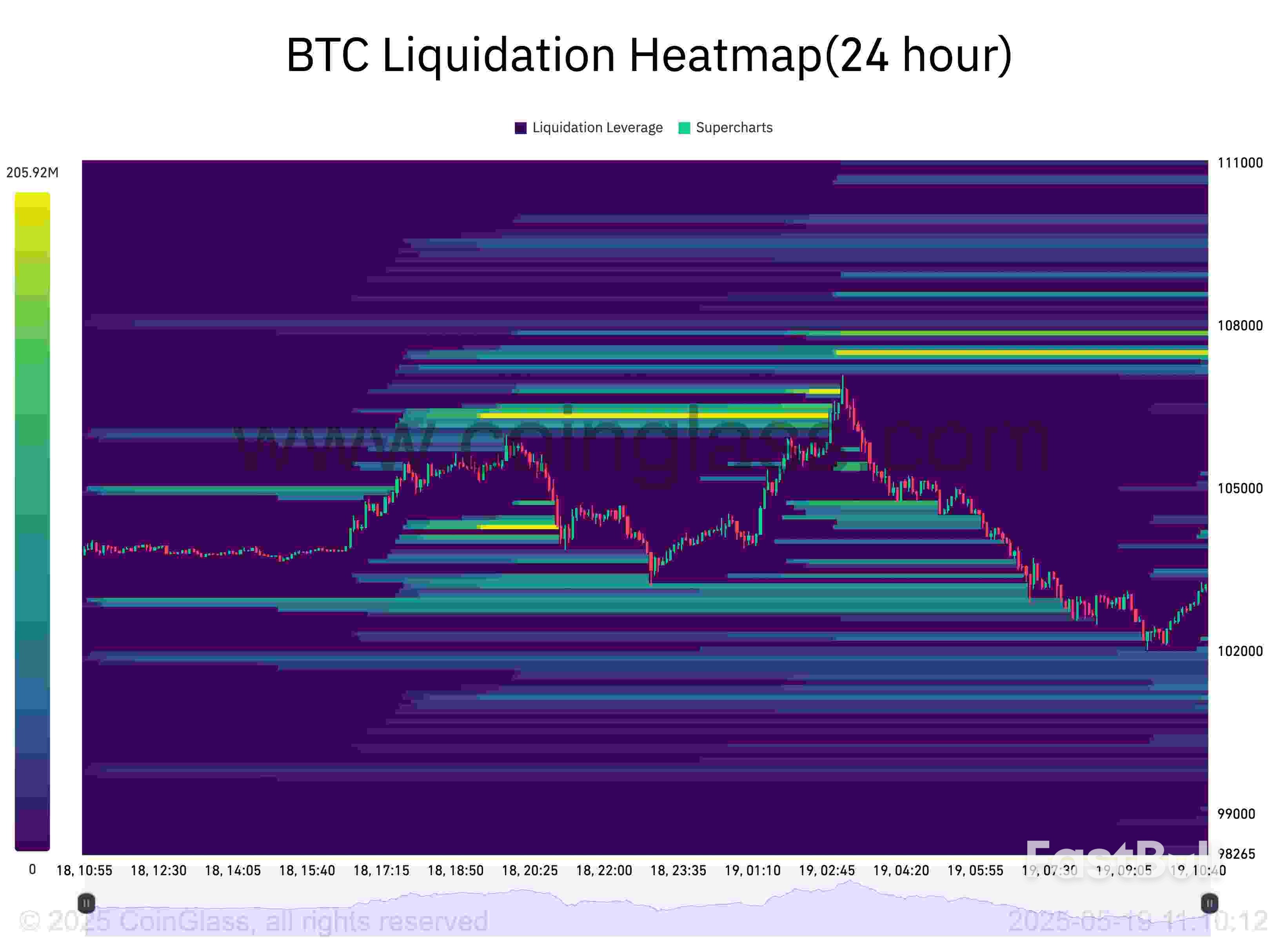
          Data from monitoring resource CoinGlass showed ask liquidity being replenished at $107,500, keeping the price from heading higher. The market then took out bid liquidity to $102,000.
          Total crypto liquidations in the 24 hours to the time of writing were $673 million.
          $107K Fakeout or New All-Time Highs? 5 Things to Know in Bitcoin This Week_3

          BTC liquidation heatmap. Source: CoinGlass

          Discussing the outlook for Bitcoin, trader CrypNuevo was among those arguing for caution instead of entering at any level in the current range above $100,000.
          “From a risk management perspective, I don’t see it worth it to go long right now at market price,” he wrote in an X thread prior to the weekly close volatility.
          “Yes, price could go up as the HTF trend suggests but as a trader I look for low risk entries. We're currently at resistance. Clearing it would make a much more attractive entry.”
          $107K Fakeout or New All-Time Highs? 5 Things to Know in Bitcoin This Week_4

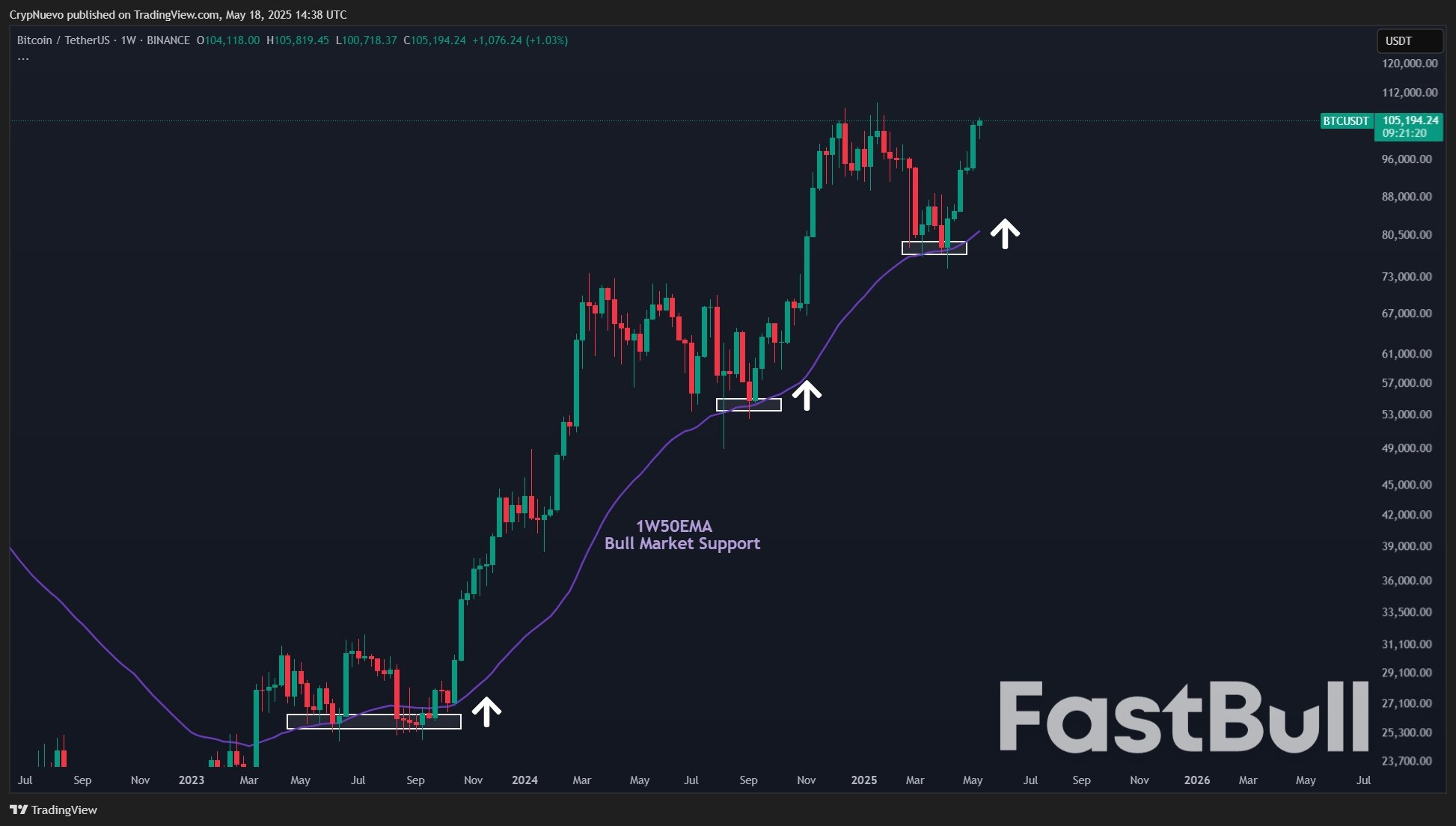
          BTC/USDT 1-week chart with 50EMA. Source: CrypNuevo/X

          CrypNuevo acknowledged that bullish signals on high timeframes remain and highlighted the retest of the 50-week exponential moving average (EMA) in April, which has historically led to new all-time highs.
          This weekend, another prediction called for $116,000 to arrive in the coming days.

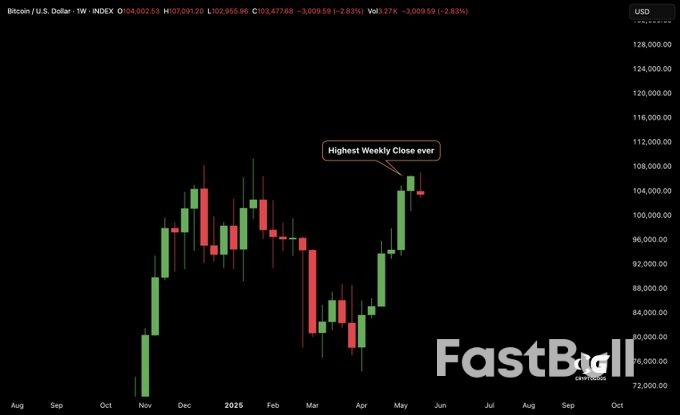
          Bitcoin scores highest weekly close in history

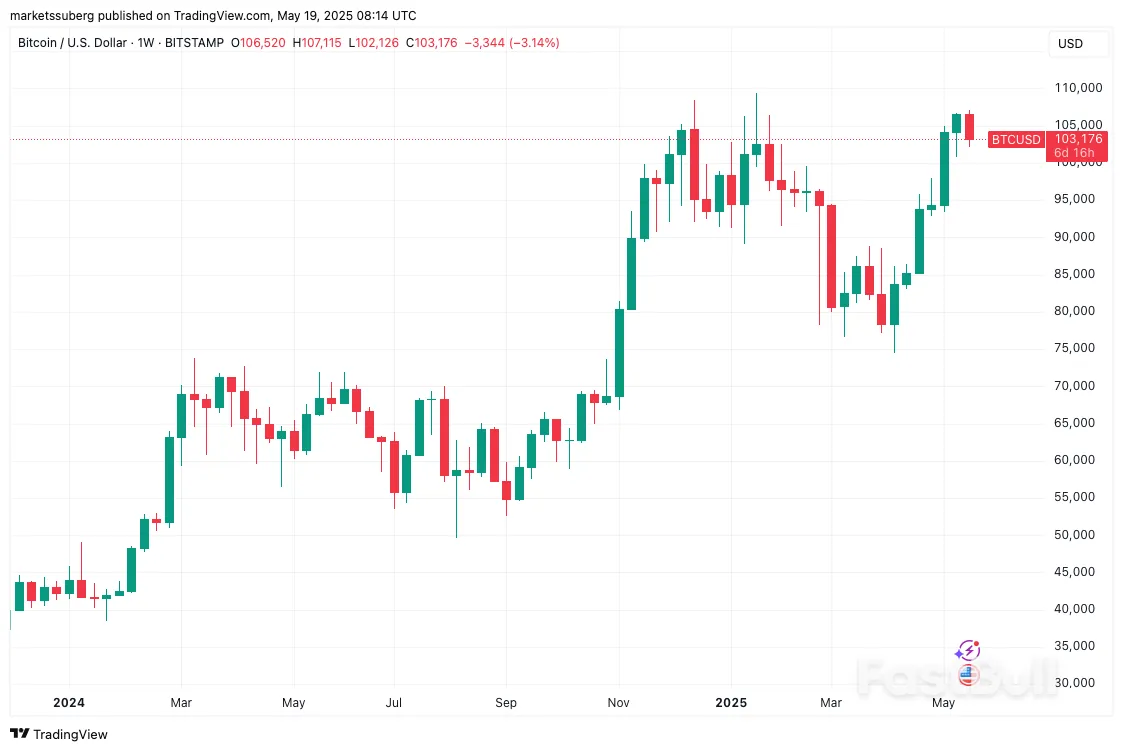
          It may not have lasted long, but Bitcoin’s latest weekly close has become the highest ever recorded.
          Coming in at around $106,500, the weekly candle also allowed for a new all-time high daily close.
          $107K Fakeout or New All-Time Highs? 5 Things to Know in Bitcoin This Week_5

          BTC/USD 1-week chart. Source: Cointelegraph/TradingView
          Despite the subsequent correction of nearly 4%, traders are keen to celebrate what they see as an underlying desire for the market to push higher.
          $107K Fakeout or New All-Time Highs? 5 Things to Know in Bitcoin This Week_6
          “Highest weekly close ever followed by a red start to the week? Yeah - get the low in early, this week likely ends in the green big time,” trader Jelle argued in an X analysis.
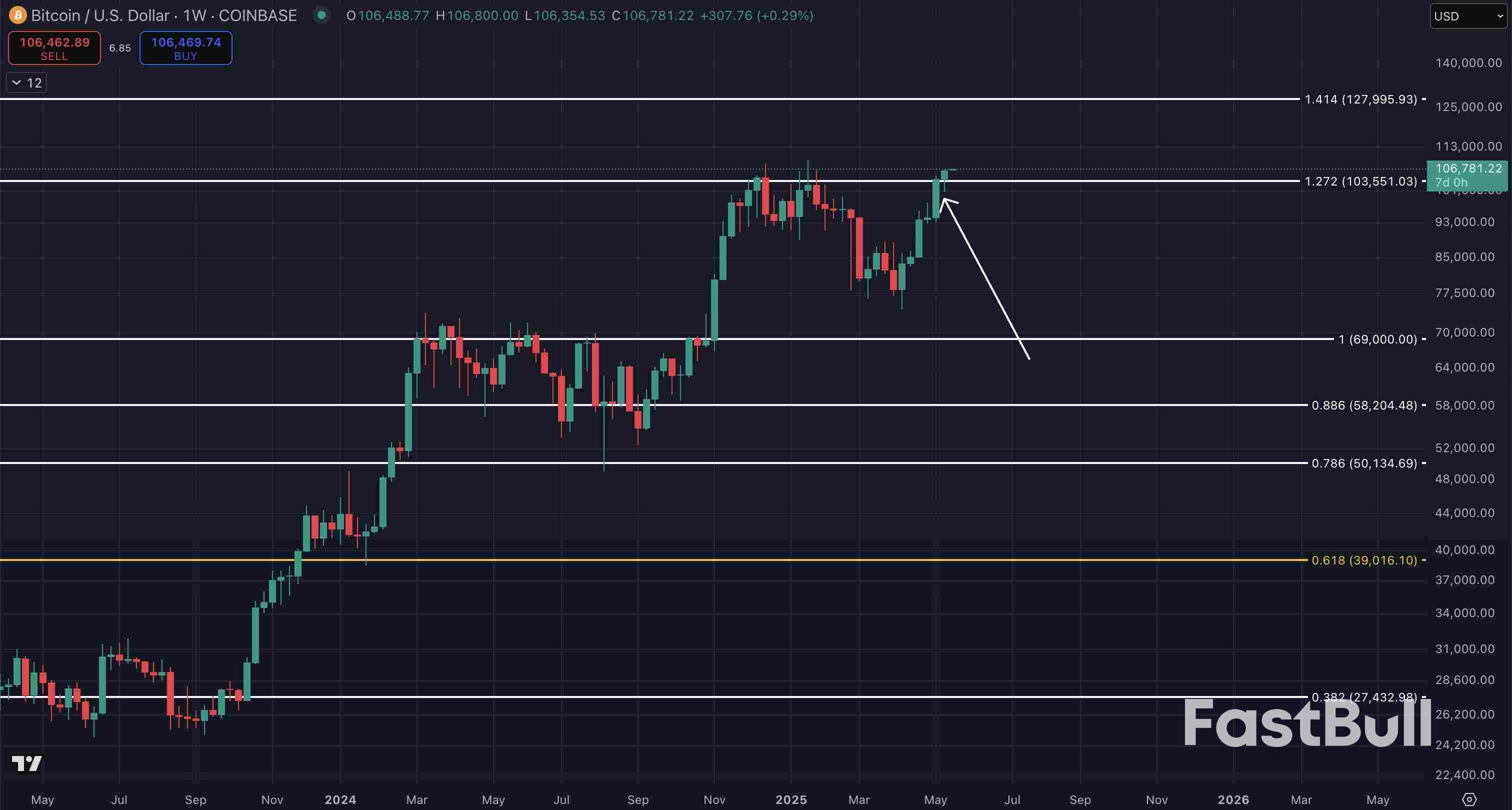
          Fellow trader Chad noted that BTC/USD has also managed to close above a key Fibonacci extension level for two consecutive weeks — a first of its kind.$107K Fakeout or New All-Time Highs? 5 Things to Know in Bitcoin This Week_7

          BTC/USD 1-week chart with Fibonacci levels. Source: Chad/X

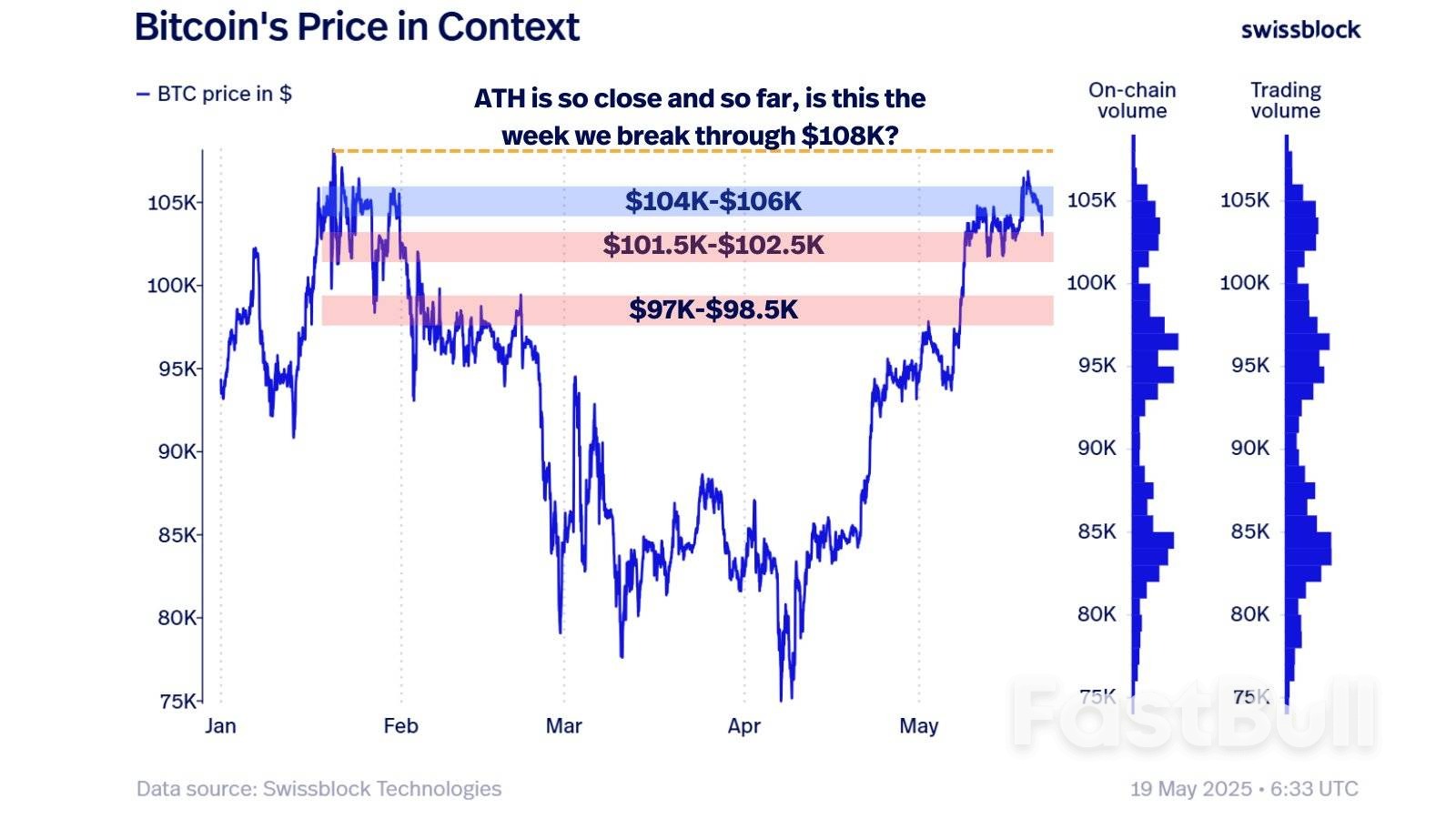
          Private wealth manager Swissblock Technologies saw one key ingredient to bullish continuation.
          “Bitcoin flirted with $107K, grabbed liquidity above $104K–$106K but failed to hold,” it summarized in its latest X reaction.
          “Back in the range, support holding, for now. Bulls have one job: defend this range.”$107K Fakeout or New All-Time Highs? 5 Things to Know in Bitcoin This Week_8

          BTC price data. Source: Swissblock Technologies/X

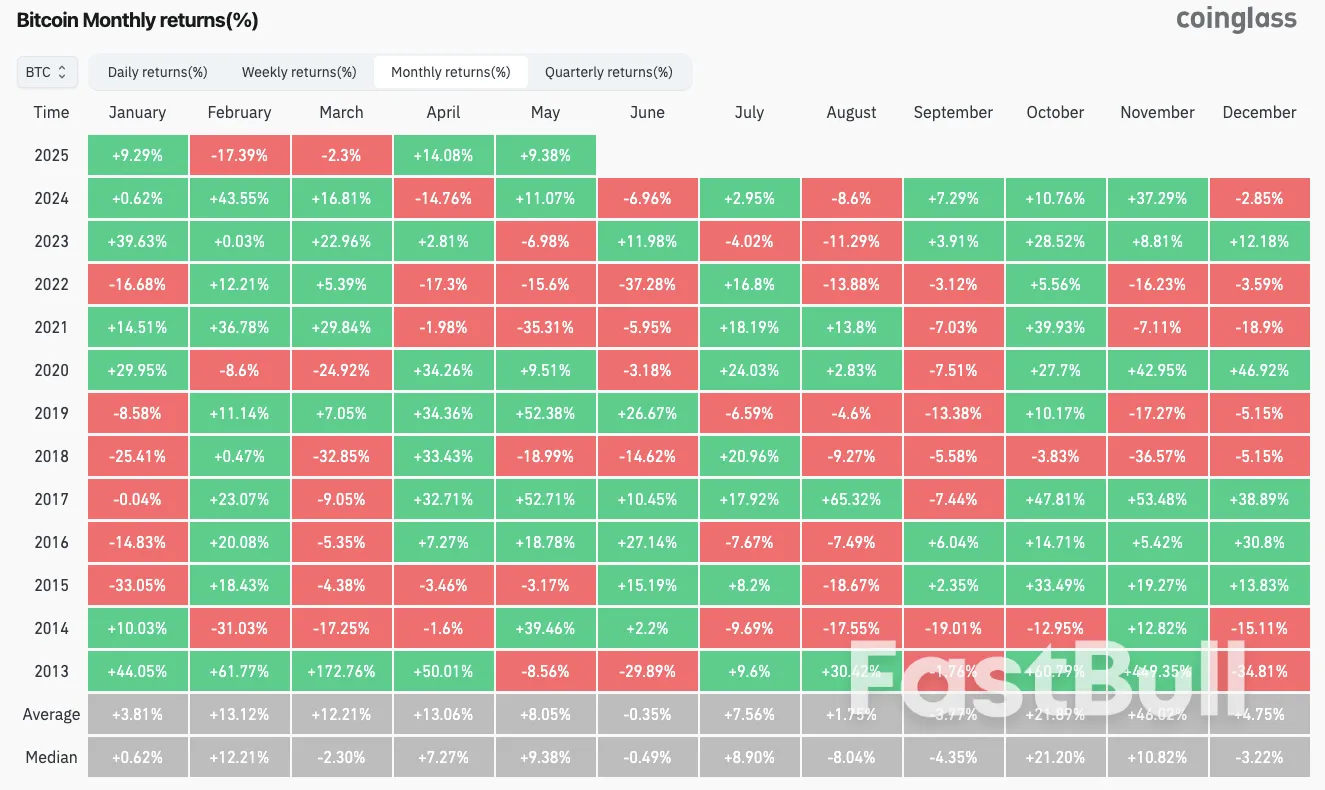
          CoinGlass showed that May is a highly varied month for BTC price action. Currently, its 10% gains sit in the middle of a wide range of historical outcomes, with under two weeks left until the monthly close.$107K Fakeout or New All-Time Highs? 5 Things to Know in Bitcoin This Week_9

          BTC/USD monthly returns (screenshot). Source: CoinGlass

          US trade war rumbles on as Bitcoin ignores rate-cut odds

          A lack of crucial macroeconomic data reports this week places the focus on the Federal Reserve and US trade deals.
          In particular, markets will be looking for positive developments regarding trade ties between the US and its partners. Treasury Secretary Scott Bessent promised to enact new tariffs on those who do not negotiate in “good faith.”
          News of a deal with China caused a snap reaction for stocks earlier this month, with traders feeling a sense of relief.
          This may not be so evident as the week begins, thanks to the recent US credit downgrade by Moody’s, wiping 1% off stocks’ futures prior to the first Wall Street open.
          With the dollar again under pressure, trading resource The Kobeissi Letter suggested that Bitcoin and altcoins may still benefit in the current climate.
          “Crypto is loving the Moody’s downgrade: Bitcoin is now 4% away from a new all time high and up over +40% since its April low,” it noted around the weekly close.
          “As the US Dollar weakens and uncertainty rises, Bitcoin and Gold are thriving. Instability is Bitcoin’s best friend.”

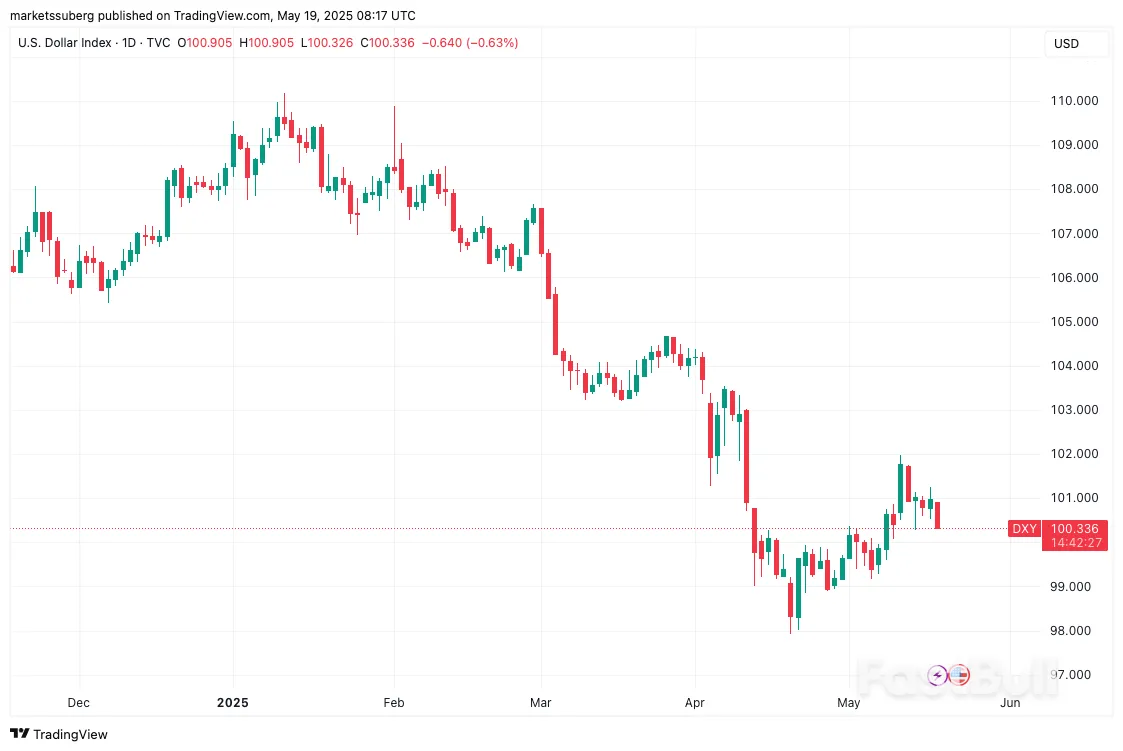
          $107K Fakeout or New All-Time Highs? 5 Things to Know in Bitcoin This Week_10US dollar Index (DXY) 1-day chart. Source: Cointelegraph/TradingView
          Crypto is also increasingly resilient to hawkish cues from the Fed, which has given markets reason to believe that interest rate cuts will not come before September.
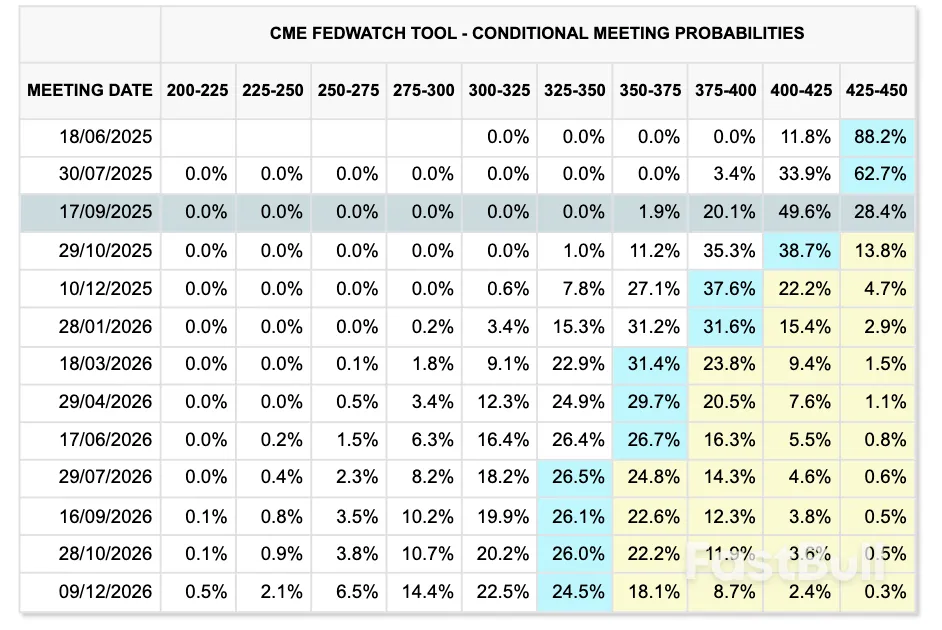
          Data from CME Group’s FedWatch Tool shows the odds of a cut at the Fed’s upcoming June meeting at just 12%. Jobless claims on May 22 could shift those expectations if the result differs significantly from predictions.$107K Fakeout or New All-Time Highs? 5 Things to Know in Bitcoin This Week_11

          Fed target rate probabilities (screenshot). Source: CME Group

          Fed Chair Jerome Powell will deliver the annual Georgetown University Law Center Commencement Address on May 25, but it is unlikely to provide much policy insight.

          Crypto stocks correlation in flux

          Diverging reactions to the Moody’s downgrade set the stage for a debate around crypto’s correlation with US stocks.
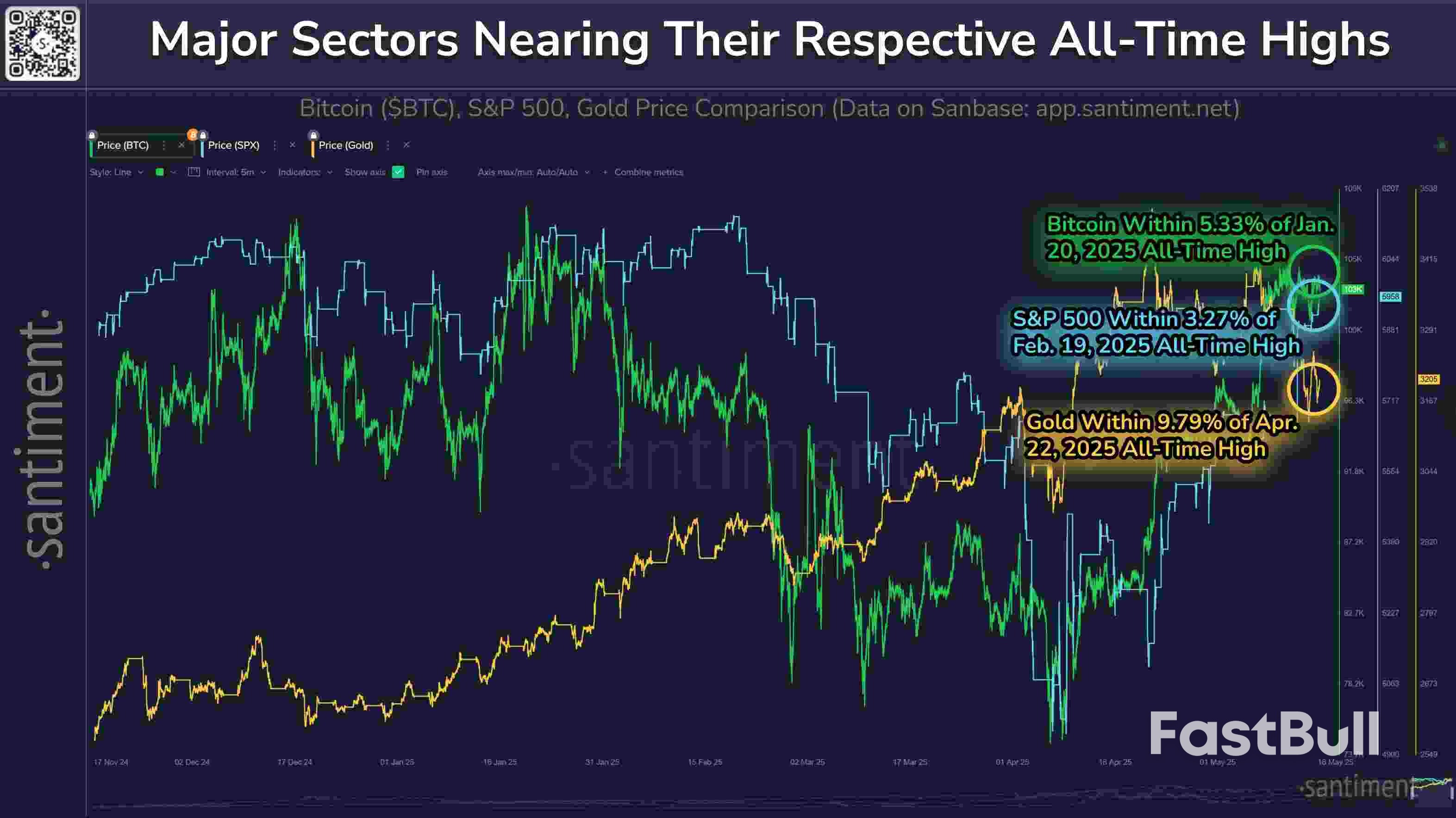
          In its latest analysis, research firm Santiment could not draw a clear conclusion over the two asset classes’ relationship, calling them “somewhat correlated.”
          “With the 90-day tariff pause between the US & China Monday, markets remain within striking distance of all-time highs,” it summarized on May 17, referring to the S&P 500, Bitcoin and gold.$107K Fakeout or New All-Time Highs? 5 Things to Know in Bitcoin This Week_12

          Bitcoin vs. S&P 500 vs. gold. Source: Santiment/X

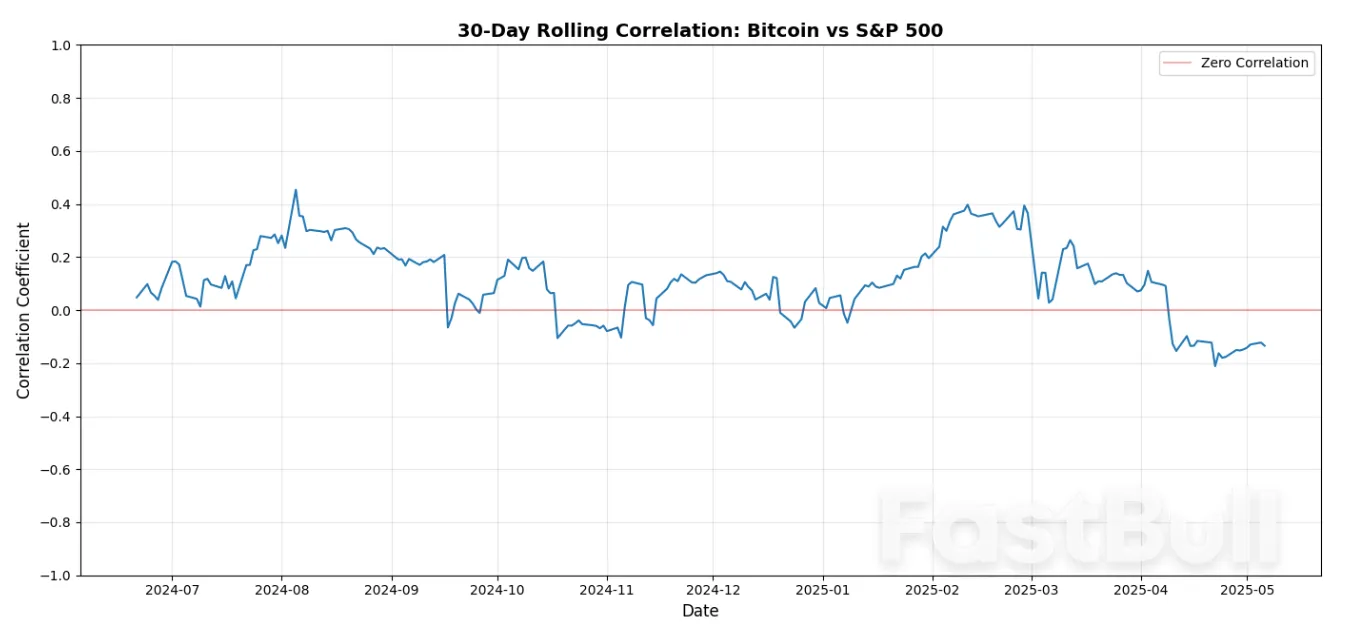
          Separate findings from blockchain data provider RedStone Oracles drew a distinction between long- and short-term correlation.
          While negative on a rolling seven-day basis, it told Cointelegraph, a 30-day perspective delivers a “valuable correlation” between Bitcoin and the S&P 500.$107K Fakeout or New All-Time Highs? 5 Things to Know in Bitcoin This Week_13

          Bitcoin, S&P 500, 30-day rolling correlation, 1-year chart. Source: Redstone Oracles

          Meanwhile, market participants have aired frustration at crypto’s susceptibility to the same volatility triggers impacting stocks.
          “It was a lot more enjoyable when $BTC traded independently of stocks,” commentator IncomeSharks told X followers on May 19.
          “It seems now it's just a way for people to trade stock futures during the weekend and mirror what the $SPY is doing during the week.”

          Volume delta warns over “local market top”

          Considering what it might take to launch Bitcoin back into price discovery, a new analysis looked at exchange order-book behavior.
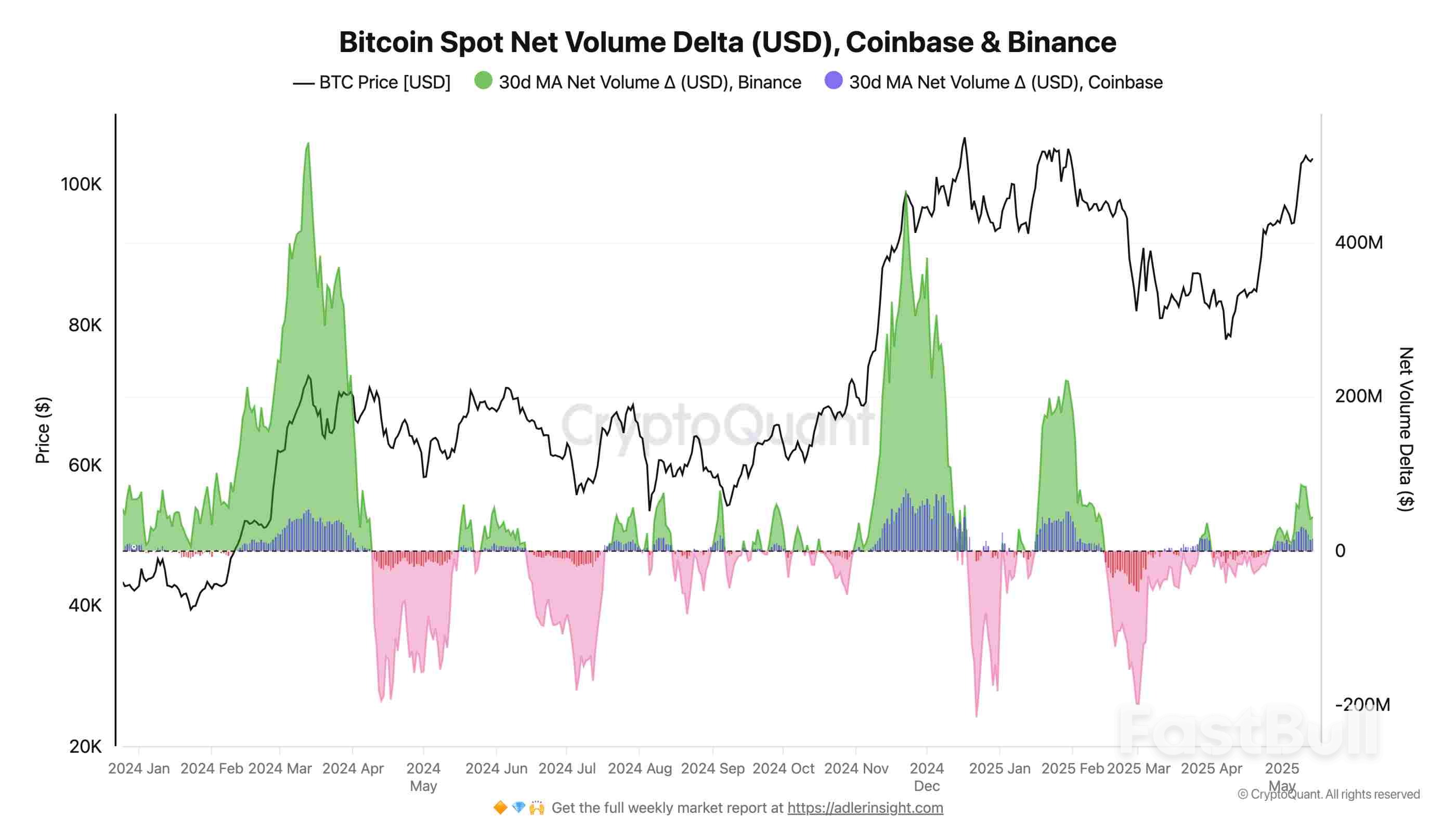
          Binance, in particular, was under the microscope as the exchange with the largest spot volumes. Volume delta, onchain analytics platform CryptoQuant said, is a key ingredient in sustained price moves.
          “After the recent market correction, the spot net volume delta on Binance has turned positive again,” contributor Darkfost wrote in a “Quicktake” blog post on May 18.
          “This signals that buying activity is picking up on spot markets, but more importantly, that selling pressure has significantly declined, even with BTC trading above $100 000. However, historically, when spot volumes on Binance rise too quickly and too sharply, it has often coincided with local market tops.”

          $107K Fakeout or New All-Time Highs? 5 Things to Know in Bitcoin This Week_14Bitcoin spot net volume delta. Source: CryptoQuant

          Volume delta measures the difference in buy and sell pressure across candles, helping assess the underlying strength of bid and ask sides.
          CryptoQuant suggests that investors throwing caution to the wind around breakouts contributes to unsustainable price spikes, and monitoring volume delta helps avoid disadvantageous market entries.
          “Rather than being a warning sign, rising spot volumes at this point would be encouraging for market strength,” Darkfost continued.
          “Tracking spot volumes can provide valuable insights into investor behavior, especially on Binance, which handles the largest share of global trading.”

          Source: Cointelegraph

          Risk Warnings and Disclaimers
          You understand and acknowledge that there is a high degree of risk involved in trading. Following any strategies or investment methods may lead to potential losses. The content on the site is provided by our contributors and analysts for information purposes only. You are solely responsible for determining whether any trading assets, securities, strategy, or any other product is suitable for investing based on your own investment objectives and financial situation.
          Add to Favorites
          Share
          FastBull
          Copyright © 2025 FastBull Ltd

          728 RM B 7/F GEE LOK IND BLDG NO 34 HUNG TO RD KWUN TONG KLN HONG KONG

          TelegramInstagramTwitterfacebooklinkedin
          App Store Google Play Google Play
          Products
          Charts

          Chats

          Q&A with Experts
          Screeners
          Economic Calendar
          Data
          Tools
          Membership
          Features
          Function
          Markets
          Copy Trading
          Latest Signals
          Contests
          News
          Analysis
          24/7
          Columns
          Education
          Company
          Careers
          About Us
          Contact Us
          Advertising
          Help Center
          Feedback
          User Agreement
          Privacy Policy
          Business

          White Label

          Data API

          Web Plug-ins

          Poster Maker

          Affiliate Program

          Risk Disclosure

          The risk of loss in trading financial instruments such as stocks, FX, commodities, futures, bonds, ETFs and crypto can be substantial. You may sustain a total loss of the funds that you deposit with your broker. Therefore, you should carefully consider whether such trading is suitable for you in light of your circumstances and financial resources.

          No decision to invest should be made without thoroughly conducting due diligence by yourself or consulting with your financial advisors. Our web content might not suit you since we don't know your financial conditions and investment needs. Our financial information might have latency or contain inaccuracy, so you should be fully responsible for any of your trading and investment decisions. The company will not be responsible for your capital loss.

          Without getting permission from the website, you are not allowed to copy the website's graphics, texts, or trademarks. Intellectual property rights in the content or data incorporated into this website belong to its providers and exchange merchants.

          Not Logged In

          Log in to access more features

          FastBull Membership

          Not yet

          Purchase

          Become a signal provider
          Help Center
          Customer Service
          Dark Mode
          Price Up/Down Colors

          Log In

          Sign Up

          Position
          Layout
          Fullscreen
          Default to Chart
          The chart page opens by default when you visit fastbull.com