• Trade
  • Markets
  • Copy
  • Contests
  • News
  • 24/7
  • Calendar
  • Q&A
  • Chats
Trending
Screeners
SYMBOL
LAST
BID
ASK
HIGH
LOW
NET CHG.
%CHG.
SPREAD
SPX
S&P 500 Index
6827.42
6827.42
6827.42
6899.86
6801.80
-73.58
-1.07%
--
DJI
Dow Jones Industrial Average
48458.04
48458.04
48458.04
48886.86
48334.10
-245.98
-0.51%
--
IXIC
NASDAQ Composite Index
23195.16
23195.16
23195.16
23554.89
23094.51
-398.69
-1.69%
--
USDX
US Dollar Index
97.950
98.030
97.950
98.500
97.950
-0.370
-0.38%
--
EURUSD
Euro / US Dollar
1.17394
1.17409
1.17394
1.17496
1.17192
+0.00011
+ 0.01%
--
GBPUSD
Pound Sterling / US Dollar
1.33707
1.33732
1.33707
1.33997
1.33419
-0.00148
-0.11%
--
XAUUSD
Gold / US Dollar
4299.39
4299.39
4299.39
4353.41
4257.10
+20.10
+ 0.47%
--
WTI
Light Sweet Crude Oil
57.233
57.485
57.233
58.011
56.969
-0.408
-0.71%
--

Community Accounts

Signal Accounts
--
Profit Accounts
--
Loss Accounts
--
View More

Become a signal provider

Sell trading signals to earn additional income

View More

Guide to Copy Trading

Get started with ease and confidence

View More

Signal Accounts for Members

All Signal Accounts

Best Return
  • Best Return
  • Best P/L
  • Best MDD
Past 1W
  • Past 1W
  • Past 1M
  • Past 1Y

All Contests

  • All
  • Trump Updates
  • Recommend
  • Stocks
  • Cryptocurrencies
  • Central Banks
  • Featured News
Top News Only
Share

Trump Isn't Certain His Economic Policies Will Translate To Midterm Wins

Share

The United States And Mexico Have Reached An Agreement On How To Resolve The Water Dispute In The Rio Grande Basin (which Borders Texas). Starting December 15, Mexico Will Supply The U.S. With An Additional 20.2 Acre-feet (a Unit Of Volume For Irrigation). The Agreement Seeks To “strengthen Water Management In The Rio Grande Basin” Within The Framework Of The 1944 Water Treaty

Share

U.S. Transportation Secretary Duffy: The Engine Of United Airlines Flight 803 That Malfunctioned Caught Fire

Share

Ukraine President Zelenskiy: He Will Meet US, European Representatives About Peace

Share

UK Prime Minister Office: Prime Minister Starmer Spoke To The President Of The European Commission Ursula Von Der Leyen This Evening - Downing Street Spokesperson

Share

Trump: We Will Retaliate Against ISIS

Share

Trump Says We Mourn The Loss Of Three Great Patriots In Syria In An Ambush

Share

Syrian Interior Ministry Spokesperson Confirms Attacker Was Member Of Security Forces With Extremist Ideology

Share

Syrian Interior Ministry Says Attacker Did Not Have Leadership Role In Security Forces, Did Not Say If He Was Junior Member

Share

Man Who Attacked Syrian, US Military Was Member Of Syrian Security Forces -Three Local Syrian Officials

Share

US Envoy Coale Says Belarus President Lukashenko Agreed To Do All He Can To Stop Weather Balloons Flying Into Lithuania

Share

Ukraine Says Russian Drone Attack Hit Civilian Turkish Vessel

Share

Islamic State Attacker In Syria Was Lone Gunman, Who Was Killed -USA Central Command

Share

US Envoy John Coale Says Around 1000 Remaining Political Prisoners In Belarus Could Be Released In Coming Months

Share

US Defense Secretary Hegseth: Attacker Was Killed By Partner Forces

Share

Pentagon Says Two USA Army Soldiers And One Civilian USA Interpreter Were Killed, And Three Were Wounded In Syria

Share

Israel Says It Kills Senior Hamas Commander Raed Saed In Gaza

Share

Ukraine's Navy Says Russian Drone Attack Hit Civilian Turkish Vessel Carrying Sunflower Oil To Egypt On Saturday

Share

Israeli Military Says It Put Planned Strike On South Lebanon Site On Hold After Lebanese Army Requested Access

Share

Norwegian Nobel Committee: Calls On The Belarusian Authorities To Release All Political Prisoners

TIME
ACT
FCST
PREV
U.K. Trade Balance (Oct)

A:--

F: --

P: --

U.K. Services Index MoM

A:--

F: --

P: --

U.K. Construction Output MoM (SA) (Oct)

A:--

F: --

P: --

U.K. Industrial Output YoY (Oct)

A:--

F: --

P: --

U.K. Trade Balance (SA) (Oct)

A:--

F: --

P: --

U.K. Trade Balance EU (SA) (Oct)

A:--

F: --

P: --

U.K. Manufacturing Output YoY (Oct)

A:--

F: --

P: --

U.K. GDP MoM (Oct)

A:--

F: --

P: --

U.K. GDP YoY (SA) (Oct)

A:--

F: --

P: --

U.K. Industrial Output MoM (Oct)

A:--

F: --

P: --

U.K. Construction Output YoY (Oct)

A:--

F: --

P: --

France HICP Final MoM (Nov)

A:--

F: --

P: --

China, Mainland Outstanding Loans Growth YoY (Nov)

A:--

F: --

P: --

China, Mainland M2 Money Supply YoY (Nov)

A:--

F: --

P: --

China, Mainland M0 Money Supply YoY (Nov)

A:--

F: --

P: --

China, Mainland M1 Money Supply YoY (Nov)

A:--

F: --

P: --

India CPI YoY (Nov)

A:--

F: --

P: --

India Deposit Gowth YoY

A:--

F: --

P: --

Brazil Services Growth YoY (Oct)

A:--

F: --

P: --

Mexico Industrial Output YoY (Oct)

A:--

F: --

P: --

Russia Trade Balance (Oct)

A:--

F: --

P: --

Philadelphia Fed President Henry Paulson delivers a speech
Canada Building Permits MoM (SA) (Oct)

A:--

F: --

P: --

Canada Wholesale Sales YoY (Oct)

A:--

F: --

P: --

Canada Wholesale Inventory MoM (Oct)

A:--

F: --

P: --

Canada Wholesale Inventory YoY (Oct)

A:--

F: --

P: --

Canada Wholesale Sales MoM (SA) (Oct)

A:--

F: --

P: --

Germany Current Account (Not SA) (Oct)

A:--

F: --

P: --

U.S. Weekly Total Rig Count

A:--

F: --

P: --

U.S. Weekly Total Oil Rig Count

A:--

F: --

P: --

Japan Tankan Large Non-Manufacturing Diffusion Index (Q4)

--

F: --

P: --

Japan Tankan Small Manufacturing Outlook Index (Q4)

--

F: --

P: --

Japan Tankan Large Non-Manufacturing Outlook Index (Q4)

--

F: --

P: --

Japan Tankan Large Manufacturing Outlook Index (Q4)

--

F: --

P: --

Japan Tankan Small Manufacturing Diffusion Index (Q4)

--

F: --

P: --

Japan Tankan Large Manufacturing Diffusion Index (Q4)

--

F: --

P: --

Japan Tankan Large-Enterprise Capital Expenditure YoY (Q4)

--

F: --

P: --

U.K. Rightmove House Price Index YoY (Dec)

--

F: --

P: --

China, Mainland Industrial Output YoY (YTD) (Nov)

--

F: --

P: --

China, Mainland Urban Area Unemployment Rate (Nov)

--

F: --

P: --

Saudi Arabia CPI YoY (Nov)

--

F: --

P: --

Euro Zone Industrial Output YoY (Oct)

--

F: --

P: --

Euro Zone Industrial Output MoM (Oct)

--

F: --

P: --

Canada Existing Home Sales MoM (Nov)

--

F: --

P: --

Euro Zone Total Reserve Assets (Nov)

--

F: --

P: --

U.K. Inflation Rate Expectations

--

F: --

P: --

Canada National Economic Confidence Index

--

F: --

P: --

Canada New Housing Starts (Nov)

--

F: --

P: --

U.S. NY Fed Manufacturing Employment Index (Dec)

--

F: --

P: --

U.S. NY Fed Manufacturing Index (Dec)

--

F: --

P: --

Canada Core CPI YoY (Nov)

--

F: --

P: --

Canada Manufacturing Unfilled Orders MoM (Oct)

--

F: --

P: --

Canada Manufacturing New Orders MoM (Oct)

--

F: --

P: --

Canada Core CPI MoM (Nov)

--

F: --

P: --

Canada Manufacturing Inventory MoM (Oct)

--

F: --

P: --

Canada CPI YoY (Nov)

--

F: --

P: --

Canada CPI MoM (Nov)

--

F: --

P: --

Canada CPI YoY (SA) (Nov)

--

F: --

P: --

Canada Core CPI MoM (SA) (Nov)

--

F: --

P: --

Canada CPI MoM (SA) (Nov)

--

F: --

P: --

Q&A with Experts
    • All
    • Chatrooms
    • Groups
    • Friends
    Connecting
    .
    .
    .
    Type here...
    Add Symbol or Code

      No matching data

      All
      Trump Updates
      Recommend
      Stocks
      Cryptocurrencies
      Central Banks
      Featured News
      • All
      • Russia-Ukraine Conflict
      • Middle East Flashpoint
      • All
      • Russia-Ukraine Conflict
      • Middle East Flashpoint
      Search
      Products

      Charts Free Forever

      Chats Q&A with Experts
      Screeners Economic Calendar Data Tools
      Membership Features
      Data Warehouse Market Trends Institutional Data Policy Rates Macro

      Market Trends

      Market Sentiment Order Book Forex Correlations

      Top Indicators

      Charts Free Forever
      Markets

      News

      News Analysis 24/7 Columns Education
      From Institutions From Analysts
      Topics Columnists

      Latest Views

      Latest Views

      Trending Topics

      Top Columnists

      Latest Update

      Signals

      Copy Rankings Latest Signals Become a signal provider AI Rating
      Contests
      Brokers

      Overview Brokers Assessment Rankings Regulators News Claims
      Broker listing Forex Brokers Comparison Tool Live Spread Comparison Scam
      Q&A Complaint Scam Alert Videos Tips to Detect Scam
      More

      Business
      Events
      Careers About Us Advertising Help Center

      White Label

      Data API

      Web Plug-ins

      Affiliate Program

      Awards Institution Evaluation IB Seminar Salon Event Exhibition
      Vietnam Thailand Singapore Dubai
      Fans Party Investment Sharing Session
      FastBull Summit BrokersView Expo
      Recent Searches
        Top Searches
          Markets
          News
          Analysis
          User
          24/7
          Economic Calendar
          Education
          Data
          • Names
          • Latest
          • Prev

          View All

          No data

          Scan to Download

          Faster Charts, Chat Faster!

          Download App
          English
          • English
          • Español
          • العربية
          • Bahasa Indonesia
          • Bahasa Melayu
          • Tiếng Việt
          • ภาษาไทย
          • Français
          • Italiano
          • Türkçe
          • Русский язык
          • 简中
          • 繁中
          Open Account
          Search
          Products
          Charts Free Forever
          Markets
          News
          Signals

          Copy Rankings Latest Signals Become a signal provider AI Rating
          Contests
          Brokers

          Overview Brokers Assessment Rankings Regulators News Claims
          Broker listing Forex Brokers Comparison Tool Live Spread Comparison Scam
          Q&A Complaint Scam Alert Videos Tips to Detect Scam
          More

          Business
          Events
          Careers About Us Advertising Help Center

          White Label

          Data API

          Web Plug-ins

          Affiliate Program

          Awards Institution Evaluation IB Seminar Salon Event Exhibition
          Vietnam Thailand Singapore Dubai
          Fans Party Investment Sharing Session
          FastBull Summit BrokersView Expo

          Global Markets Shrug Off Trump’s Economic Shocks But Risks Linger Beneath the Surface

          Gerik

          Economic

          Summary:

          Despite President Trump’s aggressive economic maneuvers including tariffs, Fed interference, and unconventional industrial policy the global economy remains surprisingly stable...

          Trump’s First 8 Months: Turbulence Without Collapse

          Since taking office, Donald Trump has unleashed a series of dramatic policy moves that many feared would rattle the global economy: sweeping tariffs, attempts to exert control over the Federal Reserve, and elements of state capitalism. However, the economic reaction so far has been notably muted. Global growth continues, equity markets are strong, and inflation remains under control.
          This resilience has defied early fears of recession and global trade collapse. BNP Paribas attributes the calm to strong corporate and household balance sheets, low energy prices, the promise of AI-led productivity, and generally supportive financial conditions.

          Trade Fears Fade, For Now

          The gravest early concern a full-blown trade war has not materialized. While some tariffs were imposed, deals with European and Asian trading partners helped limit escalation. As a result, the burden of tariffs has been somewhat diffused across exporters, importers, and consumers, avoiding a concentrated economic shock.
          Markets have also largely ignored Trump’s failed efforts to fire Federal Reserve Chair Jerome Powell and Governor Lisa Cook, with the 10-year U.S. Treasury yield falling from 4.6% to around 4.1%. The Fed’s recent 25-basis-point rate cut signals confidence in hitting its inflation target, despite Trump’s political pressure.

          Global Growth Forecasts Improve Amid U.S. Volatility

          Globally, economic performance is trending better than expected in several regions. The European Central Bank raised its 2025 euro zone growth forecast to 1.2%, while Spain raised its outlook to 2.6% thanks to tourism and consumer demand. Italy is cleaning up its public finances, with potential credit rating upgrades in sight.
          Germany, despite recent stagnation, is preparing for a strong rebound in 2026 and 2027, driven by tax cuts and massive public investment in infrastructure and defense. In Japan, manufacturing sentiment is at a three-year high, while emerging markets such as Brazil, Mexico, and India benefit from a weaker U.S. dollar and domestic policy support.

          Cracks Beneath the Surface: Delayed Tariff Impacts and Fed Overreliance

          While the surface appears calm, policymakers and analysts are watching for delayed repercussions. Bank of Japan Deputy Governor Ryozo Himino noted that the full effects of U.S. tariffs might not be visible yet, warning of unanticipated future policy shifts from Washington.
          Concerns are also growing about the U.S. economy’s internal health. Fed Chair Powell acknowledged that current growth is largely concentrated in AI-driven sectors and high-end consumers, while housing, hiring, and broader consumer spending show signs of weakness.
          There’s also skepticism about the sustainability of current market highs. With equity indexes at record levels, some investors feel uneasy. As Alan Siow of Ninety One remarked, “We’re making all-time highs in everything. As an investor, I’m uncomfortable with that.”
          The global economy has proven more resilient than expected in the face of Trump-era shocks. However, this resilience may be underpinned more by investor optimism and policy inertia than by structural strength. With geopolitical risks, delayed economic reactions, and central bank limitations in play, the second half of Trump’s term may offer a tougher test for markets and global stability.

          Source: Reuters

          To stay updated on all economic events of today, please check out our Economic calendar
          Risk Warnings and Disclaimers
          You understand and acknowledge that there is a high degree of risk involved in trading. Following any strategies or investment methods may lead to potential losses. The content on the site is provided by our contributors and analysts for information purposes only. You are solely responsible for determining whether any trading assets, securities, strategy, or any other product is suitable for investing based on your own investment objectives and financial situation.
          Add to Favorites
          Share

          Bank of Japan Holds Rates at 0.5% Amid Inflation Above Target and Political Uncertainty

          Gerik

          Economic

          BOJ Maintains Steady Policy Amid Moderate Recovery

          The Bank of Japan concluded its two-day policy meeting with a decision to leave the overnight call rate unchanged at 0.5%, maintaining a cautious stance despite inflation remaining above its 2% target. The central bank acknowledged that “Japan’s economy has recovered moderately,” although it also flagged weaknesses in some areas of activity.
          The decision follows the U.S. Federal Reserve’s 25-basis-point rate cut earlier this week, which brought the Fed’s short-term rate down to about 4.1%. However, Japan’s policy divergence continues as the country deals with very different macroeconomic conditions, including recent recovery from deflation and ongoing structural reforms.

          Inflation Persists but BOJ Holds Fire

          Recent government figures show Japanese consumer prices rising between 2.5% and 3%, exceeding the BOJ's long-standing inflation target. However, policymakers appear hesitant to hike rates aggressively given that the inflation trend, while persistent, is still relatively modest and largely cost-push in nature.
          Japan’s long battle with deflation has made the central bank cautious about reversing policy too quickly. The current environment presents a delicate balancing act between preventing runaway inflation and supporting a still-recovering domestic economy.

          Tariffs and Political Transition Add Uncertainty

          The BOJ also cited risks related to global trade, specifically higher tariffs resulting from U.S. President Donald Trump’s recent protectionist policies. While there had been a temporary boost in export activity due to pre-tariff stockpiling, that surge is now fading. Slower global demand and deteriorating trade sentiment are expected to weigh on Japan’s external sector in the coming quarters.
          Adding to the uncertainty is the impending political transition. Prime Minister Shigeru Ishiba has announced his resignation, and the ruling Liberal Democratic Party (LDP) is preparing for a leadership election. With five candidates expected to enter the race and internal party divisions deepening, the LDP’s long-standing grip on power appears increasingly fragile. Political instability could hamper fiscal coordination or delay structural reforms, both of which are critical to Japan’s economic outlook.

          Market Reaction and Outlook

          Despite the central bank’s steady hand, the Japanese stock market, which recently hit record highs on the Nikkei 225 index, showed a mild pullback on Friday, suggesting investors are now cautious about the political backdrop and external risks.
          Looking ahead, the BOJ is likely to remain data-dependent, with future rate changes tied closely to inflation sustainability, export resilience, and the outcome of domestic political developments. For now, Japan’s monetary policy appears set to remain steady in contrast to the loosening path taken by the Fed.

          Source: AP

          To stay updated on all economic events of today, please check out our Economic calendar
          Risk Warnings and Disclaimers
          You understand and acknowledge that there is a high degree of risk involved in trading. Following any strategies or investment methods may lead to potential losses. The content on the site is provided by our contributors and analysts for information purposes only. You are solely responsible for determining whether any trading assets, securities, strategy, or any other product is suitable for investing based on your own investment objectives and financial situation.
          Add to Favorites
          Share

          Gold (XAUUSD) Under Pressure From Fed Rhetoric

          Golden Gleam

          Economic

          Commodity

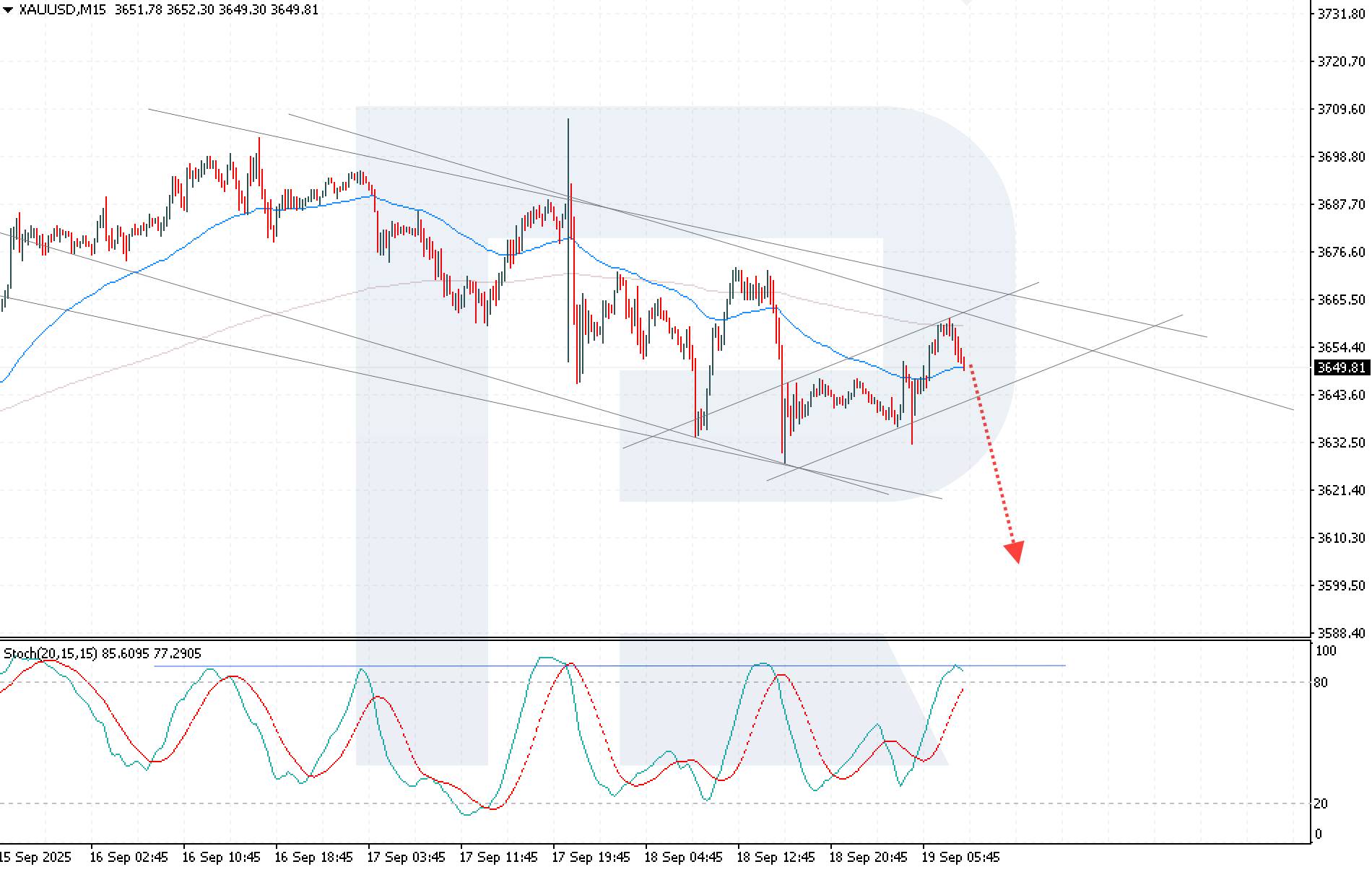
          Gold retains upside potential, but further strength will depend on more dovish Federal Reserve signals. Meanwhile, the XAUUSD forecast for 19 September 2025 points to a high downside risk, and the bearish scenario remains the priority, with a target at 3,610 USD.

          Gold (XAUUSD) is attempting to recover after recent declines, remaining in focus as investors assess the latest Fed decision. The exchange rate currently stands at 3,649 USD. Discover more in our analysis for 19 September 2025.

          XAUUSD forecast: key trading points

          The Federal Reserve left room for further rate cuts but emphasised that high inflation may slow the pace of easing.
          Market sentiment remains optimistic, but enthusiasm has faded.
          Fed commentary disappointed investors hoping for a more dovish stance.
          XAUUSD forecast for 19 September 2025: 3,610.

          Fundamental analysis

          XAUUSD prices are recovering after two consecutive sessions of losses, with buyers defending the 3,630 USD support level, indicating resilient demand. Pressure on the metal increased after the Federal Reserve cut its key interest rate for the first time since December, but left room for further action. The regulator also emphasised that persistent inflation could slow the pace of future easing.

          Market sentiment remains optimistic, yet enthusiasm has clearly cooled. The Federal Reserve failed to meet market participants' expectations for a more dovish signal. While the Fed projected two rate cuts this year, supporting gold, its outlook for just one cut in 2026 was more hawkish than markets expected, tempering upward momentum.

          Overall, the XAUUSD price forecast indicates upside potential, but sustained growth will likely require a softer Fed tone.

          XAUUSD technical analysis

          Despite recent recovery attempts, XAUUSD prices remain within a descending channel, with sellers pushing prices back below the 3,655 USD resistance level – a sign of continued pressure.

          Today’s XAUUSD analysis suggests a bearish scenario, with quotes likely to decline towards 3,610 USD. The Stochastic Oscillator has turned lower from overbought territory, confirming the risk of corrective downside.

          Consolidation below 3,630 USD would confirm a breakout below the corrective channel’s lower boundary and strengthen the bearish outlook for gold against the dollar.

          Source: RoboForex

          To stay updated on all economic events of today, please check out our Economic calendar
          Risk Warnings and Disclaimers
          You understand and acknowledge that there is a high degree of risk involved in trading. Following any strategies or investment methods may lead to potential losses. The content on the site is provided by our contributors and analysts for information purposes only. You are solely responsible for determining whether any trading assets, securities, strategy, or any other product is suitable for investing based on your own investment objectives and financial situation.
          Add to Favorites
          Share

          China Set to Hold Lending Rates Steady Despite Fed's Easing Amid Measured Stimulus Outlook

          Gerik

          Economic

          PBOC Likely to Leave LPR Unchanged Amid Fed Divergence

          In a move highlighting its cautious policy stance, the People’s Bank of China (PBOC) is expected to keep its key lending benchmarks the one-year and five-year Loan Prime Rates (LPRs) unchanged at 3.00% and 3.50% respectively. All 20 respondents in a Reuters poll this week predicted no change at the monthly LPR setting due Monday, despite the U.S. Federal Reserve delivering a 25-basis-point rate cut.
          The decision follows the PBOC's move on Thursday to hold its seven-day reverse repo rate steady, reinforcing that adjustments in LPR typically follow changes in key policy rates. This reflects the central bank’s reluctance to respond directly to U.S. monetary policy shifts, especially amid a complex domestic economic environment.

          Cautious Stimulus Despite Economic Headwinds

          Although recent data shows China’s economy facing a broad slowdown especially in the July–August period authorities appear hesitant to unleash aggressive stimulus. A rally in domestic stock markets and steady export performance are providing some buffer, reducing the urgency for immediate fiscal or monetary intervention.
          Barclays analysts noted that if the current trade détente between Washington and Beijing holds, Beijing may feel even less pressure to implement large-scale fiscal packages. This restraint aligns with the government’s strategic objective of achieving but not overshooting its 2025 GDP growth target of "around 5%."

          Structural Constraints and Targeted Easing Still Expected

          China’s unique monetary system ties most new and outstanding loans to the one-year LPR, while the five-year LPR guides mortgage rates. Although both rates were trimmed by 10 basis points in May, the central bank has refrained from further cuts in subsequent months. Market participants expect that any future easing would likely be marginal and targeted.
          Macquarie's chief China economist Larry Hu emphasized that while poor activity data from July and August increases pressure for policy action, Chinese authorities prefer a gradual approach: "They don’t want to miss the 5% GDP target, but they won’t want to overachieve it, either."
          Beijing's expected decision to hold LPR rates steady suggests confidence in managing economic recovery without risking excessive leverage or inflationary pressure. As global central banks like the Fed shift toward easing, China continues to chart its own course one defined by incremental policy support, cautious optimism, and strategic independence.

          Source: Reuters

          To stay updated on all economic events of today, please check out our Economic calendar
          Risk Warnings and Disclaimers
          You understand and acknowledge that there is a high degree of risk involved in trading. Following any strategies or investment methods may lead to potential losses. The content on the site is provided by our contributors and analysts for information purposes only. You are solely responsible for determining whether any trading assets, securities, strategy, or any other product is suitable for investing based on your own investment objectives and financial situation.
          Add to Favorites
          Share

          China Turns to Australian Canola Amid Ongoing Spat with Canada

          Gerik

          Economic

          China Quietly Diversifies Away from Canadian Canola

          As diplomatic and trade tensions between China and Canada intensify, China has acted swiftly to diversify its agricultural imports. In the latest development, Chinese state-owned trader COFCO has purchased up to nine 60,000-ton cargoes of Australian canola, totaling around 540,000 tons, according to three trade sources cited by Reuters.
          This volume represents approximately 8% of China’s total canola imports in 2024 and is seen as a direct response to China’s imposition of preliminary anti-dumping duties of 75.8% on Canadian canola in August 2025. These steep tariffs have effectively brought Canadian shipments to a halt, leaving Beijing to explore alternative sources amid ongoing trade tensions with Ottawa.

          Australia Re-Emerges as Canola Supplier After Biosecurity Freeze

          Australia, the world’s second-largest canola exporter after Canada, had been largely absent from the Chinese market due to biosecurity concerns since 2020. However, diplomatic progress earlier this year enabled five trial cargoes, paving the way for this latest wave of larger purchases.
          An Australia-based agricultural broker noted that the buying operation was characteristically low-profile. “They just went in quietly and bought nine cargoes from several major trading companies in Australia,” the broker said.
          The shipments are expected to load between November and January, positioning Australian exporters to fill at least a portion of the supply void left by Canada.

          Canola’s Dual Use: Oil and Feed

          Canola, also known as rapeseed, is a critical commodity in China, used to produce cooking oil and as a protein-rich livestock feed. With China being the world’s largest importer of canola importing 6.4 million tons worth $3.4 billion in 2024, nearly all from Canada the move to diversify suppliers is both economically and strategically significant.
          However, Australia’s ability to scale up may be limited due to its smaller production base compared to Canada. This raises questions about whether Australia can serve as a long-term replacement or merely a stopgap during the current trade impasse.

          Geopolitics Loom Over Agricultural Trade

          The trade shift comes as China’s Ministry of Commerce extended its investigation into Canadian canola until March 2026, buying more time for negotiations while keeping uncertainty alive for Canadian exporters. The final ruling may uphold, revise, or remove the current tariffs, but until then, China appears intent on hedging its supply chain risks by engaging alternative partners.
          While the recent canola purchases from Australia are notable, they may also serve as a signal to other exporters that China is actively seeking to reduce dependence on any single trading partner particularly in politically sensitive categories such as food and agriculture.

          Source: Reuters

          To stay updated on all economic events of today, please check out our Economic calendar
          Risk Warnings and Disclaimers
          You understand and acknowledge that there is a high degree of risk involved in trading. Following any strategies or investment methods may lead to potential losses. The content on the site is provided by our contributors and analysts for information purposes only. You are solely responsible for determining whether any trading assets, securities, strategy, or any other product is suitable for investing based on your own investment objectives and financial situation.
          Add to Favorites
          Share

          Europe’s EV Makers Line Up At Estonia’s Rare-Earth Magnet Plant

          Samantha Luan

          Stocks

          Forex

          Economic

          Commodity

          Executives from Europe’s electric-vehicle industry are trekking to the continent’s sparsely populated northeastern parts to queue for something they struggle to find anywhere outside of China: rare-earths magnets that are essential components in EVs.In Narva, an Estonian industrial town that sits across the river from Russia, Canadian company Neo Performance Materials has built a $75 million magnets plant that’s opening on Friday. Neo’s initial output will supply components for as many as 1 million cars annually.

          The ribbon-cutting is happening as carmakers rev up EV production in a critical phase of Europe’s energy transition. The plant in Estonia is offering a chance to lock in supply chains at a time of global trade tensions, including over rare earths with China.“This is the most important critical materials project happening in Europe today,” Neo CEO Rahim Suleman said in an interview ahead of the factory opening.Europe and the world’s vulnerabilities were exposed earlier this year when Beijing in April heavily restricted the export of some of its rare earths in retaliation against US President Donald Trump’s decision to hike tariffs on Chinese goods.

          Neo’s Estonian plant manufactures neodymium magnets, one of the products restricted by China. The magnets convert the electricity stored in a battery into motion, helping rotate the wheels of EVs. They are also used widely from smartphones to wind turbines and fighter jets.A shortage of rare earth magnet supplies earlier this year forced Ford Motor Co. to idle production of its Explorer sport utility vehicle in Chicago for a week.

          Neo — which is also active in chemicals and metals and has 10 manufacturing plants globally, including in the United States and China — made the decision to build the new factory in Estonia in late 2022, months after Russia’s full-scale invasion of Ukraine disrupted Europe’s economy. Neo managed to complete its site on time and within budget, Suleman said.“With the exception of Neo there is no EV traction motor magnet manufacturing capacity in the West,” Marvin Wolff, an analyst at Paradigm Capital, said in an Aug. 12 report.The plant will initially produce 2,000 tons of magnets per year, about a tenth of the demand in Europe. The factory will source its own raw materials from Australia.

          Neo has signed “multiple” five- to seven-year contracts in the range of $50-$100 million, Suleman said, adding that major deliveries are set to begin in 2026.

          “Customer demand is through the roof,” Suleman said.

          German car parts supplier Schaeffler AG is among the buyers, Reuters reported earlier. Another major customer will be announced on Friday in Estonia.Neo plans to triple capacity there after an expansion that could begin in 2027. It would cater to soaring demand fueled by European carmakers, who are pivoting toward EVs ahead of a 2035 deadline to ban the sale of new vehicles with combustion engines.While there are signs that the EU directive may be watered down — German Chancellor Friedrich Merz last week backed a bid by his country’s carmakers to soften the rules — the direction of travel toward more EVs isn’t in doubt.

          BMW, Volkswagen and Mercedes-Benz Group AG all unveiled new EV models at the Munich auto show last week that they said would put them in a position to take on intensifying competition from China.The magnets trade is expected to be among the thorniest items for negotiation when Trump and Chinese President Xi Jinping are scheduled to meet at the end of October on the sidelines of the Asia-Pacific Economic Cooperation meeting in South Korea.While China has recently eased its rare-earths controls — exports rose to a highest monthly level in August since at least 2012, according to Bloomberg calculations based on Chinese customs data — Beijing’s earlier weaponization of its market dominance has spurred Western companies to look for alternative suppliers.

          Last month, General Motors Co. signed a deal with Texas-based Noveon Magnetics Inc. to secure rare-earth magnets for its full-size pickup trucks and SUVs. Along with contracts with Las Vegas-based MP Materials Corp. and E-Vac Magnetics, a South Carolina-based unit of Germany’s Vacuumschmelze GmbH, GM plans to get the majority of rare-earth magnets it sources directly from domestic suppliers.

          MP Materials, the sole US rare earths miner, only plans to start commercial production of magnets later this year and it’s expected to operate at modest levels of production prior to a Pentagon-funded expansion.Neo, in this respect, appears to have an edge — much to the delight of Canada and the EU. Estonia, an EU member, is currently the only place outside of Asia that does rare earth separation and refining.European Commission President Ursula von der Leyen passed around a magnet from Neo’s plant in the Baltic country at a Group of Seven meeting in Kananaskis, western Canada in June. Canadian Prime Minister Mark Carney also brandished a sample during a speech there, hailing his nation as one with “immense potential” as a rare-earths supplier.

          “Everyone else frankly in the industry is generally making promises about what they’ll be doing in the future,” Neo’s Suleman said. “We built it in under 500 days.”

          Source: Bloomberg Europe

          To stay updated on all economic events of today, please check out our Economic calendar
          Risk Warnings and Disclaimers
          You understand and acknowledge that there is a high degree of risk involved in trading. Following any strategies or investment methods may lead to potential losses. The content on the site is provided by our contributors and analysts for information purposes only. You are solely responsible for determining whether any trading assets, securities, strategy, or any other product is suitable for investing based on your own investment objectives and financial situation.
          Add to Favorites
          Share

          BTC Hits $118K: Market Surge Follows Fed Decision

          Olivia Brooks

          Cryptocurrency

          Key Points:

          ●BTC surges to $118K, BNB to $1K, ETF speculation rises.
          ●PENGU leads market with ETF and bullish trends.
          ●Institutional inflow impacts liquidity, volumes up 300%.

          BTC Hits $118K: Market Surge Follows Fed Decision

          BTC hits $118,000 and BNB rises to $1,000 following the Fed's rate cut, with PENGU leading market gains due to ETF speculation and strong technical indicators.

          Institutional interest and retail activity surge, significantly impacting major cryptocurrencies and PENGU, as ETF-related movements continue to influence market dynamics, drawing increased attention to meme coins and NFTs.

          BTC has surged to $118,000, reaching a new height following the recent Fed rate cut. This comes alongside BNB reaching $1,000, highlighting significant market reactions to both institutional and retail investor movements.

          PENGU has demonstrated significant performance, attracting attention due to ETF speculation and a bullish technical setup. Luca Netz, leading Pudgy Penguins, remains central, although no direct public statements have been issued.

          Institutional interest is evident with Canary Capital's ETF application, impacting BTC and BNB. Rising open interest and liquidity spikes reflect increased trading volumes, supporting a broader risk-on sentiment.

          Assets like ETH benefit indirectly, although not principal focuses. Historical ETF-driven rallies reinforce patterns, with meme tokens experiencing large volatility, emphasizing speculative enthusiasm.

          Funding and accumulation indicate a robust investor interest, with PENGU purchases exceeding $424,000. Coupled with volume increases and on-chain data, the market showcases a clear risk rotation.

          Upcoming ETF reviews may sustain interest, with analysts eyeing potential market shifts. Data-driven insights underpin potential financial and technological impacts, stressing continued vigilance in crypto market developments.

          Source: CryptoSlate

          Risk Warnings and Disclaimers
          You understand and acknowledge that there is a high degree of risk involved in trading. Following any strategies or investment methods may lead to potential losses. The content on the site is provided by our contributors and analysts for information purposes only. You are solely responsible for determining whether any trading assets, securities, strategy, or any other product is suitable for investing based on your own investment objectives and financial situation.
          Add to Favorites
          Share
          FastBull
          Copyright © 2025 FastBull Ltd

          728 RM B 7/F GEE LOK IND BLDG NO 34 HUNG TO RD KWUN TONG KLN HONG KONG

          TelegramInstagramTwitterfacebooklinkedin
          App Store Google Play Google Play
          Products
          Charts

          Chats

          Q&A with Experts
          Screeners
          Economic Calendar
          Data
          Tools
          Membership
          Features
          Function
          Markets
          Copy Trading
          Latest Signals
          Contests
          News
          Analysis
          24/7
          Columns
          Education
          Company
          Careers
          About Us
          Contact Us
          Advertising
          Help Center
          Feedback
          User Agreement
          Privacy Policy
          Business

          White Label

          Data API

          Web Plug-ins

          Poster Maker

          Affiliate Program

          Risk Disclosure

          The risk of loss in trading financial instruments such as stocks, FX, commodities, futures, bonds, ETFs and crypto can be substantial. You may sustain a total loss of the funds that you deposit with your broker. Therefore, you should carefully consider whether such trading is suitable for you in light of your circumstances and financial resources.

          No decision to invest should be made without thoroughly conducting due diligence by yourself or consulting with your financial advisors. Our web content might not suit you since we don't know your financial conditions and investment needs. Our financial information might have latency or contain inaccuracy, so you should be fully responsible for any of your trading and investment decisions. The company will not be responsible for your capital loss.

          Without getting permission from the website, you are not allowed to copy the website's graphics, texts, or trademarks. Intellectual property rights in the content or data incorporated into this website belong to its providers and exchange merchants.

          Not Logged In

          Log in to access more features

          FastBull Membership

          Not yet

          Purchase

          Become a signal provider
          Help Center
          Customer Service
          Dark Mode
          Price Up/Down Colors

          Log In

          Sign Up

          Position
          Layout
          Fullscreen
          Default to Chart
          The chart page opens by default when you visit fastbull.com