Markets
News
Analysis
User
24/7
Economic Calendar
Education
Data
- Names
- Latest
- Prev


Signal Accounts for Members
All Signal Accounts
All Contests


U.K. Trade Balance (Oct)A:--
F: --
P: --
U.K. Services Index MoMA:--
F: --
P: --
U.K. Construction Output MoM (SA) (Oct)A:--
F: --
P: --
U.K. Industrial Output YoY (Oct)A:--
F: --
P: --
U.K. Trade Balance (SA) (Oct)A:--
F: --
P: --
U.K. Trade Balance EU (SA) (Oct)A:--
F: --
P: --
U.K. Manufacturing Output YoY (Oct)A:--
F: --
P: --
U.K. GDP MoM (Oct)A:--
F: --
P: --
U.K. GDP YoY (SA) (Oct)A:--
F: --
P: --
U.K. Industrial Output MoM (Oct)A:--
F: --
P: --
U.K. Construction Output YoY (Oct)A:--
F: --
P: --
France HICP Final MoM (Nov)A:--
F: --
P: --
China, Mainland Outstanding Loans Growth YoY (Nov)A:--
F: --
P: --
China, Mainland M2 Money Supply YoY (Nov)A:--
F: --
P: --
China, Mainland M0 Money Supply YoY (Nov)A:--
F: --
P: --
China, Mainland M1 Money Supply YoY (Nov)A:--
F: --
P: --
India CPI YoY (Nov)A:--
F: --
P: --
India Deposit Gowth YoYA:--
F: --
P: --
Brazil Services Growth YoY (Oct)A:--
F: --
P: --
Mexico Industrial Output YoY (Oct)A:--
F: --
P: --
Russia Trade Balance (Oct)A:--
F: --
P: --
Philadelphia Fed President Henry Paulson delivers a speech
Canada Building Permits MoM (SA) (Oct)A:--
F: --
P: --
Canada Wholesale Sales YoY (Oct)A:--
F: --
P: --
Canada Wholesale Inventory MoM (Oct)A:--
F: --
P: --
Canada Wholesale Inventory YoY (Oct)A:--
F: --
P: --
Canada Wholesale Sales MoM (SA) (Oct)A:--
F: --
P: --
Germany Current Account (Not SA) (Oct)A:--
F: --
P: --
U.S. Weekly Total Rig CountA:--
F: --
P: --
U.S. Weekly Total Oil Rig CountA:--
F: --
P: --
Japan Tankan Large Non-Manufacturing Diffusion Index (Q4)--
F: --
P: --
Japan Tankan Small Manufacturing Outlook Index (Q4)--
F: --
P: --
Japan Tankan Large Non-Manufacturing Outlook Index (Q4)--
F: --
P: --
Japan Tankan Large Manufacturing Outlook Index (Q4)--
F: --
P: --
Japan Tankan Small Manufacturing Diffusion Index (Q4)--
F: --
P: --
Japan Tankan Large Manufacturing Diffusion Index (Q4)--
F: --
P: --
Japan Tankan Large-Enterprise Capital Expenditure YoY (Q4)--
F: --
P: --
U.K. Rightmove House Price Index YoY (Dec)--
F: --
P: --
China, Mainland Industrial Output YoY (YTD) (Nov)--
F: --
P: --
China, Mainland Urban Area Unemployment Rate (Nov)--
F: --
P: --
Saudi Arabia CPI YoY (Nov)--
F: --
P: --
Euro Zone Industrial Output YoY (Oct)--
F: --
P: --
Euro Zone Industrial Output MoM (Oct)--
F: --
P: --
Canada Existing Home Sales MoM (Nov)--
F: --
P: --
Euro Zone Total Reserve Assets (Nov)--
F: --
P: --
U.K. Inflation Rate Expectations--
F: --
P: --
Canada National Economic Confidence Index--
F: --
P: --
Canada New Housing Starts (Nov)--
F: --
P: --
U.S. NY Fed Manufacturing Employment Index (Dec)--
F: --
P: --
U.S. NY Fed Manufacturing Index (Dec)--
F: --
P: --
Canada Core CPI YoY (Nov)--
F: --
P: --
Canada Manufacturing Unfilled Orders MoM (Oct)--
F: --
P: --
Canada Manufacturing New Orders MoM (Oct)--
F: --
P: --
Canada Core CPI MoM (Nov)--
F: --
P: --
Canada Manufacturing Inventory MoM (Oct)--
F: --
P: --
Canada CPI YoY (Nov)--
F: --
P: --
Canada CPI MoM (Nov)--
F: --
P: --
Canada CPI YoY (SA) (Nov)--
F: --
P: --
Canada Core CPI MoM (SA) (Nov)--
F: --
P: --
Canada CPI MoM (SA) (Nov)--
F: --
P: --


No matching data
Latest Views
Latest Views
Trending Topics
Top Columnists
Latest Update
White Label
Data API
Web Plug-ins
Affiliate Program
View All

No data
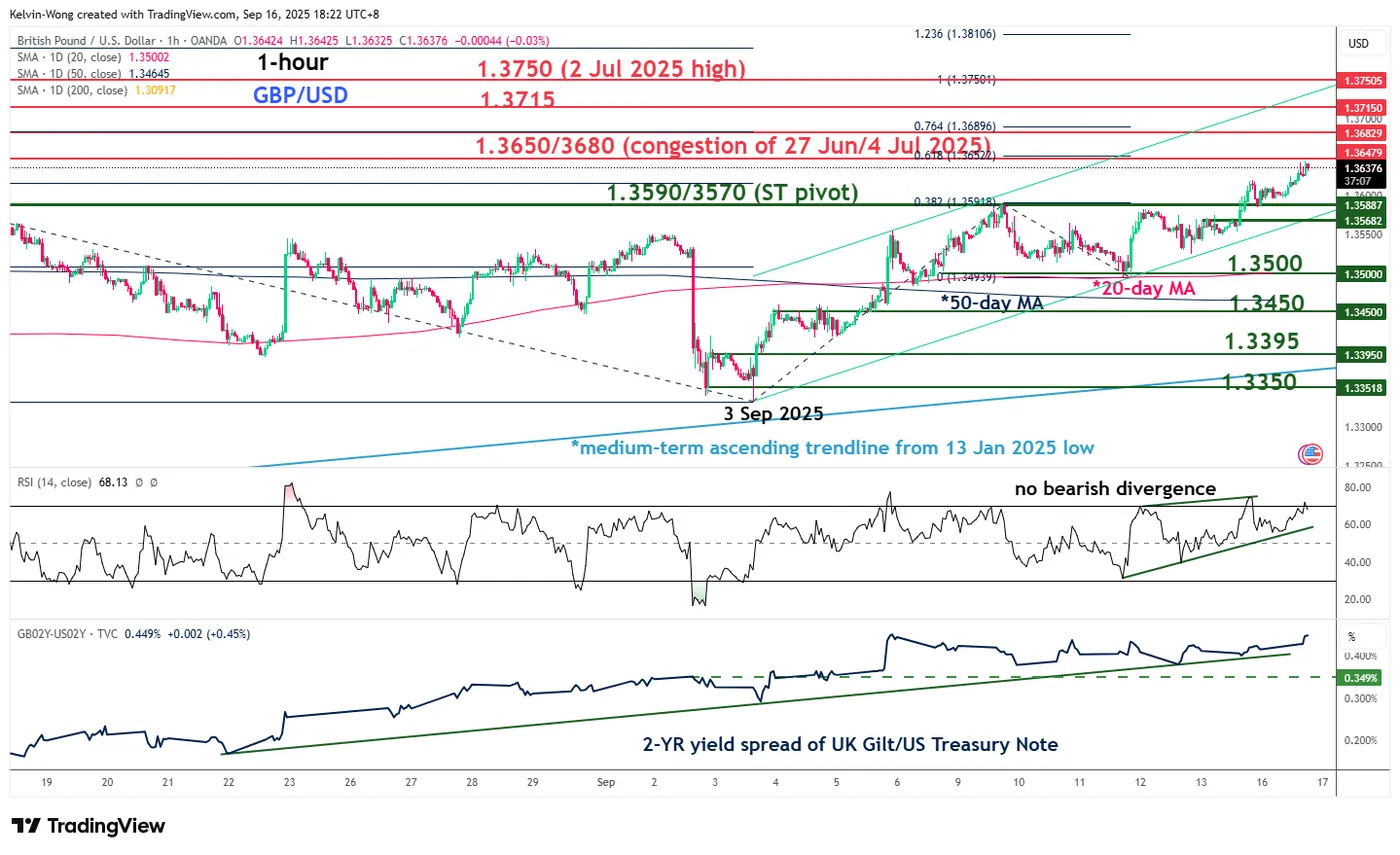
The price actions of the sterling have staged the expected recovery against the US dollar, as the GBP/USD has rallied by 1.2% and almost hit the lower limit of our highlighted resistance zone of 1.3650/1.3680 (printed an intraday high of 1.3645 on Tuesday, 16 September 2025, at the time of writing).
Today’s stellar performance of the GBP/USD (+0.3% has also been reinforced by better-than-expected July’s employment change data for the UK, which came in at 232,000, above the consensus of 222,000, while the unemployment rate remained steady for the third consecutive month at 4.7%, in line with expectations.
Let’s now update the short-term (1 to 3 days) trajectory and key technical elements of the GBP/USD ahead of tomorrow’s FOMC monetary policy decision outcome and the release of the latest Fed economic projections (dot plot).
Preferred trend bias (1-3 days)
A new minor bullish impulsive up move sequence is likely to have kicked off for the GBP/USD from its 3 September 2025 minor bullish reversal low of 1.3333 on the onset of the intraday spike up of the 30-year UK gilt yield over fiscal policy fears.
Maintain bullish bias above a tightened short-term pivotal support of 1.3590/1.3570 on the GBP/USD, with the next intermediate resistances to come in at 1.3715 and 1.3750 (also a Fibonacci extension).
Key elements
Alternative trend bias (1 to 3 days)
A break below 1.3570 key short-term support in GBP/USD will negate the bullish tone for a deeper minor corrective decline to expose the next intermediate supports at 1.3500 (also the 20-day moving average) and 1.3450 (also the 50-day moving average)
Key points:
The Fed looks set to cut rates this week after a string of softer data. Job growth has slowed, unemployment has edged up, producer prices turned negative in August, and consumer inflation was broadly in line. This marks the start of an easing cycle.For long-term investors, the key is not the size of the cut, but how different asset classes and segments might respond.
Equities often benefit from easier monetary policy because lower rates reduce financing costs and improve valuations. The opportunity set is also expanding beyond mega-cap technology.
In summary, any sector where large upfront capital spending meets long-dated cash flows — such as miners, utilities, renewables, infrastructure, pipelines, and REITs — stands to gain more than average when financing costs ease. Pairing these capital-heavy sectors with structural demand themes like AI power, electrification, and the energy transition makes the case even stronger.
Quality fixed income offers attractive risk-reward and diversification benefits. Lower policy rates are likely to push Treasury yields down, creating space for government and investment-grade bonds to deliver mid-single-digit returns over the next year. If U.S. growth slows further, yields could fall quickly, giving bonds added capital gains.
Cash was a comfortable trade when deposits and money-market funds yielded 4–5%. With rate cuts on the way, those returns will fade quickly, making idle cash less attractive.
Risks still loom
Rate cuts mark a turning point in the policy cycle. Equities could broaden beyond mega-cap tech into small caps, utilities, and EM. Bonds regain their role as a true diversifier, while gold and infrastructure look more attractive as funding costs ease.Most importantly, idle cash is set to underperform and it can be redeployed across bonds for yield, equities for growth, or real assets for diversification.The Fed is shifting gears, but inflation, growth, and politics will shape the road ahead.
Governments in the UK and France this year have been punished by bond investors over failures to shrink fiscal deficits, while in the US the Trump administration has been — for what it’s worth — making the case its policies will be reining in federal borrowing needs soon.
Not all the Group of Seven advanced economies are focused on fiscal discipline, however. Germany’s infrastructure-cum-defense buildout initiative is well known. Another case that may get less attention: Canada.
Prime Minister Mark Carney on Sunday confirmed he plans to run a “substantial” deficit — higher than last year’s shortfall of approximately C$48 billion ($35 billion). That reflects a broad plan to invest in the domestic economy and put growth on a trajectory in coming years that relies less on its southern neighbor, the US.
President Donald Trump’s tariffs have hit Canada’s economy hard, triggering the first contraction in GDP in nearly two years last quarter. That’s eroding revenues and requiring spending to support industry and workers.
Since his successful election campaign in April, Carney has outlined billions in additional federal expenditures to boost defense and increase construction of affordable housing.
“There’s going to be implications for the deficit, but it’ll build a much stronger Canada moving forward,” Carney told reporters. For now, a (slight) majority of Canadians agree, with a recent poll offering the prime minister backing for his approach.
Canada’s starting point is solid, with the lowest net debt to gross domestic product ratio in the G-7 — at little more than 40% last year, compared with roughly 100% for the US — and the top sovereign ratings from Moody’s and S&P.
The latest survey of economists by Bloomberg reflects expectations for a deficit of over 2% of GDP this year, still well below the 3% that France is struggling to reach or the north-of-6% the US has been running.
Also, Carney says his government will be looking for savings in other areas as it compiles the budget to be unveiled next month. The plan will feature both “austerity and investment,” he’s said, pushing for major reviews of operational spending in the public sector. A review of procurement practices is also in train.
In something reminiscent of former UK Chancellor Gordon Brown’s “golden rule” (only borrow to fund investment over the economic cycle) Ottawa will be looking to separate the budget into operating expenses and capital investments, something economists are divided on.
“Splitting the budget is just marketing — the ‘investment’ items are still outlays that will require financing,” says Stuart Paul of Bloomberg Economics.
Discounts for Iranian oil in China have widened on record stock levels at a major refining hub and as a shortage of import quotas towards year-end hindered buying by independent processors, six trade sources told Reuters.
Slowing demand from Chinese independent refiners in Shandong province, known as teapots, adds to pressure on Iran to sustain its oil revenue amid Western sanctions aimed at curbing its uranium enrichment programme.
Those sanctions have reduced shipments into a key Chinese port, according to data analytics firm Kpler.
Washington most recently imposed sanctions on August 21 on Qingdao Port Haiye Dongjiakou Oil Products, controlled by local government-backed Qingdao Port International, for receiving Iranian oil on designated tankers.
The Haiye Dongjiakou terminal, the sixth in China to be blacklisted by the U.S., previously handled 130,000-200,000 barrels per day of Iranian crude, making it one of China's largest receiving terminals for such oil, two of the sources said.
That terminal suspended operations shortly after the U.S. penalty, three people familiar with the terminal said.
China has bought over 90% of Iranian oil exports in the past few years, with January-August imports at an average of 1.43 million bpd, up 12% annually, according to estimates by tanker tracker Vortexa.
To circumvent sanctions, dealers brand Iranian oil mostly as Malaysian, after trans-shipment near Malaysian waters.
China defends its oil trade with Iran as conforming with international law, and describes unilateral U.S. sanctions as illegitimate.
Haiye Dongjiakou did not respond to calls and emailed requests for comment. Qingdao Port International did not respond to an emailed request for comment on the sanctions impact.
Crude imports at Dongjiakou port have declined 65% this month, Kpler senior analyst Ying Cong Loh said, citing data as of September 15. A separate terminal at the port, Qingdao Shihua Crude Oil Terminal, has not been sanctioned.
Traders have been diverting Iranian shipments to nearby terminals if the vessels have not been sanctioned, three trade sources dealing with Iranian oil said. They declined to be named due to the sensitivity of the matter.
Iranian oil imports at Huangdao, another discharge hub in the broader Qingdao Port area, are expected to rise to 229,000 bpd in September, twice the 123,000 bpd in August, Kpler's predictive data showed last week.
Discounts for Iranian Light crude widened to over $6 a barrel versus benchmark ICE Brent this week for October-arrival shipments, five trade sources said, compared with around $5 a barrel two weeks ago and $3 in March.
Record crude stocks in Shandong depressed refining margins at smaller independents, while a shortage of government-issued import quotas hindered buying, the sources added.
Deeper discounts also reflect a price reduction by Iranian suppliers to account for sanctions-linked costs for customers, an Iranian trade source familiar with Tehran's oil marketing said in late August.
Shandong's onshore commercial crude oil inventories reached a record 293 million barrels as of August 22, 20 million barrels above levels at the start of July, much of it due to Iranian oil, according to tanker tracker Vortexa Analytics.
Today’s latest snapshot of the UK jobs market shows what is becoming a familiar pattern: a gradual slowdown in hiring, rising unemployment, yet with wage growth still uncomfortably high for policymakers.Whether because of Rachel Reeves’s £25bn national insurance increase, AI-related disruption or Donald Trump’s tariffs – perhaps all three – companies seem to be cautious about taking on staff.
In the July to August period, the number of vacancies in the economy, was down by 119,000 on a year earlier.The unemployment data only runs to July – but it shows 2.3 unemployed people for each vacancy, up from 2.2 in the previous quarter.The unemployment rate was up by 0.1 percentage points on the previous three months – at 4.7% – the highest rate in four years.Employment was also rising, however, in part as more people move from being economically inactive, into the workforce.At 21.1%, the economic inactivity rate was down 0.8 percentage points on a year earlier – though it remains stubbornly higher than before the pandemic.
And as Helen Gray, the chief economist at the Learning and Work Institute thinktank, warned, “while economic inactivity is falling, a sizeable number of those returning to the labour market appear to be seeking work, rather than entering employment.”Bank of England policymakers, who meet on Thursday to decide interest rates, have been waiting for this slowdown in the labour market – under way for many months now – to bring wage inflation under control.Yet so far that has been a slow process, and wage growth remained relatively robust, at an annual rate of 4.8% excluding bonuses in the three months to July, according to the ONS.
When wages are rising strongly, economists fret that it will create the space for companies to continue raising their prices, contributing to a further round of inflation.The Bank’s governor, Andrew Bailey, has repeatedly stressed the importance of the jobs market, and specifically wages, in determining where interest rates go from their current level of 4%. The latest data makes it even less likely that the Bank’s monetary policy committee will cut rates this week.While wage growth remains higher than the Bank believes is consistent with meeting its inflation target, however, it will not feel that way for workers.
With inflation on the rise again, pushed up by food prices and energy bills, the ONS calculates that real wages are just 1% higher than a year ago – or 0.5% once housing costs are taken into account.That is likely to mean that many consumers continue to feel the pinch, despite Labour’s stated determination to ensure economic growth can be felt in workers’ pockets.As Ben Harrison, the director of the Work Foundation thinktank, put it: “the combination of stagnant living standards and sticky inflation means that people are still likely to feel pessimistic about their household finances one year into the new parliament.”
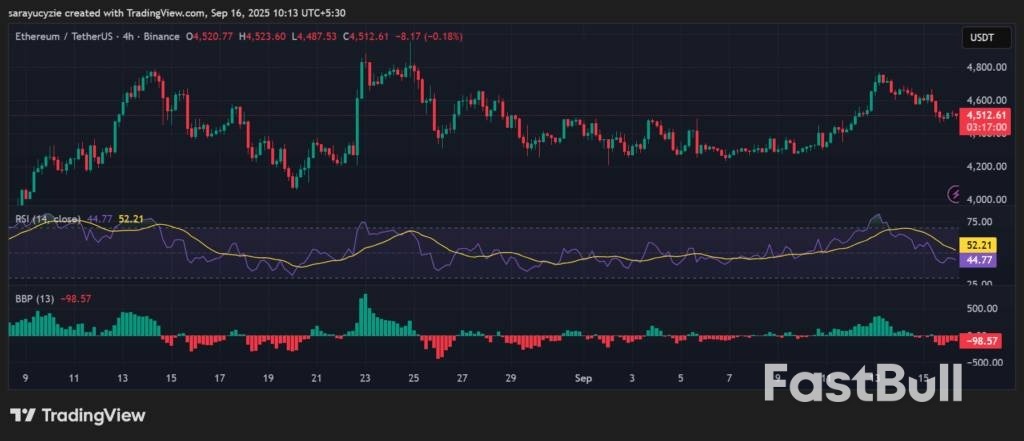
With the continuous bearish fall, the crypto market remains under downside pressure. Notably, the overall market sentiment is neutral, as the Fear and Greed Index value is located at 50. The majority of the assets had begun to lose momentum and charted in red. Meanwhile, the largest altcoin, Ethereum (ETH), has posted a 3.05% loss.
ETH’s strong bearish pressure resists the price from going up, and the bears block the bulls from stepping in. Continuous downside may bring in more losses ahead. The altcoin opened the day trading at around a high of $4,670. Gradually, the bears entered the ETH market and pulled the price back toward the $4,469 range.
At press time, Ethereum traded at around the $4,518 mark, with the market cap reaching $546.29 billion. Besides, the daily trading volume has surged by over 31.69%, touching $38.22 billion. As per Coinglass data, the market has experienced an event of $109.07 million worth of Ethereum liquidated in the last 24 hours.
Ethereum’s Moving Average Convergence Divergence (MACD) line is found below the signal line, implying a bearish crossover. If the downtrend gains enough strength, the price could continue falling. In addition, the Chaikin Money Flow (CMF) indicator at -0.22 points to the selling pressure outweighing buying pressure. The capital is flowing out of the asset, showing a weakness in ETH demand.
With the active downward pressure, the price might fall and find the key support at the $4,511 range. If the bears could extend the correction, the death cross may unfold, pushing the Ethereum price below $4,504 or even lower. Assuming a bullish wave takes control, which triggers the price to move up toward the $4,525 resistance. A steady bullish correction could invite the golden cross to emerge, and send the price of ETH above the $4,532 mark.
ETH chart (Source: TradingView)Furthermore, the daily Relative Strength Index (RSI) of ETH settled at 44.77, indicating a neutral territory that leans slightly toward the bearish side. Also, it may approach the oversold zone near 30. Ethereum’s Bull Bear Power (BBP) reading of -98.57 suggests that the bears currently have a clear upper hand, pushing the price below. If the value goes further down, it will hint at a strong downtrend.
Investors are confident that the Federal Reserve will lower its policy interest rate on Wednesday for the first time this year. Recent data support a modest cut, but the Fed would be wise to avoid signaling more reductions to come or pivoting decisively toward easing. For now, the data is too muddled for any such shift, and the central bank needs to keep an open mind.
The labor market is weaker than the Fed believed when its policymakers last met. Recent data revisions give much lower estimates of employment for the year to March, while the latest weekly jobless claims showed an increase to 263,000, the highest in four years. Those numbers are notoriously noisy, but the jobs market is plainly weakening.
That might seem to call for strong monetary stimulus. The problem is that inflation isn’t yet credibly on track toward the Fed’s 2% target. In August, the consumer price index excluding food and energy — so-called core CPI — rose 0.3%, for a year-over-year increase of 3.1%. This was roughly as expected, and it gave investors no reason to doubt that the policy rate would be trimmed this week. The fact remains: Higher-than-target inflation is stubbornly refusing to subside.
The Fed continues to assume that, at 4.25% to 4.5%, the current policy rate is gently tamping demand, enough to bring inflation back to target in due course. Maybe so. But again, caution is warranted. The neutral rate of interest — the level that neither adds to nor subtracts from demand — is unknown, one of many uncertainties clouding the outlook.
In particular, new tariffs don’t yet seem to be driving inflation higher: Importers are mostly absorbing the higher costs. That’s unlikely to last. Uncertainty over future tariffs, moreover, may itself prove to be inflationary, if it dents confidence enough to suppress supply more than demand. The administration’s crackdown on illegal immigration is yet another supply-side shock — and one that makes measures of labor-market tightness especially hard to read. Sluggish employment might reflect a shrinking supply of labor as much as a shortfall in demand.
A persistent combination of faltering supply and above-target inflation, otherwise known as stagflation, is a real possibility under these conditions. It’s a scenario that the Fed is ill-equipped to manage. The central bank’s dual mandate calls for maximum employment and stable prices — and stagflation means it cannot achieve both. Striking the right balance is especially difficult if its operational independence is in question, as it now is. The stage is set for rising inflation expectations, higher long-term borrowing costs and, eventually, an abrupt tightening of policy to get prices back under control.
For the moment, expectations seem reasonably well-anchored, a tribute to the Fed’s credibility, given the turbulence it’s being asked to navigate. In the meantime, the balance between labor-market cooling and persistent inflation has shifted — enough to warrant a quarter-point cut in the policy rate. A bigger cut, let alone promises of more to come, would be a mistake.
White Label
Data API
Web Plug-ins
Poster Maker
Affiliate Program
The risk of loss in trading financial instruments such as stocks, FX, commodities, futures, bonds, ETFs and crypto can be substantial. You may sustain a total loss of the funds that you deposit with your broker. Therefore, you should carefully consider whether such trading is suitable for you in light of your circumstances and financial resources.
No decision to invest should be made without thoroughly conducting due diligence by yourself or consulting with your financial advisors. Our web content might not suit you since we don't know your financial conditions and investment needs. Our financial information might have latency or contain inaccuracy, so you should be fully responsible for any of your trading and investment decisions. The company will not be responsible for your capital loss.
Without getting permission from the website, you are not allowed to copy the website's graphics, texts, or trademarks. Intellectual property rights in the content or data incorporated into this website belong to its providers and exchange merchants.
Not Logged In
Log in to access more features

FastBull Membership
Not yet
Purchase
Log In
Sign Up