• Trade
  • Markets
  • Copy
  • Contests
  • News
  • 24/7
  • Calendar
  • Q&A
  • Chats
Trending
Screeners
SYMBOL
LAST
BID
ASK
HIGH
LOW
NET CHG.
%CHG.
SPREAD
SPX
S&P 500 Index
6839.01
6839.01
6839.01
6878.28
6833.87
-31.39
-0.46%
--
DJI
Dow Jones Industrial Average
47728.34
47728.34
47728.34
47971.51
47695.55
-226.64
-0.47%
--
IXIC
NASDAQ Composite Index
23504.74
23504.74
23504.74
23698.93
23481.60
-73.38
-0.31%
--
USDX
US Dollar Index
99.080
99.160
99.080
99.160
98.730
+0.130
+ 0.13%
--
EURUSD
Euro / US Dollar
1.16268
1.16275
1.16268
1.16717
1.16162
-0.00158
-0.14%
--
GBPUSD
Pound Sterling / US Dollar
1.33155
1.33163
1.33155
1.33462
1.33053
-0.00157
-0.12%
--
XAUUSD
Gold / US Dollar
4189.54
4189.97
4189.54
4218.85
4175.92
-8.37
-0.20%
--
WTI
Light Sweet Crude Oil
58.893
58.923
58.893
60.084
58.837
-0.916
-1.53%
--

Community Accounts

Signal Accounts
--
Profit Accounts
--
Loss Accounts
--
View More

Become a signal provider

Sell trading signals to earn additional income

View More

Guide to Copy Trading

Get started with ease and confidence

View More

Signal Accounts for Members

All Signal Accounts

Best Return
  • Best Return
  • Best P/L
  • Best MDD
Past 1W
  • Past 1W
  • Past 1M
  • Past 1Y

All Contests

  • All
  • Trump Updates
  • Recommend
  • Stocks
  • Cryptocurrencies
  • Central Banks
  • Featured News
Top News Only
Share

EU's Foreign Chief: Giving Ukraine The Resources It Needs To Defend Itself Doesn't Prolong The War, It Can Help End It

Share

EU's Foreign Chief: Securing Multi-Year Funding For Ukraine In December Is Absolutely Essential

Share

[Bank For International Settlements: US Tariffs Drive Record Global FX Trading Volume] Data From The Bank For International Settlements (BIS) Shows That Global FX Trading Volume Surged To A Record High This Year, With An Average Daily Trading Volume Of $9.5 Trillion In April, Amid Market Turmoil Triggered By US President Trump's Tariff Policies. On December 8, The Bank Released Its Quarterly Assessment, Citing Data From Its Triennial Survey, Stating That The Impact Of Tariffs Was "substantial," Leading To An Unexpected Depreciation Of The US Dollar And Accounting For Over $1.5 Trillion In Average Daily OTC Trading Volume In April. The Report Shows That Overall FX Trading Volume Increased By More Than A Quarter Compared To The Last Survey In 2022, Surpassing The Estimated Peak During The Market Turmoil Caused By The COVID-19 Pandemic In March 2020. This Data Is An Update Based On Preliminary Survey Results Released In September

Share

UN Secretary General Guterres Strongly Condemns Unauthorized Entry By Israeli Authorities Into UNRWA Compound In East Jerusalem

Share

Bank Of America: A Dovish Federal Reserve Poses A Key Risk To High-grade U.S. Bonds In 2026

Share

Bank CEOs Will Meet With U.S. Senators To Discuss The (regulatory) Framework For The Cryptocurrency Market

Share

The U.S. Supreme Court Has Hinted That It Will Support President Trump's Decision To Remove Heads Of Federal Government Agencies

Share

[BlackRock: The Surge Of Funds Into AI Infrastructure Is Far From Peaking] Ben Powell, Chief Investment Strategist For Asia Pacific At BlackRock, Stated That The Capital Expenditure Spree In The Artificial Intelligence (AI) Infrastructure Sector Continues And Is Far From Reaching Its Peak. Powell Believes That As Tech Giants Race To Increase Their Investments In A "winner-takes-all" Competition, The "shovel Sellers" (such As Chipmakers, Energy Producers, And Copper Wire Manufacturers) Who Provide The Foundational Resources For The Sector Are The Clearest Investment Winners

Share

[Ray Dalio: The Middle East Is Rapidly Becoming One Of The World's Most Influential AI Hubs] Bridgewater Associates Founder Ray Dalio Stated That The Middle East (particularly The UAE And Saudi Arabia) Is Rapidly Emerging As A Powerful Global AI Hub, Comparable To Silicon Valley, Due To The Region's Combination Of Massive Capital And Global Talent. Dalio Believes The Gulf Region's Transformation Is The Result Of Well-thought-out National Strategies And Long-term Planning, Noting That The UAE's Outstanding Performance In Leadership, Stability, And Quality Of Life Has Made It A "Silicon Valley For Capitalists." While He Believes The AI ​​rebound Is In Bubble Territory, He Advises Investors Not To Rush Out But Rather To Look For Catalysts That Could Cause The Bubble To "burst," Such As Monetary Tightening Or Forced Wealth Selling

Share

French President Emmanuel Macron Met With The Croatian Prime Minister At The Élysée Palace

Share

In The Past 24 Hours, The Marketvector Digital Asset 100 Small Cap Index Rose 1.96%, Currently At 4135.44 Points. The Sydney Market Initially Exhibited An N-shaped Pattern, Hitting A Daily Low Of 3988.39 Points At 06:08 Beijing Time, Before Steadily Rising To A Daily High Of 4206.06 Points At 17:07, Subsequently Stabilizing At This High Level

Share

[Sovereign Bond Yields In France, Italy, Spain, And Greece Rose By More Than 7 Basis Points, Raising Concerns That The ECB's Interest Rate Outlook May Push Up Financing Costs] In Late European Trading On Monday (December 8), The Yield On French 10-year Bonds Rose 5.8 Basis Points To 3.581%. The Yield On Italian 10-year Bonds Rose 7.4 Basis Points To 3.559%. The Yield On Spanish 10-year Bonds Rose 7.0 Basis Points To 3.332%. The Yield On Greek 10-year Bonds Rose 7.1 Basis Points To 3.466%

Share

Oil Falls 1% Amid Ongoing Ukraine Talks, Ahead Of Expected US Interest Rate Cut

Share

Azeri Btc Crude Oil Exports From Ceyhan Port Set At 16.2 Million Barrels In January Versus 17.0 Million In December, Schedule Shows

Share

USA - Greenland Joint Committee Statement: The United States And Greenland Look Forward To Building On Momentum In The Year Ahead And Strengthening Ties That Support A Secure And Prosperous Arctic Region

Share

MSCI Nordic Countries Index Fell 0.4% To 356.64 Points. Among The Ten Sectors, The Nordic Healthcare Sector Saw The Largest Decline. Novo Nordisk, A Heavyweight Stock, Closed Down 3.4%, Leading The Losses Among Nordic Stocks

Share

France's CAC 40 Down 0.2%, Spain's IBEX Up 0.1%

Share

Europe's STOXX Index Up 0.1%, Euro Zone Blue Chips Index Flat

Share

Germany's DAX 30 Index Closed Up 0.08% At 24,044.88 Points. France's Stock Index Closed Down 0.19%, Italy's Stock Index Closed Down 0.13% With Its Banking Index Up 0.33%, And The UK's Stock Index Closed Down 0.32%

Share

The STOXX Europe 600 Index Closed Down 0.12% At 578.06 Points. The Eurozone STOXX 50 Index Closed Down 0.04% At 5721.56 Points. The FTSE Eurotop 300 Index Closed Down 0.05% At 2304.93 Points

TIME
ACT
FCST
PREV
France Trade Balance (SA) (Oct)

A:--

F: --

P: --
Euro Zone Employment YoY (SA) (Q3)

A:--

F: --

P: --
Canada Part-Time Employment (SA) (Nov)

A:--

F: --

P: --

Canada Unemployment Rate (SA) (Nov)

A:--

F: --

P: --

Canada Full-time Employment (SA) (Nov)

A:--

F: --

P: --

Canada Labor Force Participation Rate (SA) (Nov)

A:--

F: --

P: --

Canada Employment (SA) (Nov)

A:--

F: --

P: --

U.S. PCE Price Index MoM (Sept)

A:--

F: --

P: --

U.S. Personal Income MoM (Sept)

A:--

F: --

P: --

U.S. Core PCE Price Index MoM (Sept)

A:--

F: --

P: --

U.S. PCE Price Index YoY (SA) (Sept)

A:--

F: --

P: --

U.S. Core PCE Price Index YoY (Sept)

A:--

F: --

P: --

U.S. Personal Outlays MoM (SA) (Sept)

A:--

F: --

P: --
U.S. 5-10 Year-Ahead Inflation Expectations (Dec)

A:--

F: --

P: --

U.S. Real Personal Consumption Expenditures MoM (Sept)

A:--

F: --

P: --
U.S. Weekly Total Rig Count

A:--

F: --

P: --

U.S. Weekly Total Oil Rig Count

A:--

F: --

P: --

U.S. Consumer Credit (SA) (Oct)

A:--

F: --

P: --
China, Mainland Foreign Exchange Reserves (Nov)

A:--

F: --

P: --

Japan Trade Balance (Oct)

A:--

F: --

P: --

Japan Nominal GDP Revised QoQ (Q3)

A:--

F: --

P: --

China, Mainland Imports YoY (CNH) (Nov)

A:--

F: --

P: --

China, Mainland Exports (Nov)

A:--

F: --

P: --

China, Mainland Imports (CNH) (Nov)

A:--

F: --

P: --

China, Mainland Trade Balance (CNH) (Nov)

A:--

F: --

P: --

China, Mainland Exports YoY (USD) (Nov)

A:--

F: --

P: --

China, Mainland Imports YoY (USD) (Nov)

A:--

F: --

P: --

Germany Industrial Output MoM (SA) (Oct)

A:--

F: --

P: --
Euro Zone Sentix Investor Confidence Index (Dec)

A:--

F: --

P: --

Canada National Economic Confidence Index

A:--

F: --

P: --

U.K. BRC Like-For-Like Retail Sales YoY (Nov)

--

F: --

P: --

U.K. BRC Overall Retail Sales YoY (Nov)

--

F: --

P: --

Australia Overnight (Borrowing) Key Rate

--

F: --

P: --

RBA Rate Statement
RBA Press Conference
Germany Exports MoM (SA) (Oct)

--

F: --

P: --

U.S. NFIB Small Business Optimism Index (SA) (Nov)

--

F: --

P: --

Mexico 12-Month Inflation (CPI) (Nov)

--

F: --

P: --

Mexico Core CPI YoY (Nov)

--

F: --

P: --

Mexico PPI YoY (Nov)

--

F: --

P: --

U.S. Weekly Redbook Index YoY

--

F: --

P: --

U.S. JOLTS Job Openings (SA) (Oct)

--

F: --

P: --

China, Mainland M1 Money Supply YoY (Nov)

--

F: --

P: --

China, Mainland M0 Money Supply YoY (Nov)

--

F: --

P: --

China, Mainland M2 Money Supply YoY (Nov)

--

F: --

P: --

U.S. EIA Short-Term Crude Production Forecast For The Year (Dec)

--

F: --

P: --

U.S. EIA Natural Gas Production Forecast For The Next Year (Dec)

--

F: --

P: --

U.S. EIA Short-Term Crude Production Forecast For The Next Year (Dec)

--

F: --

P: --

EIA Monthly Short-Term Energy Outlook
U.S. API Weekly Gasoline Stocks

--

F: --

P: --

U.S. API Weekly Cushing Crude Oil Stocks

--

F: --

P: --

U.S. API Weekly Crude Oil Stocks

--

F: --

P: --

U.S. API Weekly Refined Oil Stocks

--

F: --

P: --

South Korea Unemployment Rate (SA) (Nov)

--

F: --

P: --

Japan Reuters Tankan Non-Manufacturers Index (Dec)

--

F: --

P: --

Japan Reuters Tankan Manufacturers Index (Dec)

--

F: --

P: --

Japan Domestic Enterprise Commodity Price Index MoM (Nov)

--

F: --

P: --

Japan Domestic Enterprise Commodity Price Index YoY (Nov)

--

F: --

P: --

China, Mainland PPI YoY (Nov)

--

F: --

P: --

China, Mainland CPI MoM (Nov)

--

F: --

P: --

Q&A with Experts
    • All
    • Chatrooms
    • Groups
    • Friends
    Connecting
    .
    .
    .
    Type here...
    Add Symbol or Code

      No matching data

      All
      Trump Updates
      Recommend
      Stocks
      Cryptocurrencies
      Central Banks
      Featured News
      • All
      • Russia-Ukraine Conflict
      • Middle East Flashpoint
      • All
      • Russia-Ukraine Conflict
      • Middle East Flashpoint
      Search
      Products

      Charts Free Forever

      Chats Q&A with Experts
      Screeners Economic Calendar Data Tools
      Membership Features
      Data Warehouse Market Trends Institutional Data Policy Rates Macro

      Market Trends

      Market Sentiment Order Book Forex Correlations

      Top Indicators

      Charts Free Forever
      Markets

      News

      News Analysis 24/7 Columns Education
      From Institutions From Analysts
      Topics Columnists

      Latest Views

      Latest Views

      Trending Topics

      Top Columnists

      Latest Update

      Signals

      Copy Rankings Latest Signals Become a signal provider AI Rating
      Contests
      Brokers

      Overview Brokers Assessment Rankings Regulators News Claims
      Broker listing Forex Brokers Comparison Tool Live Spread Comparison Scam
      Q&A Complaint Scam Alert Videos Tips to Detect Scam
      More

      Business
      Events
      Careers About Us Advertising Help Center

      White Label

      Data API

      Web Plug-ins

      Affiliate Program

      Awards Institution Evaluation IB Seminar Salon Event Exhibition
      Vietnam Thailand Singapore Dubai
      Fans Party Investment Sharing Session
      FastBull Summit BrokersView Expo
      Recent Searches
        Top Searches
          Markets
          News
          Analysis
          User
          24/7
          Economic Calendar
          Education
          Data
          • Names
          • Latest
          • Prev

          View All

          No data

          Scan to Download

          Faster Charts, Chat Faster!

          Download App
          English
          • English
          • Español
          • العربية
          • Bahasa Indonesia
          • Bahasa Melayu
          • Tiếng Việt
          • ภาษาไทย
          • Français
          • Italiano
          • Türkçe
          • Русский язык
          • 简中
          • 繁中
          Open Account
          Search
          Products
          Charts Free Forever
          Markets
          News
          Signals

          Copy Rankings Latest Signals Become a signal provider AI Rating
          Contests
          Brokers

          Overview Brokers Assessment Rankings Regulators News Claims
          Broker listing Forex Brokers Comparison Tool Live Spread Comparison Scam
          Q&A Complaint Scam Alert Videos Tips to Detect Scam
          More

          Business
          Events
          Careers About Us Advertising Help Center

          White Label

          Data API

          Web Plug-ins

          Affiliate Program

          Awards Institution Evaluation IB Seminar Salon Event Exhibition
          Vietnam Thailand Singapore Dubai
          Fans Party Investment Sharing Session
          FastBull Summit BrokersView Expo

          Focus on Commodities Amid Sanctions and Seemingly Lower Trade Tension

          Adam

          Commodity

          Summary:

          Gold holds above $4,000 as trade tensions ease and profit-taking slows, while new U.S. sanctions on Russian oil firms have lifted oil prices, though key resistance levels could limit further gains.
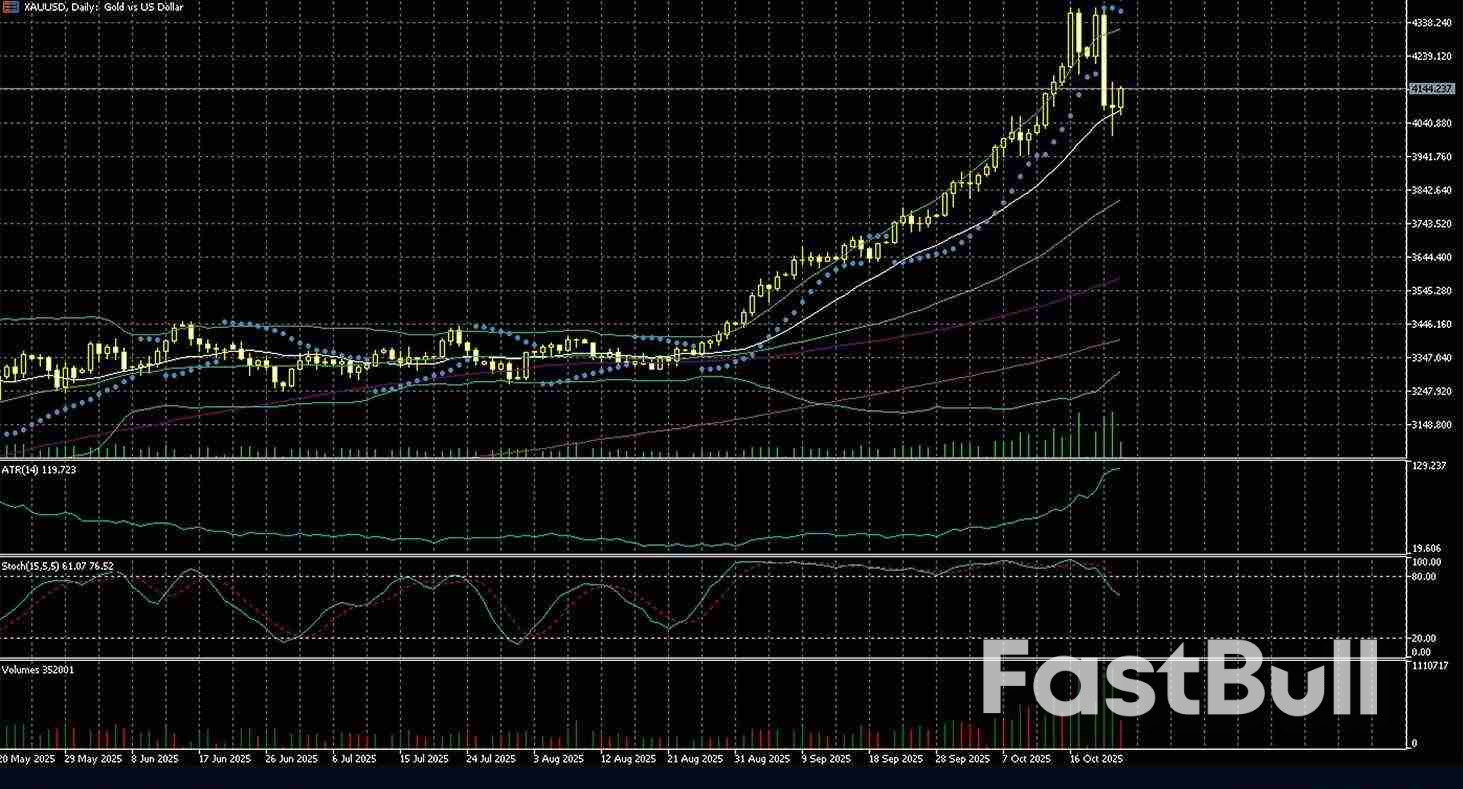
          Oil, in particular, has experienced some of its largest intraday movements since the Twelve-Day War in June. This article summarizes recent developments and then briefly examines the charts of XAUUSD and USOIL.
          Although threats of new tariffs on China by the American government contributed to uncertainty and gains for gold earlier this month, these seem to have calmed down somewhat recently. On 22 October, Donald Trump confirmed plans to meet his Chinese counterpart Xi Jinping, at which some degree of compromise seems possible, while exports of rare earth metals have moved out of traders’ focus. Two more cuts by the Fed before the end of the year have been entirely priced in with a 98% probability according to CME FedWatch.
          The American government ordered the freezing of all US-based assets of Lukoil and Rosneft this week and threatened secondary sanctions on foreign banks that expedite purchases of oil from these companies. This is a potentially significant move because it could strongly affect supplies of oil to China, India, and other smaller countries, which are primary markets for Russian oil; the shortfall would need to be made up with supplies from elsewhere, likely boosting demand for oil from Gulf countries.
          The key releases coming up in the next few weeks are American inflation, currently scheduled for Friday, 24 October, the Fed’s meeting and nearly certain cut on 29 October, and the double NFP on 7 November covering both September and October. The ongoing shutdown of the American government has significantly disrupted the regular release of data and is likely to mean that upcoming figures are at least somewhat less reliable.

          Gold Unlikely to Push Back Below $4,000 for Now

          Focus on Commodities Amid Sanctions and Seemingly Lower Trade Tension_1
          The week beginning 20 October has so far been the largest weekly loss for gold in five years, as the focus on trade wars has declined and most other major fundamental factors appear to be priced in. There was significant profit-taking on 17 and, particularly, on 21 October. With the meeting between Donald Trump and Xi Jinping expected to go ahead on 31 October in Korea, the current dispute seems unlikely to escalate again in the meantime, but any unexpected escalation could drive gold higher once more.
          The price held above $4,000 on 22 October with a strong, continuing upward reaction, making this round number a possibly practical as well as psychological support. The same day’s long-tailed doji would also suggest less demand for selling and reluctance to push lower. The 20 SMA is also in view as a potential short-term dynamic support.
          Now that there’s no longer an overbought signal from either Bollinger Bands or the slow stochastic, there could be more gains back to the record high or possibly higher if fundamentals support. Buying volume has increased enormously in the last several days of trading, but an immediate push above $4,400 might be too aggressive an expectation.

          Oil Jumps After New US Sanctions on Russia

          Focus on Commodities Amid Sanctions and Seemingly Lower Trade Tension_2
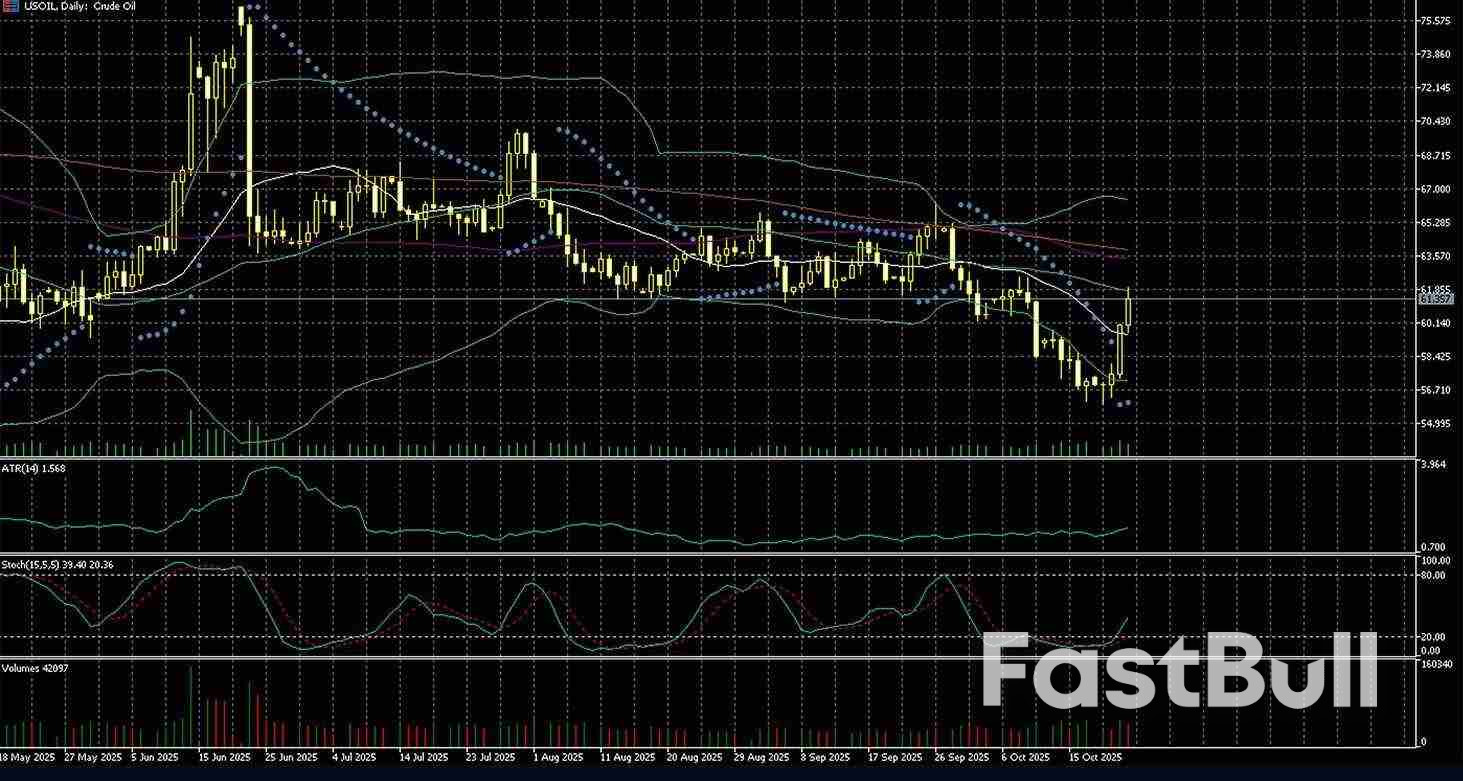
          New sanctions against Lukoil and Rosneft by the USA pushed oil up recently as traders worried that threatened secondary sanctions on banks working with these companies could disrupt supply to China, India, and other importing countries. While this has alleviated recent concerns about significant oversupply, the medium-term effects are not yet clear.
          $54.75-56 seems to be confirmed as an area of support on the weekly chart, with 17-20 October having been the third unsuccessful test. The crossover of the slow stochastic in oversold and a clear break above the 20 SMA might normally be a strong buying signal, but volume doesn’t clearly support the bounce yet.
          The 50 SMA from Bands, which is currently being tested, appears to be an important short-term dynamic resistance. Confirmation of more gains might come from a daily close clearly above $62. Beyond that, the 200 SMA, just below $64, is likely to be a strong resistance from which a breakout would probably require a significant uptick in buying volume.

          Source: fxempire

          Risk Warnings and Disclaimers
          You understand and acknowledge that there is a high degree of risk involved in trading. Following any strategies or investment methods may lead to potential losses. The content on the site is provided by our contributors and analysts for information purposes only. You are solely responsible for determining whether any trading assets, securities, strategy, or any other product is suitable for investing based on your own investment objectives and financial situation.
          Add to Favorites
          Share

          Massive Ultra-Orthodox Rally In Israel Protests Arrest Of Draft Dodgers

          Winkelmann

          Political

          Forex

          Economic

          Hundreds of thousands of ultra-Orthodox Israelis, known as the Haredim, gathered in Jerusalem on Thursday for a mass rally against the arrests of yeshiva students accused of evading military service.The rally is described by Israeli media as a 'rare show of unity' between the divided Haredi factions, who are often in opposition regarding politics and state relations. The demonstration, named "Cry of the Torah," was endorsed by nearly all ultra-Orthodox leaders, who instructed followers to attend and maintain order.

          Source: Flash90

          Only the Jerusalem Faction, led by Rabbi Azriel Auerbach, refused to participate, accusing organizers of failing to demand the full reinstatement of the long-standing Torato Omanuto exemption system that allows Torah students to defer military service.The exemption is central to the ultra-Orthodox Jewish way of life, allowing yeshiva students to dedicate their time solely to the study of the Torah instead of army duty, a principle many Haredim see as vital to preserving their religious identity. Torah study is viewed by the ultra-Orthodox as a form of spiritual service to the nation, equal in importance to military duty.

          "After it was not made clear to me that the purpose of the rally is to publicly declare that the ultra-Orthodox community demands the reinstatement of the Torato Omanuto arrangement … I cannot instruct participation in this rally," Auerbach said in a public letter.Organizers said the gathering was not against the draft exemption law itself but against the arrests of students labeled as deserters. "The debate over the law is still ongoing, and it belongs in the Knesset," a source explained. "But following the arrests and persecution against us, it was decided to protest nonetheless."

          The event featured no speeches or a central stage. Instead, rabbis stood separately in different locations while crowds recited psalms and prayers."Some will stand on balconies overlooking the streets where the rally is taking place, and others will stay in their cars," one organizer said, adding that coordinating a central platform for such large numbers was "impossible."An official notice instructed women to pray separately, stating that "women of Israel from the city of Jerusalem who wish to take part in the event will gather in a designated area," while others were asked to "join the prayers from wherever they are."

          The protest was convened after Lithuanian leaders, Rabbis Dov Landau and Moshe Hillel Hirsch, called for action following the arrest of several yeshiva students. Their decision prompted Shas and Agudat Yisrael leaders to join, forming a unified coordinating committee across factions.

          Police prepared for potential disturbances by hardline followers of Rabbi Zvi Friedman, whose group disrupted a Supreme Court hearing a day earlier. "We expect that the police will use full force against them so they don't turn our prayer rally into a violent event," a source warned.A counter-protest was organized nearby by the "Coalition of Service Organizations and Families of Reservists," including bereaved families and wounded soldiers.Prominent ultra-Orthodox leaders have repeatedly urged their followers to ignore military recruitment orders following the Israeli High Court's ruling that yeshiva students must be drafted into military service amid Israel's enlistment crisis in the army.

          The legislation was introduced in 2024 amid mounting losses in Gaza, aiming to replenish dwindling manpower as the Israeli army struggled to sustain operations while facing an unprecedented shortage of recruits.

          Source: Zero Hedge

          To stay updated on all economic events of today, please check out our Economic calendar
          Risk Warnings and Disclaimers
          You understand and acknowledge that there is a high degree of risk involved in trading. Following any strategies or investment methods may lead to potential losses. The content on the site is provided by our contributors and analysts for information purposes only. You are solely responsible for determining whether any trading assets, securities, strategy, or any other product is suitable for investing based on your own investment objectives and financial situation.
          Add to Favorites
          Share

          World shares head for 7th month of gains; dollar near 3-month high

          Adam

          Stocks

          World shares were set for a seventh straight month of gains and the dollar was near a 3-month high on Friday after Amazon and Apple's earnings reinforced global tech optimism and the hope that massive AI spending will ultimately bolster growth.
          European stocks started modestly lower ahead of euro zone inflation data later and after the European Central Bank on Thursday had further dampened talk of another euro zone interest rate cut any time soon.
          Nasdaq futures jumped 1.1% and S&P 500 futures gained 0.6%, though, after forecast-busting Amazon earnings (AMZN.O), sent its shares up more than 11% in pre-market trading and a prediction of bumper iPhone sales sent Apple's (AAPL.O) up over 2%.
          That offset overnight tumbles in Meta (META.O) and Microsoft (MSFT.O) amid worries about their surging AI spending. Six of the "Magnificent Seven" U.S. tech megacaps have now reported, with Nvidia - which has just become the world's first $5 trillion company - due to report in three weeks' time.
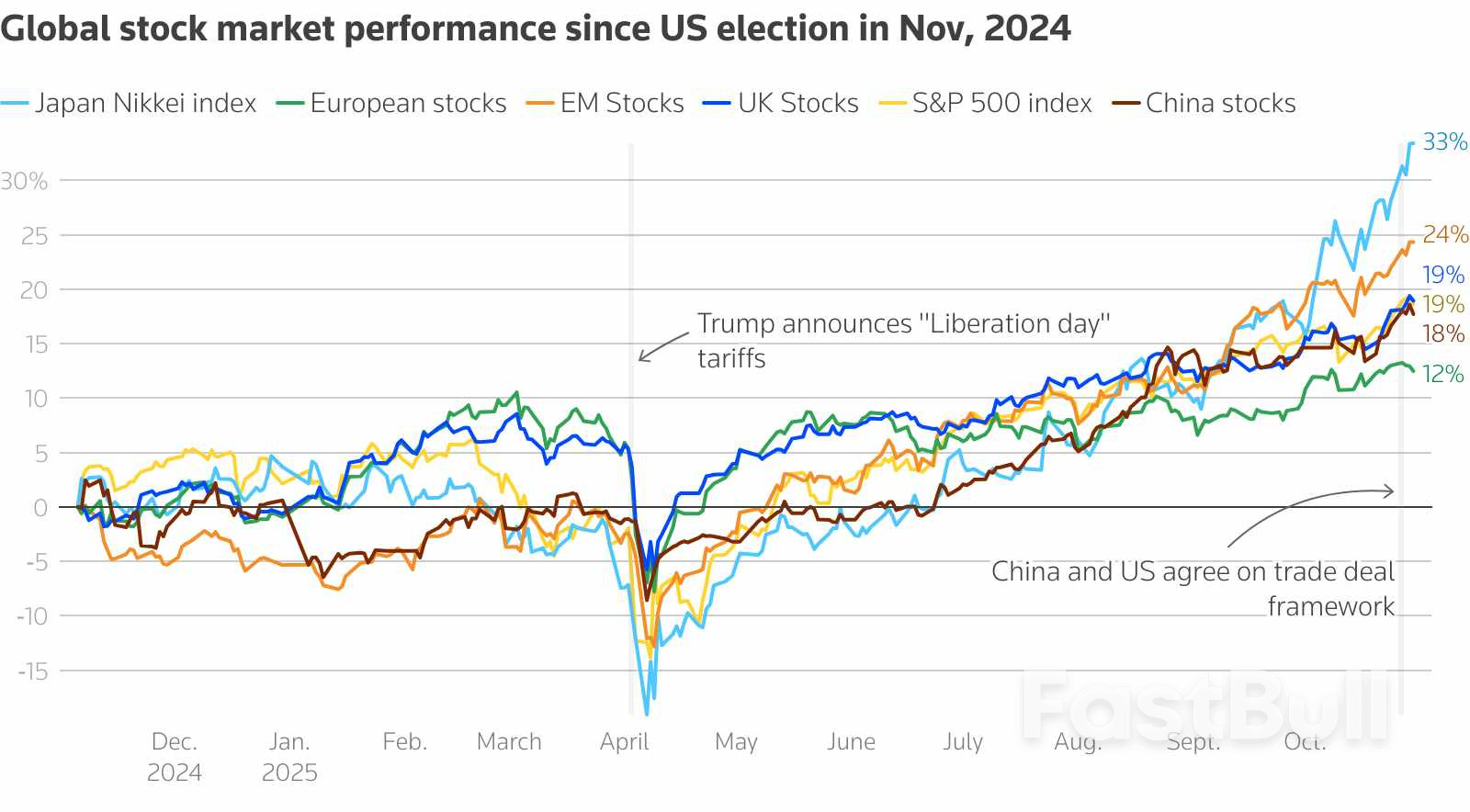
          In Asia, Japan's Nikkei (.N225) had rallied over 2%, boosting its weekly and monthly gains to 6% and 16.4%, respectively. That was the largest monthly rise since 1990, turbocharged by hopes for aggressive fiscal stimulus under new Prime Minister Sanae Takaichi.
          This week has also seen the Bank of Japan hold interest rates steady despite many economists predicting a hike.
          Chinese blue chips (.CSI300) and Hong Kong's Hang Seng (.HSI) both skidded roughly 1.5% though after data showed China's factory activity contracted at the fastest pace in six months in October.
          Investors also locked in gains after a trade truce reached by U.S. President Donald Trump and Chinese President Xi Jinping, which will lead to reduced U.S. tariffs on imports of Chinese goods and continued rare earth exports from China.
          World shares head for 7th month of gains; dollar near 3-month high_1

          Global stock market performance since US election in Nov 2024

          SUBTLE SHIFTS
          This week, major central bank meetings have delivered decisions that have subtly shifted expectations. The biggest surprise came from Federal Reserve Chair Jerome Powell who pushed back against the market's sanguine view about a rate cut in December.
          Both Treasuries and European government bonds were steady on Friday, but were set for weekly losses.
          Two-year Treasury yields were flat at 3.6085%, having risen 12 basis points this week already, while the 10-year yield was steady at 4.0969% and up 10 bps for the week.
          Germany's 10-year Bund yields , the euro area's benchmark, were up 1.5 basis points on the day at 2.65% and set for a weekly rise of 2.5 bps.
          The rise in yields offered support to the U.S. dollar (.DXY) , which was holding near three-month highs at 99.5 against its major peers, although resistance seems heavy at 99.564 and 100.25.
          The euro was flat at $1.1569 after the ECB kept its rates at 2% for the third meeting in a row and sounded moderately more positive on growth prospects.
          The central bank also published a survey on Friday showing euro zone bloc firms are seeing a slight improvement in business conditions and that investment into sectors like artificial intelligence is booming.
          "What the data this week suggests is that maybe we have got something fundamentally wrong about the impact of trade tariffs," Morgan Stanley's Chief Europe Economist Jens Eisenschmidt said, also highlighting the boost from AI.
          "It doesn't make me revise anything dramatically, but it makes me think."
          In the commodities markets, oil prices fell and were headed for a third straight monthly fall as a stronger dollar capped gains and rising supply from major producers offset new Western sanctions on Russian exports.
          Brent crude futures slipped 0.9% to $64.55 a barrel, while U.S. West Texas Intermediate crude was at $60.10, down 0.8%.
          Spot gold prices retraced some of the overnight gains and were down 0.3% to $4,008 per ounce. They were down 2.5% for the week and well below the record high of $4,381 hit just last week.

          Source: reuters

          Risk Warnings and Disclaimers
          You understand and acknowledge that there is a high degree of risk involved in trading. Following any strategies or investment methods may lead to potential losses. The content on the site is provided by our contributors and analysts for information purposes only. You are solely responsible for determining whether any trading assets, securities, strategy, or any other product is suitable for investing based on your own investment objectives and financial situation.
          Add to Favorites
          Share

          Deal Between the US and China Is Undoing Damage From a Self-Inflicted Trade War

          Warren Takunda

          Economic

          Three-digit tariffs are off the table, but import duties on each other are higher than in January.
          Rare earth materials will flow more smoothly, but China has put in place an export permitting regime that it can tighten or loosen as needed.
          Port fees will go away, but only for one year.
          And Beijing is again buying U.S. soybeans after it had abruptly cut off American farmers.
          After months of posturing, arguing and threatening, U.S. President Donald Trump and Chinese leader Xi Jinping have essentially turned back the clock. While the meeting between the two leaders was hailed by Trump as a “roaring success,” the agreement that came out of it may only serve to undo some of the damages Trump inflicted with his trade war upon his return to the White House.
          “It is hard to see what major gains the U.S. has made in the bilateral relationship relative to where things stood before Trump took office,” said Eswar Prasad, an economist at Cornell University.
          On the Senate floor, Minority Leader Chuck Schumer on Thursday denounced the deal out of South Korea as leaving the U.S. as “no better off.”
          “If anything, things are worse: Prices have gone up and China has agreed to nothing of substance that will improve trade between our nations,” the Democrat senator said, adding that Trump “started a trade war, created a giant mess for businesses, consumers, and soybean farmers, and then he celebrates for trying to clean up the very mess he created in the first place.”
          Nevertheless, the deal has injected a degree of stability, giving the world’s two largest economies — as well as the rest of the world — time and room to readjust.
          Washington and Beijing still need to finalize their agreements, a process that always has the potential for fresh disputes. But for now, Xi appears interested in moving past the latest tensions.
          In an official statement, Xi referred to “recent twists and turns” that “offered some lessons for both sides.” He said they should be “focusing on the benefits of cooperation rather than falling into a vicious cycle of mutual retaliation.”

          Both sides reduce tariffs, resume soybean sales to China

          Trump fired the first shot in the trade war in February when he imposed an additional 10% tariff on Chinese goods over the allegation that Beijing failed to stem the flow of chemicals used to make fentanyl. That soared to as much as 145% after China retaliated, but Trump walked it back following market meltdowns.
          The two sides in May slashed their massive tariffs to 10% on each other, while Washington retained the 20% fentanyl-related tariff, and China its retaliatory tariffs of 10% or 15% on U.S. farm goods.
          Now, Trump said he has removed one 10% fentanyl tariff in exchange for Beijing’s cooperation in fighting the illicit drug.
          U.S. Secretary of Agriculture Brooke Rollins said China would also withdraw the retaliatory tariffs on U.S. agricultural products. A spokesperson for the Chinese Ministry of Commerce said Beijing would “adjust accordingly” its countermeasures without giving details.
          In addition, China has agreed to buy 12 million metric tons of U.S. beans through January, and will buy at least 25 million metric tons annually for next three years, Rollins said on Thursday.
          AD
          That compares to China buying 17 million metric tons of U.S. soybeans in the first eight months of this year but importing zero in September. In 2024, China bought 22 million metric tons of U.S. soybeans, according to state media.
          Although China did not confirm the details of the latest soybean deal, the spokesperson for the Chinese commerce ministry said the two sides have reached “consensus” to expand agricultural trade.

          One-year truce on export controls and port fees

          In April, China used its monopoly power in the processing of critical minerals to institute a permitting requirement for the export of several rare earth elements. On October 9, Beijing expanded the export rules, apparently in response to the U.S. decision to extend export controls to businesses affiliated with already-blacklisted foreign companies.
          Furious, Trump threatened to impose a new 100% tariff on China, but the two sides managed to cool down in time for Trump to meet Xi in South Korea.
          Beijing on Thursday said it would pause for a year the rare earth export rules from October to “conduct research to refine specific plans,” while the U.S. will suspend its affiliate rule for one year.
          The delay by Beijing “provides just enough time for the United States to accelerate investment in capabilities and innovation for rare earths and permanent magnets,” said Wade Senti, president of the U.S. permanent magnet company AML. “This needs to be on warp speed and at a scale never seen before since the COVID-19 response,” he said.
          Another fresh thorn was the U.S. introduction of port fees in October targeting China-linked vessels, as part of a plan to restore America’s shipbuilding capabilitie s. Beijing answered with countermeasures against the U.S.
          The port fees on each other are not removed but will be suspended for one year, the Chinese commerce ministry said.

          The future is still uncertain

          Whether Trump accepts a return to the status quo or pushes to address fundamental issues that have persisted for years between the U.S. and China remains unclear. Nothing about Thursday’s meeting — the first between Trump and Xi in six years — affects Chinese manufacturing dominance that Trump has blamed for the loss of American blue collar jobs.
          Sean Stein, president of the U.S.-China Business Council, called the latest developments “very encouraging” and added: “We hope that future negotiations will address long-standing market access barriers, help level the playing field for U.S. companies, and bring long-term predictability to the bilateral trade relationship.”
          There are more opportunities on the horizon to keep working on these challenges. Trump said he will go to China in April and Xi will visit the U.S. after that.
          If Trump isn’t successful, this period could be remembered for a lot of sound and fury but no change in the basic trajectory of China’s ascendant economy.
          “Generally, Trump grows impatient with anything beyond the immediate, and it is the Chinese that play for longer term advantage,” said Kurt Campbell, a former deputy secretary of state in the Biden administration and now chairman of The Asia Group.

          Source: AP

          To stay updated on all economic events of today, please check out our Economic calendar
          Risk Warnings and Disclaimers
          You understand and acknowledge that there is a high degree of risk involved in trading. Following any strategies or investment methods may lead to potential losses. The content on the site is provided by our contributors and analysts for information purposes only. You are solely responsible for determining whether any trading assets, securities, strategy, or any other product is suitable for investing based on your own investment objectives and financial situation.
          Add to Favorites
          Share

          Oil heads for third monthly decline as dollar, OPEC+ supply weigh

          Adam

          Commodity

          Oil prices were heading for a third consecutive monthly decline, slipping on Friday due to a stronger U.S. dollar and weak China data as well as rising supply from major producers globally.
          Brent crude futures were down 38 cents, or 0.6%, at $64.62 a barrel by 1008 GMT, while U.S. West Texas Intermediate crude was at $60.19 a barrel, down 38 cents, or 0.6%.
          The U.S. dollar was near three-month highs against its major peers, making purchases of dollar-denominated commodities such as oil more expensive.
          Meanwhile, sources told Reuters that Saudi Arabia, the world's biggest oil exporter, may reduce its December crude price for Asian buyers to multi-month lows due to ample supplies, sources said, sounding a bearish note.
          Oil also slipped after an official survey showed China's factory activity shrank for a seventh month in October.
          Both Brent and WTI are set to fall around 3.5% in October with the Organization of the Petroleum Exporting Countries and major non-OPEC producers ramping up output to gain market share.
          More supply will also cushion the impact of Western sanctions disrupting Russian oil exports to its top buyers China and India.
          OPEC+ is leaning towards a modest output boost in December, people familiar with the talks said ahead of the group's meeting on Sunday.
          The eight OPEC+ members have boosted output targets by more than 2.7 million barrels per day - or about 2.5% of global supply - through a series of monthly increases.
          Meanwhile, crude exports from top exporter Saudi Arabia hit a six-month high of 6.407 million bpd in August, data from the Joint Organizations Data Initiative showed.
          A U.S. Energy Information Administration report also showed record production of 13.6 million bpd last week.
          U.S. President Donald Trump said on Thursday that China has agreed to begin the process of purchasing U.S. energy, adding that a very large-scale transaction may take place involving the purchase of oil and gas from Alaska.
          However, analysts remained sceptical as to whether the U.S.-China trade deal will boost Chinese demand for U.S. energy.

          Source: reuters

          Risk Warnings and Disclaimers
          You understand and acknowledge that there is a high degree of risk involved in trading. Following any strategies or investment methods may lead to potential losses. The content on the site is provided by our contributors and analysts for information purposes only. You are solely responsible for determining whether any trading assets, securities, strategy, or any other product is suitable for investing based on your own investment objectives and financial situation.
          Add to Favorites
          Share

          Trade Imbalance: How Do EU Membership Contenders Stack Up Against the Bloc?

          Warren Takunda

          Economic

          As Brussels pushes ahead with a new wave of enlargement, the numbers behind Europe’s trade with its candidate countries reveal a story of dependence, asymmetry, but also a large, untapped potential.
          The official EU candidates are Albania, Bosnia and Herzegovina, Moldova, Montenegro, North Macedonia, Serbia, Turkey, and Ukraine. Kosovo is treated as a potential candidate.
          Together, they cover a diverse sweep of geography from long Adriatic coastlines to lush forests and some of Europe’s most productive farmland — also including some of Europe's youngest populations.
          But while trade flows between the bloc and future members are booming, the relationship remains unequal, with more EU-produced goods finding a market than those stemming from potential member states.

          A relationship measured in billions

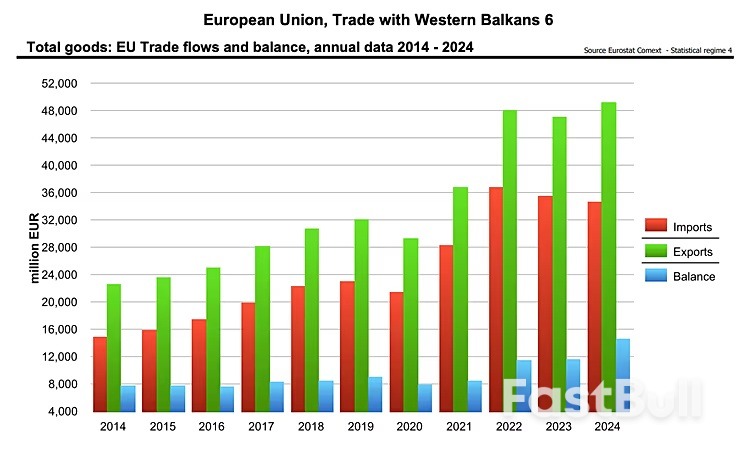
          According to the European Commission’s 2025 Western Balkans trade factsheet, total trade in goods between the EU and the six Western Balkan partners reached €83.6 billion in 2024, up 28.6% since 2021.
          Exports from the EU to the region stood at €49.06bn, while imports from the Western Balkans came to €34.52bn, leaving Brussels with a €14.54bn trade surplus.
          The EU’s dominance as a market is overwhelming. It accounts for around 62% of all Western Balkan trade, whereas the region represents barely 1.7% of the EU’s external trade.Trade Imbalance: How Do EU Membership Contenders Stack Up Against the Bloc?_1

          Import and export values between the Western Balkan countries and the EU over the years Source: Eurostat

          For Serbia, Bosnia and Herzegovina, and Albania, between two-thirds and three-quarters of all exports go to EU countries.
          "All (candidate) countries, with the curious exception of North Macedonia, have persistent trade deficits with the EU, meaning they import more from the EU than they export there," explained Branimir Jovanović, an expert with The Vienna Institute for International Economic Studies (WIIW).
          "These are economies with small productive sectors. They do not produce enough of what they need, so they have to import, and they also do not produce enough to export," Jovanović continued.
          Over the past decade, North Macedonia has become a production base for components that go straight into EU industry that qualify for preferential access to the EU market under the Stabilisation and Association framework (SAA).
          The result is that North Macedonia can sell a relatively high share of what it makes directly into the EU without being blocked by technical standards.
          This is very different from, say, Albania, which leans more on raw materials and low-value textiles, or Montenegro, which is tourism-heavy and import-dependent in goods.
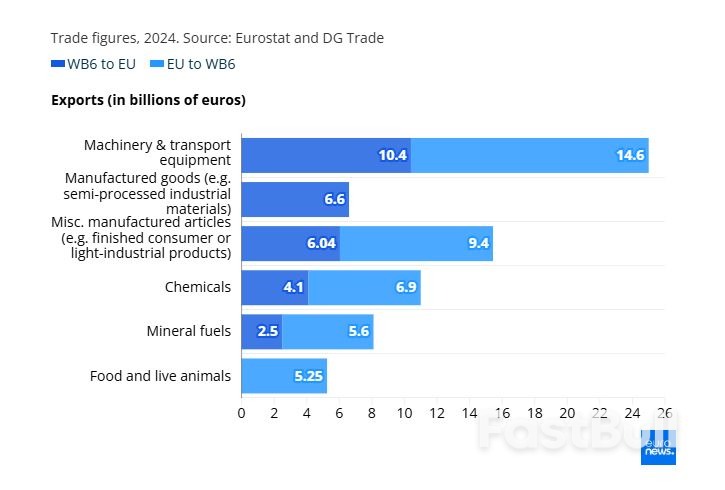
          It is also different from Bosnia and Herzegovina and Serbia, which still import a lot of higher-value machinery from the EU and then export a more mixed, lower-value basket back.
          Ukraine and Moldova import high-value EU machinery, vehicles and industrial equipment, while exporting mainly lower-margin goods. In essence, they supply raw materials and basic products, and the EU supplies the technology to produce them.Trade Imbalance: How Do EU Membership Contenders Stack Up Against the Bloc?_2

          Barriers to trade

          The Western Balkans trade with the EU under SAAs, which gradually remove tariffs and align national laws with EU rules as part of the formal accession process. By contrast, Ukraine and Moldova operate under Deep and Comprehensive Free Trade Areas (DCFTAs), broader deals that open large parts of the EU single market in exchange for adopting much of the EU’s regulatory framework.
          In essence, SAAs are a pathway to membership, while DCFTAs offer deep EU market integration without full membership. This distinction has, however, become blurred — with Brussels indicating that it believes in full membership for Ukraine and Moldova after the full-scale invasion of Ukraine in 2022.
          "Countries exporting to the EU face many barriers aside from tariffs. Economists call these technical barriers to trade, such as phytosanitary standards," Jovanović explained.
          So even if they produce something that there is a demand for in the EU, it never reaches those markets because these companies might not have the necessary certificates.
          "So, although unemployment has decreased, there is no real progress in development. There is also a real risk of a middle-income trap, in the sense that these economies remain assembly-line economies, with low wages and limited technological development and innovation."
          The same debate now extends to Ukraine, which formally opened EU accession talks in 2024. Despite the war, trade between the EU and Ukraine has surged. Eurostat data shows the bloc exported €42.8bn worth of goods to Ukraine in 2024 and imported €24.5bn, yielding a €18.3bn surplus for the EU.
          The composition of that trade has shifted dramatically since the Russian invasion. Agricultural commodities still dominate Ukrainian exports such but the EU has become its conduit for reconstruction materials and machinery.
          Neighbouring Moldova, another candidate country since 2023, shows similar patterns. The EU is Moldova’s biggest trading partner, accounting for 54% of its total trade in goods in 2024. Some 65.6% of Moldovan exports head to the EU.
          Trade turnover reached about €7.5bn last year, with EU exports to Moldova amounting to €5.1bn and imports to €2.4bn.

          EU standards, a distant dream?

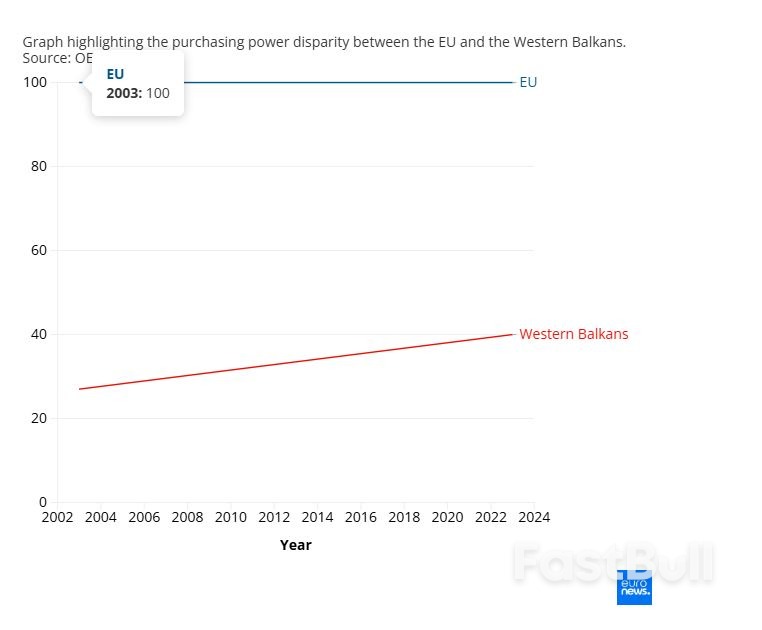
          The Western Balkans have made solid progress since the early 2000s, but full convergence with the European Union remains a distant goal, warned the OECD’s Economic Convergence Scoreboard for 2025.
          The six economies have more than doubled their output in two decades — yet the region still only reaches about 40% of the EU average. At current growth rates, full convergence won't arrive until 2074.Trade Imbalance: How Do EU Membership Contenders Stack Up Against the Bloc?_3
          The region’s output per person (in purchasing-power parity terms) has more than doubled in 20 years, showing real improvement in productivity, investment, and living standards.
          That means the Western Balkans are closing the gap, but painfully slowly, and the strong growth rates are offset by the much higher productivity and capital stock inside the EU.
          Growth, on its own, is not enough for convergence. The Western Balkans need qualitatively different growth which is driven by innovation, skills, and higher-value industries.
          Infrastructure and productivity are the region's weakest links.
          According to the OECD report: "The insufficient quality and coverage of core public transport infrastructure can be a significant obstacle to higher economic growth...as inadequate transport networks can severely constrain the connectivity of producers and consumers to global and regional markets."
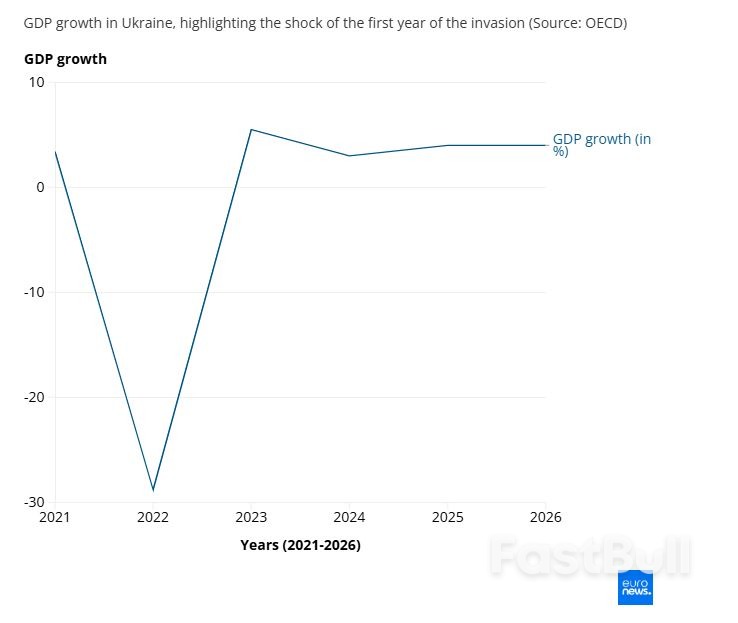
          With regard to Ukraine, its economy has adapted after a historic shock, but the damage is staggering. Much of the population has been displaced and large swathes of infrastructure have been destroyed.
          Output fell –28.8% in 2022 and rebounded +5.5% in 2023. Public finances are being stretched to the limit by defence needs, hindering convergence with EU member states.Trade Imbalance: How Do EU Membership Contenders Stack Up Against the Bloc?_4

          Foreign investment: Friend or foe?

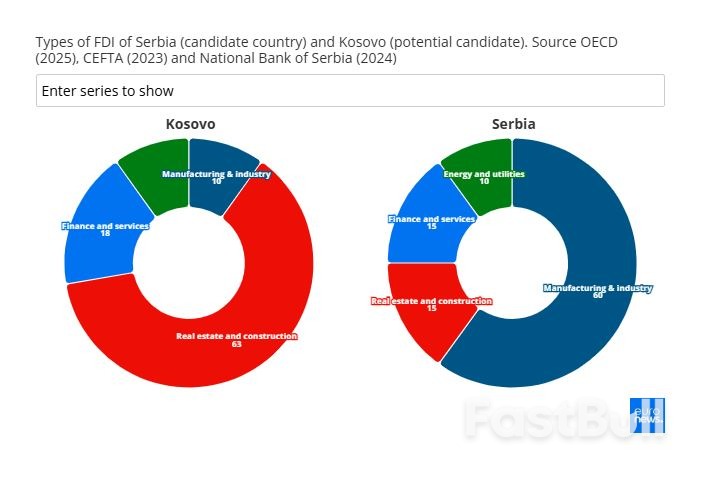
          Foreign direct investment (FDI) brings factories and jobs to candidate countries, as well as building stronger links with existing EU member states. Even so, Jovanović argued that this has not led to "structural transformation" in the candidate nations.
          The pattern is visible, for example, in Serbia — where car plants are boosting employment but the country is still importing high-tech machinery.
          When FDI concentrates in lower-value stages of production and local supplier bases remain thin, wage gains are limited and more value is captured abroad.Trade Imbalance: How Do EU Membership Contenders Stack Up Against the Bloc?_5
          “There is a duality in how FDI is perceived: politicians still see it as the key — sometimes even the only way — to develop the economy, while people are increasingly seeing it as a vicious circle," said Jovanović.
          "Hence, a change in the economic model is long overdue — with a more selective approach towards FDI, focusing on high-quality and high-tech investment and a greater focus on domestic companies through industrial and innovation policies,” Jovanović added.
          The argument is clear: while FDI raises employment and links these economies to EU markets, it becomes transformative only when it upgrades the local production base.
          Otherwise, candidate countries risk remaining an assembly platform rather than a full partner in Europe’s value chains.

          A test of Europe’s promise

          In the end, the numbers tell both a success story and a warning. They show integration without transformation: Exports are up, factories are open, but productivity and infrastructure still lag.
          The next phase will need to hinge on quality, not just quantity, say experts. This means selective FDI that upgrades supply chains, targeted single-market access tied to reforms, and faster investment in skills, energy, and transport.
          If Brussels and the candidates can shift from assembly to innovation, the gap can narrow within a generation. If not, the candidate countries risk remaining a dependable workshop rather than a prosperous partner.

          Source: Euronews

          To stay updated on all economic events of today, please check out our Economic calendar
          Risk Warnings and Disclaimers
          You understand and acknowledge that there is a high degree of risk involved in trading. Following any strategies or investment methods may lead to potential losses. The content on the site is provided by our contributors and analysts for information purposes only. You are solely responsible for determining whether any trading assets, securities, strategy, or any other product is suitable for investing based on your own investment objectives and financial situation.
          Add to Favorites
          Share

          Gold Holds Near $4,000 as Traders Weigh US-China Trade Truce

          Adam

          Commodity

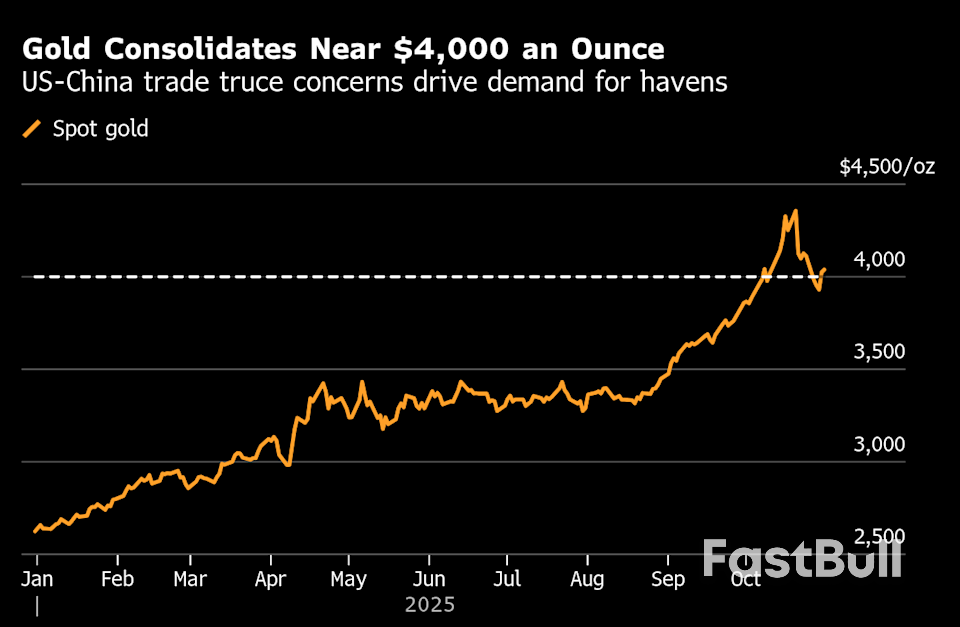
          Gold steadied near $4,000 an ounce as traders weighed a US-China trade truce that failed to quash concerns about long-term competition between the world’s two largest economies.
          Spot gold pared losses after declining as much as 0.9% an ounce on Friday during Asian hours. Chinese leader Xi Jinping called for stable supply chains in his first public remarks after meeting with US President Donald Trump.
          Talks between the two leaders appeared to resolve – for now – months of brinkmanship, but a one-year pause is likely only to stabilize relations while buying each side time to reduce strategic dependence. The détente also underscored the rise in China’s economic clout since Trump’s first term as US president, a shift that is fueling interest in haven assets.
          Gold Holds Near $4,000 as Traders Weigh US-China Trade Truce_1
          Bullion is headed for a second weekly drop and is down around 8% from a record high above $4,380 on Oct. 20. The retreat has most recently been aided by reduced expectations of further Federal Reserve rate cuts. Chair Jerome Powell warned that investors should rein in hopes for a December reduction after a quarter-point cut on Wednesday.
          Outflows from gold-backed exchange-traded funds have also removed some of the support that underpinned the scorching rally: Total gold ETF holdings fell for six days through Wednesday, the longest streak of declines since April, according to data compiled by Bloomberg.
          A “combination of a hawkish cut, a truce in the US-China trade war, plus heavy outflows from the gold ETFs are all adding to the corrective mood,” said Robert Rennie, a commodities analyst at Westpac Bank Corp. Bullion could drop back to around the $3,750 level, he said.
          Despite its recent pullback, gold has still advanced more than 50% this year, with support from a push by mainstream investors to safeguard their portfolios against risk as well as accelerated central-bank buying, the World Gold Council said in a report on Thursday. Central banks purchased 28% more gold in the third quarter than during the preceding three months, reversing a downward trend seen earlier this year.
          Spot gold fell 0.6% to $4,001.63 an ounce as of 9:50 a.m. in London. The Bloomberg Dollar Spot Index rose 0.2%. Silver, platinum and palladium all declined.
          “Uncertainty is creeping back into markets after the US-China trade truce update, which should see dip buyers adding support for gold for the remainder of the year,” said Nick Twidale, chief market analyst at AT Global Markets in Sydney. The metal’s recent correction may have run its course, he said.

          Source: Bloomberg

          Risk Warnings and Disclaimers
          You understand and acknowledge that there is a high degree of risk involved in trading. Following any strategies or investment methods may lead to potential losses. The content on the site is provided by our contributors and analysts for information purposes only. You are solely responsible for determining whether any trading assets, securities, strategy, or any other product is suitable for investing based on your own investment objectives and financial situation.
          Add to Favorites
          Share
          FastBull
          Copyright © 2025 FastBull Ltd

          728 RM B 7/F GEE LOK IND BLDG NO 34 HUNG TO RD KWUN TONG KLN HONG KONG

          TelegramInstagramTwitterfacebooklinkedin
          App Store Google Play Google Play
          Products
          Charts

          Chats

          Q&A with Experts
          Screeners
          Economic Calendar
          Data
          Tools
          Membership
          Features
          Function
          Markets
          Copy Trading
          Latest Signals
          Contests
          News
          Analysis
          24/7
          Columns
          Education
          Company
          Careers
          About Us
          Contact Us
          Advertising
          Help Center
          Feedback
          User Agreement
          Privacy Policy
          Business

          White Label

          Data API

          Web Plug-ins

          Poster Maker

          Affiliate Program

          Risk Disclosure

          The risk of loss in trading financial instruments such as stocks, FX, commodities, futures, bonds, ETFs and crypto can be substantial. You may sustain a total loss of the funds that you deposit with your broker. Therefore, you should carefully consider whether such trading is suitable for you in light of your circumstances and financial resources.

          No decision to invest should be made without thoroughly conducting due diligence by yourself or consulting with your financial advisors. Our web content might not suit you since we don't know your financial conditions and investment needs. Our financial information might have latency or contain inaccuracy, so you should be fully responsible for any of your trading and investment decisions. The company will not be responsible for your capital loss.

          Without getting permission from the website, you are not allowed to copy the website's graphics, texts, or trademarks. Intellectual property rights in the content or data incorporated into this website belong to its providers and exchange merchants.

          Not Logged In

          Log in to access more features

          FastBull Membership

          Not yet

          Purchase

          Become a signal provider
          Help Center
          Customer Service
          Dark Mode
          Price Up/Down Colors

          Log In

          Sign Up

          Position
          Layout
          Fullscreen
          Default to Chart
          The chart page opens by default when you visit fastbull.com