• Trade
  • Markets
  • Copy
  • Contests
  • News
  • 24/7
  • Calendar
  • Q&A
  • Chats
Trending
Screeners
SYMBOL
LAST
BID
ASK
HIGH
LOW
NET CHG.
%CHG.
SPREAD
SPX
S&P 500 Index
6846.50
6846.50
6846.50
6878.28
6827.18
-23.90
-0.35%
--
DJI
Dow Jones Industrial Average
47739.31
47739.31
47739.31
47971.51
47611.93
-215.67
-0.45%
--
IXIC
NASDAQ Composite Index
23545.89
23545.89
23545.89
23698.93
23455.05
-32.22
-0.14%
--
USDX
US Dollar Index
99.000
99.080
99.000
99.000
99.000
+0.050
+ 0.05%
--
EURUSD
Euro / US Dollar
1.16368
1.16376
1.16368
1.16388
1.16322
+0.00004
0.00%
--
GBPUSD
Pound Sterling / US Dollar
1.33213
1.33224
1.33213
1.33220
1.33140
+0.00008
+ 0.01%
--
XAUUSD
Gold / US Dollar
4191.19
4191.63
4191.19
4193.27
4189.64
+1.49
+ 0.04%
--
WTI
Light Sweet Crude Oil
58.660
58.702
58.660
58.676
58.543
+0.105
+ 0.18%
--

Community Accounts

Signal Accounts
--
Profit Accounts
--
Loss Accounts
--
View More

Become a signal provider

Sell trading signals to earn additional income

View More

Guide to Copy Trading

Get started with ease and confidence

View More

Signal Accounts for Members

All Signal Accounts

Best Return
  • Best Return
  • Best P/L
  • Best MDD
Past 1W
  • Past 1W
  • Past 1M
  • Past 1Y

All Contests

  • All
  • Trump Updates
  • Recommend
  • Stocks
  • Cryptocurrencies
  • Central Banks
  • Featured News
Top News Only
Share

Japan Prime Minister Takaichi: 30 Injuries Reported So Far From Monday Earthquake

Share

USA Senate Committee Votes To Advance Nomination Of Jared Isaacman To Head Nasa

Share

Singapore Post - New Rate For Standard Regular Mail & Standard Large Mail Will Be S$0.62 And S$0.90 Respectively

Share

Australia's S&P/ASX 200 Index Down 0.27% At 8601.10 Points In Early Trade

Share

Trump: The USA Needs Mexico To Release 200000 Acre-Feet Of Water Before December 31St, And The Rest Must Come Soon After

Share

Trump: I Have Authorized Documentation To Impose A 5% Tariff On Mexico If This Water Isn't Released

Share

Brazil's Sao Paulo State Governor Tarcisio De Freitas Says Flavio Bolsonaro Will Have His Support - Cnn Brasil

Share

Ukraine's Security Must Be Guaranteed, In The Long Term, As A First Line Of Defence For Our Union, Says European Commission President

Share

Ukraine's Sovereignty Must Be Respected, Says European Commission President

Share

The Goal Is A Strong Ukraine, On The Battlefield And At The Negotiating Table, Says European Commission President

Share

As Peace Talks Are Ongoing, The EU Remains Ironclad In Its Support For Ukraine, Says European Commission President

Share

Pepsico: Asking USA-Based Pepna Employees As Well As Pbus Division Offices And Pfus Region Offices To Work Remotely This Week

Share

A U.S. Judge Ruled That President Trump’s Ban On Several Wind Power Projects Was Illegal

Share

Senior USA Administration Official: We Continue To Monitor Drc-Rwanda Situation Closely, Continue To Work With All Sides To Ensure Commitments Are Honored

Share

Israeli Military Says It Has Struck Infrastructure Belonging To Hezbollah In Several Areas In Southern Lebanon

Share

SPDR Gold Holdings Down 0.11%, Or 1.14 Tonnes

Share

On Monday (December 8), In Late New York Trading, S&P 500 Futures Fell 0.21%, Dow Jones Futures Fell 0.43%, NASDAQ 100 Futures Fell 0.08%, And Russell 2000 Futures Fell 0.04%

Share

Morgan Stanley: Data Center ABS Spreads Are Expected To Widen In 2026

Share

(US Stocks) The Philadelphia Gold And Silver Index Closed Down 2.34% At 311.01 Points. (Global Session) The NYSE Arca Gold Miners Index Closed Down 2.17%, Hitting A Daily Low Of 2235.45 Points; US Stocks Remained Slightly Down Before The Opening Bell—holding Steady Around 2280 Points—before Briefly Rising Slightly

Share

IMF: IMF Executive Board Approves Extension Of The Extended Credit Facility Arrangement With Nepal

TIME
ACT
FCST
PREV
France Trade Balance (SA) (Oct)

A:--

F: --

P: --
Euro Zone Employment YoY (SA) (Q3)

A:--

F: --

P: --
Canada Part-Time Employment (SA) (Nov)

A:--

F: --

P: --

Canada Unemployment Rate (SA) (Nov)

A:--

F: --

P: --

Canada Full-time Employment (SA) (Nov)

A:--

F: --

P: --

Canada Labor Force Participation Rate (SA) (Nov)

A:--

F: --

P: --

Canada Employment (SA) (Nov)

A:--

F: --

P: --

U.S. PCE Price Index MoM (Sept)

A:--

F: --

P: --

U.S. Personal Income MoM (Sept)

A:--

F: --

P: --

U.S. Core PCE Price Index MoM (Sept)

A:--

F: --

P: --

U.S. PCE Price Index YoY (SA) (Sept)

A:--

F: --

P: --

U.S. Core PCE Price Index YoY (Sept)

A:--

F: --

P: --

U.S. Personal Outlays MoM (SA) (Sept)

A:--

F: --

P: --
U.S. 5-10 Year-Ahead Inflation Expectations (Dec)

A:--

F: --

P: --

U.S. Real Personal Consumption Expenditures MoM (Sept)

A:--

F: --

P: --
U.S. Weekly Total Rig Count

A:--

F: --

P: --

U.S. Weekly Total Oil Rig Count

A:--

F: --

P: --

U.S. Consumer Credit (SA) (Oct)

A:--

F: --

P: --
China, Mainland Foreign Exchange Reserves (Nov)

A:--

F: --

P: --

Japan Trade Balance (Oct)

A:--

F: --

P: --

Japan Nominal GDP Revised QoQ (Q3)

A:--

F: --

P: --

China, Mainland Imports YoY (CNH) (Nov)

A:--

F: --

P: --

China, Mainland Exports (Nov)

A:--

F: --

P: --

China, Mainland Imports (CNH) (Nov)

A:--

F: --

P: --

China, Mainland Trade Balance (CNH) (Nov)

A:--

F: --

P: --

China, Mainland Exports YoY (USD) (Nov)

A:--

F: --

P: --

China, Mainland Imports YoY (USD) (Nov)

A:--

F: --

P: --

Germany Industrial Output MoM (SA) (Oct)

A:--

F: --

P: --
Euro Zone Sentix Investor Confidence Index (Dec)

A:--

F: --

P: --

Canada National Economic Confidence Index

A:--

F: --

P: --

U.K. BRC Like-For-Like Retail Sales YoY (Nov)

--

F: --

P: --

U.K. BRC Overall Retail Sales YoY (Nov)

--

F: --

P: --

Australia Overnight (Borrowing) Key Rate

--

F: --

P: --

RBA Rate Statement
RBA Press Conference
Germany Exports MoM (SA) (Oct)

--

F: --

P: --

U.S. NFIB Small Business Optimism Index (SA) (Nov)

--

F: --

P: --

Mexico 12-Month Inflation (CPI) (Nov)

--

F: --

P: --

Mexico Core CPI YoY (Nov)

--

F: --

P: --

Mexico PPI YoY (Nov)

--

F: --

P: --

U.S. Weekly Redbook Index YoY

--

F: --

P: --

U.S. JOLTS Job Openings (SA) (Oct)

--

F: --

P: --

China, Mainland M1 Money Supply YoY (Nov)

--

F: --

P: --

China, Mainland M0 Money Supply YoY (Nov)

--

F: --

P: --

China, Mainland M2 Money Supply YoY (Nov)

--

F: --

P: --

U.S. EIA Short-Term Crude Production Forecast For The Year (Dec)

--

F: --

P: --

U.S. EIA Natural Gas Production Forecast For The Next Year (Dec)

--

F: --

P: --

U.S. EIA Short-Term Crude Production Forecast For The Next Year (Dec)

--

F: --

P: --

EIA Monthly Short-Term Energy Outlook
U.S. API Weekly Gasoline Stocks

--

F: --

P: --

U.S. API Weekly Cushing Crude Oil Stocks

--

F: --

P: --

U.S. API Weekly Crude Oil Stocks

--

F: --

P: --

U.S. API Weekly Refined Oil Stocks

--

F: --

P: --

South Korea Unemployment Rate (SA) (Nov)

--

F: --

P: --

Japan Reuters Tankan Non-Manufacturers Index (Dec)

--

F: --

P: --

Japan Reuters Tankan Manufacturers Index (Dec)

--

F: --

P: --

Japan Domestic Enterprise Commodity Price Index MoM (Nov)

--

F: --

P: --

Japan Domestic Enterprise Commodity Price Index YoY (Nov)

--

F: --

P: --

China, Mainland PPI YoY (Nov)

--

F: --

P: --

China, Mainland CPI MoM (Nov)

--

F: --

P: --

Italy Industrial Output YoY (SA) (Oct)

--

F: --

P: --

Q&A with Experts
    • All
    • Chatrooms
    • Groups
    • Friends
    Connecting
    .
    .
    .
    Type here...
    Add Symbol or Code

      No matching data

      All
      Trump Updates
      Recommend
      Stocks
      Cryptocurrencies
      Central Banks
      Featured News
      • All
      • Russia-Ukraine Conflict
      • Middle East Flashpoint
      • All
      • Russia-Ukraine Conflict
      • Middle East Flashpoint
      Search
      Products

      Charts Free Forever

      Chats Q&A with Experts
      Screeners Economic Calendar Data Tools
      Membership Features
      Data Warehouse Market Trends Institutional Data Policy Rates Macro

      Market Trends

      Market Sentiment Order Book Forex Correlations

      Top Indicators

      Charts Free Forever
      Markets

      News

      News Analysis 24/7 Columns Education
      From Institutions From Analysts
      Topics Columnists

      Latest Views

      Latest Views

      Trending Topics

      Top Columnists

      Latest Update

      Signals

      Copy Rankings Latest Signals Become a signal provider AI Rating
      Contests
      Brokers

      Overview Brokers Assessment Rankings Regulators News Claims
      Broker listing Forex Brokers Comparison Tool Live Spread Comparison Scam
      Q&A Complaint Scam Alert Videos Tips to Detect Scam
      More

      Business
      Events
      Careers About Us Advertising Help Center

      White Label

      Data API

      Web Plug-ins

      Affiliate Program

      Awards Institution Evaluation IB Seminar Salon Event Exhibition
      Vietnam Thailand Singapore Dubai
      Fans Party Investment Sharing Session
      FastBull Summit BrokersView Expo
      Recent Searches
        Top Searches
          Markets
          News
          Analysis
          User
          24/7
          Economic Calendar
          Education
          Data
          • Names
          • Latest
          • Prev

          View All

          No data

          Scan to Download

          Faster Charts, Chat Faster!

          Download App
          English
          • English
          • Español
          • العربية
          • Bahasa Indonesia
          • Bahasa Melayu
          • Tiếng Việt
          • ภาษาไทย
          • Français
          • Italiano
          • Türkçe
          • Русский язык
          • 简中
          • 繁中
          Open Account
          Search
          Products
          Charts Free Forever
          Markets
          News
          Signals

          Copy Rankings Latest Signals Become a signal provider AI Rating
          Contests
          Brokers

          Overview Brokers Assessment Rankings Regulators News Claims
          Broker listing Forex Brokers Comparison Tool Live Spread Comparison Scam
          Q&A Complaint Scam Alert Videos Tips to Detect Scam
          More

          Business
          Events
          Careers About Us Advertising Help Center

          White Label

          Data API

          Web Plug-ins

          Affiliate Program

          Awards Institution Evaluation IB Seminar Salon Event Exhibition
          Vietnam Thailand Singapore Dubai
          Fans Party Investment Sharing Session
          FastBull Summit BrokersView Expo

          Fed's Bostic Says Tariffs Effects May Take A Year to Fully Play Out

          Daniel Carter

          Economic

          Central Bank

          Summary:

          Atlanta Federal Reserve President Raphael Bostic indicated Thursday that the U.S. economy will likely experience a prolonged period of elevated inflation, suggesting the central bank should maintain its current monetary policy stance.

          In prepared remarks for an economic conference in Germany, Bostic explained that adjustments to changes in trade policies, other U.S. policies, and geopolitical developments would not result in a simple one-time shift in prices as standard economic models might suggest.
          "Instead, this increasingly looks like a process that may take a year or more to fully play out," Bostic said.
          He warned that this extended inflation period could potentially influence consumer psychology and inflation expectations, creating more significant challenges for the Federal Reserve.
          Bostic noted that new economic data released Thursday showed stronger-than-expected job creation and a slight decrease in the unemployment rate to 4.1%, indicating "labor market conditions remain broadly healthy." He added that the job market is not yet showing signs of deterioration that would justify preemptive interest rate cuts.
          Given the high level of uncertainty surrounding jobs, economic growth, and inflation, Bostic argued that "this is no time for significant shifts in monetary policy." He endorsed the Federal Open Market Committee’s current "wait and see" approach.
          The Federal Reserve has maintained its policy interest rate unchanged since December, despite calls from President Donald Trump for immediate and substantial rate reductions.

          Source: Investing

          To stay updated on all economic events of today, please check out our Economic calendar
          Risk Warnings and Disclaimers
          You understand and acknowledge that there is a high degree of risk involved in trading. Following any strategies or investment methods may lead to potential losses. The content on the site is provided by our contributors and analysts for information purposes only. You are solely responsible for determining whether any trading assets, securities, strategy, or any other product is suitable for investing based on your own investment objectives and financial situation.
          Add to Favorites
          Share

          Crude Oil Falls After Report Of US-Iran Nuclear Talks Next Week

          Damon

          Political

          Crude oil prices fell to a low of $66.54 on Friday, down over 1%, following an Axios report that a White House envoy plans to meet with Iran’s foreign minister in Oslo next week to restart nuclear talks.

          The potential diplomatic engagement comes after President Trump ordered military strikes on Iran’s nuclear facilities last month. According to the report, White House envoy Steve Witkoff is expected to meet with Iranian Foreign Minister Abbas Araghchi, though neither country has publicly confirmed the meeting.

          Oil markets reacted to the news as renewed nuclear negotiations could eventually lead to the lifting of sanctions on Iranian oil exports, potentially increasing global supply. Iran holds some of the world’s largest proven oil reserves, and any return of Iranian crude to international markets would likely pressure prices.

          The reported talks would mark the first direct engagement between the two countries since the recent 12-day conflict between Israel and Iran that ended in a U.S.-brokered ceasefire. Sources cited by Axios indicate that Witkoff and Araghchi have maintained direct contact during and after this conflict.

          A key focus of any future negotiations would be Iran’s stockpile of highly enriched uranium, which reportedly includes 400 kilograms enriched to 60% purity. This level of enrichment is close to weapons-grade material, which requires 90% enrichment.

          Omani and Qatari officials have reportedly been involved in mediating between the U.S. and Iran, with Iranian officials initially reluctant to engage with the U.S. following the military strikes but gradually softening their position.
          Source: Investing

          Risk Warnings and Disclaimers
          You understand and acknowledge that there is a high degree of risk involved in trading. Following any strategies or investment methods may lead to potential losses. The content on the site is provided by our contributors and analysts for information purposes only. You are solely responsible for determining whether any trading assets, securities, strategy, or any other product is suitable for investing based on your own investment objectives and financial situation.
          Add to Favorites
          Share

          Big Beautiful Bill Set To Pass; Here's What It Does

          Adam

          Economic

          President Donald Trump's "One Big Beautiful Bill Act" is on the cusp of passage, after House fiscal conservatives gave up demands of deeper spending cuts and moderate Republicans came to terms with the size of Medicaid cuts. The fact that House Speaker Mike Johnson got pulled from both sides of his party meant that neither side could be assured of a better deal if revisions proved necessary.
          Wall Street never thought it was possible that the GOP would fail to renew the 2017 tax cuts, since that would tank the economy. The most important market reaction may come from bond investors. So far, there's no sign of concern that U.S. deficits are getting too large to comfortably finance.

          The Deficit Effect

          The Congressional Budget Office said Tuesday that the final changes to the Senate version of the One Big Beautiful Bill Act (or OBBBA) added $110 billion to deficits vs. the prior version. Some of those last-minute changes were focused on extending the time for renewable energy projects to take advantage of Inflation Reduction Act production tax credits. The Senate also doubled the size of an emergency fund to support rural hospitals facing Medicaid cuts to $50 billion.
          Based on the current-law baseline, which assumes expiration of most 2017 tax cuts at the end of this year, CBO said that the OBBBA has $4.5 trillion in tax cuts and $1.1 trillion in spending cuts, raising deficits by $3.4 trillion. Based on current policy, CBO said the Senate bill would cut spending by $1.25 trillion and lower taxes by $850 billion, lowering the deficit by about $400 billion.
          The prior score showed that the Senate cut a few hundred billion less than the House in food aid and student loans. That only partly explains why the bill — despite bigger cuts to projected Medicaid spending — fell about $900 billion short of the fiscal bar set by the House, which required that tax cuts exceed spending cuts by no more than $2.5 trillion over 10 years. The Senate also spent an extra $344 billion than the House version on business tax incentives for expensing equipment purchases and funding research and development.
          The brunt of the deficits would come in the next few years. Relative to the current-law baseline that assumes expiration of the tax cuts, the deficit would be higher by $443 billion in fiscal 2026, $538 billion in 2027 and $508 billion in 2028. The deficit increase tails off to a range of $256 billion to $319 billion from 2030 onward.

          Medicaid Cuts

          On June 24, 16 House Republicans wrote to Senate Majority Leader John Thune and House Speaker Mike Johnson, taking issue with the Senate version of the bill that fails to "give hospitals time to adjust to new budgetary constraints."
          Before those last-minute tweaks, the CBO said the Senate bill included roughly $930 billion in cuts to Medicaid spending and about $230 billion in cuts to spending on tax credits to buy insurance on the Affordable Care Act health insurance exchanges. By comparison, the House sought $793 billion in Medicaid cuts.
          The CBO said 4.8 million Medicaid recipients would become uninsured due to an 80-hour work requirement for able-bodied adults who aren't caregivers for a child or disabled family member. The work requirements are projected to save $317 billion over 10 years.
          An additional $183 billion would come from limiting state taxes on medical providers, gradually lowering the ceiling to 3.5% from 6% for states that expanded Medicaid under the ACA. States plow those taxes into benefit payments, which leaves providers no worse off, yet the federal government faces a higher bill to cover its share of Medicaid costs.
          Some states have directed Medicaid managed care operators to reimburse medical providers at up to 100% of commercial insurance reimbursement rates. The Big Beautiful Bill would lower that to 100% of Medicare rates in states that expanded Medicaid.

          New Tax Cuts

          New OBBBA tax cuts include a deduction of overtime pay of up to $12,500 for single filers earning up to $150,0000, with a phase out for higher earners. The $90 billion cost is limited by having it sunset after 2028.
          A deduction of tipped income of up to $25,000 for $150,000 earners would cost $32 billion.
          A deduction of up to $10,000 for loans on U.S.-assembled autos costs $31 billion.
          The bill largely fulfills President Trump's campaign pledge to end taxes on Social Security income by providing a new $6,000 deduction for seniors. That measure carries a $93 billion cost, $27 billion more than the $66 billion cost of the House's $4,000 deduction.
          The bill boosts the child tax credit to $2,200 from $2,000, though the refundable amount for those who don't owe income taxes is held at $1,700. Both figures rise with inflation. If not extended, the child tax credit would revert to $1,000 for 2026. The entire cost is $817 billion.
          The bulk of the bill's costs come from renewing the 2017 cut in marginal income-tax rates ($2.2 trillion), a 20% business deduction ($737 billion) and limiting exposure to the estate tax ($212 billion).

          Other OBBBA Spending Cuts

          About $186 billion in spending cuts are aimed at the Supplemental Nutrition Assistance Program, including a work requirement estimated to lower funding by $69 billion.
          Limiting student loans and adjusting repayment options is estimated to save $307 billion.
          The termination of green energy tax credits, including for buying electric vehicles and producing solar and wind energy, faced roughly $550 billion in cuts before the final Senate bill tweaks.

          Source: investors

          To stay updated on all economic events of today, please check out our Economic calendar
          Risk Warnings and Disclaimers
          You understand and acknowledge that there is a high degree of risk involved in trading. Following any strategies or investment methods may lead to potential losses. The content on the site is provided by our contributors and analysts for information purposes only. You are solely responsible for determining whether any trading assets, securities, strategy, or any other product is suitable for investing based on your own investment objectives and financial situation.
          Add to Favorites
          Share

          UK Government Bond Markets Rally After Starmer Backs Reeves

          Warren Takunda

          Economic

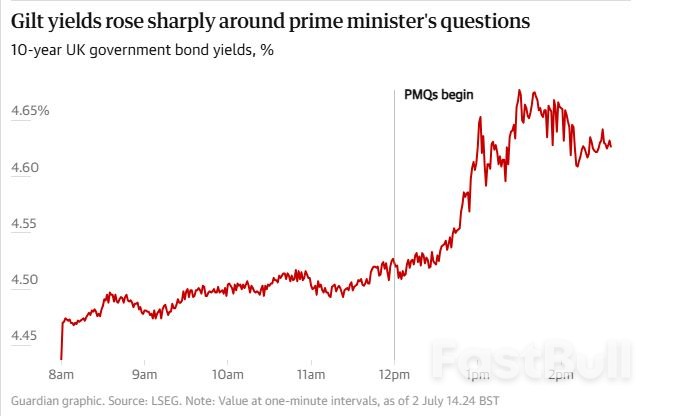
          UK government bonds have rallied after Keir Starmer backed Rachel Reeves to remain as chancellor for “a very long time” despite lingering investor concerns over a multibillion-pound hole in Britain’s public finances.
          The yield – in effect the interest rate – on British government bonds, also known as gilts, fell on Thursday morning to trade close to 4.5%, reversing much of the rise on Wednesday sparked by feverish speculation over Reeves’s future.
          The pound rose against other leading currencies, while a closely watched business survey showed that Britain’s dominant service sector recorded its fastest rate of growth in 10 months.
          Some of the gains were later pegged back after the release of stronger-than-anticipated US job market figures, which fuelled a rise in US government borrowing costs as investors bet the Federal Reserve might delay cutting interest rates.
          After Starmer had failed initially to give his full backing to a tearful Reeves at prime minister’s questions, he used a BBC interview late on Wednesday to publicly express his support for the chancellor and denied suggestions she had been upset by the fallout over the government’s welfare bill.UK Government Bond Markets Rally After Starmer Backs Reeves_1
          Investors said, however, that a climbdown over the bill and the backtracking on cuts to winter fuel payments for most pensioners had left a large hole in the public finances that would need addressing at the autumn budget.
          After Thursday morning’s recovery in the bond markets, Neil Wilson, the UK investor strategist at Saxo Bank, said: “The calculation was that [Reeves is] probably the most market-friendly chancellor Labour could field, so replacing her indicated a higher chance of changing fiscal rules, implying more debt and instability.
          “But there is a deeper problem for the government here even if she stays – the market is getting nervous about its ability to make the sums add up whether she is ‘market-friendly’ or not, and the economic outlook is hardly improving.”
          A broad rebellion by Labour backbenchers forced ministers to withdraw a planned £5.5bn cut to disability benefits this week, on top of earlier concessions on winter fuel payments worth £1.25bn.
          Reeves has repeatedly promised to stick to her “iron-clad” fiscal rules, which require day-to-day spending to be matched by receipts within five years. This is despite mounting spending pressures and rising debt interest costs.
          Having committed not to make further large tax increases after last autumn’s budget, the chancellor turned to welfare savings in her spring statement to rebuild the £9.9bn of headroom against the government’s main fiscal target after a deterioration in the outlook for the government finances.
          Economists said Reeves could break her fiscal rules unless corrective action was taken in the autumn budget. There is also speculation that the financial hit from Labour’s U-turns could be further complicated by a cut to the growth forecasts of the Office for Budget Responsibility, the Treasury watchdog.
          But in a potential boost for the chancellor, the latest snapshot from the S&P Global UK Services PMI showed a sharp rise in private sector activity buoyed by improving business and consumer spending.
          Concerns remain though about the impact from lingering inflationary pressures, Labour’s tax increases introduced in April and the end of Donald Trump’s 90-day pause in his US tariff plans on 9 July.
          Economists said tax increases would probably be required given the challenges Labour has faced in cutting spending, and that ditching the fiscal rules to allow for more borrowing could provoke a sharp reaction in bond markets.
          Jim Reid, the head of macro and thematic research at Deutsche Bank, said: “For markets, the logic is that Reeves has been a big defender of the fiscal rules, and there have been growing calls for these rules to be eased and for borrowing to go up. So the concern in bond markets is that a new chancellor might trigger a fresh wave of borrowing that pushes rates up further.
          “Unless we got a big burst of growth before the budget, then the government would need to announce further tax rises or spending cuts if they still want to meet the fiscal rules. So this leaves them in a tricky position.”

          Source: Theguardian

          To stay updated on all economic events of today, please check out our Economic calendar
          Risk Warnings and Disclaimers
          You understand and acknowledge that there is a high degree of risk involved in trading. Following any strategies or investment methods may lead to potential losses. The content on the site is provided by our contributors and analysts for information purposes only. You are solely responsible for determining whether any trading assets, securities, strategy, or any other product is suitable for investing based on your own investment objectives and financial situation.
          Add to Favorites
          Share

          Stock Pickers Shine, Sniffing Out Value During Market Tumult

          Adam

          Stocks

          Value investing has long been out of favor in US stocks and last quarter was no different, as an index of beaten-down shares badly trailed the broader market’s furious rally.
          But it was also a time to shine for stock pickers focusing on downtrodden companies. Around 63% of active managers investing in cheap large-cap stocks outperformed their benchmarks in the second quarter, the best showing since the depths of the pandemic in 2020, data compiled by Jefferies show.
          While most of the focus was on the megacap firms that led the stock-market rebound from its nadir in April, the money managers who knew where to look were able to uncover huge pockets of opportunity in value as well. Value fund managers swooped in on industrials firms, which rallied 11% last quarter — on par with with the S&P 500 — and stayed away from bond proxies like utilities, consumer staples and real estate, some of the worst performers in the Russell 1000 Value Index last quarter, Jefferies data show.
          The strength of the economically sensitive industrials sector in particular bodes well for the beaten-up value sector, leading some market watchers to anticipate broader strength from the cohort as growth remains solid and the outlook for interest-rate cuts brightens.
          “We don’t think we’re going into an economic recession so with that value stocks should perform better,” Steven DeSanctis, equity strategist at Jefferies said. “And as we still expect three rate cuts in the back half of 2025, lower interest rates will also be very helpful for cyclicals and for value.”
          Bargain Hunting
          While value companies did worse than growth firms on an absolute level, value stock pickers reaped rewards relative to their benchmarks at a time when growth money managers stayed out of luck. Money managers focused on large-cap value names outperformed their benchmarks by 1.7 percentage points last quarter, while their growth peers trailed benchmarks by 0.3 percentage points during the same period, data compiled by Jefferies show.
          The bargain-hunting ideology espoused by Warren Buffett lost its shine in the era of high-growth, high-risk big tech and artificial intelligence, but the approach shows signs of picking up. Over the past week, value has outperformed each of the 12 style factors tracked by Bloomberg.
          The S&P 500 Industrials Index, which is comprised of companies that manufacture goods and transport them, is trading near its all-time high, driven by expectations that waning trade friction will help the US economy rebound.
          The group is the top-performing sector in the index on a six-month basis, powered in part by a trade truce between the US and China and economic data that suggests the American economy remains resilient in the face of tariffs.
          Another big contributor in value stocks gains is the financials sector, the third-best performer in the S&P 500 since January. Its most recent rebound came after a group of 22 large US banks cleared the Federal Reserve’s annual stress test, indicating they can withstand a severe recession and unleashing a bonanza of buybacks and dividends for shareholders.
          The KBW Bank Index, a narrower benchmark which tracks the biggest US banks, has jumped nearly 40% from its low in April.

          Source :Bloomberg

          Risk Warnings and Disclaimers
          You understand and acknowledge that there is a high degree of risk involved in trading. Following any strategies or investment methods may lead to potential losses. The content on the site is provided by our contributors and analysts for information purposes only. You are solely responsible for determining whether any trading assets, securities, strategy, or any other product is suitable for investing based on your own investment objectives and financial situation.
          Add to Favorites
          Share

          The Debate's Heating Up at The ECB, According to Released Minutes

          Michelle

          Economic

          Forex

          The minutes of the ECB’s June meeting confirmed the message that President Christine Lagarde tried to convey during the press conference: downside risks to growth and the downward revisions to the Bank's own inflation forecasts were the main reasons for the European Central Bank to cut interest rates again.

          Interestingly, there had been two fundamental debates: one on whether monetary policy was now still neutral or already accommodative, despite earlier comments by President Lagarde debunking this concept; and one on whether or not inflation undershooting should be a concern. This latter debate would not have happened if the ECB had a price level target instead of an inflation target.

          Here are some highlights from the minutes

          Inflation undershooting, part 1. “Members discussed the extent to which the projected temporary undershooting of the inflation target was a concern. Concerns were expressed that following the downward revisions to annual inflation for both 2025 and 2026, inflation was projected to be below the target for 18 months, which could be considered as extending into the medium term.”

          Inflation undershooting, part 2. “The risk of a sustained undershooting of the inflation target was seen as limited unless there was a sharp deterioration in labour market conditions.”

          Neutral or accommodative. “It was contended that, after seven rate cuts, interest rates were now firmly in neutral territory and possibly already in accommodative territory. It was argued that this was also suggested by the upturn in credit growth and by the bank lending survey.”

          Not everyone agreed with the rate cut decision, part 1. “Almost all members supported the proposal made by Mr Lane to lower the three key ECB interest rates by 25 basis points.”

          Not everyone agreed with the rate cut decision, part 2. “At the same time, a few members saw a case for keeping interest rates at their current levels. The near-term temporary inflation undershoot should be looked through, since it was mostly due to volatile factors such as lower energy prices and a stronger exchange rate, which could easily reverse.”

          Markets can still drive the ECB. “In this context, it was recalled that the staff projections were conditioned on a market curve that embedded a 25 basis point rate cut in June and about 50 basis points of cuts in total by the end of 2025.”

          We expect the ECB to cut again in September

          In its policy assessment published earlier this week, the ECB stressed the importance of scenario analysis. An argument that perfectly fits into the current situation. A situation of high policy and economic uncertainty. With this in mind, it appears that the ECB will now want to take a step back and, at least temporarily, halt the current rate-cutting cycle. As Lagarde said at the June press conference, “the ECB is in a good place” now.

          This ‘good place’ has become somewhat less comfortable recently due to the continued strengthening of the euro. Not only does the stronger euro act as an additional tariff on top of the current trade tensions, but it also bears the risk of more inflation undershooting. Consequently, chances are high that the ECB will have to leave the ‘good place’ soon and continue cutting rates.

          Driven by the stronger currency, the only question for the ECB currently seems to be when and by how much and not if to continue cutting rates. In fact, in case of a re-escalation of trade tensions and the subsequent weakening of the eurozone growth outlook, further rate cuts would come faster and at a larger magnitude.Should the trade story move on without a strong escalation and further turmoil, and inflation continues its recent disinflationary trend but fiscal stimulus brings back growth and inflation, in 2026 at the latest, we would see the ECB cutting only one more time in September.

          All in all, today’s minutes indicate that the discussion at the ECB about next steps has heated up. The strengthening of the euro could be a welcome argument to continue cutting rates, while at the same time, the question of whether or not to simply allow for inflation undershooting to compensate for previous overshooting will get more attention.
          Source: ING

          To stay updated on all economic events of today, please check out our Economic calendar
          Risk Warnings and Disclaimers
          You understand and acknowledge that there is a high degree of risk involved in trading. Following any strategies or investment methods may lead to potential losses. The content on the site is provided by our contributors and analysts for information purposes only. You are solely responsible for determining whether any trading assets, securities, strategy, or any other product is suitable for investing based on your own investment objectives and financial situation.
          Add to Favorites
          Share

          July's Seasonal Magic: European Stocks' Summer Rally Revealed

          Warren Takunda

          Economic

          European equities have been enjoying a strong 2025 so far, with major indices capping the first half of the year in positive territory and outperforming their US counterparts. But as investors weigh whether it’s time to lock in gains or ride the momentum, history suggests July might be the month to stay invested.
          In fact, July stands out as the most bullish month of the year for European shares.
          Backed by two decades of data, the month not only delivers higher-than-average returns but also does so with remarkable consistency.

          July: The best-performing month for European indices

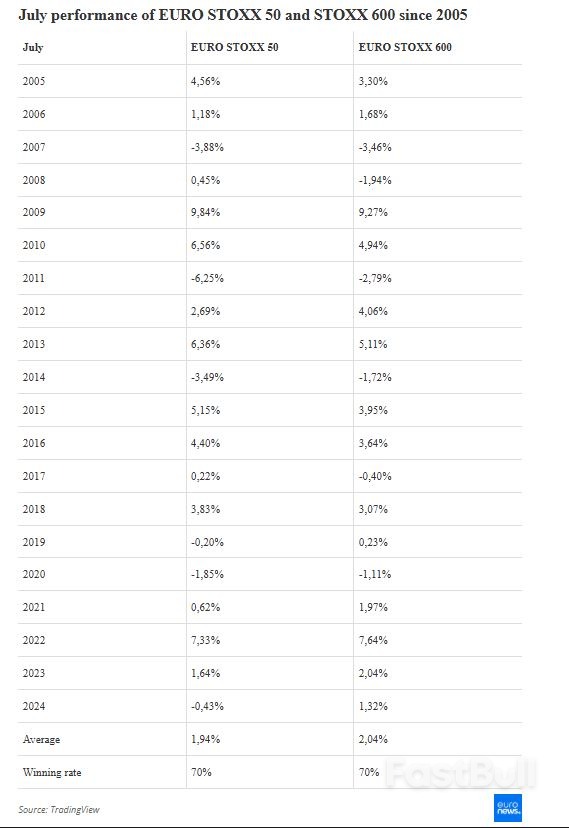
          Take the EURO STOXX 50, the region's blue-chip benchmark. Over the past 20 years, it has posted an average July return of 1.94%, finishing the month in positive territory 70% of the time. That’s the strongest performance of any month in the year.
          July 2009 was particularly stellar, with the index rallying 9.8%, followed by robust gains of 7.3% in 2022, 6.56% in 2010, and 6.36% in 2013.
          Of course, not every July has been smooth sailing. The worst declines came in 2011, when the index dropped 6.3%, and in 2007, with a 3.9% loss. Still, the broader pattern points to July as a month that favours the bulls.
          The STOXX Europe 600, which offers a wider snapshot of the region’s equity market, echoes this trend.
          The index has averaged a 2.04% return in July, again with a 70% win ratio, marking it as the most reliable month of the calendar year.July's Seasonal Magic: European Stocks' Summer Rally Revealed_1
          Zooming in on national indices, the pattern holds. France’s CAC 40 has seen average July gains of 1.8% with a 65% win rate, making it its best month of the year.
          Germany’s DAX comes close, with July returns averaging 1.91%. While not the strongest — November and April post higher gains —, July remains among the top-performing months.
          Italy’s FTSE MIB stands out, rising 1.78% on average in July with a 70% success rate — higher than any other month for the Milan index.

          Stocks with standout July track records

          Seasonal strength doesn’t stop at the index level. According to data from Seasonax, a number of European companies consistently deliver robust July returns over the past two decades.
          Among the top performers:
          Credit Agricole: A July star, averaging a 4.85% gain with a 73% win rate — the best month of the year for the French lender.
          BNP Paribas: Another banking giant shining in summer, with average returns of 3.79% and a 70% win rate.
          Societe Generale: Rounding out the trio of French banks, it posts 3.68% on average in July with the same 70% success ratio.
          Luxury also comes into play:
          LVMH and Hermès average July gains of 3.23% and 3.19% respectively, each with strong win rates (70% and 65%).
          Kering sees similar strength with 3.64%, though with a lower 55% win rate.
          Elsewhere in industrials and tech:
          Airbus: The French industrial powerhouse showed average gains of 3.9% and a remarkable 80% win rate in July. It’s the second-best month after January, but far more consistent.
          SAP SE: The German software firm sees July as its best month too, averaging 2.98% with a 65% win rate.
          Continental AG and Carl Zeiss Meditec also post average July returns above 4%, with strong seasonal signals.

          Bottom line: A seasonal tilt worth noting

          While past performance never guarantees future outcomes, July’s track record for European equities stands out as a recurring bright spot.
          From banks to luxury and industrial names, many sectors have historically benefited from a summer tailwind.
          For investors weighing their next move, seasonality isn’t everything — but it might just be a reason to keep an eye on Europe this July.

          Source: Euronews

          To stay updated on all economic events of today, please check out our Economic calendar
          Risk Warnings and Disclaimers
          You understand and acknowledge that there is a high degree of risk involved in trading. Following any strategies or investment methods may lead to potential losses. The content on the site is provided by our contributors and analysts for information purposes only. You are solely responsible for determining whether any trading assets, securities, strategy, or any other product is suitable for investing based on your own investment objectives and financial situation.
          Add to Favorites
          Share
          FastBull
          Copyright © 2025 FastBull Ltd

          728 RM B 7/F GEE LOK IND BLDG NO 34 HUNG TO RD KWUN TONG KLN HONG KONG

          TelegramInstagramTwitterfacebooklinkedin
          App Store Google Play Google Play
          Products
          Charts

          Chats

          Q&A with Experts
          Screeners
          Economic Calendar
          Data
          Tools
          Membership
          Features
          Function
          Markets
          Copy Trading
          Latest Signals
          Contests
          News
          Analysis
          24/7
          Columns
          Education
          Company
          Careers
          About Us
          Contact Us
          Advertising
          Help Center
          Feedback
          User Agreement
          Privacy Policy
          Business

          White Label

          Data API

          Web Plug-ins

          Poster Maker

          Affiliate Program

          Risk Disclosure

          The risk of loss in trading financial instruments such as stocks, FX, commodities, futures, bonds, ETFs and crypto can be substantial. You may sustain a total loss of the funds that you deposit with your broker. Therefore, you should carefully consider whether such trading is suitable for you in light of your circumstances and financial resources.

          No decision to invest should be made without thoroughly conducting due diligence by yourself or consulting with your financial advisors. Our web content might not suit you since we don't know your financial conditions and investment needs. Our financial information might have latency or contain inaccuracy, so you should be fully responsible for any of your trading and investment decisions. The company will not be responsible for your capital loss.

          Without getting permission from the website, you are not allowed to copy the website's graphics, texts, or trademarks. Intellectual property rights in the content or data incorporated into this website belong to its providers and exchange merchants.

          Not Logged In

          Log in to access more features

          FastBull Membership

          Not yet

          Purchase

          Become a signal provider
          Help Center
          Customer Service
          Dark Mode
          Price Up/Down Colors

          Log In

          Sign Up

          Position
          Layout
          Fullscreen
          Default to Chart
          The chart page opens by default when you visit fastbull.com
