• Trade
  • Markets
  • Copy
  • Contests
  • News
  • 24/7
  • Calendar
  • Q&A
  • Chats
Trending
Screeners
SYMBOL
LAST
BID
ASK
HIGH
LOW
NET CHG.
%CHG.
SPREAD
SPX
S&P 500 Index
6857.13
6857.13
6857.13
6865.94
6827.13
+7.41
+ 0.11%
--
DJI
Dow Jones Industrial Average
47850.93
47850.93
47850.93
48049.72
47692.96
-31.96
-0.07%
--
IXIC
NASDAQ Composite Index
23505.13
23505.13
23505.13
23528.53
23372.33
+51.04
+ 0.22%
--
USDX
US Dollar Index
98.950
99.030
98.950
99.000
98.740
-0.030
-0.03%
--
EURUSD
Euro / US Dollar
1.16464
1.16472
1.16464
1.16715
1.16408
+0.00019
+ 0.02%
--
GBPUSD
Pound Sterling / US Dollar
1.33428
1.33437
1.33428
1.33622
1.33165
+0.00157
+ 0.12%
--
XAUUSD
Gold / US Dollar
4223.98
4224.41
4223.98
4230.62
4194.54
+16.81
+ 0.40%
--
WTI
Light Sweet Crude Oil
59.292
59.322
59.292
59.543
59.187
-0.091
-0.15%
--

Community Accounts

Signal Accounts
--
Profit Accounts
--
Loss Accounts
--
View More

Become a signal provider

Sell trading signals to earn additional income

View More

Guide to Copy Trading

Get started with ease and confidence

View More

Signal Accounts for Members

All Signal Accounts

Best Return
  • Best Return
  • Best P/L
  • Best MDD
Past 1W
  • Past 1W
  • Past 1M
  • Past 1Y

All Contests

  • All
  • Trump Updates
  • Recommend
  • Stocks
  • Cryptocurrencies
  • Central Banks
  • Featured News
Top News Only
Share

Swiss Federal Council: Draft Mandate Will Now Be Consulted With Foreign Policy Committees Of Parliament And Cantons

Share

Swiss Federal Council: Approved The Draft Negotiating Mandate For A Trade Agreement With The US

Share

China's Public Security Ministry Says China, US Anti-Narcotic Teams Held Video Meeting Recently

Share

Argentine Shale Export Deal Includes Initial Volume Of Up To 70000 Barrels/Day, Could Generate Revenues Of $12 Billion Through June 2033

Share

Sources Say German Lawmakers Have Passed A Pension Bill

Share

Russia's Rosatom Discusses With India Possibility Of Localising Production Of Nuclear Fuel For Nuclear Power Plants

Share

Russia Offered India To Localise Production Of Su-57 - Tass Cites Chemezov

Share

Argentina Economy Ministry: Launches 6.50% National Treasury Bond In USA Dollars Maturing On November 30, 2029

Share

Czech Defence Group Csg: Framework Agreement For Period Of 7 Years, Includes Potential Use Of EU's Safe Program

Share

India Aviation Regulator: Committee Shall Submit Its Finding, Recommendation To Regulator Within 15 Days

Share

Brazil October PPI -0.48% From Previous Month

Share

Netflix To Acquire Warner Bros. Following The Separation Of Discovery Global For A Total Enterprise Value Of $82.7 Billion (Equity Value Of $72.0 Billion)

Share

Tass Cites Kremlin: Russia Will Continue Its Actions In Ukraine If Kyiv Refuses To Settle The Conflict

Share

India's Forex Reserves Fall To $686.23 Billion As Of Nov 28

Share

Reserve Bank Of India Says Federal Government Had No Outstanding Loans With It As On Nov 28

Share

Lebanon Says Ceasefire Talks Aim Mainly At Halting Israel's Hostilities

Share

Russia Plans To Boost Oil Exports From Western Ports By 27% In December From November -Sources And Reuters Calculations

Share

Sberbank: Estimated Investment Of $100 Million In Technology, Team Expansion, And New Offices In India

Share

Sberbank Says Sberbank Unveils Major Expansion Strategy For India, Plans Full-Scale Banking, Education, And Tech Transfer

Share

India Government: Expect That Flight Schedules Will Begin To Stabilise And Return To Normal By Dec 6

TIME
ACT
FCST
PREV
U.S. Initial Jobless Claims 4-Week Avg. (SA)

A:--

F: --

P: --

U.S. Weekly Continued Jobless Claims (SA)

A:--

F: --

P: --

Canada Ivey PMI (SA) (Nov)

A:--

F: --

P: --

Canada Ivey PMI (Not SA) (Nov)

A:--

F: --

P: --

U.S. Non-Defense Capital Durable Goods Orders Revised MoM (Excl. Aircraft) (SA) (Sept)

A:--

F: --

P: --
U.S. Factory Orders MoM (Excl. Transport) (Sept)

A:--

F: --

P: --

U.S. Factory Orders MoM (Sept)

A:--

F: --

P: --

U.S. Factory Orders MoM (Excl. Defense) (Sept)

A:--

F: --

P: --

U.S. EIA Weekly Natural Gas Stocks Change

A:--

F: --

P: --

Saudi Arabia Crude Oil Production

A:--

F: --

P: --

U.S. Weekly Treasuries Held by Foreign Central Banks

A:--

F: --

P: --

Japan Foreign Exchange Reserves (Nov)

A:--

F: --

P: --

India Repo Rate

A:--

F: --

P: --

India Benchmark Interest Rate

A:--

F: --

P: --

India Reverse Repo Rate

A:--

F: --

P: --

India Cash Reserve Ratio

A:--

F: --

P: --

Japan Leading Indicators Prelim (Oct)

A:--

F: --

P: --

U.K. Halifax House Price Index YoY (SA) (Nov)

A:--

F: --

P: --

U.K. Halifax House Price Index MoM (SA) (Nov)

A:--

F: --

P: --

France Current Account (Not SA) (Oct)

A:--

F: --

P: --

France Trade Balance (SA) (Oct)

A:--

F: --

P: --

France Industrial Output MoM (SA) (Oct)

A:--

F: --

P: --

Italy Retail Sales MoM (SA) (Oct)

A:--

F: --

P: --

Euro Zone Employment YoY (SA) (Q3)

A:--

F: --

P: --

Euro Zone GDP Final YoY (Q3)

A:--

F: --

P: --

Euro Zone GDP Final QoQ (Q3)

A:--

F: --

P: --

Euro Zone Employment Final QoQ (SA) (Q3)

A:--

F: --

P: --

Euro Zone Employment Final (SA) (Q3)

A:--

F: --

P: --
Brazil PPI MoM (Oct)

A:--

F: --

P: --

Mexico Consumer Confidence Index (Nov)

A:--

F: --

P: --

Canada Unemployment Rate (SA) (Nov)

--

F: --

P: --

Canada Labor Force Participation Rate (SA) (Nov)

--

F: --

P: --

Canada Employment (SA) (Nov)

--

F: --

P: --

Canada Part-Time Employment (SA) (Nov)

--

F: --

P: --

Canada Full-time Employment (SA) (Nov)

--

F: --

P: --

U.S. Personal Income MoM (Sept)

--

F: --

P: --

U.S. Dallas Fed PCE Price Index YoY (Sept)

--

F: --

P: --

U.S. PCE Price Index YoY (SA) (Sept)

--

F: --

P: --

U.S. PCE Price Index MoM (Sept)

--

F: --

P: --

U.S. Personal Outlays MoM (SA) (Sept)

--

F: --

P: --

U.S. Core PCE Price Index MoM (Sept)

--

F: --

P: --

U.S. UMich 5-Year-Ahead Inflation Expectations Prelim YoY (Dec)

--

F: --

P: --

U.S. Core PCE Price Index YoY (Sept)

--

F: --

P: --

U.S. Real Personal Consumption Expenditures MoM (Sept)

--

F: --

P: --

U.S. 5-10 Year-Ahead Inflation Expectations (Dec)

--

F: --

P: --

U.S. UMich Current Economic Conditions Index Prelim (Dec)

--

F: --

P: --

U.S. UMich Consumer Sentiment Index Prelim (Dec)

--

F: --

P: --

U.S. UMich 1-Year-Ahead Inflation Expectations Prelim (Dec)

--

F: --

P: --

U.S. UMich Consumer Expectations Index Prelim (Dec)

--

F: --

P: --

U.S. Weekly Total Rig Count

--

F: --

P: --

U.S. Weekly Total Oil Rig Count

--

F: --

P: --

U.S. Consumer Credit (SA) (Oct)

--

F: --

P: --

China, Mainland Foreign Exchange Reserves (Nov)

--

F: --

P: --

China, Mainland Exports YoY (USD) (Nov)

--

F: --

P: --

China, Mainland Imports YoY (CNH) (Nov)

--

F: --

P: --

China, Mainland Imports YoY (USD) (Nov)

--

F: --

P: --

China, Mainland Imports (CNH) (Nov)

--

F: --

P: --

China, Mainland Trade Balance (CNH) (Nov)

--

F: --

P: --

China, Mainland Exports (Nov)

--

F: --

P: --

Q&A with Experts
    • All
    • Chatrooms
    • Groups
    • Friends
    Connecting
    .
    .
    .
    Type here...
    Add Symbol or Code

      No matching data

      All
      Trump Updates
      Recommend
      Stocks
      Cryptocurrencies
      Central Banks
      Featured News
      • All
      • Russia-Ukraine Conflict
      • Middle East Flashpoint
      • All
      • Russia-Ukraine Conflict
      • Middle East Flashpoint
      Search
      Products

      Charts Free Forever

      Chats Q&A with Experts
      Screeners Economic Calendar Data Tools
      Membership Features
      Data Warehouse Market Trends Institutional Data Policy Rates Macro

      Market Trends

      Market Sentiment Order Book Forex Correlations

      Top Indicators

      Charts Free Forever
      Markets

      News

      News Analysis 24/7 Columns Education
      From Institutions From Analysts
      Topics Columnists

      Latest Views

      Latest Views

      Trending Topics

      Top Columnists

      Latest Update

      Signals

      Copy Rankings Latest Signals Become a signal provider AI Rating
      Contests
      Brokers

      Overview Brokers Assessment Rankings Regulators News Claims
      Broker listing Forex Brokers Comparison Tool Live Spread Comparison Scam
      Q&A Complaint Scam Alert Videos Tips to Detect Scam
      More

      Business
      Events
      Careers About Us Advertising Help Center

      White Label

      Data API

      Web Plug-ins

      Affiliate Program

      Awards Institution Evaluation IB Seminar Salon Event Exhibition
      Vietnam Thailand Singapore Dubai
      Fans Party Investment Sharing Session
      FastBull Summit BrokersView Expo
      Recent Searches
        Top Searches
          Markets
          News
          Analysis
          User
          24/7
          Economic Calendar
          Education
          Data
          • Names
          • Latest
          • Prev

          View All

          No data

          Scan to Download

          Faster Charts, Chat Faster!

          Download App
          English
          • English
          • Español
          • العربية
          • Bahasa Indonesia
          • Bahasa Melayu
          • Tiếng Việt
          • ภาษาไทย
          • Français
          • Italiano
          • Türkçe
          • Русский язык
          • 简中
          • 繁中
          Open Account
          Search
          Products
          Charts Free Forever
          Markets
          News
          Signals

          Copy Rankings Latest Signals Become a signal provider AI Rating
          Contests
          Brokers

          Overview Brokers Assessment Rankings Regulators News Claims
          Broker listing Forex Brokers Comparison Tool Live Spread Comparison Scam
          Q&A Complaint Scam Alert Videos Tips to Detect Scam
          More

          Business
          Events
          Careers About Us Advertising Help Center

          White Label

          Data API

          Web Plug-ins

          Affiliate Program

          Awards Institution Evaluation IB Seminar Salon Event Exhibition
          Vietnam Thailand Singapore Dubai
          Fans Party Investment Sharing Session
          FastBull Summit BrokersView Expo

          Fed Lowers Rates, Nods To Limits Of Data During Shutdown; Two Policymakers Dissent

          Liam Peterson
          Summary:

          A divided U.S. Federal Reserve cut interest rates by a quarter of a percentage point on Wednesday and announced it will restart limited purchases of Treasury securities after money markets showed signs that liquidity was becoming scarce, a condition the U.S. central bank has pledged to avoid.

          A divided U.S. Federal Reserve cut interest rates by a quarter of a percentage point on Wednesday and announced it will restart limited purchases of Treasury securities after money markets showed signs that liquidity was becoming scarce, a condition the U.S. central bank has pledged to avoid.

          The rate cut, which included a nod to the data limits the Fed faces during the current federal government shutdown, drew dissents from two policymakers, with Governor Stephen Miran again calling for a deeper reduction in borrowing costs and Kansas City Fed President Jeffrey Schmid favoring no cut at all given ongoing inflation.

          The balance sheet decision will keep the total amount of the central bank's holdings steady on a month-to-month basis as of December 1, but shift its portfolio by reinvesting the proceeds of maturing mortgage-backed securities into Treasury bills.

          The 10-2 decision to lower the policy rate to a range of 3.75%-4.00% was expected by investors as a way for the Fed to temper any further decline in a job market policymakers worry may be losing steam.

          Speaking at a press conference following the central bank meeting, Federal Reserve Chair Jerome Powell offered a note of caution about what lies ahead. "In the committee's discussions at this meeting, there were strongly differing views about how to proceed in December," Powell said, adding, "a further reduction in the policy rate at the December meeting is not a foregone conclusion. Far from it, policy is not on a preset course."

          Stock markets pulled back on Powell's comments on the outlook for monetary policy, as traders and investors pared existing bets favoring more rate cuts.

          Fed policymakers acknowledged the limits in their decision-making process posed by the government shutdown, dating their view of the unemployment rate to August - the month of the last official jobs release - while noting that "available indicators suggest" the economy continued growing at a moderate pace.

          Inflation has not risen as strongly as initially expected on the back of the Trump administration's new import taxes, but nevertheless has climbed from around 2.3% in April to about 2.7% in August, according to the last official estimate released for the Personal Consumption Expenditures Price Index before the shutdown. The Fed uses the PCE to set its 2% inflation target, and in projections issued in September policymakers expected it to rise to 3% by the end of this year.

          They expect that increase in prices to ease over time, while concern about the strength of the job market has climbed.

          "Downside risks to employment rose in recent months," the Fed said in its new policy statement.

          The dissents by Miran and Schmid marked just the third time since 1990 that policymakers have dissented both in favor of easier and tighter monetary policy at the same meeting.

          Source: Kitco

          Risk Warnings and Disclaimers
          You understand and acknowledge that there is a high degree of risk involved in trading. Following any strategies or investment methods may lead to potential losses. The content on the site is provided by our contributors and analysts for information purposes only. You are solely responsible for determining whether any trading assets, securities, strategy, or any other product is suitable for investing based on your own investment objectives and financial situation.
          Add to Favorites
          Share

          UK Small-Business Confidence Slumps Further As Budget Fears Bite

          Daniel Carter

          Economic

          Confidence across Britain's small businesses plunged in the third quarter, according to a new survey, underscoring the anxiety the country's entrepreneurs have around higher taxes in next month's budget.
          Nearly a third of small companies — a record high — predict they'll downsize, sell up or close down in the next year, according to the research by the Federation of Small Businesses. That compares to just 18% that expect to expand in that time.
          It's the latest evidence that businesses are under strain ahead of the budget, with the prospect of higher taxes weighing on the minds of small business owners. Firms are feeling the squeeze from weak growth in the UK, the country's tax burden and higher labor costs, the FSB said.
          Small business sentiment is a key indicator as these firms employ roughly three-fifths of the UK's private sector workers. Weaker confidence and shrinking growth expectations risk further denting the economy ahead of the budget, with firms reining in spending and investment.
          "Millions of small businesses shrinking, closing, or selling up instead of growing means a vicious cycle of a lower tax take, higher unemployment, and greater demands on the state all exacerbating each other in a downward spiral," said Tina McKenzie, policy chair at the FSB.
          The survey of nearly 1,500 business owners follows official data this month showing that company insolvencies in the first nine months of 2025 are broadly in line with 2023, when they hit a 30-year high. Most cases were voluntary liquidations, underlining how sustained cost pressures are forcing smaller firms to shut up shop.
          As well as entrepreneurs, working people could face the prospect of higher taxes. Prime Minister Keir Starmer refused to rule out raising income tax, national insurance or value added tax at the budget, suggesting the government may break its election manifesto promises to plug a growing hole in the country's finances.

          Source: Bloomberg Europe

          To stay updated on all economic events of today, please check out our Economic calendar
          Risk Warnings and Disclaimers
          You understand and acknowledge that there is a high degree of risk involved in trading. Following any strategies or investment methods may lead to potential losses. The content on the site is provided by our contributors and analysts for information purposes only. You are solely responsible for determining whether any trading assets, securities, strategy, or any other product is suitable for investing based on your own investment objectives and financial situation.
          Add to Favorites
          Share

          Powell's December Warning Exposes Hardening Divisions At Fed

          Daniel Carter

          Central Bank

          Economic

          While Powell made it clear that the primary concern for some is a cooling job market, others inside the Fed are warning persistent inflation will limit room for more easing. And a freeze on the release of official economic data during the ongoing government shutdown is only hardening the divide.
          Powell's comments came after the Federal Open Market Committee voted 10-2 to lower the target range for the federal funds rate by a quarter percentage point, to 3.75%-4%. It was the second straight rate cut, but for the first time in six years, there were dissents in both directions — with one official advocating a larger reduction and another preferring to stay on hold.
          In unusually direct remarks, the Fed chair used the opening statement of his post-meeting press conference to hammer home a message that a follow-up move in December is not a done deal.
          "A further reduction in the policy rate at the December meeting is not a foregone conclusion — far from it," Powell said. Later, while taking questions from reporters, he added that there was "a growing chorus now of feeling like maybe we this is where we should at least wait a cycle" before taking another step.
          Investors got the message loud and clear: Treasuries fell by the most in nearly five months after his remarks, sending the yield on the 10-year note back above 4%.
          Futures linked to the Fed's benchmark rate suggest another cut at the Fed's next policy meeting on Dec. 9-10 is now only moderately likely, instead of a virtual lock.
          "This was clearly something that we did not expect there would be such a strong pushback against," said Pooja Sriram, an economist at Barclays. "The one thing that we can make out from the press conference is they clearly had a lot of discussion about December."
          Fed officials opted for a rate cut at their last meeting in September for the first time this year after a marked slowdown in hiring raised worries about the labor market. But there were signs that several officials were wary of cutting too far. Projections released after that meeting showed 9 of 19 on the FOMC expected no more than one additional reduction this year, including seven who preferred no further moves in 2025.
          Wednesday's vote marked the third straight FOMC meeting in which officials lodged dissents against the majority decision, a run not seen since 2019.
          The division also comes at a particularly trying time due to the shutdown, which began in early October. In the absence of official government data, economists and policymakers have been scouring private sector and state-level indicators for clues about employment trends.
          Companies including Amazon.com Inc., General Motors Co. and Applied Materials Inc. have in recent weeks announced plans to reduce headcount, though layoffs remain limited overall, according to weekly state-level filings for unemployment insurance — a point Powell emphasized Wednesday.
          Still, the Fed chair made it clear which side of the jobs-versus-inflation debate he is on. He downplayed concerns about price pressures and said the Fed has a role to play in responding to the slowdown in hiring, even if it's partly on account of President Donald Trump's immigration crackdown.
          "Some people argue that that this is supply, and we really can't affect it much with our tools," Powell said. "But others argue, as I do, that there is an effect from demand, and that we should use our tools to support the labor market when we see this happening."
          If Powell's caution over December does end up foreshadowing a pause in rate cuts, that would almost certainly inflame tensions with the White House as Trump continues to criticize Powell for not lowering rates fast enough. His broadsides have already fueled worries about the future of the central bank's independence.
          Joe Brusuelas, chief economist at RSM US LLP, said he would "expect dissents to be a near-permanent feature of the meetings going forward" as new voters rotate onto the FOMC in 2026 and Trump appoints a replacement for Powell, whose term as chair ends in May.
          "There's going to be plentiful diversity around the path on which policy should proceed, given what we're seeing out of the White House, the over-pressure on the Fed to bend policy to its wishes and the substantial disagreements over risk around the outlook linked to inflation," Brusuelas said.

          Source: Bloomberg Europe

          To stay updated on all economic events of today, please check out our Economic calendar
          Risk Warnings and Disclaimers
          You understand and acknowledge that there is a high degree of risk involved in trading. Following any strategies or investment methods may lead to potential losses. The content on the site is provided by our contributors and analysts for information purposes only. You are solely responsible for determining whether any trading assets, securities, strategy, or any other product is suitable for investing based on your own investment objectives and financial situation.
          Add to Favorites
          Share

          US, South Korea Finalize Deal on Investments, Lower Tariff Rate

          Manuel

          Political

          Economic

          US President Donald Trump and South Korean President Lee Jae Myung finalized a trade deal Wednesday, capping months of negotiation over implementation of a framework agreement struck in July.
          The deal will see Seoul make $150 billion in shipbuilding investments, with an additional $200 billion earmarked for an investment pledge designed to look like a similar agreement with Japan, South Korea Policy Chief Kim Yong-beom said Wednesday. That suggests South Korea can use not only equity but loans and loan guarantees to fund the investment package, a key concession.
          Trump called his meetings with South Korea “tremendous” and said they had “pretty much finalized a trade deal” during a dinner hosted by Lee in his honor on Wednesday night.
          “I think we came to a conclusion on a lot of very important items,” Trump said.
          The won gained as much as 0.9% against the dollar following the first report of the deal. South Korea’s finance minister said last week that recent weakness in the won reflected concern that the deal hadn’t been finalized.
          Trump in a social media post hailed the investments from South Korea and the lowered tariff rate for the country, while providing few additional details beyond those offered by Seoul.
          Trump said South Korea had “agreed to buy our Oil and Gas in vast quantities,” and that investments made by the country’s businesses in the US would top $600 billion.
          The US president added that he had “given them approval to build a Nuclear Powered Submarine, rather than the old fashioned, and far less nimble, diesel powered Submarines that they have now.” In a subsequent post, Trump said that South Korea would be building the nuclear-powered submarine “in the Philadelphia Shipyards,” touting it as a boost for the US shipbuilding industry. Lee had pressed Trump to allow South Korea to reprocess nuclear fuel for submarines to replace diesel-powered ships in their fleet.
          Ahead of the breakthrough, South Korea and the US had played down the notion that the two sides could finalize the agreement, which will see the US cap tariffs on South Korean goods at 15%, during Trump’s visit.
          US duties on Korean car imports had remained at 25% while the talks continued. That left the nation’s automakers at a competitive disadvantage against their Japanese rivals since Tokyo finalized its deal in September. Those duties will now come down to 15%, according to Kim.
          Just days before the deal was sealed, Lee said key details of a $350 billion investment package remained sticking points, while Trump called the agreement “pretty close” to completion, highlighting a gap in perceptions even as talks neared the finish line.
          The agreement runs through January 2029, though actual disbursement will be spread over the long term, Kim said. South Korea will also receive guarantees that its pharmaceutical exports match the lowest tariff offered to any US trading partner, Kim said.
          Kim said that under the deal investment in the US would be capped at $20 billion annually. Earlier this month the Bank of Korea had specified that sum as the maximum that could be supplied in dollars without having a negative impact on the local currency market.
          The US is also allowing Korea’s $150 billion shipbuilding investment to be guaranteed by domestic and international commercial banks, reducing the burden on the foreign exchange market. Profits will be split 50-50 between the two nations until the principal and interest are repaid.

          Investment Safeguards

          The two sides also agreed to apply tariff levels on semiconductors that are not disadvantageous compared to those applied to Taiwan, the main competitor to Korean firms.
          Kim said the government built multiple safeguards into the investment package to limit financial risk and protect the foreign-exchange market.
          Only “commercially viable projects with guaranteed cash flow” will be pursued, he said, noting that this clause will be explicitly stated in the memorandum of understanding.
          He added that the two sides agreed to adjust profit-sharing terms if Korea is unable to recover its principal within 20 years, allowing flexibility in repayment. The agreement also limits annual disbursements to $20 billion and uses an umbrella-type special purpose company structure so that losses in one project can be offset by gains in another.
          “These measures ensure that the $350 billion commitment does not create shocks in the FX market,” Kim said, stressing that investments will be made in phases and not sourced through direct dollar purchases.
          Full details of the agreement, which is expected to include additional security guarantees, will be released in the coming days.
          The agreement gives Trump another success he can put on a list of deals struck during his trip through Asia. The most pivotal meeting for cementing positive optics for the trip comes Thursday, when he meets with Chinese leader Xi Jinping.

          Source: Bloomberg

          To stay updated on all economic events of today, please check out our Economic calendar
          Risk Warnings and Disclaimers
          You understand and acknowledge that there is a high degree of risk involved in trading. Following any strategies or investment methods may lead to potential losses. The content on the site is provided by our contributors and analysts for information purposes only. You are solely responsible for determining whether any trading assets, securities, strategy, or any other product is suitable for investing based on your own investment objectives and financial situation.
          Add to Favorites
          Share

          Consumer Loan Delinquencies Approach 5-Year High, Borrowers Struggle to Keep Up With Payments

          Manuel

          Bond

          Economic

          With the era of COVID-19 federal relief programs over and tariffs continuing to raise prices, consumers are having a harder time keeping up with their debt.
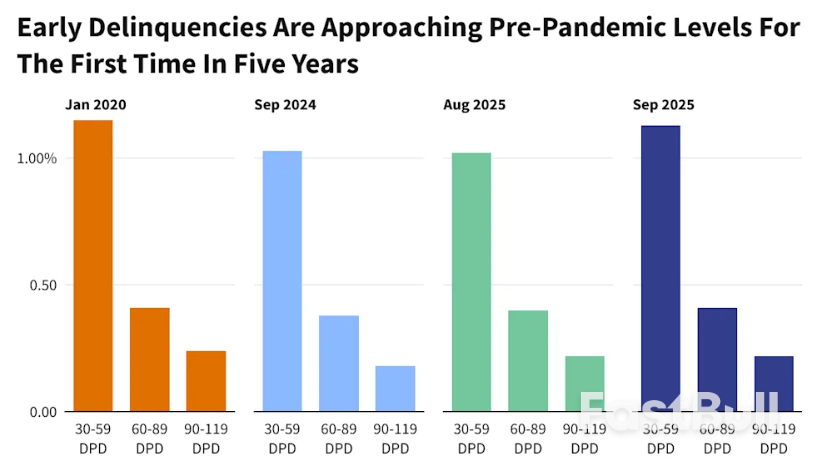
          A recent report from credit scoring company VantageScore showed that delinquency rates for consumer loans grew in September. Specifically, early-stage delinquencies are approaching rates not seen in five years.
          The percentage of loans in early delinquency, defined as a payment not made within 30 to 59 days, was 1.13% last month. This is up from 1.02% in August and approaching the 1.15% delinquency rate in January 2020, reported VantageScore.Consumer Loan Delinquencies Approach 5-Year High, Borrowers Struggle to Keep Up With Payments_1

          Why This Matters

          Delinquency rates are a strong indicator of Americans' financial health. More loans that are past due signal that inflation and other economic woes are stressing more consumers' budgets.
          Consumer loan delinquency rates dropped during the pandemic, when economic growth slowed and consumers were spending less. In addition, many Americans received federal stimulus checks at the time, which helped them keep up with their debt. Some borrowers were also granted relief from their debt payments, such as when the Department of Education paused all student loan payments.
          However, delinquency rates began accelerating again in 2022, as inflation started heating up and stimulus checks ran out. The Federal Reserve was able to tame inflation to some extent, but it began to flare up again after tariffs were announced earlier this year.
          The Fed has been wary of cutting interest rates due to rising inflation. High interest rates keep borrowing costs high and make it harder to pay off debt. However, because the job market has been deteriorating rapidly at the same time, the Fed cut rates by a quarter point in September and again on Wednesday.
          “Banks are reining in new lending, suggesting that they're taking a more cautious posture after a strong summer,” said Susan Fahy, executive vice president and chief digital officer at VantageScore, in a press release. “Early-stage delinquencies are near levels last seen before the COVID pandemic.”
          Among all loan types, mortgages have had the fastest increase in delinquency rates. Last month, late-stage delinquency rates for mortgages (90 to 119 days past due) had the most significant year-over-year growth of any debt, and were at their highest since January 2020.
          In addition, loan originations for all debt types fell in September. With high interest rates and home and car prices continuing to climb, fewer consumers have taken out auto loans and mortgages compared to early 2025.

          Source: Investopedia

          To stay updated on all economic events of today, please check out our Economic calendar
          Risk Warnings and Disclaimers
          You understand and acknowledge that there is a high degree of risk involved in trading. Following any strategies or investment methods may lead to potential losses. The content on the site is provided by our contributors and analysts for information purposes only. You are solely responsible for determining whether any trading assets, securities, strategy, or any other product is suitable for investing based on your own investment objectives and financial situation.
          Add to Favorites
          Share

          Meta Stock Sinks After Tax hit Weighs on Earnings, Company Touts 'Notably Larger' AI Investments in Year Ahead

          Manuel

          Stocks

          Meta (META) on Wednesday reported third quarter earnings beating expectations on revenue, but falling short on earnings per share due to a one-time tax related charge and increased capital expenditures this year and in the year ahead related to its AI build out.
          Meta stock plummeted more than 6% following the news.
          For Q3, Meta is saw earnings per share of $1.05 and revenue of $51.24 billion versus expectations of EPS of $6.72 on revenue of $49.6 billion, according to Bloomberg consensus estimates.
          Family of apps revenue hit $50.77 billion versus an anticipated $48.6 billion.
          The social media giant has been on a massive spending spree in recent months, laying out billions to hire talent and build the data centers necessary to meet its demand for AI.
          To that end, Meta says its increasing its capital expenditures estimates for the year to $70 billion to72 billion versus its prior outlook of $66 billion to 72 billion.
          So far, spending includes investing $14.3 billion in Scale AI (SCAI.PVT) and hiring its CEO as chief AI officer; plowing at least $1.5 billion into a new data center in El Paso, Texas; and entering into a $27 billion financing deal with Blue Owl Capital to pay for its massive Hyperion data center in Richland Parish, La, and pouring millions more into poaching AI experts from rival tech firms, including OpenAI and Apple.
          That spending will only continue to grow in the year ahead.
          "Our current expectation is that capital expenditures dollar growth will be notably larger in 2026 than 2025," Meta CFO Susan Li said in her commmentary.
          "We also anticipate total expenses will grow at a significantly faster percentage rate in 2026 than 2025, with growth driven primarily by infrastructure costs, including incremental cloud expenses and depreciation. Employee compensation costs will be the second largest contributor to growth, as we recognize a full year of compensation for employees hired throughout 2025, particularly AI talent, and add technical talent in priority areas."
          At the same time, Meta laid off some 600 workers from its AI division, continuing a trend among Silicon Valley heavyweights cutting back on employee ranks.
          Unlike cloud providers Amazon (AMZN), Google (GOOG, GOOGL), and Microsoft (MSFT), which are also spending heavily on AI, Meta isn’t angling to sell its AI offerings to enterprises. Instead, the company is using the technology to power its advertising business and drive ever more user engagement.
          Meta shares are up 27% year to date and 26% over the last 12 months. That trails advertising rival Google’s 43% year-to-date jump and 60% increase over the last 12 months.
          Meta is also putting its AI to work inside of its hardware products, including its Ray-Ban Meta smart glasses, Quest 3 headset, and newly announced Meta Ray-Ban Display glasses.
          But Futurum research director and practice lead for intelligent devices Olivier Blanchard says Meta still isn’t quite clear on how its hardware will ultimately benefit consumers.
          “I am less bullish on Meta Platforms than a lot of my peers, and worry that senior leadership continues to not quite understand what kinds of problems should be solved by their products (I am primarily thinking about the XR segment and Meta AI), and what types of remarkable experiences could be delivered by their products,” Blanchard wrote in an email.

          Source: Yahoo Finance

          Risk Warnings and Disclaimers
          You understand and acknowledge that there is a high degree of risk involved in trading. Following any strategies or investment methods may lead to potential losses. The content on the site is provided by our contributors and analysts for information purposes only. You are solely responsible for determining whether any trading assets, securities, strategy, or any other product is suitable for investing based on your own investment objectives and financial situation.
          Add to Favorites
          Share

          Federal Reserve Cuts Interest Rates by 0.25% for Second Straight Meeting, 2 Officials Vote Against Move as Shutdown Challenges Mount

          Manuel

          Forex

          Central Bank

          The Federal Reserve cut interest rates by a quarter percentage point Wednesday for the second meeting in a row, even as the government shutdown has left policymakers without key data to guide monetary policy.
          The central bank voted in a split decision to cut its benchmark interest rate to a range of 3.75% to 4.00%. President Trump’s newest appointed governor, Stephen Miran, disagreed with the decision, preferring to cut rates by half a percentage point, while Kansas City Fed president Jeff Schmid also dissented, favoring holding rates steady.
          Miran said ahead of the Fed’s meeting that he was concerned renewed trade tensions with China, which have since lessened, posed risks to the economic outlook. He also said he’d like to cut rates to a neutral setting — a level designed to neither spur nor slow growth — more quickly than his colleagues because he doesn’t see tariffs leading to higher inflation and wants to avoid causing damage to the labor market.
          Schmid has said inflation is still too high and the previous level of interest rates was the “right place to be.” He’s cautioned that aggressively boosting demand could raise the risk of an outsized increase in prices as firms gain pricing power and increase the pass-through of tariffs to consumers.
          Not since September 2019 have there been dissents on both sides of a Fed interest rate decision.
          To begin its policy statement, the Fed acknowledged the ongoing government shutdown has muddied data collection efforts and prevented officials from having a complete picture of the US economy, noting its assessment of the economy is based on "available indicators." Later in its statement, the Fed said it "will continue to monitor the implications of incoming information for the economic outlook."
          Since the US government shutdown began on Oct. 1, the September jobs report remains unpublished, and that month's inflation data was published over two weeks late. The October jobs report, scheduled for release at the end of next week, is likely to be delayed. The White House said October's inflation report likely won't be published.
          Policymakers indicated in their statement that they don’t see any change in the state of the job market since they stopped getting official labor market data.
          “Job gains have slowed this year, and the unemployment rate has edged up, but remained low through August; more recent indicators are consistent with these developments,” the statement read.
          It also reiterated that “downside risks to employment rose in recent months.”
          Officials reiterated in their statement that, “in considering additional adjustments to the target range for the federal funds rate, the Committee will carefully assess incoming data, the evolving outlook, and the balance of risks.”

          Balance sheet runoff to end

          The Fed also said it will stop shrinking its balance sheet on Dec. 1. The change in language comes after Fed Chair Jerome Powell said earlier this month that the Fed may be approaching the point in the coming months where policymakers can stop their balance sheet runoff, which is the allowance of bonds to mature and roll off the Fed's portfolio, thereby decreasing the size of its balance sheet.
          Powell noted at the time that some signs have started to emerge that liquidity conditions are gradually tightening, and the committee wants to avoid the kind of strains in money markets experienced in September 2019.
          The Fed's long-stated plan is to stop the balance sheet runoff when reserves — funds held by banks' deposits — at the Fed are somewhat above the level they judge as "ample."

          December cut 'not a foregone conclusion'

          Fed officials cut their benchmark interest rate for the first time this year in September, and the median of the 19-member FOMC committee has penciled in two more rate cuts this year, even as the government shutdown has left policymakers flying blind without most official data.
          In a press conference following the meeting, Powell emphasized that another rate cut at the Fed's December meeting is "not a foregone conclusion — far from it."
          "There were strongly differing views about how to proceed in December," Powell said.
          He noted that with this fall's two rate cuts, the benchmark rate is now 150 basis points "closer to neutral" than it was a year ago, perhaps making a case for caution.
          "There's a growing chorus now of 'maybe this is where we should at least wait a cycle,'" before cutting rates again, Powell said.
          He also acknowledged the added difficulty of setting policy absent most government data due to the government shutdown.
          "What do you do if you're driving in the fog? You slow down," Powell said.
          The Fed's challenge is that inflation remains sticky, hovering well above the central bank's 2% target. The latest reading of the Consumer Price Index showed that "core" prices, excluding volatile food and energy prices, rose 3% in September, a tenth of a percent lower than in August, but still holding at the 3% level. Official labor market data through August showed a sharp slowdown in payroll growth. Without the jobs report for September, central bankers have had to rely on private sector data and anecdotal surveys, which have shown continued weakness in payroll growth.
          The decision to ease monetary policy again Wednesday follows months of pressure from Trump to bring rates down as the president and his White House allies have repeatedly accused Powell of being "too late."

          Source: Yahoo Finance

          Risk Warnings and Disclaimers
          You understand and acknowledge that there is a high degree of risk involved in trading. Following any strategies or investment methods may lead to potential losses. The content on the site is provided by our contributors and analysts for information purposes only. You are solely responsible for determining whether any trading assets, securities, strategy, or any other product is suitable for investing based on your own investment objectives and financial situation.
          Add to Favorites
          Share
          FastBull
          Copyright © 2025 FastBull Ltd

          728 RM B 7/F GEE LOK IND BLDG NO 34 HUNG TO RD KWUN TONG KLN HONG KONG

          TelegramInstagramTwitterfacebooklinkedin
          App Store Google Play Google Play
          Products
          Charts

          Chats

          Q&A with Experts
          Screeners
          Economic Calendar
          Data
          Tools
          Membership
          Features
          Function
          Markets
          Copy Trading
          Latest Signals
          Contests
          News
          Analysis
          24/7
          Columns
          Education
          Company
          Careers
          About Us
          Contact Us
          Advertising
          Help Center
          Feedback
          User Agreement
          Privacy Policy
          Business

          White Label

          Data API

          Web Plug-ins

          Poster Maker

          Affiliate Program

          Risk Disclosure

          The risk of loss in trading financial instruments such as stocks, FX, commodities, futures, bonds, ETFs and crypto can be substantial. You may sustain a total loss of the funds that you deposit with your broker. Therefore, you should carefully consider whether such trading is suitable for you in light of your circumstances and financial resources.

          No decision to invest should be made without thoroughly conducting due diligence by yourself or consulting with your financial advisors. Our web content might not suit you since we don't know your financial conditions and investment needs. Our financial information might have latency or contain inaccuracy, so you should be fully responsible for any of your trading and investment decisions. The company will not be responsible for your capital loss.

          Without getting permission from the website, you are not allowed to copy the website's graphics, texts, or trademarks. Intellectual property rights in the content or data incorporated into this website belong to its providers and exchange merchants.

          Not Logged In

          Log in to access more features

          FastBull Membership

          Not yet

          Purchase

          Become a signal provider
          Help Center
          Customer Service
          Dark Mode
          Price Up/Down Colors

          Log In

          Sign Up

          Position
          Layout
          Fullscreen
          Default to Chart
          The chart page opens by default when you visit fastbull.com