
• Trade
  • Markets
  • Copy
  • Contests
  • News
  • 24/7
  • Calendar
  • Q&A
  • Chats
Trending
Screeners
SYMBOL
LAST
BID
ASK
HIGH
LOW
NET CHG.
%CHG.
SPREAD
SPX
S&P 500 Index
6850.71
6850.71
6850.71
6878.28
6841.15
-19.69
-0.29%
--
DJI
Dow Jones Industrial Average
47809.13
47809.13
47809.13
47971.51
47709.38
-145.85
-0.30%
--
IXIC
NASDAQ Composite Index
23542.60
23542.60
23542.60
23698.93
23505.52
-35.52
-0.15%
--
USDX
US Dollar Index
99.130
99.210
99.130
99.160
98.730
+0.180
+ 0.18%
--
EURUSD
Euro / US Dollar
1.16205
1.16213
1.16205
1.16717
1.16169
-0.00221
-0.19%
--
GBPUSD
Pound Sterling / US Dollar
1.33169
1.33178
1.33169
1.33462
1.33053
-0.00143
-0.11%
--
XAUUSD
Gold / US Dollar
4191.15
4191.56
4191.15
4218.85
4175.92
-6.76
-0.16%
--
WTI
Light Sweet Crude Oil
58.950
58.980
58.950
60.084
58.837
-0.859
-1.44%
--

Community Accounts

Signal Accounts
--
Profit Accounts
--
Loss Accounts
--
View More

Become a signal provider

Sell trading signals to earn additional income

View More

Guide to Copy Trading

Get started with ease and confidence

View More

Signal Accounts for Members

All Signal Accounts

Best Return
  • Best Return
  • Best P/L
  • Best MDD
Past 1W
  • Past 1W
  • Past 1M
  • Past 1Y

All Contests

  • All
  • Trump Updates
  • Recommend
  • Stocks
  • Cryptocurrencies
  • Central Banks
  • Featured News
Top News Only
Share

Israeli Prime Minister Netanyahu: Hamas Has Violated The Ceasefire Agreement, And We Will Never Allow Its Members To Re-arm Themselves And Threaten US

Share

Israeli Prime Minister Netanyahu: We Are Working To Return The Body Of Another Detainee From The Gaza Strip

Share

Iraq's West Qurna 2 Oil Field Will Increase Oil Production Beyond Normal Levels To Compensate For The Production Stoppage Caused By The Trump Administration's Sanctions Against Russia

Share

Israeli Prime Minister Netanyahu: We Are Close To Completing The First Phase Of Trump’s Plan And Will Now Focus On Disarming Gaza And Seizing Hamas Weapons

Share

Moody's Affirmed Burberry's Long-term Rating Of Baa3 And Revised Its Outlook (from Negative) To Stable

Share

The Trump Administration Supports Iraq's Plan To Transfer Russian Oil Company Lukoil Pjsc's Assets In The West Qurna 2 Oil Field To An American Company

Share

JMA: Tsunami Of 70 Centimetres Observed In Japan's Kuji Port In Iwate Prefecture

Share

The U.S. Bureau Of Labor Statistics Plans To Release A Press Release On January 15, 2026, For November 2025, Along With Data For October

Share

Tiger Global Has Established A New Fund, Aiming To Raise $2 Billion To $3 Billion

Share

The U.S. Bureau Of Labor Statistics Announced That It Will Not Release A Press Release Regarding The U.S. Import And Export Price Index (MXP) For October 2025

Share

The U.S. Bureau Of Labor Statistics (BLS) Will Not Release U.S. October CPI Data

Share

Government Negotiator: Dutch Political Center And Center Right Parties D66,  Cda And Vvd Advised To Start Talks On Possible Government

Share

New York Fed: November Home Price Rise Expectation Steady At 3%

Share

New York Fed: US Households' Personal Finance Worries Grew In November

Share

New York Fed: November Five-Year-Ahead Expected Inflation Rate Unchanged At 3%

Share

New York Fed: Households More Pessimistic On Current, Future Financial Situations In November

Share

New York Fed Report: USA Households' Year-Ahead Expected Inflation Rate Unchanged At 3.2% In November

Share

New York Fed: November Year-Ahead Expected Rise In Medical Costs Highest Since January 2014

Share

New York Fed: Labor Market Expectations Improved In November

Share

New York Fed: November Three-Year-Ahead Expected Inflation Rate Unchanged At 3%

TIME
ACT
FCST
PREV
France Trade Balance (SA) (Oct)

A:--

F: --

P: --
Euro Zone Employment YoY (SA) (Q3)

A:--

F: --

P: --
Canada Part-Time Employment (SA) (Nov)

A:--

F: --

P: --

Canada Unemployment Rate (SA) (Nov)

A:--

F: --

P: --

Canada Full-time Employment (SA) (Nov)

A:--

F: --

P: --

Canada Labor Force Participation Rate (SA) (Nov)

A:--

F: --

P: --

Canada Employment (SA) (Nov)

A:--

F: --

P: --

U.S. PCE Price Index MoM (Sept)

A:--

F: --

P: --

U.S. Personal Income MoM (Sept)

A:--

F: --

P: --

U.S. Core PCE Price Index MoM (Sept)

A:--

F: --

P: --

U.S. PCE Price Index YoY (SA) (Sept)

A:--

F: --

P: --

U.S. Core PCE Price Index YoY (Sept)

A:--

F: --

P: --

U.S. Personal Outlays MoM (SA) (Sept)

A:--

F: --

P: --
U.S. 5-10 Year-Ahead Inflation Expectations (Dec)

A:--

F: --

P: --

U.S. Real Personal Consumption Expenditures MoM (Sept)

A:--

F: --

P: --
U.S. Weekly Total Rig Count

A:--

F: --

P: --

U.S. Weekly Total Oil Rig Count

A:--

F: --

P: --

U.S. Consumer Credit (SA) (Oct)

A:--

F: --

P: --
China, Mainland Foreign Exchange Reserves (Nov)

A:--

F: --

P: --

Japan Trade Balance (Oct)

A:--

F: --

P: --

Japan Nominal GDP Revised QoQ (Q3)

A:--

F: --

P: --

China, Mainland Imports YoY (CNH) (Nov)

A:--

F: --

P: --

China, Mainland Exports (Nov)

A:--

F: --

P: --

China, Mainland Imports (CNH) (Nov)

A:--

F: --

P: --

China, Mainland Trade Balance (CNH) (Nov)

A:--

F: --

P: --

China, Mainland Exports YoY (USD) (Nov)

A:--

F: --

P: --

China, Mainland Imports YoY (USD) (Nov)

A:--

F: --

P: --

Germany Industrial Output MoM (SA) (Oct)

A:--

F: --

P: --
Euro Zone Sentix Investor Confidence Index (Dec)

A:--

F: --

P: --

Canada National Economic Confidence Index

A:--

F: --

P: --

U.K. BRC Like-For-Like Retail Sales YoY (Nov)

--

F: --

P: --

U.K. BRC Overall Retail Sales YoY (Nov)

--

F: --

P: --

Australia Overnight (Borrowing) Key Rate

--

F: --

P: --

RBA Rate Statement
RBA Press Conference
Germany Exports MoM (SA) (Oct)

--

F: --

P: --

U.S. NFIB Small Business Optimism Index (SA) (Nov)

--

F: --

P: --

Mexico 12-Month Inflation (CPI) (Nov)

--

F: --

P: --

Mexico Core CPI YoY (Nov)

--

F: --

P: --

Mexico PPI YoY (Nov)

--

F: --

P: --

U.S. Weekly Redbook Index YoY

--

F: --

P: --

U.S. JOLTS Job Openings (SA) (Oct)

--

F: --

P: --

China, Mainland M1 Money Supply YoY (Nov)

--

F: --

P: --

China, Mainland M0 Money Supply YoY (Nov)

--

F: --

P: --

China, Mainland M2 Money Supply YoY (Nov)

--

F: --

P: --

U.S. EIA Short-Term Crude Production Forecast For The Year (Dec)

--

F: --

P: --

U.S. EIA Natural Gas Production Forecast For The Next Year (Dec)

--

F: --

P: --

U.S. EIA Short-Term Crude Production Forecast For The Next Year (Dec)

--

F: --

P: --

EIA Monthly Short-Term Energy Outlook
U.S. API Weekly Gasoline Stocks

--

F: --

P: --

U.S. API Weekly Cushing Crude Oil Stocks

--

F: --

P: --

U.S. API Weekly Crude Oil Stocks

--

F: --

P: --

U.S. API Weekly Refined Oil Stocks

--

F: --

P: --

South Korea Unemployment Rate (SA) (Nov)

--

F: --

P: --

Japan Reuters Tankan Non-Manufacturers Index (Dec)

--

F: --

P: --

Japan Reuters Tankan Manufacturers Index (Dec)

--

F: --

P: --

Japan Domestic Enterprise Commodity Price Index MoM (Nov)

--

F: --

P: --

Japan Domestic Enterprise Commodity Price Index YoY (Nov)

--

F: --

P: --

China, Mainland PPI YoY (Nov)

--

F: --

P: --

China, Mainland CPI MoM (Nov)

--

F: --

P: --

Q&A with Experts
    • All
    • Chatrooms
    • Groups
    • Friends
    Connecting
    .
    .
    .
    Type here...
    Add Symbol or Code

      No matching data

      All
      Trump Updates
      Recommend
      Stocks
      Cryptocurrencies
      Central Banks
      Featured News
      • All
      • Russia-Ukraine Conflict
      • Middle East Flashpoint
      • All
      • Russia-Ukraine Conflict
      • Middle East Flashpoint
      Search
      Products

      Charts Free Forever

      Chats Q&A with Experts
      Screeners Economic Calendar Data Tools
      Membership Features
      Data Warehouse Market Trends Institutional Data Policy Rates Macro

      Market Trends

      Market Sentiment Order Book Forex Correlations

      Top Indicators

      Charts Free Forever
      Markets

      News

      News Analysis 24/7 Columns Education
      From Institutions From Analysts
      Topics Columnists

      Latest Views

      Latest Views

      Trending Topics

      Top Columnists

      Latest Update

      Signals

      Copy Rankings Latest Signals Become a signal provider AI Rating
      Contests
      Brokers

      Overview Brokers Assessment Rankings Regulators News Claims
      Broker listing Forex Brokers Comparison Tool Live Spread Comparison Scam
      Q&A Complaint Scam Alert Videos Tips to Detect Scam
      More

      Business
      Events
      Careers About Us Advertising Help Center

      White Label

      Data API

      Web Plug-ins

      Affiliate Program

      Awards Institution Evaluation IB Seminar Salon Event Exhibition
      Vietnam Thailand Singapore Dubai
      Fans Party Investment Sharing Session
      FastBull Summit BrokersView Expo
      Recent Searches
        Top Searches
          Markets
          News
          Analysis
          User
          24/7
          Economic Calendar
          Education
          Data
          • Names
          • Latest
          • Prev

          View All

          No data

          Scan to Download

          Faster Charts, Chat Faster!

          Download App
          English
          • English
          • Español
          • العربية
          • Bahasa Indonesia
          • Bahasa Melayu
          • Tiếng Việt
          • ภาษาไทย
          • Français
          • Italiano
          • Türkçe
          • Русский язык
          • 简中
          • 繁中
          Open Account
          Search
          Products
          Charts Free Forever
          Markets
          News
          Signals

          Copy Rankings Latest Signals Become a signal provider AI Rating
          Contests
          Brokers

          Overview Brokers Assessment Rankings Regulators News Claims
          Broker listing Forex Brokers Comparison Tool Live Spread Comparison Scam
          Q&A Complaint Scam Alert Videos Tips to Detect Scam
          More

          Business
          Events
          Careers About Us Advertising Help Center

          White Label

          Data API

          Web Plug-ins

          Affiliate Program

          Awards Institution Evaluation IB Seminar Salon Event Exhibition
          Vietnam Thailand Singapore Dubai
          Fans Party Investment Sharing Session
          FastBull Summit BrokersView Expo

          Fed Is Considering Rate Cuts 'as Early As July Meeting’ In Potential Concession To Trump

          Damon

          Central Bank

          Summary:

          Federal Reserve Governor Christopher Waller said on Friday that interest rate cuts could begin as soon as next month, aligning with US President Donald Trump’s plea. In an interview on CNBC’s

          Federal Reserve Governor Christopher Waller said on Friday that interest rate cuts could begin as soon as next month, aligning with US President Donald Trump’s plea. In an interview on CNBC’s Squawk Box, Waller said policymakers should not wait for economic conditions to deteriorate before acting.

          “I think we’re in the position that we could do this and as early as July,” Waller remarked, hinting at a potential rate cut at the July 29–30 Federal Open Market Committee (FOMC) meeting. “That would be my view, whether the committee would go along with it or not.”

          Waller’s remarks follow Wednesday’s decision by the FOMC to hold its benchmark interest rate at a range of 4.25% to 4.5%, the fourth consecutive pause since the last cut in December 2024.

          Trump turns up heat on Powell and the Fed

          President Trump, who appointed Jerome Powell as Fed Chair and nominated Waller during his first term, has argued that higher rates are choking economic growth and driving up the cost of servicing the $36 trillion national debt.

          He has called for at least a two percentage point reduction, even suggesting rates should fall 2.5 points below their current level. Powell has so far resisted those demands, but his grip may be loosening. Still, the Fed chair insists that the central bank should proceed cautiously.

          Waller’s recent comments show there’s an internal push for at least a modest rate cut, which will be the first since Trump’s return to the White House.

          “Why do we want to wait until we actually see a crash before we start cutting rates?” he asked. “I’m all in favor of saying maybe we should start thinking about cutting the policy rate at the next meeting.”

          Fed governors ‘divided’ over rate cuts

          Although Waller is a voting member of the FOMC, Wednesday’s rate decision was unanimous. According to the Fed’s “dot plot,” which outlines individual policymakers’ forecasts, seven of 19 officials expect no change in rates through the end of the year.

          Yet, two anticipate a single cut, while 10 project two or more reductions in 2025. There could be a significant split within the central bank.

          According to the prediction platform Polymarket, there is an 89% chance the Fed will keep rates unchanged in July, with only 10% betting on a 25 basis point cut.
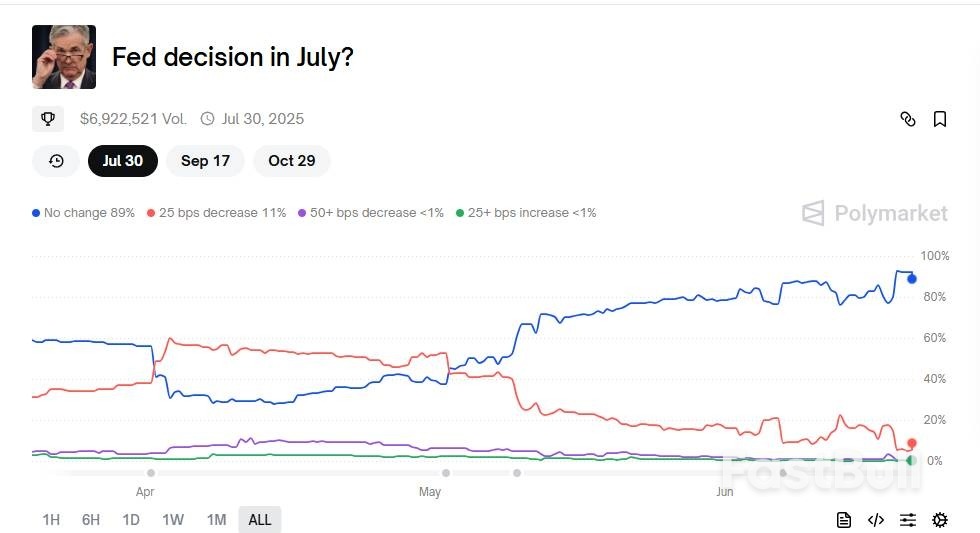
          Fed July decision prediction. Source: Polymarket

          Waller admitted that although he prefers a rate cut, they should be gradual. “You’d want to start slow and bring them down, just to make sure that there’s no big surprises. But start the process,” he continued, “We’ve been on pause for six months to wait and see, and so far, the data has been fine.”

          Powell: Tariffs could spike inflation

          During a press conference on Wednesday, Powell claimed that new trade barriers are beginning to push up consumer prices. “We’re beginning to see some effects,” he reckoned. “Inflation is creeping up,” and recent data shows that “near-term measures of inflation expectations have moved up” across consumer and market surveys.

          The Fed chair directly blamed Trump’s tariffs as the culprit, saying that survey respondents view them as the driver behind inflationary pressures.

          Still, Waller pushed back on the idea that tariffs will cause lasting damage. He argued that their effect should be “a one-off level effect and not cause persistent inflation.”

          “We believe we can stay in wait-and-see mode,” Powell told the press in his address. He mentioned that the inflation data has shown minimal pass-through so far because companies are still working through inventory stockpiled ahead of tariff implementation. Weak consumer demand has also limited pricing power, providing the Fed with some room to maneuver.

          Source: CryptoSlate

          Risk Warnings and Disclaimers
          You understand and acknowledge that there is a high degree of risk involved in trading. Following any strategies or investment methods may lead to potential losses. The content on the site is provided by our contributors and analysts for information purposes only. You are solely responsible for determining whether any trading assets, securities, strategy, or any other product is suitable for investing based on your own investment objectives and financial situation.
          Add to Favorites
          Share

          Fed’s Waller Signals Potential July Rate Cut

          Michelle

          Economic

          Forex

          Federal Reserve Governor Christopher Waller indicated Friday that the central bank might lower interest rates as early as July, marking a significant shift in monetary policy.

          "We could do this as early as July," Waller stated during a CNBC interview. The Federal Open Market Committee is scheduled to meet July 29-30 in Washington.

          Waller explained that the Fed has room to reduce rates and then assess inflation trends, adding that the central bank could pause cuts if necessary.

          His comments follow Wednesday’s decision by Fed policymakers to maintain current interest rates. Officials also projected two rate cuts before the end of 2025, according to their median forecast.

          The committee appears divided on the timing of rate adjustments, with seven policymakers indicating they expect no cuts this year.

          During the interview, Waller addressed concerns about tariffs and inflation, stating that the Fed hasn’t seen a "big tariff shock to inflation" yet. While acknowledging that inflation persistence from tariffs is a valid concern, he said he doesn’t see "second-round tariff inflation effects."

          Waller described the current labor market as "OK but not strong like in 2022" and cautioned against waiting too long to implement rate cuts. "Don’t want to wait for cuts until job market tanks," he said.

          The Fed governor also suggested that not all tariffs would be passed through to inflation, estimating that inflation might rise "three-tenths or half percent" as a result.

          Source: Investing

          To stay updated on all economic events of today, please check out our Economic calendar
          Risk Warnings and Disclaimers
          You understand and acknowledge that there is a high degree of risk involved in trading. Following any strategies or investment methods may lead to potential losses. The content on the site is provided by our contributors and analysts for information purposes only. You are solely responsible for determining whether any trading assets, securities, strategy, or any other product is suitable for investing based on your own investment objectives and financial situation.
          Add to Favorites
          Share

          Wall St Week Ahead: Stocks take a breather as investors assess geopolitics, economic data

          Adam

          Stocks

          Economic

          Investors will focus on the Israel-Iran conflict and U.S. economic data releases next week to assess the near-term outlook for stocks, as the S&P 500 hovers just below its February highs.
          The S&P 500 has rebounded sharply from its early-April selloff, as tariff-related tensions have eased. However, the U.S. benchmark index appears to be taking a breather at some 2.7% below its February closing high. The index has gone 27 trading sessions since coming within 5% of its February high but has not yet set a new record.
          With Israel and Iran trading missiles, escalating threats of a sweeping conflict in the Middle East sent oil prices sharply higher and led to caution in markets.
          "We’re all waiting on pins and needles to see what happens with the Israel-Iran situation," said Brian Jacobsen, chief economist at Annex Wealth Management.
          So far, the oil market has absorbed most of the impact from geopolitical turmoil, with equities relatively stable. Yet stock investors remain concerned that higher oil prices could stoke inflation and upset plans for interest rate cuts from the Federal Reserve.
          On Wednesday, the Fed held rates steady and policymakers signaled borrowing costs are still likely to fall this year. But they estimated the overall pace of expected future rate cuts would be slower than they saw at their March meeting. They cited expectations that higher inflation would flow from President Donald Trump's tariff plans.
          "The question is oil prices and what that does to inflation – which has implications for monetary policy and how long the Fed keeps rates "meaningfully restrictive"," said Sonu Varghese, global macro strategist at Carson Group.
          The big near-term risk for equities, investors said, was if the U.S. were to join Israel's bombing campaign against arch-enemy Iran. Trump is keeping the world guessing whether the U.S. would join Israel's bombardment of Iranian nuclear and missile sites, as residents of Iran's capital Tehran streamed out of the city on the sixth day of the air assault.
          The White House said on Thursday that Trump would decide on U.S. action in the next two weeks.
          "If we were to see the U.S. enter the war or further escalation in the attacks between the two countries, that would give the S&P 500 and equity markets more reasons to react negatively," said Damian McIntyre, head of multi-asset solutions at Federated Hermes in Pittsburgh.
          On the other hand, a de-escalation in Middle East tensions could prompt a relief rally for stocks.
          "If both sides can kind of just slowly de-escalate, that would be positive for equity markets, positive for risk markets," McIntyre said.
          "Markets are taking a bit of a wait-and-see approach here," he said.
          Still, any stock market pullbacks due to rising geopolitical tensions are likely to be fleeting, investors said.
          "History says that usually military shocks are shallow and short-lived, and so until further notice, I think that's how Wall Street will react to this one," Sam Stovall, chief investment strategist at CFRA Research, said.
          Investors will also parse a slew of incoming data releases, including U.S. business activity and housing sales on Monday, consumer confidence numbers on Tuesday and the PCE Price Index on Friday.
          U.S. consumer confidence plunged in the past few months, with households fearing tariffs could prompt a recession and higher inflation. However, with inflation in check and the U.S. reaching a truce in its trade fight with China, investors expect to see a pickup in sentiment.
          "Remember, the survey-based data all got crushed in the March, April, May time frame ... my expectation is we're still going to see an improvement," Mark Hackett, chief market strategist at Nationwide said.

          Source: Reuters

          To stay updated on all economic events of today, please check out our Economic calendar
          Risk Warnings and Disclaimers
          You understand and acknowledge that there is a high degree of risk involved in trading. Following any strategies or investment methods may lead to potential losses. The content on the site is provided by our contributors and analysts for information purposes only. You are solely responsible for determining whether any trading assets, securities, strategy, or any other product is suitable for investing based on your own investment objectives and financial situation.
          Add to Favorites
          Share

          Iran Says No Nuclear Talks Under Fire, Sources Say Qatar Met Energy Majors

          Glendon

          Political

          Iran said on Friday it would not discuss the future of its nuclear programme while under attack by Israel, as Europe tried to coax Tehran back into negotiations and the United States considers whether to get involved in the conflict.

          A week into its campaign, Israel said it had struck dozens of military targets overnight, including missile production sites, a research body involved in nuclear weapons development in Tehran and military facilities in western and central Iran.

          Iran fired missiles at the southern Israeli city of Beersheba early on Friday and Israeli media said initial reports pointed to missile impacts in Tel Aviv, the Negev and Haifa after further attacks hours later.

          About 20 missiles were fired in the latest strikes, an Israeli military official said, and at least two people were hurt, according to the Israeli ambulance service.

          Fars news agency quoted an Iranian military spokesman as saying the latest missile and drone attacks used long-range and ultra-heavy missiles that targeted military sites, defence industries and command and control centres.

          In a sign of increasing concern about any strikes on energy facilities in Iran or elsewhere in the Gulf that could affect supplies, Qatar held crisis talks this week with energy majors, an industry source and a diplomat in the region told Reuters.

          Doha was asking companies to raise governments' awareness of the risks to global gas supply in the U.S. and Europe, they said. QatarEnergy did not immediately respond to a request for comment.

          The White House said on Thursday President Donald Trump would decide on U.S. involvement in the conflict in the next two weeks.

          Iranian Foreign Minister Abbas Araqchi said there was no room for negotiations with the U.S. "until Israeli aggression stops". But he later arrived in Geneva for talks with European foreign ministers at which Europe hopes to establish a path back to diplomacy over Iran's nuclear programme.

          Before the meeting with France, Britain, Germany and the European Union's foreign policy chief, two diplomats said Araqchi would be told the U.S. is still open to direct talks. But expectations for a breakthrough are low, diplomats say.

          A senior Iranian official told Reuters Iran was ready to discuss limitations on uranium enrichment but that any proposal for zero enrichment - not being able to enrich uranium at all - would be rejected, "especially now under Israel's strikes".

          Israel began attacking Iran last Friday, saying its longtime enemy was on the verge of developing nuclear weapons. Iran, which says its nuclear programme is only for peaceful purposes, retaliated with missile and drone strikes on Israel.

          Israel is widely assumed to possess nuclear weapons. It neither confirms nor denies this.

          CIVILIANS KILLED

          Israeli air attacks have killed 639 people in Iran, according to the Human Rights Activists News Agency, a U.S.-based human rights organisation that tracks Iran. The dead include the military's top echelon and nuclear scientists.

          In Israel, 24 civilians have been killed in Iranian missile attacks, according to authorities.

          Israel's strikes on Iran's nuclear installations so far pose only limited risks of contamination, experts say. But they warn that any attack on the nuclear power station at Bushehr in Iran could cause a nuclear disaster.

          Israel says it is determined to destroy Iran's nuclear capabilities but that it wants to avoid any nuclear disaster.

          Before Friday's meeting in Geneva, Arqachi accused Israel of war crimes in an address to the U.N. Human Rights Council and said Israel's attacks had undermined plans for talks with U.S. officials on June 15 to craft a "very promising" agreement on Iran's nuclear programme.

          Israel did not immediately respond to his remarks.

          Geneva is where an initial accord was struck in 2013 to curb Iran's nuclear programme in return for sanctions being lifted. A comprehensive deal followed in 2015.

          Trump pulled the U.S. out of the agreement in 2018. A new series of talks between Iran and the U.S. collapsed when Israel started attacking Iran's nuclear facilities and ballistic capabilities on June 12.

          Trump has alternated between threatening Tehran and urging it to resume nuclear talks. His special envoy to the region, Steve Witkoff, has spoken to Araqchi several times since last week, sources say.

          Western and regional officials say Israel is trying to shatter the government of Supreme Leader Ayatollah Ali Khamenei.

          Katz said he had instructed the military to intensify attacks on "symbols of the regime" in the Iranian capital Tehran, aiming to destabilise it.

          Iranian opposition groups think their time may be near, but activists involved in previous protests say they are unwilling to unleash mass unrest with their nation under attack, and Iranian authorities have cracked down hard on dissent.

          Iranian state media reported rallies in several cities, describing them as rallies of "rage and victory,” and “solidarity and resistance.”

          Source: Reuters

          Risk Warnings and Disclaimers
          You understand and acknowledge that there is a high degree of risk involved in trading. Following any strategies or investment methods may lead to potential losses. The content on the site is provided by our contributors and analysts for information purposes only. You are solely responsible for determining whether any trading assets, securities, strategy, or any other product is suitable for investing based on your own investment objectives and financial situation.
          Add to Favorites
          Share

          A $6.5 Trillion ‘Triple Witching’ Heralds Return to Volatility

          Adam

          Economic

          Investors are bracing for $6.5 trillion of notional US options expiring on Friday, in a move that could free stocks to swing more wildly than the subdued changes seen in recent weeks.
          Every quarter, a cluster of different exchange-traded derivatives contracts all terminate on the same day, leading to what is sometimes dubbed a “triple witching” event by market watchers. The event isn’t expected to add additional volatility on Friday itself, but could open a path to more sudden stock market moves next week.
          Daily gyrations in US stocks have been relatively restrained since early May, a situation helped by the pinning effect of a swath of bearish options trades placed earlier in the year — when the chances of the S&P 500 (^GSPC) making a recovery to near-record highs seemed remote, according to Rocky Fishman, the founder of research firm Asym 500 LLC. “Pinning” refers to the tendency of a stock price to close near the strike of heavily-traded options as the expiration date nears.
          During the height of tariff-driven volatility in early April, many pessimistic investors bought insurance against a further drop in stocks, funding those positions by capping upside a little beyond the S&P 500’s current level of 5,981.
          “People might have seen a 6,000 level as something that’s really hard to get to as we were dealing with a lot of the tariff drama over the last few months, and therefore sold calls in the 6,000 range as a way of funding protection at various points,” said Fishman, who called Friday’s expiry “one of the largest ever” in a recent note.
          The way market makers and broker-dealers have to hedge their own books can have major implications and echo back into equity markets.
          Fishman says dealer hedging could be a contributing factor to the fairly placid state of equity markets since early May, despite turmoil in the Middle East and continued tariff talks. To Fishman, the market is in a state known as positive gamma, which means players can be incentivized to sell into rallies and buy dips.
          It was different during early April’s tariff turmoil, when many intermediaries found themselves having to dump stock into falling markets, and then buy it back as markets rose, exacerbating swings, according to Matthew Thompson, co-portfolio manager at Little Harbor Advisors.
          Thompson pays attention to expiry events like the triple-witching because it can help the equity ETFs he manages alongside his brother Michael take tactical positions in volatility markets.
          “We’re mostly interested in the dealers and how they have to hedge all of that exposure,” Thompson said in an interview on Wednesday.
          The quarterly triple-witching days are not usually much more volatile than monthly options expiry events, according to a study by Vishal Vivek and Stuart Kaiser, strategists at Citigroup Inc. Still, Friday’s event is “notable,” the pair wrote recently to clients.
          There is no standard way to calculate the amount of listed-derivatives due to expire on any one day - it depends which type of asset class and contract one includes in the figure.
          Citi estimates that Friday will see $5.8 trillion of notional open interest across equities expire, including $4.2 trillion of index options, $708 billion of bets on US ETFs and $819 billion of single stock options.
          Fishman’s larger figure of roughly $6.5 trillion also includes the notional value of options on equity index futures expiring on Friday.

          Source: Bloomberg

          To stay updated on all economic events of today, please check out our Economic calendar
          Risk Warnings and Disclaimers
          You understand and acknowledge that there is a high degree of risk involved in trading. Following any strategies or investment methods may lead to potential losses. The content on the site is provided by our contributors and analysts for information purposes only. You are solely responsible for determining whether any trading assets, securities, strategy, or any other product is suitable for investing based on your own investment objectives and financial situation.
          Add to Favorites
          Share

          Waller Says Fed Could Cut Interest Rates as Soon as July

          Warren Takunda

          Economic

          Federal Reserve Governor Christopher Waller said the central bank can lower interest rates as soon as next month, reiterating his view that the inflation hit from tariffs is likely to be short-lived.
          “We could do this as early as July,” Waller said Friday in an interview on CNBC. The Federal Open Market Committee next meets July 29-30 in Washington.
          Waller said economic data show GDP growth and inflation are running close to the central bank’s targets. He also said he believes the Fed’s benchmark rate is 1.25 to 1.5 percentage points above the estimated neutral level, at which it would neither slow nor stimulate the economy.
          “I think we’ve got room to bring it down, and then we can kind of see what happens with inflation,” he said, adding the central bank could pause cuts if needed due to a shock from events, such as the crisis in the Middle East. “We’ve been on pause for six months to wait and see, and so far the data has been fine.”
          Waller’s comments follow the decision by Fed policymakers on Wednesday to keep interest rates on hold for the fourth straight policy meeting. Fed Chair Jerome Powell said officials are bracing for the price hit from President Trump’s tariffs and want to see some of that play out before they lower rates.
          Officials also continued to signal their expectation for two rate cuts before the end of 2025, according to their median projection. But seven policymakers signaled they expect no cuts this year, pointing to an apparent split in the committee.
          No Cheap Financing
          Trump has repeatedly called on the Fed to lower interest rates, focusing his recent comments on how that could reduce debt servicing costs for the government. Treasury figures show the government shelled out some $776 billion in interest expenses on the federal debt over the past eight months.
          The tally, which now well outstrips the amount spent on defense, reflects both the much higher size of outstanding debt and the impact of higher interest rates from the Fed’s battle with inflation.
          “I would like to get this guy to lower interest rates, because if he doesn’t, we have to pay,” Trump said during a June 12 White House event, referring to Powell.
          Asked whether the Fed should be cutting rates to lower borrowing costs for the federal government, Waller said that was not part of the central bank’s mandate.
          “Our mandate from Congress tells us to worry about unemployment and price stability,” Waller said. “It does not tell us to provide cheap financing to the US government.”

          Source: Bloomberg

          To stay updated on all economic events of today, please check out our Economic calendar
          Risk Warnings and Disclaimers
          You understand and acknowledge that there is a high degree of risk involved in trading. Following any strategies or investment methods may lead to potential losses. The content on the site is provided by our contributors and analysts for information purposes only. You are solely responsible for determining whether any trading assets, securities, strategy, or any other product is suitable for investing based on your own investment objectives and financial situation.
          Add to Favorites
          Share

          Currency Traders Are Ditching Dollar for Euro on Option Bets

          Adam

          Forex

          The euro is taking on a bigger role in the global currency options market as traders skirt around the dollar given the risks from unpredictable US policy and a global trade war.
          There’s been a shift in trading volumes. Around 15% to 30% of contracts tied to the dollar versus major currencies were switched to the euro, looking at data from the Depository Trust & Clearing Corporation for the first five months of this year versus the final five months of 2024. There are also signs the euro is being used as a haven — traditionally the dollar’s role — and for bets on big moves.
          While deals involving the dollar still dominate in the $7.5 trillion-a-day currency market, this could be early evidence that the greenback is facing greater competition as the world’s reserve currency. Traders are sidestepping the dollar after its biggest slump in years, with Europe’s common currency looking like a key beneficiary as the region’s markets seize on billions in government stimulus spending.
          “If we’re moving to an environment in which the European flow story is more important, then we could be moving to an environment in which it’s euro pairs which are driving everything,” said Oliver Brennan, options strategist at BNP Paribas SA.
          The growing optimism toward European assets is also seen in the stock market. Wall Street strategists expect loosening monetary policy and increased government spending to boost the Stoxx Europe 600 Index by 3% by the end of the year, handing investors annual returns of about 10%, according to a survey conducted by Bloomberg.
          The euro, in the meantime, has rallied 11% against the dollar so far this year, hitting its highest since 2021 at above $1.16. The dollar has slid against every major currency, with a gauge down over 7% to its lowest since 2022. That’s undermining trust in US assets.
          And the slump may not be over yet. Hedge fund heavyweight Paul Tudor Jones just predicted another 10% drop for the dollar over the next year. Risk reversals, a gauge of options sentiment, are becoming increasingly negative on the dollar against the yen, whereas they are turning less bearish on euro-yen — a “really important signal” on the euro for Brennan.
          As markets question the dollar’s stability, implied volatility in the euro against the yen is looking the calmest in nearly four years relative to swings between the greenback and Japanese currency.
          “The market is thinking that dollar-yen will be more volatile than euro-yen in a negative market shock, which is the opposite to how the market has traded these events in the past,” said Brennan. “If that’s the thinking, then it means the market sees the euro as more of a safe haven than the dollar.”
          The cost of options is also a driver, said Ben Ford, currency strategist at Macro Hive. While implied volatility generally has eased after spiking in April’s market chaos, it stands at nearly 11% over three months for dollar-yen, compared with under 9% for euro-yen.
          “The market is finding cheaper ways to express its view, especially given the view is probably for euro outperformance,” Ford said.
          Traders also seem to be favoring the euro over the dollar when it comes to hedging or betting on big directional moves on the yen. That’s evident in so-called 10-delta fly spreads, a gauge of demand for outsized swings, where the gap between euro-yen and dollar-yen has been steadily widening since April.
          Of course, the dollar has been written off many times before. Just at the start of this year, the euro was languishing near parity with the greenback, with many investors certain the common currency’s value would fall below its US peer.
          Instead Trump’s April’s tariff announcements saw investors dump dollar assets. While US stocks have recovered since then, the dollar risk premium remains elevated, and it may require a return to US exceptionalism to reverse the trend, according to Tanvir Sandhu, chief global derivatives strategist at Bloomberg Intelligence.
          Meanwhile the European Central Bank’s President Christine Lagarde has called on policymakers to seize the moment and increase the euro’s global profile. French officials were also reported to be lobbying for additional measures aiming at raising the currency’s importance.
          “There’s a push and a pull — the pull has been that there’s potentially more safe assets to buy in Europe and more growth expectations in Europe,” said BNP’s Brennan. “And the push has been tariff uncertainty, risks to US exceptionalism, and the macro story.”

          Source: Bloomberg

          Risk Warnings and Disclaimers
          You understand and acknowledge that there is a high degree of risk involved in trading. Following any strategies or investment methods may lead to potential losses. The content on the site is provided by our contributors and analysts for information purposes only. You are solely responsible for determining whether any trading assets, securities, strategy, or any other product is suitable for investing based on your own investment objectives and financial situation.
          Add to Favorites
          Share
          FastBull
          Copyright © 2025 FastBull Ltd

          728 RM B 7/F GEE LOK IND BLDG NO 34 HUNG TO RD KWUN TONG KLN HONG KONG

          TelegramInstagramTwitterfacebooklinkedin
          App Store Google Play Google Play
          Products
          Charts

          Chats

          Q&A with Experts
          Screeners
          Economic Calendar
          Data
          Tools
          Membership
          Features
          Function
          Markets
          Copy Trading
          Latest Signals
          Contests
          News
          Analysis
          24/7
          Columns
          Education
          Company
          Careers
          About Us
          Contact Us
          Advertising
          Help Center
          Feedback
          User Agreement
          Privacy Policy
          Business

          White Label

          Data API

          Web Plug-ins

          Poster Maker

          Affiliate Program

          Risk Disclosure

          The risk of loss in trading financial instruments such as stocks, FX, commodities, futures, bonds, ETFs and crypto can be substantial. You may sustain a total loss of the funds that you deposit with your broker. Therefore, you should carefully consider whether such trading is suitable for you in light of your circumstances and financial resources.

          No decision to invest should be made without thoroughly conducting due diligence by yourself or consulting with your financial advisors. Our web content might not suit you since we don't know your financial conditions and investment needs. Our financial information might have latency or contain inaccuracy, so you should be fully responsible for any of your trading and investment decisions. The company will not be responsible for your capital loss.

          Without getting permission from the website, you are not allowed to copy the website's graphics, texts, or trademarks. Intellectual property rights in the content or data incorporated into this website belong to its providers and exchange merchants.

          Not Logged In

          Log in to access more features

          FastBull Membership

          Not yet

          Purchase

          Become a signal provider
          Help Center
          Customer Service
          Dark Mode
          Price Up/Down Colors

          Log In

          Sign Up

          Position
          Layout
          Fullscreen
          Default to Chart
          The chart page opens by default when you visit fastbull.com