• Trade
  • Markets
  • Copy
  • Contests
  • News
  • 24/7
  • Calendar
  • Q&A
  • Chats
Trending
Screeners
SYMBOL
LAST
BID
ASK
HIGH
LOW
NET CHG.
%CHG.
SPREAD
SPX
S&P 500 Index
6827.42
6827.42
6827.42
6899.86
6801.80
-73.58
-1.07%
--
DJI
Dow Jones Industrial Average
48458.04
48458.04
48458.04
48886.86
48334.10
-245.98
-0.51%
--
IXIC
NASDAQ Composite Index
23195.16
23195.16
23195.16
23554.89
23094.51
-398.69
-1.69%
--
USDX
US Dollar Index
97.950
98.030
97.950
98.500
97.950
-0.370
-0.38%
--
EURUSD
Euro / US Dollar
1.17394
1.17409
1.17394
1.17496
1.17192
+0.00011
+ 0.01%
--
GBPUSD
Pound Sterling / US Dollar
1.33707
1.33732
1.33707
1.33997
1.33419
-0.00148
-0.11%
--
XAUUSD
Gold / US Dollar
4299.39
4299.39
4299.39
4353.41
4257.10
+20.10
+ 0.47%
--
WTI
Light Sweet Crude Oil
57.233
57.485
57.233
58.011
56.969
-0.408
-0.71%
--

Community Accounts

Signal Accounts
--
Profit Accounts
--
Loss Accounts
--
View More

Become a signal provider

Sell trading signals to earn additional income

View More

Guide to Copy Trading

Get started with ease and confidence

View More

Signal Accounts for Members

All Signal Accounts

Best Return
  • Best Return
  • Best P/L
  • Best MDD
Past 1W
  • Past 1W
  • Past 1M
  • Past 1Y

All Contests

  • All
  • Trump Updates
  • Recommend
  • Stocks
  • Cryptocurrencies
  • Central Banks
  • Featured News
Top News Only
Share

USA Embassy In Lithuania: Maria Kalesnikava Is Not Going To Vilnius

Share

USA Embassy In Lithuania: Other Prisoners Are Being Sent From Belarus To Ukraine

Share

Ukraine President Zelenskiy: Five Ukrainians Released By Belarus In US-Brokered Deal

Share

USA Vilnius Embassy: USA Stands Ready For "Additional Engagement With Belarus That Advances USA Interests"

Share

USA Vilnius Embassy: Belarus, USA, Other Citizens Among The Prisoners Released Into Lithuania

Share

USA Vilnius Embassy: USA Will Continue Diplomatic Efforts To Free The Remaining Political Prisoners In Belarus

Share

USA Vilnius Embassy: Belarus Releases 123 Prisoners Following Meeting Of President Trump's Envoy Coale And Belarus President Lukashenko

Share

USA Vilnius Embassy: Masatoshi Nakanishi, Aliaksandr Syrytsa Are Among The Prisoners Released By Belarus

Share

USA Vilnius Embassy: Maria Kalesnikava And Viktor Babaryka Are Among The Prisoners Released By Belarus

Share

USA Vilnius Embassy: Nobel Peace Prize Laureate Ales Bialiatski Is Among The Prisoners Released By Belarus

Share

Belarusian Presidential Administration Telegram Channel: Lukashenko Has Pardoned 123 Prisoners As Part Of Deal With US

Share

Two Local Syrian Officials: Joint US-Syrian Military Patrol In Central Syria Came Under Fire From Unknown Assailants

Share

Israeli Military Says It Targeted 'Key Hamas Terrorist' In Gaza City

Share

Rwanda's Actions In Eastern Drc Are A Clear Violation Of Washington Accords Signed By President Trump - Secretary Of State Rubio

Share

Israeli Military Issues Evacuation Warning In Southern Lebanon Village Ahead Of Strike - Spokesperson On X

Share

Belarusian State Media Cites US Envoy Coale As Saying He Discussed Ukraine And Venezuela With Lukashenko

Share

Belarusian State Media Cites US Envoy Coale As Saying That US Removes Sanctions On Belarusian Potassium

Share

Thai Prime Minister: No Ceasefire Agreement With Cambodia

Share

US, Ukraine To Discuss Ceasefire In Berlin Ahead Of European Summit

Share

Incoming Czech Prime Minister Babis: Czech Republic Will Not Take On Guarantees For Ukraine Financing, European Commission Must Find Alternatives

TIME
ACT
FCST
PREV
U.K. Trade Balance Non-EU (SA) (Oct)

A:--

F: --

P: --

U.K. Trade Balance (Oct)

A:--

F: --

P: --

U.K. Services Index MoM

A:--

F: --

P: --

U.K. Construction Output MoM (SA) (Oct)

A:--

F: --

P: --

U.K. Industrial Output YoY (Oct)

A:--

F: --

P: --

U.K. Trade Balance (SA) (Oct)

A:--

F: --

P: --

U.K. Trade Balance EU (SA) (Oct)

A:--

F: --

P: --

U.K. Manufacturing Output YoY (Oct)

A:--

F: --

P: --

U.K. GDP MoM (Oct)

A:--

F: --

P: --

U.K. GDP YoY (SA) (Oct)

A:--

F: --

P: --

U.K. Industrial Output MoM (Oct)

A:--

F: --

P: --

U.K. Construction Output YoY (Oct)

A:--

F: --

P: --

France HICP Final MoM (Nov)

A:--

F: --

P: --

China, Mainland Outstanding Loans Growth YoY (Nov)

A:--

F: --

P: --

China, Mainland M2 Money Supply YoY (Nov)

A:--

F: --

P: --

China, Mainland M0 Money Supply YoY (Nov)

A:--

F: --

P: --

China, Mainland M1 Money Supply YoY (Nov)

A:--

F: --

P: --

India CPI YoY (Nov)

A:--

F: --

P: --

India Deposit Gowth YoY

A:--

F: --

P: --

Brazil Services Growth YoY (Oct)

A:--

F: --

P: --

Mexico Industrial Output YoY (Oct)

A:--

F: --

P: --

Russia Trade Balance (Oct)

A:--

F: --

P: --

Philadelphia Fed President Henry Paulson delivers a speech
Canada Building Permits MoM (SA) (Oct)

A:--

F: --

P: --

Canada Wholesale Sales YoY (Oct)

A:--

F: --

P: --

Canada Wholesale Inventory MoM (Oct)

A:--

F: --

P: --

Canada Wholesale Inventory YoY (Oct)

A:--

F: --

P: --

Canada Wholesale Sales MoM (SA) (Oct)

A:--

F: --

P: --

Germany Current Account (Not SA) (Oct)

A:--

F: --

P: --

U.S. Weekly Total Rig Count

A:--

F: --

P: --

U.S. Weekly Total Oil Rig Count

A:--

F: --

P: --

Japan Tankan Large Non-Manufacturing Diffusion Index (Q4)

--

F: --

P: --

Japan Tankan Small Manufacturing Outlook Index (Q4)

--

F: --

P: --

Japan Tankan Large Non-Manufacturing Outlook Index (Q4)

--

F: --

P: --

Japan Tankan Large Manufacturing Outlook Index (Q4)

--

F: --

P: --

Japan Tankan Small Manufacturing Diffusion Index (Q4)

--

F: --

P: --

Japan Tankan Large Manufacturing Diffusion Index (Q4)

--

F: --

P: --

Japan Tankan Large-Enterprise Capital Expenditure YoY (Q4)

--

F: --

P: --

U.K. Rightmove House Price Index YoY (Dec)

--

F: --

P: --

China, Mainland Industrial Output YoY (YTD) (Nov)

--

F: --

P: --

China, Mainland Urban Area Unemployment Rate (Nov)

--

F: --

P: --

Saudi Arabia CPI YoY (Nov)

--

F: --

P: --

Euro Zone Industrial Output YoY (Oct)

--

F: --

P: --

Euro Zone Industrial Output MoM (Oct)

--

F: --

P: --

Canada Existing Home Sales MoM (Nov)

--

F: --

P: --

Euro Zone Total Reserve Assets (Nov)

--

F: --

P: --

U.K. Inflation Rate Expectations

--

F: --

P: --

Canada National Economic Confidence Index

--

F: --

P: --

Canada New Housing Starts (Nov)

--

F: --

P: --

U.S. NY Fed Manufacturing Employment Index (Dec)

--

F: --

P: --

U.S. NY Fed Manufacturing Index (Dec)

--

F: --

P: --

Canada Core CPI YoY (Nov)

--

F: --

P: --

Canada Manufacturing Unfilled Orders MoM (Oct)

--

F: --

P: --

Canada Manufacturing New Orders MoM (Oct)

--

F: --

P: --

Canada Core CPI MoM (Nov)

--

F: --

P: --

Canada Manufacturing Inventory MoM (Oct)

--

F: --

P: --

Canada CPI YoY (Nov)

--

F: --

P: --

Canada CPI MoM (Nov)

--

F: --

P: --

Canada CPI YoY (SA) (Nov)

--

F: --

P: --

Canada Core CPI MoM (SA) (Nov)

--

F: --

P: --

Q&A with Experts
    • All
    • Chatrooms
    • Groups
    • Friends
    Connecting
    .
    .
    .
    Type here...
    Add Symbol or Code

      No matching data

      All
      Trump Updates
      Recommend
      Stocks
      Cryptocurrencies
      Central Banks
      Featured News
      • All
      • Russia-Ukraine Conflict
      • Middle East Flashpoint
      • All
      • Russia-Ukraine Conflict
      • Middle East Flashpoint
      Search
      Products

      Charts Free Forever

      Chats Q&A with Experts
      Screeners Economic Calendar Data Tools
      Membership Features
      Data Warehouse Market Trends Institutional Data Policy Rates Macro

      Market Trends

      Market Sentiment Order Book Forex Correlations

      Top Indicators

      Charts Free Forever
      Markets

      News

      News Analysis 24/7 Columns Education
      From Institutions From Analysts
      Topics Columnists

      Latest Views

      Latest Views

      Trending Topics

      Top Columnists

      Latest Update

      Signals

      Copy Rankings Latest Signals Become a signal provider AI Rating
      Contests
      Brokers

      Overview Brokers Assessment Rankings Regulators News Claims
      Broker listing Forex Brokers Comparison Tool Live Spread Comparison Scam
      Q&A Complaint Scam Alert Videos Tips to Detect Scam
      More

      Business
      Events
      Careers About Us Advertising Help Center

      White Label

      Data API

      Web Plug-ins

      Affiliate Program

      Awards Institution Evaluation IB Seminar Salon Event Exhibition
      Vietnam Thailand Singapore Dubai
      Fans Party Investment Sharing Session
      FastBull Summit BrokersView Expo
      Recent Searches
        Top Searches
          Markets
          News
          Analysis
          User
          24/7
          Economic Calendar
          Education
          Data
          • Names
          • Latest
          • Prev

          View All

          No data

          Scan to Download

          Faster Charts, Chat Faster!

          Download App
          English
          • English
          • Español
          • العربية
          • Bahasa Indonesia
          • Bahasa Melayu
          • Tiếng Việt
          • ภาษาไทย
          • Français
          • Italiano
          • Türkçe
          • Русский язык
          • 简中
          • 繁中
          Open Account
          Search
          Products
          Charts Free Forever
          Markets
          News
          Signals

          Copy Rankings Latest Signals Become a signal provider AI Rating
          Contests
          Brokers

          Overview Brokers Assessment Rankings Regulators News Claims
          Broker listing Forex Brokers Comparison Tool Live Spread Comparison Scam
          Q&A Complaint Scam Alert Videos Tips to Detect Scam
          More

          Business
          Events
          Careers About Us Advertising Help Center

          White Label

          Data API

          Web Plug-ins

          Affiliate Program

          Awards Institution Evaluation IB Seminar Salon Event Exhibition
          Vietnam Thailand Singapore Dubai
          Fans Party Investment Sharing Session
          FastBull Summit BrokersView Expo

          EUR/USD, GBP/USD, DXY Price Forecast: Awaiting US GDP, Job Claims for Market Clarity

          Devin

          Forex

          Summary:

          German retail contraction and GBP's mixed signals reflect complex economic landscapes in Europe.EUR/USD and GBP/USD face critical junctures amid US data releases and European economic indicators.
          Market Overview
          Recent data revealed a contraction in German Retail Sales by 1.9%, against a forecasted decrease of 0.4%, underscoring the ongoing challenges in Europe’s largest economy. The GBP saw mixed signals with a current account deficit slightly better than expected at -21.2B GBP and a final GDP quarter-on-quarter reading confirming a contraction of -0.3%.

          Events Ahead

          Looking forward, the market’s focus shifts to the US, with a packed schedule including the Final GDP quarter-on-quarter expected at 3.2%, Unemployment Claims anticipated around 212K, and the Final GDP Price Index quarter-on-quarter forecasted at 1.6%.
          Additionally, the Chicago PMI and Pending Home Sales, along with the Revised University of Michigan Consumer Sentiment and Inflation Expectations, are set to provide further insights into the US economic landscape.
          For the EUR, upcoming figures on German Unemployment Change and the Eurozone’s M3 Money Supply and Private Loans will offer fresh clues on the health of the European economy.

          US Dollar Index (DXY)

          EUR/USD, GBP/USD, DXY Price Forecast: Awaiting US GDP, Job Claims for Market Clarity_1
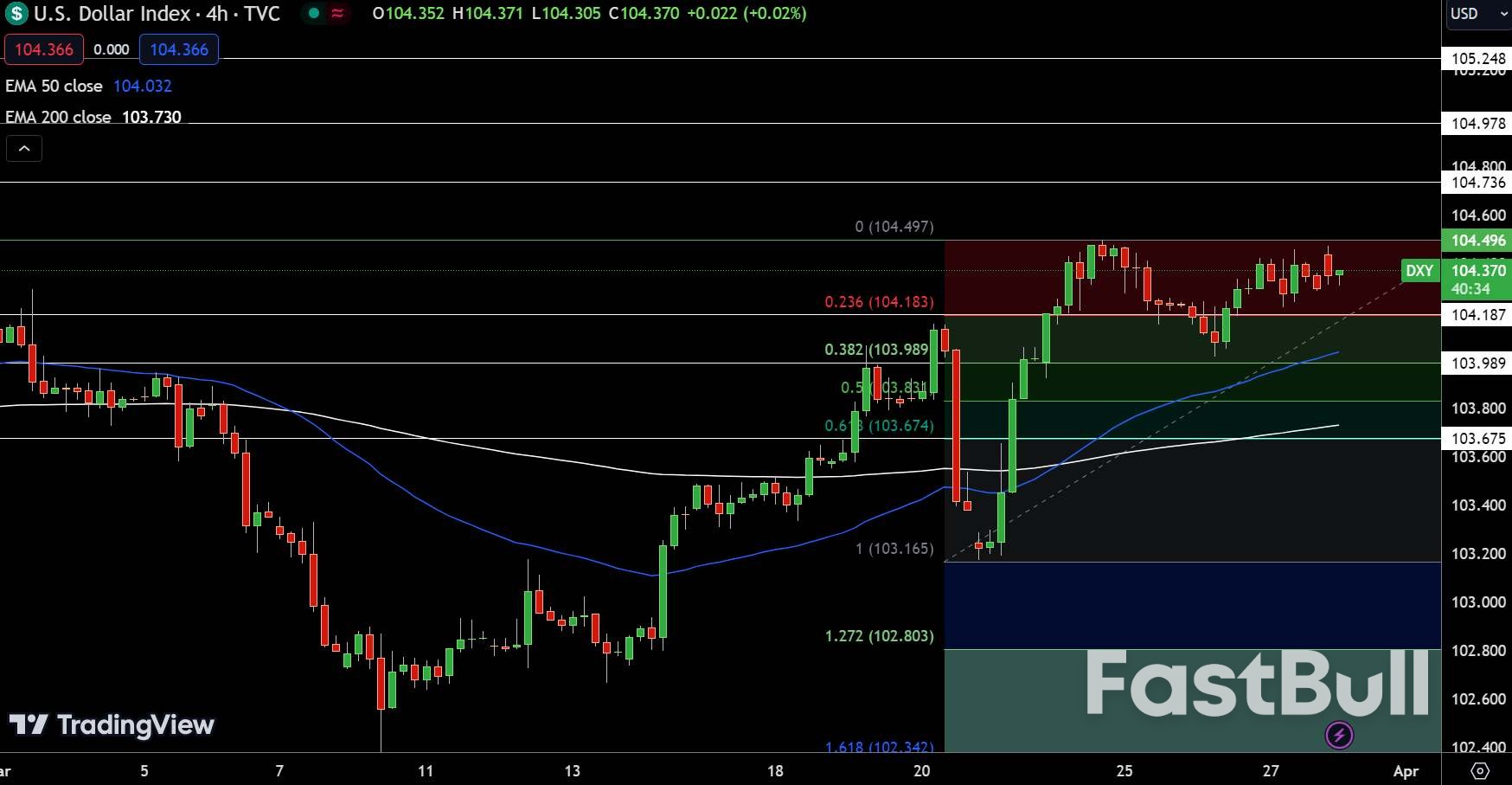
          The Dollar Index experienced a slight downturn, registering at 104.370, demonstrating a minimal decrease of 0.07%. Currently, the index hovers just below the crucial pivot point of 104.496, suggesting a potentially volatile trading environment.
          Resistance levels are mapped out at 104.736, 104.978, and an upper echelon at 105.248. Conversely, foundational support lies at 104.187, with further layers at 103.989 and 103.675. The proximity of the 50-day and 200-day Exponential Moving Averages at 104.032 and 103.730 respectively underscores the index’s bullish momentum.
          However, its position beneath a notable double-top resistance hints at a decisive moment for traders: a bullish breakout above 104.496 could propel further gains, while failure to surpass this threshold may invite a bearish reversal.

          EUR/USD Technical Forecast

          EUR/USD, GBP/USD, DXY Price Forecast: Awaiting US GDP, Job Claims for Market Clarity_2
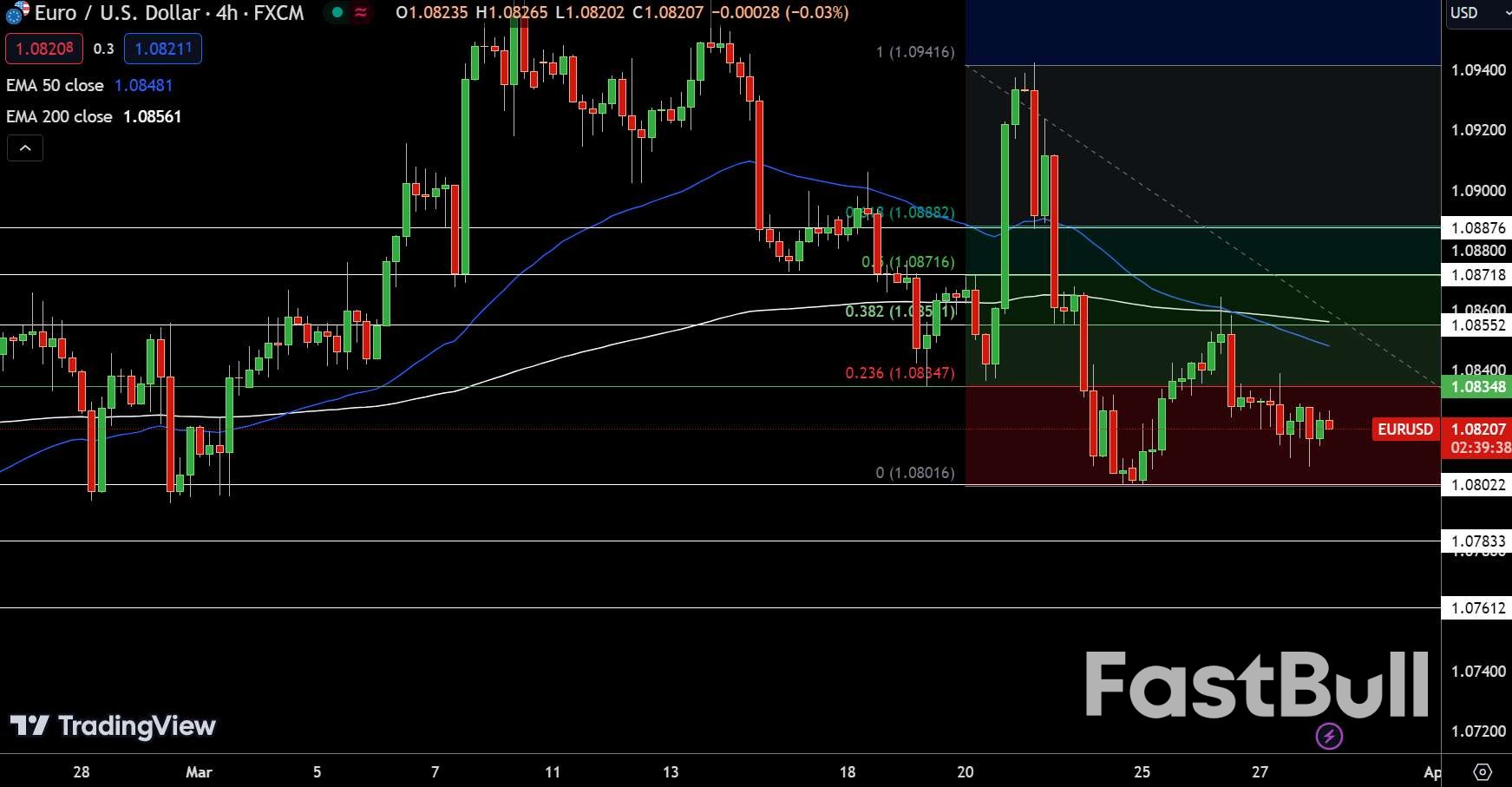
          The EUR/USD pair slightly declined by 0.07%, positioning at 1.08207. Presently, the currency duo is navigating below a critical pivot of 1.0835, suggesting a cautious bearish sentiment in the market. Resistance points are identified at 1.0855, 1.0872, and 1.0888, indicating potential barriers to upward momentum.
          On the downside, support levels are established at 1.0802, 1.0783, and 1.0761, which may offer a buffer against further declines. The 50-day and 200-day Exponential Moving Averages, sitting at 1.08481 and 1.08561 respectively, align closely, hinting at a tight trading range.
          A movement above the pivot could signify a shift towards a bullish outlook, while staying below it maintains a bearish perspective.

          GBP/USD Technical Forecast

          EUR/USD, GBP/USD, DXY Price Forecast: Awaiting US GDP, Job Claims for Market Clarity_3
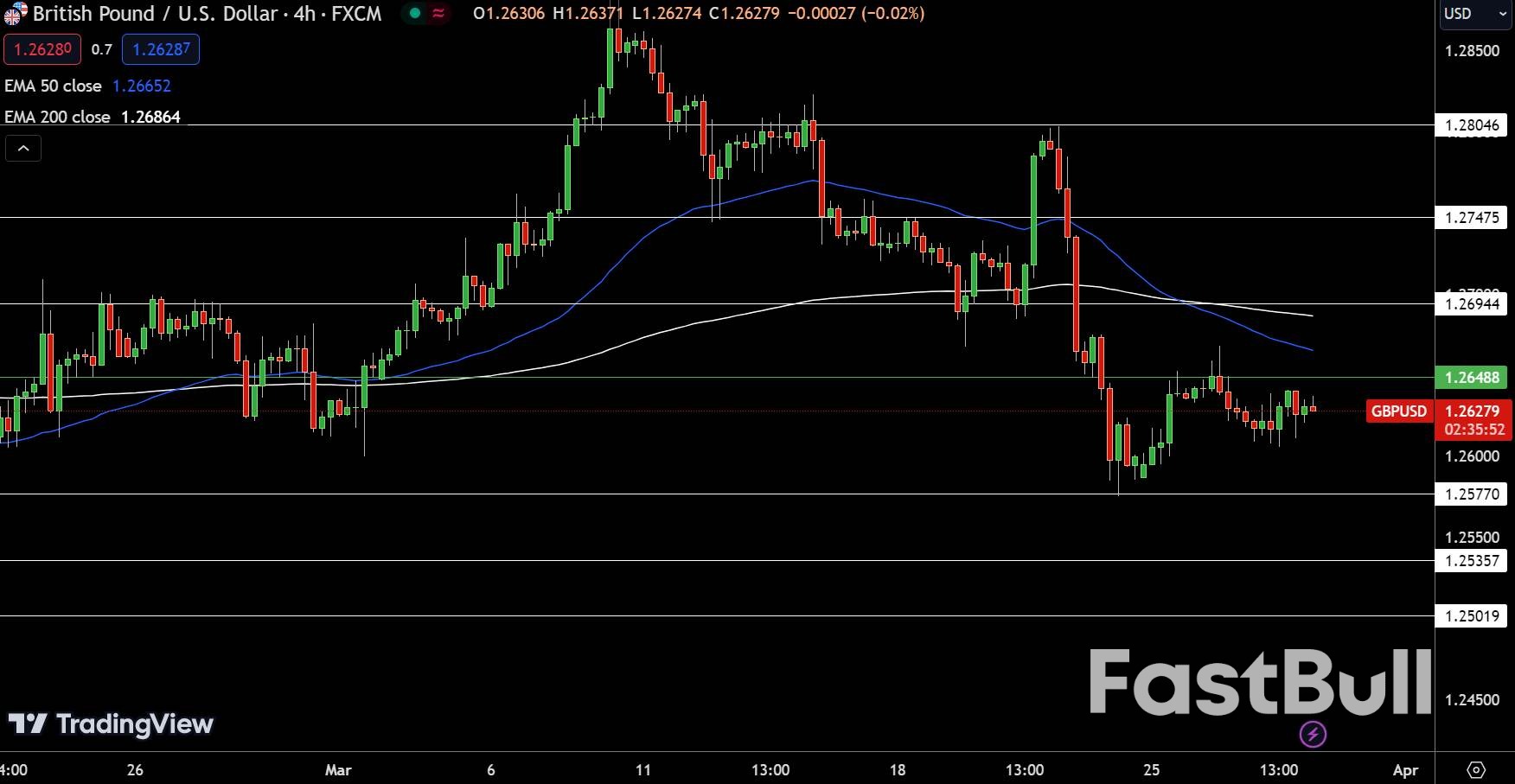
          The GBP/USD pair is experiencing a slight downturn, shedding 0.10% to stand at 1.26279. It currently trades beneath the pivotal 1.2649 mark, suggesting a lean towards bearish sentiment. Resistance levels loom at 1.2694, 1.2748, and 1.2805, potentially capping any bullish attempts.
          Support is established at 1.2577, with further floors at 1.2536 and 1.2502, ready to counter dips. The proximity of the 50-day and 200-day Exponential Moving Averages, at 1.2665 and 1.2686 respectively, indicates a tight battle between bears and bulls.
          A decisive move above the pivot may shift momentum towards bullish territory, while remaining below could reinforce bearish trends.

          Source: FX Empire

          Risk Warnings and Disclaimers
          You understand and acknowledge that there is a high degree of risk involved in trading. Following any strategies or investment methods may lead to potential losses. The content on the site is provided by our contributors and analysts for information purposes only. You are solely responsible for determining whether any trading assets, securities, strategy, or any other product is suitable for investing based on your own investment objectives and financial situation.
          Add to Favorites
          Share

          Chinese and Hong Kong Markets Rally on the Back of Technology Stock Surge

          Ukadike Micheal

          Economic

          Stocks

          Equities in Hong Kong and China soared on Thursday, propelled by a surge in technology stocks amid the backdrop of China's annual Boao Forum. The Hang Seng index in Hong Kong led the gains, surging by a notable 1.6%, buoyed by enthusiastic investor participation in Chinese tech firms listed on the city's stock exchange. Particularly noteworthy was the impressive 3.6% jump in the Hang Seng Tech index, showcasing investor confidence in the growth potential of the technology sector.
          Simultaneously, on the mainland, China's CSI 300 index also experienced a robust increase of 0.8%, with technology stocks spearheading the gains. Notably, iFlytek, an information technology group, surged by an impressive 9.5%, reflecting strong investor appetite for technology-related investments.
          Meanwhile, India's Nifty 50 index kicked off the day on a positive note, registering a solid 1.1% gain in early trading, adding to the overall positive sentiment across Asian markets.
          While the day's performance across major Asian stock markets exhibited variations, with the Hang Seng index and the CSI 300 index demonstrating resilience despite their respective year-to-date fluctuations, the overarching narrative remained focused on the notable strength in the technology sector.
          From a technical standpoint, the surge in technology stocks signifies a significant shift in investor sentiment, with renewed optimism surrounding the growth prospects of tech companies amidst the broader economic landscape. Investors appear to be increasingly confident in the ability of technology firms to navigate challenges and capitalize on emerging opportunities, driving substantial inflows into the sector.
          This resurgence in tech stocks not only underscores the sector's resilience but also has broader implications for market dynamics. The outperformance of technology stocks could potentially serve as a catalyst for broader market movements, influencing investor behavior and reshaping asset allocations across various sectors.
          The rally in Hong Kong and China's equity markets, fueled by the strength of technology stocks, highlights the evolving nature of market sentiment and the enduring appeal of innovative industries. While individual market performances may vary, the overarching trend reflects a growing recognition of the pivotal role that technology plays in driving economic growth and fostering innovation. As market dynamics continue to evolve, maintaining a keen focus on sectoral trends and adaptability remains paramount for investors navigating an ever-changing investment landscape.

          Source: Financial Times

          To stay updated on all economic events of today, please check out our Economic calendar
          Risk Warnings and Disclaimers
          You understand and acknowledge that there is a high degree of risk involved in trading. Following any strategies or investment methods may lead to potential losses. The content on the site is provided by our contributors and analysts for information purposes only. You are solely responsible for determining whether any trading assets, securities, strategy, or any other product is suitable for investing based on your own investment objectives and financial situation.
          Add to Favorites
          Share

          Yen on Intervention Watch; Asian Shares Creep Higher

          Warren Takunda

          Central Bank

          Economic

          The yen languished near its weakest in decades on Thursday though the threat of intervention from Japanese authorities prevented traders from pushing the currency to a new low, while Asian stocks rose ahead of a key U.S. inflation report.
          Markets were largely rangebound ahead of Friday's much-anticipated U.S. core personal consumption expenditures (PCE) price index data, the Federal Reserve's preferred measure of inflation. Few markets will be open to assess and respond to the new data, however, given the long Easter weekend in many countries.
          Heightened focus was also on the yen, which was last little changed at 151.35 per dollar , having slid to a 34-year low of 151.975 in the previous session.
          Japan's three main monetary authorities held an emergency meeting on Wednesday to discuss the weak yen, and suggested they were ready to intervene in the market to stop what they described as disorderly and speculative moves in the currency.
          That came after officials ramped up verbal warnings to stem the yen's fall, with Finance Minister Shunichi Suzuki saying "decisive steps" will be taken against excessive currency moves.
          Japanese authorities last intervened to support the yen in 2022, when they also used phrases such as "deeply concerned" and pledged to take "decisive steps" prior to intervention.
          "Contrary to popular belief of 152 as the line in the sand, I think it's more of the magnitude of the move that may matter," said Christopher Wong, a currency strategist at OCBC (OCBC.SI), opens new tab.
          "There is also a limit to how far verbal intervention can go. Nonetheless, the actual intervention risk is still high, if not higher."
          The sliding yen has been a boon for Japan's Nikkei (.N225), opens new tab, which is up about 3% for the month thus far. It closed more than 1% lower.
          In China, the yuan , which has similarly come under close scrutiny as it continues to struggle on the weaker side of the key 7.2 per level, steadied at 7.2268. It drew support from a strong fix by the People's Bank of China on Thursday, as Beijing remains vigilant to any sharp sell-off in the currency.
          The central bank set the midpoint rate , around which the yuan is allowed to trade in a 2% band, 1,311 pips stronger than a Reuters' estimate, the widest gap since November 2023.
          Chinese stocks also reversed losses from the previous day, buoyed by a firmer yuan and expectations that Beijing will take more aggressive measures to stimulate the economy.
          The blue-chip CSI300 index (.CSI300), opens new tab and Shanghai Composite index (.SSEC), opens new tab each rose roughly 0.9%, while Hong Kong's Hang Seng Index (.HSI), opens new tab gained 1.45%.
          All that lifted MSCI's broadest index of Asia-Pacific shares outside Japan (.MIAPJ0000PUS), opens new tab up 0.6%.
          S&P 500 futures and Nasdaq futures were trading little changed, while EUROSTOXX 50 futures added 0.32%. FTSE futures gained 0.46%.

          DOLLAR POWER

          In currencies, the dollar was on the front foot, helped in part by comments from Fed Governor Christopher Waller, who said late on Wednesday there is no rush to ease interest rates.
          While a more than 50% chance of a first Fed cut in June continues to be priced in, traders are placing greater bets for similar moves by the European Central Bank and the Bank of England that same month.
          Sweden's central bank on Wednesday signalled there was a good chance of a series of rate cuts starting in May if inflation continued to drop towards its 2% target.
          Against the greenback, the euro fell 0.06% to $1.08215, and sterling eased 0.08% to $1.26305.
          The New Zealand dollar fell to its weakest level in more than four months to $0.5981.
          "(The dollar) is still being swayed by the relative hawkishness of the Fed, taking all 19 policymakers together, and other central banks, who have tilted even more toward dovish in their tone recently," said Thierry Wizman, global FX and rates strategist at Macquarie.
          The renewed dollar strength halted a blistering rally in gold that sent it to a record peak last week. The yellow metal last gained 0.1% to $2,196.69 an ounce .
          Oil prices edged up, with Brent gaining 39 cents to $86.48 a barrel, while U.S. crude rose 50 cents to $81.85 per barrel.

          Source: Reuters

          To stay updated on all economic events of today, please check out our Economic calendar
          Risk Warnings and Disclaimers
          You understand and acknowledge that there is a high degree of risk involved in trading. Following any strategies or investment methods may lead to potential losses. The content on the site is provided by our contributors and analysts for information purposes only. You are solely responsible for determining whether any trading assets, securities, strategy, or any other product is suitable for investing based on your own investment objectives and financial situation.
          Add to Favorites
          Share

          Improvement in UK Living Standards as Wage Growth Surpasses Inflation

          Ukadike Micheal

          Economic

          Forex

          At the close of 2023, UK living standards reached their highest point in over two years, fueled by easing inflation and substantial wage hikes. Official statistics released by the Office for National Statistics reveal a 0.4% increase in real household disposable income per head in the fourth quarter, marking a significant turnaround from the 0.3% decline in the preceding quarter. This surge in incomes reflects the most robust per capita earnings since the third quarter of 2021, before household finances were strained by energy shocks and soaring inflation. Moreover, overall disposable incomes witnessed a 0.7% rise during this period.
          Despite this positive upswing in living standards, the data also confirms that the UK slipped into a mild recession by the end of 2023. However, recent indicators suggest a promising trajectory for the economy, with growth rebounding in January and anticipated further recovery in the forthcoming months, bolstering Prime Minister Rishi Sunak's assertion of steering the economy back on course.
          Comparatively, the UK, along with Germany, lags behind other Group of Seven nations in recovering from the lingering impacts of the Covid-19 pandemic. The UK particularly faced the brunt of inflation shocks, prompting a more cautious approach from the Bank of England regarding interest rate adjustments, which currently stand at a 16-year high. BOE policy makers signal a reluctance to implement rate cuts anytime soon, underscoring the disparity between the UK and its international counterparts in monetary policy adjustments.
          Investor sentiments reflect a scaling back of expectations for rate cuts in the UK this year, with a full pricing in of two quarter-point reductions by year-end and a strong possibility of a third. This shift in expectations underscores the dynamic nature of monetary policy responses amid evolving economic conditions.
          Furthermore, the ONS's revised estimate of fourth quarter GDP confirms the technical recession experienced by the UK economy, albeit with a slightly smaller contraction than initially projected. The savings ratio, indicating the proportion of incomes saved, edged up to 10.2% in the fourth quarter, suggesting a cautious approach to spending amidst economic uncertainties.
          While household spending, investment, and trade posed challenges to the economy at the close of 2023, government consumption emerged as a mitigating factor. Despite a slip in household consumption, attributed to reduced spending across various sectors, the government maintains that its economic strategy is yielding results.
          However, opposition parties criticize the government's handling of the economy, citing the recession as evidence of failed promises and inadequate growth initiatives. Nonetheless, amidst the economic downturn, there are signs of recovery, with forecasts projecting a decline in inflation and continued strong wage growth in the near term.
          From a technical perspective, these economic fluctuations have implications for the market dynamics. Uncertainties surrounding interest rates, inflation, and consumer spending patterns influence investor behavior and asset valuations across various sectors. Moreover, the widening current account deficit underscores the need for sustainable economic policies to address structural imbalances and ensure long-term stability.
          While the UK grapples with economic challenges, there are glimmers of hope for a gradual recovery. Policy interventions, coupled with resilient consumer spending and robust wage growth, are pivotal in navigating the path towards economic revival. However, vigilance and adaptability remain crucial in responding to evolving market dynamics and global economic shifts.

          Source: Bloomberg

          To stay updated on all economic events of today, please check out our Economic calendar
          Risk Warnings and Disclaimers
          You understand and acknowledge that there is a high degree of risk involved in trading. Following any strategies or investment methods may lead to potential losses. The content on the site is provided by our contributors and analysts for information purposes only. You are solely responsible for determining whether any trading assets, securities, strategy, or any other product is suitable for investing based on your own investment objectives and financial situation.
          Add to Favorites
          Share

          Markets in Q1: The Wild Ride Towards Rate Cuts

          Cohen

          Economic

          Central Bank

          Stocks

          Global bond and equity markets are ending the first quarter on a high note, with investors poised for more wild swings ahead after months of the mood lurching between optimism and pessimism about prospective rate cuts from major central banks.
          MSCI's global share index, which smashed through record highs in March, is up 10% since mid-January after traders dropped earlier bets for as many as seven U.S. rate cuts in 2024 but then chose to celebrate the idea of cuts starting in June.
          Switzerland last week kicked off an easing cycle among big, developed economies. And while traders almost fully expect the Federal Reserve to lower U.S. borrowing costs from 23-year highs in June and the European Central Bank to cut its deposit rate from 4% then too, caution could follow.
          Dennis Jose, head of equity strategy at Exane BNP Paribas, said central banks could lower borrowing costs in the summer but might then pause if economic growth improves -- raising the odds of further labour market tightness, wage growth and inflation.
          "I think it may be better to travel than arrive at that first rate cut," he said.Markets in Q1: The Wild Ride Towards Rate Cuts_1

          Everything Rally

          A global government bond index posted its first monthly gain of 2024 in March as the quarter's rally became a buy-everything frenzy, sending Japanese stocks past their 1989 bubble-era high and powering stunning gains for emerging market debt.
          Wall Street's S&P 500 index and Europe's STOXX 600 index are near record levels.
          Of major markets, only China was left out of the party as its once-roaring industrial growth engine continued to sputter.
          But it was really those high-yielding emerging market international bonds that enjoyed some stellar rises - as idiosyncratic reasons for optimism were magnified by U.S. rate cut hopes.
          Argentina's international bonds returned more than 25% in the first quarter, fired up by hopes over the radical reform agenda of chainsaw-wielding new President Javier Milei. Pakistan matched those gains when a new government emerged from delayed, inconclusive elections, now setting out to secure a fresh multi-billion IMF deal. Returns for embattled Ukraine also surpassed 25% while Egyptian debt benefited from capturing billions of dollars from Abu Dhabi and a new IMF deal.
          "High-yield EM sovereigns have strongly outperformed since 4Q23, buoyed risk-seeking from Fed pivot, easing of external financing conditions, and IMF and GCC financing support has been on the rise as China’s financing have stabilized," said Citi strategist Johann Chua.
          Markets in Q1: The Wild Ride Towards Rate Cuts_2In commodity markets, a supply shortage has pushed cocoa futures to record highs, and in currencies the paring back of Fed rate cut bets has left the dollar sailing high again.
          The dollar index, which measures the greenback's value against other major currencies, ends the quarter up almost 3%. Its strength has created more pain for both major and developing economies, with markets alert to Japanese intervention to bolster a yen trading near 34-year lows.Markets in Q1: The Wild Ride Towards Rate Cuts_3

          Mixed Signals

          With investors now banking on a so-called "no landing" scenario of rate cuts without recessions, some analysts warned about the fallout from conflicting economic signals.
          "This is a weird (economic) cycle where nothing is quite what it seems and you've got all these conflicting signals right now," said Andrew Pease, global head of investment strategy at Russell Investments.
          "This is not the sort of environment where you want to sit back and buy in to the prevailing optimism."
          Markets in Q1: The Wild Ride Towards Rate Cuts_4So, even as markets bet on rate cuts, purchasing managers' surveys show U.S. and euro zone business activity picking up.
          Brent crude oil is up 13% over the quarter, after the International Monetary Fund raised its global growth forecast in January and the International Energy Agency hiked its oil demand outlook in March.
          Zurich Insurance Group's chief market strategist Guy Miller said that while markets embraced the idea of better economic growth supporting companies' earnings, recession risks should not be forgotten.
          "There is still a risk of recession in the U.S. and that shouldn't be underestimated. And therefore as an investor, you have be clear on what is driving markets and what, if any, risks are being priced in."
          A Deutsche Bank survey of 250 investors this month found that almost half expected no U.S. recession and inflation to still be above the Fed's average 2% goal by end-2024.
          More than half of those investors surveyed believed the S&P 500, which influences the direction of stocks worldwide, was more likely to fall by 10% than to rise by that amount.
          "It would be a very different situation (to now) if inflation surprises to the upside and rate cuts have once again to be pushed further and further out. Financial markets would suffer," Zurich's Miller said.

          Source: Reuters

          To stay updated on all economic events of today, please check out our Economic calendar
          Risk Warnings and Disclaimers
          You understand and acknowledge that there is a high degree of risk involved in trading. Following any strategies or investment methods may lead to potential losses. The content on the site is provided by our contributors and analysts for information purposes only. You are solely responsible for determining whether any trading assets, securities, strategy, or any other product is suitable for investing based on your own investment objectives and financial situation.
          Add to Favorites
          Share

          Money Supply Dips for First Time Since November

          Devin

          Economic

          Central Bank

          Money Supply is a very important indicator. It helps show how tight or loose current monetary conditions are regardless of what the Fed is doing with interest rates. Even if the Fed is tight, if Money Supply is increasing, it has an inflationary effect.
          One key metric shown below is the “Wenzel” 13-week annualized money supply figure. It was made popular by the late Robert Wenzel who tracked the metric weekly as an indicator of where the economy might be headed. In 2020, the Fed started reporting the data monthly instead of weekly. It should also be noted that Money Supply data can be heavily revised in future months.

          Recent Trends

          Seasonally Adjusted Money Supply is delayed by a month. The decrease in Money Supply shown below occurred in February.
          Money Supply Dips for First Time Since November_1

          Figure 1: MoM M2 Change (Seasonally Adjusted)

          February was a very modest drop of -0.4%.
          Money Supply Dips for First Time Since November_2

          Figure 2: M2 Growth Rates

          This is well below the February average of +6.3%.
          Money Supply Dips for First Time Since November_3

          Figure 3: Average Monthly Growth Rates

          Non-seasonally adjusted numbers show data through early March, with a large uptick in the most recent period.
          Money Supply Dips for First Time Since November_4

          Figure 4: MoM M2 Change (Non-Seasonally Adjusted)

          The weekly data below shows the activity over the last month in unadjusted money supply. You can see the big jump in the most recent week.
          Money Supply Dips for First Time Since November_5

          Figure 5: WoW M2 Change

          The “Wenzel” 13-week Money Supply

          The late Robert Wenzel of Economic Policy Journal used a modified calculation to track Money Supply. He used a trailing 13-week average growth rate annualized as defined in his book The Fed Flunks.
          He specifically used the weekly data that was not seasonally adjusted. His analogy was that in order to know what to wear outside, he wants to know the current weather, not temperatures that have been averaged throughout the year.
          The objective of the 13-week average is to smooth some of the choppy data without bringing in too much history that could blind someone from seeing what’s in front of them.
          The 13-week average growth rate can be seen in the table below. Decelerating trends are in red and accelerating trends in green. The last three weeks have seen a deceleration in Money Supply growth.
          Money Supply Dips for First Time Since November_6
          Money Supply Dips for First Time Since November_7
          Money Supply Dips for First Time Since November_8

          Figure 6: WoW Trailing 13-week Average Money Supply Growth

          The plot below shows how this year compares with previous years. The 13-week average reached an all-time low back in May of last year but has been accelerating ever since, with only a modest pull-back in the current period.
          This could be one of the components driving the stock market higher. Record negative Money Supply growth turning positive will certainly provide a tailwind to equities. That said, compared to previous years, Money Supply growth is still well below the average.
          Money Supply Dips for First Time Since November_9

          Figure 7: Yearly 13-week Overlay

          Inflation and Money Supply

          The chart below shows the history of inflation, Money Supply, and Fed Funds. As shown, in 1970, inflation worked with a 2-year lag compared to Money Supply. Given this, another bout of inflation may be lurking just under the surface.
          Money Supply Dips for First Time Since November_10

          Figure 8: YoY M2 Change with CPI and Fed Funds

          Historical Perspective

          The charts below are designed to put the current trends into historical perspective. The orange bars represent annualized percentage change rather than raw dollar amount.
          Money Supply Dips for First Time Since November_11

          Figure 9: M2 with Growth Rate

          Below is the 13-week annualized average over history. This chart overlays the log return of the S&P. Mr. Wenzel proposed that large drops in Money Supply could be a sign of stock market pullbacks.
          His theory, derived from Murray Rothbard, states that when the market experiences a shrinking growth rate of Money Supply (or even negative) it can create liquidity issues in the stock market, leading to a sell-off.
          While not a perfect predictive tool, many of the dips in Money Supply precede market dips. Specifically, the major dips in 2002 and 2008 from +10% down to 0%. 2022 was highly correlated with a fall in Money Supply and the rebound has corresponded with the big stock market move we have seen recently.
          Please note the chart only shows market data through Mar 4th to align with available M2 data.
          Money Supply Dips for First Time Since November_12

          Figure 10: 13-week M2 Annualized and S&P 500

          One other consideration is the reverse repo market at the Fed. This is a tool that allows financial institutions to swap cash for instruments on the Fed balance sheet.
          Reverse Repos peaked at $2.55T on Dec 30, 2022. Money has been gushing out ever since. While the Fed has been maintaining higher interest rates, this drop in reverse repos is certainly providing liquidity to the economy, driving Money Supply and the stock market higher.
          Money Supply Dips for First Time Since November_13

          Figure 11: Fed Reverse Repurchase Agreements

          Source: SchiffGold

          To stay updated on all economic events of today, please check out our Economic calendar
          Risk Warnings and Disclaimers
          You understand and acknowledge that there is a high degree of risk involved in trading. Following any strategies or investment methods may lead to potential losses. The content on the site is provided by our contributors and analysts for information purposes only. You are solely responsible for determining whether any trading assets, securities, strategy, or any other product is suitable for investing based on your own investment objectives and financial situation.
          Add to Favorites
          Share

          Opinions on the State of the Economy

          Westpac

          Economic

          This week, Westpac surveys provided insight into both the current conditions and outlook faced by consumers and manufacturers. The Monthly CPI Indictor and job vacancies subsequently provided more evidence of the persistence of Australia's disinflationary trend.
          Westpac-MI Consumer Sentiment's March survey signalled that consumers remain very concerned over their family finances, with headline confidence 16% below average at 84.4, little changed from 2023's average of 80.9. Unsurprisingly, the underlying pulse of nominal retail sales remains weak and ‘time to buy a major household item' assessments from the Westpac-MI suggests this trend will persist for some time.
          Elements of the survey are showing tentative signs of promise though. The RBA's more balanced commentary looks to have had a positive impact, as evinced by the rise in sentiment between those surveyed before the policy meeting (79.3) and after (94.9). Westpac-MI mortgage rate expectations also eased. That said, few consumers believe rate cuts are imminent.
          The Q1 Westpac-ACCI Survey of Industrial Trends provided a timely perspective on the state of the economy from the perspective of manufacturers. Respondents were deeply pessimistic on the general business outlook, a view reinforced by the deterioration in new orders (from flat to declining) and a corresponding fall in output in the quarter. In response to a prolonged period of acute cost pressures over 2022 and 2023, manufacturers are reporting a reduction in both overtime and employment in 2024. The sector is keenly awaiting a less restrictive policy stance. Though, as rate cuts are likely to proceed slowly from September, it may be some time before manufacturers feel material benefit.
          At least the other data released this week was consistent with steady progress towards the RBA's inflation goal.
          The Monthly CPI Indicator rose a benign 0.2% in February, leaving the annual rate unchanged at 3.4%yr for a third consecutive month. Trimmed Mean inflation ticked a little higher, from 3.8%yr to 3.9%yr; though the headline index excluding volatile items and holiday travel managed to move lower, from 4.1%yr to 3.9%yr.
          Services inflation was a focus as this month's release provided the quarterly update on prices in this category of spending, giving an idea of the risks surrounding the Q1 CPI report. We view these risks as balanced, the lift in services inflation (3.7%yr to 4.2%yr) due to a stronger increase in education costs being largely offset by softer electricity and holiday travel prices (both monthly surveys). Hence, we have retained our forecast of 0.7% (3.4%yr) for Q1 CPI and continue to expect inflation to reach the top of the target range by the end of the year.
          On the labour market, job vacancies were reported to have fallen 6.1% between November and February, a pace of decline more in line with the average seen in the middle of 2022. The survey was consistent with other data. Labour demand is moderating in response to the broadening economic slowdown, but there remains a substantial ‘overhang' of vacancies relative to pre-pandemic levels. This is in line with our expectation for a continued deceleration in jobs growth through 2024, albeit while avoiding outright national declines in employment. On the labour market, Chief Economist Luci Ellis' essay this week explores productivity dynamics during and after the pandemic.
          Offshore, markets took a breather in the absence of top-tier data.
          In the US, total durable goods orders rose 1.4% in February thanks to orders for new non-defence transport equipment, particularly aircraft. Elsewhere in manufacturing, conditions are much weaker, core goods shipments and orders only marginally higher year-to-date.
          The March regional Fed surveys also point to downside risks for activity ahead. The Richmond Fed Index declined to –11, with pessimism in new orders and the order backlog of note, while the Dallas Fed index fell to –14.4. The Dallas Fed's ‘average employee work week' and employment components point to businesses in the region dealing with softening demand by cutting hours instead of laying off staff. Expectations of a soft landing should limit downside risks for employment over the year ahead.
          To stay updated on all economic events of today, please check out our Economic calendar
          Risk Warnings and Disclaimers
          You understand and acknowledge that there is a high degree of risk involved in trading. Following any strategies or investment methods may lead to potential losses. The content on the site is provided by our contributors and analysts for information purposes only. You are solely responsible for determining whether any trading assets, securities, strategy, or any other product is suitable for investing based on your own investment objectives and financial situation.
          Add to Favorites
          Share
          FastBull
          Copyright © 2025 FastBull Ltd

          728 RM B 7/F GEE LOK IND BLDG NO 34 HUNG TO RD KWUN TONG KLN HONG KONG

          TelegramInstagramTwitterfacebooklinkedin
          App Store Google Play Google Play
          Products
          Charts

          Chats

          Q&A with Experts
          Screeners
          Economic Calendar
          Data
          Tools
          Membership
          Features
          Function
          Markets
          Copy Trading
          Latest Signals
          Contests
          News
          Analysis
          24/7
          Columns
          Education
          Company
          Careers
          About Us
          Contact Us
          Advertising
          Help Center
          Feedback
          User Agreement
          Privacy Policy
          Business

          White Label

          Data API

          Web Plug-ins

          Poster Maker

          Affiliate Program

          Risk Disclosure

          The risk of loss in trading financial instruments such as stocks, FX, commodities, futures, bonds, ETFs and crypto can be substantial. You may sustain a total loss of the funds that you deposit with your broker. Therefore, you should carefully consider whether such trading is suitable for you in light of your circumstances and financial resources.

          No decision to invest should be made without thoroughly conducting due diligence by yourself or consulting with your financial advisors. Our web content might not suit you since we don't know your financial conditions and investment needs. Our financial information might have latency or contain inaccuracy, so you should be fully responsible for any of your trading and investment decisions. The company will not be responsible for your capital loss.

          Without getting permission from the website, you are not allowed to copy the website's graphics, texts, or trademarks. Intellectual property rights in the content or data incorporated into this website belong to its providers and exchange merchants.

          Not Logged In

          Log in to access more features

          FastBull Membership

          Not yet

          Purchase

          Become a signal provider
          Help Center
          Customer Service
          Dark Mode
          Price Up/Down Colors

          Log In

          Sign Up

          Position
          Layout
          Fullscreen
          Default to Chart
          The chart page opens by default when you visit fastbull.com