• Trade
  • Markets
  • Copy
  • Contests
  • News
  • 24/7
  • Calendar
  • Q&A
  • Chats
Trending
Screeners
SYMBOL
LAST
BID
ASK
HIGH
LOW
NET CHG.
%CHG.
SPREAD
SPX
S&P 500 Index
6827.42
6827.42
6827.42
6899.86
6801.80
-73.58
-1.07%
--
DJI
Dow Jones Industrial Average
48458.04
48458.04
48458.04
48886.86
48334.10
-245.98
-0.51%
--
IXIC
NASDAQ Composite Index
23195.16
23195.16
23195.16
23554.89
23094.51
-398.69
-1.69%
--
USDX
US Dollar Index
97.950
98.030
97.950
98.500
97.950
-0.370
-0.38%
--
EURUSD
Euro / US Dollar
1.17394
1.17409
1.17394
1.17496
1.17192
+0.00011
+ 0.01%
--
GBPUSD
Pound Sterling / US Dollar
1.33707
1.33732
1.33707
1.33997
1.33419
-0.00148
-0.11%
--
XAUUSD
Gold / US Dollar
4299.39
4299.39
4299.39
4353.41
4257.10
+20.10
+ 0.47%
--
WTI
Light Sweet Crude Oil
57.233
57.485
57.233
58.011
56.969
-0.408
-0.71%
--

Community Accounts

Signal Accounts
--
Profit Accounts
--
Loss Accounts
--
View More

Become a signal provider

Sell trading signals to earn additional income

View More

Guide to Copy Trading

Get started with ease and confidence

View More

Signal Accounts for Members

All Signal Accounts

Best Return
  • Best Return
  • Best P/L
  • Best MDD
Past 1W
  • Past 1W
  • Past 1M
  • Past 1Y

All Contests

  • All
  • Trump Updates
  • Recommend
  • Stocks
  • Cryptocurrencies
  • Central Banks
  • Featured News
Top News Only
Share

Ukraine Says It Received 114 Prisoners From Belarus

Share

USA Embassy In Lithuania: Maria Kalesnikava Is Not Going To Vilnius

Share

USA Embassy In Lithuania: Other Prisoners Are Being Sent From Belarus To Ukraine

Share

Ukraine President Zelenskiy: Five Ukrainians Released By Belarus In US-Brokered Deal

Share

USA Vilnius Embassy: USA Stands Ready For "Additional Engagement With Belarus That Advances USA Interests"

Share

USA Vilnius Embassy: Belarus, USA, Other Citizens Among The Prisoners Released Into Lithuania

Share

USA Vilnius Embassy: USA Will Continue Diplomatic Efforts To Free The Remaining Political Prisoners In Belarus

Share

USA Vilnius Embassy: Belarus Releases 123 Prisoners Following Meeting Of President Trump's Envoy Coale And Belarus President Lukashenko

Share

USA Vilnius Embassy: Masatoshi Nakanishi, Aliaksandr Syrytsa Are Among The Prisoners Released By Belarus

Share

USA Vilnius Embassy: Maria Kalesnikava And Viktor Babaryka Are Among The Prisoners Released By Belarus

Share

USA Vilnius Embassy: Nobel Peace Prize Laureate Ales Bialiatski Is Among The Prisoners Released By Belarus

Share

Belarusian Presidential Administration Telegram Channel: Lukashenko Has Pardoned 123 Prisoners As Part Of Deal With US

Share

Two Local Syrian Officials: Joint US-Syrian Military Patrol In Central Syria Came Under Fire From Unknown Assailants

Share

Israeli Military Says It Targeted 'Key Hamas Terrorist' In Gaza City

Share

Rwanda's Actions In Eastern Drc Are A Clear Violation Of Washington Accords Signed By President Trump - Secretary Of State Rubio

Share

Israeli Military Issues Evacuation Warning In Southern Lebanon Village Ahead Of Strike - Spokesperson On X

Share

Belarusian State Media Cites US Envoy Coale As Saying He Discussed Ukraine And Venezuela With Lukashenko

Share

Belarusian State Media Cites US Envoy Coale As Saying That US Removes Sanctions On Belarusian Potassium

Share

Thai Prime Minister: No Ceasefire Agreement With Cambodia

Share

US, Ukraine To Discuss Ceasefire In Berlin Ahead Of European Summit

TIME
ACT
FCST
PREV
U.K. Trade Balance Non-EU (SA) (Oct)

A:--

F: --

P: --

U.K. Trade Balance (Oct)

A:--

F: --

P: --

U.K. Services Index MoM

A:--

F: --

P: --

U.K. Construction Output MoM (SA) (Oct)

A:--

F: --

P: --

U.K. Industrial Output YoY (Oct)

A:--

F: --

P: --

U.K. Trade Balance (SA) (Oct)

A:--

F: --

P: --

U.K. Trade Balance EU (SA) (Oct)

A:--

F: --

P: --

U.K. Manufacturing Output YoY (Oct)

A:--

F: --

P: --

U.K. GDP MoM (Oct)

A:--

F: --

P: --

U.K. GDP YoY (SA) (Oct)

A:--

F: --

P: --

U.K. Industrial Output MoM (Oct)

A:--

F: --

P: --

U.K. Construction Output YoY (Oct)

A:--

F: --

P: --

France HICP Final MoM (Nov)

A:--

F: --

P: --

China, Mainland Outstanding Loans Growth YoY (Nov)

A:--

F: --

P: --

China, Mainland M2 Money Supply YoY (Nov)

A:--

F: --

P: --

China, Mainland M0 Money Supply YoY (Nov)

A:--

F: --

P: --

China, Mainland M1 Money Supply YoY (Nov)

A:--

F: --

P: --

India CPI YoY (Nov)

A:--

F: --

P: --

India Deposit Gowth YoY

A:--

F: --

P: --

Brazil Services Growth YoY (Oct)

A:--

F: --

P: --

Mexico Industrial Output YoY (Oct)

A:--

F: --

P: --

Russia Trade Balance (Oct)

A:--

F: --

P: --

Philadelphia Fed President Henry Paulson delivers a speech
Canada Building Permits MoM (SA) (Oct)

A:--

F: --

P: --

Canada Wholesale Sales YoY (Oct)

A:--

F: --

P: --

Canada Wholesale Inventory MoM (Oct)

A:--

F: --

P: --

Canada Wholesale Inventory YoY (Oct)

A:--

F: --

P: --

Canada Wholesale Sales MoM (SA) (Oct)

A:--

F: --

P: --

Germany Current Account (Not SA) (Oct)

A:--

F: --

P: --

U.S. Weekly Total Rig Count

A:--

F: --

P: --

U.S. Weekly Total Oil Rig Count

A:--

F: --

P: --

Japan Tankan Large Non-Manufacturing Diffusion Index (Q4)

--

F: --

P: --

Japan Tankan Small Manufacturing Outlook Index (Q4)

--

F: --

P: --

Japan Tankan Large Non-Manufacturing Outlook Index (Q4)

--

F: --

P: --

Japan Tankan Large Manufacturing Outlook Index (Q4)

--

F: --

P: --

Japan Tankan Small Manufacturing Diffusion Index (Q4)

--

F: --

P: --

Japan Tankan Large Manufacturing Diffusion Index (Q4)

--

F: --

P: --

Japan Tankan Large-Enterprise Capital Expenditure YoY (Q4)

--

F: --

P: --

U.K. Rightmove House Price Index YoY (Dec)

--

F: --

P: --

China, Mainland Industrial Output YoY (YTD) (Nov)

--

F: --

P: --

China, Mainland Urban Area Unemployment Rate (Nov)

--

F: --

P: --

Saudi Arabia CPI YoY (Nov)

--

F: --

P: --

Euro Zone Industrial Output YoY (Oct)

--

F: --

P: --

Euro Zone Industrial Output MoM (Oct)

--

F: --

P: --

Canada Existing Home Sales MoM (Nov)

--

F: --

P: --

Euro Zone Total Reserve Assets (Nov)

--

F: --

P: --

U.K. Inflation Rate Expectations

--

F: --

P: --

Canada National Economic Confidence Index

--

F: --

P: --

Canada New Housing Starts (Nov)

--

F: --

P: --

U.S. NY Fed Manufacturing Employment Index (Dec)

--

F: --

P: --

U.S. NY Fed Manufacturing Index (Dec)

--

F: --

P: --

Canada Core CPI YoY (Nov)

--

F: --

P: --

Canada Manufacturing Unfilled Orders MoM (Oct)

--

F: --

P: --

Canada Manufacturing New Orders MoM (Oct)

--

F: --

P: --

Canada Core CPI MoM (Nov)

--

F: --

P: --

Canada Manufacturing Inventory MoM (Oct)

--

F: --

P: --

Canada CPI YoY (Nov)

--

F: --

P: --

Canada CPI MoM (Nov)

--

F: --

P: --

Canada CPI YoY (SA) (Nov)

--

F: --

P: --

Canada Core CPI MoM (SA) (Nov)

--

F: --

P: --

Q&A with Experts
    • All
    • Chatrooms
    • Groups
    • Friends
    Connecting
    .
    .
    .
    Type here...
    Add Symbol or Code

      No matching data

      All
      Trump Updates
      Recommend
      Stocks
      Cryptocurrencies
      Central Banks
      Featured News
      • All
      • Russia-Ukraine Conflict
      • Middle East Flashpoint
      • All
      • Russia-Ukraine Conflict
      • Middle East Flashpoint
      Search
      Products

      Charts Free Forever

      Chats Q&A with Experts
      Screeners Economic Calendar Data Tools
      Membership Features
      Data Warehouse Market Trends Institutional Data Policy Rates Macro

      Market Trends

      Market Sentiment Order Book Forex Correlations

      Top Indicators

      Charts Free Forever
      Markets

      News

      News Analysis 24/7 Columns Education
      From Institutions From Analysts
      Topics Columnists

      Latest Views

      Latest Views

      Trending Topics

      Top Columnists

      Latest Update

      Signals

      Copy Rankings Latest Signals Become a signal provider AI Rating
      Contests
      Brokers

      Overview Brokers Assessment Rankings Regulators News Claims
      Broker listing Forex Brokers Comparison Tool Live Spread Comparison Scam
      Q&A Complaint Scam Alert Videos Tips to Detect Scam
      More

      Business
      Events
      Careers About Us Advertising Help Center

      White Label

      Data API

      Web Plug-ins

      Affiliate Program

      Awards Institution Evaluation IB Seminar Salon Event Exhibition
      Vietnam Thailand Singapore Dubai
      Fans Party Investment Sharing Session
      FastBull Summit BrokersView Expo
      Recent Searches
        Top Searches
          Markets
          News
          Analysis
          User
          24/7
          Economic Calendar
          Education
          Data
          • Names
          • Latest
          • Prev

          View All

          No data

          Scan to Download

          Faster Charts, Chat Faster!

          Download App
          English
          • English
          • Español
          • العربية
          • Bahasa Indonesia
          • Bahasa Melayu
          • Tiếng Việt
          • ภาษาไทย
          • Français
          • Italiano
          • Türkçe
          • Русский язык
          • 简中
          • 繁中
          Open Account
          Search
          Products
          Charts Free Forever
          Markets
          News
          Signals

          Copy Rankings Latest Signals Become a signal provider AI Rating
          Contests
          Brokers

          Overview Brokers Assessment Rankings Regulators News Claims
          Broker listing Forex Brokers Comparison Tool Live Spread Comparison Scam
          Q&A Complaint Scam Alert Videos Tips to Detect Scam
          More

          Business
          Events
          Careers About Us Advertising Help Center

          White Label

          Data API

          Web Plug-ins

          Affiliate Program

          Awards Institution Evaluation IB Seminar Salon Event Exhibition
          Vietnam Thailand Singapore Dubai
          Fans Party Investment Sharing Session
          FastBull Summit BrokersView Expo

          [Euro Area] June Unemployment Rate

          FastBull Featured

          Economic

          In June 2022, the euro area seasonally-adjusted unemployment rate was 6.6%, stable compared with May 2022 and down from 7.9% in June 2021.
          The EU unemployment rate was 6.0% in June 2022, also stable compared with May 2022 and down from 7.2% in June 2021.
          Compared with June 2021, unemployment decreased by 2.311 million in the EU and by 1.957 million in the euro area.
          In June 2022, the youth unemployment rate was 13.6% in both the EU and the euro area. Compared with May 2022, youth unemployment increased by 59 thousand in the EU and by 64 thousand in the euro area. Compared with June 2021, youth unemployment decreased by 527 thousand in the EU and by 450 thousand in the euro area.
          In June 2022, the unemployment rate for women was 6.4% in the EU, and the unemployment rate for men was 5.7%.
          In the euro area, the unemployment rate for women was 7.0% and the unemployment rate for men was 6.2%.

          June Unemployment Rate

          To stay updated on all economic events of today, please check out our Economic calendar
          Risk Warnings and Disclaimers
          You understand and acknowledge that there is a high degree of risk involved in trading. Following any strategies or investment methods may lead to potential losses. The content on the site is provided by our contributors and analysts for information purposes only. You are solely responsible for determining whether any trading assets, securities, strategy, or any other product is suitable for investing based on your own investment objectives and financial situation.
          Comments
          Add to Favorites
          Share

          Asia Posts Biggest 6-Month Drop in FX Reserves Since 2015-16

          Owen Li
          Foreign exchange reserves in Asia have recorded their biggest six-month decline in years, a testament to policymakers' determination to defend currencies facing persistent downward pressure from a strong U.S. dollar.
          Across the region, reserves fell a total of $372 billion, or 6.2%, in the first half of 2022. It was the largest percentage drop in half a year since the six months to January 2016.
          Asia Posts Biggest 6-Month Drop in FX Reserves Since 2015-16_1Thailand led the decline with a 10.4% fall to $201.4 billion at end-June, followed by the Philippines, where reserves fell 7.3% over the same period to $100.9 billion.
          India and Japan came in at about equal-third, both sliding about 7% - to $529.2 billion and $1.2 trillion, respectively, at end-June.
          "Usually, actually, Asian economies aren't that concerned about having a weaker currency, as most of them are large exporters ... but the size of the moves has been pretty large and would have raised concern," said Alex Holmes, senior economist at Oxford Economics.
          "The big added factor is that most countries are now battling decade-high inflation, and that's a problem that's compounded by having a weaker currency."
          The Deutsche Bank Currency Volatility Index, which measures expectations for gyrations in foreign exchange, has risen more than 70% this year.
          The Reserve Bank of India (RBI) has said it is prepared to draw down forex reserves further to stem any sharp, jerky depreciation of the currency.
          ANZ economist and foreign exchange strategist Dhiraj Nim expects the RBI to not run down its reserves too quickly or aggressively.
          "We don't exactly know what the peak Fed funds rate will be at the end of this cycle ... so I think that uncertainty means that the RBI will still have to be cautious about how to manage their FX reserve intervention policy."
          Likewise, only a more definitive tone from the Fed on peaking rates could provide other currencies in the region with some respite, and reduce the need for more significant reserve drawdowns.
          "A deeper corrective pullback in the dollar is probably key to provide relief to the pressure valve," said Christopher Wong, senior FX strategist at Maybank.
          In general, Asia's fundamentals have vastly improved since the taper tantrum of mid-2013 and the 1997 Asian financial crisis, giving policymakers some headroom to continue whittling down their reserves. But economies such as India, Thailand and the Philippines, which are running current account deficits, may prove to be more vulnerable.
          Foreign investment inflows into Asia were not quite enough to cover trade deficit gaps, said Galvin Chia, emerging markets strategist at NatWest Markets.
          "But in each of these cases, there isn't quite enough of these vulnerabilities, like the gap between the foreign financing and the trade deficit, ... to suggest some sort of blow-up risk."
          The last time reserves for all of Asia fell more strongly in half a year, in the six months beginning August 1, 2015, Beijing spent heavily to stabilise its currency after a surprise devaluation.

          Source: Reuters

          Risk Warnings and Disclaimers
          You understand and acknowledge that there is a high degree of risk involved in trading. Following any strategies or investment methods may lead to potential losses. The content on the site is provided by our contributors and analysts for information purposes only. You are solely responsible for determining whether any trading assets, securities, strategy, or any other product is suitable for investing based on your own investment objectives and financial situation.
          Comments
          Add to Favorites
          Share

          Kosovo Defers New Rules for Entry from Serbia

          Devin
          Kosovo's government on Sunday postponed for a month the implementation of new border rules that led to tensions in the country's north, where ethnic Serbs blocked roads and gunmen shot at police.
          Police closed two border crossings with Serbia on Sunday after the shooting by unidentified attackers. No one was injured Kosovo proclaimed independence from Serbia in 2008 but ethnic Serbs who make up the majority in the northern region do not recognise the authority of the government in Pristina.
          They remain politically loyal to Serbia, which provides financial support.
          The latest tensions came after Pristina said that from August 1, people entering Kosovo with Serbian identification documents would have to replace them with a temporary document during their stay in the country.
          The government also said ethnic Serbs who have vehicle registration plates issued by Serbia would have to change them for Kosovo plates within two months.
          Kosovo's Prime Minister Albin Kurti said on Sunday that it was a reciprocal move since Belgrade requires the same from Kosovo citizens entering Serbia.
          But, after meeting with US ambassador to Kosovo Jeffrey Hovenier, who told reporters he sought from Pristina that implementation of the new regime be postponed for 30 days, the government pledged to do so.
          The government said in a statement it would postpone the implementation of the two decisions until September 1, seeking that "all barricades are removed and full freedom of movement is established" on Monday.
          EU foreign policy chief Josep Borrell hailed the decision and said he expected "all roadblocks to be removed immediately".
          On Sunday evening, hundreds of ethnic Serbs parked lorries, tankers and other heavy vehicles on roads towards the Jarinje and Brnjak crossings with Serbia, blocking traffic.
          Large crowds of Serbs gathered around the barricades.
          "The atmosphere has been brought to a boil," Serbian President Aleksandar Vucic said on Sunday, warning that "Serbia will win" if Serbs are attacked.
          Mr Kurti accused him of igniting "unrest".
          Nato-led peacekeepers from the Kosovo Force mission said the security situation in Kosovo's north as tense.
          Tensions in the region were raised in September when hundreds of ethnic Serbs staged daily protests and blocked the traffic at the two border crossings.
          Their anger was triggered by Pristina's decision to require drivers with Serbian registration plates to put on temporary ones when entering Kosovo.
          Those entering from Kosovo have to do the same in Serbia.
          EU-led talks between Kosovo and Serbia since 2011 have failed to achieve any normalisation of ties.
          Kosovo is already recognised by about 100 nations, including the US and most EU countries, but Serbia refuses to do so.

          Source: The National News

          Risk Warnings and Disclaimers
          You understand and acknowledge that there is a high degree of risk involved in trading. Following any strategies or investment methods may lead to potential losses. The content on the site is provided by our contributors and analysts for information purposes only. You are solely responsible for determining whether any trading assets, securities, strategy, or any other product is suitable for investing based on your own investment objectives and financial situation.
          Comments
          Add to Favorites
          Share

          A Mixed Start to the Week

          Devin
          A mixed start to the week in Asia where Chinese PMIs dampened the mood as the reopening boost to activity quickly faded.
          The country was already facing an uphill challenge, to put it mildly, with regards to its growth target this year and the fact that manufacturing activity is slowing again doesn't bode well. While the non-manufacturing survey is much healthier, it also experienced a deceleration last month which further suggests the economy is struggling to get back to full strength.
          One positive from the surveys was the improvement in supply chain conditions which should aid the inflation fight around the world. Of course, it is more than just a supply chain problem at this point but every little helps as central banks are forced to hike rates aggressively for fear of inflation becoming entrenched.
          The PMI theme continues throughout the European session on Monday, with final manufacturing and services data being released throughout the morning session followed by the US later where the ISM is always of particular interest.
          There was a lot of debate last week about whether the US is in recession or not, with one camp pointing to the technical definition of two consecutive negative quarters of growth and the other the strength of the labour market and the consumer. Naturally, the proximity to the midterms aided the discussion.
          The same debate is unlikely to rage if (or when) Europe slips into recession and the surveys are expected to highlight the broader weakness this morning. The war in Ukraine is undoubtedly taking its toll; not the mention the constant disruption to gas flows which could lead to rationing this winter, with countries already committed to cutting gas usage by 15%.
          With the PMIs expected to post contraction numbers across the bloc, a recession is looking increasingly likely which will be compounded by the ECB being forced to hike rates and stop inflation from getting further out of control. Winter is coming and it promises to be hazardous. Europe will be hoping it just isn't too cold.

          An earnings beat but not all good news

          HSBC surpassed analyst expectations, reporting profits of $5 billion in the second quarter while assuring investors that it will return to pre-pandemic quarterly dividends early next year. Profits were lower than last year in the first half though as a result of $1.1 billion in expected credit loss and impairments due to the challenging economic environment. While the company is confident in the progress made in its transformation program, there's still clearly some way to go to keep investors on board amid a drive to spin off its Asia business.

          Attention turns to OPEC+ meeting

          Oil prices are lower at the start of the week as traders eye the next OPEC+ meeting on Wednesday. With the previous agreement having expired as the group has theoretically unwound all of the pandemic production cuts, attention will now shift to how OPEC+ plans to actually hit those targets and whether any further increases will be announced going forward.
          Not many have the capacity to do that but some potentially do and President Biden will be hoping his Middle East trip will have helped secure some form of boost – or at least appear that way – that could prove important heading into the midterms in a few months. ​ One US official last week sounded optimistic although reports suggest no increase is likely even if it will be discussed.

          Gold recovery may have legs

          Gold is a little lower, paring gains after rebounding strongly in the second half of last week. The Fed's data-dependent shift was the latest catalyst for a decline in US yields as traders pared back their expectations for rate hikes going forward. The 10-year is now well off its highs from a couple of weeks ago which is triggering the latest relief rally in the yellow metal.
          I'm not entirely convinced by the recent rebound we're seeing throughout the markets as inflation is still extremely high, central banks are far from done with their tightening and the recession narrative just doesn't cut it. Gold is potentially the outlier here as it could benefit from safe-haven flows if countries are thrown into recession and central banks are left to choose between hitting inflation targets or the economy.

          A bear-market rally in cryptos?

          Bitcoin is another example of an instrument that is performing well and yet I'm struggling to get on board with its justification. It has all the feeling of a bear-market rally, as we may be seeing in equity markets, but that doesn't mean it won't have further to run. It showed a lot of resilience below $20,000 at times as conditions were far from ideal, which may provide some confidence that the worst is behind it but I'm not convinced it is. There may be a few shocks to come in the broader markets this year and cryptos will not be immune to them.

          Source: Market pulse

          Risk Warnings and Disclaimers
          You understand and acknowledge that there is a high degree of risk involved in trading. Following any strategies or investment methods may lead to potential losses. The content on the site is provided by our contributors and analysts for information purposes only. You are solely responsible for determining whether any trading assets, securities, strategy, or any other product is suitable for investing based on your own investment objectives and financial situation.
          Comments
          Add to Favorites
          Share

          British PM Candidate Sunak Vows 20% Income Tax Cut by 2029

          Devin
          Rishi Sunak, trailing in the race to become Britain's next prime minister, has vowed to slash the basic rate of income tax by 20% by 2029 in a potentially make-or-break throw of the dice by the former finance minister.
          Sunak, once seen as the favourite to replace Boris Johnson when he helped to steer the economy through the ravages of the COVID-19 pandemic, has struggled against his rival, Foreign Secretary Liz Truss, who has pledged immediate tax cuts.
          Sunak said he remained focused on tackling inflation but once that was achieved he would follow through on an already-announced plan to take 1 pence off income tax in 2024, and then take a further 3 pence off by the end of the next parliament, likely around 2029.
          The two pledges would take income tax from 20p to 16p.
          Sunak said the plan would mark the biggest income tax cut since the time of Margaret Thatcher.
          "It is a radical vision but it is also a realistic one," he said in a statement late on Sunday, a day before Conservative Party members are due to start receiving their ballot papers to vote for the party's new leader.
          Sunak told BBC Radio on Monday he would fund the tax cut by growing the economy and being disciplined with public spending.
          Britain's hunt for a new prime minister was triggered on July 7 when Johnson was forced to announce his resignation following months of scandal. Conservative lawmakers have whittled a field of candidates down to Truss and Sunak, with an announcement of the decision by party members due on Sept. 5.
          With inflation surging to a 40-year high of 9.4% and growth stalling, the economy dominated early stages of the contest, with Sunak arguing that Truss's plan to reverse a rise in social security contributions and cancel a planned rise in corporation tax would stoke inflation further.
          "I don't think embarking on a spree of excessive borrowing at a time when inflation and interest rates are already on the rise would be wise," Sunak said.
          Sunak said each penny cut from the rate of income tax would cost around 6 billion pounds ($7.3 billion) a year, a figure that he said would still allow Britain's debt-to-GDP ratio to fall, if the economy grows in line with official forecasts.
          Truss has argued that tax cuts are needed now to give the economy a shot in the arm. A recent poll by YouGov showed Truss held a 24-point lead over Sunak among Conservative Party members.
          ($1 = 0.8220 pounds)

          Source: Reuters

          Risk Warnings and Disclaimers
          You understand and acknowledge that there is a high degree of risk involved in trading. Following any strategies or investment methods may lead to potential losses. The content on the site is provided by our contributors and analysts for information purposes only. You are solely responsible for determining whether any trading assets, securities, strategy, or any other product is suitable for investing based on your own investment objectives and financial situation.
          Comments
          Add to Favorites
          Share

          U.S. Sustainable Funds Saw Outflows in Q2, But Demand Remained 'Sticky'

          Damon
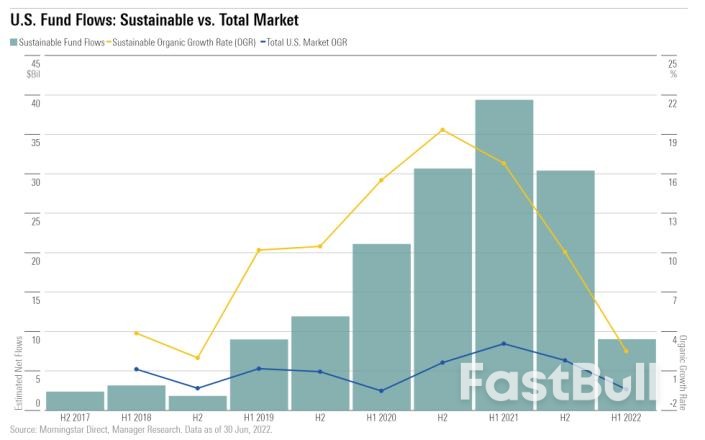
          Investors moved $1.6 billion out of U.S. sustainable funds in the second quarter, according to a Morningstar report, marking the first quarter of outflows in more than five years.
          When compared to the broader market, demand for sustainable funds remained resilient.
          "It's worth noting that even though sustainable funds saw outflows, this was less severe than the total U.S. market," Alyssa Stankiewicz, Morningstar associated director of sustainability research in the U.S., told Yahoo Finance. "I do think that this higher level of demand and sustained growth versus the overall market does point to demand for sustainable funds being a bit more sticky, meaning that investors have higher conviction and tend to stick with them even when short-term performance might be a challenge."
          The organic growth rate for sustainable funds, calculated as net flows as a percentage of total assets, held up much better than that of the overall market.
          In the second quarter, the organic growth rate of the sustainable funds market fell 0.45% compared to a decline of 0.74% in the overall market. And year over year, the sustainable funds market increased by 13% whereas the overall market only grew by 1.4%.
          Globally, sustainable funds were buoyed by Europe and captured $32.6 billion in inflows during the quarter, a 62% decline from the first quarter.U.S. Sustainable Funds Saw Outflows in Q2, But Demand Remained 'Sticky'_1

          How sustainable funds fared

          Inflation, rising interest rates, and recession fears played a large role in the decline. The move up in energy prices due to the Russia-Ukraine war and a confidence crisis in assets labeled for their environmental, social, and governance (ESG) virtues likely didn't help.
          "Investors are looking at ESG investments as one part of a larger portfolio, and they rebalance or reposition depending on what they're seeing as forward-looking trends to the overall market," Stankiewicz said about investors wanting to reduce risk exposure.
          The bear market in stocks challenged active funds and sustainable equity funds in particular.
          "The hardest-hit category within our sustainable funds universe was the sector equity category, especially in energy and tech climate funds and renewable energy funds," Stankiewicz explained. "I think one of the main drivers for that is probably just due to performance. They had overall pretty challenging 2021 and first half of 2022."U.S. Sustainable Funds Saw Outflows in Q2, But Demand Remained 'Sticky'_2
          Notably, the picture was rosier for sustainable bond funds as investors sought refuge from inflation. Sustainable bond fund flows as a category continued to see inflows during the quarter, even as traditional taxable- and municipal-bond funds shed $150 billion.
          "Sustainable bond funds have been seeing increasing adoption in past quarters — they actually hit a new record in the first quarter with $3.2 billion in inflows," Stankiewicz said."During the second quarter, obviously, they were down from that record, but they did stay positive."
          The sustainable funds that saw the most inflows included the iShares ESG Aware MSCI USA ETF (ESGU), Invesco Floating Rate ESG (AFRAX) and the Vanguard ESG U.S. Stock ETF (ESGV). The bottom funds with the most outflows were the iShares ESG Aware MSCI Emerging Markets ETF (ESGE), Parnassus Core Equity (PRBLX), and Calvert U.S. Large Cap Core Responsible Index (CISIX).

          Institutional players investing 'in a big way'

          Institutional investors appear to be behind sustainable fund market's momentum; Sudden inflow surges point to larger organizations, as was the case with the SPDR MSCI ACWI Climate Paris Aligned ETF (NZAC).
          "What was really interesting about this fund is that just in the month of April, that funds gained $149 million in net flows, and that's more than six times the total flows that this fund saw in 2021," Stankiewicz said. "So that would point to very likely an institutional client coming in for that fund in a big way."
          But institutional investors can also have large effects at the other extreme. After BlackRock changed its recommendations for its Target Allocation ETF portfolio series, the investing giant reduced its exposure to the iShares ESG Aware MSCI Emerging Markets ETF in May, which drove significant outflows. Consequently, that fund saw the most outflows of any sustainable fund in the second quarter, totaling $1.26 billion.
          According to another ETF expert, it makes sense that retail investors would suspend deposits into ESG funds while they grapple with the broader market downturn. Though he noted that this would likely only be temporary.
          "The evidence would suggest that institutions, which are really the drivers of the assets in the ESG space, they don't seem to be slowing down," Dave Nadig, a financial futurist at VettaFi, told Yahoo Finance in early July. "What we have seen is a pullback in interest from the average retail investor. I think that's completely understandable."
          Despite the setback in flows this quarter, new investment product launches kept apace with asset managers launching 32 sustainable funds, 12 of which were ETFs and 20 were equity funds.
          "It's helpful to remember that a lot of these funds are still very new," Stankiewicz said. "A lot of them are still coming to market, and many advisers look for three- or five-year track records before they recommend investing in a fund. They also look for a certain asset base before they recommend investing in a fund."
          She added: "In light of the fact that so many of these funds are still new, I think the prospects for continued growth in this sector are still pretty strong, especially given what we're seeing in the early stages of the market."

          Source: Yahoo

          Risk Warnings and Disclaimers
          You understand and acknowledge that there is a high degree of risk involved in trading. Following any strategies or investment methods may lead to potential losses. The content on the site is provided by our contributors and analysts for information purposes only. You are solely responsible for determining whether any trading assets, securities, strategy, or any other product is suitable for investing based on your own investment objectives and financial situation.
          Comments
          Add to Favorites
          Share

          Amid Wild Swings, Some Hungarians Are Losing Faith in Forint

          Devin
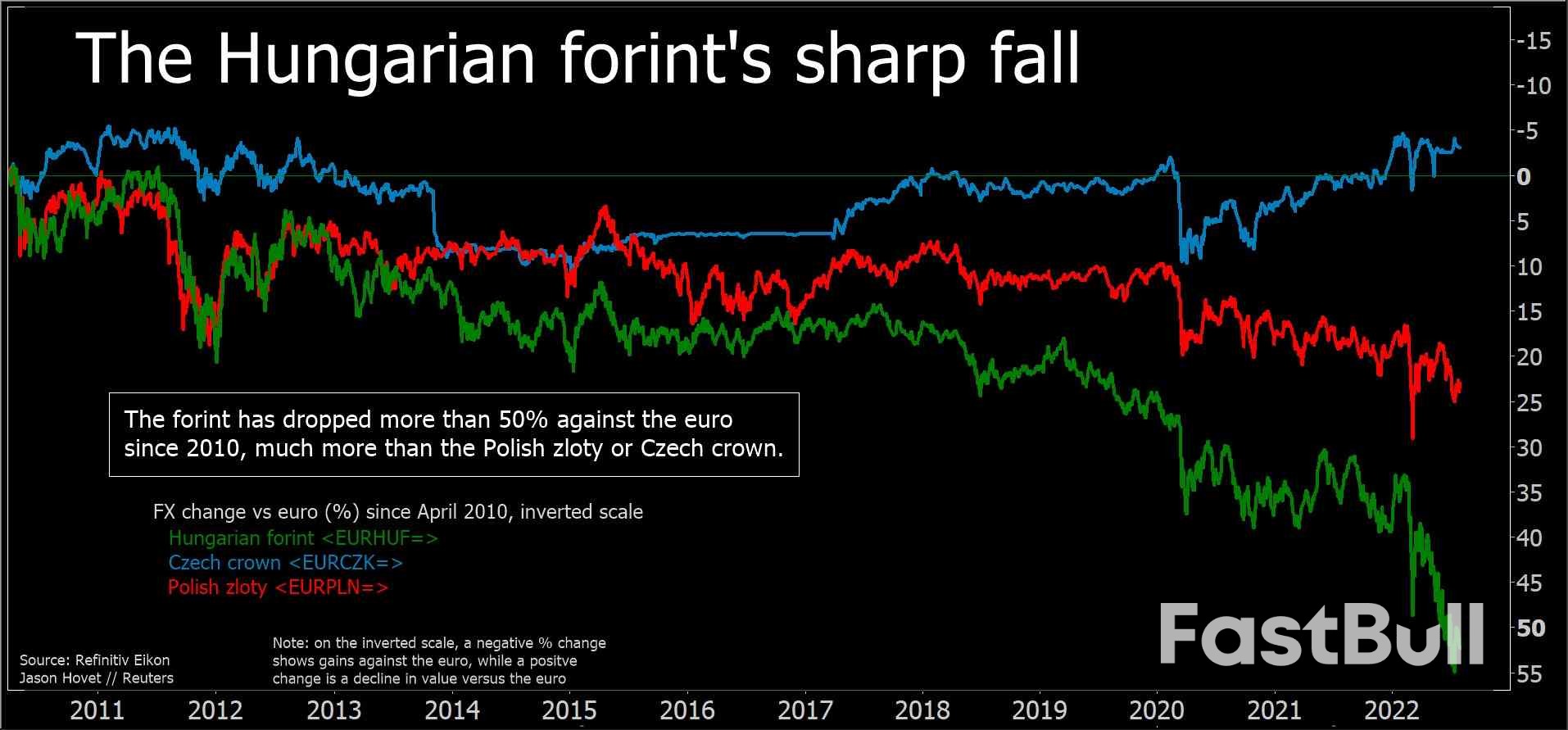
          The Hungarian forint's slide following Russia's invasion of Ukraine is leading some Hungarians to embrace the euro instead of the local currency, which has lost more than half of its value since Prime Minister Viktor Orban took power in 2010.
          Like fellow European Union members Poland, Czech Republic or Romania, Hungary is nowhere near adopting the single currency, with Orban's government ruling out in the foreseeable future a move it says would amount to a loss of economic policy sovereignty.
          But the forint, which has been under pressure from Hungary's twin deficits and a standoff with Brussels over rule of law holding up EU funds, is the region's laggard this year again and some Hungarians are taking matters into their own hands.
          An April Eurobarometer survey among countries not yet using the single currency showed support for adopting it was the highest in Hungary and neighbouring Romania, where euro payments have long been the norm in used car sales and home rentals.
          Both the forint's 8% slide against the euro so far this year and its volatility highlighted by its nearly 4% move over two days earlier this month, boosted the euro's appeal even further, even though its use is still limited within the broader economy.
          Shortly after Russia's invasion of Ukraine in late February, Laszlo Szucs, a lawyer at Reti, Varszegi & Partners Law Firm PwC Legal, started fielding more calls from corporate clients asking how they could compensate workers for the forint's declines.
          He said most calls came from financial and business services firms and the manufacturing sector.
          While workers and consumers elsewhere in European countries faced similar pressures from runaway energy and food prices, the weakening forint was an additional challenge.
          As paying wages in euros outright is, with few exceptions, against the Hungarian law, most companies opted for extraordinary hikes worth 5-10%, while some offered end-of-quarter extra payments linked to the forint's moves, Szucs said.
          The IT services sector, where many work as independent contractors and bill foreign clients in euros, switched almost entirely to euro-based contracts for new projects in Hungary over the past three to four months, he said.
          The National Bank of Hungary, which has been raising rates to cool prices, moving by another percentage point this week, declined comment.
          Available data suggests a shift to euro so far remains limited, but in some sectors businesses are already effectively pegging their prices to euros.
          The government said its latest available data showed the euro accounted for 35.1% of non-financial corporate deposits compared with 34.7% in January, which it said showed no evidence of an increase in euroisation.
          However, on Saturday Orban's cabinet unexpectedly announced it would let companies pay taxes in euros or dollars along with forints - a move some analysts say could lessen the national currency's significance.Amid Wild Swings, Some Hungarians Are Losing Faith in Forint_1

          Forint only in 'special cases'

          Agoston Deim, who runs a small IT services firm with a partner, said he switched to pricing in euros in March when the forint tumbled through a psychological barrier of 400 against the euro.
          He said that while a year ago the firm rarely issued offers in euros, now they accounted for about half of turnover, with another one-fourth pegged to the euro's exchange rate, in line with a broader industry trend.
          "When you cannot tell what happens the next day ... and send out price offers with a one-month deadline, the risk of dealing in forints becomes just too high," he said.
          Akos Deliaga, who runs Talk-A-Bot, said his IT services company, which employs 15 people, has been setting prices in euros for even longer, offering forint-based prices only in "special cases" such as in public sector orders.
          "Unsurprisingly, our colleagues have presented a very strong demand to be paid in euros, or at least have their salaries pegged to the euro," he said in an emailed response.
          The forint's volatility has also led some property owners in Budapest and western Hungary to quote in euros.
          While such offers are still a minority and mostly involve high-end properties, their numbers have tripled compared with last year, according to a survey by Hungarian real estate website ingatlan.com.
          "Hungarian owners do not want to squander the value of their assets," spokesman Laszlo Balogh said. "They set it in euros, so if the exchange rate moves, they are covered."
          Some dealers in a high-end furniture store in Budapest suburbs are also displaying prices in euros.
          Zsuzsa Mosolygo, a co-owner of Vivax, said the office furniture retailer adopted euro-based pricing last year.
          "An office furniture project can cost 100,000 to 200,000 euros. That is a lot easier to price in euros than having to keep adjusting prices to moves in the forint," she said.
          "It is hard enough (to plan) in euros, but in forints, it would be completely impossible."

          Source: Reuters

          Risk Warnings and Disclaimers
          You understand and acknowledge that there is a high degree of risk involved in trading. Following any strategies or investment methods may lead to potential losses. The content on the site is provided by our contributors and analysts for information purposes only. You are solely responsible for determining whether any trading assets, securities, strategy, or any other product is suitable for investing based on your own investment objectives and financial situation.
          Comments
          Add to Favorites
          Share
          FastBull
          Copyright © 2025 FastBull Ltd

          728 RM B 7/F GEE LOK IND BLDG NO 34 HUNG TO RD KWUN TONG KLN HONG KONG

          TelegramInstagramTwitterfacebooklinkedin
          App Store Google Play Google Play
          Products
          Charts

          Chats

          Q&A with Experts
          Screeners
          Economic Calendar
          Data
          Tools
          Membership
          Features
          Function
          Markets
          Copy Trading
          Latest Signals
          Contests
          News
          Analysis
          24/7
          Columns
          Education
          Company
          Careers
          About Us
          Contact Us
          Advertising
          Help Center
          Feedback
          User Agreement
          Privacy Policy
          Business

          White Label

          Data API

          Web Plug-ins

          Poster Maker

          Affiliate Program

          Risk Disclosure

          The risk of loss in trading financial instruments such as stocks, FX, commodities, futures, bonds, ETFs and crypto can be substantial. You may sustain a total loss of the funds that you deposit with your broker. Therefore, you should carefully consider whether such trading is suitable for you in light of your circumstances and financial resources.

          No decision to invest should be made without thoroughly conducting due diligence by yourself or consulting with your financial advisors. Our web content might not suit you since we don't know your financial conditions and investment needs. Our financial information might have latency or contain inaccuracy, so you should be fully responsible for any of your trading and investment decisions. The company will not be responsible for your capital loss.

          Without getting permission from the website, you are not allowed to copy the website's graphics, texts, or trademarks. Intellectual property rights in the content or data incorporated into this website belong to its providers and exchange merchants.

          Not Logged In

          Log in to access more features

          FastBull Membership

          Not yet

          Purchase

          Become a signal provider
          Help Center
          Customer Service
          Dark Mode
          Price Up/Down Colors

          Log In

          Sign Up

          Position
          Layout
          Fullscreen
          Default to Chart
          The chart page opens by default when you visit fastbull.com