• Trade
  • Markets
  • Copy
  • Contests
  • News
  • 24/7
  • Calendar
  • Q&A
  • Chats
Trending
Screeners
SYMBOL
LAST
BID
ASK
HIGH
LOW
NET CHG.
%CHG.
SPREAD
SPX
S&P 500 Index
6839.21
6839.21
6839.21
6878.28
6836.96
-31.19
-0.45%
--
DJI
Dow Jones Industrial Average
47728.64
47728.64
47728.64
47971.51
47704.23
-226.34
-0.47%
--
IXIC
NASDAQ Composite Index
23499.08
23499.08
23499.08
23698.93
23492.15
-79.03
-0.34%
--
USDX
US Dollar Index
99.110
99.190
99.110
99.160
98.730
+0.160
+ 0.16%
--
EURUSD
Euro / US Dollar
1.16228
1.16235
1.16228
1.16717
1.16162
-0.00198
-0.17%
--
GBPUSD
Pound Sterling / US Dollar
1.33140
1.33148
1.33140
1.33462
1.33053
-0.00172
-0.13%
--
XAUUSD
Gold / US Dollar
4188.66
4189.09
4188.66
4218.85
4175.92
-9.25
-0.22%
--
WTI
Light Sweet Crude Oil
58.855
58.885
58.855
60.084
58.837
-0.954
-1.60%
--

Community Accounts

Signal Accounts
--
Profit Accounts
--
Loss Accounts
--
View More

Become a signal provider

Sell trading signals to earn additional income

View More

Guide to Copy Trading

Get started with ease and confidence

View More

Signal Accounts for Members

All Signal Accounts

Best Return
  • Best Return
  • Best P/L
  • Best MDD
Past 1W
  • Past 1W
  • Past 1M
  • Past 1Y

All Contests

  • All
  • Trump Updates
  • Recommend
  • Stocks
  • Cryptocurrencies
  • Central Banks
  • Featured News
Top News Only
Share

[BlackRock: The Surge Of Funds Into AI Infrastructure Is Far From Peaking] Ben Powell, Chief Investment Strategist For Asia Pacific At BlackRock, Stated That The Capital Expenditure Spree In The Artificial Intelligence (AI) Infrastructure Sector Continues And Is Far From Reaching Its Peak. Powell Believes That As Tech Giants Race To Increase Their Investments In A "winner-takes-all" Competition, The "shovel Sellers" (such As Chipmakers, Energy Producers, And Copper Wire Manufacturers) Who Provide The Foundational Resources For The Sector Are The Clearest Investment Winners

Share

[Ray Dalio: The Middle East Is Rapidly Becoming One Of The World's Most Influential AI Hubs] Bridgewater Associates Founder Ray Dalio Stated That The Middle East (particularly The UAE And Saudi Arabia) Is Rapidly Emerging As A Powerful Global AI Hub, Comparable To Silicon Valley, Due To The Region's Combination Of Massive Capital And Global Talent. Dalio Believes The Gulf Region's Transformation Is The Result Of Well-thought-out National Strategies And Long-term Planning, Noting That The UAE's Outstanding Performance In Leadership, Stability, And Quality Of Life Has Made It A "Silicon Valley For Capitalists." While He Believes The AI ​​rebound Is In Bubble Territory, He Advises Investors Not To Rush Out But Rather To Look For Catalysts That Could Cause The Bubble To "burst," Such As Monetary Tightening Or Forced Wealth Selling

Share

French President Emmanuel Macron Met With The Croatian Prime Minister At The Élysée Palace

Share

In The Past 24 Hours, The Marketvector Digital Asset 100 Small Cap Index Rose 1.96%, Currently At 4135.44 Points. The Sydney Market Initially Exhibited An N-shaped Pattern, Hitting A Daily Low Of 3988.39 Points At 06:08 Beijing Time, Before Steadily Rising To A Daily High Of 4206.06 Points At 17:07, Subsequently Stabilizing At This High Level

Share

[Sovereign Bond Yields In France, Italy, Spain, And Greece Rose By More Than 7 Basis Points, Raising Concerns That The ECB's Interest Rate Outlook May Push Up Financing Costs] In Late European Trading On Monday (December 8), The Yield On French 10-year Bonds Rose 5.8 Basis Points To 3.581%. The Yield On Italian 10-year Bonds Rose 7.4 Basis Points To 3.559%. The Yield On Spanish 10-year Bonds Rose 7.0 Basis Points To 3.332%. The Yield On Greek 10-year Bonds Rose 7.1 Basis Points To 3.466%

Share

Oil Falls 1% Amid Ongoing Ukraine Talks, Ahead Of Expected US Interest Rate Cut

Share

Azeri Btc Crude Oil Exports From Ceyhan Port Set At 16.2 Million Barrels In January Versus 17.0 Million In December, Schedule Shows

Share

USA - Greenland Joint Committee Statement: The United States And Greenland Look Forward To Building On Momentum In The Year Ahead And Strengthening Ties That Support A Secure And Prosperous Arctic Region

Share

MSCI Nordic Countries Index Fell 0.4% To 356.64 Points. Among The Ten Sectors, The Nordic Healthcare Sector Saw The Largest Decline. Novo Nordisk, A Heavyweight Stock, Closed Down 3.4%, Leading The Losses Among Nordic Stocks

Share

France's CAC 40 Down 0.2%, Spain's IBEX Up 0.1%

Share

Europe's STOXX Index Up 0.1%, Euro Zone Blue Chips Index Flat

Share

Germany's DAX 30 Index Closed Up 0.08% At 24,044.88 Points. France's Stock Index Closed Down 0.19%, Italy's Stock Index Closed Down 0.13% With Its Banking Index Up 0.33%, And The UK's Stock Index Closed Down 0.32%

Share

The STOXX Europe 600 Index Closed Down 0.12% At 578.06 Points. The Eurozone STOXX 50 Index Closed Down 0.04% At 5721.56 Points. The FTSE Eurotop 300 Index Closed Down 0.05% At 2304.93 Points

Share

Israeli Prime Minister Netanyahu: Hamas Has Violated The Ceasefire Agreement, And We Will Never Allow Its Members To Re-arm Themselves And Threaten US

Share

Israeli Prime Minister Netanyahu: We Are Working To Return The Body Of Another Detainee From The Gaza Strip

Share

Iraq's West Qurna 2 Oil Field Will Increase Oil Production Beyond Normal Levels To Compensate For The Production Stoppage Caused By The Trump Administration's Sanctions Against Russia

Share

Israeli Prime Minister Netanyahu: We Are Close To Completing The First Phase Of Trump’s Plan And Will Now Focus On Disarming Gaza And Seizing Hamas Weapons

Share

Moody's Affirmed Burberry's Long-term Rating Of Baa3 And Revised Its Outlook (from Negative) To Stable

Share

The Trump Administration Supports Iraq's Plan To Transfer Russian Oil Company Lukoil Pjsc's Assets In The West Qurna 2 Oil Field To An American Company

Share

JMA: Tsunami Of 70 Centimetres Observed In Japan's Kuji Port In Iwate Prefecture

TIME
ACT
FCST
PREV
France Trade Balance (SA) (Oct)

A:--

F: --

P: --
Euro Zone Employment YoY (SA) (Q3)

A:--

F: --

P: --
Canada Part-Time Employment (SA) (Nov)

A:--

F: --

P: --

Canada Unemployment Rate (SA) (Nov)

A:--

F: --

P: --

Canada Full-time Employment (SA) (Nov)

A:--

F: --

P: --

Canada Labor Force Participation Rate (SA) (Nov)

A:--

F: --

P: --

Canada Employment (SA) (Nov)

A:--

F: --

P: --

U.S. PCE Price Index MoM (Sept)

A:--

F: --

P: --

U.S. Personal Income MoM (Sept)

A:--

F: --

P: --

U.S. Core PCE Price Index MoM (Sept)

A:--

F: --

P: --

U.S. PCE Price Index YoY (SA) (Sept)

A:--

F: --

P: --

U.S. Core PCE Price Index YoY (Sept)

A:--

F: --

P: --

U.S. Personal Outlays MoM (SA) (Sept)

A:--

F: --

P: --
U.S. 5-10 Year-Ahead Inflation Expectations (Dec)

A:--

F: --

P: --

U.S. Real Personal Consumption Expenditures MoM (Sept)

A:--

F: --

P: --
U.S. Weekly Total Rig Count

A:--

F: --

P: --

U.S. Weekly Total Oil Rig Count

A:--

F: --

P: --

U.S. Consumer Credit (SA) (Oct)

A:--

F: --

P: --
China, Mainland Foreign Exchange Reserves (Nov)

A:--

F: --

P: --

Japan Trade Balance (Oct)

A:--

F: --

P: --

Japan Nominal GDP Revised QoQ (Q3)

A:--

F: --

P: --

China, Mainland Imports YoY (CNH) (Nov)

A:--

F: --

P: --

China, Mainland Exports (Nov)

A:--

F: --

P: --

China, Mainland Imports (CNH) (Nov)

A:--

F: --

P: --

China, Mainland Trade Balance (CNH) (Nov)

A:--

F: --

P: --

China, Mainland Exports YoY (USD) (Nov)

A:--

F: --

P: --

China, Mainland Imports YoY (USD) (Nov)

A:--

F: --

P: --

Germany Industrial Output MoM (SA) (Oct)

A:--

F: --

P: --
Euro Zone Sentix Investor Confidence Index (Dec)

A:--

F: --

P: --

Canada National Economic Confidence Index

A:--

F: --

P: --

U.K. BRC Like-For-Like Retail Sales YoY (Nov)

--

F: --

P: --

U.K. BRC Overall Retail Sales YoY (Nov)

--

F: --

P: --

Australia Overnight (Borrowing) Key Rate

--

F: --

P: --

RBA Rate Statement
RBA Press Conference
Germany Exports MoM (SA) (Oct)

--

F: --

P: --

U.S. NFIB Small Business Optimism Index (SA) (Nov)

--

F: --

P: --

Mexico 12-Month Inflation (CPI) (Nov)

--

F: --

P: --

Mexico Core CPI YoY (Nov)

--

F: --

P: --

Mexico PPI YoY (Nov)

--

F: --

P: --

U.S. Weekly Redbook Index YoY

--

F: --

P: --

U.S. JOLTS Job Openings (SA) (Oct)

--

F: --

P: --

China, Mainland M1 Money Supply YoY (Nov)

--

F: --

P: --

China, Mainland M0 Money Supply YoY (Nov)

--

F: --

P: --

China, Mainland M2 Money Supply YoY (Nov)

--

F: --

P: --

U.S. EIA Short-Term Crude Production Forecast For The Year (Dec)

--

F: --

P: --

U.S. EIA Natural Gas Production Forecast For The Next Year (Dec)

--

F: --

P: --

U.S. EIA Short-Term Crude Production Forecast For The Next Year (Dec)

--

F: --

P: --

EIA Monthly Short-Term Energy Outlook
U.S. API Weekly Gasoline Stocks

--

F: --

P: --

U.S. API Weekly Cushing Crude Oil Stocks

--

F: --

P: --

U.S. API Weekly Crude Oil Stocks

--

F: --

P: --

U.S. API Weekly Refined Oil Stocks

--

F: --

P: --

South Korea Unemployment Rate (SA) (Nov)

--

F: --

P: --

Japan Reuters Tankan Non-Manufacturers Index (Dec)

--

F: --

P: --

Japan Reuters Tankan Manufacturers Index (Dec)

--

F: --

P: --

Japan Domestic Enterprise Commodity Price Index MoM (Nov)

--

F: --

P: --

Japan Domestic Enterprise Commodity Price Index YoY (Nov)

--

F: --

P: --

China, Mainland PPI YoY (Nov)

--

F: --

P: --

China, Mainland CPI MoM (Nov)

--

F: --

P: --

Q&A with Experts
    • All
    • Chatrooms
    • Groups
    • Friends
    Connecting
    .
    .
    .
    Type here...
    Add Symbol or Code

      No matching data

      All
      Trump Updates
      Recommend
      Stocks
      Cryptocurrencies
      Central Banks
      Featured News
      • All
      • Russia-Ukraine Conflict
      • Middle East Flashpoint
      • All
      • Russia-Ukraine Conflict
      • Middle East Flashpoint
      Search
      Products

      Charts Free Forever

      Chats Q&A with Experts
      Screeners Economic Calendar Data Tools
      Membership Features
      Data Warehouse Market Trends Institutional Data Policy Rates Macro

      Market Trends

      Market Sentiment Order Book Forex Correlations

      Top Indicators

      Charts Free Forever
      Markets

      News

      News Analysis 24/7 Columns Education
      From Institutions From Analysts
      Topics Columnists

      Latest Views

      Latest Views

      Trending Topics

      Top Columnists

      Latest Update

      Signals

      Copy Rankings Latest Signals Become a signal provider AI Rating
      Contests
      Brokers

      Overview Brokers Assessment Rankings Regulators News Claims
      Broker listing Forex Brokers Comparison Tool Live Spread Comparison Scam
      Q&A Complaint Scam Alert Videos Tips to Detect Scam
      More

      Business
      Events
      Careers About Us Advertising Help Center

      White Label

      Data API

      Web Plug-ins

      Affiliate Program

      Awards Institution Evaluation IB Seminar Salon Event Exhibition
      Vietnam Thailand Singapore Dubai
      Fans Party Investment Sharing Session
      FastBull Summit BrokersView Expo
      Recent Searches
        Top Searches
          Markets
          News
          Analysis
          User
          24/7
          Economic Calendar
          Education
          Data
          • Names
          • Latest
          • Prev

          View All

          No data

          Scan to Download

          Faster Charts, Chat Faster!

          Download App
          English
          • English
          • Español
          • العربية
          • Bahasa Indonesia
          • Bahasa Melayu
          • Tiếng Việt
          • ภาษาไทย
          • Français
          • Italiano
          • Türkçe
          • Русский язык
          • 简中
          • 繁中
          Open Account
          Search
          Products
          Charts Free Forever
          Markets
          News
          Signals

          Copy Rankings Latest Signals Become a signal provider AI Rating
          Contests
          Brokers

          Overview Brokers Assessment Rankings Regulators News Claims
          Broker listing Forex Brokers Comparison Tool Live Spread Comparison Scam
          Q&A Complaint Scam Alert Videos Tips to Detect Scam
          More

          Business
          Events
          Careers About Us Advertising Help Center

          White Label

          Data API

          Web Plug-ins

          Affiliate Program

          Awards Institution Evaluation IB Seminar Salon Event Exhibition
          Vietnam Thailand Singapore Dubai
          Fans Party Investment Sharing Session
          FastBull Summit BrokersView Expo

          EU Should Reject Automakers’ Biofuel Plea, Says Campaign Group

          Justin

          Political

          Economic

          Summary:

          The European Commission should resist automakers' calls to allow cars to run on biofuels beyond 2035 because they are in short supply and not truly carbon-neutral, campaign group T&E said on Thursday.

          The European Commission should resist automakers' calls to allow cars to run on biofuels beyond 2035 because they are in short supply and not truly carbon-neutral, campaign group T&E said on Thursday.

          New vehicles in the European Union must have no carbon dioxide emissions from 2035 under rules designed to boost sales of electric cars and phase out fossil fuels and the internal combustion engine.

          However, automakers are pushing the EU executive to grant an exemption to allow carbon-neutral fuels to continue to power internal combustion engines, plug-in hybrids and range extenders. The Commission will unveil measures designed to support the auto sector on December 10.

          In a report published on Thursday, T&E pointed to EU law changes in 2018 that limited the use of crop-based fuels, such as from palm oil or soy, favouring used cooking oil, animals and other waste-based sources, which now account for about half of bio-based diesel in the EU.

          However, some 60% of biofuels and 80% of used cooking oil are imported, principally from Asia, T&E said, with rising cases of fraud, such as palm oil passed off as waste.

          T&E said biofuels made from food crops typically only save 60% of CO2 emissions compared with fossil fuels because of CO2 emitted in their cultivation and transportation. They also risk leading to deforestation.

          More advanced fuels made from municipal waste or sewage sludge are more sustainable, the report said, but are not available in sufficient quantities and are already earmarked for aviation and shipping. If road transport were included, EU demand could be from double to nine times the 2050 sustainable supply.

          The T&E report said that allowing biofuel in EU cars could increase CO2 emissions by up to 23% in 2050.

          The group advises that biofuels should not be part of the post-2035 solution and, if they are, limited to just 5% of sales of cars powered by truly carbon-neutral e-fuels.
          Source: Investing

          To stay updated on all economic events of today, please check out our Economic calendar
          Risk Warnings and Disclaimers
          You understand and acknowledge that there is a high degree of risk involved in trading. Following any strategies or investment methods may lead to potential losses. The content on the site is provided by our contributors and analysts for information purposes only. You are solely responsible for determining whether any trading assets, securities, strategy, or any other product is suitable for investing based on your own investment objectives and financial situation.
          Add to Favorites
          Share

          Frustration, Confusion Ripple Across Markets on CME Outage

          Adam

          Economic

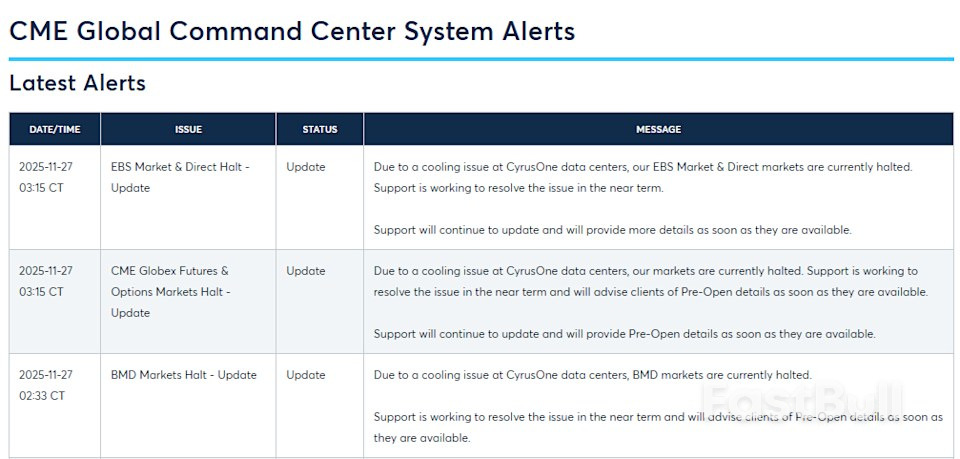
          The Chicago Mercantile Exchange Group proudly describes itself as the place “where the world comes to manage risk.” Except on Friday, the world was shut out.
          Trading of futures and options was halted due to a fault at a data center, spilling over into multiple markets and affecting contracts covering trillions of dollars. It hit S&P 500 futures as well as everything from Treasuries and US crude oil to gasoline and palm oil. EBS, a platform used in foreign exchanges, was restored at 12 p.m. London time after being down for several hours.
          In Singapore, one oil trader said when the initial alert was issued around 10:30 a.m. local time on Friday, they thought it was a hoax because the trades and quotes were still streaming in. But a few minutes later, the screen suddenly froze and they were booted out of the Nymex platform.
          With the go-to service out, screens that would usually be a flickering wall of numbers ground to a halt, and traders had to seek out other options to keep trading and operating.
          “It’s pretty annoying. We wanted to price some equity index options,” said Gerald Gan, deputy chief investment officer at Singapore-based Reed Capital Partners. “My provider is scouring for alternatives, but I doubt the liquidity would be as ample as CME.”
          Such reactions reflect how CME — which started in the late 1800s as the Chicago Butter and Egg Board — has grown to become an integral part of the global market machinery and a crucial part of traders’ daily work. On average in October, derivatives trading volumes amounted to more than 26 million contracts every day, according to data from the group.
          On Nov. 20, open interest in CME’s US Treasury futures and options set an all-time high of 35.1 million contracts. About $1 trillion of notional value is traded daily in the E-mini S&P 500 and Nasdaq 100 futures alone.
          Exchange outages have occurred frequently in recent years, with technology issues affecting pricing across platforms globally.
          In June 2024, a glitch during a software update in June 2024 led the New York Stock Exchange to erroneously halt trading on about 40 stocks and display odd trades showing a 99% drop in prices. Earlier in the year, tech issues disrupted premarket Nasdaq trading for almost three hours.
          In Europe, London Stock Exchange Group Plc suffered three outages in a few months at the end of 2023, including one that halted trading for thousands of shares.
          The latest CME malfunction is already longer than a similar, hours-long outage due to a technical error in 2019, which will mean questions for the company, the data center operator and the extent of contingency plans.
          ‘Real Black Friday’
          Commodity traders scrambled to work out what would happen when the US benchmarks for gasoline and diesel futures expired later in the day — that can involve delivering actual barrels when the market closes at the end of month. Some oil brokers questioned why they came to work, with volumes already expected to be low the day after Thanksgiving and unable to trade CME volumes.
          On LinkedIn, one employee at Glencore commented “Real Black Friday” in response to a post on the issues.
          The outage meant limited trading in Treasury futures. Elsewhere, cash bonds traded sporadically and volumes may be hit by the reduced ability of traders to hedge. There are alternative methods to hedge trades, such as through swap markets which became more active following the start of trading in London, according to traders.
          Futures for European and UK bond markets trade on a different exchange and were unaffected.
          In the foreign exchange market, one trader said prices on platforms were returning to normal, but when trading opened at 8 a.m. in London, some platforms initially showed elevated bid-offer spreads.
          “We typically use derivatives for tactical trades but it’s obviously impossible this morning,” said Amelie Derambure, a portfolio manager at Amundi SA. “Thankfully, it’s a quiet day. It would have been quite a handicap had it been a busy day.”
          Global Impact
          Friday was set to be a subdued day for stock markets, with only a half day of trading in the US after the Thanksgiving holiday. There’s no US economic data scheduled and no Federal Reserve speakers ahead of a blackout period leading up to their December decision.
          “Lucky it’s quiet post Thanksgiving,” said Emmanuel Valavanis, a London-based equity sales specialist at Forte Securities. “For this to happen on the last trading day of the month is bad enough, but coinciding with last day of year-end for many mutual funds compounds the potential issue. Freezing a trillion dollars is not a good look for those involved.”
          Frustration, Confusion Ripple Across Markets on CME Outage_1
          Some said they were staying away given the risks posed by the outage on a day when trading was already expected to be thinner.
          “I am wary about trading on such an illiquid day, so I would not have wanted to trigger trades anyway,” said Rajeev De Mello, chief investment officer at Gama Asset Management. “And with this outage, all the more so.”

          Source: Bloomberg

          To stay updated on all economic events of today, please check out our Economic calendar
          Risk Warnings and Disclaimers
          You understand and acknowledge that there is a high degree of risk involved in trading. Following any strategies or investment methods may lead to potential losses. The content on the site is provided by our contributors and analysts for information purposes only. You are solely responsible for determining whether any trading assets, securities, strategy, or any other product is suitable for investing based on your own investment objectives and financial situation.
          Add to Favorites
          Share

          Biggest Eurozone Members See Easing Inflation Except for Germany

          Michelle

          Forex

          Economic

          Inflation figures from the eurozone's major economies paint a mixed picture of the bloc's price prospects. In Germany, the region's biggest economy, the inflation rate unexpectedly rose to the highest level in nine months.

          Mainly driven by food prices, as energy prices fell modestly, EU-harmonised inflation in Germany was 2.6% higher in November compared with the previous year, after inflation hit 2.3% in October of 2025. This is according to preliminary results from the Federal Statistical Office (Destatis).

          Month-on-month, the harmonised inflation rate showed that German prices fell by 0.5% in November, from a 0.3% rise in October.

          French prices are slow to rise

          Elsewhere, it appears that Europe's price pressure is cooling following the region's post-pandemic cost-of-living crisis. Preliminary data released on Friday suggests French inflation remains subdued. According to flash estimates from INSEE, the country's EU-harmonised price index is projected to rise by 0.8% year-on-year in November, unchanged from the previous month and down from 1.7% a year earlier.

          Economists had expected a stronger increase of 1%.

          The stable reading reflects contrasting movements across spending categories: a slowdown in service prices, driven down by communication services, and a more pronounced decrease in manufactured goods prices, offset by a smaller decline in energy prices and a slight acceleration in food prices.

          Month-over-month, French prices fell by 0.2% in November, after a 0.1% increase in October. The consensus forecast had pointed to no change.

          The decline was driven by lower service prices, particularly in transport and communications, and to a lesser extent by cheaper manufactured goods. Energy prices are expected to rebound, led by petrol products, while tobacco prices are projected to edge higher. Food prices are expected to remain broadly stable.

          Inflation in Italy

          The EU's third-largest economy showed a similar pattern. Italy's harmonised index of consumer prices fell by 0.2% in November, matching October's decline, according to preliminary figures from the national statistics agency ISTAT.

          Annual inflation eased to 1.1% from 1.3% in the previous month, which is its lowest level since October 2024.

          Italian inflation remained low as falling energy prices and softer services inflation offset modest rises elsewhere. The largest downward pressures came from steep declines in regulated energy and communication services, alongside slower increases in transport and recreational services.

          Only a few categories — mainly processed food and some unregulated energy products — added mild upward pressure.

          Spanish prices are on the rise

          Spain, the eurozone's fourth-largest economy, recorded somewhat stronger price pressures. The EU-harmonised index of consumer prices was flat in November following a 0.5% rise in October, defying expectations of a 0.2% monthly fall, according to preliminary data from the National Statistics Institute.

          However, annual inflation came in higher than expected. The harmonised rate eased to 3.1% from 3.2% in October, compared with a forecast of 2.9%. Price rises for food, transport and other non-energy goods continued to drive inflation.

          Friday's figures from the eurozone's major economies will inform the European Central Bank ahead of its meeting in December. The ECB is not expected to cut its key interest rate from the current 2%, with policymakers judging that medium-term inflation targets are broadly being met.

          Eurozone inflation stood at 2.1% in October, slightly above the ECB's 2% target, reinforcing the bank's view that price pressures are largely under control after the surge to double-digit highs caused by post-pandemic supply shocks and the energy crisis triggered by Russia's invasion of Ukraine.

          Meanwhile, inflation expectations have edged higher. According to a new ECB survey published on Friday, median consumer inflation expectations for the next year rose to 2.8% in October from 2.7% in September. Expectations for three years ahead were unchanged at 2.5%, while five-year-ahead expectations remained steady at 2.2%.

          Source: Yahoo Finance

          To stay updated on all economic events of today, please check out our Economic calendar
          Risk Warnings and Disclaimers
          You understand and acknowledge that there is a high degree of risk involved in trading. Following any strategies or investment methods may lead to potential losses. The content on the site is provided by our contributors and analysts for information purposes only. You are solely responsible for determining whether any trading assets, securities, strategy, or any other product is suitable for investing based on your own investment objectives and financial situation.
          Add to Favorites
          Share

          Market Ends November on a Whimper as Dovish Glow Replaces AI Panic

          Adam

          Economic

          The market is closing out November with all the intensity of a flickering candle in a well-lit room, an almost comical contrast to the drama that tried—unsuccessfully—to hijack the month. It’s only fitting that we coast into the finish on what is universally considered the most forgettable trading day of the year, a day when even the screens seem to yawn. And with CME’s derivatives plumbing briefly going dark? Well, if the market were ever going to have a systems outage, this was the moment. The Street is thinly staffed, the U.S. is still digesting turkey, and most institutional desks are already running on half-power secondary feeds. A rare case where a glitch becomes a feature, ensuring no one can put on a hero trade they’ll regret by Monday.
          This soft yawn into the weekend caps a month that spent its early weeks trying to convince traders that the AI supercycle had finally run out of narrative rope. The whisper campaign about an AI bubble felt almost gleeful—every dip framed as the first crack in the silicon cathedral. But as the fear crescendoed, the Federal Reserve stepped in with the softest of tones, the kind that turns terminal rates into mush and revives risk like water on dry earth. Suddenly, cut expectations went vertical. A probability that sat at 39% just a week ago has vaulted to 85%, all because a few policymakers reminded us they still remember where they put the easing toolkit.
          The repricing was textbook: the dollar caught the downdraft, logging its worst week in four months, while equities floated higher—not euphoric, not giddy, but relieved. It’s the kind of late-November drift that happens when the macro tide quietly shifts, and there’s no one at the helm willing to contradict it. Markets want to believe in the December cut. They want the Fed’s language to mean what they think it means. But the whole setup has the delicacy of an options vol surface on a holiday afternoon: one hawkish speech next week and we’re right back to questioning everything. Today, though, none of that matters. There is barely enough liquidity to price conviction, let alone express it.
          The FX market is ending the week in classic Thanksgiving mode: tight ranges, thin liquidity, and very little appetite to force anything ahead of proper U.S. flow returning on Monday. The dollar is essentially drifting, still carrying a mild overvaluation premium on short-term models, and the bias into next week remains for DXY to ease back toward the 99.00 area as it converges with front-end rate pricing.
          The one development with enough weight to tilt the FX market beyond the rate curve is the slow build-up in expectations around Russia–Ukraine negotiations. Putin’s latest remarks—that the Geneva draft could serve as a foundation for a deal—and confirmation that U.S. envoy Steve Witkoff will travel to Moscow next week have not moved oil markets yet, but traders are paying attention. The FX reaction function here is straightforward: any credible sign of progress would weaken the dollar and support the Euro and European high-beta currencies. This is one of the few catalysts with genuine asymmetry; peace risk takes a geopolitical premium out of USD and shifts momentum back toward European risk.
          The euro enters this backdrop with a reasonably constructive setup amid dovish echoes from the Eccles building and the prospect of some peace in Eastern Europe.
          My stance on EUR/USD into year-end remains positive, but the near-term driver isn’t European inflation or ECB rhetoric. The euro needs either confirmation of a December Fed cut from a non-dove or a geopolitical catalyst. Given the U.S. data vacuum until next week, any improvement in peace-deal expectations becomes the most immediate upside lever for EUR/USD.
          For now, it’s a quiet end to the week, but the setup is clear: the dollar stays vulnerable, Europe stands to benefit from any geopolitical progress, and the first real moves will land once U.S. liquidity comes back online.So we sign off November on a whimper, not a crescendo.
          All in all, it’s nothingburger of a day, wrapping up a month that flirted with panic, feigned crisis, and then—almost spitefully—resolved back into a soft, dovish glow. Liquidity is a rumour, positioning is frozen, and the most tradable thing on the blotter is the knowledge that nothing of real consequence will happen until the desks fill back up on Monday. And sometimes, after the theatrics of a long month, that kind of quiet is exactly the reset the tape needs.

          Source: investing

          To stay updated on all economic events of today, please check out our Economic calendar
          Risk Warnings and Disclaimers
          You understand and acknowledge that there is a high degree of risk involved in trading. Following any strategies or investment methods may lead to potential losses. The content on the site is provided by our contributors and analysts for information purposes only. You are solely responsible for determining whether any trading assets, securities, strategy, or any other product is suitable for investing based on your own investment objectives and financial situation.
          Add to Favorites
          Share

          Wall Street's 2026 forecasts are rolling in — and some see the S&P 500 hitting 8,000

          Adam

          Economic

          The boldest stock market calls for 2026 are starting to hit Wall Street — and some of them include a run to 8,000 for the S&P 500 (^GSPC) as the AI boom continues reshaping the economy and financial markets.
          Deutsche Bank set a year-end 2026 price target of 8,000 for the benchmark index in a new outlook published on Tuesday, calling for "mid-teens returns" driven by stronger inflows, buybacks, and continued momentum in earnings, which have been especially strong so far in 2025.
          S&P 500 companies grew earnings by 13.4% in the third quarter, according to FactSet.
          "In 2026, we see robust earnings growth and equity valuations remaining elevated," Deutsche Bank's equities strategy team, led by Binky Chadha, wrote in the report.
          That view sits at the upper end of Wall Street's expectations for next year. HSBC, for example, has a 2026 target of 7,500, while JPMorgan is calling for the S&P 500 to reach 7,500 with upside to 8,000 if the Fed continues to cut rates.
          Morgan Stanley also expects a strong year, forecasting the index will finish 2026 at 7,800 amid what strategist Mike Wilson calls a "new bull market," arguing in a report last week that a rolling recession ended earlier this year and that policy support and earnings strength will continue into next year.
          And more firms are leaning into the idea that the next phase of the bull market still has room to run.
          Wells Fargo is in that camp, calling for a double-digit move higher in stocks over the next 12 months and a year-end 2026 target of 7,800. The bank expects a two-stage rally next year as the market shifts from a "reflation hope" trade in the first half to a stronger AI-driven surge in the second.
          While Wells Fargo sees the AI boom echoing past periods of tech-led growth, it also cautions that the trade could become a bubble. The firm argues that policy and liquidity should keep the backdrop supportive heading into the midterm election cycle, but notes the market is becoming increasingly intertwined with the broader economy.
          "A K-shaped economy led by wealth effect means a bear market could trigger an economic downturn, which neither the Fed nor the Gov't can afford especially into midterms," the bank's equity strategy team, led by Ohsung Kwon, wrote. The firm noted that equity gains have become increasingly tied to household wealth as the economy splits between the "haves" and the "have-nots."
          JPMorgan lands in a similar place. The bank's baseline call for 2026 is a run toward 7,500, but it sees a path above 8,000 if an improved inflation outlook prompts the Fed to cut rates more aggressively. For now, JPMorgan expects two additional cuts before the central bank pauses.
          Markets are currently pricing in an 83% chance that the central bank cuts interest rates by the end of its December meeting in two weeks, up from a roughly 30% chance seen just last week, according to the CME FedWatch Tool.
          "Despite AI bubble and valuation concerns, we see current elevated multiples correctly anticipating above-trend earnings growth, an AI capex boom, rising shareholder payouts, and easier fiscal policy (i.e. [One Big Beautiful Bill Act])," JPMorgan lead equity strategist Dubravko Lakos-Bujas wrote.
          "More so, the earnings benefit tied to deregulation and broadening AI-related productivity gains remain underappreciated," Lakos-Bujas added, projecting earnings growth of 13% to 15% over the next two years.
          That boom, however, isn't unfolding in a vacuum. JPMorgan, like other firms, notes the AI shift is happening against a polarized economic backdrop: "This disruption is unfolding within an already unhealthy K-shaped economy, with AI expected to amplify this polarization even further."
          HSBC is also leaning on that theme, initiating coverage on 2026 with a 7,500 price target that suggests "another year of double-digit gains mirroring the late 1990s equity boom."
          Like JPMorgan, the bank expects the AI investment cycle to continue supporting earnings, even as lower-income consumers remain under pressure.
          "While 2025 was marked by the policy fallout from Liberation Day tariffs, stricter immigration policy, and overall elevated uncertainty from trade to geopolitics to Fed independence, we expect 2026 to be marked by a two speed economy/market," the bank said.

          Source: finance.yahoo

          To stay updated on all economic events of today, please check out our Economic calendar
          Risk Warnings and Disclaimers
          You understand and acknowledge that there is a high degree of risk involved in trading. Following any strategies or investment methods may lead to potential losses. The content on the site is provided by our contributors and analysts for information purposes only. You are solely responsible for determining whether any trading assets, securities, strategy, or any other product is suitable for investing based on your own investment objectives and financial situation.
          Add to Favorites
          Share

          IMF Warns Tokenized Markets Amplify Flash Crashes, Risking Systemic Shocks

          Glendon

          Cryptocurrency

          Economic

          The International Monetary Fund (IMF) released an explanatory video on its X account, highlighting the potential of tokenized markets to speed up asset trading while introducing severe risks, such as intensified flash crashes.

          Tokenization removes the need for intermediaries by automating clearing and settlement directly in code, which early pilots have shown can cut costs and enable near-instant execution. While this paves the way for cheaper, programmable financial services, it can also amplify volatility, since automated trades fire off immediately with no buffers in between.

          Tokenized Markets' benefits face volatility risks

          Researchers note that tokenized systems allow near-instant settlement and more efficient use of collateral, reshaping how assets can trade around the clock. But the IMF warns that these benefits come with familiar risks: past episodes of automated trading have shown how quickly flash crashes can unfold, and layered smart contracts could make those shocks even sharper by triggering chain reactions under stress. On top of that, if platforms remain fragmented and don't interoperate, liquidity could get stuck in silos, undercutting the broader vision of unified, always-on markets.

          The video points to historical precedents, such as the 1944 Bretton Woods system, in which governments fixed currencies to the U.S. dollar and gold, only for it to collapse into fiat and floating rates by the 1970s.

          Such interventions shaped global finance for decades, signalling that regulators may soon embed tokenized assets under tighter regulatory oversight. BlackRock's BUIDL fund has surged to become the largest tokenized Treasury product, outpacing rivals like Franklin Templeton's fund through 2025.​

          Governments eye active tokenization role

          This public video signals tokenization moving from a niche topic to a mainstream policy focus for the IMF, which has been following digital money developments for a while. Historically, governments don't stay on the sidelines when money evolves; they step in to regulate. As tokenized markets reach multibillion-dollar sizes, platforms will need to tackle these risks head-on to avoid heavy-handed interventions that could change the entire landscape.

          Source: CryptoSlate

          To stay updated on all economic events of today, please check out our Economic calendar
          Risk Warnings and Disclaimers
          You understand and acknowledge that there is a high degree of risk involved in trading. Following any strategies or investment methods may lead to potential losses. The content on the site is provided by our contributors and analysts for information purposes only. You are solely responsible for determining whether any trading assets, securities, strategy, or any other product is suitable for investing based on your own investment objectives and financial situation.
          Add to Favorites
          Share

          Kenya Turns To China For $1.5 Billion Highway Expansion

          Winkelmann

          Political

          Economic

          Key points:

          · China's CRBC, Shandong and Kenya's NSSF to expand highway
          · China changes model of developing Africa infrastructure
          · Kenya highway project financing split into debt, equity

          Kenya and two Chinese state firms are launching construction of a $1.5 billion highway expansion on Friday, marking Beijing's return to major infrastructure development in the East African economy after a years-long hiatus.

          The project, split into two phases, will be financed by the partners through a mix of debt and equity using a model that is gaining traction after China's traditional lending model raised concerns over borrowers' debt burdens.

          "We don't have any room to borrow any more money," Kefa Seda, director general of the Public-Private Partnerships directorate at Kenya's finance ministry told Reuters ahead of the official launch ceremony.

          The project will improve a key transport corridor that links Kenya's port of Mombasa with its western region and neighbouring landlocked states like Uganda, via Nairobi.

          AS CHINA REPOSITIONS IN AFRICA, KENYA STRIKES A DEAL

          After pumping billions of dollars into infrastructure projects, China cut its lending in Africa around 2019 as worries grew over debt sustainability in countries like Kenya.

          Beijing pledged $50 billion in credit and investments over three years, however, at a summit with African leaders last year as it moves to reposition itself on the continent.

          Kenya terminated a deal with a consortium led by France's Vinci SAfor the highway expansion project earlier this year.

          The new agreement was announced during a state visit by Kenya's President William Ruto to Beijing in April.

          Kenya is among Washington's closest African allies. And the rapprochement between Nairobi and Beijing angered U.S. PresidentDonald Trump, prompting Ruto to issue a public defence of the strategy, saying Kenya needed to boost exports into markets like China.

          DEBT, EQUITY MIX AND A 28-YEAR TOLL CONCESSION

          One phase of the highway project will cost $863 million and see China Road and Bridge Corporation partner with Kenya's state pension fund NSSF to expand two existing stretches of a single-lane, 139-kilometre (86-mile) highway into four- and six-lane dual-carriage roads, the Kenya National Highways Authority said.

          In the second phase, Shandong Hi-Speed Road and Bridge International, a subsidiary of China's Shandong Hi-Speed Group, will develop an existing single-lane, 94-kilometre stretch of highway into a six-lane carriageway at a cost of $678.56 million.

          Both total cost estimates include financing costs, KENHA said.

          Deals for the two portions of the project will be split into 75% debt and 25% equity. NSSF will contribute 45% of the equity funding in the phase it is involved in.

          The borrowing could come from Chinese commercial lenders and state entities like Export-Import Bank of China, Seda said.

          The firms have until the end of 2027 to complete construction followed by a 28-year concession to collect tolls to recoup their investment and make a return.

          Source: TradingView

          To stay updated on all economic events of today, please check out our Economic calendar
          Risk Warnings and Disclaimers
          You understand and acknowledge that there is a high degree of risk involved in trading. Following any strategies or investment methods may lead to potential losses. The content on the site is provided by our contributors and analysts for information purposes only. You are solely responsible for determining whether any trading assets, securities, strategy, or any other product is suitable for investing based on your own investment objectives and financial situation.
          Add to Favorites
          Share
          FastBull
          Copyright © 2025 FastBull Ltd

          728 RM B 7/F GEE LOK IND BLDG NO 34 HUNG TO RD KWUN TONG KLN HONG KONG

          TelegramInstagramTwitterfacebooklinkedin
          App Store Google Play Google Play
          Products
          Charts

          Chats

          Q&A with Experts
          Screeners
          Economic Calendar
          Data
          Tools
          Membership
          Features
          Function
          Markets
          Copy Trading
          Latest Signals
          Contests
          News
          Analysis
          24/7
          Columns
          Education
          Company
          Careers
          About Us
          Contact Us
          Advertising
          Help Center
          Feedback
          User Agreement
          Privacy Policy
          Business

          White Label

          Data API

          Web Plug-ins

          Poster Maker

          Affiliate Program

          Risk Disclosure

          The risk of loss in trading financial instruments such as stocks, FX, commodities, futures, bonds, ETFs and crypto can be substantial. You may sustain a total loss of the funds that you deposit with your broker. Therefore, you should carefully consider whether such trading is suitable for you in light of your circumstances and financial resources.

          No decision to invest should be made without thoroughly conducting due diligence by yourself or consulting with your financial advisors. Our web content might not suit you since we don't know your financial conditions and investment needs. Our financial information might have latency or contain inaccuracy, so you should be fully responsible for any of your trading and investment decisions. The company will not be responsible for your capital loss.

          Without getting permission from the website, you are not allowed to copy the website's graphics, texts, or trademarks. Intellectual property rights in the content or data incorporated into this website belong to its providers and exchange merchants.

          Not Logged In

          Log in to access more features

          FastBull Membership

          Not yet

          Purchase

          Become a signal provider
          Help Center
          Customer Service
          Dark Mode
          Price Up/Down Colors

          Log In

          Sign Up

          Position
          Layout
          Fullscreen
          Default to Chart
          The chart page opens by default when you visit fastbull.com
