• Trade
  • Markets
  • Copy
  • Contests
  • News
  • 24/7
  • Calendar
  • Q&A
  • Chats
Trending
Screeners
SYMBOL
LAST
BID
ASK
HIGH
LOW
NET CHG.
%CHG.
SPREAD
SPX
S&P 500 Index
6831.92
6831.92
6831.92
6878.28
6827.18
-38.48
-0.56%
--
DJI
Dow Jones Industrial Average
47657.00
47657.00
47657.00
47971.51
47611.93
-297.98
-0.62%
--
IXIC
NASDAQ Composite Index
23469.73
23469.73
23469.73
23698.93
23455.05
-108.39
-0.46%
--
USDX
US Dollar Index
99.020
99.100
99.020
99.160
98.730
+0.070
+ 0.07%
--
EURUSD
Euro / US Dollar
1.16377
1.16385
1.16377
1.16717
1.16162
-0.00049
-0.04%
--
GBPUSD
Pound Sterling / US Dollar
1.33244
1.33253
1.33244
1.33462
1.33053
-0.00068
-0.05%
--
XAUUSD
Gold / US Dollar
4186.07
4186.50
4186.07
4218.85
4175.92
-11.84
-0.28%
--
WTI
Light Sweet Crude Oil
58.568
58.598
58.568
60.084
58.495
-1.241
-2.07%
--

Community Accounts

Signal Accounts
--
Profit Accounts
--
Loss Accounts
--
View More

Become a signal provider

Sell trading signals to earn additional income

View More

Guide to Copy Trading

Get started with ease and confidence

View More

Signal Accounts for Members

All Signal Accounts

Best Return
  • Best Return
  • Best P/L
  • Best MDD
Past 1W
  • Past 1W
  • Past 1M
  • Past 1Y

All Contests

  • All
  • Trump Updates
  • Recommend
  • Stocks
  • Cryptocurrencies
  • Central Banks
  • Featured News
Top News Only
Share

U.S. Senate Democratic Member And Antitrust Activist Warren Stated That Paramount Skydance's Hostile Takeover Offer Triggered A "Level 5 Antitrust Alert."

Share

Benin Government: Coup Plotters Kidnapped Two Senior Military Officials Who Were Later Freed

Share

Canada: G7 Finance Ministers Discussed Export Controls And Critical Minerals In Call

Share

Benin Government: Nigeria Carried Out Air Strikes To Help Thwart Coup Bid

Share

Fitch: Expects General Government (Gg) Deficit To Fall Modestly In Canada And But Rise Modestly In USA In 2026

Share

An Important Point Of Consensus Was Concern Regarding Application Of Non-Market Policies, Including Export Controls, To Critical Minerals Supply Chains

Share

Fitch: Despite Full-Year Impact Of Tariffs, We Expect USA Fiscal Deficit To Widen In 2026 Due To Additional Tax Cuts Under One Big Beautiful Bill Act

Share

Private Equity Firm Cinven Has Signed A £190 Million Deal To Acquire A Majority Stake In UK Advisory Firm Flint Global

Share

Bank Of England's Taylor Expects Inflation To Fall To Target 'In The Near Term'

Share

Ukraine President Zelenskiy: He Will Travel To Italy On Tuesday

Share

China Is Not Interested In Forcing Russia To End Its War In Ukraine

Share

ICE Certified Arabica Stocks Decreased By 5144 As Of December 08, 2025

Share

UK Government: Leaders All Agreed That "Now Is A Critical Moment And That We Must Continue To Ramp Up Support To Ukraine And Economic Pressure On Putin"

Share

UK Government: After Meeting With The Leaders Of France, Germany And Ukraine, UK Prime Minister Convened A Call With Other European Allies To Update Them On The Latest Situation

Share

Am Best: US Incurred Asbestos Losses Rise Again In 2024 To $1.5 Billion

Share

Readout Of UK Prime Minister's Engagements With Counterparts From France, Germany And European Partners: Discussed Positive Progress Made To Use Immobilised Russian Sovereign Assets To Support Ukraine's Reconstruction

Share

New York Fed Accepts $1.703 Billion Of $1.703 Billion Submitted To Reverse Repo Facility On Dec 08

Share

Ukraine President Zelenskiy: Coalition Of Willing Meeting To Take Place This Week

Share

Ukraine President Zelenskiy: Ukraine Lacks $800 Million For USA Weapons Purchase Programme This Year

Share

Zimbabwe's President Removes Winston Chitando As Mines Minister, Replaces Him With Polite Kambamura

TIME
ACT
FCST
PREV
France Trade Balance (SA) (Oct)

A:--

F: --

P: --
Euro Zone Employment YoY (SA) (Q3)

A:--

F: --

P: --
Canada Part-Time Employment (SA) (Nov)

A:--

F: --

P: --

Canada Unemployment Rate (SA) (Nov)

A:--

F: --

P: --

Canada Full-time Employment (SA) (Nov)

A:--

F: --

P: --

Canada Labor Force Participation Rate (SA) (Nov)

A:--

F: --

P: --

Canada Employment (SA) (Nov)

A:--

F: --

P: --

U.S. PCE Price Index MoM (Sept)

A:--

F: --

P: --

U.S. Personal Income MoM (Sept)

A:--

F: --

P: --

U.S. Core PCE Price Index MoM (Sept)

A:--

F: --

P: --

U.S. PCE Price Index YoY (SA) (Sept)

A:--

F: --

P: --

U.S. Core PCE Price Index YoY (Sept)

A:--

F: --

P: --

U.S. Personal Outlays MoM (SA) (Sept)

A:--

F: --

P: --
U.S. 5-10 Year-Ahead Inflation Expectations (Dec)

A:--

F: --

P: --

U.S. Real Personal Consumption Expenditures MoM (Sept)

A:--

F: --

P: --
U.S. Weekly Total Rig Count

A:--

F: --

P: --

U.S. Weekly Total Oil Rig Count

A:--

F: --

P: --

U.S. Consumer Credit (SA) (Oct)

A:--

F: --

P: --
China, Mainland Foreign Exchange Reserves (Nov)

A:--

F: --

P: --

Japan Trade Balance (Oct)

A:--

F: --

P: --

Japan Nominal GDP Revised QoQ (Q3)

A:--

F: --

P: --

China, Mainland Imports YoY (CNH) (Nov)

A:--

F: --

P: --

China, Mainland Exports (Nov)

A:--

F: --

P: --

China, Mainland Imports (CNH) (Nov)

A:--

F: --

P: --

China, Mainland Trade Balance (CNH) (Nov)

A:--

F: --

P: --

China, Mainland Exports YoY (USD) (Nov)

A:--

F: --

P: --

China, Mainland Imports YoY (USD) (Nov)

A:--

F: --

P: --

Germany Industrial Output MoM (SA) (Oct)

A:--

F: --

P: --
Euro Zone Sentix Investor Confidence Index (Dec)

A:--

F: --

P: --

Canada National Economic Confidence Index

A:--

F: --

P: --

U.K. BRC Like-For-Like Retail Sales YoY (Nov)

--

F: --

P: --

U.K. BRC Overall Retail Sales YoY (Nov)

--

F: --

P: --

Australia Overnight (Borrowing) Key Rate

--

F: --

P: --

RBA Rate Statement
RBA Press Conference
Germany Exports MoM (SA) (Oct)

--

F: --

P: --

U.S. NFIB Small Business Optimism Index (SA) (Nov)

--

F: --

P: --

Mexico 12-Month Inflation (CPI) (Nov)

--

F: --

P: --

Mexico Core CPI YoY (Nov)

--

F: --

P: --

Mexico PPI YoY (Nov)

--

F: --

P: --

U.S. Weekly Redbook Index YoY

--

F: --

P: --

U.S. JOLTS Job Openings (SA) (Oct)

--

F: --

P: --

China, Mainland M1 Money Supply YoY (Nov)

--

F: --

P: --

China, Mainland M0 Money Supply YoY (Nov)

--

F: --

P: --

China, Mainland M2 Money Supply YoY (Nov)

--

F: --

P: --

U.S. EIA Short-Term Crude Production Forecast For The Year (Dec)

--

F: --

P: --

U.S. EIA Natural Gas Production Forecast For The Next Year (Dec)

--

F: --

P: --

U.S. EIA Short-Term Crude Production Forecast For The Next Year (Dec)

--

F: --

P: --

EIA Monthly Short-Term Energy Outlook
U.S. API Weekly Gasoline Stocks

--

F: --

P: --

U.S. API Weekly Cushing Crude Oil Stocks

--

F: --

P: --

U.S. API Weekly Crude Oil Stocks

--

F: --

P: --

U.S. API Weekly Refined Oil Stocks

--

F: --

P: --

South Korea Unemployment Rate (SA) (Nov)

--

F: --

P: --

Japan Reuters Tankan Non-Manufacturers Index (Dec)

--

F: --

P: --

Japan Reuters Tankan Manufacturers Index (Dec)

--

F: --

P: --

Japan Domestic Enterprise Commodity Price Index MoM (Nov)

--

F: --

P: --

Japan Domestic Enterprise Commodity Price Index YoY (Nov)

--

F: --

P: --

China, Mainland PPI YoY (Nov)

--

F: --

P: --

China, Mainland CPI MoM (Nov)

--

F: --

P: --

Italy Industrial Output YoY (SA) (Oct)

--

F: --

P: --

Q&A with Experts
    • All
    • Chatrooms
    • Groups
    • Friends
    Connecting
    .
    .
    .
    Type here...
    Add Symbol or Code

      No matching data

      All
      Trump Updates
      Recommend
      Stocks
      Cryptocurrencies
      Central Banks
      Featured News
      • All
      • Russia-Ukraine Conflict
      • Middle East Flashpoint
      • All
      • Russia-Ukraine Conflict
      • Middle East Flashpoint
      Search
      Products

      Charts Free Forever

      Chats Q&A with Experts
      Screeners Economic Calendar Data Tools
      Membership Features
      Data Warehouse Market Trends Institutional Data Policy Rates Macro

      Market Trends

      Market Sentiment Order Book Forex Correlations

      Top Indicators

      Charts Free Forever
      Markets

      News

      News Analysis 24/7 Columns Education
      From Institutions From Analysts
      Topics Columnists

      Latest Views

      Latest Views

      Trending Topics

      Top Columnists

      Latest Update

      Signals

      Copy Rankings Latest Signals Become a signal provider AI Rating
      Contests
      Brokers

      Overview Brokers Assessment Rankings Regulators News Claims
      Broker listing Forex Brokers Comparison Tool Live Spread Comparison Scam
      Q&A Complaint Scam Alert Videos Tips to Detect Scam
      More

      Business
      Events
      Careers About Us Advertising Help Center

      White Label

      Data API

      Web Plug-ins

      Affiliate Program

      Awards Institution Evaluation IB Seminar Salon Event Exhibition
      Vietnam Thailand Singapore Dubai
      Fans Party Investment Sharing Session
      FastBull Summit BrokersView Expo
      Recent Searches
        Top Searches
          Markets
          News
          Analysis
          User
          24/7
          Economic Calendar
          Education
          Data
          • Names
          • Latest
          • Prev

          View All

          No data

          Scan to Download

          Faster Charts, Chat Faster!

          Download App
          English
          • English
          • Español
          • العربية
          • Bahasa Indonesia
          • Bahasa Melayu
          • Tiếng Việt
          • ภาษาไทย
          • Français
          • Italiano
          • Türkçe
          • Русский язык
          • 简中
          • 繁中
          Open Account
          Search
          Products
          Charts Free Forever
          Markets
          News
          Signals

          Copy Rankings Latest Signals Become a signal provider AI Rating
          Contests
          Brokers

          Overview Brokers Assessment Rankings Regulators News Claims
          Broker listing Forex Brokers Comparison Tool Live Spread Comparison Scam
          Q&A Complaint Scam Alert Videos Tips to Detect Scam
          More

          Business
          Events
          Careers About Us Advertising Help Center

          White Label

          Data API

          Web Plug-ins

          Affiliate Program

          Awards Institution Evaluation IB Seminar Salon Event Exhibition
          Vietnam Thailand Singapore Dubai
          Fans Party Investment Sharing Session
          FastBull Summit BrokersView Expo

          EU Eyes Strategic Investments in Australian Resources Amid Renewed Trade Momentum

          Gerik

          Economic

          Summary:

          European Trade Commissioner Maros Sefcovic has confirmed the EU's growing interest in investing directly in Australian resource projects, including through equity and long-term supply deals...

          A Strategic Pivot Toward Resource Security

          In a renewed push for resource security and economic alignment, the European Union is actively considering direct investments in Australian resources projects. Speaking from Melbourne, EU Trade Commissioner Maros Sefcovic revealed that discussions with Australian Resources Minister Madeleine King had centered on several mechanisms including equity stakes, long-term off-take agreements, and joint ventures aimed at deepening the EU’s participation in Australia’s resource sector.
          These conversations come as both sides attempt to revive a long-stalled free trade agreement, one which could reshape access to critical minerals essential for Europe’s green and digital transitions. Sefcovic noted that the EU had already shortlisted several projects of interest, with a formal announcement expected imminently. This move reflects a strategic shift in the EU’s trade posture: from purely transactional trade negotiations toward more embedded, co-investment-led partnerships.

          Lessons from Past Dependencies and the Case for Diversification

          Sefcovic pointed to recent European overdependence on Russian oil and gas as a cautionary tale. The subsequent scramble for alternatives after the Ukraine invasion, combined with current constraints in global semiconductor and raw material supplies, has made clear the costs of reactive diversification. Rather than repeat this cycle, the EU is proactively seeking upstream control and supply stability in sectors like lithium, cobalt, and rare earths resources abundant in Australia.
          The shift also mirrors strategies adopted by Japan, which has long used government-supported equity and processing investments to secure long-term access to essential inputs. By following a similar model, the EU aims to reduce exposure to geopolitical shocks and price volatility, especially in light of current global competition for these resources.

          Rekindling Trade Talks with Mutual Strategic Interests

          While a prior attempt to finalize an EU-Australia free trade deal collapsed in 2023 primarily due to disputes over agricultural market access the latest signals from both parties suggest renewed momentum. Australia has long sought more flexibility to export farm goods into Europe, whereas the EU is focusing on securing reliable access to Australian critical minerals and lowering barriers to its manufactured exports.
          Sefcovic confirmed that another round of negotiations is scheduled for early next year, and the recent tone from both delegations is markedly more constructive. The strategic alignment on resource security is providing a new shared foundation for compromise.

          A New Trade Framework Anchored in Resource Diplomacy

          The EU’s willingness to move beyond tariff reduction into resource co-investment represents a broader evolution in trade policy, where economic security now intersects with environmental and geopolitical goals. Australia’s rich mineral base and stable regulatory environment make it a natural partner, especially as the EU seeks to de-risk supply chains for its ambitious climate and technology goals.
          By transitioning from a buyer-supplier dynamic to one of strategic partnership, both the EU and Australia stand to benefit Europe through supply assurance, and Australia through capital inflows and diversified export markets. If successful, this model could reshape how future trade agreements are built in a resource-constrained and geopolitically complex world.
          The EU’s direct engagement in Australian resource projects signals a maturing approach to trade and economic security. As both sides look to conclude a comprehensive agreement in 2026, these investments may serve not only as a foundation for shared prosperity but also as a geopolitical hedge in a world increasingly defined by competition for critical resources.

          Source: Reuters

          To stay updated on all economic events of today, please check out our Economic calendar
          Risk Warnings and Disclaimers
          You understand and acknowledge that there is a high degree of risk involved in trading. Following any strategies or investment methods may lead to potential losses. The content on the site is provided by our contributors and analysts for information purposes only. You are solely responsible for determining whether any trading assets, securities, strategy, or any other product is suitable for investing based on your own investment objectives and financial situation.
          Add to Favorites
          Share

          Japan’s October Export Growth Masks Ongoing Fragility in U.S. Trade Ties

          Gerik

          Economic

          Exports Show Modest Recovery Amid Shifting Tariff Landscape

          Japan’s export sector delivered a better-than-expected performance in October 2025, with a 3.6% year-on-year rise in total export value, exceeding the median forecast of 1.1%. This marked the second consecutive month of growth following a 4.2% increase in September. However, the data reveals an uneasy recovery as structural challenges in the global trade environment persist especially those involving the United States.
          The recent moderation in the slump of U.S.-bound exports played a key role in October’s rebound, though these shipments still recorded a 3.1% annual decline. Exports to China, in contrast, grew 2.1%, offering some diversification support. Imports also grew 0.7% compared to October 2024, defying expectations for a contraction. This caused Japan to register a trade deficit of 231.8 billion yen (approximately $1.47 billion), which was nonetheless smaller than the projected 280.1 billion yen gap.

          Tariff Recalibration Offers Partial Relief but Structural Weakness Remains

          The more favorable trade figures follow the U.S.–Japan trade agreement formalized in September, which lowered punitive tariffs to a baseline 15%, replacing the prior rates of 27.5% on autos and 25% on many other goods. The tariff adjustment had an initial cushioning effect, particularly for manufacturers, yet the causal burden of tariffs on Japanese exports remains visible. Automakers who had previously absorbed costs by slashing export prices have now begun passing these costs on to American consumers reducing demand elasticity and leading to continued export sluggishness to the U.S. market.
          The temporary easing in U.S.-bound export decline is therefore more correlational than causal in nature, reflecting the short-term benefit of tariff relief rather than an underlying structural improvement. Analysts suggest that without a sustained recovery in U.S. demand or a more favorable long-term trade policy, Japanese exports could stagnate again in coming months.

          Domestic Demand and Capital Spending Offset Export Weakness

          Japan’s overall economic outlook for the third quarter remains subdued, as recently released GDP data confirmed a contraction after six consecutive quarters of growth. Export volatility particularly due to the U.S. policy shock was a central driver of this downturn. Nonetheless, the contraction was partially offset by relatively firm domestic demand.
          Strong capital expenditure and resilient private consumption offered key internal buffers against external drag. These segments point to underlying economic strength, but this internal momentum may not be sufficient to fully offset long-term export weakness if global demand, particularly from the U.S., continues to erode.

          Prospects Clouded by U.S. Economic Softness and Global Uncertainty

          The outlook for Japan’s export sector remains uncertain. Although October’s trade data shows marginal progress, persistent weakness in the U.S. economy could dampen any recovery. Should American consumers respond to higher Japanese product prices by shifting demand to domestic or alternative imports, Japanese manufacturers will face renewed headwinds.
          Furthermore, Japan’s reliance on exports, particularly in high-value sectors like automobiles and electronics, renders it vulnerable to shifts in global demand and trade policy. Even with positive growth in exports to China, overall export-led recovery will depend on whether Japan can sustain diversified trade flows and avoid over-dependence on a volatile U.S. market.
          Japan’s October trade performance provides cautious optimism but does not signal a broad-based rebound. The easing of U.S.-imposed tariffs delivered temporary relief, but long-term concerns persist as Japanese exporters contend with high costs, shifting consumer behavior in key markets, and rising geopolitical trade risks. Without a durable turnaround in external demand or new trade partnerships to offset these pressures, Japan’s export sector may continue to weigh down its broader economic recovery.

          Source: Reuters

          To stay updated on all economic events of today, please check out our Economic calendar
          Risk Warnings and Disclaimers
          You understand and acknowledge that there is a high degree of risk involved in trading. Following any strategies or investment methods may lead to potential losses. The content on the site is provided by our contributors and analysts for information purposes only. You are solely responsible for determining whether any trading assets, securities, strategy, or any other product is suitable for investing based on your own investment objectives and financial situation.
          Add to Favorites
          Share

          Progress on Ukraine Peace Plan, Nonfarm Payrolls Show "Slow but Steady" Job Growth

          FastBull Featured

          Daily News

          [Quick Facts]

          1. U.S. Government reorganizes Energy Department, prioritizes fossil fuels and nuclear energy.
          2. White House confirms discussions with Ukraine on Peace Plan.
          3. Zelenskyy receives U.S. Peace Plan draft, to speak with Trump for consultations.
          4. EU imposes sanctions on multiple Russian individuals.
          5. U.S. President Trump modifies tariff scope on Brazilian goods.
          6. UK Consumer Confidence Index falls broadly, budget outlook raises market concerns.
          7. Miran: Interest rates should be adjusted closer to neutral levels.
          8. Goolsbee: Unwilling to overly bet on "Transitory Inflation".
          9. September nonfarm payrolls report: Job market continues "Slow but Steady" trend for the year after data gap.

          [News Details]

          U.S. Government reorganizes Energy Department, prioritizes fossil fuels and nuclear energy
          On November 20th, local time, the U.S. Department of Energy (DOE) announced a restructuring that prioritizes oil and nuclear resources, replacing previous departments focused on renewable energy and energy efficiency. The DOE released a new organizational chart along with a brief statement, saying the changes align with President Trump's energy dominance agenda. The new structure includes several additional offices, such as the Office of Hydrocarbons and Geothermal Energy and the Office of Fusion. The Biden administration's Clean Energy Demonstration Office has been eliminated. The Office of Energy Efficiency and Renewable Energy also disappeared from the new structure. The Loan Programs Office, which provided financing for innovative energy projects, has been renamed the Office of Energy-Dominant Financing.
          White House confirms discussions with Ukraine on Peace Plan
          According to U.S. White House Press Secretary Karoline Leavitt, who confirmed at a routine press briefing on the afternoon of November 20th, local time, senior U.S. government officials recently met with Ukrainian counterparts to discuss a peace plan that should be acceptable to both Russia and Ukraine. Leavitt said U.S. Secretary of State Marco Rubio and U.S. Special Envoy for the Middle East Steve Witkoff were involved in these talks. The U.S. government is engaged in good dialogue with both parties to the conflict on how to end the Russia-Ukraine war.
          Zelenskyy receives U.S. Peace Plan draft, to speak with Trump for consultations
          On November 20th, local time, the Office of the President of Ukraine announced that President Volodymyr Zelenskyy has officially received the U.S.-submitted draft peace plan for the Russia-Ukraine conflict. The U.S. side assessed that the plan is expected to bring breakthrough progress to the long-stalled diplomatic process. Zelenskyy outlined fundamental principles related to the core interests of the Ukrainian people, and consensus was reached between Ukraine and the U.S. to further collaborate on the terms of the plan, aiming to achieve a solution that dignifies the end of the conflict. Ukraine reiterated that achieving peace has been a core objective since the outbreak of the conflict and supports all substantive proposals that lead to genuine peace. Ukraine is willing to engage in constructive cooperation with the U.S., Europe, and global partners to jointly advance the peace process. It is reported that Zelenskyy is expected to speak with President Trump in the coming days to conduct detailed consultations on existing diplomatic possibilities and the core elements of achieving peace.
          EU imposes sanctions on multiple Russian individuals
          On November 20th, local time, the Council of the European Union announced restrictive measures against 10 Russian individuals. The newly released list targets senior officials of the Russian Federal Penitentiary Service's Rostov Regional Directorate (including the Pretrial Detention Center No. 2) and members of the Russian judiciary. Those listed will face asset freezes, and EU citizens and companies are prohibited from providing them with funds. In addition, the sanctioned individuals will be subject to travel bans, preventing them from entering or transiting through EU countries. There was no immediate response from the Russian side.
          U.S. President Trump modifies tariff scope on Brazilian goods
          On the 20th, local time, the White House announced that President Trump signed an executive order modifying the tariff scope on imports from Brazil. While maintaining the 40% ad valorem tariff on some goods, certain specific Brazilian agricultural products entering the U.S. after 00:00 Eastern Time on November 13th, have had additional ad valorem tariffs removed, in light of progress in negotiations. The White House stated that the move aims to balance national security concerns with the promotion of trade relations with Brazil.
          UK Consumer Confidence Index falls broadly, budget outlook raises market concerns
          Ahead of the UK government's upcoming budget announcement, a closely watched consumer confidence index saw an across-the-board decline. Data from research firm GfK showed the overall confidence index dropped by 2 points to -19 in November, reflecting widespread public concern about personal finances, willingness to make major purchases, and the outlook for the UK economy.
          Neil Bellamy, Head of GfK Consumer Insights, said this is a set of bleak figures ahead of the budget release. The public is bracing for tough news, and the current environment does little to improve expectations. The decline is mainly due to market expectations that the Labour government will introduce tax hikes in the budget, highlighting the significant impact of fiscal policy uncertainty on public sentiment.
          Miran: Interest rates should be adjusted closer to neutral levels
          Federal Reserve Governor Stephen Miran reiterated his view that monetary policy is overly restrictive and that officials should adjust interest rates closer to a neutral level — one that neither slows nor stimulates the economy. Speaking in New York on Thursday at an event hosted by the American Investment Council, Milan said he believes the Fed has a responsibility to adjust policy to be closer to a neutral stance, so it is not imposing such significant restraint on the economy. Milan has previously stated that it would be appropriate to cut interest rates at the next policy meeting on December 9th–10th.
          Goolsbee: Unwilling to overly bet on "Transitory Inflation"
          On Thursday, Chicago Fed President Austan Goolsbee made a speech, saying inflation "seems to have kind of stalled out and, if anything, given warnings of going the wrong way." "My unease is about the short-run front-loading of too many rate cuts and counting on … the inflation uptick that we've seen being transitory."
          September jobs data did not alter the employment landscape, showing a stable and slightly cooling labor market, while jobless claims data also failed to indicate rapid deterioration.
          September nonfarm payrolls report: Job market continues "Slow but Steady" trend for the year after data gap
          Nonfarm payrolls extend the "slow but steady" trend in September after the data gap period. Jobs increased by 119,000, exceeding the Dow Jones consensus estimate of 50,000, demonstrating resilience in job growth. However, details of the report also revealed market complexities. Data for the prior two months were revised downward, with August now showing a loss of 4,000 jobs. Meanwhile, the unemployment rate ticked up slightly to 4.4%, the highest since October 2021, although a broader measure that includes those not looking for jobs or working part-time for economic reasons edged lower to 8%.
          The report ends a data drought on the labor market that began in early September and continued through the record 44-day government shutdown. Overall, the report shows the labor market entered the autumn months on much the same footing it has been all year – a slow but steady pace, with firms reluctant both to hire many new workers or lay off existing workforce during a time of unusual economic volatility spurred by aggressive policy actions in President Donald Trump's White House.

          [Today's Focus]

          UTC+8 16:15 France November Manufacturing PMI Flash
          UTC+8 16:30 Germany November Manufacturing PMI Flash
          UTC+8 17:00 Eurozone November Manufacturing PMI Flash
          UTC+8 17:30 UK November Manufacturing PMI Flash
          UTC+8 20:30 Speech by New York Fed President John Williams
          UTC+8 20:40 Speech by Swiss National Bank President Martin Schlegel
          UTC+8 21:30 Canada September Retail Sales MoM
          UTC+8 21:30 Speech by Federal Reserve Governor Michael Barr
          UTC+8 21:45 Speech by Federal Reserve Vice Chair for Supervision Philip Jefferson on Financial Stability
          UTC+8 22:00 Speech by Dallas Fed President Lorie Logan
          UTC+8 22:45 U.S. November S&P Global Manufacturing PMI Flash
          Risk Warnings and Disclaimers
          You understand and acknowledge that there is a high degree of risk involved in trading. Following any strategies or investment methods may lead to potential losses. The content on the site is provided by our contributors and analysts for information purposes only. You are solely responsible for determining whether any trading assets, securities, strategy, or any other product is suitable for investing based on your own investment objectives and financial situation.
          Add to Favorites
          Share

          Trump Eases Brazilian Food Tariffs to Combat Rising Grocery Prices and Repair Diplomatic Ties

          Gerik

          Economic

          Commodity

          Widening Tariff Relief Amid Economic Pressures

          In a significant policy reversal, President Donald Trump signed an executive order removing the 40% tariffs he previously imposed on a range of Brazilian food imports. This comes just a week after he canceled a 10% duty on the same items but had initially left the more punitive tariff untouched. The decision is retroactive to November 13 and marks a strategic pivot aimed at addressing growing domestic frustration over persistent grocery inflation ahead of the 2026 election cycle.
          The tariff rollback comes in response to mounting voter dissatisfaction over the rising cost of essential goods. With coffee, orange juice, and beef prices reaching record highs due to global shortages and disrupted supply chains, the removal of import taxes on these Brazilian staples is expected to provide some economic relief to American households. The causal relationship between the earlier imposition of tariffs and the inflationary pressures on consumer prices, especially for coffee and beef, underscores the administration’s urgent need to pivot.
          Although Trump had initially justified the steep tariffs as a punitive measure against Brazil for prosecuting former President Jair Bolsonaro his political ally the economic fallout from that policy prompted a reevaluation. Now, affordability for consumers has taken precedence over political messaging.

          Diplomatic Reset Between Two Hemispheric Powers

          The Brazilian government, led by President Luiz Inácio Lula da Silva, welcomed the change as a diplomatic victory. During remarks at the São Paulo Auto Show, Lula praised the decision, indicating it marked a new chapter in US-Brazil relations. Agriculture Minister Carlos Fávaro further emphasized that the renewed cooperation between the two countries benefits not just their citizens, but the broader Americas.
          The move also marks a diplomatic shift. Months of strained relations driven by US-imposed sanctions have been replaced by renewed high-level dialogue. After brief interactions in New York and a more substantive meeting in Malaysia, Lula successfully lobbied Trump to lift tariffs and ease sanctions, leveraging Brazil’s trade deficit with the US as a negotiating chip.

          Market and Industry Reactions Signal Approval

          Industry leaders in Brazil greeted the announcement with optimism. The Brazilian Beef Exporters Association and Cecafé, the coffee exporters council, celebrated the move as a victory for fair competition and reciprocal trade. Cecafé Director General Marcos Matos noted that ongoing negotiations with US roasters had laid the groundwork for this breakthrough, emphasizing the role of coordinated government and industry efforts.
          From an economic perspective, the removal of the 40% tariffs may also reverse the trend of declining Brazilian shipments to the US and help stabilize supply in the American market. This correlation between tariff easing and supply normalization could dampen the inflationary pressures that have plagued key food categories for over a year.

          Economic Pragmatism Over Political Retribution

          Trump’s administration defended the tariff exemptions as consistent with his broader trade strategy, pointing out that they were applied to products that the US does not produce in sufficient volume domestically. Commerce Secretary Howard Lutnick noted that this is not a retreat but a pragmatic shift: allowing exemptions where bilateral deals have stalled, with a focus on affordability for American families.
          This justification reflects a nuanced admission that the sweeping tariffs imposed earlier may have contributed to inflation. While the administration has avoided directly linking the tariffs to rising consumer costs, the timing and scope of this rollback suggest a causally motivated decision shaped by economic and electoral realities.
          Trump’s expanded tariff relief on Brazilian food imports signals a recalibrated strategy where domestic economic concerns and international diplomacy intersect. The move not only addresses voter anxiety over the cost of living but also represents a thaw in US-Brazil relations after months of tension. Whether this shift restores long-term consumer price stability or simply provides temporary relief will depend on market responses and further diplomatic coordination. Nonetheless, the policy reversal illustrates how economic pragmatism can override politically motivated trade aggression when voter sentiment is at stake.

          Source: Bloomberg

          To stay updated on all economic events of today, please check out our Economic calendar
          Risk Warnings and Disclaimers
          You understand and acknowledge that there is a high degree of risk involved in trading. Following any strategies or investment methods may lead to potential losses. The content on the site is provided by our contributors and analysts for information purposes only. You are solely responsible for determining whether any trading assets, securities, strategy, or any other product is suitable for investing based on your own investment objectives and financial situation.
          Add to Favorites
          Share

          ComfortDelGro Makes Senior Leadership Changes

          Winkelmann

          Stocks

          Economic

          Transport operator ComfortDelGro on Nov 20 announced senior leadership changes, which included the creation of a new "point-to-point mobility officer" role.

          Derek Koh will step down from his role as chief financial officer (CFO) in 2026, and retire at the end of March. He will also give up his two other senior roles – as deputy chief executive officer and chief corporate services officer.

          Having spent seven years in his roles, he will next assume an advisory role, to aid in the transition and ensure "continuity of strategic initiatives", said the company in a bourse filing.

          Stepping into Mr Koh's CFO role would be the current group deputy CFO, Christopher David White.

          Mr White, who has more than two decades of experience in finance, has been with ComfortDelGro since 2019, overseeing group-level financial governance, performance management and integration of international finance operations. He is concurrently the group head of investor relations.

          The newly created role of group chief point-to-point mobility officer will be filled by Liam Griffin, who has been the group's current head of point-to-point mobility in the UK. Mr Griffin is also chief executive officer of ComfortDelgro's London subsidiary, Addison Lee.

          ComfortDelGro chairman Mark Greaves said: "The board views these forward-looking appointments as essential to the ongoing evolution of the group as a leading global multi-modal mobility operator."

          He added that these internal appointments enable "continuity" and provide the necessary structure to advance the group's future growth plans.

          Shares of ComfortDelGro fell 1.4 per cent or two cents to $1.45 as at 10.57am on Nov 21, after the announcement. The Straits Times Index was down 0.9 per cent.

          Source: Straitstimes

          To stay updated on all economic events of today, please check out our Economic calendar
          Risk Warnings and Disclaimers
          You understand and acknowledge that there is a high degree of risk involved in trading. Following any strategies or investment methods may lead to potential losses. The content on the site is provided by our contributors and analysts for information purposes only. You are solely responsible for determining whether any trading assets, securities, strategy, or any other product is suitable for investing based on your own investment objectives and financial situation.
          Add to Favorites
          Share

          Bill Pulte’s Leadership at FHFA: A Trump Ally’s Rising Influence and Mounting Concerns

          Gerik

          Economic

          A Controversial Appointment in a Critical Sector

          Initially perceived as a low-priority role, Bill Pulte’s leadership at the Federal Housing Finance Agency (FHFA) has become a growing concern within Donald Trump’s inner circle. Appointed during Trump’s second term, Pulte now oversees Fannie Mae and Freddie Mac two mortgage giants underpinning the US housing system, especially as the administration prepares to reintroduce their shares to the public market after years under federal conservatorship. The Trump team had once underestimated the FHFA's strategic role, but amid rising housing costs, voter frustration, and political volatility, the agency has moved to the policy forefront.
          Pulte, 37, gained influence not through traditional qualifications but via his online persona and Mar-a-Lago connections. He spent only four years on the board of his family’s homebuilding business and is better known for his past as a “Twitter philanthropist.” His appointment to FHFA followed rejections for more senior roles at HUD, highlighting his unconventional pathway to authority. Despite lacking deep housing expertise, he’s been one of the most visible FHFA heads in history, regularly making bold policy statements and engaging in social media spats.

          Diverging from Policy Norms: Disruption or Liability?

          Trump values Pulte’s loyalty and aggressive style, but that approach has sparked internal disputes. Pulte’s open criticism of Federal Reserve Chair Jerome Powell and impromptu ideas such as portable or 50-year mortgages have unsettled administration officials and housing industry leaders. While these proposals aim to improve affordability, their long-term effects could be counterproductive. For instance, 50-year mortgages may reduce monthly payments but increase lifetime interest costs and delay equity accumulation, potentially inflating prices.
          This dynamic reflects a broader issue: Pulte often mirrors Trump’s public suggestions without detailed implementation plans, creating policy instability. The administration had to involve experienced figures like Mark Calabria, former FHFA director, to guide preparations for Fannie and Freddie’s public stock offerings.

          Investor Confidence and Perception Management

          Concerns extend to investor sentiment. Billionaire Bill Ackman has voiced caution, noting that a public offering of Fannie and Freddie shares requires time and deliberate planning to secure market confidence. Pulte’s unpredictable behavior including sudden dismissals and aggressive anti-fraud campaigns may deter institutional investors. His decision to appoint himself chairman of both Fannie and Freddie further compounded perceptions of overreach.
          Despite these reservations, the FHFA insists on the agencies’ improved governance. However, industry insiders observe that Pulte has had limited engagement in high-level stakeholder discussions, even as the administration gears up for one of the most significant restructurings in modern mortgage finance.

          Online Behavior and Legacy Complications

          Pulte’s personal history is no less complex. His social media record allegedly scrubbed of over 25,000 posts prompted scrutiny from Senator Elizabeth Warren. His involvement in meme-stock culture and participation in controversial events have further fueled doubts about his professionalism. Additionally, internal family conflicts, including lawsuits and distancing statements from other Pulte relatives, highlight a turbulent legacy despite his claims of inheriting the founder’s mantle.
          Attempting to rebrand the FHFA as “U.S. Federal Housing,” Pulte has tried to distance the agency from bureaucratic language, emphasizing public impact. However, many of his policy initiatives have lacked traction. Notably, Trump quickly minimized the importance of 50-year mortgages, only days after Pulte described them as transformative. This pattern raises questions about the strategic alignment between policy announcements and long-term planning.

          Causal and Correlational Dynamics at Play

          The causal relationship between Pulte’s leadership and FHFA’s reform trajectory remains uncertain. His high-profile role correlates with increased media visibility and political symbolism, but not necessarily with effective or stable policy delivery. Conversely, the causal effects of his actions such as firing sprees, erratic proposals, and investor discomfort may directly threaten the delicate balance needed for a successful privatization of Fannie and Freddie.
          Bill Pulte exemplifies the tension between loyalty-driven appointments and the demands of technocratic governance. While he enjoys Trump’s support and populist appeal, his lack of policy depth and reliance on social media tactics may impair critical reforms in the housing sector. As the FHFA confronts structural challenges and the administration eyes electoral gains, Pulte’s continued leadership may prove as politically symbolic as it is operationally risky.

          Soure: Bloomberg

          To stay updated on all economic events of today, please check out our Economic calendar
          Risk Warnings and Disclaimers
          You understand and acknowledge that there is a high degree of risk involved in trading. Following any strategies or investment methods may lead to potential losses. The content on the site is provided by our contributors and analysts for information purposes only. You are solely responsible for determining whether any trading assets, securities, strategy, or any other product is suitable for investing based on your own investment objectives and financial situation.
          Add to Favorites
          Share

          Gold Price Forecast: Bullion Settles At $4077 On Mixed NFP Data, Fed Increasingly Hawkish

          MarketPulse by OANDA Group

          Commodity

          Forex

          At the time of writing, gold trades at $4077 per troy ounce, having erased gains made prior to the months-delayed September US Nonfarm Payrolls release.

          Relatively unchanged at -0.02% in today's session, gold currently trades approximately 7.00% shy of all-time highs made in October, and remains on pace to secure a remarkable yearly gain of over 50% in 2025.

          What's next for gold?

          Gold (XAU/USD): Key takeaways 20/11/2025

          · Picking up in volatility in recent weeks, precious metal markets remain highly active as markets readjust expectations for the Federal Reserve's December 10th decision
          · With yesterday's FOMC minutes revealing "strongly differing views" in the most recent meeting, a better-than-expected September NFP report adds to rationale to slow down the Fed's current easing cycle
          · Albeit now concluded, the US government shutdown and the knock-on effect on data availability still cast a shadow over financial markets, with many using gold as a hedge against policy risk and a perceived decline in central bank efficacy

          Gold (XAU/USD): September NFP report eases pressure on December rate cut

          Having had at least some dealings with the financial markets for the best part of ten years now, today marks a special occasion, being the first time I'm discussing nonfarm payrolls on the 20th of the month.

          While I can only speak for myself, I'm happy to see NFP back on the calendar in any capacity, especially considering the lack of economic data in the last month or so.

          With that said, this brings us back to today, and, albeit representing conditions from some time ago, today saw the release of September's nonfarm payroll report, which beat expectations by +69,000 jobs.

          Keeping our focus on precious metal markets, let's discuss some implications for gold, as well as further macroeconomic themes currently at play.

          Gold (XAU/USD): Fundamental Analysis 20/11/2025

          September jobs beat to further Fed hawkish tilt:

          Let's start by addressing the most recent and obvious fundamental happening in the last twelve hours – the September NFP report.

          Delayed just shy of two months owing to the US government shutdown, September's numbers beat expectations by some margin. However, the report also noted rising unemployment to 4.4%, its highest level since 2021, as well as downward revisions to both July and August numbers.

          While this is fairly mixed on the surface, markets have received some assurance that the US labour market was stronger than expected before the US government shutdown took place.

          Speaking of which, we've also recently had confirmation from the Bureau of Labor Statistics that October's NFP release will not be postponed indefinitely, and alongside the delayed release of November's report, today serves as the last NFP report available before the Federal Reserve votes again on interest rates early December.

          Tying this all together, and considering the most recent data, albeit two months old, shows some buoyancy in the US labour market, this will not only somewhat relieve the pressure for further rate cuts by the Fed, but further vindicates a pre-existing hawkish tilt, best described by Vice Chair Jefferson's commitment to "proceed slowly" in the current easing cycle.

          On gold pricing, there's no surprise that any notion of higher interest rates spells trouble for the current rally in gold pricing, with price action in the last week or so, alongside the Fed's increasingly hawkish stance, testament to this.

          Gold Price Forecast: Bullion Settles At $4077 On Mixed NFP Data, Fed Increasingly Hawkish_1

          CME FedWatch, 20/11/2025

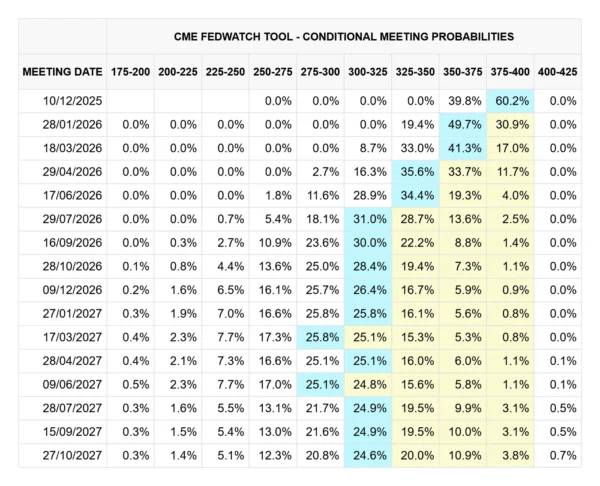
          At the time of writing, the CME FedWatch tool predicts rates will be maintained in the upcoming meeting, currently at odds of 60.2%, with a 39.8% chance of a rate cut.

          It's worth noting that, just a few short weeks ago, directly following the October decision, markets had almost 'nailed-on' a consecutive rate cut in December, with this change of expectations going some way in explaining the pullback seen in precious metal pricing.Split room highlighted in October FOMC Minutes:

          Released yesterday, minutes shared from the October rate decision highlight an increasingly divided group of policymakers ahead of the December decision, adding further rationale to expectations of rates being left unchanged.

          In brief, the meeting can be summarised as follows:

          · "Several" participants believed that another rate in December could be justified if the labour market continues to slow. Naturally, today's NFP raises some questions over this
          · "Many" others deemed that a maintenance of the current rate, held at 4.00%, would be the appropriate choice in December, especially considering the lack of economic data to guide decisions in recent months
          · Focus seems to be primarily on the jobs market, as opposed to inflation or economic activity, which makes today's NFP report, which will be the last before the December decision, even more significant

          For reasons discussed above, at least one result is a dampening of gold upside, which would likely receive a second wind if rates were to be cut.Gold as a hedge against policy failure:

          While the above casts some shadow on gold upside, markets are currently asking one question: How can the Fed make the right decision with no data?

          On this basis, and despite the notion that higher interest rates are inherently gold negative, there is some evidence that markets are using gold as a hedge against policy failure.

          Put simply, and while the Fed could be forgiven considering the lack of data, suppose a decision to hold in December was found to be, in hindsight, the wrong decision when more data is made available, this could spell trouble for the dollar, making gold a more attractive option to store wealth by comparison.

          Albeit a minor theme at play, this could offer some precious metals upside, as markets are less confident of the Fed's grasp on current conditions, although by no fault of their own.

          XAU/USD: Technical Analysis 20/11/2025

          XAU/USD: Daily (D1) chart analysis:

          Gold Price Forecast: Bullion Settles At $4077 On Mixed NFP Data, Fed Increasingly Hawkish_2

          Gold (XAU/USD), D1, OANDA, TradingView, 20/11/2025

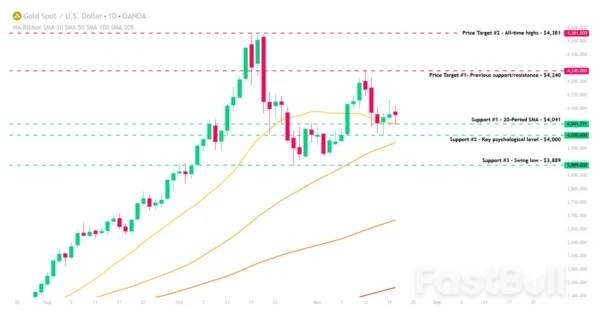
          I'm pleased to say that, as per my previous coverage, the first price target of $4,090 was hit in yesterday's session.

          Going forward, here are some other levels to consider:

          Price targets and support/resistance levels:

          · Price target/Resistance #1 – $4,240 – Previous support/resistance
          · Price target/Resistance #2 – $4,381 – All-time highs
          · Support #1 – $4,031 – 20-Period SMA
          · Support #2 – $4,000 – Key psychological level
          · Support #3 – $3,889 – Swing low

          While, in fairness, my commentary above suggests a somewhat bearish angle in the short term for gold, it's essential to remember that gold has rallied in response to other macro factors this year, despite a staunchly hawkish Fed for much of 2025.

          To the downside, the yellow metal remains well supported by many moving averages, as well as the key psychological level of $4,000, which was breached for the first time earlier this year.

          Otherwise, and in the immediate, we have seen a few pin bars to suggest that there is further bullish appetite for gold, despite a more hawkish Fed putting a lid on 2025 upside – at least for now.

          Source: MarketPulse by OANDA Group

          Risk Warnings and Disclaimers
          You understand and acknowledge that there is a high degree of risk involved in trading. Following any strategies or investment methods may lead to potential losses. The content on the site is provided by our contributors and analysts for information purposes only. You are solely responsible for determining whether any trading assets, securities, strategy, or any other product is suitable for investing based on your own investment objectives and financial situation.
          Add to Favorites
          Share
          FastBull
          Copyright © 2025 FastBull Ltd

          728 RM B 7/F GEE LOK IND BLDG NO 34 HUNG TO RD KWUN TONG KLN HONG KONG

          TelegramInstagramTwitterfacebooklinkedin
          App Store Google Play Google Play
          Products
          Charts

          Chats

          Q&A with Experts
          Screeners
          Economic Calendar
          Data
          Tools
          Membership
          Features
          Function
          Markets
          Copy Trading
          Latest Signals
          Contests
          News
          Analysis
          24/7
          Columns
          Education
          Company
          Careers
          About Us
          Contact Us
          Advertising
          Help Center
          Feedback
          User Agreement
          Privacy Policy
          Business

          White Label

          Data API

          Web Plug-ins

          Poster Maker

          Affiliate Program

          Risk Disclosure

          The risk of loss in trading financial instruments such as stocks, FX, commodities, futures, bonds, ETFs and crypto can be substantial. You may sustain a total loss of the funds that you deposit with your broker. Therefore, you should carefully consider whether such trading is suitable for you in light of your circumstances and financial resources.

          No decision to invest should be made without thoroughly conducting due diligence by yourself or consulting with your financial advisors. Our web content might not suit you since we don't know your financial conditions and investment needs. Our financial information might have latency or contain inaccuracy, so you should be fully responsible for any of your trading and investment decisions. The company will not be responsible for your capital loss.

          Without getting permission from the website, you are not allowed to copy the website's graphics, texts, or trademarks. Intellectual property rights in the content or data incorporated into this website belong to its providers and exchange merchants.

          Not Logged In

          Log in to access more features

          FastBull Membership

          Not yet

          Purchase

          Become a signal provider
          Help Center
          Customer Service
          Dark Mode
          Price Up/Down Colors

          Log In

          Sign Up

          Position
          Layout
          Fullscreen
          Default to Chart
          The chart page opens by default when you visit fastbull.com