• Trade
  • Markets
  • Copy
  • Contests
  • News
  • 24/7
  • Calendar
  • Q&A
  • Chats
Trending
Screeners
SYMBOL
LAST
BID
ASK
HIGH
LOW
NET CHG.
%CHG.
SPREAD
SPX
S&P 500 Index
6870.39
6870.39
6870.39
6895.79
6858.28
+13.27
+ 0.19%
--
DJI
Dow Jones Industrial Average
47954.98
47954.98
47954.98
48133.54
47871.51
+104.05
+ 0.22%
--
IXIC
NASDAQ Composite Index
23578.12
23578.12
23578.12
23680.03
23506.00
+72.99
+ 0.31%
--
USDX
US Dollar Index
98.890
98.970
98.890
98.960
98.730
-0.060
-0.06%
--
EURUSD
Euro / US Dollar
1.16508
1.16516
1.16508
1.16717
1.16341
+0.00082
+ 0.07%
--
GBPUSD
Pound Sterling / US Dollar
1.33236
1.33245
1.33236
1.33462
1.33151
-0.00076
-0.06%
--
XAUUSD
Gold / US Dollar
4210.75
4211.16
4210.75
4218.85
4190.61
+12.84
+ 0.31%
--
WTI
Light Sweet Crude Oil
59.755
59.785
59.755
60.084
59.752
-0.054
-0.09%
--

Community Accounts

Signal Accounts
--
Profit Accounts
--
Loss Accounts
--
View More

Become a signal provider

Sell trading signals to earn additional income

View More

Guide to Copy Trading

Get started with ease and confidence

View More

Signal Accounts for Members

All Signal Accounts

Best Return
  • Best Return
  • Best P/L
  • Best MDD
Past 1W
  • Past 1W
  • Past 1M
  • Past 1Y

All Contests

  • All
  • Trump Updates
  • Recommend
  • Stocks
  • Cryptocurrencies
  • Central Banks
  • Featured News
Top News Only
Share

Tkms CEO: With Meko Frigates We Are Offering To German Government An Alternative To Delayed F126 Frigates

Share

Tkms CEO: Expect Decision On Canadian Submarine Order In 2026

Share

EU's Costa: Normal We Do Not Share Vision On Different Issues With The USA, But Interference In Political Life Is Unacceptable

Share

Swiss Six Exchange: Several Derivatives From UBS Are Under Mistrade Investigation

Share

Hsi Down 319 Pts, Hsti Closes Flat At 5662, Ccb Down Over 4%, Ping An, Hansoh Pharma, Global New Mat Hit New Highs, Market Turnover Rises

Share

It Was Gazprom's First Such LNG Delivery Since Sanctions Introduced In January, Lseg Data Shows

Share

United Arab Emirates Energy Minister: We Are Working To Open Opportunities For Ai Firms To Improve Efficiency Of Electricity Andwater Grids, We Already Saved 30% Of Energy Consumption By Using Ai

Share

Switzerland's Consumer Confidence Index Fell To 34 In November, Compared With A Previous Reading Of -36.9

Share

Shares In Italy's Fincantieri Up 3.2% In Early Trade

Share

India's Nifty Smallcap 100 Index Falls 2.75%

Share

Britain's FTSE 100 Up 0.17%, France's CAC 40 Down 0.07%

Share

Europe's STOXX Index Up 0.04%, Euro Zone Blue Chips Index Up 0.02%

Share

United Arab Emirates Energy Minister: Natural Gas Is Important And We Intend To Not Only Satisfy Our Local Demand, But Also Grow Our Export Of LNG

Share

Yomiuri: Mitsubishi Ufj Bank Chief Hanzawa Likely To Become MUFG President

Share

Benin's International Bonds Slip After Attempted Coup, 2052 Maturity Down By 1.5 Euro Cents, Tradeweb Data

Share

China Vice Commerce Minister, On Nexperia: Root Cause Of Chaos In The Global Semiconductor Supply Chain Lies In The Netherlands

Share

United Arab Emirates Energy Minister: We Should Not Be Worrying About When Demand For Fossil Fuels Will Peak

Share

China Vice Commerce Minister: Urges Germany And EU Auto Association To Push EU Commission To Resolve EV Anti-Subsidy Case

Share

China Vice Commerce Minister Held Video Conferences With The President Of The German Association Of The Automotive Industry And The President Of The European Automobile Manufacturers Association, Respectively, To Exchange Views On Cooperation In The Automotive Industry And Supply Chain Between China And Germany And Between China And Europe

Share

China Vice Commerce Minister: Welcomes Eu Automakers To Continue To Invest In China

TIME
ACT
FCST
PREV
Italy Retail Sales MoM (SA) (Oct)

A:--

F: --

P: --

Euro Zone Employment YoY (SA) (Q3)

A:--

F: --

P: --

Euro Zone GDP Final YoY (Q3)

A:--

F: --

P: --

Euro Zone GDP Final QoQ (Q3)

A:--

F: --

P: --

Euro Zone Employment Final QoQ (SA) (Q3)

A:--

F: --

P: --

Euro Zone Employment Final (SA) (Q3)

A:--

F: --

P: --
Brazil PPI MoM (Oct)

A:--

F: --

P: --

Mexico Consumer Confidence Index (Nov)

A:--

F: --

P: --

Canada Unemployment Rate (SA) (Nov)

A:--

F: --

P: --

Canada Labor Force Participation Rate (SA) (Nov)

A:--

F: --

P: --

Canada Employment (SA) (Nov)

A:--

F: --

P: --

Canada Part-Time Employment (SA) (Nov)

A:--

F: --

P: --

Canada Full-time Employment (SA) (Nov)

A:--

F: --

P: --

U.S. Personal Income MoM (Sept)

A:--

F: --

P: --

U.S. PCE Price Index YoY (SA) (Sept)

A:--

F: --

P: --

U.S. PCE Price Index MoM (Sept)

A:--

F: --

P: --

U.S. Personal Outlays MoM (SA) (Sept)

A:--

F: --

P: --

U.S. Core PCE Price Index MoM (Sept)

A:--

F: --

P: --

U.S. Core PCE Price Index YoY (Sept)

A:--

F: --

P: --

U.S. UMich 5-Year-Ahead Inflation Expectations Prelim YoY (Dec)

A:--

F: --

P: --

U.S. Real Personal Consumption Expenditures MoM (Sept)

A:--

F: --

P: --

U.S. 5-10 Year-Ahead Inflation Expectations (Dec)

A:--

F: --

P: --

U.S. UMich Current Economic Conditions Index Prelim (Dec)

A:--

F: --

P: --

U.S. UMich Consumer Sentiment Index Prelim (Dec)

A:--

F: --

P: --

U.S. UMich 1-Year-Ahead Inflation Expectations Prelim (Dec)

A:--

F: --

P: --

U.S. UMich Consumer Expectations Index Prelim (Dec)

A:--

F: --

P: --

U.S. Weekly Total Rig Count

A:--

F: --

P: --

U.S. Weekly Total Oil Rig Count

A:--

F: --

P: --

U.S. Unit Labor Cost Prelim (SA) (Q3)

--

F: --

P: --

U.S. Consumer Credit (SA) (Oct)

A:--

F: --

P: --

RBA Rate Statement
RBA Press Conference
EIA Monthly Short-Term Energy Outlook
BOE Gov Bailey Speaks
ECB President Lagarde Speaks
BOC Monetary Policy Report
U.S. Refinitiv/Ipsos Primary Consumer Sentiment Index (PCSI) (Dec)

--

F: --

P: --

Russia CPI YoY (Nov)

--

F: --

P: --

U.S. Federal Funds Rate Projections-Longer Run (Q4)

--

F: --

P: --

U.S. Federal Funds Rate Projections-2nd Year (Q4)

--

F: --

P: --

U.S. Budget Balance (Nov)

--

F: --

P: --

U.S. Target Federal Funds Rate Lower Limit (Overnight Reverse Repo Rate)

--

F: --

P: --

U.S. Federal Funds Rate Projections-Current (Q4)

--

F: --

P: --

U.S. Interest Rate On Reserve Balances

--

F: --

P: --

U.S. Target Federal Funds Rate Upper Limit (Excess Reserves Ratio)

--

F: --

P: --

U.S. Federal Funds Rate Projections-1st Year (Q4)

--

F: --

P: --

U.S. Federal Funds Rate Projections-3rd Year (Q4)

--

F: --

P: --

U.S. Federal Funds Rate Target

--

F: --

P: --

FOMC Statement
FOMC Press Conference
Brazil Selic Interest Rate

--

F: --

P: --

U.K. 3-Month RICS House Price Balance (Nov)

--

F: --

P: --

Australia Employment (Nov)

--

F: --

P: --

Australia Full-time Employment (SA) (Nov)

--

F: --

P: --

Australia Labor Force Participation Rate (SA) (Nov)

--

F: --

P: --

Australia Unemployment Rate (SA) (Nov)

--

F: --

P: --

Turkey Retail Sales YoY (Oct)

--

F: --

P: --

Italy Quarterly Unemployment Rate (SA) (Q3)

--

F: --

P: --

IEA Oil Market Report
South Africa Gold Production YoY (Oct)

--

F: --

P: --

South Africa Mining Output YoY (Oct)

--

F: --

P: --

Q&A with Experts
    • All
    • Chatrooms
    • Groups
    • Friends
    Connecting
    .
    .
    .
    Type here...
    Add Symbol or Code

      No matching data

      All
      Trump Updates
      Recommend
      Stocks
      Cryptocurrencies
      Central Banks
      Featured News
      • All
      • Russia-Ukraine Conflict
      • Middle East Flashpoint
      • All
      • Russia-Ukraine Conflict
      • Middle East Flashpoint
      Search
      Products

      Charts Free Forever

      Chats Q&A with Experts
      Screeners Economic Calendar Data Tools
      Membership Features
      Data Warehouse Market Trends Institutional Data Policy Rates Macro

      Market Trends

      Market Sentiment Order Book Forex Correlations

      Top Indicators

      Charts Free Forever
      Markets

      News

      News Analysis 24/7 Columns Education
      From Institutions From Analysts
      Topics Columnists

      Latest Views

      Latest Views

      Trending Topics

      Top Columnists

      Latest Update

      Signals

      Copy Rankings Latest Signals Become a signal provider AI Rating
      Contests
      Brokers

      Overview Brokers Assessment Rankings Regulators News Claims
      Broker listing Forex Brokers Comparison Tool Live Spread Comparison Scam
      Q&A Complaint Scam Alert Videos Tips to Detect Scam
      More

      Business
      Events
      Careers About Us Advertising Help Center

      White Label

      Data API

      Web Plug-ins

      Affiliate Program

      Awards Institution Evaluation IB Seminar Salon Event Exhibition
      Vietnam Thailand Singapore Dubai
      Fans Party Investment Sharing Session
      FastBull Summit BrokersView Expo
      Recent Searches
        Top Searches
          Markets
          News
          Analysis
          User
          24/7
          Economic Calendar
          Education
          Data
          • Names
          • Latest
          • Prev

          View All

          No data

          Scan to Download

          Faster Charts, Chat Faster!

          Download App
          English
          • English
          • Español
          • العربية
          • Bahasa Indonesia
          • Bahasa Melayu
          • Tiếng Việt
          • ภาษาไทย
          • Français
          • Italiano
          • Türkçe
          • Русский язык
          • 简中
          • 繁中
          Open Account
          Search
          Products
          Charts Free Forever
          Markets
          News
          Signals

          Copy Rankings Latest Signals Become a signal provider AI Rating
          Contests
          Brokers

          Overview Brokers Assessment Rankings Regulators News Claims
          Broker listing Forex Brokers Comparison Tool Live Spread Comparison Scam
          Q&A Complaint Scam Alert Videos Tips to Detect Scam
          More

          Business
          Events
          Careers About Us Advertising Help Center

          White Label

          Data API

          Web Plug-ins

          Affiliate Program

          Awards Institution Evaluation IB Seminar Salon Event Exhibition
          Vietnam Thailand Singapore Dubai
          Fans Party Investment Sharing Session
          FastBull Summit BrokersView Expo

          DWS-Backed AllUnity Secures BaFin Approval to Launch Euro-Pegged Stablecoin

          Gerik

          Economic

          Cryptocurrency

          Summary:

          AllUnity, a joint venture involving DWS, has received regulatory approval from Germany’s BaFin to issue a euro-denominated stablecoin, marking a milestone for regulated digital assets in Europe....

          BaFin Greenlights Euro Stablecoin Issuance by DWS Venture

          In a significant development for the European digital finance sector, AllUnity—a joint venture that includes Deutsche Bank's asset management arm DWS—announced on Wednesday that it has received formal authorization from Germany’s financial regulator BaFin to issue a euro-backed stablecoin. The approval comes after more than a year of preparation and regulatory engagement.
          This regulatory milestone positions AllUnity as one of the first ventures in Europe to bring a fully compliant, euro-pegged stablecoin to market under the supervision of a major financial authority. The decision underscores BaFin’s willingness to support innovation in tokenized assets within a structured legal framework.

          Stablecoins Gain Ground in Europe’s Regulated Financial Ecosystem

          Stablecoins are digital tokens that maintain a fixed value by being backed 1:1 by fiat currencies such as the euro or US dollar. While the majority of stablecoins globally are pegged to the dollar, the emergence of a euro-denominated token under German regulation is seen as a strategic step toward increasing the euro’s presence in the growing digital asset landscape.
          BaFin’s approval signals institutional support for regulated stablecoins that can serve as bridges between traditional banking and decentralized finance (DeFi), while offering predictability and compliance to corporate users, fintechs, and digital asset platforms.

          Implications for the Future of Digital Payments and Tokenization in Europe

          AllUnity’s stablecoin could have broad applications in payment settlements, digital marketplaces, and blockchain-based financial services, providing a euro-denominated option for real-time transactions and on-chain liquidity. As European regulators continue to define frameworks under MiCA (Markets in Crypto-Assets Regulation), early approvals such as this one may shape how stablecoins are adopted across the EU.
          The venture’s backing by DWS—one of Europe’s leading asset managers—adds institutional credibility to the project, and may pave the way for further integration of tokenized finance into mainstream investment infrastructure.
          BaFin’s authorization of AllUnity’s euro stablecoin is more than just a technical milestone—it reflects a broader trend of increasing regulatory clarity and institutional participation in the digital asset economy. With Europe moving toward a harmonized crypto regulatory regime, this development may serve as a catalyst for broader adoption of regulated stablecoins and deeper fintech-bank collaboration in the evolving financial landscape.

          Source: Reuters

          To stay updated on all economic events of today, please check out our Economic calendar
          Risk Warnings and Disclaimers
          You understand and acknowledge that there is a high degree of risk involved in trading. Following any strategies or investment methods may lead to potential losses. The content on the site is provided by our contributors and analysts for information purposes only. You are solely responsible for determining whether any trading assets, securities, strategy, or any other product is suitable for investing based on your own investment objectives and financial situation.
          Add to Favorites
          Share

          GBP/USD: July Seasonality Favors Upside, But Is The Rally Already Overdone?

          Michelle

          Economic

          Forex

          July has historically been a bullish month for GBP/USD going back to the Bretton Woods Agreement in 1971 - will it hold this month?

          July Forex Seasonality Key Points

          • July has historically been a bullish month for GBP/USD going back to the Bretton Woods Agreement in 1971.
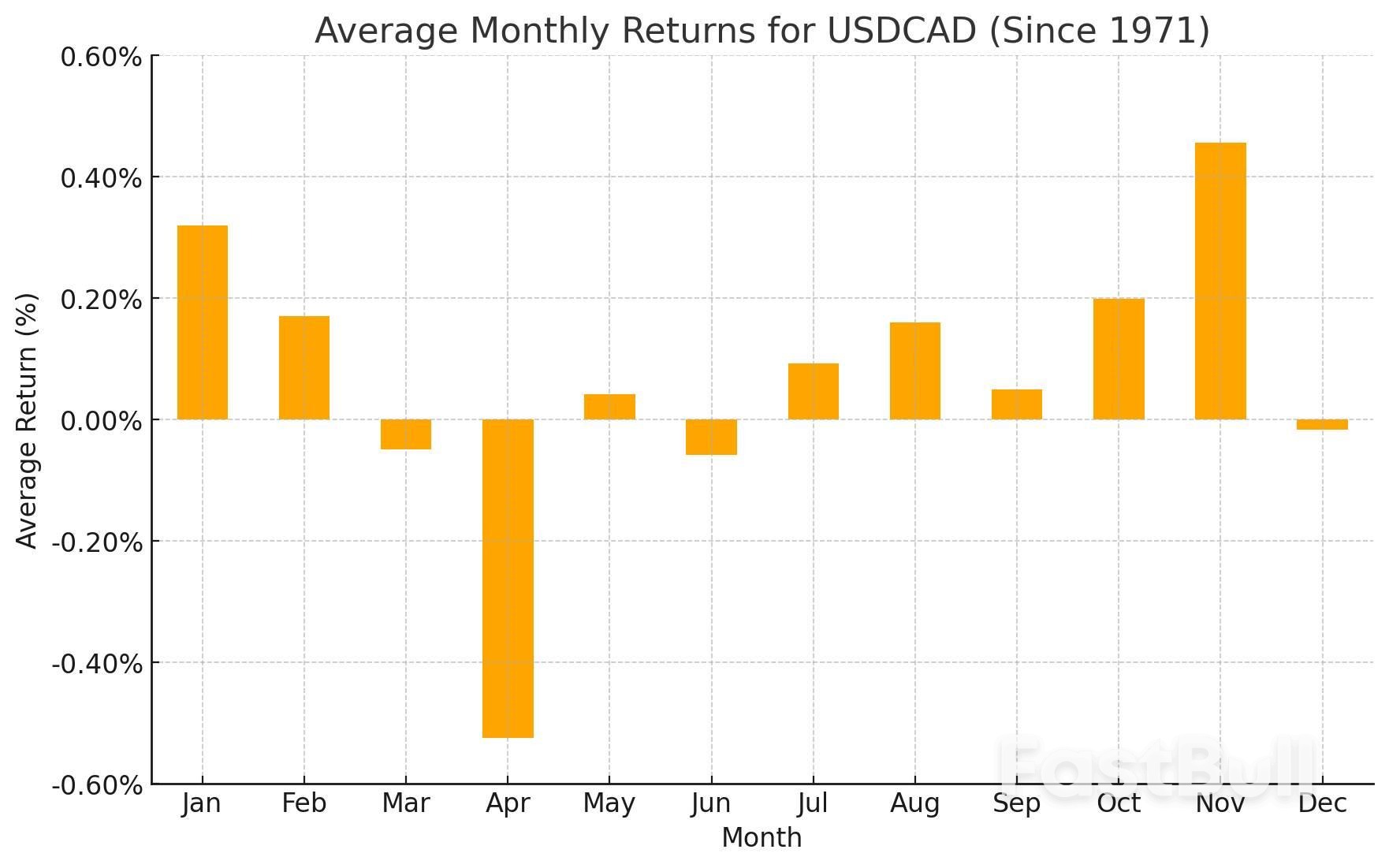
          • In contrast, AUD/USD and USD/CAD have tended to consolidate in July over the last 50+ years.
          • With US President Trump’s trade war in flux as we go to press, it’s worth watching the headlines to determine if deals, or more uncertainty, is likely in the second half of the year.

          The beginning of a new month marks a good opportunity to review the seasonal patterns that have influenced the forex market over the 50+ years since the Bretton Woods system was dismantled in 1971, ushering in the modern foreign exchange market.

          As always, these seasonal tendencies are just historical averages, and any individual month or year may vary from the historic average, so it’s important to complement these seasonal leans with alternative forms of analysis to create a long-term successful trading strategy. In other words, past performance is not necessarily indicative of future results.

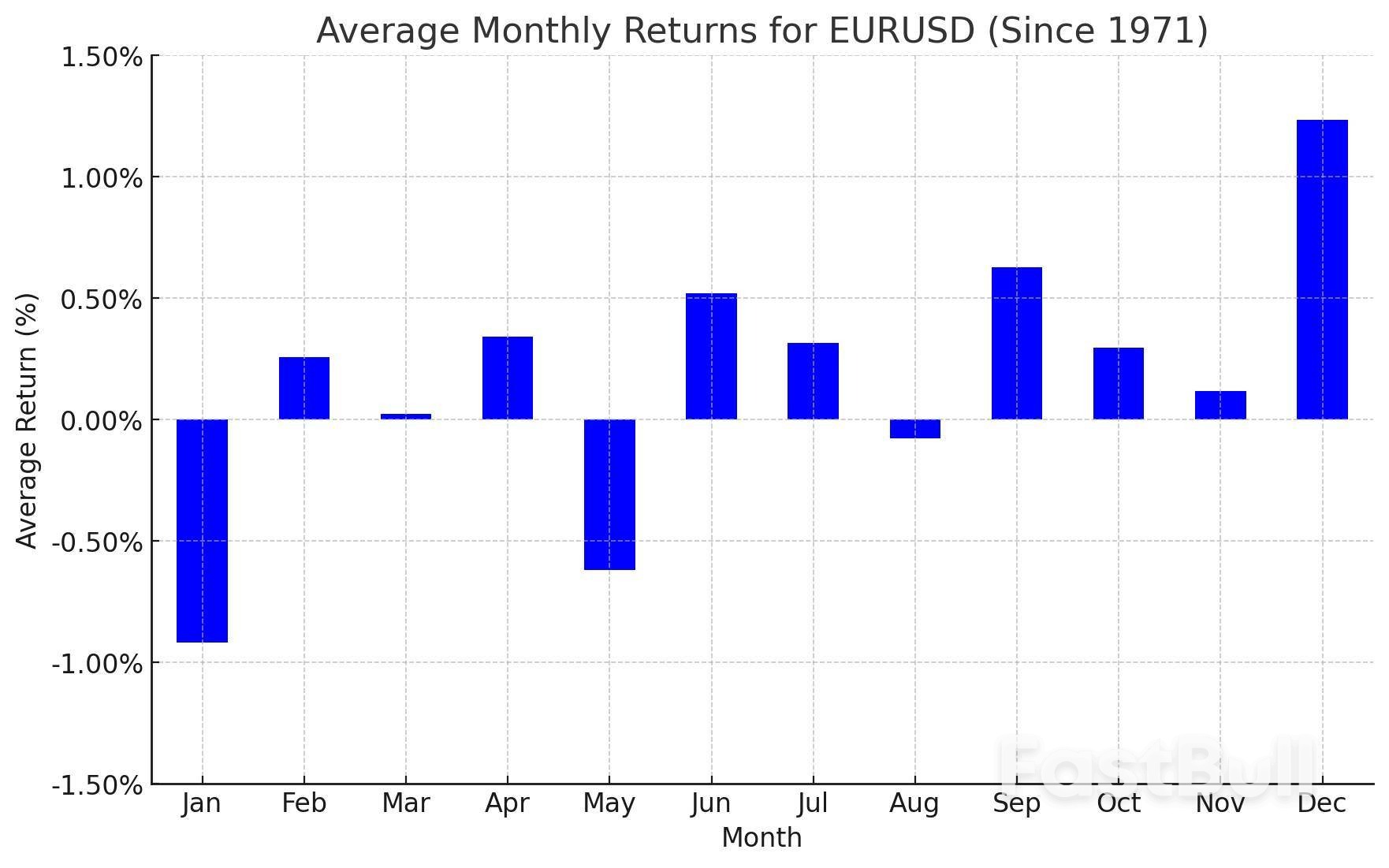
          Euro Forex Seasonality – EUR/USD Chart

          Source: TradingView, StoneX. Please note that past performance is not necessarily indicative of future results.

          Historically, July has been a modestly bullish month for EUR/USD, with the world’s most widely-traded currency pair sporting an average return of +0.32% over the last 50+ years. In June, EUR/USD followed its bullish seasonal trend, surging nearly 4% to reach its highest level in over 3.5 years.

          While the momentum and seasonal tendency point to the potential for continued gains in July, it’s worth noting that the pair is very stretched relative to its medium- and long-term moving averages, suggesting that a near-term dip in the first half of the month may be more likely than usual.

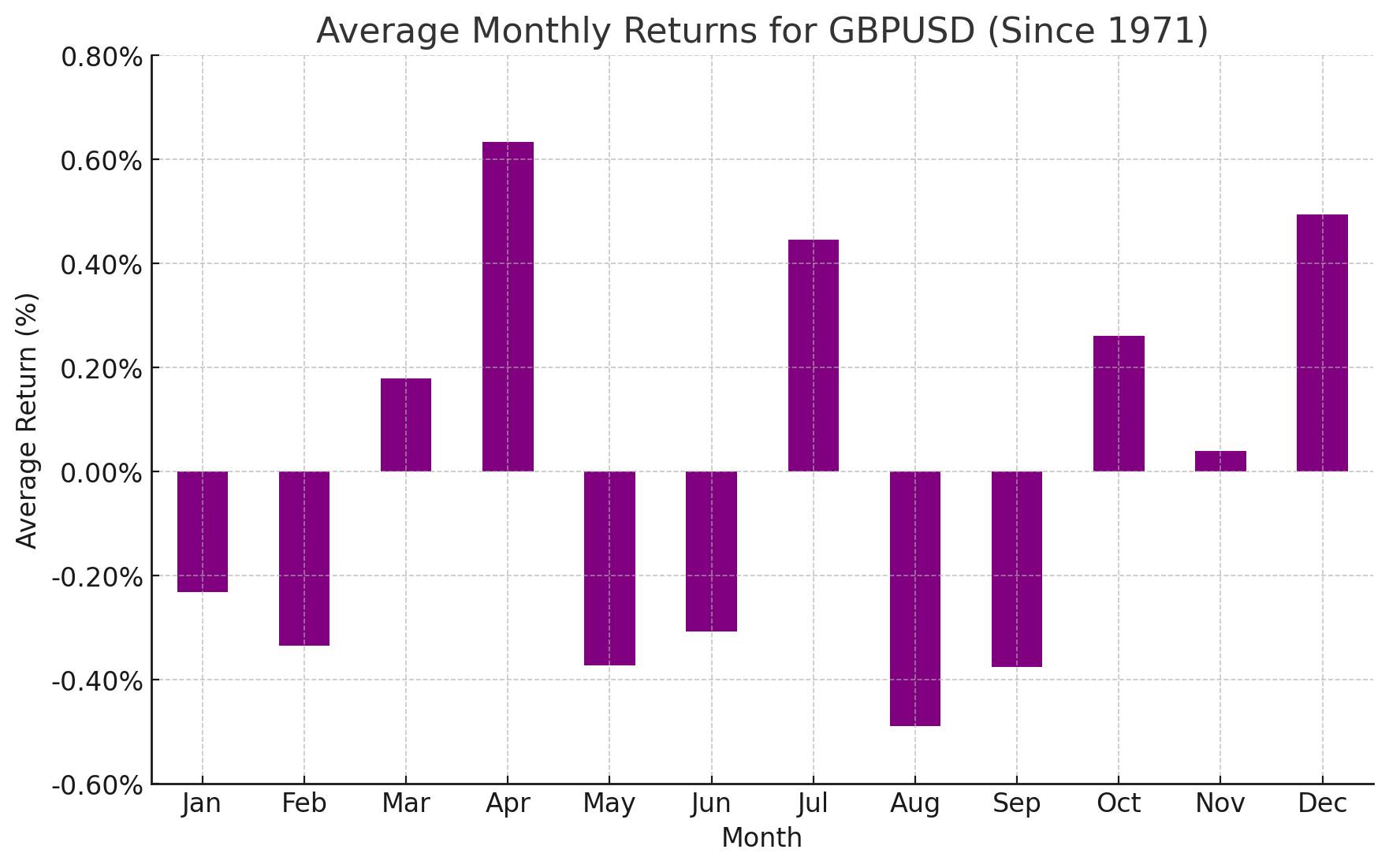
          British Pound Forex Seasonality – GBP/USD Chart

          Source: TradingView, StoneX. Please note that past performance is not necessarily indicative of future results.

          Looking at the above chart, GBP/USD has historically seen strength in July, with average returns of around +0.45% since 1971. Like the euro, the British pound traded higher in June to reach multi-month highs amidst broad-based US dollar weakness. After a run of five straight “up” months, it may be more difficult for bulls to build on this year’s gains through the summer without a near-term pullback or consolidation first.

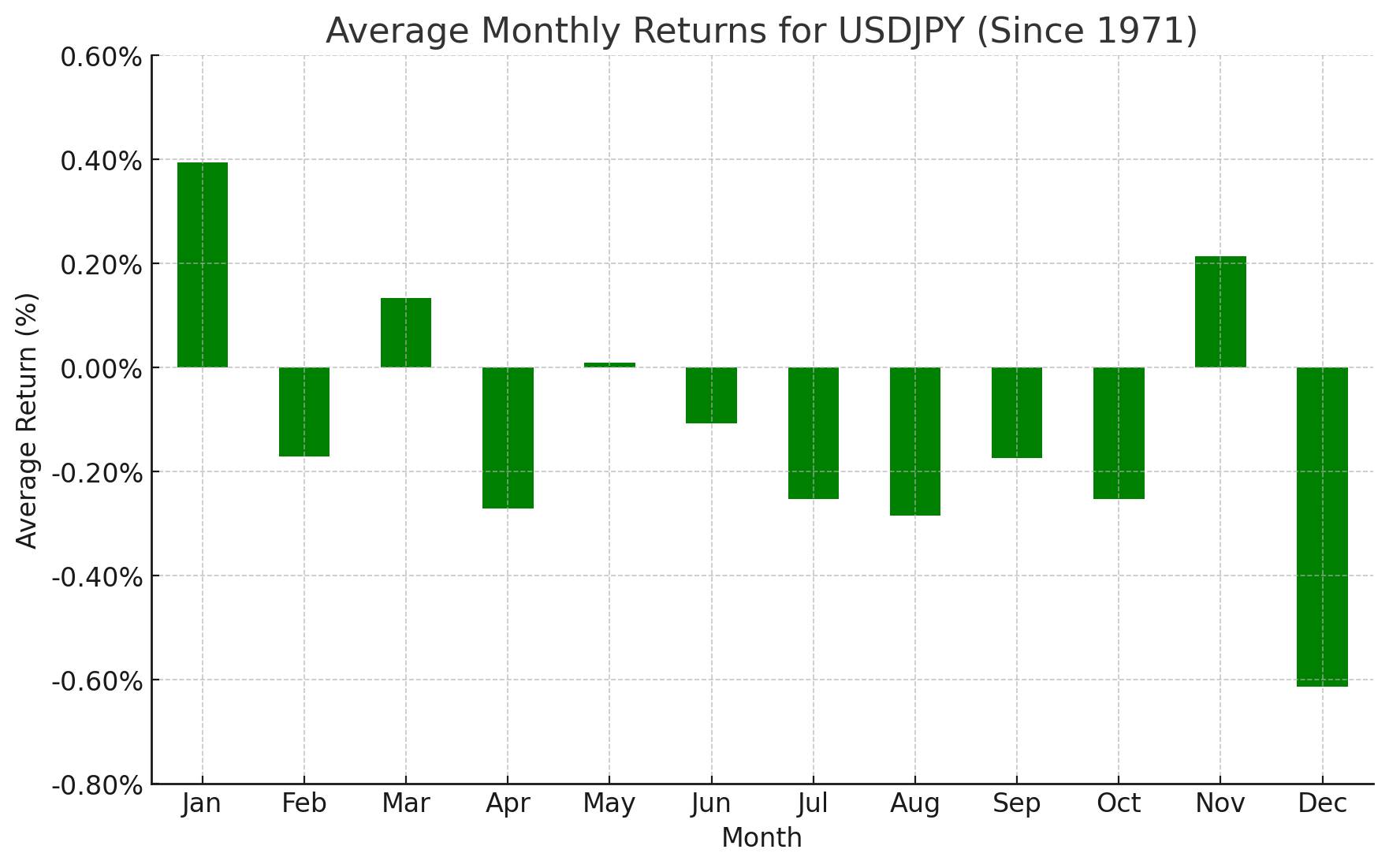
          Japanese Yen Forex Seasonality – USD/JPY Chart

          Source: TradingView, StoneX. Please note that past performance is not necessarily indicative of future results.

          July has historically been a modestly bearish month for USD/JPY, with the pair falling by an average of -0.25% since the Bretton Woods agreement. In line with its long-term seasonal trend, USD/JPY saw relatively quiet trade in June amidst a lack of clear progress in trade negotiations between the US and Japan. Traders will be watching the 2-year lows at 1.3950 for a potential breakdown if the seasonal trend asserts itself again this month.

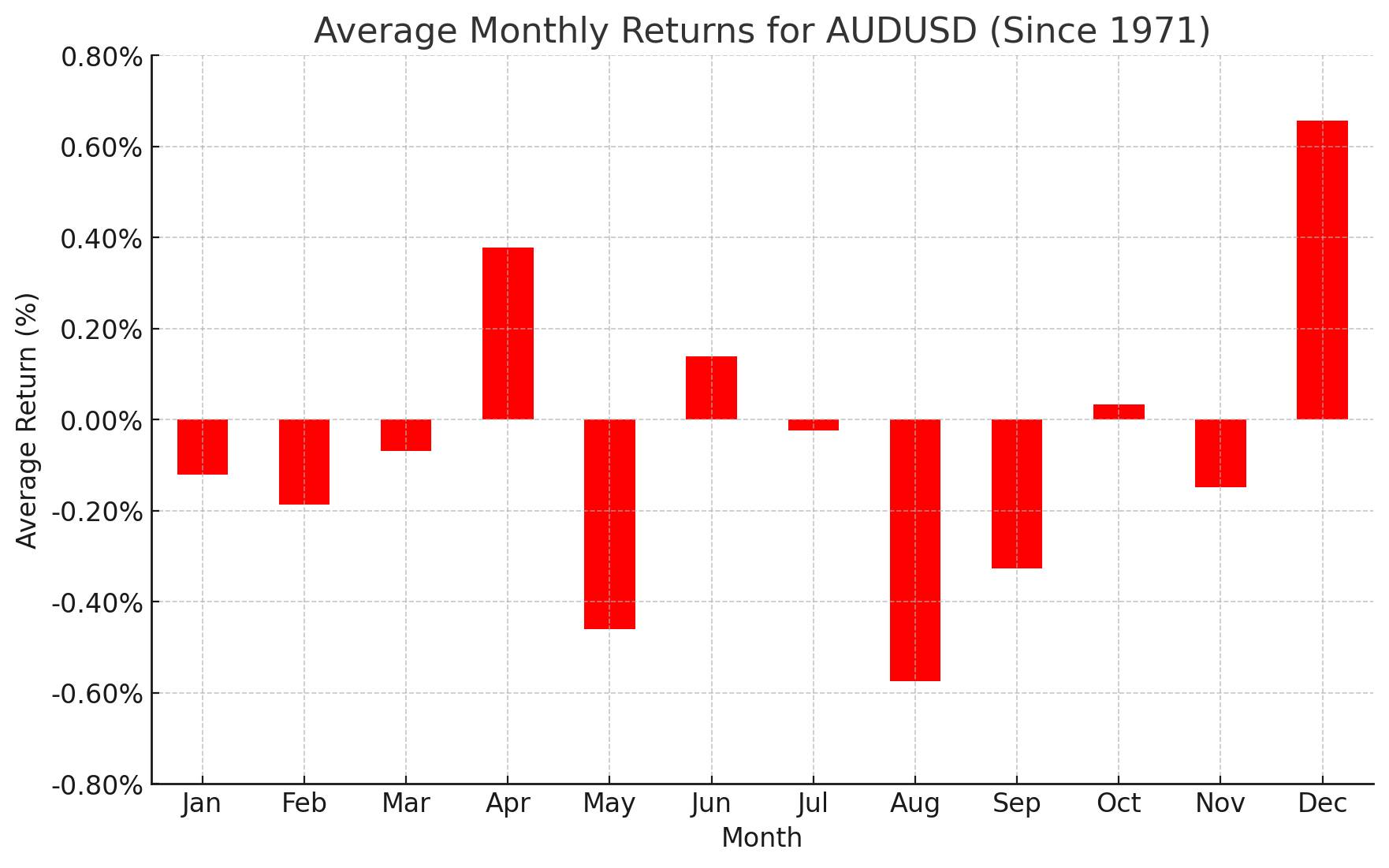
          Australian Dollar Forex Seasonality – AUD/USD Chart

          Source: TradingView, StoneX. Please note that past performance is not necessarily indicative of future results.

          Turning our attention Down Under, AUD/USD has historically seen quiet price action in July, with an average move of -0.2% going back to 1971. Last month, AUD/USD rallied more than 2%, following its bullish seasonal trend to break above the 61.8% Fibonacci retracement of the September 2024 to April 2025 drop at 0.6550. Following four straight positive months, a consolidation in line with the seasonal trend this month would not be surprising.

          Canadian Dollar Forex Seasonality – USD/CAD Chart

          Source: TradingView, StoneX. Please note that past performance is not necessarily indicative of future results.

          Last but not least, July has been a modestly positive month for USD/CAD, with an average historical return of +0.09%. The US dollar fell against its Northern rival last month, and bulls are starting to warily eye the 1.5-year low at 1.3425 as a key support level that needs to hold to keep any semblance of optimism intact.

          As always, we want to close this article by reminding readers that seasonal tendencies are not gospel – even if they’ve tracked relatively closely so far this year–so it’s important to complement this analysis with an examination of the current fundamental and technical backdrops for the major currency pairs.

          Source: Investing

          To stay updated on all economic events of today, please check out our Economic calendar
          Risk Warnings and Disclaimers
          You understand and acknowledge that there is a high degree of risk involved in trading. Following any strategies or investment methods may lead to potential losses. The content on the site is provided by our contributors and analysts for information purposes only. You are solely responsible for determining whether any trading assets, securities, strategy, or any other product is suitable for investing based on your own investment objectives and financial situation.
          Add to Favorites
          Share

          Gold Steadies Near $3,330 as Traders Weigh US Jobs Data and Tax Bill Impact

          Gerik

          Economic

          Commodity

          Gold Holds Gains as Fiscal Concerns and Fed Outlook Dominate Market Focus

          Gold remained steady near $3,330 per ounce on Wednesday, consolidating its recent 2% gain across the previous two sessions. The stability in prices reflects investor hesitation as they await two key developments in the US: the June jobs report and the House decision on President Donald Trump’s expansive tax reform package.
          The Senate approved the tax bill on Tuesday, which is projected to increase the federal deficit by $3.3 trillion over the next ten years. If passed by the House, the legislation may enhance gold’s attractiveness as a hedge against fiscal deterioration, with a larger deficit potentially weakening long-term confidence in US debt markets.

          All Eyes on Labor Data as Fed Rate Cuts Hang in Balance

          Investor attention is also centered on the upcoming June employment report, due Thursday. The report is expected to show a deceleration in job creation and a slight rise in unemployment. These indicators could revive expectations for interest rate cuts by the Federal Reserve, especially if they contrast with the stronger-than-anticipated job openings figure released on Tuesday, which had briefly cooled rate cut hopes.
          Gold, which does not yield interest, tends to benefit in environments of declining interest rates, as the opportunity cost of holding the metal diminishes. The upcoming jobs data thus holds critical implications for the Fed’s trajectory and, by extension, for bullion prices.

          Geopolitical Risks and Central Bank Demand Provide a Supportive Backdrop

          Beyond macroeconomic indicators, gold continues to draw strength from sustained geopolitical risks and strong institutional demand. Since the beginning of 2025, gold has risen more than 25%, driven by concerns over global trade tensions, unpredictable tariff policy from Washington, and ongoing regional conflicts. These factors have underpinned demand for safe-haven assets.
          Additionally, consistent central bank purchases and increasing inflows into gold-backed ETFs have provided a structural base for price support. Despite recent volatility, gold remains just $170 shy of its all-time high set in April, indicating resilient bullish sentiment.

          Market Sentiment Mixed Amid Broader Economic Stability

          Although President Trump has indicated he will not postpone the July 9 deadline for new tariffs, market reactions have been more subdued than in previous trade standoffs. This suggests a shifting investor calculus, where solid macroeconomic fundamentals in the US are beginning to offset fears of sudden policy shocks.
          The Bloomberg Dollar Spot Index rose 0.1% on the day, though it remains down 0.5% for the week. A softer dollar generally supports gold by making it cheaper for overseas buyers. Other precious metals showed limited movement, with silver and platinum remaining flat, while palladium saw modest gains.
          Gold’s performance near $3,330 reflects a cautious optimism as investors await near-term signals from Washington and the labor market. While macro uncertainty continues to support the metal’s long-term case, traders are now positioning for clarity on the Fed’s policy direction and the fiscal implications of the US tax bill. If Thursday’s data aligns with cooling labor trends and fiscal risks escalate, gold could find renewed upward momentum toward retesting its April highs.

          Source: Bloomberg

          To stay updated on all economic events of today, please check out our Economic calendar
          Risk Warnings and Disclaimers
          You understand and acknowledge that there is a high degree of risk involved in trading. Following any strategies or investment methods may lead to potential losses. The content on the site is provided by our contributors and analysts for information purposes only. You are solely responsible for determining whether any trading assets, securities, strategy, or any other product is suitable for investing based on your own investment objectives and financial situation.
          Add to Favorites
          Share

          Renewed Feud Between Musk And Trump Drags Tesla (TSLA) Share Price Lower

          FXOpen

          Economic

          Stocks

          The US Senate yesterday narrowly approved Trump’s so-called “big, beautiful budget bill.”

          Elon Musk, who had previously criticised the bill for potentially adding $3.3 trillion to the national debt, warned that Republican lawmakers who supported it would face political consequences. In a post on X, Musk wrote:“Every member of Congress who campaigned on reducing government spending and then immediately voted for the biggest debt increase in history should hang their head in shame! And they will lose their primary next year if it is the last thing I do on this Earth.”

          He also reiterated his intention to establish a third political force under the name “America Party.”

          In response, President Trump issued sharp threats:

          → to apply federal pressure on Musk’s companies by revisiting existing subsidies and government contracts (estimated by The Washington Post at $38 billion);

          → to deport Musk back to South Africa.

          The market responded immediately to this renewed escalation in the Trump–Musk conflict. Tesla (TSLA) shares fell by over 5% yesterday, forming a significant bearish gap.

          Technical Analysis of TSLA Stock Chart

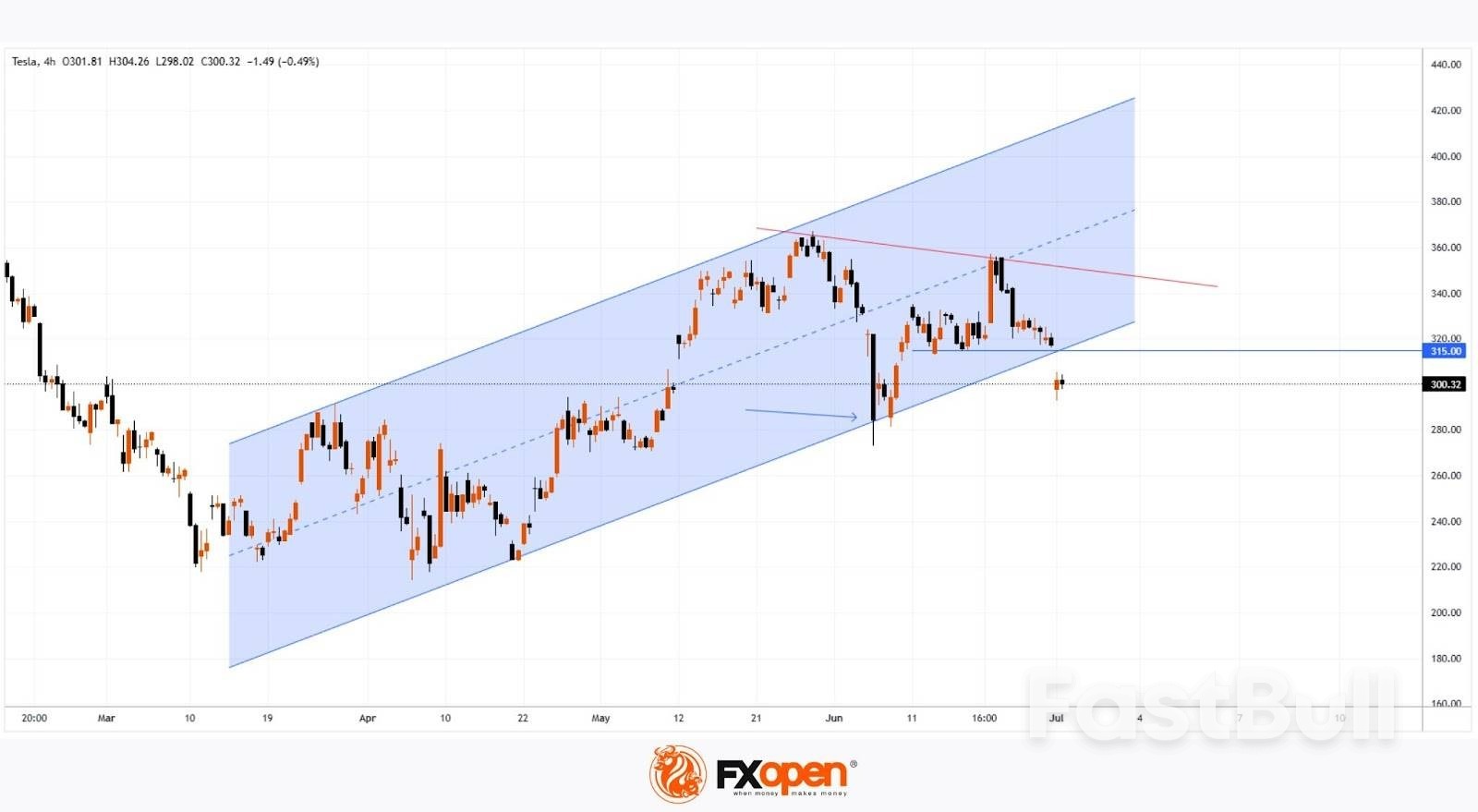
          Eight days ago, we analysed the TSLA price chart, continuing to observe price action within the context of an ascending channel (indicated in blue). At that point:

          → In mid-June, when the initial Musk–Trump tensions surfaced, TSLA managed to hold within the channel. However, as of yesterday, the price broke below the lower boundary, casting doubt on the sustainability of the uptrend that had been in place since March–April;

          → The price breached the lower channel limit near the $315 level — a zone that previously acted as support. This suggests that $315 may now serve as a resistance level.

          As a result, optimism related to the late-June launch of Tesla’s robotaxi initiative has been eclipsed by concerns that the Musk–Trump confrontation may have broader implications.

          If the former allies refrain from further escalation, TSLA may consolidate into a broadening contracting triangle (its upper boundary marked in red) in the near term, ahead of Tesla’s Q2 earnings release scheduled for 29 July.

          Source: FXOpen

          To stay updated on all economic events of today, please check out our Economic calendar
          Risk Warnings and Disclaimers
          You understand and acknowledge that there is a high degree of risk involved in trading. Following any strategies or investment methods may lead to potential losses. The content on the site is provided by our contributors and analysts for information purposes only. You are solely responsible for determining whether any trading assets, securities, strategy, or any other product is suitable for investing based on your own investment objectives and financial situation.
          Add to Favorites
          Share

          Vietnam Activates International Financial Center: A Strategic Inflection Point for Domestic Fintechs

          Gerik

          Economic

          From Financial Hub to Innovation Ecosystem: Redefining the International Financial Center Model

          In the digital era, International Financial Centers (IFSCs) are evolving beyond their traditional role as capital aggregators. They now function as innovation ecosystems tightly interwoven with financial technology (fintech). According to the Bank for International Settlements (BIS), fintech has the potential to revolutionize the delivery of financial services, foster new business models, and promote sustainable financial ecosystems.
          In Asia, countries like Singapore, Hong Kong (China), and Shanghai have already positioned their IFSCs as fintech accelerators. Singapore’s Monetary Authority (MAS), for instance, introduced a FinTech Regulatory Sandbox in 2016—later upgraded to Sandbox Plus—to fast-track regulatory approval and financial support for innovation. Simultaneously, the city-state has invested in open banking, financial data infrastructure, and capital access, placing fintech at the heart of its digital economy strategy.
          Hong Kong, meanwhile, attracted significant foreign investment by licensing digital banks such as WeLab, ZA Bank, and Mox Bank, embedding fintech into its modern financial architecture. Shanghai’s roadmap to becoming an IFSC by 2035 includes leveraging green finance and blockchain technology, aiming to make fintech a direct contributor to national financial objectives.

          Vietnam's Fintech Moment: A Policy Breakthrough with Strategic Ambition

          Vietnam has entered the fintech race with renewed determination. On June 27, 2025, the National Assembly passed a resolution to establish an International Financial Center, effective from September 1, 2025. The resolution outlines preferential policies, including a regulatory sandbox for fintech innovation, designed to test and validate emerging financial services under controlled conditions.
          With a GDP ranked among the world’s top 32, Vietnam’s ambition is not merely to catch up but to assert a position on the regional financial map. The sandbox mechanism will serve as both an incubator and a filter, allowing qualified fintechs to experiment with services such as micro-lending, digital insurance, and asset tokenization before commercial launch.
          Vice Governor of the State Bank of Vietnam, Phạm Tiến Dũng, emphasized that Vietnam’s fintech regulations are gradually maturing. He views the new financial center not only as a magnet for foreign capital but also as a stress test for the local financial ecosystem’s capacity for innovation and resilience.

          Emerging Players and Early Momentum in Vietnam's Fintech Sector

          Companies such as Viettel Money, Timo, and VnPay have already gained strong footholds by offering comprehensive digital financial services and building robust user bases. These firms are expected to be early participants in the sandbox environment after July 1, positioning themselves to refine and scale their products regionally. The shift from legacy systems to agile, tech-driven financial platforms will likely accelerate with regulatory support and investment incentives provided through the new IFSC.
          The potential for these fintechs to lead Vietnam’s digital finance sector lies in their ability to balance innovation with compliance. Data privacy, risk governance, and cross-border regulatory alignment will be critical metrics as they seek to attract funding and form international partnerships.

          Lessons from Asia’s Leading Financial Centers

          Singapore, Hong Kong, and Shanghai demonstrate that fintech success requires more than favorable market conditions. Institutional strength, flexible yet robust policy frameworks, and strategic foresight are equally important. For Vietnam, establishing an IFSC will require coordinated efforts among government agencies, financial regulators, and private-sector stakeholders.
          Access to global capital, exposure to advanced technologies, and the transfer of international financial expertise will offer Vietnamese fintechs a chance to integrate into high-value regional financial networks. However, this also exposes them to increased scrutiny and competition, particularly in areas such as cybersecurity standards, transaction transparency, and capital adequacy.

          Fintech Vietnam at a Strategic Crossroads

          Vietnam’s new IFSC initiative marks a pivotal moment for the country’s fintech sector. It is both a platform for innovation and a testing ground for global integration. While regulatory sandboxes offer a low-risk space for trial, the broader challenge lies in building institutional capabilities that align with international financial norms.
          Success will depend not only on regulatory support but also on the fintech community’s preparedness to scale, comply, and compete. If Vietnamese firms can meet these demands, they will not only help elevate the country’s financial status but also contribute meaningfully to the transformation of Asia’s digital economy. The coming years will determine whether Vietnam can move from ambition to realization and secure its place among the region’s emerging financial powers.
          To stay updated on all economic events of today, please check out our Economic calendar
          Risk Warnings and Disclaimers
          You understand and acknowledge that there is a high degree of risk involved in trading. Following any strategies or investment methods may lead to potential losses. The content on the site is provided by our contributors and analysts for information purposes only. You are solely responsible for determining whether any trading assets, securities, strategy, or any other product is suitable for investing based on your own investment objectives and financial situation.
          Add to Favorites
          Share

          South Korea's Inflation Hits Five-Month High as Central Bank Maintains Dovish Outlook

          Gerik

          Economic

          Inflation Rises but Remains Within Policy Comfort Zone

          In June, South Korea's consumer price index (CPI) increased by 2.2% year-on-year, according to data from the national statistics agency. This is the highest rate since January and exceeds the 1.9% increase recorded in May, as well as the 2.1% forecast by economists surveyed by The Wall Street Journal. Despite this uptick, the figure remains within the Bank of Korea’s (BoK) 2% inflation target range, which strengthens the case for maintaining its current dovish policy stance.
          On a monthly basis, consumer prices remained flat in June, aligning with market expectations. This follows a 0.1% decrease in May compared to April, showing stability in short-term price movement.

          Core Inflation and Sectoral Price Movements

          Core inflation, which excludes volatile food and energy prices, rose by 2.0% year-on-year and inched up by 0.1% from the previous month. The breakdown of the CPI basket shows a divergence in price trends: processed food prices rose, while gasoline and agricultural product prices fell. These offsetting trends helped moderate overall inflation despite sectoral shifts.
          The relatively muted impact of global energy prices, likely due to easing tensions in the Middle East, has also contributed to the restrained inflation environment, according to market analysts. This correlation between geopolitical stability and fuel price movements appears to have softened headline inflation pressure in the short term.

          Weak Growth Outlook Underpins Continued Monetary Easing

          In May, the Bank of Korea lowered its 2025 GDP growth forecast and cut the benchmark interest rate by 25 basis points to 2.50%, aiming to cushion the economy from slowing momentum. The central bank now projects just 0.8% growth in 2025, down from a 1.5% forecast in February and significantly below the 2.0% expansion recorded in 2024.
          This weakening outlook reinforces expectations that BoK will maintain or further ease its monetary policy in the coming months. Analysts believe that with inflation hovering around the target and economic growth faltering, the policy environment remains supportive of additional rate cuts.

          Caution Remains Amid Strength in Exports and Housing

          Despite the overall case for continued easing, there are areas of economic resilience that may temper the speed of interest rate cuts. Semiconductor exports rebounded in June, providing a key boost to South Korea’s trade figures even in the face of heightened global tariffs, particularly from the United States. Moreover, the housing market in Seoul is heating up more than expected, introducing potential risks of asset bubbles.
          These developments suggest a nuanced policy landscape. While inflation and growth metrics broadly support dovish policy, the central bank may need to proceed more cautiously if export performance and housing demand remain robust.
          June’s inflation data confirms a modest acceleration in prices but still within a range that allows the central bank to focus on supporting the broader economy. With weak domestic growth prospects and inflation near the policy target, the BoK is expected to continue its accommodative stance. However, it must balance this approach against pockets of economic strength and sector-specific overheating risks, particularly in real estate and tech exports. The path ahead will likely involve gradual adjustments rather than aggressive easing, shaped by both domestic dynamics and external pressures.

          Source: Reuters

          To stay updated on all economic events of today, please check out our Economic calendar
          Risk Warnings and Disclaimers
          You understand and acknowledge that there is a high degree of risk involved in trading. Following any strategies or investment methods may lead to potential losses. The content on the site is provided by our contributors and analysts for information purposes only. You are solely responsible for determining whether any trading assets, securities, strategy, or any other product is suitable for investing based on your own investment objectives and financial situation.
          Add to Favorites
          Share

          Trump’s 35% Tariff Threat Feeds Japan’s Worst-Case Scenario Fear

          Michelle

          Economic

          Forex

          US President Donald Trump threatened Japan with tariffs of up to 35% as he ramped up tensions for a third straight day, fueling fears of a worst-case scenario among market players and raising doubts over Tokyo’s tactics in trade talks.

          Japan should be forced to “pay 30%, 35% or whatever the number is that we determine, because we also have a very big trade deficit with Japan,” Trump said, again flagging the possibility that across-the-board tariffs could go much higher than the 24% initially penciled in for July 9. “I’m not sure we’re going to make a deal. I doubt it with Japan, they’re very tough. You have to understand, they’re very spoiled.”

          Market participants and analysts warned against taking Trump’s comments at face value and suggested that some kind of deal will eventually get done. But they also warned that Prime Minister Shigeru Ishiba’s government may need to change tack from a friendly and firm stance that is now leading the two sides to brinkmanship.

          “The ball is in Japan’s court now, and if Tokyo hesitates, it’s all over,” said Chihiro Ota, senior strategist at SMBC Nikko Securities. “If Japan doesn’t properly respond to Trump’s call to the table, he’ll only get more hostile. Ishiba should get on the phone with him right away.”

          Trump’s latest threat fits in with a high-pressure deal-making strategy that sometimes results in big last-minute concessions on both sides, as seen with China, but market players still need to game out how to position themselves should talks founder.

          While few analysts see Japan’s stocks collapsing on a no-deal scenario, some of them forecast the Nikkei 225 to fall into the 38,000 range, a decline of more than 4%, rather than rallying above 40,000 if there’s an agreement.

          The Nikkei 225 was down 1% at 39,593 at the end of the morning session Wednesday while the yen was trading at 143.57 against the dollar, up around 0.1%.

          Japan has so far stood firm in negotiations over across-the-board reciprocal tariffs, insisting that they be removed along with additional sectoral tariffs on autos, steel and aluminum. The car duties are particularly painful for Japan as the industry contributes the equivalent of almost 10% of gross domestic product and employs around 8% of the workforce.

          Tokyo has insisted that a “win-win” deal must encompass all the tariffs in one go with Ishiba preferring no deal to a bad deal ahead of a July 20 upper house election. The prime minister on Wednesday reiterated his view that focusing on jobs and investment in the US was the way forward, just like it was for Nippon Steel as it patiently sought to change Trump’s view and take over US Steel.

          But as July 9 gets closer, some observers say more needs to be done.

          “We have to work on Trump himself, to first try to avoid the tariffs to be imposed from July 9,” said Ichiro Fujisaki, former Japanese ambassador to the US, adding that the president’s remarks show that Tokyo hasn’t brought enough to the table yet.

          “We don’t have something like rare earths but the US is dependent on Japanese industry as well. About half of materials for making semiconductors come from Japanese industry,” Fujisaki said, pointing to a possible area of leverage, too.

          In the meantime, market players are evaluating the potential scale of the fallout.

          “There is a lot more risk of things falling apart than is being priced in by the market,” said Zuhair Khan, a fund manager at UBP Investments. “There is always the risk of a policy blunder by either side.”

          He points to the 32,000 Nikkei level on the day Trump first announced the reciprocal tariffs. “If the probability of a no deal is 25% then the Nikkei should be at 38,000.”

          The point of imposing a deadline in negotiations is to create an opportunity for leverage, so it’s not surprising to see Trump pushing high tariffs as a threat to push for better deals as the date approaches, said Phillip Wool, head of portfolio management at Rayliant Global Advisors Ltd.

          “There’s also an element of political theater here, as Trump’s narrative to American voters is that the US has been bullied on trade for so long, and there’s clearly a desire to look ‘tough’ on trade,” Wool said. “But there has to be a face-saving deal at some point so that it looks like the negotiation was truly a success as opposed to the mutually assured destruction of impasse and perpetually high tariffs.”

          Like some other market players, he is wary of an overly pessimistic knee-jerk response to each remark Trump makes. If there is a big selloff in a worst-case scenario, Wool sees it as a great buying opportunity for long-term, active investors.

          Strategists are split on how a bad scenario might play out for the yen. While some such as SBI Liquidity Market Co.’s Marito Ueda see the possibility of risk aversion sparking a strengthening of Japan’s currency to the 138 range against the dollar, others see a weakening as more likely.

          A stalemate in trade talks would likely delay the Bank of Japan’s next interest rate hike, especially if it led to tariffs of up to 35% in the meantime, said Akira Moroga, chief market strategist at Aozora Bank. Still, movement would slow after the 145 mark, making a push past 147 difficult, he said.

          Still, the consensus is that a deal will be reached sooner or later, and that Japan will have to concede more ground to achieve it.

          “If it’s concluded I don’t think it’s going to be a win-win situation,” said Fujisaki. “Maybe a capital-letter ‘WIN’ for US, but a small letter ‘win’ for Japan.”

          Source: Bloomberg Europe

          To stay updated on all economic events of today, please check out our Economic calendar
          Risk Warnings and Disclaimers
          You understand and acknowledge that there is a high degree of risk involved in trading. Following any strategies or investment methods may lead to potential losses. The content on the site is provided by our contributors and analysts for information purposes only. You are solely responsible for determining whether any trading assets, securities, strategy, or any other product is suitable for investing based on your own investment objectives and financial situation.
          Add to Favorites
          Share
          FastBull
          Copyright © 2025 FastBull Ltd

          728 RM B 7/F GEE LOK IND BLDG NO 34 HUNG TO RD KWUN TONG KLN HONG KONG

          TelegramInstagramTwitterfacebooklinkedin
          App Store Google Play Google Play
          Products
          Charts

          Chats

          Q&A with Experts
          Screeners
          Economic Calendar
          Data
          Tools
          Membership
          Features
          Function
          Markets
          Copy Trading
          Latest Signals
          Contests
          News
          Analysis
          24/7
          Columns
          Education
          Company
          Careers
          About Us
          Contact Us
          Advertising
          Help Center
          Feedback
          User Agreement
          Privacy Policy
          Business

          White Label

          Data API

          Web Plug-ins

          Poster Maker

          Affiliate Program

          Risk Disclosure

          The risk of loss in trading financial instruments such as stocks, FX, commodities, futures, bonds, ETFs and crypto can be substantial. You may sustain a total loss of the funds that you deposit with your broker. Therefore, you should carefully consider whether such trading is suitable for you in light of your circumstances and financial resources.

          No decision to invest should be made without thoroughly conducting due diligence by yourself or consulting with your financial advisors. Our web content might not suit you since we don't know your financial conditions and investment needs. Our financial information might have latency or contain inaccuracy, so you should be fully responsible for any of your trading and investment decisions. The company will not be responsible for your capital loss.

          Without getting permission from the website, you are not allowed to copy the website's graphics, texts, or trademarks. Intellectual property rights in the content or data incorporated into this website belong to its providers and exchange merchants.

          Not Logged In

          Log in to access more features

          FastBull Membership

          Not yet

          Purchase

          Become a signal provider
          Help Center
          Customer Service
          Dark Mode
          Price Up/Down Colors

          Log In

          Sign Up

          Position
          Layout
          Fullscreen
          Default to Chart
          The chart page opens by default when you visit fastbull.com