• Trade
  • Markets
  • Copy
  • Contests
  • News
  • 24/7
  • Calendar
  • Q&A
  • Chats
Trending
Screeners
SYMBOL
LAST
BID
ASK
HIGH
LOW
NET CHG.
%CHG.
SPREAD
SPX
S&P 500 Index
6827.42
6827.42
6827.42
6899.86
6801.80
-73.58
-1.07%
--
DJI
Dow Jones Industrial Average
48458.04
48458.04
48458.04
48886.86
48334.10
-245.98
-0.51%
--
IXIC
NASDAQ Composite Index
23195.16
23195.16
23195.16
23554.89
23094.51
-398.69
-1.69%
--
USDX
US Dollar Index
97.950
98.030
97.950
98.500
97.950
-0.370
-0.38%
--
EURUSD
Euro / US Dollar
1.17394
1.17409
1.17394
1.17496
1.17192
+0.00011
+ 0.01%
--
GBPUSD
Pound Sterling / US Dollar
1.33707
1.33732
1.33707
1.33997
1.33419
-0.00148
-0.11%
--
XAUUSD
Gold / US Dollar
4299.39
4299.39
4299.39
4353.41
4257.10
+20.10
+ 0.47%
--
WTI
Light Sweet Crude Oil
57.233
57.485
57.233
58.011
56.969
-0.408
-0.71%
--

Community Accounts

Signal Accounts
--
Profit Accounts
--
Loss Accounts
--
View More

Become a signal provider

Sell trading signals to earn additional income

View More

Guide to Copy Trading

Get started with ease and confidence

View More

Signal Accounts for Members

All Signal Accounts

Best Return
  • Best Return
  • Best P/L
  • Best MDD
Past 1W
  • Past 1W
  • Past 1M
  • Past 1Y

All Contests

  • All
  • Trump Updates
  • Recommend
  • Stocks
  • Cryptocurrencies
  • Central Banks
  • Featured News
Top News Only
Share

Ukraine Says It Received 114 Prisoners From Belarus

Share

USA Embassy In Lithuania: Maria Kalesnikava Is Not Going To Vilnius

Share

USA Embassy In Lithuania: Other Prisoners Are Being Sent From Belarus To Ukraine

Share

Ukraine President Zelenskiy: Five Ukrainians Released By Belarus In US-Brokered Deal

Share

USA Vilnius Embassy: USA Stands Ready For "Additional Engagement With Belarus That Advances USA Interests"

Share

USA Vilnius Embassy: Belarus, USA, Other Citizens Among The Prisoners Released Into Lithuania

Share

USA Vilnius Embassy: USA Will Continue Diplomatic Efforts To Free The Remaining Political Prisoners In Belarus

Share

USA Vilnius Embassy: Belarus Releases 123 Prisoners Following Meeting Of President Trump's Envoy Coale And Belarus President Lukashenko

Share

USA Vilnius Embassy: Masatoshi Nakanishi, Aliaksandr Syrytsa Are Among The Prisoners Released By Belarus

Share

USA Vilnius Embassy: Maria Kalesnikava And Viktor Babaryka Are Among The Prisoners Released By Belarus

Share

USA Vilnius Embassy: Nobel Peace Prize Laureate Ales Bialiatski Is Among The Prisoners Released By Belarus

Share

Belarusian Presidential Administration Telegram Channel: Lukashenko Has Pardoned 123 Prisoners As Part Of Deal With US

Share

Two Local Syrian Officials: Joint US-Syrian Military Patrol In Central Syria Came Under Fire From Unknown Assailants

Share

Israeli Military Says It Targeted 'Key Hamas Terrorist' In Gaza City

Share

Rwanda's Actions In Eastern Drc Are A Clear Violation Of Washington Accords Signed By President Trump - Secretary Of State Rubio

Share

Israeli Military Issues Evacuation Warning In Southern Lebanon Village Ahead Of Strike - Spokesperson On X

Share

Belarusian State Media Cites US Envoy Coale As Saying He Discussed Ukraine And Venezuela With Lukashenko

Share

Belarusian State Media Cites US Envoy Coale As Saying That US Removes Sanctions On Belarusian Potassium

Share

Thai Prime Minister: No Ceasefire Agreement With Cambodia

Share

US, Ukraine To Discuss Ceasefire In Berlin Ahead Of European Summit

TIME
ACT
FCST
PREV
U.K. Trade Balance Non-EU (SA) (Oct)

A:--

F: --

P: --

U.K. Trade Balance (Oct)

A:--

F: --

P: --

U.K. Services Index MoM

A:--

F: --

P: --

U.K. Construction Output MoM (SA) (Oct)

A:--

F: --

P: --

U.K. Industrial Output YoY (Oct)

A:--

F: --

P: --

U.K. Trade Balance (SA) (Oct)

A:--

F: --

P: --

U.K. Trade Balance EU (SA) (Oct)

A:--

F: --

P: --

U.K. Manufacturing Output YoY (Oct)

A:--

F: --

P: --

U.K. GDP MoM (Oct)

A:--

F: --

P: --

U.K. GDP YoY (SA) (Oct)

A:--

F: --

P: --

U.K. Industrial Output MoM (Oct)

A:--

F: --

P: --

U.K. Construction Output YoY (Oct)

A:--

F: --

P: --

France HICP Final MoM (Nov)

A:--

F: --

P: --

China, Mainland Outstanding Loans Growth YoY (Nov)

A:--

F: --

P: --

China, Mainland M2 Money Supply YoY (Nov)

A:--

F: --

P: --

China, Mainland M0 Money Supply YoY (Nov)

A:--

F: --

P: --

China, Mainland M1 Money Supply YoY (Nov)

A:--

F: --

P: --

India CPI YoY (Nov)

A:--

F: --

P: --

India Deposit Gowth YoY

A:--

F: --

P: --

Brazil Services Growth YoY (Oct)

A:--

F: --

P: --

Mexico Industrial Output YoY (Oct)

A:--

F: --

P: --

Russia Trade Balance (Oct)

A:--

F: --

P: --

Philadelphia Fed President Henry Paulson delivers a speech
Canada Building Permits MoM (SA) (Oct)

A:--

F: --

P: --

Canada Wholesale Sales YoY (Oct)

A:--

F: --

P: --

Canada Wholesale Inventory MoM (Oct)

A:--

F: --

P: --

Canada Wholesale Inventory YoY (Oct)

A:--

F: --

P: --

Canada Wholesale Sales MoM (SA) (Oct)

A:--

F: --

P: --

Germany Current Account (Not SA) (Oct)

A:--

F: --

P: --

U.S. Weekly Total Rig Count

A:--

F: --

P: --

U.S. Weekly Total Oil Rig Count

A:--

F: --

P: --

Japan Tankan Large Non-Manufacturing Diffusion Index (Q4)

--

F: --

P: --

Japan Tankan Small Manufacturing Outlook Index (Q4)

--

F: --

P: --

Japan Tankan Large Non-Manufacturing Outlook Index (Q4)

--

F: --

P: --

Japan Tankan Large Manufacturing Outlook Index (Q4)

--

F: --

P: --

Japan Tankan Small Manufacturing Diffusion Index (Q4)

--

F: --

P: --

Japan Tankan Large Manufacturing Diffusion Index (Q4)

--

F: --

P: --

Japan Tankan Large-Enterprise Capital Expenditure YoY (Q4)

--

F: --

P: --

U.K. Rightmove House Price Index YoY (Dec)

--

F: --

P: --

China, Mainland Industrial Output YoY (YTD) (Nov)

--

F: --

P: --

China, Mainland Urban Area Unemployment Rate (Nov)

--

F: --

P: --

Saudi Arabia CPI YoY (Nov)

--

F: --

P: --

Euro Zone Industrial Output YoY (Oct)

--

F: --

P: --

Euro Zone Industrial Output MoM (Oct)

--

F: --

P: --

Canada Existing Home Sales MoM (Nov)

--

F: --

P: --

Euro Zone Total Reserve Assets (Nov)

--

F: --

P: --

U.K. Inflation Rate Expectations

--

F: --

P: --

Canada National Economic Confidence Index

--

F: --

P: --

Canada New Housing Starts (Nov)

--

F: --

P: --

U.S. NY Fed Manufacturing Employment Index (Dec)

--

F: --

P: --

U.S. NY Fed Manufacturing Index (Dec)

--

F: --

P: --

Canada Core CPI YoY (Nov)

--

F: --

P: --

Canada Manufacturing Unfilled Orders MoM (Oct)

--

F: --

P: --

Canada Manufacturing New Orders MoM (Oct)

--

F: --

P: --

Canada Core CPI MoM (Nov)

--

F: --

P: --

Canada Manufacturing Inventory MoM (Oct)

--

F: --

P: --

Canada CPI YoY (Nov)

--

F: --

P: --

Canada CPI MoM (Nov)

--

F: --

P: --

Canada CPI YoY (SA) (Nov)

--

F: --

P: --

Canada Core CPI MoM (SA) (Nov)

--

F: --

P: --

Q&A with Experts
    • All
    • Chatrooms
    • Groups
    • Friends
    Connecting
    .
    .
    .
    Type here...
    Add Symbol or Code

      No matching data

      All
      Trump Updates
      Recommend
      Stocks
      Cryptocurrencies
      Central Banks
      Featured News
      • All
      • Russia-Ukraine Conflict
      • Middle East Flashpoint
      • All
      • Russia-Ukraine Conflict
      • Middle East Flashpoint
      Search
      Products

      Charts Free Forever

      Chats Q&A with Experts
      Screeners Economic Calendar Data Tools
      Membership Features
      Data Warehouse Market Trends Institutional Data Policy Rates Macro

      Market Trends

      Market Sentiment Order Book Forex Correlations

      Top Indicators

      Charts Free Forever
      Markets

      News

      News Analysis 24/7 Columns Education
      From Institutions From Analysts
      Topics Columnists

      Latest Views

      Latest Views

      Trending Topics

      Top Columnists

      Latest Update

      Signals

      Copy Rankings Latest Signals Become a signal provider AI Rating
      Contests
      Brokers

      Overview Brokers Assessment Rankings Regulators News Claims
      Broker listing Forex Brokers Comparison Tool Live Spread Comparison Scam
      Q&A Complaint Scam Alert Videos Tips to Detect Scam
      More

      Business
      Events
      Careers About Us Advertising Help Center

      White Label

      Data API

      Web Plug-ins

      Affiliate Program

      Awards Institution Evaluation IB Seminar Salon Event Exhibition
      Vietnam Thailand Singapore Dubai
      Fans Party Investment Sharing Session
      FastBull Summit BrokersView Expo
      Recent Searches
        Top Searches
          Markets
          News
          Analysis
          User
          24/7
          Economic Calendar
          Education
          Data
          • Names
          • Latest
          • Prev

          View All

          No data

          Scan to Download

          Faster Charts, Chat Faster!

          Download App
          English
          • English
          • Español
          • العربية
          • Bahasa Indonesia
          • Bahasa Melayu
          • Tiếng Việt
          • ภาษาไทย
          • Français
          • Italiano
          • Türkçe
          • Русский язык
          • 简中
          • 繁中
          Open Account
          Search
          Products
          Charts Free Forever
          Markets
          News
          Signals

          Copy Rankings Latest Signals Become a signal provider AI Rating
          Contests
          Brokers

          Overview Brokers Assessment Rankings Regulators News Claims
          Broker listing Forex Brokers Comparison Tool Live Spread Comparison Scam
          Q&A Complaint Scam Alert Videos Tips to Detect Scam
          More

          Business
          Events
          Careers About Us Advertising Help Center

          White Label

          Data API

          Web Plug-ins

          Affiliate Program

          Awards Institution Evaluation IB Seminar Salon Event Exhibition
          Vietnam Thailand Singapore Dubai
          Fans Party Investment Sharing Session
          FastBull Summit BrokersView Expo

          Downturn in German Economy Impacts Eastern European Nations

          Ukadike Micheal

          Economic

          Forex

          Summary:

          In an unexpected turn, Romania experienced a contraction, while Hungary faced stagnation in the fourth quarter. Eastern European countries are pinning their hopes on a consumer demand-driven recovery strategy.

          In the fourth quarter of last year, economic weakness in Germany had a significant impact on the economies of several Eastern European countries. Romania unexpectedly experienced a 0.4% decline in its gross domestic product, contrary to expectations of expansion. Similarly, Hungary's economy stagnated, defying forecasts of a recovery from recession. Poland, the largest economy in the region, also stagnated, despite predictions of a contraction.
          The economic performance of these Eastern European countries is closely tied to that of Germany, their main trading partner, which accounts for a substantial portion of their exports. As a result, the faltering industrial production in Germany has led to delayed recovery and weakened factory orders in the Eastern EU countries. Looking ahead, these economies will likely rely on domestic consumers for growth, with expectations of moderate growth in the first part of the year due to the ongoing economic challenges in Germany and the Eurozone.
          The technical viewpoint on how this economic weakness in Germany and its impact on the Eastern European markets can be analyzed from various perspectives. From a macroeconomic standpoint, the interconnectedness of the European economies underscores the importance of stability and growth in the region. The reliance of Eastern European countries on German demand for their exports highlights the vulnerability of their economies to external shocks, such as downturns in major trading partners.
          Furthermore, the implications for financial markets and investment sentiment cannot be overlooked. The uncertainty stemming from the economic underperformance in Germany and the Eurozone may lead to cautious investor behavior, affecting capital flows and market valuations. Additionally, the prospects for monetary policy and exchange rate dynamics in the affected countries may be influenced by the broader economic trends in the region.
          The economic challenges faced by Germany and their ripple effects on the Eastern European economies underscore the interconnectedness of the global economy. As these countries navigate through the impact of German weakness, the resilience of their domestic consumer demand and the potential for policy responses will be critical in shaping their economic outlook. The evolving market dynamics and investor sentiment in response to these developments will require careful monitoring and analysis in the coming months.

          Source: Bloomberg

          To stay updated on all economic events of today, please check out our Economic calendar
          Risk Warnings and Disclaimers
          You understand and acknowledge that there is a high degree of risk involved in trading. Following any strategies or investment methods may lead to potential losses. The content on the site is provided by our contributors and analysts for information purposes only. You are solely responsible for determining whether any trading assets, securities, strategy, or any other product is suitable for investing based on your own investment objectives and financial situation.
          Comments
          Add to Favorites
          Share

          Investors Pin Hopes on Robust US Economy to Shield Stocks Amid Yield Surge

          Ukadike Micheal

          Economic

          Forex

          As Treasury yields rise, some investors are optimistic that the strong U.S. economy and moderating inflation can shield stocks from their traditionally negative impact. The S&P 500 experienced a 19.4% decline in 2022 during a yield surge, but investors believe the current economic resilience and subdued inflation make stocks better equipped to handle rising yields.
          This optimism was tested on Tuesday when hotter-than-expected consumer price data led to a surge in Treasury yields, pushing the benchmark 10-year yield to a 10-week high of 4.297%. The S&P 500 closed down 1.36%, highlighting the historical inverse relationship between rising yields and stock performance.
          Despite this, some investors believe stocks are better positioned this time. The U.S. economy's resilience to higher interest rates eases concerns about the impact of tighter monetary policy on growth. While expectations for significant Fed rate cuts have been scaled back, the belief in cooler inflation suggests the central bank might still lower rates this year, with a 3.1% rise in consumer prices moderating from a peak of 9.1% in June 2022.
          Market experts emphasize that higher rates indicate a robust economy, and inflation is perceived as less threatening than before. However, they anticipate a gradual increase in the 10-year Treasury yield to a range between 4.25% and 4.75%, with equities continuing to rally at a slower pace. This contrasts with last year's peak yield of just over 5%.
          Investors are currently pricing in around 90 basis points in Fed rate cuts this year, down from 150 basis points last month but still above the 75 basis points projected by Fed policymakers. Optimism is evident in a recent fund manager survey, showing allocations to global stocks at a two-year high, and an earnings season stronger than expected, with Q4 earnings growth for the S&P 500 now forecasted at 9.2%, almost double the initial prediction.
          Despite this optimism, concerns linger about a potential inflationary rebound and fears that the Fed might keep rates higher for an extended period. Such a scenario could negatively impact interest rate-sensitive stocks, particularly smaller companies facing debt refinancing requirements. Bank stocks have already been affected, with the KBW Regional Banking index down nearly 12.5% due to concerns over exposure to stressed U.S. commercial real estate.
          As the market advances cautiously, some investors are becoming more wary. However, they anticipate ongoing support for equities due to substantial cash allocations on the sidelines, providing investors with the means to capitalize on stock market dips. With total money market fund assets at $6.02 trillion, there is a belief that the abundance of cash waiting for opportunities will continue to support the stock market.

          Source: Reuters

          To stay updated on all economic events of today, please check out our Economic calendar
          Risk Warnings and Disclaimers
          You understand and acknowledge that there is a high degree of risk involved in trading. Following any strategies or investment methods may lead to potential losses. The content on the site is provided by our contributors and analysts for information purposes only. You are solely responsible for determining whether any trading assets, securities, strategy, or any other product is suitable for investing based on your own investment objectives and financial situation.
          Comments
          Add to Favorites
          Share

          Bank of England Gets Reprieve as UK Inflation Falls Short of Forecasts

          Ukadike Micheal

          Economic

          Forex

          In January, UK inflation came in below forecast, with consumer prices rising 4% compared to a year earlier, matching the pace seen in December, according to the Office for National Statistics. This figure was lower than the 4.1% increase expected by both the Bank of England and private-sector economists. Notably, services inflation, which is closely tied to domestic costs, accelerated to 6.5% in January, slightly below the BOE's forecast of 6.6%. Despite expectations for inflation to dip below the bank's 2% target in the coming months, policymakers are proceeding cautiously due to ongoing labor market tightness and signs of economic recovery.
          The Consumer Prices Index including owner occupiers' housing costs (CPIH) recorded a 4.2% increase in the 12 months to January 2024, mirroring the rate observed in December 2023. Meanwhile, the Consumer Prices Index (CPI) rose by 4.0% over the same period, also matching the December 2023 rate. The largest contributor to the monthly change in both CPIH and CPI annual rates was housing and household services, driven primarily by higher gas and electricity charges. Conversely, the largest downward contribution came from furniture and household goods, as well as food and non-alcoholic beverages.Bank of England Gets Reprieve as UK Inflation Falls Short of Forecasts_1
          Core CPIH (excluding energy, food, alcohol, and tobacco) saw a 5.1% rise in the 12 months to January 2024, slightly down from 5.2% in December 2023. The annual rate for CPIH goods slowed from 1.9% to 1.8%, while the CPIH services annual rate increased from 6.0% to 6.1%. Similarly, core CPI (excluding energy, food, alcohol, and tobacco) rose by 5.1% in the 12 months to January 2024, remaining consistent with the December 2023 rate. The CPI goods annual rate slowed from 1.9% to 1.8%, while the CPI services annual rate rose from 6.4% to 6.5%.
          Looking ahead, the Bank of England's optimistic projection in February anticipated a return of inflation to around 2%, akin to pre-pandemic levels. However, with inflation remaining at 4%, caution is likely to prevail regarding rate cuts. BOE Governor Andrew Bailey may provide further insights into the bank's policy direction during his upcoming session with lawmakers in the House of Lords.
          The cost of various goods and services, including groceries, clothing, transportation, furniture, and household goods, contributed to pulling inflation lower. However, there were counteracting effects within the basket of goods and services, such as rising household energy prices and the increased cost of second-hand cars.
          From a technical standpoint, the recent inflation data will undoubtedly impact the market. The lower-than-expected inflation figures may prompt a reevaluation of interest rate cut expectations, influencing currency exchange rates and potentially impacting investor sentiment. Additionally, the cautious approach by the Bank of England in response to the inflation data could lead to shifts in bond yields and equity markets as investors reassess the future trajectory of monetary policy.Bank of England Gets Reprieve as UK Inflation Falls Short of Forecasts_2
          While the latest inflation data presents a mixed picture, it underscores the ongoing challenges and uncertainties facing the UK economy. The cautious stance adopted by the Bank of England in light of the inflation figures reflects the delicate balance policymakers must strike between supporting economic recovery and managing inflationary pressures. As market participants digest these developments, attention will likely turn to upcoming policy announcements and economic indicators for further clarity on the trajectory of the UK economy and financial markets.

          Source: Office for National Statistics

          To stay updated on all economic events of today, please check out our Economic calendar
          Risk Warnings and Disclaimers
          You understand and acknowledge that there is a high degree of risk involved in trading. Following any strategies or investment methods may lead to potential losses. The content on the site is provided by our contributors and analysts for information purposes only. You are solely responsible for determining whether any trading assets, securities, strategy, or any other product is suitable for investing based on your own investment objectives and financial situation.
          Comments
          Add to Favorites
          Share

          Japan Issues Strong Warnings as Yen Dips Below 150 Against Dollar

          Ukadike Micheal

          Economic

          Forex

          The yen slid below the 150-per-dollar mark for the first time since November, eliciting a strong response from Japanese officials amid concerns over rising US inflation and diminishing prospects of an early Federal Reserve interest rate cut. The currency's 1% overnight plunge, in line with a broader trend in G-10 currencies against the dollar, was propelled by speculations that the Fed would maintain elevated interest rates, heightening the appeal of holding higher-yielding dollars.
          Japanese Vice Finance Minister for International Affairs, Masato Kanda, expressed concerns about both fundamental and speculative factors influencing the currency's rapid movements. He emphasized authorities' readiness to respond around the clock, marking his strongest remarks since November. Finance Minister Shunichi Suzuki echoed this sentiment, reinforcing a sense of vigilance against disruptive yen depreciation. The comments came as the yield on 10-year Japanese debt touched 0.765%, its highest since mid-December, suggesting anticipation of a potential Bank of Japan interest rate hike.
          Despite a weaker yen aiding inflation and benefiting exporters, Japanese officials are wary of abrupt declines that could disrupt the economy and markets. The recent pressure on the yen intensified after BOJ Deputy Governor Shinichi Uchida signaled reluctance to raise the policy rate continuously and rapidly. The yen's 23% decline over the past two years, the most among major currencies, has raised concerns about its impact on the economy.
          Market reactions to the verbal warnings were relatively muted, indicating that tangible actions might be necessary to halt the yen's decline, especially if it weakens past 152 per dollar. The yen has already depreciated over 6% against the dollar in 2024, making it the worst-performing G-10 currency. Japanese authorities intervened in the foreign-exchange market in 2022, spending around ¥9 trillion ($60 billion) to support the currency.
          Analysts caution that while the market anticipates yen bullishness on expectations of the BOJ exiting its negative interest rate policy, authorities are unlikely to rush into a prolonged normalization cycle. Tom Nakamura, a portfolio manager at AGF Investments Inc., emphasizes that expectations for yen strength based on central bank actions should be unwound gradually. The situation underscores the delicate balance Japanese authorities face in managing the yen's value amid global economic dynamics.
          The yen's recent slide below 150 per dollar has triggered heightened vigilance from Japanese officials, reflecting concerns about the impact of rising US inflation and the potential delay in a Federal Reserve interest rate cut. The market's anticipation of yen strength based on BOJ actions adds an element of uncertainty, emphasizing the delicate balancing act Japanese authorities must navigate to stabilize the currency and protect their economic interests.

          Source: Bloomberg

          To stay updated on all economic events of today, please check out our Economic calendar
          Risk Warnings and Disclaimers
          You understand and acknowledge that there is a high degree of risk involved in trading. Following any strategies or investment methods may lead to potential losses. The content on the site is provided by our contributors and analysts for information purposes only. You are solely responsible for determining whether any trading assets, securities, strategy, or any other product is suitable for investing based on your own investment objectives and financial situation.
          Comments
          Add to Favorites
          Share

          Assessing Fed Policy And Geopolitical Risks

          ING

          Commodity

          Geopolitical tensions support gold prices

          Gold prices have held above $2,000/oz, with the precious metal being supported by safe-haven demand amid geopolitical tensions. Ongoing geopolitical risk in Ukraine and the Middle East continue to provide support to gold. Prices hit an all-time high of $2,077.49/oz on 27 December 2023. Still, we believe the Federal Reserve's wait-and-see approach will keep the rally in check. We expect prices to average $2,025/oz over the first quarter.

          Assessing Fed Policy And Geopolitical Risks_1Fed policy remains key

          We believe Fed policy will remain key to the outlook for gold prices in the months ahead. US dollar strength and central bank tightening weighed on the gold market for most of 2023.
          Strong GDP and jobs growth show that the US economy continues to shrug off high borrowing costs and tight credit conditions, largely through robust government spending and consumers running down their savings.
          These factors will be less supportive in 2024 and inflation is on the path to 2%, so the Fed has the room to cut interest rates sharply. Our US economist still expects the Fed to start cutting rates in May.
          We expect gold prices to remain volatile in the months ahead as the market reacts to macro drivers, tracking geopolitical events and Fed rate policy.

          Central bank buying continues

          Meanwhile, central bank demand maintained its momentum in the fourth quarter with a further 229 tonnes added to global official gold reserves, as shown by data from the World Gold Council. This lifted annual net demand to 1,037 tonnes – just short of the record set in 2022 of 1,082 tonnes – as geopolitical concerns pushed central banks to increase their allocation towards safe assets. Central banks’ healthy appetite for gold is also driven by concerns about Russian-style sanctions on their foreign assets, following a decision from the US and Europe to freeze Russian assets and shift strategies on currency reserves.
          The People’s Bank of China was the largest single gold buyer, with a total rise of 225 tonnes in its gold reserves over the year. The National Bank of Poland was the second largest buyer in 2023. Between April and November, the central bank bought 130 tonnes of gold, increasing its gold holdings by 57% to 359 tonnes.
          Gold tends to become more attractive in times of instability and demand has been surging over the past two years, with the trend showing few signs of abating. We believe this is likely to continue this year amid geopolitical tensions and the current economic climate.Assessing Fed Policy And Geopolitical Risks_2

          Assessing Fed Policy And Geopolitical Risks_32024 starts with continued ETF outflows

          Yet, total holdings in bullion-backed ETFs have continued to decline. January saw eight monthly outflows in global gold ETFs, led by North American funds. This was equivalent to a 51-tonne reduction in global holdings to 3,175 tonnes by the end of January, as shown by data from the World Gold Council. With the bets on early rate cuts from major central banks being pushed back, investors’ interest in gold ETFs faded.
          Looking further ahead, however, we believe we will see a resurgence of investor interest in the precious metal and a return to net inflows given higher gold prices as US interest rates fall.Assessing Fed Policy And Geopolitical Risks_4
          The latest positioning data from the CFTC reflecting sentiment in the gold market showed that managed money net longs in COMEX gold increased by 10,615 lots following four weeks of decline to 82,591 lots as of 6 February 2024. The move higher was driven by falling gross shorts by 6,376 lots.

          Assessing Fed Policy And Geopolitical Risks_5Gold to reach new highs in 2024

          We expect gold prices to hit fresh highs this year. We think they'll average $2,150/oz in the fourth quarter and $2,081/oz in 2024 on the assumption that i) the Fed starts cutting rates in the second quarter, ii) the dollar weakens, and iii) safe haven demand continues amid global economic uncertainty. Downside risks revolve around US monetary policy and dollar strength. The higher-for-longer narrative could see a stronger dollar for longer and weaker gold prices.Assessing Fed Policy And Geopolitical Risks_6
          Risk Warnings and Disclaimers
          You understand and acknowledge that there is a high degree of risk involved in trading. Following any strategies or investment methods may lead to potential losses. The content on the site is provided by our contributors and analysts for information purposes only. You are solely responsible for determining whether any trading assets, securities, strategy, or any other product is suitable for investing based on your own investment objectives and financial situation.
          Comments
          Add to Favorites
          Share

          Housing Costs Propel U.S. Inflation Surge: OER Takes Center Stage

          Warren Takunda

          Central Bank

          Economic

          Inflationary tremors rippled through the U.S. economy in January, with headline CPI soaring to 3.1% year-on-year and Core CPI inflation spiking to 3.9% y/y, unsettling market expectations and reigniting debates over the Federal Reserve's policy trajectory. However, beneath the surface of this inflationary surge lies a nuanced tale of housing-driven pressures and broader economic dynamics that hint at a more transient phenomenon than a fundamental shift in inflationary forces.
          Housing Costs Propel U.S. Inflation Surge: OER Takes Center Stage_1
          At the heart of the inflationary storm lie shelter costs, particularly evident in the outsized contribution of home rents, which accounted for over half of the January month-over-month rise in core inflation. Analysts are quick to attribute this surge to temporary factors, predicting a cooling effect in the months ahead as leading indicators normalize. Indeed, the recent spike in owners' equivalent rent (OER), though significant, is expected to be short-lived, with primary rents showing signs of moderation in their inflationary trajectory.
          The Bureau of Labor Statistics' report sheds light on the underlying dynamics of the housing market. While primary rents rose modestly by 0.36%, the smallest increase since August 2021, owners' equivalent rent (OER) leaped unexpectedly by 0.56%, marking the most substantial increase since last April. This disparity raises eyebrows among economists, particularly given the historical tendency for utility costs to offset the impact on OER, a trend seemingly absent in January's data.
          Ian Shepherdson, chief economist at Pantheon Macroeconomics, notes this anomaly but remains confident in the transient nature of the surge. "While this spike in OER is a mystery, it is unlikely to persist," he asserts, pointing to the downward trend in primary rent inflation, mirrored by private sector rent numbers.
          Despite the temporary nature of housing-driven inflation, the broader economic landscape paints a more complex picture. Nathan Janzen, Assistant Chief Economist at the Royal Bank of Canada, acknowledges the role of shelter inflation but also sounds a note of caution, pointing to signs of inflationary pressures broadening. With another surge in employment and faster wage growth in January, coupled with a notable increase in the share of products experiencing above 3% annualized inflation rates, concerns mount regarding the Fed's ability to pivot swiftly towards interest rate cuts.
          Furthermore, markets have responded to these inflationary dynamics with a swift adjustment of expectations, pushing back anticipated rate cuts from May to June and propelling the dollar to fresh three-month highs. Yet, amidst this market recalibration, the exceptionalism narrative of the U.S. economy remains intact, bolstered by robust inflation figures that underscore its resilience amid global economic uncertainties.
          While the recent inflationary spike may have jolted markets, it is unlikely to be a gamechanger. The dominance of housing-driven inflation is expected to wane in the coming months, even as broader signs of price pressures emerge. As investors navigate this complex landscape, the key question remains: will the Fed stay the course, or will mounting inflationary pressures force a reassessment of its policy stance? Only time will tell.
          To stay updated on all economic events of today, please check out our Economic calendar
          Risk Warnings and Disclaimers
          You understand and acknowledge that there is a high degree of risk involved in trading. Following any strategies or investment methods may lead to potential losses. The content on the site is provided by our contributors and analysts for information purposes only. You are solely responsible for determining whether any trading assets, securities, strategy, or any other product is suitable for investing based on your own investment objectives and financial situation.
          Comments
          Add to Favorites
          Share

          Real Estate Pain for US Regional Banks is Piling up, Say Investors

          Alex

          Economic

          New York Community Bancorp's exposure to commercial real estate has intensified investor scrutiny around regional banks, with some expecting more pain for those with office and multifamily property loans.
          Fears about the health of the smaller banks have escalated again a year after the collapse of Silicon Valley Bank in spring of 2023 triggered a regional banking crisis.
          NYCB's recent earnings release which sparked a dive of about 60% in its shares has particularly focused investors on combing through portfolios of regional banks, as small banks account for nearly 70% of all commercial real estate (CRE) loans outstanding, according to research from Apollo.
          “As long as interest rates stay high, it's hard for the banks to avoid problems with CRE loans," said short-seller William C. Martin of Raging Capital Ventures, who decided to place a bet against NYCB after the bank's disastrous Jan. 30 earnings release which detailed real estate pain and led him to believe that shares could sink further on more real estate losses.
          Martin, who shorted Silicon Valley Bank last year before its collapse, said he shorted NYCB because he thought its earnings power would be diminished and that it might have to raise capital. NYCB said on Wednesday that a capital increase is an option, but that it has no plan to do this "right at the moment."
          The bank declined to comment on the short-seller's view.
          "The regional banks ... (are) doubly more exposed to rates," said Dan Zwirn, co-founder and CEO of distressed debt investment firm Arena Investors, who is avoiding real estate for the next year or two, citing in part higher risk of default. The KBW Regional Banking index .KRX is down around 11% since NYCB's announcement.
          The CRE market has been hit by the repercussions of the COVID-19 pandemic. Delinquency rates on commercial mortgage-backed securities (CMBS) are expected to rise to 8.1% in 2024, according to Fitch, as many companies struggle to convert remote and hybrid-working employees. Meanwhile CMBS loan delinquencies in commercial multifamily - housing properties with more than five units - are expected to touch 1.3% in 2024 versus 0.62% in 2023.
          CRE has also faced pressure from higher interest rates where roughly $1.2 trillion in commercial mortgages are set to mature this year and next, Goldman Sachs research showed.
          Some have also assigned greater risk to commercial multifamily assets in New York City.
          Unique to NYCB is its role as a major lender to rent-stabilized landlords in New York City. More than half of its total multifamily loan portfolio is secured by properties in New York state, many of which are subject to rent regulation laws, the company has said. The default rate on New York’s rent-stabilized housing has historically been low, but has risen from 0.32% in April 2020 to 4.93% in December 2023, impacted by the pandemic and a 2019 law limiting landlords' ability to raise rents, said Stephen Buschbom, research director at real estate data provider Trepp.
          As banks start taking up provisions for their New York property more broadly, “you could have a possible next wave of the crisis that began unfolding last year," said Nate Koppikar of Orso Partners, who is short banks that have outsized CRE exposure. He declined to elaborate.

          HIGH CONCENTRATION

          Some investors are focused on those banks with high concentration of real estate loans. Martin said he was also short OceanFirst, and had been short Valley National, but he closed his position this month after pocketing gains.
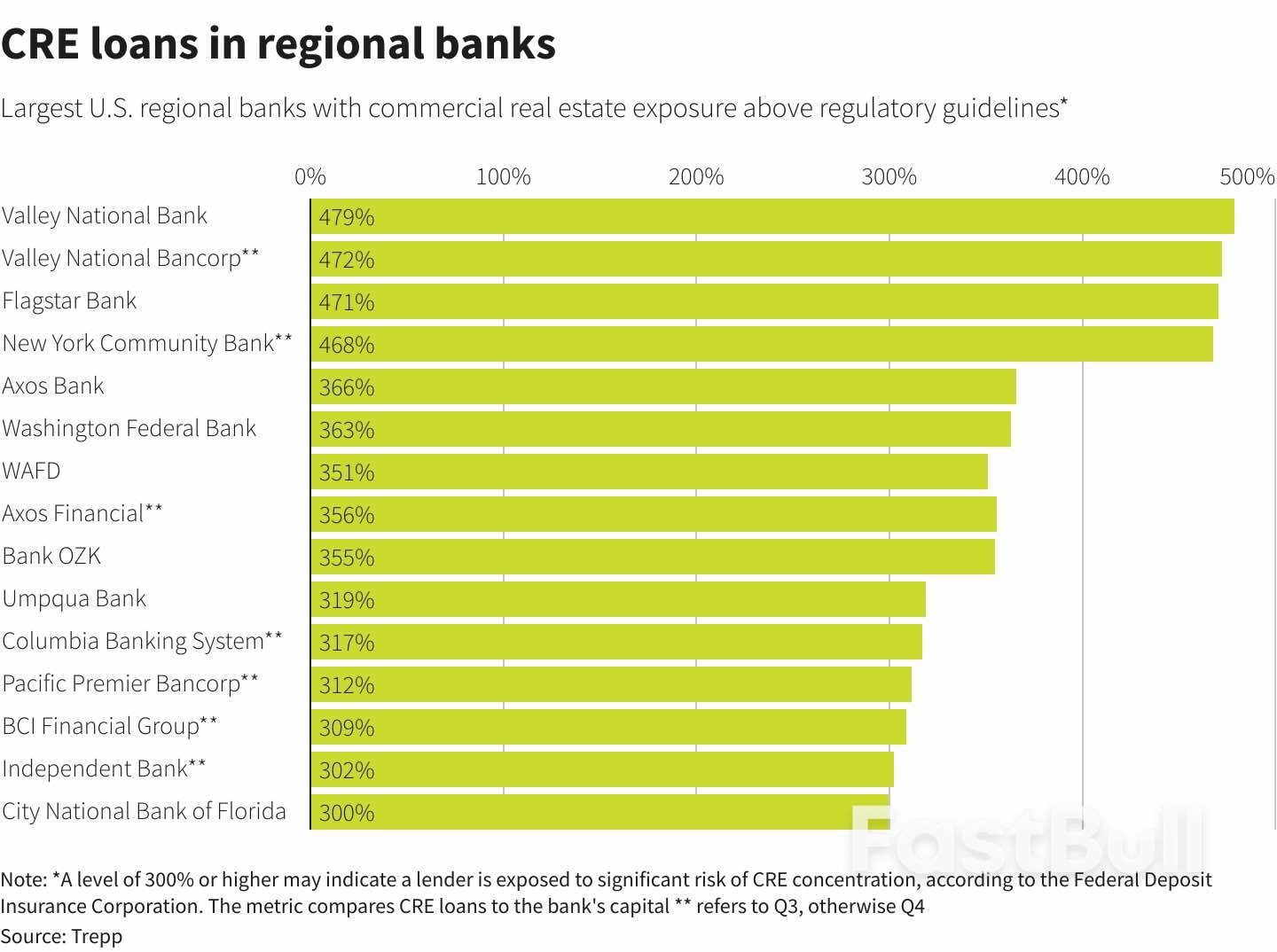
          Both banks, as well as NYCB, have CRE holdings as a proportion of total risk-based capital above 300% according to data from Trepp. That level of 300% may indicate a lender is exposed to significant risk of CRE concentration, according to public guidelines from the Federal Deposit Insurance Corporation (FDIC). The FDIC did not respond to a request for comment.Real Estate Pain for US Regional Banks is Piling up, Say Investors_1
          Valley's CRE holdings as a proportion of its total risk-based capital was at 479% in the fourth quarter, while OceanFirst was at 447%, Trepp's data showed. As of the third quarter, NYCB had a ratio of 468%.
          In total, nearly 1,900 banks with assets less than $100 billion had CRE loans outstanding greater than 300% of equity, according to Fitch.
          Fitch, in a detailed report in December, also said if prices decline by approximately 40% on average, losses in CRE portfolios could result in the failure of a moderate number of predominately smaller banks.
          OceanFirst told Reuters it has a "widely diversified portfolio" with very low levels of concentration in central business district office and rent-stabilized multifamily and said short selling interest in the stock is low.
          NYCB did not immediately respond to a request for comment on the short selling and concentration risk. Valley's deputy CFO Travis Lan said the bank is "comfortable with our diverse and granular commercial real estate portfolio" and said the bank "prioritized balance sheet diversity."

          LOAN SALES

          Investors predict that some regional banks could be forced to sell loans at a loss or increase provisioning for losses. A distressed debt investor said that some regional banks with exposure to New York City's rent-stabilized multifamily loans have begun exploring sales of these and other assets.
          NYCB said on Wednesday options could include loan sales and that the bank "will be razor-focused on reducing our CRE concentration."
          But selling loans may not be an optimal solution with properties now valued 50%-75% below their valuations at the time loans were struck, said Rebel Cole, a finance professor at Florida Atlantic University.
          "Loans that were done over the last five to seven years, a lot of those are challenged now," said Ran Eliasaf, founder and managing partner of real estate investment firm Northwind Group, who is investing in the New York multifamily market.

          Source: Reuters

          To stay updated on all economic events of today, please check out our Economic calendar
          Risk Warnings and Disclaimers
          You understand and acknowledge that there is a high degree of risk involved in trading. Following any strategies or investment methods may lead to potential losses. The content on the site is provided by our contributors and analysts for information purposes only. You are solely responsible for determining whether any trading assets, securities, strategy, or any other product is suitable for investing based on your own investment objectives and financial situation.
          Comments
          Add to Favorites
          Share
          FastBull
          Copyright © 2025 FastBull Ltd

          728 RM B 7/F GEE LOK IND BLDG NO 34 HUNG TO RD KWUN TONG KLN HONG KONG

          TelegramInstagramTwitterfacebooklinkedin
          App Store Google Play Google Play
          Products
          Charts

          Chats

          Q&A with Experts
          Screeners
          Economic Calendar
          Data
          Tools
          Membership
          Features
          Function
          Markets
          Copy Trading
          Latest Signals
          Contests
          News
          Analysis
          24/7
          Columns
          Education
          Company
          Careers
          About Us
          Contact Us
          Advertising
          Help Center
          Feedback
          User Agreement
          Privacy Policy
          Business

          White Label

          Data API

          Web Plug-ins

          Poster Maker

          Affiliate Program

          Risk Disclosure

          The risk of loss in trading financial instruments such as stocks, FX, commodities, futures, bonds, ETFs and crypto can be substantial. You may sustain a total loss of the funds that you deposit with your broker. Therefore, you should carefully consider whether such trading is suitable for you in light of your circumstances and financial resources.

          No decision to invest should be made without thoroughly conducting due diligence by yourself or consulting with your financial advisors. Our web content might not suit you since we don't know your financial conditions and investment needs. Our financial information might have latency or contain inaccuracy, so you should be fully responsible for any of your trading and investment decisions. The company will not be responsible for your capital loss.

          Without getting permission from the website, you are not allowed to copy the website's graphics, texts, or trademarks. Intellectual property rights in the content or data incorporated into this website belong to its providers and exchange merchants.

          Not Logged In

          Log in to access more features

          FastBull Membership

          Not yet

          Purchase

          Become a signal provider
          Help Center
          Customer Service
          Dark Mode
          Price Up/Down Colors

          Log In

          Sign Up

          Position
          Layout
          Fullscreen
          Default to Chart
          The chart page opens by default when you visit fastbull.com